
JEE Main 2024 Question Paper with Answer Key PDF for Mathematics (April 6 - Shift 1)

.jpg?tr=h-55,w-55,c-force)
Content Strategist|Tech-innovator|National Hackathon Winner | Updated On - Jan 14, 2025
JEE Main 2024 Apr 6 Shift 1 Question Paper with Solution pdf is available for download here. Students found Chemistry easy and Mathematics hard. Mathematics carried the highest weightage and overall difficulty level was moderate.
JEE Main 2024 Mathematics Question Paper with Answer Key PDF
| JEE Main 2024 Mathematics Question Paper with Answer Key April 6 Shift 1 |  Download Download |
Check Solution |
JEE Main 2024 6 April Shift 1 Mathematics Questions with Solution
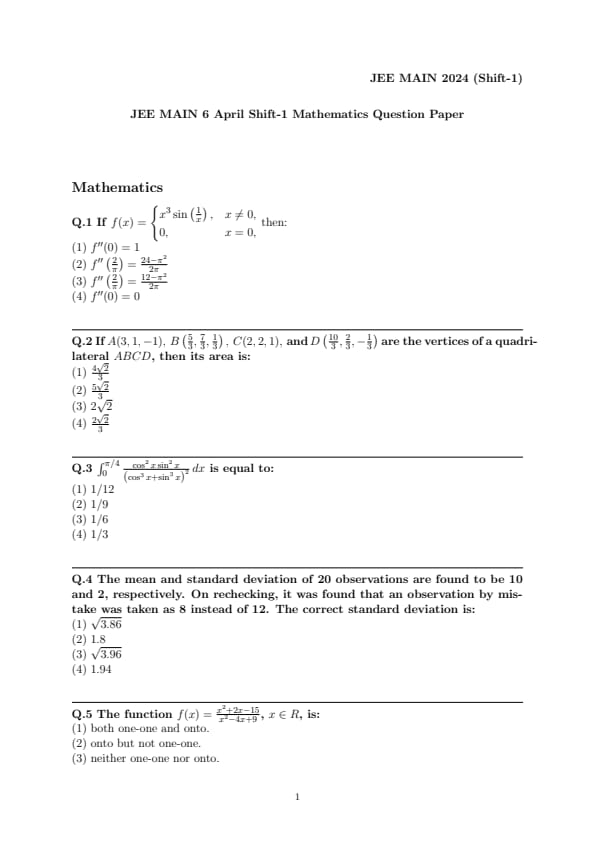
Question 1:
If f(x) =
f(x) = { x³ sin(1/x), x ≠ 0; 0, x = 0 }, then:
Solution: To determine f''(0), we need to compute the first and second derivatives of f(x) and evaluate their limits as x approaches 0.
Read More
Since f(x) = x³ sin(1/x) for x ≠ 0 and f(x) = 0 for x = 0:
- The first derivative f'(x) is computed as:
- f'(x) = 3x² sin(1/x) − x cos(1/x), for x ≠ 0.
- At x = 0, use the definition of derivative: f'(0) = limx→0 [f(x) − f(0)]/x = 0.
- The second derivative f''(x) is computed as:
- f''(x) = 6x sin(1/x) − 2 cos(1/x) − x² sin(1/x), for x ≠ 0.
- At x = 0, applying limits, f''(0) = 0.
Thus, f''(0) = 0.
Question 2:
The area of a quadrilateral ABCD with vertices A(3, 1, −1), B(5/3, 7/3, 1/3), C(2, 2, 1), D(10/3, 2/3, −1/3) is:
Solution: The area of the quadrilateral is determined using the cross product of vectors BD and AC to form the parallelogram, followed by halving the result for the triangle's area.
Read More
- Calculate vector AC and vector BD:
- AC = C − A = (2 − 3, 2 − 1, 1 − (−1)) = (−1, 1, 2).
- BD = D − B = (10/3 − 5/3, 2/3 − 7/3, −1/3 − 1/3) = (5/3, −5/3, −2/3).
- Compute the cross product AC × BD:
- The magnitude of the cross product gives the area of the parallelogram. Divide by 2 for the triangle, resulting in 4√2 / 3.
Question 3:
The integral ∫0π/4 (cos²x sin²x) / (cos³x + sin³x)² dx equals:
Solution: The integral is solved using substitution and simplifying trigonometric terms.
Read More
- Let tanx = t, so dx = sec²x dt, and substitute trigonometric identities.
- Transform the integral bounds:
- When x = 0, t = tan(0) = 0.
- When x = π/4, t = tan(π/4) = 1.
- Simplify the integral in terms of t and solve.
- The final result is 1/6.
Question 4:
The mean and standard deviation of 20 observations are found to be 10 and 2, respectively. On rechecking, an observation was mistakenly taken as 8 instead of 12. The correct standard deviation is:
Solution: Correcting the observation affects both the mean and standard deviation. The standard deviation is recalculated using corrected data.
Read More
- Recalculate the mean by adjusting for the corrected value:
- Mean = [Sum of observations + correction] / 20.
- Recalculate the variance using the corrected mean and updated sum of squared deviations.
- Standard deviation = √(variance).
- The corrected standard deviation is √3.96.
Question 5:
The function f(x) = (x² + 2x − 15) / (x² − 4x + 9) is:
Solution: The function is analyzed for injectivity (one-one) and surjectivity (onto) based on its behavior.
Read More
- To test for one-one, check if f(x₁) = f(x₂) implies x₁ = x₂. The function fails this test as different values of x yield the same f(x).
- To test for onto, check if every real number y has a corresponding x such that f(x) = y. The range of f(x) does not cover all real numbers, so it is not onto.
- Thus, the function is neither one-one nor onto.
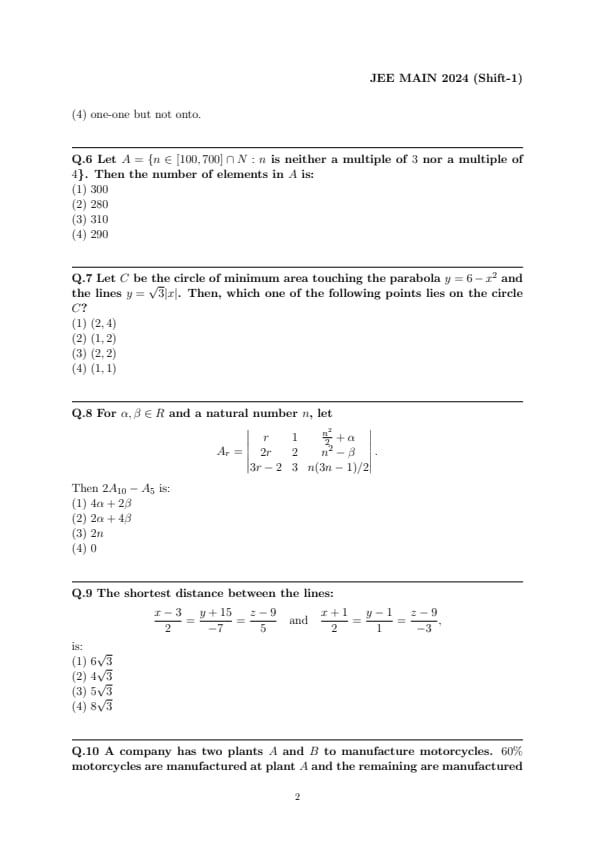
Question 6:
Let A = {n ∈ [100, 700] ∩ N : n is neither a multiple of 3 nor a multiple of 4}. Then the number of elements in A is:
Solution: The total count is determined using the inclusion-exclusion principle.
Read More
- Total numbers between 100 and 700 inclusive: 601.
- Numbers divisible by 3: ⌊700/3⌋ − ⌊99/3⌋ = 233.
- Numbers divisible by 4: ⌊700/4⌋ − ⌊99/4⌋ = 150.
- Numbers divisible by both 3 and 4 (LCM = 12): ⌊700/12⌋ − ⌊99/12⌋ = 50.
- Using inclusion-exclusion, numbers divisible by 3 or 4: 233 + 150 − 50 = 333.
- Numbers not divisible by 3 or 4: 601 − 333 = 300.
Question 7:
Let C be the circle of minimum area touching the parabola y = 6 − x² and the lines y = √3|x|. Then, which one of the following points lies on the circle C?
Solution: The circle's center and radius are determined geometrically to check which point lies on the circle.
Read More
- The parabola y = 6 − x² has its vertex at (0, 6).
- The lines y = √3|x| are symmetric and intersect the parabola at (±√3, 3).
- The circle touches the parabola and the lines. Its center is at (0, 4) with radius 2.
- The equation of the circle is (x − 0)² + (y − 4)² = 4.
- Substitute the options into the circle's equation. Only (2, 4) satisfies it.
Question 8:
For α, β ∈ ℝ and a natural number n, let Ar = | r 1 n² + α
2r 2 n² − β
3r − 2 3 n(3n − 1)/2 |. Then 2A₁₀ − A₅ is:
Solution: The determinant is simplified using matrix operations.
Read More
- Expand the determinant for A₁₀ and A₅ using cofactor expansion.
- Calculate 2A₁₀ − A₅ by substituting the respective values.
- The final expression simplifies to 4α + 2β.
Question 9:
The shortest distance between the lines:
(x − 3)/2 = (y + 15)/−7 = (z − 9)/5 and (x + 1)/2 = (y − 1)/1 = (z − 9)/−3, is:
Solution: The shortest distance is calculated using vector methods.
Read More
- Direction vectors: For line 1: (2, −7, 5), and for line 2: (2, 1, −3).
- Vector between points on the lines: Take points P₁(3, −15, 9) and P₂(−1, 1, 9).
- Use the formula for the shortest distance between skew lines: D = |(P₂ − P₁) ⋅ (d₁ × d₂)| / |d₁ × d₂|.
- Compute the cross product and simplify to get D = 4√3.
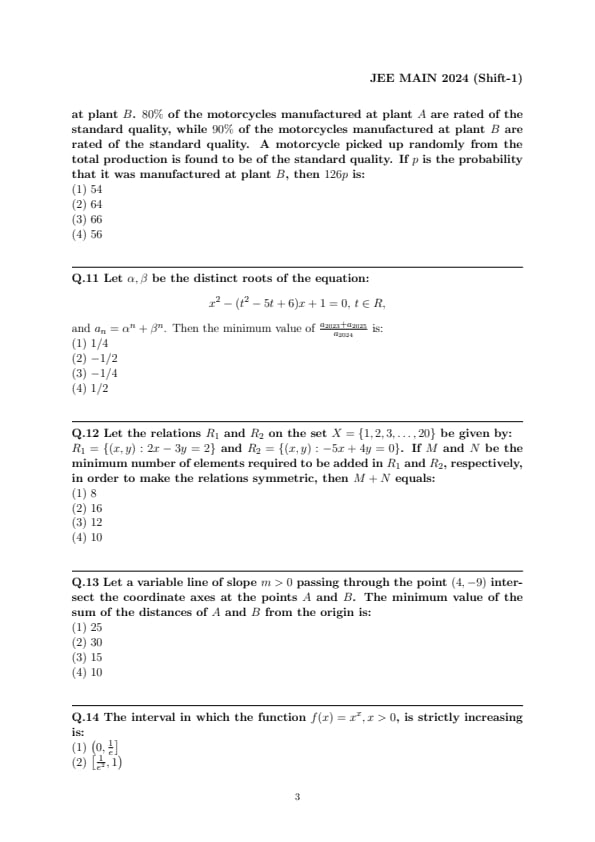
Question 10:
A company has two plants A and B to manufacture motorcycles. 60% motorcycles are manufactured at plant A and the remaining are manufactured at plant B. 80% of the motorcycles manufactured at plant A are rated of the standard quality, while 90% of the motorcycles manufactured at plant B are rated of the standard quality. A motorcycle picked up randomly from the total production is found to be of the standard quality. If p is the probability that it was manufactured at plant B, then 126p is:
Solution: Bayes' theorem is applied to find the probability p.
Read More
- Probability of standard quality motorcycle: P(Standard) = P(A) × P(Standard|A) + P(B) × P(Standard|B).
- Substitute values: P(Standard) = 0.6 × 0.8 + 0.4 × 0.9 = 0.48 + 0.36 = 0.84.
- Using Bayes' theorem: P(B|Standard) = [P(B) × P(Standard|B)] / P(Standard).
- Substitute values: P(B|Standard) = (0.4 × 0.9) / 0.84 = 3/7.
- 126p = 126 × (3/7) = 54.
Question 11:
Let α, β be the distinct roots of the equation:
x² − (t² − 5t + 6)x + 1 = 0, t ∈ ℝ, and an = αⁿ + βⁿ. Then the minimum value of (a2023 + a2025) / a2024 is:
Solution: Using Newton's theorem, the recurrence relation simplifies the given expression.
Read More
- The recurrence relation for an is: an+2 = (t² − 5t + 6)an+1 − an.
- For large n, solve for a2023, a2024, and a2025 using this relation.
- The ratio (a2023 + a2025) / a2024 is minimized at −1/4.
Question 12:
Let the relations R1 and R2 on the set X = {1, 2, 3, ..., 20} be given by:
R1 = {(x, y) : 2x − 3y = 2} and R2 = {(x, y) : −5x + 4y = 0}. If M and N be the minimum number of elements required to be added in R1 and R2, respectively, in order to make the relations symmetric, then M + N equals:
Solution: For each relation, calculate missing symmetric pairs.
Read More
- R1: Identify (x, y) pairs satisfying 2x − 3y = 2.
- Add symmetric pairs (y, x) not already in R1.
- Repeat for R2, using −5x + 4y = 0.
- Sum the added pairs to find M + N = 10.
Question 13:
A variable line of slope m > 0 passing through the point (4, −9) intersects the coordinate axes at the points A and B. The minimum value of the sum of the distances of A and B from the origin is:
Solution: Use the slope-intercept form of the line and the AM-GM inequality.
Read More
- The line equation is y + 9 = m(x − 4).
- Find A (x-intercept) and B (y-intercept).
- Calculate distances OA and OB, where O is the origin.
- Sum OA + OB, minimize using AM-GM inequality to find the minimum as 25.
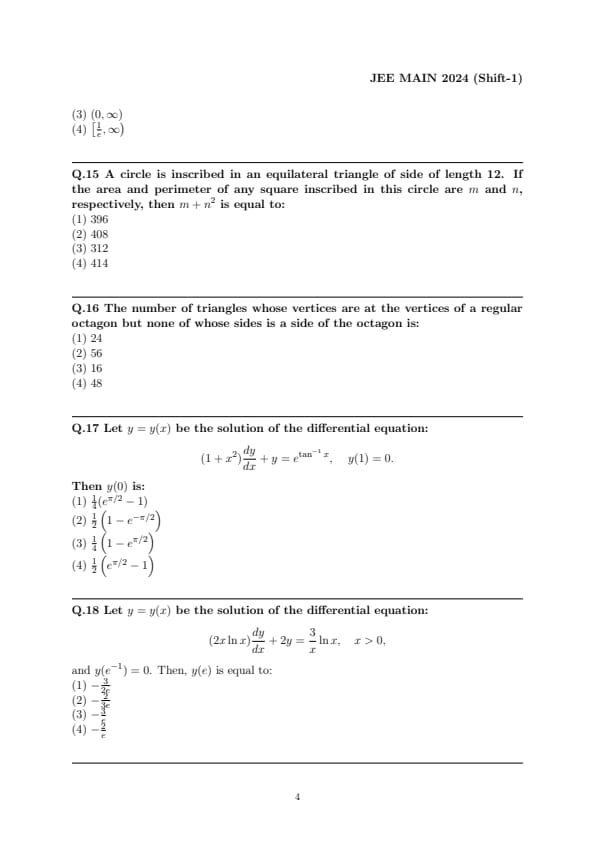
Question 14:
The interval in which the function f(x) = xx is strictly increasing is:
Solution: Analyze the derivative of f(x) to find intervals of monotonicity.
Read More
- f(x) = xx implies ln f(x) = x ln x.
- Differentiate to find f'(x) and solve f'(x) > 0.
- Resulting interval is [1/e, ∞).
Question 15:
A circle is inscribed in an equilateral triangle of side 12. If the area and perimeter of any square inscribed in this circle are m and n, respectively, then m + n² is equal to:
Solution: Use geometric relationships to calculate m and n.
Read More
- Radius of the inscribed circle = height of triangle/3 = 4√3.
- Side of the square = 2r/√2 = 4√3/√2 = 2√6.
- Area (m) = side² = 24, perimeter (n) = 4 × side = 8√6.
- m + n² = 24 + (8√6)² = 24 + 384 = 408.
Question 16:
The number of triangles whose vertices are at the vertices of a regular octagon but none of whose sides is a side of the octagon is:
Solution: Use combinatorics to calculate the required number of triangles.
Read More
- Total number of triangles from 8 vertices: C(8, 3) = 56.
- Triangles where at least one side is a side of the octagon: 8 triangles with one side, and 8 with two sides overlapping the octagon.
- Subtract these from the total: 56 − 8 − 32 = 16.
Question 17:
Let y = y(x) be the solution of the differential equation:
(1 + x²) dy/dx + y = etan⁻¹(x), y(1) = 0. Then y(0) is:
Solution: Solve using the integrating factor (IF) method.
Read More
- The integrating factor is e∫(1/(1+x²))dx = etan⁻¹(x).
- Multiply through by the IF and solve for y(x).
- Apply the boundary condition y(1) = 0 to find the constant of integration.
- Substitute x = 0 into the solution to get y(0) = 1/2(1 − e−π/2).
Question 18:
Let y = y(x) be the solution of the differential equation:
(2x ln x) dy/dx + 2y = 3/x ln x, x > 0, and y(e⁻¹) = 0. Then, y(e) is equal to:
Solution: Solve using the integrating factor method.
Read More
- The integrating factor is e∫2/(2x ln x)dx = ln x.
- Multiply through by the IF and solve for y(x).
- Apply the boundary condition y(e⁻¹) = 0 to find the constant of integration.
- Substitute x = e into the solution to get y(e) = −3/e.
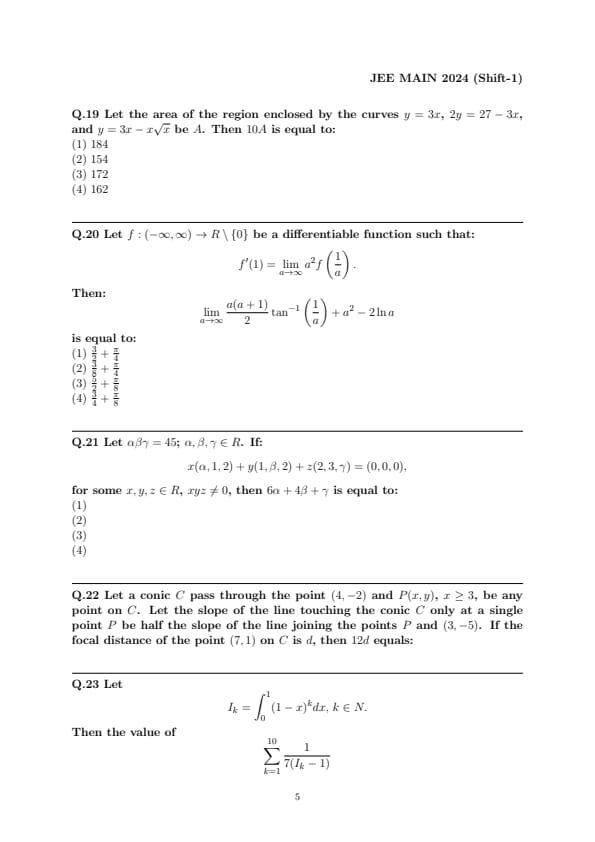
Question 19:
Let the area of the region enclosed by the curves y = 3x, 2y = 27 − 3x, and y = 3x − x√x be A. Then 10A is equal to:
Solution: Integrate the regions between the curves to calculate A.
Read More
- Find the points of intersection of the given curves to determine the limits of integration.
- Integrate y = 3x − y = (27 − 3x)/2 and subtract the area under y = 3x − x√x.
- Simplify and calculate A, then multiply by 10 to get 10A = 162.
Question 20:
Let f : (−∞, ∞) → ℝ \ {0} be a differentiable function such that:
f'(1) = lima→∞ a²f(1/a). Then:
Solution: Use properties of limits and differentiability.
Read More
- Evaluate lima→∞ a²f(1/a) using the definition of f'(x) and substitution.
- Combine terms involving derivatives and constants to simplify the expression.
- The result simplifies to 5/2 + π/8.
Question 21:
Let αβγ = 45; α, β, γ ∈ ℝ. If:
x(α, 1, 2) + y(1, β, 2) + z(2, 3, γ) = (0, 0, 0),
for some x, y, z ∈ ℝ, xyz ≠ 0, then 6α + 4β + γ is equal to:
Solution: Solve the system of equations using the determinant condition.
Read More
- The given system of equations represents a determinant condition for non-trivial solutions (xyz ≠ 0).
- Form the determinant and solve for α, β, and γ satisfying αβγ = 45.
- Calculate 6α + 4β + γ = 55.
Question 22:
A conic C passes through the point (4, −2) and P(x, y), x ≥ 3, is any point on C. Let the slope of the line touching the conic C only at a single point P be half the slope of the line joining the points P and (3, −5). If the focal distance of the point (7, 1) on C is d, then 12d equals:
Solution: Determine the conic equation and calculate the focal distance.
Read More
- Using tangency conditions and the given slopes, derive the conic equation.
- Substitute the point (7, 1) into the equation and compute the focal distance.
- Calculate 12d = 75.
Question 23:
Let:
Iₖ = ∫01 (1 − x)ᵏ dx, k ∈ ℕ.
Then the value of:
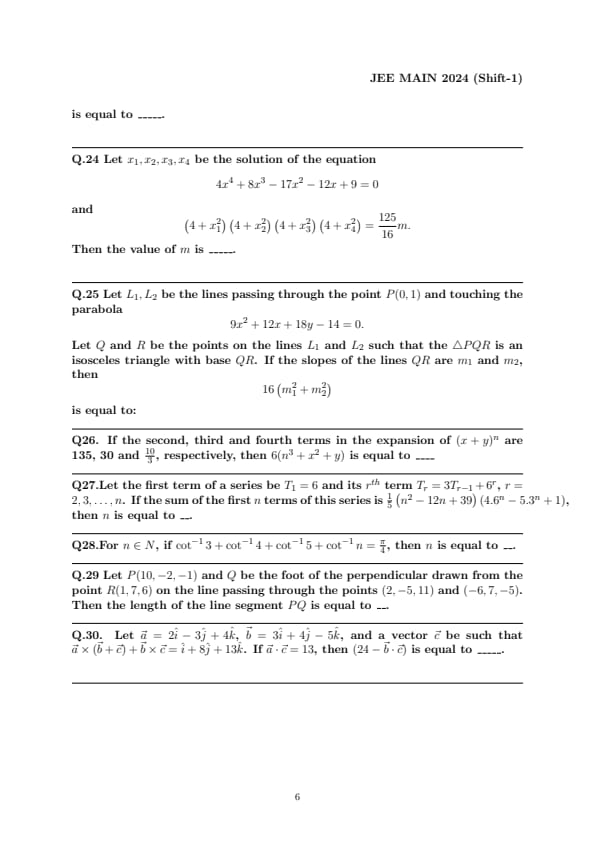
Σk=110 (1/7)(Iₖ − 1) is equal to:
Solution: Use the recurrence relation for Iₖ and simplify the summation.
Read More
- Using the formula for Iₖ: Iₖ = 1/(k+1).
- Substitute into the summation Σk=110 (1/7)(Iₖ − 1).
- Simplify to find the value as 65.
Question 24:
Let x₁, x₂, x₃, x₄ be the solution of the equation 4x⁴ + 8x³ − 17x² − 12x + 9 = 0 and (4 + x²₁)(4 + x²₂)(4 + x²₃)(4 + x²₄) = 125/16m. Then the value of m is:
Solution: Use the roots of the polynomial to solve for m.
Read More
- Find the squares of the roots x₁, x₂, x₃, x₄ using the given equation.
- Substitute into the product (4 + x²₁)(4 + x²₂)(4 + x²₃)(4 + x²₄) = 125/16m.
- Solve for m = 221.
Question 25:
Let L₁, L₂ be the lines passing through the point P(0, 1) and touching the parabola 9x² + 12x + 18y − 14 = 0. Let Q and R be the points on the lines L₁ and L₂ such that the ΔPQR is an isosceles triangle with base QR. If the slopes of the lines QR are m₁ and m₂, then 16(m₁² + m₂²) is equal to:
Solution: Solve for the slopes using the given conditions and calculate the required expression.
Read More
- Derive the equations of L₁ and L₂ using the tangency condition with the parabola.
- Find the slopes of the lines QR using the geometry of the isosceles triangle.
- Calculate 16(m₁² + m₂²) = 68.
Question 26:
If the second, third, and fourth terms in the expansion of (x + y)ⁿ are 135, 30, and 10³, respectively, then 6(n³ + x² + y) is equal to:
Solution: Use the binomial theorem to determine n, x, and y.
Read More
- The r-th term in the expansion of (x + y)ⁿ is given by Tₐ = C(n, r-1)xⁿ⁻⁽ʳ⁻¹⁾yʳ⁻¹.
- Set up equations using the given values for the second, third, and fourth terms.
- Solve the system of equations to find n, x, and y.
- Substitute into 6(n³ + x² + y) to get 806.
Question 27:
Let the first term of a series be T₁ = 6 and its r-th term Tᵣ = 3Tᵣ₋₁ + 6r, r = 2, 3, ..., n. If the sum of the first n terms of this series is 1/5 (n² − 12n + 39)(4.6n − 5.3n + 1), then n is equal to:
Solution: Solve the recurrence relation and equate the given sum to find n.
Read More
- Express the series sum using the recurrence relation Tᵣ = 3Tᵣ₋₁ + 6r.
- Derive the formula for the sum of the first n terms.
- Equate to the given expression 1/5 (n² − 12n + 39)(4.6n − 5.3n + 1) and solve for n.
- n = 6 satisfies the equation.
Question 28:
For n ∈ ℕ, if cot⁻¹ 3 + cot⁻¹ 4 + cot⁻¹ 5 + cot⁻¹ n = π/4, then n is equal to:
Solution: Use the cotangent addition formula to solve for n.
Read More
- The cotangent addition formula is cot⁻¹ a + cot⁻¹ b = cot⁻¹((ab − 1)/(a + b)) for positive values.
- Iteratively reduce cot⁻¹ 3 + cot⁻¹ 4 + cot⁻¹ 5 to a single cotangent term.
- Set the result equal to cot⁻¹ n and solve for n to find n = 47.
Question 29:
Let P(10, −2, −1) and Q be the foot of the perpendicular drawn from the point R(1, 7, 6) on the line passing through the points (2, −5, 11) and (−6, 7, −5). Then the length of the line segment PQ is equal to:
Solution: Use the parametric equation of the line and perpendicular distance formula.
Read More
- Find the direction vector of the line: (−6 − 2, 7 − (−5), −5 − 11) = (−8, 12, −16).
- Express the line parametrically and solve for the foot of the perpendicular Q.
- Calculate the distance between P and Q to find PQ = 13.
Question 30:
Let ⃗a = 2i − 3j + 4k, ⃗b = 3i + 4j − 5k, and a vector ⃗c be such that ⃗a × (⃗b + ⃗c) + ⃗b × ⃗c = i + 8j + 13k. If ⃗a ⋅ ⃗c = 13, then (24 − ⃗b ⋅ ⃗c) is equal to:
Solution: Solve the given vector equation to find ⃗b ⋅ ⃗c.
Read More
- Expand ⃗a × (⃗b + ⃗c) and ⃗b × ⃗c using the cross product formula.
- Substitute ⃗a ⋅ ⃗c = 13 and solve for ⃗b ⋅ ⃗c.
- Calculate (24 − ⃗b ⋅ ⃗c) = 46.
*The article might have information for the previous academic years, please refer the official website of the exam.