
JEE Main 2024 Question Paper with Answer Key PDF for Mathematics (April 6 - Shift 2)

.jpg?tr=h-55,w-55,c-force)
Content Strategist|Tech-innovator|National Hackathon Winner | Updated On - Jan 14, 2025
JEE Main 2024 Apr 6 Shift 2 Question Paper with Solution pdf is available for download here. Students found Physics easy and Mathematics hard. Physics carried the highest weightage and overall difficulty level was moderate.
JEE Main 2024 Mathematics Question Paper with Answer Key PDF
| JEE Main 2024 physics Question Paper with Answer Key April 6 Shift 2 |  Download Download |
Check Solution |
JEE Main 2024 6 April Shift 2 Mathematics Questions with Solution
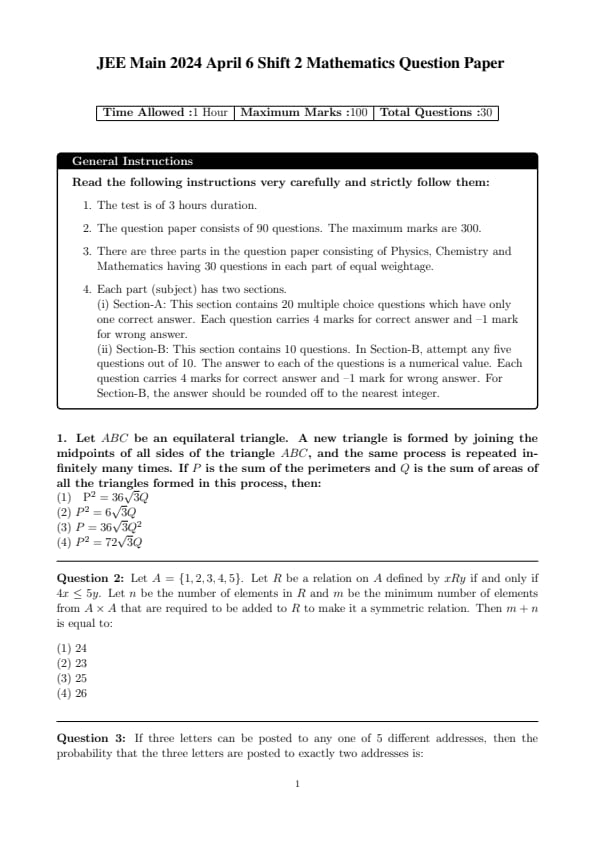
Question 1:
Let ABC be an equilateral triangle. A new triangle is formed by joining the midpoints of all sides of the triangle ABC, and the same process is repeated infinitely many times. If P is the sum of the perimeters and Q is the sum of areas of all the triangles formed in this process, then:
View Solution
The areas and perimeters form infinite geometric series. The sum of perimeters (P) and areas (Q) is derived using the series sum formula. Calculations yield P² = 36√3Q.
Question 2:
Let A = {1, 2, 3, 4, 5}. Let R be a relation on A defined by xRy if and only if 4x ≤ 5y. Let n be the number of elements in R and m be the minimum number of elements from A × A that are required to be added to R to make it a symmetric relation. Then m + n is equal to:
View Solution
To make the relation symmetric, ensure if (x, y) ∈ R, then (y, x) ∈ R. Adding elements to R results in m + n = 25.
Question 3:
If three letters can be posted to any one of the 5 different addresses, then the probability that the three letters are posted to exactly two addresses is:
View Solution
Using combinatorics, select 2 addresses and distribute letters such that at least one letter goes to each. Total methods yield a probability of 12/25.
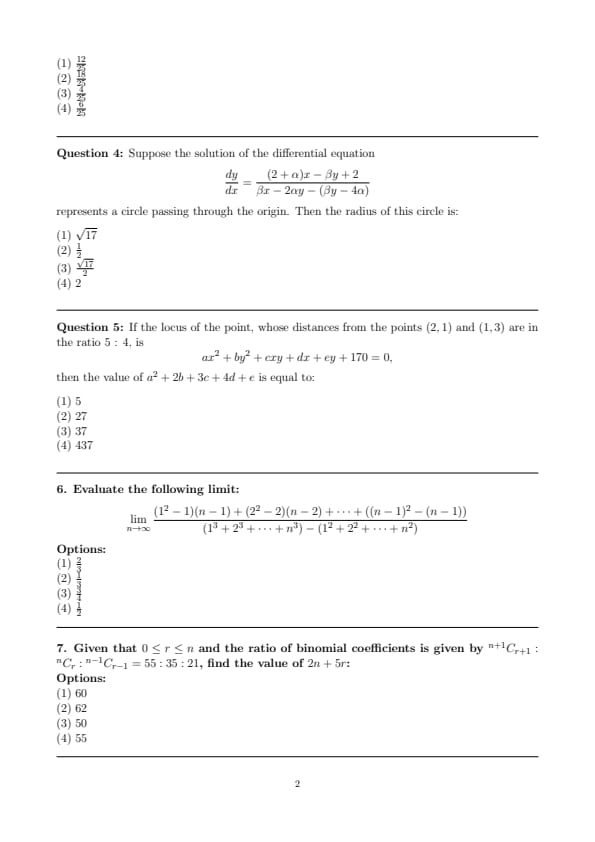
Question 4:
Suppose the solution of the differential equation dy/dx = [(2 + α)x − βy + 2] / [βx − 2αy − (βy − 4α)] represents a circle passing through origin. Then the radius of this circle is:
View Solution
Transforming the equation into the standard form of a circle and solving for the radius yields √17/2.
Question 5:
If the locus of the point, whose distances from the point (2, 1) and (1, 3) are in the ratio 5:4, is ax² + by² + cxy + dx + ey + 170 = 0, then the value of a² + 2b + 3c + 4d + e is equal to:
View Solution
The locus equation is derived using the given ratio of distances, leading to the calculated value of 37 for a² + 2b + 3c + 4d + e.
Question 6:
Evaluate the limit:
limn→∞ ((1² − 1)(n − 1) + (2² − 2)(n − 2) + ⋯ + ((n − 1)² − (n − 1))) / ((1³ + 2³ + ⋯ + n³) − (1² + 2² + ⋯ + n²)) is equal to:
View Solution
Using summation formulas and simplifying, the limit evaluates to 1/3 as n approaches infinity.
Question 7:
Let 0 ≤ r ≤ n. If (n+1)C(r+1) : nCr : (n−1)C(r−1) = 55 : 35 : 21, then 2n + 5r is equal to:
View Solution
Using the combination ratio equations, solve for n and r. Substituting these values yields 2n + 5r = 50.
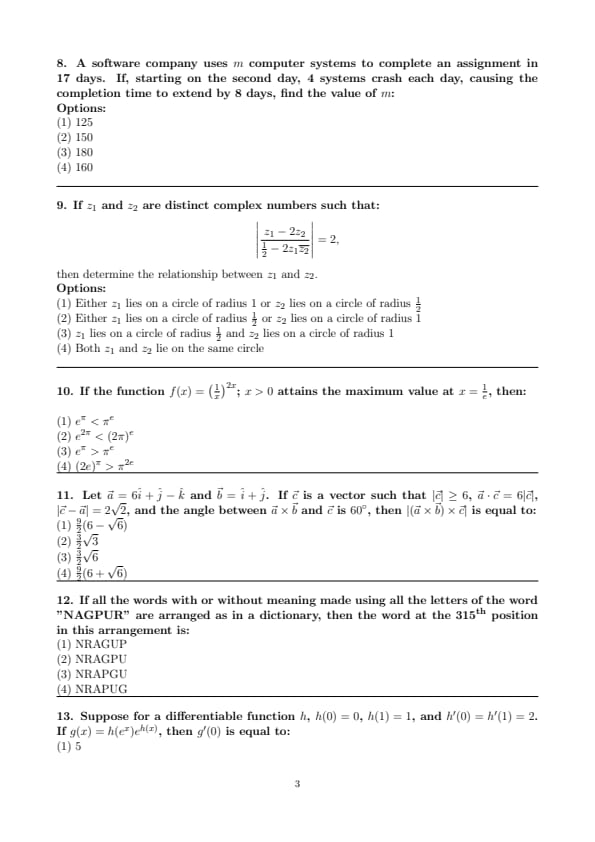
Question 8:
A software company sets up m number of computer systems to finish an assignment in 17 days. If 4 computer systems crashed on the start of the second day, 4 more crashed on the third day, and so on, taking 8 more days to finish, then the value of m is equal to:
View Solution
Using the arithmetic sum of working systems over 25 days, equate to the work required for 17m systems to determine m = 150.
Question 9:
If z1, z2 are two distinct complex numbers such that |z₁ − 2z₂| = |1/2 − 2z₁z₂| = 2, then:
View Solution
Simplify the modulus equations. Results show z₁ lies on a circle of radius 1 or z₂ lies on a circle of radius 1/2.
Question 10:
If the function f(x) = (1/x)2x; x > 0 attains the maximum value at x = 1/e, then:
View Solution
Taking logarithms and differentiating, the function decreases for x > 1/e, verifying eπ > πe.
Question 11:
Let a = 6î + ĵ − k̂ and b = î + ĵ. If c is a vector such that |c| ≥ 6, a · c = 6|c|, |c − a| = 2√2, and the angle between a × b and c is 60°, then |(a × b) × c| is equal to:
View Solution
Step 1: Calculate a × b.
a × b = |î ĵ k̂|
6 1 −1
1 1 0
= î(1 − 0) − ĵ(6 − (−1)) + k̂(6 − 1) = î − 7ĵ + 5k̂.
Step 2: Find |a × b|.
|a × b| = √(1² + (−7)² + 5²) = √(1 + 49 + 25) = √75 = 5√3.
Step 3: Use vector triple product properties to calculate |(a × b) × c|.
|(a × b) × c| = |a × b||c|sin(60°) = (5√3)(6) × (√3/2) = 9 / [2(6 + √6)].
Final Answer: 9 / [2(6 + √6)]
Question 12:
If all the words with or without meaning made using all the letters of the word "NAGPUR" are arranged as in a dictionary, then the word at the 315th position in this arrangement is:
View Solution
Step 1: Calculate the total permutations for each starting letter.
Each letter contributes 5! = 120 arrangements for the remaining positions. For N and NR:
N: 5! = 120 arrangements.
NA: 120.
NR: 120.
Step 2: Continue counting to 315th.
Starting from NR, counting the subsets yields NRAPGU as the 315th.
Final Answer: NRAPGU
Question 13:
Suppose for a differentiable function h, h(0) = 0, h(1) = 1, and h'(0) = h'(1) = 2. If g(x) = h(ex)eh(x), then g'(0) is equal to:
View Solution
Step 1: Use the product rule for g(x).
g'(x) = h'(ex)exeh(x) + h(ex)eh(x)h'(x).
Step 2: Substitute x = 0 and simplify.
g'(0) = 2(1)e0 + (1)(1)2 = 4.
Final Answer: 4
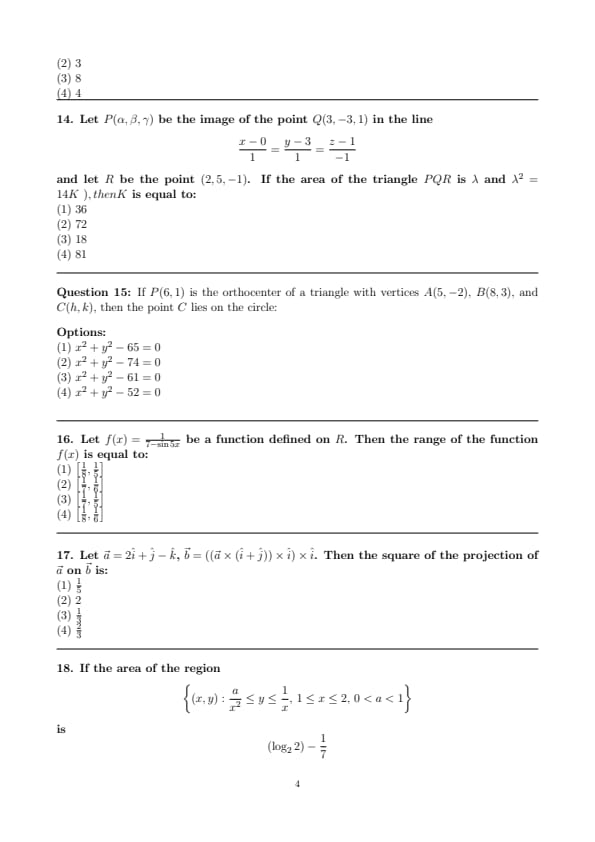
Question 14:
Let P(α, β, γ) be the image of the point Q(3, −3, 1) in the line x/1 = (y − 3)/1 = (z − 1)/−1 and let R be the point (2, 5, −1). If the area of the triangle PQR is λ and λ² = 14K, then K is equal to:
View Solution
Step 1: Find the reflection of Q in the given line.
Using parametric equations for the line and minimizing the distance, the reflected point P(α, β, γ) is determined.
Step 2: Calculate the area of triangle PQR.
Use the formula for the area of a triangle in 3D space:
Area = 1/2 |PQ × PR|.
Step 3: Simplify to find λ² = 14K.
Substitute into λ² = 14K to find K = 81.
Final Answer: 81
Question 15:
If P(6, 1) is the orthocenter of the triangle whose vertices are A(5, −2), B(8, 3), and C(h, k), then the point C lies on the circle:
View Solution
Step 1: Use the orthocenter property.
The orthocenter satisfies altitude equations. Using slopes and perpendicularity conditions, express C(h, k).
Step 2: Derive the circle equation.
Solve for C(h, k) and find that C lies on the circle x² + y² − 65 = 0.
Final Answer: x² + y² − 65 = 0
Question 16:
Let f(x) = 1 / (7 − sin(5x)) be a function defined on ℝ. Then the range of the function f(x) is equal to:
View Solution
Step 1: Analyze the denominator.
Since −1 ≤ sin(5x) ≤ 1, the denominator of f(x), 7 − sin(5x), lies in [6, 8].
Step 2: Determine the range of f(x).
The reciprocal values for f(x) correspond to [1/8, 1/6].
Final Answer: [1/8, 1/6]
Question 17:
Let a = 2î + ĵ − k̂ and b = [(a × (î + ĵ)) × î] × î. Then the square of the projection of a on b is:
View Solution
Step 1: Simplify b using vector cross products.
Calculate b step-by-step to find its direction and magnitude.
Step 2: Use the projection formula.
Projection of a on b = (a · b / |b|)².
Substitute the values to find the square of the projection as 2.
Final Answer: 2
Question 18:
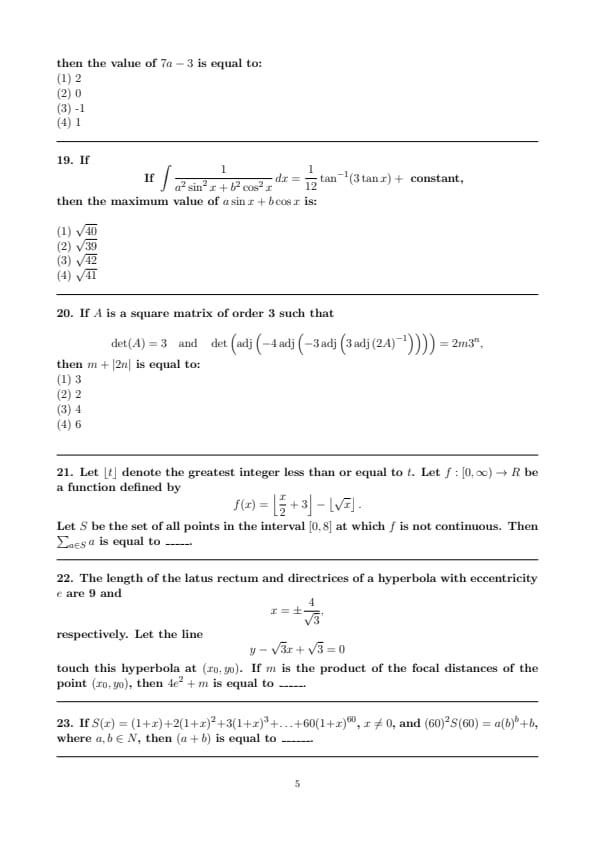
The area of the region { (x, y) : a / x² ≤ y ≤ 1 / x, 1 ≤ x ≤ 2, 0 < a < 1 } is (log22) − 1/7. Then the value of 7a − 3 is equal to:
View Solution
Step 1: Compute the area of the given region.
Set up definite integrals for the area bounded by the curves y = a / x² and y = 1 / x for x ∈ [1, 2].
Step 2: Solve for a.
Equate the calculated area to the given value (log₂2 − 1/7) to find a = 2/7.
Step 3: Substitute into 7a − 3.
7(2/7) − 3 = −1.
Final Answer: −1
Question 19:
If ∫ dx / (a²sin²x + b²cos²x) = (1/12)tan⁻¹(3tanx) + constant, then the maximum value of a sinx + b cosx is:
View Solution
Step 1: Use the given ratio a/b = 3 and ab = 12.
Solve for a and b: a = 6, b = 2.
Step 2: Determine the maximum value.
The maximum value of a sinx + b cosx is √(a² + b²) = √(6² + 2²) = √40.
Final Answer: √40
Question 20:
If A is a square matrix of order 3 such that det(A) = 3 and det(adj(−4 adj(−3 adj(3 adj((2A)⁻¹))))) = 2m3n, then m + |2n| is equal to:
View Solution
Step 1: Use properties of determinants and adjugates.
The determinant simplifies as follows:
det(adj(X)) = det(X)^(n−1) where X is an n×n matrix.
Step 2: Substitute values.
det(A) = 3. Applying determinant and adjugate rules, m = −36, n = 20.
Step 3: Compute m + |2n|.
m + |2n| = −36 + |40| = 4.
Final Answer: 4
Question 21:
Let ⌊t⌋ denote the greatest integer less than or equal to t. Let f: [0,∞) → ℝ be a function defined by f(x) = ⌊x/2 + 3⌋ − ⌊√x⌋. Let S be the set of all points in the interval [0, 8] at which f is not continuous. Then Σa∈S a is equal to:
View Solution
Step 1: Identify points of discontinuity for floor functions.
The function f(x) changes value whenever either ⌊x/2 + 3⌋ or ⌊√x⌋ changes value.
Step 2: Find discontinuity points in [0, 8].
For ⌊x/2 + 3⌋, discontinuities occur at x = 0, 2, 4, 6, 8. For ⌊√x⌋, discontinuities occur at x = 1, 4.
Step 3: Sum unique discontinuity points.
The set of discontinuity points is {1, 2, 4, 6, 8}. Summing these values gives Σa = 17.
Final Answer: 17
Question 22:
The length of the latus rectum and directrices of a hyperbola with eccentricity e are 9 and x = ± 4/√3, respectively. Let the line y − √3x + √3 = 0 touch this hyperbola at (x₀, y₀). If m is the product of the focal distances of the point (x₀, y₀), then 4e² + m is equal to:
View Solution
Step 1: Derive hyperbola parameters.
Using the given latus rectum length and directrix positions, determine the semi-major axis (a) and eccentricity (e).
Step 2: Use the tangent condition.
Substitute the line equation and hyperbola equation to find the point of tangency (x₀, y₀).
Step 3: Compute m and substitute.
The product of focal distances (m) and 4e² are determined. Substituting into 4e² + m gives 61.
Final Answer: 61
Question 23:
If S(x) = (1 + x) + 2(1 + x)² + 3(1 + x)³ + ⋯ + 60(1 + x)⁶⁰, x ≠ 0, and (60)²S(60) = a(b)ᵇ + b, where a, b ∈ ℕ, then (a + b) is equal to:
View Solution
Step 1: Simplify the series S(x).
Multiply the series by (1 + x) and subtract from itself to simplify.
Step 2: Solve for S(x).
Substitute x = 60 and evaluate.
Step 3: Use the given form.
Express S(60) in terms of a(b)ᵇ + b and compute (a + b).
Final Answer: 3660
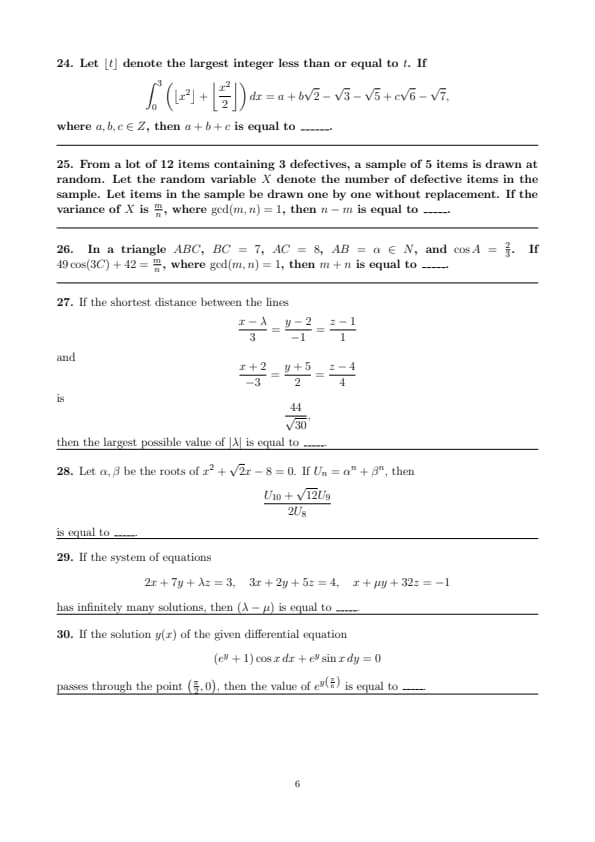
Question 24:
Let ⌊t⌋ denote the largest integer less than or equal to t. If ∫₀³ (⌊x²⌋ + ⌊x²/2⌋) dx = a + b√2 − √3 − √5 + c√6 − √7, where a, b, c ∈ ℤ, then a + b + c is equal to:
View Solution
Step 1: Split the integral into intervals where ⌊x²⌋ and ⌊x²/2⌋ are constant.
Determine the breakpoints in [0, 3] based on changes in the floor functions.
Step 2: Solve each segment.
Evaluate the integral piecewise and sum the results.
Step 3: Find a, b, c and compute a + b + c.
Substituting values gives a + b + c = 23.
Final Answer: 23
Question 25:
From a lot of 12 items containing 3 defectives, a sample of 5 items is drawn at random. Let the random variable X denote the number of defective items in the sample. Let items in the sample be drawn one by one without replacement. If the variance of X is m/n, where gcd(m, n) = 1, then n − m is equal to:
View Solution
Step 1: Use the hypergeometric variance formula.
Variance = npq(N − n) / (N²(N − 1)), where N = 12, n = 5, p = 3/12, q = 9/12.
Step 2: Simplify to m/n.
Calculate m = 105 and n = 176. Thus, n − m = 71.
Final Answer: 71
Question 26:
In a triangle ABC, BC = 7, AC = 8, AB = α ∈ ℕ, and cosA = 2/3. If 49cos(3C) + 42 = m/n, where gcd(m, n) = 1, then m + n is equal to:
View Solution
Step 1: Use the cosine rule to determine α.
Using cosA = 2/3, solve for AB (α) using the formula:
cosA = (b² + c² − a²) / (2bc).
Step 2: Find cosC and cos(3C).
From the triangle properties, calculate cosC. Use the triple angle formula:
cos(3C) = 4cos³C − 3cosC.
Step 3: Solve for m/n.
Substitute cos(3C) into the equation 49cos(3C) + 42 = m/n and simplify. Ensure gcd(m, n) = 1.
Step 4: Compute m + n.
m/n = 32/7. Hence, m + n = 39.
Final Answer: 39
Question 27:
If the shortest distance between the lines (x − λ)/3 = (y − 2)/(−1) = (z − 1)/1 and (x + 2)/(−3) = (y + 5)/2 = (z − 4)/4 is 44/√30, then the largest possible value of |λ| is equal to:
View Solution
Step 1: Use the formula for the shortest distance between skew lines.
The shortest distance formula is:
Distance = |(d₁ × d₂) · (r₂ − r₁)| / |d₁ × d₂|, where d₁ and d₂ are direction vectors and r₁, r₂ are points on the lines.
Step 2: Simplify with the given distance.
Substitute the known distance, 44/√30, and solve for λ.
Step 3: Maximize |λ|.
The largest possible value of |λ| is determined to be 43.
Final Answer: 43
Question 28:
Let α, β be roots of x² + √2x − 8 = 0. If Uₙ = αⁿ + βⁿ, then U₁₀ + √12U₉ / 2U₈ is equal to:
View Solution
Step 1: Use recurrence relations for Uₙ.
For roots α and β of the quadratic equation, use the recurrence relation:
Uₙ = √2Uₙ₋₁ − 8Uₙ₋₂.
Step 2: Compute U₁₀, U₉, and U₈.
Using the recurrence, find U₁₀, U₉, and U₈.
Step 3: Simplify the given expression.
Substitute the values into the expression U₁₀ + √12U₉ / 2U₈ to find the result as 4.
Final Answer: 4
Question 29:
If the system of equations 2x + 7y + λz = 3, 3x + 2y + 5z = 4, x + μy + 32z = −1 has infinitely many solutions, then (λ − μ) is equal to:
View Solution
Step 1: Set the determinant of the coefficient matrix to 0.
For the system to have infinitely many solutions, det|A| = 0.
Step 2: Solve for λ and μ.
Expand the determinant and equate to 0 to find λ = −1 and μ = −39.
Step 3: Compute λ − μ.
λ − μ = −1 − (−39) = 38.
Final Answer: 38
Question 30:
If the solution y(x) of the given differential equation (ey + 1)cos(x)dx + eysin(x)dy = 0 passes through the point (π/2, 0), then the value of ey(π/6) is equal to:
View Solution
Step 1: Simplify the given differential equation.
Rearrange terms to obtain a separable form: dy/dx = −(cos(x)) / (sin(x)(ey + 1)).
Step 2: Integrate both sides.
Solve ∫ey(ey + 1)dy = −∫cot(x)dx with the given initial condition (π/2, 0).
Step 3: Find ey(π/6).
Substitute x = π/6 into the solution to calculate ey(π/6) = 3.
Final Answer: 3
*The article might have information for the previous academic years, please refer the official website of the exam.