
JEE Main 2024 Question Paper with Answer Key PDF for Mathematics (April 8 - Shift 1)

.jpg?tr=h-55,w-55,c-force)
Content Strategist|Tech-innovator|National Hackathon Winner | Updated On - Jan 6, 2025
JEE Main 2024 Apr 8 Shift 1 Question Paper with Solution pdf is available for download here. Students found Physics easy and Chemistry hard. Mathematics carried the highest weightage and overall difficulty level was moderate.
JEE Main 2024 8 April Shift 1 Mathematics Question Paper with Solution PDF
| JEE Main 2024 Mathematics Question Paper with Solution Pdf 8 April Shift 1 |  Download Download |
Check Solution |
JEE Main 2024 8 April Shift 1 Mathematics Questions with Solutions
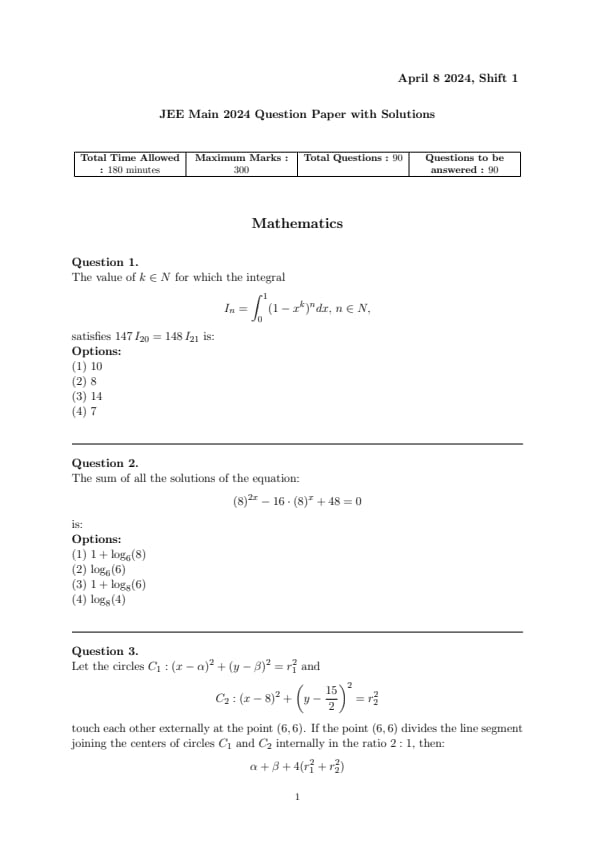
Question 1:
The value of k ∈ ℕ for which the integral:
In = ∫01 (1 - xk)n dx, where n ∈ ℕ, satisfies 147 I20 = 148 I21 is:
Options:
View Solution
Solution:
The integral is:
In = ∫01 (1 - xk)n · 1 dx
Using integration by parts:
In = (1 - xk)n · x |01 - nk ∫01 (1 - xk)n-1 · xk-1 dx
In = nk ∫01 [(1 - xk)n - (1 - xk)n-1] dx
In = nk In-1 - nk In
Rearranging terms:
In / In-1 = nk / (nk + 1)
Given:
I21 / I20 = 21k / (1 + 21k)
Equating:
147 / 148 = 21k / (1 + 21k)
Solve for k:
k = 7
Question 2:
The sum of all the solutions of the equation:
(8)2x - 16 · (8)x + 48 = 0
Options:
View Solution
Solution:
1. Substitution:
Let t = (8)x. The equation becomes:
t2 - 16t + 48 = 0.
2. Solve the Quadratic Equation:
Using the quadratic formula:
t = (-b ± √(b2 - 4ac)) / 2a, where a = 1, b = -16, c = 48:
t = (16 ± √(162 - 4(1)(48))) / 2.
t = (16 ± √(256 - 192)) / 2.
t = (16 ± √64) / 2.
t = (16 ± 8) / 2.
t = 12 or t = 4.
3. Back Substitution:
Recall t = (8)x:
- For t = 4:
(8)x = 4 ⟹ x = log8(4).
- For t = 12:
(8)x = 12 ⟹ x = log8(12).
4. Sum of Solutions:
The sum of solutions is:
log8(4) + log8(12).
Using the logarithmic property logb(m) + logb(n) = logb(mn):
log8(4) + log8(12) = log8(4 ⋅ 12) = log8(48).
Simplify:
log8(48) = log8(8 ⋅ 6) = log8(8) + log8(6).
log8(8) = 1, so the sum is:
1 + log8(6).
Question 3:
Let the circles C1: (x - α)2 + (y - β)2 = r12 and:
C2: (x - 8)2 + (y - 15/2)2 = r22
Touch each other externally at the point (6, 6). If the point (6, 6) divides the line segment joining the centers of circles C1 and C2 internally in the ratio 2:1, then:
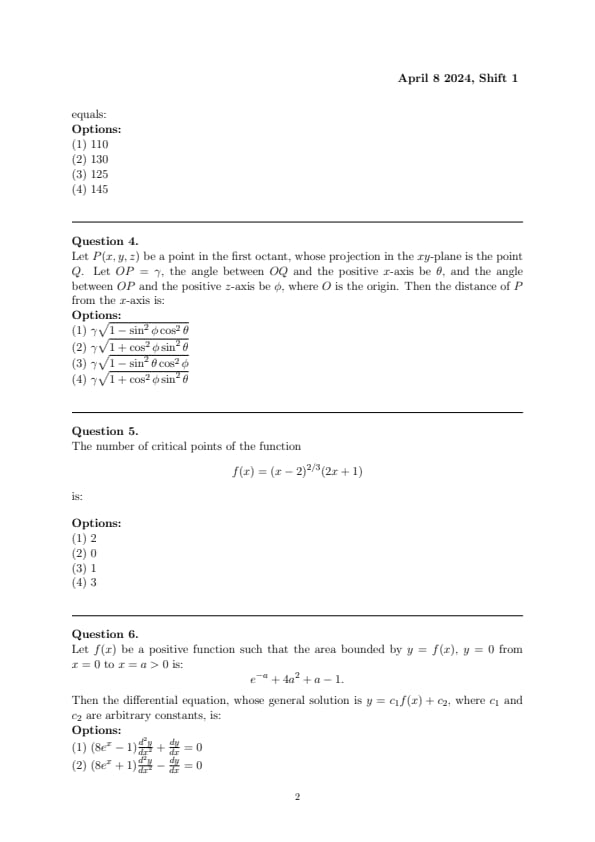
α + β + 4(r12 + r22) equals:
Options:
View Solution
Solution:
1. Determine the Coordinates of the Center of C1:
The point (6, 6) divides the line joining (α, β) and (8, 15/2) in the ratio 2:1. Using the section formula:
6 = (2 × 8 + 1 × α) / 3, and 6 = (2 × 15/2 + 1 × β) / 3.
Solving for α and β:
16 + α = 18 ⟹ α = 2, and 15 + β = 18 ⟹ β = 3.
Thus, the center of C1 is (α, β) = (2, 3).
2. Use the Touching Condition:
The distance between the centers of C1 and C2 equals the sum of the radii:
√[(2 - 8)2 + (3 - 15/2)2] = r1 + r2.
Simplify:
√[(-6)2 + (-9/2)2] = r1 + r2.
√[36 + 81/4] = r1 + r2.
√[(144 + 81) / 4] = r1 + r2.
√(225 / 4) = r1 + r2.
r1 + r2 = 15/2.
3. Determine r1 and r2:
From the external touching condition:
2r2 = r1 = 5.
r2 = 5/2, and r1 = 5.
4. Calculate α + β + 4(r12 + r22):
Compute r12 + r22:
r12 = 52 = 25, and r22 = (5/2)2 = 25/4.
r12 + r22 = 25 + 25/4 = 100/4 + 25/4 = 125/4.
Now calculate:
α + β + 4(r12 + r22) = 2 + 3 + 4 × 125/4.
α + β + 4(r12 + r22) = 5 + 125 = 130.
Question 4:
Let P(x, y, z) be a point in the first octant, whose projection in the xy-plane is the point Q. Let OP = γ, the angle between OQ and the positive x-axis be θ, and the angle between OP and the positive z-axis be φ, where O is the origin. Then the distance of P from the x-axis is:
Options:
View Solution
Solution:
1. Coordinates of Points:
- P(x, y, z) is a point in 3D space.
- Q(x, y, 0) is the projection of P in the xy-plane.
2. Distance Relations:
- The distance OP = γ, so:
x² + y² + z² = γ².
- The distance OQ is the projection in the xy-plane:
OQ = √(x² + y²).
3. Using the Angles θ and φ:
- The angle θ is between OQ and the x-axis. From this, we have:
cosθ = x / √(x² + y²).
- The angle φ is between OP and the z-axis. From this, we derive:
cosφ = z / √(x² + y² + z²) = z / γ.
Using cos²φ + sin²φ = 1, we get:
sin²φ = 1 - cos²φ = (x² + y²) / γ².
4. Distance of P from the x-Axis:
- The distance of P from the x-axis is calculated as:
Distance = √(y² + z²).
- Substituting y² + z² using x² + y² + z² = γ²:
y² + z² = γ² - x².
- Since sin²φ = (x² + y²) / γ², we have:
x² = γ² cos²θ sin²φ.
- Replacing x² in γ² - x²:
y² + z² = γ² (1 - cos²θ sin²φ).
- Taking the square root:
Distance = γ √(1 - sin²φ cos²θ).
Question 5:
The number of critical points of the function:
f(x) = (x - 2)2/3(2x + 1)
Options:
View Solution
Solution:
1. Given Function:
f(x) = (x - 2)2/3(2x + 1)
2. Finding the First Derivative:
Using the product rule:
f'(x) = (2/3)(x - 2)-1/3(2x + 1) + (x - 2)2/3(2)
3. Combine Terms:
f'(x) = [2(2x + 1) + 2(x - 2)] / [3(x - 2)1/3]
f'(x) = 2(3x - 1) / [3(x - 2)1/3]
4. Critical Points:
f'(x) = 0 ⟹ 3x - 1 = 0 ⟹ x = 1/3
f'(x) is undefined when x = 2.
5. Conclusion:
The critical points are x = 1/3 and x = 2.
Question 6:
Let f(x) be a positive function such that the area bounded by y = f(x), y = 0 from x = 0 to x = a > 0 is:
e-a + 4a2 + a - 1.
The differential equation whose general solution is y = c1f(x) + c2, where c1 and c2 are arbitrary constants, is:
Options:
View Solution
Solution:
1. Expression for Area:
∫0af(x) dx = e-a + 4a2 + a - 1
2. Differentiate:
f(a) = -e-a + 8a + 1
f'(a) = e-a + 8
f''(a) = -e-a
3. Differential Equation:
(8ex + 1)f''(x) + f'(x) = 0
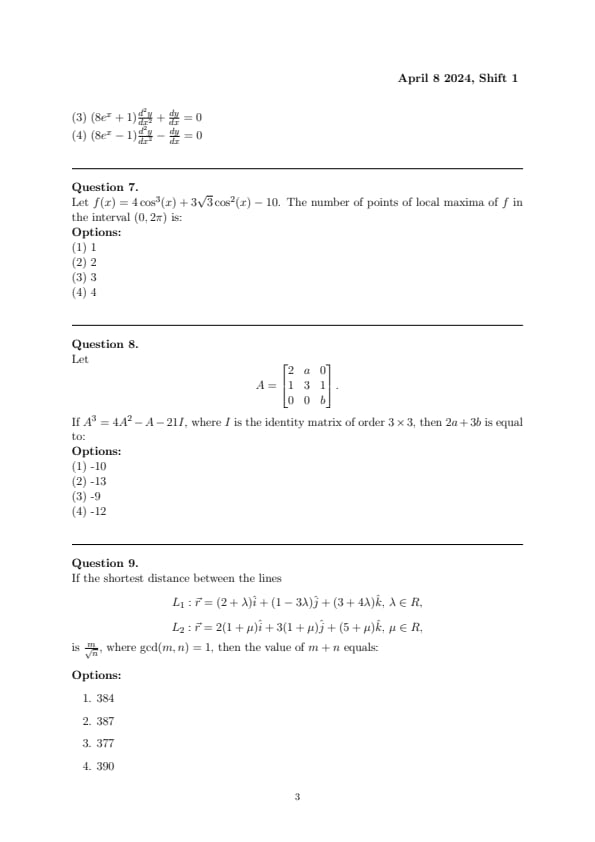
Question 7:
Let f(x) = 4cos3(x) + 3√3cos2(x) - 10. The number of points of local maxima of f in the interval (0, 2π) is:
Options:
View Solution
Solution:
1. Find f'(x):
f'(x) = -sin(x)(12cos2(x) + 6√3cos(x))
2. Critical Points:
f'(x) = 0 ⟹ sin(x) = 0, cos(x) = 0, or 2cos(x) + √3 = 0
Solutions in (0, 2π):
x = π/2, 3π/2 (local maxima)
3. Conclusion:
The number of local maxima is 2.
Question 8:
Let:
A = [ [2, a, 0], [1, 3, 1], [0, 0, b] ].
If A3 = 4A2 - A - 21I, where I is the identity matrix of order 3 × 3, then 2a + 3b equals:
Options:
View Solution
Solution:
1. Trace and Determinant:
tr(A) = 2 + 3 + b, det(A) = 6b - ab
2. Given det(A) = -21:
6b - ab = -21
3. Solve for a and b:
a = -5, b = -1
4. Calculate:
2a + 3b = -13
Question 9:
If the shortest distance between the lines:
L1: r = (2+λ)i + (1-3λ)j + (3+4λ)k
L2: r = 2(1+μ)i + 3(1+μ)j + (5+μ)k
is m/√n where gcd(m, n) = 1, then m + n equals:
Options:
View Solution
Solution:
1. Direction Vectors:
p = i - 3j + 4k, q = 2i + 3j + k
2. Cross Product:
p × q = -15i + 7j + 9k
3. Dot Product:
AB • (p × q) = 32
4. Distance:
Distance = 32 / √355
m = 32, n = 355 ⟹ m + n = 387
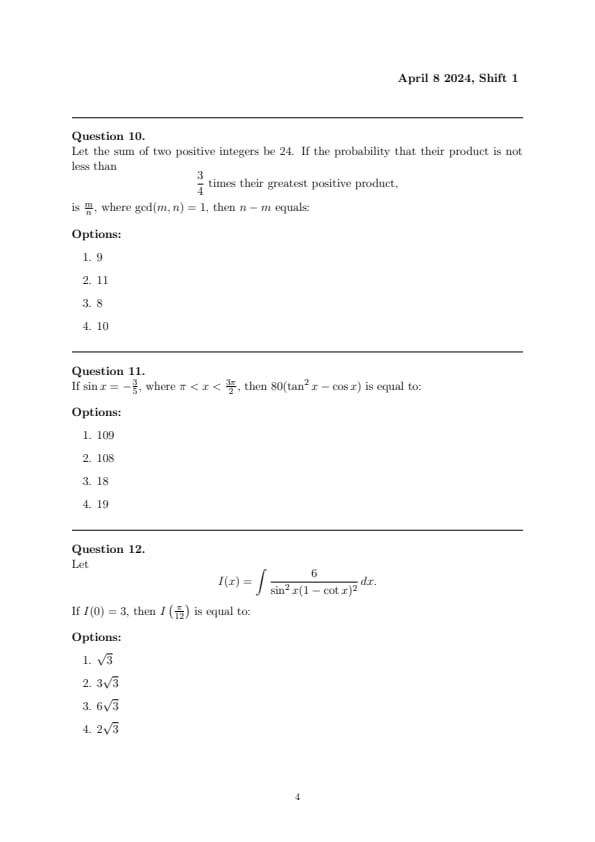
Question 10:
Let the sum of two positive integers be 24. If the probability that their product is not less than 3/4 times their greatest positive product is m/n where gcd(m, n) = 1, then n - m equals:
Options:
View Solution
Solution:
1. Maximum Product:
Max product = 144 when x = y = 12
2. Favorable Condition:
Product ≥ 108
3. Favorable Pairs:
13 pairs: (13, 11), ..., (6, 18)
4. Total Pairs:
23 pairs
5. Probability:
P = 13/23 ⟹ m = 13, n = 23
6. Find n - m:
n - m = 10
Question 11:
If sin x = -3/5, where π < x < 3π/2, then 80(tan²x - cos x) is equal to:
Options:
View Solution
Solution:
1. Given Information:
sin x = -3/5, π < x < 3π/2.
Since x lies in the third quadrant:
- cos x < 0
- tan x > 0
2. Find cos x:
Using the Pythagorean identity:
sin²x + cos²x = 1.
Substitute sin x = -3/5:
(-3/5)² + cos²x = 1
9/25 + cos²x = 1
cos²x = 16/25
Since cos x < 0 (third quadrant):
cos x = -4/5
3. Find tan x:
Using the definition tan x = sin x / cos x:
tan x = (-3/5) / (-4/5) = 3/4
4. Calculate 80(tan²x - cos x):
Substitute tan x = 3/4 and cos x = -4/5:
tan²x = (3/4)² = 9/16
80(tan²x - cos x) = 80[(9/16) - (-4/5)]
80[(9/16) + (4/5)]
Find the common denominator for 9/16 and 4/5:
9/16 = 45/80, 4/5 = 64/80
Add the fractions:
45/80 + 64/80 = 109/80
Multiply by 80:
80 × 109/80 = 109
Conclusion:
The value of 80(tan²x - cos x) is 109.
Question 12:
Let I(x) = ∫ [6 / sin²x(1 - cot x)²] dx. If I(0) = 3, then I(π/12) is equal to:
Options:
View Solution
Solution:
1. Given Integral:
I(x) = ∫ [6 / sin²x(1 - cot x)²] dx
2. Simplify the Integrand:
Using the identity sin²x = 1 / csc²x, rewrite the integrand:
I(x) = ∫ [6 csc²x / (1 - cot x)²] dx
3. Substitution:
Let t = 1 - cot x, then:
csc²x dx = dt
Substitute into the integral:
I = ∫ [6 / t²] dt
4. Evaluate the Integral:
I = -6/t + c
Substituting back t = 1 - cot x, we get:
I(x) = -6 / (1 - cot x) + c
5. Given Condition:
At x = 0, I(0) = 3. Substituting x = 0, where cot 0 = ∞, we find:
c = 3
Therefore:
I(x) = -6 / (1 - cot x) + 3
6. Find I(π/12):
At x = π/12, we calculate:
cot(π/12) = 2 + √3
Substituting:
I(π/12) = 3 - 6 / [1 - (2 + √3)]
Simplify the denominator:
1 - (2 + √3) = -1 - √3
So:
I(π/12) = 3 + 6 / (1 + √3)
Rationalize the denominator:
6 / (1 + √3) = 6(1 - √3) / [(1 + √3)(1 - √3)]
= 6(1 - √3) / -2
6 / (1 + √3) = -3(1 - √3) = -3 + 3√3
7. Final Value:
Substituting back:
I(π/12) = 3 + (-3 + 3√3) = 3√3
Conclusion:
The value of I(π/12) is 3√3.
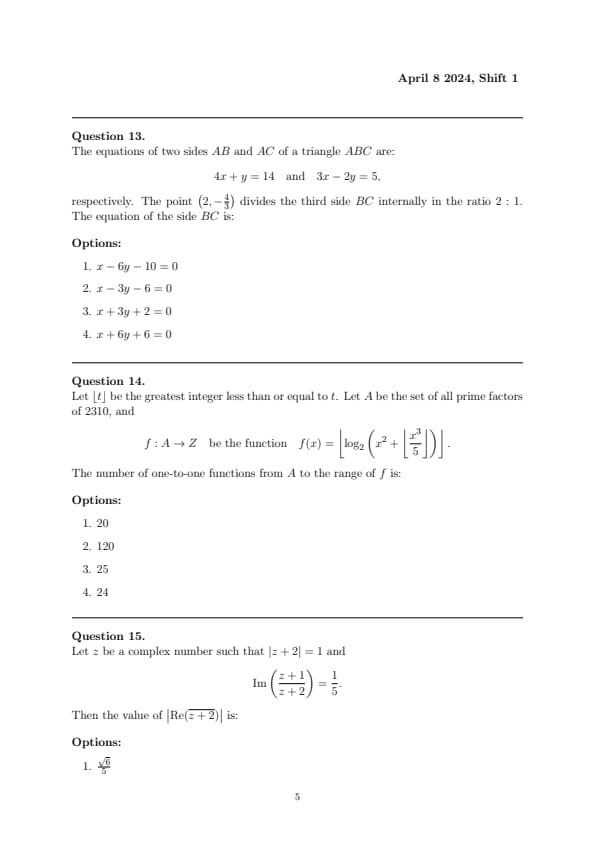
Question 13:
The equations of two sides AB and AC of a triangle ABC are:
4x + y = 14 and 3x - 2y = 5,
The point (2, -4/3) divides the third side BC internally in the ratio 2:1. The equation of the side BC is:
Options:
View Solution
Solution:
1. Equations of the Lines AB and AC:
The equations of the sides are given as:
AB: 4x + y = 14, AC: 3x - 2y = 5.
2. Point Dividing the Line BC:
The point P = (2, -4/3) divides BC internally in the ratio 2:1.
3. Coordinates of B:
From the equation of line AB: 4x + y = 14,
y = 14 - 4x.
Let B = (x1, 14 - 4x1).
4. Coordinates of C:
From the equation of line AC: 3x - 2y = 5,
y = (3x - 5)/2.
Let C = (x2, (3x2 - 5)/2).
5. Section Formula for P:
The coordinates of P are given by the section formula:
x = (2x2 + x1)/3, y = (2y2 + y1)/3.
Substituting P = (2, -4/3):
2 = (2x2 + x1)/3, -4/3 = (2y2 + y1)/3.
6. Solve for x1 and x2:
From 2 = (2x2 + x1)/3:
6 = 2x2 + x1 → x1 = 6 - 2x2.
From -4/3 = (2y2 + y1)/3, substitute y1 = 14 - 4x1 and y2 = (3x2 - 5)/2:
-4 = 2y2 + y1 = 2((3x2 - 5)/2) + (14 - 4x1).
-4 = (3x2 - 5) + 14 - 4(6 - 2x2).
-4 = 3x2 - 5 + 14 - 24 + 8x2.
-4 = 11x2 - 15.
Solve for x2:
x2 = 1.
Substitute x2 = 1 into x1 = 6 - 2x2:
x1 = 6 - 2(1) = 4.
Therefore, B = (4, -2) and C = (1, -1).
7. Equation of Line BC:
The slope of BC is:
m = (y2 - y1)/(x2 - x1) = (-1 - (-2))/(1 - 4) = 1/-3 = -1/3.
The equation of BC is:
y - y1 = m(x - x1).
Substituting (x1, y1) = (4, -2) and m = -1/3:
y + 2 = -1/3(x - 4).
3(y + 2) = -(x - 4).
3y + 6 = -x + 4.
x + 3y + 2 = 0.
Conclusion:
The equation of BC is x + 3y + 2 = 0.
Question 14:
Let ⌊t⌋ be the greatest integer less than or equal to t. Let A be the set of all prime factors of 2310, and
f: A → ℤ be the function f(x) = ⌊log₂(x² + ⌊x³/5⌋)⌋.
The number of one-to-one functions from A to the range of f is:
Options:
View Solution
Solution:
1. Prime Factorization of 2310:
The prime factorization of 2310 is:
N = 2310 = 231 × 10 = 3 × 11 × 7 × 2 × 5.
Hence:
A = {2, 3, 5, 7, 11}.
2. Definition of f(x):
The function is given as:
f(x) = ⌊log₂(x² + ⌊x³/5⌋)⌋.
3. Calculate f(x) for Each Element of A:
For each x ∈ A:
f(2) = ⌊log₂(2² + ⌊2³/5⌋)⌋ = ⌊log₂(4 + ⌊8/5⌋)⌋ = ⌊log₂(4 + 1)⌋ = ⌊log₂(5)⌋ = 2.
f(3) = ⌊log₂(3² + ⌊3³/5⌋)⌋ = ⌊log₂(9 + ⌊27/5⌋)⌋ = ⌊log₂(9 + 5)⌋ = ⌊log₂(14)⌋ = 3.
f(5) = ⌊log₂(5² + ⌊5³/5⌋)⌋ = ⌊log₂(25 + ⌊125/5⌋)⌋ = ⌊log₂(25 + 25)⌋ = ⌊log₂(50)⌋ = 5.
f(7) = ⌊log₂(7² + ⌊7³/5⌋)⌋ = ⌊log₂(49 + ⌊343/5⌋)⌋ = ⌊log₂(49 + 68)⌋ = ⌊log₂(117)⌋ = 6.
f(11) = ⌊log₂(11² + ⌊11³/5⌋)⌋ = ⌊log₂(121 + ⌊1331/5⌋)⌋ = ⌊log₂(121 + 266)⌋ = ⌊log₂(387)⌋ = 8.
- f(2):
- f(3):
- f(5):
- f(7):
- f(11):
4. Range of f:
From the above calculations, the range of f is:
B = {2, 3, 5, 6, 8}.
5. Number of One-to-One Functions:
The number of one-to-one functions from A to B is given by:
|A| = |B| = 5.
Therefore, the number of one-to-one functions is:
5! = 120.
Conclusion:
The number of one-to-one functions is 120.
Question 15:
Let z be a complex number such that |z + 2| = 1 and:
Im((z + 1) / (z + 2)) = 1/5.
Then the value of |Re(̅(z + 2))| is:
Options:
View Solution
Solution:
We are given:
|z + 2| = 1, and Im((z + 1) / (z + 2)) = 1/5.
Let z + 2 = cosθ + i sinθ.
The reciprocal becomes:
1 / (z + 2) = cosθ - i sinθ.
Now:
(z + 1) / (z + 2) = 1 - (1 / (z + 2)) = 1 - (cosθ - i sinθ).
Simplifying:
(z + 1) / (z + 2) = (1 - cosθ) + i sinθ.
From the given condition:
Im((z + 1) / (z + 2)) = sinθ, sinθ = 1/5.
Using the Pythagorean identity:
cos²θ = 1 - sin²θ = 1 - (1/25) = 24/25.
Therefore:
cosθ = ±√(24/25) = ±(2√6)/5.
Finally, the real part of z + 2 is:
|Re(z + 2)| = 2√6/5.
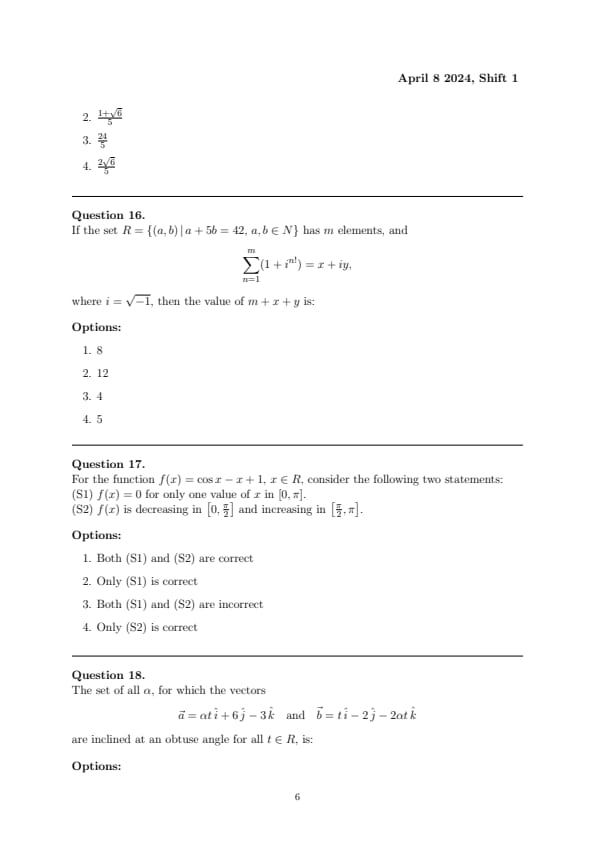
Question 16:
If the set R = {(a, b) | a + 5b = 42, a, b ∈ ℕ} has m elements, and:
∑(n=1 to m) [1 + i^(n!)] = x + iy, where i = √(-1), then the value of m + x + y is:
Options:
View Solution
Solution:
We are given:
a + 5b = 42, a, b ∈ ℕ.
Rewrite a = 42 - 5b:
- For b = 1, a = 37.
- For b = 2, a = 32.
- For b = 3, a = 27.
- For b = 4, a = 22.
- For b = 5, a = 17.
- For b = 6, a = 12.
- For b = 7, a = 7.
- For b = 8, a = 2.
The set R has 8 elements, so m = 8.
The summation is:
∑(n=1 to 8) [1 + i^(n!)] = x + iy.
For n ≥ 4, n! is a multiple of 4, and i^(n!) = 1.
The terms alternate cyclically as i, -1, -i, 1, and repeat.
Therefore:
∑ = (1 + i) + (1 - 1) + (1 - i) + (1 + 1) + ...
Simplifying:
x = 5, y = -1.
m + x + y = 8 + 5 - 1 = 12.
Question 17:
For the function f(x) = cos x - x + 1, x ∈ ℜ, consider the following two statements:
Options:
View Solution
Solution:
The function f(x) = cos x - x + 1 is given.
Step 1: Analyze the derivative f′(x):
Differentiate f(x): f′(x) = -sin x - 1.
Since sin x ∈ [-1, 1], f′(x) = -sin x - 1 ∈ [-2, 0], which means f′(x) < 0 for all x ∈ ℜ. Hence, f(x) is strictly decreasing.
Step 2: Analyze statement (S1):
Since f(x) is strictly decreasing, it is one-to-one. Check values at endpoints of [0, π]:
- f(0) = 2 and f(π) = -π.
By the Intermediate Value Theorem, f(x) = 0 has exactly one solution in [0, π]. Thus, (S1) is correct.
Step 3: Analyze statement (S2):
Since f′(x) < 0, f(x) is strictly decreasing on [0, π], and it cannot be increasing in [π/2, π]. Hence, (S2) is incorrect.
Conclusion: (S1) is correct, and (S2) is incorrect.
Question 18:
The set of all α, for which the vectors:
a = αt î + 6 ĵ - 3 k̂ and b = t î - 2 ĵ - 2αt k̂ are inclined at an obtuse angle for all t ∈ ℜ.
Options:
View Solution
Solution:
To find the set of α:
- Step 1: Calculate the dot product of a and b:
- a ∙ b = αt2 - 12 + 6αt.
- Step 2: For obtuse angle, a ∙ b < 0 for all t:
- The inequality becomes αt2 + 6αt - 12 < 0.
- Step 3: For this inequality to hold, the discriminant must be negative:
- D = 36α2 + 48α < 0 → 12α(α + 4) < 0.
Solving gives α ∈ (-4/3, 0].
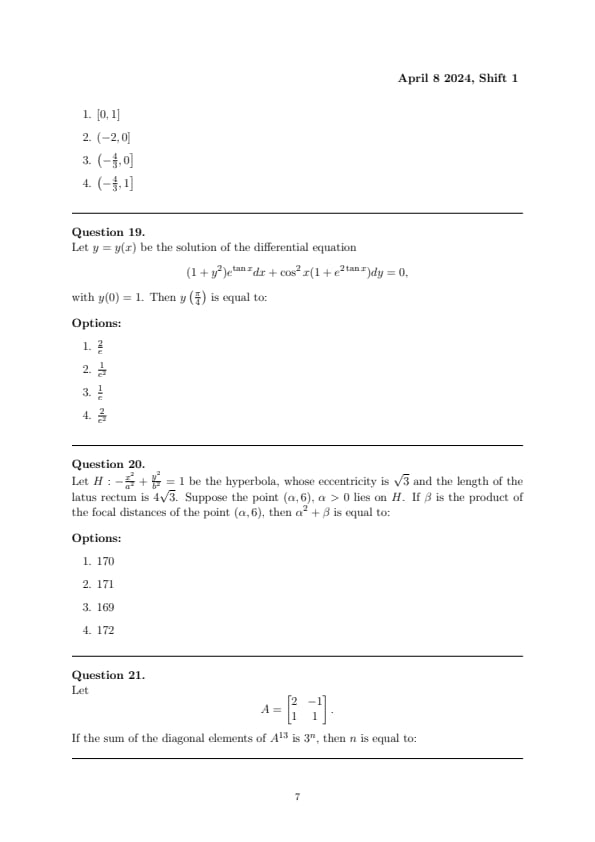
Question 19:
Let y = y(x) be the solution of the differential equation:
(1 + y2)etan x dx + cos2 x (1 + e2tan x) dy = 0, with y(0) = 1. Then y(π/4) is equal to:
Options:
View Solution
Solution:
The given differential equation can be rewritten and integrated to give:
tan-1(etan x) + tan-1(y) = C.
Applying initial conditions x = 0, y = 1, we find C = π/2.
Substituting x = π/4:
tan-1(e) + tan-1(y) = π/2.
Solving gives y = 1/e.
Question 20:
Let H: -x2/a2 + y2/b2 = 1 be the hyperbola, whose eccentricity is √3 and the length of the latus rectum is 4√3. Suppose the point (α, 6), α > 0 lies on H. If β is the product of the focal distances of the point (α, 6), then α2 + β is equal to:
Options:
View Solution
Solution:
The hyperbola is given by:
y2/b2 - x2/a2 = 1.
With e = √3, a2 = 6, b2 = 3, we find α2 = 66.
Calculating the focal distances and their product β:
β = 105.
Thus, α2 + β = 171.
Question 21:
Let
A =
| 2  -1 |
| 1   1 |
If the sum of the diagonal elements of A13 is 3n, then n is equal to:
View Solution
Solution:
Step 1: Matrix Definition:
The matrix is given as:
A =
| 2  -1 |
| 1   1 |
Step 2: Finding Powers of A:
Calculate A2:
A2 =
| 3  -3 |
| 3   0 |
Calculate A3:
A3 =
| 3  -6 |
| 6  -3 |
Calculate A4:
A4 =
| 0  -9 |
| 9  -9 |
Calculate A5:
A5 =
| -9  -9 |
|  9 -18 |
Calculate A6:
A6 =
| -27   0 |
|   0 -27 |
Step 3: Sum of Diagonal Elements:
From A6, observe the diagonal elements pattern:
- For An, the sum of the diagonal elements is 3n.
For A13, the sum of the diagonal elements is:
3n = 37.
Thus, n = 7.
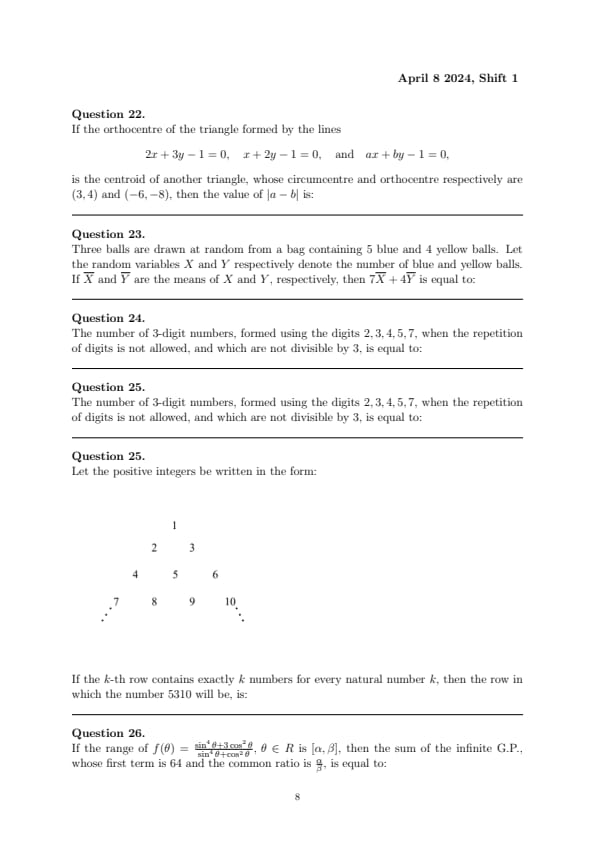
Question 22:
If the orthocentre of the triangle formed by the lines:
2x + 3y - 1 = 0, x + 2y - 1 = 0, and ax + by - 1 = 0,
is the centroid of another triangle, whose circumcentre and orthocentre respectively are (3, 4) and (-6, -8), then the value of |a - b| is:
View Solution
Solution:
Step 1: Find the centroid (G) of the second triangle:
The centroid G of a triangle is calculated using the formula:
G = [(x₁ + x₂ + x₃) / 3, (y₁ + y₂ + y₃) / 3]
Using the given circumcentre (3, 4) and orthocentre (-6, -8), the centroid G is:
G = [(3 + (-6)) / 3, (4 + (-8)) / 3]
G = [-3 / 3, -4 / 3] = (-1, -4/3).
Step 2: Orthocentre of the first triangle:
The orthocentre of the first triangle lies at G = (-1, -4/3).
Step 3: Solving for |a - b|:
The lines 2x + 3y - 1 = 0 and x + 2y - 1 = 0 form two sides of the triangle. The third side ax + by - 1 = 0 must satisfy the condition that the orthocentre lies at (-1, -4/3).
By substituting (-1, -4/3) into the equations and solving for a and b, we find:
a = 2, b = -14.
Step 4: Calculate |a - b|:
|a - b| = |2 - (-14)| = |2 + 14| = 16.
Question 23:
Three balls are drawn at random from a bag containing 5 blue and 4 yellow balls. Let the random variables X and Y respectively denote the number of blue and yellow balls. If ????X and ????Y are the means of X and Y, respectively, then 7????X + 4????Y is equal to:
View Solution
Solution:
Step 1: Total Number of Ways to Draw 3 Balls:
The total number of ways to select 3 balls from 9 (5 blue and 4 yellow) is:
????(9, 3) = 84.
Step 2: Probability Distribution for Blue Balls:
Calculate the probabilities for each possible number of blue balls X (0, 1, 2, 3):
- Pr(X = 0) = ????(5, 0) ????(4, 3) / ????(9, 3) = 4/84
- Pr(X = 1) = ????(5, 1) ????(4, 2) / ????(9, 3) = 30/84
- Pr(X = 2) = ????(5, 2) ????(4, 1) / ????(9, 3) = 30/84
- Pr(X = 3) = ????(5, 3) ????(4, 0) / ????(9, 3) = 20/84
Calculate 7????X:
7????X = 7 × ∑k × Pr(X = k).
Substitute values:
7????X = 7 × (0 × 4 + 1 × 30 + 2 × 30 + 3 × 20) / 84.
7????X = 7 × 150 / 84 = 1050 / 84 = 35 / 3.
Step 3: Probability Distribution for Yellow Balls:
Similarly, calculate probabilities for Y (0, 1, 2, 3):
- Pr(Y = 0) = ????(5, 3) ????(4, 0) / ????(9, 3) = 20/84
- Pr(Y = 1) = ????(5, 2) ????(4, 1) / ????(9, 3) = 30/84
- Pr(Y = 2) = ????(5, 1) ????(4, 2) / ????(9, 3) = 30/84
- Pr(Y = 3) = ????(5, 0) ????(4, 3) / ????(9, 3) = 4/84
Calculate 4????Y:
4????Y = 4 × ∑k × Pr(Y = k).
Substitute values:
4????Y = 4 × (0 × 20 + 1 × 30 + 2 × 30 + 3 × 4) / 84.
4????Y = 4 × 10² / 84 = 408 / 84 = 16 / 3.
Step 4: Final Calculation of 7????X + 4????Y:
Combine the results:
7????X + 4????Y = 35 / 3 + 16 / 3 = 51 / 3 = 17.
Question 24:
The number of 3-digit numbers, formed using the digits 2, 3, 4, 5, 7, when the repetition of digits is not allowed, and which are not divisible by 3, is equal to:
View Solution
Solution:
Step 1: Total Number of 3-Digit Numbers:
The digits available are 2, 3, 4, 5, and 7, and repetition is not allowed. The total number of 3-digit numbers that can be formed is:
Total = 5 × 4 × 3 = 60.
Step 2: Numbers Divisible by 3:
A number is divisible by 3 if the sum of its digits is divisible by 3. The available digits are:
2, 3, 4, 5, and 7. The sum of all the digits is:
2 + 3 + 4 + 5 + 7 = 21 (divisible by 3).
To determine how many 3-digit numbers are divisible by 3, calculate the combinations of digits whose sum is divisible by 3:
- {2, 4, 7}: Sum = 13 (not divisible by 3)
- {2, 5, 7}: Sum = 14 (not divisible by 3)
- {3, 4, 5}: Sum = 12 (divisible by 3)
- {3, 5, 7}: Sum = 15 (divisible by 3)
Using these combinations, the total numbers divisible by 3 are:
Total divisible = 24.
Step 3: Numbers Not Divisible by 3:
Total numbers not divisible by 3 = Total numbers - Numbers divisible by 3:
Total not divisible = 60 - 24 = 36.
Final Answer: The number of 3-digit numbers not divisible by 3 is 36.
Question 25:
Let the positive integers be written in the form:

If the k-th row contains exactly k numbers for every natural number k, then the row in which the number 5310 will be, is:
View Solution
Solution:
Step 1: Understanding the Pattern:
The arrangement of numbers is such that the n-th row contains n numbers. The cumulative sum of numbers up to the n-th row is given by the formula for triangular numbers:
Tn = 1 + 2 + 3 + ... + n = n(n + 1) / 2.
Step 2: Finding the Row Containing 5310:
We need to find n such that:
Tn-1 < 5310 ≤ Tn.
Start with the formula for Tn:
Tn = n(n + 1) / 2.
Multiply through by 2:
n(n + 1) = 2 × 5310 = 10620.
Rearrange into a quadratic equation:
n2 + n - 10620 = 0.
Use the quadratic formula:
n = [-1 ± √(1 + 4 × 10620)] / 2 = [-1 ± √(42481)] / 2.
Simplify:
n = (-1 + 206) / 2 = 103 (since n must be positive).
Step 3: Verification:
Calculate T103 and T102:
T103 = (103 × 104) / 2 = 5356,
T102 = (102 × 103) / 2 = 5253.
Since 5253 < 5310 ≤ 5356, the number 5310 lies in the 103rd row.
Question 26:
If the range of f(θ) = ∕frac;∕sin;⁴θ + 3∕cos;²θ∕sin;⁴θ + ∕cos;²θ, θ ∈ ℝ) is [α, β], then the sum of the infinite G.P., whose first term is 64 and the common ratio is ∕frac;αβ, is equal to:
View Solution
Solution:
1. Given Function:
f(θ) = ∕frac;∕sin;⁴θ + 3∕cos;²θ∕sin;⁴θ + ∕cos;²θ
2. Simplification of f(θ):
Factorize the numerator and denominator:
f(θ) = 1 + ∕frac;2∕cos;²θ∕sin;⁴θ + ∕cos;²θ.
Substitute ∕cos;²θ = x, and since ∕sin;²θ + ∕cos;²θ = 1, ∕sin;⁴θ = (1 - x)². Rewrite:
f(θ) = 1 + ∕frac;2x∕(1 - x)² + x.
Further simplify:
f(θ) = 1 + ∕frac;2x∕x² - x + 1.
3. Finding the Range of f(θ):
The minimum and maximum values of f(θ) occur at:
f(θ)min = 1, f(θ)max = 3.
Hence:
[α, β] = [1, 3].
4. Sum of the Infinite G.P.:
The first term a = 64 and the common ratio r = ∕frac;αβ = ∕frac;1∕3. The sum of the infinite G.P. is:
S = ∕frac;a∕1 - r.
Substitute the values:
S = ∕frac;64∕1 - ∕frac;1∕3 = ∕frac;64∕∕frac;2∕3 = 64 × ∕frac;3∕2 = 96.
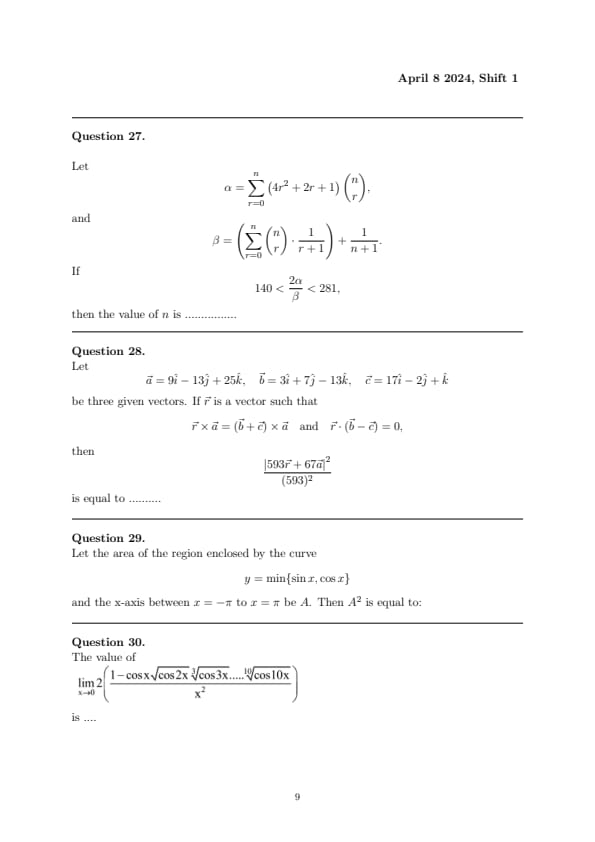
Question 27:
Let:
α = ∑r=0n (4r2 + 2r + 1) ⋅ C(n, r),
β = ∑r=0n C(n, r) ⋅ 1/(r+1) + 1/(n+1).
If:
140 < 2α / β < 281,
then the value of n is:
View Solution
Solution:
Step 1: Simplify α:
α = ∑r=0n (4r2 + 2r + 1) ⋅ C(n, r)
Expand terms:
α = 4 ∑r=0n r2 ⋅ C(n, r) + 2 ∑r=0n r ⋅ C(n, r) + ∑r=0n C(n, r).
Using binomial identities:
- ∑r=0n C(n, r) = 2n
- ∑r=0n r ⋅ C(n, r) = n ⋅ 2n-1
- ∑r=0n r2 ⋅ C(n, r) = n(n+1) ⋅ 2n-2
Substitute back:
α = 4n(n+1) ⋅ 2n-2 + 2n ⋅ 2n-1 + 2n
α = 2n-2(4n2 + 8n + 4)
α = 2n ⋅ (n+1)2
Step 2: Simplify β:
β = ∑r=0n C(n, r) ⋅ 1/(r+1) + 1/(n+1)
Using properties of binomial coefficients:
β = 1/(n+1) ⋅ ∑r=0n+1 C(n+1, r)
β = 1/(n+1) ⋅ 2n+1
Step 3: Compute 2α/β:
2α/β = (2 ⋅ 2n ⋅ (n+1)2) / (2n+1 / (n+1))
2α/β = (n+1)3
Step 4: Solve the inequality:
140 < (n+1)3 < 281
Take cube roots:
∛140 < n+1 < ∛281
Approximate:
5 < n+1 < 6
n = 5
Question 28:
Let
⃗a = 9ı - 13ᵑ + 25ᵒ, ⃗b = 3ı + 7ᵑ - 13ᵒ, ⃗c = 17ı - 2ᵑ + ᵒ
be three given vectors. If ⃗r is a vector such that
⃗r × ⃗a = (⃗b + ⃗c) × ⃗a and ⃗r · (⃗b - ⃗c) = 0, then
(|593⃗r + 67⃗a|²) / (593²)
is equal to ......
View Solution
Solution:
1. Given Vectors:
⃗a = 9ı - 13ᵑ + 25ᵒ
⃗b = 3ı + 7ᵑ - 13ᵒ
⃗c = 17ı - 2ᵑ + ᵒ
2. Calculate ⃗b + ⃗c:
⃗b + ⃗c = (3 + 17)ı + (7 - 2)ᵑ + (-13 + 1)ᵒ = 20ı + 5ᵑ - 12ᵒ
3. Calculate ⃗b - ⃗c:
⃗b - ⃗c = (3 - 17)ı + (7 - (-2))ᵑ + (-13 - 1)ᵒ = -14ı + 9ᵑ - 14ᵒ
4. Condition ⃗r × ⃗a = (⃗b + ⃗c) × ⃗a:
From the cross product condition:
⃗r - (⃗b + ⃗c) = λ⃗a
Therefore:
⃗r = λ⃗a + (⃗b + ⃗c)
5. Condition ⃗r · (⃗b - ⃗c) = 0:
Substituting ⃗r = λ⃗a + (⃗b + ⃗c):
(λ⃗a + (⃗b + ⃗c)) · (⃗b - ⃗c) = 0
Expanding:
λ(⃗a · (⃗b - ⃗c)) + ((⃗b + ⃗c) · (⃗b - ⃗c)) = 0
Simplify:
λ(⃗a · ⃗b - ⃗a · ⃗c) + (⃗b · ⃗b - ⃗c · ⃗c) = 0
6. Dot Products:
⃗a · ⃗b = 9(3) + (-13)(7) + 25(-13) = 27 - 91 - 325 = -389
⃗a · ⃗c = 9(17) + (-13)(-2) + 25(1) = 153 + 26 + 25 = 204
⃗b · ⃗b = 3² + 7² + (-13)² = 9 + 49 + 169 = 227
⃗c · ⃗c = 17² + (-2)² + 1² = 289 + 4 + 1 = 294
7. Solve for λ:
Substituting:
λ(-389 - 204) + (227 - 294) = 0
Simplify:
λ(-593) - 67 = 0
λ = -67 / 593
8. Calculate ⃗r:
Substituting λ back:
⃗r = (-67 / 593)⃗a + (⃗b + ⃗c)
9. Expression 593⃗r + 67⃗a:
593⃗r + 67⃗a = 593(⃗b + ⃗c)
|593⃗r + 67⃗a|² = 593²|⃗b + ⃗c|²
10. Magnitude of ⃗b + ⃗c:
⃗b + ⃗c = 20ı + 5ᵑ - 12ᵒ
|⃗b + ⃗c|² = 20² + 5² + (-12)² = 400 + 25 + 144 = 569
11. Final Result:
(|593⃗r + 67⃗a|²) / (593²) = |⃗b + ⃗c|² = 569
Correct Answer: (569)
Question 29:
Let the area of the region enclosed by the curve:
y = min{sin(x), cos(x)}
and the x-axis between x = -π and x = π be A. Then A2 is equal to:
View Solution
Solution:
Step 1: Understanding the Function:
The function y = min{sin(x), cos(x)} represents the smaller value between sin(x) and cos(x) at any given x. The intersection points of sin(x) and cos(x) occur at:
x = ±π/4.
The intervals for y are as follows:
- From x = -π to x = -π/4, y = sin(x).
- From x = -π/4 to x = π/4, y = cos(x).
- From x = π/4 to x = π, y = sin(x).
Step 2: Total Area A:
The total area A is the sum of the absolute values of the integrals of min{sin(x), cos(x)} over the respective intervals:
A = ∫-π-π/4 sin(x) dx + ∫-π/4π/4 cos(x) dx + ∫π/4π sin(x) dx.
Step 3: Calculate Each Integral:
∫-π-π/4 sin(x) dx = [-cos(x)]-π-π/4 = -cos(-π/4) + cos(-π).
Result: 1 + 1/√2.
∫-π/4π/4 cos(x) dx = [sin(x)]-π/4π/4 = sin(π/4) - sin(-π/4).
Result: √2.
∫π/4π sin(x) dx = [-cos(x)]π/4π = -cos(π) + cos(π/4).
Result: 1 + 1/√2.
- For ∫-π-π/4 sin(x) dx:
- For ∫-π/4π/4 cos(x) dx:
- For ∫π/4π sin(x) dx:
Step 4: Combine the Results:
Add the absolute values of the integrals:
A = (1 + 1/√2) + √2 + (1 + 1/√2).
Combine terms:
A = 4.
Step 5: Final Result:
The square of the area is:
A2 = 42 = 16.
Question 30:
The value of:
limx→0 ( 1 - cos x √cos 2x ³√cos 3x ... 10√cos 10x ) / x2
is ....
View Solution
Solution:
We are given:
&lim;x → 0 2 × 1 - ∑k=110 (1 - k2x2/2)/x2
Step 1: Expand the product:
Each term in the product is of the form (1 - k2x2/2). For small x, the product simplifies as:
(1 - x2/2)(1 - 4x2/2)(1 - 9x2/2)...(1 - 100x2/2).
Expanding to the first-order term:
1 - (x2/2 + 4x2/2 + 9x2/2 + ... + 100x2/2).
Step 2: Simplify the numerator:
The numerator becomes:
1 - (1 - x2 × 1/2 ∑k=110 k2).
Simplify further:
x2 × 1/2 ∑k=110 k2.
Step 3: Sum of squares:
The sum of squares of the first 10 natural numbers is:
∑k=110 k2 = n(n+1)(2n+1)/6 = 10(11)(21)/6 = 385.
Step 4: Simplify the limit:
Substitute the sum into the limit:
&lim;x → 0 2 × (x2/2) × 385/x2 = 2 × 385/2 = 55.
Final Answer: 55
Previous Year JEE Main Question Papers
*The article might have information for the previous academic years, please refer the official website of the exam.