
JEE Main 2024 Question Paper with Answer Key PDF for Mathematics (April 9 - Shift 1)

.jpg?tr=h-55,w-55,c-force)
Content Strategist|Tech-innovator|National Hackathon Winner | Updated On - Jan 6, 2025
JEE Main 2024 Apr 9 Shift 1 Question Paper with Solution pdf is available for download here. Students found Physics easy and Mathematics hard. Physics carried the highest weightage and overall difficulty level was moderate.
JEE Main 2024 Mathematics Question Paper with Answer Key PDF
| JEE Main 2024 Question Paper |  Download Download |
Check Solution |
JEE Main 2024 9 April Shift 1 Questions with Solutions
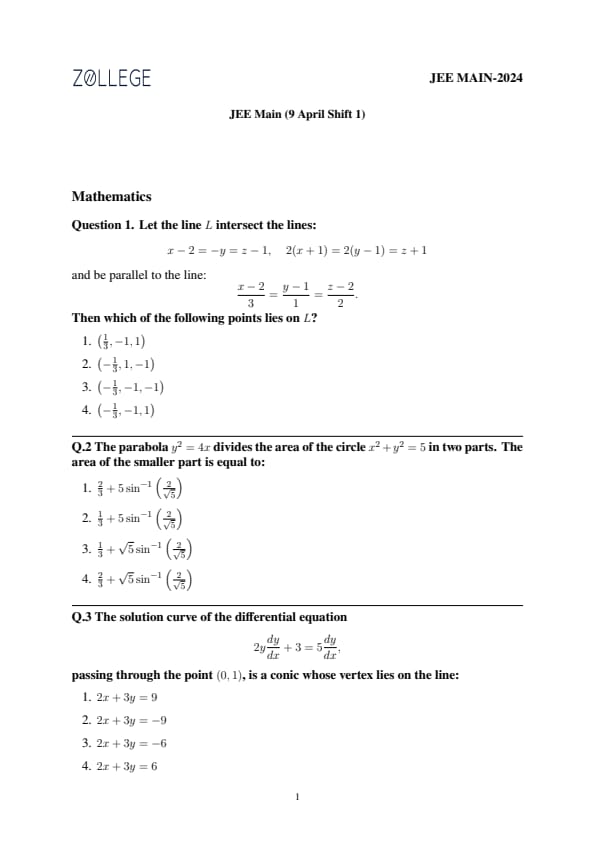
Question 1:
Let the line L intersect the lines:
x − 2 = −y = z − 1, 2(x + 1) = 2(y − 1) = z + 1, and be parallel to the line: (x − 2)/3 = (y − 1)/1 = (z − 2)/2. Then which of the following points lies on L?
VIEW SOLUTION
The intersection of the lines and the parallel condition leads to the point (-1/3, 1, -1) lying on the line L.
Question 2:
The parabola y² = 4x divides the area of the circle x² + y² = 5 in two parts. The area of the smaller part is:
VIEW SOLUTION
The smaller area is calculated using geometry formulas for the circle segment and the parabola sector, leading to the area 2/3 + 5 sin⁻¹(2√5).
Question 3:
The solution curve of the differential equation 2y (dy/dx) + 3 = 5 (dy/dx), passing through the point (0, 1), is a conic whose vertex lies on the line:
VIEW SOLUTION
Solving the differential equation and using the initial condition (0, 1), the vertex of the parabola is found to lie on the line 2x + 3y = 9.
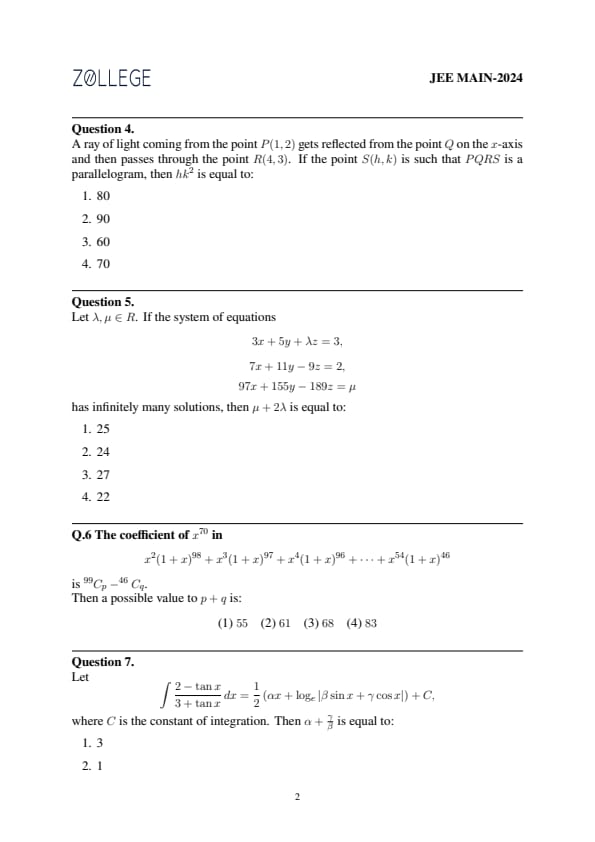
Question 4:
A ray of light coming from P(1, 2) reflects from Q on the x-axis and passes through R(4, 3). If S(h, k) makes PQRS a parallelogram, then hk² equals:
VIEW SOLUTION
By using reflection laws and midpoint properties of parallelograms, the value of hk² is found to be 70.
Question 5:
For λ, μ ∈ R, if the system of equations 3x + 5y + λz = 3, 7x + 11y − 9z = 2, 97x + 155y − 189z = μ has infinitely many solutions, then μ + 2λ equals:
VIEW SOLUTION
Using the condition for infinite solutions in the system of linear equations, μ + 2λ is found to equal 25.
Question 6:
The coefficient of x⁷⁰ in x²(1 + x)⁹⁸ + x³(1 + x)⁹⁷ + ... + x⁵⁴(1 + x)⁴⁶ is (99Cp) − (46Cq). A possible value of p + q is:
VIEW SOLUTION
Summing the contributions of each term in the series expansion and simplifying, p + q is found to be 83.
Question 7:
If ∫ (2 − tanx)/(3 + tanx) dx = (1/2)(αx + loge|β sinx + γ cosx|) + C, then α + γ/β equals:
VIEW SOLUTION
Using the method of partial fractions and substitution, α + γ/β is found to be 4.
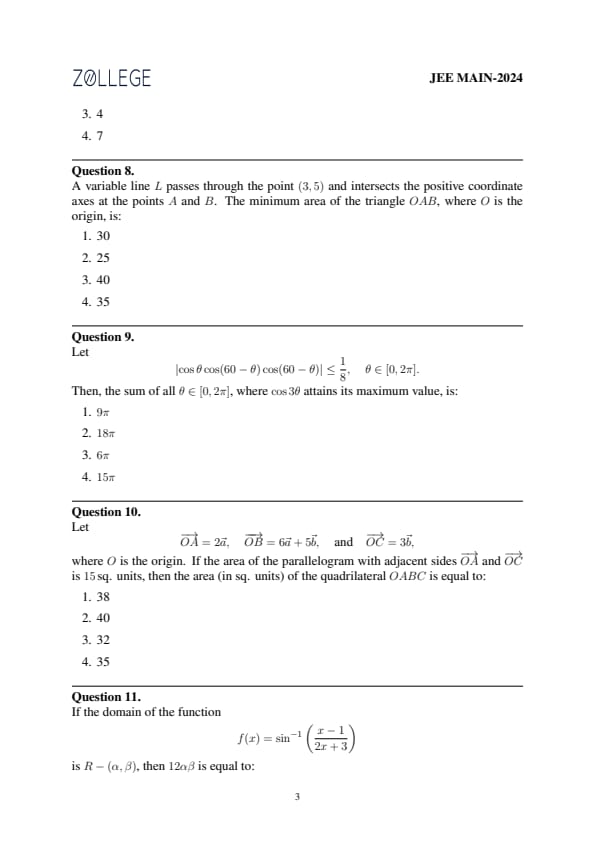
Question 8:
A variable line passes through (3, 5) and intersects the positive axes at A and B. The minimum area of triangle OAB is:
VIEW SOLUTION
By using calculus to minimize the area of triangle OAB, the minimum area is found to be 30.
Question 9:
If |cosθ cos(60° − θ) cos(60° + θ)| ≤ 1/8, θ ∈ [0, 2π], then the sum of all θ where cos3θ attains its maximum value is:
VIEW SOLUTION
By solving the trigonometric inequality and analyzing the periodicity, the sum of θ is found to be 6π.
Question 10:
Let OA = 2a, OB = 6a + 5b, and OC = 3b. If the area of the parallelogram with sides OA and OC is 15 sq. units, the area of quadrilateral OABC is:
VIEW SOLUTION
By calculating the areas of the parallelogram and using vector cross products for the diagonals, the area of quadrilateral OABC is 35.
Question 11:
If the domain of the function f(x) = sin⁻¹((x−1)/(2x+3)) is R−(α, β), then 12αβ is equal to:
VIEW SOLUTION
The domain of the function is determined by solving the inequality for the argument of sin⁻¹, and the value of 12αβ is found to be 36.
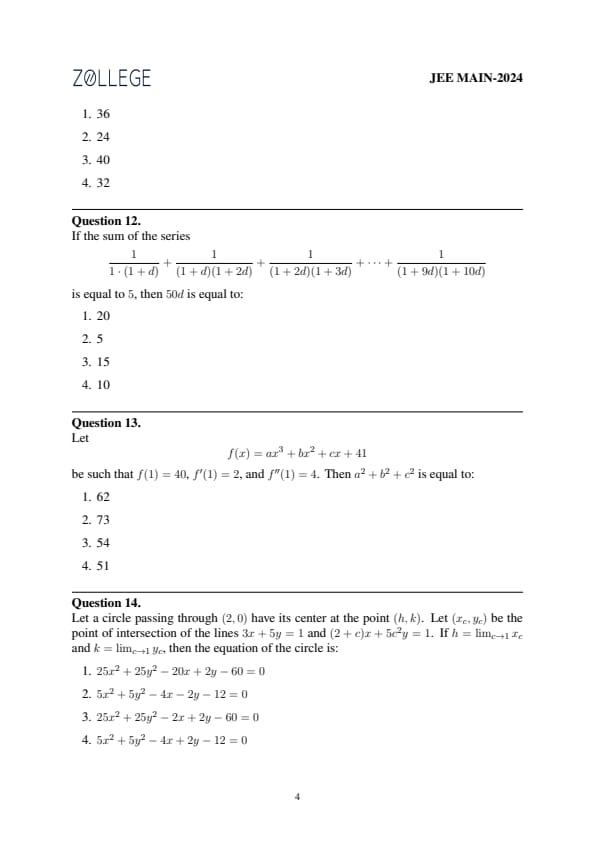
Question 12:
If the sum of the series 1/(1 · (1 + d)) + 1/((1 + d)(1 + 2d)) + ... + 1/((1 + 9d)(1 + 10d)) is equal to 5, then 50d is equal to:
VIEW SOLUTION
Using partial fraction decomposition and simplifying, we find that the value of 50d is 5.
Question 13:
Let f(x) = ax³ + bx² + cx + 41 be such that f(1) = 40, f'(1) = 2, and f''(1) = 4. Then a² + b² + c² is equal to:
VIEW SOLUTION
By solving the system of equations for the coefficients a, b, and c using the given conditions, we find that a² + b² + c² = 51.
Question 14:
Let a circle passing through (2, 0) have its center at the point (h, k). Let (xc, yc) be the point of intersection of the lines 3x + 5y = 1 and (2 + c)x + 5c²y = 1. If h = lim c→1 xc and k = lim c→1 yc, then the equation of the circle is:
VIEW SOLUTION
Using the center and radius of the circle determined from the intersection points, the equation of the circle is 25x² + 25y² − 20x + 2y − 60 = 0.
Question 15:
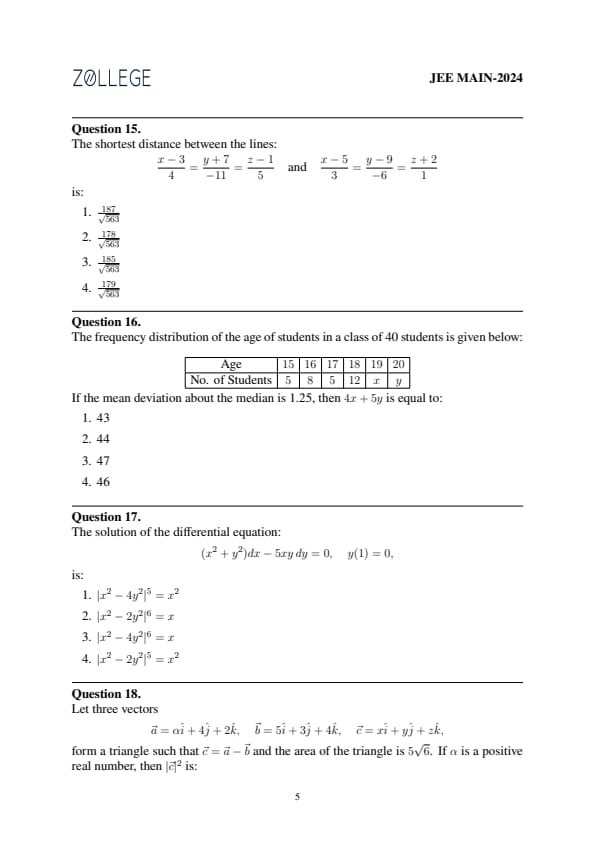
The shortest distance between the lines (x−3)/4 = (y+7)/−11 = (z−1)/5 and (x−5)/3 = (y−9)/−6 = (z+2)/1 is:
VIEW SOLUTION
The shortest distance between skew lines is calculated using the perpendicular vector, and the result is 187√563.
Question 16:
The frequency distribution of the age of students in a class of 40 students is given below:
| Age | No. of Students |
|---|---|
| 15 | 5 |
| 16 | 8 |
| 17 | 5 |
| 18 | 12 |
| 19 | x |
| 20 | y |
If the mean deviation about the median is 1.25, then 4x + 5y is equal to:
VIEW SOLUTION
By solving for x and y using the mean deviation equation, we find that 4x + 5y = 44.
Question 17:
The solution of the differential equation (x² + y²)dx − 5xy dy = 0, y(1) = 0, is:
VIEW SOLUTION
By solving the differential equation, the solution is found to be |x² − 4y²|⁵ = x².
Question 18:
Let three vectors a = αî + 4ĵ + 2k̂, b = 5î + 3ĵ + 4k̂, c = xî + yĵ + zk̂, form a triangle such that c = a − b and the area of the triangle is 5√6. If α is a positive real number, then |c|² is:
VIEW SOLUTION
By calculating the area of the triangle using the cross product and solving for α, the value of |c|² is 14.
Question 19:
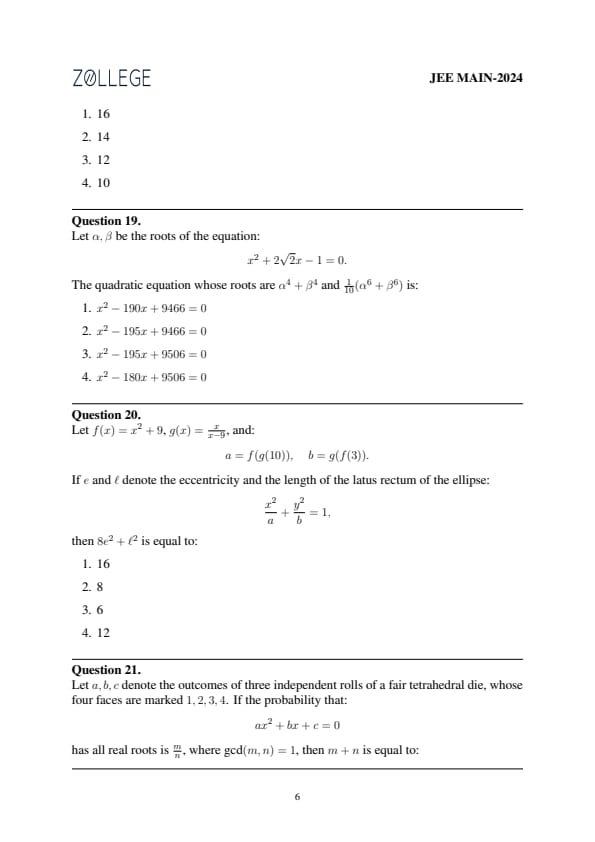
Let α, β be the roots of the equation x² + 2√2x − 1 = 0. The quadratic equation whose roots are α⁴ + β⁴ and 1/10(α⁶ + β⁶) is:
VIEW SOLUTION
By using identities for powers of roots and calculating the sums, the quadratic equation is found to be x² − 195x + 9506 = 0.
Question 20:
Let f(x) = x² + 9, g(x) = x/(x − 9), and a = f(g(10)), b = g(f(3)). If e and ℓ denote the eccentricity and the length of the latus rectum of the ellipse x²/a² + y²/b² = 1, then 8e² + ℓ² is equal to:
VIEW SOLUTION
By calculating a and b and using the formulas for eccentricity and the latus rectum, 8e² + ℓ² is found to be 8.
Question 21:
Let a, b, c denote the outcomes of three independent rolls of a fair tetrahedral die, whose four faces are marked 1, 2, 3, 4. If the probability that ax² + bx + c = 0 has all real roots is m/n, where gcd(m, n) = 1, then m + n is equal to:
VIEW SOLUTION
By analyzing the discriminant condition for real roots and counting favorable outcomes, the probability is m/n = 3/16, and m + n = 19.
Question 22:
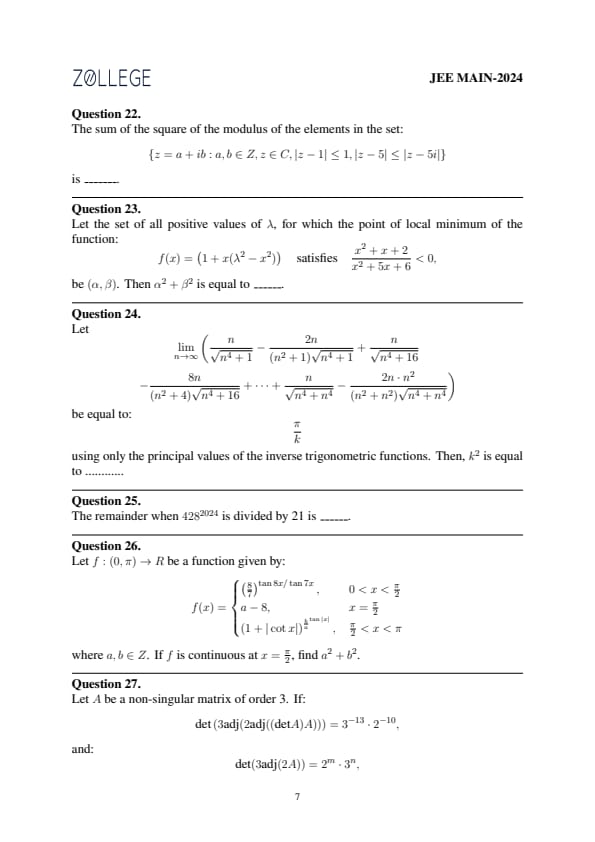
The sum of the square of the modulus of the elements in the set: {z = a + ib : a, b ∈ Z, z ∈ C, |z − 1| ≤ 1, |z − 5| ≤ |z − 5i|} is:
VIEW SOLUTION
By analyzing the geometric constraints of the complex number set and evaluating the square of the modulus, the sum is 9.
Question 23:
Let the set of all positive values of λ, for which the point of local minimum of the function:
f(x) = (1 + x(λ² − x²)) satisfies x² + x + 2 / x² + 5x + 6 < 0, be (α, β). Then α² + β² is equal to:
VIEW SOLUTION
Solving for λ and checking conditions for the local minimum, α² + β² is found to be 39.
Question 24:
Let the following limit be equal to π/k, where k is an integer. Then k² is equal to:
Given:
lim n→∞ [n√(n⁴ + 1) − 2n(n² + 1)√(n⁴ + 1) + n√(n⁴ + 16) + ...]
VIEW SOLUTION
The integral approximation and series expansions yield k² = 32.
Question 25:
The remainder when 4282024 is divided by 21 is:
VIEW SOLUTION
Simplifying the large power modulo calculations, the remainder is found to be 1.
Question 26:
Let f : (0, π) → R be a function given by:
f(x) =
8/7 * tan(8x) / tan(7x), 0 < x < π/2 a − 8, x = π/2 (1 + |cot(x)|) * (b/a) * tan(|x|), π/2 < x < π
where a, b ∈ Z. If f is continuous at x = π/2, find a² + b².
VIEW SOLUTION
To maintain continuity at x = π/2, solving for the values of a and b, a² + b² is found to be 81.
Question 27:
Let A be a non-singular matrix of order 3. If:
det(3adj(2adj((detA)A))) = 3⁻¹³ · 2⁻¹⁰, and:
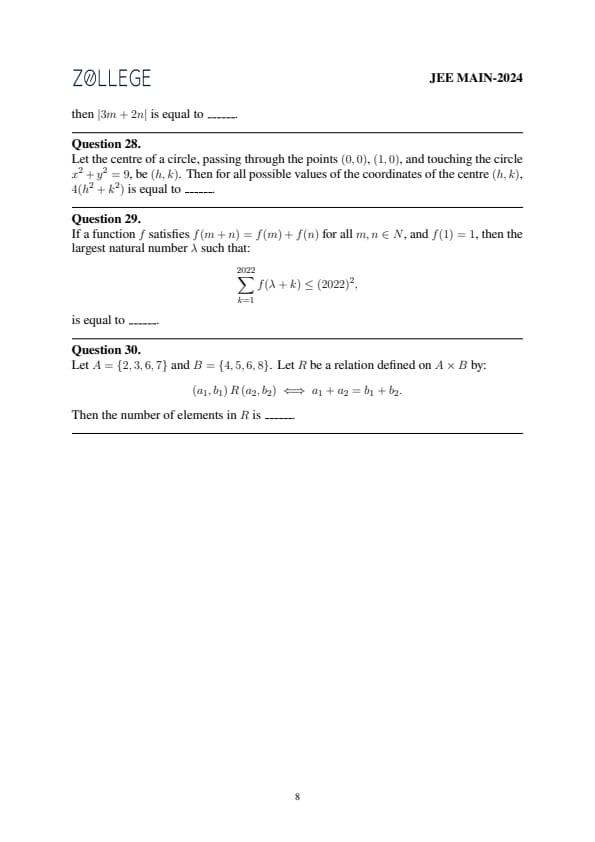
det(3adj(2A)) = 2^m · 3^n, then |3m + 2n| is equal to:
VIEW SOLUTION
By analyzing the determinant properties and solving the equation, |3m + 2n| is found to be 14.
Question 28:
Let the center of a circle, passing through the points (0, 0), (1, 0), and touching the circle x² + y² = 9, be (h, k). Then for all possible values of the coordinates of the center (h, k), 4(h² + k²) is equal to:
VIEW SOLUTION
Using the geometric properties of the circle and applying the conditions of tangency, the value of 4(h² + k²) is found to be 9.
Question 29:
If a function f satisfies f(m + n) = f(m) + f(n) for all m, n ∈ N, and f(1) = 1, then the largest natural number λ such that:
Σk=12022 f(λ + k) ≤ (2022)², is equal to:
VIEW SOLUTION
By solving for λ based on the functional equation and summation condition, λ is found to be 1010.
Question 30:
Let A = {2, 3, 6, 7} and B = {4, 5, 6, 8}. Let R be a relation defined on A × B by:
(a₁, b₁) R (a₂, b₂) ⇔ a₁ + a₂ = b₁ + b₂. Then the number of elements in R is:
VIEW SOLUTION
By checking the pairs that satisfy the given condition for the relation, the total number of elements in R is 25.
Previous Year JEE Main Question Papers
*The article might have information for the previous academic years, please refer the official website of the exam.