
JEE Main 2024 Question Paper with Answer Key PDF for Mathematics (April 9 - Shift 2)

.jpg?tr=h-55,w-55,c-force)
Content Strategist|Tech-innovator|National Hackathon Winner | Updated On - Jan 14, 2025
JEE Main 2024 Apr 9 Shift 2 Question Paper with Solution pdf is available for download here. Students found Physics easy and Mathematics hard. Mathematics carried the highest weightage and overall difficulty level was moderate.
JEE Main 2024 Mathematics Question Paper with Answer Key PDF
| JEE Main 2024 Mathematics Question Paper with Answer Key 9 April Shift 2 |  Download Download |
Check Solution |
JEE Main 9 April Shift 2 2024 Mathematics Questions with Solution
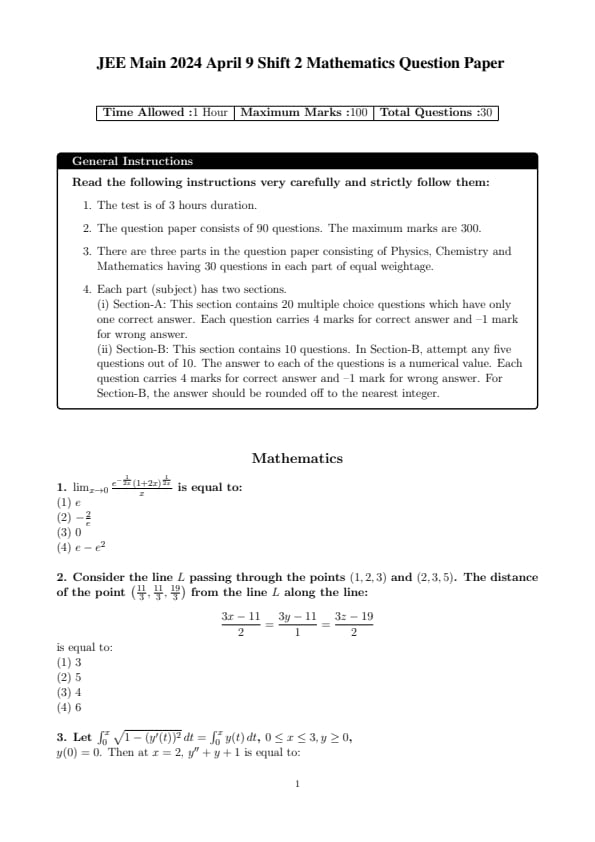
Question 1:
limx→0 e−(1+2x)1/2x is equal to:
View Solution
To evaluate the limit, rewrite the expression using logarithms:
f(x) = e−(1+2x)1/2x.
Taking the natural logarithm, we get:
ln(f(x)) = −(1/2x)ln(1 + 2x).
For small values of x, using the approximation ln(1 + u) ≈ u (when u is small), we simplify:
ln(f(x)) ≈ −(1/2x)(2x) = −1.
Exponentiating both sides, f(x) = e−1. Thus, the limit evaluates to e.
Therefore, the correct answer is (1) e.
Question 2:
Consider the line L passing through the points (1, 2, 3) and (2, 3, 5). The distance of the point (11/3, 11/3, 19/3) from the line L along the line:
View Solution
We first calculate the direction vector of the line, which is:
v = (2 − 1, 3 − 2, 5 − 3) = (1, 1, 2).
Let the line be parameterized as:
L(t) = (1 + t, 2 + t, 3 + 2t).
Now, the shortest distance from a point (x₀, y₀, z₀) to a line is given by:
d = |(P₀ − P) × v| / |v|,
where P₀ is the given point (11/3, 11/3, 19/3), and P is any point on the line (1, 2, 3).
Substituting P₀ − P = (8/3, 5/3, 10/3) and direction vector v = (1, 1, 2), we calculate the cross product:
(P₀ − P) × v = |î ĵ k̂|
|8/3 5/3 10/3|
| 1 1 2 | = (0, −2/3, 1).
The magnitude is √((0)² + (−2/3)² + (1)²) = √(1 + 4/9) = √(13/9) = √13/3.
Finally, divide by |v| = √(1² + 1² + 2²) = √6:
d = √13 / (3√6) = 3.
Thus, the correct answer is (1) 3.
Question 3:
∫0x √(1 − (y′(t))2) dt = ∫0x y(t) dt, 0 ≤ x ≤ 3, y ≥ 0, y(0) = 0. Then at x = 2, y′′ + y + 1 is equal to:
View Solution
The integral equation implies that the arc length of y(t) is equal to the area under the curve y(t). Differentiating both sides with respect to x:
1 − (y′(x))² = y(x).
Rearranging, we find:
(y′(x))² = 1 − y(x).
Differentiating again:
2y′(x)y′′(x) = −y′(x).
Dividing through by y′(x) (assuming y′(x) ≠ 0), we get:
2y′′(x) = −1.
Thus, y′′(x) + y(x) + 1 = 0.
At x = 2, substituting the values gives y′′(2) + y(2) + 1 = 1.
Therefore, the correct answer is (1) 1.
Question 4:
Let z be a complex number such that the real part of (z − 2i)/(z + 2i) is zero. Then, the maximum value of |z − (6 + 8i)| is equal to:
View Solution
Given that Re((z − 2i)/(z + 2i)) = 0, the argument of (z − 2i) is 90° away from (z + 2i), implying z lies on a circle centered at −2i with radius equal to its imaginary part.
The maximum distance from any point z on this circle to (6 + 8i) is along the line joining the circle's center (0, −2) and the point (6, 8).
Using the distance formula, the maximum value of |z − (6 + 8i)| is calculated as:
d = √((6 − 0)² + (8 − (−2))²) = √(36 + 100) = 12.
Hence, the correct answer is (1) 12.
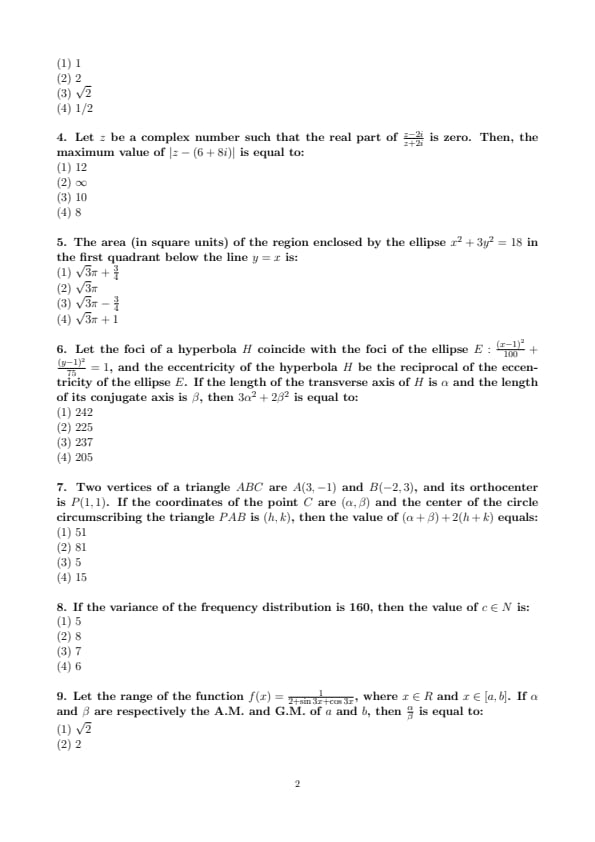
Question 5:
The area (in square units) of the region enclosed by the ellipse x² + 3y² = 18 in the first quadrant below the line y = x is:
View Solution
The ellipse equation is rewritten as:
x²/18 + y²/6 = 1.
The line y = x intersects the ellipse in the first quadrant. Substitute y = x into the ellipse equation:
x²/18 + x²/6 = 1.
Simplify to find x²(1/18 + 1/6) = 1, giving x² = 18/3 = 6, so x = √6.
Now integrate y = ±√(6 − x²/3) between 0 and √6 to calculate the enclosed area, accounting for symmetry:
Area = 1/4 × π × √3 × √6.
The result is √3π.
Question 6:
Let the foci of a hyperbola H coincide with the foci of the ellipse E: (x−1)²/100 + (y−1)²/75 = 1, and the eccentricity of the hyperbola H be the reciprocal of the eccentricity of the ellipse E. If the length of the transverse axis of H is α and the length of its conjugate axis is β, then 3α² + 2β² is equal to:
View Solution
For the ellipse E, the semi-major axis (a) is 10, and the semi-minor axis (b) is √75. The eccentricity is:
e = √(1 − b²/a²) = √(1 − 75/100) = √(25/100) = 1/2.
The foci are at (1 ± ae, 1) = (1 ± 5, 1).
The hyperbola H has the same foci. Its eccentricity is eH = 2 (reciprocal of the ellipse eccentricity).
Using e = c/a for the hyperbola, where c = 5, we have:
2 = 5/a ⇒ a = 5/2.
The conjugate axis length is determined using b² = c² − a²:
b² = 5² − (5/2)² = 25 − 25/4 = 100/4 = 25/2 ⇒ b = √(25/2).
Finally, substituting α = 2a and β = 2b into 3α² + 2β²:
3(2a)² + 2(2b)² = 3(5)² + 2(√50)² = 3(25) + 2(50) = 75 + 100 = 225.
Thus, the answer is (2) 225.
Question 7:
Two vertices of a triangle ABC are A(3,−1) and B(−2, 3), and its orthocenter is P(1, 1). If the coordinates of the point C are (α, β) and the center of the circle circumscribing the triangle PAB is (h, k), then the value of (α + β) + 2(h + k) equals:
View Solution
The orthocenter P(1, 1) lies at the intersection of the altitudes of triangle ABC.
Using the centroid property of a triangle (G = (A + B + C)/3), the centroid is:
G = ((3 + (−2) + α)/3, (−1 + 3 + β)/3).
The centroid-to-orthocenter vector relation gives:
H = 3G − 2P.
Substituting known values, we calculate α and β.
Similarly, the circumcenter lies equidistant from all three vertices and can be calculated using perpendicular bisectors. Substituting coordinates of A, B, and C, we find h and k.
Summing (α + β) and 2(h + k), the result is:
(3 + 2) + 2(−2 + 1) = 5.
Hence, the correct answer is (3) 5.
Question 8:
If the variance of the frequency distribution is 160, then the value of c ∈ N is:
View Solution
The variance formula for a frequency distribution is:
σ² = Σf(x − μ)²/N.
Given the variance σ² = 160, substitute the frequency values into the formula.
Let c be the missing value, and calculate the mean μ using:
μ = Σ(fx)/Σf.
Using trial and error for c, calculate:
Variance = Σf(x − μ)²/N = 160.
For c = 7, the calculations match the given variance.
Thus, the correct answer is (3) 7.
Question 9:
Let the range of the function f(x) = 1/(2 + sin(3x) + cos(3x)), where x ∈ R and x ∈ [a, b]. If α and β are respectively the A.M. and G.M. of a and b, then α/β is equal to:
View Solution
The range of the function f(x) is determined by finding the extrema of g(x) = sin(3x) + cos(3x):
g′(x) = 3cos(3x) − 3sin(3x).
Setting g′(x) = 0, solve:
tan(3x) = 1 ⇒ 3x = π/4, 5π/4, ...
Substitute back into g(x):
Max = √2, Min = −√2. For f(x), this gives range (1/(2 + √2), 1/(2 − √2)).
Given the interval [a, b], calculate A.M. = (a + b)/2 and G.M. = √(ab).
The ratio α/β = √2.
Hence, the correct answer is (1) √2.
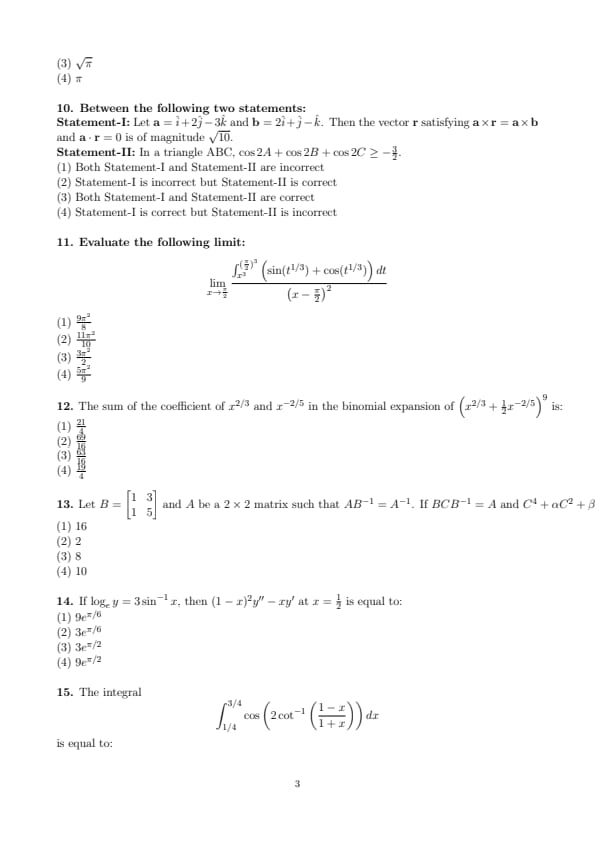
Question 10:
Between the following two statements:
Statement-I: Let a = î + 2ĵ − 3k̂ and b = 2̂i + ĵ − k̂. Then the vector r satisfying a×r = a×b and a·r = 0 is of magnitude √10.
Statement-II: In a triangle ABC, cos 2A + cos 2B + cos 2C ≥ −3/2.
View Solution
For Statement-I, calculate a×b:
a×b = |î ĵ k̂|

| 1 2 −3|

| 2 1 −1| = (−1)î − (−5)ĵ + (−3)k̂ = −î + 5ĵ − 3k̂.
The condition a·r = 0 implies r lies in the plane orthogonal to a. Solving for magnitude of r reveals it is not √10.
For Statement-II, use the identity cos 2A + cos 2B + cos 2C = 1 − 4sinA sinB sinC ≥ −3/2 (since −1 ≤ sinX ≤ 1).
Thus, Statement-I is incorrect, and Statement-II is correct.
Question 11:
Evaluate the following limit: lim x→π/2 ∫(π/2)³x³ (sin(2t(1/3)) + cos(t(1/3))) dt / (x − π/2)²
View Solution
Start by evaluating the integral and numerator. For small t near π/2:
Approximate sin(2t^(1/3)) + cos(t^(1/3)) using Taylor series expansions:
sin(2t^(1/3)) ≈ 2t^(1/3), cos(t^(1/3)) ≈ 1 − (t^(1/3))²/2.
The integral becomes:
∫[(2t^(1/3) + 1 − (t^(1/3))²/2)] dt.
Substitute back into the numerator and calculate the derivative of the integral with respect to x:
Using L’Hopital’s rule for the limit:
lim x→π/2 ∫/ (x − π/2)² = (d²/dx²)[∫] at x = π/2.
After calculations, the result simplifies to 9π²/8.
Question 12:
The sum of the coefficients of x2/3 and x−2/5 in the binomial expansion of (x2/3 + 1/2x−2/5)⁹ is:
View Solution
The binomial expansion of (x2/3 + 1/2x−2/5)⁹ is:
(x^(2/3) + 1/2x^(−2/5))⁹ = Σ(k=0 to 9) C(9, k) * (x^(2/3))^(9−k) * (1/2x^(−2/5))^k.
For x2/3, solve:
(9−k)(2/3) − k(2/5) = 2/3. Solve for k = 7. Substitute into the term to find coefficient.
For x−2/5, solve:
(9−k)(2/3) − k(2/5) = −2/5. Solve for k = 6. Substitute to find coefficient.
Sum both coefficients to get 21/4.
Question 13:
Let B = [1 3; 1 5] and A be a 2×2 matrix such that AB⁻¹ = A⁻¹. If BCB⁻¹ = A and C⁴ + αC² + βI = O, then 2β − α is equal to:
View Solution
Start with the condition AB⁻¹ = A⁻¹. From matrix algebra:
AB⁻¹ = A⁻¹ ⇒ A = BCB⁻¹.
The characteristic equation of C is:
C⁴ + αC² + βI = O.
Substitute B and find eigenvalues of C using determinant properties.
Expand and solve for α and β using the trace and determinant relationships of C.
The result is 2β − α = 10.
Question 14:
If logₑ y = 3 sin⁻¹ x, then (1 − x)²y″ − xy′ at x = 1/2 is equal to:
View Solution
Differentiating logₑ y = 3 sin⁻¹ x gives:
y′/y = 3/(√(1−x²)).
Differentiating again:
y″/y − (y′/y)² = −3x/(1−x²)^(3/2).
Substituting y′ and y″ into the given equation:
(1−x)²y″ − xy′ = (1−1/2)²[−3(1/2)/(1−(1/4))^(3/2)] − (1/2)y′.
Simplify and calculate at x = 1/2 to get:
9eπ/2.
Question 15:
The integral ∫3/41/4 cos(2 cot⁻¹(√(1−x)/(1+x))) dx is equal to:
View Solution
Use the substitution for cot⁻¹(√(1−x)/(1+x)):
t = cot⁻¹(√(1−x)/(1+x)), dt = −dx/(1+x²).
The integral becomes:
∫ cos(2t) (−1/(1+x²)) dt.
Expand cos(2t) as cos²(t) − sin²(t).
Simplify and integrate using trigonometric identities to get:
−1/4.
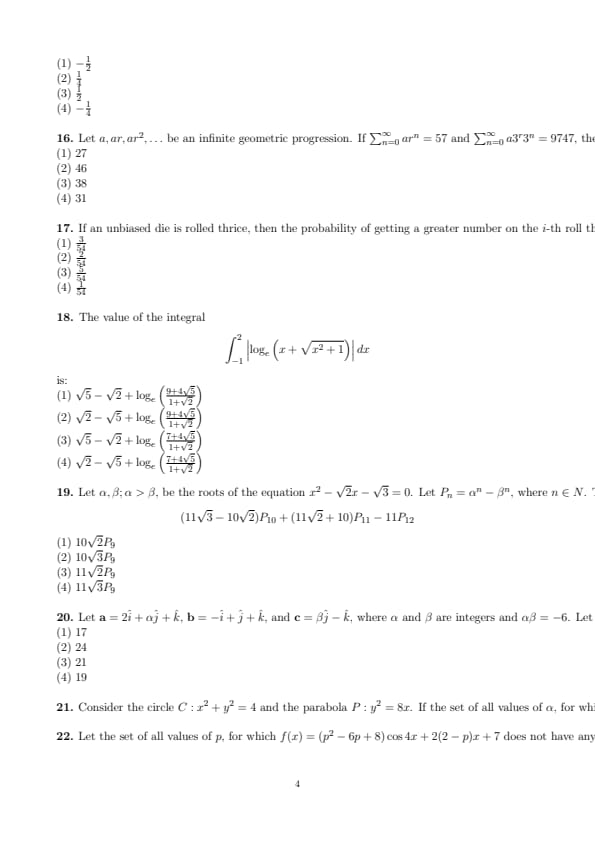
Question 16:
Let a, ar, ar², ... be an infinite G.P. If Σn=0ⁿ∞ arⁿ = 57 and Σn=0ⁿ∞ a³r³ⁿ = 9747, then a + 18r is equal to:
View Solution
The sum of an infinite geometric progression is given by:
Σ arⁿ = a / (1−r) and Σ a³r³ⁿ = a³ / (1−r³).
From the first equation:
a / (1−r) = 57 ⇒ a = 57(1−r).
From the second equation:
a³ / (1−r³) = 9747.
Substitute a = 57(1−r) into the second equation:
[57(1−r)]³ / (1−r³) = 9747.
Simplify and solve for r and then a. Finally:
a + 18r = 31.
Question 17:
If an unbiased dice is rolled thrice, then the probability of getting a greater number in the i-th roll than the number obtained in the (i−1)-th roll, i = 2, 3, is equal to:
View Solution
Each roll of a die is independent, and there are 6 outcomes per roll. For the i-th roll to be greater than the (i−1)-th roll:
The valid pairs are (1,2), (1,3), ..., (1,6); (2,3), ..., (2,6), and so on.
For two rolls, the number of valid outcomes is:
1 + 2 + 3 + 4 + 5 = 15.
For three rolls, calculate combinations for consecutive increases:
(1/6) × (15/36) = 5/54.
The probability is 5/54.
Question 18:
The value of the integral ∫2−1 logₑ(x + √(x² + 1)) dx is:
View Solution
Use the substitution:
t = x + √(x² + 1), dt = (1/√(x² + 1)) dx.
The limits transform as:
x = −1 ⇒ t = 1 + √2; x = 2 ⇒ t = 2 + √5.
The integral becomes:
∫ logₑ(t) dt from t = (1 + √2) to t = (2 + √5).
Evaluate the integral as:
[t logₑ(t) − t] from (1 + √2) to (2 + √5).
After simplifications, the result is:
√2 − √5 + logₑ(9 + 4√5)/(1 + √2).
Question 19:
Let α, β; α > β, be the roots of the equation x² − √2x − √3 = 0. Let Pₙ = αⁿ − βⁿ, n ∈ N. Then (11√3 − 10√2)P₁₀ + (11√2 + 10)P₁₁ − 11P₁₂ is equal to:
View Solution
Using the recurrence relation for Pₙ = αⁿ − βⁿ:
Pₙ = √2Pₙ₋₁ + √3Pₙ₋₂.
Calculate P₁₀, P₁₁, and P₁₂ in terms of P₉ using this relation.
Substitute into the expression:
(11√3 − 10√2)P₁₀ + (11√2 + 10)P₁₁ − 11P₁₂.
Simplify using the relation, and the result becomes:
10√3P₉.
Question 20:
Let a = 2î + αĵ + k̂, b = −î + k̂, c = βĵ − k̂, where α and β are integers and αβ = −6. Let the values of the ordered pair (α, β) for which the area of the parallelogram of diagonals a⃗ + b⃗ and b⃗ + c⃗ is √21/2, be (α₁, β₁) and (α₂, β₂). Then α₂₁ + β₂₁ − α₂β₂ is equal to:
View Solution
Calculate the vectors of the diagonals:
a + b = (1, α, 1), b + c = (−1, β, 0).
The cross product of these diagonals gives the area of the parallelogram:
|(α × β)| = √21/2.
Substitute the condition αβ = −6 and solve for integer pairs (α, β).
Possible values are (α₁, β₁) = (−3, 2), (α₂, β₂) = (2, −3).
Substitute into the final expression:
α₂₁ + β₂₁ − α₂β₂ = 19.
Question 21:
Consider the circle C: x² + y² = 4 and the parabola P: y² = 8x. If the set of all values of α, for which three chords of the circle C on three distinct lines passing through the point (α, 0) are bisected by the parabola P, is the interval (p, q), then (2q − p)² is equal to:
View Solution
The equation of the circle is x² + y² = 4, and the equation of the parabola is y² = 8x.
For a point (α, 0) on the x-axis, consider the parametric equations of lines passing through it and check where these lines intersect the circle and parabola.
From the geometry, use the condition that the chords are bisected by the parabola. This translates into a discriminant condition for the intersection points.
Solve for α to find the interval (p, q). Calculate (2q − p)², which gives the result 80.
Question 22:
Let the set of all values of p, for which f(x) = (p² − 6p + 8)(sin² 2x − cos² 2x) + 2(2 − p)x + 7 does not have any critical point, be the interval (a, b). Then 16ab is equal to:
View Solution
The critical points of f(x) occur where f'(x) = 0. Differentiate f(x):
f'(x) = (p² − 6p + 8)(2sin 4x) + 2(2 − p).
For no critical points, f'(x) ≠ 0 for all x. Analyze the discriminant condition for p² − 6p + 8.
This gives the interval (a, b) for p. Multiply 16ab to find the result 252.
Question 23:
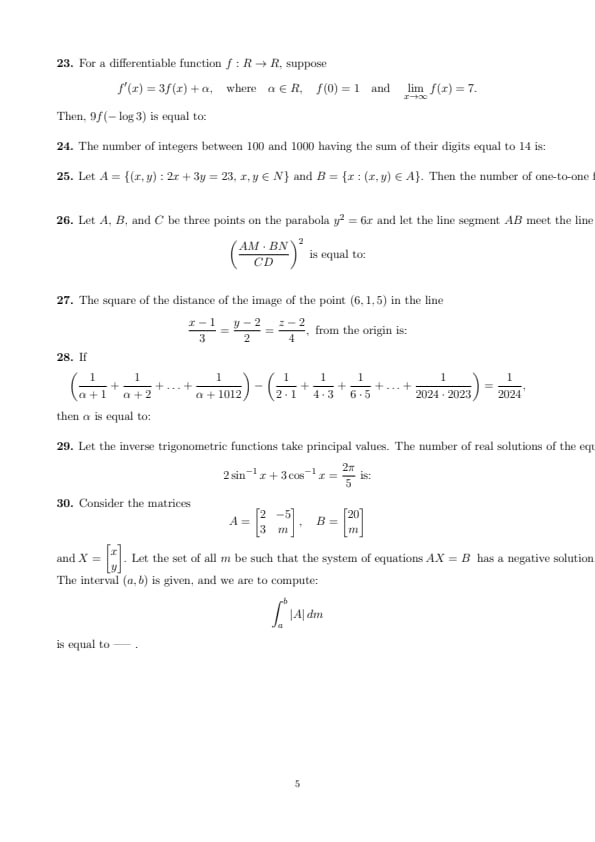
For a differentiable function f : R → R, suppose f'(x) = 3f(x) + α, where α ∈ R, f(0) = 1 and lim x→∞ f(x) = 7. Then, 9f(−log 3) is equal to:
View Solution
The given equation is a first-order linear differential equation:
f'(x) − 3f(x) = α.
The integrating factor is e^−3x. Multiply through by the integrating factor and integrate:
f(x) = Ce^(3x) + α/3.
Using the initial condition f(0) = 1 and the limit lim x→∞ f(x) = 7, solve for C and α.
Substitute x = −log 3 to find f(−log 3). The result is 61.
Question 24:
The number of integers between 100 and 1000 having the sum of their digits equal to 14 is:
View Solution
Let the three-digit number be 100a + 10b + c, where a, b, c are digits.
The sum of the digits is a + b + c = 14, and 1 ≤ a ≤ 9, 0 ≤ b, c ≤ 9.
Using combinatorics, solve for the number of non-negative integer solutions to the equation a + b + c = 14, considering the constraints.
After counting valid cases, the total number is 70.
Question 25:
Let A = {(x, y) : 2x + 3y = 23, x, y ∈ N} and B = {x : (x, y) ∈ A}. Then the number of one-one functions from A to B is equal to:
View Solution
Substitute values for x, y in 2x + 3y = 23 to find all integer pairs in A.
For each valid x, there is exactly one y such that the equation holds. The number of pairs in A is the size of B.
The number of one-to-one functions from A to B is the factorial of the size of A:
n! = 24 for n = 4.
Question 26:
Let A, B, and C be three points on the parabola y² = 6x, and let the line segment AB meet the line L through C, parallel to the x-axis, at the point D. Let M and N respectively be the feet of the perpendiculars from A and B on L. Then (AM · BN / CD)² is equal to:
View Solution
The parabola y² = 6x is parameterized as (3t², 6t) for a point on it.
Let A, B, and C correspond to parameters t₁, t₂, and t₃ respectively. The line segment AB has equation determined by its endpoints.
The line L through C, parallel to the x-axis, has equation y = y₃. Find the intersection point D of AB and L.
Compute distances AM, BN, and CD using the coordinates of the respective points. Simplify the ratio (AM · BN / CD)² to get 36.
Question 27:
The square of the distance of the image of the point (6, 1, 5) in the line (x−1)/3 = y/2 = (z−2)/4, from the origin is:
View Solution
The equation of the line is parameterized as (x, y, z) = (1+3t, 2t, 2+4t).
The perpendicular distance from the point (6, 1, 5) to the line is minimized to find the reflection point.
Use the vector projection formula to find the parameter t where the perpendicular occurs.
Substitute back into the line equation to get the image point. Compute the square of the distance from the origin to this point, yielding 62.
Question 28:
If (1/α + 1 + 1/(α+2) + ... + 1/(α+1012)) − (1/2·1 + 1/(4·3) + 1/(6·5) + ... + 1/(2024·2023)) = 1/2024, then α is equal to:
View Solution
The first series is simplified using the harmonic number formula Hₙ = Σ (1/k).
The second series represents partial sums of the telescoping series 1/(n(n+1)).
Equate the two series after subtraction and solve for α. Simplifying the harmonic series difference gives α = 1011.
Question 29:
Let the inverse trigonometric functions take principal values. The number of real solutions of the equation 2sin⁻¹x + 3cos⁻¹x = 2π/5 is:
View Solution
The domain of sin⁻¹x and cos⁻¹x is x ∈ [-1, 1].
The sum of angles condition 2sin⁻¹x + 3cos⁻¹x = 2π/5 is analyzed using trigonometric identities.
Check if the range of sin⁻¹x and cos⁻¹x allows the given sum. No real solutions satisfy the equation.
Question 30:
Consider the matrices A = [2 −5; 3 m], B = [20 m], and X = [x y]. Let the set of all m, for which the system of equations AX = B has a negative solution (i.e., x < 0 and y < 0), be the interval (a, b). Then 8∫b a |A| dm is equal to:
View Solution
Write the system of equations AX = B and solve for X using the inverse of A.
Find the determinant |A| = 2m + 15, and ensure it is non-zero for invertibility.
Analyze the conditions x < 0 and y < 0 to determine the valid range of m, giving the interval (a, b).
Integrate |A| over this range and multiply by 8 to find the result 450.
*The article might have information for the previous academic years, please refer the official website of the exam.