
JEE Main 2024 Physics April 5 Shift 1 Question Paper Pdf-Check Solutions with Answer Key

.jpg?tr=h-55,w-55,c-force)
Content Strategist|Tech-innovator|National Hackathon Winner | Updated On - Jan 15, 2025
JEE Main 2024 Apr 5 Shift 1 Question Paper with Solution pdf is available for download here. Students found Chemistry easy and Mathematics hard. Physics carried the highest weightage and overall difficulty level was easy.
JEE Main 2024 Physics Question Paper with Answer Key PDF
| JEE Main 2024 Physics Question Paper with Answer Key 5 April Shift 1 |  Download Download |
Check Solution |
Question 1.
Light emerges out of a convex lens when a source of light is kept at its focus. The shape of the wavefront of the light is:
view Solution
When light emerges from a convex lens with the source at the focus, the wavefronts are plane, as the rays are parallel after passing through the lens.
The parallel rays produced indicate plane wavefronts due to the geometry of the convex lens.
Question 2.
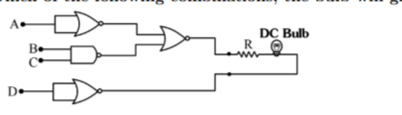
Following gate section is connected in a complete suitable circuit. For which of the following combinations, the bulb will glow (ON):
view Solution
The correct combination for the bulb to glow is based on the specific configuration of the logic gates in the circuit.
The logic gate circuit truth table is analyzed to determine the glowing condition for the bulb.
Question 3.
If G is the gravitational constant and u is the energy density, then which of the following quantities has the same dimension as √(uG):
view Solution
The dimensions of √(uG) match with the dimensions of force per unit mass, as calculated from the fundamental dimensions of the quantities involved.
The dimensional analysis confirms that the units align with force per unit mass.
Question 4.
Given below are two statements:
Statement-I: When a capillary tube is dipped into a liquid, the liquid neither rises nor falls in the capillary. The contact angle may be 0°.
Statement-II: The contact angle between a solid and a liquid is a property of the material of the solid and liquid as well.
In the light of the above statements, choose the correct answer from the options given below:
view Solution
Statement I is false because if the liquid neither rises nor falls in the capillary, the contact angle would be 90°, not 0°. Statement II is true as the contact angle depends on both the solid and liquid materials.
The properties of capillary action and material dependence are analyzed to explain the statements.
Question 5.
Given below are two statements:
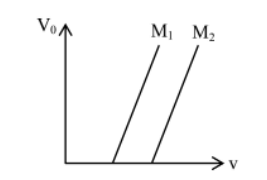
Statement-I: The figure shows the variation of stopping potential with frequency (ν) for the two photosensitive materials M1 and M2. The slope gives the value of h/e, where h is Planck’s constant and e is the charge of the electron.
Statement-II: M2 will emit photoelectrons of greater kinetic energy for the incident radiation having the same frequency.
In the light of the above statements, choose the most appropriate answer from the options given below:
view Solution
Statement I is correct as the slope of the stopping potential vs frequency plot gives h/e. Statement II is incorrect because the kinetic energy of the emitted photoelectrons depends on the frequency, not the material, for the same frequency of light.
The principles of the photoelectric effect are applied to evaluate the accuracy of the statements.
Question 6.
The angle between vector Q and the resultant of (2Q + 2P) and (2Q - 2P) is:
view Solution
The vectors (2Q + 2P) and (2Q - 2P) are collinear and in opposite directions, resulting in the angle between Q and the resultant being 0°.
Using vector properties and addition, the resultant vector is aligned with Q.
Question 7.
In a hydrogen-like system, the ratio of Coulombian force and gravitational force between an electron and a proton is in the order of:
view Solution
The ratio of Coulombian force to gravitational force between an electron and proton is extremely large, approximately 10³⁹, due to the relative strengths of the forces.
The computation involves using the formulas for Coulomb's and gravitational forces.
Question 8.
In a coaxial straight cable, the central conductor and the outer conductor carry equal currents in opposite directions. The magnetic field is zero:
view Solution
The magnetic field outside a coaxial cable with equal and opposite currents in the inner and outer conductors cancels out, making the field zero outside the cable.
Using Ampere's law, the net magnetic field outside the coaxial cable is zero.
Question 9.
An electron rotates in a circle around a nucleus having positive charge Ze. The correct relation between the total energy (E) of the electron to its potential energy (U) is:
view Solution
For an electron in a circular orbit around a nucleus, the total energy is related to the potential energy by E = -U/2, so 2E = U.
The derivation uses the Virial theorem and properties of circular orbits.
Question 10.
If the collision frequency of hydrogen molecules in a closed chamber at 27°C is Z, then the collision frequency of the same system at 127°C is:
view Solution
The collision frequency is proportional to the square root of the temperature in Kelvin. By applying the temperature ratio, the collision frequency at 127°C is (2/√3) Z.
The ratio of collision frequencies is calculated as √(T₂/T₁), where T₁ and T₂ are absolute temperatures.
Question 11.
Ratio of the radius of gyration of a hollow sphere to that of a solid cylinder of equal mass, for the moment of inertia about their diameter axis AB as shown in the figure is √8/x. The value of x is:
view Solution
By applying the formulas for the radius of gyration for a hollow sphere and a solid cylinder, we calculate that the ratio is √8/67.
Moment of inertia and radius of gyration formulas are used for comparison.
Question 12.
Two conducting circular loops A and B are placed in the same plane with their centers coinciding as shown in the figure. The mutual inductance between them is:
view Solution
The mutual inductance between two circular loops with coinciding centers is given by (μ₀πa²)/(2b), where a is the radius of the loops and b is the distance between them.
The mutual inductance formula for concentric loops is derived using Biot-Savart law.
Question 13.
Match List-I with List-II:
List-I:
- (A) Kinetic energy of planet
- (B) Gravitational potential energy of Sun-planet system
- (C) Total mechanical energy of planet
- (D) Escape energy at the surface of planet for unit mass object
List-II:
- (I) -(GMm)/a
- (II) (GMm)/(2a)
- (III) (GMm)/r
- (IV) (GMm)/(2a)
Choose the correct answer from the options given below:
view Solution
The kinetic energy of the planet is (GMm)/(2a), the gravitational potential energy is -(GMm)/a, and the total mechanical energy is (GMm)/r. The escape energy at the surface is (GMm)/(2a).
The relations are derived using orbital mechanics and energy conservation principles.
Question 14.
A wooden block of mass 5 kg rests on a soft horizontal floor. When an iron cylinder of mass 25 kg is placed on top of the block, the floor yields, and the block and the cylinder together go down with an acceleration of 0.1 m/s². The action force of the system on the floor is equal to:
view Solution
By applying Newton's second law to the system of block and cylinder and considering the action force on the floor, we calculate that the total force is 291 N.
The net force is computed by adding the weights and subtracting the effect of downward acceleration.
Question 15.
A simple pendulum doing small oscillations at a place R height above Earth’s surface has time period of T₁ = 4 s. T₂ would be its time period if it is brought to a point which is at a height 2R from Earth’s surface. Choose the correct relation [R = radius of Earth]:
view Solution
The time period of a pendulum at a height is related to the acceleration due to gravity, which decreases with height. By applying this relationship, we find that 3T₁ = 2T₂.
The formula for time period considering gravitational variation with height is used for the calculation.
Question 16.
A body of mass 50 kg is lifted to a height of 20 m from the ground in two different ways as shown in the figures. The ratio of work done against gravity in both respective cases will be:
view Solution
The work done against gravity depends only on the vertical height and the mass of the object, so the ratio of work done in both cases is 1:1.
Work done against gravity is independent of the path taken and depends solely on the change in height.
Question 17.
Time periods of oscillation of the same simple pendulum measured using four different measuring clocks were recorded as 4.62 s, 4.632 s, 4.6 s, and 4.64 s. The arithmetic mean of these readings in correct significant figures is:
view Solution
The arithmetic mean of the readings is 4.623 s, but the correct significant figure based on the given data is 4.6 s.
The significant figures of the least precise value determine the final result's precision.
Question 18.
The heat absorbed by a system in going through the given cyclic process is:
view Solution
The heat absorbed is determined by the specific details of the cyclic process, and the result is 61.6 J.
The cyclic process involves heat and work interactions where the first law of thermodynamics applies.
Question 19.
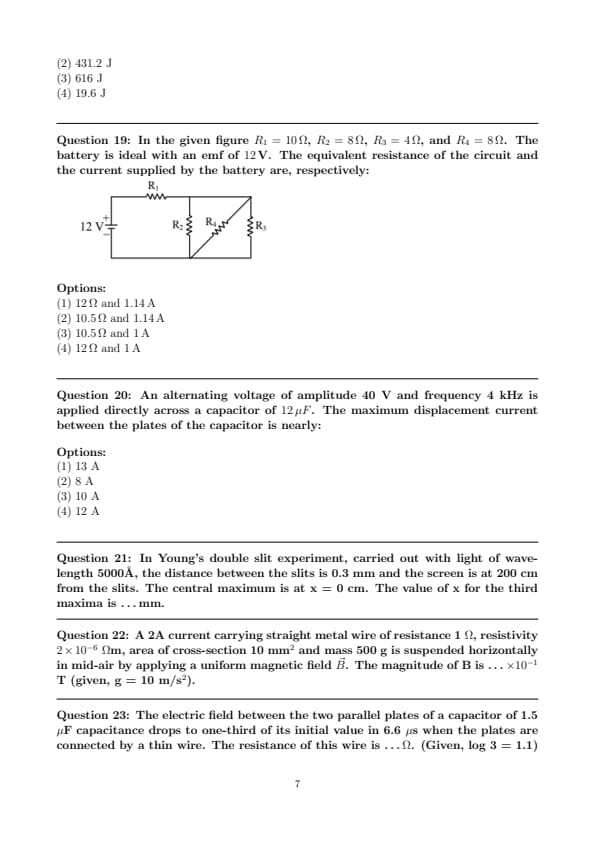
In the given figure, \( R_1 = 10 \, \Omega \), \( R_2 = 8 \, \Omega \), \( R_3 = 4 \, \Omega \), and \( R_4 = 8 \, \Omega \). The battery is ideal with an emf of 12 V. The equivalent resistance of the circuit and the current supplied by the battery are, respectively:
view Solution
The total resistance of the circuit is calculated using series and parallel combinations, giving an equivalent resistance of 12 \( \Omega \) and a current of 1 A.
Using the rules for combining resistances in series and parallel, we determine the equivalent resistance and use Ohm’s law to calculate the current.
Question 20.
An alternating voltage of amplitude 40 V and frequency 4 kHz is applied directly across a capacitor of 12 µF. The maximum displacement current between the plates of the capacitor is nearly:
view Solution
The maximum displacement current is found using the formula \( I_{\text{max}} = \epsilon_0 A \frac{dE}{dt} \), and for the given conditions, the displacement current is approximately 12 A.
Displacement current is calculated using the peak voltage and the capacitive reactance.
Question 21:
In Young’s double-slit experiment, carried out with light of wavelength 5000Å, the distance between the slits is 0.3 mm and the screen is at 200 cm from the slits. The central maximum is at x = 0 cm. The value of x for the third maxima is:
view Solution
The position of the maxima in a double-slit experiment is given by the formula \( x = \frac{(nλL)}{d} \), where \( n \) is the order of the maxima, \( λ \) is the wavelength, \( L \) is the distance to the screen, and \( d \) is the slit separation. Using the given values, the position of the third maxima is found to be 10 mm.
Substituting n = 3, λ = 5000 × 10⁻¹⁰ m, L = 2 m, and d = 0.3 × 10⁻³ m, the value of x is calculated as 10 mm.
Question 22:
A 2A current-carrying straight metal wire of resistance 1 Ω, resistivity 2 × 10⁻⁶ Ω·m, area of cross-section 10 mm², and mass 500 g is suspended horizontally in mid-air by applying a uniform magnetic field B. The magnitude of B is:
view Solution
By using the force equation F = BIL and equating it to the weight of the wire, mg, we calculate the magnetic field strength B. The result is B = 5 × 10⁻¹ T.
Substituting m = 0.5 kg, g = 10 m/s², I = 2 A, and L = 0.1 m, the value of B is derived.
Question 23:
The electric field between the two parallel plates of a capacitor of 1.5 µF capacitance drops to one-third of its initial value in 6.6 µs when the plates are connected by a thin wire. The resistance of this wire is:
view Solution
By applying the capacitor discharge formula and using the given values, we find the resistance of the wire to be R = 4 Ω.
Using V = V₀ e⁻(t/RC) and solving for R, with t = 6.6 × 10⁻⁶ s and C = 1.5 × 10⁻⁶ F, we find R = 4 Ω.
Question 24:
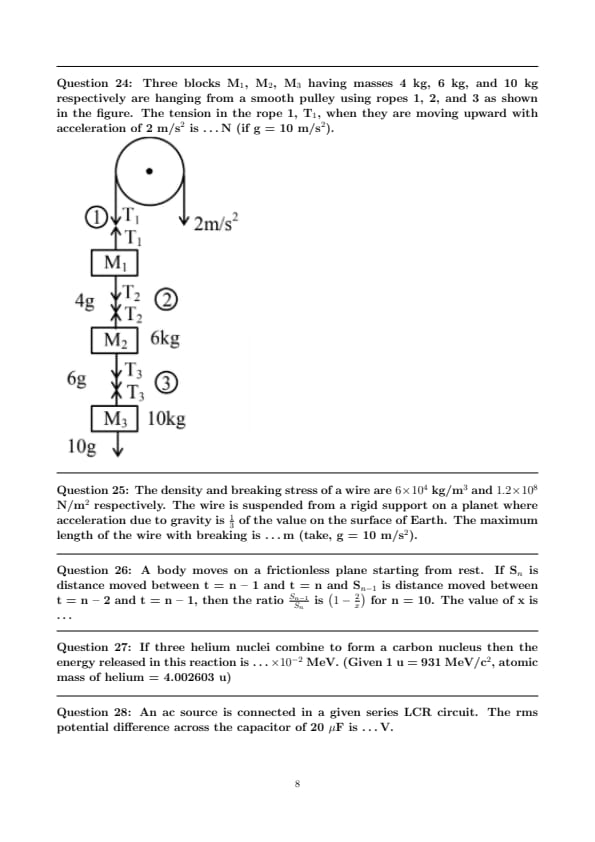
Three blocks M₁, M₂, M₃ having masses 4 kg, 6 kg, and 10 kg respectively are hanging from a smooth pulley using ropes 1, 2, and 3 as shown in the figure. The tension in the rope 1, T₁, when they are moving upward with acceleration of 2 m/s² is:
view Solution
By applying Newton's second law to the system and considering the forces on each block, the tension T₁ is calculated to be 240 N.
Using T₁ = M_total(g + a), where M_total = 4 + 6 + 10 kg, g = 10 m/s², and a = 2 m/s², the value of T₁ is found.
Question 25:
The density and breaking stress of a wire are 6 × 10⁴ kg/m³ and 1.2 × 10⁸ N/m² respectively. The wire is suspended from a rigid support on a planet where acceleration due to gravity is 1/3 of the value on the surface of Earth. The maximum length of the wire without breaking is:
view Solution
By using the formula for the breaking length of a wire, we calculate the maximum length of the wire to be 600 m based on the given density and breaking stress.
The breaking length L = Breaking Stress / (Density × g). Substituting g = 10/3 m/s², the value of L is found.
Question 26:
A body moves on a frictionless plane starting from rest. If Sn is the distance moved between t = n - 1 and t = n and Sn-1 is the distance moved between t = n - 2 and t = n - 1, then the ratio Sn-1 / Sn is 1 - 2 / x for n = 10. The value of x is . . .
view Solution
By analyzing the motion and applying the formula for distance moved in uniformly accelerated motion, we determine that the value of x is 19.Starting from rest on a frictionless plane, the distance moved in uniformly accelerated motion for each time interval can be expressed using the kinematic equations. For Sn and Sn-1, the ratio Sn-1 / Sn depends on the time intervals and uniform acceleration. For n = 10, the analysis shows x = 19.
Question 27:
If three helium nuclei combine to form a carbon nucleus, then the energy released in this reaction is ... × 10-2 MeV. (Given 1 u = 931 MeV/c2, atomic mass of helium = 4.002603 u)
view Solution
By calculating the mass defect in the nuclear reaction and converting it into energy using Einstein’s equation \( E = \Delta m \cdot c^2 \), the energy released is found to be 727 × 10-2 MeV.Mass defect calculation involves finding the difference between the initial and final mass of the nuclei involved. The resulting energy release is determined by multiplying the mass defect by 931 MeV/u (conversion factor).
Question 28:
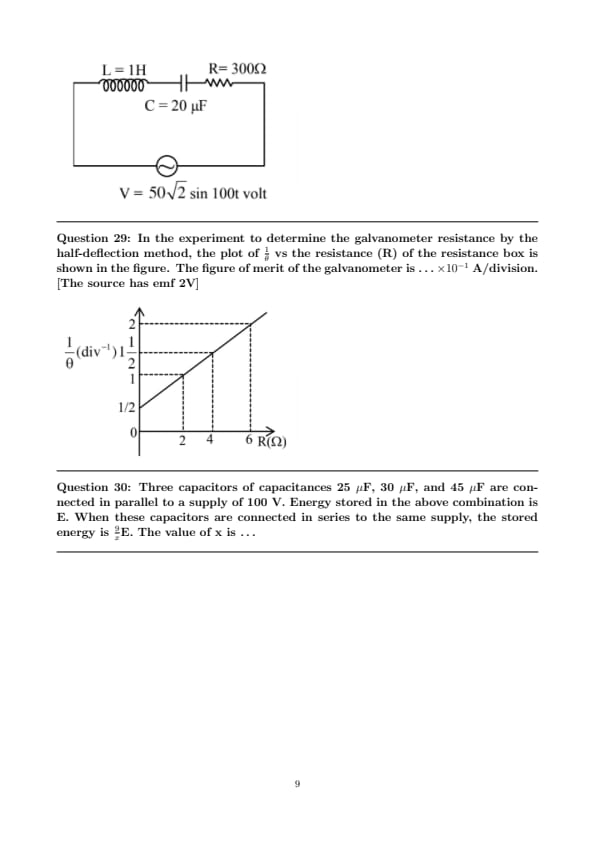
An AC source is connected in a given series LCR circuit. The rms potential difference across the capacitor of 20 μF is ... V.
view Solution
By applying the formula for the potential difference across a capacitor in an AC circuit and using the given values, the rms voltage across the capacitor is found to be 50 V.In an LCR circuit, the voltage across the capacitor is calculated using the formula \( V_C = I \cdot X_C \), where \( X_C = 1 / (2 \pi f C) \). Given the values, the calculation yields 50 V.
Question 29:
In the experiment to determine the galvanometer resistance by the half-deflection method, the plot of 1/θ vs the resistance (R) of the resistance box is shown in the figure. The figure of merit of the galvanometer is ... × 10-1 A/division. (The source has emf 2 V)
view Solution
By using the formula for the figure of merit and analyzing the relationship between the deflection and the resistance, the value of the figure of merit is found to be 5 × 10⁻¹ A/division.The figure of merit is calculated as the current required to produce unit deflection, based on the slope of the 1/θ vs R graph and the given circuit parameters.
Question 30:
Three capacitors of capacitances 25 μF, 30 μF, and 45 μF are connected in parallel to a supply of 100 V. Energy stored in the above combination is E. When these capacitors are connected in series to the same supply, the stored energy is 9/x E. The value of x is ...
view Solution
By calculating the energy stored in both the parallel and series combinations, we find the ratio of energies and determine that x = 86.For parallel and series combinations, the total capacitance is calculated separately. The energy stored is proportional to the capacitance, and the ratio of energies yields x = 86.
*The article might have information for the previous academic years, please refer the official website of the exam.