
JEE Main 2024 Question Paper with Answer Key PDF for Physics (April 5 - Shift 2)

.jpg?tr=h-55,w-55,c-force)
Content Strategist|Tech-innovator|National Hackathon Winner | Updated On - Jan 14, 2025
JEE Main 2024 Apr 5 Shift 2 Physics Question Paper with Solution pdf is available for download here. Students found Physics easy and Mathematics hard. Chemistry carried the highest weightage and overall difficulty level was moderate.
JEE Main 2024 5 April Shift 2 Question Paper with Solution PDF
| JEE Main 2024 physics Question Paper with Answer Key April 5 Shift 2 |  Download Download |
Check Solution |
JEE Main 2024 5 April Shift 2 Questions with Solution
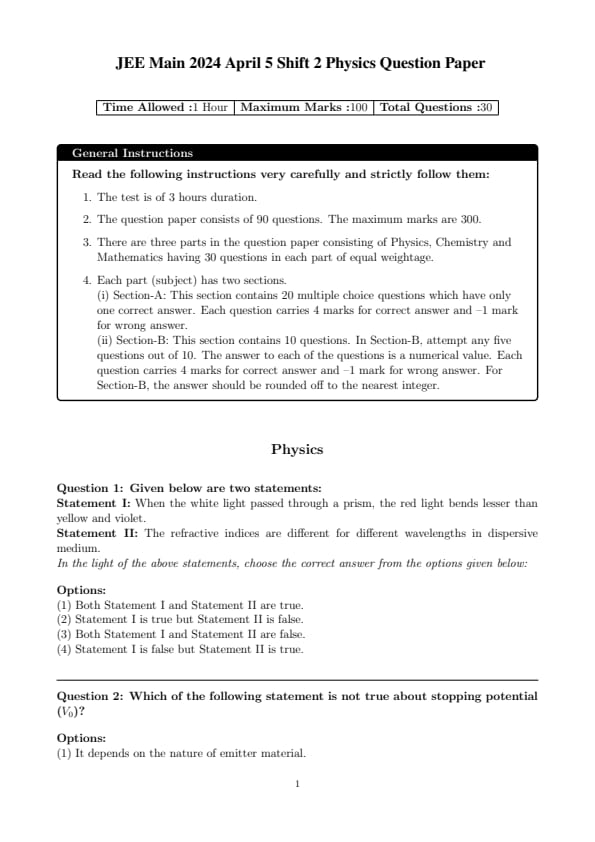
Question 1:
Given below are two statements:
Statement I: When white light passes through a prism, red light bends less than yellow and violet.
Statement II: The refractive indices are different for different wavelengths in dispersive media.
In the light of the above statements, choose the correct answer:
White light dispersion through a prism occurs because refractive indices vary with wavelength. Red light, having the longest wavelength, bends the least, while violet bends the most. Both statements are correct and consistent with this phenomenon.
Read More
Dispersion happens because refractive indices depend on the wavelength of light, which explains the varying degrees of bending for different colors in a prism.
Question 2:
Which of the following statements is NOT true about the stopping potential (V0)?
The stopping potential depends on the frequency of light and the material’s work function but not on light intensity. Light intensity only affects the number of photoelectrons emitted, not their energy or the stopping potential.
Read More
According to the photoelectric equation, stopping potential is related to the frequency of the incident light and the work function, independent of light intensity.
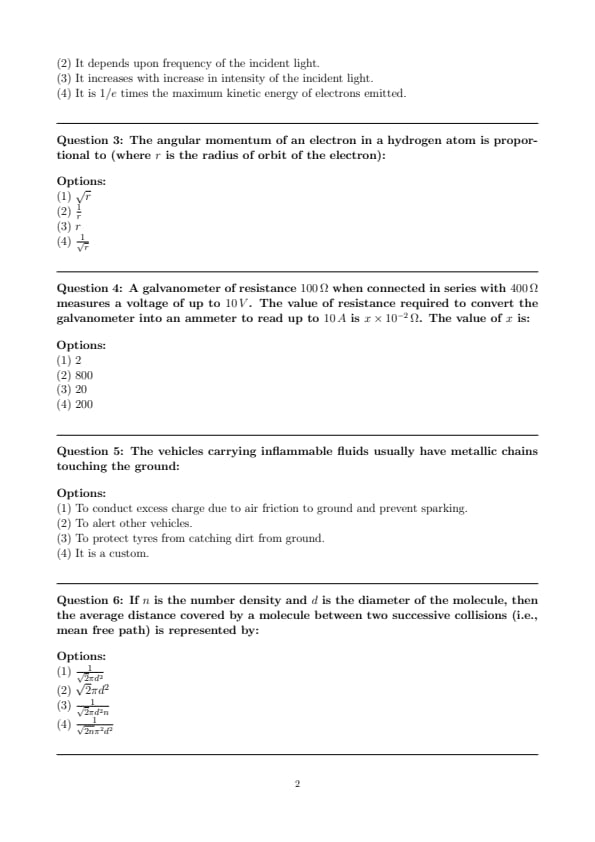
Question 3:
The angular momentum of an electron in a hydrogen atom is proportional to (where r is the radius of the orbit):
According to Bohr’s model, angular momentum (L) is proportional to the quantum number n, and the orbit radius (r) is proportional to n². Hence, L is proportional to √r.
Read More
The relationship between radius and angular momentum comes from combining Bohr’s quantization condition and the centripetal force equation.
Question 4:
A galvanometer of resistance 100Ω is connected in series with a 400Ω resistor to measure up to 10V. The value of resistance required to convert the galvanometer into an ammeter to read up to 10A is x × 10-2Ω. The value of x is:
To convert the galvanometer into an ammeter, a shunt resistance is calculated as S = igRg / (I - ig). Substituting the given values, S is found to be 0.2Ω, or 20 × 10-2Ω, giving x = 20.
Read More
Use the shunt resistance formula with ig = 10mA and I = 10A to find the required value of S. Simplify to express it as x × 10-2Ω.
Question 5:
The vehicles carrying inflammable fluids usually have metallic chains touching the ground:
Metallic chains are used to discharge static electricity generated due to friction with air while moving, preventing sparking that could ignite inflammable fluids.
Read More
The chains provide a grounding mechanism to dissipate static charges safely, avoiding hazards related to inflammable materials.
Question 6:
If n is the number density and d is the diameter of the molecule, then the average distance covered by a molecule between two successive collisions (i.e., mean free path) is represented by:
The mean free path (λ) of a gas molecule is derived from kinetic theory and is given by λ = 1/√(2πd2n), where n is the number density and d is the molecular diameter.
Read More
Mean free path is calculated considering the collision cross-section and the number of molecules in a given volume. The formula is derived from statistical mechanics.
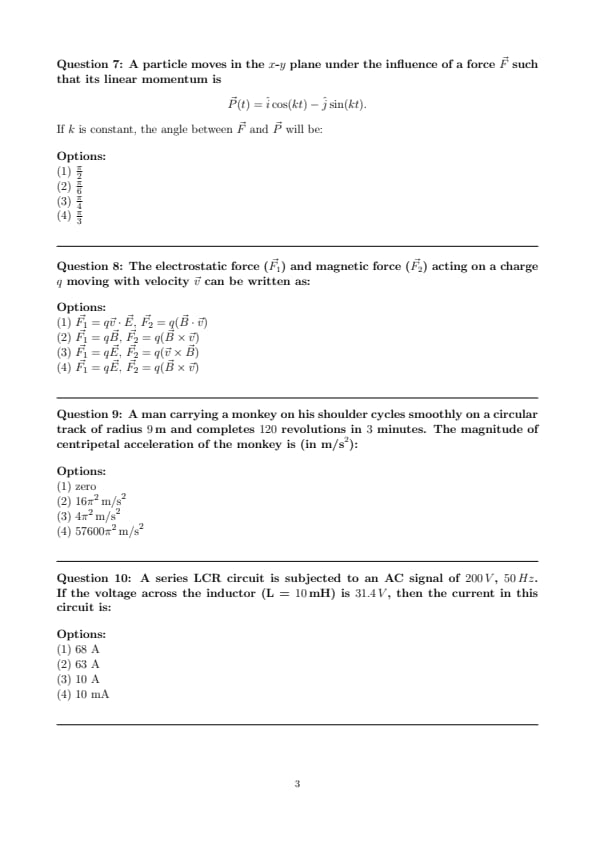
Question 7:
A particle moves in the x-y plane under the influence of a force F such that its linear momentum is P⃗(t) = î cos(kt) − ĵ sin(kt). If k is constant, the angle between F⃗ and P⃗ will be:
Differentiating P⃗(t) to find the force F⃗ shows that F⃗ is perpendicular to P⃗ because their dot product is zero. Hence, the angle between F⃗ and P⃗ is π/2.
Read More
Force F⃗ is the derivative of momentum P⃗ with respect to time. Compute the dot product F⃗ · P⃗ and observe that it equals zero, indicating perpendicularity.
Question 8:
The electrostatic force (F1) and magnetic force (F2) acting on a charge q moving with velocity v can be written as:
The electrostatic force is F1 = qE, and the magnetic force is F2 = q(v × B), as per the Lorentz force law.
Read More
According to the Lorentz force equation, the total force on a charged particle is F⃗ = q(E⃗ + v⃗ × B⃗). Separate the electric and magnetic components to identify F1 and F2.
Question 9:
A man carrying a monkey on his shoulder cycles smoothly on a circular track of radius 9m and completes 120 revolutions in 3 minutes. The magnitude of the centripetal acceleration of the monkey is (in m/s2):
The angular velocity is ω = 4π/3 rad/s. Using ac = ω2R, the centripetal acceleration is ac = 16π2 m/s2.
Read More
Calculate the angular velocity ω from the number of revolutions and time. Substitute ω and R into the centripetal acceleration formula to find the result.
Question 10:
A series LCR circuit is subjected to an AC signal of 200V, 50Hz. If the voltage across the inductor (L = 10mH) is 31.4V, then the current in this circuit is:
The inductive reactance is XL = 2πfL = 3.14Ω. Using V = IXL, the current is I = 31.4/3.14 = 10 A.
Read More
Find the inductive reactance XL using the formula XL = 2πfL. Use Ohm's law to calculate the current: I = V/XL.
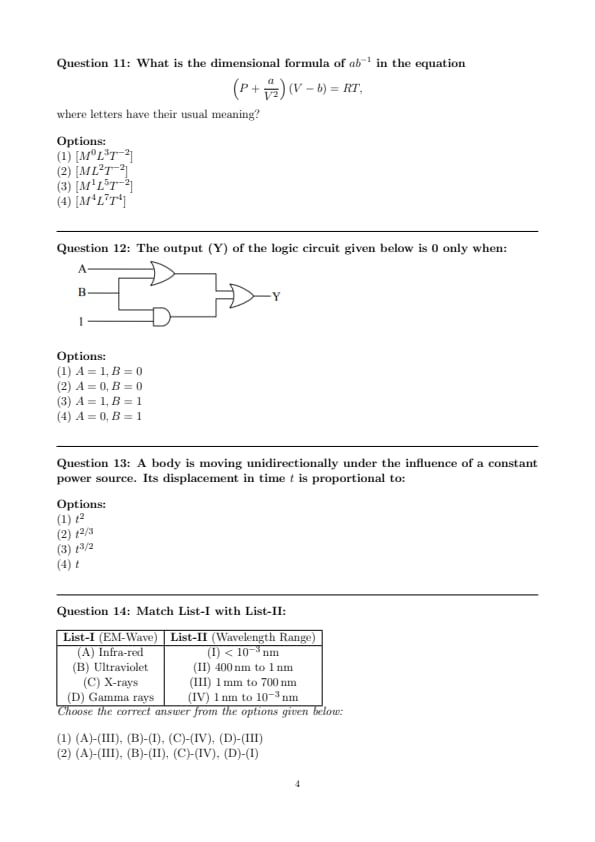
Question 11:
What is the dimensional formula of ab-1 in the equation:
(P + a/V2)(V − b) = RT,
where letters have their usual meaning?
Using the dimensional formula of pressure ([ML-1T-2]) and volume ([L3]), the formula for ab-1 simplifies to [ML2T-2].
Read More
Dimensional analysis of the equation relates pressure and volume terms. Substituting their dimensions and simplifying leads to the result.
Question 12:
The output (Y) of the logic circuit given below is 0 only when:
Analyzing the logic gates, the output Y is 0 only when both inputs A and B are 0, as the OR gate and AND gate conditions are not satisfied simultaneously.
Read More
Examine the truth table for the given logic circuit. The combination where both inputs are 0 ensures the output is 0.
Question 13:
A body is moving unidirectionally under the influence of a constant power source. Its displacement in time t is proportional to:
For a body moving under constant power, velocity is proportional to √t, and displacement (integral of velocity) is proportional to t3/2.
Read More
Constant power implies force varies inversely with velocity. Integrating velocity over time gives displacement proportional to t3/2.
Question 14:
Match List-I with List-II:
List-I (EM-Wave) List-II (Wavelength Range)
(A) Infra-red (I) < 10-3 nm
(B) Ultraviolet (II) 400 nm to 1 nm
(C) X-rays (III) 1 mm to 700 nm
(D) Gamma rays (IV) 1 nm to 10-3 nm
Choose the correct option:
Infra-red corresponds to 1 mm to 700 nm, ultraviolet corresponds to 400 nm to 1 nm, X-rays correspond to 1 nm to 10-3 nm, and gamma rays correspond to wavelengths less than 10-3 nm.
Read More
Electromagnetic waves are categorized by their wavelengths. Refer to their standard ranges to match them correctly.
Question 15:
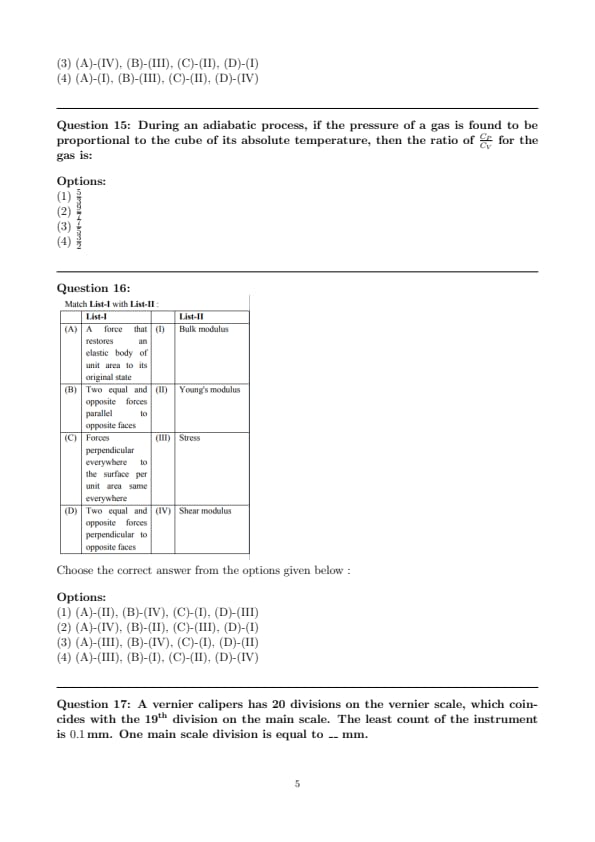
During an adiabatic process, if the pressure of a gas is found to be proportional to the cube of its absolute temperature, then the ratio of CP/CV for the gas is:
For an adiabatic process, P ∝ T3. Using the relation P ∝ V-γ, γ = 7/5 is obtained, where γ = CP/CV.
Read More
Apply the ideal gas law and the adiabatic condition to derive the proportionality and solve for γ = CP/CV.
Question 16:
Choose the answer from the options given below:
The matching between List-I and List-II is as follows:
(A) A force that restores an elastic body of unit area to its original state corresponds to Stress (III).
(B) Two equal and opposite forces parallel to opposite faces correspond to Shear modulus (IV).
(C) Forces perpendicular everywhere to the surface per unit area correspond to Bulk modulus (I).
(D) Two equal and opposite forces perpendicular to opposite faces correspond to Young’s modulus (II).
Read More
Analyze the definitions and roles of different mechanical properties to match them correctly with their descriptions.
Question 17:
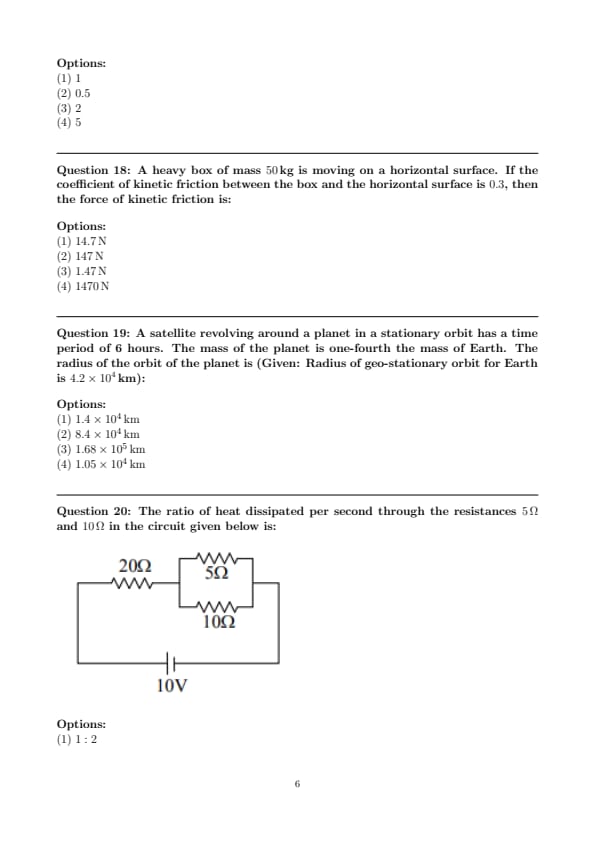
A vernier calipers has 20 divisions on the vernier scale, which coincides with the 19th division on the main scale. The least count of the instrument is 0.1mm. One main scale division is equal to:
From the given data, 20 vernier scale divisions coincide with 19 main scale divisions. The least count is given as 1 main scale division minus 1 vernier scale division. Substituting the values, one main scale division is calculated to be 2mm.
Read More
The least count formula is LC = 1 MSD - 1 VSD. Solving for MSD using the relationship between MSD and VSD yields 2mm.
Question 18:
A heavy box of mass 50kg is moving on a horizontal surface. If the coefficient of kinetic friction between the box and the surface is 0.3, then the force of kinetic friction is:
The normal force acting on the box is equal to its weight, calculated as 50 × 9.8 = 490N. The force of kinetic friction is given by µk × N = 0.3 × 490 = 147N.
Read More
Apply the frictional force formula Fk = µk × N, where N is the normal force. Substituting the values gives Fk = 147N.
Question 19:
A satellite revolving around a planet in a stationary orbit has a time period of 6 hours. The mass of the planet is one-fourth the mass of Earth. The radius of the orbit of the planet is:
Using Kepler’s third law and the given ratio of the masses and time periods, the radius of the orbit is calculated as 1.05×10⁴ km, using the proportional relationship r³ ∝ T²/M.
Read More
Kepler’s third law is T² ∝ r³/M. Substituting the given values for T and M and solving for r gives the orbit radius as 1.05×10⁴ km.
Question 20:
The ratio of heat dissipated per second through the resistances 5Ω and 10Ω in the circuit given below is:
The 5Ω and 10Ω resistors are connected in parallel. The current through each resistor is inversely proportional to its resistance. The power dissipated in a resistor is proportional to the square of the current and the resistance. This gives a ratio of heat dissipation of 2:1.
Read More
Using P = I²R and the inverse proportionality of current to resistance in parallel circuits, calculate the power ratio between the two resistors.
Question 21:
A solenoid of length 0.5m has a radius of 1 cm and is made up of m number of turns. It carries a current of 5A. If the magnitude of the magnetic field inside the solenoid is 6.28×10⁻³T, then the value of m is:
The magnetic field inside a solenoid is given by B = µ₀ni, where n is the number of turns per unit length. Rearranging to find m, we use the given values of B, µ₀, and i to calculate m as 500.
Read More
Use the formula n = m/L and B = µ₀ni. Substituting the given parameters simplifies to m = 500.
Question 22:
The shortest wavelength of the spectral lines in the Lyman series of the hydrogen spectrum is 915 Å. The longest wavelength of spectral lines in the Balmer series will be:
The longest wavelength in the Balmer series corresponds to the transition from n=3 to n=2. Using the formula for energy levels and the given Lyman series data, the wavelength is calculated as 6588 Å.
Read More
Use the Rydberg formula for the wavelength of spectral lines and solve for the longest wavelength in the Balmer series.
Question 23:
In a single-slit experiment, a parallel beam of green light of wavelength 550 nm passes through a slit of width 0.20 mm. The transmitted light is collected on a screen 100 cm away. The distance of the first-order minima from the central maximum will be x×10⁻⁵ m. The value of x is:
The distance of the first-order minima is given by y = λD/d. Substituting the given values, the distance is calculated as 275×10⁻⁵ m, where x=275.
Read More
Calculate the position of the minima using y = λD/d with given parameters for wavelength (λ), distance (D), and slit width (d).
Question 24:
A sonometer wire of resonating length 90 cm has a fundamental frequency of 400 Hz when kept under some tension. The resonating length of the wire with a fundamental frequency of 600 Hz under the same tension is:
The length of the sonometer wire is inversely proportional to the frequency. Using the ratio L₁/L₂ = f₂/f₁, the resonating length for 600 Hz is calculated as 60 cm.
Read More
Apply the inverse relationship between length and frequency to find the new resonating length.
Question 25:
A hollow sphere is rolling on a plane surface about its axis of symmetry. The ratio of rotational kinetic energy to its total kinetic energy is x/5. The value of x is:
The total kinetic energy is the sum of rotational and translational kinetic energy. For a hollow sphere, the ratio of rotational to total kinetic energy is 2/5, giving x=2.
Read More
Calculate the ratio using the moment of inertia of a hollow sphere and the relationship between rotational and translational kinetic energies.
Question 26:
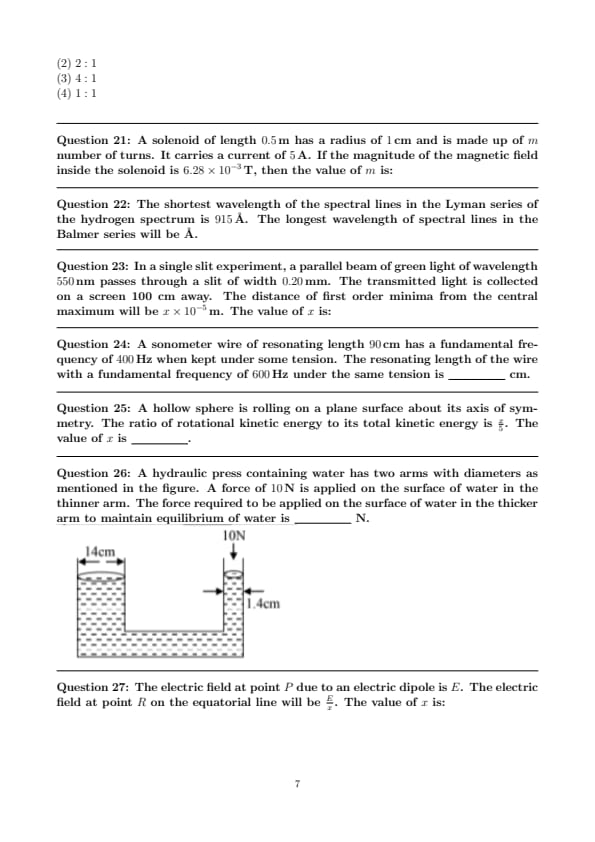
A hydraulic press containing water has two arms with diameters as mentioned in the figure. A force of 10 N is applied on the surface of water in the thinner arm. The force required to be applied on the surface of water in the thicker arm to maintain equilibrium of water is:
Using Pascal's law, the pressures in both arms are equal. The force is proportional to the cross-sectional area of each arm. Given the ratio of diameters, the force on the thicker arm is calculated to be 1000 N.
Read More
Apply Pascal’s principle: Pressure = Force/Area. Use the area ratio from diameters to find the force.
Question 27:
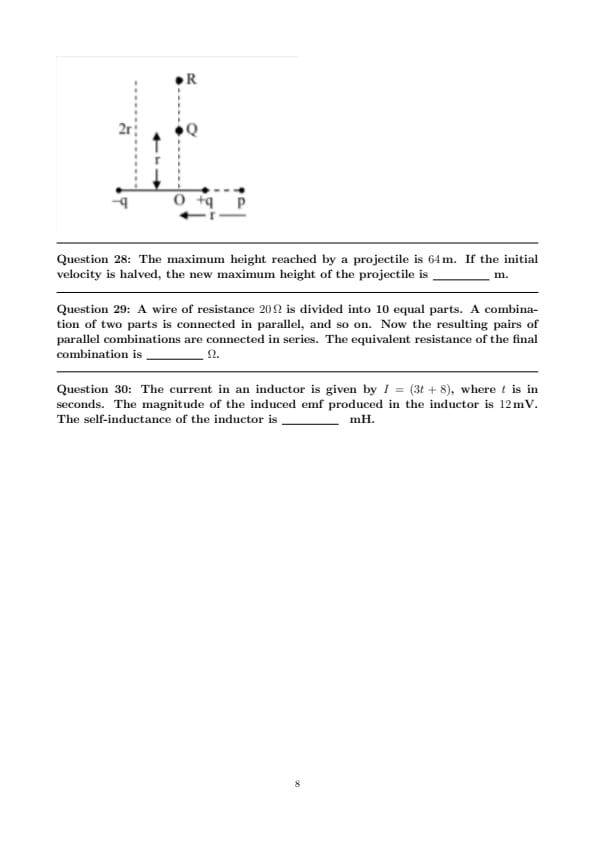
The electric field at point P due to an electric dipole is E. The electric field at point R on the equatorial line will be E/x. The value of x is:
For an electric dipole, the field on the axial line is twice as strong as the field on the equatorial line at the same distance. The ratio E_axial/E_equatorial gives x = 16.
Read More
Electric field along the axial line is proportional to 2p/r³, while the equatorial line field is proportional to p/r³. Taking the ratio gives x = 16.
Question 28:
The maximum height reached by a projectile is 64 m. If the initial velocity is halved, the new maximum height of the projectile is:
The maximum height of a projectile is proportional to the square of the initial velocity. Halving the velocity reduces the height to one-fourth. Thus, the new height is 64/4 = 16 m.
Read More
Maximum height H = (v₀²sin²θ)/(2g). Reducing v₀ to v₀/2 decreases H to (1/4)H.
Question 29:
A wire of resistance 20 Ω is divided into 10 equal parts. A combination of two parts is connected in parallel, and so on. Now the resulting pairs of parallel combinations are connected in series. The equivalent resistance of the final combination is:
Each part of the wire has a resistance of 2 Ω. When two parts are connected in parallel, the equivalent resistance is 1 Ω. Five such pairs connected in series result in a total resistance of 5 Ω.
Read More
Resistance of each part = 20/10 = 2 Ω. Parallel combination of two parts gives R_parallel = 1 Ω. Total resistance = 5 × 1 = 5 Ω.
Question 30:
The current in an inductor is given by I = (3t + 8), where t is in seconds. The magnitude of the induced emf produced in the inductor is 12 mV. The self-inductance of the inductor is:
The induced emf is given by |ε| = L (dI/dt). Differentiating I = 3t + 8 gives dI/dt = 3. Substituting |ε| = 12×10⁻³ V, L is calculated as 4 mH.
Read More
Using |ε| = L(dI/dt), calculate L = ε/dI/dt. Substituting values gives L = 4 mH.
*The article might have information for the previous academic years, please refer the official website of the exam.