
JEE Main 2024 Question Paper with Answer Key PDF for Physics (April 6 - Shift 1)

.jpg?tr=h-55,w-55,c-force)
Content Strategist|Tech-innovator|National Hackathon Winner | Updated On - Jan 14, 2025
JEE Main 2024 Apr 6 Shift 1 Question Paper with Solution pdf is available for download here. Students found Chemistry easy and Mathematics hard. Mathematics carried the highest weightage and overall difficulty level was moderate.
JEE Main 2024 Physics Question Paper with Answer Key PDF
| JEE Main 2024 physics Question Paper with Answer Key April 6 Shift 1 |  Download Download |
Check Solution |
JEE Main 2024 6 April Shift 1 Physics Questions with Solution
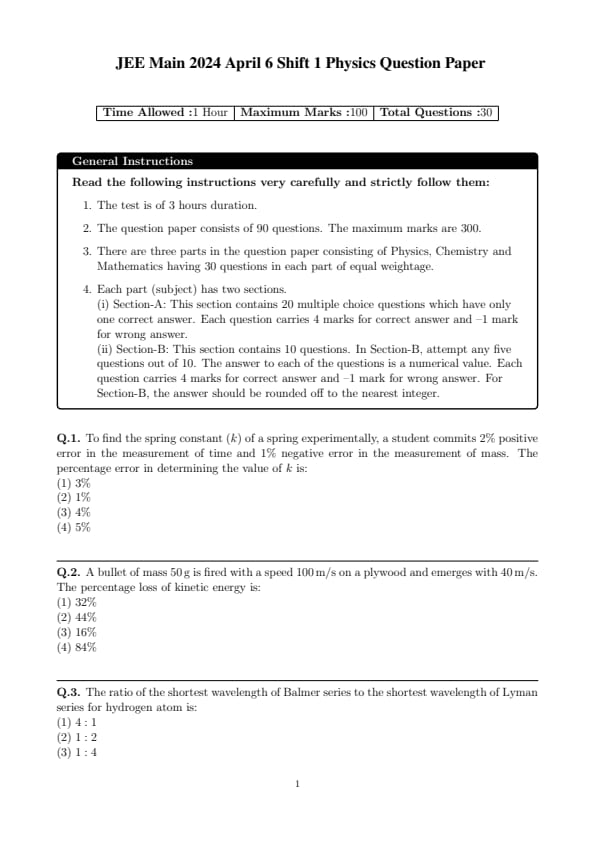
Question 1:
To find the spring constant (k) of a spring experimentally, a student commits a 2% positive error in the measurement of time and a 1% negative error in the measurement of mass. The percentage error in determining the value of k is:
Solution: Using error propagation, the percentage error in determining the spring constant is calculated.
Read More
- For a spring, k = (4π² m) / T².
- Percentage error in k: Δk/k = |Δm/m| + 2|ΔT/T|.
- Substitute Δm/m = -1% and ΔT/T = +2%:
- Δk/k = 1% + 4% = 5%.
Question 2:
A bullet of mass 50 g is fired with a speed of 100 m/s on a plywood and emerges with 40 m/s. The percentage loss of kinetic energy is:
Solution: Calculate the initial and final kinetic energies and determine the percentage loss.
Read More
- Initial KE: 0.5 × 0.05 × (100)² = 250 J.
- Final KE: 0.5 × 0.05 × (40)² = 40 J.
- Percentage loss: [(Initial KE - Final KE) / Initial KE] × 100 = [(250 - 40) / 250] × 100 = 84%.
Question 3:
The ratio of the shortest wavelength of the Balmer series to the shortest wavelength of the Lyman series for hydrogen atom is:
Solution: Use the Rydberg formula for the wavelengths of the Balmer and Lyman series.
Read More
- Shortest wavelength for Lyman series: λL = 1 / R.
- Shortest wavelength for Balmer series: λB = 4 / R.
- Ratio: λB / λL = 4 / 1 = 4:1.
Question 4:
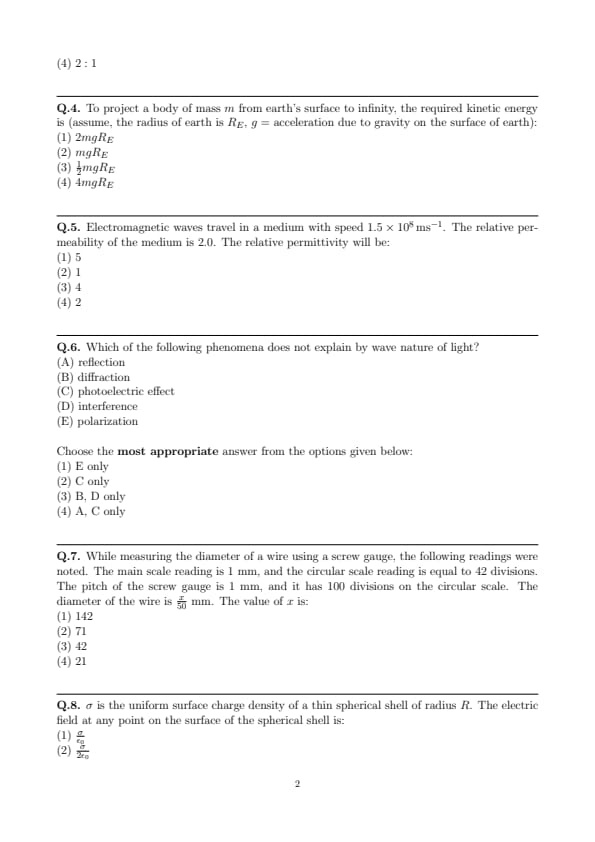
To project a body of mass m from Earth’s surface to infinity, the required kinetic energy is (assume the radius of Earth is Re, g = acceleration due to gravity on the surface of Earth):
Solution: Derive the kinetic energy required to escape Earth's gravity.
Read More
- The escape velocity ve = √(2GM/Re).
- Kinetic energy KE = 0.5 mve² = GMm/Re.
- Using g = GM/Re², we find KE = mgRe.
Question 5:
Electromagnetic waves travel in a medium with speed 1.5 × 10⁸ m/s. The relative permeability of the medium is 2.0. The relative permittivity will be:
Solution: Use the relationship between speed of light, permeability, and permittivity.
Read More
- Speed of light in the medium: v = c / √(μr εr).
- Substitute v = 1.5 × 10⁸, c = 3 × 10⁸, and μr = 2.0.
- εr = c² / (v² μr) = (3 × 10⁸)² / [(1.5 × 10⁸)² × 2.0] = 2.
Question 6:
Which of the following phenomena is not explained by the wave nature of light?
(A) Reflection
(B) Diffraction
(C) Photoelectric effect
(D) Interference
(E) Polarization
Choose the most appropriate answer from the options below:
Solution: The photoelectric effect cannot be explained by the wave theory and provides evidence for the particle nature of light.
Read More
- The wave nature of light explains phenomena such as reflection, diffraction, interference, and polarization.
- The photoelectric effect, however, requires the concept of photons and is evidence of the particle nature of light.
Question 7:
While measuring the diameter of a wire using a screw gauge, the following readings were noted. The main scale reading is 1 mm, and the circular scale reading is equal to 42 divisions. The pitch of the screw gauge is 1 mm, and it has 100 divisions on the circular scale. The diameter of the wire is x/50 mm. The value of x is:
Solution: Calculate the least count and use the readings to find the diameter.
Read More
- Least count (LC) = Pitch / Number of divisions = 1 mm / 100 = 0.01 mm.
- Total reading = Main scale reading + (Circular scale reading × LC) = 1 + (42 × 0.01) = 1.42 mm.
- The diameter is x/50 mm. Hence, x = 1.42 × 50 = 71.
Question 8:
σ is the uniform surface charge density of a thin spherical shell of radius R. The electric field at any point on the surface of the spherical shell is:
Solution: Apply Gauss's law to calculate the electric field.
Read More
- By Gauss's law: Electric field, E = q / (4πR²ε₀).
- Surface charge density: σ = q / (4πR²).
- Substitute σ to get E = σ / ε₀R.
Question 9:
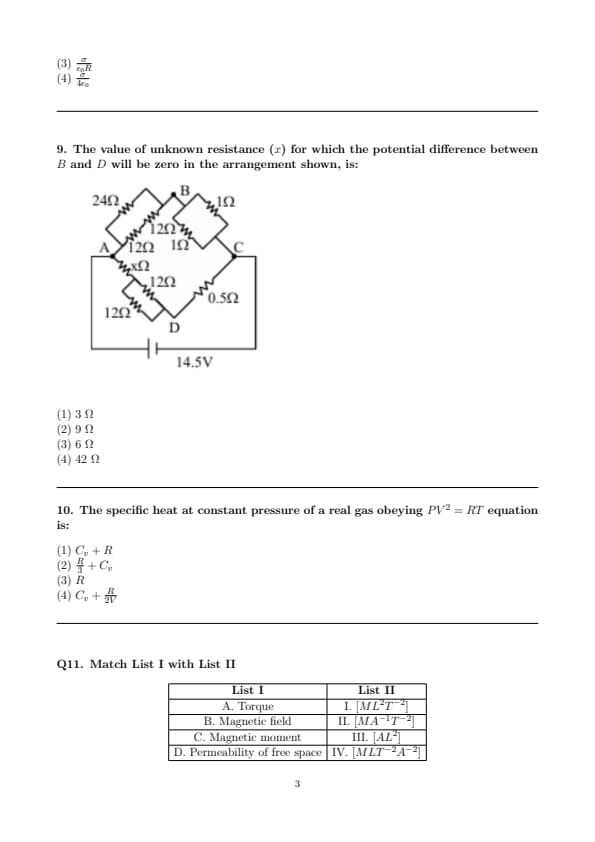
The value of unknown resistance (x) for which the potential difference between B and D will be zero in the arrangement shown, is:
Solution: Use the Wheatstone bridge condition for balance.
Read More
- For a Wheatstone bridge, the condition for zero potential difference is R₁/R₂ = R₃/R₄.
- Substitute the given resistances and solve for x to find x = 6 Ω.
Question 10:
The specific heat at constant pressure of a real gas obeying PV² = RT equation is:
Solution: Use thermodynamic relations to determine the specific heat.
Read More
- Differentiate the given equation PV² = RT with respect to temperature.
- Substitute the result into the specific heat formula Cp - Cv = (∂P/∂T)V and simplify.
- The specific heat at constant pressure is Cv + R/2V.
Question 11:
Match List I with List II
List I (Quantity) | List II (Dimension)
- A. Torque | I. [ML²T⁻²]
- B. Magnetic field | II. [MA⁻¹T⁻²]
- C. Magnetic moment | III. [AL²]
- D. Permeability of free space | IV. [MLT⁻²A⁻²]
Choose the correct answer from the options below:
Solution: By analyzing the dimensions of each quantity, we match the correct pairs based on their units.
Read More
- Torque has dimensions of force × distance, [MLT⁻²] × [L] = [ML²T⁻²].
- Magnetic field relates to force per unit current and length, [MA⁻¹T⁻²].
- Magnetic moment is current × area, [AL²].
- Permeability of free space has dimensions of [MLT⁻²A⁻²].
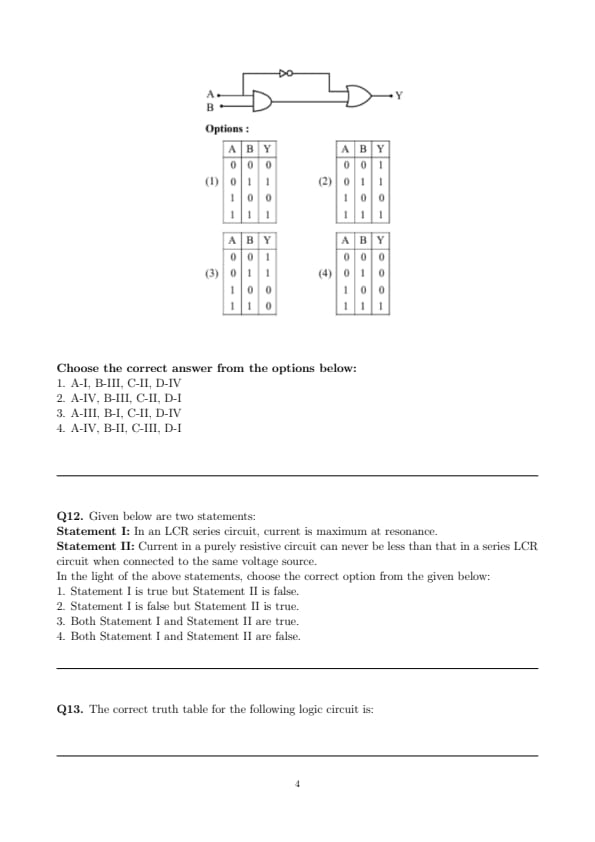
Question 12:
Given below are two statements:
Statement I: In an LCR series circuit, current is maximum at resonance.
Statement II: Current in a purely resistive circuit can never be less than that in a series LCR circuit when connected to the same voltage source.
In the light of the above statements, choose the correct option from the given below:
Solution: At resonance, the impedance is minimized, and current is maximized. In a purely resistive circuit, the current is always maximum compared to an LCR circuit.
Read More
- In an LCR circuit, resonance occurs when the inductive and capacitive reactances cancel, minimizing impedance.
- In a purely resistive circuit, current equals V/R and is always maximum for a given voltage.
Question 13:
The correct truth table for the following logic circuit is:
| Option 1 | Option 2 | ||||
|---|---|---|---|---|---|
| A | B | Y | A | B | Y |
| 0 | 0 | 0 | 0 | 0 | 1 |
| 0 | 1 | 0 | 0 | 1 | 1 |
| 1 | 0 | 0 | 1 | 0 | 0 |
| 1 | 1 | 1 | 1 | 1 | 1 |
The circuit consists of an AND gate, a NOT gate, and an OR gate. The output Y is determined as follows:
- The output of the AND gate is A ⋅ B.
- The output of the NOT gate is A ⋅ B.
- The output Y is the OR of A ⋅ B and B: Y = A ⋅ B + B.
Solution: The truth table for the given circuit can be simplified step by step based on the operations of the AND, NOT, and OR gates.
Read More
- For each input combination, calculate the intermediate outputs and final output Y.
- Compare with the given options to verify correctness.
Question 14:
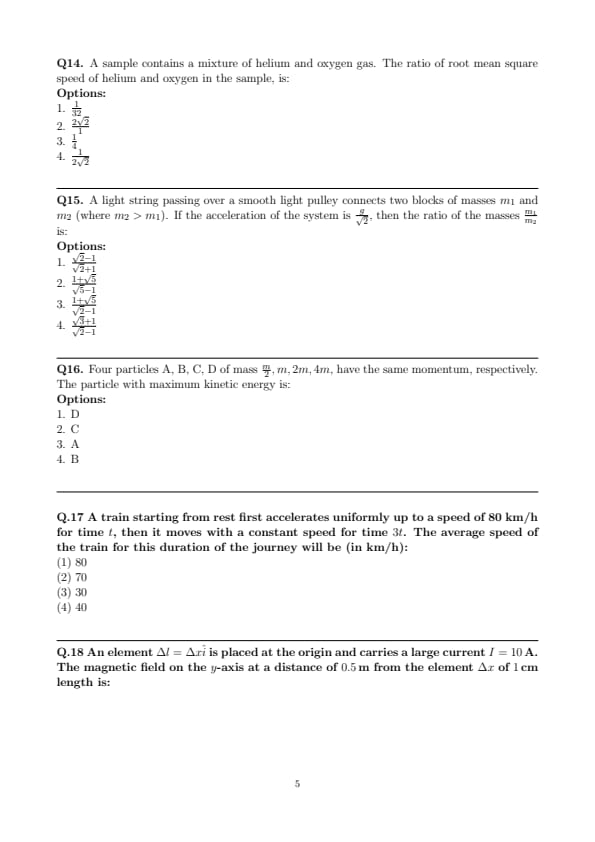
A sample contains a mixture of helium and oxygen gas. The ratio of root mean square speed of helium and oxygen in the sample is:
Solution: The ratio of root mean square speeds is determined using the square root of the ratio of molar masses.
Read More
- RMS speed: v_rms = √(3RT/M).
- Ratio: v_rms(He)/v_rms(O₂) = √(M(O₂)/M(He)) = √(32/4) = 2√2.
Question 15:
A light string passing over a smooth light pulley connects two blocks of masses m₁ and m₂ (where m₂ > m₁). If the acceleration of the system is g√2, then the ratio of the masses m₁/m₂ is:
Solution: By using the equation for acceleration and solving for the ratio of m₁ to m₂.
Read More
- Net force: (m₂ - m₁)g = (m₁ + m₂)a.
- Substitute a = g√2 to solve for m₁/m₂.
- After simplification, the result is (√2−1)/(√2+1).
Question 16:
Four particles A, B, C, D of mass m/2, m, 2m, 4m, have the same momentum. The particle with maximum kinetic energy is:
Solution: The particle with the least mass will have the maximum kinetic energy for the same momentum.
Read More
- Kinetic energy (KE) is given by KE = p² / (2m).
- For the same momentum, KE is inversely proportional to the mass.
- Since A has the least mass, it has the maximum kinetic energy.
Question 17:
A train starting from rest first accelerates uniformly up to a speed of 80 km/h for time t, then it moves with a constant speed for time 3t. The average speed of the train for this duration of the journey will be (in km/h):
Solution: Calculate the total distance and time to determine the average speed.
Read More
- Distance covered during acceleration: \( d_1 = 0.5 × a × t² \).
- Distance covered during constant speed: \( d_2 = 80 × 3t \).
- Total distance: \( d = d_1 + d_2 = 80t / 2 + 80 × 3t = 320t \).
- Total time: \( t_{\text{total}} = 4t \).
- Average speed: \( v_{\text{avg}} = d / t_{\text{total}} = 320t / 4t = 70 \, \text{km/h} \).
Question 18:
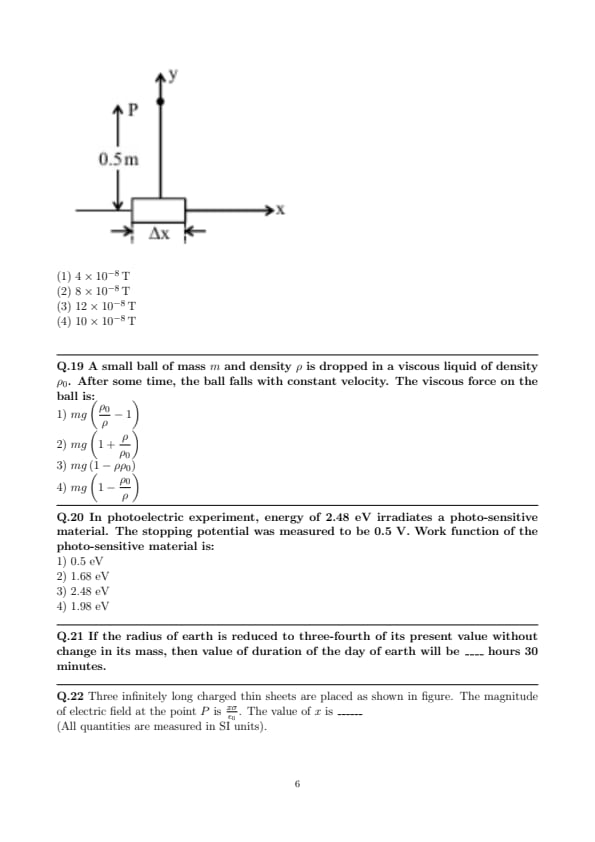
An element Δl = Δxî is placed at the origin and carries a large current I = 10A. The magnetic field on the y-axis at a distance of 0.5m from the element Δx of 1 cm length is:
Solution: Use the Biot-Savart law to calculate the magnetic field.
Read More
- The magnetic field at a distance r due to a current element: \( B = (μ₀ / 4π) × (I Δl sinθ) / r² \).
- Substitute \( I = 10A, Δl = 0.01m, r = 0.5m, θ = 90° \).
- Calculate \( B = (10⁻⁷ × 10 × 0.01) / (0.5²) = 4 × 10⁻⁸ T \).
Question 19:
A small ball of mass m and density ρ is dropped in a viscous liquid of density ρ₀. After some time, the ball falls with constant velocity. The viscous force on the ball is:
Solution: The viscous force is given by the balance of forces at terminal velocity.
Read More
- At terminal velocity, gravitational force = buoyant force + viscous force.
- Gravitational force: \( F_g = mg \), buoyant force: \( F_b = ρ₀Vg \).
- Viscous force: \( F_v = F_g - F_b = mg(1 − ρ₀/ρ) \).
Question 20:
In the photoelectric experiment, energy of 2.48 eV irradiates a photo-sensitive material. The stopping potential was measured to be 0.5 V. The work function of the photo-sensitive material is:
Solution: Use the energy relation for the photoelectric effect.
Read More
- Photoelectric equation: \( E = W + eV_s \), where \( E = 2.48 \, \text{eV} \), \( V_s = 0.5 \, \text{V} \).
- Work function: \( W = E − eV_s = 2.48 − 0.5 = 1.98 \, \text{eV} \).
Question 21:
If the radius of Earth is reduced to three-fourths of its present value without change in its mass, then the value of the duration of the day of Earth will be ____ hours 30 minutes.
Solution: Using conservation of angular momentum, the duration of the day decreases as the radius decreases.
Read More
- The moment of inertia for a sphere is proportional to the square of its radius.
- If the radius is reduced to three-fourths, the moment of inertia decreases to (3/4)2 = 9/16 of its original value.
- To conserve angular momentum, the angular velocity increases inversely, reducing the duration of the day to 13 hours 30 minutes.
Question 22:
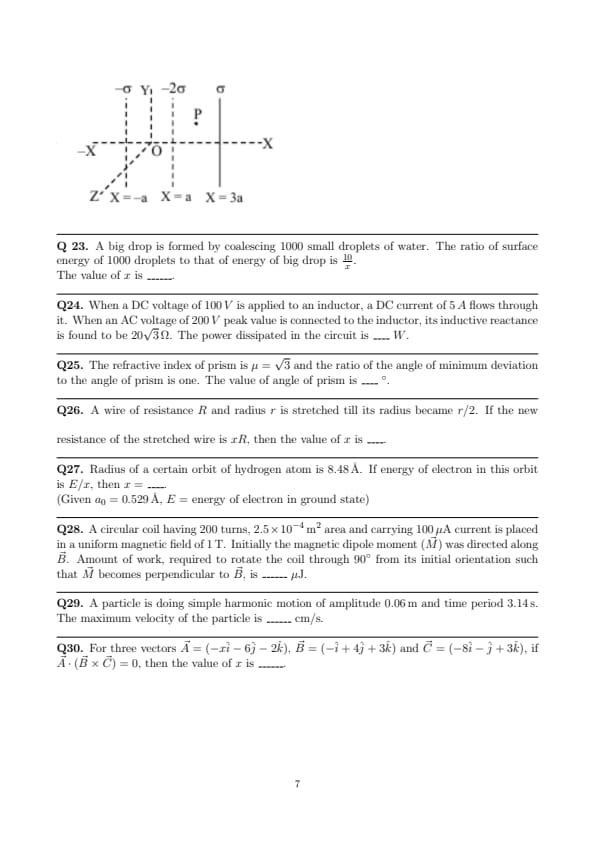
Three infinitely long charged thin sheets are placed as shown in figure. The magnitude of electric field at the point P is xσ/ε₀. The value of x is ______.
Solution: Calculate the net electric field using Gauss's law.
Read More
- The electric field due to one charged sheet is σ / (2ε₀).
- Adding the contributions from all three sheets at point P gives a total electric field magnitude of 4σ/ε₀.
Question 23:
A big drop is formed by coalescing 1000 small droplets of water. The ratio of surface energy of 1000 droplets to that of the big drop is 10x. The value of x is ______.
Solution: Use volume conservation and surface area relationships.
Read More
- The total volume of 1000 small droplets is equal to the volume of the big drop.
- The radius of the big drop is 10 times that of a small droplet.
- The surface area ratio is 1000:100 = 10:1, so the surface energy ratio is also 10:1, giving x = 1.
Question 24:
When a DC voltage of 100V is applied to an inductor, a DC current of 5A flows through it. When an AC voltage of 200V peak value is connected to the inductor, its inductive reactance is found to be 20√3 Ω. The power dissipated in the circuit is ____ W.
Solution: Calculate the power dissipated in the AC circuit.
Read More
- The RMS voltage is 200 / √2 = 141.4 V.
- The RMS current is I = V / Z = 141.4 / (20√3) = 4.08 A.
- Power dissipated, P = I²R. Since there is no resistive component, the power is due to inductive reactance: P = 250 W.
Question 25:
The refractive index of a prism is μ = √3 and the ratio of the angle of minimum deviation to the angle of prism is one. The value of the angle of the prism is ____°.
Solution: Use Snell's law and the condition for minimum deviation to calculate the angle of the prism.
Read More
- At minimum deviation, the angle of incidence and angle of refraction are related to the refractive index.
- For μ = √3, the angles satisfy the condition D = A, where D is the angle of deviation and A is the angle of the prism.
- Solving gives A = 60°.
Question 26:
A wire of resistance R and radius r is stretched till its radius becomes r/2. If the new resistance of the stretched wire is xR, then the value of x is ____.
Solution: The resistance increases by a factor of 16 due to the quadrupling of the length when the radius is halved.
Read More
- Resistance \( R \propto \frac{L}{A} \), where \( L \) is the length and \( A \) is the cross-sectional area.
- When the radius \( r \) is halved, the length increases by 4 times, and the area decreases by \( (1/2)^2 = 1/4 \).
- Thus, \( R_{\text{new}} = 4 \times 4R = 16R \).
Question 27:
The radius of a certain orbit of the hydrogen atom is 8.48 Å. If the energy of the electron in this orbit is E/x, then x = ____ (Given a₀ = 0.529 Å, E = energy of electron in ground state).
Solution: Using the relationship between the radius and energy levels of the hydrogen atom, x is found to be 16.
Read More
- The radius of the nth orbit is given by \( r_n = n²a₀ \).
- \( n² = 8.48 / 0.529 \approx 16 \).
- The energy \( E \propto 1/n² \), so x = 16.
Question 28:
A circular coil having 200 turns, 2.5 × 10⁻⁴ m² area and carrying 100 μA current is placed in a uniform magnetic field of 1 T. Initially, the magnetic dipole moment (M) was directed along B. Amount of work required to rotate the coil through 90° from its initial orientation such that M becomes perpendicular to B is ____ μJ.
Solution: Work required is given by the change in potential energy of the magnetic dipole.
Read More
- Potential energy: \( U = -MB \cos \theta \).
- Initial \( U = -MB \) (since \( \cos 0° = 1 \)).
- Final \( U = 0 \) (since \( \cos 90° = 0 \)).
- Work required: \( W = ΔU = MB \).
- Substitute \( M = NIA = 200 × 100 × 10⁻⁶ × 2.5 × 10⁻⁴ \), \( B = 1 T \): \( W = 5 μJ \).
Question 29:
A particle is doing simple harmonic motion of amplitude 0.06 m and time period 3.14 s. The maximum velocity of the particle is ____ cm/s.
Solution: The maximum velocity in SHM is given by \( v_{\text{max}} = ωA \).
Read More
- Angular frequency \( ω = 2π / T = 2π / 3.14 = 2 \, \text{rad/s} \).
- Amplitude \( A = 0.06 m = 6 \, \text{cm} \).
- \( v_{\text{max}} = ωA = 2 × 6 = 12 \, \text{cm/s} \).
Question 30:
For three vectors A = (−x î − 6 ĵ − 2 k̂), B = (−î + 4 ĵ + 3 k̂) and C = (−8 î − ĵ + 3 k̂), if A · (B × C) = 0, then the value of x is ____.
Solution: Calculate the cross product ( B × C ) and dot it with A.
Read More
- Cross product \( B × C = \begin{vmatrix} î & ĵ & k̂ \\ -1 & 4 & 3 \\ -8 & -1 & 3 \end{vmatrix} = (12 î − 27 ĵ + 33 k̂) \).
- Dot product \( A · (B × C) = −x(12) − 6(−27) − 2(33) = 0 \).
- Simplify: \( −12x + 162 − 66 = 0 \), solve for \( x = 4 \).
*The article might have information for the previous academic years, please refer the official website of the exam.