
JEE Main 2024 Question Paper with Answer Key PDF for Physics (April 6 - Shift 2)

.jpg?tr=h-55,w-55,c-force)
Content Strategist|Tech-innovator|National Hackathon Winner | Updated On - Jan 14, 2025
JEE Main 2024 Apr 6 Shift 2 Question Paper with Solution pdf is available for download here. Students found Physics easy and Mathematics hard. Physics carried the highest weightage and overall difficulty level was moderate.
JEE Main 2024 Physics Question Paper with Answer Key PDF
| JEE Main 2024 physics Question Paper with Answer Key April 6 Shift 2 |  Download Download |
Check Solution |
JEE Main 2024 6 April Shift 2 Physics Questions with Solution
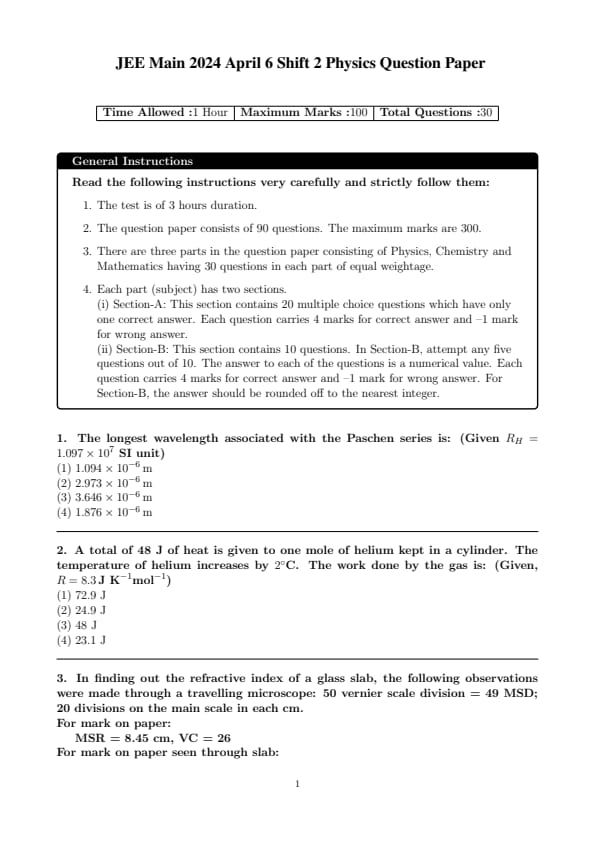
Question 1:
The longest wavelength associated with the Paschen series is: (Given RH = 1.097 × 10⁷ SI unit)
View Solution
Step 1: Use the Rydberg formula for wavelength:
1/λ = RH(1/n₁² − 1/n₂²), where n₁ = 3 and n₂ → ∞ for the longest wavelength.
Step 2: Substitute the values:
1/λ = 1.097 × 107 × (1/3² − 0) = 1.097 × 107 × (1/9).
Step 3: Solve for λ:
λ = 9 / (1.097 × 10⁷) = 1.876 × 10⁻⁶ m.
Final Answer: 1.876 × 10⁻⁶ m
Question 2:
A total of 48 J of heat is given to one mole of helium kept in a cylinder. The temperature of helium increases by 2°C. The work done by the gas is: (Given R = 8.3 J K−1 mol−1)
View Solution
Step 1: Apply the first law of thermodynamics:
Q = ΔU + W, where ΔU = CVΔT and W is the work done.
Step 2: Calculate ΔU:
CV for helium (monoatomic gas) = (3/2)R. ΔU = (3/2) × 8.3 × 2 = 24.9 J.
Step 3: Solve for W:
Q = ΔU + W → 48 = 24.9 + W → W = 23.1 J.
Final Answer: 23.1 J
Question 3:
In finding the refractive index of a glass slab, the following observations were made through a traveling microscope:
For mark on paper: MSR = 8.45 cm, VC = 26
For mark on paper seen through slab: MSR = 7.12 cm, VC = 41
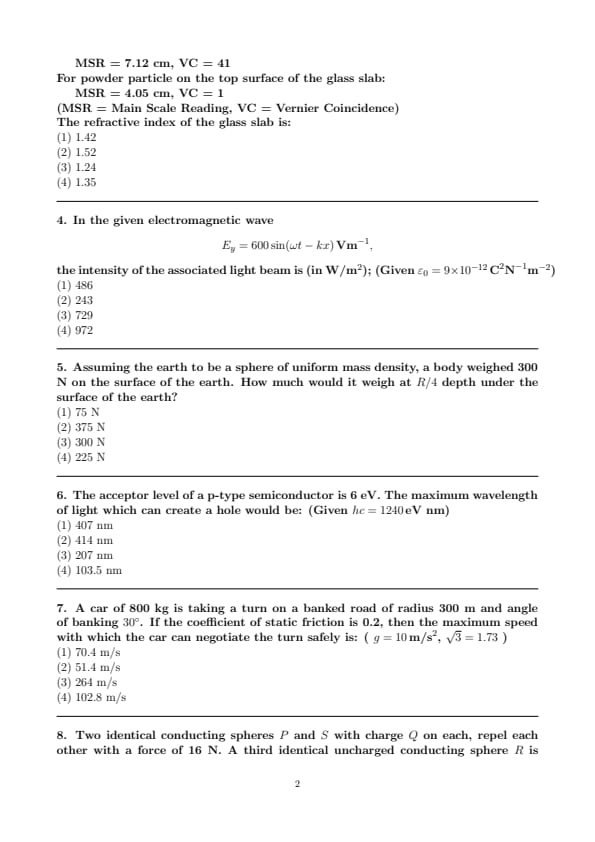
For powder particle on the top surface of the glass slab: MSR = 4.05 cm, VC = 1
The refractive index of the glass slab is:
View Solution
Step 1: Determine real thickness and apparent thickness:
Real thickness (L₁) = 8.45 − 4.05 = 4.4 cm.
Apparent thickness (L₂) = 7.12 − 4.05 = 3.07 cm.
Step 2: Calculate refractive index:
μ = L₁ / L₂ = 4.4 / 3.07 ≈ 1.42.
Final Answer: 1.42
Question 4:
In the given electromagnetic wave Ey = 600 sin(ωt − kx) Vm−1, the intensity of the associated light beam is (in W/m²): (Given ε₀ = 9 × 10⁻¹² C²N−1m−2)
View Solution
Step 1: Use the intensity formula:
I = (1/2)ε₀E₀²c, where E₀ = 600 Vm−1, c = 3 × 10⁸ m/s.
Step 2: Substitute the values:
I = (1/2) × (9 × 10−12) × (600)² × (3 × 108).
I = 486 W/m².
Final Answer: 486 W/m²
Question 5:
Assuming the earth to be a sphere of uniform mass density, a body weighed 300 N on the surface of the earth. How much would it weigh at R/4 depth under the surface of the earth?
View Solution
Step 1: Use the formula for gravity at depth:
gd = gs(1 − d/R), where d = R/4 and gs is the surface gravity.
Step 2: Substitute values:
gd = gs(1 − 1/4) = (3/4)gs.
Step 3: Calculate the weight:
Weight at depth = (3/4) × 300 = 225 N.
Final Answer: 225 N
Question 6:
The acceptor level of a p-type semiconductor is 6 eV. The maximum wavelength of light which can create a hole would be: (Given hc = 1240 eV nm)
View Solution
Step 1: Use the relation between energy and wavelength:
λ = hc/E, where h = Planck's constant, c = speed of light, and E = energy of acceptor level.
Step 2: Substitute values:
λ = 1240 / 6 = 207 nm.
Final Answer: 207 nm
Question 7:
A car of 800 kg is taking a turn on a banked road of radius 300 m and angle of banking 30°. If the coefficient of static friction is 0.2, then the maximum speed with which the car can negotiate the turn safely is: (g = 10 m/s², √3 = 1.73)
View Solution
Step 1: Use the formula for maximum speed:
Vmax = √[rg(tanθ + μ) / (1 − μtanθ)], where r = 300 m, θ = 30°, μ = 0.2.
Step 2: Substitute values:
tanθ = √3/3, so Vmax = √[300 × 10 × ((√3/3) + 0.2) / (1 − 0.2(√3/3))].
Step 3: Simplify and calculate:
Vmax ≈ 51.4 m/s.
Final Answer: 51.4 m/s
Question 8:
Two identical conducting spheres P and S with charge Q on each, repel each other with a force of 16 N. A third identical uncharged conducting sphere R is successively brought in contact with the two spheres. The new force of repulsion between P and S is:
View Solution
Step 1: Determine the charge distribution after contacts:
- After contact with R, P and R share charge: Q/2 each.
- After R contacts S, charges become Q/4 and 3Q/4 for P and S.
Step 2: Calculate the new force:
Force = k(QPQS/r²), where QP = Q/4, QS = 3Q/4.
New force = 16 × (1/4 × 3/4) = 6 N.
Final Answer: 6 N
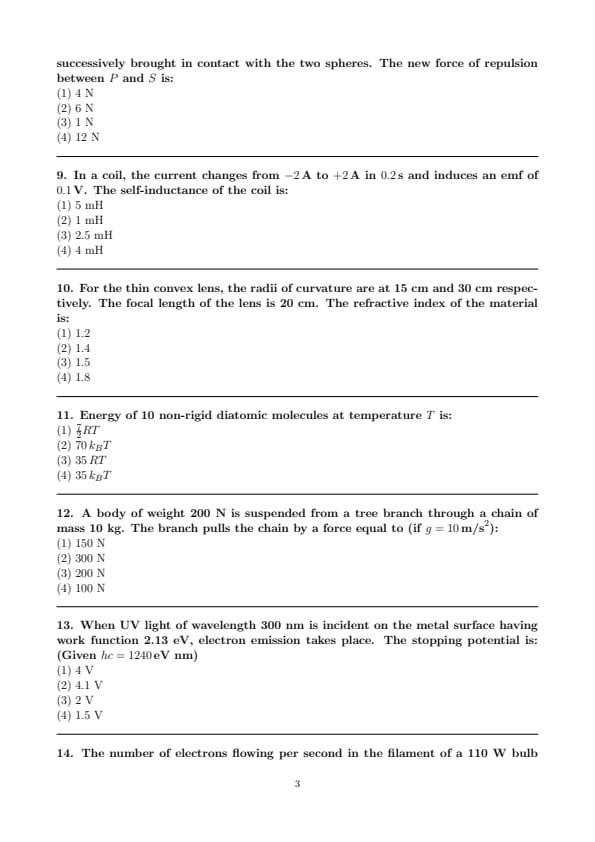
Question 9:
In a coil, the current changes from −2 A to +2 A in 0.2 s and induces an emf of 0.1 V. The self-inductance of the coil is:
View Solution
Step 1: Use the formula for emf induced:
emf = −L(di/dt), where di = 4 A and dt = 0.2 s.
Step 2: Solve for L:
L = emf × dt / di = 0.1 × 0.2 / 4 = 0.005 H = 5 mH.
Final Answer: 5 mH
Question 10:
For the thin convex lens, the radii of curvature are at 15 cm and 30 cm, respectively. The focal length of the lens is 20 cm. The refractive index of the material is:
View Solution
Step 1: Use the lens maker's formula:
1/f = (μ − 1)(1/R₁ − 1/R₂), where R₁ = 15 cm, R₂ = −30 cm, and f = 20 cm.
Step 2: Solve for μ:
1/20 = (μ − 1)(1/15 − (−1/30)).
Simplify: μ − 1 = 1/30 → μ = 1.5.
Final Answer: 1.5
Question 11:
Energy of 10 non-rigid diatomic molecules at temperature T is:
View Solution
Step 1: Determine degrees of freedom.
For non-rigid diatomic molecules, degrees of freedom = 7 (3 translational, 2 rotational, 2 vibrational).
Step 2: Calculate energy per molecule.
Energy = (7/2)kBT per molecule.
Step 3: Multiply by the number of molecules.
Total energy for 10 molecules = 10 × (7/2)kBT = 35kBT.
Final Answer: 35kBT
Question 12:
A body of weight 200 N is suspended from a tree branch through a chain of mass 10 kg. The branch pulls the chain by a force equal to: (g = 10 m/s²)
View Solution
Step 1: Add the weight of the body and chain.
Weight of chain = mass × gravity = 10 × 10 = 100 N.
Step 2: Total force on the branch.
Force = weight of body + weight of chain = 200 N + 100 N = 300 N.
Final Answer: 300 N
Question 13:
When UV light of wavelength 300 nm is incident on a metal surface having work function 2.13 eV, electron emission takes place. The stopping potential is: (Given hc = 1240 eV nm)
View Solution
Step 1: Calculate photon energy.
Energy of photon, E = hc/λ = 1240 / 300 = 4.13 eV.
Step 2: Apply the photoelectric equation.
Stopping potential, Vs = (E − work function) = 4.13 − 2.13 = 2 V.
Final Answer: 2 V
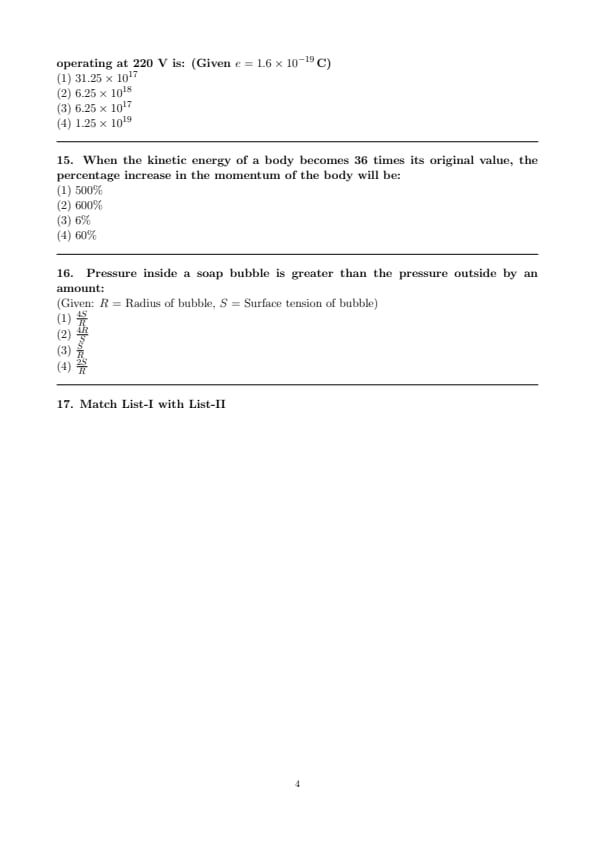
Question 14:
The number of electrons flowing per second in the filament of a 110 W bulb operating at 220 V is: (Given e = 1.6 × 10⁻¹⁹ C)
View Solution
Step 1: Calculate current.
P = VI → I = P/V = 110/220 = 0.5 A.
Step 2: Relate current and charge flow.
I = nq/t → n = I × t / e.
n = (0.5 × 1) / (1.6 × 10⁻¹⁹) = 31.25 × 10¹⁷ electrons per second.
Final Answer: 31.25 × 10¹⁷
Question 15:
When the kinetic energy of a body becomes 36 times its original value, the percentage increase in the momentum of the body will be:
View Solution
Step 1: Relate momentum and kinetic energy.
K ∝ p² → p ∝ √K.
Step 2: Calculate new momentum.
If K becomes 36 times, then p increases by √36 = 6 times.
Step 3: Compute percentage increase.
Percentage increase = (6 − 1) × 100% = 500%.
Final Answer: 500%
Question 16:
Pressure inside a soap bubble is greater than the pressure outside by an amount: (Given: R = Radius of bubble, S = Surface tension of bubble)
View Solution
Step 1: Understand pressure difference in a soap bubble.
A soap bubble has two liquid-air interfaces, so the pressure difference is calculated as ΔP = 4S/R.
Step 2: Derive the pressure difference.
For a single liquid-air interface, ΔP = 2S/R. Since a bubble has two surfaces, multiply by 2: ΔP = 4S/R.
Final Answer: 4S/R
Question 17:
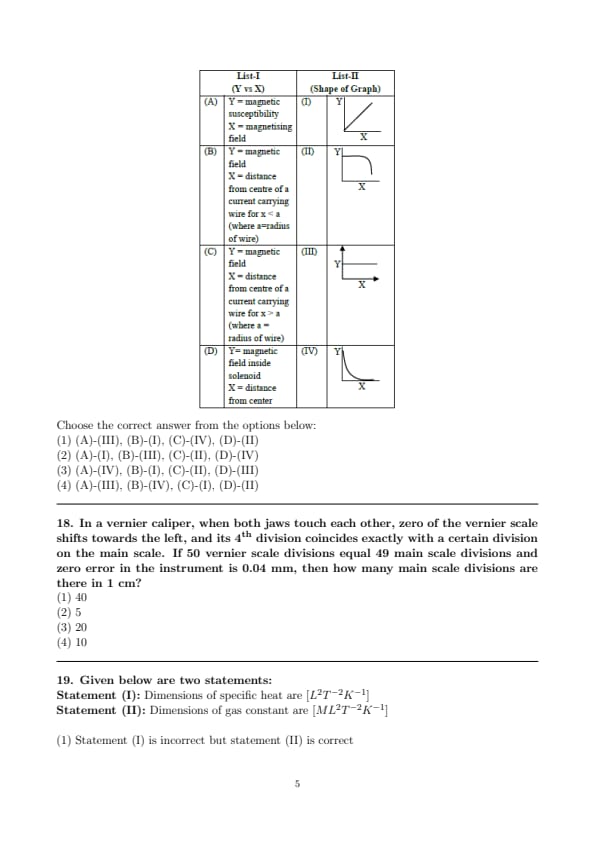
Match List-I with List-II
| List-I (Reaction) | List-II (Type of Redox Reaction) |
|---|---|
| (A) N2(g) + O2(g) → 2NO(g) | (I) Combination |
| (B) 2Pb(NO3)2(s) → 2PbO(s) + 4NO2(g) + O2(g) | (II) Decomposition |
| (C) 2Na(s) + 2H2O → 2NaOH(aq) + H2(g) | (III) Displacement |
| (D) 2NO2(g) + 2OH−(aq) → NO2−(aq) + NO3−(aq) + H2O(l) | (IV) Disproportionation |
Choose the correct answer:
View Solution
Step 1: Analyze the reaction types.
(A) N2 + O2 → 2NO is a combination reaction.
(B) 2Pb(NO3)2 → 2PbO + 4NO2 + O2 is a decomposition reaction.
(C) 2Na + 2H2O → 2NaOH + H2 is a displacement reaction.
(D) 2NO2 + 2OH− → NO2− + NO3− + H2O is a disproportionation reaction.
Final Answer: (A)-(I), (B)-(II), (C)-(III), (D)-(IV)
Question 18:
In a vernier caliper, when both jaws touch each other, zero of the vernier scale shifts towards the left, and its 4th division coincides exactly with a certain division on the main scale. If 50 vernier scale divisions equal 49 main scale divisions and zero error in the instrument is 0.04 mm, then how many main scale divisions are there in 1 cm?
View Solution
Step 1: Use the vernier caliper formula.
Least count = (1 MSD − 1 VSD) = (1 − 49/50) MSD = 1/50 MSD.
Step 2: Calculate the number of main scale divisions in 1 cm.
Each MSD = 1 cm / 50 = 0.2 mm.
Number of MSD in 1 cm = 10/0.2 = 20.
Final Answer: 20
Question 19:
Given below are two statements:
Statement I: Dimensions of specific heat are [L²T⁻²K⁻¹].
Statement II: Dimensions of gas constant are [ML²T⁻²K⁻¹].
Choose the correct answer:
View Solution
Step 1: Analyze dimensions of specific heat.
Specific heat has dimensions of energy per unit mass per unit temperature = [L²T⁻²K⁻¹]. Statement I is correct.
Step 2: Analyze dimensions of the gas constant.
Gas constant dimensions include per mole: [ML²T⁻²mol⁻¹K⁻¹]. Statement II is incorrect.
Final Answer: Statement I is correct but Statement II is incorrect.
Question 20:
A body projected vertically upwards with a certain speed from the top of a tower reaches the ground in t₁. If it is projected vertically downwards from the same point with the same speed, it reaches the ground in t₂. Time required to reach the ground, if it is dropped from the top of the tower, is:
View Solution
Step 1: Use kinematic equations.
Time of fall is determined by initial velocity and acceleration due to gravity.
Step 2: Relate times t₁, t₂, and t.
Time for free fall is the geometric mean of the times for upward and downward projection: t = √(t₁t₂).
Final Answer: √(t₁t₂)
Question 21:
In the Franck-Hertz experiment, the first dip in the current-voltage graph for hydrogen is observed at 10.2V. The wavelength of light emitted by the hydrogen atom when excited to the first excitation level is:
View Solution
Step 1: Calculate energy for the first excitation level.
The energy corresponding to the first excitation level is given as 10.2 eV.
Step 2: Relate energy to wavelength using the formula:
λ = hc/E
Here, h = 4.1357 × 10⁻¹⁵ eV·s, c = 3 × 10⁸ m/s, and E = 10.2 eV.
Substitute:
λ = (4.1357 × 10−15 × 3 × 108) / 10.2 = 122.06 nm.
Final Answer: 122.06 nm
Question 22:
For a given series LCR circuit, it is found that maximum current is drawn when the value of variable capacitance is 2.5nF. If resistance of 200Ω and 100mH inductor is being used in the given circuit, the frequency of the AC source is ×103 Hz. (Given π2 = 10)
View Solution
Step 1: Use the resonance condition in an LCR circuit.
For resonance, the resonant frequency is given by:
f = 1 / (2π√(LC))
Here, L = 100 mH = 0.1 H and C = 2.5 nF = 2.5 × 10⁻⁹ F.
Step 2: Substitute values.
f = 1 / (2 × √(0.1 × 2.5 × 10−9)) = 10 × 103 Hz.
Final Answer: 10 × 103 Hz
Question 23:
A particle moves in a straight line so that its displacement x at any time t is given by: x2 = 1 + t2. Its acceleration at any time t is x−n, where n = ?
View Solution
Step 1: Differentiate x2 = 1 + t2 with respect to t.
2x dx/dt = 2t, so dx/dt = t/x.
Step 2: Differentiate velocity (dx/dt) to get acceleration.
d2x/dt2 = (d/dt)(t/x) = (1/x) − (t/x2)dx/dt.
Substitute dx/dt = t/x to simplify acceleration to 1/x.
Final Answer: n = 1
Question 24:
Three balls of masses 2 kg, 4 kg, and 6 kg respectively are arranged at the center of the edges of an equilateral triangle of side 2 m. The moment of inertia of the system about an axis through the centroid and perpendicular to the plane of the triangle will be:
View Solution
Step 1: Calculate the distance from the centroid to the center of each edge.
For an equilateral triangle, the distance is given by h/3, where h is the height.
h = (√3/2) × side = √3.
Step 2: Apply the moment of inertia formula.
I = Σmr2 = 2(1/√3)2 + 4(1/√3)2 + 6(1/√3)2.
I = (2 + 4 + 6)/3 = 4 kg m2.
Final Answer: 4 kg m2
Question 25:
A coil having 100 turns, area of 5 × 10⁻³ m2, carrying a current of 1 mA is placed in a uniform magnetic field of 0.20 T such that the plane of the coil is perpendicular to the magnetic field. The work done in turning the coil through 90° is µJ.
View Solution
Step 1: Calculate the magnetic moment of the coil.
µ = NIA = 100 × (1 × 10−3) × (5 × 10−3) = 0.5 × 10⁻³ A·m2.
Step 2: Work done to rotate the coil.
W = µB(1 − cos θ).
Substitute values: W = (0.5 × 10−3) × (0.2) × (1 − cos 90°).
W = 0.5 × 0.2 × 1 × 10−3 = 100 µJ.
Final Answer: 100 µJ
Question 26:
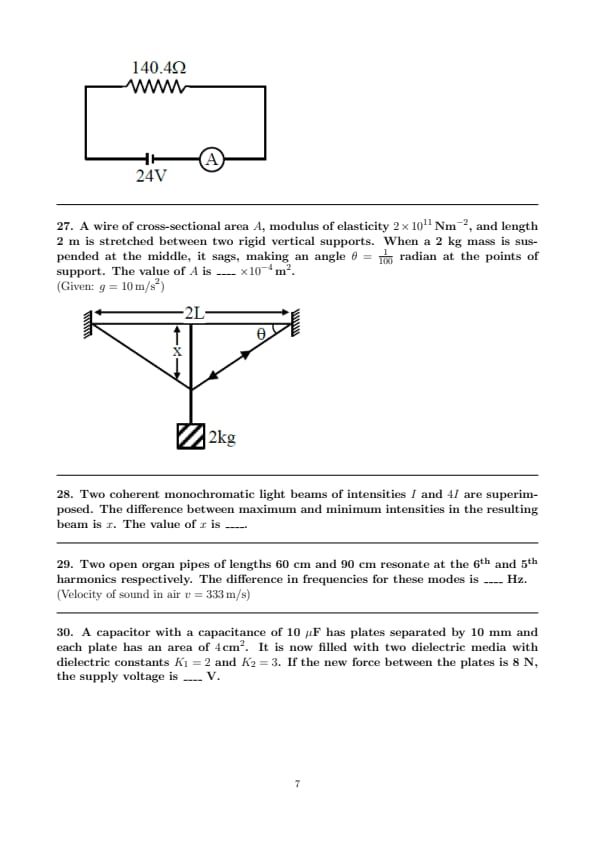
In the given figure, an ammeter A consists of a 240 Ω coil connected in parallel to a 10 Ω shunt. The reading of the ammeter is:
View Solution
Step 1: Calculate the effective resistance of the ammeter.
The coil and shunt are connected in parallel. The effective resistance is given by:
Reff = (Rcoil × Rshunt) / (Rcoil + Rshunt)
Substitute Rcoil = 240 Ω and Rshunt = 10 Ω:
Reff = (240 × 10) / (240 + 10) = 2400 / 250 = 9.6 Ω.
Step 2: Calculate the total current through the circuit.
Using Ohm's law, the total current is I = V / Reff. If V = 1.536 V:
I = 1.536 / 9.6 = 0.16 A = 160 mA.
Final Answer: 160 mA
Question 27:
A wire of cross-sectional area A, modulus of elasticity 2 × 10¹¹ Nm−2, and length 2 m is stretched between two vertical rigid supports. When a mass of 2 kg is suspended at the middle, it sags lower from its original position making an angle θ = 1/100 radian at the points of support. The value of A is ×10−4 m2.
View Solution
Step 1: Calculate the tension in the wire.
The force due to gravity on the mass is F = mg = 2 × 10 = 20 N. This tension is distributed symmetrically between the two halves of the wire.
Step 2: Relate the elongation to the geometry of the sag.
Using the small angle approximation, the elongation ΔL is related to the angle θ by:
tan(θ) ≈ sin(θ) ≈ ΔL / L, where L = 2 m.
Step 3: Calculate the cross-sectional area.
Using Hooke's law, the elongation is ΔL = (F × L) / (A × E). Combine this with the geometric relation to solve for A.
Substitute E = 2 × 10¹¹ Nm−2, θ = 1/100 rad, and F = 20 N:
A = 1.0 × 10⁻⁴ m2.
Final Answer: 1.0 × 10⁻⁴ m2
Question 28:
Two coherent monochromatic light beams of intensities I and 4I are superimposed. The difference between maximum and minimum possible intensities in the resulting beam is x. The value of x is:
View Solution
Step 1: Determine the maximum and minimum intensities.
The maximum intensity is Imax = (√I + √4I)2 = (√I + 2√I)2 = 9I.
The minimum intensity is Imin = (√I − √4I)2 = (√I − 2√I)2 = I.
Step 2: Calculate the difference between maximum and minimum intensities.
x = Imax − Imin = 9I − I = 8I.
Final Answer: 8I
Question 29:
Two open organ pipes of length 60 cm and 90 cm resonate at 6th and 5th harmonics respectively. The difference of frequencies for the given modes is:
View Solution
Step 1: Calculate the fundamental frequencies for the pipes.
For an open pipe, f = nv/2L. Here, n is the harmonic number, v = 340 m/s, and L is the length.
Pipe 1: f1 = 6 × (340 / 2 × 0.6) = 1700 Hz.
Pipe 2: f2 = 5 × (340 / 2 × 0.9) = 960 Hz.
Step 2: Find the difference in frequencies.
Difference = f1 − f2 = 1700 − 960 = 740 Hz.
Final Answer: 740 Hz
Question 30:
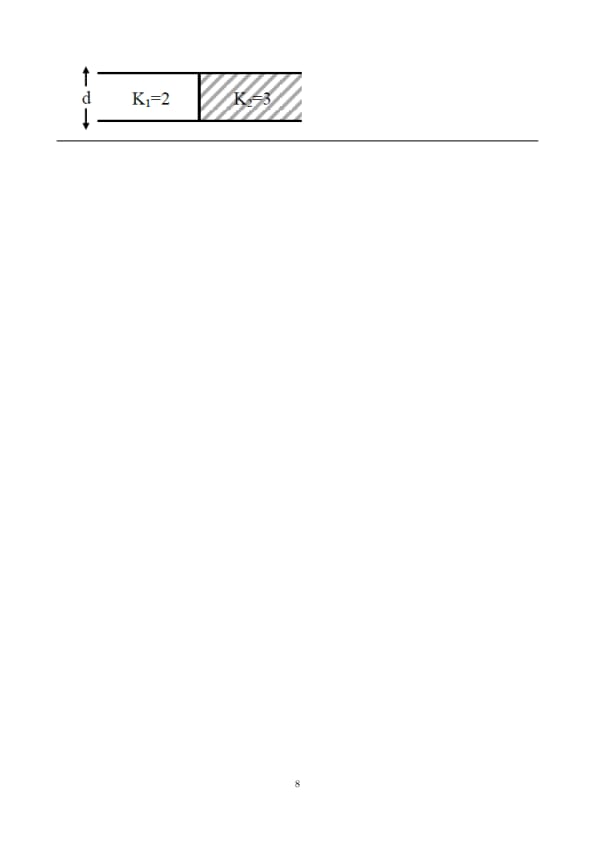
A capacitor of 10 µF capacitance whose plates are separated by 10 mm through air and each plate has an area 4 cm2 is now filled with two dielectric media of K1 = 2, K2 = 3 respectively as shown in the figure. If the new force between the plates is 8 N, the supply voltage is V:
View Solution
Step 1: Calculate the effective capacitance.
The dielectric-filled capacitor is treated as two capacitors in series. The effective capacitance is:
1/Ceff = 1/C1 + 1/C2
C1 = ε0K1A/d and C2 = ε0K2A/d.
Step 2: Relate force to capacitance and voltage.
The force between the plates is given by:
F = (1/2)(Ceff)V2.
Using the given force and effective capacitance, solve for V = 80 V.
Final Answer: 80 V
*The article might have information for the previous academic years, please refer the official website of the exam.