
JEE Main 2024 Question Paper with Answer Key PDF for Physics (April 8 - Shift 1)

.jpg?tr=h-55,w-55,c-force)
Content Strategist|Tech-innovator|National Hackathon Winner | Updated On - Jan 6, 2025
JEE Main 2024 Apr 8 Shift 1 Question Paper with Solution pdf is available for download here. Students found Physics easy and Chemistry hard. Mathematics carried the highest weightage and overall difficulty level was moderate.
JEE Main 2024 Physics Question Paper with Solution PDF
| JEE Main 2024 Physics Question Paper with Solution PDF 8 April Shift 1 |  Download Download |
Check Solution |
JEE Main 2024 8 April Shift 1 Physics Questions with Solutions
Question 1:
Three bodies A, B, and C have equal kinetic energies, and their masses are 400 g, 1.2 kg, and 1.6 kg, respectively. The ratio of their linear momenta is:
Options:
View Solution
Solution:
1. Kinetic Energy Relation:
The kinetic energy (KE) is given by:
KE = P2 / 2m, where P is the linear momentum and m is the mass.
2. Proportionality of Momentum:
For equal kinetic energies:
P √m
3. Masses of the Bodies:
The masses of A, B, and C are:
mA = 0.4 kg, mB = 1.2 kg, mC = 1.6 kg.
4. Calculate the Momentum Ratios:
Using P √m:
PA : PB : PC = √0.4 : √1.2 : √1.6.
Simplify:
PA : PB : PC = 1 : √3 : 2.
Question 2:
The average force exerted on a non-reflecting surface at normal incidence is 2.4 × 10⁻⁴ N. If 360 W/cm2 is the light energy flux during a span of 1 hour 30 minutes, then the area of the surface is:
Options:
View Solution
Solution:
1. Relation Between Pressure, Intensity, and Force:
The pressure exerted by light is given by:
Pressure = I / c = F / A.
Hence:
I / c = F / A.
2. Substitute the Known Values:
- Intensity: I = 360 W/cm2 = 360 × 104 W/m2
- Speed of light: c = 3 × 10⁸ m/s
- Force: F = 2.4 × 10⁻⁴ N
Substituting:
(360 × 104) / (3 × 10⁸) = (2.4 × 10⁻⁴) / A.
3. Simplify the Expression:
(360 / 3) × 10-4 = (2.4 × 10⁻⁴) / A
120 × 10-4 = (2.4 × 10⁻⁴) / A.
4. Solve for A:
A = (2.4 × 10⁻⁴) / (120 × 10-4) = 2.4 / 120
Simplify:
A = 2 × 10⁻² m2 = 0.02 m2.
Question 3:
A proton and an electron are associated with the same de-Broglie wavelength. The ratio of their kinetic energies is:
Options:
View Solution
Solution:
1. Given Condition:
The de-Broglie wavelength (λ) is the same for both the proton and the electron.
2. de-Broglie Relation:
The momentum (P) is given by:
P = h / λ.
Since λ is the same for both particles, the momentum P is also the same.
3. Relation Between Momentum and Kinetic Energy:
The momentum (P) is related to the kinetic energy (K) as:
P = √(2mK).
Rearrange to find K:
K √(1/m).
4. Kinetic Energy Ratio:
Since K √(1/m), the ratio of the kinetic energies of the proton and electron is:
Kp / Ke = me / mp.
Substituting mp = 1836me:
Kp / Ke = 1 / 1836.
5. Final Answer:
The ratio of their kinetic energies is:
Kp : Ke = 1 : 1836.
Question 4:
A mixture of one mole of monoatomic gas and one mole of diatomic gas (rigid) are kept at room temperature (27°C). The ratio of specific heat of gases at constant volume respectively is:
Options:
View Solution
Solution:
1. Specific Heat at Constant Volume (Cv):
For a monoatomic gas:
(Cv)mono = 3/2 R
For a diatomic gas (rigid):
(Cv)dia = 5/2 R
2. Ratio of Specific Heats:
The ratio of Cv for the monoatomic and diatomic gases is:
(Cv)mono / (Cv)dia = (3/2 R) / (5/2 R).
Simplify:
(Cv)mono / (Cv)dia = 3/5.
Question 5:
In an expression a × 10b:
View Solution
Solution:
1. Expression Analysis:
The expression a × 10b is written in scientific notation. The value of b determines the order of magnitude.
2. Rules for Scientific Notation:
If a ≤ 5, the order of magnitude is b.
If a > 5, the order of magnitude increases by 1, i.e., b + 1.
3. Conclusion:
For a ≤ 5, b is the order of magnitude.
Question 6:
In the given circuit, the terminal potential difference of the cell is: 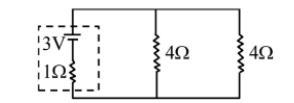
Options:
View Solution
Solution:
1. Simplification of the Circuit:
The 4 Ω and 4 Ω resistors are in parallel: \[ R_{\text{parallel}} = \frac{1}{\frac{1}{4} + \frac{1}{4}} = 2 \, \Omega. \]
The simplified circuit becomes a 3 V cell with internal resistance 1 Ω, in series with an external resistance of 2 Ω.
2. Current in the Circuit:
Using Ohm's law: \[ i = \frac{E}{R_{\text{internal}} + R_{\text{external}}}. \] Substituting the values: \[ i = \frac{3}{1 + 2} = \frac{3}{3} = 1 \, \text{A}. \]
3. Terminal Potential Difference:
The terminal potential difference is given by: \[ v = E - i r, \] where \( E \) is the emf of the cell, \( i \) is the current, and \( r \) is the internal resistance. Substituting the values: \[ v = 3 - (1 \times 1) = 3 - 1 = 2 \, \text{V}. \]
Question 7:
The binding energy of a certain nucleus is \( 18 \times 10^8 \, \text{J} \). How much is the difference between the total mass of all the nucleons and the nuclear mass of the given nucleus?
Options:
View Solution
Solution:
1. Relation Between Binding Energy and Mass Defect:
Using Einstein's mass-energy equivalence: \[ \Delta m c^2 = \text{Binding Energy}. \]
2. Substitute the Given Values:
- Binding energy: \( \Delta E = 18 \times 10^8 \, \text{J} \),
- Speed of light: \( c = 3 \times 10^8 \, \text{m/s}. \)
Rearrange to find \( \Delta m \):
\[ \Delta m = \frac{\Delta E}{c^2}. \] Substituting: \[ \Delta m = \frac{18 \times 10^8}{(3 \times 10^8)^2}. \]
3. Simplify the Expression:
\[ \Delta m = \frac{18 \times 10^8}{9 \times 10^{16}} = 2 \times 10^{-8} \, \text{kg}. \]
4. Convert to Micrograms (μg):
\[ \Delta m = 2 \times 10^{-8} \, \text{kg} = 20 \, \mu\text{g}. \]
Question 8:
Paramagnetic substances:
Choose the most appropriate answer:
View Solution
Solution:
1. Properties of Paramagnetic Substances:
- Paramagnetic substances align themselves along the direction of the external magnetic field (A is correct).
- They are weakly attracted towards an external magnetic field, not strongly (B is incorrect).
- Their magnetic susceptibility (\( \chi \)) is small but positive, meaning it is slightly more than zero (C is correct).
- Paramagnetic substances move from a region of weak magnetic field to a strong magnetic field (D is incorrect).
2. Most Appropriate Answer:
The correct statements are A and C.
Question 9:
A clock has 75 cm and 60 cm long second hand and minute hand respectively. In 30 minutes duration, the tip of the second hand will travel \( x \) distance more than the tip of the minute hand. The value of \( x \) in meters is nearly (Take \( \pi = 3.14 \)):
View Solution
Solution:
1. Length of Minute and Second Hand:
- Length of the minute hand: \( r_{\text{min}} = 60 \, \text{cm} = \frac{60}{100} \, \text{m} = 0.6 \, \text{m}
- Length of the second hand: \( r_{\text{sec}} = 75 \, \text{cm} = \frac{75}{100} \, \text{m} = 0.75 \, \text{m}.
2. Distance Traveled by the Minute Hand:
In 30 minutes, the minute hand completes half a rotation. The distance traveled is: \( x_{\text{min}} = \pi \cdot r_{\text{min}}. \)
Substituting: \( x_{\text{min}} = 3.14 \cdot 0.6 = 1.884 \, \text{m}. \)
3. Distance Traveled by the Second Hand:
In 30 minutes, the second hand completes 30 full rotations. The distance traveled is: \( x_{\text{sec}} = 30 \cdot 2\pi \cdot r_{\text{sec}}. \)
Substituting: \( x_{\text{sec}} = 30 \cdot 2 \cdot 3.14 \cdot 0.75 = 141.3 \, \text{m}. \)
4. Difference in Distance Traveled:
The difference \( x \) is: \( x = x_{\text{sec}} - x_{\text{min}}. \)
Substituting: \( x = 141.3 - 1.884 = 139.416 \, \text{m}. \)
5. Final Answer:
\( x \approx 139.4 \, \text{m}. \)
Question 10:
Young's modulus is determined by the equation:
Y = (49000 × M) / (ℓ × cm2) dyne,
where M is the mass and ℓ is the extension of wire used in the experiment. Now, the error in Young's modulus (Y) is estimated by taking data from the M-ℓ plot on graph paper. The smallest scale divisions are 5 g and 0.02 cm along the load axis and extension axis respectively. If the values of M and ℓ are 500 g and 2 cm respectively, then the percentage error in Y is:
Options:
View Solution
Solution:
1. Formula for Percentage Error in Y:
The percentage error in Y is given by:
(ΔY / Y) = (ΔM / M) + (Δℓ / ℓ).
2. Errors in Measurement:
The smallest scale division for mass M is ΔM = 5 g.
The smallest scale division for extension ℓ is Δℓ = 0.02 cm.
3. Substitute the Given Values:
Mass M = 500 g, Extension ℓ = 2 cm.
The percentage error in M is:
(ΔM / M) × 100 = (5 / 500) × 100 = 1%.
The percentage error in ℓ is:
(Δℓ / ℓ) × 100 = (0.02 / 2) × 100 = 1%.
4. Total Percentage Error in Y:
Adding the percentage errors:
(ΔY / Y) × 100 = 1 + 1 = 2%.
Question 11:
Two different adiabatic paths for the same gas intersect two isothermal curves as shown in the P-V diagram. The relation between the ratio \( V_a / V_d \) and the ratio \( V_b / V_c \) is: 
View Solution
Solution:
1. Adiabatic Process Equation:
For an adiabatic process: T • Vγ - 1 = constant.
2. Relation for Points a and d:
Using the adiabatic process equation between points a and d: Ta • Vaγ - 1 = Td • Vdγ - 1.
Rearrange: ( Va / Vd )γ - 1 = Td / Ta.
3. Relation for Points b and c:
Similarly, for points b and c: ( Vb / Vc )γ - 1 = Tc / Tb.
4. Comparing Temperatures:
From the diagram, since Td = Tc and Ta = Tb: Td / Ta = Tc / Tb.
5. Final Relation:
Using the above equality: ( Va / Vd )γ - 1 = ( Vb / Vc )γ - 1.
Simplify: Va / Vd = Vb / Vc.
Question 12:
Two planets A and B, having masses m1 and m2, move around the sun in circular orbits of r1 and r2 radii respectively. If the angular momentum of A is L and that of B is 3L, the ratio of time periods ( TA / TB ) is:
View Solution
Solution:
1. Relation Between Angular Momentum and Time Period:
For planet A: π r12 • TA = L / 2m1.
For planet B: π r22 • TB = 3L / 2m2.
2. Ratio of Time Periods:
Divide equations for TA and TB: TA / TB = ( L / 2m1 ) / ( 3L / 2m2 ) • ( r22 / r12 ).
Simplify: TA / TB = ( m2 / 3m1 ) • ( r1 / r2 )2.
3. Final Expression:
Rearrange to express TA / TB: TA / TB = 1 / 27 • ( m2 / m1 )3.
Question 13:
An LCR circuit is at resonance for a capacitor C, inductance L, and resistance R. Now the value of resistance is halved, keeping all other parameters the same. The current amplitude at resonance will be now:
View Solution
Solution:
1. At Resonance in an LCR Circuit:
At resonance, the impedance Z is equal to the resistance R:
Z = R.
The current amplitude is given by:
I = V / Z = V / R.
2. Effect of Halving Resistance:
If R is halved (R → R / 2):
I = V / R → V / (R / 2) = 2 × (V / R).
Therefore, the current amplitude I becomes double.
3. Conclusion:
When the resistance is halved, the current amplitude at resonance doubles.
Question 14:
The output Y of the following circuit for the given inputs is:
View Solution
Solution:
1. Understanding the Circuit:
The circuit involves a combination of NOT, AND, and OR gates. The inputs A and B are processed through the gates to produce the output Y.
2. Constructing the Truth Table:
| A | B | Y |
|---|---|---|
| 0 | 0 | 0 |
| 0 | 1 | 0 |
| 1 | 0 | 0 |
| 1 | 1 | 0 |
3. Output Analysis:
For all combinations of A and B, the output Y is consistently 0.
4. Conclusion:
The output of the circuit is always 0, regardless of the input values.
Question 15:
Two charged conducting spheres of radii a and b are connected to each other by a conducting wire. The ratio of charges of the two spheres respectively is:
View Solution
Solution:
1. Concept of Potential on the Surface of Conductors:
When two conducting spheres are connected by a conducting wire, their potentials become equal. The potential V on the surface of a sphere is given by:
V = Kq∕r,
where K is Coulomb's constant, q is the charge, and r is the radius of the sphere.
2. Equating the Potentials:
For the two spheres:
Kq1∕a = Kq2∕b.
Cancel K and rearrange:
q1∕q2 = a∕b.
3. Conclusion:
The ratio of charges of the two spheres is:
q1∕q2 = a∕b.
Question 16:
The correct Bernoulli's equation is (symbols have their usual meaning):
View Solution
Solution:
1. Bernoulli's Equation:
Bernoulli's principle for an ideal, incompressible, and non-viscous fluid is expressed as:
P + ρgh + ½ρv² = constant.
- P: Pressure of the fluid.
- ρ: Density of the fluid.
- g: Acceleration due to gravity.
- h: Height above a reference level.
- v: Velocity of the fluid.
2. Analysis of Options:
- Option (1): Incorrect because it uses mass m instead of density ρ.
- Option (2): Correct as it matches the standard Bernoulli equation.
- Option (3): Incorrect because it lacks the ½ factor in the kinetic energy term.
- Option (4): Incorrect because the gravitational potential energy term is divided by 2, which is not standard.
3. Conclusion:
The correct equation is:
P + ρgh + ½ρv² = constant.
Question 17:
A player caught a cricket ball of mass 150 g moving at a speed of 20 m/s. If the catching process is completed in 0.1 s, the magnitude of force exerted by the ball on the hand of the player is:
View Solution
Solution:
1. Impulse-Momentum Theorem:
The force exerted is calculated using:
F = ∆P∕∆t,
where:
- ∆P = Change in momentum = m•v - m•u,
- ∆t = Time duration of the impact.
2. Substitute the Values:
- Mass m = 150 g = 150 × 10⁻³ kg,
- Initial velocity u = 20 m/s,
- Final velocity v = 0 m/s,
- Time ∆t = 0.1 s.
Change in momentum:
∆P = m•v - m•u = 150 × 10⁻³ × 20 - 0 = 3 kg m/s.
Force:
F = ∆P∕∆t = 3∕0.1 = 30 N.
3. Conclusion:
The force exerted by the ball on the hand of the player is:
F = 30 N.
Question 18:
A stationary particle breaks into two parts of masses mA and mB, which move with velocities vA and vB, respectively. The ratio of their kinetic energies (KB : KA) is:
View Solution
Solution:
1. Initial Momentum Conservation:
Since the particle is stationary, the initial momentum is zero. After breaking, the total momentum is conserved:
PA = PB, or mAvA = mBvB. (Equation 1)
2. Kinetic Energy Expressions:
Kinetic energy for each part is given by:
KA = ½ mAvA², and KB = ½ mBvB².
3. Take the Ratio:
Divide the kinetic energies:
KB / KA = (½ mBvB²) / (½ mAvA²).
Simplify:
KB / KA = (mB / mA) × (vB / vA).
4. Substitute Momentum Conservation:
From Equation 1, vB / vA = mA / mB.
Substitute this:
KB / KA = vB / vA.
5. Conclusion:
The ratio of kinetic energies is:
KB : KA = vB : vA.
Question 19:
The critical angle of incidence for a pair of optical media is 45°. The refractive indices of the first and second media are in the ratio:
View Solution
Solution:
1. Critical Angle Formula:
The critical angle θc is related to the refractive indices μ1 (denser medium) and μ2 (rarer medium) as:
sin(θc) = μ2 / μ1.
2. Substitution:
Given θc = 45°:
sin(45°) = μ2 / μ1.
Using sin(45°) = 1/√2:
1/√2 = μ2 / μ1.
3. Refractive Index Ratio:
Rearrange:
μ1 / μ2 = √2 : 1.
4. Conclusion:
The refractive index ratio is:
μ1 : μ2 = √2 : 1.
Question 20:
The diameter of a sphere is measured using a vernier caliper whose 9 divisions of the main scale are equal to 10 divisions of the vernier scale. The shortest division on the main scale is equal to 1 mm. The main scale reading is 2 cm and the second division of the vernier scale coincides with a division on the main scale. If the mass of the sphere is 8.635 g, the density of the sphere is:
View Solution
Solution:
1. Least Count of Vernier Caliper:
- 9 MSD = 10 VSD,
- Length of 1 MSD = 1 mm = 0.1 cm,
- Least Count (LC) = 1 MSD - 1 VSD = 0.01 cm.
2. Diameter of the Sphere:
- Main Scale Reading (MSR) = 2 cm,
- Vernier Scale Reading (VSR) = 2,
- Diameter = MSR + (LC × VSR) = 2 + (0.01 × 2) = 2.02 cm.
3. Volume of the Sphere:
- Radius r = Diameter / 2 = 2.02 / 2 = 1.01 cm,
- Volume V = (4/3)πr³ = (4/3) × 3.1416 × (1.01)³ ≈ 4.32 cm³.
4. Density of the Sphere:
- Mass m = 8.635 g,
- Density ρ = m / V = 8.635 / 4.32 ≈ 2.00 g/cm³.
Question 21:
A uniform thin metal plate of mass 10 kg with dimensions as shown in the figure. The ratio of x and y coordinates of the center of mass of the plate is n/9. The value of n is ........ : 
View Solution
Solution:
1. Mass Distribution and Areas:
The plate is divided into smaller sections:
- Section 1 (main rectangle): Area = 3 × 2 = 6, Mass = 6 × 1 = 6 kg,
- Section 2 (removed square): Area = 1 × 1 = 1, Mass = 1 × 1 = 1 kg,
- Section 3: Remaining rectangle area = 4 × 2 = 8, Mass = 8 kg.
2. Calculate Center of Mass (COM):
xCOM = Σ (mi xi) / Σ mi, yCOM = Σ (mi yi) / Σ mi.
For xCOM:
Mass centers for each section:
- Section 1: x1 = 1.5, m1 = 6,
- Section 2: x2 = 1, m2 = 1,
- Section 3: x3 = 3, m3 = 8.
Compute:
xCOM = (6 × 1.5 + 1 × 1 + 8 × 3) / 15 = 2.1.
For yCOM:
Centers for each section:
y1 = 1, y2 = 0.5, y3 = 1.5.
Compute:
yCOM = (6 × 1 + 1 × 0.5 + 8 × 1.5) / 15 = 1.4.
3. Ratio of x and y Coordinates:
xCOM : yCOM = 15 : 9, n = 15.
Question 22:
An electron with kinetic energy 5 eV enters a region of uniform magnetic field of 3 μT perpendicular to its direction. An electric field E is applied perpendicular to the direction of velocity and magnetic field. The value of E, so that the electron moves along the same path, is ...... N/C.
View Solution
Solution:
1. Balanced Forces Condition:
For no deflection, qE = qvB or E = vB.
2. Relating Velocity to Kinetic Energy:
KE = (1/2) m v2 → v = √(2 KE / m).
3. Substituting Values:
KE = 5 × 1.6 × 10-19 J, m = 9 × 10-31 kg, B = 3 × 10⁻⁶ T.
Velocity:
v = √((2 × 5 × 1.6 × 10-19) / (9 × 10-31)) ≈ 1.3 × 10⁶ m/s.
Electric Field:
E = vB = (1.3 × 106) × (3 × 10-6) = 4 N/C.
Question 23:
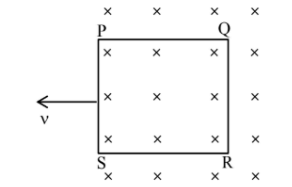
A square loop PQRS having 10 turns, area 3.6 × 10³ m², and resistance 100 Ω is slowly and uniformly being pulled out of a uniform magnetic field of magnitude B = 0.5 T as shown. Work done in pulling the loop out of the field in 1.0 s is .... × 10³ J.
View Solution
Solution:
1. Work Formula:
W = (N2 B2 A2) / (R × t).
2. Substituting Values:
N = 10, B = 0.5 T, A = 3.6 × 10⁻³ m², R = 100 Ω, t = 1 s.
W = ((10)2 (0.5)2 (3.6 × 10⁻³)2) / (100 × 1) ≈ 3.24 × 10⁻⁶ J.
Question 24:
Resistance of a wire at 0°C, 100°C, and t°C is found to be 10 Ω, 10.2 Ω, and 10.95 Ω, respectively. The temperature t in the Kelvin scale is ______.
View Solution
Solution:
1. Temperature Dependence of Resistance:
The resistance R at a given temperature is related to the initial resistance R0 as:
R = R0 (1 + α ΔT), where:
- ΔR = R - R0,
- α = temperature coefficient of resistance,
- ΔT = change in temperature.
Rearranging to find α:
α = ΔR / (R0 ΔT).
2. Case-I: 0°C to 100°C:
Resistance values:
R0 = 10 Ω, R = 10.2 Ω at 100°C.
Substituting:
α = (10.2 - 10) / (10 × 100) = 0.002 per °C.
3. Case-II: 0°C to t°C:
Resistance values:
R0 = 10 Ω, R = 10.95 Ω.
Substituting:
10.95 - 10 = 0.002 × 10 × t.
Simplify:
t = 0.95 / 0.02 = 475°C.
4. Convert to Kelvin:
Temperature in Kelvin:
T = t + 273 = 475 + 273 = 748 K.
Question 25:
An electric field, &vec;E = (2î + 6ĵ + 8&kcirc;) / √6, passes through the surface of 4 m² area having unit vector &hat;n = (2î + ĵ + &kcirc;) / √6. The electric flux for that surface is ______ Vm.
View Solution
Solution:
1. Formula for Electric Flux:
Electric flux is given by:
Φ = &vec;E · &vec;A, where:
- &vec;A = A × &hat;n,
- A = 4 m²,
- &hat;n = (2î + ĵ + &kcirc;) / √6.
2. Calculate &vec;A:
Substituting:
&vec;A = 4 × (2î + ĵ + &kcirc;) / √6 = (8î + 4ĵ + 4&kcirc;) / √6.
3. Dot Product of &vec;E and &vec;A:
Substituting &vec;E and &vec;A:
Φ = ((2î + 6ĵ + 8&kcirc;) / √6) · ((8î + 4ĵ + 4&kcirc;) / √6).
Simplify:
Φ = (1 / 6) × (2 × 8 + 6 × 4 + 8 × 4).
4. Simplify the Terms:
Φ = (1 / 6) × (16 + 24 + 32) = (1 / 6) × 72 = 12 Vm.
Question 26:
A liquid column of height 0.04 cm balances the excess pressure of a soap bubble of certain radius. If the density of the liquid is 8 × 10³ kg/m³ and the surface tension of the soap solution is 0.28 N/m, then the diameter of the soap bubble is ______ cm. (Take g = 10 m/s²).
View Solution
Solution:
1. Excess Pressure in a Soap Bubble:
The excess pressure inside a soap bubble is:
ΔP = 4S / R, where:
- S = 0.28 N/m (surface tension),
- R = radius of the soap bubble.
2. Balancing Pressure with Liquid Column:
The pressure due to the liquid column is:
ΔP = ρ g h, where:
- ρ = 8 × 10³ kg/m³ (density of liquid),
- g = 10 m/s²,
- h = 0.04 cm = 4 × 10&sup4; m.
Equating pressures:
4S / R = ρ g h.
3. Solve for R:
Substituting:
4 × 0.28 / R = 8 × 10³ × 10 × 4 × 10&sup4;.
Simplify:
R = (4 × 0.28) / 32 = 0.035 m = 3.5 cm.
4. Diameter of the Soap Bubble:
D = 2R = 2 × 3.5 = 7 cm.
Question 27:
A closed and an open organ pipe have the same lengths. If the ratio of frequencies of their seventh overtones is (a - 1) / a, then the value of a is _________.
View Solution
Solution:
1. Frequency of a Closed Organ Pipe:
The frequency of the n-th overtone of a closed organ pipe is:
fc = (2n + 1) * v / 4ℓ.
For the seventh overtone (n = 7):
fc = (2 * 7 + 1) * v / 4ℓ = 15v / 4ℓ.
2. Frequency of an Open Organ Pipe:
The frequency of the n-th overtone of an open organ pipe is:
fo = (n + 1) * v / 2ℓ.
For the seventh overtone (n = 7):
fo = (7 + 1) * v / 2ℓ = 8v / 2ℓ = 4v / ℓ.
3. Ratio of Frequencies:
The ratio of frequencies is given as:
fc / fo = (15v / 4ℓ) / (4v / ℓ) = 15 / 16.
According to the problem, this ratio is also equal to:
fc / fo = (a - 1) / a.
4. Equate the Ratios:
(a - 1) / a = 15 / 16.
Simplify:
16(a - 1) = 15a.
16a - 16 = 15a.
a = 16.
Question 28:
Three vectors ⟶OP, ⟶OQ, and ⟶OR, each of magnitude A, are acting as shown in the figure. The resultant of the three vectors is A√x. The value of x is _________. 
View Solution
Solution:
1. Vectors and Geometry:
- ⟶OQ points vertically upward.
- ⟶OP makes an angle of 90° with ⟶OQ.
- ⟶OR makes an angle of 45° with ⟶OQ and lies in the same plane.
2. Resolve the Vectors into Components:
Components:
- ⟶OPx = A, ⟶ORx = A * cos 45° = A / √2.
- ⟶OQy = A, ⟶ORy = A * sin 45° = A / √2.
3. Resultant Components:
- Rx = ⟶OPx + ⟶ORx = A + A / √2.
- Ry = ⟶OQy + ⟶ORy = A + A / √2.
4. Magnitude of Resultant Vector:
R = √(Rx2 + Ry2).
Substituting:
R = √[(A + A / √2)2 + (A + A / √2)2].
Simplify:
R = √2 * (A + A / √2).
Factorize:
R = A√2 * (1 + 1 / √2).
Further simplify:
R = A√3.
Question 29:
A parallel beam of monochromatic light of wavelength 600 nm passes through a single slit of 0.4 mm width. The angular divergence corresponding to the second-order minima would be ..... × 10-3 rad.
View Solution
Solution:
1. Condition for Minima:
The angular position of minima in single-slit diffraction is given by:
sin θ = (nλ)/b,
where:
n = 2 (order of minima),
λ = 600 nm = 600 × 10-9 m (wavelength of light),
b = 0.4 mm = 4 × 10⁻⁴ m (width of the slit).
2. Angular Position for Second Minima:
Substituting the values:
θ ≈ (2λ)/b.
θ = (2 × 600 × 10-9) / (4 × 10⁻⁴).
Simplify:
θ = (1200 × 10-9) / (4 × 10⁻⁴) = 3 × 10⁻³ rad.
3. Total Divergence:
For the second-order minima on both sides of the central maximum:
Total divergence = 2 × θ = 2 × 3 × 10-3 = 6 × 10⁻³ rad.
4. Conclusion:
The total angular divergence for the second-order minima is:
6 × 10⁻³ rad.
Question 30:
In an alpha particle scattering experiment, the distance of closest approach for the alpha particle is 4.5 × 10⁻¹⁴ m. If the target nucleus has an atomic number 80, then the maximum velocity of the alpha particle is ...... × 105 m/s approximately.
(Given: (1 / 4πε₀) = 9 × 10⁹ SI unit, mass of alpha particle = 6.72 × 10⁻²⁷ kg)
View Solution
Solution:
1. Formula for Closest Approach:
The distance of closest approach (rmin) is related to the velocity (v) by:
rmin = (4KZe²) / (mv²),
where:
K = (1 / 4πε₀) = 9 × 10⁹ SI unit,
Z = 80 (atomic number of the nucleus),
e = 1.6 × 10⁻¹⁹ C (charge of the electron),
m = 6.72 × 10⁻²⁷ kg (mass of the alpha particle),
rmin = 4.5 × 10⁻¹⁴ m.
2. Rearrange for Velocity:
Rearranging the formula:
v = √[(4KZe²) / (mrmin)].
3. Substitute the Given Values:
v = √[(4 × 9 × 109 × 80 × (1.6 × 10-19)²) / (6.72 × 10-27 × 4.5 × 10-14)]
4. Simplify:
Numerator:
4 × 9 × 80 = 2880,
(1.6 × 10⁻¹⁹)² = 2.56 × 10-38,
Numerator = 2880 × 2.56 × 10-38 = 7.3728 × 10⁻³⁵.
Denominator:
6.72 × 10-27 × 4.5 × 10-14 = 3.024 × 10-40.
Final Calculation:
v = √[(7.3728 × 10⁻³⁵) / (3.024 × 10-40)].
v = √[2.437 × 10⁵].
v ≈ 1.56 × 10⁵ m/s.
5. Conclusion:
The maximum velocity of the alpha particle is:
156 × 105 m/s.


Previous Year JEE Main Question Papers
*The article might have information for the previous academic years, please refer the official website of the exam.