
JEE Main 2024 Question Paper with Answer Key PDF for Physics (April 9 - Shift 1)

.jpg?tr=h-55,w-55,c-force)
Content Strategist|Tech-innovator|National Hackathon Winner | Updated On - Jan 6, 2025
JEE Main 2024 Apr 9 Shift 1 Question Paper with Solution pdf is available for download here. Students found Physics easy and Mathematics hard. Physics carried the highest weightage and overall difficulty level was moderate.
JEE Main 2024 Physics Question Paper with Answer Key PDF

JEE Main 2024 9 April Shift 1 Questions with Solutions
Question 1:
A proton, an electron, and an alpha particle have the same energies. Their de-Broglie wavelengths will be compared as:
View Solution
Since de-Broglie wavelength is inversely proportional to the square root of mass, the order is λe > λp > λα, where λe, λp, and λα correspond to the electron, proton, and alpha particle respectively.
Question 2:
A particle moving in a straight line covers half the distance with speed 6 m/s. The other half is covered in two equal time intervals with speeds 9 m/s and 15 m/s, respectively. The average speed of the particle during the motion is:
View Solution
The average speed is calculated by the total distance divided by the total time, yielding 8 m/s after evaluating the times for each segment.
Question 3:
A plane EM wave is propagating along the x-direction. It has a wavelength of 4 mm. If the electric field is in the y-direction with the maximum magnitude of 60 V/m, the equation for the magnetic field is:
View Solution
By applying the relationship between the electric and magnetic fields for plane waves, the magnetic field equation is derived to be Bz = 2 × 10⁻⁷ sin[π/2 × 10³(x − 3 × 10⁸t)] k̂ T.
Question 4:
Given below are two statements:
Statement (I): When currents vary with time, Newton’s third law is valid only if momentum carried by the electromagnetic field is taken into account.
Statement (II): Ampere’s circuital law does not depend on Biot-Savart’s law.
Choose the correct answer:
View Solution
Statement I is true because the momentum carried by the electromagnetic field must be included when time-varying currents are involved. Statement II is false because Ampere’s circuital law is independent of Biot-Savart’s law.
Question 5:
A light-emitting diode (LED) is fabricated using GaAs semiconducting material whose band gap is 1.42 eV. The wavelength of light emitted from the LED is:
View Solution
Using the formula λ = 1240 / Eg (where Eg is the band gap in eV), the wavelength of the emitted light is found to be 875 nm.
Question 6:
A sphere of relative density σ and diameter D has a concentric cavity of diameter d. The ratio of D/d, if it just floats on water in a tank, is:
View Solution
The floating condition and buoyancy lead to the relationship D/d = (σ / (σ − 1))^(1/3).
Question 7:
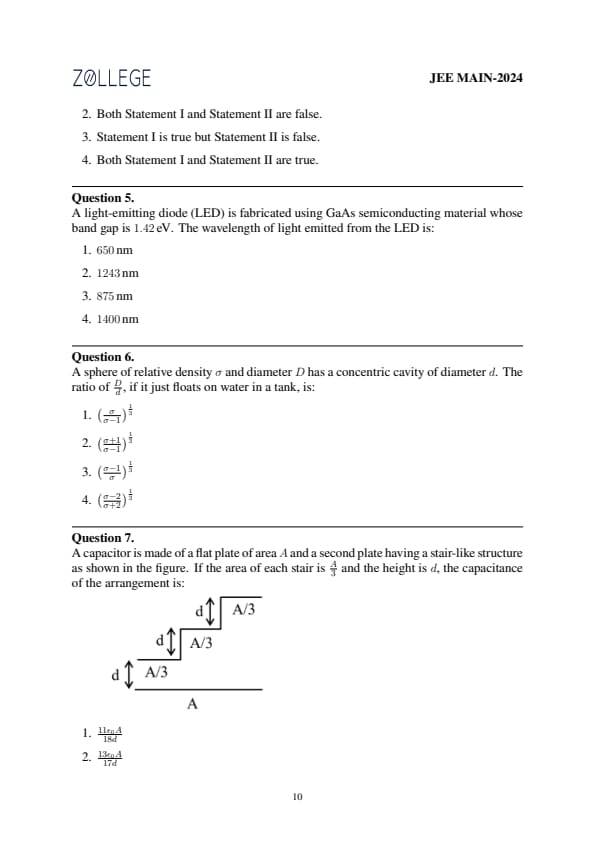
A capacitor is made of a flat plate of area A and a second plate having a stair-like structure as shown in the figure. If the area of each stair is A/3 and the height is d, the capacitance of the arrangement is:
View Solution
The capacitance is found by considering the individual contributions of each segment of the capacitor, leading to a total capacitance of (11ϵ₀A) / (18d).
Question 8:
A light, unstretchable string passing over a smooth light pulley connects two blocks of masses m₁ and m₂. If the acceleration of the system is g/8, then the ratio of the masses m₂/m₁ is:
View Solution
By solving the equations of motion for the two masses and using the given acceleration, the ratio m₂/m₁ is found to be 9:7.
Question 9:
The dimensional formula of latent heat is:
View Solution
Latent heat is energy per unit mass, and using the dimensional formula for energy and mass, the formula for latent heat is [M₀L²T⁻²].
Question 10:
The volume of an ideal gas (γ = 1.5) is changed adiabatically from 5 litres to 4 litres. The ratio of initial pressure to final pressure is:
View Solution
By applying the adiabatic relation between pressure and volume, the ratio of initial pressure to final pressure is found to be 8/5√5.
Question 11:
The energy equivalent of 1 g of substance is:
View Solution
Using Einstein’s equation E = mc² and converting mass and energy units, the energy equivalent of 1 g is found to be 5.6 × 10⁶ MeV.
Question 12:
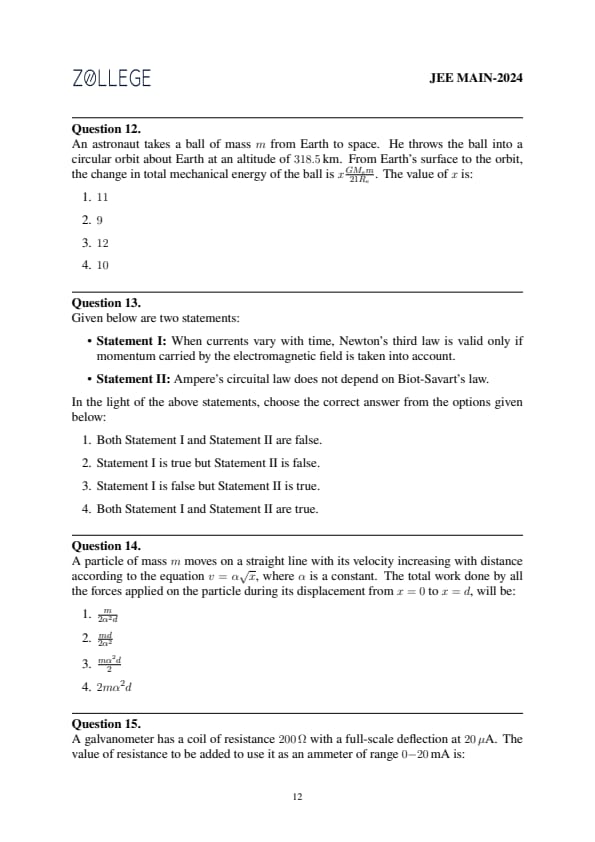
An astronaut takes a ball of mass m from Earth to space. He throws the ball into a circular orbit about Earth at an altitude of 318.5 km. From Earth’s surface to the orbit, the change in total mechanical energy of the ball is xGMem / 21Re. The value of x is:
View Solution
The change in total mechanical energy during the transition from the Earth's surface to orbit is calculated as 11GMem / 21Re.
Question 13:
Given below are two statements:
Statement (I): When currents vary with time, Newton’s third law is valid only if momentum carried by the electromagnetic field is taken into account.
Statement (II): Ampere’s circuital law does not depend on Biot-Savart’s law.
Choose the correct answer:
View Solution
Statement I is true because time-varying currents carry electromagnetic momentum. Statement II is false because Ampere's law does depend on Biot-Savart’s law.
Question 14:
A particle of mass m moves on a straight line with its velocity increasing with distance according to the equation v = α√x, where α is a constant. The total work done by all the forces applied on the particle during its displacement from x = 0 to x = d, will be:
View Solution
By using the work-energy theorem and integrating the velocity equation, the work done is found to be mα²d / 2.
Question 15:
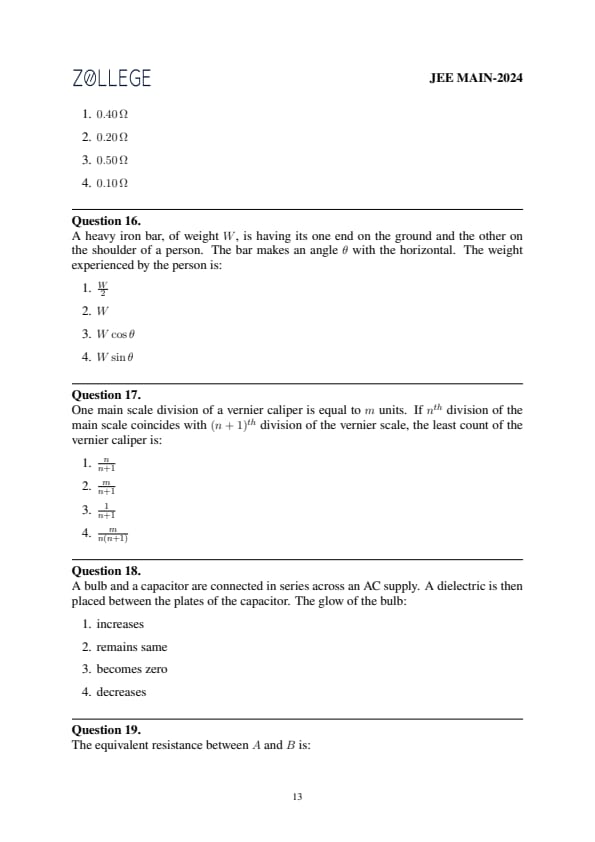
A galvanometer has a coil of resistance 200Ω with a full-scale deflection at 20µA. The value of resistance to be added to use it as an ammeter of range 0−20mA is:
View Solution
Using the formula for the shunt resistance, the required resistance is found to be 0.20Ω to use the galvanometer as an ammeter.
Question 16:
A heavy iron bar, of weight W, is having its one end on the ground and the other on the shoulder of a person. The bar makes an angle θ with the horizontal. The weight experienced by the person is:
View Solution
Since the bar is uniform, the weight is distributed equally between the two points of support, and the person experiences half of the total weight, i.e., W/2.
Question 17:
One main scale division of a vernier caliper is equal to m units. If nth division of the main scale coincides with (n+1)th division of the vernier scale, the least count of the vernier caliper is:
View Solution
The least count of a vernier caliper is the difference between the main scale division and the vernier scale division, which gives m / (n+1).
Question 18:
A bulb and a capacitor are connected in series across an AC supply. A dielectric is then placed between the plates of the capacitor. The glow of the bulb:
View Solution
The introduction of the dielectric increases the capacitance, thus decreasing the impedance of the capacitor, which leads to an increase in the current and an increase in the bulb's glow.
Question 19:
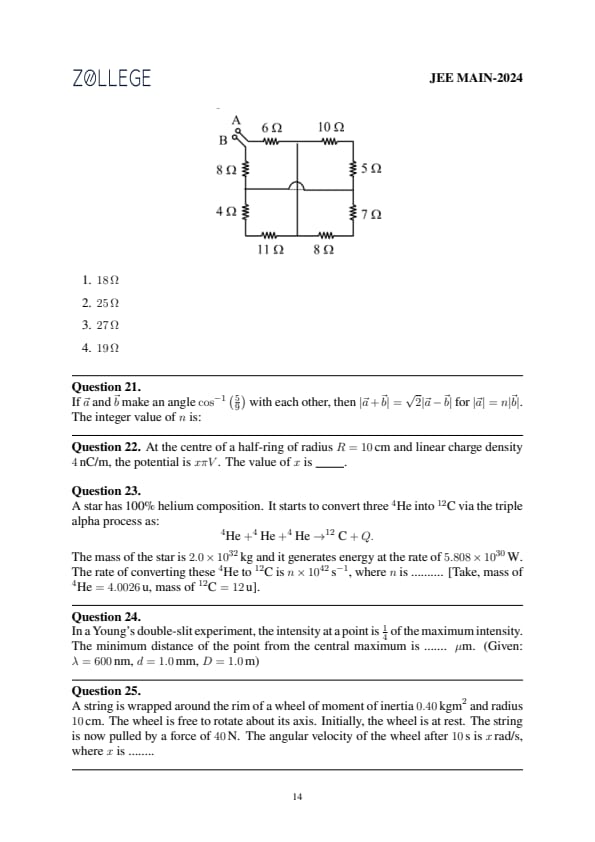
The equivalent resistance between A and B is:
View Solution
After simplifying the resistor network step by step using series and parallel combinations, the total resistance is found to be 19Ω.
Question 20:
A sample of 1 mole gas at temperature T is adiabatically expanded to double its volume. If the adiabatic constant for the gas is γ = 3/2, then the work done by the gas in the process is:
View Solution
Using the adiabatic relation and solving for work done, the result is RT [2 − √2].
Question 21:
If vec a and vec b make an angle cos⁻¹(5/9) with each other, then |vec a + vec b| = √2|vec a − vec b| for |vec a| = n|vec b|. The integer value of n is:
View Solution
Using vector addition and applying the given conditions, the integer value of n is found to be 4.
Question 22:
At the center of a half-ring of radius R = 10 cm and linear charge density 4 nC/m, the potential is xπV. The value of x is:
View Solution
The potential at the center of the half-ring is derived from the formula for the potential due to a charged ring, giving x = 2.
Question 23:
A star has 100% helium composition. It starts to convert three 4He into 12C via the triple alpha process as: 4He + 4He + 4He → 12C + Q. The mass of the star is 2.0 × 10³² kg and it generates energy at the rate of 5.808 × 10³⁰ W. The rate of converting these 4He to 12C is n × 10⁴² s⁻¹, where n is:
View Solution
The rate of helium conversion is calculated as n = 15 × 10⁴² s⁻¹ based on the energy produced and mass defect per reaction.
Question 24:
In a Young’s double-slit experiment, the intensity at a point is 1/4 of the maximum intensity. The minimum distance of the point from the central maximum is x μm. (Given: λ = 600 nm, d = 1.0 mm, D = 1.0 m)
View Solution
The minimum distance is calculated using the phase difference formula, yielding a result of 200 μm.
Question 25:
A string is wrapped around the rim of a wheel of moment of inertia 0.40 kgm² and radius 10 cm. The wheel is free to rotate about its axis. Initially, the wheel is at rest. The string is now pulled by a force of 40N. The angular velocity of the wheel after 10 s is x rad/s, where x is:
View Solution
The angular velocity is determined using the torque and angular acceleration relation, yielding 100 rad/s.
Question 26:
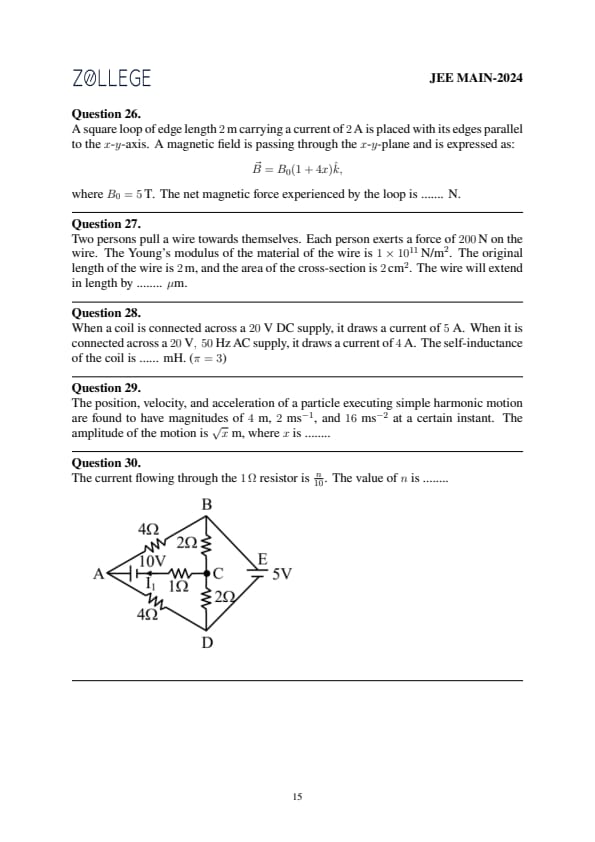
A square loop of edge length 2m carrying a current of 2A is placed with its edges parallel to the x-y-axis. A magnetic field is passing through the x-y-plane and is expressed as: B = B₀(1 + 4x)k̂, where B₀ = 5T. The net magnetic force experienced by the loop is x N.
View Solution
The net magnetic force is calculated based on the varying magnetic field across the loop, yielding 160 N.
Question 27:
Two persons pull a wire towards themselves. Each person exerts a force of 200 N on the wire. The Young's modulus of the material of the wire is 1 × 10¹¹ N/m². The original length of the wire is 2 m, and the area of the cross-section is 2 cm². The wire will extend in length by ........ µm.
View Solution
Step 1: Relation between stress and strain
Young's modulus is given by: Y = Stress / Strain = (F / A) / (Δl / l).
Rearranging for Δl: Δl = (F × l) / (A × Y).
Step 2: Substitute given values
- Force, F = 200 N,
- Original length, l = 2 m,
- Area of cross-section, A = 2 cm² = 2 × 10⁻⁴ m²,
- Young's modulus, Y = 1 × 10¹¹ N/m².
Substitute into the formula:
Δl = (200 × 2) / (2 × 10⁻⁴ × 10¹¹).
Step 3: Simplify the expression
Δl = 400 / (2 × 10⁷) = 2 × 10⁻⁵ m.
Convert to micrometers (µm):
Δl = 20 µm.
Question 28:
When a coil is connected across a 20 V DC supply, it draws a current of 5 A. When it is connected across a 20 V, 50 Hz AC supply, it draws a current of 4 A. The self-inductance of the coil is ...... mH. (π = 3)
View Solution
Step 1: Analyze the DC circuit
In DC, the inductive reactance is 0, so R = V / I = 20 / 5 = 4 Ω.
Step 2: Analyze the AC circuit
Impedance Z = V / I = 20 / 4 = 5 Ω, and Z = √(R² + XL²).
Substitute R = 4 Ω:
5 = √(4² + XL²), so XL = 3 Ω.
Step 3: Calculate inductance
XL = 2πfL, so L = XL / (2πf).
Substitute XL = 3, f = 50 Hz, π = 3:
L = 3 / (2 × 3 × 50) = 3 / 300 = 0.01 H = 10 mH.
Question 29:
The position, velocity, and acceleration of a particle executing simple harmonic motion are found to have magnitudes of 4 m, 2 m/s, and 16 m/s² at a certain instant. The amplitude of the motion is √x m, where x is ........
View Solution
Step 1: Use acceleration and position relation in SHM
Acceleration a = -ω²x.
Substitute a = 16 m/s² and x = 4 m:
16 = ω² × 4, so ω² = 4 and ω = 2 rad/s.
Step 2: Use velocity and amplitude relation
Velocity v² = ω² (A² - x²).
Substitute v = 2 m/s, ω = 2 rad/s, x = 4 m:
2² = 2² (A² - 4²).
Simplify:
4 = 4 (A² - 16), so A² = 17.
Amplitude A = √17. Thus, x = 17.
Question 30:
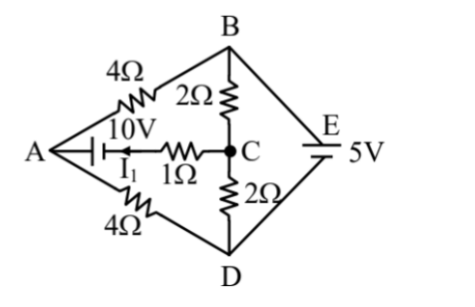
The current flowing through the 1 Ω resistor is n/10. The value of n is ........
Diagram:
View Solution
Let the potentials at points A, B, and C be x, y, and 0 respectively.
Applying Kirchhoff's Current Law (KCL) at node B:
(y - 5)/2 + y/2 + (y - x + 10)/1 = 0.
Simplify: 4y - 2x + 15 = 0 ........ (i).
Applying KCL at node A:
(x - 5)/4 + x/4 + (x - 10 - y)/1 = 0.
Simplify: 6x - 4y - 45 = 0 ........ (ii).
Solving equations (i) and (ii):
From (i): y = (2x - 15)/4.
Substitute in (ii): x = 7.5, y = 0.
Current through the 1 Ω resistor is:
i = (y - x + 10)/1 = (0 - 7.5 + 10) = 2.5 A.
Thus, i = n/10, so n = 25.
Previous Year JEE Main Question Papers
*The article might have information for the previous academic years, please refer the official website of the exam.