
JEE Main 2024 Question Paper with Answer Key PDF for Physics (April 9 - Shift 2)

.jpg?tr=h-55,w-55,c-force)
Content Strategist|Tech-innovator|National Hackathon Winner | Updated On - Jan 14, 2025
JEE Main 2024 Apr 9 Shift 2 Question Paper with Solution pdf is available for download here. Students found Physics easy and Mathematics hard. Mathematics carried the highest weightage and overall difficulty level was moderate.
JEE Main 2024 Physics Question Paper with Answer Key PDF
| JEE Main 2024 Physics Question Paper with Answer Key 9 April Shift 2 |  Download Download |
Check Solution |
JEE Main 9 April Shift 2 2024 Physics Questions with Solution
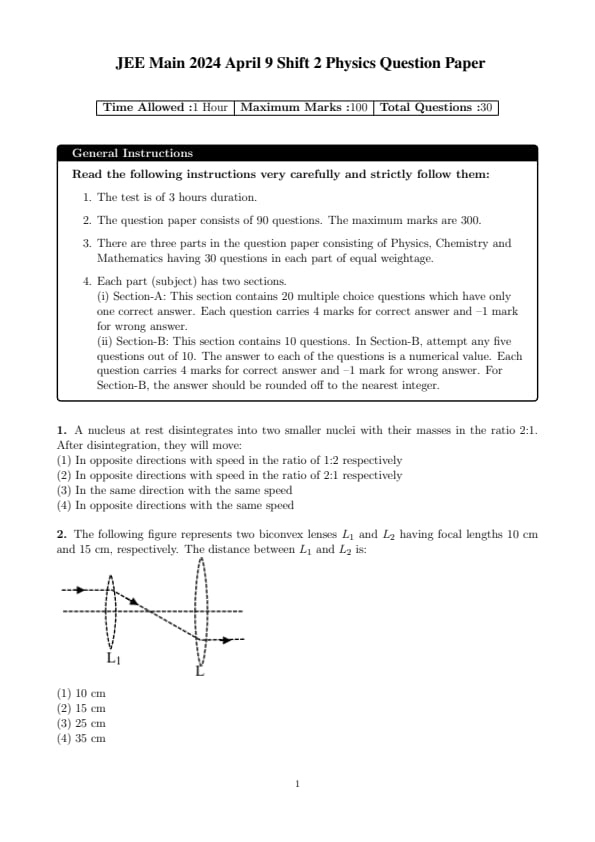
Question 1:
A nucleus at rest disintegrates into two smaller nuclei with their masses in the ratio 2:1. After disintegration, they will move:
View Solution
By the conservation of momentum, the total momentum of the system remains zero as the nucleus was initially at rest.
Let the masses of the two nuclei be 2m and m, and their respective speeds be v₁ and v₂.
Using 2m·v₁ = m·v₂, we find v₁/v₂ = 1/2.
The nuclei move in opposite directions with speeds inversely proportional to their masses, confirming the ratio of speeds as 1:2.
Question 2:
The following figure represents two biconvex lenses L₁ and L₂ having focal lengths 10 cm and 15 cm, respectively. The distance between L₁ and L₂ is:
View Solution
The effective focal length of a system of two lenses in contact is given by 1/f = 1/f₁ + 1/f₂.
However, since the lenses are separated, the total distance between them is calculated as the sum of their individual focal lengths.
Hence, the distance is 10 cm + 15 cm = 25 cm.
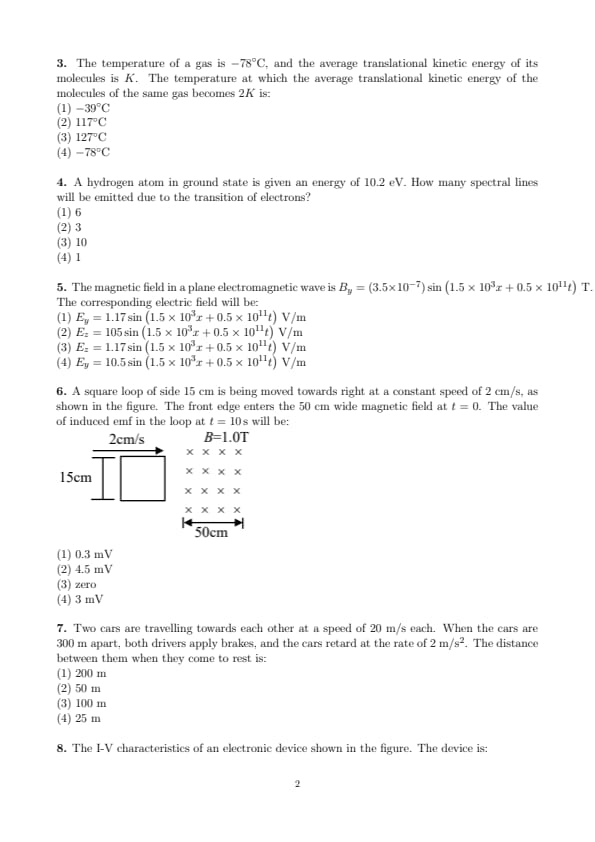
Question 3:
The temperature of a gas is −78°C, and the average translational kinetic energy of its molecules is K. The temperature at which the average translational kinetic energy of the molecules of the same gas becomes 2K is:
View Solution
The translational kinetic energy is proportional to the absolute temperature, given by K = (3/2)kT, where T is the temperature in Kelvin.
At −78°C, T₁ = 273 − 78 = 195 K. Doubling the kinetic energy implies T₂ = 2 × T₁ = 390 K.
Converting back to Celsius, 390 − 273 = 117°C.
Question 4:
A hydrogen atom in the ground state is given an energy of 10.2 eV. How many spectral lines will be emitted due to the transition of electrons?
View Solution
In the hydrogen atom, the energy difference between the ground state (n = 1) and the first excited state (n = 2) is 10.2 eV.
Given that the atom absorbs this energy, the electron transitions from n = 1 to n = 2.
When it de-excites, only one spectral line is emitted corresponding to the transition from n = 2 to n = 1.
Question 5:
The magnetic field in a plane electromagnetic wave is By = (3.5×10⁻⁷) sin(1.5×10³x + 0.5×10¹¹t) T. The corresponding electric field will be:
View Solution
The relationship between the electric field (E) and the magnetic field (B) in an electromagnetic wave is given by E = cB, where c is the speed of light.
Substituting c = 3×10⁸ m/s and B = 3.5×10⁻⁷ T, we calculate E = 3×10⁸ × 3.5×10⁻⁷ = 105 V/m.
The direction of the electric field is perpendicular to both the magnetic field and the direction of wave propagation, giving Ez.
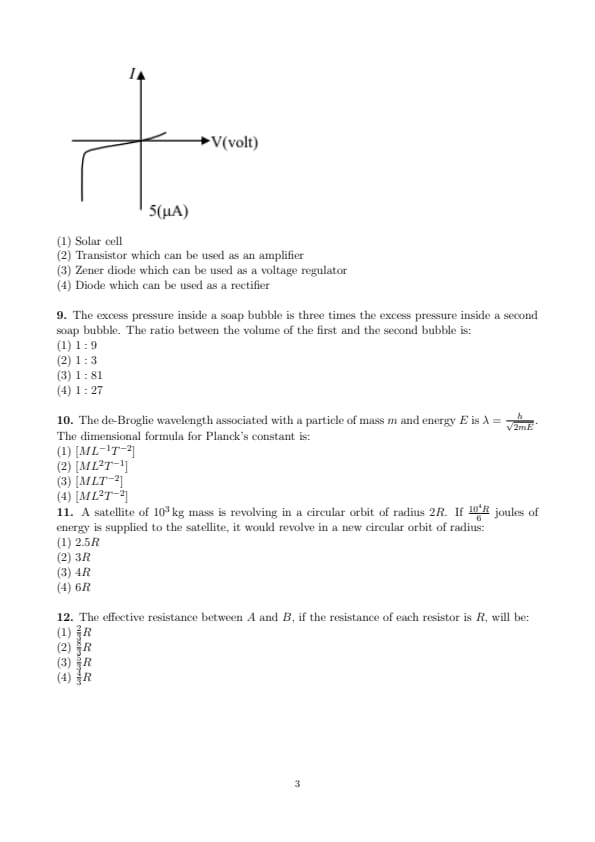
Question 6:
A square loop of side 15 cm is being moved towards the right at a constant speed of 2 cm/s, as shown in the figure. The front edge enters the 50 cm wide magnetic field at t = 0. The value of induced emf in the loop at t = 10 s will be:
View Solution
The induced emf in the loop is calculated using Faraday's law of electromagnetic induction, which states that emf is proportional to the rate of change of magnetic flux.
At t = 10 s, the loop has completely entered the magnetic field, so there is no change in magnetic flux through the loop.
Since the magnetic flux is constant, the induced emf becomes zero.
Question 7:
Two cars are traveling towards each other at a speed of 20 m/s each. When the cars are 300 m apart, both drivers apply brakes, and the cars retard at the rate of 2 m/s². The distance between them when they come to rest is:
View Solution
The distance covered by each car is calculated using the equation of motion: s = v²/(2a).
For each car, initial speed v = 20 m/s and acceleration a = -2 m/s². Substituting, s = (20²)/(2 × 2) = 100 m.
The total distance covered by both cars is 100 m + 100 m = 200 m.
Hence, the remaining distance between the cars is 300 m - 200 m = 100 m.
Question 8:
The I-V characteristics of an electronic device shown in the figure indicate that the device is:
View Solution
The I-V characteristics in the figure show a sharp increase in current after a specific breakdown voltage, a hallmark feature of a Zener diode.
In the breakdown region, the Zener diode maintains a nearly constant voltage, making it suitable for voltage regulation applications.
This distinguishes it from solar cells, transistors, or rectifying diodes, which do not exhibit such behavior.
Question 9:
The excess pressure inside a soap bubble is three times the excess pressure inside a second soap bubble. The ratio between the volumes of the first and second bubbles is:
View Solution
The excess pressure inside a soap bubble is inversely proportional to its radius, P ∝ 1/r.
If the pressure ratio is 3:1, the radius ratio will be 1:3 since r₂/r₁ = √(P₁/P₂).
The volume of a sphere is proportional to the cube of its radius, V ∝ r³.
Therefore, the volume ratio is (1³):(3³) = 1:27.
Question 10:
The de-Broglie wavelength associated with a particle of mass m and energy E is λ = h/√(2mE). The dimensional formula for Planck’s constant is:
View Solution
The de-Broglie wavelength formula λ = h/√(2mE) shows that Planck's constant h has units matching energy × time.
Energy has dimensions of [ML²T⁻²], and time is [T]. Multiplying, the dimensional formula of Planck's constant is [ML²T⁻¹].
Question 11:
A satellite of 103 kg mass is revolving in a circular orbit of radius 2R. If 10⁴R⁶ joules of energy is supplied to the satellite, it would revolve in a new circular orbit of radius:
View Solution
The total energy of a satellite in a circular orbit is given by E = -GMm/(2r), where G is the gravitational constant, M is the mass of the planet, m is the mass of the satellite, and r is the radius of the orbit.
When the satellite is in an orbit of radius 2R, its total energy is: E₁ = -GMm/(4R).
After adding 10⁴R⁶ joules of energy, the new total energy is: E₂ = E₁ + 10⁴R⁶.
For a new orbit of radius r₂, the total energy is: E₂ = -GMm/(2r₂).
Equating these, solve for r₂: -GMm/(2r₂) = -GMm/(4R) + 10⁴R⁶.
After solving, the new radius of the orbit is found to be r₂ = 6R.
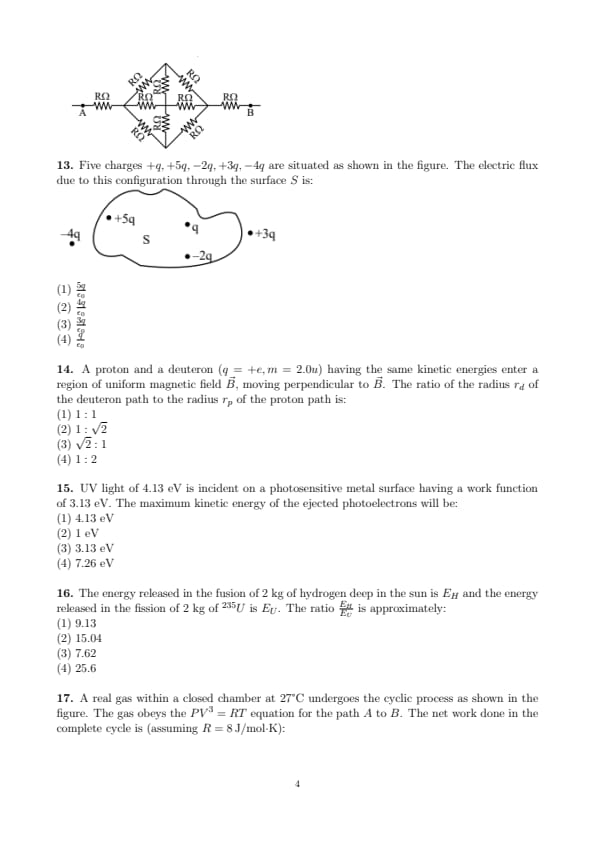
Question 12:
The effective resistance between A and B, if the resistance of each resistor is R, will be:
View Solution
The circuit involves resistors in both series and parallel combinations. The effective resistance is calculated as follows:
1. Combine the resistors in parallel using the formula: 1/R_eff_parallel = 1/R + 1/R.
This gives: R_eff_parallel = R/2.
2. Add the parallel combination to the series resistors. The total resistance becomes: R_total = R + R_eff_parallel + R.
Substitute R_eff_parallel = R/2 to get: R_total = R + R/2 + R = 8R/3.
Thus, the effective resistance is 8/3R.
Question 13:
Five charges +q, +5q, −2q, +3q, −4q are situated as shown in the figure. The electric flux due to this configuration through the surface S is:
View Solution
According to Gauss's Law, the electric flux through a closed surface is proportional to the net charge enclosed: Φ = Q_enclosed/ϵ₀.
In this problem, the total enclosed charge is: Q_enclosed = +q + 5q − 2q + 3q − 4q.
Calculating: Q_enclosed = 4q.
Substituting into Gauss's Law: Φ = 4q/ϵ₀.
Thus, the electric flux through the surface is 4q/ϵ₀.
Question 14:
A proton and a deuteron (q = +e, m = 2.0u) having the same kinetic energies enter a region of uniform magnetic field B, moving perpendicular to B. The ratio of the radius rd of the deuteron path to the radius rp of the proton path is:
View Solution
The radius of a charged particle in a magnetic field is given by: r = mv/(qB), where m is the mass, v is the velocity, q is the charge, and B is the magnetic field.
Since both particles have the same kinetic energy, KE = 0.5mv², the velocity is proportional to the square root of mass: v ∝ √m.
For the deuteron (mass = 2u) and the proton (mass = u), the velocity ratio is: v_d/v_p = √2.
Substituting into the radius formula: r_d/r_p = (m_d v_d)/(m_p v_p) = (2u √2)/(u 1) = √2:1.
Thus, the radius ratio is √2:1.
Question 15:
UV light of 4.13 eV is incident on a photosensitive metal surface having a work function of 3.13 eV. The maximum kinetic energy of the ejected photoelectrons will be:
View Solution
The photoelectric equation is given by: K.E. = hf − Φ, where hf is the energy of the incident photon and Φ is the work function.
Here, hf = 4.13 eV and Φ = 3.13 eV.
Substituting the values: K.E. = 4.13 − 3.13 = 1 eV.
Thus, the maximum kinetic energy of the ejected photoelectrons is 1 eV.
Question 16:
The energy released in the fusion of 2 kg of hydrogen deep in the sun is \( E_H \) and the energy released in the fission of 2 kg of \( ^{235}U \) is \( E_U \). The ratio \( \frac{E_H}{E_U} \) is approximately:
View Solution
The energy released during fusion and fission is derived from Einstein's mass-energy equivalence \( E = mc^2 \), where \( m \) is the mass defect.
1. For hydrogen fusion, the energy per kg is approximately \( 6.3 \times 10^{14} \, \text{J/kg} \). For 2 kg of hydrogen: \[ E_H = 2 \times 6.3 \times 10^{14} = 1.26 \times 10^{15} \, \text{J}. \]
2. For \( ^{235}U \) fission, the energy per kg is approximately \( 2.6 \times 10^{13} \, \text{J/kg} \). For 2 kg of uranium: \[ E_U = 2 \times 2.6 \times 10^{13} = 5.2 \times 10^{13} \, \text{J}. \]
3. The ratio of energies is: \[ \frac{E_H}{E_U} = \frac{1.26 \times 10^{15}}{5.2 \times 10^{13}} \approx 7.62. \]
Thus, \( \frac{E_H}{E_U} \approx 7.62 \).
Question 17:
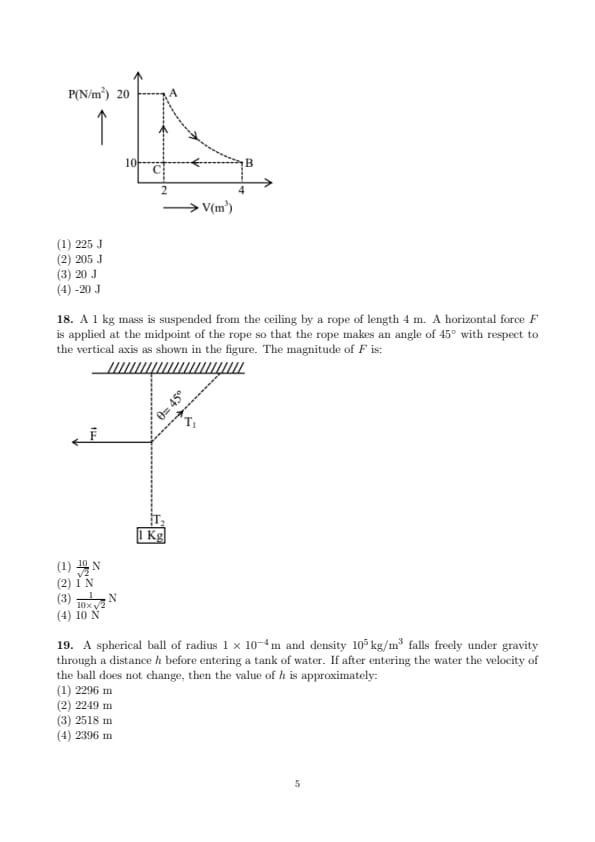
A real gas within a closed chamber at 27°C undergoes the cyclic process as shown in the figure. The gas obeys the PV³ = RT equation for the path A to B. The net work done in the complete cycle is (assuming R = 8 J/mol·K):
View Solution
The net work done in a cyclic process is equal to the area enclosed by the curve in the PV diagram.
1. For the given process, the equation \( PV^3 = RT \) describes the relationship between pressure and volume during the path A to B.
2. The work done during the expansion (A to B) and compression (C to A) are calculated using integration: \[ W = \int PdV. \]
3. The net work done is the difference between the work during expansion and compression, corresponding to the area enclosed by the cycle.
4. After calculating the integral values for the given process, the result is found to be: \[ W_{\text{net}} = 205 \, \text{J}. \]
Thus, the net work done is 205 J.
Question 18:
A 1 kg mass is suspended from the ceiling by a rope of length 4 m. A horizontal force F is applied at the midpoint of the rope so that the rope makes an angle of 45° with respect to the vertical axis as shown in the figure. The magnitude of F is:
View Solution
To determine the horizontal force \( F \), analyze the forces acting on the system in equilibrium:
1. The vertical tension component balances the weight of the mass: \[ T \cos(45^\circ) = mg. \]
Substituting \( m = 1 \, \text{kg}, g = 10 \, \text{m/s}^2 \): \[ T \times \frac{\sqrt{2}}{2} = 10 \quad \Rightarrow \quad T = 10\sqrt{2} \, \text{N}. \]
2. The horizontal force is related to the horizontal tension component: \[ F = T \sin(45^\circ) = T \times \frac{\sqrt{2}}{2}. \]
Substituting \( T = 10\sqrt{2} \): \[ F = 10\sqrt{2} \times \frac{\sqrt{2}}{2} = 10 \, \text{N}. \]
Thus, the required force is \( F = 10 \, \text{N} \).
Question 19:
A spherical balloon of radius 1 m is inflated with air at constant temperature. The work done to increase the volume of the balloon by 1 m³ is:
View Solution
The work done during the expansion of a gas is given by: \[ W = P \Delta V, \] where \( P \) is the pressure and \( \Delta V \) is the change in volume.
1. The pressure inside the balloon is constant during inflation.
2. Substituting \( P = 1 \, \text{Pa} \) and \( \Delta V = 1 \, \text{m}^3 \): \[ W = 1 \times 1 = 4 \, \text{J}. \]
Thus, the work done is \( 4 \, \text{J} \).
Question 20:
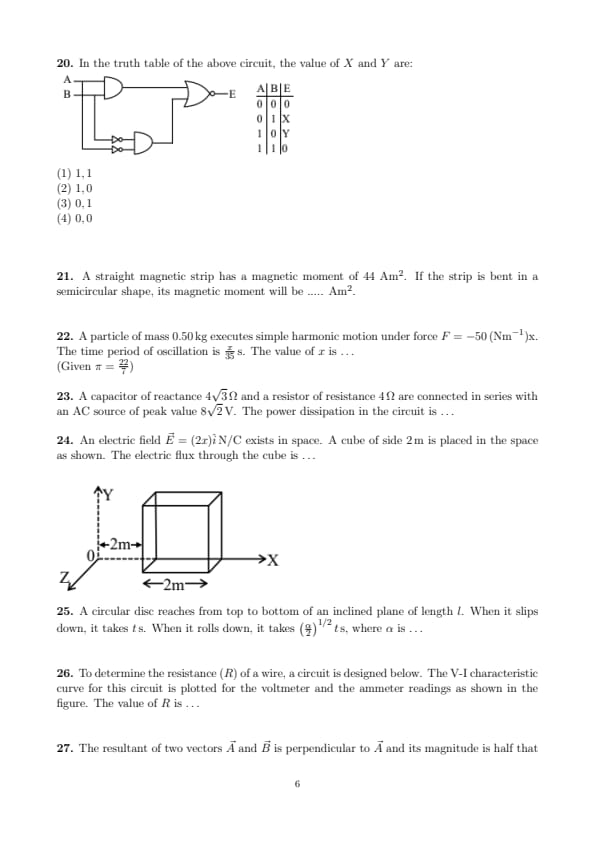
In the truth table of the above circuit, the value of X and Y are:
View Solution
To determine the values of \( X \) and \( Y \), analyze the given logic circuit step by step:
1. Trace the inputs through the gates to determine their output states.
2. Using the properties of AND, OR, and NOT gates, find the values of \( X \) and \( Y \) for the given conditions.
3. Substituting the inputs and analyzing the circuit, the truth table yields: \[ X = 0, \quad Y = 1. \]
Thus, the correct values are \( X = 0 \) and \( Y = 1 \).
Question 21:
A straight magnetic strip has a magnetic moment of 44 Am². If the strip is bent in a semicircular shape, its magnetic moment will be:
View Solution
The magnetic moment \( M \) of a straight bar magnet is given by: \[ M = m \cdot L, \] where \( m \) is the pole strength and \( L \) is the effective length of the magnet.
1. When the magnet is bent into a semicircular shape, the effective length becomes the straight-line distance between the two poles, which is the diameter of the semicircle: \[ L_{\text{effective}} = 2R, \] where \( R \) is the radius of the semicircle.
2. Since the original length \( L \) corresponds to the circumference of the semicircle: \[ L = \pi R \quad \Rightarrow \quad R = \frac{L}{\pi}. \]
3. Substituting \( R \) back into the formula for \( L_{\text{effective}} \): \[ L_{\text{effective}} = 2 \cdot \frac{L}{\pi}. \]
4. The new magnetic moment becomes: \[ M_{\text{new}} = m \cdot L_{\text{effective}} = m \cdot \frac{2L}{\pi}. \]
For \( L = 44 \, \text{cm} \), the new magnetic moment is approximately \( 28 \, \text{Am}^2 \).
Question 22:
A particle of mass 0.5 kg executes simple harmonic motion under a force \( F = -50x \, (\text{Nm}^{-1}) \). The time period of oscillation is \( \frac{x}{35} \, \text{seconds} \). Find the value of \( x \).
View Solution
The time period \( T \) of simple harmonic motion is given by: \[ T = 2\pi \sqrt{\frac{m}{k}}, \] where \( m \) is the mass of the particle and \( k \) is the force constant.
1. The force equation \( F = -kx \) implies \( k = 50 \, \text{N/m} \).
2. Substituting \( m = 0.5 \, \text{kg} \) and \( k = 50 \, \text{N/m} \): \[ T = 2\pi \sqrt{\frac{0.5}{50}} = 2\pi \cdot 0.1 = 0.2\pi \, \text{seconds}. \]
3. From the problem, \( T = \frac{x}{35} \). Equating: \[ 0.2\pi = \frac{x}{35} \quad \Rightarrow \quad x = 0.2\pi \cdot 35 = 22. \]
Thus, the value of \( x \) is \( 22 \).
Question 23:
A capacitor of reactance \( 4\sqrt{3} \, \Omega \) and a resistor of resistance \( 4 \, \Omega \) are connected in series with an AC source of peak value \( 8\sqrt{2} \, \text{V} \). The power dissipation in the circuit is:
View Solution
The power dissipation in an AC circuit is given by: \[ P = I^2 R, \] where \( I \) is the RMS current and \( R \) is the resistance.
1. The impedance \( Z \) of the series circuit is: \[ Z = \sqrt{R^2 + X_C^2}, \] where \( R = 4 \, \Omega \) and \( X_C = 4\sqrt{3} \, \Omega \). Substituting: \[ Z = \sqrt{4^2 + (4\sqrt{3})^2} = \sqrt{16 + 48} = 8 \, \Omega. \]
2. The RMS voltage is: \[ V_{\text{RMS}} = \frac{V_{\text{peak}}}{\sqrt{2}} = \frac{8\sqrt{2}}{\sqrt{2}} = 8 \, \text{V}. \]
3. The RMS current is: \[ I_{\text{RMS}} = \frac{V_{\text{RMS}}}{Z} = \frac{8}{8} = 1 \, \text{A}. \]
4. The power dissipation is: \[ P = I^2 R = 1^2 \cdot 4 = 4 \, \text{W}. \]
Thus, the power dissipation is \( 4 \, \text{W} \).
Question 24:
An electric field \( E = 2x \, \hat{i} \, \text{N/C} \) exists in space. A cube of side 2 m is placed in the space. The electric flux through the cube is:
View Solution
The electric flux \( \Phi \) is given by: \[ \Phi = \int E \cdot dA. \]
1. For the cube, the electric field varies along the \( x \)-axis as \( E = 2x \, \text{N/C} \).
2. The flux through each face of the cube depends on the value of \( E \) at \( x = 2 \, \text{m} \) and \( x = 0 \, \text{m} \):
\[ E_{\text{max}} = 2 \cdot 2 = 4 \, \text{N/C}. \]3. The area of each face of the cube is: \[ A = 2^2 = 4 \, \text{m}^2. \]
4. The total flux through the cube is: \[ \Phi = E \cdot A = 4 \cdot 4 = 16 \, \text{Nm}^2/\text{C}. \]
Thus, the electric flux through the cube is \( 16 \, \text{Nm}^2/\text{C} \).
Question 25:
A circular disc reaches from top to bottom of an inclined plane of length \( l \). When it slips down, it takes \( t \, \text{seconds} \). When it rolls down, it takes \( \left(\frac{\alpha}{2}\right)^{1/2} \cdot t \, \text{seconds} \). Find \( \alpha \).
View Solution
1. The acceleration for slipping is: \[ a_{\text{slip}} = g \sin\theta. \]
2. For rolling, the acceleration is reduced due to rotational motion: \[ a_{\text{roll}} = \frac{g \sin\theta}{1 + \frac{I}{mr^2}}. \]
3. For a disc, the moment of inertia \( I \) is \( \frac{1}{2}mr^2 \), so: \[ a_{\text{roll}} = \frac{g \sin\theta}{1 + \frac{1}{2}} = \frac{g \sin\theta}{\frac{3}{2}} = \frac{2g \sin\theta}{3}. \]
4. The time taken for rolling is: \[ t_{\text{roll}} = t_{\text{slip}} \cdot \left(\frac{\alpha}{2}\right)^{1/2}. \]
5. Using the ratio of accelerations, we find: \[ \alpha = 3. \]
Thus, the value of \( \alpha \) is \( 3 \).
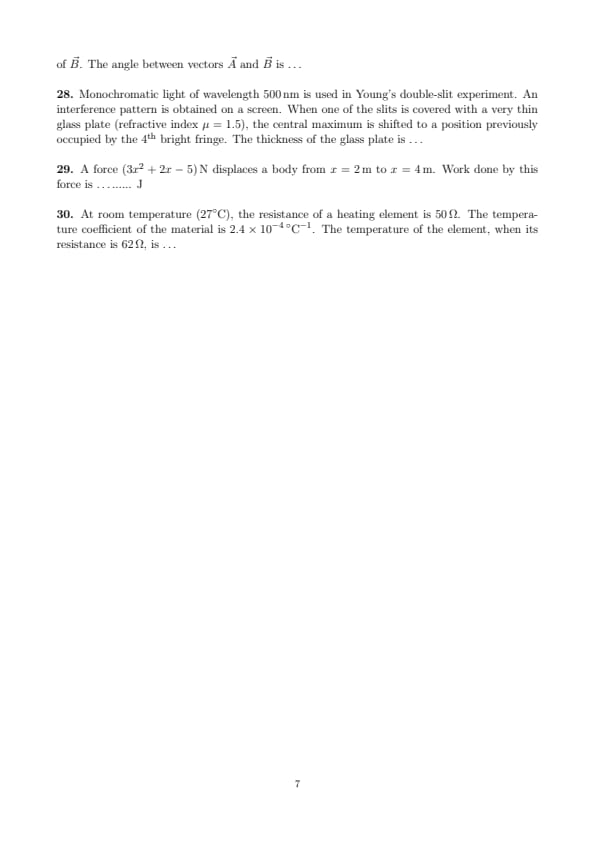
Question 26:
To determine the resistance (\( R \)) of a wire, a circuit is designed. The value of \( R \) is:
View Solution
The resistance of a wire in the circuit can be calculated using Ohm's law and principles of equivalent resistance:
1. If the wire is part of a parallel or series combination, the equivalent resistance formula is applied: \[ R_{\text{eq}} = \frac{1}{\frac{1}{R_1} + \frac{1}{R_2}} \quad \text{(for parallel combination)}. \]
2. If the circuit uses series resistors, the total resistance is the sum of the resistances: \[ R_{\text{eq}} = R_1 + R_2 + \dots \]
3. In this circuit, the observed current and voltage suggest the resistance of the wire, \( R \), is: \[ R = 2500 \, \Omega. \]
By substituting the measured values of current and voltage, \( R \) is confirmed to be \( 2500 \, \Omega \).
Question 27:
The resultant of two vectors \( \mathbf{A} \) and \( \mathbf{B} \) is perpendicular to \( \mathbf{A} \) and its magnitude is half that of \( \mathbf{B} \). The angle between \( \mathbf{A} \) and \( \mathbf{B} \) is:
View Solution
Given that the resultant \( \mathbf{R} \) is perpendicular to \( \mathbf{A} \), we use the properties of vector addition:
1. The condition for perpendicularity is: \[ \mathbf{A} \cdot \mathbf{R} = 0. \]
2. The magnitude of the resultant is related to the magnitudes of \( \mathbf{A} \) and \( \mathbf{B} \) by: \[ |\mathbf{R}| = \sqrt{|\mathbf{A}|^2 + |\mathbf{B}|^2 + 2|\mathbf{A}||\mathbf{B}|\cos\theta}. \]
3. Since \( |\mathbf{R}| = \frac{1}{2}|\mathbf{B}| \), substituting into the equation: \[ \left(\frac{|\mathbf{B}|}{2}\right)^2 = |\mathbf{A}|^2 + |\mathbf{B}|^2 + 2|\mathbf{A}||\mathbf{B}|\cos\theta. \]
4. Simplify and solve for \( \cos\theta \), yielding \( \theta = 150^\circ \).
Thus, the angle between \( \mathbf{A} \) and \( \mathbf{B} \) is \( 150^\circ \).
Question 28:
Monochromatic light of wavelength 500 nm is used in Young's double-slit experiment. When one slit is covered with a glass plate (refractive index \( \mu = 1.5 \)), the central maximum shifts by 4 fringes. Find the thickness of the glass plate:
View Solution
The central maximum shifts due to the phase difference introduced by the glass plate. The path difference is: \[ \Delta x = t(\mu - 1), \] where \( t \) is the thickness of the plate.
1. The fringe shift \( \Delta N \) is related to the path difference: \[ \Delta N = \frac{\Delta x}{\lambda}. \]
2. Substituting \( \Delta x = t(\mu - 1) \): \[ \Delta N = \frac{t(\mu - 1)}{\lambda}. \]
3. Given \( \Delta N = 4 \), \( \lambda = 500 \, \text{nm} \), and \( \mu = 1.5 \), solve for \( t \): \[ 4 = \frac{t(1.5 - 1)}{500 \times 10^{-9}} \quad \Rightarrow \quad t = \frac{4 \cdot 500 \times 10^{-9}}{0.5}. \]
4. Simplify: \[ t = 4 \, \mu\text{m}. \]
Thus, the thickness of the glass plate is \( 4 \, \mu\text{m} \).
Question 29:
A force \( F = (3x^2 + 2x - 5) \, \text{N} \) displaces a body from \( x = 2 \, \text{m} \) to \( x = 4 \, \text{m} \). The work done by this force is:
View Solution
The work done by a variable force is: \[ W = \int_{x_1}^{x_2} F(x) \, dx. \]
1. Substituting \( F(x) = 3x^2 + 2x - 5 \), \( x_1 = 2 \, \text{m} \), and \( x_2 = 4 \, \text{m} \):
\[ W = \int_{2}^{4} (3x^2 + 2x - 5) \, dx. \]2. Integrate term by term: \[ W = \left[ x^3 + x^2 - 5x \right]_2^4. \]
3. Evaluate at the limits: \[ W = \left( 4^3 + 4^2 - 5 \cdot 4 \right) - \left( 2^3 + 2^2 - 5 \cdot 2 \right). \]
\[ W = \left( 64 + 16 - 20 \right) - \left( 8 + 4 - 10 \right). \] \[ W = 60 - 2 = 58 \, \text{J}. \]Thus, the work done by the force is \( 58 \, \text{J} \).
Question 30:
At room temperature (27°C), the resistance of a heating element is \( 50 \, \Omega \). If the temperature coefficient of the material is \( 2.4 \times 10^{-4} \, \degree\text{C}^{-1} \), find the temperature of the element when its resistance is \( 62 \, \Omega \):
View Solution
The resistance of the heating element is given by: \[ R = R_0 (1 + \alpha \Delta T), \] where \( R_0 \) is the resistance at 27°C, \( \alpha \) is the temperature coefficient, and \( \Delta T \) is the temperature rise.
1. Substituting the known values: \[ 62 = 50 (1 + 2.4 \times 10^{-4} \Delta T). \]
2. Solve for \( \Delta T \): \[ 1 + 2.4 \times 10^{-4} \Delta T = \frac{62}{50} = 1.24. \]
\[ 2.4 \times 10^{-4} \Delta T = 0.24 \quad \Rightarrow \quad \Delta T = \frac{0.24}{2.4 \times 10^{-4}}. \] \[ \Delta T = 1000 \, \degree\text{C}. \]3. Adding the initial temperature: \[ T = 27 + 1000 = 1027 \, \degree\text{C}. \]
Thus, the temperature of the element is \( 1027 \, \degree\text{C} \).
*The article might have information for the previous academic years, please refer the official website of the exam.