
JEE Main 2024 Question Paper with Answer Key PDF for Chemistry (January 29 - Shift 2)

.jpg?tr=h-55,w-55,c-force)
Content Strategist|Tech-innovator|National Hackathon Winner | Updated On - Jan 13, 2025
JEE Main 2024 Jan 29 Shift 2 Chemistry Question Paper with Solution pdf is available for download here. Students found easy and hard. carried the highest weightage and overall difficulty level was moderate.
JEE Main 2024 Chemistry Question Paper with Answer Key PDF
| JEE Main 2024 Question Paper PDF | JEE Main 2024 Answer Key PDF |
|---|---|
| Download PDF | Download PDF |
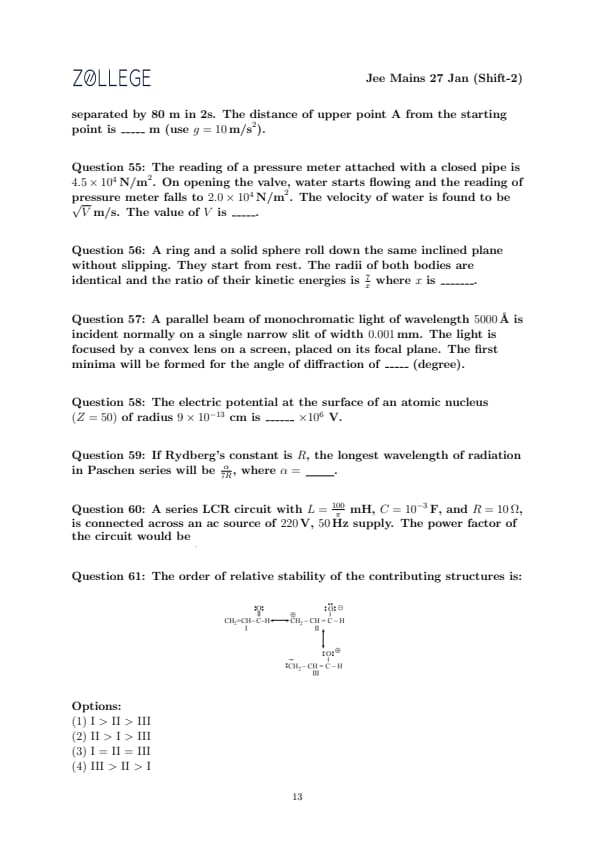
Question 61:
The ascending acidity order of given H atoms is:
- C < D < B < A
- A < B < C < D
- A < B < D < C
- D < C < B < A
The relative acidities follow from the stability of their conjugate bases in the order C < D < B < A.
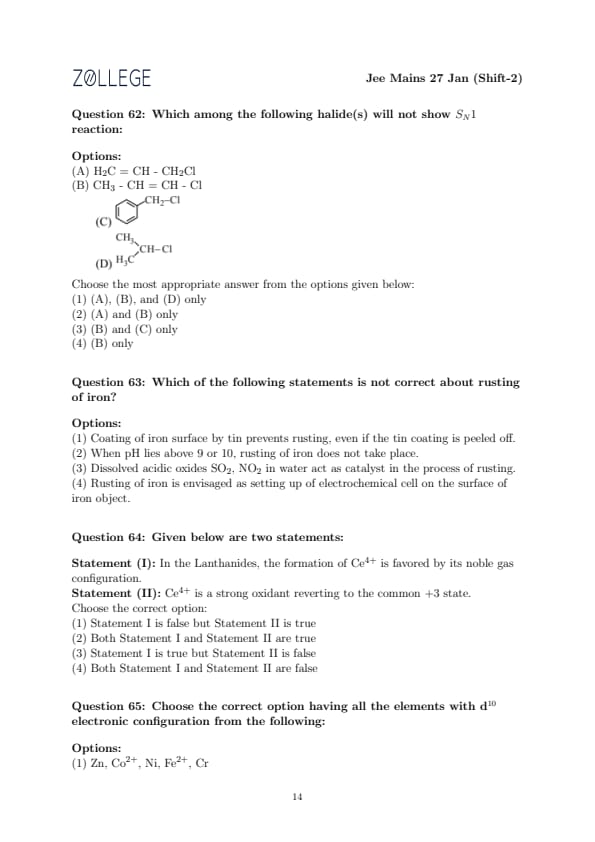
Question 62:
Match List I (Bio Polymer) with List II (Monomer):
A. Starch | I. Nucleotide
B. Cellulose | II. α-glucose
C. Nucleic acid | III. β-glucose
D. Protein | IV. α-amino acid
- A-II, B-I, C-III, D-IV
- A-IV, B-II, C-I, D-III
- A-I, B-III, C-IV, D-II
- A-II, B-III, C-I, D-IV
Starch is α-glucose based, Cellulose is β-glucose, Nucleic acids are nucleotides, and Proteins are α-amino acids.
Question 63:
Match List I (Compound) with List II (pKa value):
A. Ethanol | II. 15.9
B. Phenol | I. 10.0
C. m-Nitrophenol | IV. 8.3
D. p-Nitrophenol | III. 7.1
- A-I, B-II, C-III, D-IV
- A-IV, B-I, C-II, D-III
- A-III, B-IV, C-I, D-II
- A-II, B-I, C-IV, D-III
Ethanol=15.9, Phenol=10.0, m-Nitrophenol=8.3, p-Nitrophenol=7.1.
Question 64:
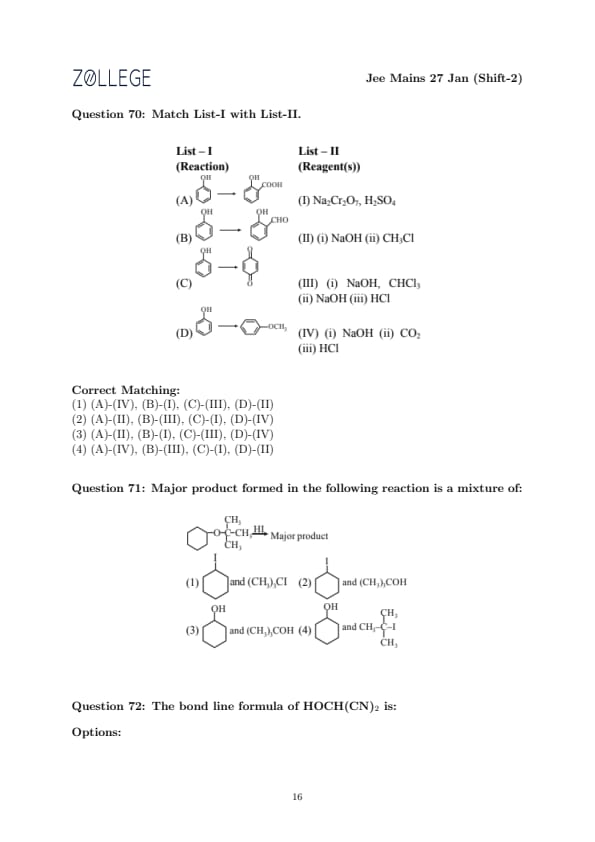
Which reaction is correct?
- Incorrect reaction
- Correct reaction
- Partially correct reaction
- Not valid reaction
HI adds Markovnikov-style, attaching I to less hydrogenated carbon.
Question 65:
IUPAC name of the compound?
- Cyclohex-1-en-2-ol
- 1-Hydroxyhex-2-ene
- Cyclohex-1-en-3-ol
- Cyclohex-2-en-1-ol
The double bond and OH are numbered for lowest locants => 2-en-1-ol.
Question 66:
Correct IUPAC name of K₂MnO₄ is?
- Potassium tetraoxopermanganate(VI)
- Potassium tetraoxidomanganate(VI)
- Dipotassium tetraoxidomanganate(VII)
- Potassium tetraoxidomanganese(VI)
Mn is in +6 oxidation => “tetraoxidomanganate(VI).”
Question 67:
Reagent giving red ppt with Ni²⁺ in basic medium?
- Sodium nitroprusside
- Neutral FeCl₃
- Meta-dinitrobenzene
- Dimethyl glyoxime
DMG + Ni²⁺ => red ppt of Ni(dmg)₂ in basic medium.
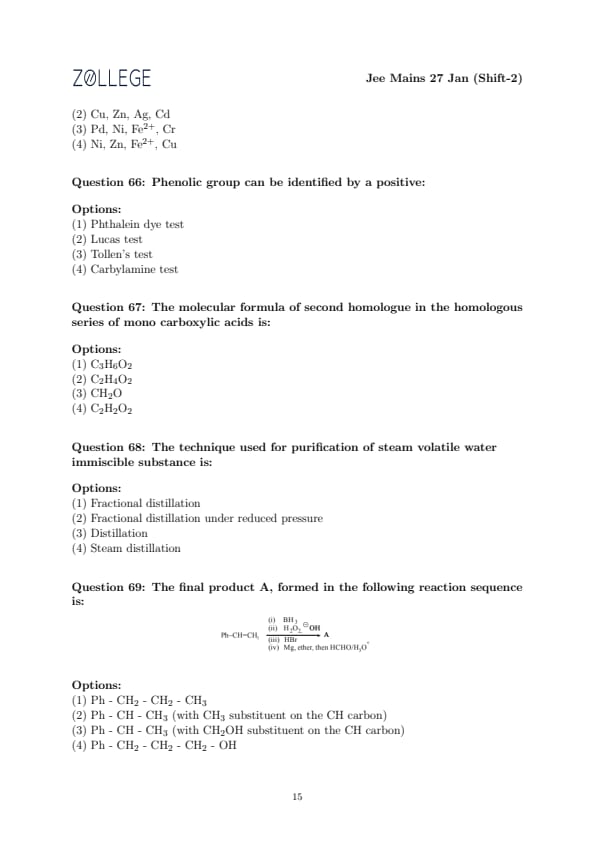
Question 68:
Phenol + CHCl₃ + NaOH => acid hydrolysis => product= ? => 2-hydroxybenzaldehyde
- Salicylic acid
- Benzene-1,2-diol
- Benzene-1,3-diol
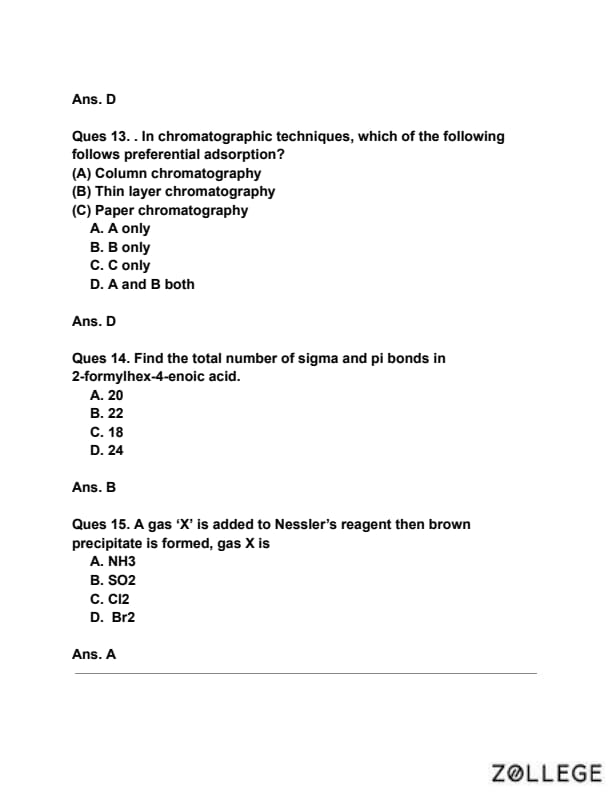
- 2-Hydroxybenzaldehyde
Reimer-Tiemann reaction forms salicylaldehyde (2-hydroxybenzaldehyde).
Question 69:
Match H spectral series vs region: Lyman/Balmer/Paschen/Pfund => UV/Visible/IR/IR
- A-II, B-III, C-I, D-IV
- A-I, B-III, C-II, D-IV
- A-II, B-IV, C-III, D-I
- A-I, B-II, C-III, D-IV
Lyman=UV, Balmer=visible, Paschen & Pfund=IR.
Question 70:
A brown ppt with Nessler’s reagent => gas=? => NH₃
- H₂S
- CO₂
- NH₃
- Cl₂
Nessler’s reagent + ammonia => brown precipitate (Millon's base).
Question 71:
The product A in a diazotization + Sandmeyer reaction => chlorobenzene
- ...
- ...
- Chlorobenzene
- ...
Diazonium salt + Cu₂Cl₂ => chlorobenzene.
Question 72:
Identify reagents for a certain conversion => DIBAL-H, NaOH(alc), Zn/HCl => correct set?
- A=LiAlH₄, B=NaOH(aq), C=NH₂NH₂/KOH
- A=LiAlH₄, B=NaOH(alc), C=Zn/HCl
- A=DIBAL-H, B=NaOH(aq), C=NH₂NH₂/KOH
- A=DIBAL-H, B=NaOH(alc), C=Zn/HCl
DIBAL-H => partial ester reduction, NaOH(alc)=> aldol steps, Zn/HCl=> Clemmensen.
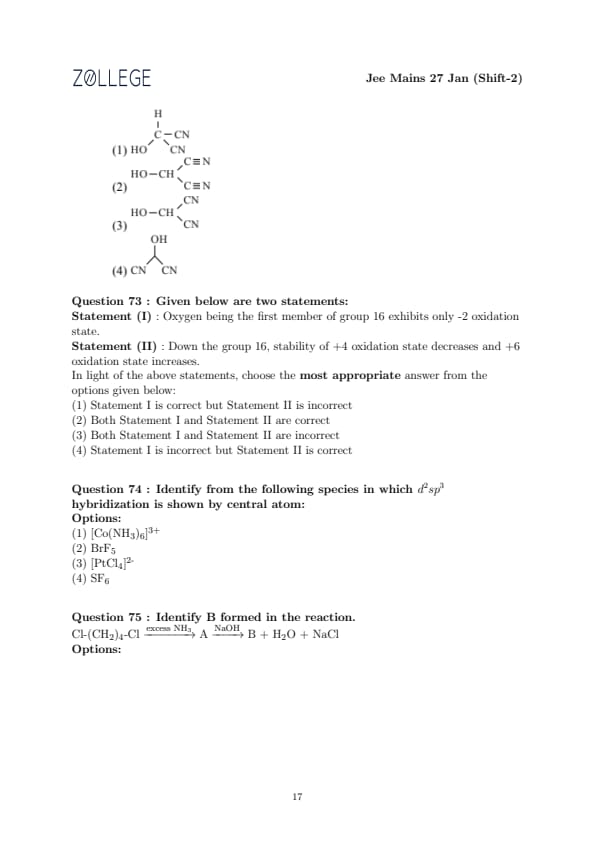
Question 73:
Strong reducing agent among Ce=58, Eu=63, Gd=64, Lu=71 => ? => Eu²⁺
- Lu³⁺
- Gd³⁺
- Eu²⁺
- Ce⁴⁺
Eu²⁺ easily oxidizes to Eu³⁺ => strong reducing agent.
Question 74:
Which chromatography is based on differential adsorption? => Column & TLC => (A,B only)
- B only
- A only
- A & B only
- C only
Column & Thin Layer rely on adsorption, Paper uses partition.
Question 75:
Statements re: Zn, Cd, Hg => correct ones? => B & D only
- B, D only
- B, C only
- A, D only
- C, D only
Zn & Cd no variable O.S., Hg does +1,+2; all are soft metals.
Question 76:
Highest first I.E. among Si, Al, N, C => ? => N
- Si
- Al
- N
- C
N’s half-filled 2p³ => highest I.E.
Question 77:
Alkyl halide => alkyl isocyanide => reagent=? => AgCN
- NaCN
- NH₄CN
- KCN
- AgCN
AgCN + R–X => R–NC due to covalent nature.
Question 78:
Which has geometrical isomerism? => CH₃CH=CHBr
- CH₃CH=CHCH₃
- CH₂=CBr₂
- CH₃CH=CHBr
- Cyclohexane
Different substituents => restricted rotation => cis/trans forms.
Question 79:
I: F has most negative EGE in group => false. II: O has least negative EGE in group => true => so (I false, II true)
- Both true
- I true, II false
- Both false
- I false, II true
Cl has more negative EGE than F; O is smallest negative in its group.
Question 80:
Oxygen’s anomaly => small size + high electronegativity
- Large size, high EN
- Small size, low EN
- Small size, high EN
- Large size, low EN
O's unique properties arise from small radius & strong EN.
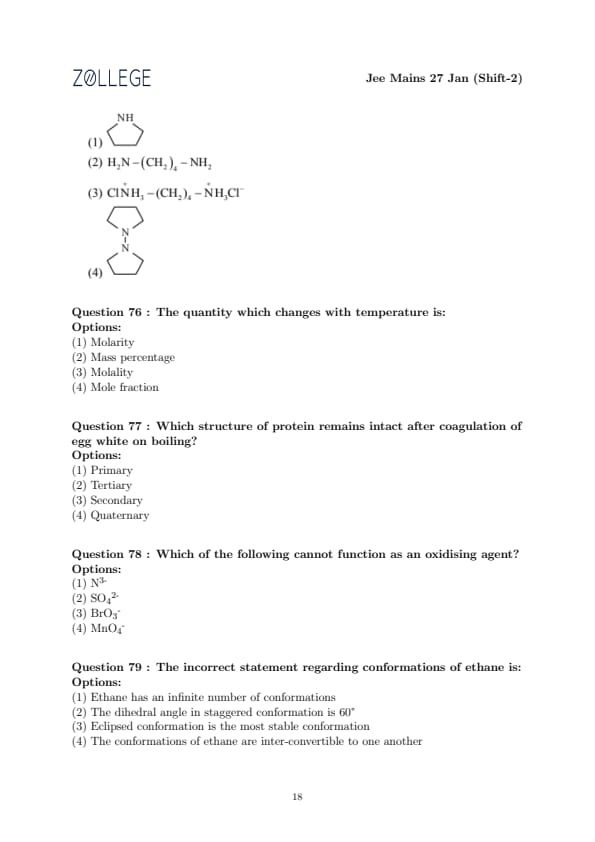
Question 81:
Total antibonding MOs from 2s,2p in a diatomic => 4
1 antibonding from 2s*, plus 3 from 2p* => total=4.
Question 82:
Brown ring test complex => Fe in +1 state
[Fe(H₂O)₅(NO)]²⁺ => Fe=+1 once charges are tallied.
Question 83:
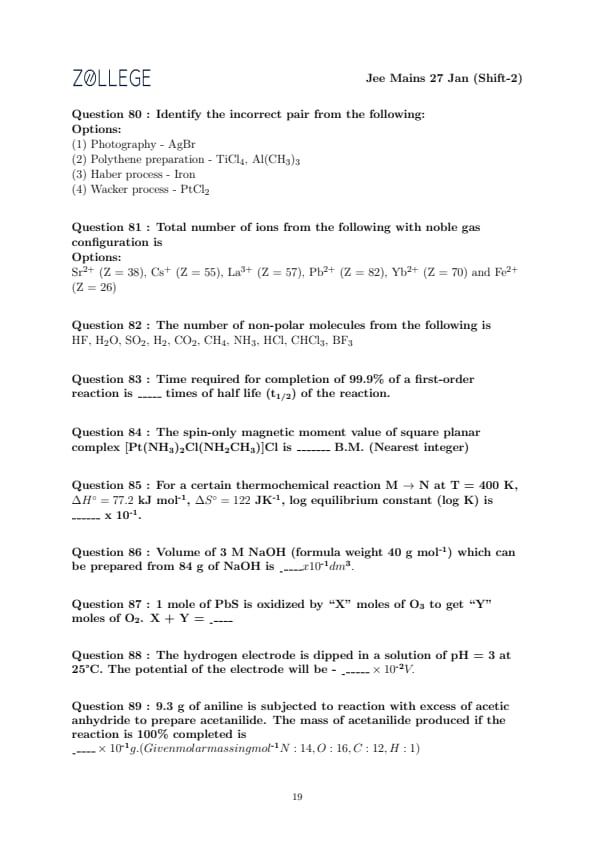
NH₃ formation => [N₂]=2×10⁻², [H₂]=3×10⁻², [NH₃]=1.5×10⁻² => Kc=? =>417
Kc= [NH₃]² / ([N₂][H₂]³)= (1.5×10⁻²)² /((2×10⁻²)(3×10⁻²)³)=417.
Question 84:
0.8 M H₂SO₄, density=1.06 => molality=? => 815×10⁻³ m
Mass(1 L)=1060 g, moles acid=0.8 => ~78.4 g => solute in 981.6 g solvent => molality=0.08 mol/kg => 0.815 => 815×10⁻³.
Question 85:
50 mL NaOH neutralizes 50 mL 0.5 M oxalic => mass(NaOH)=4 g
Eq’s => n(oxalic)= 0.5×0.05=0.025 => n(NaOH)= 2×0.025=0.05 => mass=2g/0.05? => 4g total.
Question 86:
2-formylhex-4-enoic acid => total σ+π bonds=22
Summing 16 sigma, 6 pi => 22 total.
Question 87:
Bromine-82 half-life=36 h => fraction left after 24 h=? =>0.63
Using N/N₀= (1/2)^(24/36)= (1/2)^(2/3)=~0.63.
Question 88:
ΔH(vap)(CCl₄)=30.5 kJ/mol => 284 g => heat=? =>56 kJ
Moles=284/154=1.84 => total=1.84×30.5=56 kJ.
Question 89:
AuCl₄⁻ electrolyzed => cathode mass gained 1.314 g => total charge=2 F
Q= n(e⁻)×F => from mass & eq.wt => 2 F total.
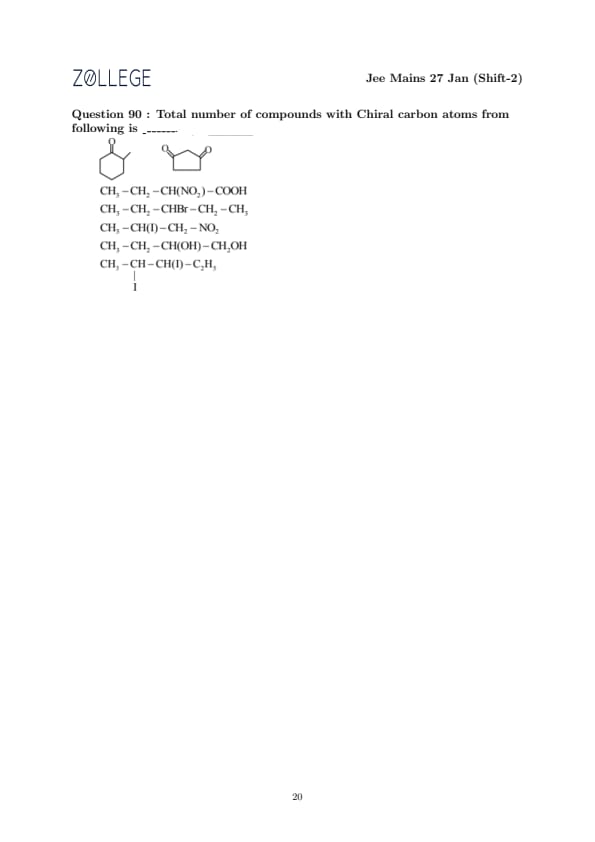
Question 90:
Zero dipole among CH₄,BF₃,H₂O,HF,NH₃,CO₂,SO₂ => total=? =>3
CH₄,BF₃,CO₂ have zero net dipole => total 3.


Previous Year JEE Main Question Papers
*The article might have information for the previous academic years, please refer the official website of the exam.