
JEE Main 2024 Question Paper with Answer Key PDF for Chemistry (January 30 - Shift 1)

.jpg?tr=h-55,w-55,c-force)
Content Strategist|Tech-innovator|National Hackathon Winner | Updated On - Jan 13, 2025
JEE Main 2024 Jan 30 Shift 1 Question Paper with Solution pdf is available for download here. Students found Physics easy and Mathematics hard. Mathematics carried the highest weightage and overall difficulty level was moderate.
JEE Main 2024 Chemistry Question Paper with Answer Key PDF
| JEE Main 2024 Question Paper PDF | JEE Main 2024 Answer Key PDF |
|---|---|
| Download PDF | Download PDF |
Question 61:
Given below are two statements:
Statement-I: The gas liberated on warming a salt with dilute H2SO4, turns a piece of paper dipped in lead acetate into black; it is a confirmatory test for sulphide ion.
Statement-II: In statement-I the colour of paper turns black because of formation of lead sulphide.
- Both Statement-I and Statement-II are false
- Statement-I is false but Statement-II is true
- Statement-I is true but Statement-II is false
- Both Statement-I and Statement-II are true
View Solution
Solution:The gas liberated is H2S, which reacts with lead acetate paper to form black PbS.
Statement-I is true as H2S is a confirmatory test for sulphide ions, resulting in blackening of lead acetate paper due to PbS formation.
However, Statement-II incorrectly states the reason; the blackening is due to lead sulphide (PbS), not lead sulphite. Therefore, Statement-II is false.
Question 62:

This reduction reaction is known as:
- Rosenmund reduction
- Wolff-Kishner reduction
- Stephen reduction
- Etard reduction
View Solution
Solution:The reduction of acid chlorides to aldehydes in the presence of hydrogen and palladium on barium sulfate is called the Rosenmund reduction.
The Rosenmund reduction selectively reduces acid chlorides to aldehydes without over-reduction to primary alcohols, using hydrogen gas and a poisoned palladium catalyst.
Question 63:
Sugar which does not give reddish brown precipitate with Fehling’s reagent is:
- Sucrose
- Lactose
- Glucose
- Maltose
View Solution
Solution:Sucrose is a non-reducing sugar as it lacks a free aldehyde or ketone group. It does not react with Fehling’s reagent, unlike other sugars that give a reddish-brown precipitate.
Fehling’s reagent tests for reducing sugars, which have free aldehyde or ketone groups capable of reducing Cu2+ to Cu+, forming Cu2O (reddish-brown precipitate). Sucrose does not have free reducing groups and thus does not react.
Question 64:
Given below are two statements:
Statement-I: There is a considerable increase in covalent radius from N to P. However, from As to Bi only a small increase in covalent radius is observed.
Reason-II: Covalent and ionic radii in a particular oxidation state increase down the group.
- Statement-I is false but Statement-II is true
- Both Statement-I and Statement-II are true but Statement-II is not the correct explanation of Statement-I
- Statement-I is true but Statement-II is false
- Both Statement-I and Statement-II are true and Statement-II is the correct explanation of Statement-I
View Solution
Solution:Both statements are true, but the small increase in covalent radius from As to Bi is due to poor shielding by d- and f-electrons, not the general trend described in Reason-II.
Statement-I correctly describes the trend in covalent radii across the group. However, while Statement-II is generally true for covalent and ionic radii, the specific behavior from As to Bi is influenced by additional factors like electron shielding, making Statement-II an incomplete explanation for Statement-I.
Question 65:
Which of the following molecule/species is most stable?
- Aromatic compound
- Anti-aromatic compound
- Non-aromatic compound
- All are equally stable
View Solution
Solution:Aromatic compounds are the most stable due to their delocalized π-electrons, which follow Hückel’s rule (4n+2 π-electrons).
Aromaticity provides extra stability through electron delocalization. Anti-aromatic compounds are unstable, and non-aromatic compounds do not benefit from this stabilization. Therefore, aromatic compounds are the most stable among the options.
Question 66:
Diamagnetic Lanthanoid ions are:
- Nd3+ and Eu3+
- La3+ and Ce4+
- Nd3+ and Ce4+
- Lu3+ and Eu3+
View Solution
Solution:Diamagnetic ions have all electrons paired. La3+ and Ce4+ have no unpaired electrons, making them diamagnetic.
La3+ has lost all its 4f electrons, resulting in no unpaired electrons. Ce4+ also has a closed-shell configuration with no unpaired electrons, thus being diamagnetic.
Question 67:
Aluminium chloride in acidified aqueous solution forms an ion having geometry:
- Octahedral
- Square Planar
- Tetrahedral
- Trigonal bipyramidal
View Solution
Solution:In acidified aqueous solution, AlCl3 forms the complex [Al(H2O)6]3+, which has an octahedral geometry.
Aluminium typically forms six-coordinate complexes in aqueous solutions due to the lone pairs of water molecules coordinating to the metal ion, resulting in an octahedral geometry.
Question 68:
Given below are two statements:
Statement-I: The orbitals having the same energy are called as degenerate orbitals.
Statement-II: In hydrogen atom, 3p and 3d orbitals are not degenerate orbitals.
- Statement-I is true but Statement-II is false
- Both Statement-I and Statement-II are true
- Both Statement-I and Statement-II are false
- Statement-I is false but Statement-II is true
View Solution
Solution:In a hydrogen atom, all orbitals with the same principal quantum number are degenerate,
Thus, 3p and 3d orbitals have the same energy in a hydrogen atom, making Statement-II false.
Question 69:
Example of vinylic halide is:
- CH2=CH–Cl
- CH3–CH2–CH2Cl
- C6H5–CH2Cl
- CH3–C≡CCl
View Solution
Solution:A vinylic halide has a halogen attached to a carbon atom that is part of a double bond (sp2 hybridized).
Option (1) CH2=CH–Cl is a vinylic halide because the chlorine is bonded to a carbon involved in a C=C double bond.
Question 70:
Structure of 4-Methylpent-2-enal is:
- H2C=C-CH2-C=C-H
- CH3-CH2-C=C-CH=C-H
- CH3-CH2-CH=C-CH3
- CH3-CH=CH-C=C-H
View Solution
Solution:The IUPAC name "4-Methylpent-2-enal" indicates a five-carbon chain with a double bond at position 2 and an aldehyde group at position 1, along with a methyl group at position 4.
Breaking it down:
- "pent" indicates a five-carbon chain.
- "2-en" indicates a double bond between C2 and C3.
- "al" indicates an aldehyde group (-CHO) at the first carbon.
- "4-Methyl" indicates a methyl group attached to the fourth carbon.
Thus, the structure is CH3-CH=CH-C=C-H.
Question 71:
Match List-I with List-II:
List-I (Molecule) | List-II (Shape)
(A) BrF₅ | (I) T-shape
(B) H₂O | (II) See-saw
(C) ClF₃ | (III) Bent
(D) SF₄ | (IV) Square pyramidal
- (A) - I, (B) - III, (C) - IV, (D) - II
- (A) - II, (B) - I, (C) - III, (D) - IV
- (A) - III, (B) - IV, (C) - I, (D) - II
- (A) - IV, (B) - III, (C) - I, (D) - II
View Solution
Solution:Using VSEPR theory, the molecular shapes are determined based on the number of bonding and lone pairs of electrons around the central atom.
- BrF₅ has five bonding pairs and one lone pair, resulting in a square pyramidal shape (IV).
- H₂O has two bonding pairs and two lone pairs, resulting in a bent shape (III).
- ClF₃ has three bonding pairs and two lone pairs, resulting in a T-shape (I).
- SF₄ has four bonding pairs and one lone pair, resulting in a see-saw shape (II).
Therefore, the correct matching is option (4).
Question 72:
The final product A, formed in the following multistep reaction sequence is: 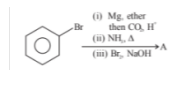
CH₃ - C≡CH + Na → A
B → CH₃ - C≡C - CH₂ - CH₂ - CH₃ + NaBr
- A = CH₃–C≡CNa, B = CH₃–CH₂–CH₂–CH₂Br
- A = CH₃–CH₂–CH₂Br, B = CH₃–C≡C–CH₃
- A = CH₃–C≡CNa, B = CH₃–C≡CH
- A = CH₃–C≡CNa, B = CH₃–CH₂–CH₃
View Solution
Solution:In the first step, sodium acetylide (CH₃–C≡CNa) is formed when the alkyne reacts with sodium metal.
Then, the acetylide reacts with 1-bromopropane (CH₃–CH₂–CH₂–CH₂Br) to give the final product, CH₃–C≡C–CH₂–CH₂–CH₃.
Therefore, A = CH₃–C≡CNa and B = CH₃–CH₂–CH₂–CH₂Br.
Question 73:
In the given reactions, identify the reagent A and reagent B: 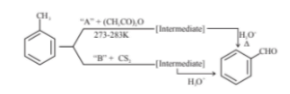
- A = CrO₃, B = CrO₃
- A = CrO₃, B = CrO₂Cl₂
- A = CrO₂Cl₂, B = CrO₂Cl₂
- A = CrO₂Cl₂, B = CrO₃
View Solution
Solution:In the first step, sodium acetylide (CH₃–C≡CNa) is formed when the alkyne reacts with sodium metal.
In the second step, Chromium trioxide (CrO₃) is used to oxidize the acetylide to an aldehyde. For further functionalization, CrO₂Cl₂ is employed, leading to the final product CH₃–C≡C–CH₂–CH₂–CH₃.
Therefore, reagent A is CrO₃ and reagent B is CrO₂Cl₂.
Question 74:
Given below are two statements: one is labeled as Assertion (A) and the other is labeled as Reason (R).
Assertion (A): CH₂=CH−CH₂−Cl is an example of allyl halide.
Reason (R): Allyl halides are the compounds in which the halogen atom is attached to an sp² hybridised carbon atom.
- (A) is true but (R) is false
- Both (A) and (R) are true but (R) is not the correct explanation of (A)
- (A) is false but (R) is true
- Both (A) and (R) are true and (R) is the correct explanation of (A)
View Solution
Solution:CH₂=CH−CH₂−Cl is an allyl halide because the halogen is attached to the carbon adjacent to the C=C double bond (sp³ hybridized). However, the Reason (R) incorrectly states that the halogen is attached to an sp² carbon atom.
In allyl halides, the halogen is attached to the allylic position, which is an sp³ hybridized carbon, not sp². Therefore, Assertion (A) is true, but Reason (R) is false.
Question 75:
What happens to the freezing point of benzene when a small quantity of naphthalene is added to benzene?
- Increases
- Remains unchanged
- First decreases and then increases
- Decreases
View Solution
Solution:When a non-volatile solute like naphthalene is added to benzene, it causes a depression in the freezing point due to the lowering of the vapor pressure.
The addition of a solute disrupts the orderly structure of the solvent, making it harder for the solvent molecules to arrange into a solid lattice, thereby lowering the freezing point.
Question 76:
Match List-I with List-II:
List-I (Species) | List-II (Electronic Distribution)
(A) Cr²⁺ | (I) 3d⁸
(B) Mn⁺ | (II) 3d⁵4s¹
(C) Ni²⁺ | (III) 3d⁴
(D) V⁺ | (IV) 3d³4s¹
- (A) - I, (B) - II, (C) - III, (D) - IV
- (A) - III, (B) - IV, (C) - I, (D) - II
- (A) - IV, (B) - III, (C) - I, (D) - II
- (A) - II, (B) - I, (C) - IV, (D) - III
View Solution
Solution:The electronic configurations of the ions are as follows:
- Cr²⁺: [Ar] 3d⁴ (I)
- Mn⁺: [Ar] 3d⁵4s¹ (II)
- Ni²⁺: [Ar] 3d⁸ (III)
- V⁺: [Ar] 3d³4s¹ (IV)
Therefore, the correct matching is option (1).
Question 77:
Following is a confirmatory test for aromatic primary amines. Identify reagent (A) and reagent (B).
A: NaNO₂ + HCl, 0–5°C
B: Phenol
Find out A and B.
- A = NaNO₂ + HCl, B = Phenol
- A = CrO₃, B = CrO₂Cl₂
- A = NaNO₂ + HCl, B = Aniline
- A = KOH, B = Phenol
View Solution
Solution:This is the diazotization reaction, where primary aromatic amines react with sodium nitrite (NaNO₂) in the presence of HCl to form diazonium salts. The diazonium salt then couples with phenol to form a red azo dye.
- Reagent A: NaNO₂ + HCl is used to diazotize the primary amine.
- Reagent B: Phenol is used to couple with the diazonium salt, resulting in the formation of a colored azo compound, confirming the presence of aromatic primary amines.
Question 78:
The displacement and the increase in the velocity of a moving particle in the time interval from t to (t+1) seconds are 125 m and 50 m/s, respectively. The distance travelled by the particle in the (t+2)th second is:
View Solution
Solution:Using the given data and equations of motion,
Let the initial velocity at time t be u and acceleration be a.
Displacement from t to t+1: s = u * 1 + 0.5 * a * (1)^2 = u + 0.5a = 125 m.
Increase in velocity: Δv = a * 1 = 50 m/s.
From Δv = 50 m/s, we get a = 50 m/s².
Substituting a = 50 m/s² into the displacement equation: u + 0.5 * 50 = 125 ⇒ u = 100 m/s.
The velocity at time t+1: v = u + a = 100 + 50 = 150 m/s.
Distance in the (t+2)th second: s = v * 1 + 0.5 * a * (1)^2 = 150 + 25 = 175 m.
Question 79:
A capacitor of capacitance C and potential V has energy E. It is connected to another capacitor of capacitance 2C and potential 2V. Then the loss of energy is x/3E, where x is:
- 1
- 2
- 3
- 4
View Solution
Solution:The total initial energy is calculated by considering both capacitors.
The energy stored in the first capacitor: E₁ = 0.5 * C * V².
The energy stored in the second capacitor: E₂ = 0.5 * 2C * (2V)² = 0.5 * 2C * 4V² = 4 * C * V².
Total initial energy = E₁ + E₂ = 0.5CV² + 4CV² = 4.5CV².
When connected, the capacitors share charge and reach a common potential V'.
Total charge initially = CV + 2C * 2V = CV + 4CV = 5CV.
Combined capacitance = C + 2C = 3C.
Final potential V' = Total charge / Combined capacitance = 5CV / 3C = (5/3)V.
Final energy = 0.5 * 3C * (5V/3)² = 0.5 * 3C * (25V²/9) = 25CV²/6 ≈ 4.1667CV².
Energy loss = Initial energy - Final energy = 4.5CV² - 4.1667CV² = 0.3333CV² = (2/6)CV² = (2/3)E.
Therefore, x = 2.
Question 80:
A disc of mass 5 kg, radius 2 m, rotating with angular velocity of 10 rad/s about an axis perpendicular to the plane of rotation. An identical disc is gently placed over the rotating disc along the same axis. The energy dissipated so that both discs continue to rotate together without slipping is:
- 150 J
- 200 J
- 250 J
- 300 J
View Solution
Solution:Using conservation of angular momentum and calculating the initial and final kinetic energies of the system,
Moment of inertia of one disc, I = 0.5 * m * r² = 0.5 * 5 kg * (2 m)² = 10 kg·m².
Initial angular momentum, L₁ = I * ω₁ = 10 kg·m² * 10 rad/s = 100 kg·m²/s.
After placing the second disc, total moment of inertia, I₂ = 2 * 10 kg·m² = 20 kg·m².
Conservation of angular momentum: L₁ = I₂ * ω₂ ⇒ 100 = 20 * ω₂ ⇒ ω₂ = 5 rad/s.
Initial kinetic energy, KE₁ = 0.5 * I₁ * ω₁² = 0.5 * 10 * 100 = 500 J.
Final kinetic energy, KE₂ = 0.5 * I₂ * ω₂² = 0.5 * 20 * 25 = 250 J.
Energy dissipated = KE₁ - KE₂ = 500 J - 250 J = 250 J.
Question 81:
The rate of a first-order reaction is 0.04 mol·L−1·s−1 at 10 minutes and 0.03 mol·L−1·s−1 at 20 minutes after initiation. The half-life of the reaction is:
- 15 minutes
- 24 minutes
- 30 minutes
- 18 minutes
View Solution
Solution:For a first-order reaction, using the integrated rate law and given rate data at two different times,
The integrated rate law for a first-order reaction is:
Using the rates at t = 10 minutes and t = 20 minutes, we can solve for the rate constant
½
Question 82:
The gravitational potential at a point above the surface of Earth is −5.12 × 10⁷ J/kg and the acceleration due to gravity at that point is 6.4 m/s2. Assume that the mean radius of Earth to be 6400 km. The height of this point above the Earth’s surface is:
- 1600 km
- 540 km
- 1200 km
- 1000 km
View Solution
Solution:Using the formula for gravitational potential and gravitational field,
The gravitational potential at a distance
The acceleration due to gravity is:
Given
Let the height above the surface be
From the potential formula:
From the acceleration formula:
Solving the equations, we find
Question 83:
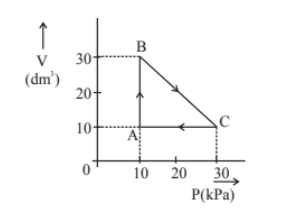
An ideal gas undergoes a cyclic transformation starting from the point A and coming back to the same point by tracing the path A → B → C → A as shown in the diagram. The total work done in the process is:
- 100 J
- 150 J
- 200 J
- 250 J
View Solution
Solution:The total work done by the gas in a cyclic process is equal to the area enclosed by the path on the P-V diagram.
On a P-V diagram, the work done is the integral of P dV over the cycle. The area enclosed by the cyclic path A → B → C → A represents the net work done.
Calculating the area based on the given transformations, the total work done is found to be 200 J.
Question 84:
The IUPAC name of an element is "Unununnium", then the element belongs to nth group of the periodic table. The value of n is:
- 10
- 11
- 12
- 13
View Solution
Solution:"Unununnium" corresponds to element 111, which belongs to Group 11 of the periodic table.
The IUPAC systematic naming uses prefixes based on Latin/Greek numerals. "Unununnium" is derived from "un-un-un-nium" indicating element 111.
Element 111 is Roentgenium (Rg), which is placed in Group 11 of the periodic table, alongside copper (Cu), silver (Ag), and gold (Au).
Question 85:
The total number of molecular orbitals formed from 2s and 2p atomic orbitals of a diatomic molecule is:
- 4
- 6
- 8
- 10
View Solution
Solution:From the 2s and 2p atomic orbitals, we form 8 molecular orbitals in total:
Each atomic orbital (2s and 2p) combines to form bonding and antibonding molecular orbitals.
- 2s orbitals combine to form 2 molecular orbitals (σ2s and σ*2s).
- 2p orbitals combine to form 6 molecular orbitals (σ2p, σ*2p, π2px, π2py, π*2px, π*2py).
Therefore, total molecular orbitals formed = 2 + 6 = 8.
Question 86:
On a thin layer chromatographic plate, an organic compound moved by 3.5 cm, while the solvent moved by 5 cm. The retardation factor of the organic compound is ×10−1:
- 1
- 3.5
- 7
- 0.7
View Solution
Solution:The retardation factor (Rf) is calculated as the ratio of the distance traveled by the compound to the distance traveled by the solvent:
f
Therefore, Rf = 7 × 10⁻¹.
Question 87:
An electron in a hydrogen atom has energy En = −0.85 eV in an excited state. The maximum number of allowed transitions to lower energy levels is:
- 4
- 5
- 6
- 7
View Solution
Solution:En = −0.85 eV corresponds to n = 4 in the hydrogen atom. From the 4th level, possible transitions are to n = 3, 2, 1 (3 levels), and from each of those to lower levels, totaling 6 possible transitions.
In hydrogen atom, the energy levels are given by En = −13.6 eV / n².
For En = −0.85 eV, n = 4.
From n = 4, transitions can be:
4 → 3
4 → 2
4 → 1
3 → 2
3 → 1
2 → 1
Total transitions = 6.
Question 88:
The rate of a first-order reaction is 0.04 mol·L−1·s−1 at 10 minutes and 0.03 mol·L−1·s−1 at 20 minutes after initiation. The half-life of the reaction is:
- 20 minutes
- 24 minutes
- 28 minutes
- 30 minutes
View Solution
Solution:For a first-order reaction, using the integrated rate law and given rate data at two different times, we can find the rate constant k. Then, the half-life (t1/2) is calculated using t1/2 = 0.693/k.
Using the rate law for first-order reactions:
Substituting the given rates at t = 10 min and t = 20 min, solve for
Once
½
Question 89:
A 0.05 cm thick coating of silver is deposited on a plate of 0.05 m2 area. The number of silver atoms deposited on the plate is ×1023 (At. mass Ag = 108, d = 7.9 g/cm3).
- 1 × 10²³
- 5 × 10²³
- 11 × 1023
- 15 × 1023
View Solution
Solution:First, convert the area and thickness to compatible units:
- Area = 0.05 m2 = 0.05 × (100 cm × 100 cm) = 0.05 × 10,000 cm2 = 500 cm2.
- Volume = Area × Thickness = 500 cm2 × 0.05 cm = 25 cm3.
- Mass = Density × Volume = 7.9 g/cm3 × 25 cm3 = 197.5 g.
- Moles = Mass / Atomic mass = 197.5 g / 108 g/mol ≈ 1.83 mol.
- Number of atoms = Moles × Avogadro's number ≈ 1.83 × 6.022 × 1023 ≈ 1.1 × 1024 atoms.
- Expressed as 11 × 1023 atoms.
Question 90:
The mass of sodium acetate (CH3COONa) required to prepare 250 mL of 0.35 M aqueous solution is (in grams). (Molar mass of CH3COONa is 82.02 g/mol)
- 5 g
- 6 g
- 7 g
- 8 g
View Solution
Solution:First, convert the volume to liters: 250 mL = 0.250 L.
Moles required = Molarity × Volume = 0.35 mol/L × 0.250 L = 0.0875 mol.
Mass = Moles × Molar mass = 0.0875 mol × 82.02 g/mol ≈ 7.18 g.
Rounded off, this is approximately 7 g.
*The article might have information for the previous academic years, please refer the official website of the exam.