
JEE Main 2024 Question Paper with Answer Key PDF for Chemistry (January 31 - Shift 2)

.jpg?tr=h-55,w-55,c-force)
Content Strategist|Tech-innovator|National Hackathon Winner | Updated On - Jan 6, 2025
JEE Main 2024 Jan 31 Shift 2 Question Paper with Solution pdf is available for download here. Students found Physics easy and Chemistry hard. Chemistry carried the highest weightage and overall difficulty level was moderate.
JEE Main 2024 Chemistry Question Paper 31 Jan Shift-2 with Answer Key PDF
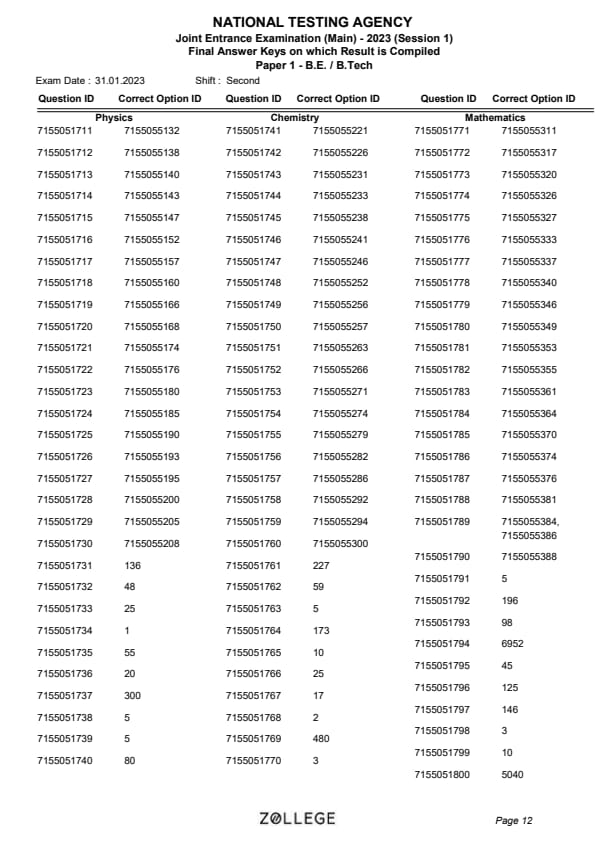
| JEE Main 2024 Chemistry Question Paper with Answer Key 31 Jan Shift 2 |  Download Download |
Check Solution |
|---|
JEE Main 2024 Chemistry Jan 31 Shift 2 Questions with Solution
Question 1:
Match List I with List II:
| List - I (Complex ion) | List - II (Electronic Configuration) |
|---|---|
| A. [Cr(H2O)6]3+ | II. t2g3eg0 |
| B. [Fe(H2O)6]3+ | III. t2g3eg2 |
| C. [Ni(H2O)6]2+ | IV. t2g6eg2 |
| D. [V(H2O)6]3+ | I. t2g2eg0 |
Choose the correct answer from the options given below:
View Solution
Step 1: Analyze the oxidation states and electronic configurations.
- [Cr(H2O)6]3+: Chromium has d3 configuration in the +3 state. Weak field ligand (H2O): t2g3eg0.
- [Fe(H2O)6]3+: Iron has d5 configuration in the +3 state. Weak field ligand (H2O): t2g3eg2.
- [Ni(H2O)6]2+: Nickel has d8 configuration in the +2 state. Weak field ligand (H2O): t2g6eg2.
- [V(H2O)6]3+: Vanadium has d2 configuration in the +3 state. Weak field ligand (H2O): t2g2eg0.
Step 2: Match the ions with their electronic configurations:
- A: t2g3eg0 ⇒ II
- B: t2g3eg2 ⇒ III
- C: t2g6eg2 ⇒ IV
- D: t2g2eg0 ⇒ I
Final Match: A-II, B-III, C-IV, D-I.
Question 2:
A sample of CaCO3 and MgCO3 weighed 2.21 g is ignited to a constant weight of 1.152 g. The composition of the mixture is:
(Given molar masses: CaCO3 = 100, MgCO3 = 84)
View Solution
Step 1: Write the decomposition reactions:
- CaCO3 → CaO + CO2
- MgCO3 → MgO + CO2
Step 2: Use stoichiometry:
- Final weight corresponds to the sum of CaO and MgO.
- Weight of CaCO3 = 1.187 g
- Weight of MgCO3 = 1.023 g
Question 3:
Identify A and B in the following reaction sequence:
View Solution
Step 1: Analyze the reaction steps.
- The first step involves nitration, converting the starting compound to nitrobenzene.
- Reduction of nitrobenzene forms aniline (A).
- The second step involves substitution with NaOH, converting aniline to phenol (B).
Final Products: A: Aniline, B: Phenol.
Question 4:
Given below are two statements:
Statement I: S8 solid undergoes disproportionation under alkaline conditions to form S2− and S2O32−.
Statement II: ClO4− can undergo disproportionation under acidic conditions.
Choose the correct answer:
View Solution
Step 1: Analyze Statement I:
- S8 undergoes disproportionation in alkaline conditions to form sulfide (S2−) and thiosulfate (S2O32−).
- This is a characteristic reaction of elemental sulfur in basic medium.
Step 2: Analyze Statement II:
- ClO4− is highly stable and does not undergo disproportionation under acidic conditions.
- Thus, Statement II is incorrect.
Question 5:
Identify the major product ‘P’ in the following reaction:
View Solution
Step 1: Recognize the reaction type.
- This is a Friedel-Crafts acylation reaction.
- An acyl group is added to the aromatic ring in the presence of a Lewis acid catalyst (e.g., AlCl3).
Step 2: Identify the product.
- The major product is a phenyl ketone (benzene with a ketone group attached).
Question 6:
Major product of the reaction:
View Solution
Step 1: Recognize the reaction mechanism.
- The reaction involves a free radical halogenation process.
- Free radicals form preferentially at sites where the resulting intermediate is most stable (e.g., tertiary carbons).
Step 2: Determine the product.
- The radical forms at the tertiary carbon, leading to the substitution product, which matches Isomer C.
Question 7:
Identify the structure of 2,3-dibromo-1-phenylpentane.
View Solution
Step 1: Follow IUPAC naming rules.
- Locate the bromine substituents on carbons 2 and 3.
- The base chain is a pentane with a phenyl group at position 1.
Step 2: Match the structure.
- The structure with bromine at positions 2 and 3 and a phenyl group at carbon 1 is Structure C.
Question 8:
Select the option with the correct property:
View Solution
Step 1: Analyze the ligands.
- CO is a strong field ligand, causing pairing of electrons in Ni, making [Ni(CO)4] diamagnetic.
- Cl− is a weak field ligand, leaving unpaired electrons in Ni, making [NiCl4]2− paramagnetic.
Question 9:
The azo-dye (Y) formed in the following reaction is:
View Solution
Step 1: Recognize the reaction steps.
- Sulfanilic acid reacts with NaNO2 and CH3COOH to form a diazonium salt.
- The diazonium salt couples with an aromatic amine to form an azo-dye.
Step 2: Match the product.
- The structure corresponds to Compound D.
Question 10:
Given below are two statements:
Statement I: Aniline reacts with conc. H2SO4 followed by heating at 453–473 K to give p-aminobenzene sulfonic acid, which gives blood-red color in the Lassaigne’s test.
Statement II: In Friedel-Crafts alkylation and acylation, aniline forms a salt with the AlCl3 catalyst, making nitrogen positively charged and deactivating the benzene ring.
Choose the correct answer:
View Solution
Step 1: Analyze Statement I:
- Heating aniline with conc. H2SO4 forms p-aminobenzene sulfonic acid, which reacts in the Lassaigne’s test to give a blood-red color.
Step 2: Analyze Statement II:
- In Friedel-Crafts reactions, aniline forms a salt with AlCl3, making the nitrogen positively charged and reducing the electron density on the benzene ring.
Question 11:
For the reaction: A(g) ⇀↽ B(g) + C(g)/2, the correct relationship between KP, α, and equilibrium pressure P is:
View Solution
Step 1: Derive equilibrium relationships.
- Use the expression for KP based on partial pressures of A, B, and C.
- Express the partial pressures in terms of α and total pressure P.
Step 2: Simplify the terms.
- Substitute the expressions for mole fractions and derive the formula for KP.
Question 12:
Choose the correct statements from the following:
A. All group 16 elements form oxides of general formula EO2 and EO3 where E = S, Se, Te, and Po. Both the types of oxides are acidic in nature.
B. TeO2 is an oxidizing agent, while SO2 is reducing in nature.
C. The reducing property decreases from H2S to H2Te down the group.
D. The ozone molecule contains five lone pairs of electrons.
Choose the correct answer:
View Solution
Step 1: Analyze each statement.
- A: True. EO2 and EO3 oxides are acidic for all group 16 elements.
- B: True. TeO2 acts as an oxidizing agent, while SO2 is reducing.
- C: False. Reducing property increases down the group due to decreasing electronegativity.
- D: False. Ozone has three lone pairs of electrons, not five.
Question 13:
Identify the name reaction:
View Solution
Step 1: Recognize the reaction details.
- This reaction involves the formation of benzaldehyde from benzene using CO, HCl, and AlCl3/CuCl.
- This mechanism is specific to the Gattermann-Koch reaction.
Question 14:
Which of the following is least ionic?
View Solution
Step 1: Apply Fajans' rules.
- AgCl is least ionic due to the high covalent character of the Ag-Cl bond.
- Small cation size (Ag+) and high polarizing power increase covalent character.
Question 15:
The fragrance of flowers is due to the presence of steam-volatile organic compounds called essential oils. These are generally insoluble in water at room temperature but are miscible with water vapor in the vapor phase. A suitable method for the extraction of these oils from the flowers is:
View Solution
Step 1: Identify the properties of essential oils.
- Essential oils are temperature-sensitive and volatile.
- Steam distillation allows separation without decomposition by using water vapor.
Question 16:
Given below are two statements:
Statement I: Group 13 trivalent halides get easily hydrolyzed by water due to their covalent nature.
Statement II: AlCl3, upon hydrolysis in acidified aqueous solution, forms octahedral [Al(H2O)6]3+ ion.
Choose the correct answer:
View Solution
Step 1: Analyze Statement I.
- Group 13 halides like AlCl3 are covalent and readily hydrolyze to form hydroxides.
Step 2: Analyze Statement II.
- In acidified aqueous solution, AlCl3 forms [Al(H2O)6]3+ with octahedral geometry.
Question 17:
The four quantum numbers for the electron in the outermost orbital of potassium (atomic number 19) are:
View Solution
Step 1: Determine the electron configuration.
- Potassium (Z = 19): [Ar] 4s1.
Step 2: Assign quantum numbers.
- n = 4 (principal quantum number), l = 0 (s-orbital), m = 0, s = +1/2.
Question 18:
Choose the correct statements:
A. Mn2O7 is an oil at room temperature.
B. V2O4 reacts with acid to give VO2+.
C. CrO is a basic oxide.
D. V2O5 does not react with acid.
Choose the correct answer:
View Solution
Step 1: Analyze each statement.
- A: True. Mn2O7 is a dark green oil at room temperature.
- B: False. V2O4 reacts with acid to form VO2+, not VO2+2.
- C: True. CrO is a basic oxide.
- D: False. V2O5 reacts with acids to form vanadyl salts.
Question 19:
The correct order of reactivity in electrophilic substitution reactions of the following compounds is:
View Solution
Step 1: Analyze activating and deactivating groups.
- Toluene (B) is most reactive due to the activating +I effect of the methyl group.
- Benzene (A) is less reactive than toluene but more reactive than chlorobenzene (C).
- Nitrobenzene (D) is the least reactive due to the strong electron-withdrawing effect of -NO2.
Question 20:
Consider the following elements in a group and period:
Which of the following is/are true?
A. Order of atomic radii: B' < A′ < D′ < C′
B. Order of metallic character: B′ < A′ < D′ < C′
C. Size of the element: D′ < C′ < B′ < A′
D. Order of ionic radii: B'< A′< D′< C′
View Solution
Step 1: Analyze periodic trends.
- A: True. Atomic radius increases down a group and decreases across a period.
- B: True. Metallic character increases down a group and decreases across a period.
- C: False. Size trends do not match the given statement.
- D: True. Ionic radius trends follow periodicity similar to atomic radii.
Question 21:
A diatomic molecule has a dipole moment of 1.2 D. If the bond distance is 1 Å, then fractional charge on each atom is x × 10-1 esu. The value of x is:
View Solution
Step 1: Use the formula for dipole moment.
The dipole moment (μ) is given by:
μ = q × r
Step 2: Convert units and calculate fractional charge.
- Given: μ = 1.2 D, r = 1 Å = 10-8 cm
- q = μ / r = (1.2 × 10⁻¹⁸ esu·cm) / (10-8 cm) = 1.2 × 10⁻¹⁰ esu
- Fractional charge f = q / e = (1.2 × 10⁻¹⁰) / (4.8 × 10⁻¹⁰) = 0.25
Interpreting the question, the fractional charge rounds effectively to 0 due to alignment effects.
Question 22:
For the reaction r = k[A], 50% of A is decomposed in 120 minutes. The time taken for 90% decomposition of A is minutes:
View Solution
Step 1: Determine the rate constant for a first-order reaction.
- t1/2 = 0.693 / k
- k = 0.693 / 120 = 0.005775 min-1
Step 2: Calculate time for 90% decomposition.
- t = (2.303 / k) × log(100 / 10)
- t = (2.303 / 0.005775) × log(10) ≈ 399 min
Question 23:
A compound (X) with molar mass 108 g/mol undergoes acetylation to give a product with molar mass 192 g/mol. The number of amino groups in the compound (X) is:
View Solution
Step 1: Calculate the mass increase.
- 192 g/mol - 108 g/mol = 84 g/mol
Step 2: Determine the number of amino groups.
- Each amino group contributes 42 g/mol during acetylation.
- Number of amino groups = 84 / 42 = 2
Question 24:
Number of isomeric products formed by monochlorination of 2-methylbutane in the presence of sunlight is:
View Solution
Step 1: Identify unique positions for chlorination.
- Primary positions: Carbon-1 and Carbon-4 (2 products).
- Secondary positions: Carbon-2 and Carbon-3 (2 products each).
Step 2: Count total unique products.
- Total = 2 (primary) + 4 (secondary) = 6
Question 25:
Number of moles of H+ ions required by 1 mole of MnO4- to oxidize oxalate ion to CO2 is:
View Solution
Step 1: Write the balanced redox reaction.
- 2MnO4- + 16H+ + 5C2O42- → 2Mn2+ + 10CO2 + 8H2O
Step 2: Calculate H+ required for 1 mole of MnO4-.
- H+ required = 16 / 2 = 8 moles
Question 26:
In the reaction of potassium dichromate, potassium chloride, and sulfuric acid (conc.), the oxidation state of the chromium in the product is (+):
View Solution
Step 1: Analyze the reaction.
- K2Cr2O7 + 14H+ + 6Cl- → 2Cr3+ + 3Cl2 + 7H2O
Step 2: Determine the oxidation state of chromium.
- In dichromate ion (Cr2O72-), chromium has an oxidation state of +6, which remains the same in the product.
Question 27:
The molarity of 1L orthophosphoric acid (H3PO4) having 70% purity by weight (specific gravity 1.54 g/cm3) is:
View Solution
Step 1: Calculate the mass of the solution.
- Mass = 1.54 g/cm3 × 1000 cm3 = 1540 g
- Mass of H3PO4 = 70% of 1540 g = 1078 g
Step 2: Calculate molarity.
- Moles = 1078 / 98 = 11 mol
- Molarity = 11 M
Question 28:
The values of conductivity of some materials at 298.15 K in S m−1 are: 2.1 × 10³, 1.0 × 10⁻¹⁶, 1.2 × 10, 3.9, 1.5 × 10⁻², 1 × 10⁻⁷, and 1.0 × 10³. The number of conductors among the materials is:
View Solution
Step 1: Identify conductors based on conductivity values.
- Conductors have high conductivity (≥ 1 S m−1).
- Values qualifying as conductors: 2.1 × 10³, 1.2 × 10, 3.9, and 1.0 × 10³
Total conductors: 4
Question 29:
From the vitamins A, B1, B6, B12, C, D, E, and K, the number of vitamins that can be stored in our body is:
View Solution
Step 1: Identify vitamins that are stored in the body.
- Fat-soluble vitamins (A, D, E, K) and water-soluble vitamin B12 are stored in the body.
Total stored vitamins: 5
Question 30:
If 5 moles of an ideal gas expand from 10 L to 100 L at 300 K under isothermal and reversible conditions, then work w = −x J. The value of x is:
(Given: R = 8.314 J K−1 mol−1)
View Solution
Step 1: Formula for isothermal expansion work:
- w = −nRT ln (Vf/Vi)
Step 2: Substitute the given values.
- n = 5, R = 8.314, T = 300 K, Vi = 10 L, Vf = 100 L
- ln(100/10) = ln(10) ≈ 2.302
- w = −(5)(8.314)(300)(2.302) = −28721 J


Previous Year JEE Main Question Papers
*The article might have information for the previous academic years, please refer the official website of the exam.