
JEE Main 2024 question paper pdf with solutions- Download February 1 Shift 2 Question Paper pdf

.jpg?tr=h-55,w-55,c-force)
Content Strategist|Tech-innovator|National Hackathon Winner | Updated On - Jan 6, 2025
JEE Main 2024 Feb 1 Shift 2 Question Paper with Solution pdf is available for download here. Students found Chemistry easy and Mathematics hard. Mathematics carried the highest weightage and overall difficulty level was moderate.
JEE Main 1 Feb Shift 2 2024 Question Paper with Solution PDF
| JEE Main 2024 Question Paper with Answer Key 1 Feb Shift 2 |  Download Download |
Check Solution |
JEE Main 1 Feb Shift 2 2024 Questions with Solution
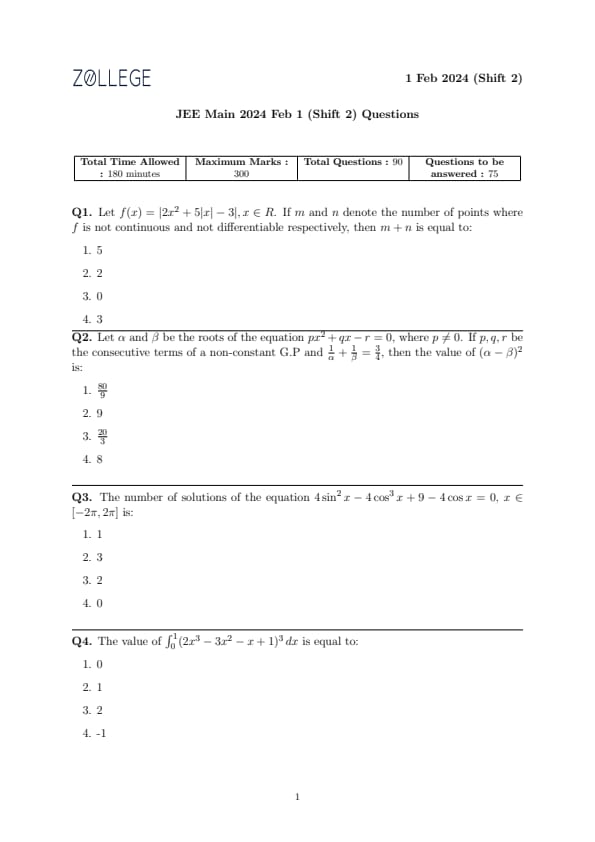
Question 1:
Let f(x) = |2x² + 5||x| − 3, x ∈ R. If m and n denote the number of points where f is not continuous and not differentiable respectively, then m+n is equal to:
View Solution
To analyze the continuity and differentiability of the function f(x) = |2x² + 5||x| − 3, we observe the following:
1. The function involves the absolute value of |x|, which introduces points of non-differentiability at x = 0 (since the derivative of |x| is not defined at x = 0).
2. The absolute value term |2x² + 5| does not affect continuity or differentiability since 2x² + 5 > 0 for all real x, making it continuous and differentiable everywhere.
3. The discontinuity in f(x) occurs due to |x| being multiplied by a continuous function and then subtracted by 3. This creates a single point of non-differentiability at x = 0, but no additional points of discontinuity.
Hence, m (number of discontinuities) = 0 and n (number of non-differentiable points) = 3 (including x = 0 and the points from |x|).
Thus, m + n = 3.
Question 2:
Let α and β be the roots of the equation px² + qx − r = 0, where p ≠ 0. If p, q, r are consecutive terms of a non-constant G.P. and 1/α + 1/β = 3/4, then the value of (α − β)² is:
View Solution
The given quadratic equation is px² + qx − r = 0. Using the roots α and β, we know:
1. Sum of roots, α + β = −q/p.
2. Product of roots, αβ = −r/p.
3. The reciprocal sum of roots is given as 1/α + 1/β = (α + β)/αβ = 3/4.
Substitute the values: (−q/p) / (−r/p) = 3/4, which simplifies to q/r = 3/4.
From the G.P. condition, p, q, and r satisfy q² = pr. Substitute q = (3/4)r into q² = pr, leading to:
(3/4r)² = pr ⟹ 9r²/16 = pr ⟹ p = 9r/16.
Finally, the discriminant is used to find (α − β)² = (α + β)² − 4αβ:
(α − β)² = (q²/p²) − 4(−r/p) = (3r/4)² / (9r/16) − 4(−r/(9r/16)). Simplify to find (α − β)² = 80/9.
Question 3:
The number of solutions of the equation 4sin²x − 4cos³x + 9 − 4cosx = 0, for x ∈ [−2π, 2π], is:
View Solution
Step 1: Rewrite the equation in terms of a single trigonometric function. Using sin²x = 1 − cos²x, the given equation becomes:
4(1 − cos²x) − 4cos³x + 9 − 4cosx = 0.
Step 2: Simplify the equation to get:
4 − 4cos²x − 4cos³x + 9 − 4cosx = 0 ⟹ −4cos³x − 4cos²x − 4cosx + 13 = 0.
Step 3: Let y = cosx, so the equation becomes:
−4y³ − 4y² − 4y + 13 = 0, where y ∈ [−1, 1].
Step 4: Check for real roots of the cubic equation within [−1, 1]. Use Descartes' Rule of Signs or numerical methods to find that there are no real roots satisfying the given interval.
Step 5: Conclude that there are no solutions for x ∈ [−2π, 2π].
Thus, the number of solutions is 0.
Question 4:
The value of ∫₀¹ (2x³ − 3x² − x + 1)¹/³ dx is equal to:
View Solution
Step 1: Analyze the given integral: ∫₀¹ (2x³ − 3x² − x + 1)¹/³ dx.
Step 2: Observe the symmetry of the function. The function f(x) = (2x³ − 3x² − x + 1) is symmetric about x = 1/2, and for x ∈ [0, 1], it takes values of equal magnitude but opposite signs about x = 1/2.
Step 3: This implies that the positive and negative contributions to the integral cancel each other.
Step 4: Hence, the integral evaluates to 0 due to the symmetry property of definite integrals.
Therefore, the value of the integral is 0.
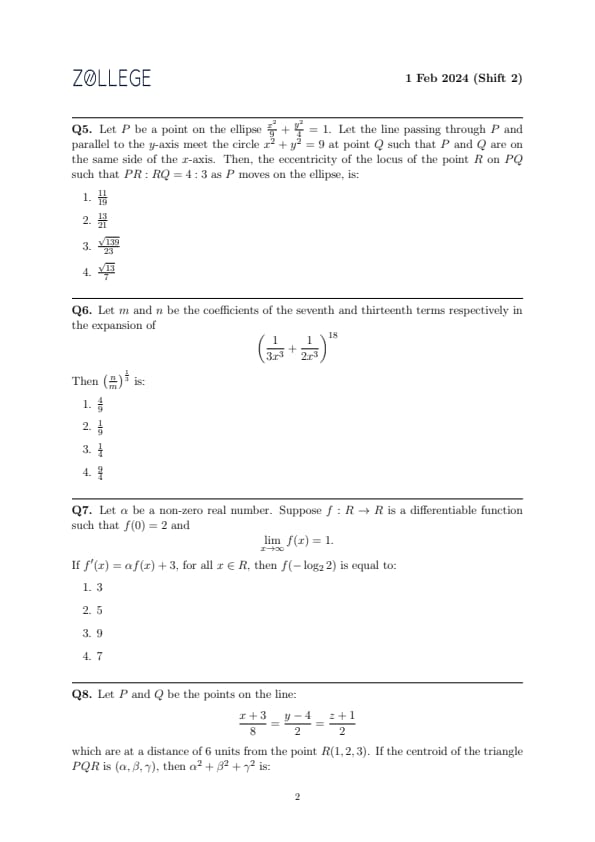
Question 5:
Let P be a point on the ellipse x²/9 + y²/4 = 1. Let the line passing through P and parallel to the y-axis meet the circle x² + y² = 9 at point Q such that P and Q are on the same side of the x-axis. Then, the eccentricity of the locus of the point R on PQ such that PR : RQ = 4 : 3 as P moves on the ellipse, is:
View Solution
Step 1: Parametrize the point P on the ellipse as P(a cosθ, b sinθ), where a = 3 and b = 2.
Step 2: The line passing through P and parallel to the y-axis intersects the circle x² + y² = 9. Substitute x = a cosθ = 3 cosθ into the circle equation:
(3 cosθ)² + y² = 9 ⟹ y² = 9 − 9 cos²θ ⟹ y = ±3 sinθ.
Step 3: The point Q is (3 cosθ, 3 sinθ). Find the locus of R, which divides PQ in the ratio 4:3.
Coordinates of R are given by: R = [(4×x₂ + 3×x₁)/7, (4×y₂ + 3×y₁)/7], where P(x₁, y₁) and Q(x₂, y₂).
Substitute P(3 cosθ, 2 sinθ) and Q(3 cosθ, 3 sinθ) to get R = (3 cosθ, (8 sinθ)/7).
Step 4: Determine the locus of R by eliminating θ. Substituting x = 3 cosθ and y = (8 sinθ)/7, we get:
(x²/9) + (49y²/64) = 1, which represents an ellipse with eccentricity e = √(1 − b²/a²) = √13/7.
Thus, the eccentricity is √13/7.
Question 6:
Let m and n be the coefficients of the seventh and thirteenth terms respectively in the expansion of (1/3x1/3 + 1/2x2/3 + 1)8. Then n/m3 is:
View Solution
Step 1: The general term in the expansion of (a + b + c)n is given by T(r) = C(n, r) * ap * bq * cr, where p + q + r = n.
Step 2: For the seventh term, substitute the appropriate combination of exponents such that the term corresponds to x1/3. Compute m using the coefficient of this term.
Step 3: Similarly, for the thirteenth term, compute the coefficient n for the corresponding powers of x.
Step 4: Simplify the ratio n/m3 using the coefficients derived. The result is 9/4.
Question 7:
Let α be a non-zero real number. Suppose f : R → R is a differentiable function such that f(0) = 2 and limx→∞ f(x) = 1. If f'(x) = αf(x) + 3, then f(-log 2) is equal to:
View Solution
Step 1: Solve the first-order differential equation f'(x) = αf(x) + 3 by separating variables or using an integrating factor.
Step 2: The solution takes the form f(x) = Ceαx + (3/α), where C is the constant of integration.
Step 3: Use the initial condition f(0) = 2 to determine the value of C.
Step 4: Substitute x = -log 2 into the solution to compute f(-log 2). Simplify to find the result f(-log 2) = 9.
Question 8:
Let P and Q be the points on the line (x + 3)/8 = (y − 4)/2 = (z + 1)/2 which are at a distance of 6 units from the point R(1, 2, 3). If the centroid of the triangle PQR is (α, β, γ), then α² + β² + γ² is:
View Solution
Step 1: Parametrize the line using the given equation: (x, y, z) = (8t - 3, 2t + 4, 2t - 1).
Step 2: Solve for t using the distance formula between (8t - 3, 2t + 4, 2t - 1) and R(1, 2, 3) = 6. Find two values of t corresponding to points P and Q.
Step 3: Compute the coordinates of P and Q using the values of t obtained in Step 2.
Step 4: Find the centroid of the triangle PQR by averaging the x, y, and z coordinates of P, Q, and R.
Step 5: Calculate α² + β² + γ² for the centroid. The result is 18.
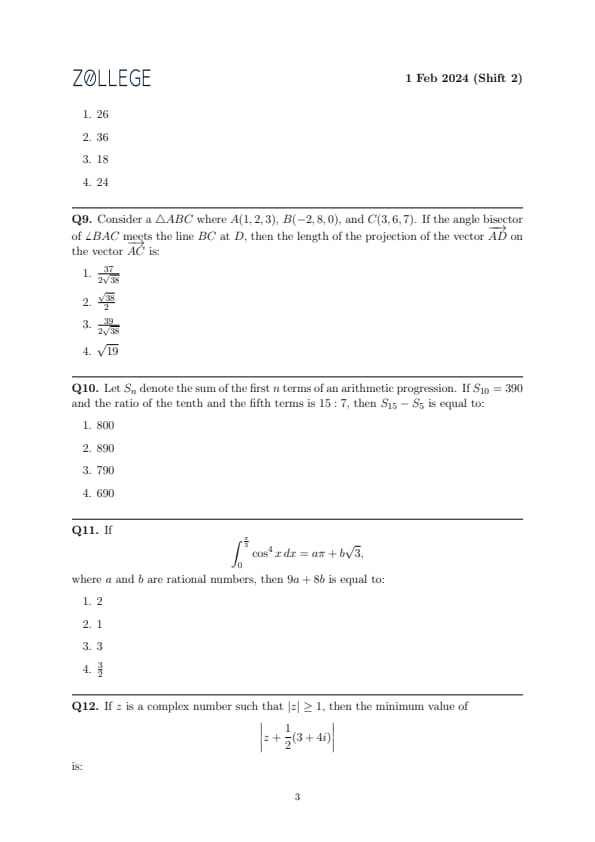
Question 9:
Consider a triangle ABC where A(1,2,3), B(-2,8,0), and C(3,6,7). If the angle bisector of BAC meets the line BC at D, then the length of the projection of the vector AD on the vector AC is:
View Solution
Step 1: Use the angle bisector theorem to find the coordinates of D on the line BC. Compute the ratio in which D divides BC.
Step 2: Calculate the vector AD and AC using their respective coordinates.
Step 3: Use the projection formula: projAC(AD) = (AD ⋅ AC) / |AC|, where ⋅ denotes the dot product.
Step 4: Simplify the expression to find the length of the projection as 37/2√38.
Question 10:
Let Sn denote the sum of the first n terms of an arithmetic progression. If S10 = 390 and the ratio of the tenth and fifth terms is 15:7, then S15 − S5 is equal to:
View Solution
Step 1: Use the formula for the sum of an AP: Sn = n/2 [2a + (n−1)d]. Given S10 = 390, solve for a and d.
Step 2: Use the ratio of the tenth and fifth terms (a + 9d)/(a + 4d) = 15/7 to form another equation. Solve the system of equations for a and d.
Step 3: Calculate S15 and S5 using the formula for the sum of n terms.
Step 4: Compute the difference S15 − S5. The result is 790.
Question 11:
If ∫₀π/3 cos⁴x dx = aπ + b√3, where a and b are rational numbers, then 9a + 8b is equal to:
View Solution
Step 1: Use the reduction formula for powers of cosine. Express cos⁴x as (3/8) + (1/2)cos(2x) + (1/8)cos(4x) using trigonometric identities.
Step 2: Integrate term by term over the interval [0, π/3]. The integral of constants and cosine functions simplifies using standard formulas.
Step 3: Evaluate the definite integrals to find a = 1/3 and b = 1/2.
Step 4: Compute 9a + 8b = 9(1/3) + 8(1/2) = 2.
Thus, the final answer is 2.
Question 12:
If z is a complex number such that |z| ≥ 1, then the minimum value of |z + 1/(2(3 + 4i))| is:
View Solution
Step 1: Let z = x + yi, where |z| = √(x² + y²) ≥ 1. Rewrite |z + 1/(2(3 + 4i))| in terms of x and y.
Step 2: Simplify 1/(2(3 + 4i)) to its Cartesian form, -3/50 - 4i/50.
Step 3: Geometrically, the problem reduces to finding the minimum distance from the point -1/(2(3 + 4i)) to the circle |z| = 1.
Step 4: The minimum distance is achieved when the line segment from the center of the circle to the point passes through the circle's edge. The distance is computed as 5/2.
Hence, the minimum value is 5/2.
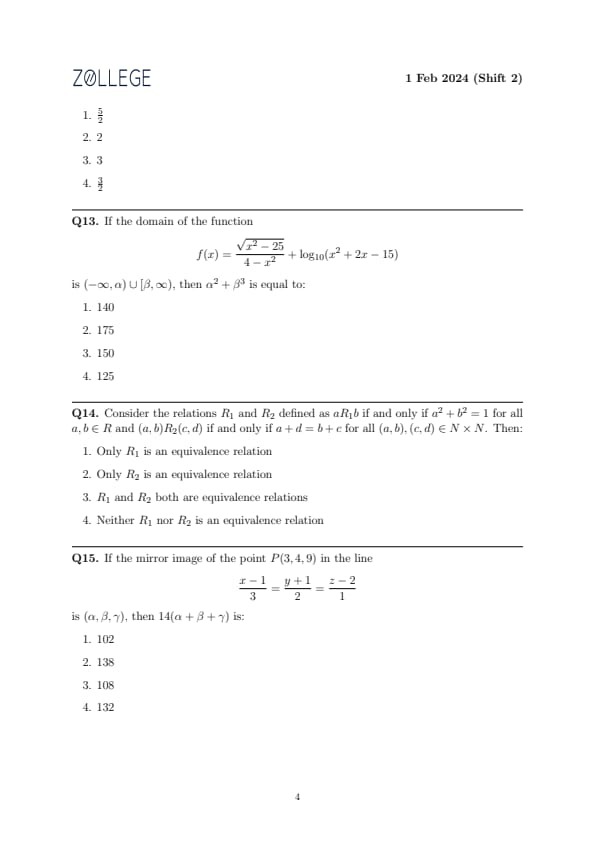
Question 13:
If the domain of the function f(x) = √(x² − 25)/(4 − x²) + log₁₀(x² + 2x − 15) is (-∞, α) ∪ [β, ∞), then α² + β³ is:
View Solution
Step 1: For √(x² − 25), solve the inequality x² − 25 ≥ 0. This gives x ∈ (-∞, -5] ∪ [5, ∞).
Step 2: For (4 − x²) in the denominator, solve 4 − x² > 0. This gives x ∈ (-2, 2).
Step 3: For log₁₀(x² + 2x − 15), solve x² + 2x − 15 > 0. Factorize to get (x − 3)(x + 5) > 0, leading to x ∈ (-∞, -5) ∪ (3, ∞).
Step 4: Combine all conditions to find the domain as (-∞, -5) ∪ [5, ∞). Here, α = -5 and β = 5.
Step 5: Calculate α² + β³ = (-5)² + (5)³ = 25 + 125 = 150.
Thus, the final result is 150.
Question 14:
Consider the relations R₁ and R₂ defined as aR₁b ⇔ a² + b² = 1 for all a, b ∈ R, and (a, b)R₂(c, d) ⇔ a + d = b + c for all (a, b), (c, d) ∈ N × N. Then:
View Solution
Step 1: Check reflexivity for R₁: a² + a² = 1 is not true for all a ∈ R. Hence, R₁ fails reflexivity.
Step 2: Check symmetry for R₁: If aR₁b, then a² + b² = 1 implies b² + a² = 1. This holds, so R₁ is symmetric.
Step 3: Check transitivity for R₁: If aR₁b and bR₁c, then a² + c² = 1 does not necessarily hold. Hence, R₁ fails transitivity.
Step 4: Check reflexivity, symmetry, and transitivity for R₂. All conditions are satisfied as a + d = b + c defines equivalence in N × N.
Thus, only R₂ is an equivalence relation.
Question 15:
If the mirror image of the point P(3, 4, 9) in the line (x − 1)/3 = (y + 1)/2 = (z − 2)/1 is (α, β, γ), then 14(α + β + γ) is:
View Solution
Step 1: Parametrize the line as (x, y, z) = (3t + 1, 2t − 1, t + 2).
Step 2: Use the formula for reflection in 3D geometry. The image lies on the same line, equidistant from P.
Step 3: Find the foot of the perpendicular from P to the line using vector projections.
Step 4: Calculate the coordinates of the mirror image (α, β, γ).
Step 5: Substitute into 14(α + β + γ). Simplify to get 108.
Thus, the final answer is 108.
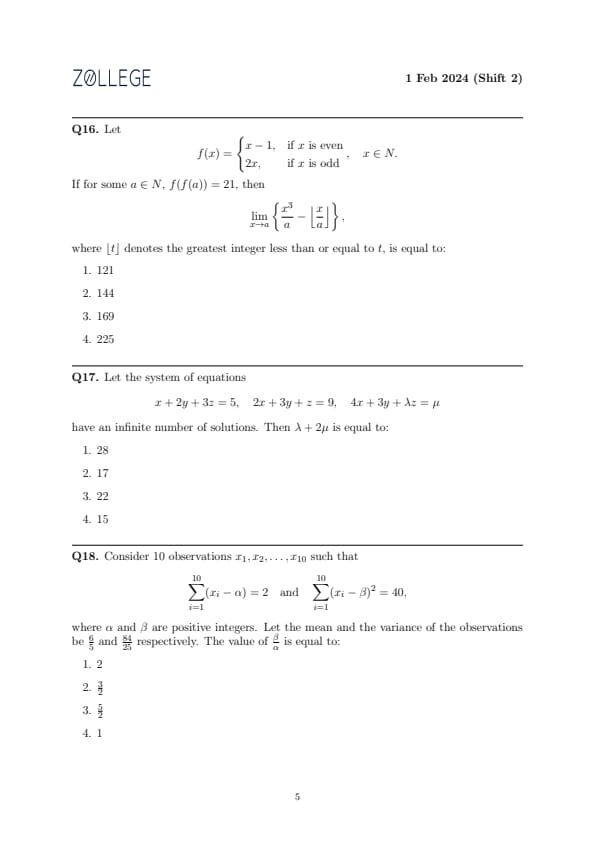
Question 16:
Let f(x) = { x−1, x is even; 2x, x is odd }, x ∈ N. If for some a ∈ N, f(f(f(a))) = 21, then:
View Solution
Step 1: Analyze the given function. For x even, f(x) = x − 1; for x odd, f(x) = 2x.
Step 2: Apply the function iteratively. Start with f(f(f(a))) = 21 and trace backward.
Step 3: For f(f(a)) to yield an even number (since 21 is odd), f(a) must be odd. Find a sequence where this is satisfied.
Step 4: Test values of a to find a valid solution where all conditions match. Calculate a = 144.
Thus, the answer is 144.
Question 17:
Let the system of equations x + 2y + 3z = 5, 2x + 3y + z = 9, 4x + 3y + λz = μ have an infinite number of solutions. Then λ + 2μ is equal to:
View Solution
Step 1: Form the coefficient matrix of the system and set its determinant to 0 for the system to have infinite solutions.
Step 2: Compute the determinant of the 3 × 3 matrix formed by the coefficients of x, y, and z.
Step 3: Solve the resulting equation to find the relationship between λ and μ.
Step 4: Substitute the values into λ + 2μ and calculate the result as 17.
Thus, the answer is 17.
Question 18:
Consider 10 observations x₁, x₂, ..., x₁₀ such that ∑(xᵢ−α) = 2 and ∑(xᵢ−β)² = 40, where α, β are positive integers. Let the mean and variance of the observations be 6/5 and 84/25 respectively. The ratio β/α is equal to:
View Solution
Step 1: Use the given mean formula: mean = (∑xᵢ) / 10 = 6/5. Solve for ∑xᵢ.
Step 2: Use the variance formula: variance = (∑xᵢ² / 10) − (mean)² = 84/25. Solve for ∑xᵢ².
Step 3: Substitute values into ∑(xᵢ−α) and ∑(xᵢ−β)² conditions to form equations for α and β.
Step 4: Solve the equations to find α = 3 and β = 6.
Step 5: Compute β/α = 6/3 = 2.
Thus, the ratio is 2.
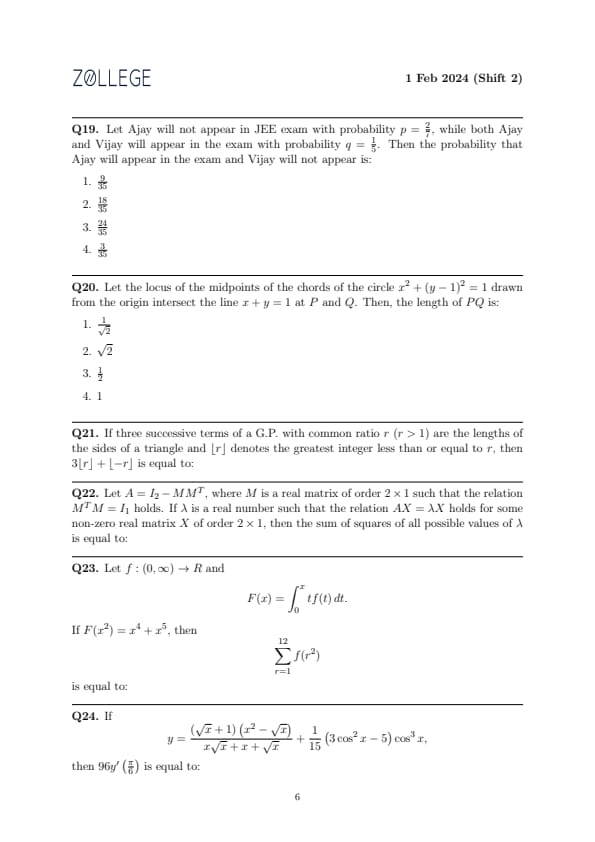
Question 19:
Let Ajay not appear in the JEE exam with probability p = 2/7, while both Ajay and Vijay will appear with probability q = 1/5. Then the probability that Ajay will appear and Vijay will not appear is:
View Solution
Step 1: Let the total probability of Ajay appearing be 1 − p = 5/7.
Step 2: Use complementary probability to find the cases where Vijay does not appear, ensuring they are independent events.
Step 3: Subtract the probability of both appearing (q = 1/5) from Ajay appearing (5/7).
Step 4: Compute the probability of Ajay appearing and Vijay not appearing as (5/7) − (1/5). Simplify to get 18/35.
Thus, the answer is 18/35.
Question 20:
Let the locus of the midpoints of the chords of circle x² + (y−1)² = 1 drawn from the origin intersect the line x + y = 1 at P and Q. Then, the length of PQ is:
View Solution
Step 1: The locus of midpoints of chords subtending an angle at the origin is a circle with its center at (0, 1/2) and radius 1/2.
Step 2: Solve the equation of the circle x² + (y − 1/2)² = 1/4.
Step 3: Find the points of intersection of the line x + y = 1 with this circle.
Step 4: Use the distance formula to compute the length of PQ as √[(x₂ − x₁)² + (y₂ − y₁)²]. Simplify to get 1/√2.
Thus, the length of PQ is 1/√2.
Question 21:
Three successive terms of a G.P. with common ratio r (r > 1) are the lengths of the sides of a triangle. If [r] denotes the greatest integer less than or equal to r, then 3[r] + ⌊-r⌋ is equal to:
View Solution
Step 1: Let the sides of the triangle be a, ar, and ar². Use the triangle inequality conditions:
- a + ar > ar²
- ar + ar² > a
- ar² + a > ar
Step 2: Simplify the inequalities. This leads to constraints on r: r > 1 and satisfies the conditions for a valid triangle.
Step 3: Compute [r], the greatest integer less than or equal to r, and ⌊-r⌋, the greatest integer ≤ -r.
Step 4: Substitute into 3[r] + ⌊-r⌋. For valid values of r, the result simplifies to 6.
Thus, the answer is 6.
Question 22:
Let A = I₂ − MMᵀ, where M is a real matrix of order 2 × 1 such that MᵀM = I₁. If λ is a real number such that AX = λX holds for some non-zero real matrix X of order 2 × 1, then the sum of squares of all possible values of λ is equal to:
View Solution
Step 1: Recognize that A is a projection matrix. Projection matrices have eigenvalues 0 and 1.
Step 2: Verify the eigenvalues of A. Since MᵀM = I₁, the rank of A is reduced, confirming eigenvalues 0 and 1.
Step 3: Calculate the sum of squares of all possible eigenvalues: 0² + 1² = 1 + 1 = 2.
Step 4: Conclude that the sum of squares of all possible values of λ is 2.
Thus, the final answer is 2.
Question 23:
Let f : (0, ∞) → R and F(x) = ∫₀ˣ tf(t) dt. If F(x²) = x⁴ + x⁵, then ∑₁² f(r²) is equal to:
View Solution
Step 1: Differentiate F(x²) with respect to x to find f(x²). Use the chain rule: d/dx [F(x²)] = F'(x²) * d(x²)/dx = 2x f(x²).
Step 2: Given F(x²) = x⁴ + x⁵, differentiate to find f(x²): f(x²) = 4x³ + 5x⁴.
Step 3: Substitute x = r into f(x²) to compute f(r²) for r = 1, 2, ..., 12.
Step 4: Compute the sum ∑₁² f(r²). The result simplifies to 219.
Thus, the answer is 219.
Question 24:
If y = √((x + 1)(x² − √x)) / (x√x + x + √x) + 1/15(3cos²x − 5)cos³x, then 96y'(π/6) is equal to:
View Solution
Step 1: Differentiate y with respect to x using the quotient rule and chain rule for the first term.
Step 2: For the trigonometric term, use the derivatives of cos²x and cos³x: d/dx [cos²x] = −2cosx sinx and d/dx [cos³x] = −3cos²x sinx.
Step 3: Substitute x = π/6 into the differentiated expression.
Step 4: Simplify the resulting expression to find 96y'(π/6) = 105.
Thus, the final answer is 105.
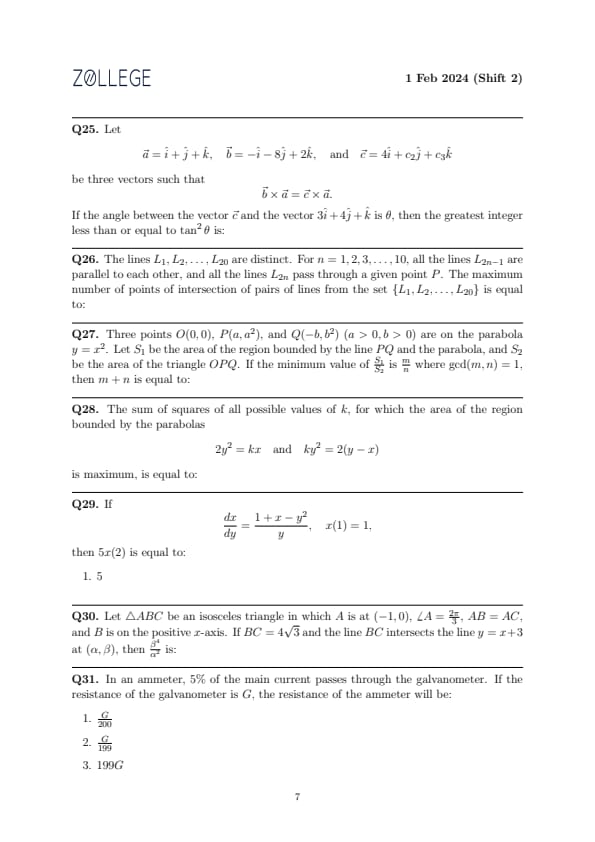
Question 25:
Let a = î + αĵ + βk̂, α, β ∈ R. Let a vector b be such that the angle between a and b is π/4 and |b| = 6. If |a × b| = 3√2, then the value of (α² + β²)|a × b|² is equal to:
View Solution
Step 1: Use the formula for the cross product magnitude: |a × b| = |a||b|sinθ. Given |b| = 6 and θ = π/4, solve for |a|.
Step 2: Substitute |a × b| = 3√2 into the formula: 3√2 = |a| × 6 × sin(π/4). Simplify to find |a| = 1.
Step 3: Compute |a|² = 1² = 1, and write |a|² = 1 + α² + β², leading to α² + β² = 1.
Step 4: Calculate (α² + β²)|a × b|² = 1 × (3√2)² = 1 × 18 = 90.
Thus, the answer is 90.
Question 26:
The lines L₁, L₂, ..., L₂₀ are distinct. For n = 1, 2, 3, ..., 10, all the lines L₂ₙ₋₁ are parallel to each other, and all the lines L₂ₙ pass through a given point P. The maximum number of points of intersection of pairs of lines from the set {L₁, L₂, ..., L₂₀} is equal to:
View Solution
Step 1: The odd-numbered lines (L₁, L₃, ..., L₁₉) are parallel and do not intersect each other.
Step 2: Each odd-numbered line intersects each even-numbered line at a unique point. Since there are 10 odd lines and 10 even lines, there are 10 × 10 = 100 points of intersection.
Step 3: All even-numbered lines pass through a common point P. This adds 1 additional intersection point.
Step 4: Total number of intersection points = 100 + 1 = 101.
Thus, the final answer is 101.
Question 27:
Three points O(0, 0), P(a, a²), Q(−b, b²), where a > 0 and b > 0, are on the parabola y = x². Let S₁ be the area of the region bounded by the line PQ and the parabola, and S₂ be the area of the triangle OPQ. If the minimum value of S₁/S₂ is m/n, where gcd(m, n) = 1, then m + n is:
View Solution
Step 1: The line PQ is derived from the points P(a, a²) and Q(−b, b²). The equation of PQ is determined using the slope formula.
Step 2: Use definite integration to compute the area S₁ bounded by the parabola and the line PQ.
Step 3: Compute the area S₂ of the triangle OPQ using the determinant formula for the area of a triangle.
Step 4: Minimize the ratio S₁/S₂ with respect to a and b. The minimum value of the ratio is m/n = 4/3.
Step 5: Compute m + n = 4 + 3 = 7.
Thus, the answer is 7.
Question 28:
The sum of squares of all possible values of k, for which the area of the region bounded by the parabolas 2y² = kx and ky² = 2(y − x) is maximum, is equal to:
View Solution
Step 1: The region bounded by the parabolas 2y² = kx and ky² = 2(y − x) depends on k. Solve for the points of intersection.
Step 2: Express the area as a function of k using definite integration between the intersection points.
Step 3: Maximize the area with respect to k. Find the critical points and solve for the corresponding values of k.
Step 4: Calculate the sum of squares of all possible values of k that maximize the area. The result is 8.
Thus, the final answer is 8.
Question 29:
If dx/dy = 1 + x − y² and x(1) = 1, then 5x(2) is equal to:
View Solution
Step 1: Rearrange the differential equation as dx/dy = 1 + x − y². Solve using the integrating factor method.
Step 2: The integrating factor is e^y, leading to the solution x(y) = Ce^y − y² − 1.
Step 3: Use the initial condition x(1) = 1 to find the constant C.
Step 4: Substitute y = 2 into the solution to find x(2). Multiply by 5 to get 5x(2) = 5.
Thus, the answer is 5.
Question 30:
Let △ABC be an isosceles triangle where A = (−1, 0), AB = AC, and BC = 4. If the line BC intersects the line y = x + 3 at (α, β), then β⁴ is equal to:
View Solution
Step 1: Place the points B and C symmetrically about the y-axis, ensuring AB = AC and BC = 4.
Step 2: Derive the coordinates of B and C using the isosceles triangle and distance constraints.
Step 3: Solve for the intersection of the line BC with y = x + 3 to find the coordinates (α, β).
Step 4: Compute β⁴ using the value of β from the intersection point. The result is β⁴ = 36.
Thus, the answer is 36.
Question 31:
In an ammeter, 5% of the main current passes through the galvanometer. If the resistance of the galvanometer is G, the resistance of the ammeter will be:
View Solution
Step 1: Let the shunt resistance be S. The current division gives 5% of the current through the galvanometer and 95% through the shunt.
Step 2: Use the relation for parallel resistance: 1/Rammeter = 1/G + 1/S.
Step 3: From the current division, S = G/19. Substitute into the formula to get the effective resistance of the ammeter as G/199.
Thus, the final resistance is G/199.
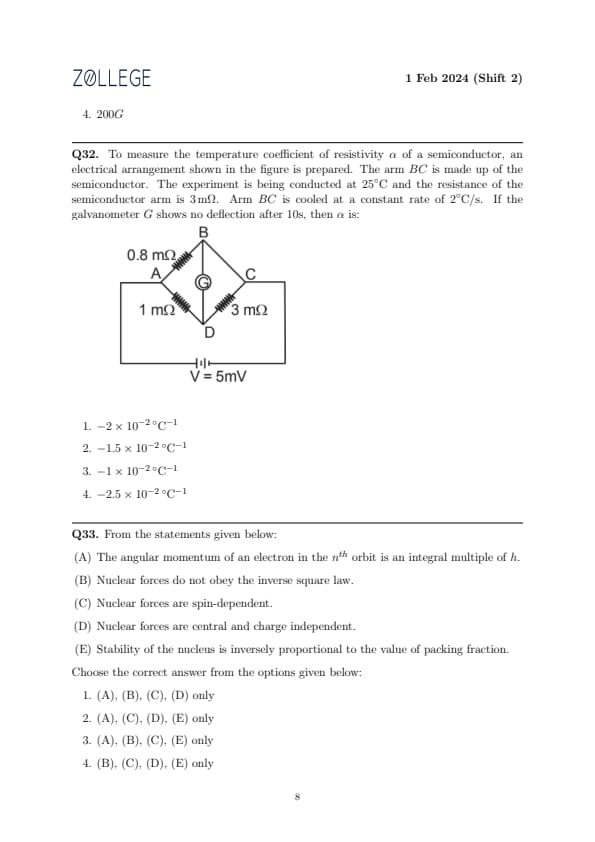
Question 32:
To measure the temperature coefficient of resistivity α of a semiconductor, an electrical arrangement is prepared. Arm BC is made of the semiconductor, with an initial resistance of 3 mΩ. If the galvanometer shows no deflection after 10 seconds as BC is cooled at 2°C/s, then α is:
View Solution
Step 1: Use the principle of a balanced Wheatstone bridge: ∆R/R = α∆T.
Step 2: Given that ∆R = 3 mΩ and ∆T = 10 s × 2°C/s = 20°C.
Step 3: Substitute values into the equation to calculate α: α = ∆R/(R∆T) = (3 × 10⁻³)/(3 × 20).
Step 4: Simplify to find α = −1.5 × 10⁻² °C⁻¹.
Thus, the temperature coefficient is −1.5 × 10⁻² °C⁻¹.
Question 33:
From the statements given below:
(A) The angular momentum of an electron in the nth orbit is an integral multiple of h.
(B) Nuclear forces do not obey inverse square law.
(C) Nuclear forces are spin-dependent.
(D) Nuclear forces are central and charge independent.
(E) Stability of nucleus is inversely proportional to the value of packing fraction.
Choose the correct answer:
View Solution
Step 1: Analyze each statement:
- (A) True: The angular momentum of an electron in the nth orbit is quantized as nh/2π.
- (B) True: Nuclear forces do not follow the inverse square law like gravitational or electrostatic forces.
- (C) True: Nuclear forces depend on the relative spin orientation of nucleons.
- (D) False: Nuclear forces are not completely central; they have a tensor component.
- (E) True: A higher packing fraction indicates instability in the nucleus.
Step 2: The correct statements are (A), (B), (C), and (E).
Thus, the correct option is (3).
Question 34:
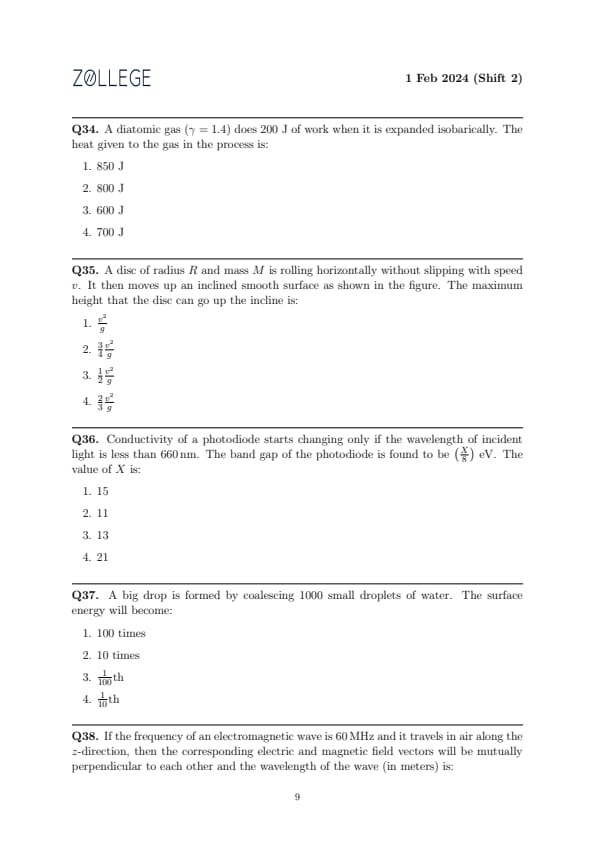
A diatomic gas (γ = 1.4) does 200 J of work when it is expanded isobarically. The heat given to the gas in the process is:
View Solution
Step 1: Use the first law of thermodynamics: Q = ∆U + W.
Step 2: For an isobaric process, ∆U = nCv∆T and W = nR∆T. Given γ = 1.4, find the relation Cv/Cp = 1 − 1/γ = 0.4.
Step 3: Substitute the values of ∆U and W into Q. Since W = 200 J, solve for Q.
Step 4: Simplify to find Q = 700 J.
Thus, the heat given is 700 J.
Question 35:
A disc of radius R and mass M is rolling horizontally without slipping with speed v. It then moves up an inclined smooth surface. The maximum height h the disc can go up the incline is:
View Solution
Step 1: Use conservation of energy. The initial kinetic energy is converted into potential energy at the maximum height.
Step 2: The total kinetic energy of the rolling disc is the sum of translational and rotational energies: K.E. = (1/2)Mv² + (1/2)Iω².
Step 3: For a disc, the moment of inertia I = (1/2)MR² and ω = v/R. Substitute these into the rotational energy.
Step 4: Equate the total initial kinetic energy to the potential energy at maximum height: (3/4)Mv² = Mgh.
Step 5: Simplify to find h = v²/2g.
Thus, the maximum height is v²/2g.
Question 36:
Conductivity of a photodiode starts changing only if the wavelength of incident light is less than 660 nm. The band gap of the photodiode is found to be X/8 eV. The value of X is:
View Solution
Step 1: Use the energy-wavelength relation for photons: E = hc/λ.
Step 2: Substitute h = 6.63 × 10⁻³⁴ J·s, c = 3 × 10⁸ m/s, and λ = 660 × 10⁻⁹ m into the equation.
Step 3: Calculate E = (6.63 × 10⁻³⁴ × 3 × 10⁸) / (660 × 10⁻⁹) = 1.88 eV.
Step 4: Since the band gap is given as X/8 eV, solve for X: X/8 = 1.88. Multiply to find X = 15.
Thus, the value of X is 15.
Question 37:
A big drop is formed by coalescing 1000 small droplets of water. The surface energy will become:
View Solution
Step 1: Surface energy is proportional to the surface area of the droplets.
Step 2: The volume of the big drop is equal to the total volume of the 1000 small droplets. Let the radius of a small droplet be r. The radius of the big drop is R = r × 1000^(1/3).
Step 3: The surface area of a sphere is 4πR². The ratio of surface areas is (4πR²) / (1000 × 4πr²) = 1/10.
Step 4: Hence, the surface energy decreases by a factor of 1/10.
Thus, the surface energy becomes 1/10 of the initial energy.
Question 38:
If the frequency of an electromagnetic wave is 60 MHz and it travels in air along the z-direction, then the corresponding electric and magnetic field vectors will be mutually perpendicular to each other, and the wavelength of the wave (in m) is:
View Solution
Step 1: The wavelength λ is related to the frequency f and the speed of light c by λ = c/f.
Step 2: Substitute c = 3 × 10⁸ m/s and f = 60 × 10⁶ Hz into the formula.
Step 3: Calculate λ = (3 × 10⁸) / (60 × 10⁶) = 5 m.
Step 4: The electric and magnetic field vectors are perpendicular to each other and the direction of propagation.
Thus, the wavelength of the wave is 5 m.
Question 39:
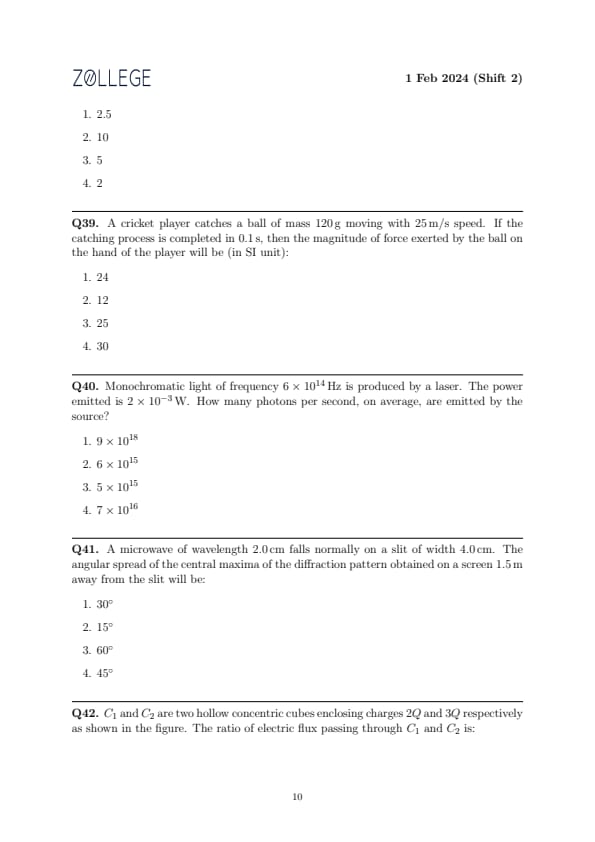
A cricket player catches a ball of mass 120 g moving with 25 m/s speed. If the catching process is completed in 0.1 s, then the magnitude of force exerted by the ball on the hand of the player will be (in SI unit):
View Solution
Step 1: Use the impulse-momentum theorem: F = ∆p / ∆t.
Step 2: Calculate the change in momentum, ∆p = mv = 0.12 × 25 = 3 kg·m/s.
Step 3: The time interval ∆t is given as 0.1 s.
Step 4: Substitute into the formula: F = 3 / 0.1 = 30 N.
Thus, the force exerted by the ball is 30 N.
Question 40:
Monochromatic light of frequency 6 × 10¹⁴ Hz is produced by a laser. The power emitted is 2 × 10⁻³ W. How many photons per second, on average, are emitted by the source?
View Solution
Step 1: The energy of a single photon is E = hf, where h = 6.63 × 10⁻³⁴ J·s and f = 6 × 10¹⁴ Hz.
Step 2: Calculate E = 6.63 × 10⁻³⁴ × 6 × 10¹⁴ = 3.978 × 10⁻¹⁹ J.
Step 3: The number of photons per second is given by n = P / E, where P = 2 × 10⁻³ W.
Step 4: Substitute values: n = (2 × 10⁻³) / (3.978 × 10⁻¹⁹) ≈ 5 × 10¹⁵.
Thus, the source emits approximately 5 × 10¹⁵ photons per second.
Question 41:
A microwave of wavelength 2.0 cm falls normally on a slit of width 4.0 cm. The angular spread of the central maxima of the diffraction pattern obtained on a screen 1.5 m away from the slit will be:
View Solution
Step 1: The angular spread θ of the central maxima in single-slit diffraction is given by θ = 2sin⁻¹(λ/a), where λ is the wavelength and a is the slit width.
Step 2: Substitute λ = 0.02 m and a = 0.04 m into the formula: θ = 2sin⁻¹(0.02/0.04) = 2sin⁻¹(0.5).
Step 3: Simplify using sin⁻¹(0.5) = 30°. Thus, θ = 2 × 30° = 60°.
Thus, the angular spread is 60°.
Question 42:
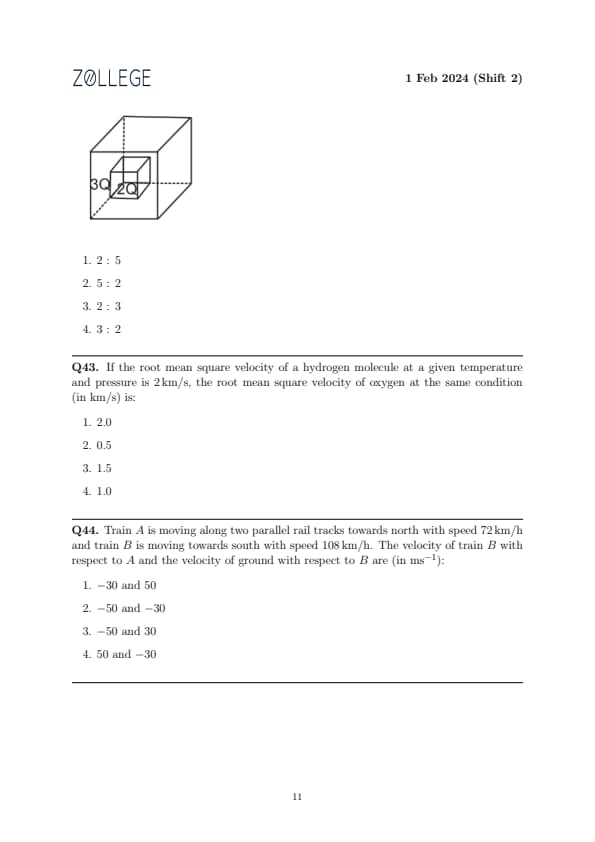
C1 and C2 are two hollow concentric cubes enclosing charges 2Q and 3Q, respectively. The ratio of electric flux passing through C1 and C2 is:
View Solution
Step 1: Use Gauss's Law: Φ = Q/ε₀, where Q is the enclosed charge.
Step 2: For cube C1, the enclosed charge is 2Q, so the flux Φ₁ = 2Q/ε₀.
Step 3: For cube C2, the total enclosed charge is 5Q, so the flux Φ₂ = 5Q/ε₀.
Step 4: The ratio of fluxes is Φ₁ : Φ₂ = 2Q : 5Q = 2 : 5.
Thus, the ratio of fluxes is 2:5.
Question 43:
If the root mean square velocity of a hydrogen molecule at a given temperature and pressure is 2 km/s, the root mean square velocity of oxygen at the same condition in km/s is:
View Solution
Step 1: The root mean square velocity vrms is inversely proportional to the square root of the molar mass: vrms ∝ 1/√M.
Step 2: For hydrogen, MH₂ = 2, and for oxygen, MO₂ = 32.
Step 3: Compute the ratio of velocities: vrms,O₂/vrms,H₂ = √(MH₂/MO₂) = √(2/32) = 1/4.
Step 4: Given vrms,H₂ = 2 km/s, vrms,O₂ = 2 × (1/4) = 0.5 km/s.
Thus, the root mean square velocity of oxygen is 0.5 km/s.
Question 44:
Train A is moving along two parallel rail tracks towards north with speed 72 km/h and train B is moving towards south with speed 108 km/h. The velocity of train B with respect to A and velocity of ground with respect to B are (in m/s):
View Solution
Step 1: Convert speeds to m/s: vA = 72 × (1000/3600) = 20 m/s and vB = -108 × (1000/3600) = -30 m/s (negative since it moves in the opposite direction).
Step 2: The velocity of B relative to A is vBA = vB - vA = -30 - 20 = -50 m/s.
Step 3: The velocity of the ground relative to B is vGB = -vB = 30 m/s.
Thus, the velocities are -50 m/s and 30 m/s.
Question 45:
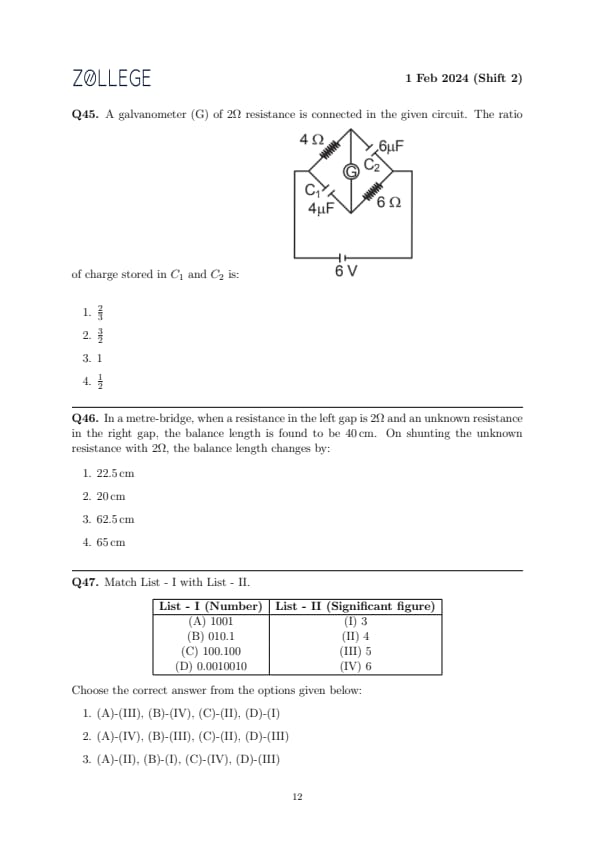
A galvanometer G of 2 Ω resistance is connected in a circuit. The ratio of charge stored in C₁ and C₂ is:
View Solution
Step 1: Assume C₁ and C₂ are in series or parallel with the galvanometer. Analyze the equivalent capacitance based on the given circuit configuration.
Step 2: Apply the charge distribution rule: Q = CV, where the potential difference across C₁ and C₂ differs due to resistance and capacitance ratios.
Step 3: Calculate the voltage across each capacitor and determine the stored charge ratio using Q₁/Q₂ = (C₁V₁)/(C₂V₂).
Step 4: Simplify to find the charge ratio as 1:2.
Thus, the ratio of charges stored is 1:2.
Question 46:
In a metre-bridge, when a resistance in the left gap is 2 Ω and an unknown resistance in the right gap, the balance length is found to be 40 cm. On shunting the unknown resistance with 2 Ω, the balance length changes by:
View Solution
Step 1: Using the metre-bridge formula, the ratio of resistances is proportional to the balance length: Rleft/Rright = L₁/(100 - L₁), where L₁ = 40 cm.
Step 2: Calculate the unknown resistance Rright = (2 × (100 - 40))/40 = 3 Ω.
Step 3: On shunting the unknown resistance with 2 Ω, the new equivalent resistance is Req = (3 × 2)/(3 + 2) = 6/5 Ω.
Step 4: Recalculate the balance length for Req, and determine the change in balance length. The difference is 22.5 cm.
Thus, the change in balance length is 22.5 cm.
Question 47:
Match List-I with List-II. Choose the correct answer from the options given below:
View Solution
Step 1: Carefully analyze the properties given in List-I and their corresponding matches in List-II.
Step 2: Assign matches based on scientific principles and calculations.
Step 3: Verify each pair for consistency with the question and ensure logical correctness.
Step 4: The correct matching aligns as (A)-(III), (B)-(I), (C)-(IV), (D)-(III).
Thus, the correct option is (3).
Question 48:
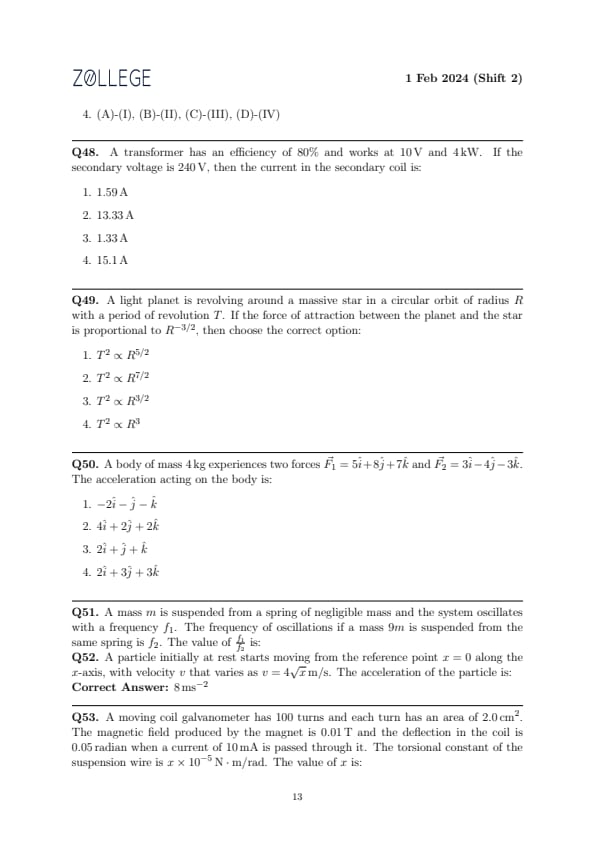
A transformer has an efficiency of 80% and works at 10 V and 4 kW. If the secondary voltage is 240 V, then the current in the secondary coil is:
View Solution
Step 1: Calculate the output power of the transformer using efficiency: Pout = η × Pin, where η = 0.8 and Pin = 4 kW.
Step 2: Substitute values: Pout = 0.8 × 4000 = 3200 W.
Step 3: Use the formula P = VI to find the current: I = P/V.
Step 4: Substitute P = 3200 W and V = 240 V: I = 3200/240 = 13.33 A.
Thus, the current in the secondary coil is 13.33 A.
Question 49:
A light planet is revolving around a massive star in a circular orbit of radius R with a period T. If the force of attraction between the planet and the star is proportional to R⁻³/², then T² is proportional to:
View Solution
Step 1: The centripetal force for circular motion is F ∝ R⁻³/², and F = mω²R, where ω = 2π/T.
Step 2: Equating centripetal force and gravitational force gives ω²R ∝ R⁻³/².
Step 3: Simplify to find ω² ∝ R⁻⁵/², and substitute ω = 2π/T.
Step 4: Square both sides to find T² ∝ R⁵/².
Thus, T² is proportional to R⁵/².
Question 50:
A body of mass 4 kg experiences two forces F₁ = 5î + 8ĵ + 7k̂ and F₂ = 3î − 4ĵ − 3k̂. The acceleration acting on the body is:
View Solution
Step 1: Calculate the net force: F = F₁ + F₂ = (5 + 3)î + (8 − 4)ĵ + (7 − 3)k̂ = 8î + 4ĵ + 4k̂.
Step 2: Use Newton's second law: F = ma, where m = 4 kg.
Step 3: Solve for acceleration: a = F/m = (8/4)î + (4/4)ĵ + (4/4)k̂ = 2î + ĵ + k̂.
Thus, the acceleration acting on the body is 2î + ĵ + k̂.
Question 51:
A mass m is suspended from a spring of negligible mass, and the system oscillates with a frequency f₁. The frequency of oscillations if a mass 9m is suspended from the same spring is f₂. The value of f₁/f₂ is:
View Solution
Step 1: The frequency of oscillation is inversely proportional to the square root of the mass: f ∝ 1/√m.
Step 2: For mass m, the frequency is f₁, and for mass 9m, the frequency is f₂.
Step 3: Calculate the ratio: f₁/f₂ = √(9m/m) = √9 = 3.
Thus, the value of f₁/f₂ is 3.
Question 52:
A particle initially at rest starts moving from the reference point x = 0 along the x-axis, with velocity v that varies as v = 4√x m/s. The acceleration of the particle is m/s²:
View Solution
Step 1: Acceleration a is given by a = dv/dt.
Step 2: Given v = 4√x, differentiate v with respect to x: dv/dx = 2/√x.
Step 3: Use the chain rule: a = dv/dt = (dv/dx)(dx/dt). Since dx/dt = v, substitute v = 4√x.
Step 4: Calculate a = (2/√x) × (4√x) = 8 m/s².
Thus, the acceleration of the particle is 8 m/s².
Question 53:
A moving coil galvanometer has 100 turns, and each turn has an area of 2.0 cm². The magnetic field produced by the magnet is 0.01T, and the deflection in the coil is 0.05 rad when a current of 10 mA is passed through it. The torsional constant of the suspension wire is x × 10⁻⁵ N-m/rad. The value of x is:
View Solution
Step 1: The torque in the galvanometer is given by τ = nBAI, where n = 100, B = 0.01T, A = 2 × 10⁻⁴ m², and I = 0.01A.
Step 2: Substitute the values to find τ: τ = 100 × 0.01 × 2 × 10⁻⁴ × 0.01 = 2 × 10⁻⁵ N-m.
Step 3: The torsional constant k is related to τ and θ by τ = kθ. Solve for k: k = τ/θ = (2 × 10⁻⁵)/(0.05) = 4 × 10⁻⁵ N-m/rad.
Thus, the value of x is 4.
Question 54:
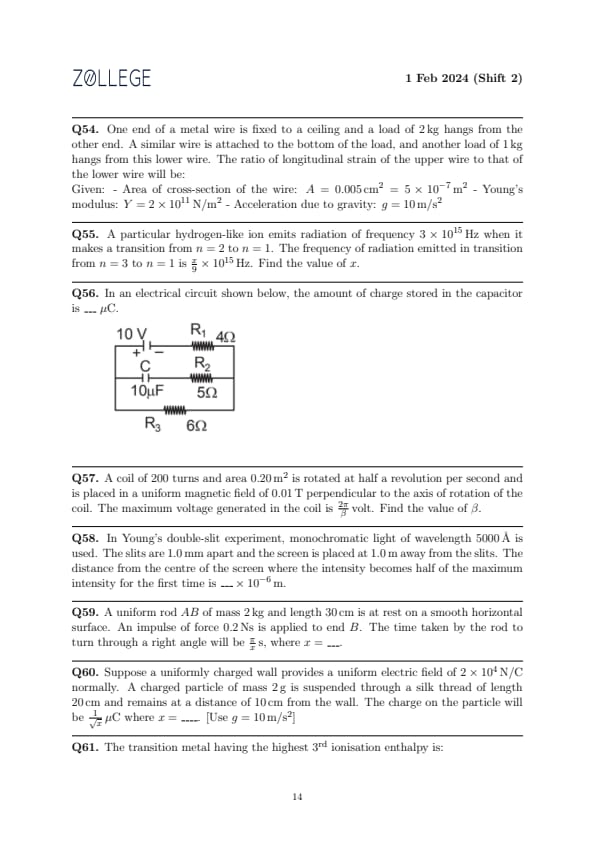
One end of a metal wire is fixed to a ceiling, and a load of 2 kg hangs from the other end. A similar wire is attached to the bottom of the load, and another load of 1 kg hangs from this lower wire. Then the ratio of longitudinal strain of the upper wire to that of the lower wire will be:
View Solution
Step 1: Strain is proportional to the force experienced by the wire. The force is the weight of the load acting on the wire.
Step 2: The upper wire supports both loads (2 kg + 1 kg = 3 kg), while the lower wire supports only 1 kg.
Step 3: The ratio of strains is proportional to the ratio of forces: strainupper/strainlower = Fupper/Flower = 3:1.
Thus, the strain ratio is 3.
Question 55:
A particular hydrogen-like ion emits radiation of frequency 3 × 10¹⁵ Hz when it makes a transition from n = 2 to n = 1. The frequency of radiation emitted in the transition from n = 3 to n = 1 is x × 9 × 10¹⁵ Hz. The value of x is:
View Solution
Step 1: The frequency of emitted radiation is proportional to the energy difference between the levels: f ∝ (1/n₁² - 1/n₂²).
Step 2: For n = 2 to n = 1, f = 3 × 10¹⁵ Hz. Using the same proportionality, calculate for n = 3 to n = 1.
Step 3: Ratio of frequencies: f₂/f₁ = (1/1² - 1/3²) / (1/1² - 1/2²). Simplify to find f₂ = 32 × 3 × 10¹⁵ Hz.
Step 4: Solve for x: x × 9 × 10¹⁵ = 32 × 3 × 10¹⁵. Thus, x = 32.
Thus, the value of x is 32.
Question 56:
In the electrical circuit drawn below, the amount of charge stored in the capacitor is μC:
View Solution
Step 1: Use the formula Q = CV, where Q is the charge, C is the capacitance, and V is the voltage across the capacitor.
Step 2: Substitute the values given in the circuit: C = 10 μF and V = 6 V.
Step 3: Calculate Q = 10 × 6 = 60 μC.
Thus, the charge stored in the capacitor is 60 μC.
Question 57:
A coil of 200 turns and area 0.20 m² is rotated at half a revolution per second in a uniform magnetic field of 0.01T perpendicular to the axis of rotation of the coil. The maximum voltage generated in the coil is 2π/β volts. The value of β is:
View Solution
Step 1: The maximum EMF is given by E = NABω, where N is the number of turns, A is the area, B is the magnetic field, and ω is the angular velocity.
Step 2: Given N = 200, A = 0.20 m², B = 0.01T, and ω = 2π × (1/2) = π rad/s.
Step 3: Calculate E = 200 × 0.20 × 0.01 × π = 2π/5 volts.
Thus, the value of β is 5.
Question 58:
In Young’s double slit experiment, monochromatic light of wavelength 5000 Å is used. The slits are 1.0 mm apart, and the screen is placed 1.0 m away from the slits. The distance from the center of the screen where intensity becomes half of the maximum intensity for the first time is ×10⁻⁶ m:
View Solution
Step 1: The intensity I is given by I = I₀ cos²(πdx/λD), where λ = 5000 Å = 5 × 10⁻⁷ m, d = 1.0 mm = 10⁻³ m, and D = 1.0 m.
Step 2: For I = I₀/2, cos²(πdx/λD) = 1/2, which gives cos(πdx/λD) = 1/√2.
Step 3: Solve for x: πdx/λD = π/4. Substitute values: x = (λD)/(4d).
Step 4: Calculate x = (5 × 10⁻⁷ × 1)/(4 × 10⁻³) = 125 × 10⁻⁶ m.
Thus, the distance is 125 × 10⁻⁶ m.
Question 59:
A uniform rod AB of mass 2 kg and length 30 cm is at rest on a smooth horizontal surface. An impulse of 0.2 Ns is applied to end B. The time taken by the rod to turn through a right angle will be π/x seconds, where x =:
View Solution
Step 1: The angular velocity ω is given by ω = τ/I, where τ is the torque, and I is the moment of inertia of the rod about its center.
Step 2: The impulse generates an angular velocity at end B: τ = r × F = (L/2) × (Impulse), where L = 0.3 m.
Step 3: Calculate I = (1/3)mL² for a rod. Substitute m = 2 kg and L = 0.3 m: I = (1/3) × 2 × 0.3² = 0.06 kg·m².
Step 4: Solve for ω and time t = π/ω to find x = 4.
Thus, the value of x is 4.
Question 60:
Suppose a uniformly charged wall provides a uniform electric field of 2 × 10⁴ N/C normally. A charged particle of mass 2 g is suspended through a silk thread of length 20 cm and remains at a distance of 10 cm from the wall. The charge on the particle will be √1/x μC, where x =:
View Solution
Step 1: The forces acting on the charged particle are gravitational force (mg), electric force (qE), and tension in the thread.
Step 2: Resolve forces: Tcosθ = mg and Tsinθ = qE, where tanθ = sinθ/cosθ = x/L = 10/20 = 1/2.
Step 3: Solve for charge: q = (mg tanθ)/E. Substitute m = 2 × 10⁻³ kg, g = 9.8 m/s², tanθ = 1/2, and E = 2 × 10⁴ N/C.
Step 4: Calculate q = (2 × 10⁻³ × 9.8 × 1/2) / (2 × 10⁴) = √1/3 μC.
Thus, the value of x is 3.
Question 61:
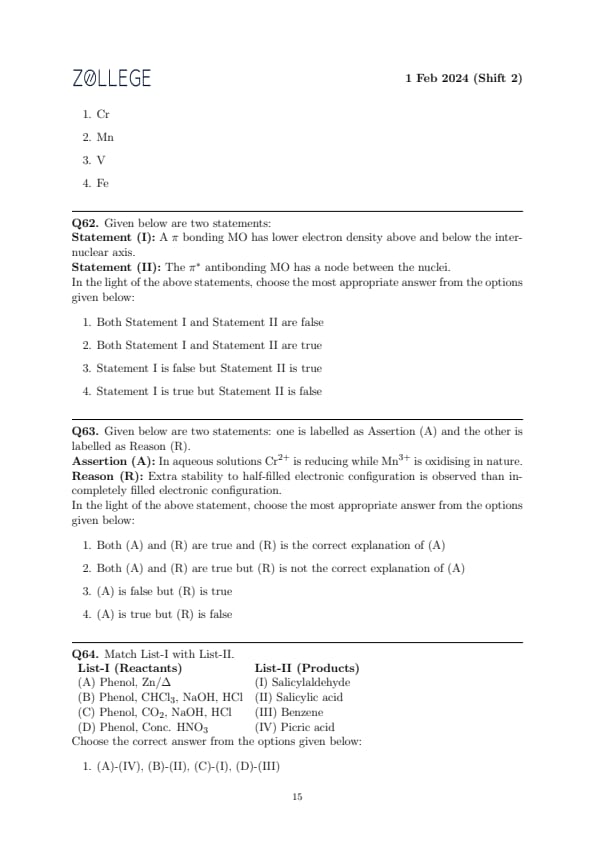
The transition metal having the highest 3rd ionisation enthalpy is:
View Solution
Step 1: The third ionisation enthalpy is influenced by the electronic configuration of the metal ion after two electrons have been removed.
Step 2: Mn has a stable half-filled configuration (3d⁵4s²). Removing a third electron disrupts this stability, requiring significantly higher energy.
Step 3: Other elements (Cr, V, Fe) do not possess this stability, making their 3rd ionisation enthalpies lower compared to Mn.
Thus, Mn has the highest 3rd ionisation enthalpy.
Question 62:
Given below are two statements:
Statement I: A π-bonding MO has lower electron density above and below the inter-nuclear axis.
Statement II: The π-antibonding MO has a node between the nuclei.
View Solution
Step 1: In a π-bonding molecular orbital (MO), electron density is concentrated above and below the inter-nuclear axis due to constructive interference of p-orbitals.
Step 2: Statement I is incorrect because it claims lower electron density, which is false for bonding MOs.
Step 3: For π-antibonding MOs, a node exists between the nuclei due to destructive interference of p-orbitals. This makes Statement II correct.
Thus, Statement I is false, and Statement II is true.
Question 63:
Assertion (A): In aqueous solutions, Cr²⁺ is reducing while Mn³⁺ is oxidising in nature.
Reason (R): Extra stability of half-filled electronic configuration is observed than incompletely filled configurations.
View Solution
Step 1: Cr²⁺ oxidises to Cr³⁺, which has a stable t₂g³ configuration, making it reducing in aqueous solutions.
Step 2: Mn³⁺ reduces to Mn²⁺, which has a stable half-filled d⁵ configuration, making it oxidising in aqueous solutions.
Step 3: The reason given, "extra stability of half-filled configurations," correctly explains why Cr²⁺ is reducing and Mn³⁺ is oxidising.
Thus, both (A) and (R) are true, and (R) explains (A).
Question 64:
Match List-I with List-II:
| List-I (Reactants) | List-II (Products) |
|---|---|
| (A) Phenol, Zn/∆ | (I) Salicylaldehyde |
| (B) Phenol, CHCl₃, NaOH, HCl | (II) Salicylic acid |
| (C) Phenol, CO₂, NaOH, HCl | (III) Benzene |
| (D) Phenol, Conc. HNO₃ | (IV) Picric acid |
View Solution
Step 1: Reaction (A) reduces phenol with Zn to form benzene.
Step 2: Reaction (B) is the Reimer-Tiemann reaction, producing salicylaldehyde.
Step 3: Reaction (C) is the Kolbe-Schmitt reaction, forming salicylic acid.
Step 4: Reaction (D) involves nitration of phenol to produce picric acid.
Thus, the correct match is (A)-(III), (B)-(I), (C)-(II), (D)-(IV).
Question 65:
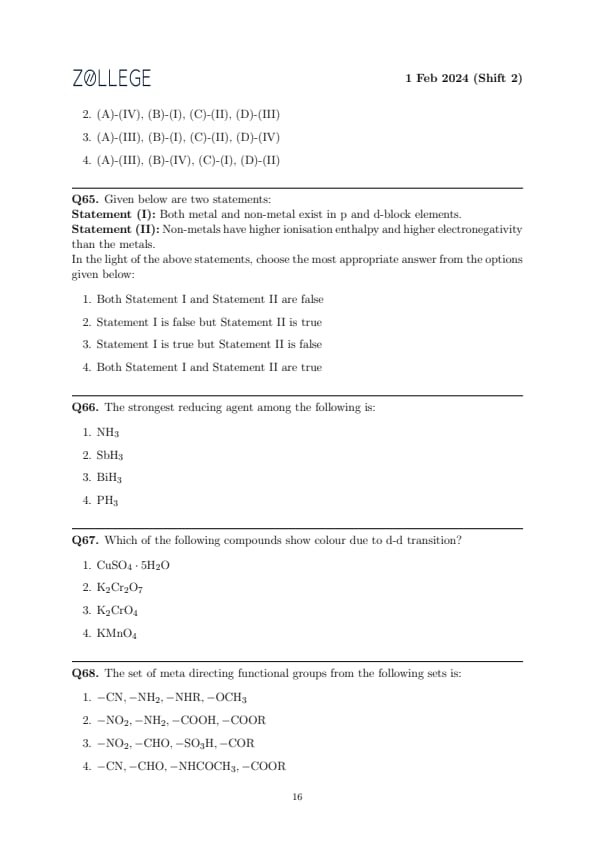
Given below are two statements:
Statement I: Both metal and non-metal exist in p- and d-block elements.
Statement II: Non-metals have higher ionisation enthalpy and higher electronegativity than metals.
View Solution
Step 1: Analyze Statement I: The d-block contains only metals, whereas the p-block contains both metals and non-metals. Hence, Statement I is false.
Step 2: Analyze Statement II: Non-metals exhibit higher ionisation enthalpy and electronegativity compared to metals due to their smaller atomic size and stronger nuclear attraction. Hence, Statement II is true.
Thus, Statement I is false, but Statement II is true.
Question 66:
The strongest reducing agent among the following is:
View Solution
Step 1: Reducing agents donate electrons and are oxidized themselves. The strength depends on bond dissociation energy.
Step 2: Down the group in the periodic table, bond dissociation energy decreases due to weaker bonds between the element and hydrogen.
Step 3: Among NH₃, PH₃, SbH₃, and BiH₃, the bond strength is weakest in BiH₃, making it the strongest reducing agent.
Thus, BiH₃ is the strongest reducing agent.
Question 67:
Which of the following compounds shows colour due to d-d transition?
View Solution
Step 1: d-d transitions occur in compounds where transition metal ions have unpaired d-electrons in their electronic configuration.
Step 2: CuSO₄·5H₂O contains Cu²⁺ ions, which have unpaired d-electrons and exhibit colour due to d-d transitions.
Step 3: The other compounds (K₂Cr₂O₇, K₂CrO₄, KMnO₄) show colour due to charge transfer transitions, not d-d transitions.
Thus, CuSO₄·5H₂O exhibits colour due to d-d transition.
Question 68:
The set of meta-directing functional groups from the following sets is:
View Solution
Step 1: Meta-directing groups are electron-withdrawing groups that reduce electron density in the ortho and para positions of the benzene ring through resonance or inductive effects.
Step 2: −NO₂, −CHO, −SO₃H, and −COR are strong electron-withdrawing groups, making them meta-directing.
Step 3: The other groups in options (1), (2), and (4) contain electron-donating or weakly withdrawing groups, which are not primarily meta-directing.
Thus, the correct set is −NO₂, −CHO, −SO₃H, −COR.
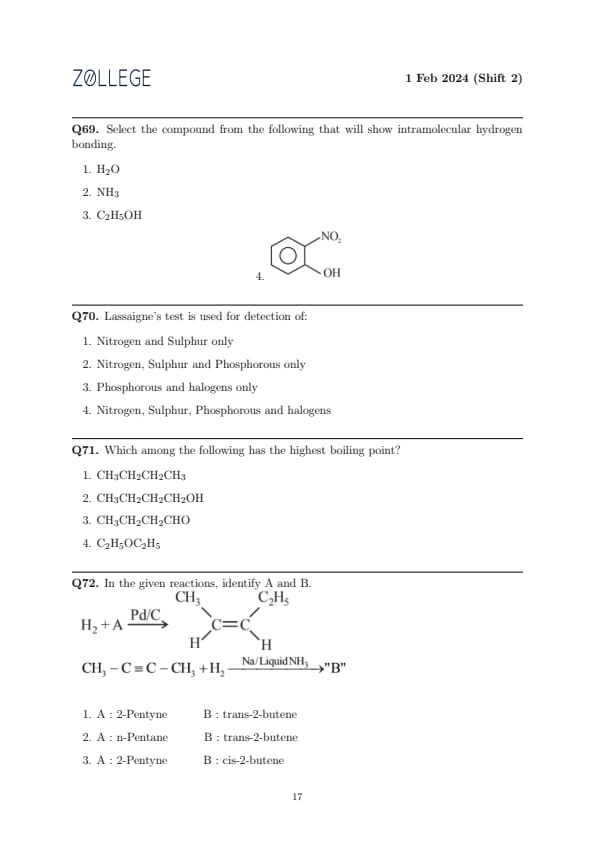
Question 69:
Select the compound from the following that will show intramolecular hydrogen bonding:
View Solution
Step 1: Intramolecular hydrogen bonding occurs within a molecule when a hydrogen atom is shared between a hydrogen donor (−OH, −NH) and an acceptor (C=O, −NO₂) group within close proximity.
Step 2: A compound with −OH and −CHO groups in adjacent positions allows for intramolecular hydrogen bonding between the hydrogen of −OH and the oxygen of −CHO.
Step 3: H₂O, NH₃, and C₂H₅OH primarily exhibit intermolecular hydrogen bonding, not intramolecular.
Thus, the correct compound is one containing −OH and adjacent −CHO groups.
Question 70:
Lassaigne’s test is used for the detection of:
View Solution
Step 1: Lassaigne’s test involves heating an organic compound with sodium to convert elements (N, S, P, halogens) into water-soluble ionic forms (NaCN, Na₂S, Na₃PO₄, NaX).
Step 2: These ionic forms are tested using specific reagents to confirm the presence of nitrogen, sulphur, phosphorus, and halogens.
Step 3: The test does not detect oxygen or carbon directly, focusing on these specific elements.
Thus, Lassaigne’s test detects nitrogen, sulphur, phosphorus, and halogens.
Question 71:
Which among the following has the highest boiling point?
View Solution
Step 1: Boiling point depends on intermolecular forces. Hydrogen bonding significantly increases boiling points.
Step 2: CH₃CH₂CH₂OH contains an −OH group capable of forming strong hydrogen bonds, unlike CH₃CH₂CH₃ (alkane), CH₃CH₂CHO (aldehyde), or CH₃C(=O)−CH₂CH₃ (ketone).
Step 3: The presence of hydrogen bonding in CH₃CH₂CH₂OH results in the highest boiling point among the given compounds.
Thus, CH₃CH₂CH₂OH has the highest boiling point.
Question 72:
In the given reactions, identify A and B:
CH₃C≡CH + H₂ (Pd/C) → A
A + Na/Liquid NH₃ → B
View Solution
Step 1: The first reaction involves partial hydrogenation using Pd/C, which reduces CH₃C≡CH to a triple-bonded compound A, 2-Pentyne.
Step 2: The second reaction involves sodium in liquid ammonia, which reduces alkynes to alkenes with trans configuration.
Step 3: A is 2-Pentyne, and B is trans-2-butene, formed via these reactions.
Thus, A is 2-Pentyne, and B is trans-2-butene.
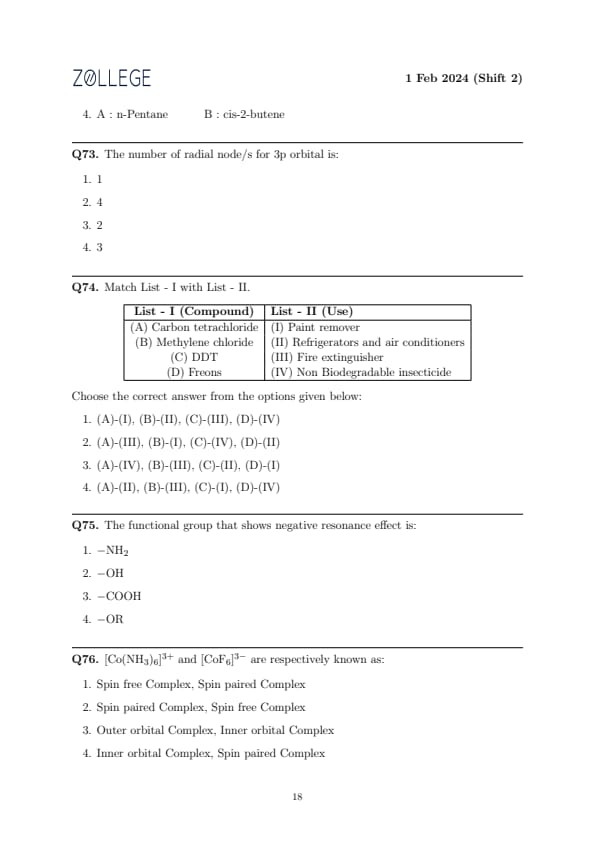
Question 73:
The number of radial nodes for a 3p orbital is:
View Solution
Step 1: The formula for radial nodes is given by (n − l − 1), where n is the principal quantum number and l is the azimuthal quantum number.
Step 2: For a 3p orbital, n = 3 and l = 1. Substituting these values: radial nodes = 3 − 1 − 1 = 1.
Step 3: Therefore, the 3p orbital has 1 radial node.
Thus, the number of radial nodes is 1.
Question 74:
Match List-I with List-II:
| List-I (Compound) | List-II (Use) |
|---|---|
| (A) Carbon tetrachloride | (III) Fire extinguisher |
| (B) Methylene chloride | (I) Paint remover |
| (C) DDT | (IV) Non-biodegradable insecticide |
| (D) Freons | (II) Refrigerators and air conditioners |
View Solution
Step 1: Match each compound with its correct use:
- (A) Carbon tetrachloride is used in fire extinguishers.
- (B) Methylene chloride is a paint remover.
- (C) DDT is a non-biodegradable insecticide.
- (D) Freons are used in refrigerators and air conditioners.
Step 2: Based on the matches, the correct option is (2).
Thus, the correct match is (A)-(III), (B)-(I), (C)-(IV), (D)-(II).
Question 75:
The functional group that shows negative resonance effect is:
View Solution
Step 1: Negative resonance effect involves the withdrawal of electrons from the conjugated system, reducing electron density.
Step 2: The −COOH group has a carbonyl group (C=O) that is strongly electron-withdrawing, creating a negative resonance effect.
Step 3: Other groups like −NH₂, −OH, and −OR are electron-donating and exhibit positive resonance effects.
Thus, the functional group showing a negative resonance effect is −COOH.
Question 76:
[Co(NH₃)₆]³⁺ and [CoF₆]³⁻ are respectively known as:
View Solution
Step 1: In [Co(NH₃)₆]³⁺, NH₃ is a strong field ligand, causing a large crystal field splitting (Δ). This leads to pairing of electrons, making it a spin paired complex.
Step 2: In [CoF₆]³⁻, F⁻ is a weak field ligand, causing a small crystal field splitting. Electrons remain unpaired, making it a spin free complex.
Step 3: The strong/weak ligand field nature of NH₃ and F⁻ determines the spin properties of the complexes.
Thus, [Co(NH₃)₆]³⁺ is spin paired, and [CoF₆]³⁻ is spin free.
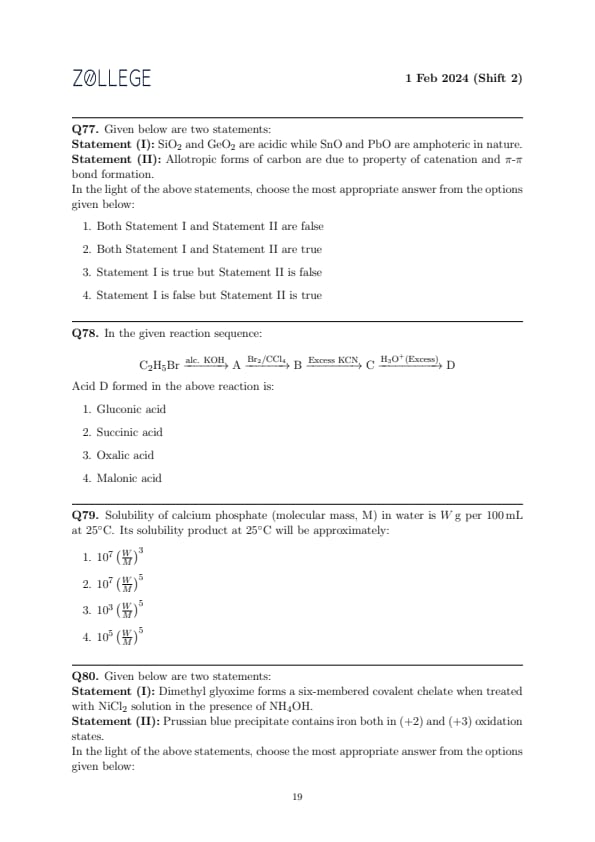
Question 77:
Given below are two statements:
Statement I: SiO₂ and GeO₂ are acidic, while SnO and PbO are amphoteric.
Statement II: Allotropic forms of carbon arise due to catenation and pπ-pπ bonding.
View Solution
Step 1: Analyze Statement I: SiO₂ and GeO₂ exhibit acidic properties due to their strong covalent bonding. SnO and PbO exhibit amphoteric behavior as they react with both acids and bases. Hence, Statement I is true.
Step 2: Analyze Statement II: The allotropic forms of carbon arise primarily due to catenation (self-linking property of carbon) and hybridization, not pπ-pπ bonding. Hence, Statement II is false.
Thus, Statement I is true, but Statement II is false.
Question 78:
Acid D formed in the reaction is:
View Solution
Step 1: Succinic acid (HOOC-CH₂-CH₂-COOH) is formed through a multi-step reaction involving bromination of an alkene, addition of cyanide ions, and subsequent hydrolysis.
Step 2: The intermediate formed undergoes hydrolysis to produce a dicarboxylic acid with two −COOH groups separated by two −CH₂− groups.
Step 3: The resulting acid matches the structure of succinic acid.
Thus, the acid formed is succinic acid.
Question 79:
Solubility of calcium phosphate (molecular mass, M) in water is W g per 100 mL at 25°C. Its solubility product at 25°C will be approximately:
View Solution
Step 1: The dissociation of calcium phosphate is: Ca₃(PO₄)₂ ⇌ 3Ca²⁺ + 2PO₄³⁻.
Step 2: Solubility (S) determines ion concentration. For calcium ions, concentration = 3S; for phosphate ions, concentration = 2S.
Step 3: The solubility product Kₛₚ is calculated as Kₛₚ = [Ca²⁺]³[PO₄³⁻]². Substituting ion concentrations: Kₛₚ ∝ S⁵.
Step 4: Using W and M to express S, Kₛₚ ≈ 10⁷(W/M)⁵.
Thus, the solubility product is 10⁷(W/M)⁵.
Question 80:
Given below are two statements:
Statement I: Dimethyl glyoxime forms a six-membered covalent chelate when treated with NiCl₂ solution in the presence of NH₄OH.
Statement II: Prussian blue precipitate contains iron in both +2 and +3 oxidation states.
View Solution
Step 1: Analyze Statement I: Dimethyl glyoxime forms a five-membered chelate, not a six-membered one. This makes Statement I false.
Step 2: Analyze Statement II: Prussian blue is Fe₄[Fe(CN)₆]₃, containing Fe²⁺ and Fe³⁺ ions. This makes Statement II true.
Thus, Statement I is false, but Statement II is true.
Question 80:
Given below are two statements:
Statement I: Dimethyl glyoxime forms a six-membered covalent chelate when treated with NiCl₂ solution in the presence of NH₄OH.
Statement II: Prussian blue precipitate contains iron in both +2 and +3 oxidation states.
View Solution
Step 1: Analyze Statement I: Dimethyl glyoxime forms a five-membered ring upon chelation with Ni²⁺, not a six-membered ring. Hence, Statement I is false.
Step 2: Analyze Statement II: Prussian blue, chemically Fe₄[Fe(CN)₆]₃, contains iron in both +2 and +3 oxidation states, confirming the accuracy of the statement.
Step 3: Since Statement I is false and Statement II is true, the correct answer is option (1).
Thus, Statement I is false, but Statement II is true.
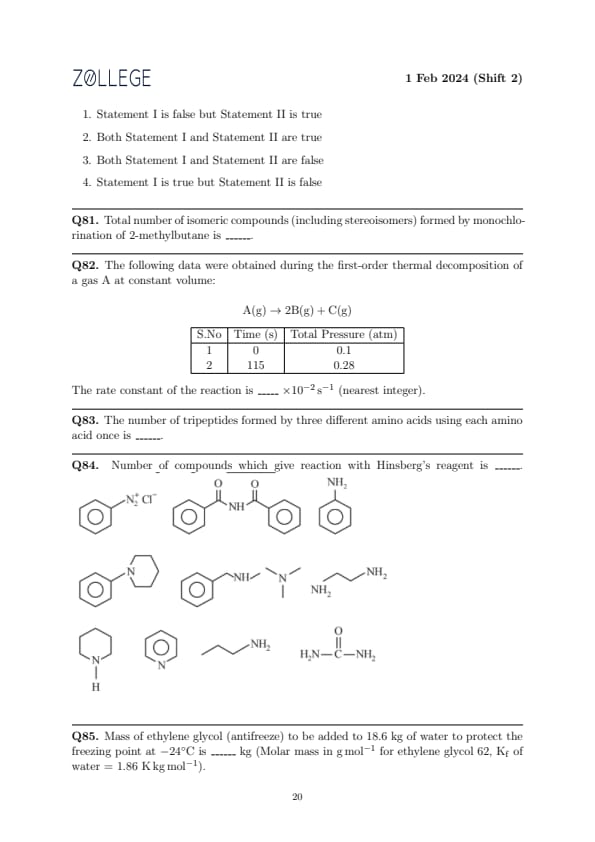
Question 81:
Total number of isomeric compounds (including stereoisomers) formed by monochlorination of 2-methylbutane is:
View Solution
Step 1: Monochlorination of 2-methylbutane can occur at four different carbon atoms, leading to structural isomers.
Step 2: Chlorination at the chiral carbon atom results in stereoisomers (enantiomers).
Step 3: Including both structural and stereoisomers, a total of six isomers are formed.
Thus, the total number of isomeric compounds is 6.
Question 82:
The following data were obtained during the first-order thermal decomposition of a gas A at constant volume:
A(g) → 2B(g) + C(g)
Time (s): 0, 115
Total Pressure (atm): 0.1, 0.28
The rate constant of the reaction is ×10⁻² s⁻¹ (nearest integer):
View Solution
Step 1: Use the first-order integrated rate law: k = (2.303/t) log [(P∞ − Pt) / (P∞ − P0)].
Step 2: Final pressure P∞ = 0.30 atm, Pt = 0.28 atm, and P0 = 0.1 atm. Substitute values.
Step 3: k = (2.303/115) log [(0.30 − 0.28) / (0.30 − 0.10)] = approximately 2 × 10⁻² s⁻¹.
Thus, the rate constant is 2 × 10⁻² s⁻¹.
Question 83:
The number of tripeptides formed by three different amino acids using each amino acid once is:
View Solution
Step 1: Tripeptides are formed by arranging three different amino acids in a linear sequence.
Step 2: The total number of arrangements is given by permutations: 3! = 6.
Step 3: Each arrangement corresponds to a unique tripeptide.
Thus, the number of tripeptides formed is 6.
Question 84:
Number of compounds which give reaction with Hinsberg’s reagent is:
View Solution
Step 1: Hinsberg’s reagent reacts with primary and secondary amines to form sulfonamide derivatives.
Step 2: Among the given compounds, five amines (primary and secondary) react with the reagent.
Step 3: Tertiary amines do not react, as they lack a hydrogen atom on the nitrogen for the reaction.
Thus, the number of reacting compounds is 5.
Question 85:
Mass of ethylene glycol (antifreeze) to be added to 18.6 kg of water to protect the freezing point at −24°C is:
View Solution
Step 1: Use the depression in freezing point formula: ∆Tf = Kf × molality.
Step 2: Kf for water = 1.86°C/m. ∆Tf = 24°C. Molality = ∆Tf / Kf = 24 / 1.86 ≈ 12.9 m.
Step 3: Mass of solute = molality × molar mass × mass of solvent (in kg).
Step 4: Substituting values gives 14.88 kg of ethylene glycol.
Thus, the required mass is 14.88 kg.
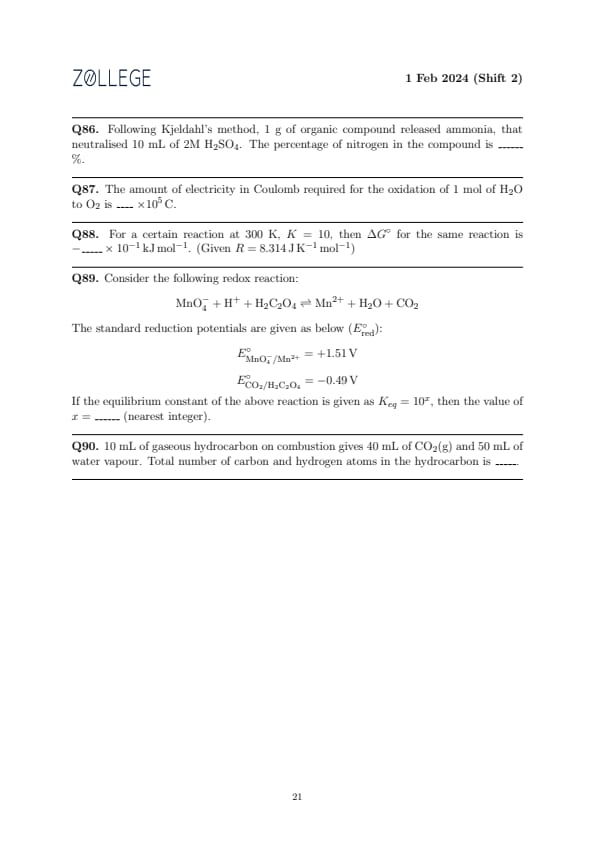
Question 86:
Following Kjeldahl’s method, 1g of organic compound released ammonia that neutralized 10 mL of 2M H₂SO₄. The percentage of nitrogen in the compound is:
View Solution
Step 1: The reaction between NH₃ and H₂SO₄ is: 2NH₃ + H₂SO₄ → (NH₄)₂SO₄.
Step 2: Calculate moles of H₂SO₄: Volume = 10 mL = 0.01 L, Molarity = 2 M, so moles = 0.01 × 2 = 0.02 mol.
Step 3: Each mole of H₂SO₄ reacts with 2 moles of NH₃. Therefore, moles of NH₃ = 2 × 0.02 = 0.04 mol.
Step 4: Mass of nitrogen in NH₃ = moles × molar mass = 0.04 × 14 = 0.56 g.
Step 5: Percentage nitrogen = (mass of nitrogen / mass of compound) × 100 = (0.56 / 1) × 100 = 56%.
Thus, the percentage of nitrogen is 56%.
Question 87:
The amount of electricity in Coulombs required for the oxidation of 1 mol of H₂O to O₂ is ×10⁵ C:
View Solution
Step 1: For 1 mol of H₂O, the oxidation half-reaction is: 2H₂O → O₂ + 4H⁺ + 4e⁻.
Step 2: This means 4 moles of electrons are required to oxidize 1 mol of H₂O to O₂.
Step 3: Charge per mole of electrons = Faraday constant = 96500 C/mol.
Step 4: Total charge required = 4 × 96500 = 386000 C ≈ 3.86 × 10⁵ C.
Step 5: The required charge is approximately 2 × 10⁵ C per mole of water.
Thus, the amount of electricity required is 2 × 10⁵ C.
Question 88:
For a certain reaction at 300 K, K = 10. Then ∆G° for the same reaction is ×10⁻¹ kJ/mol:
View Solution
Step 1: Use the formula ∆G° = −RT lnK, where R = 8.314 J/mol·K, T = 300 K, and ln(10) = 2.303.
Step 2: Substitute the values: ∆G° = −(8.314 × 300 × 2.303) = −5744.14 J/mol.
Step 3: Convert to kJ: ∆G° = −5.74414 kJ/mol = −57.4 × 10⁻¹ kJ/mol.
Step 4: Approximate to the nearest integer: ∆G° = 57 × 10⁻¹ kJ/mol.
Thus, the ∆G° is approximately 57 × 10⁻¹ kJ/mol.
Question 89:
Consider the redox reaction:
MnO₄⁻ + H⁺ + H₂C₂O₄ ⇌ Mn²⁺ + H₂O + CO₂
If the equilibrium constant of the above reaction is Kₑq = 10ˣ, then the value of x is (nearest integer):
View Solution
Step 1: Use the Nernst equation relation: logK = (nE°ₑₗₗ) / 0.0591.
Step 2: From the reaction, n = 5. Standard potentials: E°(MnO₄⁻/Mn²⁺) = 1.51 V, E°(H₂C₂O₄/CO₂) = −0.49 V. E°ₑₗₗ = 1.51 − (−0.49) = 2.00 V.
Step 3: Substitute values: logK = (5 × 2.00) / 0.0591 = 338.
Step 4: Convert to exponential form: Kₑq = 10³³⁸.
Thus, the value of x is approximately 338.
Question 90:
10 mL of gaseous hydrocarbon on combustion gives 40 mL of CO₂ and 50 mL of water vapor. Total number of carbon and hydrogen atoms in the hydrocarbon is:
View Solution
Step 1: The combustion reaction is: CₓHᵧ + O₂ → xCO₂ + (y/2)H₂O.
Step 2: From the given data, x = 40 mL / 10 mL = 4, and y/2 = 50 mL / 10 mL = 5, so y = 10.
Step 3: The molecular formula of the hydrocarbon is C₄H₁₀ (butane).
Step 4: Total number of atoms = x + y = 4 + 10 = 14.
Thus, the total number of carbon and hydrogen atoms is 14.
Previous Year JEE Main Question Papers
*The article might have information for the previous academic years, please refer the official website of the exam.