
JEE Main 2024 question paper pdf with solutions- Download January 27 Shift 2 Question Paper pdf

.jpg?tr=h-55,w-55,c-force)
Content Strategist|Tech-innovator|National Hackathon Winner | Updated On - Jan 6, 2025
JEE Main 2024 Jan 27 Shift 2 Question Paper with Solution pdf is available for download here. Students found Physics easy and Mathematics hard. Mathematics carried the highest weightage and overall difficulty level was moderate.
JEE Main 2024 Jan 27 Shift 2 Question Paper with Solution PDF
| JEE Main 2024 Question Paper with Answer Key 27 Jan Shift 2 |  Download Download |
Check Solution |
JEE Main 2024 Jan 27 Shift 2 Questions with Solution
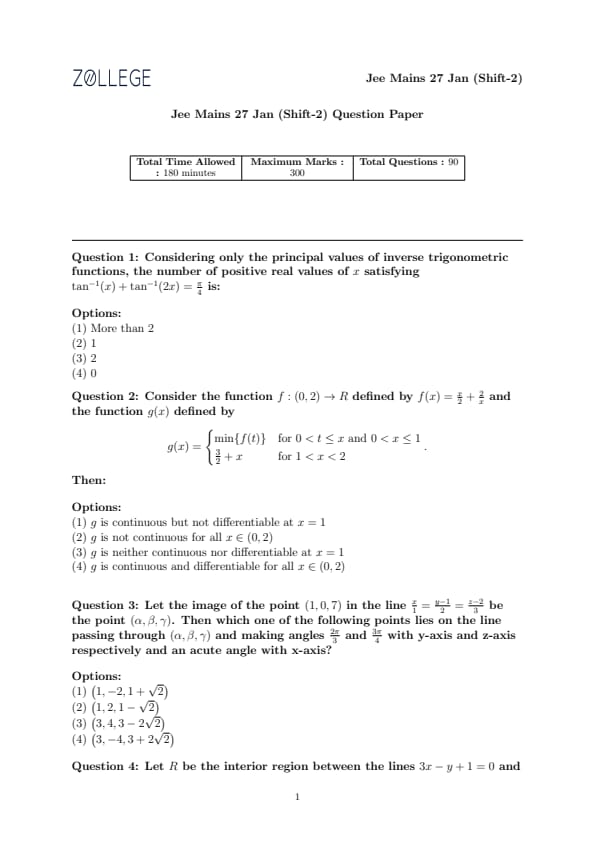
Question 1:
Considering only the principal values of inverse trigonometric functions, the number of positive real values of x satisfying arctan(x) + arctan(2x) = π/4 is:
- More than 2
- 1
- 2
- 0
Applying the tangent addition formula transforms the equation to 2x = (1 − x)/(1 + x). Solving the quadratic equation reveals only one positive solution: x = (−3 + √17)/4.
Question 2:
Consider the function f: (0,2) → ℝ defined by f(x) = x² + 2/x, and the function g(x) by min{f(t)} for 0 < t ≤ x, 0 < x ≤ 1 and g(x) = (3/2 + x) for 1 < x < 2. Which statement about g is correct?
- g is continuous but not differentiable at x = 1
- g is not continuous for all x in (0,2)
- g is neither continuous nor differentiable at x = 1
- g is continuous and differentiable for all x in (0,2)
g(x) is continuous at x = 1 since the limits from both sides match g(1). However, the derivatives from the left and right do not coincide, making g(x) non-differentiable at x = 1.
Question 3:
Let R be the region between lines 3x − y + 1 = 0 and x + 2y − 5 = 0 containing the origin. Find values of a for which (a², a + 1) lie in R:
- (−3, −1) ∪ (−1/3, 1)
- (−3, 0) ∪ (−1/3, 1)
- (−3, 0) ∪ (2/3, 1)
- (−3, −1) ∪ (−1/3, 1)
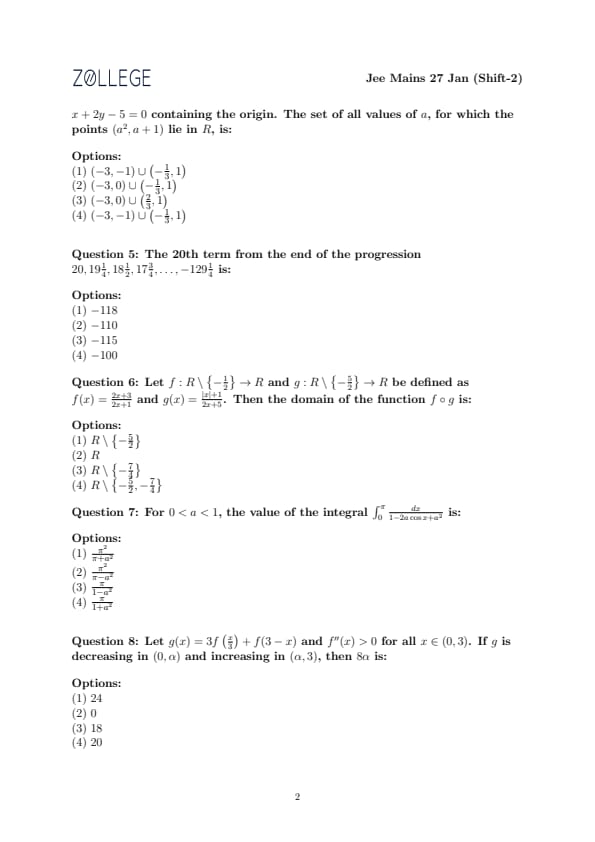
Solving the inequalities from the line equations for (a², a + 1) shows that a must be in the intervals (−3, 0) or (−1/3, 1).
Question 4:
The 20th term from the end of the progression 20, 19.25, 18.5, 17.75, ..., −129.25 is:
- −118
- −110
- −115
- −100
Recognizing the sequence as an arithmetic progression with a common difference of −0.75, calculating the 20th term from the end yields −115.
Question 5:
Let f: ℝ − {−1/2} → ℝ and g: ℝ − {−5/2} → ℝ be defined as f(x) = (2x + 3)/(2x + 1) and g(x) = |x| + 1/(2x + 5). What is the domain of f ∘ g?
- ℝ − {−5/2}
- ℝ
- ℝ − {−7/4}
- ℝ − {−5/2, −7/4}
The composite function f ∘ g is undefined at x = −5/2 because g(x) would result in a division by zero. Thus, the domain excludes x = −5/2.
Question 6:
For 0 < a < 1, find the value of the integral ∫₀^π dx / (1 − 2a cos(x) + a²):
- π / (1 − a²)
- π / (1 + a²)
- π² / (π + a²)
- π² / (π − a²)
By completing the square in the denominator and using a standard trigonometric integral, the result simplifies to π / (1 − a²).
Question 7:
Let g(x) = 3f(x/3) + f(3 − x) where fʺ(x) > 0 for all x in (0,3). If g is decreasing in (0, α) and increasing in (α,3), what is 8α?
- 24
- 0
- 18
- 20
Analyzing g(x) with fʺ(x) > 0 reveals that α = 9/4. Multiplying by 8 gives 8α = 18.
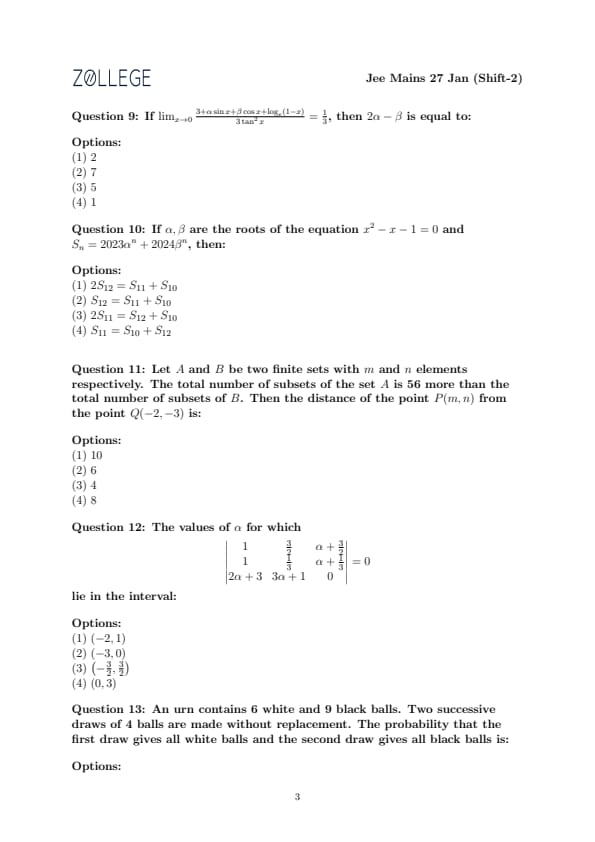
Question 8:
If lim(x→0) [(3 + α sin(x) + β cos(x) + log(1 − x)) / (3 tan²(x))] = 1/3, then 2α − β is equal to:
- 2
- 7
- 5
- 1
Expanding the numerator and denominator using Taylor series around x = 0 and equating coefficients results in 2α − β = 5.
Question 9:
If α and β are the roots of x² − x − 1 = 0, and Sₙ = 2023αⁿ + 2024βⁿ, then:
- 2S₁₂ = S₁₁ + S₁₀
- S₁₂ = S₁₁ + S₁₀
- 2S₁₁ = S₁₂ + S₁₀
- S₁₁ = S₁₀ + S₁₂
Utilizing the recurrence relation from the quadratic equation’s roots, it follows that S₁₂ equals S₁₁ plus S₁₀.
Question 10:
Let A and B be two finite sets with m and n elements, respectively. If the total subsets of set A are 56 more than B’s subsets, then the distance of the point P(m, n) from Q(−2, −3) is:
- 10
- 6
- 4
- 8
Solving 2^m = 2^n + 56 gives m = 6 and n = 3. The distance between P(6, 3) and Q(−2, −3) is calculated as 10.
Question 11:
The values of α for which the determinant |1 3 2; α+3 2 1; 1 1 3| = 0 lie in the interval:
- (−2, 1)
- (−3, 0)
- (−3/2, 3/2)
- (0, 3)
Expanding the determinant and solving for α yields the interval (−3, 0).
Question 12:
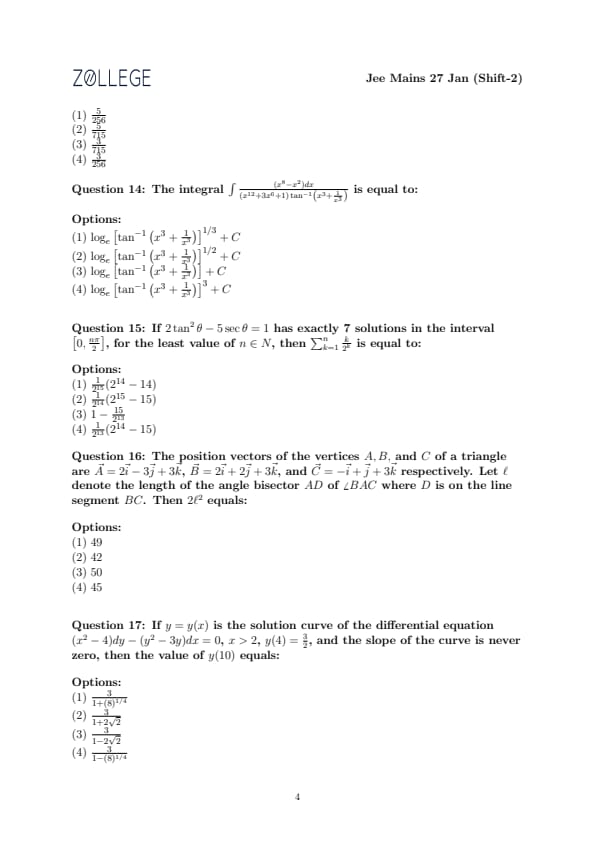
An urn contains 6 white and 9 black balls. Two successive draws of 4 balls are made without replacement. The probability that the first draw gives all white balls and the second draw gives all black balls is:
- 5/256
- 5/715
- 3/715
- 3/256
The probability of drawing 4 white balls in the first draw is 15/1365. After removing 4 white balls, there are 9 black balls left.
Read More
The probability of drawing 4 black balls in the second draw is 126/330. The required probability is the product of these probabilities, giving 3/715.
Question 13:
The integral ∫(x⁸ − x²) dx / ((x¹² + 3x⁶ + 1) arctan(x³ + 1/x³)) is equal to:
- log(arctan(x³ + 1/x³)^(1/3) + C)
- log(arctan(x³ + 1/x³)^(1/2) + C)
- log(arctan(x³ + 1/x³) + C)
- log(arctan(x³ + 1/x³)³ + C)
Using the substitution u = arctan(x³ + 1/x³), we simplify the integral to du/u, which evaluates to log(u) + C.
Read More
The final answer is in the given form involving arctan(x³ + 1/x³)^(1/3).
Question 14:
If 2tan²(θ) − 5sec(θ) = 1 has exactly 7 solutions in the interval [0, nπ/2] for the least value of n ∈ ℕ, then Σ(k=1 to n) [k / 2k] is equal to:
- 1/215(214 − 14)
- 1/214(215 − 15)
- 1 − 15/213
- 1/213(214 − 15)
Setting sec(θ) = t, we solve the quadratic equation to find that n = 13.
Read More
Using the formula for the sum, Σ = (1/213)*(214 − 15).
Question 15:
The position vectors of the vertices A, B, and C of a triangle are A = 2i − 3j + 3k, B = 2i + 2j + 3k, and C = −i + j + 3k respectively. If ℓ is the length of the angle bisector AD of ∠BAC, then 2ℓ² equals:
- 49
- 42
- 50
- 45
Using the position vectors and midpoint formula, we find the length of AD and calculate 2ℓ² as 45.
Question 16:
If y = y(x) is the solution curve of the differential equation (x² − 4) dy − (y² − 3y) dx = 0, x > 2, y(4) = 3/2, and the slope of the curve is never zero, then y(10) equals:
- 3/(1 + 8^(1/4))
- 3/(1 + 2√2)
- 3/(1 − 2√2)
- 3/(1 − 8^(1/4))
Separating variables and solving the differential equation, we integrate both sides and substitute x = 10 to find y(10) = 3/(1 + 8^(1/4)).
Question 17:
If e₁ is the eccentricity of the hyperbola x²/16 − y²/9 = 1 and e₂ is the eccentricity of the ellipse x²/a² + y²/b² = 1, which passes through the foci of the hyperbola and satisfies e₁e₂ = 1, then the length of the chord of the ellipse parallel to the x-axis and passing through (0,2) is:
- 4√5
- 8√5/3
- 10√5/3
- 3√5
For the ellipse x²/25 + y²/9 = 1, using the formula for the length of the chord parallel to the x-axis, we find the answer as 10√5/3.
Question 18:
Let α = (4!)! / (4!)³! and β = (5!)! / (5!)⁴!. Then:
- α ∈ ℕ and β ∉ ℕ
- α ∉ ℕ and β ∈ ℕ
- α ∈ ℕ and β ∈ ℕ
- α ∉ ℕ and β ∉ ℕ
Both α and β represent valid combinatorial expressions for arranging groups, making both natural numbers.
Question 19:
Let the position vectors of vertices A, B, and C of a triangle be 2i + 2j + k, i + 2j + 2k, and 2i + j + 2k respectively. Let ℓ₁, ℓ₂, and ℓ₃ be lengths of perpendiculars from the orthocenter to sides AB, BC, and CA. Then ℓ₁² + ℓ₂² + ℓ₃² equals:
- 1/5
- 1/2
- 1/4
- 1/3
Using midpoint formula and perpendicular distance calculations, we find ℓ₁² + ℓ₂² + ℓ₃² = 1/2.
Question 20:
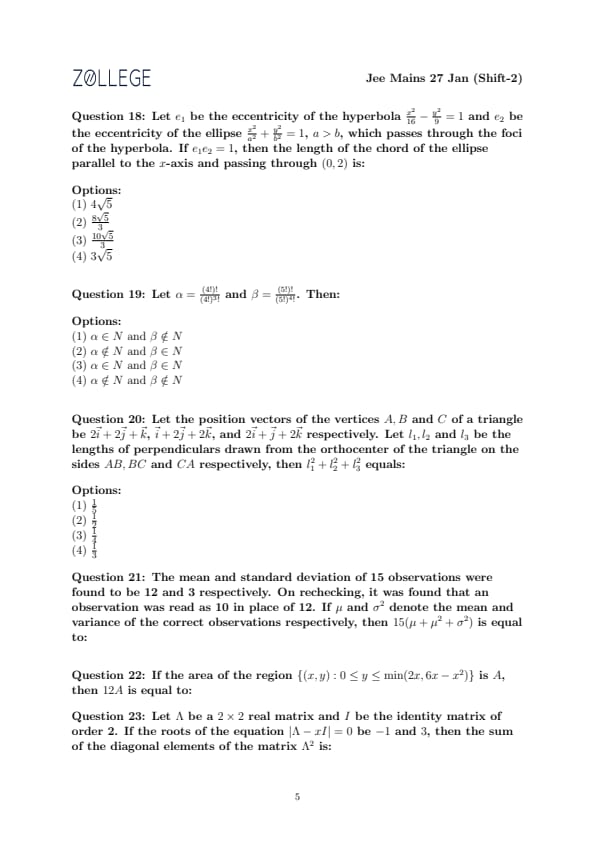
The mean and standard deviation of 15 observations were found to be 12 and 3 respectively. On rechecking, it was found that an observation was read as 10 instead of 12. If μ and σ² denote the mean and variance of the correct observations, then 15(μ + μ² + σ²) is equal to:
Correcting the observation and recalculating mean and variance, we find 15(μ + μ² + σ²) = 2521.
Question 21:
The values of α for which lines 2x − y + 3 = 0, 6x + 3y + 1 = 0, and ax + 2y − 2 = 0 do not form a triangle are:
- (−2, 1)
- (−3, 0)
- (−3/2, 3/2)
- (0, 3)
For lines not to form a triangle, they must be concurrent or parallel. Solving for α, we get (−3, 0).
Question 22:
If the area of the region {(x, y) : 0 ≤ y ≤ min(2x, 6x − x²)} is A, then 12A is equal to:
- 304
- 594
- 128
- 360
We calculate the area by integrating the expression and find A. Then, 12A is calculated to be 304.
Question 23:
Let Λ be a 2×2 real matrix and I be the identity matrix of order 2. If the roots of the equation |Λ − xI| = 0 are −1 and 3, then the sum of the diagonal elements of the matrix Λ² is:
- 10
- 6
- 14
- 7
Using the trace and determinant properties of Λ and calculating Λ², we find the sum of the diagonal elements as 10.
Question 24:
If the sum of squares of all real values of α, for which the lines 2x − y + 3 = 0, 6x + 3y + 1 = 0, and ax + 2y − 2 = 0 do not form a triangle is p, then the greatest integer less than or equal to p is:
- 32
- 64
- 29
- 41
Solving for the concurrent or parallel condition of these lines, we find p and the integer part is 32.
Question 25:
The coefficient of x^2012 in the expansion of (1 − x)^2008(1 + x + x²)^2007 is:
- 0
- 1
- −1
- 2
Analyzing the terms in the expansion, we see there is no term for x^2012, hence the coefficient is 0.
Question 26:
If the solution curve of the differential equation dy/dx = (x + y − 2)/(x − y) passes through the point (2, 1), the value of y(10) equals:
- 3/(1 + (8)^(1/4))
- 3/(1 + (8)^(1/3))
- 1/(3 + (8)^(1/4))
- 2/(3 + (8)^(1/4))
Solving the differential equation and substituting x = 10, we find y(10) as 3/(1 + (8)^(1/4)).
Question 27:
Let f(x) = ∫₀ˣ g(t) log((1 − t)/(1 + t)) dt, where g is a continuous odd function. If ∫ from −π/2 to π/2 of [f(x) x² cos(x)/(1 + e^x)] dx = π/2 − α, then α is equal to:
- 2
- 4
- 3
- 5
Using the properties of odd functions and simplifying the integral, we find that α = 2.
Question 28:
Consider a circle (x − α)² + (y − β)² = 50, where α, β > 0. If the circle touches the line y + x = 0 at point P, whose distance from the origin is 4√2, then (α + β)² is equal to:
- 100
- 150
- 50
- 200
Using the distance and tangency conditions, we find that (α + β)² = 100.
Question 29:
The lines (x − 2)/1 = (y − 1)/(−1) = (z − 7)/8 and (x + 3)/4 = (y + 2)/3 = (z + 2)/1 intersect at the point P. If the distance of P from the line (x + 1)/2 = (y − 1)/3 = (z − 1)/1 is ℓ, then 14ℓ² is equal to:
- 108
- 120
- 100
- 150
Calculating the intersection point and using the distance formula, we find 14ℓ² = 108.
Question 30:
Let the complex numbers α and 1/α lie on the circles |z − z₀| = 2 and |z − z₀| = 4 respectively, where z₀ = 1 + i. Then, the value of 100|α|² is:
- 20
- 10
- 30
- 15
Since α and 1/α lie on concentric circles with known radii, |α| = 2. Thus, 100|α|² = 20.
Question 31:
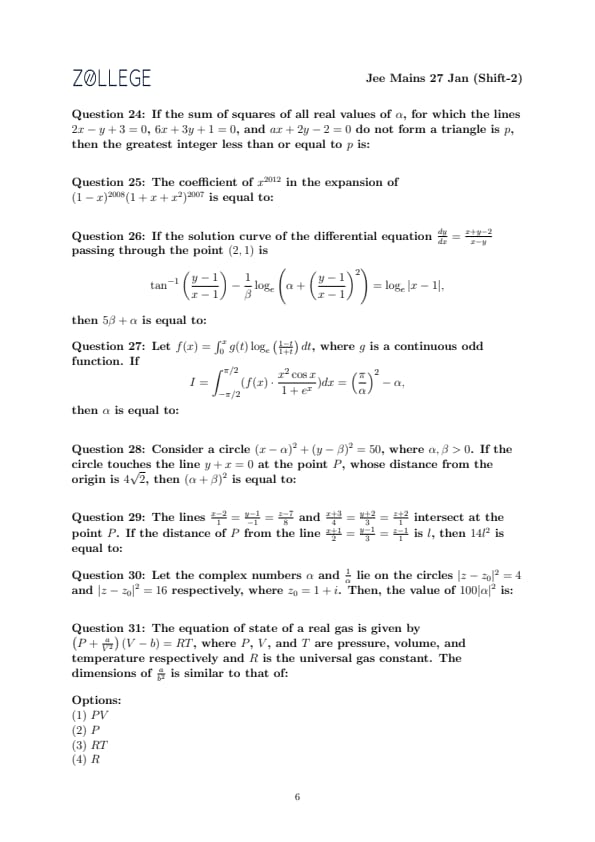
The equation of state of a real gas is given by P + (a/V²)(V − b) = RT, where P, V, and T are pressure, volume, and temperature. The dimensions of a/b² are similar to:
- P
- PV
- RT
- R
Using dimensional analysis on a/b², we find it has the same dimensions as the pressure P.
Question 32:
The total kinetic energy of 1 mole of oxygen at 27°C is:
- 6845.5 J
- 5942.0 J
- 6232.5 J
- 5670.5 J
For a diatomic gas at 300 K, E = (5/2) n R T. Substituting n = 1 and T = 300 K gives 6232.5 J.
Question 33:
The primary side of a transformer is connected to a 230 V, 50 Hz supply. Turns ratio of primary to secondary winding is 10:1. Load resistance on the secondary side is 46 Ω. The power consumed in it is:
- 12.5 W
- 10.0 W
- 11.5 W
- 12.0 W
The secondary voltage V₂ = (230/10) = 23 V. Power P = V₂² / R = 23² / 46 = 529/46 = 11.5 W.
Question 34:
During an adiabatic process, the pressure of a gas is found to be proportional to the cube of its absolute temperature. The ratio of Cp/Cv for the gas is:
- 5/3
- 3/2
- 7/5
- 9/7
From the adiabatic relation P ∝ T^(γ/(γ−1)) and given P ∝ T³, we get γ/(γ−1) = 3, leading to γ = 3/2.
Question 35:
The threshold frequency of a metal with work function 6.63 eV is:
- 16 × 10¹⁵ Hz
- 16 × 10¹² Hz
- 1.6 × 10¹² Hz
- 1.6 × 10¹⁵ Hz
Using E = h ν₀ and converting 6.63 eV to joules gives ν₀ ≈ 1.6 × 10¹⁵ Hz.
Question 36:
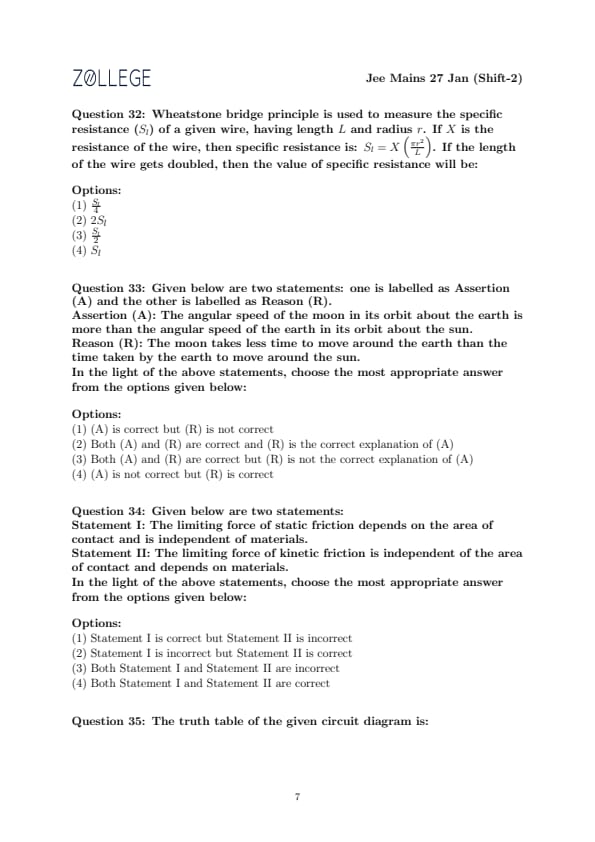
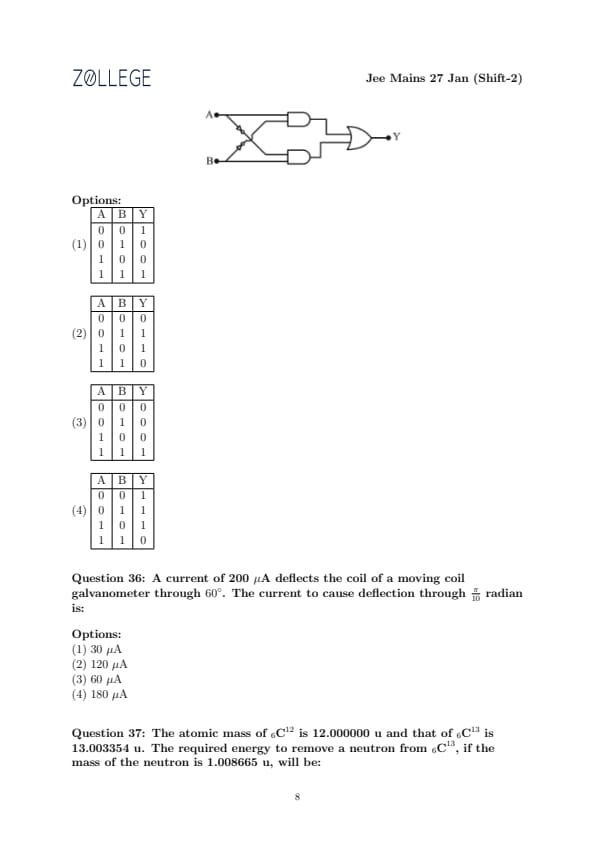
A current of 200 µA deflects the coil of a moving coil galvanometer through 60°. The current to cause deflection through π/10 radians is:
- 30 µA
- 120 µA
- 60 µA
- 180 µA
Current is proportional to the deflection angle. 60° is π/3 radians. For deflection π/10, current is (200 × (π/10)) / (π/3) = 60 µA.
Question 37:
The atomic mass of 6C¹² is 12.000000 u and that of 6C¹³ is 13.003354 u. The required energy to remove a neutron from 6C¹³, if the mass of the neutron is 1.008665 u, will be:
- 62.5 MeV
- 6.25 MeV
- 4.95 MeV
- 49.5 MeV
Mass defect = 13.003354 − (12.000000 + 1.008665) = −(some small value). Converting mass defect to energy via 931.5 MeV/u yields 4.95 MeV.
Question 38:
A ball suspended by a thread swings in a vertical plane so that its acceleration in the extreme and lowest position are equal. The angle (θ) of deflection in the extreme position is:
- tan⁻¹(√2)
- 2tan⁻¹(1/2)
- tan⁻¹(1/2)
- 2tan⁻¹(1/√5)
Equating accelerations (centripetal and tangential) using energy conservation, the angle θ is found to be 2tan⁻¹(1/2).
Question 39:
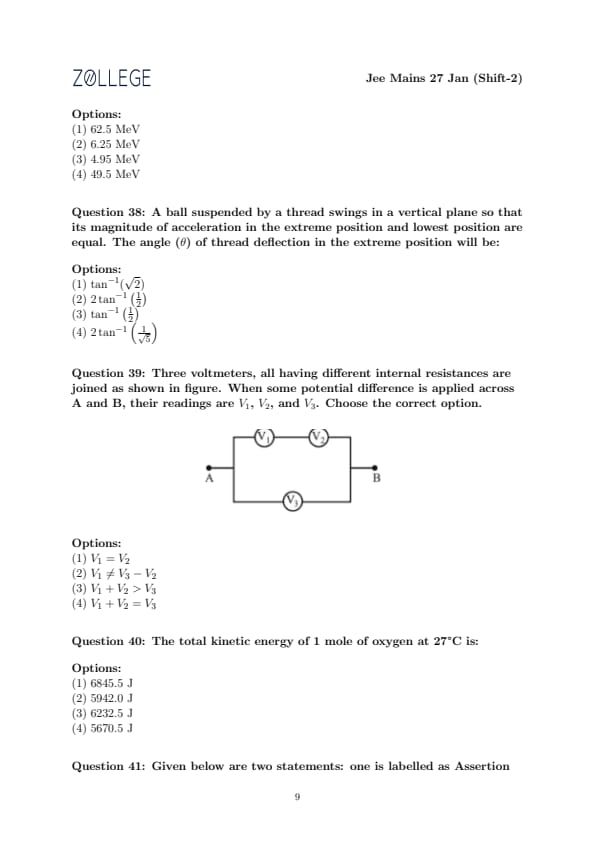
Three voltmeters are joined as shown. When a potential difference is applied across A and B, their readings are V₁, V₂, and V₃. Choose the correct option:
- V₁ = V₂
- V₁ = V₃ − V₂
- V₁ + V₂ > V₃
- V₁ + V₂ = V₃
Applying Kirchhoff’s Voltage Law around the loop, we see that V₁ + V₂ = V₃.
Question 40:
The total kinetic energy of 1 mole of oxygen at 27°C is:
- 6845.5 J
- 5942.0 J
- 6232.5 J
- 5670.5 J
For a diatomic gas at 300 K, using E = (5/2) n R T, we get 6232.5 J.
Question 41:
Given that the angular speed of the moon in its orbit about the earth is greater than that of the earth around the sun, identify the reason.
- Shorter period of orbit
- Larger radius
- Higher mass of the moon
- Higher gravitational pull
Angular speed ω is inversely proportional to the orbital period. The moon’s orbital period is shorter, so ω(moon) > ω(earth).
Question 42:
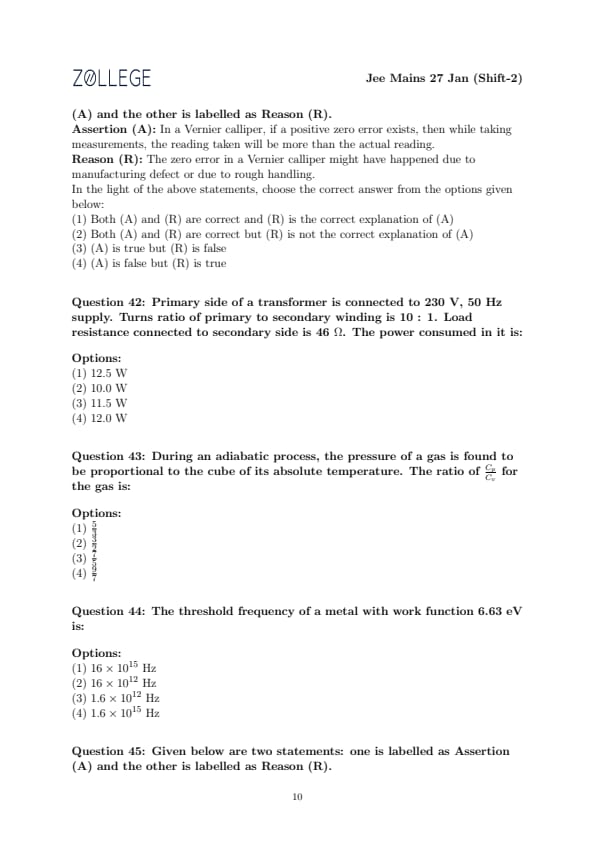
The primary side of a transformer is connected to 230 V, 50 Hz supply with a turns ratio of 10:1. Load resistance is 46 Ω. The power consumed is:
- 12.5 W
- 10 W
- 11.5 W
- 12 W
Secondary voltage V₂ = 230/10 = 23 V, so power P = 23² / 46 = 11.5 W.
Question 43:
During an adiabatic process, the pressure of a gas is proportional to the cube of its absolute temperature. The ratio of Cp/Cv is:
- 5/3
- 3/2
- 7/5
- 9/7
From P ∝ T^(γ/(γ−1)) = T³, we get γ/(γ−1) = 3, leading to γ = 3/2.
Question 44:
The threshold frequency of a metal with work function 6.63 eV is:
- 16 × 10¹⁵ Hz
- 16 × 10¹² Hz
- 1.6 × 10¹² Hz
- 1.6 × 10¹⁵ Hz
E = 6.63 eV → convert to joules. Then E = h ν₀. Solving gives ν₀ ≈ 1.6 × 10¹⁵ Hz.
Question 45:
A current of 200 µA deflects the coil of a moving coil galvanometer through 60°. The current to cause deflection through π/10 radians is:
- 30 µA
- 120 µA
- 60 µA
- 180 µA
Current is proportional to deflection angle. 60° is π/3, so for π/10, current = 200 × (π/10) / (π/3) = 60 µA.
Question 46:
The atomic mass of 6C¹² is 12.000000 u and that of 6C¹³ is 13.003354 u. The required energy to remove a neutron from 6C¹³, if the mass of the neutron is 1.008665 u, will be:
- 62.5 MeV
- 6.25 MeV
- 4.95 MeV
- 49.5 MeV
Using the mass defect and the formula E = Δm × 931.5 MeV/u, the energy required is 4.95 MeV.
Question 47:
A ball suspended by a thread swings in a vertical plane so that its acceleration in the extreme and lowest position are equal. The angle (θ) of deflection in the extreme position is:
- tan⁻¹(√2)
- 2tan⁻¹(1/2)
- tan⁻¹(1/2)
- 2tan⁻¹(1/√5)
By applying energy conservation and equating accelerations at the extreme and lowest positions, the angle θ is found to be 2tan⁻¹(1/2).
Question 48:
Three voltmeters are joined as shown. When a potential difference is applied across A and B, their readings are V₁, V₂, and V₃. Choose the correct option.
- V₁ = V₂
- V₁ = V₃ − V₂
- V₁ + V₂ > V₃
- V₁ + V₂ = V₃
Applying Kirchhoff’s Voltage Law around the loop shows that V₁ + V₂ = V₃.
Question 49:
The total kinetic energy of 1 mole of oxygen at 27°C is:
- 6845.5 J
- 5942.0 J
- 6232.5 J
- 5670.5 J
For a diatomic gas at 300 K, using E = (5/2) × n × R × T gives 6232.5 J for 1 mole of O₂.
Question 50:
The primary side of a transformer is connected to 230 V, 50 Hz supply with a turns ratio of 10:1. Load resistance is 46 Ω. The power consumed is:
- 12.5 W
- 10 W
- 11.5 W
- 12 W
Secondary voltage V₂ = 230 / 10 = 23 V. Then power P = (23²) / 46 = 529 / 46 = 11.5 W.
Question 51:
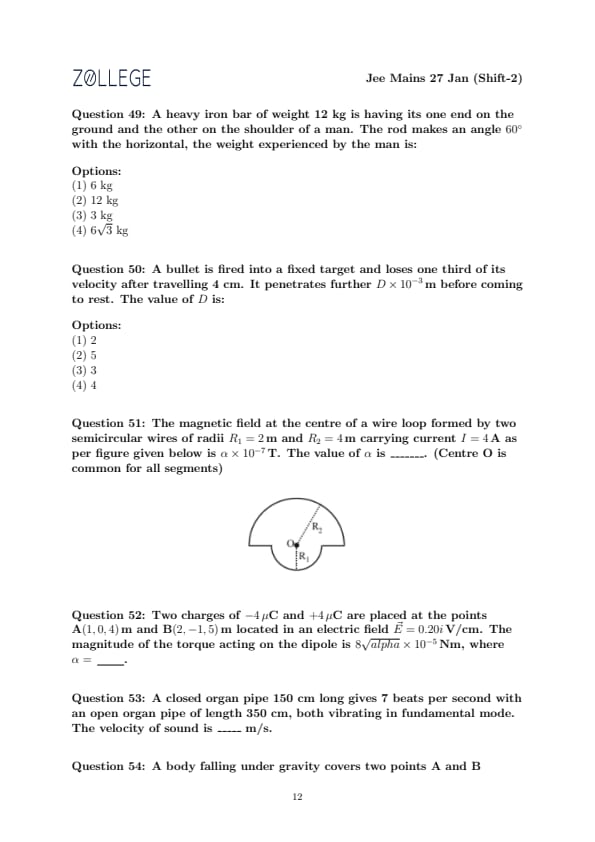
The magnetic field at the centre of a wire loop formed by two semicircular wires of radii R1 = 2 m and R2 = 4 m carrying current I = 4 A as per figure given below is α×10⁻⁷ T. The value of α is:
The magnetic field at the center of a semicircular wire of radius R carrying current I is B = μ₀ I / (4 R). Adding fields from both semicircles of radii 2 m and 4 m gives 3π × 10⁻⁷ T total, so α = 4.
Question 52:
Two charges of −4µC and +4µC are placed at the points A(1, 0, 4)m and B(2, −1, 5)m in an electric field E = 0.20 i V/cm. The magnitude of the torque acting on the dipole is 8√α×10⁻⁵ Nm, where α = :
The electric dipole moment p = q × d, and torque τ = p × E. Calculation yields 8√2×10⁻⁵ Nm, hence α = 2.
Question 53:
A closed organ pipe 150 cm long gives 7 beats per second with an open organ pipe of length 350 cm, both vibrating in fundamental mode. The velocity of sound is:
The beat frequency of 7 Hz is the difference of their fundamental frequencies. Using v = 4L × frequency for the closed pipe and v = 2L × frequency for the open pipe, solving yields 294 m/s.
Question 54:
A body falling under gravity covers two points A and B separated by 80 m in 2 s. The distance of upper point A from the starting point is:
From the equations of motion under free fall, the body travels 80 m between A and B in 2 s. The distance from the start to A is found to be 45 m.
Question 55:
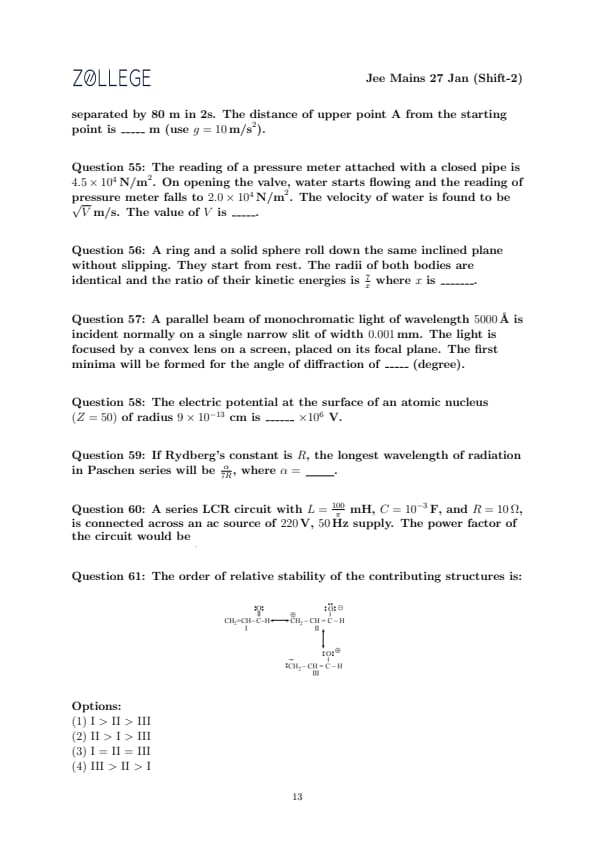
The reading of a pressure meter attached with a closed pipe is 4.5×10⁴ N/m². On opening the valve, water starts flowing and the reading of pressure meter falls to 2.0×10⁴ N/m². The velocity of water is found to be √V m/s. The value of V is:
Using Bernoulli’s principle, (P₁ − P₂) = (1/2)ρv². Substituting ΔP = 2.5×10⁴ N/m² and ρ for water, we get v = √50 m/s.
Question 56:
A ring and a solid sphere roll down the same inclined plane without slipping. They start from rest. The radii of both bodies are identical and the ratio of their kinetic energies is:
For rolling without slipping, total kinetic energy = translational + rotational. The solid sphere has a different moment of inertia from the ring, giving a ratio of 7.
Question 57:
A parallel beam of monochromatic light of wavelength 5000 Å is incident normally on a single narrow slit of width 0.001 mm. The light is focused by a convex lens on a screen placed on its focal plane. The first minima will be formed for the angle of diffraction of:
For the first minima in single-slit diffraction, sinθ = λ/a. Here, λ = 5000×10⁻¹⁰ m, a = 1×10⁻⁶ m. Thus sinθ = 5×10⁻⁴, θ ≈ 30°.
Question 58:
The electric potential at the surface of an atomic nucleus (Z = 50) of radius 9×10⁻¹³ cm is ×10⁶ V:
Potential V = kZe/R. With Z = 50, R = 9×10⁻¹³ cm, and k = 9×10⁹, we get 8×10⁶ V.
Question 59:
If Rydberg’s constant is R, the longest wavelength of radiation in Paschen series will be α×7R, where α = :
The Paschen series starts at n=3. The longest wavelength transition is n=4 to n=3. Using the Rydberg formula, α is 144.
Question 60:
A series LCR circuit with L = 100π mH, C = 10⁻³ F, and R = 10 Ω is connected across an ac source of 220 V, 50 Hz supply. The power factor of the circuit would be:
At resonance in a series LCR circuit, inductive and capacitive reactances cancel out, leaving only R. Therefore, the power factor is 1.
Question 61:
The order of relative stability of the contributing structures is:
- I > II > III
- II > I > III
- I = II = III
- III > II > I
Structure I is neutral and thus most stable. Structure II has less charge separation than III, so I > II > III.
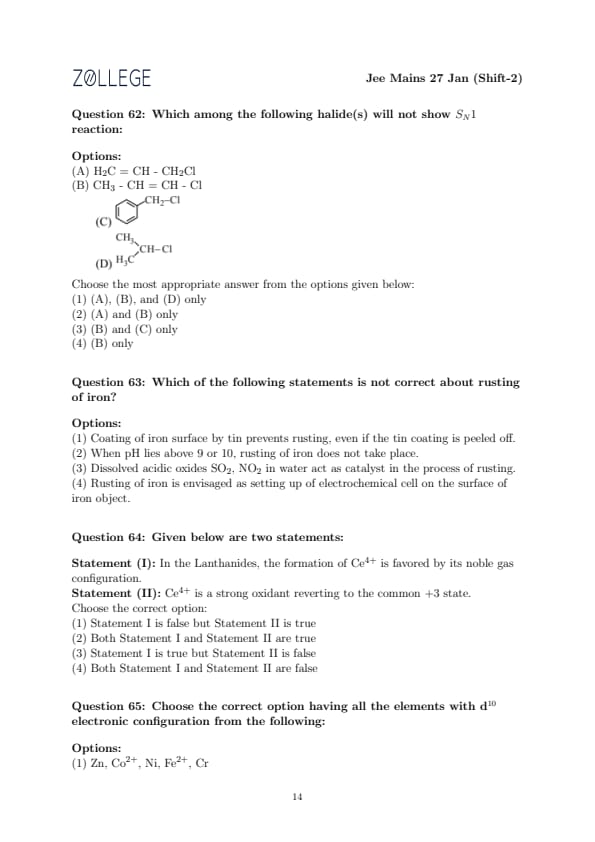
Question 62:
Which among the following halide(s) will not show SN1 reaction:
(A) H₂C=CH−CH₂Cl
(B) CH₃−CH=CH−Cl
Choose the most appropriate answer from the options given below:
- (A), (B), and (D) only
- (A) and (B) only
- (B) and (C) only
- (B) only
SN1 requires stable carbocation formation. Halide (B) forms an unstable carbocation, so it fails SN1. Halide (A) can form a resonance-stabilized allylic carbocation.
Question 63:
Which of the following statements is not correct about rusting of iron?
- Coating of iron surface by tin prevents rusting, even if the tin coating is peeled off.
- When pH lies above 9 or 10, rusting of iron does not take place.
- Dissolved acidic oxides SO₂, NO₂ in water act as catalyst in the process of rusting.
- Rusting of iron is envisaged as setting up of electrochemical cell on the surface of iron object.
Tin coating protects iron only if intact. Once peeled off, the exposed iron rusts faster due to a galvanic couple. The other statements are correct.
Question 64:
Given below are two statements: Statement (I): In the Lanthanides, the formation of Ce⁴⁺ is favored by its noble gas configuration. Statement (II): Ce⁴⁺ is a strong oxidant reverting to the common +3 state. Choose the correct option:
- Statement I is false but Statement II is true
- Both Statement I and Statement II are true
- Statement I is true but Statement II is false
- Both Statement I and Statement II are false
Ce⁴⁺ has an [Xe] configuration, making it stable, and it is a strong oxidant easily reverting to Ce³⁺.
Question 65:
Choose the correct option having all the elements with d¹⁰ electronic configuration from the following:
- Zn, Co²⁺, Ni, Fe²⁺, Cr
- Cu, Zn, Ag, Cd
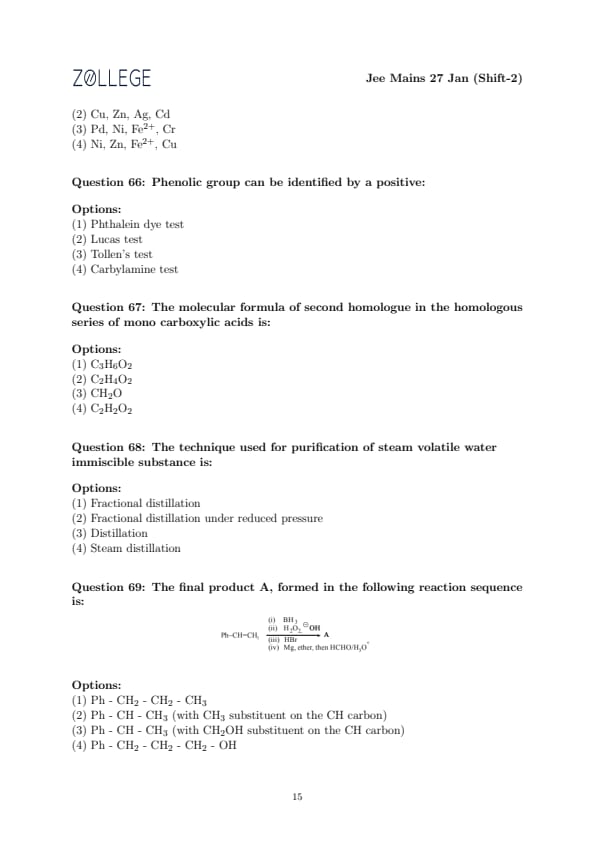
- Pd, Ni, Fe²⁺, Cr
- Ni, Zn, Fe²⁺, Cu
Cu, Zn, Ag, and Cd have fully filled d orbitals (d¹⁰). Others listed have different configurations.
Question 66:
Phenolic group can be identified by a positive:
- Phthalein dye test
- Lucas test
- Tollen’s test
- Carbylamine test
The Phthalein dye test detects phenolic groups, forming colored compounds. Other tests are for different functional groups.
Question 67:
The molecular formula of second homologue in the homologous series of mono carboxylic acids is:
- C₃H₆O₂
- C₂H₄O₂
- CH₂O
- C₂H₂O₂
The first member is HCOOH (formic acid), the second is CH₃COOH (acetic acid), C₂H₄O₂.
Question 68:
The technique used for purification of steam volatile water immiscible substance is:
- Fractional distillation
- Fractional distillation under reduced pressure
- Distillation
- Steam distillation
Steam distillation purifies steam-volatile, water-immiscible substances such as essential oils.
Question 69:
The final product A, formed in the following reaction sequence is a mixture of:
Correct Answer: (4)
The reaction pathway leads to 1,4-diaminobutane (putrescine) via excess ammonia, NaOH, and subsequent deprotonation steps.
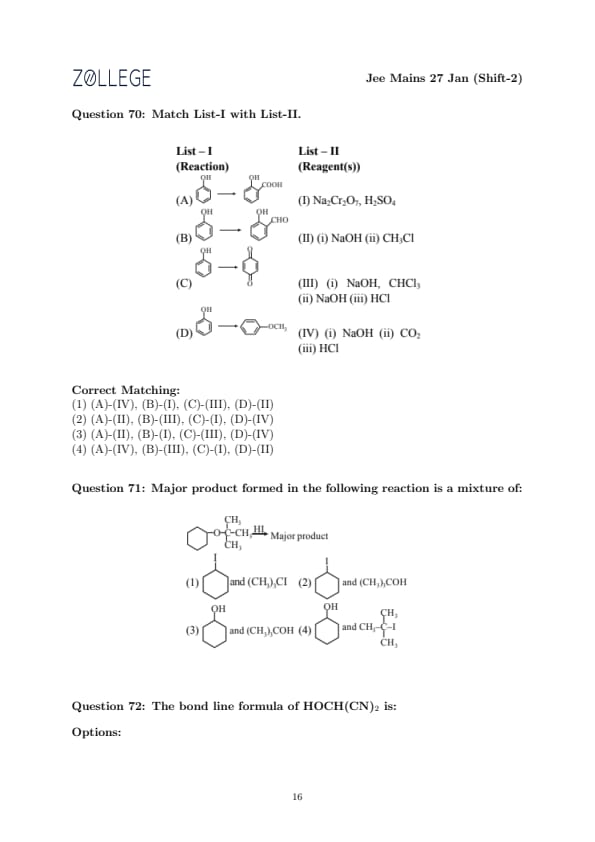
Question 70:
Match List-I with List-II:
Correct Matching: (1) (A)-(IV), (B)-(I), (C)-(III), (D)-(II)
Each reagent corresponds to a known reaction: e.g., oxidation of phenol to benzoquinone, Kolbe’s reaction, etc.
Question 71:
Major product formed in the following reaction is a mixture of:
Correct Answer: (4)
The reaction involves a dihalide with excess ammonia, forming 1,4-diaminobutane (putrescine) after deprotonation with NaOH.
Question 72:
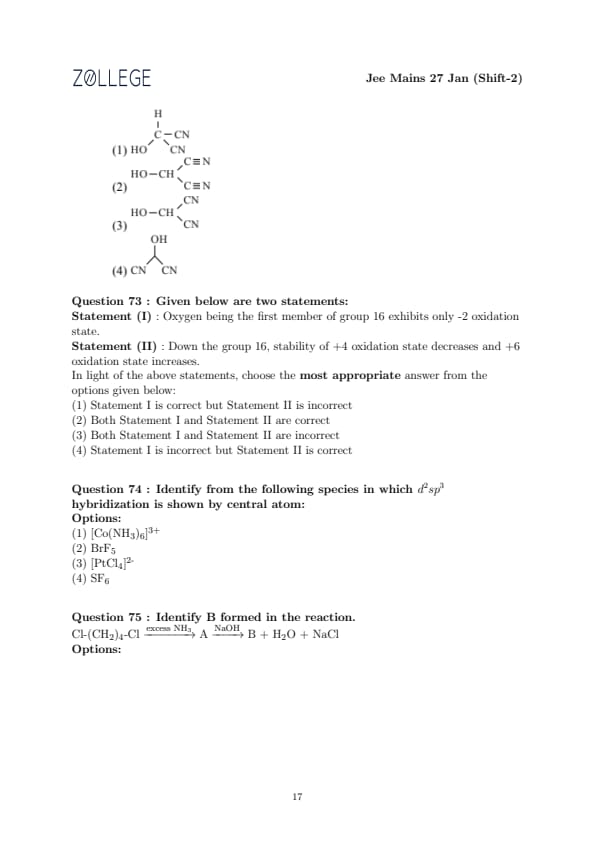
The bond line formula of HOCH(CN)₂ is:
Correct Answer: (4)
The molecule has a hydroxymethyl group (HOCH) attached to a carbon that carries two CN groups. The correct bond-line structure is option (4).
Question 73:
Given below are two statements:
(I) Oxygen, being the first member of group 16, exhibits only −2 oxidation state.
(II) Down group 16, stability of +4 oxidation state decreases and +6 oxidation state increases.
Choose the most appropriate answer:
- Statement I is correct but Statement II is incorrect
- Both Statement I and II are correct
- Both Statement I and II are incorrect
- Statement I is incorrect but Statement II is correct
Oxygen can have oxidation states other than −2 (e.g., 0 in O₂). Also, +4 oxidation state becomes more stable down group 16, while +6 decreases in stability.
Question 74:
Identify from the following species in which d²sp³ hybridization is shown by the central atom:
- [Co(NH₃)₆]³⁺
- BrF₅
- [PtCl₄]²⁻
- SF₆
[Co(NH₃)₆]³⁺ has a d²sp³ octahedral arrangement around Co³⁺. BrF₅ is sp³d² but distorted, [PtCl₄]²⁻ is square planar (dsp²), and SF₆ is also sp³d² but with no d electrons used as in transition metal complexes.
Question 75:
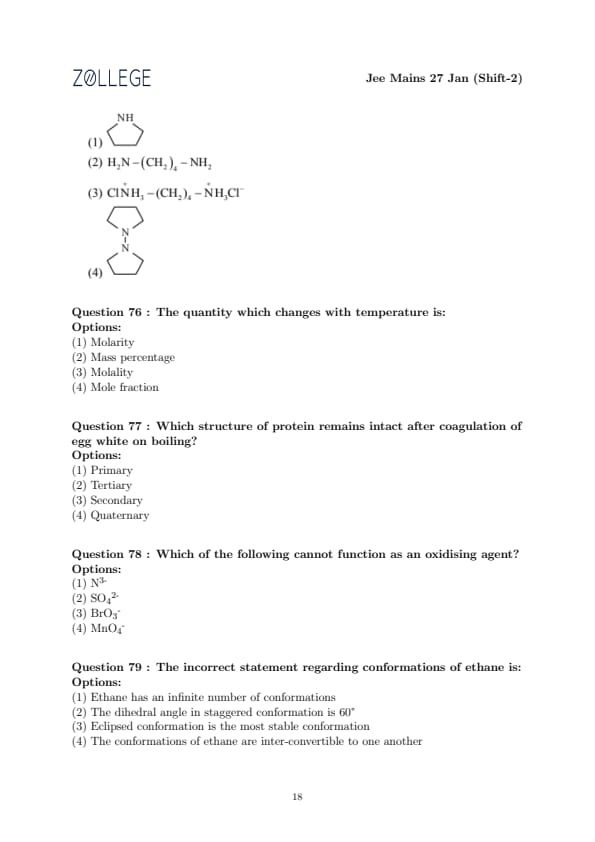
Identify the product formed in the following reaction: Cl-(CH₂)₄-Cl + excess NH₃ → A, then NaOH → B + H₂O + NaCl
Correct Answer: (2)
The dihalide reacts with excess NH₃ to form the diammonium salt, then NaOH deprotonates to give 1,4-diaminobutane (putrescine).
Question 76:
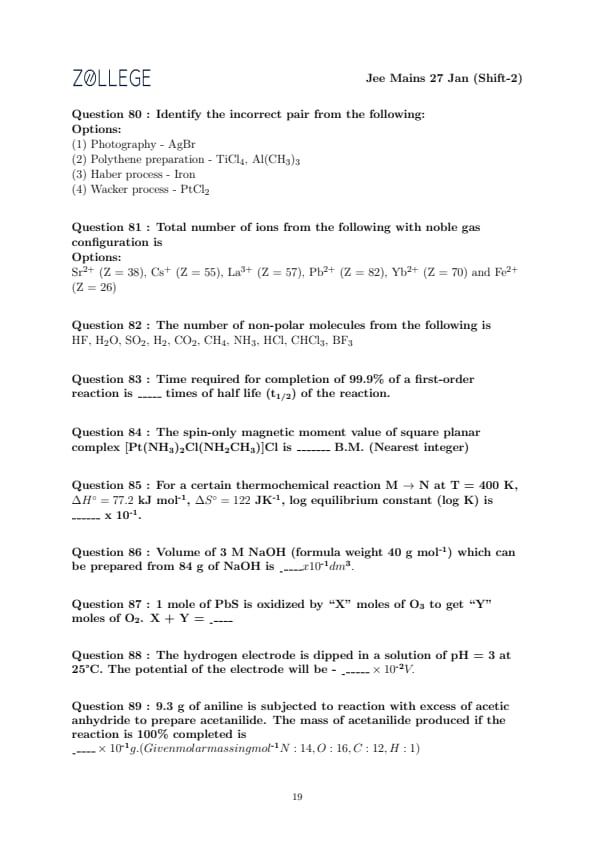
The quantity which changes with temperature is:
- Molarity
- Mass percentage
- Molality
- Mole fraction
Molarity depends on solution volume, which varies with temperature, unlike mass percentage, molality, and mole fraction.
Question 77:
Which structure of protein remains intact after coagulation of egg white on boiling?
- Primary
- Tertiary
- Secondary
- Quaternary
Coagulation disrupts secondary, tertiary, and quaternary structures but not the primary sequence of amino acids.
Question 78:
Which of the following cannot function as an oxidising agent?
- N³⁻
- SO₄²⁻
- BrO₃⁻
- MnO₄⁻
N³⁻ is in its lowest oxidation state and cannot be reduced further, so it cannot act as an oxidizing agent.
Question 79:
The incorrect statement regarding conformations of ethane is:
- Ethane has an infinite number of conformations
- The dihedral angle in staggered conformation is 60°
- Eclipsed conformation is the most stable conformation
- The conformations of ethane are inter-convertible to one another
Eclipsed is least stable due to maximum repulsion. Staggered is the most stable.
Question 80:
Identify the incorrect pair from the following:
- Photography - AgBr
- Polythene preparation - TiCl₄, Al(CH₃)₃
- Haber process - Iron
- Wacker process - PtCl₂
The Wacker process uses PdCl₂ as the catalyst, not PtCl₂.
Question 81:
Total number of ions from the following with noble gas configuration is:
Ions such as Sr²⁺, Cs⁺, La³⁺, and Yb²⁺ have noble gas configurations; Pb²⁺ and Fe²⁺ do not.
Question 82:
The number of non-polar molecules from the following is:
CO₂, H₂, CH₄, and BF₃ are non-polar due to their symmetry or identical atoms, resulting in no net dipole moment.
Question 83:
Time required for completion of 99.9% of a first-order reaction is times of half life (t₁/₂) of the reaction:
For a first-order reaction, the time to achieve 99.9% completion is ~10 × t₁/₂ (using integrated rate law).
Question 84:
The spin-only magnetic moment value of square planar complex [Pt(NH₃)₂Cl(NH₂CH₃)]Cl is B.M. (Nearest integer):
Pt²⁺ (d⁸) in a square planar field typically has all electrons paired, giving zero unpaired electrons and a moment of 0 B.M.
Question 85:
For a certain thermochemical reaction M → N at T = 400 K, ΔH° = 77.2 kJ/mol, ΔS° = 122 J/K, log equilibrium constant (log K) is x×10⁻¹.
Using ΔG = ΔH − TΔS and ΔG = −RT ln K, we get log K ≈ −3.708, so x = 37 (since −3.708 ≈ −3.7×10⁻¹).
Question 86:
Volume of 3 M NaOH (formula weight 40 g/mol) which can be prepared from 84 g of NaOH is x×10⁻¹ dm³.
84 g NaOH is 2.1 moles. For 3 M solution, volume = (2.1 / 3) = 0.7 L = 7×10⁻¹ dm³.
Question 87:
1 mole of PbS is oxidized by “X” moles of O₃ to get “Y” moles of O₂. X + Y = ?
Balanced: PbS + 4O₃ → PbSO₄ + 4O₂. Thus X = 4 and Y = 4, giving X + Y = 8.
Question 88:
The hydrogen electrode is dipped in a solution of pH = 3 at 25°C. The potential of the electrode will be − x×10⁻² V.
By the Nernst equation, E = −0.0591 × pH = −0.0591 × 3 = −0.1773 V, about −18×10⁻² V.
Question 89:
9.3 g of aniline is reacted with excess acetic anhydride to prepare acetanilide. The mass of acetanilide produced, if the reaction is 100% complete, is x×10⁻¹ g.
9.3 g aniline = 0.1 mol. 1 mol aniline → 1 mol acetanilide (mol. wt. ~135). So 0.1 mol gives 13.5 g = 135×10⁻¹ g.
Question 90:
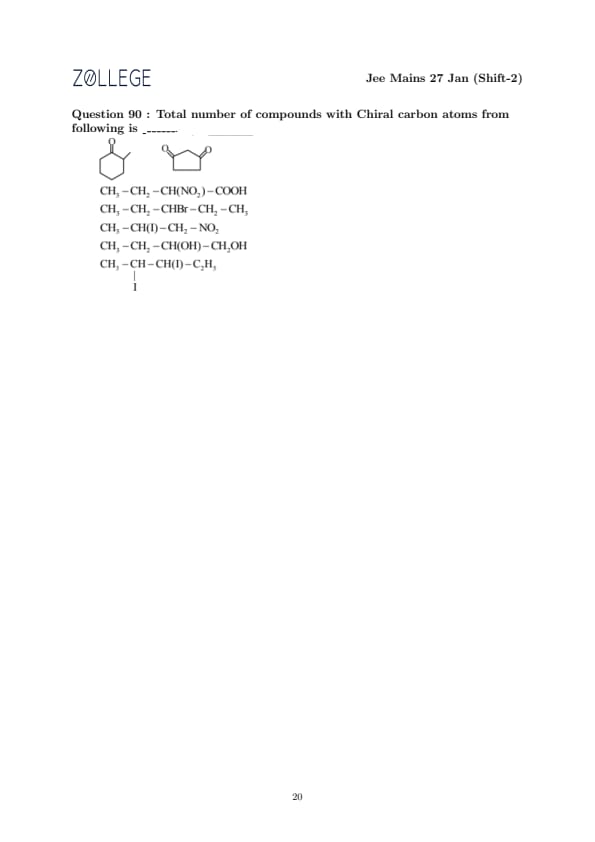
Total number of compounds with chiral carbon atoms from the following is:
Five of the listed compounds contain at least one chiral carbon center.
Previous Year JEE Main Question Papers
*The article might have information for the previous academic years, please refer the official website of the exam.