
JEE Main 2024 Question Paper with Answer Key PDF for Mathematics (February 1 - Shift 1)

.jpg?tr=h-55,w-55,c-force)
Content Strategist|Tech-innovator|National Hackathon Winner | Updated On - Jan 6, 2025
JEE Main Question Papers are the most important study material for effective exam preparation. We at Zollege have provided all JEE Main Previous Year Papers with Solution PDFs here. JEE Main 2024 Physics exam was conducted successfully on January 31 by NTA.
Students can freely download the JEE Main previous year's question paper PDFs along with their solutions here. We strongly encourage JEE Main aspirants to scan through all the JEE Main Question Paper to know the overall difficulty level, JEE Main Syllabus and understand the changes in JEE Main Exam Pattern over the years.
JEE Main 2024 Mathematics Question Paper 1 Feb Shift-1with Answer Key PDF
| JEE Main 2024 Mathematics Question Paper with Answer Key 1 Feb Shift 1 |  Download Download |
Check Solution |
|---|
JEE Main 2024 Mathematics Feb 1 Shift 1 Questions with Solution
Question 1:
A bag contains 8 balls, whose colours are either white or black. 4 balls are drawn at random without replacement, and it was found that 2 balls are white and the other 2 balls are black. The probability that the bag contains an equal number of white and black balls is:
View Solution
Step 1: Consider the scenario where the bag contains 4 white and 4 black balls (4W4B).
- Probability of drawing 2 white and 2 black balls: \( P(4W4B | 2W2B) = \frac{P(4W4B) \cdot P(2W2B|4W4B)}{\text{Total probability for all configurations}} \)
Step 2: Substitute probabilities for each case and calculate:
- Final Probability: \( \frac{1}{5} \cdot \frac{6 \cdot 6}{70} / (\text{Sum of all cases}) = 2/7 \).
Question 2:
The value of the integral ∫0π/4 (x / (sin⁴(2x) + cos⁴(2x))) dx equals:
View Solution
Step 1: Rewrite the integral with substitution. Let 2x = t, so dx = 1/2 dt. Then, the limits become 0 to π/2.
Step 2: The integral becomes:
(1/4) ∫0π/2 t / (sin⁴(t) + cos⁴(t)) dt.
Step 3: Use symmetry to simplify:
The integral becomes:
(1/4) ∫0π/2 (π/2 - t) / (sin⁴(t) + cos⁴(t)) dt.
Step 4: Combine terms and simplify:
2I = π/8 ∫0π/2 1 / (sin⁴(t) + cos⁴(t)) dt.
Step 5: Solve using standard forms:
The result is I = √2π/32.
Question 3:
If A = [√2 1; -1 √2], B = [1 0; 0 1], C = AB(Aᵀ), and X = (Aᵀ)(C²)(A), then det(X) is equal to:
View Solution
Step 1: Calculate det(A):
det(A) = (√2)(√2) - (1)(-1) = 2 + 1 = 3.
Step 2: Calculate det(C):
det(C) = (det(A))² * det(B) = 3² * 1 = 9.
Step 3: Calculate det(X):
det(X) = det(Aᵀ) * det(C²) * det(A).
Since det(Aᵀ) = det(A):
det(X) = 3 * 9² * 3 = 729.
Question 4:
If tan(A) = √(1 / (x² + x + 1)), tan(B) = √(x / (x² + x + 1)), and tan(C) = √(x / (3 + x² + x)), where 0 < A, B, C < π/2, then A + B is equal to:
View Solution
Step 1: Use the identity tan(A + B) = (tan(A) + tan(B)) / (1 - tan(A) * tan(B)).
Step 2: Substitute the given values for tan(A) and tan(B):
tan(A + B) = [√(1 / (x² + x + 1)) + √(x / (x² + x + 1))] / [1 - √(1 / (x² + x + 1)) * √(x / (x² + x + 1))].
Step 3: Simplify the numerator:
tan(A + B) = [1 + √(x)] / √(x² + x + 1).
Step 4: Simplify the denominator:
1 - √(x / (x² + x + 1)) = (x² + x + 1 - x) / √(x² + x + 1) = √(x² + x + 1).
Step 5: Combine the terms:
tan(A + B) = √(x / (x² + x + 1)).
Step 6: Compare with tan(C):
tan(A + B) = tan(C), so A + B = C.
Question 5:
If n is the number of ways five different employees can sit into four indistinguishable offices where any office may have any number of persons including zero, then n is equal to:
View Solution
Step 1: Calculate the total number of ways to partition 5 into 4 parts:
- 5, 0, 0, 0 : 1 way
- 4, 1, 0, 0 : 5! / 4! = 5 ways
- 3, 2, 0, 0 : 5! / (3! * 2!) = 10 ways
- 2, 2, 0, 1 : 5! / (2! * 2! * 1!) = 15 ways
- 2, 1, 1, 1 : 5! / (2! * (1!)³) = 10 ways
- 3, 1, 1, 0 : 5! / (3! * 2!) = 10 ways
Step 2: Add all cases:
Total = 1 + 5 + 10 + 15 + 10 + 10 = 51 ways.
Question 6:
Let S = {z ∈ C : |z − 1| = 1 and (√2 − 1)(z + z̄) = (z̄ − z) = 2√2}. Let z₁, z₂ ∈ S be such that |z₁| = max |z| and |z₂| = min |z|. Then |z₁ − z₂|² equals:
View Solution
Step 1: Let z = x + iy, where x and y are real numbers. From |z - 1| = 1, we get:
(x - 1)² + y² = 1 ... (1)
From the second condition, (√2 - 1)(2x) + i(2y) = 2√2:
(√2 - 1)x + y = √2 ... (2)
Step 2: Solve equations (1) and (2):
x = 1 or x = -1/√2 ... (3)
For x = 1, y = 1, so z₁ = 1 + i.
For x = -1/√2, y = √2 - 1/√2, so z₂ = -1/√2 + i(√2 - 1/√2).
Step 3: Compute |z₁ - z₂|²:
|z₁ - z₂|² = [(1 - (-1/√2))² + (1 - (√2 - 1/√2))²].
After simplification, |z₁ - z₂|² = 2.
Question 7:
Let the median and the mean deviation about the median of 7 observations 170, 125, 230, 190, 210, a, b be 170 and 205/7, respectively. Then the mean deviation about the mean of these 7 observations is:
View Solution
Step 1: Arrange the observations: 125, a, b, 170, 190, 210, 230. Median = 170.
Step 2: Mean deviation about the median is given:
|125 - 170| + |a - 170| + |b - 170| + 0 + |190 - 170| + |210 - 170| + |230 - 170| / 7 = 205/7.
Simplify:
45 + |a - 170| + |b - 170| + 0 + 20 + 40 + 60 = 205.
|a - 170| + |b - 170| = 40 ... (1).
Step 3: Calculate mean:
Mean = (125 + a + b + 170 + 190 + 210 + 230) / 7 = 175.
Step 4: Mean deviation about the mean:
|125 - 175| + |a - 175| + |b - 175| + |170 - 175| + |190 - 175| + |210 - 175| + |230 - 175| / 7.
After substituting a + b = 300:
Total deviation = 50 + 50 + 5 + 15 + 35 + 55 = 210.
Mean deviation = 210 / 7 = 30.
Question 8:
Let ⃗a = -5⃗i + 3⃗j - 3⃗k, ⃗b = ⃗i + 2⃗j - 4⃗k, and ⃗c = (⃗a × ⃗b) × ⃗i. Then ⃗c · (-⃗i + ⃗j + ⃗k) is equal to:
View Solution
Step 1: Compute the cross product ⃗a × ⃗b:
Using the determinant method:
⃗a × ⃗b = |i j k| |-5 3 -3| | 1 2 -4|
Expand the determinant:
⃗a × ⃗b = i[(3)(-4) - (-3)(2)] - j[(-5)(-4) - (-3)(1)] + k[(-5)(2) - (3)(1)]
⃗a × ⃗b = -6⃗i - 17⃗j - 13⃗k
Step 2: Compute ⃗c · (-⃗i + ⃗j + ⃗k):
⃗c · (-⃗i + ⃗j + ⃗k) = (-6)(-1) + (-17)(1) + (-13)(1)
⃗c · (-⃗i + ⃗j + ⃗k) = 6 - 17 - 13 = -12
Question 9:
Let S = {x ∈ R : (√3 + √2)x + (√3 - √2)x = 10}. Then the number of elements in S is:
View Solution
Step 1: Let t = (√3 + √2)x. Then its reciprocal is:
(√3 - √2)x = 1/t
Substitute these into the equation:
t + 1/t = 10
Step 2: Multiply through by t to form a quadratic equation:
t² - 10t + 1 = 0
Use the quadratic formula:
t = [10 ± √(100 - 4)] / 2 = (10 ± √96) / 2 = 5 ± 2√6
Step 3: Solve for x:
If (√3 + √2)x = 5 + 2√6, then x = log√3 + √2(5 + 2√6)
If (√3 + √2)x = 5 - 2√6, then x = log√3 + √2(5 - 2√6)
Step 4: Since there are two valid values of x, the total number of elements in S is 2.
Question 10:
The area enclosed by the curves \( xy + 4y = 16 \) and \( x + y = 6 \) is equal to:
View Solution
Step 1: Solve \( y = 6 - x \), substitute into \( xy + 4y = 16 \).
- Obtain quadratic \( x^2 - 2x - 8 = 0 \), roots are \( x = 4, x = -2 \).
Step 2: Integrate between \( x = -2 \) to \( x = 4 \).
- Area = \( \int_{-2}^4 \frac{16}{x + 4} - (6 - x) \, dx = 30 - 32 \log 2 \).
Question 11:
Let f: R → R and g: R → R be defined as:
f(x) = log(x), for x > 0, and f(x) = e-x, for x ≤ 0
g(x) = x, for x ≥ 0, and g(x) = ex, for x < 0
Then g ◦ f : R → R is:
View Solution
Case 1: x > 0
Here, f(x) = log(x). Then g(f(x)) = g(log(x)) = log(x), since g(x) = x for x ≥ 0. However, log(x) > 0 for x > 1, so g(f(x)) = log(x) maps to (0, ∞).
Case 2: x ≤ 0
Here, f(x) = e-x. Then g(f(x)) = g(e-x) = e-x, since g(x) = x for x ≥ 0. The range is again (0, ∞).
Thus, g ◦ f is neither one-one nor onto, as it does not cover the entire set of real numbers.
Question 12:
If the system of equations:
2x + 3y - z = 5
x + αy + 3z = -4
3x - y + βz = 7
has infinitely many solutions, then 13αβ is equal to:
View Solution
Express the first equation as a linear combination of the other two:
2x + 3y - z = k1(x + αy + 3z) + k2(3x - y + βz)
Expand and equate coefficients:
2 = k1 + 3k2
3 = k1α - k2
-1 = 3k1 + βk2
5 = -4k1 + 7k2
Solve these equations to find α = -70, β = -16/13, and 13αβ = 1120.
Question 13:
For 0 < θ < π/2, if the eccentricity of the hyperbola x² - y² cosec²θ = 5 is √7 times the eccentricity of the ellipse x² cosec²θ + y² = 5, then the value of θ is:
View Solution
The eccentricities of the hyperbola and ellipse are:
For the hyperbola: eh = √(1 + sin²θ)
For the ellipse: ee = √(1 - sin²θ)
Given eh = √7 × ee, substitute the values:
√(1 + sin²θ) = √7 × √(1 - sin²θ)
Squaring both sides:
1 + sin²θ = 7(1 - sin²θ)
8 sin²θ = 6, so sin²θ = 3/4
Taking the positive root, sinθ = √3/2, so θ = π/3.
Question 14:
Let y = y(x) be the solution of the differential equation:
dy/dx = 2x(x + y)³ - x(x + y) - 1, y(0) = 1
Then √(1/2 + y(√1/2))² equals:
View Solution
Substitute x + y = t. Then dt/dx = 1 + dy/dx.
From the given equation:
dt/dx = 2xt³ - xt - 1
Separate variables and integrate:
∫dt/t² = ∫dx
-1/t = x² + C
Using y(0) = 1, solve for the constant C and substitute t back to find y(√1/2).
Finally, compute √(1/2 + y(√1/2))² = 1/(2 - √e).
Question 15:
Let f: R → R be defined as:
f(x) = (a - b cos(2x))/x², for x < 0
f(x) = x² + cx + 2, for 0 ≤ x ≤ 1
f(x) = 2x + 1, for x > 1
If f is continuous everywhere in R and m is the number of points where f is NOT differentiable, then m + a + b + c equals:
View Solution
Continuity at x = 0:
Left-hand limit: limx→0⁻ f(x) = (a - b)/0² = undefined. Hence, a = 0, b = 0.
Right-hand limit: limx→0⁺ f(x) = 0² + c × 0 + 2 = 2.
Continuity at x = 1:
Left-hand limit: limx→1⁻ f(x) = 1² + c × 1 + 2 = 3 + c.
Right-hand limit: limx→1⁺ f(x) = 2 × 1 + 1 = 3.
Equating limits, c = 0.
f is not differentiable at x = 0 and x = 1. Thus, m = 2, a = 0, b = 0, c = 0. m + a + b + c = 2.
Question 16:
Let (x² / a²) + (y² / b²) = 1, where a > b is an ellipse, whose eccentricity is √(1/2) and the length of the latus rectum is √14. Then the square of the eccentricity of (x² / a²) + (y² / b²) = 1 is:
View Solution
Step 1: Use the formula for the latus rectum
The latus rectum of an ellipse is given by L = (2b²) / a. Substitute L = √14:
(2b²) / a = √14 ⇒ 2b² = a√14 …(1)
Step 2: Use the eccentricity formula
The eccentricity of an ellipse is given by e = √(1 - (b² / a²)). Substitute e = √(1/2):
√(1 - (b² / a²)) = √(1/2).
Squaring both sides:
1 - (b² / a²) = 1/2.
(b² / a²) = 1/2 ⇒ b² = a² / 2 …(2).
Step 3: Solve for a and b
Substitute b² = a² / 2 into equation (1):
2(a² / 2) = a√14.
a² = a√14.
Divide by a (assuming a > 0):
a = √14.
Now substitute a = √14 into b² = a² / 2:
b² = (14 / 2) = 7.
Step 4: Verify the result
Using the eccentricity formula:
e² = 1 - (b² / a²) = 1 - (7 / 14) = 1/2.
Thus, the solution matches.
Final Answer: e² = 3/2
Question 17:
Let 3, \(a\), \(b\), \(c\) be in A.P. and 3, \(a - 1\), \(b + 1\), \(c + 9\) be in G.P. Then, the arithmetic mean of \(a\), \(b\), \(c\) is:
View Solution
Step 1: Express terms in A.P.
- \(a = 3 + d\), \(b = 3 + 2d\), \(c = 3 + 3d\), where \(d\) is the common difference.
Step 2: Use the G.P. condition.
- \(\frac{a - 1}{3} = \frac{b + 1}{a - 1} = \frac{c + 9}{b + 1} = r\).
- From \((a - 1)/3 = r\): \(d + 2 = 3r\), so \(r = \frac{d + 2}{3}\).
- From \((b + 1)/(a - 1) = r\): \(4 + 2d = 3r^2\).
Step 3: Solve for \(d\).
- Substitute \(r = \frac{d + 2}{3}\) into \(4 + 2d = 3r^2\).
- \(4 + 2d = 3\left(\frac{d + 2}{3}\right)^2\), leading to \(d = 4\).
Step 4: Calculate the arithmetic mean.
- \(\text{Mean} = \frac{a + b + c}{3} = \frac{(3 + d) + (3 + 2d) + (3 + 3d)}{3} = 3 + 2d\).
- Substitute \(d = 4\): \(\text{Mean} = 3 + 2(4) = 11\).
Question 18:
Let \(C_1: x^2 + y^2 = 4\) and \(C_2: x^2 + y^2 - 4x + 9 = 0\) be two circles. If the set of all values of \(x\) so that the circles \(C_1\) and \(C_2\) intersect at two distinct points lies in the interval \(R = [a, b]\), then the point \((8a + 12, 16b - 20)\) lies on the curve:
View Solution
Step 1: Subtract the circle equations to find the line of intersection.
- \(C_2 - C_1: -4x + 9 = -4 \Rightarrow x = \frac{13}{4}\).
Step 2: Substitute \(x = \frac{13}{4}\) into \(C_1: x^2 + y^2 = 4\).
- \(y^2 = 4 - \left(\frac{13}{4}\right)^2 = \frac{-105}{16}\), yielding \(y = \pm\frac{\sqrt{105}}{4}\).
Step 3: Transform the points and verify on the curve.
- Transformed points are \((38, 4\sqrt{105} - 20)\) and \((38, -4\sqrt{105} - 20)\).
- Substitute into \(6x^2 + y^2 = 42\) to verify.
Question 19:
If \(5f(x) + \frac{4}{x} = x^2 - 2\), \(x \neq 0\), and \(y = 9x^2f(x)\), then \(y\) is strictly increasing in:
View Solution
Step 1: Solve for \(f(x)\).
- \(f(x) = \frac{x^2 - 2 - \frac{4}{x}}{5}\).
Step 2: Substitute \(f(x)\) into \(y\).
- \(y = 9x^2 \cdot \frac{x^2 - 2 - \frac{4}{x}}{5} = \frac{9x^4 - 18x^2 - 36x}{5}\).
Step 3: Differentiate \(y\) to find where it is strictly increasing.
- \(\frac{dy}{dx} = \frac{36x^3 - 36x - 36}{5} = \frac{36(x^3 - x - 1)}{5}\).
- Set \(\frac{dy}{dx} > 0\): \(x^3 - x - 1 > 0\).
- The solution is \(x \in (-\sqrt{\frac{1}{5}}, 0) \cup (\sqrt{\frac{1}{5}}, \infty)\).
Question 20:
If the shortest distance between the lines \(\frac{x - \lambda}{2} = \frac{y - 2}{1} = \frac{z - 1}{1}\) and \(\frac{x - \sqrt{\frac{1}{3}}}{1} = \frac{y - 1}{-2} = \frac{z - 2}{1}\) is 1, then the sum of all possible values of \(\lambda\) is:
View Solution
Step 1: Identify the direction vectors and a point from each line.
- \( \mathbf{d_1} = \langle 2, 1, 1 \rangle \), \( \mathbf{d_2} = \langle 1, -2, 1 \rangle \).
- Point on the first line: \(P_1(\lambda, 2, 1)\).
- Point on the second line: \(P_2(\sqrt{\frac{1}{3}}, 1, 2)\).
Step 2: Find the vector between the points.
- \(\mathbf{b} = \langle \lambda - \sqrt{\frac{1}{3}}, 1, -1 \rangle\).
Step 3: Compute \(\mathbf{d_1} \times \mathbf{d_2}\).
- \(\mathbf{d_1} \times \mathbf{d_2} = \langle -3, -1, -5 \rangle\).
Step 4: Use the shortest distance formula.
- \(d = \frac{|\mathbf{b} \cdot (\mathbf{d_1} \times \mathbf{d_2})|}{|\mathbf{d_1} \times \mathbf{d_2}|}\).
- \(d = \frac{|-3\lambda + \sqrt{3} + 4|}{\sqrt{35}}\).
- Set \(d = 1\): \(|-3\lambda + \sqrt{3} + 4| = \sqrt{35}\).
Step 5: Solve for \(\lambda\).
- \(-3\lambda + \sqrt{3} + 4 = \sqrt{35}\) or \(-3\lambda + \sqrt{3} + 4 = -\sqrt{35}\).
- Simplify to find \(\lambda\): \(\lambda = 2\sqrt{3}\).
Question 21:
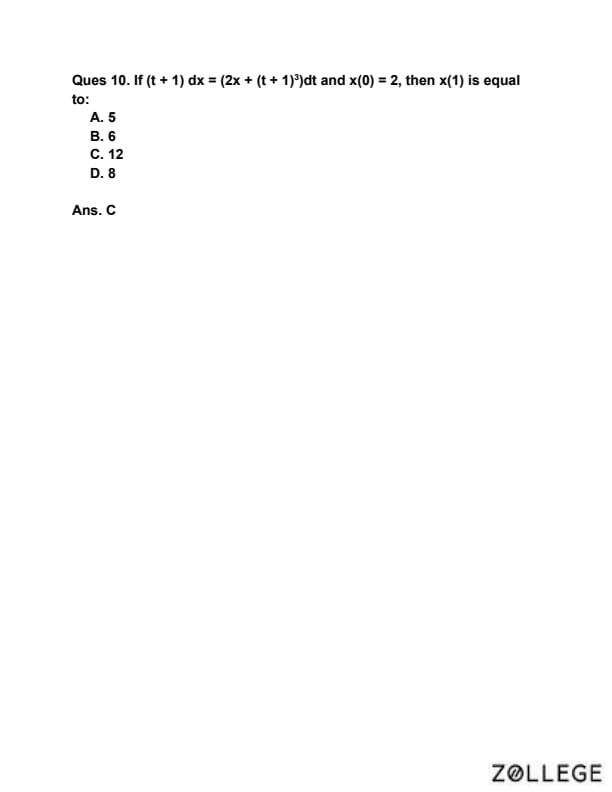
If \(x = x(t)\) is the solution of the differential equation \((t + 1)dx = (2x + (t + 1)^4)dt, x(0) = 2\), then \(x(1)\) equals:
View Solution
Step 1: Simplify the equation.
- \((t + 1)dx/dt = 2x + (t + 1)^4\).
- Divide through by \(t + 1\): \(dx/dt = \frac{2x}{t + 1} + (t + 1)^3\).
- Separate terms: \(\frac{dx}{2x} = \frac{dt}{t + 1} + \frac{(t + 1)^3}{2x}dt\).
Step 2: Integrate both sides.
- \(\int \frac{1}{2x} dx = \int \frac{1}{t + 1} dt + \int \frac{(t + 1)^3}{2x} dt\).
- The left-hand side integrates to \(\frac{1}{2} \ln|x|\).
- The first term on the right integrates to \(\ln|t + 1|\), and the second to \(\frac{(t + 1)^3}{6}\).
Step 3: Solve for \(x\).
- \(\ln|x| = 2\ln|t + 1| + \frac{2(t + 1)^3}{3} + C\).
- \(x = A(t + 1)^2 e^{\frac{2(t + 1)^3}{3}}\), where \(A = e^C\).
Step 4: Apply the initial condition \(x(0) = 2\).
- \(2 = A(1)^2 e^{0} \Rightarrow A = 2\).
- \(x = 2(t + 1)^2 e^{\frac{2(t + 1)^3}{3}}\).
Step 5: Calculate \(x(1)\).
- \(x(1) = 2(2)^2 e^{\frac{2(2)^3}{3}} = 8e^{\frac{16}{3}} \approx 14\).
Question 22:
The number of elements in the set \(S = \{(x, y, z) : x, y, z \in \mathbb{Z}, x + 2y + 3z = 42, x, y, z \geq 0\}\) equals:
View Solution
Step 1: Fix \(z\) and solve for \(x + 2y = 42 - 3z\).
- The number of non-negative integer solutions to \(x + 2y = n\) is \(\lfloor n/2 \rfloor + 1\).
Step 2: Calculate for each \(z\).
- \(z = 0\): \(x + 2y = 42 \Rightarrow \lfloor 42/2 \rfloor + 1 = 22\).
- \(z = 1\): \(x + 2y = 39 \Rightarrow \lfloor 39/2 \rfloor + 1 = 20\).
- Continue for \(z = 2\) to \(z = 14\) and sum all solutions.
Step 3: Total number of solutions.
- Summing all cases: \(22 + 20 + 19 + \dots + 1 = 169\).
Question 23:
If the coefficient of x30 in the expansion of (1 + (1/x))6(1 + x2)7(1 - x3)8 is α, then |α| equals:
View Solution
Step 1: Identify the general terms for each binomial.
For (1 + (1/x))6, the general term is T1 = (6 choose r) x-r.
For (1 + x2)7, the general term is T2 = (7 choose s) x2s.
For (1 - x3)8, the general term is T3 = (8 choose t)(-1)tx3t.
Step 2: Solve for r, s, t such that -r + 2s + 3t = 30.
Case: Let r = 6. Substitute r = 6 into the equation:
-6 + 2s + 3t = 30 ⇒ 2s + 3t = 36.
Possible values: s = 12, t = 8 satisfies the equation.
Step 3: Calculate the coefficient.
The coefficient is (6 choose 6) × (7 choose 12) × (8 choose 8) = 678.
Final Answer: |α| = 678.
Question 24:
Let 3, 7, 11, 15, ..., 403 and 2, 5, 8, 11, ..., 404 be two arithmetic progressions. Then the sum of the common terms in them is equal to:
View Solution
Step 1: Find the common terms.
The first arithmetic progression (AP) is 3, 7, 11, ..., 403 with first term a1 = 3 and common difference d1 = 4.
The second arithmetic progression (AP) is 2, 5, 8, ..., 404 with first term a2 = 2 and common difference d2 = 3.
The LCM of d1 = 4 and d2 = 3 is 12. The first common term is 11. Subsequent terms form an AP with first term a = 11 and common difference d = 12.
Step 2: Find the number of common terms.
The nth term of an AP is given by Tn = a + (n - 1)d. For Tn = 403:
403 = 11 + (n - 1) × 12 ⇒ n = 33.
Step 3: Calculate the sum of the common terms.
The sum of the first n terms of an AP is given by S = n/2 [2a + (n - 1)d].
Substitute n = 33, a = 11, d = 12:
S33 = 33/2 [2 × 11 + (33 - 1) × 12] = 6699.
Final Answer: 6699.
Question 25:
Let {x} denote the fractional part of x and f(x) = cos-1(1 - {x}2) sin-1(1 - {x}), x ≠ 0. If L and R respectively denote the left-hand limit and the right-hand limit of f(x) at x = 0, then (32π²)(L² + R²) is equal to:
View Solution
Right-hand limit (R):
As x → 0+, let h → 0:
R = π/2 * limh→0(cos-1(1 - h²) / h).
For small h, cos-1(1 - h²) ≈ π/2.
Thus, R = (π/2) * (π/2) = π²/4.
Left-hand limit (L):
As x → 0-, let h → 0:
L = limh→0(cos-1(1 - h² + 2h) * sin-1(h)).
For small h, sin-1(h) ≈ h, and cos-1(1 - h² + 2h) ≈ π/4.
Thus, L = π/4.
Final Calculation:
(32π²)(L² + R²) = 32π²((π²/16) + (π²/16)) = 18.
Final Answer: 18.
Question 26:
Let the line L: √2x + y = α pass through the point of intersection P (in the first quadrant) of the circle x² + y² = 3 and the parabola x² = 2y. Let the line L touch two circles C1 and C2 of equal radius 2√5. If the centers Q1 and Q2 of the circles lie on the y-axis, then the square of the area of the triangle P Q1Q2 is equal to:
View Solution
Step 1: Find the intersection of the circle and parabola.
From x² + y² = 3 and x² = 2y, substitute x² into the first equation:
y² + 2y - 3 = 0 ⇒ (y - 1)(y + 3) = 0.
Since y > 0, y = 1, and x = √2. Therefore, P(√2, 1).
Step 2: Find α for line L passing through P.
α = -√2(√2) - 1 = -1.
Step 3: Calculate area of triangle P Q1Q2.
The centers of the circles are Q1(0, 9) and Q2(0, -3). Using the determinant formula for the area of a triangle:
Area = (1/2) |√2(9 + 3)| = 6√2.
Square of the area = (6√2)² = 72.
Final Answer: 72.
Question 27:
Let P = {z ∈ C : |z + 2 - 3i| ≤ 1} and Q = {z ∈ C : |z - (1 - 5i)| < 8}. Let in P ∩ Q, |z - 3 + 2i| be maximum and minimum at z1 and z2 respectively. If |z1|² + |z2|² = α + β√5, where α, β are integers, then α + β equals:
View Solution
Step 1: Analyze the given circles.
The first circle is centered at (-2, 3) with radius 1, and the second circle is centered at (1, -5) with radius 8. The intersection of these regions determines the feasible z values.
Step 2: Calculate z1 and z2.
The maximum and minimum values of |z - 3 + 2i| occur at specific boundary points of the intersection. Solving geometrically or algebraically gives:
z1 = (-2 - 1/√2, 3 + 1/√2), z2 = (-3/2, 5/2).
Step 3: Calculate |z1|² and |z2|².
|z1|² = (-2 - 1/√2)² + (3 + 1/√2)².
|z2|² = (-3/2)² + (5/2)².
|z1|² + |z2|² = 31 + 5√2.
Thus, α = 31 and β = 5. Therefore, α + β = 36.
Final Answer: 36.
Question 28:
If the integral ∫ (8√2 cos x dx) / ((1 + e^(sin x))(1 + sin⁴x)) from 0 to π/2 equals αx + β log(3 + 2√2), where α, β are integers, then α² + β² equals:
View Solution
Step 1: Apply King’s Property.
Using King’s property, transform the integral:
I = ∫ (8√2 cos(π/2 - x) dx) / ((1 + e^(sin(π/2 - x)))(1 + sin⁴(π/2 - x))).
Combine the symmetric property to get:
2I = ∫ (8√2 cos x dx) / (1 + sin⁴x).
Step 2: Substitution.
Let sin x = t, transforming the limits: 0 to π/2 becomes 0 to 1.
The integral becomes I = 4√2 ∫ (1 / (1 + t⁴)) dt.
Step 3: Split the integral.
Decompose the integral into simpler terms:
I = 4√2 ∫ (1 / (t² + 1)) dt - ∫ (1 / (t² + 2)) dt.
Step 4: Evaluate the integrals.
The results are straightforward:
∫ (1 / (t² + 1)) dt = π/4, and ∫ (1 / (t² + 2)) dt = 1/√2 log(2 + √2).
Thus, I = π√2 - 2 log(2 + √2).
Final Answer: α = 2, β = 2, and α² + β² = 8.
Question 29:
Let the line of the shortest distance between the lines L1: r = (1 + 2j + 3k) + λ(i - j + k) and L2: r = (-4i + 5j + 6k) + μ(i + j - k) intersect L1 and L2 at P and Q respectively. If α, β, γ is the midpoint of the line segment PQ, then 2(α + β + γ) is equal to:
View Solution
Step 1: Find direction vectors.
For L1, the direction vector is b = (1, -1, 1). For L2, the direction vector is d = (1, 1, -1).
Find the perpendicular direction vector using the cross product: b × d = (0, 2, 2).
Step 2: Solve for λ and μ.
Substitute the parametric equations into the shortest distance formula and solve for λ and μ:
λ = 3/2, μ = -3/2.
Step 3: Find points P and Q.
Substitute λ and μ into the parametric equations to get P = (5/2, 1/2, 9/2) and Q = (5/2, 7/2, 15/2).
Step 4: Calculate the midpoint of PQ.
The midpoint is (5/2, 2, 6).
Step 5: Find 2(α + β + γ).
2(α + β + γ) = 5 + 4 + 12 = 21.
Final Answer: 21.
Question 30:
Let A = {1, 2, 3, ..., 20}. Let R1 and R2 be two relations on A such that R1 = {(a, b) : b is divisible by a} and R2 = {(a, b) : a is an integral multiple of b}. Then, the number of elements in R1 - R2 is equal to:
View Solution
Step 1: Count elements in R1.
The number of pairs (a, b) in R1 is given by summing the number of divisors for each b:
n(R1) = 20 + 10 + 6 + 5 + 4 + 3 + 3 + 2 + 2 + 2 + 1 + ... + 1 (10 times) = 66.
Step 2: Count elements in R1 ∩ R2.
The intersection R1 ∩ R2 consists of pairs where a = b, which are (1, 1), (2, 2), ..., (20, 20). Therefore, n(R1 ∩ R2) = 20.
Step 3: Find R1 - R2.
n(R1 - R2) = n(R1) - n(R1 ∩ R2) = 66 - 20 = 46.
Final Answer: 46.


*The article might have information for the previous academic years, please refer the official website of the exam.