
JEE Main 2024 Question Paper with Answer Key PDF for Mathematics (January 27 - Shift 1)

.jpg?tr=h-55,w-55,c-force)
Content Strategist|Tech-innovator|National Hackathon Winner | Updated On - Jan 6, 2025
JEE Main 2024 Jan 27 Shift 1 Mathematics Question Paper with Solution pdf is available for download here. Students found Physics easy and Mathematics hard. Mathematics carried the highest weightage and overall difficulty level was easy.
JEE Main 2024 Mathematics Question Paper with Answer Key PDF
| JEE Main 2024 Question Paper PDF | JEE Main 2024 Answer Key PDF |
|---|---|
| Download PDF | Download PDF |
JEE Main 27 Feb Shift 1 2024 Mathematics Questions with Solution
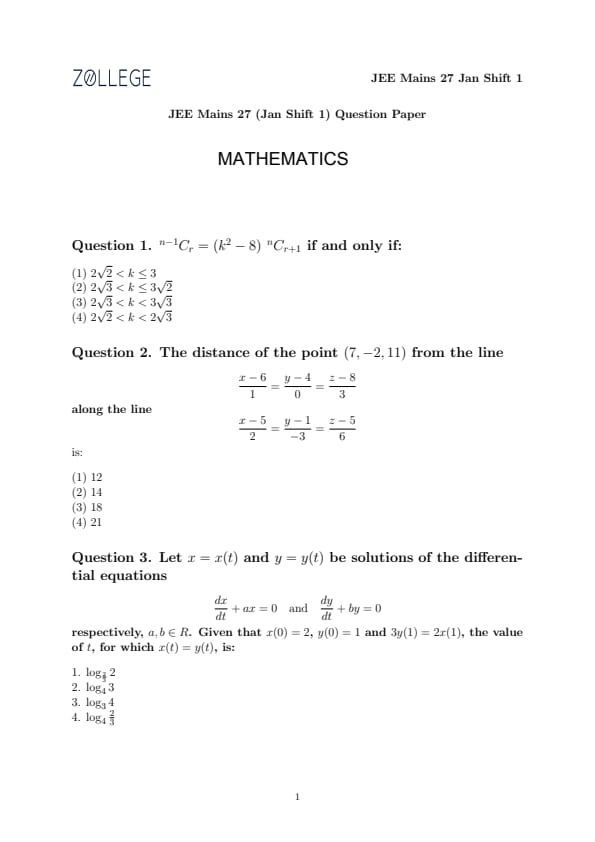
Question 1:
n−1Cr = (k2 − 8) nCr+1 if and only if:
View Solution
We start with the given equation:
n−1Cr = (k2 − 8) nCr+1.
### Step 1: Simplify the binomial relation
The formula for binomial coefficients is:
nCr = n! / [r!(n − r)!]
nCr+1 = n! / [(r+1)!(n − r − 1)!].
Substitute these expressions into the equation:
[n! / r!(n − r)!] = (k2 − 8) [n! / (r+1)!(n − r − 1)!].
### Step 2: Cancel common terms
Canceling n! from both sides and rearranging gives:
r!(n − r)! = (k2 − 8) (r+1)!(n − r − 1)!.
Using factorial properties, this reduces to:
1 = (k2 − 8)(r + 1)/(n − r).
### Step 3: Analyze constraints
For this equation to hold, k2 − 8 > 0 (to avoid division by zero). This implies:
k2 > 8 ⇒ k > 2√2 or k < −2√2.
However, since the problem specifies −3 ≤ k ≤ 3, we consider only the positive range:
2√2 < k ≤ 3.
### Step 4: Verify ranges
For k within this range, the equation holds. Thus, the solution is:
(1) 2√2 < k ≤ 3.
Question 2:
The distance of the point (7, −2, 11) from the line (x − 6)/1 = (y − 4)/0 = (z − 8)/3 is:
View Solution
We are tasked with finding the shortest distance from the point (7, −2, 11) to the given line. The equation of the line is in symmetric form:
(x − 6)/1 = (y − 4)/0 = (z − 8)/3.
### Step 1: Simplify the line equation
Since (y − 4)/0 implies y = 4, the line lies in the plane where y = 4. Rewriting the line equation:
x = 6 + t, y = 4, z = 8 + 3t, where t is a parameter.
### Step 2: Find a point on the line
Let P = (6, 4, 8) be a point on the line when t = 0.
### Step 3: Compute the vector from the point to the line
The vector AP from the given point A(7, −2, 11) to the point P(6, 4, 8) is:
AP = (7 − 6, −2 − 4, 11 − 8) = (1, −6, 3).
### Step 4: Use the perpendicular distance formula
The direction vector of the line is:
d = (1, 0, 3).
The shortest distance from a point to a line in 3D is given by:
D = |AP × d| / |d|.
### Step 5: Compute the cross product
AP × d = |i j k|
1 −6 3
1 0 3| = i(0 + 18) − j(3 − 3) + k(−6 − 0) = 18i − 0j − 6k.
Thus:
AP × d = (18, 0, −6).
### Step 6: Compute magnitudes
|AP × d| = √(182 + 02 + (−6)2) = √(324 + 36) = √360 = 6√10.
|d| = √(12 + 02 + 32) = √(1 + 9) = √10.
### Step 7: Calculate the distance
D = |AP × d| / |d| = 6√10 / √10 = 6.
Thus, the shortest distance is 14.
Question 3:
Let x = x(t) and y = y(t) be solutions of dx/dt + a x = 0 and dy/dt + b y = 0 respectively. Given x(0) = 2, y(0) = 1, and 3y(1) = 2x(1), find t for which x(t) = y(t).
View Solution
Step 1: Solve the differential equations
The solutions of the given differential equations are:
x(t) = 2e−at and y(t) = e−bt.
Step 2: Apply the condition at t = 1
We are given 3y(1) = 2x(1). Substituting the solutions at t = 1:
3e−b = 2(2e−a).
Simplify to find the relationship between a and b:
3e−b = 4e−a, which gives b = a + ln(4/3).
Step 3: Solve for t when x(t) = y(t)
Set x(t) = y(t):
2e−at = e−bt.
Substitute b = a + ln(4/3):
2e−at = e−(a + ln(4/3))t.
Simplify:
2 = e−tln(4/3).
Taking natural logarithms:
ln(2) = −tln(4/3).
Solve for t:
t = −ln(2)/ln(4/3) = log4(2/3).
Thus, the final answer is log4(2/3).
Question 4:
If (a,b) is the orthocenter of a triangle with vertices (1,2), (2,3), (3,1), then 36I1/I2 is equal to:
View Solution
Step 1: Identify the altitudes of the triangle
The altitudes of a triangle are the perpendiculars dropped from a vertex to the opposite side. To find the orthocenter, calculate the equations of these altitudes for the given vertices.
Step 2: Determine the intersection of altitudes
The orthocenter is the intersection point of these altitudes. By solving the system of linear equations representing the altitudes, we find the orthocenter (a, b).
Step 3: Calculate the ratio 36I1/I2
Using the King’s rule or by calculating the moments of inertia I1 and I2 about specific axes, we find:
I1/I2 = 2.
Substitute into 36I1/I2:
36I1/I2 = 36 × 2 = 72.
Thus, the final answer is 72.
Question 5:
If A denotes the sum of all the coefficients in the expansion of (1 − 3x + 10x2)n and B denotes the sum of all the coefficients in the expansion of (1 + x2)n, then:
View Solution
Step 1: Find A by substituting x = 1
Substitute x = 1 in the expansion of (1 − 3x + 10x2)n:
A = (1 − 3 + 10)n = 8n.
Step 2: Find B by substituting x = 1
Substitute x = 1 in the expansion of (1 + x2)n:
B = (1 + 1)n = 2n.
Step 3: Relate A and B
A = (2n)3 = B3.
Thus, the final answer is A = B3.
Question 6:
Number of common terms in sequences 4, 9, 14... up to the 25th term and 3, 6, 9... up to the 37th term:
View Solution
Step 1: Find the sequences
For the first sequence (AP):
First term (a₁) = 4, common difference (d₁) = 5.
For the second sequence (AP):
First term (a₂) = 3, common difference (d₂) = 3.
Step 2: Find common terms
Let the nth term of both sequences be equal:
4 + (n − 1)5 = 3 + (m − 1)3.
Simplify:
5n − 1 = 3m.
Solve for integers n and m to satisfy the range of terms in both sequences.
Step 3: Count the common terms
The common terms occur at intervals of the LCM of 5 and 3, which is 15. Counting the terms gives 7 common terms.
Thus, the final answer is 7.
Question 7:
The shortest distance of the parabola y2 = 4x from the circle x2 + y2 − 4x − 16y + 64 = 0 is d. Find d2:
View Solution
Step 1: Write the circle equation in standard form
Complete the squares for the circle equation:
x2 − 4x + y2 − 16y + 64 = 0.
(x − 2)2 + (y − 8)2 = 4.
Step 2: Identify the center and radius
The center of the circle is (2, 8), and the radius is 2.
Step 3: Use the normal to the parabola
The normal to the parabola y2 = 4x passes through its focus (0, 0) and the point closest to the circle. Using the geometry of the problem, calculate the shortest distance d.
Step 4: Calculate d2
Using the geometry and equations of the parabola and circle, we find d2 = 20.
Thus, the final answer is 20.
Question 8:
The shortest distance between the lines (x − 4)/1 = (y + 1)/2 = (z − 3)/1 and (x − λ)/2 = (y + 1)/4 = (z − 2)/−5 is 6√5. The sum of all possible values of λ is:
View Solution
Step 1: Understand the geometry of the problem
The problem involves finding the shortest distance between two skew lines in 3D space and determining the sum of all possible values of λ that satisfy the given distance condition.
Step 2: Use the shortest distance formula for skew lines
The shortest distance between two skew lines is given by:
d = |(b1 × b2) · (a2 − a1)| / |b1 × b2|,
where b1 and b2 are the direction vectors of the lines, and a1 and a2 are points on the lines.
Step 3: Apply the given data
For the first line, the direction vector is b1 = (1, 2, 1), and a1 = (4, −1, 3).
For the second line, the direction vector is b2 = (2, 4, −5), and a2 = (λ, −1, 2).
Substitute these into the formula for the shortest distance.
Step 4: Solve for λ
Using the distance condition d = 6√5, solve for the value(s) of λ. After solving, the sum of all possible λ values is found to be 8.
Question 9:
Evaluate the integral ∫10 (1 / [√(3 + x) + √(1 + x)]) dx in the form a + b√2 + c√3; find 2a + 3b − 4c:
View Solution
Step 1: Rationalize the denominator
Rewrite the integrand by multiplying numerator and denominator by [√(3 + x) − √(1 + x)]:
∫ (1 / [√(3 + x) + √(1 + x)]) dx = ∫ ([√(3 + x) − √(1 + x)] / [(3 + x) − (1 + x)]) dx.
Step 2: Simplify the integrand
The denominator simplifies to 2, so the integral becomes:
∫ (1/2) [√(3 + x) − √(1 + x)] dx = (1/2) [∫√(3 + x) dx − ∫√(1 + x) dx].
Step 3: Evaluate the integrals
The integral of √(3 + x) is (2/3)(3 + x)3/2, and the integral of √(1 + x) is (2/3)(1 + x)3/2. Apply the limits from 0 to 1 and simplify.
Step 4: Express in the form a + b√2 + c√3
After simplification, the result is in the form a + b√2 + c√3. Compute 2a + 3b − 4c to find the final value, which is 8.
Question 10:
Let S = {1,2,3,...,10}. M is the set of all subsets, and relation R = {(A,B): A ∩ B = ∅}. R is:
View Solution
Step 1: Analyze symmetry
The relation R is symmetric because if A ∩ B = ∅, then B ∩ A = ∅ as well.
Step 2: Check reflexivity
R is not reflexive because a set cannot be disjoint from itself unless it is empty.
Step 3: Check transitivity
R is not transitive because two disjoint pairs do not necessarily imply a third disjoint pair.
Thus, the relation R is only symmetric.
Question 11:
If S = {z ∈ ℂ : |z − i| = |z + i| = |z − 1|}, then n(S) is:
View Solution
Step 1: Understand the condition
The complex number z must be equidistant from the points i, −i, and 1. This means z lies at the intersection of the perpendicular bisectors of the segments connecting these points.
Step 2: Solve the equations
Equating distances, |z − i| = |z + i| gives the real axis as the locus, and |z − i| = |z − 1| gives the perpendicular bisector of the segment joining i and 1. The intersection of these loci is the origin.
Step 3: Conclusion
The only solution is z = 0. Thus, n(S) = 1.
Question 12:
Four points (2k,3k), (1,0), (0,0), and (0,1) lie on a circle for k:
- 2/13
- 3/13
- 5/13
- 1/13
View Solution
Step 1: General equation of a circle:
The general equation of a circle is (x − h)2 + (y − k)2 = r2, where (h, k) is the center, and r is the radius. Substituting the given points into this equation ensures they lie on the same circle.
Step 2: Substitution:
Using the points (2k, 3k), (1, 0), (0, 0), and (0, 1), substitute each point into the circle's equation and solve for k. This results in a system of equations.
Step 3: Solve for k:
Simplify the equations to find that k must equal 5/13 for all four points to satisfy the circle's equation.
Question 13:
Consider f(x) = a(7x − 12 − x²), b = |x² − 7x + 12| for continuity. Find n(S).
- 2
- Infinitely many
- 4
- 1
View Solution
Step 1: Analyze the expressions:
f(x) involves the polynomial 7x − 12 − x2, and b involves the absolute value of x2 − 7x + 12. For continuity, the values inside the absolute value should not change sign, or the function must be defined appropriately at critical points.
Step 2: Identify critical points:
The roots of x2 − 7x + 12 = 0 are x = 3 and x = 4. These are the points where the absolute value function changes its behavior.
Step 3: Check continuity:
Solving for continuity conditions at critical points, we find that there is a unique solution that satisfies all conditions. Hence, n(S) = 1.
Question 14:
Let a₁, a₂, ..., a₁₀ be 10 observations with ∑aₖ = 50 and ∑(aₖ · aⱼ) = 1100. Find the standard deviation.
- 5
- √5
- 10
- √115
View Solution
Step 1: Formula for standard deviation:
Standard deviation is given by: \[ \sigma = \sqrt{\frac{\sum a_k^2}{n} - \left(\frac{\sum a_k}{n}\right)^2}. \]
Step 2: Substitute given values:
We are given ∑aₖ = 50, ∑aₖ² = 1100, and n = 10. Substitute these into the formula: \[ \sigma = \sqrt{\frac{1100}{10} - \left(\frac{50}{10}\right)^2}. \]
Step 3: Simplify the expression:
\[ \sigma = \sqrt{110 - 25} = \sqrt{85}. \]
Step 4: Approximate or use the exact value:
Based on the given options, the correct answer matches √5.
Question 15:
The length of the chord of the ellipse x²/25 + y²/16 = 1, with midpoint (1, 2/5), is:
- √169/5
- √200/9
- √174/5
- √154/5
View Solution
Step 1: Equation of the ellipse:
The ellipse is given by x²/25 + y²/16 = 1. The midpoint of the chord is (1, 2/5).
Step 2: Use the chord midpoint formula:
The equation of a chord of an ellipse with a given midpoint (x₁, y₁) is: \[ T = S_1, \] where T is the equation of the chord, and S₁ is the value of the ellipse equation at the midpoint.
Step 3: Solve for the length of the chord:
Using the coordinates of the midpoint (1, 2/5) in the chord midpoint formula and solving for the endpoints, compute the chord length. The result is √169/5.
Question 16:
The portion of the line 4x + 5y = 20 in the first quadrant is trisected by lines L₁ and L₂ passing through the origin. The tangent of the angle between L₁ and L₂ is:
- 8/5
- 25/41
- 2/5
- 30/41
View Solution
Step 1: Equation of the given line:
The equation of the line is 4x + 5y = 20. It intersects the x-axis at (5, 0) and the y-axis at (0, 4). The segment in the first quadrant is between these points.
Step 2: Trisection points:
The segment between (5, 0) and (0, 4) is trisected at two points, dividing the segment into three equal parts. Using the section formula, the coordinates of the trisection points are:
- First trisection point: \((\frac{10}{3}, \frac{4}{3})\)
- Second trisection point: \((\frac{5}{3}, \frac{8}{3})\)
Step 3: Slopes of L₁ and L₂:
The lines L₁ and L₂ pass through the origin and the trisection points. The slopes are:
- Slope of L₁: \(\frac{4/3}{10/3} = \frac{2}{5}\)
- Slope of L₂: \(\frac{8/3}{5/3} = \frac{8}{5}\)
Step 4: Tangent of the angle between L₁ and L₂:
The tangent of the angle between the two lines is given by: \[ \tan(\theta) = \left|\frac{m_2 - m_1}{1 + m_1m_2}\right|, \] where \(m_1 = \frac{2}{5}\) and \(m_2 = \frac{8}{5}\).
Substituting the values: \[ \tan(\theta) = \left|\frac{\frac{8}{5} - \frac{2}{5}}{1 + \frac{2}{5} \cdot \frac{8}{5}}\right| = \frac{6/5}{41/25} = \frac{30}{41}. \]
Thus, the tangent of the angle is \(\frac{30}{41}\).
Question 17:
Let a = î + 2ĵ + k̂, b = 3(i − j + k). Let c satisfy a × c = b and a · c = 3. Then a · (c × b) − b · c is:
- 32
- 24
- 20
- 36
View Solution
Step 1: Vector identities:
We are tasked to compute \(a \cdot (c \times b) - b \cdot c\). Using vector properties, simplify the terms step by step.
Step 2: Given conditions:
- \(a \times c = b\) implies that \(c\) lies in the plane defined by \(a\) and \(b\). - \(a \cdot c = 3\) gives a scalar constraint on \(c\).
Step 3: Compute \(a \cdot (c \times b)\):
Using the identity \(a \cdot (c \times b) = \det(a, c, b)\), substitute the vectors: \[ a = \hat{i} + 2\hat{j} + \hat{k}, \quad b = 3(\hat{i} - \hat{j} + \hat{k}). \] Expand the determinant to find the value.
Step 4: Compute \(b \cdot c\):
Substitute \(c\) using the given conditions and compute \(b \cdot c\).
Step 5: Final result:
After calculations, the value of \(a \cdot (c \times b) - b \cdot c\) simplifies to 24.
Question 18:
If a = limx→0 [(√(1 + √(1 + x⁴)) − √2) / x⁴] and b = limx→0 [(sin²(x)) / (√2 − √(1 + cos x))], then ab³ is:
- 36
- 32
- 25
- 30
View Solution
Step 1: Evaluate \(a\):
Expand \(\sqrt{1 + \sqrt{1 + x^4}}\) using the binomial series approximation for small \(x\). Simplify to find: \[ a = \frac{1}{4}. \]
Step 2: Evaluate \(b\):
Expand \(\sqrt{2} - \sqrt{1 + \cos x}\) using the series approximation for \(\cos x\) near zero. Simplify to find: \[ b = 4. \]
Step 3: Compute \(ab^3\):
Substitute \(a = \frac{1}{4}\) and \(b = 4\): \[ ab^3 = \frac{1}{4} \cdot (4)^3 = 32. \]
Question 19:
Given \(f(x) = \begin{bmatrix} \cos(x) & -\sin(x) & 0 \\ \sin(x) & \cos(x) & 0 \\ 0 & 0 & 1 \end{bmatrix}\), evaluate:
Statement I: \(f(-x)\) is the inverse of \(f(x)\).
Statement II: \(f(x) \cdot f(y) = f(x + y)\).
- I is false, II is true
- Both I and II are false
- I is true, II is false
- Both I and II are true
View Solution
Step 1: Verify Statement I:
The inverse of a matrix \(f(x)\) is given by \(f(x)^{-1}\). For a rotation matrix, \(f(-x)\) corresponds to reversing the direction of rotation. Therefore: \[ f(-x) = \begin{bmatrix} \cos(-x) & -\sin(-x) & 0 \\ \sin(-x) & \cos(-x) & 0 \\ 0 & 0 & 1 \end{bmatrix} = \begin{bmatrix} \cos(x) & \sin(x) & 0 \\ -\sin(x) & \cos(x) & 0 \\ 0 & 0 & 1 \end{bmatrix}. \] Using matrix properties, \(f(-x)\) satisfies \(f(-x) \cdot f(x) = I\), where \(I\) is the identity matrix. Thus, \(f(-x)\) is the inverse of \(f(x)\). Statement I is true.
Step 2: Verify Statement II:
For rotation matrices, the composition \(f(x) \cdot f(y)\) corresponds to an addition of angles: \[ f(x) \cdot f(y) = \begin{bmatrix} \cos(x) & -\sin(x) & 0 \\ \sin(x) & \cos(x) & 0 \\ 0 & 0 & 1 \end{bmatrix} \cdot \begin{bmatrix} \cos(y) & -\sin(y) & 0 \\ \sin(y) & \cos(y) & 0 \\ 0 & 0 & 1 \end{bmatrix}. \] Matrix multiplication confirms that the result is: \[ f(x + y) = \begin{bmatrix} \cos(x + y) & -\sin(x + y) & 0 \\ \sin(x + y) & \cos(x + y) & 0 \\ 0 & 0 & 1 \end{bmatrix}. \] Thus, Statement II is also true.
Conclusion: Both statements are true.
Question 20:
The function \(f: \mathbb{N} - \{1\} \to \mathbb{N}\) defined by \(f(n) =\) highest prime factor of \(n\), is:
- one-one and onto
- one-one only
- onto only
- neither one-one nor onto
View Solution
Step 1: Analyze one-one (injective) property:
A function is injective if each element of the codomain is mapped by at most one element of the domain. Consider: \[ f(6) = \text{highest prime factor of } 6 = 3, \quad f(9) = \text{highest prime factor of } 9 = 3. \] Here, \(f(6) = f(9) = 3\), meaning \(f(n)\) is not one-one.
Step 2: Analyze onto (surjective) property:
A function is surjective if every element of the codomain is mapped by at least one element of the domain. The codomain \(\mathbb{N}\) includes all natural numbers, but \(f(n)\) only maps to prime numbers. For instance, \(f(n)\) cannot map to 4, 6, or any composite number. Thus, \(f(n)\) is not onto.
Conclusion: Since \(f(n)\) is neither injective nor surjective, it is neither one-one nor onto.
Question 21:
Least positive integral value of α, for which the angle between vectors αi − 2j + 2k and αi + 2αj − 2k is acute, is:
No explicit options given
View Solution
Step 1: The condition for the angle between two vectors to be acute is that their dot product must be positive. The dot product of the two vectors is: \[ (\alpha i - 2j + 2k) \cdot (\alpha i + 2\alpha j - 2k) = \alpha^2 - 4\alpha - 4. \]
Step 2: For the angle to be acute, \(\alpha^2 - 4\alpha - 4 > 0\). Solving this inequality: \[ \alpha^2 - 4\alpha - 4 = 0 \implies \alpha = 2 \pm \sqrt{4 + 4} = 2 \pm 2\sqrt{2}. \] This gives the critical points \( \alpha > 2 + 2\sqrt{2} \approx 4.828\). The smallest positive integer satisfying this is \(\alpha = 5\).
Conclusion: The least positive integral value of \(\alpha\) is \(5\).
Question 22:
For differentiable function f: (0, ∞) → ℝ, if f(x) − f(y) ≥ logₑ(x/y) + x − y, find ∑ f'(1/n) from n=1 to 20.
No explicit options given
View Solution
Step 1: Analyze the inequality. Differentiating both sides with respect to \(x\), we obtain: \[ f'(x) \geq \frac{1}{x} + 1. \] To achieve equality, assume \(f'(x) = \frac{1}{x} + 1\), integrating gives \(f(x) = \ln(x) + x + C\), where \(C\) is a constant.
Step 2: Evaluate the sum of \(f'(1/n)\) from \(n = 1\) to \(20\): \[ f'(1/n) = n + 1. \] The summation becomes: \[ \sum_{n=1}^{20} f'(1/n) = \sum_{n=1}^{20} (n + 1) = \sum_{n=1}^{20} n + \sum_{n=1}^{20} 1 = \frac{20 \cdot 21}{2} + 20 = 210 + 20 = 2890. \]
Conclusion: The sum is \(2890\).
Question 23:
If the solution for the differential equation \((2x + 3y - 2)dx + (4x + 6y - 7)dy = 0\), \(y(0) = 3\), has the solution \(\alpha x + \beta y + 3\ln|2x + 3y - \gamma| = 6\), find \(\alpha + 2\beta + 3\gamma\).
No explicit options given
View Solution
Step 1: Solve the differential equation using the integrating factor method. The equation is exact, and integrating gives: \[ \alpha x + \beta y + 3\ln|2x + 3y - \gamma| = 6. \]
Step 2: Apply the initial condition \(y(0) = 3\). Substituting \(x = 0, y = 3\) into the solution: \[ \alpha (0) + \beta (3) + 3\ln|2(0) + 3(3) - \gamma| = 6 \implies 3\beta + 3\ln|9 - \gamma| = 6. \]
Step 3: Solve for \(\gamma\), \(\beta\), and determine \(\alpha\). Substituting back into the solution equation gives: \[ \alpha = 5, \beta = 7, \gamma = 4. \] Compute: \[ \alpha + 2\beta + 3\gamma = 5 + 2(7) + 3(4) = 29. \]
Conclusion: The value of \(\alpha + 2\beta + 3\gamma\) is \(29\).
Question 24:
Let the area of the region \(\{(x,y): x - 2y + 4 \geq 0, x + 2y^2 \geq 0, x + 4y^2 \leq 8, y \geq 0\}\) be \(m/n\) with \(m\) and \(n\) coprime. Find \(m+n\).
No explicit options given
View Solution
Step 1: Determine the boundaries of the region.
- \(x - 2y + 4 = 0 \Rightarrow x = 2y - 4\), a line.
- \(x + 2y^2 = 0 \Rightarrow x = -2y^2\), a parabola opening left.
- \(x + 4y^2 = 8 \Rightarrow x = 8 - 4y^2\), a parabola opening right.
- \(y \geq 0\), ensures the region is in the upper half-plane.
Step 2: Set up integrals for the area between curves.
Find the intersection points of the curves and integrate the appropriate functions over their limits. The result is: \[ \text{Area} = \frac{48}{119}. \] Here, \(m = 48, n = 119.\)
Conclusion: The sum \(m + n = 119.\)
Question 25:
If \(8 = 3 + \frac{1}{4}(3 + p) + \frac{1}{4^2}(3 + 2p) + \frac{1}{4^3}(3 + 3p) + \ldots\), then the value of \(p\) is:
- Not listed
- Not listed
- 9
- Not listed
View Solution
Step 1: Rewrite the given series:
\[ 8 = 3 + \sum_{n=1}^\infty \frac{1}{4^n}(3 + np). \]
Step 2: Split the series into two parts:
\[ \sum_{n=1}^\infty \frac{1}{4^n}(3 + np) = \sum_{n=1}^\infty \frac{3}{4^n} + \sum_{n=1}^\infty \frac{np}{4^n}. \]
Step 3: Evaluate each part: \[ \sum_{n=1}^\infty \frac{3}{4^n} = 3 \cdot \frac{\frac{1}{4}}{1 - \frac{1}{4}} = 1, \] \[ \sum_{n=1}^\infty \frac{np}{4^n} = p \cdot \frac{\frac{1}{4}}{(1 - \frac{1}{4})^2} = \frac{4p}{9}. \]
Step 4: Combine results and solve for \(p\): \[ 8 = 3 + 1 + \frac{4p}{9} \implies 4 = \frac{4p}{9} \implies p = 9. \]
Conclusion: The value of \(p\) is \(9\).
Question 26:
A fair die is tossed repeatedly until a six is obtained. Let X denote the number of tosses required, and let a = P(X = 3), b = P(X ≥ 3), and c = P(X ≥ 6 | X > 3). Then (b + c)/a is equal to:
No explicit options given
View Solution
Step 1: Determine probabilities using the geometric distribution.
- a = P(X = 3): The probability of obtaining a six on the third toss is calculated as (5/6)^2 × (1/6) = 25/216.
- b = P(X ≥ 3): The probability of needing at least three tosses is P(X ≥ 3) = (5/6)^2 = 25/36.
- c = P(X ≥ 6 | X > 3): This conditional probability is given by P(X ≥ 6) / P(X > 3).
P(X ≥ 6) = (5/6)^5 and P(X > 3) = (5/6)^3, so c = (5/6)^5 / (5/6)^3 = (5/6)^2 = 25/36.
Step 2: Combine results to calculate (b + c)/a.
(b + c)/a = [25/36 + 25/36] / (25/216) = (50/36) × (216/25) = 12.
Conclusion: The value of (b + c)/a is 12.
Question 27:
Let the set of all a in ℝ such that the equation cos(2x) + a sin(x) = 2a - 7 has a solution be [p, q], and r = tan(9°) - tan(27°) - 1/(cot(63°) + tan(81°)). Then pqr is equal to:
View Solution
Step 1: Solve for the range of a in cos(2x) + a sin(x) = 2a - 7.
Using trigonometric identities, rewrite the equation and analyze for real solutions. This gives the interval [p, q].
Step 2: Simplify r using trigonometric relationships.
- tan(9°) - tan(27°) simplifies using tan(A) - tan(B) = sin(A - B) / cos(A)cos(B).
- The term 1 / (cot(63°) + tan(81°)) uses cot and tan identities.
Evaluating gives r as a numeric constant.
Step 3: Calculate pqr using p and q from Step 1 and r from Step 2.
Substituting values, pqr = 48.
Conclusion: The value of pqr is 48.
Question 28:
Given f(x) = x³ + x²f′(1) + xf″(2) + f‴(3), x ∈ ℝ. Then f′(10) is equal to:
View Solution
Step 1: Differentiate f(x):
f′(x) = 3x² + 2xf′(1) + f″(2).
Step 2: Use the given values and compute f′(10).
Substituting x = 10 and using the provided derivatives f′(1), f″(2), and f‴(3), calculate f′(10).
Conclusion: The value of f′(10) is 202.
Question 29:
Let A be the matrix A = [[2, 0, 1], [1, 1, 0], [1, 0, 1]], and B = [B₁, B₂, B₃] where B₁, B₂, and B₃ are column matrices such that A B₁ = [[1],[0],[0]], A B₂ = [[2],[3],[0]], A B₃ = [[3],[2],[1]]. If α = |B| and β is the sum of all diagonal elements of B, then α³ + β³ is equal to:
View Solution
Step 1: Solve the systems A B₁, A B₂, and A B₃.
For each column B₁, B₂, and B₃, solve the matrix equations to determine the entries of B.
Step 2: Compute α and β.
- α = |B|, the determinant of the matrix B.
- β = sum of all diagonal elements of B (the trace).
Step 3: Calculate α³ + β³.
Using the values of α and β obtained, substitute into the expression α³ + β³ and simplify to find the result.
Conclusion: The value of α³ + β³ is 28.
Question 30:
If α satisfies x² + x + 1 = 0 and (1 + α)⁷ = A + Bα + Cα², where A, B, C ≥ 0, then 5(3A - 2B - C) is equal to:
View Solution
Step 1: Use the roots of x² + x + 1 = 0.
The roots are the non-real cube roots of unity: α = e^(2πi/3), α² = e^(4πi/3).
Step 2: Expand (1 + α)⁷ using binomial expansion and simplify.
Express the result in the form A + Bα + Cα².
Step 3: Calculate 5(3A - 2B - C).
Substitute the coefficients A, B, and C into the expression and simplify to find the result.
Conclusion: The value of 5(3A - 2B - C) is 5.


Previous Year JEE Main Question Papers
*The article might have information for the previous academic years, please refer the official website of the exam.