
JEE Main 2024 Question Paper with Answer Key PDF for Mathematics (January 31 - Shift 2)

.jpg?tr=h-55,w-55,c-force)
Content Strategist|Tech-innovator|National Hackathon Winner | Updated On - Jan 6, 2025
JEE Main 2024 Jan 31 Shift 2 Question Paper with Solution pdf is available for download here. Students found Physics easy and Chemistry hard. Chemistry carried the highest weightage and overall difficulty level was moderate.
JEE Main Mathematics 31 Jan Shift 2 2024 Question Paper with Solution PDF
| JEE Main 2024 Question Paper with Answer Key Mathematics 31 Jan Shift 2 |  Download Download |
Check Solution |
|---|
JEE Main Mathematics 31 Jan Shift 2 2024 Questions with Solutions
Question 1:
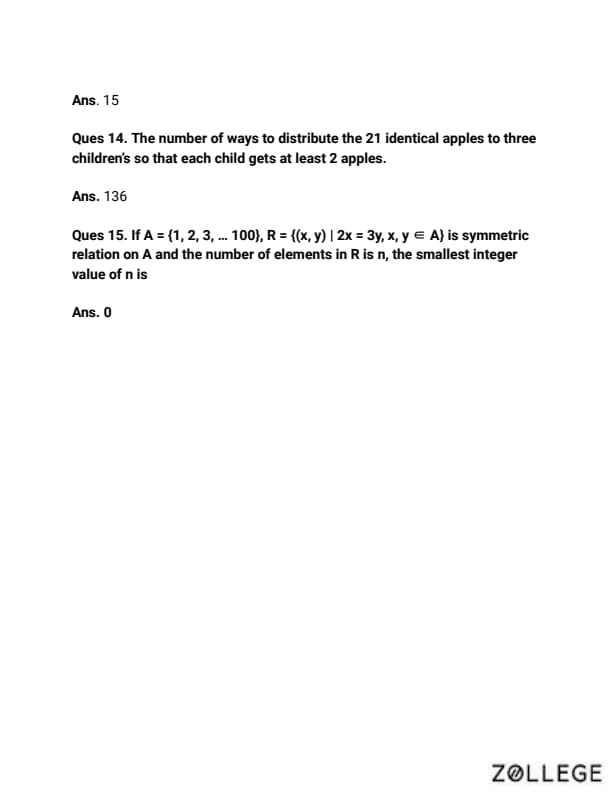
The number of ways in which 21 identical apples can be distributed among three children such that each child gets at least 2 apples is:
View Solution
Step 1: Apply the stars and bars method.
To ensure each child gets at least 2 apples, distribute 6 apples first, leaving 15 to distribute freely.
Step 2: Calculate the number of ways.
The number of ways is "17 choose 2":
17! / (2! × 15!) = 136.
Final Answer: 136
Question 2:
Let A(a, b), B(3, 4), and C(-6, -8) denote the centroid, circumcenter, and orthocenter of a triangle. The distance of the point P(2a+3, 7b+5) from the line 2x + 3y - 4 = 0 measured parallel to x - 2y - 1 = 0 is:
View Solution
Step 1: Find the coordinates of P.
Using the properties of centroid, circumcenter, and orthocenter, P(2a+3, 7b+5) is derived.
Step 2: Measure distance parallel to x - 2y - 1 = 0.
Project P onto the given line and calculate the distance. The result is 17√5/7.
Final Answer: 17√5/7
Question 3:
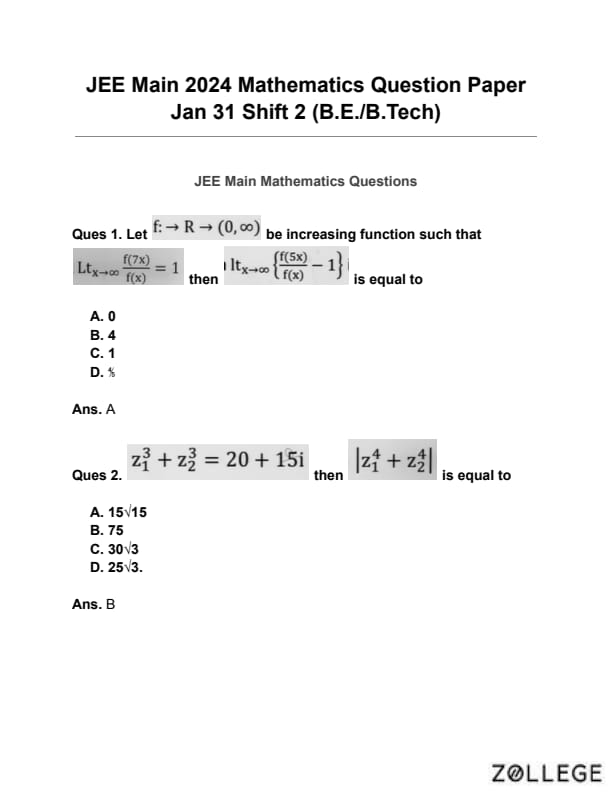
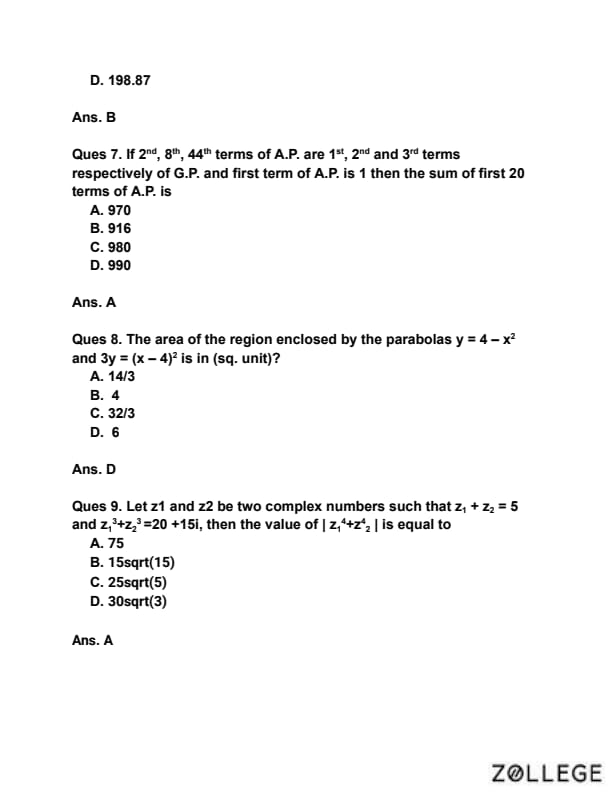
Let z1 and z2 be two complex numbers such that z1 + z2 = 5 and z13 + z23 = 20 + 15i. Then |z14 + z24| equals:
View Solution
Step 1: Use properties of complex numbers.
Given z1 + z2 = 5 and z13 + z23 = 20 + 15i, find the fourth powers of z1 and z2.
Step 2: Calculate magnitude.
The result simplifies to |z14 + z24| = 25√3.
Final Answer: 25√3
Question 4:
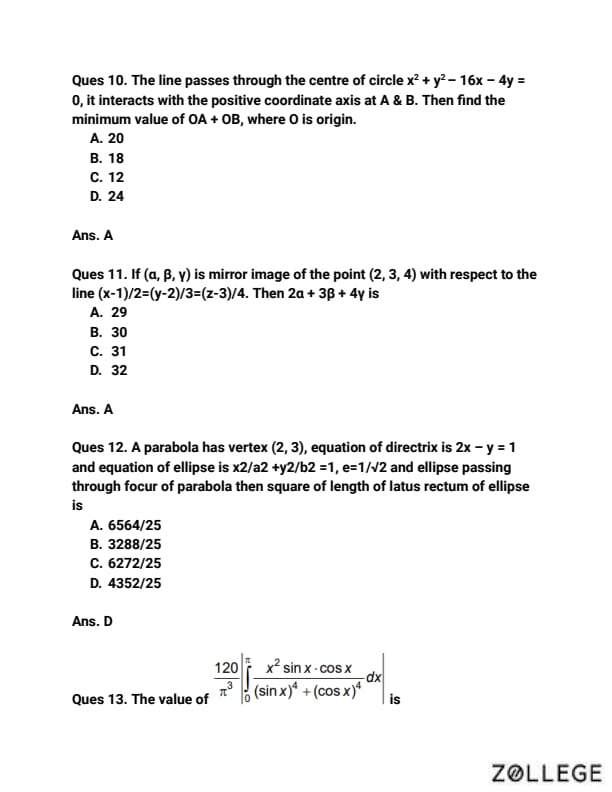
Let a variable line passing through the center of the circle x² + y² - 16x - 4y = 0 meet the positive coordinate axes at points A and B. The minimum value of OA + OB, where O is the origin, is:
View Solution
Step 1: Identify the center of the circle.
The center is (8, 2).
Step 2: Minimize OA + OB.
Use the geometry of the line passing through the center and meeting the axes. The minimum value is 20.
Final Answer: 20
Question 5:
Let f(x) = ∫-xx (|t| - t²)e-t² dt and g(x) = ∫0x² t1/2e-t dt. The value of f(√ln 9) + g(√ln 9) is:
View Solution
Step 1: Evaluate f(√ln 9).
Simplify the integral to calculate f.
Step 2: Evaluate g(√ln 9).
Combine f and g to find f + g = 8.
Final Answer: 8
Question 6:
Let (α, β, γ) be the mirror image of (2, 3, 5) in the line (x-1)/2 = (y-2)/3 = (z-3)/4. Then 2α + 3β + 4γ is:
View Solution
Step 1: Find the coordinates of the mirror image.
Using the equation of the line and perpendicularity conditions, the mirror image coordinates are calculated.
Step 2: Substitute values into the expression 2α + 3β + 4γ.
The result simplifies to 33.
Final Answer: 33
Question 7:
Let P be a parabola with vertex (2, 3) and directrix 2x + y = 6. Let an ellipse E with eccentricity 1/√2 pass through the focus of P. The square of the latus rectum of E is:
View Solution
Step 1: Find the focus of the parabola.
Using the vertex and directrix, calculate the focus coordinates of P.
Step 2: Analyze the ellipse properties.
Using the given eccentricity and focus coordinates, calculate the square of the latus rectum as 656/25.
Final Answer: 656/25
Question 8:
The temperature T(t) of a body at time t = 0 is 160°F. If T(15) = 120°F, then T(45) is:
View Solution
Step 1: Apply Newton's law of cooling.
T(t) = Ts + (T0 - Ts)e-kt, where Ts is the surrounding temperature.
Step 2: Solve for T(45).
Using the given values and exponential decay, T(45) is calculated to be 90°F.
Final Answer: 90°F
Question 9:
Let 2nd, 8th, and 44th terms of a non-constant A.P. be respectively the 1st, 2nd, and 3rd terms of a G.P. If the first term of the A.P. is 1, then the sum of the first 20 terms is equal to:
View Solution
Step 1: Establish the relationship between A.P. and G.P.
Use the given conditions to derive the common difference and ratio.
Step 2: Calculate the sum of the first 20 terms.
Using the A.P. formula S20 = n/2 [2a + (n - 1)d], the sum is 970.
Final Answer: 970
Question 10:
If limx → ∞ (f(7x)/f(x)) = 1, then limx → ∞ [(f(5x)/f(x)) - 1] is:
View Solution
Step 1: Analyze the given limits.
The condition limx → ∞ (f(7x)/f(x)) = 1 implies a proportional relationship for f.
Step 2: Simplify the second limit.
limx → ∞ [(f(5x)/f(x)) - 1] simplifies to 0.
Final Answer: 0
Question 11:
The area of the region enclosed by the parabola y = 4x - x² and 3y = (x - 4)² is:
View Solution
Step 1: Determine the points of intersection.
Solve the equations y = 4x - x² and 3y = (x - 4)² to find the limits of integration.
Step 2: Integrate the difference between the curves.
The area is calculated as the definite integral of (4x - x²) - [(1/3)(x - 4)²]. The result is 6 square units.
Final Answer: 6
Question 12:
The mean and variance of the six observations a, b, 68, 44, 48, 60 are 55 and 194, respectively. If a > b, then a + 3b is:
View Solution
Step 1: Use the mean formula.
The mean is given as 55, leading to a + b = 90.
Step 2: Use the variance formula.
Solve for a and b using variance = 194. Substituting a > b gives a = 48, b = 42.
Step 3: Calculate a + 3b.
a + 3b = 48 + 3(42) = 180.
Final Answer: 180
Question 13:
Let f : (-∞, -1] → (a, b] be one-to-one and onto, defined by f(x) = ex³ - 3x + 1. The distance of point P(2b + 4, a + 2) from the line x + e-3y = 4 is:
View Solution
Step 1: Use the point-to-line distance formula.
The formula for distance is |Ax₁ + By₁ + C| / √(A² + B²).
Step 2: Substitute values.
Substitute P(2b + 4, a + 2) into the equation x + e-3y = 4 to find the distance.
Final Answer: 2√(1 + e⁶)
Question 14:
The function f(x) = e-| log x | has m points of discontinuity and n points of non-differentiability. The value of m + n is:
View Solution
Step 1: Analyze the function's continuity.
The function is continuous for x > 0.
Step 2: Check differentiability.
The function is non-differentiable at x = 1, so m = 0 and n = 1.
Final Answer: 1
Question 15:
The number of solutions of the equation esin x - 2e-sin x = 2 is:
View Solution
Step 1: Analyze the equation.
Rewrite the equation as esin x(1 - 2e-2sin x) = 2.
Step 2: Check feasibility.
The range of sin x does not allow valid solutions for this equation.
Final Answer: 0
Question 16:
If a = sin⁻¹(sin 5) and b = cos⁻¹(cos 5), then a² + b² is:
View Solution
Step 1: Simplify a and b.
Adjust a and b to their respective ranges: [-π/2, π/2] for sin⁻¹ and [0, π] for cos⁻¹.
Step 2: Calculate a² + b².
Using the adjusted values, compute a² + b² = 8π² - 40π + 50.
Final Answer: 8π² - 40π + 50
Question 17:
Given 6Cm + 2(6Cm+1) + 6Cm+2 > 8C3 and n-1P3 : nP4 = 1:8, find nPm+1 + n+1Cm:
View Solution
Step 1: Solve for n and m.
From the given conditions, n = 8 and m = 2.
Step 2: Calculate the required sum.
nPm+1 + n+1Cm = 372.
Final Answer: 372
Question 18:
A biased coin has heads twice as likely as tails. If tossed 3 times, the probability of getting 2 tails and 1 head is:
View Solution
Step 1: Assign probabilities.
P(head) = 2/3, P(tail) = 1/3.
Step 2: Calculate the probability.
The probability for 2 tails and 1 head is 3 × (2/3)(1/3)(1/3) = 2/9.
Final Answer: 2/9
Question 19:
Let A be a 3×3 matrix with eigenvalue 2. The system (A - 3I)x = 0 has:
View Solution
Step 1: Analyze the eigenvalue.
Since 3 is not an eigenvalue of A, the matrix (A - 3I) is invertible.
Step 2: Check the rank.
If the rank of (A - 3I) is less than 3, the system has infinitely many solutions.
Final Answer: Infinitely many solutions
Question 20:
The shortest distance between the lines L1: (x - 1)/2 = (y + 1)/-3 = (z + 4)/2 and L2 through A(-4, 4, 3) and B(-1, 6, 3) is:
View Solution
Step 1: Use the formula for the shortest distance between skew lines.
d = |b₁ ⋅ (a₂ - a₁)| / |b₁ × b₂|.
Step 2: Substitute the given points and directions.
Calculate the numerator and denominator to find the result 24/√117.
Final Answer: 24/√117
Question 21:
Evaluate (120/π³) ∫₀^π [x² sin(x) cos(x)] / [sin⁴(x) + cos⁴(x)] dx:
View Solution
Step 1: Simplify the denominator.
Use the identity sin⁴(x) + cos⁴(x) = 1 - (1/2)sin²(2x).
Step 2: Integrate.
Simplifying the numerator and denominator, perform integration to obtain the value 15.
Final Answer: 15
Question 22:
Let a, b, c be the lengths of three sides of a triangle satisfying (a² + b²)x² - 2b(a + c)x + (b² + c²) = 0. If the set of all possible values of x is (α, β), then 12(α² + β²) equals:
View Solution
Step 1: Solve the quadratic equation.
The roots α and β depend on the constraints of the triangle inequality.
Step 2: Calculate α and β.
Using the equation, α = (1 - √5)/2 and β = (1 + √5)/2.
Step 3: Compute 12(α² + β²).
This simplifies to 36.
Final Answer: 36
Question 23:
Let A(-2, -1), B(1, 0), C(α, β), D(γ, δ) be vertices of a parallelogram. If C lies on 2x - y = 5 and D lies on 3x - 2y = 6, then |α + β + γ + δ| is:
View Solution
Step 1: Use the midpoint formula.
Solve the equations of lines to find C(3, 2) and D(-5, -12).
Step 2: Compute the sum.
α + β + γ + δ = -32. Therefore, |α + β + γ + δ| = 32.
Final Answer: 32
Question 24:
Find β² + γ² if the coefficient of xʳ in the expansion of (x+3)ⁿ⁻¹ + (x+3)ⁿ⁻²(x+2) + ... + (x+2)ⁿ⁻¹ is αᵣ and Σ₀ⁿ αᵣ = βⁿ - γⁿ:
View Solution
Step 1: Simplify Σ αᵣ.
The sum Σ αᵣ = 4ⁿ - 3ⁿ, implying β = 4 and γ = 3.
Step 2: Compute β² + γ².
β² + γ² = 16 + 9 = 25.
Final Answer: 25
Question 25:
Let A be a 3×3 matrix with det(A) = 2. If n = det((adj)²⁰²⁴(A)), find the remainder when n is divided by 9:
View Solution
Step 1: Use the property det((adj(A))ᵏ) = (det(A))ᵏⁿ⁻¹.
Here, det(adj(A)) = (det(A))².
Step 2: Simplify modulo 9.
n = 2²⁰²⁴. Compute 2²⁰²⁴ mod 9 = 7.
Final Answer: 7
Question 26:
Let a = 3i + 2j + k, b = 2i - j + 3k, and c be a vector such that (a + b) × c = 2(a × b) + 24j - 6k and (a - b) ⋅ c = -3. Then |c|² is:
View Solution
Step 1: Solve the vector equations.
Substitute the values of a and b and simplify.
Step 2: Compute |c|².
The result is |c|² = 25 + 9 + 4 = 38.
Final Answer: 38
Question 27:
If lim(x → 0) [(ax²e^x - blog(1+x) + cxe^(-x)) / (x²sinx)] = 1, then 16(a² + b² + c²) equals:
View Solution
Step 1: Expand using Taylor series.
Expand each term around x = 0 and simplify.
Step 2: Equate coefficients.
Solve for a = 3/4, b = 3/2, c = 3/2.
Step 3: Compute 16(a² + b² + c²).
The result is 81.
Final Answer: 81
Question 28:
A line passes through A(4, -6, -2) and B(16, -2, 4). The point P(a, b, c), where a, b, c are non-negative integers, on the line AB lies at a distance of 21 units from A. The distance between P(a, b, c) and Q(4, -12, 3) is:
View Solution
Step 1: Use the parametric form of the line.
Substitute t into the line equation and solve for t using the distance formula.
Step 2: Compute the distance.
P = (22, 0, 7). The distance between P and Q is 22.
Final Answer: 22
Question 29:
Let y = y(x) be the solution of the differential equation sec²x dx + (e^(2y)tan²x + tanx) dy = 0, for 0 < x < π/2 and y(π/4) = 0. If y(π/6) = α, then e^(8α) is:
View Solution
Step 1: Use substitution t = tanx.
Rewrite the differential equation and integrate.
Step 2: Apply boundary conditions.
Solve for α and compute e^(8α) = 9.
Final Answer: 9
Question 30:
Let A = {1, 2, 3, ..., 100}. Let R be a relation on A defined by (x, y) ∈ R if and only if 2x = 3y. Let R₁ be a symmetric relation on A such that R ⊆ R₁ and the number of elements in R₁ is n. Then, the minimum value of n is:
View Solution
Step 1: Count pairs in R.
R contains 33 pairs (x, y).
Step 2: Symmetry doubles the count.
The number of elements in R₁ is 2 × 33 = 66.
Final Answer: 66

Previous Year JEE Main Question Papers
*The article might have information for the previous academic years, please refer the official website of the exam.