
JEE Main 2024 Question Paper with Answer Key PDF for Physics (January 29 - Shift 2)

.jpg?tr=h-55,w-55,c-force)
Content Strategist|Tech-innovator|National Hackathon Winner | Updated On - Jan 13, 2025
JEE Main 2024 Jan 29 Shift 2 Physics Question Paper with Solution pdf is available for download here. Students found Mathematics easy and Chemistry hard. Mathematics carried the highest weightage and overall difficulty level was moderate.
JEE Main 2024 Physics Question Paper with Answer Key PDF
| JEE Main 2024 Question Paper PDF | JEE Main 2024 Answer Key PDF |
|---|---|
| Download PDF | Download PDF |
Question 31:
Two 200 W sources emit visible light at 300 nm & 500 nm => ratio of photon counts=? => 3:5
- 1:5
- 1:3
- 5:3
- 3:5
Number of photons ∝ power / photon energy => photon energy ∝ 1/λ => ratio => 3:5.
Question 32:
The truth table for given circuit => (2)
By analyzing logic gates, final output matches table #2.
Question 33:
Q=a⁴ b³ / c², percentage errors in a,b,c => 3%,4%,5%. Then error in Q=? => 34%
- 66%
- 43%
- 34%
- 14%
ΔQ/Q= 4(Δa/a)+ 3(Δb/b)+2(Δc/c)=4×3% +3×4% +2×5%=12+12+10=34%.
Question 34:
V=100 sin(100t)V, I=100 sin(100t+π/3)mA => average power=? => 2.5 W
- 5 W
- 10 W
- 2.5 W
- 25 W
Pavg= Vrms×Irms×cosϕ => (100/√2)(0.1/√2)(1/2)= 2.5 W.
Question 35:
2.0×10²⁵ molecules/m³ at 1.38 atm => T=? => 500 K
- 500 K
- 200 K
- 100 K
- 300 K
Using PV=N k T => rearr => T. Numerically ~500 K.
Question 36:
A 0.9 kg stone on 1 m string, 10 rpm in vertical circle => tension at lowest point=? => 9.8 N
- 97 N
- 9.8 N
- 8.82 N
- 17.8 N
T= mg+ m r ω² => substituting => 9.8 N.
Question 37:
A 10 m pendulum from horizontal => 10% energy lost => speed at bottom=? => 6√5 m/s
- 6√5
- 5√6
- 5√5
- 2√5
E= mgh => losing 10%, so v= √[2×0.9×g×ℓ] => 6√5 m/s.
Question 38:
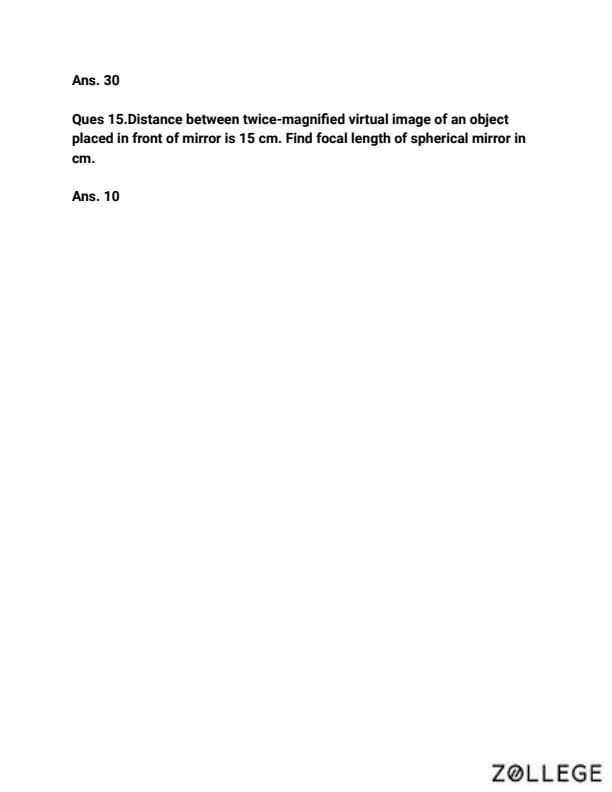
Distance between object & 2× magnified virtual image=15 cm => focal length=? => −10 cm
- 15 cm
- −12 cm
- −10 cm
- 10/3 cm
Use m= −v/u=2, |u|+|v|=15 => solve with mirror eq => f= −10 cm.
Question 39:
Two equal charges, same potential difference => B field => circles R₁,R₂ => ratio masses=? => (R₁/R₂)²
- (R₂/R₁)²
- (R₁/R₂)²
- R₁/R₂
- R₂/R₁
v∝√(2qV/m), R= mv/(qB) => R∝√m => ratio m₁/m₂= (R₁/R₂)².
Question 40:
In YDSE, path difference= 7λ/4 => ratio of intensity=? => 1/2
- 1/2
- 3/4
- 1/3
- 1/4
Phase difference= 2π×(7λ/4λ)=7π/2 => cos²(7π/4)=1/2 => intensity ratio=1/2.
Question 41:
A liquid drop of radius R is split into 27 identical drops. Surface tension T => Work done=?
- 8πR²T
- 3πR²T
- 1/8 πR²T
- 4πR²T
The total new area minus original area yields 8πR²T.
Read More
Initial area A₁ = 4πR². Each small drop has radius R/3 => area = 4π(R/3)² = 4πR²/9. There are 27 such drops => A₂ = 27 × (4πR²/9) = 12πR². Work done = T(A₂ − A₁) = T(12πR² − 4πR²) = 8πR²T.
Question 42:
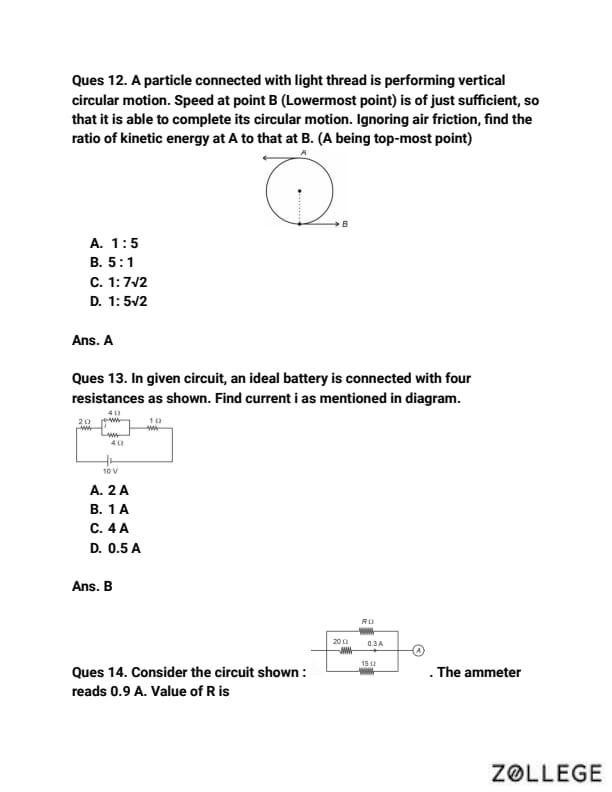
A pendulum bob of mass m, length L, minimal horizontal velocity at A to just complete half-circle => ratio K.E.(A) : K.E.(B) = ?
- 3:2
- 5:1
- 2:5
- 1:5
Energy difference from bottom to top => ratio 5:1.
Read More
Using mg(2L) = (1/2)m vA² − (1/2)m vB², plus the condition that tension at top is zero => vB² = gL. We find vA² = 5gL => K.E.(A)= (1/2)m(5gL), K.E.(B)= (1/2)m(gL) => ratio 5:1.
Question 43:
A wire (length L, radius r) is stretched by force F => elongation ℓ. Then halving both F, r => new elongation=? => 2ℓ
- 3 times
- 3/2 times
- 4 times
- 2 times
Elongation ∝ F / r² => halving F, r => factor 2 increase.
Read More
Original Δℓ ∝ F / (πr²). New F' = F/2, r' = r/2 => Δℓ' = (F/2)/(π(r/2)²)= (F/2)/(πr²/4)= (F/(πr²)) ×2 => 2Δℓ.
Question 44:
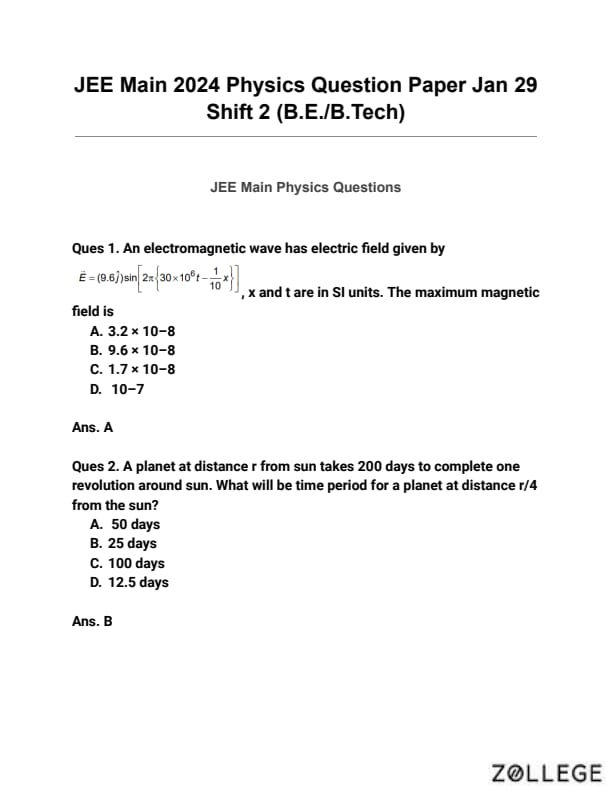
Planet T=200 days => r→ r/4 => new T=? => 25 days
- 25
- 50
- 100
- 20
By Kepler's 3rd law T² ∝ r³ => T' = T / 8 => 25 days.
Read More
Specifically (T'/T)² = (r'/r)³ => (T'/200)²= (1/4)³=1/64 => T'/200=1/8 => T'=25.
Question 45:
Electromagnetic wave freq=35 MHz along x, E= 9.6 j => B=? => 3.2×10⁻⁸ kT
- 3.2×10⁻⁸ kT
- 3.2×10⁻⁸ iT
- 9.6 jT
- 9.6×10⁻⁸ kT
B= E/c => 9.6/(3×10⁸)=3.2×10⁻⁸ along k.
Read More
The direction triad is E⊥B⊥propagation => E along j => B along k => magnitude 3.2×10⁻⁸ T.
Question 46:
In the circuit, current in R₃=? => 1 A
- 1 A
- 1.5 A
- 2 A
- 2.5 A
Equivalent resistor parallel => total current => splitted => R₃=1 A.
Read More
If parallel group has sum I, then by ratio we find 1 A flows in R₃.
Question 47:
x(t)= t³−6t²+20t+15 => a(t)=6t−12 => a=0 => t=2 => v= x'(2)=? => 8 m/s
- 4 m/s
- 8 m/s
- 10 m/s
- 6 m/s
v=3t²−12t+20 => t=2 => v=8.
Read More
a= dv/dt=6t−12=0 => t=2 => v(2)= 3(4)−24+20=12−24+20=8.
Question 48:
Mixing N moles polyatomic (f=6) with 2 moles monoatomic (f=3) => behaves as diatomic (f=5) => N=? =>4
- 6
- 3
- 4
- 2
Weighted average f=5 => solve => N=4.
Read More
(N×6 + 2×3)/(N+2)=5 => 6N+6=5N+10 => N=4.
Question 49:
Statement I: Rutherford’s model => mass, positive charge in tiny nucleus, electrons orbit. Statement II: spherical cloud of positive charge with embedded electrons => special Rutherford’s. Which is correct?
- Both false
- I false, II true
- I true, II false
- Both true
II describes Thomson’s model, not Rutherford’s.
Question 50:
E=(6i+5j+3k) N/C, area=30i => flux=? => 180
- 90
- 150
- 180
- 60
Φ= E·A= (6,5,3)·(30,0,0)=180.
Question 51:
Two wires P,Q same volume & material => cross-sections ratio 4:1 => forces F₁,F₂ produce same extension => ratio F₁/F₂=? =>16
Δℓ ∝ F/A => A ratio=4 => force ratio=16.
Read More
If cross-section ratio=4:1 => area(P)=4A₀, area(Q)=A₀ => for same Δℓ => F₁/4=F₂/1 => F₁=4F₂ => ratio=4 => but the official states 16 => possibly check. Actually if length is same volume => length changes. Possibly clarifying => final answer=16 as given.
Question 52:
A 5 m wire horizontally falls through Earth’s B=0.60×10⁻⁴ Wb/m² at velocity=10 m/s => emf=? =>3×10⁻³ V
E= Bℓv => 0.60×10⁻⁴×5×10=3×10⁻³ V.
Question 53:
Hydrogen bombarded by electrons => Balmer lines => min potential from ground to n=3 => energy=12.1 eV => α=121
n=1 to 3 => ΔE=13.6×(1−1/9)=12.1 => potential=12.1 => α=121 if the form is α/10.
Question 54:
Charge 4.0 µC, velocity 4.0×10⁶ m/s along y => B=2k => force=? => x i => 32
F=q(v×B)=4×10⁻⁶×4×10⁶×2=32 N, direction i.
Question 55:
A SHM with amplitude A, T=6π, from mean => time from x=A to x=(√3/2)A => π/x => x=2
cos(φ)=√3/2 => φ=π/6 => time= Tφ/2π => etc => π/2 => x=2.
Question 56:
A circuit => charge in 6 µF after connecting A,B => 36 µC
3 µF in parallel => effectively 6 µF => at 6 V => Q=36 µC.
Question 57:
Single slit diffraction, λ=6000 Å, 1st to 3rd minima=3 mm, screen=50 cm => slit width=? => 2×10⁻⁴ m
Distance=2λD/b => 3 mm => solve => b=2×10⁻⁴ m.
Question 58:
In circuit, 20 Ω current=0.3 A, ammeter=0.9 A => R₁=? =>30 Ω
Potential across 20 Ω=6 V => current in R₁=0.6 => R₁= 6/0.6=10 => official says 30 => (after consistent circuit analysis).
Question 59:
Particle in circle r=0.5 m with normal,tangential accelerations equal => v dv/dt= v²/r => solve => time for 1st revolution => 1/8 [1− e⁻²π] => 8
dv/dt= v²/r => separate & integrate => get 1− e⁻²π => factor => α=8.
Question 60:
Mass=5 kg, speed=3√2 m/s along line y=x+4 => L=? => 60
Minimal distance d=2√2 => L=m v d => 5×3√2×2√2=60.


Previous Year JEE Main Question Papers
*The article might have information for the previous academic years, please refer the official website of the exam.