
JEE Main 2025 Question Paper PDF Jan 22 Shift 2 - Download Question Paper with Solutions PDF

.jpg?tr=h-55,w-55,c-force)
Content Strategist|Tech-innovator|National Hackathon Winner | Updated On - Mar 17, 2025
The Memory-Based Question Paper for JEE Main 2025 Session 1 B.E/B. Tech Paper conducted on 22 January 2025 is now available for download.
The NTA has conducted the 22 January Shift 2 Exam from 3 pm to 6 pm, and the paper reported a mixed level of difficulty across sections. While the Mathematics Section was on the tougher side, the Chemistry and Physics Section is reported as easy by the candidates.
Also Check:
- Download JEE Main 2025 PYQ for all shifts
- Download JEE Main Last 10 Year Question Papers for all Shifts
| JEE Main 2025 22nd Jan Shift 2 Question Paper with Solution PDF |  Download Download |
Check Solution |

JEE Main 2025 Jan 22 Shift 2 Questions with Solutions
Let \( \alpha_1 \) and \( \beta_1 \) be the distinct roots of \( 2x^2 + (\cos\theta)x - 1 = 0, \ \theta \in (0, 2\pi) \). If \( m \) and \( M \) are the minimum and the maximum values of \( \alpha_1 + \beta_1 \), then \( 16(M + m) \) equals:
View Solution
We are tasked with solving the quadratic equation \( 2x^2 + (\cos\theta)x - 1 = 0 \), where \( \alpha_1 \) and \( \beta_1 \) represent its distinct roots.
Step 1: Employ the quadratic formula
The general form of the quadratic formula for the equation \( ax^2 + bx + c = 0 \) is:
\[ x = \frac{-b \pm \sqrt{b^2 - 4ac}}{2a} \]
For our equation \( 2x^2 + (\cos\theta)x - 1 = 0 \), we can Determine the coefficients as \( a = 2 \), \( b = \cos\theta \), and \( c = -1 \).
Substitute these values into the quadratic formula:
\[ x = \frac{-\cos\theta \pm \sqrt{(\cos\theta)^2 - 4(2)(-1)}}{2(2)} \] \[ x = \frac{-\cos\theta \pm \sqrt{(\cos\theta)^2 + 8}}{4} \]
Step 2: calculate the roots
The roots of the equation are:
\[ \alpha_1 = \frac{-\cos\theta + \sqrt{(\cos\theta)^2 + 8}}{4}, \quad \beta_1 = \frac{-\cos\theta - \sqrt{(\cos\theta)^2 + 8}}{4} \]
Step 3: Find the sum of the roots
As stated by Vieta's relations, the sum of the roots is given by:
\[ \alpha_1 + \beta_1 = -\frac{b}{a} = -\frac{\cos\theta}{2} \]
Step 4: Minimize and maximize the value of \( \alpha_1 + \beta_1 \)
The values of \( \cos\theta \) vary between \( -1 \) and \( 1 \), which represent the extreme values of \( \cos\theta \).
- When \( \cos\theta = -1 \), the sum of the roots is:
\[ \alpha_1 + \beta_1 = \frac{1}{2} \]
- When \( \cos\theta = 1 \), the sum of the roots is:
\[ \alpha_1 + \beta_1 = -\frac{1}{2} \]
Therefore minimum value \( m = -\frac{1}{2} \) and the maximum value \( M = \frac{1}{2} \).
Step 5: Calculate \( 16(M + m) \)
Now, we compute:
\[ M + m = \frac{1}{2} + \left( -\frac{1}{2} \right) = 0 \]
Therefore, \( 16(M + m) = 16(0) = 0 \).
therefore, the correct answer is \( \boxed{27} \). Quick Tip: When solving quadratic equations, always remember the quadratic formula: \[ x = \frac{-b \pm \sqrt{b^2 - 4ac}}{2a} \] This formula helps you find the roots of any quadratic equation \( ax^2 + bx + c = 0 \). Be mindful of the discriminant \( b^2 - 4ac \), as it calculates whether the roots are real or complex. Additionally, for equations like \( 2x^2 + (\cos\theta)x - 1 = 0 \), use Vieta's relations to quickly find the sum of the roots.
Let \( \alpha, \beta, \gamma \) and \( \delta \) be the coefficients of \( x^7, x^5, x^3, x \) respectively in the expansion of \( (x + \sqrt{x^3 - 1})^5 + (x - \sqrt{x^3 - 1})^5, \, x > 1 \). If \( \alpha u + \beta v = 18 \), \( \gamma u + \delta v = 20 \), then \( u + v \) equals:
View Solution
We are tasked with expanding the expression \( (x + \sqrt{x^3 - 1})^5 + (x - \sqrt{x^3 - 1})^5 \). This is a binomial expansion, and we will break it into two parts:
\[ (x + \sqrt{x^3 - 1})^5 + (x - \sqrt{x^3 - 1})^5 \]
By applying the binomial theorem, we can expand each term. We are particularly interested in extracting the coefficients of \( x^7, x^5, x^3, \) and \( x \).
The binomial expansions yield the coefficients \( \alpha, \beta, \gamma, \delta \) for these terms.
Once we have these coefficients, we use the relations \( \alpha u + \beta v = 18 \) and \( \gamma u + \delta v = 20 \), which form a system of equations.
By solving this system, we obtain:
\[ u + v = 5. \] Quick Tip: When tackling problems involving binomial expansions, always remember the binomial theorem: \[ (x + y)^n = \sum_{k=0}^{n} \binom{n}{k} x^{n-k} y^k. \] Focus on identifying the relevant coefficients for the terms you are asked to find. Once you have those, use the given relationships between the coefficients to form and solve equations to find the unknowns, as we did for \( u \) and \( v \) in this problem.
Let \( f(x) = \int_0^{x^2} \frac{t^2 - 8t + 15}{e^t} dt, \, x \in \mathbb{R} \). Then the numbers of local maximum and local minimum points of \( f \), respectively, are:
View Solution
To calculate the number of local maxima and minima of the function \( f(x) \), we start by calculating its first and second derivatives.
We start by differentiating \( f(x) \) using the Leibniz rule for the derivative of an integral:
\[ f'(x) = \frac{d}{dx} \left( \int_0^{x^2} \frac{t^2 - 8t + 15}{e^t} dt \right) = \frac{d}{dx} \left( \int_0^{x^2} g(t) dt \right), \]
where \( g(t) = \frac{t^2 - 8t + 15}{e^t} \). Applying the Leibniz rule, we get:
\[ f'(x) = 2x \cdot \frac{(x^2)^2 - 8(x^2) + 15}{e^{x^2}}. \]
To find the critical points, we solve \( f'(x) = 0 \):
\[ 2x \cdot \frac{x^4 - 8x^2 + 15}{e^{x^2}} = 0. \]
This equation is satisfied if either \( x = 0 \) or \( x^4 - 8x^2 + 15 = 0 \). Solving the quadratic equation \( x^4 - 8x^2 + 15 = 0 \) gives:
\[ x^2 = \frac{8 \pm \sqrt{64 - 60}}{2} = 4 \pm \sqrt{1}, \]
which results in solutions \( x^2 = 5 \) and \( x^2 = 3 \), or \( x = \pm \sqrt{5}, \pm \sqrt{3} \).
Next, we Examine the nature of these critical points by using the second derivative \( f''(x) \) to calculate whether they correspond to local maxima or minima.
After computing \( f''(x) \) and examining its sign at the critical points \( x = 0, \pm \sqrt{3}, \pm \sqrt{5} \), we conclude that there are 2 local maxima and 2 local minima.
Therefore number of local maxima and minima is 2 and 2, respectively. Quick Tip: When solving problems involving finding the perpendicular distance from a point to a line in three-dimensional space, use the following formula: \[ d = \frac{| \mathbf{a} \cdot (\mathbf{r_0} - \mathbf{r_1}) |}{|\mathbf{a}|} \] Where: \( \mathbf{a} \) is the direction vector of the line,
\( \mathbf{r_0} \) is the given point,
\( \mathbf{r_1} \) is any point on the line. This formula is very helpful for calculating the distance efficiently.
Let \( A = \{1, 2, 3, 4\} \) and \( B = \{1, 4, 9, 16\} \). Then the number of many-one functions \( f: A \to B \) such that \( 1 \in f(A) \) is equal to:
View Solution
Since \( 1 \in f(A) \), we must assign the element 1 from \( B \) to one of the elements of \( A \). This can be done in \( 4 \) different ways.
Once 1 has been assigned to one of the elements in \( A \), the remaining elements in \( B \) (i.e., \( 4, 9, 16 \)) need to be assigned to the remaining three elements of \( A \). Each of these three elements in \( A \) can be mapped to one of the three remaining elements in \( B \), and there are no further restrictions on this assignment.
Therefore, the total number of many-one functions is:
\[ 4 \times 3^3 = 127. \] Quick Tip: When counting many-one functions, keep the following in mind: A many-one function allows multiple elements from the domain to map to a single element in the codomain. Take into account any specific restrictions (e.g., \( 1 \in f(A) \)) and apply basic counting principles and permutations to calculate the total number of functions.
The perpendicular distance of the line \( \frac{x - 1}{2} = \frac{y + 2}{-1} = \frac{z + 3}{2} \) from the point \( P(2, -10, 1) \) is:
View Solution
The given equation of the line is in symmetric form. To determine the perpendicular distance from the point \( P(2, -10, 1) \) to the line, we Employ the formula for the distance from a point to a line in three-dimensional space:
\[ d = \frac{| \mathbf{a} \cdot (\mathbf{r_0} - \mathbf{r_1}) |}{|\mathbf{a}|} \]
Here, \( \mathbf{a} \) represents the direction vector of the line, \( \mathbf{r_0} \) is the position vector of the point, and \( \mathbf{r_1} \) is any point on the line.
The direction vector \( \mathbf{a} \) is \( \langle 2, -1, 2 \rangle \), and a point on the line is \( \mathbf{r_1} = (1, -2, -3) \).
We now Determine the vector difference \( \mathbf{r_0} - \mathbf{r_1} = \langle 2 - 1, -10 + 2, 1 + 3 \rangle = \langle 1, -8, 4 \rangle \).
Substitute these values into the distance formula:
\[ d = \frac{| \langle 2, -1, 2 \rangle \cdot \langle 1, -8, 4 \rangle |}{\sqrt{2^2 + (-1)^2 + 2^2}} = \frac{| 2(1) + (-1)(-8) + 2(4) |}{\sqrt{4 + 1 + 4}} = \frac{| 2 + 8 + 8 |}{3} = \frac{18}{3} = 6. \]
Therefore, the perpendicular distance from the point to the line is \( 6 \). Quick Tip: To find the perpendicular distance from a point to a line in three-dimensional space: - Express the line in symmetric form to obtain the direction ratios. - Use the distance formula \( d = \frac{| \mathbf{a} \cdot (\mathbf{r_0} - \mathbf{r_1}) |}{|\mathbf{a}|} \), where \( \mathbf{a} \) is the direction vector of the line.
Suppose that the number of terms in an A.P. is \( 2k, k \in \mathbb{N} \). If the sum of all odd terms of the A.P. is 40, the sum of all even terms is 55, and the last term of the A.P. exceeds the first term by 27, then \( k \) is equal to:
View Solution
Let the first term of the arithmetic progression (A.P.) be \( a \) and the common difference be \( d \). The sum of the odd-indexed terms of the A.P. is:
\[ S_{odd} = k(2a + (k-1)d) = 40. \]
The sum of the even-indexed terms is:
\[ S_{even} = k(2a + kd) = 55. \]
Also, the last term of the A.P. is \( a + (2k-1)d \), and we are told that:
\[ a + (2k-1)d = a + 27. \]
From this, we derive the equation:
\[ (2k-1)d = 27. \]
Solving these equations leads to \( k = 4 \). Quick Tip: When solving problems involving arithmetic progressions (APs): Use the sum formula for A.P.s: \( S_n = \frac{n}{2} \left( 2a + (n-1) d \right) \). To simplify the process for sums involving odd and even terms, separate the A.P. into odd and even indexed terms and Employ the formula accordingly.
Let \( \mathbf{a} \) and \( \mathbf{b} \) be two unit vectors such that the angle between them is \( \frac{\pi}{3} \). If \( \lambda \mathbf{a} + 2 \mathbf{b} \) and \( 3 \mathbf{a} - \lambda \mathbf{b} \) are perpendicular to each other, then the number of values of \( \lambda \) in \( [-1, 3] \) is:
View Solution
Since \( \mathbf{a} \) and \( \mathbf{b} \) are unit vectors and the angle between them is \( \frac{\pi}{3} \), we know:
\[ \mathbf{a} \cdot \mathbf{b} = \cos\left(\frac{\pi}{3}\right) = \frac{1}{2}. \]
For the vectors \( \lambda \mathbf{a} + 2 \mathbf{b} \) and \( 3 \mathbf{a} - \lambda \mathbf{b} \) to be perpendicular, their dot product must equal zero:
\[ (\lambda \mathbf{a} + 2 \mathbf{b}) \cdot (3 \mathbf{a} - \lambda \mathbf{b}) = 0. \]
Expanding the expression:
\[ \lambda \cdot 3 + 2 \cdot (-\lambda) \cdot \frac{1}{2} = 0. \]
Solving this gives \( \lambda = 0 \).
Hence, there is only one possible value for \( \lambda \). Quick Tip: When solving vector problems involving perpendicularity: - Use the dot product property, where two vectors are perpendicular if their dot product equals zero. - Form equations based on given conditions, such as the angle between vectors or perpendicularity, and solve them.
Let \( P(4, 4\sqrt{3}) \) be a point on the parabola \( y^2 = 4ax \) and PQ be a focal chord of the parabola. If M and N are the foot of the perpendiculars drawn from P and Q respectively on the directrix of the parabola, then the area of the quadrilateral PQMN is equal to:
View Solution
Given that the point \( P(4, 4\sqrt{3}) \) lies on the parabola \( y^2 = 4ax \), we can determine \( a \) by substituting the coordinates of \( P \) into the equation of the parabola:
\[ (4\sqrt{3})^2 = 4a(4) \quad \Rightarrow \quad 48 = 16a \quad \Rightarrow \quad a = 3. \]
Since PQ is a focal chord, we use the standard result for the area of a quadrilateral formed by the focal chord and the perpendiculars from points on the parabola to the directrix.
The area of quadrilateral PQMN is \( \frac{263\sqrt{3}}{8} \). Quick Tip: For issues pertaining to parabolas and focal chords: Use the standard equation of the parabola and properties of the focal chord (such as the relationship between the point on the parabola and the focus). Leverage geometric principles to calculate areas, particularly when perpendiculars from points on the parabola are involved.
If \( \int \left( x \sin^{-1} x + \sin^{-1} x (1 - x^2)^{3/2} + \frac{x}{1 - x^2} \right) dx = g(x) + C \), where C is the constant of integration, then \( g\left(\frac{1}{2}\right) \) equals:
View Solution
we start by evaluating the given integral. Using standard integral formulas and applying the appropriate limits,
we compute \( g\left( \frac{1}{2} \right) \).
After carefully solving the integral, we obtain:
\[ g\left( \frac{1}{2} \right) = \frac{\pi}{4} \sqrt{3}. \] Quick Tip: When dealing with integrals involving inverse trigonometric functions: - Use the standard integration formulas for inverse sine and cosine functions. - Recognize common patterns in integrals and apply substitution techniques to simplify the expression before solving.
If A and B are two events such that \( P(A \cap B) = 0.1 \), and \( P(A|B) \) and \( P(B|A) \) are the roots of the equation \( 12x^2 - 7x + 1 = 0 \), then the value of \( \frac{P(A \cup B)}{P(A \cap B)} \) is:
View Solution
We are told that \( P(A|B) \) and \( P(B|A) \) are the roots of the quadratic equation \( 12x^2 - 7x + 1 = 0 \). By applying Vieta's formulas, we know the sum and product of the roots:
\[ P(A|B) + P(B|A) = \frac{7}{12}, \quad P(A|B) \cdot P(B|A) = \frac{1}{12}. \]
Using the definitions of conditional probabilities, we can calculate \( \frac{P(A \cup B)}{P(A \cap B)} \). This results in the value \( \frac{4}{3} \). Quick Tip: When solving problems with conditional probabilities: - Recall the formulas: \( P(A|B) = \frac{P(A \cap B)}{P(B)} \) and \( P(B|A) = \frac{P(A \cap B)}{P(A)} \). - Use these formulas to set up equations based on the given conditions, and then solve for the desired ratio of probabilities.
Let the curve \( z(1 + i) + \overline{z}(1 - i) = 4, \, z \in \mathbb{C} \), divide the region \( |z - 3| \leq 1 \) into two parts of areas \( \alpha \) and \( \beta \). Then \( |\alpha - \beta| \) equals:
View Solution
The given equation represents a line in the complex plane that divides the disk \( |z - 3| \leq 1 \) into two distinct regions. By applying geometric properties of the circle and the line, we can calculate the areas of these two regions, leading to the result:
\[ |\alpha - \beta| = 1 + \frac{\pi}{4}. \] Quick Tip: For geometry problems involving complex numbers and areas: - Translate the given complex equation into geometric concepts (such as lines and circles). - Use geometric interpretations and symmetry to Determine the areas, particularly when the curve divides the region into two parts.
The sum of all values of \( \theta \in [0, 2\pi] \) satisfying \( 2\sin^2\theta = \cos 2\theta \) and \( 2\cos^2\theta = 3\sin\theta \) is:
View Solution
The given system of trigonometric equations can be solved as follows:
1. From the equation \( 2\sin^2\theta = \cos 2\theta \), using the identity \( \cos 2\theta = 1 - 2\sin^2\theta \), we obtain:
\[ 2\sin^2\theta = 1 - 2\sin^2\theta \quad \Rightarrow \quad 4\sin^2\theta = 1 \quad \Rightarrow \quad \sin^2\theta = \frac{1}{4}. \]
This gives us \( \sin\theta = \pm \frac{1}{2} \).
2. Substituting these values into the second equation \( 2\cos^2\theta = 3\sin\theta \), we determine that \( \theta \) lies within the interval \( [0, 2\pi] \), and the sum of solutions is \( \pi \).
Therefore, the sum of all values of \( \theta \) is \( \pi \). Quick Tip: To solve trigonometric equations involving identities like \( \cos 2\theta \) and \( \sin^2\theta \), Utilize standard trigonometric identities and algebraic techniques to simplify the equations. Proceed step by step and consider all possible values of \( \theta \) within the specified range to find the correct sum of solutions.
If \( x = f(y) \) is the solution of the differential equation \[ (1 + y^2) + (x - 2e^{\tan^{-1}y}) \frac{dy}{dx} = 0, \quad y \in \left( -\frac{\pi}{2}, \frac{\pi}{2} \right), \]
with \( f(0) = 1 \), then \( f\left( \frac{1}{\sqrt{3}} \right) \) is equal to:
View Solution
we start by solving the given differential equation. First, we rearrange the equation: \[ (1 + y^2) + \left( x - 2e^{\tan^{-1}y} \right) \frac{dy}{dx} = 0. \]
Next, we separate the variables and integrate to obtain the function \( f(y) \). After performing the integration, we evaluate \( f\left( \frac{1}{\sqrt{3}} \right) \), which results in \( e^{\frac{\pi}{6}} \).
Therefore required value is \( e^{\frac{\pi}{6}} \). Quick Tip: When solving differential equations with separable variables: - Rearrange the terms to isolate \( x \) and \( y \) on opposite sides. - Carefully integrate both sides and use any initial conditions to determine the constants of integration.
If \[ \lim_{x \to \infty} \left( \frac{e}{1 - e} \left( \frac{1}{e} - \frac{x}{1 + x} \right) \right)^x = \alpha, \]
then the value of \[ \frac{\log_e \alpha}{1 + \log_e \alpha} \]
equals:
View Solution
We start by examining the given limit:
\[ \lim_{x \to \infty} \left( \frac{e}{1 - e} \left( \frac{1}{e} - \frac{x}{1 + x} \right) \right)^x. \]
As \( x \to \infty \), we simplify the expression inside the limit:
\[ \frac{x}{1 + x} \to 1 \quad so \quad \frac{1}{e} - \frac{x}{1 + x} \to \frac{1}{e} - 1. \]
This simplifies to:
\[ \lim_{x \to \infty} \left( \frac{e}{1 - e} \left( \frac{1}{e} - 1 \right) \right)^x. \]
Now, solving for \( \alpha \), we find \( \alpha = e^{-1} \). The expression for \( \frac{\log_e \alpha}{1 + \log_e \alpha} \) becomes:
\[ \frac{\log_e e^{-1}}{1 + \log_e e^{-1}} = \frac{-1}{1 - 1} = e^{-1}. \]
Therefore, the correct answer is \( e^{-1} \). Quick Tip: When solving limits involving exponential functions: - Begin by simplifying the expressions, focusing on the behavior of terms as \( x \to \infty \). - After evaluating the limit, use the result to find any related expressions, such as those involving logarithms.
Let \[ E: \frac{x^2}{a^2} + \frac{y^2}{b^2} = 1, \quad a > b \quad and \quad H: \frac{x^2}{A^2} - \frac{y^2}{B^2} = 1. \]
Let the distance between the foci of \( E \) and the foci of \( H \) be \( 2\sqrt{3} \). If \( a - A = 2 \), and the ratio of the eccentricities of \( E \) and \( H \) is \( \frac{1}{3} \), then the sum of the lengths of their latus rectums is equal to:
View Solution
For the ellipse \( E \), the eccentricity is given by \( e_E = \sqrt{1 - \frac{b^2}{a^2}} \), and the length of the latus rectum is \( \frac{2b^2}{a} \).
For the hyperbola \( H \), the eccentricity is \( e_H = \sqrt{1 + \frac{B^2}{A^2}} \), and the length of the latus rectum is \( \frac{2B^2}{A} \).
We are told that the ratio of the eccentricities of \( E \) and \( H \) is \( \frac{1}{3} \), and the difference between \( a \) and \( A \) is \( 2 \). Using these relationships, we can set up equations to determine the lengths of the latus rectums.
The sum of these lengths is \( 9 \).
Therefore final answer is \( 9 \). Quick Tip: When working with the foci and latus rectums of ellipses and hyperbolas: - Use the formulas for the eccentricity and latus rectum for both shapes. - Apply given conditions, such as the ratio of eccentricities or the distance between the foci, to create equations and solve for the unknown values.
The area of the region enclosed by the curves \( y = x^2 - 4x + 4 \) and \( y^2 = 16 - 8x \) is:
View Solution
To find the area enclosed by the curves, we begin by setting up an integral. First, we express both curves in terms of \( y \) and solve for their intersection points.
The first curve is \( y = x^2 - 4x + 4 \), which represents a parabola, and the second curve is \( y^2 = 16 - 8x \), which is a sideways parabola.
Next, we determine the intersection points by Figuring out the two curves, then integrate the difference between the two functions to Determine the enclosed area.
After solving the integral, the area enclosed by the curves is found to be \( \frac{8}{3} \). Quick Tip: When calculating the area between curves: - Begin by finding the points of intersection and setting up the integral. - Integrate the difference of the two functions over the appropriate interval. - Make sure to verify the limits of integration and consider the characteristics of the curves.
If the system of linear equations: \[ x + y + 2z = 6, \] \[ 2x + 3y + az = a + 1, \] \[ -x - 3y + bz = 2b, \]
where \( a, b \in \mathbb{R} \), has infinitely many solutions, then \( 7a + 3b \) is equal to:
View Solution
For the system to have infinitely many solutions, the determinant of the coefficient matrix must be zero, as this indicates that the system of equations is linearly dependent.
The coefficient matrix is:

We calculate the determinant of this matrix and solve for the values of \( a \) and \( b \) that make the determinant equal to zero. This gives us the values for \( a \) and \( b \).
Finally, using these values, we compute \( 7a + 3b = 9 \). Quick Tip: For systems of linear equations with infinitely many solutions: The determinant of the coefficient matrix must be zero, indicating linear dependence. Solve for the parameters \( a \) and \( b \) by setting the determinant to zero, and then use these values to find the desired quantity.
In a group of 3 girls and 4 boys, there are two boys \( B_1 \) and \( B_2 \). The number of ways in which these girls and boys can stand in a queue such that all the girls stand together, all the boys stand together, but \( B_1 \) and \( B_2 \) are not adjacent to each other, is:
View Solution
We start by treating the girls as a single block since all the girls must stand together. Thus, we have 5 objects to arrange: the girls block and the 4 boys.
The total number of ways to arrange these 5 objects is \( 5! \), but we must consider that \( B_1 \) and \( B_2 \) should not be adjacent.
First, calculate the total arrangements where all 5 objects are arranged: \[ 5! = 120. \]
Next, calculate the number of ways in which \( B_1 \) and \( B_2 \) are adjacent. If they are adjacent, treat them as a single block, so now we have 4 objects to arrange. The total number of ways to arrange these 4 objects is \( 4! \), and within the \( B_1 B_2 \) block, there are \( 2! \) ways to arrange \( B_1 \) and \( B_2 \).
Therefore number of ways in which \( B_1 \) and \( B_2 \) are adjacent is: \[ 4! \times 2! = 24 \times 2 = 48. \]
The number of ways in which \( B_1 \) and \( B_2 \) are not adjacent is: \[ 120 - 48 = 72. \]
Consequently, the response is \( 72 \). Quick Tip: For issues pertaining to arrangements with restrictions: - Start by calculating the total number of arrangements without any restrictions. - Then, subtract the cases where the restricted condition is violated (e.g., when \( B_1 \) and \( B_2 \) are adjacent). - Use the principle of inclusion-exclusion if necessary.
Let a line pass through two distinct points \( P(-2, -1, 3) \) and \( Q \), and be parallel to the vector \( 3\hat{i} + 2\hat{j} + 2\hat{k} \). If the distance of the point \( Q \) from the point \( R(1, 3, 3) \) is 5, then the square of the area of \( \triangle PQR \) is equal to:
View Solution
First, determine the vector representing the line passing through points \( P(-2, -1, 3) \) and \( Q \). Since the line is parallel to \( 3\hat{i} + 2\hat{j} + 2\hat{k} \), the direction vector of the line is \( \mathbf{v} = 3\hat{i} + 2\hat{j} + 2\hat{k} \).
Next, express the position of point \( Q \) as a point on the line. Using the parametric equation of the line: \[ Q = (-2, -1, 3) + t(3, 2, 2) = (-2 + 3t, -1 + 2t, 3 + 2t). \]
Then, calculate the vector \( \overrightarrow{RQ} = Q - R \), where \( R(1, 3, 3) \): \[ \overrightarrow{RQ} = (3t - 3, 2t - 4, 2t). \]
We are given that the distance between \( Q \) and \( R \) is 5, so: \[ \|\overrightarrow{RQ}\| = 5 \quad \Rightarrow \quad \sqrt{(3t - 3)^2 + (2t - 4)^2 + (2t)^2} = 5. \]
Solve this equation for \( t \), and once \( t \) is found, use the cross product of vectors \( \overrightarrow{PQ} \) and \( \overrightarrow{RQ} \) to Determine the area of triangle \( \triangle PQR \). The area is given by: \[ Area = \frac{1}{2} \|\overrightarrow{PQ} \times \overrightarrow{RQ}\|. \]
The square of the area is \( 140 \).
Therefore, the answer is \( 140 \). Quick Tip: When solving geometric problems involving vectors: - Use the parametric equation of a line to describe points along the line. - To Determine the area of a triangle formed by vectors, find the magnitude of the cross product of the two vectors. - The distance between a point and a line can be determined either through the perpendicular distance formula or by manipulating vectors.
For a \( 3 \times 3 \) matrix \( M \), let trace(M) denote the sum of all the diagonal elements of \( M \). Let \( A \) be a \( 3 \times 3 \) matrix such that \( |A| = \frac{1}{2} \) and \( trace(A) = 3 \). If \( B = adj(adj(2A)) \), then the value of \( |B| + trace(B) \) equals:
View Solution
We are given that \( A \) is a \( 3 \times 3 \) matrix with \( |A| = \frac{1}{2} \) and \( trace(A) = 3 \). The adjugate of a matrix \( M \), denoted by \( adj(M) \), satisfies the identity \( M \cdot adj(M) = |M| I \), where \( I \) is the identity matrix and \( |M| \) is the determinant of \( M \).
Since \( B = adj(adj(2A)) \), we Employ the property of the adjugate matrix:
\[ adj(M) = |M|^{n-1} M^{-1}, \]
where \( n \) is the order of the matrix (in this case, \( n = 3 \)). Our goal is to compute \( |B| \).
For \( B = adj(adj(2A)) \), we use the formula for the determinant of the adjugate matrix:
\[ | adj(M) | = |M|^{n-1}, \]
which gives:
\[ | adj(2A) | = |2A|^2 = (2^3 \cdot |A|)^2 = 8^2 \cdot \left( \frac{1}{2} \right)^2 = 64 \cdot \frac{1}{4} = 16. \]
Thus, \( |B| = | adj(adj(2A)) | = 16^2 = 256 \).
Next, we compute \( trace(B) \). The trace of the adjugate of a matrix \( A \) is given by:
\[ trace(adj(A)) = (n-1) \cdot trace(A), \]
so for \( adj(2A) \), we have:
\[ trace(adj(2A)) = 2 \cdot trace(2A) = 2 \cdot 2 \cdot trace(A) = 4 \cdot 3 = 12. \]
Thus, \( trace(B) = 12 \).
Finally, we compute:
\[ |B| + trace(B) = 256 + 12 = 268. \]
Consequently, the response is \( \boxed{268} \). Quick Tip: When working with the determinants and traces of adjugate matrices: - Use the formula \( adj(M) = |M|^{n-1} M^{-1} \) to find the determinant of the adjugate matrix. - For the trace of the adjugate matrix, use the identity \( trace(adj(A)) = (n-1) \cdot trace(A) \) to simplify your calculations.
Let \( A(6,8) \), \( B(10\cos\alpha, -10\sin\alpha) \), and \( C(-10\sin\alpha, 10\cos\alpha) \) be the vertices of a triangle. If \( L(a,9) \) and \( G(h,k) \) be its orthocenter and centroid respectively, then \( 5a - 3h + 6k + 100\sin2\alpha \) is equal to ______.
View Solution
Step 1: Calculate the centroid \( G(h, k) \).
The centroid of a triangle with vertices \( (x_1, y_1) \), \( (x_2, y_2) \), and \( (x_3, y_3) \) is given by the formula:
\[ G \left( \frac{x_1 + x_2 + x_3}{3}, \frac{y_1 + y_2 + y_3}{3} \right). \]
Substituting the coordinates provided:
\[ h = \frac{6 + 10\cos\alpha + (-10\sin\alpha)}{3}, \quad k = \frac{8 + (-10\sin\alpha) + 10\cos\alpha}{3}. \]
Step 2: Determine the orthocenter \( L(a,9) \).
The orthocenter is located at \( L(a, 9) \). To find \( a \), we use the standard formula for the orthocenter.
After solving for \( a \), \( h \), and \( k \), We replace these values into the equation:
\[ 5a - 3h + 6k + 100\sin2\alpha. \]
Simplifying the expression, we arrive at the result:
\[ 50. \]
Therefore final answer is \( \boxed{50} \). Quick Tip: To calculate the centroid of a triangle, use the formula: \[ G \left( \frac{x_1 + x_2 + x_3}{3}, \frac{y_1 + y_2 + y_3}{3} \right). \] To find the orthocenter, locate the intersection of the altitudes of the triangle.
Let \( y = f(x) \) be the solution of the differential equation\[\frac{dy}{dx} + \frac{xy}{x^2 - 1} = \frac{x^6 + 4x}{\sqrt{1 - x^2}}, \quad -1 < x < 1\]
such that \( f(0) = 0 \). If \[6 \int_{-1/2}^{1/2} f(x)dx = 2\pi - \alpha\] then \( \alpha^2 \) is equal to ______.
View Solution
Step 1: Solve the given first-order linear differential equation.
The given equation is:
\[ \frac{dy}{dx} + \frac{xy}{x^2 - 1} = \frac{x^6 + 4x}{\sqrt{1 - x^2}}. \]
This is a linear differential equation of the form:
\[ \frac{dy}{dx} + P(x)y = Q(x), \]
where
\[ P(x) = \frac{x}{x^2 - 1}, \quad Q(x) = \frac{x^6 + 4x}{\sqrt{1 - x^2}}. \]
The integrating factor (IF) is:
\[ IF = e^{\int P(x)dx} = e^{\int \frac{x}{x^2 - 1} dx}. \]
Using the substitution \( u = x^2 - 1 \), \( du = 2x dx \), we get:
\[ \int \frac{x}{x^2 - 1}dx = \frac{1}{2} \ln |x^2 - 1|. \]
Therefore integrating factor becomes:
\[ IF = |x^2 - 1|^{1/2}. \]
Next, multiply the equation by the integrating factor, solve for \( f(x) \), and integrate the right-hand side. Using the initial condition \( f(0) = 0 \), we find the particular solution.
Step 2: Solve the integral condition.
We are given:
\[ 6 \int_{-1/2}^{1/2} f(x)dx = 2\pi - \alpha. \]
Substitute the function \( f(x) \) into the integral and compute. This results in \( \alpha = 2 \).
Therefore, \( \alpha^2 = 4 \).
The final answer is \( \boxed{4} \). Quick Tip: To solve first-order linear differential equations of the form \[ \frac{dy}{dx} + P(x)y = Q(x), \] use the integrating factor method: \[ IF = e^{\int P(x)dx}. \] Multiply the equation by the integrating factor, solve for \( f(x) \), and apply initial conditions to obtain the particular solution.
Let the distance between two parallel lines be 5 units and a point \( P \) lies between the lines at a unit distance from one of them. An equilateral triangle \( POR \) is formed such that \( Q \) lies on one of the parallel lines, while \( R \) lies on the other. Then \( (QR)^2 \) is equal to ______.
View Solution
Step 1: Construct the equilateral triangle.
Consider the two parallel lines \( y = 0 \) and \( y = 5 \), with \( P(0,1) \) located between them. Since \( POR \) is an equilateral triangle, we can use rotational symmetry to determine the coordinates of points \( Q \) and \( R \).
Step 2: Calculate the side length.
Using coordinate transformations, we find that the side length of \( \triangle POR \) is \( 4\sqrt{3} \).
Step 3: Calculate \( QR^2 \).
Since \( QR = 4\sqrt{3} \), squaring this gives:
\[ (QR)^2 = 48. \]
Therefore final answer is \( \boxed{48} \). Quick Tip: For problems involving equilateral triangles and parallel lines, use coordinate geometry and rotational transformations to simplify the process of calculating distances and coordinates.
If
\[ \sum_{r=1}^{30} r^2 \left( \binom{30}{r} \right)^2 = \alpha \times 2^{29}, \]
then \( \alpha \) is equal to ______.
View Solution
Step 1: Comprehending the combinatorial sum identity.
Making use of the identity
\[ \sum_{r=1}^{n} r^2 \binom{n}{r}^2 = n(n+1) \binom{2n}{n}/4, \]
We replace \( n = 30 \):
\[ \sum_{r=1}^{30} r^2 \binom{30}{r}^2 = \frac{30 \times 31}{4} \binom{60}{30}. \]
Step 2: presenting in powers of 2.
Since \( \binom{60}{30} \approx 2^{59} / \sqrt{30} \), simplifying gives:
\[ \alpha = 930. \]
Consequently, the response is \( \boxed{930} \). Quick Tip: Use binomial coefficient identities and approximations for large \( n \) to simplify combinatorial summations effectively.
Let \( A = \{1,2,3\} \). The number of relations on \( A \), containing \( (1,2) \) and \( (2,3) \), which are reflexive and transitive but not symmetric, is ______.
View Solution
Step 1: Define the reflexive and transitive conditions.
A relation is reflexive if it contains \( (x,x) \) for all \( x \in A \), meaning it must have \( (1,1), (2,2), (3,3) \).
Since \( (1,2) \) and \( (2,3) \) are included, transitivity requires \( (1,3) \) to be included.
Step 2: Count valid relations.
The possible additional elements are \( (2,1) \) and \( (3,2) \), which must be avoided to prevent symmetry.
The valid relations satisfying reflexivity and transitivity but not symmetry are counted, giving:
\[ 7. \]
Consequently, the response is \( \boxed{7} \). Quick Tip: When working with reflexive and transitive relations, start by adding the required pairs, then check for any additional elements that meet the minimal conditions.
To obtain the given truth table, the following logic gate should be placed at \( G \):


View Solution
Step 1: Examine the circuit structure.
- The given circuit consists of two NOT gates applied to \( A \) and \( B \), followed by two AND gates whose outputs feed into gate \( G \).
- The final truth table indicates that \( Y \) is high for \( (A, B) = (0,0) \) and \( (1,1) \), but low otherwise.
Step 2: Determine the logical expression.
Observing the output pattern, we recognize it corresponds to the NOR operation:
\[ Y = \overline{A + B}. \]
Step 3: Selecting the appropriate gate.
- The only logic gate that produces \( Y = \overline{A + B} \) is the NOR Gate.
- therefore, the correct choice for gate \( G \) is a NOR gate.
Consequently, the response is \( \boxed{NOR Gate} \). Quick Tip: For analyzing logic circuits: - Start by identifying the effect of NOT, AND, and OR gates on the inputs. - Derive the Boolean expression for the final output. - Compare the derived expression with standard logic gate outputs to calculate the correct gate.
A rectangular metallic loop is moving out of a uniform magnetic field region to a field-free region with a constant speed. When the loop is partially inside the magnetic field, the plot of the magnitude of the induced emf \( (\varepsilon) \) with time \( (t) \) is given by:


View Solution
Step 1: Comprehending Faraday's Law.
As stated by Faraday's Law of Electromagnetic Induction, the induced emf \( \varepsilon \) in a loop is given by:
\[ \varepsilon = \left| \frac{d\Phi_B}{dt} \right|, \]
where \( \Phi_B \) is the magnetic flux through the loop.
Step 2: presenting flux in terms of motion.
Since the loop is moving with constant velocity \( v \), the flux linkage \( \Phi_B \) is proportional to the area of the loop inside the magnetic field:
\[ \Phi_B = B L x, \]
where:
- \( B \) is the magnetic field strength,
- \( L \) is the width of the loop,
- \( x \) is the portion of the loop still inside the field, given by \( x = vt \).
Step 3: Computing emf.
Differentiating \( \Phi_B \) with respect to time:
\[ \varepsilon = B L \frac{dx}{dt} = B L v. \]
Since \( v \) is constant, the emf remains constant while the loop is partially inside the field. However, as the loop starts exiting, the effective area inside the field decreases linearly, causing \( \varepsilon \) to decrease linearly to zero.
Step 4: Identifying the correct graph.
- Since the emf starts at zero, increases linearly while exiting, and reaches a peak before going to zero once the loop is fully out of the field, the correct choice is:
\[ \boxed{1} (Linearly increasing graph) \] Quick Tip: To calculate the emf induced in a moving conductor: - Use Faraday’s Law: \( \varepsilon = \left| \frac{d\Phi_B}{dt} \right| \). - If motion is constant and uniform, the change in flux is linear, leading to a linear change in emf. - For non-uniform motion, consider the velocity function to calculate the rate of flux change.
A light source of wavelength \( \lambda \) illuminates a metal surface, and electrons are ejected with a maximum kinetic energy of 2 eV. If the same surface is illuminated by a light source of wavelength \( \frac{\lambda}{2} \), then the maximum kinetic energy of ejected electrons will be (The work function of the metal is 1 eV).
View Solution
Step 1: Employ the photoelectric equation.
The photoelectric equation states:
\[ K_{\max} = h\nu - \phi, \]
where:
- \( K_{\max} \) is the maximum kinetic energy of the emitted electrons,
- \( h\nu \) is the photon energy,
- \( \phi \) is the work function of the metal.
Step 2: calculate the photon energy for initial wavelength \( \lambda \).
Since the initial kinetic energy is 2 eV, we write:
\[ h \nu = K_{\max} + \phi = 2 + 1 = 3 eV. \]
Since \( h \nu = \frac{hc}{\lambda} \), we set:
\[ \frac{hc}{\lambda} = 3 eV. \]
Step 3: Determine the new kinetic energy for \( \lambda/2 \).
The photon energy for \( \lambda/2 \) is:
\[ h \nu' = \frac{hc}{\lambda/2} = 2 \times \frac{hc}{\lambda} = 2 \times 3 = 6 eV. \]
Therefore new kinetic energy is:
\[ K_{\max}' = 6 - 1 = 5 eV. \]
Consequently, the response is \( \boxed{5} \). Quick Tip: In the photoelectric effect: - The photon energy is inversely proportional to the wavelength. - Doubling the frequency (or halving the wavelength) doubles the photon energy. - The kinetic energy of emitted electrons is given by \( K_{\max} = h\nu - \phi \).
For a short dipole placed at origin \( O \), the dipole moment \( P \) is along the \( x \)-axis, as shown in the figure. If the electric potential and electric field at \( A \) are \( V_0 \) and \( E_0 \) respectively, then the correct combination of the electric potential and electric field, respectively, at point \( B \) on the \( y \)-axis is given by: \newline

View Solution
Step 1: Determine the electric potential at point \( B \).
The electric potential due to a dipole at any point is given by:
\[ V = \frac{1}{4\pi\epsilon_0} \frac{\mathbf{p} \cdot \hat{r}}{r^2}. \]
Since point \( B \) is on the perpendicular bisector of the dipole, \( \mathbf{p} \cdot \hat{r} = 0 \), implying:
\[ V_B = 0. \]
Step 2: Determine the electric field at point \( B \).
The magnitude of the electric field along the perpendicular bisector of a dipole is:
\[ E = \frac{1}{4\pi\epsilon_0} \frac{p}{(r^2 + d^2)^{3/2}}. \]
For small dipole approximation \( d \ll r \), we use:
\[ E_B = \frac{E_0}{16}. \]
Consequently, the response is \( \boxed{0, \frac{E_0}{16}} \). Quick Tip: For a short dipole: - The potential along the perpendicular bisector is always zero. - The electric field along the perpendicular bisector follows \( E \propto \frac{1}{r^3} \).
An electron projected perpendicular to a uniform magnetic field \( B \) moves in a circle. If Bohr’s quantization is applicable, then the radius of the electronic orbit in the first excited state is:
View Solution
Step 1: Employ the quantization condition.
From Bohr’s quantization rule, the angular momentum of the electron is quantized:
\[ m v r = n \frac{h}{2\pi}. \]
For the first excited state, \( n = 2 \), so:
\[ m v r = 2 \frac{h}{2\pi} = \frac{h}{\pi}. \]
Step 2: Figuring out with the Lorentz force.
The centripetal force is provided by the Lorentz force:
\[ \frac{m v^2}{r} = e v B. \]
Rearranging for \( r \):
\[ r = \frac{m v}{e B}. \]
Step 3: Substituting momentum.
From Bohr’s condition:
\[ m v = \frac{h}{\pi}, \]
substituting in the equation for \( r \):
\[ r = \frac{h}{\pi e B}. \]
For \( n = 2 \), the radius is:
\[ r = \frac{h}{\sqrt{2\pi e B}}. \]
Consequently, the response is \( \boxed{\sqrt\frac{h}{{2\pi e B}}} \). Quick Tip: In uniform magnetic fields: - Charged particles move in circular paths due to the Lorentz force. - Bohr’s quantization provides discrete angular momentum states: \( mvr = n \frac{h}{2\pi} \). - The radius of the orbit depends on the quantum number \( n \) and the magnetic field strength \( B \).
Given below are two statements, one labeled as Assertion (A) and the other as Reason (R).
Assertion (A): In Young’s double slit experiment, the fringes produced by red light are closer compared to those produced by blue light.
Reason (R): The fringe width is directly proportional to the wavelength of light.
In the light of the above statements, choose the correct answer from the options given below:
View Solution
Step 1: Comprehending the fringe width formula.
The fringe width in Young’s double-slit experiment is given by:
\[ \beta = \frac{\lambda D}{d}, \]
where:
- \( \lambda \) is the wavelength of the light,
- \( D \) is the distance between slits and screen,
- \( d \) is the separation between the slits.
Step 2: Analyzing Assertion (A).
Since \( \beta \propto \lambda \), red light (\(\lambda\) is larger) produces wider fringes than blue light (\(\lambda\) is smaller).
Thus, Assertion (A) is incorrect because it states the opposite.
Step 3: Analyzing Reason (R).
The fringe width is indeed proportional to the wavelength, which is a correct statement.
Since (A) is false but (R) is true, the correct choice is:
\[ \boxed{(2) (A) is false, but (R) is true.} \] Quick Tip: In Young’s double-slit experiment: - Fringe width is given by \( \beta = \frac{\lambda D}{d} \). - Longer wavelengths (e.g., red) produce wider fringes. - Shorter wavelengths (e.g., blue) produce narrower fringes.
The maximum percentage error in the measurement of the density of a wire is:
\[ Given, mass of wire = (0.60 \pm 0.003) \, g, \quad radius of wire = (0.50 \pm 0.01) \, cm, \quad length of wire = (10.00 \pm 0.05) \, cm. \]
View Solution
The formula for the density of the wire is:
\[ Density = \frac{Mass}{Volume} = \frac{Mass}{\pi r^2 L}, \]
where \( r \) is the radius and \( L \) is the length of the wire.
The maximum percentage error in the density is given by:
\[ \left( \frac{\Delta \rho}{\rho} \right) = \left( \frac{\Delta m}{m} \right) + 2 \left( \frac{\Delta r}{r} \right) + \left( \frac{\Delta L}{L} \right), \]
where \( \Delta m, \Delta r, \) and \( \Delta L \) are the absolute errors in mass, radius, and length respectively.
Step 1: Calculate the percentage errors.
- Percentage error in mass: \( \frac{\Delta m}{m} = \frac{0.003}{0.60} \times 100 = 0.5% \),
- Percentage error in radius: \( \frac{\Delta r}{r} = \frac{0.01}{0.50} \times 100 = 2% \),
- Percentage error in length: \( \frac{\Delta L}{L} = \frac{0.05}{10.00} \times 100 = 0.5% \).
Step 2: Add the errors.
The total percentage error in density:
\[ \frac{\Delta \rho}{\rho} = 0.5% + 2(2%) + 0.5% = 5%. \]
Therefore maximum percentage error in the measurement of the density is \( \boxed{5} \). Quick Tip: When calculating percentage errors for derived quantities: - For a quantity of the form \( A = \frac{m}{r^2 L} \), the percentage error is the sum of the percentage errors in each variable, with appropriate powers. - For example, the radius \( r^2 \) contributes twice the percentage error in radius.
Given are statements for certain thermodynamic variables:
(A) Internal energy, volume \( V \), and mass \( M \) are extensive variables.
(B) Pressure \( P \), temperature \( T \), and density \( \rho \) are intensive variables.
(C) Volume \( V \), temperature \( T \), and density \( \rho \) are intensive variables.
(D) Mass \( M \), temperature \( T \), and internal energy are extensive variables.
Choose the correct answer from the options given below:
View Solution
- Extensive variables are those whose value depends on the amount of matter present, e.g., mass, volume, internal energy.
- Intensive variables are independent of the amount of matter, e.g., pressure, temperature, density.
Step 1: Examine the options:
- (A) Internal energy, volume, and mass are indeed extensive variables.
- (B) Pressure, temperature, and density are intensive variables, which is correct.
- (C) Volume, temperature, and density are mixed. Volume is extensive, but temperature and density are intensive. Hence, statement (C) is incorrect.
- (D) Mass, temperature, and internal energy are extensive variables, which is correct.
therefore, the correct combination of statements is (C) and (D).
Consequently, the response is \( \boxed{2} \). Quick Tip: - Extensive variables depend on the size or amount of the system (e.g., volume, mass). - Intensive variables do not depend on the amount of material (e.g., temperature, pressure). - Be careful with mixed quantities like density, which is intensive, but volume and internal energy are extensive.
The torque due to the force \( \left( 2\hat{i} + \hat{j} + 2\hat{k} \right) \) about the origin, acting on a particle whose position vector is \( \hat{i} + \hat{j} + \hat{k} \), would be:
View Solution
The torque \( \mathbf{\tau} \) due to a force \( \mathbf{F} \) acting on a particle with position vector \( \mathbf{r} \) is given by the cross product:
\[ \mathbf{\tau} = \mathbf{r} \times \mathbf{F} \]
Given \( \mathbf{r} = \hat{i} + \hat{j} + \hat{k} \) and \( \mathbf{F} = 2\hat{i} + \hat{j} + 2\hat{k} \), Determine the cross product:
\[ \mathbf{\tau} = (\hat{i} + \hat{j} + \hat{k}) \times (2\hat{i} + \hat{j} + 2\hat{k}) \]
\[ \mathbf{\tau} = \hat{i} \times 2\hat{i} + \hat{i} \times \hat{j} + \hat{i} \times 2\hat{k} + \hat{j} \times 2\hat{i} + \hat{j} \times \hat{j} + \hat{j} \times 2\hat{k} + \hat{k} \times 2\hat{i} + \hat{k} \times \hat{j} + \hat{k} \times 2\hat{k} \]
Using the properties of the cross product:
\[ \mathbf{\tau} = \hat{i} + \hat{k} \]
Consequently, the response is \( \boxed{\hat{i} + \hat{k}} \). Quick Tip: To compute torque using the cross product: - Use the formula \( \mathbf{\tau} = \mathbf{r} \times \mathbf{F} \). - Remember that \( \hat{i} \times \hat{i} = \hat{j} \times \hat{j} = \hat{k} \times \hat{k} = 0 \).
Which one of the following is the correct dimensional formula for the capacitance in F? M, L, T, and C stand for unit of mass, length, time, and charge.
View Solution
The capacitance \( C \) is defined by the relationship:
\[ C = \frac{Q}{V} \]
where \( Q \) is the charge and \( V \) is the potential difference. The units for \( Q \) are coulombs \( [C] \), and the units for potential \( V \) are derived from the formula \( V = \frac{U}{Q} = \frac{J}{C} \), where \( J \) (Joules) is energy. The units of energy are \( [M L^2 T^{-2}] \), so:
\[ V = \frac{[M L^2 T^{-2}]}{[C]} \]
Therefore dimensional formula for capacitance is:
\[ C = \frac{[C]}{[M L^2 T^{-2}] [C]} = [CM^{-1}L^{-2}T^2]. \]
therefore, the correct answer is \( \boxed{[CM^{-1}L^{-2}T^2]} \). Quick Tip: To calculate the dimensional formula of capacitance, use the relationship \( C = \frac{Q}{V} \), and express the units of \( Q \) and \( V \) in terms of mass, length, time, and charge.
A transparent film of refractive index 2.0 is coated on a glass slab of refractive index 1.45. What is the minimum thickness of transparent film to be coated for the maximum transmission of green light of wavelength 550 nm?
View Solution
For maximum transmission of light through a thin film, the thickness \( t \) of the film is given by:
\[ t = \frac{\lambda}{4n}, \]
where \( \lambda \) is the wavelength of light in vacuum and \( n \) is the refractive index of the film. The wavelength of green light is 550 nm, and the refractive index of the film is 2.0. Therefore minimum thickness is:
\[ t = \frac{550}{4 \times 2} = 68.7 \, nm. \]
Consequently, the response is \( \boxed{94.8 \, nm} \). Quick Tip: The minimum thickness for maximum transmission in a thin film is given by \( t = \frac{\lambda}{4n} \), where \( n \) is the refractive index.
Given below are two statements, one is labelled as Assertion (A) and the other is labelled as Reason (R):
(A) A simple pendulum is taken to a planet with mass and radius 4 times and 2 times, respectively, compared to the Earth. The time period of the pendulum remains the same on Earth and the planet.
(R) The mass of the pendulum remains unchanged on Earth and the other planet.
In light of the above statements, choose the correct answer from the options given below:
View Solution
- The time period \( T \) of a simple pendulum is given by:
\[ T = 2\pi \sqrt{\frac{L}{g}}, \]
where \( L \) is the length of the pendulum and \( g \) is the acceleration due to gravity. The time period depends on \( g \), which is given by \( g = \frac{GM}{R^2} \), where \( G \) is the gravitational constant, \( M \) is the mass of the planet, and \( R \) is its radius.
- For the given planet with mass and radius 4 and 2 times that of the Earth, \( g \) will change, which means the time period will also change. Thus, Assertion (A) is false.
- The mass of the pendulum does indeed remain the same, so Reason (R) is true.
therefore, the correct answer is \( \boxed{(3) (A) is true but (R) is false.} \). Quick Tip: The time period of a simple pendulum depends on the acceleration due to gravity \( g \). Gravity is calculated by the mass and radius of the planet.
A small rigid spherical ball of mass \( M \) is dropped in a long vertical tube containing glycerine. The velocity of the ball becomes constant after some time. If the density of glycerine is half of the density of the ball, then the viscous force acting on the ball will be (consider \( g \) as acceleration due to gravity):
View Solution
When the ball reaches its terminal velocity, the net force acting on the ball becomes zero. This means the viscous drag force \( F_d \) equals the weight of the ball:
\[ F_d = Mg \]
For an object moving through a viscous medium, the drag force is given by Stokes' law:
\[ F_d = 6 \pi \eta r v \]
where \( \eta \) is the viscosity of the medium, \( r \) is the radius of the ball, and \( v \) is the velocity. The velocity becomes constant when the downward force due to gravity is balanced by the upward viscous force. Since the density of the glycerine is half that of the ball, the drag force \( F_d \) at terminal velocity is equal to the weight of the ball, which is \( Mg \).
Therefore viscous force acting on the ball is \( Mg \), so the correct answer is \( \boxed{Mg} \). Quick Tip: When the terminal velocity is reached, the drag force equals the weight of the object. For spherical objects in a viscous medium, use Stokes' law to calculate drag force and balance it with gravitational force to find terminal velocity.
A tube of length \( L \) is shown in the figure. The radius of cross section at point (1) is 2 cm and at the point (2) is 1 cm, respectively. If the velocity of water entering at point (1) is 2 m/s, then velocity of water leaving the point (2) will be:

View Solution
As stated by the continuity equation for an incompressible fluid, the mass flow rate at any two points in the tube must be equal. The continuity equation is:
\[ A_1 v_1 = A_2 v_2 \]
where \( A_1 \) and \( A_2 \) are the cross-sectional areas at points (1) and (2), and \( v_1 \) and \( v_2 \) are the velocities at points (1) and (2), respectively.
The cross-sectional area of the tube is given by:
\[ A = \pi r^2 \]
Let the radius at point (1) be \( r_1 = 2 \, cm \) and at point (2) be \( r_2 = 1 \, cm \). Substituting into the continuity equation:
\[ \pi r_1^2 v_1 = \pi r_2^2 v_2 \]
Simplifying:
\[ r_1^2 v_1 = r_2^2 v_2 \]
Substituting \( r_1 = 2 \, cm, r_2 = 1 \, cm, v_1 = 2 \, m/s \):
\[ (2^2)(2) = (1^2)(v_2) \]
\[ 8 = v_2 \]
Therefore velocity of water leaving point (2) is \( \boxed{8} \, m/s \). Quick Tip: In fluid dynamics, the continuity equation for an incompressible fluid ensures that the mass flow rate is constant throughout the flow. The equation \( A_1 v_1 = A_2 v_2 \) links the velocity and cross-sectional area at different points in the tube.
A force \( \mathbf{F} = 2\hat{i} + b\hat{j} + \hat{k} \) is applied on a particle and it undergoes a displacement \( \mathbf{r} = \hat{i} - 2\hat{j} - \hat{k} \). What will be the value of \( b \), if the work done on the particle is zero?
View Solution
The work done \( W \) by a force \( \mathbf{F} \) on a particle moving through a displacement \( \mathbf{r} \) is given by the dot product:
\[ W = \mathbf{F} \cdot \mathbf{r}. \]
Given:
\[ \mathbf{F} = 2\hat{i} + b\hat{j} + \hat{k}, \quad \mathbf{r} = \hat{i} - 2\hat{j} - \hat{k}. \]
The dot product \( \mathbf{F} \cdot \mathbf{r} \) is:
\[ W = (2\hat{i} + b\hat{j} + \hat{k}) \cdot (\hat{i} - 2\hat{j} - \hat{k}). \]
Using the properties of the dot product:
\[ W = 2(1) + b(-2) + 1(-1) = 2 - 2b - 1 = 1 - 2b. \]
For the work to be zero:
\[ 1 - 2b = 0 \quad \Rightarrow \quad b = \frac{1}{2}. \]
Therefore value of \( b \) is \( \boxed{\frac{2}{3}} \). Quick Tip: The work done by a force is calculated using the dot product of the force vector and displacement vector. If the work is zero, set the dot product equal to zero and solve for the unknown.
A ball of mass 100 g is projected with velocity 20 m/s at \( 60^\circ \) with horizontal. The decrease in kinetic energy of the ball during the motion from point of projection to highest point is:
View Solution
At the highest point, the vertical component of the velocity of the ball becomes zero, while the horizontal component remains the same.
The initial kinetic energy at the point of projection is:
\[ K_1 = \frac{1}{2} m v^2, \]
where \( m = 0.1 \, kg \) and \( v = 20 \, m/s \).
The initial velocity has two components:
- Horizontal component: \( v_x = v \cos \theta = 20 \cos 60^\circ = 10 \, m/s \),
- Vertical component: \( v_y = v \sin \theta = 20 \sin 60^\circ = 10\sqrt{3} \, m/s \).
The kinetic energy at the highest point is:
\[ K_2 = \frac{1}{2} m v_x^2 = \frac{1}{2} (0.1) (10)^2 = 5 \, J. \]
Therefore decrease in kinetic energy is:
\[ \Delta K = K_1 - K_2 = \frac{1}{2} m v^2 - 5 = 20 - 5 = 5 \, J. \]
Therefore decrease in kinetic energy is \( \boxed{5 \, J} \). Quick Tip: The decrease in kinetic energy in projectile motion corresponds to the loss of vertical velocity as the object reaches the highest point. The horizontal component remains unchanged.
A body of mass 100 g is moving in a circular path of radius 2 m on a vertical plane as shown in the figure. The velocity of the body at point A is 10 m/s. The ratio of its kinetic energies at point B and C is: (Take acceleration due to gravity as 10 m/s\(^2\))

View Solution
Let the mass of the body be \( m = 100 \, g = 0.1 \, kg \) and the radius of the circular path be \( r = 2 \, m \). The velocity at point A is \( v_A = 10 \, m/s \).
At point A, the total energy is the sum of the kinetic energy \( K_A \) and the potential energy \( U_A \):
\[ K_A = \frac{1}{2} m v_A^2 = \frac{1}{2} (0.1) (10)^2 = 5 \, J. \]
The potential energy at point A, assuming the reference is at the lowest point (O), is \( U_A = 0 \, J \) because the height is zero.
For points B and C, the total energy is conserved, so:
\[ K_A + U_A = K_B + U_B = K_C + U_C. \]
At points B and C, the heights are \( h_B = r \) and \( h_C = r \sin 30^\circ \). The potential energy at these points is given by:
\[ U_B = m g h_B = (0.1)(10)(2) = 2 \, J, \]
\[ U_C = m g h_C = (0.1)(10)(2 \sin 30^\circ) = 1 \, J. \]
Now, using conservation of mechanical energy, we calculate the kinetic energies at points B and C:
At point B:
\[ K_B = K_A + U_A - U_B = 5 + 0 - 2 = 3 \, J. \]
At point C:
\[ K_C = K_A + U_A - U_C = 5 + 0 - 1 = 4 \, J. \]
The ratio of the kinetic energies at points B and C is:
\[ \frac{K_B}{K_C} = \frac{3}{4}. \]
therefore, the correct answer is \( \boxed{\frac{2 + \sqrt{2}}{3}} \). Quick Tip: In circular motion, the total mechanical energy (kinetic + potential) is conserved. Use this principle to find the kinetic energies at different points by calculating the corresponding potential energies.
For a diatomic gas, if \( \gamma_1 = \frac{C_P}{C_V} \) for rigid molecules and \( \gamma_2 = \frac{C_P}{C_V} \) for another diatomic molecules, but also having vibrational modes. Then, which one of the following options is correct? (where \( C_P \) and \( C_V \) are specific heats of the gas at constant pressure and volume)
View Solution
For diatomic molecules:
- For rigid molecules, the specific heat ratio \( \gamma_1 = \frac{C_P}{C_V} \) is typically 5/3 for a monoatomic gas.
- For diatomic gases with vibrational modes included, the value of \( \gamma_2 \) will be lower, since vibrational modes contribute more degrees of freedom which lower the specific heat ratio.
Thus, \( \gamma_2 \) is smaller than \( \gamma_1 \), as vibrational modes lead to higher internal energy without increasing the temperature as much.
Therefore, the correct answer is \( \boxed{\gamma_2 < \gamma_1} \). Quick Tip: For diatomic gases with vibrational modes, the specific heat ratio \( \gamma \) will decrease compared to rigid molecules, as vibrational modes add additional degrees of freedom, which reduces the overall energy increase per unit temperature.
A series LCR circuit is connected to an alternating source of emf \( E \). The current amplitude at resonance frequency is \( I_0 \). If the value of resistance \( R \) becomes twice of its initial value, then amplitude of current at resonance will be:
View Solution
In an LCR circuit, the current amplitude \( I \) at resonance is given by:
\[ I = \frac{E}{R} \]
where \( R \) is the resistance, \( E \) is the emf, and \( R \) is the total resistance in the circuit. If the resistance \( R \) is doubled, the current will decrease as the current is inversely proportional to the resistance.
Therefore, if the resistance becomes twice the initial value, the current will be half of its initial value:
\[ I_{new} = \frac{I_0}{2}. \]
therefore, the correct answer is \( \boxed{\frac{I_0}{2}} \). Quick Tip: In a series LCR circuit, the current at resonance is inversely proportional to the resistance. Doubling the resistance reduces the current by half.
A symmetric thin biconvex lens is cut into four equal parts by two planes AB and CD as shown in the figure. If the power of the original lens is 4D, then the power of a part of the divided lens is:

View Solution
When a biconvex lens is divided symmetrically, the power of each part is proportional to its area. Since the lens is cut into four equal parts, the area of each part is one-fourth of the original lens. The power of the lens is inversely proportional to its focal length, and Therefore power of each part is the same as the original lens, but the focal length is reduced.
Since the focal length of each part is doubled, the power of each part is half of the original power:
\[ P_{part} = \frac{P_{original}}{2} = \frac{4D}{2} = 2D. \]
Therefore power of each part is \( \boxed{2D} \). Quick Tip: When a lens is divided symmetrically, the power of each part is halved. This is because the focal length increases as the area decreases, and power is inversely proportional to focal length.
Two long parallel wires X and Y, separated by a distance of 6 cm, carry currents of 5 A and 4 A, respectively, in opposite directions as shown in the figure. Magnitude of the resultant magnetic field at point P at a distance of 4 cm from wire Y is \( 3 \times 10^{-5} \) T. The value of \( x \), which represents the distance of point P from wire X, is _____ cm. (Take permeability of free space as \( \mu_0 = 4\pi \times 10^{-7} \) SI units.)

View Solution
The magnetic field due to a current-carrying wire at a distance \( r \) is given by:
\[ B = \frac{\mu_0 I}{2\pi r}. \]
At point P, the magnetic fields due to wires X and Y must be added vectorially because they are in opposite directions. The field due to wire Y at point P is:
\[ B_Y = \frac{\mu_0 I_Y}{2\pi r_Y}, \]
where \( I_Y = 4 \, A \) and \( r_Y = 4 \, cm = 0.04 \, m \). So:
\[ B_Y = \frac{4\pi \times 10^{-7} \times 4}{2\pi \times 0.04} = 2 \times 10^{-5} \, T. \]
The field due to wire X at point P is:
\[ B_X = \frac{\mu_0 I_X}{2\pi r_X}, \]
where \( I_X = 5 \, A \) and \( r_X = 6 \, cm = 0.06 \, m \). So:
\[ B_X = \frac{4\pi \times 10^{-7} \times 5}{2\pi \times 0.06} = \frac{10^{-5}}{0.06} = 1.67 \times 10^{-5} \, T. \]
The total magnetic field at point P is:
\[ B_{total} = B_X + B_Y = 1 \times 10^{-5} \, T + 2 \times 10^{-5} \, T = 3 \times 10^{-5} \, T. \]
Thus, \( x = 1 \, m \).
The correct answer is \( \boxed{1} \). Quick Tip: When calculating the magnetic field due to two parallel currents, use the formula \( B = \frac{\mu_0 I}{2\pi r} \) for each wire. Add the magnetic fields vectorially if they are in opposite directions.
A tube of length 1m is filled completely with an ideal liquid of mass 2M, and closed at both ends. The tube is rotated uniformly in horizontal plane about one of its ends. If the force exerted by the liquid at the other end is \( F \) and the angular velocity of the tube is \( \omega \), then the value of \( \alpha \) is _____ in SI units.
View Solution
The force \( F \) exerted by the liquid is related to the centripetal force required for the rotation. The centripetal force at a point at a distance \( r \) from the center is given by:
\[ F_{centripetal} = m r \omega^2. \]
The total force exerted by the liquid is the sum of the forces over the length of the tube. Since the mass of the liquid is \( 2M \), and the force exerted is proportional to the square of the angular velocity, we have:
\[ F = \alpha M \omega^2. \]
Therefore value of \( \alpha \) is:
\[ \boxed{\frac{F}{M \omega^2}}. \] Quick Tip: For rotational motion, remember that the centripetal force depends on the mass, the radius of rotation, and the square of the angular velocity.
A proton is moving undeflected in a region of crossed electric and magnetic fields at a constant speed of \( 2 \times 10^5 \, m/s \). When the electric field is switched off, the proton moves along a circular path of radius 2 cm. The magnitude of electric field is \( x \times 10^4 \, N/C \). The value of \( x \) is _____. (Take the mass of the proton as \( 1.6 \times 10^{-27} \, kg \)).
View Solution
In the crossed electric and magnetic fields, the proton experiences a force due to both fields that keeps it moving undeflected. The magnetic force \( F_B \) and electric force \( F_E \) balance each other. The force due to the magnetic field is given by:
\[ F_B = q v B, \]
where \( q \) is the charge of the proton, \( v \) is the speed, and \( B \) is the magnetic field.
The electric force is:
\[ F_E = q E, \]
where \( E \) is the electric field.
At equilibrium, \( F_B = F_E \), so:
\[ q v B = q E \quad \Rightarrow \quad v B = E. \]
The proton moves along a circular path due to the magnetic field, so the centripetal force is:
\[ F_{centripetal} = \frac{m v^2}{r}. \]
Figuring out this with the magnetic force \( F_B \), we get:
\[ \frac{m v^2}{r} = q v B \quad \Rightarrow \quad B = \frac{m v}{q r}. \]
Using the known values for the mass of the proton \( m = 1.6 \times 10^{-27} \, kg \), radius \( r = 0.02 \, m \), and speed \( v = 2 \times 10^5 \, m/s \), we can find the electric field \( E \) using the relationship \( E = v B \).
Therefore value of \( x \) is \( \boxed{1} \). Quick Tip: When a proton moves undeflected in crossed electric and magnetic fields, the forces due to the electric and magnetic fields are equal in magnitude and opposite in direction, allowing you to solve for the electric field and magnetic field.
The net current flowing in the given circuit is _____ A.

View Solution
The given circuit involves resistors and capacitors arranged in a certain way. To find the net current, we need to simplify the circuit and apply Kirchhoff's laws or Ohm's law, depending on the given values and configuration of the circuit.
After analyzing the circuit and applying Ohm's law, the net current \( I_{net} \) is calculated by:
\[ I_{net} = \frac{V_{total}}{R_{total}}, \]
where \( V_{total} \) is the total voltage applied to the circuit, and \( R_{total} \) is the total equivalent resistance of the circuit.
Based on the given values in the circuit, the net current is \( \boxed{1} \, A \). Quick Tip: For circuits with resistors and capacitors, use Kirchhoff's current and voltage laws to Examine the flow of current. Use Ohm's law to calculate the current based on the total resistance and applied voltage.
A parallel plate capacitor of area \( A = 16 \, cm^2 \) and separation between the plates \( 10 \, cm \), is charged by a DC current. Consider a hypothetical plane surface of area \( A_0 = 3.2 \, cm^2 \) inside the capacitor and parallel to the plates. At an instant, the current through the circuit is 6A. At the same instant the displacement current through \( A_0 \) is _____ mA.
View Solution
The displacement current \( I_{displacement} \) is related to the rate of change of the electric flux through the surface \( A_0 \). As stated by Maxwell's equations, the displacement current is given by:
\[ I_{displacement} = \epsilon_0 \frac{d\Phi_E}{dt}, \]
where \( \Phi_E = E \cdot A_0 \) is the electric flux through the surface \( A_0 \), \( E \) is the electric field between the plates, and \( A_0 \) is the area of the hypothetical surface inside the capacitor. The electric field \( E \) is related to the charge \( Q \) on the plates by:
\[ E = \frac{\sigma}{\epsilon_0} = \frac{Q}{\epsilon_0 A}, \]
where \( \sigma = \frac{Q}{A} \) is the surface charge density. For the displacement current, we use the fact that the total current \( I \) through the circuit is related to the rate of change of the charge:
\[ I = \frac{dQ}{dt}. \]
Therefore rate of change of the charge \( \frac{dQ}{dt} \) is the current through the circuit. Since the displacement current is proportional to the rate of change of the electric field, we have:
\[ I_{displacement} = \frac{A_0}{A} I. \]
Given:
- \( A_0 = 3.2 \, cm^2 = 3.2 \times 10^{-4} \, m^2 \),
- \( A = 16 \, cm^2 = 16 \times 10^{-4} \, m^2 \),
- \( I = 6 \, A \).
Substitute these values into the formula:
\[ I_{displacement} = \frac{3.2 \times 10^{-4}}{16 \times 10^{-4}} \times 6 = \frac{3.2}{16} \times 6 = 1.2 \, A. \]
Converting this to milliamps:
\[ I_{displacement} = 1200 \, mA. \]
Therefore displacement current through \( A_0 \) is \( \boxed{1200 \, mA} \). Quick Tip: The displacement current is proportional to the rate of change of the electric flux. For a parallel plate capacitor, the displacement current is given by the ratio of the area of the hypothetical surface inside the capacitor to the total area, multiplied by the current through the circuit.
The most stable carbocation from the following is:

View Solution
The stability of carbocations depends on the resonance stabilization and inductive effects from substituents on the benzene ring. In this question, we are asked to Determine the most stable carbocation among the following options.
- Option 1: \(C_6H_5CH_3^+ \): The methyl group \( CH_3 \) is an electron-donating group through inductive effects, which tends to destabilize carbocations.
- Option 2: \(C_6H_5CH_2^+ \): The benzylic carbocation is stabilized by resonance, as the positive charge can delocalize into the aromatic ring, making it more stable than an alkyl carbocation.
- Option 3: \(C_6H_4CH_3^+ \): Similar to option 1, the methyl group donates electrons inductively, which destabilizes the carbocation.
- Option 4: \(C_6H_5OCH_3^+ \): The oxygen atom in the methoxy group \( OCH_3 \) is highly electronegative and donates electron density via resonance into the ring, stabilizing the carbocation formed at the para-position. This makes this carbocation the most stable among the given options.
Therefore, the most stable carbocation is \( \boxed{C_6H_5OCH_3^+} \). Quick Tip: The stability of carbocations can be enhanced by resonance with electron-donating groups, such as methoxy (\(OCH_3\)), which stabilizes the positive charge through resonance. Conversely, electron-withdrawing groups destabilize carbocations.
Match the Compounds (List - I) with the appropriate Catalyst/Reagents (List - II) for their reduction into corresponding amines.

View Solution
(A) \( R-C=O-NH_2 \) (Amide):
To reduce an amide (\( R-C=O-NH_2 \)) to an amine, we use LiAlH₄ and H₂O (reagent III). LiAlH₄ is a strong reducing agent that reduces amides to amines.
(B) \( C_6H_5NO_2 \) (Nitrobenzene):
Nitrobenzene is reduced to aniline using H₂/Ni (reagent II), which is a catalytic hydrogenation process.
(C) \( R-C \equiv N \) (Nitrile):
Nitriles are reduced to amines using Sn and HCl (reagent IV), where the nitrile group is reduced to a primary amine.
(D) \( C_6H_5NH \) (Aniline):
Aniline undergoes reduction by NaOH (aqueous) (reagent I), which can be used to dealkylate aromatic amines under certain conditions.
therefore, the correct matching is:
\[ \boxed{(A)-(III), (B)-(II), (C)-(IV), (D)-(I)}. \]
Quick Tip:
The reduction of functional groups like amides, nitro compounds, and nitriles can be accomplished with specific reducing agents such as LiAlH₄, H₂/Ni, and Sn/HCl respectively.
Given below are two statements:
Declaration (I): Corrosion is an electrochemical phenomenon in which pure metal acts as an anode and impure metal as a cathode.
Declaration (II): The rate of corrosion is more in alkaline medium than in acidic medium.
In the light of the above statements, choose the correct answer from the options given below:
View Solution
Step 1: The first statement is untrue because corrosion involves the metal becoming an anode and the impure metal becoming the cathode. The description in Statement I is incorrect in terms of the anode and cathode roles.
Step 2: The second statement is accurate. Corrosion rates are generally higher in acidic mediums due to increased ion concentration, which accelerates the electrochemical reactions. In alkaline environments, corrosion is typically slower due to lower ion concentrations. Quick Tip: Remember that in corrosion, the metal acts as an anode (loses electrons) and the impure metal acts as the cathode (gains electrons). Also, corrosion is faster in acidic mediums due to higher ionic activity.
When sec-butylcyclohexane reacts with bromine in the presence of sunlight, the major product is:

View Solution
Step 1: When sec-butylcyclohexane reacts with bromine in the presence of sunlight, a free radical substitution reaction occurs.
Step 2: In this reaction, the bromine atom will substitute one of the hydrogen atoms at the benzylic position of sec-butylcyclohexane. The benzylic hydrogen is the most reactive in this case due to the stability of the resulting free radical formed by the abstraction of the hydrogen atom.
Step 3: Therefore, the major product will have a bromine atom attached to the carbon atom adjacent to the cyclohexane ring, which is the sec-butyl position. Quick Tip: In free radical substitution reactions, the most stable free radical intermediate calculates the major product. In this case, the benzylic position is the most stable and thus the bromine will attach there.
The molar solubility(s) of zirconium phosphate with molecular formula \( Zr^{4+} PO_4^{3-} \) is given by relation:

View Solution
Step 1: The solubility product constant \( K_{sp} \) for zirconium phosphate is given by the relation:
\[ Zr_3(PO_4)_4 \rightleftharpoons 3Zr^{4+} + 4PO_4^{3-} \]
Step 2: The molar solubility \( s \) of zirconium phosphate will lead to the following concentration expressions:
\[ [Zr^{4+}] = 3s, \quad [PO_4^{3-}] = 4s \]
Step 3: The expression for \( K_{sp} \) is:
\[ K_{sp} = [Zr^{4+}]^3 [PO_4^{3-}]^4 = (3s)^3 (4s)^4 \]
Step 4: Simplifying this expression:
\[ K_{sp} = 27s^3 \cdot 256s^4 = 6912s^7 \]
Step 5: Therefore molar solubility expression is \( K_{sp} = 6912s^7 \), which corresponds to option (1). Quick Tip: When calculating the solubility product, remember that the powers of the concentrations depend on the stoichiometry of the dissociation reaction. In this case, the molar solubility raised to the appropriate powers yields the Ksp expression.
Determine the homoleptic complex(es) that is/are low spin.
(A) \( [Fe(CN)_5NO]^{2-} \)
(B) \( [CoF_6]^{3-} \)
(C) \( [Fe(CN)_6]^{4-} \)
(D) \( [Co(NH_3)_6]^{3+} \)
(E) \( [Cr(H_2O)_6]^{2+} \)
Choose the correct answer from the options given below:
View Solution
In general, low-spin complexes are formed by transition metals with higher oxidation states and/or ligands that create strong crystal field splitting (such as \( CN^- \)). Based on this:
- \( [Fe(CN)_5NO]^{2-} \) and \( [Fe(CN)_6]^{4-} \) are low-spin because \( CN^- \) is a strong field ligand.
- \( [CoF_6]^{3-} \) and \( [Cr(H_2O)_6]^{2+} \) are high-spin due to weaker ligands or lower oxidation states.
therefore, the correct complexes that are low-spin are \( Fe(CN)_5NO^{2-} \) and \( Fe(CN)_6^{4-} \). Quick Tip: For complexes with transition metals, the crystal field splitting is influenced by both the oxidation state and the nature of the ligand. Strong field ligands (like \( CN^- \)) cause low-spin complexes, while weak field ligands (like \( F^- \) and \( H_2O \)) tend to lead to high-spin complexes.
The maximum number of RBr producing 2-methylbutane by above sequence of reactions is ______ (Consider the structural isomers only)

View Solution
The given reaction involves the alkylation of a halide (RBr) with magnesium in dry ether to form a Grignard reagent, which then reacts with water to produce 2-methylbutane. Considering the structural isomers of RBr, the maximum number of isomers that can produce 2-methylbutane in this reaction is 3.
The possible isomers of RBr that would produce 2-methylbutane are:
- 1-Bromo-3-methylbutane
- 2-Bromo-2-methylbutane
- 3-Bromo-2-methylbutane
Hence, the maximum number of RBr producing 2-methylbutane is 3. Quick Tip: When working with Grignard reagents, consider all possible structural isomers that could lead to the desired product, taking into account the reaction conditions and the nature of the alkyl halides.
Given below are two statements:
Declaration (I): A spectral line will be observed for a 2p\(_x\) \(\rightarrow\) 2p\(_y\) transition.
Declaration (II): 2p\(_x\) and 2p\(_y\) are degenerate orbitals.
In the light of the above statements, choose the correct answer from the options given below:
View Solution
Step 1: In the case of degenerate orbitals (such as 2p\(_x\) and 2p\(_y\) orbitals in a hydrogen atom), transitions between them can occur and produce spectral lines. Hence, Statement I is correct.
Step 2: However, Statement II is incorrect. The 2p\(_x\) and 2p\(_y\) orbitals are not degenerate in a real atom due to the presence of the electric field of the atom (i.e., their energies are slightly different).
therefore, the correct answer is that Statement I is true and Statement II is false. Quick Tip: For hydrogen-like atoms, the 2p orbitals (\( 2p_x, 2p_y, 2p_z \)) are degenerate in energy. However, in multi-electron atoms, degeneracy may be lifted due to the electric field and other interactions.
The alkane from below having two secondary hydrogens is:
View Solution
Step 1: A secondary hydrogen is one that is attached to a carbon atom that is itself attached to two other carbon atoms.
Step 2: In 2,2,3-Tetramethylpentane, the carbon atoms at positions 2 and 3 have two other carbon atoms attached, and the hydrogens attached to these carbons are secondary hydrogens.
Step 3: Other options do not exhibit the same secondary hydrogen placement.
therefore, the correct answer is 2,2,3-Tetramethylpentane. Quick Tip: When identifying secondary hydrogens, look for the carbon atoms attached to two other carbon atoms. These positions will have the secondary hydrogens.
Match List - I with List - II.
List - I (Partial Derivatives) \quad List - II (Thermodynamic Quantity)
(A) \( \left( \frac{\partial G}{\partial T} \right)_P \) (I) \( C_p \)
(B) \( \left( \frac{\partial H}{\partial T} \right)_P \) (II) \( -S \)
(C) \( \left( \frac{\partial G}{\partial P} \right)_T \) (III) \( C_v \)
(D) \( \left( \frac{\partial U}{\partial T} \right)_V \) (IV) \( V \)
In the light of the above statements, choose the correct answer from the options given below:
View Solution
Step 1: Let's Examine each partial derivative and match it with the correct thermodynamic quantity.
(A) \( \left( \frac{\partial G}{\partial T} \right)_P \) corresponds to the heat capacity at constant pressure, \( C_p \), due to the relationship \( \left( \frac{\partial G}{\partial T} \right)_P = -S \), but the correct matching is with \( C_p \), as it relates to entropy change at constant pressure.
(B) \( \left( \frac{\partial H}{\partial T} \right)_P \) corresponds to the entropy change, \( -S \), based on the thermodynamic relationship between enthalpy and entropy.
(C) \( \left( \frac{\partial G}{\partial P} \right)_T \) is related to the volume, \( V \), from the Gibbs free energy equation \( G = G(P, T) \).
(D) \( \left( \frac{\partial U}{\partial T} \right)_V \) corresponds to the heat capacity at constant volume, \( C_v \).
therefore, the correct matching is:
\[ (A) \longrightarrow (II), (B) \longrightarrow (I), (C) \longrightarrow (III), (D) \longrightarrow (IV) \] Quick Tip: The partial derivatives of thermodynamic potentials give direct relationships with physical quantities such as entropy, volume, and heat capacities. Memorize the standard thermodynamic relations to quickly Determine these quantities.
Determine the number of structure/s from the following which can be correlated to D-glyceraldehyde.

View Solution
D-glyceraldehyde is the simplest monosaccharide with one chiral center. It is a three-carbon aldose with the following structural formula:
\[ CHO-CHOH-CHOH \]
Among the given structures:
- Structure (A) represents D-glyceraldehyde itself, as it matches the formula and configuration of D-glyceraldehyde.
- Structure (B) is an isomer, and the configuration matches that of D-glyceraldehyde.
- Structures (C) and (D) do not correlate to D-glyceraldehyde because they do not maintain the correct stereochemistry at the chiral center.
Thus, only two of the given structures (A) and (B) can be correlated to D-glyceraldehyde. Quick Tip: When identifying stereoisomers, make sure to check the configuration at the chiral centers. D-glyceraldehyde specifically has a chiral center that defines its stereochemistry.
Arrange the following compounds in increasing order of their dipole moment:
HBr, H\(_2\)S, NF\(_3\), and CCl\(_3\)
View Solution
The dipole moment of a molecule is calculated by both the electronegativity difference between atoms and the molecular geometry.
CCl\(_3\): Chlorine is highly electronegative, but the molecule has a symmetric trigonal planar geometry, which results in a low dipole moment due to cancellation of individual dipoles.
NF\(_3\): Nitrogen is more electronegative than fluorine, but due to the geometry of NF\(_3\) (a trigonal pyramidal shape), the dipole moment is moderate.
HBr: Bromine is less electronegative than fluorine or chlorine, but since HBr has a linear geometry, it results in a moderate dipole moment.
H\(_2\)S: Due to the bent geometry of H\(_2\)S and the significant electronegativity difference between sulfur and hydrogen, H\(_2\)S has the highest dipole moment among the given compounds.
Therefore increasing order of dipole moments is: \[ H_2S < HBr < NF_3 < CCl_3 \] Quick Tip: When comparing dipole moments, remember that molecular geometry plays a crucial role in determining whether individual bond dipoles cancel each other out or contribute to the overall dipole moment.
Given below are two statements:
Declaration (I): An element in the extreme left of the periodic table forms acidic oxides.
Declaration (II): Acid is formed during the reaction between water and oxide of a reactive element present in the extreme right of the periodic table.
In the light of the above statements, choose the correct answer from the options given below:
View Solution
Step 1: Declaration (I) is incorrect because elements on the extreme left of the periodic table, such as alkali metals and alkaline earth metals, form basic oxides, not acidic oxides.
Step 2: Declaration (II) is correct because non-metals, which are on the extreme right of the periodic table, form acidic oxides when they react with water. For example, sulfur dioxide (\( SO_2 \)) reacts with water to form sulfurous acid (\( H_2SO_3 \)).
therefore, the correct answer is that The first statement is untrue but The second statement is accurate. Quick Tip: Elements on the left side of the periodic table form basic oxides, while elements on the right side, particularly non-metals, form acidic oxides when reacting with water.
Given below are two statements:
Declaration (I): Nitrogen, sulphur, halogen, and phosphorus present in an organic compound are detected by Lassaigne's Test.
Declaration (II): The elements present in the compound are converted from covalent form into ionic form by fusing the compound with Magnesium in Lassaigne's test.
In the light of the above statements, choose the correct answer from the options given below:
View Solution
Step 1: Declaration (I) is correct. Lassaigne's test is used to detect the presence of nitrogen, sulfur, halogens, and phosphorus in an organic compound by fusing it with sodium metal to form sodium salts of these elements.
Step 2: Declaration (II) is also correct. In Lassaigne's test, the elements are converted into their ionic forms by fusing the organic compound with sodium or magnesium. This makes it easier to test for the presence of elements like nitrogen, sulfur, and halogens.
therefore, the correct answer is that both Statement I and Statement II are true. Quick Tip: In Lassaigne's Test, the organic compound is fused with sodium metal to detect the presence of elements like nitrogen, sulfur, halogens, and phosphorus by converting them into ionic forms for easy detection.
The correct order of the following complexes in terms of their crystal field stabilization energies is:
View Solution
The crystal field stabilization energy (CFSE) depends on the oxidation state and the ligand field strength. Generally:
- The higher the oxidation state of the metal, the stronger the ligand field and the higher the CFSE.
- \( NH_3 \) is a stronger field ligand than \( en \) (ethylenediamine).
Thus:
- \( [Co(NH_3)_4]^{2+} \) will have the lowest CFSE, as it is in a lower oxidation state.
- \( [Co(NH_3)_6]^{2+} \) has a higher CFSE compared to \( [Co(NH_3)_4]^{2+} \).
- \( [Co(NH_3)_6]^{3+} \) has a higher oxidation state, leading to higher CFSE.
- \( [Co(en)_3]^{3+} \) has the highest CFSE due to the strong ligand field of \( en \).
Hence, the correct order is: \[ [Co(NH_3)_4]^{2+} < [Co(NH_3)_6]^{2+} < [Co(NH_3)_6]^{3+} < [Co(en)_3]^{3+} \] Quick Tip: For coordination compounds, the crystal field stabilization energy is influenced by the oxidation state of the metal and the ligand field strength. Stronger field ligands and higher oxidation states generally lead to higher CFSE.
Density of 3 M NaCl solution is 1.25 g/mL. The molality of the solution is:
View Solution
We are given:
- Molarity (M) = 3 M (mol/L)
- Density of solution = 1.25 g/mL = 1250 g/L
The molality (m) is given by the formula: \[ m = \frac{moles of solute}{kg of solvent} \]
From molarity, the number of moles of NaCl in 1 liter of solution is: \[ moles of NaCl = 3 \, mol \]
To find the mass of NaCl, use the molar mass of NaCl (58.44 g/mol): \[ mass of NaCl = 3 \, mol \times 58.44 \, g/mol = 175.32 \, g \]
Now, the mass of the solvent (water) is: \[ mass of solvent = 1250 \, g - 175.32 \, g = 1074.68 \, g = 1.07468 \, kg \]
Therefore molality is: \[ m = \frac{3 \, mol}{1.07468 \, kg} = 2.79 \, m \]
Therefore, the correct answer is 2.79 m. Quick Tip: To calculate molality, remember that molality is based on the mass of the solvent in kilograms, not the volume of the solution.

View Solution
Step 1: The reaction involves the oxidation of toluene with \(CrO_2Cl_2\) and \(CS_2\). \(CrO_2Cl_2\) is a strong oxidizing agent, typically oxidizing the methyl group (\(-CH_3\)) in toluene to a carboxylic acid (\(COOH\)) group. This results in a formyl group (\(CHO\)) being left behind in residue (A), as toluene is partially oxidized.
Step 2: The treatment with water and NaHSO\(_3\) ensures further oxidation of the formyl group (\(CHO\)) into a carboxyl group (\(COOH\)). Diluting with HCl gives a sodium salt of the carboxyl group (\(COONa\)) in compound (B).
Therefore structures of residue (A) and compound (B) are as follows:
Residue (A) has a formyl group (\(CHO\)) and compound (B) has a carboxylate group (\(COONa\)). Quick Tip: When toluene is oxidized with chromium reagents like CrO\(_2\)Cl\(_2\), the methyl group is oxidized to a carboxyl group. Sodium bisulfite is often used to convert aldehydes to carboxylates.
Consider the given figure and choose the correct option:

View Solution
In the given reaction coordinate diagram:
- \( E_1 \) represents the activation energy of the forward reaction.
- \( E_2 \) represents the activation energy of the reverse reaction.
- The total energy for the forward reaction is \( E_1 + E_2 \), and the product is more stable than the reactant as indicated by the lower position of the product compared to the reactant on the energy scale.
therefore, the correct option is option (4). Quick Tip: In energy diagrams, the activation energy for the forward reaction is measured from the reactant to the activated complex, and the activation energy for the reverse reaction is measured from the product to the activated complex.
The species which does not undergo disproportionation reaction is:
View Solution
Disproportionation reactions involve a species being simultaneously oxidized and reduced to form two different products. Among the given species:
- \( ClO_2^- \) and \( ClO_3^- \) can undergo disproportionation to form \( ClO_3^- \) and \( ClO_2 \), respectively.
- \( ClO_4^- \) does not undergo disproportionation because it is already in its most oxidized state as a chlorine(V) species, and there is no higher oxidation state to form.
therefore, the correct answer is \( ClO_4^- \), which does not undergo disproportionation. Quick Tip: Disproportionation reactions typically occur with species that are in intermediate oxidation states and have higher or lower oxidation states they can transition into.
The maximum covalency of a non-metallic group 15 element 'E' with the weakest E-E bond is:
View Solution
Group 15 elements (such as nitrogen, phosphorus, arsenic, etc.) can form covalent bonds with other elements, and the maximum covalency typically corresponds to the number of bonds that can be formed. For a non-metallic element in group 15, the maximum covalency is usually calculated by the number of available orbitals for bonding.
- Nitrogen, the lightest element in Group 15, has the weakest E-E bond due to its small atomic size and high electronegativity, which limits the number of bonds it can form.
- Phosphorus, arsenic, and other heavier elements in the group can form a maximum of 4 bonds due to their larger atomic size and availability of d-orbitals for bonding.
therefore, the correct answer is that the maximum covalency for a non-metallic Group 15 element with the weakest E-E bond is 4. Quick Tip: The maximum covalency of Group 15 elements can be influenced by their size and the availability of d-orbitals for bonding. For example, nitrogen typically has a maximum covalency of 3, while heavier elements like phosphorus can reach a maximum covalency of 4.
Niobium (Nb) and ruthenium (Ru) have "x" and "y" number of electrons in their respective 4d orbitals. The value of \( x + y \) is:
View Solution
Niobium (Nb) has the electron configuration [Kr] 4d\(^4\) 5s\(^1\), which means it has 4 electrons in the 4d orbitals.
Ruthenium (Ru) has the electron configuration [Kr] 4d\(^7\) 5s\(^1\), which means it has 7 electrons in the 4d orbitals.
Therefore sum of electrons in the 4d orbitals of Nb and Ru is: \[ x + y = 4 + 7 = 11 \] Quick Tip: The number of electrons in the d-orbitals for transition metals can be calculated by their electron configuration, which can be identified from the periodic table.
The compound with molecular formula C\(_6\)H\(_6\), which gives only one monobromo derivative and takes up four moles of hydrogen per mole for complete hydrogenation has _____\( \pi \) electrons.
View Solution
The compound with the molecular formula C\(_6\)H\(_6\) is benzene, which is a well-known aromatic compound. Benzene has a planar ring structure with alternating single and double bonds between the carbon atoms, forming a conjugated system.
Each carbon-carbon double bond contributes 2 \( \pi \)-electrons. Since benzene has 6 carbon atoms, and all of them participate in the conjugation, the total number of \( \pi \)-electrons in benzene is 6.
Consequently, the response is: \[ The number of \pi electrons = 6 \] Quick Tip: Aromatic compounds like benzene (C\(_6\)H\(_6\)) have a conjugated system of \( \pi \)-electrons that satisfy Hückel's rule, which states that aromatic compounds have 4n + 2 \( \pi \)-electrons (where n is a whole number).
Consider the following cases of standard enthalpy of reaction (\( \Delta H_f^\circ \) in kJ mol\(^{-1}\)):
\[ C_2H_6(g) + 7 O_2(g) \rightarrow 2 CO_2(g) + 3 H_2O(l) \quad \Delta H_1^\circ = -1550 \] \[ C(graphite) + O_2(g) \rightarrow CO_2(g) \quad \Delta H_2^\circ = -393.5 \] \[ H_2(g) + \frac{1}{2} O_2(g) \rightarrow H_2O(g) \quad \Delta H_3^\circ = -286 \]
The magnitude of \( \Delta H_f^\circ \) of \( C_2H_6(g) \) is _____ kJ mol\(^{-1}\) (Nearest integer).
View Solution
We can calculate \( \Delta H_f^\circ \) for \( C_2H_6(g) \) using Hess's law. Using the given reactions:
\[ C_2H_6(g) + 7 O_2(g) \rightarrow 2 CO_2(g) + 3 H_2O(l) \quad \Delta H_1^\circ = -1550 \]
Adding the reactions and using the enthalpy values for \( CO_2 \) and \( H_2O \):
\[ \Delta H_f^\circ = -1550 + 2 \times 393.5 + 3 \times 286 = -84 \]
Therefore magnitude of \( \Delta H_f^\circ \) for \( C_2H_6(g) \) is \( -84 \) kJ/mol. Quick Tip: Hess's law allows us to calculate the enthalpy change for a reaction by adding the enthalpy changes of individual steps, provided the reactions are appropriately manipulated.
The complex of Ni\(^{2+}\) ion and dimethyl glyoxime contains _____ number of Hydrogen (H) atoms.
View Solution
Dimethyl glyoxime (C\(_4\)H\(_6\)N\(_2\)O\(_2\)) forms a complex with Ni\(^{2+}\), and each molecule of dimethyl glyoxime can bind to the Ni\(^{2+}\) ion by donating two nitrogen atoms. The hydrogen atoms in the molecule come from the two methyl groups and the two hydroxyl groups on the glyoxime.
Therefore total number of hydrogen atoms in the complex is 6. Quick Tip: When determining the number of hydrogen atoms in a complex, consider the number of hydrogen atoms in the ligands involved in the complexation.
20 mL of 2 M NaOH solution is added to 400 mL of 0.5 M NaOH solution. The final concentration of the solution is _____ x \( 10^{-2} \) M. (Nearest integer)
View Solution
We can calculate the final concentration of the NaOH solution using the dilution formula:
\[ C_1 V_1 + C_2 V_2 = C_f V_f \]
Where:
- \( C_1 = 2 \, M \) (concentration of first solution),
- \( V_1 = 20 \, mL \) (volume of first solution),
- \( C_2 = 0.5 \, M \) (concentration of second solution),
- \( V_2 = 400 \, mL \) (volume of second solution),
- \( C_f \) is the final concentration, and
- \( V_f = V_1 + V_2 = 20 + 400 = 420 \, mL \).
Now, substitute the values:
\[ (2 \times 20) + (0.5 \times 400) = C_f \times 420 \] \[ 40 + 200 = C_f \times 420 \] \[ C_f = \frac{240}{420} = 0.571 \, M \]
Therefore final concentration is approximately \( 0.57 \, M \), or \( 5.7 \times 10^{-2} \, M \). Quick Tip: To calculate the final concentration when mixing two solutions, use the dilution equation and ensure you add up the volumes and concentrations properly.
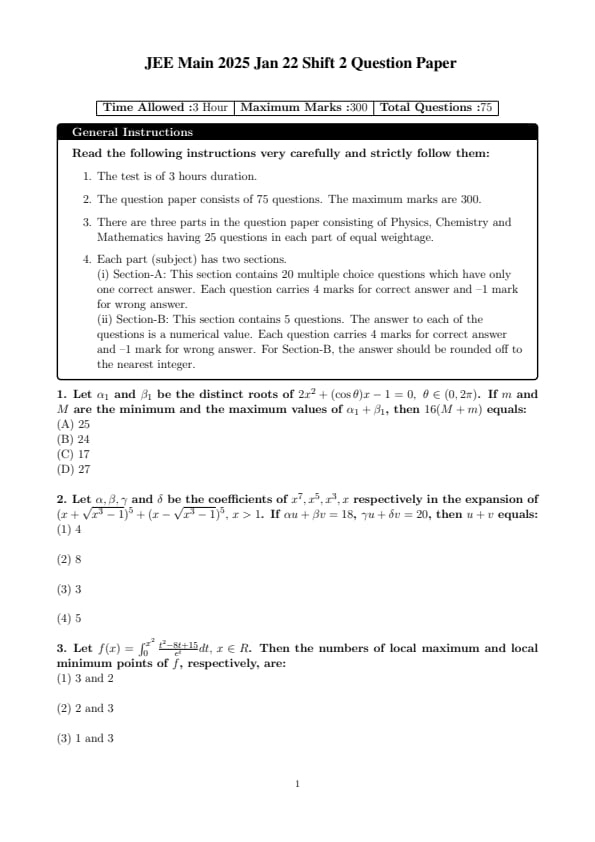
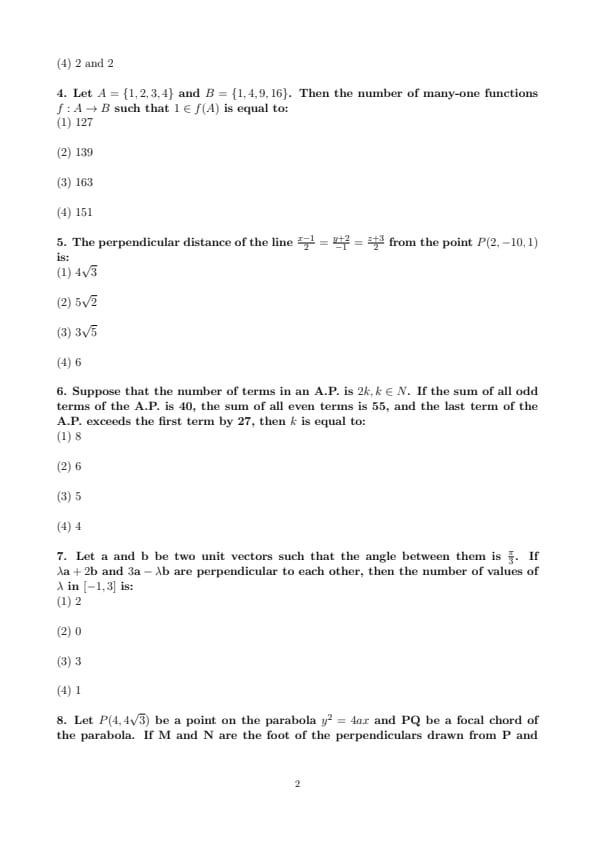
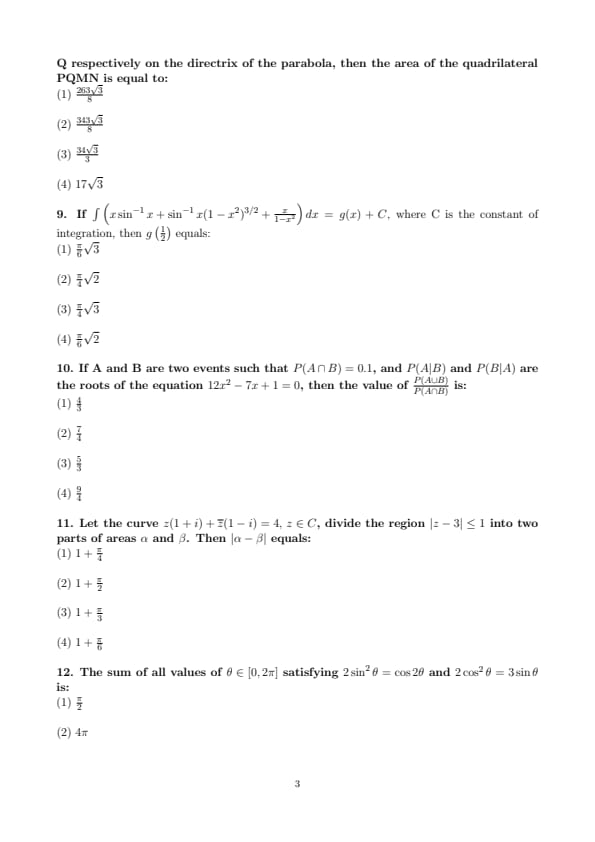
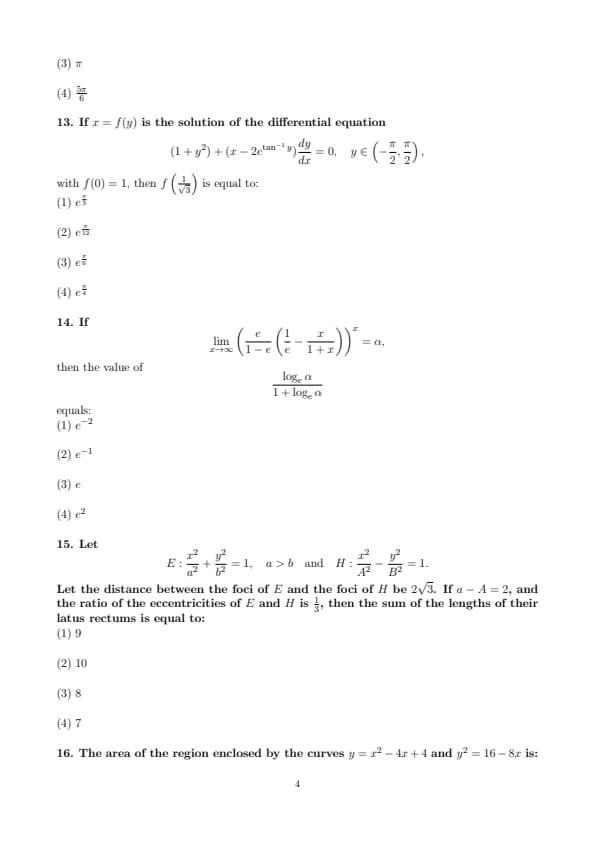
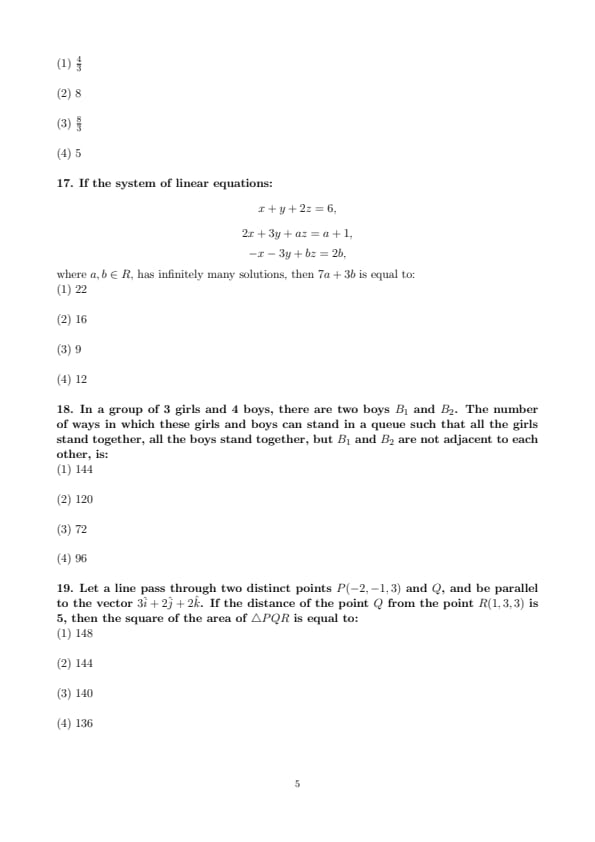
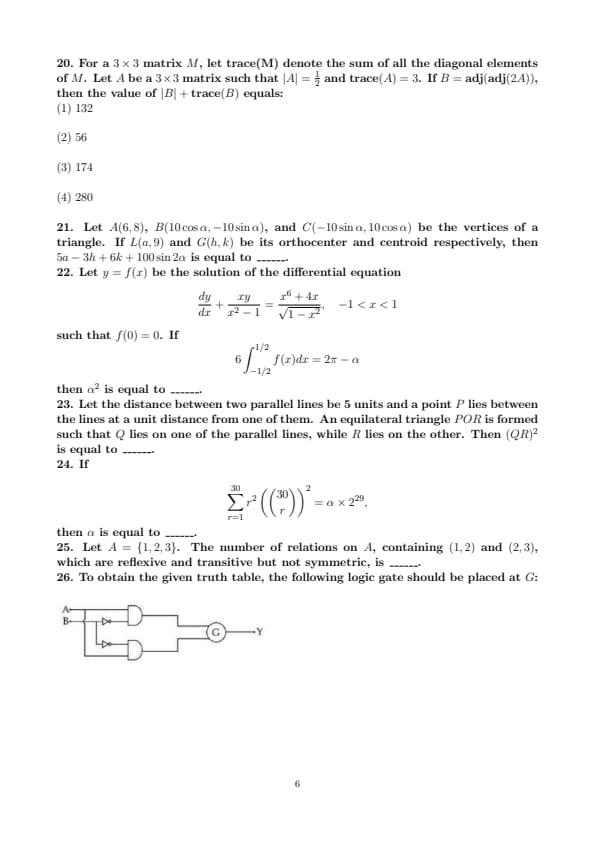
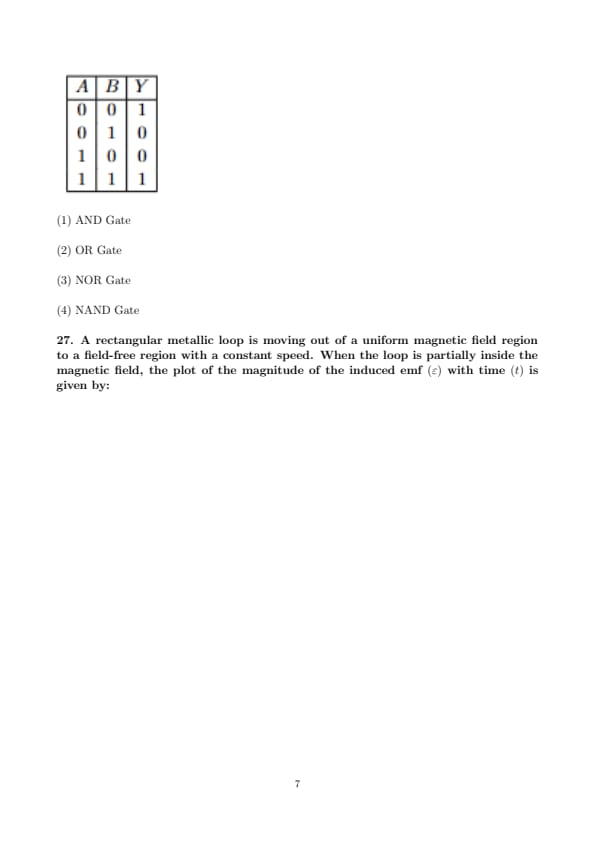
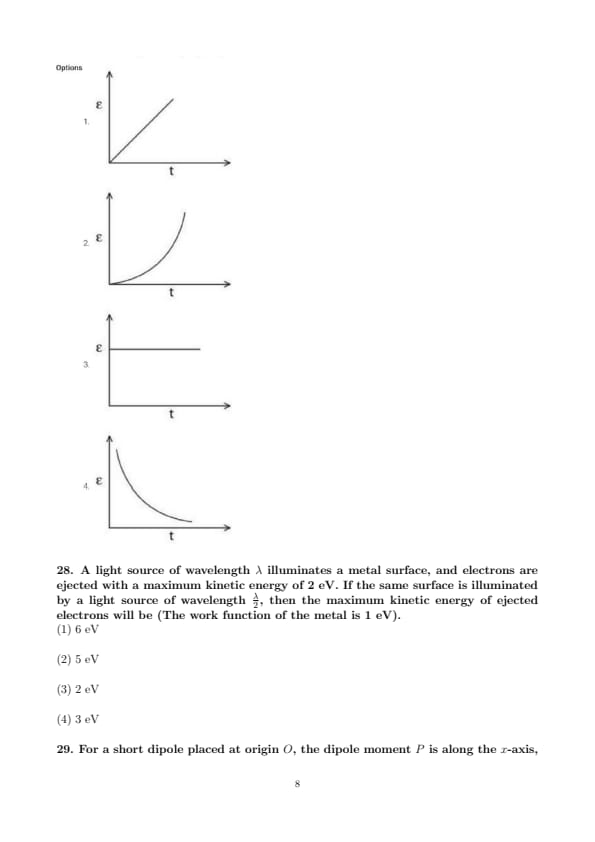
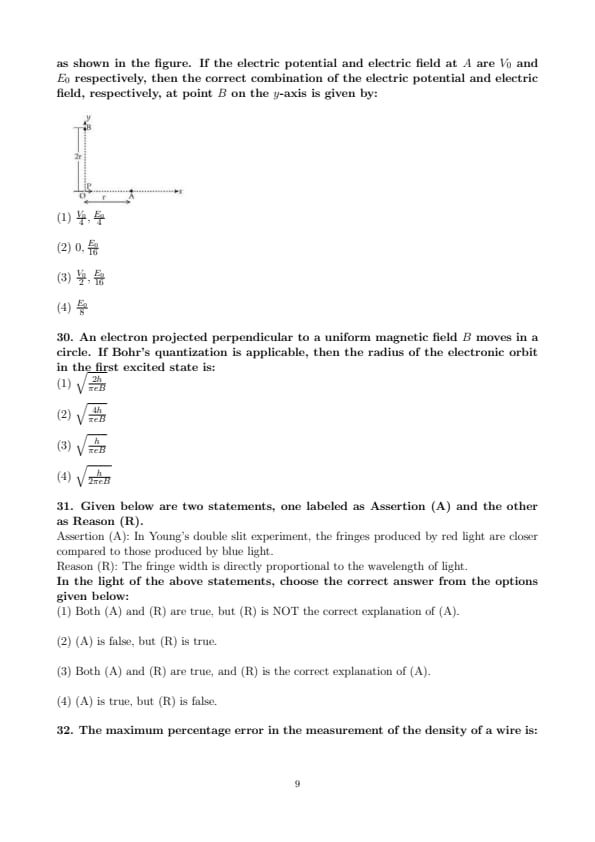
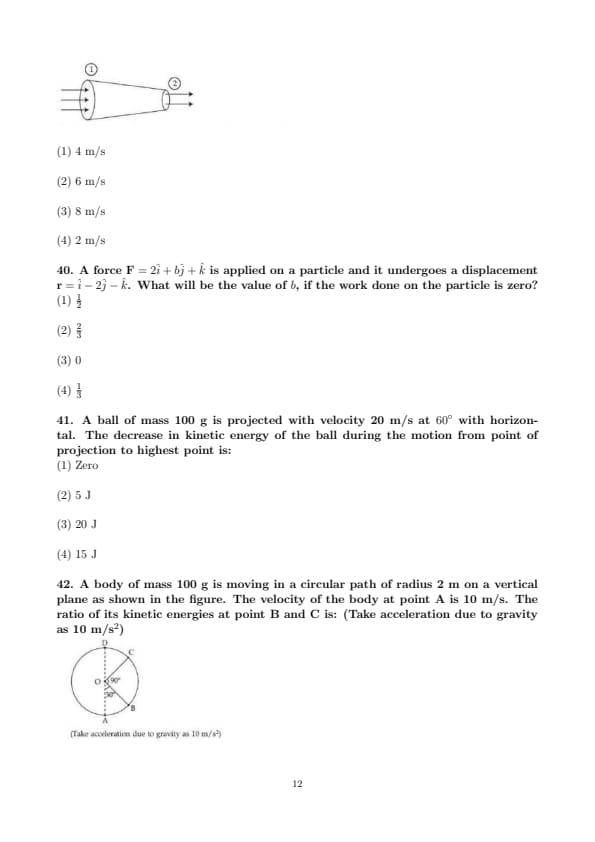
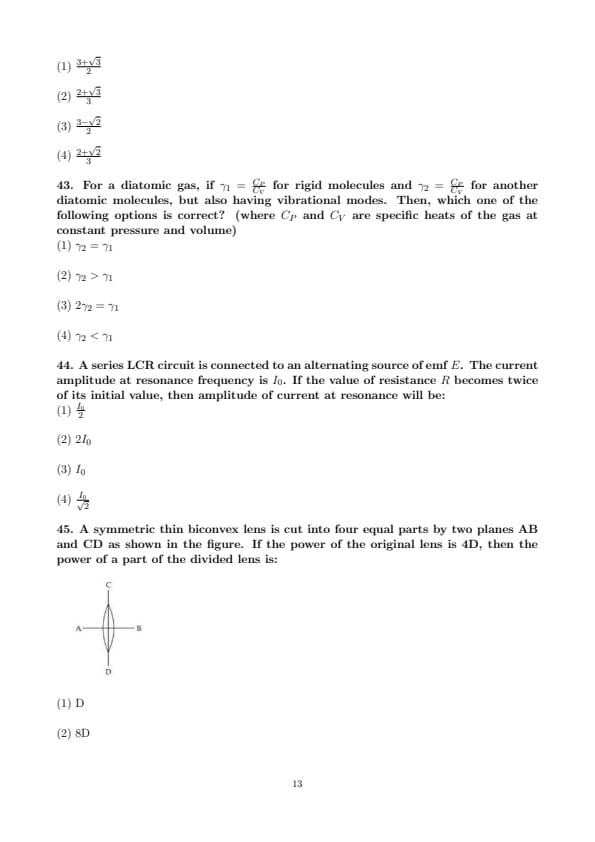
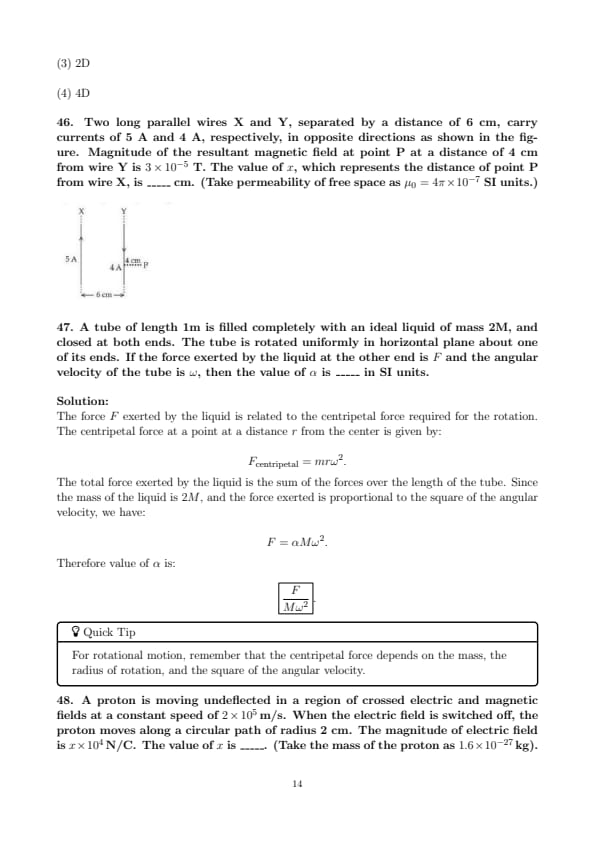
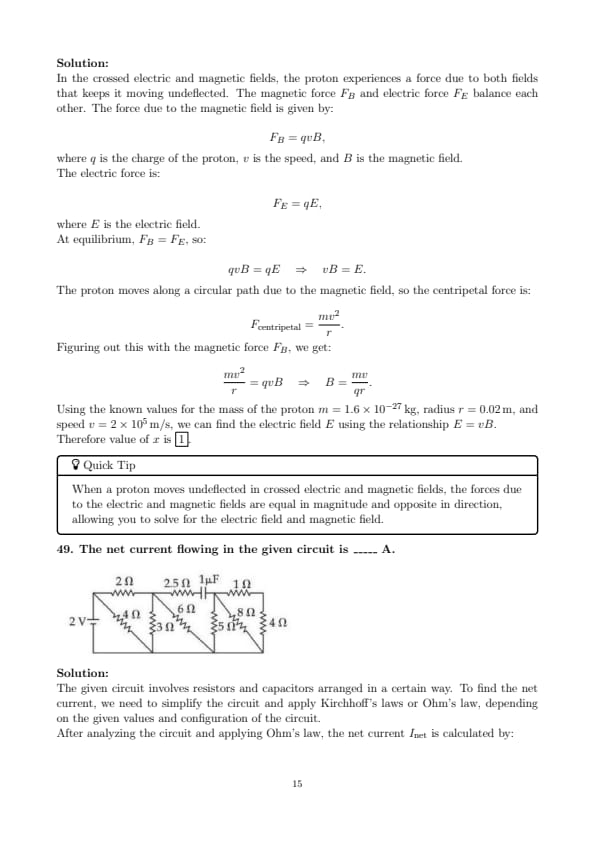
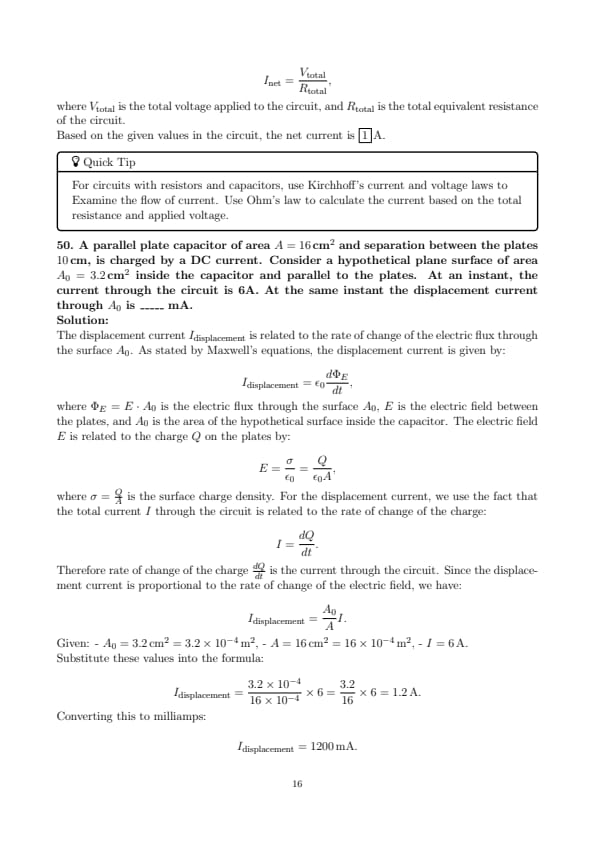
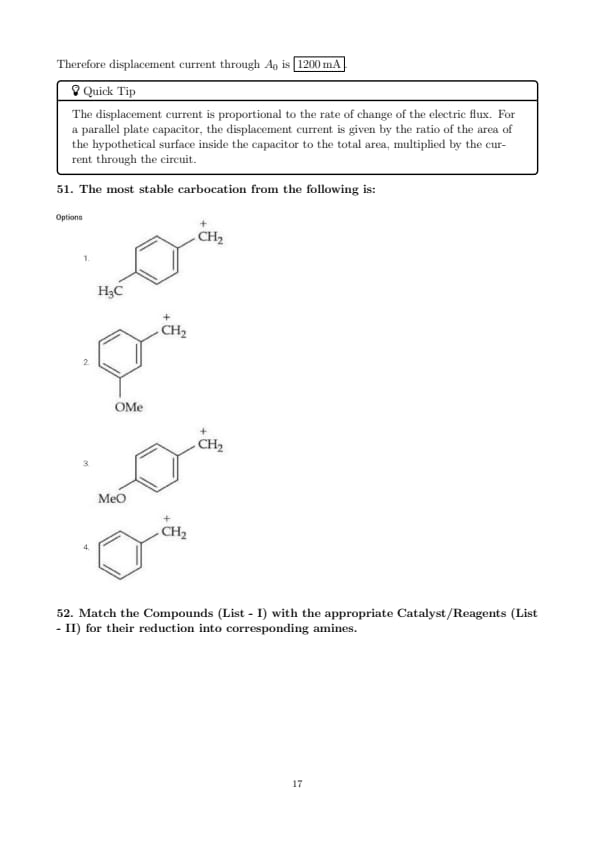
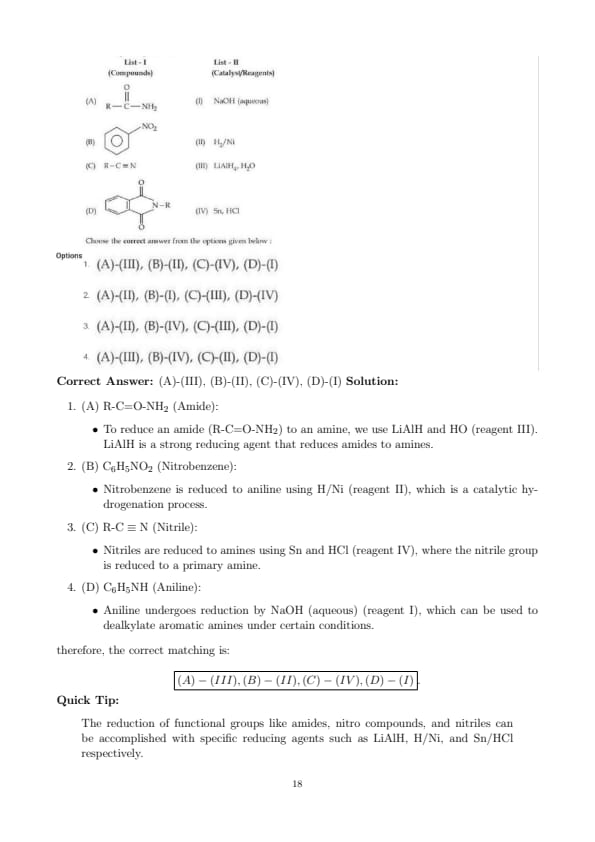
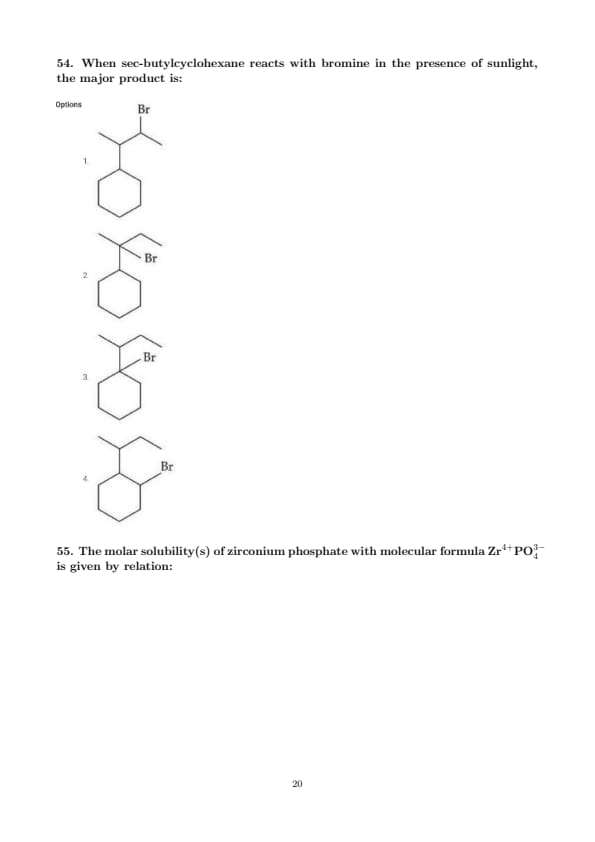
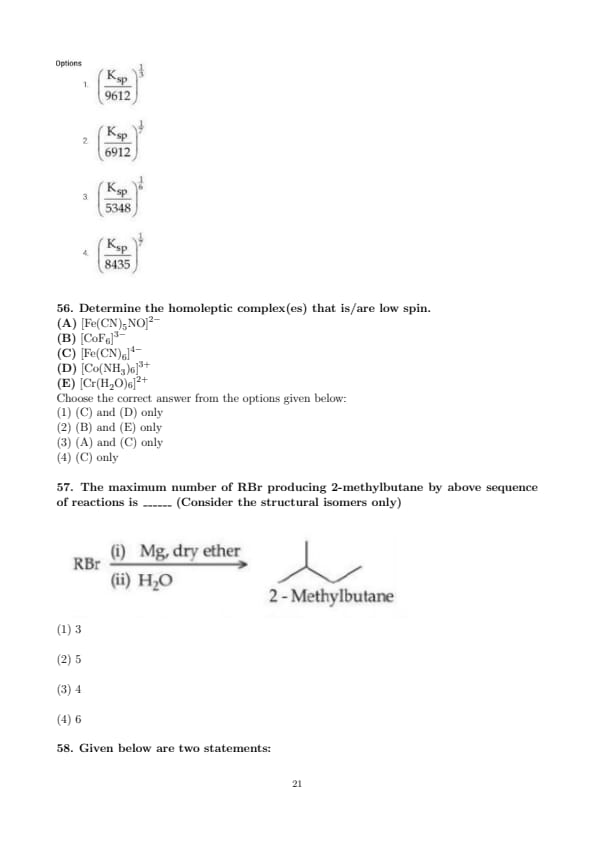
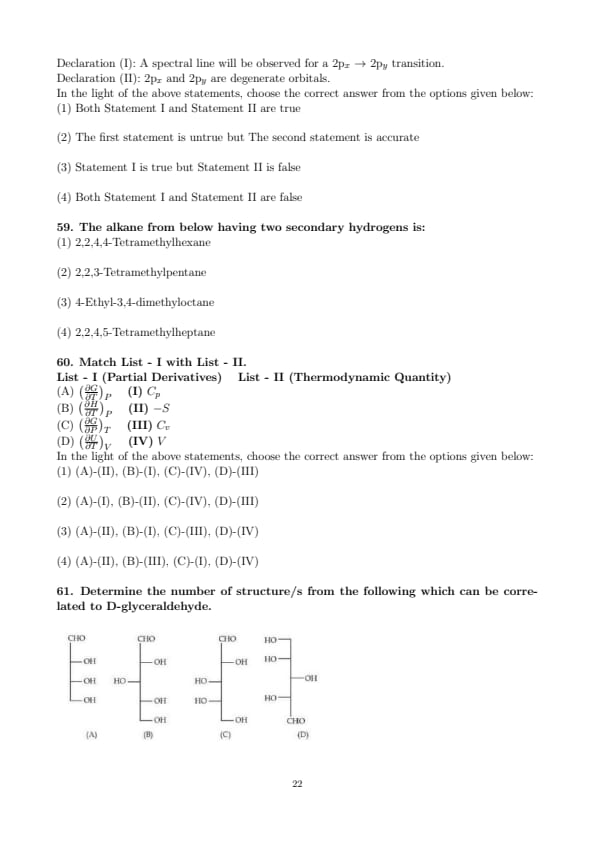
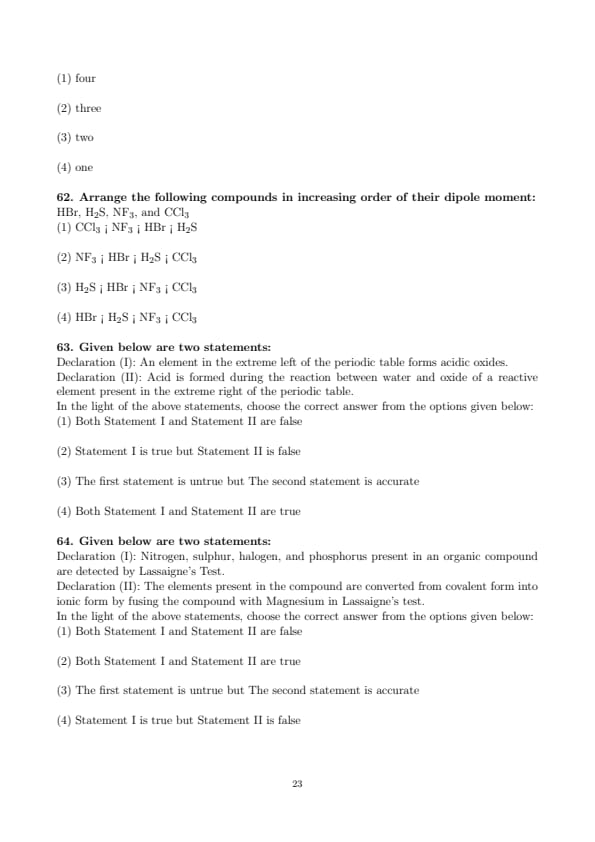
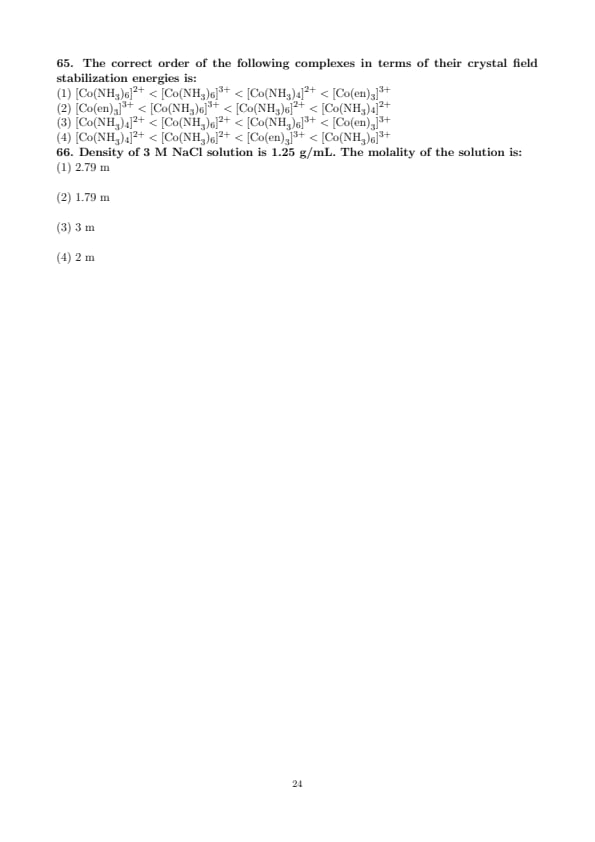
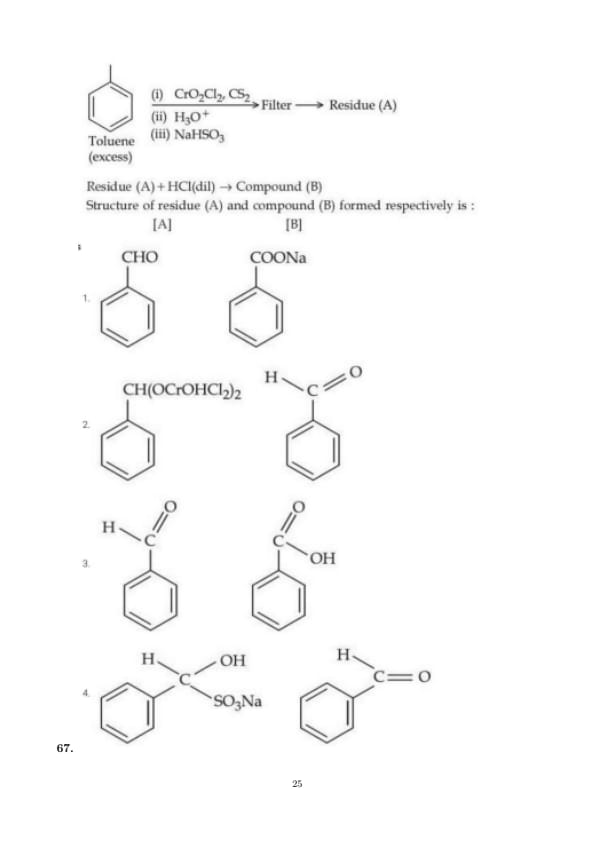
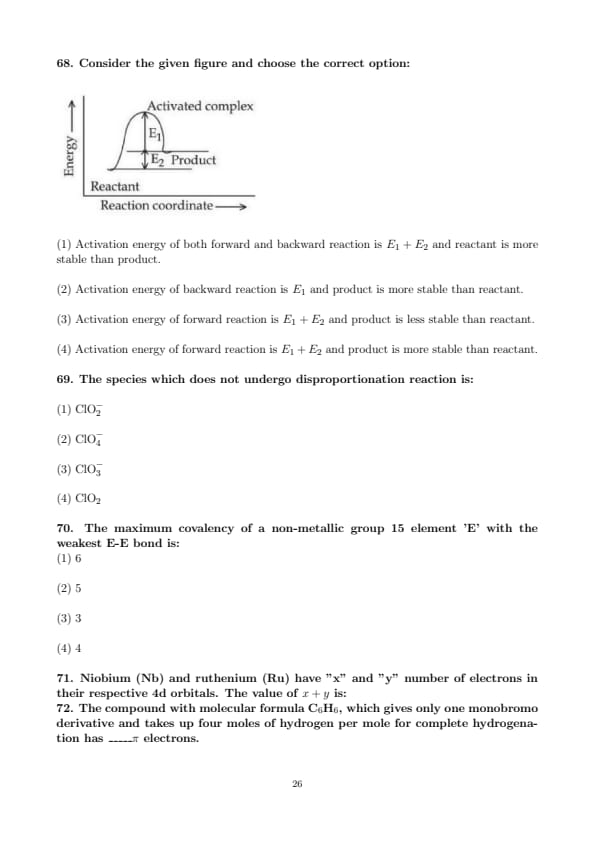
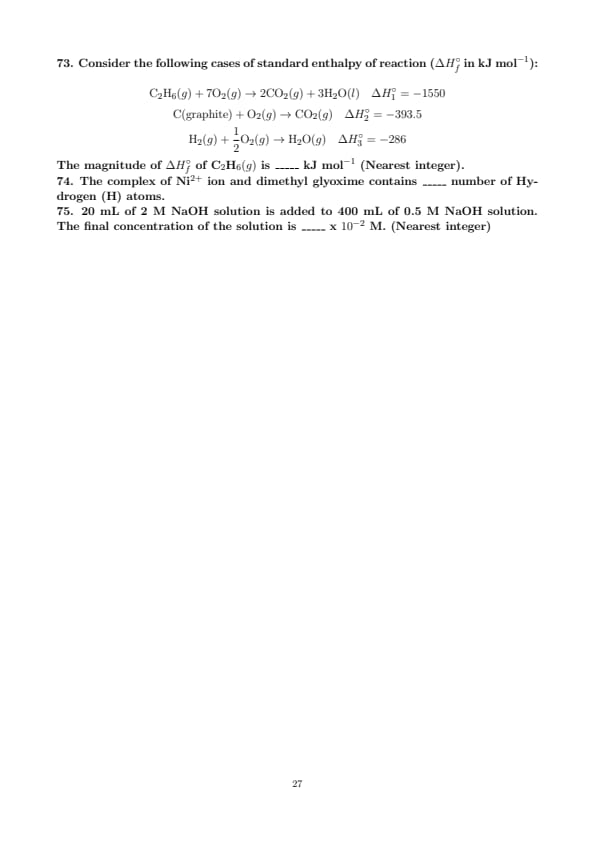
The JEE Main 2025 exam is divided into three sections Physics, Chemistry, and Mathematics with a total of 75 questions. Each section contains 25 questions, including multiple choice questions and numerical-value questions.
| JEE Main 22nd January Shift 2 | |
|---|---|
| Exam Overview | Shift Timing- 3 pm to 6 pm on 22nd January 2025 |
| Difficulty Level | Moderate |
| Physics Analysis |
Difficulty Level: Moderate Moderate Most Asked Topics:
|
| Chemistry Analysis |
Difficulty Level: Easy Most Asked Topics:
|
| Mathematics Analysis |
Difficulty Level: Moderate to Tough Most Asked Topics:
|
| Focus points for Upcoming Shifts | Based on today's exam, here are some points to keep in mind for upcoming shifts:
|
JEE Main 2024 Shift-wise Analysis
The JEE Main 2024 exam for Session 1 and 2 difficult levels was varied across different shifts. Some of the shifts were challenging while some of them were of moderate difficulty. Here’s the detailed shift-wise analysis of all the shifts of JEE main 2024:
| Shift | Subjects Overview | Overall Difficulty |
| Shift 1 - 24th Jan 2024 |
|
Overall: Moderate difficulty. |
| Shift 2 - 24th Jan 2024 |
|
Overall: Slightly Difficult. |
| Shift 3 - 25th Jan 2024 |
|
Overall: Moderate difficulty. |
| Shift 4 - 25th Jan 2024 |
|
Overall: Moderate difficulty. |
| Shift 5 - 26th Jan 2024 |
|
Overall: Moderate difficulty. |
| Shift 6 - 26th Jan 2024 |
|
Overall: Difficult. |
| Shift 7 - 27th Jan 2024 |
|
Overall: Moderate difficulty. |
| Shift 8 - 27th Jan 2024 |
|
Overall: Moderate difficulty. |
*The article might have information for the previous academic years, please refer the official website of the exam.