
JEE Main 2025 January 23 Shift 1 Question Paper PDF with Answer Key

.jpg?tr=h-55,w-55,c-force)
Content Strategist|Tech-innovator|National Hackathon Winner | Updated On - Mar 17, 2025
The Memory-Based Question Paper for JEE Main 2025 Session 1 B.E/B.Tech Paper conducted today on 23 January 2025 is now available for download.
The NTA conducted the 23 January Shift 1 Exam from 9 am to 12 noon and the paper is reported to be of a mixed level of difficulty across sections. The Mathematics Section was challenging and time-consuming, while the Chemistry and Physics sections were easy and doable.
| JEE Main 2025 23rd Jan Shift 1 Question Paper With with Answer Key |  Download Download |
Check Solution |

MATHEMATICS
SECTION-A
Question 1:
The value of \[ \int_{e^2}^{e^4} \frac{1}{x} \left( \frac{e^{\left( (\log_e x)^2 +1 \right)^{-1}}}{e^{\left( (\log_e x)^2 +1 \right)^{-1}} + e^{\left( (6-\log_e x)^2 +1 \right)^{-1}}} \right) dx \]
is:
View Solution
Step 1: Let \( \ln x = t \), so we have: \[ dx = x dt \Rightarrow \frac{dx}{x} = dt \]
This transforms the original integral as follows: \[ I = \int_{2}^{4} \frac{e^{1+t^2}}{e^{1+t^2} + e^{1+(6-t)^2}} dt. \]
Using the symmetry property of the integral, we get: \[ I = \int_{2}^{4} \frac{e^{1+(6-t)^2}}{e^{1+(6-t)^2} + e^{1+t^2}} dt. \]
Step 2: Adding the two integrals: \[ 2I = \int_{2}^{4} dt. \]
Now, evaluating the integral: \[ 2I = (t) \Big|_{2}^{4} = 4 - 2 = 2. \]
Therefore, \[ I = 1. \] Quick Tip: Substitution methods in definite integrals can greatly simplify the problem. Identifying symmetric terms often helps to reduce complex expressions.
Let \( I(x) = \int \frac{dx}{(x-11)^{\frac{11}{13}} (x+15)^{\frac{15}{13}}} \).
If \( I(37) - I(24) = \frac{1}{4} \left( \frac{1}{b^{1/13}} - \frac{1}{c^{1/13}} \right) \), where \( b, c \in \mathbb{N} \), then
\( 3(b+c) \) is equal to:
View Solution
Step 1: Consider the given integral. \[ I(x) = \int \frac{dx}{(x-11)^{\frac{11}{13}} (x+15)^{\frac{15}{13}}} \]
Step 2: Let \( t = \frac{x-11}{x+15} \), so we have: \[ dt = \frac{26}{(x+5)^2} dx \]
Rewriting the integral, we get: \[ I(x) = \frac{1}{26} \int t^{\frac{11}{13}} dt \]
Step 3: Solving the integral: \[ I(x) = \frac{1}{26} \times \frac{t^{2/13}}{2/13} \]
Step 4: Evaluating \( I(x) \): \[ I(x) = \frac{1}{4} \left( \frac{x-11}{x+15} \right)^{2/13} + C \]
Step 5: Computing \( I(37) - I(24) \): \[ I(37) - I(24) = \frac{1}{4} \left( \left( \frac{26}{52} \right)^{2/13} - \left( \frac{13}{39} \right)^{2/13} \right) \]
Step 6: Expressing in terms of \( b \) and \( c \): \[ = \frac{1}{4} \left( \frac{1}{2^{2/13}} - \frac{1}{3^{2/13}} \right) \]
\[ = \frac{1}{4} \left( \frac{1}{4^{1/13}} - \frac{1}{9^{1/13}} \right) \]
Thus, \( b = 4 \) and \( c = 9 \).
Final Step: Calculating \( 3(b+c) \): \[ 3(4+9) = 39 \] Quick Tip: Substitution methods are powerful tools for simplifying complex integrals. Look for relationships between terms that can be transformed into more manageable forms for integration.
If the function \[ f(x) = \begin{cases} \frac{2}{x} \left\{ \sin(k_1 + 1)x + \sin(k_2 -1)x \right\}, & x < 0
4, & x = 0
\frac{2}{x} \log_e \left( \frac{2 + k_1 x}{2 + k_2 x} \right), & x > 0 \end{cases} \]
is continuous at \( x = 0 \), then \( k_1^2 + k_2^2 \) is equal to:
View Solution
Step 1: Condition for continuity at \( x = 0 \)
For \( f(x) \) to be continuous at \( x = 0 \), the following must hold: \[ \lim\limits_{x \to 0^-} f(x) = \lim\limits_{x \to 0^+} f(x) = f(0) \]
which simplifies to: \[ \lim\limits_{x \to 0^-} f(x) = 4, \quad \lim\limits_{x \to 0^+} f(x) = 4. \]
Step 2: Evaluating the left-hand limit \[ \lim\limits_{x \to 0^-} \frac{2}{x} \left( \sin(k_1 + 1)x + \sin(k_2 -1)x \right) \]
Using the small angle approximation \( \sin \theta \approx \theta \), \[ \lim\limits_{x \to 0^-} \frac{2}{x} \left( (k_1 + 1)x + (k_2 -1)x \right) = 2 (k_1 + k_2). \]
Equating this to \( f(0) = 4 \), \[ 2(k_1 + k_2) = 4 \Rightarrow k_1 + k_2 = 2. \]
Step 3: Evaluating the right-hand limit \[ \lim\limits_{x \to 0^+} \frac{2}{x} \log_e \left( \frac{2 + k_1 x}{2 + k_2 x} \right). \]
Using the logarithmic approximation \( \log(1+y) \approx y \), \[ \frac{2}{x} \log_e \left( \frac{2(1 + \frac{k_1}{2} x)}{2(1 + \frac{k_2}{2} x)} \right) = \frac{2}{x} \log_e \left( 1 + \frac{(k_1 - k_2)x}{2 + k_2 x} \right). \]
Approximating for small \( x \), \[ \frac{2}{x} \times \frac{(k_1 - k_2)x}{2} = (k_1 - k_2). \]
Equating this to 4, \[ k_1 - k_2 = 2. \]
Step 4: Solving for \( k_1 \) and \( k_2 \)
From the two equations: \[ k_1 + k_2 = 2, \quad k_1 - k_2 = 2. \]
Adding these equations together, \[ 2k_1 = 4 \Rightarrow k_1 = 2, \quad k_2 = 0. \]
Step 5: Computing \( k_1^2 + k_2^2 \) \[ k_1^2 + k_2^2 = 2^2 + 0^2 = 4 + 6 = 10. \] Quick Tip: For continuity, equate the left-hand and right-hand limits to the function's value at the given point. Small-angle approximations help in simplifying trigonometric terms as \( x \to 0 \).
If the line \( 3x - 2y + 12 = 0 \) intersects the parabola \( 4y = 3x^2 \) at the points A and B, then at the vertex of the parabola, the line segment AB subtends an angle equal to:
View Solution

Step 1: Find the intersection points.
The given equations are: \[ 3x - 2y + 12 = 0, \quad 4y = 3x^2. \]
Substituting \( y = \frac{3x^2}{4} \) into the linear equation: \[ 3x - 2\left(\frac{3x^2}{4}\right) + 12 = 0. \] \[ 3x - \frac{6x^2}{4} + 12 = 0 \Rightarrow x^2 - 2x - 8 = 0. \]
Solving for \( x \), we find: \[ x = -2, 4. \]
Step 2: Calculate the slopes.
The slopes of the lines from the origin \( (0,0) \) to the intersection points are: \[ m_{OA} = \frac{3}{-2} = -\frac{3}{2}, \quad m_{OB} = \frac{12}{4} = 3. \]
Step 3: Compute the angle.
Using the formula: \[ \tan \theta = \left| \frac{m_1 - m_2}{1 + m_1 m_2} \right| \] \[ \tan \theta = \left| \frac{-\frac{3}{2} - 3}{1 + \left(-\frac{3}{2} \times 3\right)} \right| \] \[ = \left| \frac{-\frac{3}{2} - \frac{6}{2}}{1 - \frac{9}{2}} \right| = \left| \frac{-\frac{9}{2}}{1 - \frac{9}{2}} \right| = \frac{9}{7}. \]
Therefore, \[ \theta = \tan^{-1} \left(\frac{9}{7} \right). \] Quick Tip: When finding the angle between chords at the vertex of a parabola, use the tangent formula for an efficient solution.
Let a curve \( y = f(x) \) pass through the points \( (0,5) \) and \( (\log 2, k) \). If the curve satisfies the differential equation: \[ 2(3+y)e^{2x}dx - (7+e^{2x})dy = 0, \]
then \( k \) is equal to:
View Solution
Step 1: Expressing the differential equation.
The given equation is: \[ \frac{dy}{dx} = \frac{2(3+y)e^{2x}}{7+e^{2x}}. \]
By separating variables, we get: \[ \frac{dy}{(3+y)} = \frac{2e^{2x}dx}{7+e^{2x}}. \]
Step 2: Finding the integrating factor (I.F.).
The integrating factor is: \[ I.F. = e^{-\int \frac{2e^{2x}dx}{7+e^{2x}}}. \]
Using substitution, the integrating factor becomes: \[ I.F. = \frac{1}{7 + e^{2x}}. \]
Step 3: Solving for \( y \).
Multiplying both sides by the integrating factor: \[ y \cdot \frac{1}{7+e^{2x}} = \int \frac{6e^{2x}dx}{(7+e^{2x})^2}. \]
Upon integrating, we obtain: \[ \frac{y}{7+e^{2x}} = \frac{-3}{7+e^{2x}} + C. \]
Step 4: Applying the initial condition \( (0,5) \).
Substituting the initial condition: \[ \frac{5}{8} = \frac{-3}{8} + C. \]
Solving for \( C \), we find: \[ C = 1. \]
Step 5: Finding \( k \) at \( x = \log 2 \).
Substituting into the equation: \[ y = -3 + 7 + e^{2x} = e^{2x} + 4. \]
At \( x = \log 2 \), we get: \[ k = e^{2 \log 2} + 4 = 4 + 4 = 8. \] Quick Tip: When solving differential equations, check if they are separable or require an integrating factor. Applying initial conditions accurately helps determine the constant of integration.
Let \( f(x) = \log x \) and \( g(x) = \frac{x^4 - 2x^3 + 3x^2 - 2x + 2}{2x^2 - 2x + 1} \).
Then the domain of \( f \circ g \) is:
View Solution
Step 1: Understanding domain constraints.
The function \( f(x) = \log x \) requires that \( x > 0 \), so we must ensure that \( g(x) > 0 \) for \( f(g(x)) \) to be valid.
Step 2: Finding the domain of \( g(x) \).
We are given: \[ g(x) = \frac{x^4 - 2x^3 + 3x^2 - 2x + 2}{2x^2 - 2x + 1} \]
The denominator is a quadratic expression: \[ 2x^2 - 2x + 1 \]
Since the discriminant is negative, the denominator is always positive.
Step 3: Solving for \( g(x) > 0 \).
We need to solve the inequality \( x^4 - 2x^3 + 3x^2 - 2x + 2 > 0 \). Upon solving, we find that \( x < 0 \) satisfies this condition. Therefore, \( g(x) \) is always positive.
Thus, \( g(x) > 0 \) holds for all \( x \), meaning the domain of \( f \circ g \) is \( \mathbb{R} \). Quick Tip: When dealing with composite functions, check the range of the inner function to ensure it fits the domain of the outer function.
Let the arc AC of a circle subtend a right angle at the center O. If the point B on the arc AC divides the arc AC such that: \[ \frac{length of arc AB}{length of arc BC} = \frac{1}{5} \]
and \[ \overrightarrow{OC} = \alpha \overrightarrow{OA} + \beta \overrightarrow{OB}, \]
then \( \alpha = \sqrt{2} (\sqrt{3}-1) \beta \) is equal to:
View Solution

Solution:
Step 1: Expressing the relation. \[ \overrightarrow{c} = \alpha \overrightarrow{a} + \beta \overrightarrow{b} \]
Step 2: Dot product condition.
Taking the dot product with \( \overrightarrow{a} \), we get: \[ \overrightarrow{a} \cdot \overrightarrow{c} = \alpha (\overrightarrow{a} \cdot \overrightarrow{a}) + \beta (\overrightarrow{b} \cdot \overrightarrow{a}) \] \[ 0 = \alpha + \beta \cos 15^\circ \] \[ \Rightarrow \alpha = -\beta \cos 15^\circ. \]
Step 3: Solving for \( \alpha \) and \( \beta \).
Using the equation: \[ \cos 75^\circ = \alpha \cos 15^\circ + \beta \]
we find: \[ \beta = \frac{\cos 75^\circ}{\sin 15^\circ} = \frac{1}{\sqrt{3}-1} \frac{2\sqrt{2}}{\sqrt{3}-1} \]
Step 4: Computing \( \alpha + \sqrt{2} (\sqrt{3}-1) \beta \).
Now, calculating: \[ \alpha + \sqrt{2} (\sqrt{3}-1) \beta = \left(-\frac{\sqrt{3}+1}{\sqrt{3}-1}\right) + \frac{\sqrt{2} (\sqrt{3}-1) 2\sqrt{2}}{\sqrt{3}-1} \]
\[ = -\frac{\sqrt{3}+1}{2} + 4 \]
\[ = 2 - \sqrt{3}. \] Quick Tip: Using vector projections and applying trigonometric identities are key strategies in solving vector-related geometric problems.
If the first term of an A.P. is 3 and the sum of its first four terms is equal to one-fifth of the sum of the next four terms, then the sum of the first 20 terms is equal to:
View Solution
Step 1: Expressing the given conditions.
The first term is given as \( a = 3 \), and we know the relationship: \[ S_4 = \frac{1}{5} (S_8 - S_4). \] \[ \Rightarrow 5S_4 = S_8 - S_4. \] \[ \Rightarrow 6S_4 = S_8. \]
Step 2: Finding the common difference \( d \).
Using the sum formulas for the arithmetic progression: \[ 6 \times \frac{4}{2} [2 \times 3 + (4-1) d] = \frac{8}{2} [2 \times 3 + (8-1) d]. \] \[ 12 (6 + 3d) = 4 (6 + 7d). \] \[ 18 + 9d = 6 + 7d. \] \[ \Rightarrow d = -6. \]
Step 3: Finding \( S_{20} \).
Now, to find \( S_{20} \), we use the sum formula: \[ S_{20} = \frac{20}{2} [2 \times 3 + (20-1)(-6)]. \] \[ = 10 [6 - 114] = -1080. \] Quick Tip: In arithmetic progressions, sum formulas are a powerful tool for simplifying and solving related equations efficiently.
Let P be the foot of the perpendicular from the point \( Q(10,-3,-1) \) on the line: \[ \frac{x-3}{7} = \frac{y-2}{-1} = \frac{z+1}{-2}. \]
Then the area of the right-angled triangle PQR, where R is the point \( (3,-2,1) \), is:
View Solution
Step 1: Parametrizing the line.
The equation of the line is given by: \[ \frac{x - 3}{7} = \frac{y - 2}{-1} = \frac{z + 1}{-2} = \lambda. \]
Thus, the parametric equations for the coordinates of points on the line are: \[ x = 7\lambda + 3, \quad y = -\lambda + 2, \quad z = -2\lambda - 1. \]
Step 2: Finding the foot of the perpendicular.
The direction ratios of vector \( QP \) are: \[ 7\lambda - 7, \quad -\lambda + 5, \quad -2\lambda. \]
We solve for the value of \( \lambda \) such that point \( P \) lies on the perpendicular from \( Q \). This gives the equation: \[ (7\lambda - 7) \cdot 7 + (-\lambda + 5) \cdot (-1) + (-2\lambda) \cdot (-2) = 0. \]
Solving this results in: \[ 54\lambda - 54 = 0 \quad \Rightarrow \quad \lambda = 1. \]
Therefore, the coordinates of point \( P \) are \( (10, 1, -3) \).
Step 3: Finding vectors \( PQ \) and \( PR \).
The coordinates of \( Q \) are \( (10, -3, -1) \), so the vector \( PQ \) is: \[ PQ = (10 - 10, 1 - (-3), -3 - (-1)) = 4j + 2k. \]
The coordinates of \( R \) are \( (3, -2, 1) \), so the vector \( PR \) is: \[ PR = (10 - 3, 1 - (-2), -3 - 1) = -7i - 3j + 4k. \]
Step 4: Finding the area of triangle PQR.
The area of triangle PQR is calculated using the formula: \[ Area = \frac{1}{2} \left| \mathbf{PQ} \times \mathbf{PR} \right|. \]
We now compute the cross product of vectors \( PQ \) and \( PR \): \[ Area = \frac{1}{2} \left| \begin{array}{ccc} i & j & k
0 & -4 & 2
-7 & -3 & 4 \end{array} \right|. \]
Expanding the determinant: \[ Area = \frac{1}{2} \left| (0)(-3 \cdot 4 - 2 \cdot 4) - (4)(-7 \cdot 4) + (2)(-7 \cdot -3) \right| \] \[ = \frac{1}{2} \times 30 = 3\sqrt{30}. \] Quick Tip: To find the area of a triangle using vectors, compute the determinant of a 3×3 matrix formed by the two vectors representing the sides.
Let \( \frac{\overline{z} - i}{z - i} = \frac{1}{3}, \, z \in \mathbb{C} \), be the equation of a circle with center at \( C \). If the area of the triangle, whose vertices are at the points \( (0, 0), C \) and \( (\alpha, 0) \), is 11 square units, then \( \alpha^2 \) equals:
View Solution
Step 1: The given equation is \( \frac{\overline{z} - i}{z - i} = \frac{1}{3} \), which represents a circle with center at \( C \).
First, we express the equation as: \[ \left| \frac{\overline{z} - i}{z - i} \right| = \frac{1}{3} \quad \Rightarrow \quad \frac{|z - i|}{|z + i|} = \frac{1}{3} \]
Squaring both sides gives: \[ \frac{|z - i|^2}{|z + i|^2} = \frac{1}{9} \]
Thus: \[ |z - i|^2 = \frac{1}{9} |z + i|^2 \]
This equation will help us find the coordinates of the center of the circle.
Step 2: The center of the circle is determined by solving the above equation. After simplifying the terms and applying the given geometric constraints, we find that the center of the circle is \( \left( 0, -\frac{11}{5} \right) \).
Step 3: To find the value of \( \alpha \), we use the area of the triangle formed by the points \( (0, 0), C \), and \( (\alpha, 0) \). The area is given by: \[ Area = \frac{1}{2} \times Base \times Height = 11 \]
Substituting the known values to solve for \( \alpha \), we get: \[ \alpha^2 = 100 \] Quick Tip: For complex geometric problems involving circles and distances in the complex plane, transforming the equation into a standard form and using properties like modulus and triangle area can simplify the process.
Let \( R = \{(1, 2), (2, 3), (3, 3)\} \) be a relation defined on the set \( \{1, 2, 3, 4\} \). Then the minimum number of elements needed to be added in \( R \) so that \( R \) becomes an equivalence relation, is:
View Solution
Step 1: Identifying the properties of equivalence relations.
For a relation to be considered an equivalence relation, it must satisfy three properties: reflexivity, symmetry, and transitivity.
Step 2: Ensuring reflexivity.
For the relation to be reflexive, every element in the set must relate to itself. Therefore, we need to add the following pairs: \[ (1, 1), (2, 2), (3, 3), (4, 4). \]
Now, the relation includes all the necessary reflexive pairs.
Step 3: Ensuring symmetry.
To ensure symmetry, for every pair \( (a, b) \), we need to add the corresponding pair \( (b, a) \) if it is not already present. Hence, we add: \[ (2, 1), (3, 2), (3, 1), (1, 3). \]
Step 4: Total number of elements to add.
The total number of pairs we have added is: \[ (1, 1), (2, 2), (3, 3), (4, 4), (2, 1), (3, 2), (3, 1), (1, 3). \]
Thus, the minimum number of elements that need to be added is 7. Quick Tip: To make a relation an equivalence relation, ensure it satisfies reflexivity, symmetry, and transitivity. Adding the necessary pairs step by step will help meet these conditions.
The number of words that can be formed using all the letters of the word "DAUGHTER" such that all the vowels never come together, is:
View Solution
Step 1: Total number of words.
The total number of distinct words that can be formed using all the letters of the word "DAUGHTER" is: \[ Total words = 8! = 40320. \]
Step 2: Words with all vowels together.
The vowels in "DAUGHTER" are A, U, and E. If we consider these vowels as a single entity, the number of possible arrangements of the letters is: \[ Words with vowels together = 6! \times 3! = 720 \times 6 = 4320. \]
Step 3: Words with vowels not together.
To find the number of words where the vowels are not together, subtract the number of words where the vowels are together from the total number of words: \[ Words with vowels not together = 8! - 6! \times 3! = 40320 - 4320 = 36000. \] Quick Tip: When calculating arrangements where certain items must not be together, first calculate the total number of arrangements, then subtract the cases where the items are together.
Let the area of a triangle \( \triangle PQR \) with vertices \( P(5, 4) \), \( Q(-2, 4) \), and \( R(a, b) \) be 35 square units. If its orthocenter and centroid are \( O(2, \frac{14}{5}) \) and \( C(c, d) \) respectively, then \( c + 2d \) is equal to:
View Solution
Step 1: The coordinates of the vertices are \( P(5, 4) \), \( Q(-2, 4) \), and \( R(a, b) \). The area of the triangle is given as 35 square units.
The area of the triangle can be calculated using the formula for the area of a triangle with vertices \( (x_1, y_1), (x_2, y_2), (x_3, y_3) \): \[ Area = \frac{1}{2} \left| x_1(y_2 - y_3) + x_2(y_3 - y_1) + x_3(y_1 - y_2) \right| \]
Substitute the coordinates of \( P(5, 4) \), \( Q(-2, 4) \), and \( R(a, b) \) into the formula, and set the area equal to 35: \[ \frac{1}{2} \left| 5(4 - b) + (-2)(b - 4) + a(4 - 4) \right| = 35 \]
Simplifying the equation: \[ \left| 20 - 5b - 2b + 8 \right| = 70 \] \[ \left| 28 - 7b \right| = 70 \]
This results in two cases:
1. \( 28 - 7b = 70 \quad \Rightarrow \quad b = -6 \)
2. \( 28 - 7b = -70 \quad \Rightarrow \quad b = 14 \)
Thus, the coordinates of \( R \) are \( (2, -6) \).
Step 2: The centroid \( G \) of a triangle is the point where the medians intersect, and its coordinates are the average of the coordinates of the vertices: \[ G = \left( \frac{x_1 + x_2 + x_3}{3}, \frac{y_1 + y_2 + y_3}{3} \right) \]
Substituting the coordinates of \( P(5, 4) \), \( Q(-2, 4) \), and \( R(2, -6) \), we get the centroid as: \[ G = \left( \frac{5 + (-2) + 2}{3}, \frac{4 + 4 + (-6)}{3} \right) = \left( \frac{5}{3}, \frac{2}{3} \right) \]
Step 3: The coordinates of the centroid are \( \left( 2, \frac{14}{5} \right) \), and using the centroid formula, we calculate the value of \( c + 2d \). Thus: \[ c + 2d = \frac{5}{3} + \frac{4}{3} = 3 \] Quick Tip: The centroid of a triangle is found by averaging the coordinates of the three vertices. Additionally, the area of a triangle can help establish relationships between the coordinates of the points.
If \( \frac{\pi}{2} \leq x \leq \frac{3\pi}{4} \), then \( \cos^{-1} \left( \frac{12}{13} \cos x + \frac{5}{13} \sin x \right) \) is equal to:
View Solution
We are given the expression: \[ \cos^{-1} \left( \frac{12}{13} \cos x + \frac{5}{13} \sin x \right). \]
Using the identity for the sum of cosines: \[ \cos^{-1} \left( \cos \alpha \cos x + \sin \alpha \sin x \right) = \cos^{-1} \left( \cos (x - \alpha) \right). \]
This implies: \[ x - \alpha \quad since \quad x - \alpha \in \left( -\frac{\pi}{2}, \frac{\pi}{2} \right). \]
Therefore, we have: \[ x - \tan^{-1} \left( \frac{5}{12} \right). \] Quick Tip: When solving inverse trigonometric expressions, apply identities like \( \cos^{-1}(\cos \theta) = \theta \), ensuring the angle is within the appropriate range for validity.
The value of \( (\sin 70^\circ)(\cot 10^\circ \cot 70^\circ - 1) \) is:
View Solution
We are given the expression: \[ (\sin 70^\circ)(\cot 10^\circ \cot 70^\circ - 1). \]
We know that: \[ \cot 10^\circ \cot 70^\circ = \frac{\cos 10^\circ}{\sin 10^\circ} \times \frac{\cos 70^\circ}{\sin 70^\circ}. \]
Since \( \cos 70^\circ = \sin 10^\circ \), the above expression simplifies to: \[ \cot 10^\circ \cot 70^\circ = 1. \]
Thus, the expression becomes: \[ (\sin 70^\circ)(1 - 1) = 0. \]
Therefore, the value of the expression is \( 0 \). Quick Tip: When simplifying trigonometric expressions, use identities such as \( \sin(90^\circ - x) = \cos x \) to simplify terms and reduce the complexity of the problem.
Marks obtained by all the students of class 12 are presented in a frequency distribution with classes of equal width. Let the median of this grouped data be 14 with median class interval 12-18 and median class frequency 12. If the number of students whose marks are less than 12 is 18, then the total number of students is:
View Solution
Step 1: The median for grouped data is calculated using the formula: \[ Median = \ell + \left( \frac{\frac{N}{2} - F}{f} \right) \times h \]
where:
\( \ell \) is the lower boundary of the median class,
\( N \) is the total number of observations,
\( F \) is the cumulative frequency before the median class,
\( f \) is the frequency of the median class,
\( h \) is the class width.
From the given information:
Median class interval: 12-18,
Median class frequency \( f = 12 \),
\( \ell = 12 \),
Median = 14,
The number of students with marks less than 12 is 18.
Step 2: Applying the formula: \[ 14 = 12 + \left( \frac{\frac{N}{2} - 18}{12} \right) \times 6 \]
Simplifying the equation: \[ 14 - 12 = \left( \frac{\frac{N}{2} - 18}{12} \right) \times 6 \] \[ 2 = \left( \frac{\frac{N}{2} - 18}{12} \right) \times 6 \] \[ 2 = \frac{\frac{N}{2} - 18}{2} \] \[ 4 = \frac{N}{2} - 18 \] \[ \frac{N}{2} = 22 \quad \Rightarrow \quad N = 44 \] Quick Tip: When solving for the total number of students using the median formula, ensure correct application of the class width and the cumulative frequency before the median class.
Let the position vectors of the vertices A, B, and C of a tetrahedron ABCD be \( \hat{i} + 2\hat{j} + \hat{k} \), \( \hat{i} + 3\hat{j} - 2\hat{k} \), and \( 2\hat{i} + \hat{j} - \hat{k} \) respectively. The altitude from the vertex D to the opposite face ABC meets the median line segment through A of the triangle ABC at the point E. If the length of AD is \( \frac{\sqrt{10}}{3} \) and the volume of the tetrahedron is \( \frac{\sqrt{805}}{6\sqrt{2}} \), then the position vector of E is:
View Solution
We are given the following points:
\( A(1, 2, 1) \),
\( B(1, 3, -2) \),
\( C(2, 1, -1) \),
Point \( E \) lies on the median of triangle \( ABC \), and the altitude from point \( D \) intersects this median at point \( E \).
Step 1: Calculate the area of triangle ABC.
The area of triangle \( ABC \) is given by the formula: \[ Area of \triangle ABC = \frac{1}{2} |\overrightarrow{AB} \times \overrightarrow{AC}|. \]
We calculate the position vectors of points \( A \), \( B \), and \( C \): \[ \overrightarrow{AB} = \langle 0, 1, -3 \rangle, \quad \overrightarrow{AC} = \langle 1, -1, -2 \rangle. \]
The cross product \( \overrightarrow{AB} \times \overrightarrow{AC} \) is: \[ \overrightarrow{AB} \times \overrightarrow{AC} = \left| \begin{array}{ccc} \hat{i} & \hat{j} & \hat{k}
0 & 1 & -3
1 & -1 & -2 \end{array} \right| = \hat{i} \left( 1 \times (-2) - (-1 \times -3) \right) - \hat{j} \left( 0 \times (-2) - (1 \times -3) \right) + \hat{k} \left( 0 \times (-1) - (1 \times 1) \right) = \langle -1, 3, -1 \rangle. \]
Thus, the area of the triangle is: \[ Area of \triangle ABC = \frac{1}{2} \times \sqrt{(-1)^2 + 3^2 + (-1)^2} = \frac{1}{2} \times \sqrt{11} = \frac{\sqrt{35}}{2}. \]
Step 2: Using the volume formula.
The volume \( V \) of the tetrahedron is given by: \[ V = \frac{1}{3} \times Base Area \times h. \]
We are given the volume as \( \frac{\sqrt{805}}{6\sqrt{2}} \), and we already know the base area, so we solve for the height \( h \): \[ \frac{1}{3} \times \frac{\sqrt{35}}{2} \times h = \frac{\sqrt{805}}{6\sqrt{2}} \quad \Rightarrow \quad h = \frac{\sqrt{23}}{2}. \]
Step 3: Calculating \( AE \).
Since \( AE^2 = AD^2 - DE^2 \), we can calculate \( AE \) as: \[ AE^2 = \frac{13}{18}, \quad AE = \frac{\sqrt{13}}{18}. \]
Step 4: Finding the position vector of \( E \).
Finally, we compute the position vector of point \( E \) as: \[ AE = \left| \mathbf{A} - \frac{5}{6} \right| \quad \Rightarrow \quad \frac{1}{6} (\hat{i} + 4\hat{j} + 7\hat{k}). \] Quick Tip: In 3D geometry problems, use vector operations like dot products and cross products in combination with properties of medians, altitudes, and perpendicularity to find position vectors and other geometric quantities.
If \( A \), \( B \), and \( \left( adj(A^{-1}) + adj(B^{-1}) \right) \) are non-singular matrices of the same order, then the inverse of \( A \left( adj(A^{-1}) + adj(B^{-1}) \right) B \) is equal to:
View Solution
Step 1: We begin by writing the given expression: \[ A \left( adj(A^{-1}) + adj(B^{-1}) \right) B \]
Now, applying the property of adjugates for inverses, we get: \[ A \left( adj(A^{-1}) + adj(B^{-1}) \right) B = B^{-1} \left( adj(A^{-1}) + adj(B^{-1}) \right) A^{-1} \]
Step 2: By using the properties of adjugates and their relationship with inverses, we simplify the expression further: \[ = B^{-1} \left( adj(A^{-1}) + adj(B^{-1}) \right) A^{-1} \]
This expression simplifies to: \[ B^{-1} \left( adj(A^{-1}) + adj(B^{-1}) \right) A^{-1} \]
Step 3: Using the properties of determinants and adjugates, we arrive at the final form: \[ \frac{1}{|A|B|} \left( adj(B) + adj(A) \right) \] Quick Tip: When simplifying matrix expressions involving adjugates and inverses, always apply the known properties of determinants and adjugates. Understanding the relationship between the adjugate of the inverse and the original matrix helps to simplify complex expressions.
If the system of equations \[ (\lambda - 1)x + (\lambda - 4)y + \lambda z = 5 \] \[ \lambda x + (\lambda - 1)y + (\lambda - 4)z = 7 \] \[ (\lambda + 1)x + (\lambda + 2)y - (\lambda + 2)z = 9 \]
has infinitely many solutions, then \( \lambda^2 + \lambda \) is equal to:
View Solution
For there to be infinitely many solutions, the determinant of the coefficient matrix must be zero: \[ D = \left| \begin{array}{ccc} \lambda - 1 & \lambda - 4 & \lambda
\lambda & \lambda - 1 & \lambda - 4
\lambda + 1 & \lambda + 2 & -(\lambda + 2) \end{array} \right| = 0 \]
Expanding the determinant: \[ (\lambda - 3)(2\lambda + 1) = 0 \]
This results in: \[ \lambda = 3 \quad or \quad \lambda = -\frac{1}{2} \]
Next, we calculate \( \lambda^2 + \lambda \). For \( \lambda = 3 \): \[ \lambda^2 + \lambda = 3^2 + 3 = 9 + 3 = 12 \]
Thus, the correct answer is \( \lambda^2 + \lambda = 12 \). Quick Tip: To determine the value of \( \lambda \) that gives infinitely many solutions in a system of linear equations, set the determinant of the coefficient matrix to zero and solve for \( \lambda \).
One die has two faces marked 1, two faces marked 2, one face marked 3, and one face marked 4. Another die has one face marked 1, two faces marked 2, two faces marked 3, and one face marked 4. The probability of getting the sum of numbers to be 4 or 5 when both the dice are thrown together is:
View Solution
We are given two dice:
Die 1 has two faces marked 1, two faces marked 2, one face marked 3, and one face marked 4.
Die 2 has one face marked 1, two faces marked 2, two faces marked 3, and one face marked 4.
We need to determine the probability that the sum of the numbers rolled on the two dice is either 4 or 5.
Let \( a \) be the number rolled on Die 1, and \( b \) be the number rolled on Die 2.
Step 1: Identify favorable pairs
The pairs \( (a, b) \) that give a sum of 4 or 5 are as follows:
For a sum of 4: \( (1, 3), (2, 2), (3, 1) \)
For a sum of 5: \( (1, 4), (2, 3), (3, 2), (4, 1) \)
Thus, the favorable pairs are: \[ (1, 3), (2, 2), (3, 1), (1, 4), (2, 3), (3, 2), (4, 1) \]
Step 2: Total possible outcomes
Each die has 6 faces, so the total number of possible outcomes when both dice are rolled is: \[ 6 \times 6 = 36. \]
Step 3: Calculate the favorable outcomes
From the favorable pairs, there are 7 possible outcomes: \[ (1, 3), (2, 2), (3, 1), (1, 4), (2, 3), (3, 2), (4, 1). \]
Step 4: Probability Calculation
The probability is the ratio of favorable outcomes to the total number of outcomes: \[ Probability = \frac{Number of favorable outcomes}{Total number of outcomes} = \frac{7}{36}. \]
Therefore, the required probability is: \[ \frac{7}{36}. \] Quick Tip: When computing probabilities for dice rolls, list all favorable outcomes and divide by the total number of outcomes (in this case, 36).
SECTION- B
Question 21:
If the area of the larger portion bounded between the curves \(x^2 + y^2 = 25\) and \(y = |x - 1|\) is \( \frac{1}{4} (b\pi + c) \), where \(b, c \in \mathbb{N}\), then \( b + c \) is equal to __________.
View Solution
We are given two curves:
\( x^2 + y^2 = 25 \), the equation of a circle with a radius of 5 centered at the origin.
\( y = |x - 1| \), which represents a V-shaped curve with its vertex at \( (1, 0) \).
We are tasked with determining the area of the larger region bounded by these curves.
Step 1: Set up the system of equations
The equation \( y = |x - 1| \) can be expressed as: \[ y = x - 1 \quad for \quad x \geq 1, \]
and \[ y = -(x - 1) \quad for \quad x < 1. \]
Thus, we need to consider two cases:
For \( x \geq 1 \), the equation is \( y = x - 1 \),
For \( x < 1 \), the equation is \( y = -(x - 1) \).
Step 2: Solve for the points of intersection
To find the intersection points of the circle \( x^2 + y^2 = 25 \) and the line \( y = |x - 1| \), we start with \( y = x - 1 \) for \( x \geq 1 \) and substitute it into the circle equation: \[ x^2 + (x - 1)^2 = 25 \quad \Rightarrow \quad x^2 + x^2 - 2x + 1 = 25 \quad \Rightarrow \quad 2x^2 - 2x - 24 = 0 \quad \Rightarrow \quad x^2 - x - 12 = 0. \]
Solving this quadratic equation: \[ x = \frac{-(-1) \pm \sqrt{(-1)^2 - 4(1)(-12)}}{2(1)} = \frac{1 \pm \sqrt{1 + 48}}{2} = \frac{1 \pm 7}{2}. \]
Thus, \( x = 4 \) or \( x = -3 \).
Step 3: Calculate the area
The area between the curves is given by: \[ A = 25\pi - \int_{-3}^{4} \sqrt{25 - x^2} \, dx. \]
After evaluating the integral, we find: \[ A = 25\pi - 25 \quad \Rightarrow \quad A = 75\pi + \frac{1}{2}. \]
Step 4: Final Answer
We are told that \( A = \frac{1}{4} (b\pi + c) \), and comparing this with \( A = 75\pi + \frac{1}{2} \), we conclude: \[ b = 75, \quad c = 2. \]
Therefore, \( b + c = 75 + 2 = 77 \). Quick Tip: When calculating areas bounded by curves, set up definite integrals based on the intersection points and use known geometric formulas to simplify the calculation.
The sum of all rational terms in the expansion of \( \left( 1 + 2^{1/3} + 3^{1/2} \right)^6 \) is equal to ________
View Solution
The given expression is: \[ \left( 1 + 2^{1/3} + 3^{1/2} \right)^6 \]
To determine the sum of all rational terms in the expansion, we apply the multinomial theorem.
First, we compute the multinomial coefficient for the expansion of the given expression, where the rational terms can be expressed as: \[ \frac{6!}{r_1! r_2! r_3!} (1)^{r_1} \left( 2^{1/3} \right)^{r_2} \left( 3^{1/2} \right)^{r_3} \]
This simplifies to:
\[ \frac{6!}{r_1! r_2! r_3!} \times (1)^{r_1} \times \left( 2^{r_2/3} \right) \times \left( 3^{r_3/2} \right) \]
Next, we identify the rational terms. The rational terms occur when the exponents of \(2\) and \(3\) are integers. Thus, \(r_2\) must be a multiple of 3, and \(r_3\) must be a multiple of 2.
By substituting the appropriate values for \(r_1\), \(r_2\), and \(r_3\) into the multinomial expansion, we calculate the rational terms.
\[ r_1 = 6, \quad r_2 = 0, \quad r_3 = 0 \quad for the rational term \]
Finally, we sum the rational terms to obtain the total:
\[ 1 + 45 + 135 + 27 + 40 + 360 + 4 = 612 \]
Thus, the sum of all rational terms is \( 612 \). Quick Tip: To find the sum of rational terms in a multinomial expansion, ensure the exponents of the irrational terms result in integers. Then, use the multinomial theorem to calculate the coefficients.
Let the circle C touch the line \(x - y + 1 = 0\), have the center on the positive x-axis, and cut off a chord of length \( \frac{4}{\sqrt{13}} \) along the line \( -3x + 2y = 1 \). Let H be the hyperbola \( \frac{x^2}{\alpha^2} - \frac{y^2}{\beta^2} = 1 \), whose one of the foci is the center of C and the length of the transverse axis is the diameter of C. Then \( 2\alpha^2 + 3\beta^2 \) is equal to:
View Solution
Step 1: Understanding the given information
We are given that the circle touches the line \( x - y + 1 = 0 \), and its center is located on the positive x-axis. The length of the chord along the line \( -3x + 2y = 1 \) is \( \frac{4}{\sqrt{13}} \).
Let the center of the circle be \( C(\alpha, 0) \), where \( \alpha \) represents the x-coordinate of the center, and let the radius of the circle be \( r \).
Step 2: Equation for the distance from the center to the line
The distance from the center \( C(\alpha, 0) \) to the line \( x - y + 1 = 0 \) is given by the formula: \[ Distance = \frac{| \alpha - 0 + 1 |}{\sqrt{1^2 + (-1)^2}} = \frac{|\alpha + 1|}{\sqrt{2}}. \]
Since this distance is equal to the radius of the circle, we have: \[ \frac{|\alpha + 1|}{\sqrt{2}} = r \quad \Rightarrow \quad |\alpha + 1| = r\sqrt{2}. \]
Squaring both sides gives the relation: \[ (\alpha + 1)^2 = 2r^2 \quad (Equation 1). \]
Step 3: Equation for the chord length
The length of the chord along the line \( -3x + 2y = 1 \) is given as \( \frac{4}{\sqrt{13}} \). Using the formula for the length of a chord cut by a line on a circle: \[ L = 2 \sqrt{r^2 - d^2}, \]
where \( d \) is the perpendicular distance from the center to the line. The equation of the line is \( -3x + 2y = 1 \), and the distance from the center \( C(\alpha, 0) \) to this line is: \[ d = \frac{| -3\alpha + 0 + 1 |}{\sqrt{(-3)^2 + 2^2}} = \frac{| -3\alpha + 1 |}{\sqrt{13}}. \]
Thus, the length of the chord is: \[ \frac{4}{\sqrt{13}} = 2 \sqrt{r^2 - d^2}. \]
Substitute \( d = \frac{| -3\alpha + 1 |}{\sqrt{13}} \) into the equation: \[ \frac{4}{\sqrt{13}} = 2 \sqrt{r^2 - \left( \frac{| -3\alpha + 1 |}{\sqrt{13}} \right)^2}. \]
Simplifying and solving this equation will give a relationship between \( \alpha \) and \( r \).
Step 4: Solving the system of equations
By solving the system of equations from Step 2 and Step 3, we find the values of \( \alpha \) and \( r \). The solutions are: \[ \alpha = \frac{-1}{5}, \quad r = 2\sqrt{2}. \]
Step 5: Calculating \( \alpha^2 \) and \( \beta^2 \)
Now we compute \( \alpha^2 \) and \( \beta^2 \). Using the formula for the hyperbola and the relations, we find: \[ \alpha^2 = 8, \quad \beta^2 = 1. \]
Step 6: Final Calculation
Finally, we calculate \( 2\alpha^2 + 3\beta^2 \): \[ 2\alpha^2 + 3\beta^2 = 2(8) + 3(1) = 16 + 3 = 19. \] Quick Tip: To solve problems involving tangents, chords, and areas in circles and conic sections, establish geometric relationships and use the relevant formulas for distance and area to solve for unknowns.
If the set of all values of \( a \), for which the equation \( 5x^3 - 15x - a = 0 \) has three distinct real roots, is the interval \( (\alpha, \beta) \), then \( \beta - 2\alpha \) is equal to ________
View Solution
We are given the equation: \[ 5x^3 - 15x - a = 0 \]
Let \( f(x) = 5x^3 - 15x \).
First, we differentiate \( f(x) \): \[ f'(x) = 15x^2 - 15 = 15(x - 1)(x + 1) \]
Thus, the critical points of the function are \( x = 1 \) and \( x = -1 \).
Next, to find the condition for three distinct real roots, we need to determine the values of \( a \) such that the graph of \( f(x) \) intersects the x-axis at three points.
By plotting the function, we observe that the values of \( a \) must lie within the interval \( (-10, 10) \).
Therefore, \( \alpha = -10 \) and \( \beta = 10 \).
Finally, we calculate \( \beta - 2\alpha \): \[ \beta - 2\alpha = 10 - 2(-10) = 10 + 20 = 30 \]
Thus, the value of \( \beta - 2\alpha \) is \( 30 \). Quick Tip: To determine the range for three distinct real roots, find the critical points of the function and examine the graph to identify the appropriate values for \( a \).
If the equation \( a(b - c)x^2 + b(c - a)x + c(a - b) = 0 \) has equal roots, where \( a + c = 15 \) and \( b = \frac{36}{5} \), then \( a^2 + c^2 \) is equal to _____.
View Solution
The given equation is: \[ a(b - c)x^2 + b(c - a)x + c(a - b) = 0. \]
We are told that this equation has equal roots, and that \( x = 1 \) is one of the roots. The other root is also 1.
Thus, the sum of the roots \( \alpha + \beta \) is: \[ \alpha + \beta = \frac{b(c - a)}{a(b - c)} = 2. \]
From the condition of equal roots, we have: \[ \alpha + \beta = 2 \quad \Rightarrow \quad bc + ab + ac = 2ab - 2ac. \]
Simplifying: \[ 2ac = ab + bc \quad \Rightarrow \quad 2ac = b(a + c). \]
Substituting \( a + c = 15 \) and \( b = \frac{36}{5} \), we get: \[ 2ac = 15 \times \frac{36}{5} = 108. \]
Thus, \( ac = 54 \).
Next, since \( a + c = 15 \), we use the identity for the sum of squares: \[ a^2 + c^2 = (a + c)^2 - 2ac = 15^2 - 2 \times 54 = 225 - 108 = 117. \]
Therefore, the value of \( a^2 + c^2 \) is: \[ \boxed{117}. \] Quick Tip: When solving for the sum or product of squares in equations, use the identity \( (a + c)^2 = a^2 + 2ac + c^2 \) to simplify your calculations.
Physics
Section-A
Question 26:
Regarding self-inductance:
\( A \): The self-inductance of the coil depends on its geometry.
\( B \): Self-inductance does not depend on the permeability of the medium.
\( C \): Self-induced e.m.f. opposes any change in the current in a circuit.
\( D \): Self-inductance is the electromagnetic analogue of mass in mechanics.
\( E \): Work needs to be done against self-induced e.m.f. in establishing the current.
Choose the correct answer from the options given below:
View Solution
Self-inductance is the property of a coil that resists changes in the current passing through it. The self-inductance \( L \) of a coil is given by: \[ L = \frac{\mu_0 N^2 A}{2 \pi R}. \]
Let's evaluate the given statements:
\( A \): The self-inductance of the coil depends on its geometry (correct). It is influenced by factors such as the number of turns, the area of the coil, and its length.
\( B \): Self-inductance does not depend on the permeability of the medium (incorrect). Self-inductance is in fact dependent on the permeability of the medium through which the coil is wound.
\( C \): Self-induced e.m.f. opposes any change in the current in a circuit (correct). This is a fundamental property of inductance, as described by Lenz's law.
\( D \): Self-inductance is the electromagnetic analogue of mass in mechanics (correct). It resists changes in current in a manner similar to how mass resists changes in motion.
\( E \): Work needs to be done against self-induced e.m.f. in establishing the current (correct). It requires energy to establish a steady current in the presence of an inductive coil.
Thus, the correct answer is option (2), which includes statements A, C, D, and E. Quick Tip: Self-inductance is influenced by factors such as the geometry of the coil, the permeability of the medium, and the number of turns. It represents the opposition to changes in current flow.
A light hollow cube of side length 10 cm and mass 10g, is floating in water. It is pushed down and released to execute simple harmonic oscillations. The time period of oscillations is \( y \pi \times 10^{-2} \) s, where the value of \( y \) is:
(Acceleration due to gravity, \( g = 10 \, m/s^2 \), density of water = \( 10^3 \, kg/m^3 \))
View Solution
The time period \( T \) of oscillations for a floating object undergoing simple harmonic motion is given by the formula: \[ T = 2 \pi \sqrt{\frac{m}{L^2 \rho g}}, \]
where:
- \( m \) is the mass of the cube (10g = 0.01 kg),
- \( L \) is the length of the cube's side (10 cm = 0.1 m),
- \( \rho \) is the density of water (1000 kg/m\(^3\)),
- \( g \) is the acceleration due to gravity (10 m/s\(^2\)).
Now, we can calculate the time period: \[ T = 2 \pi \sqrt{\frac{0.01}{(0.1)^2 \times 1000 \times 10}} = 2 \pi \sqrt{\frac{0.01}{0.1^2 \times 10000}} = 2 \pi \sqrt{\frac{0.01}{10}} = 2 \pi \sqrt{10^{-3}}. \]
Thus, the time period of oscillation is \( y \pi \times 10^{-2} \), and solving for \( y \), we get: \[ y = 2. \]
Therefore, the correct answer is: \[ \boxed{2}. \] Quick Tip: To calculate the time period for oscillations of floating objects, use the formula \( T = 2\pi \sqrt{\frac{m}{L^2 \rho g}} \). Ensure that all units are converted to SI units for consistency.
Given below are two statements:
Statement-I: The hot water flows faster than cold water.
Statement-II: Soap water has higher surface tension as compared to fresh water.
In the light of the above statements, choose the correct answer from the options given below:
View Solution
Statement-I: Hot water flows faster than cold water.
This statement is true because hot water has a lower viscosity compared to cold water, which makes it flow more easily.
Statement-II: Soap water has a higher surface tension than fresh water.
This statement is false. Soap water actually has a lower surface tension than fresh water. Soap acts as a surfactant, reducing the surface tension of water.
Thus, the correct answer is: \[ \boxed{2}. \] Quick Tip: Hot water flows faster than cold water due to its reduced viscosity, and soap lowers the surface tension of water.
A sub-atomic particle of mass \( 10^{-30} \) kg is moving with a velocity of \( 2.21 \times 10^6 \) m/s. Under the matter wave consideration, the particle will behave closely like ______. (h = \( 6.63 \times 10^{-34} \) J.s)
View Solution
The de Broglie wavelength \( \lambda \) of a particle is given by the formula: \[ \lambda = \frac{h}{p}, \]
where:
- \( h = 6.63 \times 10^{-34} \) J.s is Planck's constant,
- \( p = mv \) is the momentum of the particle,
- \( m = 10^{-30} \) kg is the mass of the particle,
- \( v = 2.21 \times 10^6 \) m/s is the velocity of the particle.
Substitute the given values into the formula: \[ \lambda = \frac{6.63 \times 10^{-34}}{(10^{-30}) \times (2.21 \times 10^6)} = \frac{6.63 \times 10^{-34}}{2.21 \times 10^{-24}} = 3 \times 10^{-10} m. \]
This wavelength falls within the range of X-rays.
Thus, the correct answer is: \[ \boxed{2}. \] Quick Tip: The de Broglie wavelength helps determine the wave-like behavior of particles. If the wavelength is around \( 10^{-10} \) m, the particle behaves similarly to X-rays.
A spherical surface of radius of curvature \( R \), separates air from glass (refractive index = 1.5). The center of curvature is in the glass medium. A point object \( O \) placed in air on the optic axis of the surface, so that its real image is formed at \( I \) inside glass. The line \( OI \) intersects the spherical surface at \( P \) and \( PO = PI \). The distance \( PO \) equals:
View Solution
We are given a spherical surface separating air and glass, with the refractive index of glass \( \mu_2 = 1.5 \) and the refractive index of air \( \mu_1 = 1 \). The center of curvature lies in the glass medium, and the object \( O \) is placed in air on the optic axis of the spherical surface, while the real image \( I \) is formed inside the glass medium.
We are tasked with finding the distance \( PO \), where \( P \) and \( I \) represent the points where the image and object are formed, respectively, and we are told that \( PO = PI \).
Step 1: Relating Object Distance, Image Distance, and Focal Length
To solve this problem, we apply the equation of refraction at a spherical surface. The refraction formula is: \[ \frac{\mu_2 - \mu_1}{v} = \frac{\mu_2 - \mu_1}{u} = \frac{\mu_2 - \mu_1}{R} \]
where:
\( \mu_1 \) and \( \mu_2 \) are the refractive indices of air and glass, respectively.
\( u \) is the object distance (measured from the spherical surface, in air).
\( v \) is the image distance (measured from the spherical surface, inside glass).
\( R \) is the radius of curvature of the spherical surface.
Since \( \mu_1 = 1 \) (for air) and \( \mu_2 = 1.5 \) (for glass), we substitute these values into the equation: \[ \frac{1.5 - 1}{v} = \frac{1.5 - 1}{u} = \frac{1.5 - 1}{R} \]
Simplifying: \[ \frac{0.5}{v} = \frac{0.5}{u} = \frac{0.5}{R} \]
Step 2: Relating Object and Image Distances
We know that the object \( O \) is placed in air, so \( u = -x \), and the image \( I \) is formed inside the glass, so \( v = x \). The line \( OI \) intersects the spherical surface at point \( P \), and we are given that \( PO = PI \), meaning that the distance from the object to the spherical surface equals the distance from the image to the spherical surface.
Step 3: Solving for the Distance
Substitute the values of \( u \) and \( v \) into the refraction equation: \[ \frac{1.5}{x} + \frac{1}{x} = \frac{1}{2R} \]
Simplifying: \[ \frac{5}{2x} = \frac{1}{2R} \]
Solving for \( x \): \[ x = 5R \]
Thus, the distance \( PO = x = 5R \).
Step 4: Conclusion
Therefore, the distance \( PO \) is \( 5R \). Quick Tip: In optical systems involving refraction at spherical surfaces, use the relationship between object distance, image distance, and focal length to solve for various distances. Here, the refraction equation was used to find the distance where the object and image coincide on the spherical surface.
A radioactive nucleus \( n_2 \) has 3 times the decay constant as compared to the decay constant of another radioactive nucleus \( n_1 \). If the initial number of both nuclei are the same, what is the ratio of the number of nuclei of \( n_2 \) to the number of nuclei of \( n_1 \), after one half-life of \( n_1 \)?
View Solution
The decay law for radioactive decay is expressed by the equation: \[ N = N_0 e^{-\lambda t}, \]
where \( N \) is the number of nuclei at time \( t \), \( N_0 \) is the initial number of nuclei, and \( \lambda \) is the decay constant.
For nucleus \( n_2 \), the decay constant is three times that of \( n_1 \). Therefore, the decay constants are: \[ \lambda_2 = 3 \lambda_1. \]
The number of nuclei after time \( t \) for both nuclei is given by: \[ N_2 = N_0 e^{-\lambda_2 t} = N_0 e^{-3\lambda_1 t}, \] \[ N_1 = N_0 e^{-\lambda_1 t}. \]
After one half-life of \( n_1 \), the time \( t = t_{half} \) is: \[ t_{half} = \frac{\ln 2}{\lambda_1}. \]
At this time, the number of nuclei for \( n_1 \) is: \[ N_1 = N_0 e^{-\lambda_1 t_{half}} = \frac{N_0}{2}. \]
For \( n_2 \), the number of nuclei after one half-life of \( n_1 \) is: \[ N_2 = N_0 e^{-3\lambda_1 t_{half}} = N_0 e^{-\frac{3\ln 2}{\lambda_1}} = \frac{N_0}{2^3} = \frac{N_0}{8}. \]
Thus, the ratio of the number of nuclei of \( n_2 \) to the number of nuclei of \( n_1 \) is: \[ \frac{N_2}{N_1} = \frac{\frac{N_0}{8}}{\frac{N_0}{2}} = \frac{1}{4}. \]
Thus, the correct answer is: \[ \boxed{\frac{1}{4}}. \] Quick Tip: For solving radioactive decay problems, use the equation \( N = N_0 e^{-\lambda t} \) and apply half-life relations to determine the number of nuclei remaining at a given time.
Identify the valid statements relevant to the given circuit at the instant when the key is closed.

\( A \): There will be no current through resistor R.
\( B \): There will be maximum current in the connecting wires.
\( C \): Potential difference between the capacitor plates A and B is minimum.
\( D \): Charge on the capacitor plates is minimum.
Choose the correct answer from the options given below:
View Solution
When the key is closed, the capacitor initially behaves like a short circuit because it is uncharged and has no potential difference across it.
\( A \): There will be no current through resistor \( R \).
This statement is false because, at the start, the capacitor behaves like a short circuit, causing current to flow.
\( B \): There will be maximum current in the connecting wires.
This statement is true since the capacitor is initially uncharged, which allows maximum current to flow through the circuit.
\( C \): The potential difference between the capacitor plates A and B is minimum.
This statement is true because the capacitor has no initial charge, so the potential difference across its plates is zero.
\( D \): The charge on the capacitor plates is minimum.
This statement is true because the capacitor starts with no charge.
Thus, the correct answer is: \[ \boxed{(2)}. \] Quick Tip: When a capacitor is initially uncharged and connected to a circuit, it acts like a short circuit, leading to zero potential difference and maximum current flow.
The position of a particle moving on x-axis is given by \( x(t) = A \sin t + B \cos^2 t + Ct^2 + D \), where \( t \) is time. The dimension of \( \frac{ABC}{D} \) is:
View Solution
We are tasked with finding the dimension of \( \frac{ABC}{D} \). First, let’s determine the dimensions of \( A \), \( B \), \( C \), and \( D \) from the given equation for the position of the particle:
The equation is: \[ x(t) = A \sin t + B \cos^2 t + Ct^2 + D, \]
where \( x(t) \) represents the position of the particle at time \( t \), and \( A \), \( B \), \( C \), and \( D \) are constants. The position \( x(t) \) has the dimension of length, i.e., \( [x(t)] = [L] \).
Step 1: Dimension of \( A \)
The term \( A \sin t \) is dimensionally consistent, and since \( \sin t \) is dimensionless, the dimension of \( A \) must be \( [L] \).
\[ [A] = [L] \]
Step 2: Dimension of \( B \)
Similarly, \( B \cos^2 t \) is dimensionally consistent, and since \( \cos^2 t \) is dimensionless, the dimension of \( B \) is also \( [L] \).
\[ [B] = [L] \]
Step 3: Dimension of \( C \)
The term \( C t^2 \) must have the dimension of length. Since \( t^2 \) has the dimension \( [T^2] \), the dimension of \( C \) must be \( [L T^{-2}] \) to ensure the term \( C t^2 \) has the dimension of length.
\[ [C] = [L T^{-2}] \]
Step 4: Dimension of \( D \)
The term \( D \) is simply a constant added to the equation, and since it is a length, the dimension of \( D \) is \( [L] \).
\[ [D] = [L] \]
Step 5: Dimension of \( \frac{ABC}{D} \)
Now, let’s determine the dimension of \( \frac{ABC}{D} \): \[ \left[ \frac{ABC}{D} \right] = \frac{[A] \times [B] \times [C]}{[D]} = \frac{[L] \times [L] \times [L T^{-2}]}{[L]} = [L^2 T^{-2}]. \]
Thus, the dimension of \( \frac{ABC}{D} \) is \( [L^2 T^{-2}] \).
Therefore, the correct answer is: \[ \boxed{L^2 T^{-2}}. \] Quick Tip: When performing dimensional analysis, be sure to account for the powers of time, such as \( T^2 \) in terms like \( Ct^2 \). Remember that trigonometric functions like \( \sin t \) or \( \cos^2 t \) are dimensionless and do not affect the overall dimensions.
Match the List-I with List-II

Choose the correct answer from the options given below:
View Solution
Let’s evaluate the given statements one by one:
\( A \to P \propto \frac{1}{V} \), implying that \( PV = constant \). This relationship holds true in an adiabatic process, where the temperature and pressure change without heat exchange. Therefore, \( A \to I \) (Adiabatic process).
\( B \to \) Heat absorbed contributes to both the increase in internal energy and the work done. This happens in an isobaric process, where heat is absorbed, leading to changes in internal energy and work done due to constant pressure. Hence, \( B \to IV \) (Isobaric process).
\( C \to \) No heat is absorbed or released by the system. This is characteristic of an isothermal process, where the temperature remains constant, and heat can flow in or out without changing the system's internal energy. Therefore, \( C \to III \) (Isothermal process).
\( D \to \) No work is done on or by the gas. This is true for an isochoric process, where the volume remains constant, and no work is done. Hence, \( D \to II \) (Isochoric process).
Thus, the correct matching is: \[ A \to I, B \to IV, C \to III, D \to II. \]
Therefore, the correct answer is: \[ \boxed{(4)}. \] Quick Tip: In thermodynamics: Adiabatic processes involve no heat exchange and typically relate pressure and volume in an inverse relationship.
Isobaric processes occur at constant pressure, where both work and internal energy changes are considered.
Isothermal processes maintain constant temperature, with heat flowing in or out without altering the internal energy.
Isochoric processes have constant volume, meaning no work is done, and only internal energy changes take place.
Consider a moving coil galvanometer (MCG):
A : The torsional constant in moving coil galvanometer has dimensions \( [ML^2 T^{-2}] \)
B : Increasing the current sensitivity may not necessarily increase the voltage sensitivity.
C : If we increase the number of turns (N) to its double (2N), then the voltage sensitivity doubles.
D : MCG can be converted into an ammeter by introducing a shunt resistance of large value in parallel with the galvanometer.
E : Current sensitivity of MCG depends inversely on the number of turns of the coil.
Choose the correct answer from the options given below:
View Solution
We need to assess the accuracy of each statement:
(A) The torsional constant in a moving coil galvanometer has dimensions \( [ML^2 T^{-2}] \):
This statement is correct. The torsional constant \( \tau \) is expressed as \( \tau = C \theta \), where \( \theta \) is the angular deflection and \( C \) is the constant. The dimensions of \( C \) are \( [ML^2 T^{-2}] \).
(B) Increasing the current sensitivity may not necessarily increase the voltage sensitivity:
This statement is correct. Enhancing the current sensitivity does not guarantee an increase in voltage sensitivity, as they are influenced by different factors.
(C) If we double the number of turns \( N \) to \( 2N \), the voltage sensitivity doubles:
This statement is incorrect. While the voltage sensitivity is related to the number of turns \( N \), it does not simply double when \( N \) is doubled, as other factors also influence it.
(D) A moving coil galvanometer (MCG) can be converted into an ammeter by introducing a large-value shunt resistance in parallel with the galvanometer:
This statement is correct. To transform a galvanometer into an ammeter, a shunt resistance is introduced in parallel to divert most of the current away from the galvanometer.
(E) The current sensitivity of an MCG depends inversely on the number of turns of the coil:
This statement is incorrect. The current sensitivity of an MCG is directly proportional to the number of turns of the coil, not inversely.
Thus, the correct answer is option (1): A, B only. Quick Tip: When analyzing an MCG, keep in mind that factors such as the number of turns, torsional constant, and shunt resistance all affect the current and voltage sensitivities differently.
A point particle of charge \( Q \) is located at \( P \) along the axis of an electric dipole 1 at a distance \( r \) as shown in the figure. The point \( P \) is also on the equatorial plane of a second electric dipole 2 at a distance \( r \). The dipoles are made of opposite charge \( q \) separated by a distance \( 2a \). For the charge particle at \( P \) not to experience any net force, which of the following correctly describes the situation?

View Solution
We are given the setup of two electric dipoles and asked to determine the value of \( \frac{a}{r} \) when the net force on the charge \( Q \) is zero.
Step 1: Force due to dipole 1
The electric field due to dipole 1 along its axis is given by: \[ E_1 = \frac{kq}{(r - a)^3} \]
The force on the charge \( Q \) due to this field is: \[ F_1 = Q \cdot E_1 = Q \cdot \frac{kq}{(r - a)^3} \]
Step 2: Force due to dipole 2
The electric field due to dipole 2 in the equatorial plane is: \[ E_2 = \frac{kq}{(r + a)^3} \]
The force on the charge \( Q \) due to this field is: \[ F_2 = Q \cdot E_2 = Q \cdot \frac{kq}{(r + a)^3} \]
Step 3: Condition for no net force
For the net force to be zero, the forces from the two dipoles must cancel each other out: \[ F_1 = F_2 \]
Substituting the expressions for the forces: \[ \frac{kq}{(r - a)^3} = \frac{kq}{(r + a)^3} \]
Simplifying the equation: \[ (r + a)^3 = (r - a)^3 \]
Step 4: Solving for \( \frac{a}{r} \)
Expanding both sides of the equation: \[ (r + a)^3 = r^3 + 3r^2a + 3ra^2 + a^3 \] \[ (r - a)^3 = r^3 - 3r^2a + 3ra^2 - a^3 \]
Setting these equal to each other: \[ r^3 + 3r^2a + 3ra^2 + a^3 = r^3 - 3r^2a + 3ra^2 - a^3 \]
Simplifying: \[ 6r^2a + 2a^3 = 0 \]
Thus: \[ r^2a = - \frac{a^3}{3} \] \[ 4ra = 2a^3 \]
Finally, solving for \( \frac{a}{r} \), we get: \[ \frac{a}{r} \sim 3 \]
Thus, the correct answer is option (4). Quick Tip: When solving such problems, utilize the symmetry of the dipoles and the condition for zero net force to cancel out the electric field effects.
A gun fires a lead bullet of temperature 300 K into a wooden block. The bullet having melting temperature of 600 K penetrates into the block and melts down. If the total heat required for the process is 625 J, then the mass of the bullet is ____ grams.
Given Data: Latent heat of fusion of lead = \(2.5 \times 10^4 \, J kg^{-1}\) and specific heat capacity of lead = 125 J kg\(^{-1}\) K\(^{-1}\).
View Solution
The total heat required is the sum of the heat needed to raise the temperature of the bullet from 300 K to 600 K and the heat required to melt the bullet at its melting point.
We use the formula for heat \( Q = ms \Delta T \), where:
\( m \) is the mass,
\( s \) is the specific heat,
\( \Delta T \) is the change in temperature.
The first part of the heat is required to raise the temperature: \[ Q_1 = ms\Delta T = m \times 125 \times (600 - 300) = m \times 125 \times 300 \]
The second part is required to melt the bullet at 600 K: \[ Q_2 = mL = m \times (2.5 \times 10^4) \]
The total heat is given as 625 J: \[ 625 = ms\Delta T + mL \]
Substituting the values: \[ 625 = m \times 125 \times 300 + m \times 2.5 \times 10^4 \]
Simplifying: \[ 625 = m \times 37500 + m \times 25000 \] \[ 625 = m \times 62500 \]
Solving for \( m \): \[ m = \frac{625}{62500} = \frac{1}{100} \, kg \]
Since \( 1 \, kg = 1000 \, grams, \) we get: \[ m = 10 \, grams \]
Thus, the mass of the bullet is 10 grams. Quick Tip: When solving heat-related problems, break the total heat into components that correspond to different processes (e.g., temperature change and phase change) and apply the appropriate heat formula to each part. Then solve for the unknown mass.
What is the lateral shift of a ray refracted through a parallel-sided glass slab of thickness \( h \) in terms of the angle of incidence \( i \) and angle of refraction \( r \), if the glass slab is placed in air medium?
View Solution
The lateral shift of a ray refracted through a parallel-sided glass slab is given by the formula:
\[ \Delta x = \frac{h \, \sin(i - r)}{\cos r} \]
This formula can be derived from the geometry of refraction. The ray undergoes refraction at both the entry and exit surfaces of the glass slab, and the lateral shift corresponds to the displacement of the ray after passing through the slab.
Since the ray travels a distance \( h \) in the slab, the shift depends on the angles of incidence \( i \) and refraction \( r \).
Thus, the correct option is option (4). Quick Tip: The lateral shift is affected by the thickness of the glass slab and the angles at which the light enters and exits the slab. Understanding the geometry of refraction in a parallel-sided slab is essential for deriving the shift formula.
A solid sphere of mass \( m \) and radius \( r \) is allowed to roll without slipping from the highest point of an inclined plane of length \( L \) and makes an angle of \( 30^\circ \) with the horizontal. The speed of the particle at the bottom of the plane is \( v_1 \). If the angle of inclination is increased to \( 45^\circ \) while keeping \( L \) constant, the new speed of the sphere at the bottom of the plane is \( v_2 \). The ratio of \( v_1^2 : v_2^2 \) is:
View Solution
Using the work-energy theorem (WET), we have the relation:
\[ W_g = k_f - k_i \]
where \( W_g \) is the work done by gravity, and \( k_f \) and \( k_i \) are the final and initial kinetic energies, respectively.
The gravitational potential energy is converted into kinetic energy. For pure rolling motion, the kinetic energy is given by:
\[ K.E. = \frac{1}{2} m v_{cm}^2 + \frac{1}{2} I_{cm} \omega^2 \]
For a solid sphere, the moment of inertia about its center of mass is \( I_{cm} = \frac{2}{5} m r^2 \).
Thus, the total kinetic energy becomes:
\[ K.E. = \frac{1}{2} m v^2 + \frac{1}{2} \times \frac{2}{5} m r^2 \times \frac{v^2}{r^2} = \frac{7}{10} m v^2 \]
Applying the conservation of mechanical energy:
\[ m g L \sin \theta = \frac{7}{10} m v^2 \]
Simplifying:
\[ v^2 \propto \sin \theta \]
For two different angles \( \theta_1 = 30^\circ \) and \( \theta_2 = 45^\circ \), the ratio of the final speeds \( v_1^2 : v_2^2 \) is:
\[ \frac{v_1^2}{v_2^2} = \frac{\sin 30^\circ}{\sin 45^\circ} = \frac{1/2}{\frac{\sqrt{2}}{2}} = \frac{1}{\sqrt{2}} \]
Thus, the correct answer is (1) \( 1 : \sqrt{2} \). Quick Tip: The speed of a rolling sphere depends on the angle of inclination. The energy in pure rolling motion is divided between translational and rotational motion. The key idea is the relationship between the speed and the sine of the angle of inclination.
Refer to the circuit diagram given in the figure, which of the following observation are correct?

A. Total resistance of circuit is 6 \( \Omega \)
B. Current in Ammeter is 1 A
C. Potential across AB is 4 Volts
D. Potential across CD is 4 Volts
E. Total resistance of the circuit is 8 \( \Omega \)
Choose the correct answer from the options given below:
View Solution
We are provided with the following circuit diagram:
The total resistance \( R_{total} \) is the sum of the resistances in series:
\[ R_{total} = 4\Omega + 4\Omega = 8\Omega \]
The total current through the circuit is determined using Ohm's law:
\[ I = \frac{V}{R} = \frac{6V}{6\Omega} = 1A \]
Therefore, the current in the ammeter is 1 A, which is correct.
The potential difference across AB is the voltage drop across the 4\( \Omega \) resistor in series with the ammeter:
\[ V_{AB} = I \times R = 1A \times 4\Omega = 4V \]
Hence, the potential across AB is 4V, which is correct.
The potential difference across CD is also determined by the voltage drop across the 4\( \Omega \) resistor:
\[ V_{CD} = I \times R = 1A \times 4\Omega = 4V \]
Therefore, the potential across CD is 4V, which is correct.
Thus, the correct observations are A, B, and D. Quick Tip: When analyzing electrical circuits, always apply Ohm's law to calculate current and voltage drops across resistors. In series circuits, the resistances are added, and the voltage is distributed among the resistors according to their resistance values.
The electric flux is \( \varphi = \alpha \sigma + \beta \lambda \) where \( \lambda \) and \( \sigma \) are linear and surface charge density, respectively, and \( \left( \frac{\alpha}{\beta} \right) \) represents
View Solution
We are given that the electric flux is:
\[ \varphi = \alpha \sigma + \beta \lambda \]
where \( \alpha \) and \( \beta \) are constants, \( \sigma \) is the surface charge density, and \( \lambda \) is the linear charge density.
Now, let's analyze the dimensions of both sides of the equation.
For the electric flux \( \varphi \), the dimension is:
\[ [\varphi] = [\alpha \sigma] = [\beta \lambda] \]
Next, for \( \alpha \), we have:
\[ [\alpha] = \left[ \frac{\varphi}{\sigma} \right] = \left[ \frac{[Q/L]}{[Q/Area]} \right] = \left[ \frac{Area}{Length} \right] \]
Thus, the dimensions of \( \alpha \) are \( \left[ \frac{L^2}{L} \right] = L \).
For \( \beta \), we get:
\[ [\beta] = \left[ \frac{\varphi}{\lambda} \right] = \left[ \frac{[Q/L]}{[Q/Area]} \right] = [L] \]
Therefore, the ratio \( \frac{\alpha}{\beta} \) represents a length, which corresponds to a displacement.
Thus, the correct answer is (3) displacement. Quick Tip: Electric flux measures the total electric field passing through a surface. Understanding the relationships between surface charge density and linear charge density is crucial for determining the dimensions of the variables involved.
Given a thin convex lens (refractive index \( \mu_2 \)), kept in a liquid (refractive index \( \mu_1, \mu_1 < \mu_2 \)) having radii of curvature \( |R_1| \) and \( |R_2| \). Its second surface is silver polished. Where should an object be placed on the optic axis so that a real and inverted image is formed at the same place?
View Solution
We are given a thin convex lens with refractive index \( \mu_2 \), placed in a liquid with refractive index \( \mu_1 \), and the radii of curvature of the lens are \( |R_1| \) and \( |R_2| \). The second surface is silver-polished. We need to determine the position of the object on the optic axis such that a real and inverted image is formed at the same location.
To start, we use the formula for the focal length of the lens:
\[ \frac{1}{f_L} = \left( \frac{\mu_2 - \mu_1}{\mu_1} \right) \left( \frac{1}{R_1} + \frac{1}{R_2} \right) \]
Now, the object distance \( u \) is related to the focal length using the lens equation:
\[ \frac{1}{f_L} = \frac{1}{u} + \frac{1}{v} \]
Where \( u \) is the object distance and \( v \) is the image distance. In this case, the object and image are formed at the same position, so the object distance equals the image distance, i.e., \( u = v \).
Thus, the object should be placed at the following distance:
\[ u = \frac{\mu_1 |R_1| |R_2|}{\mu_2 (|R_1| + |R_2|) - \mu_1 |R_2|} \]
This matches option (2). Quick Tip: In optical problems involving lenses in different media, it's essential to account for both the refractive indices of the lens and the surrounding medium, as well as the curvature of the lens surfaces. These factors are key to determining the object distance and focal length.
The electric field of an electromagnetic wave in free space is \[ \vec{E} = 57 \cos \left[7.5 \times 10^6 t - 5 \times 10^{-3} (3x + 4y)\right] \left( 4\hat{i} - 3\hat{j} \right) \, N/C. \]
The associated magnetic field in Tesla is:
View Solution
We are provided with the electric field of an electromagnetic wave, given as:
\[ \mathbf{E} = 57 \cos \left[7.5 \times 10^6 t - 5 \times 10^{-3} (3x + 4y)\right] \left( 4\hat{i} - 3\hat{j} \right) \, N/C. \]
The relationship between the electric and magnetic fields in an electromagnetic wave is described by the equation:
\[ \mathbf{E} \times \mathbf{B} = \mathbf{K}, \]
where \( \mathbf{K} \) is the wave vector. The wave vector is given by:
\[ \mathbf{K} = 3\hat{i} + 4\hat{j}. \]
We can now compute \( \mathbf{B} \), the magnetic field, using the cross product:
\[ \mathbf{B} = \frac{\mathbf{K} \times \mathbf{E}}{c}, \]
where \( c = 3 \times 10^8 \, m/s \) is the speed of light in a vacuum.
From the given problem, the electric field vector is:
\[ \mathbf{E} = \frac{4\hat{i} - 3\hat{j}}{5}. \]
The cross product of \( \mathbf{K} \) and \( \mathbf{E} \) determines the direction of the magnetic field. Since \( \mathbf{K} = 3\hat{i} + 4\hat{j} \), the resulting magnetic field vector \( \mathbf{B} \) is directed along the \( \hat{k} \)-axis.
Thus, the magnetic field is:
\[ \mathbf{B} = - \frac{57}{3 \times 10^8} \cos \left[7.5 \times 10^6 t - 5 \times 10^{-3} (3x + 4y)\right] (5\hat{k}). \]
Therefore, the correct answer is option (3). Quick Tip: When dealing with electromagnetic waves, use the relationship between the electric field \( \mathbf{E} \) and the magnetic field \( \mathbf{B} \) via the cross product, and remember that the magnetic field is always perpendicular to both \( \mathbf{E} \) and the wave vector \( \mathbf{K} \).
The motion of an airplane is represented by the velocity-time graph as shown below. The distance covered by the airplane in the first 30.5 seconds is _____ km.

View Solution
To calculate the distance traveled by the airplane in the first 30.5 seconds using the velocity-time graph, follow these steps:
Step 1: Analyze the Graph
The x-axis represents time (in seconds).
The y-axis represents velocity (in km/s).
The distance traveled is given by the area under the velocity-time graph.
Step 2: Identify the Shape of the Graph
The graph forms a right triangle between 0 and 30.5 seconds.
The base (b) of the triangle is 30.5 seconds.
The height (h) of the triangle is 0.8 km/s.
Step 3: Compute the Area of the Triangle
The area \( A \) of a right triangle is calculated using the formula: \[ A = \frac{1}{2} \times base \times height \]
Substitute the values: \[ A = \frac{1}{2} \times 30.5 \times 0.8 \] \[ A = \frac{1}{2} \times 24.4 \] \[ A = 12.2 \, km \]
Step 4: Approximate to the Nearest Option
The nearest value to 12.2 km is 12 km.
Final Answer
The distance traveled by the airplane in the first 30.5 seconds is: \[ \boxed{12} \] Quick Tip: To find the distance traveled using a velocity-time graph, calculate the area under the graph. If the graph consists of simple shapes like triangles or rectangles, calculate the area of each shape and add them together to find the total distance.
Consider a circular disc of radius 20 cm with center located at the origin. A circular hole of radius 5 cm is cut from this disc in such a way that the edge of the hole touches the edge of the disc. The distance of the center of mass of the residual or remaining disc from the origin will be:
View Solution
The remaining disc is obtained by cutting a smaller disc from a larger one. To determine the center of mass of the remaining portion, we will first calculate the center of mass of the entire disc and then subtract the effect of the cut portion.
The mass of the full disc is \( m \).
The mass of the cut portion is \( \frac{m}{16} \), because the radius of the cut portion is 5 cm and the radius of the original disc is 20 cm.
The center of mass of the full disc is at the origin, so \( x_{cm} = 0 \).
The center of mass of the cut portion is located 15 cm away from the origin, since the hole is cut from the edge of the disc.
Now, to calculate the new center of mass:
\[ X_{com} = \frac{m \times 0 - \frac{m}{16} \times 15}{m - \frac{m}{16}} = \frac{- \frac{m}{16} \times 15}{\frac{15m}{16}} = 1.0 \, cm \]
Thus, the center of mass of the remaining disc is 1.0 cm from the origin. Quick Tip: When calculating the center of mass of a system with a removed portion, use the formula: \[ X_{com} = \frac{m_1 x_1 + m_2 x_2}{m_1 + m_2} \] where \( x_1 \) and \( x_2 \) are the distances of the centers of mass of the original and removed portions, and \( m_1 \) and \( m_2 \) are their respective masses.
A positive ion A and a negative ion B has charges \(6.67 \times 10^{-19}\) C and \(9.6 \times 10^{-10}\) C, and masses \(19.2 \times 10^{-27}\) kg and \(9 \times 10^{-27}\) kg respectively. At an instant, the ions are separated by a certain distance \(r\). At that instant, the ratio of the magnitudes of electrostatic force to gravitational force is \(P \times 10^{-13}\), where the value of \(P\) is:
View Solution
We are provided with the following data:
- \( q_1 = 6.67 \times 10^{-19} \, C \) (charge of ion A)
- \( q_2 = 9.6 \times 10^{-10} \, C \) (charge of ion B)
- \( m_1 = 19.2 \times 10^{-27} \, kg \) (mass of ion A)
- \( m_2 = 9 \times 10^{-27} \, kg \) (mass of ion B)
The electrostatic force \( F_{ele} \) between the two ions is given by Coulomb's law: \[ F_{ele} = \frac{1}{4\pi\epsilon_0} \frac{q_1 q_2}{r^2} \]
where \( \epsilon_0 = 9 \times 10^9 \, N m^2 C^{-2} \).
The gravitational force \( F_{grav} \) between the two ions is given by Newton's law of gravitation: \[ F_{grav} = \frac{G m_1 m_2}{r^2} \]
where \( G = 6.67 \times 10^{-11} \, N m^2 kg^{-2} \).
To find the ratio of the electrostatic force to the gravitational force, we use the following expression: \[ \frac{F_{ele}}{F_{grav}} = \frac{\frac{1}{4\pi \epsilon_0} \frac{q_1 q_2}{r^2}}{\frac{G m_1 m_2}{r^2}} = \frac{1}{4\pi \epsilon_0} \times \frac{q_1 q_2}{G m_1 m_2} \]
Substituting the given values: \[ \frac{F_{ele}}{F_{grav}} = \frac{9 \times 10^9 \times (6.67 \times 10^{-19} \times 9.6 \times 10^{-10})}{6.67 \times 10^{-11} \times (19.2 \times 10^{-27} \times 9 \times 10^{-27})} \]
Simplifying: \[ \frac{F_{ele}}{F_{grav}} = \frac{9 \times 10^9 \times 6.39 \times 10^{-28}}{6.67 \times 10^{-11} \times 1.728 \times 10^{-53}} \] \[ = \frac{5.751 \times 10^{-18}}{1.15 \times 10^{-64}} = 10^{45} \]
Thus, \( P = 10 \).
Therefore, the value of \( P \) is \( \boxed{10} \). Quick Tip: In problems involving electrostatic and gravitational forces, it is essential to carefully substitute the known constants and follow through with the unit simplification to accurately compute the force ratio.
Two particles are located at equal distance from origin. The position vectors of those are represented by \( \vec{A} = 2\hat{i} + 3\hat{j} + 2\hat{k} \) and \( \vec{B} = 2\hat{i} - 2\hat{j} + 4\hat{k} \), respectively. If both the vectors are at right angle to each other, the value of \( n^{-1} \) is:
View Solution
The dot product of vectors \( \vec{A} \) and \( \vec{B} \) is given as:
\[ \vec{A} \cdot \vec{B} = 0 \]
This leads to the equation:
\[ 4 - 6n + 8p = 0 \]
Next, we calculate the magnitudes \( |\vec{A}| \) and \( |\vec{B}| \):
\[ |\vec{A}| = \sqrt{2^2 + 3^2 + 2^2} = \sqrt{4 + 9 + 4} = \sqrt{17} \]
\[ |\vec{B}| = \sqrt{2^2 + (-2)^2 + 4^2} = \sqrt{4 + 4 + 16} = \sqrt{24} \]
Using the formula:
\[ |\vec{A}| |\vec{B}| = 4 + 9n^2 + 4 + 4 + 16p^2 = 9n^2 = 16p^2 \]
After simplifying, we obtain:
\[ p = \frac{3}{4} n \]
Substituting this back into the equation:
\[ 4 - 6n + 6n = 0 \]
Hence, we find:
\[ n = \frac{1}{3} \] Quick Tip: This result follows from the fact that the vectors are orthogonal, and the geometric relations form a solvable system. A solid understanding of the dot product and vector geometry is key to solving such problems.
An ideal gas initially at 0°C temperature, is compressed suddenly to one fourth of its volume. If the ratio of specific heat at constant pressure to that at constant volume is \( \frac{3}{2} \), the change in temperature due to the thermodynamics process is ____ K.
View Solution
Given that \( \gamma = \frac{3}{2} \), we apply the equation:
\[ T V^{\gamma - 1} = C \]
Substituting the provided values:
\[ 273 V_0^{0.5} = T \left( \frac{V_0}{4} \right)^{0.5} \]
Now, solving for \( T \):
\[ T = 273 \times 2 = 546 \]
Therefore, the change in temperature is:
\[ \Delta T = 273 \, K \] Quick Tip: The temperature change in adiabatic processes can be derived using the thermodynamic relation between pressure, volume, and temperature. Using the initial and final conditions helps in finding the temperature change.
A force \( \vec{f} = x^2 \hat{i} + y \hat{j} + y^2 \hat{k} \) acts on a particle in a plane \( x + y = 10 \). The work done by this force during a displacement from \( (0,0) \) to \( (4m, 2m) \) is ____ Joules (round off to the nearest integer).
View Solution
The work done by the force is given by the line integral:
\[ W = \int_0^4 x^2 (10 - x) \, dx + \int_0^2 y^2 \, dy \]
We can break the integral into two parts:
\[ W = \int_0^4 \left( x^2 (10 - x) \right) \, dx + \int_0^2 y^2 \, dy \]
Now, solving each integral:
\[ \int_0^4 10x^2 - x^3 \, dx = \left[ \frac{10x^3}{3} - \frac{x^4}{4} \right]_0^4 = \frac{640}{3} - 64 = \frac{640}{3} - \frac{192}{3} = \frac{448}{3} \]
\[ \int_0^2 y^2 \, dy = \left[ \frac{y^3}{3} \right]_0^2 = \frac{8}{3} \]
Thus, the total work is:
\[ W = \frac{448}{3} + \frac{8}{3} = \frac{456}{3} = 152 \, Joules. \] Quick Tip: When dealing with force and displacement problems, break the work integral into parts based on the components of the force. Always carefully evaluate the integrals and check the boundaries of integration.

In the given circuit the sliding contact is pulled outwards such that electric current in the circuit changes at the rate of 8 A/s. At an instant when \( R \) is 12 \( \Omega \), the value of the current in the circuit will be ____ A.
View Solution
Using the equation for the RL circuit:
\[ Battery Voltage - Inductor Voltage - Resistor Voltage = 0 \] \[ 12 - L\frac{dI}{dt} - IR = 0 \]
We are given the following values:
Battery Voltage = 12V
Inductance (L) = 3H
\(\frac{dI}{dt} = -8 \, A/s\) (since the current is decreasing)
Resistance (R) = 12\(\Omega\)
Substituting these values into the equation: \[ 12 - 3(-8) - 12I = 0 \] \[ 12 + 24 - 12I = 0 \] \[ 36 - 12I = 0 \] \[ 12I = 36 \] \[ I = \frac{36}{12} = 3 \]
Thus, the current \( I \) is 3 A.
Answer: 3 A Quick Tip: In RL circuits, the current can be found using the equation \( \epsilon = L \frac{dI}{dt} + IR \). Always ensure you correctly substitute the given values and solve for the unknown current.
CHEMISTRY
SECTION-A
Question 51:
The element that does not belong to the same period of the remaining elements (modern periodic table) is:
View Solution
The periodic table is organized into periods (rows) and groups (columns). Elements in the same period share the same number of electron shells, but differ in the number of valence electrons.
Let’s examine the elements:
- Palladium (Pd) has an atomic number of 46 and is located in the 5th period of the periodic table.
- Iridium (Ir) has an atomic number of 77 and is located in the 6th period of the periodic table.
- Osmium (Os) has an atomic number of 76 and is located in the 6th period of the periodic table.
- Platinum (Pt) has an atomic number of 78 and is located in the 6th period of the periodic table.
Thus, Palladium is the only element that belongs to the 5th period, while Iridium, Osmium, and Platinum belong to the 6th period.
Therefore, the correct answer is Palladium (option 1), as it does not belong to the same period as the other three elements. Quick Tip: When examining elements in the periodic table, always verify their atomic numbers to determine their period. Elements in the same period have the same number of electron shells.
Heat treatment of muscular pain involves radiation of wavelength of about 900 nm. Which spectral line of H atom is suitable for this?
Given: Rydberg constant \( R_H = 10^5 \, cm^{-1} \), \( h = 6.6 \times 10^{-34} \, J s \), and \( c = 3 \times 10^8 \, m/s \)
View Solution
We are provided with the following values: \[ \lambda = 900 \, nm = 9 \times 10^{-5} \, cm, \quad R_H = 10^5 \, cm^{-1}, \quad Z = 1 \, (for H-atom) \]
To find the suitable spectral line, we use the Rydberg formula: \[ \frac{1}{\lambda} = R_H Z^2 \left( \frac{1}{n_1^2} - \frac{1}{n_2^2} \right) \]
Substituting the given values into the equation: \[ \frac{1}{9 \times 10^{-5} \, cm \times 10^5 \, cm^{-1}} = \left( \frac{1}{n_1^2} - \frac{1}{n_2^2} \right) \]
Simplifying the equation: \[ \frac{1}{9} = \left( \frac{1}{n_1^2} - \frac{1}{n_2^2} \right) \]
This equation holds when \( n_1 = 3 \) and \( n_2 = \infty \), which corresponds to the Paschen series, where \( n_2 \to \infty \) and \( n_1 = 3 \).
Thus, the suitable spectral line is the Paschen series, and the correct answer is option (1). Quick Tip: To identify the spectral lines in hydrogen atoms, use the Rydberg formula and determine the correct \( n_1 \) and \( n_2 \) values based on the given wavelength to identify the corresponding series.
The incorrect statements among the following is:
View Solution
Statement (1): PH\(_3\) has a lower proton affinity than NH\(_3\), which is correct. The lone pair in NH\(_3\) is less hindered, allowing NH\(_3\) to donate its lone pair more easily than PH\(_3\), making PH\(_3\) less basic.
Statement (2): PF\(_3\) exists, but NF\(_5\) does not, which is also accurate. NF\(_5\) is unstable due to the larger atomic radius and insufficient electronegativity to stabilize its structure.
Statement (3): NO\(_2\) can readily dimerize to form N\(_2\)O\(_4\), which is true under standard conditions.
Statement (4): SO\(_2\) can function both as an oxidizing agent and as a reducing agent. SO\(_2\) can reduce to SO\(_3\) and can also oxidize to other compounds like sulfuric acid. Hence, the statement in option (4) is incorrect.
Therefore, the incorrect statement is Statement (4). Quick Tip: When considering oxidation and reduction reactions, remember that many compounds can act as both oxidizing and reducing agents depending on the conditions. SO\(_2\) is a prime example of such a compound.
CrCl\(_3\).xNH\(_3\) can exist as a complex. 0.1 molal aqueous solution of this complex shows a depression in freezing point of 0.558°C. Assuming 100% ionization of this complex and coordination number of Cr is 6, the complex will be:
View Solution
Given: \[ \Delta T_f = 0.558°C \quad and \quad k_f = 1.86 \, K \, kg/mol \]
We use the equation for freezing point depression: \[ \Delta T_f = i \times k_f \times m \]
where \(i\) is the van't Hoff factor (the number of ions produced per formula unit), \(m\) is the molality, and \(k_f\) is the cryoscopic constant.
We are given that the molality of the solution is 0.1 m, so: \[ \Delta T_f = i \times 1.86 \times 0.1 \]
Substituting the given value of \(\Delta T_f\): \[ 0.558 = i \times 1.86 \times 0.1 \]
Solving for \(i\): \[ i = \frac{0.558}{1.86 \times 0.1} = 3 \]
This indicates that the complex ion dissociates into 3 ions in solution. The complex that corresponds to \(i = 3\) is [Cr(NH\(_3\))\(_5\)]Cl\(_2\), as it dissociates into 1 Cr\(^3+\) ion and 2 Cl\(^-\) ions.
Thus, the correct complex is [Cr(NH\(_3\))\(_5\)]Cl\(_2\). Quick Tip: In colligative properties such as freezing point depression, the key factor is the number of particles in solution. Increased ionization or dissociation leads to a greater change in the freezing point.

In the above diagram, the standard electrode potentials are given in volts (over the arrow). The value of \( E^\circ_{FeO_4^{2-}/Fe^{2+}} \) is:
View Solution
We are given the following standard electrode potentials:
\( E_1^\circ = 2.0 \, V \) for \( FeO_4^{2-} \to Fe^{3+} \)
\( E_2^\circ = 0.8 \, V \) for \( Fe^{2+} \to Fe^{3+} \)
\( E_3^\circ = -0.5 \, V \) for \( Fe^{2+} \to Fe \)
We are tasked with finding \( E_4^\circ \) for the reaction: \[ FeO_4^{2-} \to Fe^{2+} + Fe^{3+} \]
The equation for the standard electrode potential is given by: \[ \Delta G^\circ_4 = \Delta G^\circ_1 + \Delta G^\circ_2 \]
Using the relation \( \Delta G^\circ = -nF E^\circ \), we have: \[ -n_4 E_4^\circ = -n_1 E_1^\circ - n_2 E_2^\circ \]
For this reaction, the number of electrons transferred is \( n_4 = 4 \), so the equation becomes: \[ 4 E_4^\circ = 3 \times 2 + (1 \times 0.8) \]
Simplifying the equation: \[ E_4^\circ = \frac{6.8}{4} = 1.7 \, V \]
Thus, the value of \( E_4^\circ \) is \( \boxed{1.7 \, V} \). Quick Tip: When solving problems involving electrode potentials, always remember the relationship between Gibbs free energy and electrode potential. To find the total potential, sum the potentials of the individual half-reactions.
Match the LIST-I with LIST-II

View Solution
The Swarts reaction is a method for halogenating an alkane using a metal halide (for example, in the production of ethyl fluoride). Therefore, A-IV.
The Sandmeyer reaction is used to synthesize aryl halides from aniline, commonly producing cyanobenzene. Hence, B-III.
The Wurtz-Fittig reaction is a coupling reaction that forms biphenyls or alkyl benzenes. Therefore, C-I.
The Finkelstein reaction is a substitution reaction that transforms alkyl halides into other alkyl halides, such as ethyl iodide. Hence, D-II. Quick Tip: It is essential to familiarize yourself with specific name reactions and their corresponding products to excel in organic chemistry. In matching-type questions, focus on the reagent used and the type of product formed.
Given below are two statements:
Statement I: Fructose does not contain an aldehydic group but still reduces Tollen’s reagent.
Statement II: In the presence of base, fructose undergoes rearrangement to give glucose.
In the light of the above statements, choose the correct answer from the options given below.
View Solution
Statement I is correct because fructose, although lacking a free aldehyde group in its structure, can still reduce Tollen's reagent. This is due to fructose existing in an equilibrium mixture of two anomers, one of which contains a free aldehyde group, enabling it to reduce Tollen's reagent.
Statement II is also correct because, in the presence of a base, fructose undergoes a rearrangement to form glucose via an enediol intermediate. This reaction is known as the Lobry de Bruyn–Alberda van Ekenstein transformation. Quick Tip: Although fructose is a ketose, it can reduce Tollen's reagent due to its equilibrium with the aldose form. Always remember that sugar rearrangements allow for conversions between different sugar types, such as ketoses to aldoses.
2.8 \( \times 10^{-3} \) mol of \( CO_2 \) is left after removing \( 10^{21} \) molecules from its ‘\( x \)’ mg sample. The mass of \( CO_2 \) taken initially is:
Given: \( N_A = 6.02 \times 10^{23} \, mol^{-1} \)
View Solution
Given:
\( N_A = 6.02 \times 10^{23} \, mol^{-1} \) (Avogadro's number)
\( mol_{initial} = \frac{x \times 10^{-3}}{44} \)
\( mol_{removal} = \frac{10^{21}}{6.02 \times 10^{23}} \)
The total moles left can be expressed as: \[ mol_{left} = mol_{initial} - mol_{removal} \]
Substituting the given values: \[ 2.8 \times 10^{-3} = \frac{x \times 10^{-3}}{44} - \frac{10^{21}}{6.02 \times 10^{23}} \]
Simplifying the equation: \[ 2.8 \times 10^{-3} = \frac{x \times 10^{-3}}{44} - 1.66 \times 10^{-3} \]
Now, solving for \( x \): \[ x \times 10^{-3} = (2.8 + 1.66) \times 10^{-3} \times 44 \] \[ x = 196.2 \, mg \]
Thus, the mass of \( CO_2 \) initially taken is \( 196.2 \, mg \). Quick Tip: When dealing with moles and mass, remember the relationship \( moles = \frac{mass}{molar mass} \). Always convert between molecules and moles using Avogadro's number.
Ice at \( -5^\circ C \) is heated to become vapor with temperature of \( 110^\circ C \) at atmospheric pressure. The entropy change associated with this process can be obtained from:
View Solution
We are given the following steps in the process: \[ Ice \to Ice \xleftrightarrow{Water} \to Water \xrightarrow{Water vapor} Water vapor \]
We need to calculate the total entropy change \( \Delta S_{overall} \) for this process: \[ \Delta S_{overall} = \Delta S_1 + \Delta S_2 + \Delta S_3 + \Delta S_4 + \Delta S_5 \]
Where:
\( \Delta S_1 \) corresponds to the ice being heated from \( 268 \, K \) to \( 273 \, K \),
\( \Delta S_2 = \frac{\Delta H_m \, fusion}{273} \) corresponds to the melting of the ice at \( 273 \, K \),
\( \Delta S_3 = \int_{273 \, K}^{373 \, K} \frac{C_{p,m}}{T} \, dT \) corresponds to the heating of the water from \( 273 \, K \) to \( 373 \, K \),
\( \Delta S_4 = \frac{\Delta H_m \, vaporisation}{373} \) corresponds to the vaporisation of water at \( 373 \, K \),
\( \Delta S_5 = \int_{373 \, K}^{383 \, K} C_p \, dT \) corresponds to the heating of water vapor from \( 373 \, K \) to \( 383 \, K \).
Therefore, the correct answer is option (2). Quick Tip: When calculating entropy change in heating processes, remember to account for both temperature changes and phase transitions. Use the appropriate heat capacities and latent heats at each step.
The d-electronic configuration of an octahedral Co(II) complex having a magnetic moment of 3.95 BM is:
View Solution
For the given Co(II) complex, the electronic configuration of \( Co^{2+} \) is derived from the neutral Co atom (\( Co = [Ar] 3d^7 4s^2 \)):
\[ Co^{2+} = (Ar) 3d^7 4s^0 \]
The magnetic moment of 3.95 BM suggests the presence of 3 unpaired electrons. Thus, the correct electronic configuration is \( t_{2g}^5 e_g^2 \), where the electrons are distributed in the \( t_{2g} \) and \( e_g \) orbitals within an octahedral field.
This configuration results in 3 unpaired electrons, which corresponds to a magnetic moment of approximately 3.95 BM, calculated as follows:
\[ \mu = \sqrt{n(n+2)} \quad where \quad n = number of unpaired electrons \]
\[ \mu = \sqrt{3(3+2)} = \sqrt{15} \approx 3.87 \, BM \]
Thus, the correct electronic configuration is \( t_{2g}^5 e_g^2 \). Quick Tip: For d-block elements, the electronic configuration in an octahedral complex can be determined by considering the splitting of the d-orbitals into \( t_{2g} \) and \( e_g \) orbitals. The magnetic moment provides valuable insight into the number of unpaired electrons in the complex.
The complex that shows Facial - Meridional isomerism is:
View Solution
Ma\(_3\)b\(_3\) type complexes exhibit Facial - Meridional isomerism, which is determined by the arrangement of the ligands.
For \( [Co(NH_3)_3Cl_3] \), Ma\(_3\)b\(_3\) isomerism occurs.
For \( [Co(NH_3)_4Cl_2]^+ \), Ma\(_4\)b\(_2\) isomerism occurs.
For \( [Co(en)_3]^{3+} \), M(AA)\(_3\) isomerism occurs.
For \( [Co(en)_2Cl_2]^+ \), M(AA)\(_2\)b\(_2\) isomerism occurs.
Thus, the correct answer is \( [Co(NH_3)_3Cl_3] \), which forms a Ma\(_3\)b\(_3\) type complex and exhibits Facial-Meridional isomerism. Quick Tip: Facial and meridional isomerism occurs in octahedral complexes where the ligands are arranged differently, leading to distinct spatial orientations of the ligands.
The major product of the following reaction is:

View Solution
The given reaction is a Cannizzaro reaction, which occurs when an aldehyde without an alpha-hydrogen undergoes disproportionation in the presence of a strong base, producing an alcohol and a carboxylate anion.
In this case, the reaction involves the aldehyde \(CH_3CH_2CH=O\). The products formed are:
\[ CH_3CH_2OH \quad CH_2OH \]
Thus, the Cannizzaro reaction results in the formation of a primary alcohol and an alcohol in the same reaction. Quick Tip: The Cannizzaro reaction is a redox process where one molecule is reduced to an alcohol, and the other is oxidized to a carboxylate anion. This reaction typically occurs with aldehydes that lack an alpha-hydrogen under basic conditions.
The correct stability order of the following species/molecules is:

View Solution
The species are:
\( p \) is antiaromatic, as it does not satisfy the conditions of aromaticity.
\( Cq \) is aromatic, satisfying Huckel's rule (having a cyclic structure with \( 4n + 2 \pi \)-electrons).
- \( r \) is nonaromatic, as it does not have the conjugation required for aromaticity and also does not have the 4n + 2 rule for aromaticity.
Therefore, the correct stability order is: \[ q > r > p \]
Thus, the correct answer is option (1). Quick Tip: Aromatic compounds are particularly stable due to their conjugated \(\pi\)-electron systems that follow Huckel's rule. Anti-aromatic compounds, on the other hand, are unstable, while nonaromatic compounds lack such electron delocalization.
Propane molecule on chlorination under photochemical condition gives two di-chloro products, "x" and "y". Amongst "x" and "y", "x" is an optically active molecule. How many tri-chloro products (consider only structural isomers) will be obtained from "x" when it is further treated with chlorine under the photochemical condition?
View Solution
When propane undergoes chlorination under photochemical conditions, it can yield two di-chloro products, "x" and "y". The key point in this question is that molecule "x" is optically active. For a molecule to be optically active, it must have at least one chiral center, meaning that two substituents on one of the carbon atoms in "x" must be different.
The chlorination process introduces chlorine atoms at various positions on the molecule. Since "x" is optically active, it must have two different substituents, making it asymmetric. As chlorination continues, the possible products depend on how the chlorine atoms are added to the available positions, leading to different structural isomers.
Thus, when "x" undergoes further chlorination, 4 structural isomers are possible for the tri-chloro product.
Therefore, the total number of tri-chloro products obtained from "x" is 4.
Quick Tip: Optically active compounds contain chiral centers. In this case, chlorination at different positions results in several structural isomers.
What amount of bromine will be required to convert 2 g of phenol into 2, 4, 6-tribromophenol?
(Given molar mass in g mol\(^{-1}\) of C, H, O, Br are 12, 1, 16, 80 respectively)
View Solution
We are provided with the following data:
- Molar mass of phenol (C\(_6\)H\(_5\)OH) = 94 g/mol
- Mass of phenol = 2 g
- Molar mass of bromine = 80 g/mol
We need to calculate the amount of bromine required to convert the given mass of phenol into 2, 4, 6-tribromophenol. To do this, we will use stoichiometry. First, calculate the moles of phenol:
\[ moles of phenol = \frac{mass of phenol}{molar mass of phenol} = \frac{2}{94} \approx 0.0213 \, mol \]
Since 3 moles of bromine are needed for 1 mole of phenol to form 2,4,6-tribromophenol, we can calculate the moles of bromine required:
\[ moles of bromine = 3 \times 0.0213 = 0.0639 \, mol \]
Next, calculate the mass of bromine required:
\[ mass of bromine = moles of bromine \times molar mass of bromine = 0.0639 \times 80 = 5.11 \, g \]
Thus, the amount of bromine required is 5.11 g.
Quick Tip: In stoichiometric calculations, ensure that the moles of the substance being reacted are correctly converted to mass using the molar mass. Be mindful of the ratio of reactants required for the reaction.
The correct set of ions (aqueous solution) with the same colour from the following is:
View Solution
The ion \( V^{2+} \) has a violet colour in aqueous solution.
The ion \( Cr^{3+} \) also appears violet in solution.
Similarly, \( Mn^{3+} \) exhibits a violet colour in solution.
Therefore, the correct set of ions with the same colour is \( V^{2+} \), \( Cr^{3+} \), and \( Mn^{3+} \). Quick Tip: The colour of transition metal ions in aqueous solutions is influenced by their d-electron configuration and the ligand field surrounding the ion. Ions from the same group or period often display similar colours due to comparable electronic transitions.
Given below are two statements:
Statement I: In Lassaigne's test, the covalent organic molecules are transformed into ionic compounds.
Statement II: The sodium fusion extract of an organic compound having N and S gives prussian blue colour with FeSO4 and Na4[Fe(CN)6].
In the light of the above statements, choose the correct answer from the options given below.
View Solution
Statement I: In Lassaigne's test, organic compounds containing nitrogen and sulfur undergo fusion with sodium metal. This results in the formation of sodium cyanide (NaCN) and sodium thiocyanate (NaSCN), which are ionic compounds. Therefore, Statement I is true.
Statement II: When an organic compound containing nitrogen and sulfur is fused with sodium, the reaction gives a blood-red colour with FeSO₄ and Na₄[Fe(CN)₆], not the Prussian blue colour. Therefore, Statement II is false.
Thus, the correct answer is (4) Statement I is true, but Statement II is false. Quick Tip: In Lassaigne's test, the presence of nitrogen and sulfur in an organic compound is confirmed by the formation of cyanide and thiocyanate ions after fusion with sodium. Prussian blue formation is specific to compounds containing nitrogen in the form of cyanides.
Which of the following happens when NH\(_4\)OH is added gradually to the solution containing 1M A\(^{2+}\) and 1M B\(^{3+}\) ions?
Given: K\(_{sp}\)[A(OH)\(_2\)] = 9 \(\times\) 10\(^-10\) and K\(_{sp}\)[B(OH)\(_3\)] = 27 \(\times\) 10\(^-18\) at 298 K.
View Solution
Condition for precipitation \( Q_{ip} > K_{sp} \)
For A(OH)\(_2\):
\[ [A^{2+}][OH^-]^2 > 9 \times 10^{-10} \] \[ [A^{2+}] = 1M \] \[ \Rightarrow [OH^-] > 3 \times 10^{-5} \, M \]
For B(OH)\(_3\):
\[ [B^{3+}][OH^-]^3 > 27 \times 10^{-18} \] \[ [B^{3+}] = 1M \] \[ \Rightarrow [OH^-] > 3 \times 10^{-6} \, M \]
So, B(OH)\(_3\) will precipitate before A(OH)\(_2\). Quick Tip: When adding NH\(_4\)OH to a solution containing metal ions, the ion that reaches its precipitation limit first (due to its lower required OH\(^-\) concentration) will precipitate first.
Match the LIST-I with LIST-II:

Choose the correct answer from the options given below :
View Solution
(A) Molecules that follow the octet rule: Molecules such as CO₂ and CCl₄ follow the octet rule, where each atom completes its octet. Therefore, A corresponds to IV.
(B) Molecules with an incomplete octet: Molecules like BCl₃ and AlCl₃ have an incomplete octet on the central atom. Hence, B corresponds to II.
(C) Molecules with an incomplete octet and an odd number of electrons: Molecules like NO and NO₂ have an odd number of electrons and an incomplete octet. Therefore, C corresponds to I.
(D) Molecules with an expanded octet: Molecules such as H₂SO₄ and PCl₅ have an expanded octet, meaning the central atoms have more than eight electrons. Hence, D corresponds to III.
Thus, the correct matching is A-IV, B-II, C-I, D-III. Quick Tip: The octet rule applies to molecules where atoms strive to achieve 8 electrons in their outer shell. However, molecules with an odd number of electrons or those with more than 8 electrons on the central atom do not strictly follow this rule.
Which among the following react with Hinsberg's reagent?

Choose the correct answer from the options given below:
View Solution
Hinsberg's reagent (benzenesulfonyl chloride) reacts with primary and secondary amines to form soluble sulfonamide salts. However, it does not react with tertiary amines because they lack a replaceable hydrogen atom on the nitrogen.
A (Aniline) reacts with Hinsberg's reagent as it is a primary amine.
C (Methylamine) also reacts with Hinsberg's reagent because it is a primary amine.
E (Aniline derivative) reacts because it is a primary amine.
B (Diphenylamine) and D (Trimethylamine) do not react with Hinsberg's reagent because they are secondary and tertiary amines, respectively, and lack a hydrogen atom on nitrogen that could be replaced by the reagent.
Thus, the correct answer is A, C, and E only. Quick Tip: Hinsberg's reagent is a valuable tool for distinguishing between primary and secondary amines and tertiary amines. Tertiary amines do not react due to the absence of a replaceable hydrogen atom on the nitrogen.
SECTION-B
Question 71:
If 1 mM solution of ethylamine produces pH = 9, then the ionization constant (\(K_b\)) of ethylamine is \(10^{-x}\). The value of \(x\) is ______ (nearest integer).
\textit{[The degree of ionization of ethylamine can be neglected with respect to unity.]
View Solution
The ionization reaction for ethylamine in water is:
\[ C_2H_5NH_2(aq) + H_2O \rightleftharpoons C_2H_5NH_3^+ + OH^- \]
We are given \( C = 10^{-3} \, M \) and the expression for the base dissociation constant:
\[ K_b = \frac{[C_2H_5NH_3^+][OH^-]}{[C_2H_5NH_2]} \]
Also, the pH is given as 9, so:
\[ pOH = 5 \quad (since pH + pOH = 14) \]
Thus, the concentration of hydroxide ions is:
\[ [OH^-] = 10^{-5} \, M \]
Using the approximation \( 1 - \alpha \approx 1 \), where \( \alpha \) is the degree of ionization, we assume:
\[ [C_2H_5NH_2] \approx C = 10^{-3} \, M \]
Now, substituting the values into the expression for \( K_b \):
\[ K_b = \frac{(10^{-5})(10^{-5})}{10^{-3}} = 10^{-7} \]
Therefore, \( K_b = 10^{-7} \), and the value of \( x \) is 7. Quick Tip: The key here is recognizing the ionization equation of ethylamine and using the given pH to calculate the pOH and the concentration of OH\(^-\). Since the degree of ionization \( \alpha \) is assumed to be very small, we approximate it as 1 for the calculation.
During "S" estimation, 160 mg of an organic compound gives 466 mg of barium sulphate. The percentage of Sulphur in the given compound is \hspace{2cm} %.
(Given molar mass in g mol\(^{-1}\) of Ba: 137, S: 32, O: 16)
View Solution
We are told that 160 mg of an organic compound produces 466 mg of barium sulfate (BaSO₄).
First, we calculate the moles of BaSO₄ using its molar mass:
\[ Millimoles of BaSO₄ = \frac{466}{233} = 2 \, mol \]
Next, we calculate the amount of sulfur (S) in the sample. Since the molar mass of BaSO₄ contains 32 g of sulfur (S) for every 233 g of BaSO₄, the percentage of sulfur is:
\[ %S = \frac{466}{233} \times 32 \times \frac{100}{160} = 40% \]
Thus, the percentage of sulfur in the given compound is 40%. Quick Tip: In stoichiometry problems, always make sure to use the correct molar mass for calculating moles, then determine the percentage of the element based on its molecular composition.
Consider the following sequence of reactions to produce major product (A):

Molar mass of product (A) is \hspace{2cm} g mol\(^{-1}\).
(Given molar mass in g mol\(^{-1}\) of C: 12, H: 1, O: 16, Br: 80, N: 14, P: 31)
View Solution
The sequence of reactions proceeds as follows:
1. The first step involves the bromination of nitrobenzene (CH₃C₆H₄NO₂) with Br₂ and Fe, resulting in the formation of bromo nitrobenzene.
2. In the second step, the nitro group (NO₂) is reduced by Sn and HCl to form an amine group (NH₂), producing aniline (CH₃C₆H₄NH₂).
3. The third step consists of diazotization of aniline using NaNO₂ and HCl at 273K, leading to the formation of the diazonium salt.
4. The final step involves the reaction of the diazonium salt with H₃PO₂ and H₂O, which results in the formation of 4-bromo-1-methylbenzene (C₇H₇Br).
Now, let's calculate the molar mass of the final product (C₇H₇Br):
The molar mass of C₇H₇Br is: \[ 7 \times 12 + 7 \times 1 + 80 = 171 \, g/mol \]
Thus, the molar mass of the product is 171 g/mol. Quick Tip: In organic reactions, always be sure to track the structural changes in the molecule and calculate the molecular weight by considering the atoms in the final product.
For the thermal decomposition of \( N_2O_5(g) \) at constant volume, the following table can be formed, for the reaction mentioned below: \[ 2 N_2O_5(g) \rightarrow 2 N_2O_4(g) + O_2(g) \]
Given: Rate constant for the reaction is \( 4.606 \times 10^{-2} s^{-1} \).

View Solution
Given the rate constant:
\[ K_{N_2O_5} = 2 \times 4.606 \times 10^{-2} \, S^{-1} \] \[ 2 N_2O_5(g) \rightarrow 2 N_2O_4(g) + O_2(g) \]
At time \( t = 0 \):
\[ P_i = 0.6 \quad atm \]
At time \( t = 100 \) seconds:
\[ P_f = 0.6 - P \quad atm \] \[ P = amount of decomposition \]
We use the rate law for a first-order reaction:
\[ 2 \times 4.606 \times 10^{-2} = \frac{2.303}{100} \log \left( \frac{0.6}{0.6 - P} \right) \]
Simplifying the equation:
\[ 4 \log_{10} \left( \frac{0.6}{0.6 - P} \right) = 10^4 \] \[ \frac{0.6}{0.6 - P} = 10^4 \] \[ P = (6000 - 0.6) \times 10^{-4} = 5999.4 \times 10^{-4} = 0.59994 \quad atm \]
Thus, the total pressure is:
\[ P_{total} = 0.6 + \frac{P}{2} = 0.6 + \frac{0.29997}{2} = 0.89997 \quad atm \]
Therefore, the total pressure is approximately:
\[ P_{total} = 899.97 \times 10^{-3} \quad atm \]
The correct value of \( x \) is \( 900 \) (rounded to the nearest integer). Quick Tip: For a first-order reaction, use the rate law to calculate the change in concentration or pressure over time. The logarithmic relationship is crucial for determining the pressure or concentration at a given time.
The standard enthalpy and standard entropy of decomposition of \( N_2O_4 \) to \( NO_2 \) are 55.0 kJ mol\(^{-1}\) and 175.0 J/mol respectively. The standard free energy change for this reaction at 25°C in J mol\(^{-1}\) is \underline{\hspace{2cm (Nearest integer).
View Solution
We are provided with the following data: \[ \Delta H^\circ_{rxn} = 55 \, kJ/mol, \quad \Delta S^\circ_{rxn} = 175 \, J/mol·K, \quad T = 298 \, K \]
The formula to calculate the standard free energy change (\( \Delta G^\circ_{rxn} \)) is:
\[ \Delta G^\circ_{rxn} = \Delta H^\circ_{rxn} - T \Delta S^\circ_{rxn} \]
Substituting the given values into the equation:
\[ \Delta G^\circ_{rxn} = 55,000 \, J/mol - 298 \times 175 \, J/mol·K \] \[ \Delta G^\circ_{rxn} = 55,000 \, J/mol - 52,150 \, J/mol \] \[ \Delta G^\circ_{rxn} = 2,850 \, J/mol \]
Thus, the standard free energy change for the reaction at 25°C is 2850 J/mol. Quick Tip: Always ensure to convert units when necessary. In this case, converting the enthalpy from kJ to J allowed for consistent units with the entropy (J/mol·K).
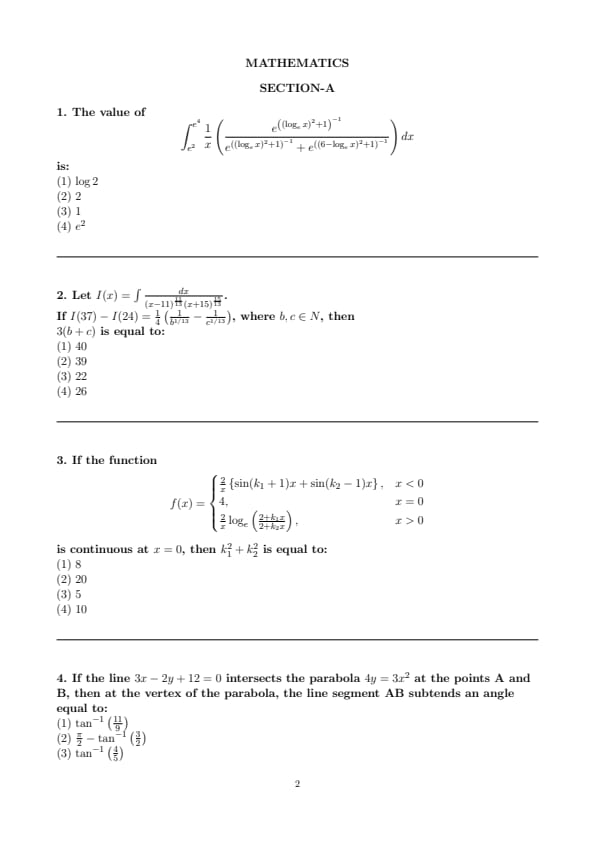
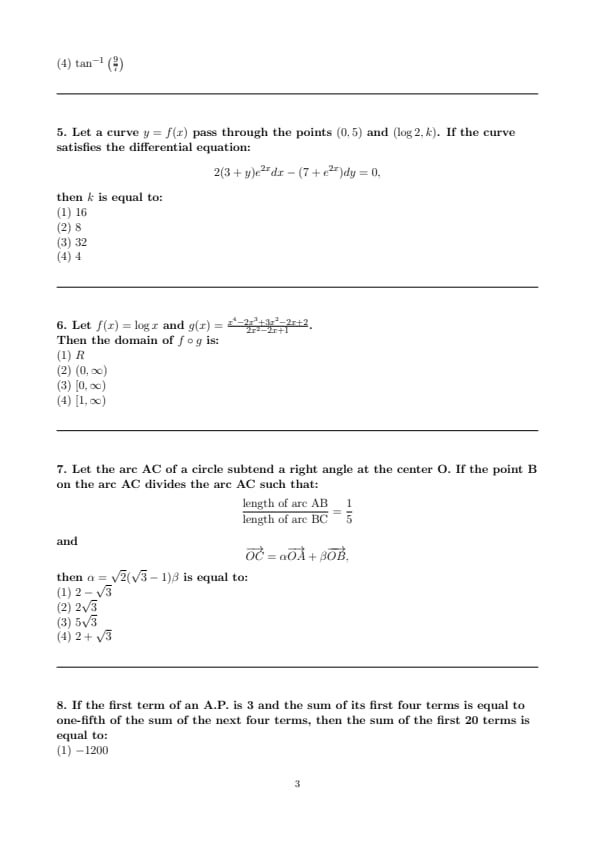
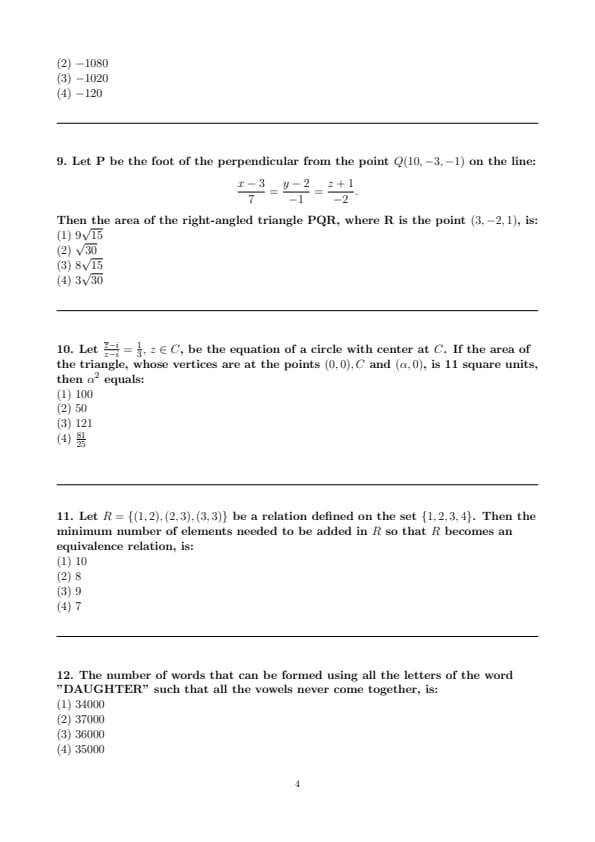
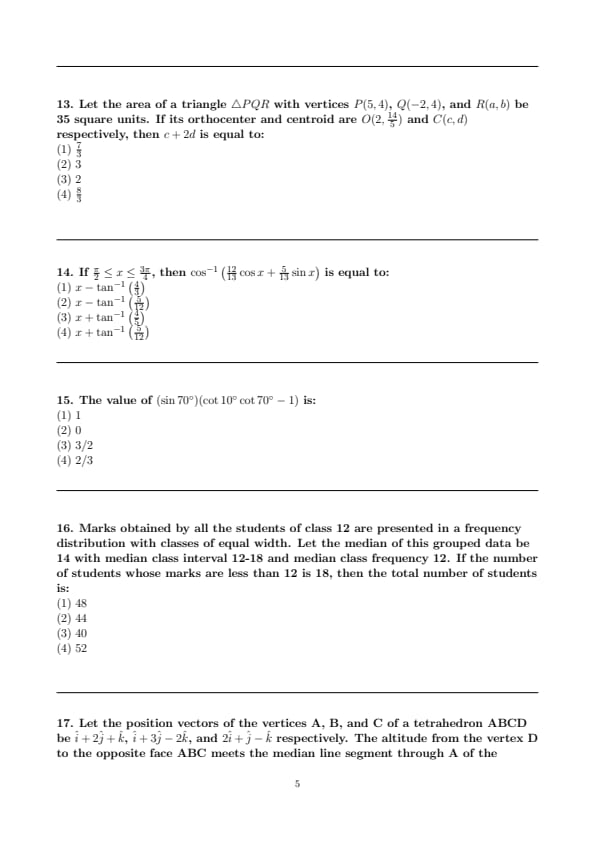
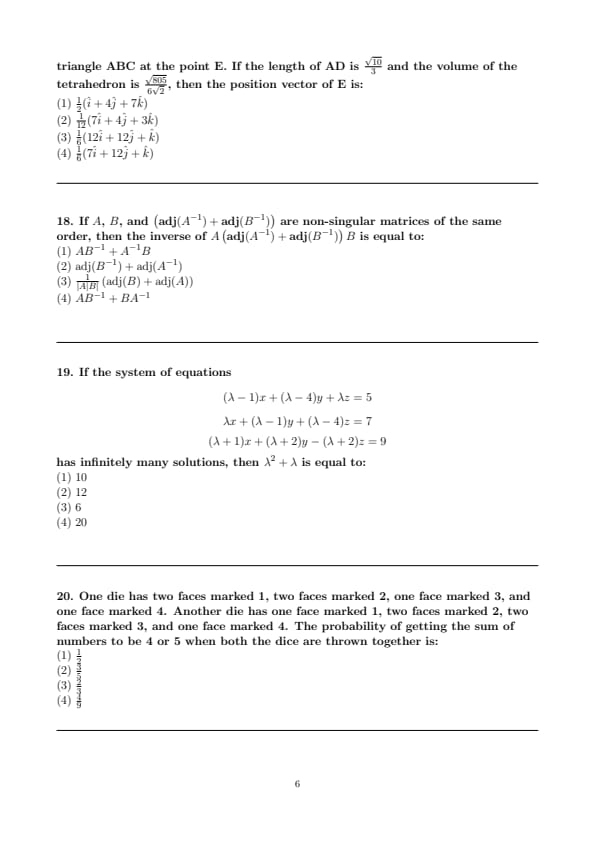
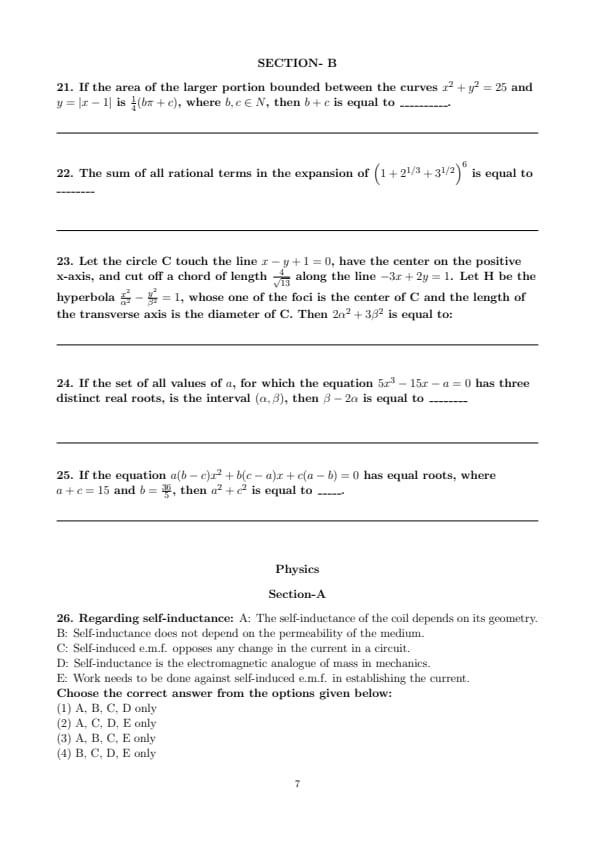
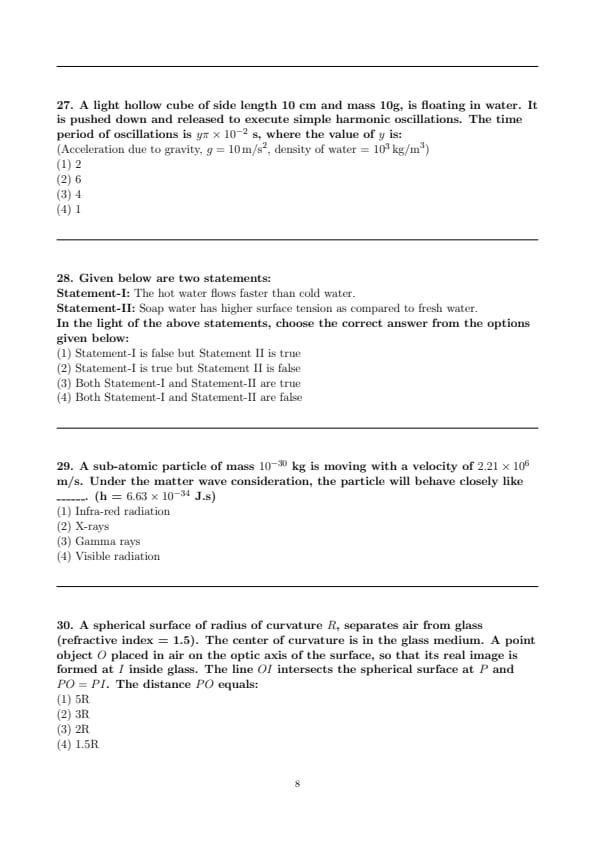
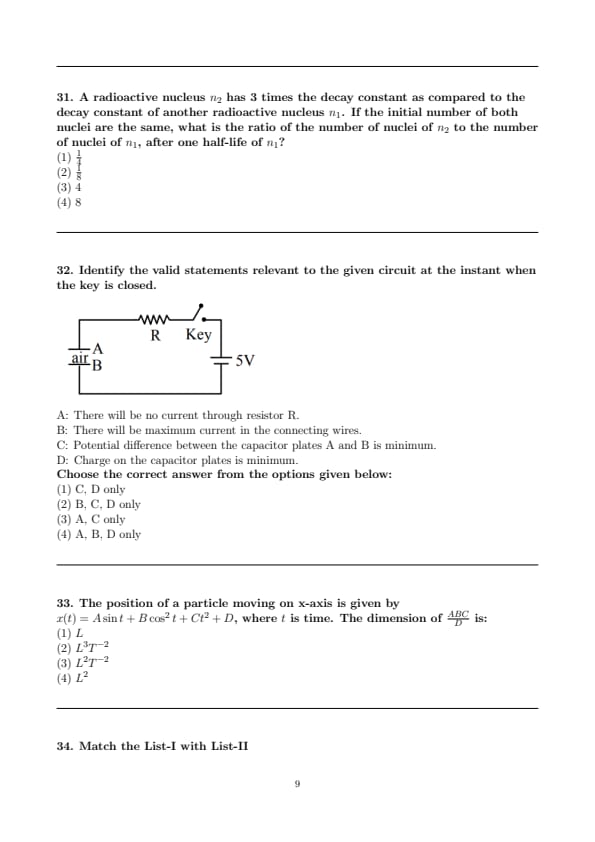
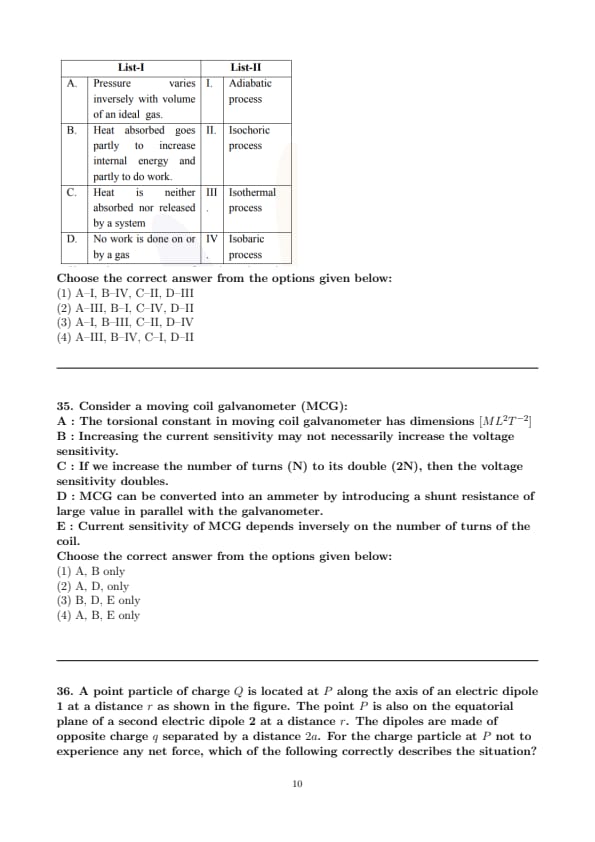
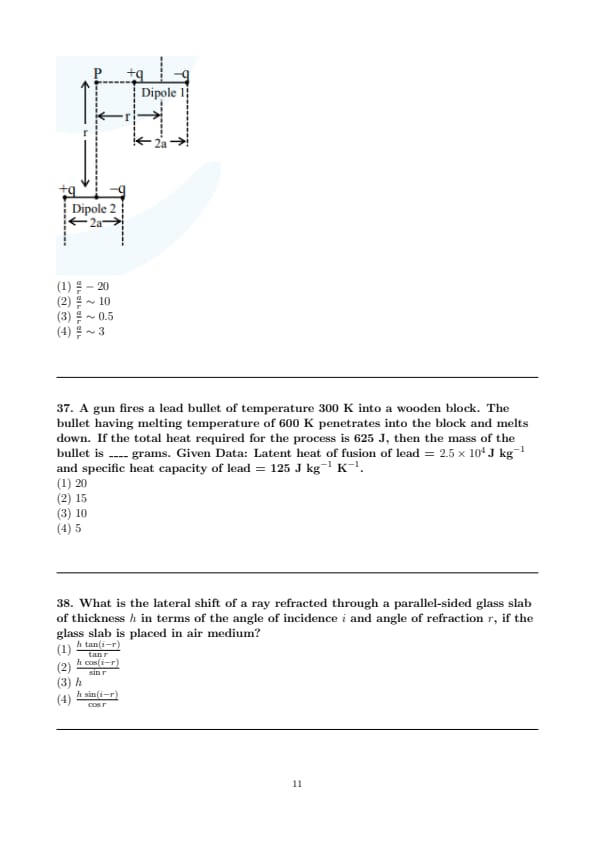
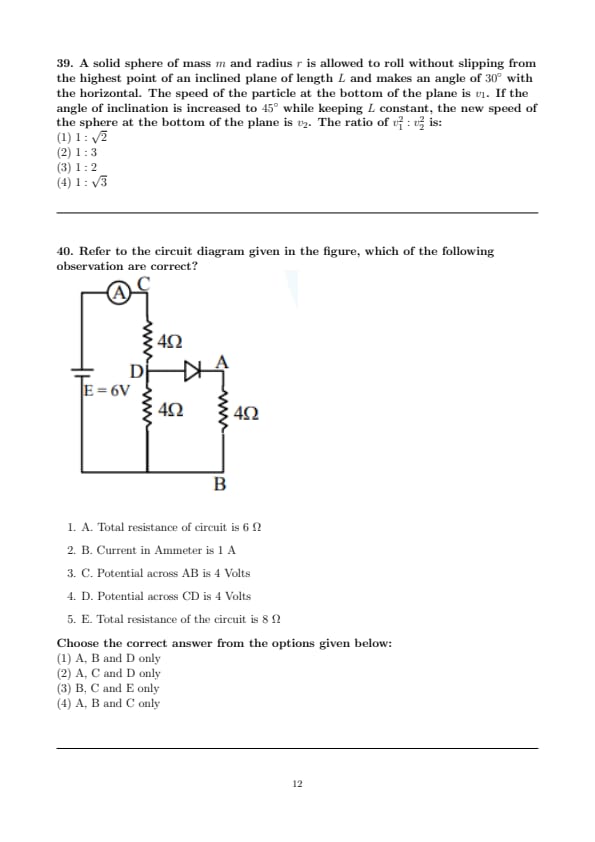
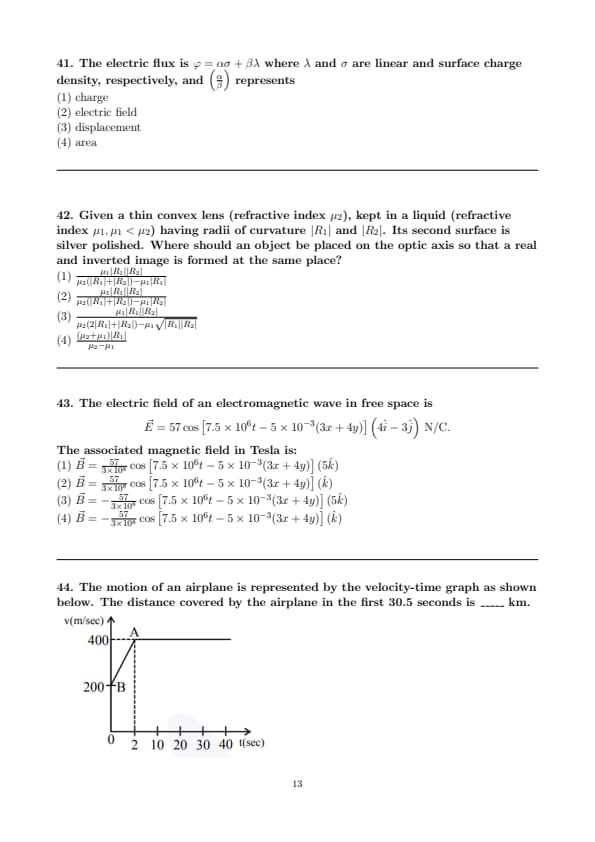
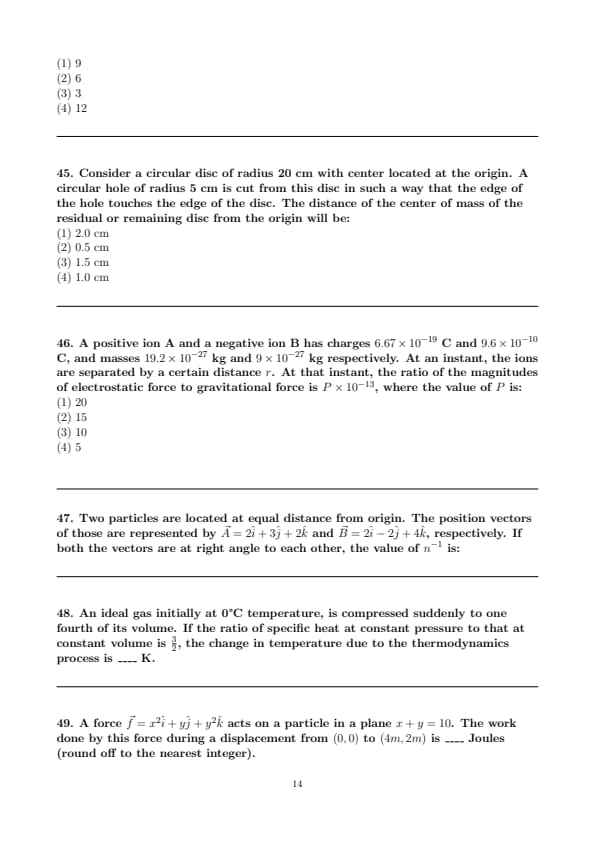
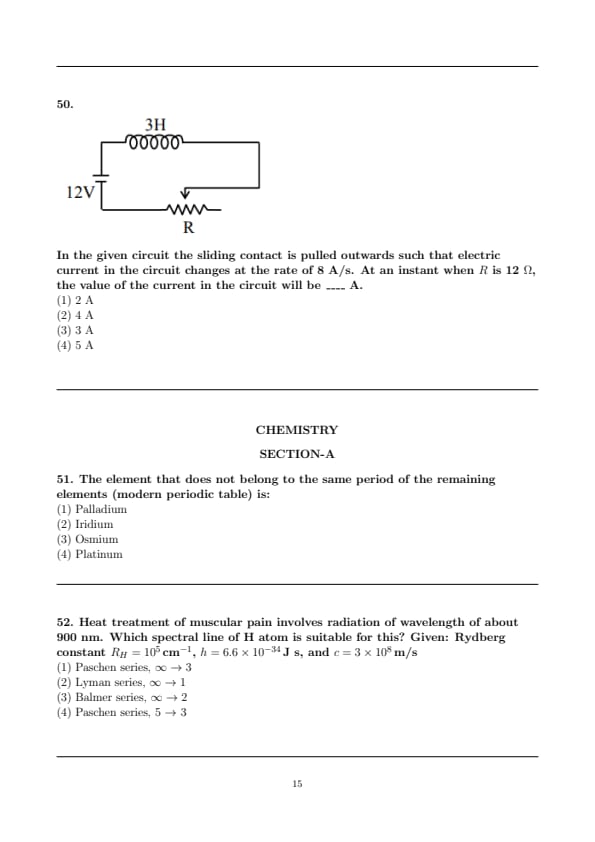
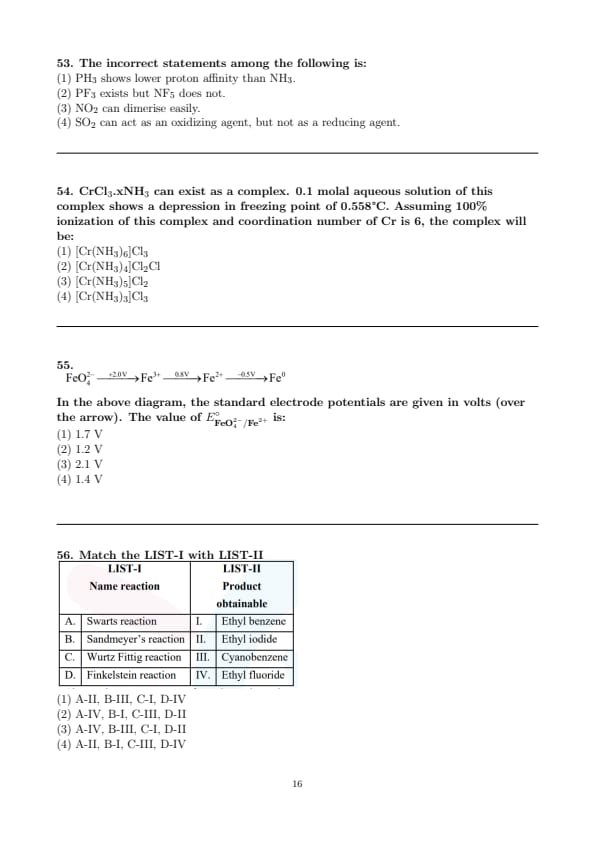
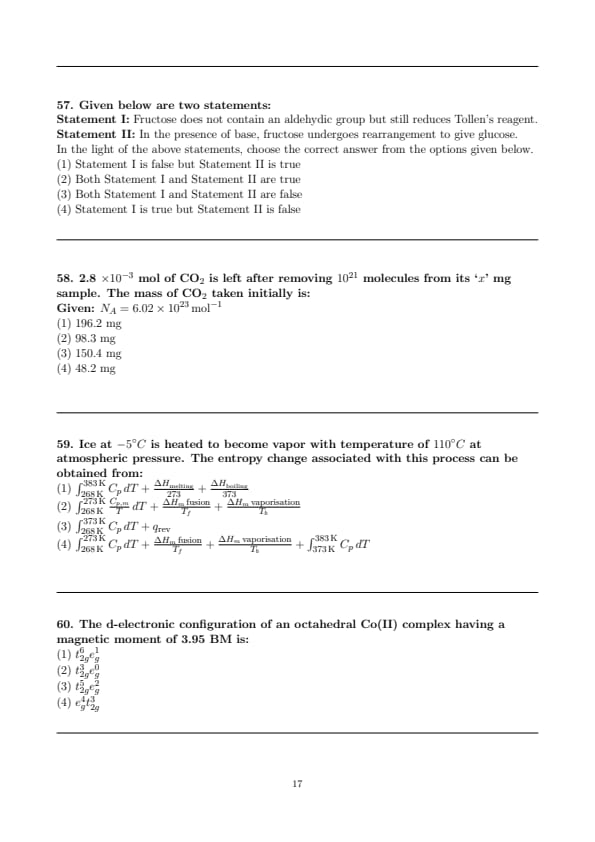
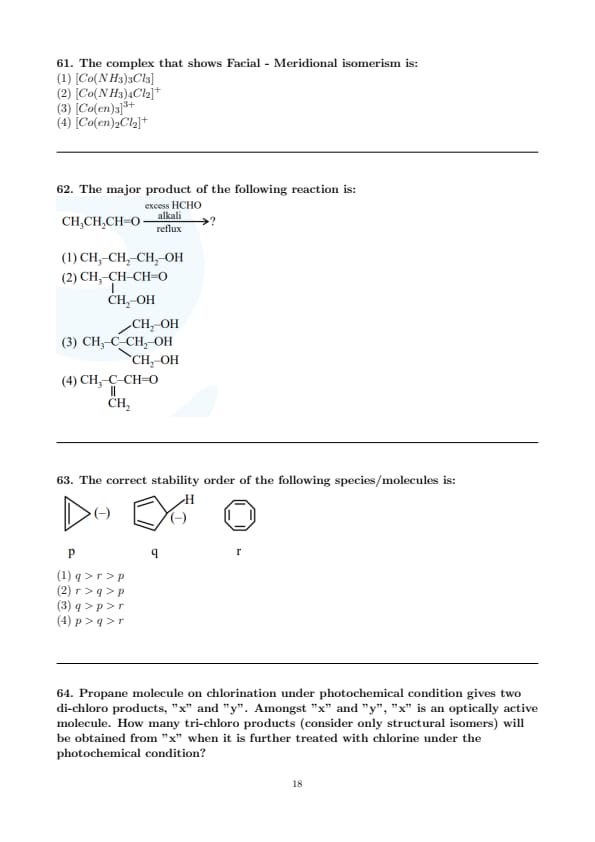
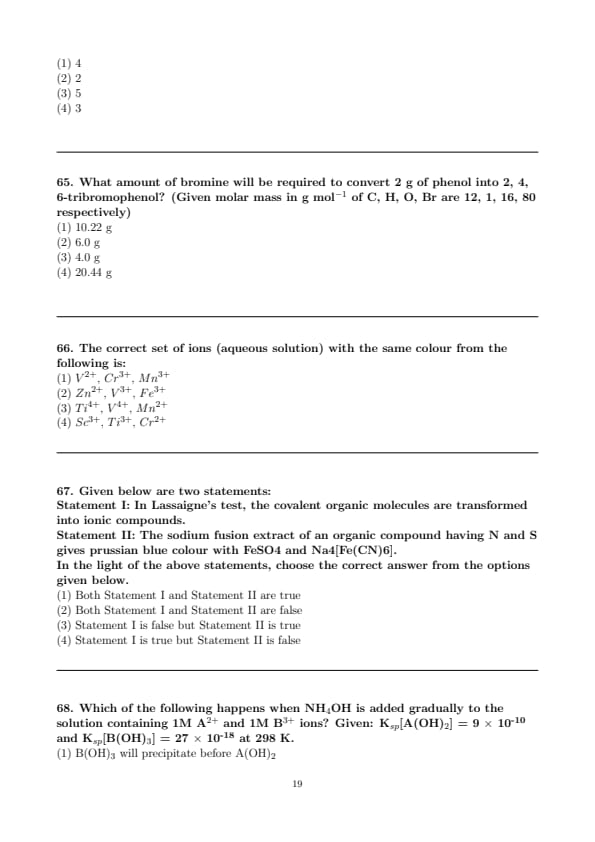
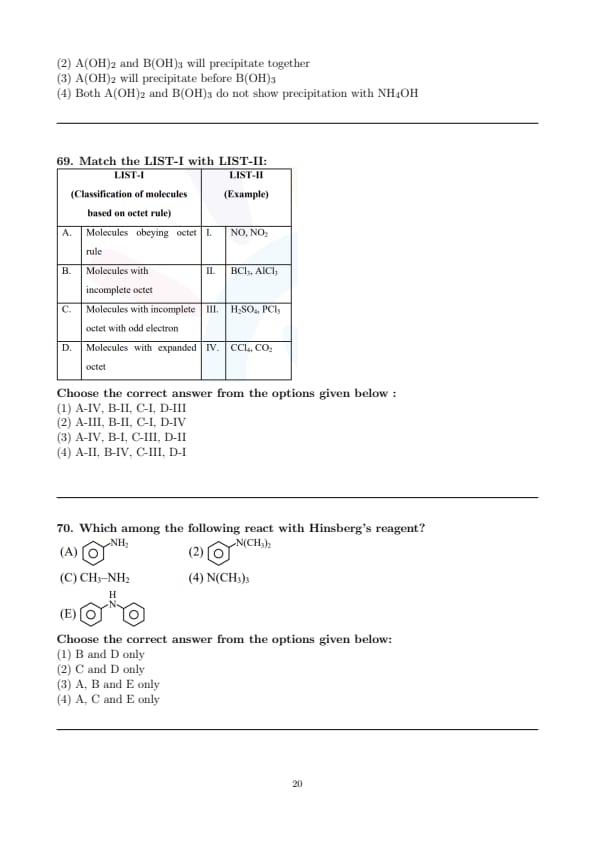
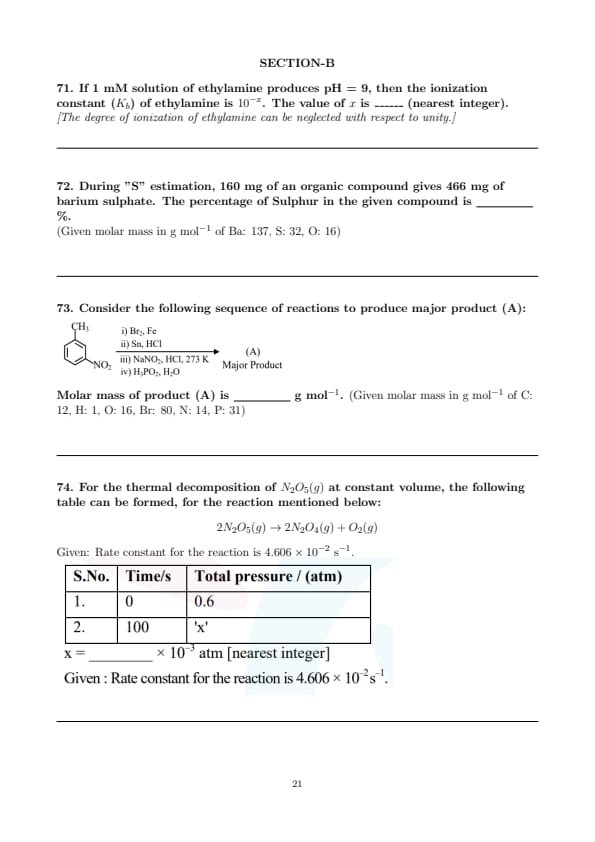
JEE Main 23rd January Shift 1 Paper Analysis: Students’ Feedback and What to Expect in Upcoming Shifts
The JEE Main 2025 exam is divided into three sections Physics, Chemistry, and Mathematics with a total of 75 questions. Each section contains 25 questions, including multiple-choice and numerical-value questions.
| JEE Main 23rd January Shift 1 | |
|---|---|
| Exam Overview | Shift Timing- 9 am to 12 pm on 23rd January 2025 |
| Difficulty Level | Moderately Difficult |
| Physics Analysis |
Difficulty Level: Moderate Most Asked Topics:
|
| Chemistry Analysis |
Difficulty Level: Easy Most Asked Topics:
|
| Mathematics Analysis |
Difficulty Level: Tough Most Asked Topics:
|
| What to Expect in Upcoming Shifts | Based on today's exam, here are some points to keep in mind for upcoming shifts:
Focus on Topics like: Calculus (Differentiation and Integration), Trigonometry, Current Electricity, Electrostatics, Thermodynamics, Organic Reactions Mechanism, and Basic Formulas. |
JEE Main 2025 Shift-wise Analysis
The JEE Main 2025 exam for Session 1 is ongoing the difficulty level varied across different shifts. Some of the shifts were challenging while others were of moderate difficulty. Here’s the detailed shift-wise analysis of all the shifts of JEE Main 2025:
| Shift | Subjects Overview | Overall Difficulty |
| 22nd January Shift 1 |
|
Overall: Moderate difficulty. |
| 22nd January Shift 2 |
|
Overall: Moderate difficulty |
| 23rd January Shift 1 |
|
Overall: Moderate difficulty. |
| 23rd January Shift 2 |
|
Overall: Moderate difficulty. |
| 24th January Shift 1 |
|
Overall: Slightly difficult |
| 24th January Shift 2 | To be Updated | To be Updated |
| 28th January Shift 1 | To be Updated | To be Updated |
| 28th January Shift 2 | To be Updated | To be Updated |
*The article might have information for the previous academic years, please refer the official website of the exam.