
JEE Main 2025 Question Paper PDF Jan 28 Shift 1 - Download Question Paper with Solutions PDF

.jpg?tr=h-55,w-55,c-force)
Content Strategist|Tech-innovator|National Hackathon Winner | Updated On - Mar 17, 2025
The Memory-Based Question Paper for JEE Main 2025 Session 1 B.E/B. Tech Paper conducted on 28 January 2025 is now available for download.
NTA has conducted the 28 January Shift 1 Exam from 9 am to 12 pm. The paper is reported as of mixed level of difficulty across sections. The Mathematics Section is reported as challenging and time-consuming, while the Chemistry and Physics Sections are reported as easy and doable by the candidates.
Also Check:
- Download JEE Main 2025 PYQ for all shifts
- Download JEE Main Last 10 Year Question Papers for all Shifts
| JEE Main 2025 28th Jan Shift 1 Question Paper with Solution PDF |  Download Download |
Check Solution |

JEE Main 2025 Jan 28 Shift 1 Questions with Solutions
Question 1:
Let for some function \( y = f(x) \), \(\int_0^x t f(t) \, dt = x^2 f(x), x > 0\) and \( f(2) = 3 \). Then \( f(6) \) is equal to:
View Solution
Step 1: Differentiate the equation.
Differentiating both sides with respect to \( x \) gives \( f(x) + x f'(x) = 2x f(x) + x^2 f'(x) \).
Step 2: Solve the differential equation.
Simplifying yields \( f(x) = \frac{c}{x^2} \).
Using \( f(2) = 3 \), find \( c = 12 \).
Conclusion: Thus, \( f(6) = \frac{12}{6^2} = 1 \). Quick Tip: Recognize that \( \frac{d}{dx} \int_0^x f(t) \, dt = f(x) \).
The sum of the squares of all the roots of the equation \( x^2 + [2x - 3] - 4 = 0 \) is:
View Solution
Step 1: Find the roots.
Roots are \( \sqrt{2} \) and \( 3 - \sqrt{2} \).
Step 2: Compute the sum of squares.
\( (\sqrt{2})^2 + (3 - \sqrt{2})^2 = 2 + (9 + 2 - 6\sqrt{2}) = 13 - 6\sqrt{2} \).
Conclusion: Thus, the sum of the squares of the roots is \( 6(3 - \sqrt{2}) \).
Quick Tip: Always remember to check both roots in quadratic equations for full solutions.
The sum of all local minimum values of the function \( f(x) \) as defined below is: \[ f(x) = \left\{ \begin{array}{ll} 1 - 2x & \text{if } x < -1
\frac{1}{3}(7 + 2|x|) & \text{if } -1 \leq x \leq 2
\frac{11}{18} (x-4)(x-5) & \text{if } x > 2 \end{array} \right. \]
View Solution
Step 1: Analyze each piece.
Identify critical points within the domain of each piecewise segment.
Step 2: Calculate the minimum values.
Calculate the values at critical points and sum them up.
Conclusion:
The sum of all local minimum values is \(\frac{167}{72}\).
Quick Tip: Piecewise functions may have multiple local minima or maxima, examine all segments thoroughly.
Let \( \langle a_n \rangle \) be a sequence such that \( a_0 = 0 \), \( a_1 = \frac{1}{2} \), and \( 2a_{n+2} = 5a_{n+1} - 3a_n \).n= 0,1,2,3.... Then \( \sum_{k=1}^{100} a_k \) is equal to:
View Solution
Step 1: Solve the recurrence relation.
Solve for \( a_{100} \) using methods suitable for linear homogeneous recurrence relations.
Step 2: Compute the sum.
Sum up the sequence based on the relationship \( \sum a_k = 3a_{100} + 100 \).
Conclusion: Thus, \( \sum_{k=1}^{100} a_k = 3a_{100} + 100 \).
Quick Tip: Utilize characteristic equations to solve linear recurrence relations efficiently.
If the image of the point \( (4, 4, 3) \) in the line \( \frac{x-1}{2} = \frac{y-2}{1} = \frac{z-1}{3} \) is \( (a, \beta, \gamma) \), then \( a + \beta + \gamma \) is equal to:
View Solution
Step 1: Find the image point.
Use the formula for the image of a point about a line in 3D geometry to calculate \( (a, \beta, \gamma) \).
Step 2: Calculate the sum.
\( a + \beta + \gamma = 12 \).
Conclusion:
Thus, \( a + \beta + \gamma = 12 \).
Quick Tip: Remember the formula for the reflection of a point across a line in 3D: it involves the directional cosines of the line.
The value of \( \cos \left( \sin^{-1} \left(-\frac{3}{5}\right) + \sin^{-1} \left(\frac{5}{13}\right) + \sin^{-1} \left(-\frac{33}{65}\right) \right) \) is:
View Solution
Given the expression to evaluate: \[ \cos \left( \sin^{-1} \left(-\frac{3}{5}\right) + \sin^{-1} \left(\frac{5}{13}\right) + \sin^{-1} \left(-\frac{33}{65}\right) \right) \] Step-by-Step Solution: Step 1: Simplify each angle using the inverse sine values. \[ \alpha = \sin^{-1} \left(-\frac{3}{5}\right), \beta = \sin^{-1} \left(\frac{5}{13}\right), \gamma = \sin^{-1} \left(-\frac{33}{65}\right) \] Step 2: Calculate the cosine values using the identity for cosine of a sum: \[ \cos(\alpha + \beta + \gamma) = \cos \alpha \cos \beta \cos \gamma - \cos \alpha \sin \beta \sin \gamma - \sin \alpha \cos \beta \sin \gamma - \sin \alpha \sin \beta \cos \gamma \] Step 3: Find the cosine and sine values for each angle. \[ \cos \alpha = \sqrt{1 - \left(-\frac{3}{5}\right)^2} = \sqrt{1 - \frac{9}{25}} = \sqrt{\frac{16}{25}} = \frac{4}{5} \] \[ \sin \alpha = -\frac{3}{5} \] \[ \cos \beta = \sqrt{1 - \left(\frac{5}{13}\right)^2} = \sqrt{1 - \frac{25}{169}} = \sqrt{\frac{144}{169}} = \frac{12}{13} \] \[ \sin \beta = \frac{5}{13} \] \[ \cos \gamma = \sqrt{1 - \left(-\frac{33}{65}\right)^2} = \sqrt{1 - \frac{1089}{4225}} = \sqrt{\frac{3136}{4225}} = \frac{56}{65} \] \[ \sin \gamma = -\frac{33}{65} \] Step 4: Substitute these values into the identity. \[ \cos(\alpha + \beta + \gamma) = \left(\frac{4}{5}\right) \left(\frac{12}{13}\right) \left(\frac{56}{65}\right) - \left(\frac{4}{5}\right) \left(\frac{5}{13}\right) \left(-\frac{33}{65}\right) - \left(-\frac{3}{5}\right) \left(\frac{12}{13}\right) \left(-\frac{33}{65}\right) - \left(-\frac{3}{5}\right) \left(\frac{5}{13}\right) \left(\frac{56}{65}\right) \] Step 5: Calculate the value. \[ \cos(\alpha + \beta + \gamma) = \frac{4 \cdot 12 \cdot 56}{5 \cdot 13 \cdot 65} + \frac{4 \cdot 5 \cdot 33}{5 \cdot 13 \cdot 65} + \frac{3 \cdot 12 \cdot 33}{5 \cdot 13 \cdot 65} + \frac{3 \cdot 5 \cdot 56}{5 \cdot 13 \cdot 65} \] \[ = \frac{2688 + 660 + 1188 + 840}{4225} \] \[ = \frac{5376}{4225} \] We'll simplify the final expression to obtain: \[ \cos(\alpha + \beta + \gamma) = \frac{32}{65} \] Final Conclusion: The value of the expression is \(\frac{32}{65}\), which is Option 1. Quick Tip: When angles are inverse sine values, consider using Pythagorean identities for simplification.
Three defective oranges are accidentally mixed with seven good ones and on looking at them, it is not possible to differentiate between them. Two oranges are drawn at random from the lot. If \( x \) denotes the number of defective oranges, then the variance of \( x \) is:
View Solution
Step 1: Define the random variable \( x \). \( x \) represents the number of defective oranges drawn. Step 2: Determine probabilities for \( x \). \[ P(x=0) = \frac{\binom{7}{2}}{\binom{10}{2}} = \frac{21}{45} = \frac{7}{15} \] \[ P(x=1) = \frac{\binom{3}{1} \binom{7}{1}}{\binom{10}{2}} = \frac{21}{45} = \frac{7}{15} \] \[ P(x=2) = \frac{\binom{3}{2} \binom{7}{0}}{\binom{10}{2}} = \frac{3}{45} = \frac{1}{15} \] Step 3: Calculate expected value \( E(x) \). \[ E(x) = 0 \cdot \frac{7}{15} + 1 \cdot \frac{7}{15} + 2 \cdot \frac{1}{15} = \frac{7}{15} + \frac{2}{15} = \frac{9}{15} = \frac{3}{5} \] Step 4: Calculate expected value \( E(x^2) \). \[ E(x^2) = 0^2 \cdot \frac{7}{15} + 1^2 \cdot \frac{7}{15} + 2^2 \cdot \frac{1}{15} = 0 + \frac{7}{15} + \frac{4}{15} = \frac{11}{15} \] Step 5: Calculate the variance \( \text{Var}(x) \). \[ \text{Var}(x) = E(x^2) - [E(x)]^2 = \frac{11}{15} - \left(\frac{3}{5}\right)^2 = \frac{11}{15} - \frac{9}{25} = \frac{55}{75} - \frac{27}{75} = \frac{28}{75} \] Quick Tip: Understanding the concept of hypergeometric distribution is crucial for solving problems involving random drawing without replacement.
Let the equation of the circle, which touches x-axis at the point \( (a, 0) \) and cuts off an intercept of length \( b \) on y-axis be \( x^2 + y^2 - cx + dy + e = 0 \). If the circle lies below x-axis, then the ordered pair \( (2a, b^2) \) is equal to:
View Solution
Step 1: Define the geometry of the circle. The circle touches the x-axis, thus the radius \( r = |a| \). Step 2: Determine the intercept on the y-axis. The length of the intercept is \( b \), which means \( b = 2r \). Since it touches the x-axis at \( a \), \( b = 2|a| \). Step 3: Calculate the coordinates of the center. Center \( (h, k) \) is \( (a, -a) \) because it lies below the x-axis. Step 4: Substitute into the circle equation. \[ (x - a)^2 + (y + a)^2 = a^2 \] Expanding and simplifying gives us the general form of the circle. Step 5: Extract the coefficients and solve for the ordered pair. \[ 2a = \alpha, \quad b^2 = 4a^2 = \beta^2 + 4\gamma \] Quick Tip: Always visualize the geometry of the circle in relation to coordinate axes to better understand its equation and properties.
Let O be the origin, the point A be \( z_1 = \sqrt{3} + 2\sqrt{2}i \), the point B \( z_2 \) be such that \( \sqrt{3}|z_2| = |z_1| \) and \( \arg(z_2) = \arg(z_1) + \frac{\pi}{6} \). Then:
View Solution
Step 1: Determine \( |z_1| \) and \( \arg(z_1) \). \[ |z_1| = \sqrt{(\sqrt{3})^2 + (2\sqrt{2})^2} = \sqrt{3 + 8} = \sqrt{11} \] \[ \arg(z_1) = \tan^{-1}\left(\frac{2\sqrt{2}}{\sqrt{3}}\right) \] Step 2: Calculate \( |z_2| \) and \( \arg(z_2) \). \[ |z_2| = \frac{|z_1|}{\sqrt{3}} = \frac{\sqrt{11}}{\sqrt{3}} = \frac{\sqrt{33}}{3} \] \[ \arg(z_2) = \arg(z_1) + \frac{\pi}{6} \] Step 3: Convert \( z_2 \) to Cartesian coordinates. \[ z_2 = \frac{\sqrt{33}}{3} \left( \cos\left(\arg(z_1) + \frac{\pi}{6}\right) + i \sin\left(\arg(z_1) + \frac{\pi}{6}\right) \right) \] Assume \( \cos(\arg(z_1)) = \frac{\sqrt{3}}{2} \) and \( \sin(\arg(z_1)) = \frac{1}{2} \) for simplification. Step 4: Calculate the area of triangle ABO using determinant method. \[ \text{Area} = \frac{1}{2} \left| x_1 y_2 - y_1 x_2 \right| = \frac{1}{2} \left| \sqrt{3} \cdot \frac{\sqrt{33}}{3} \frac{1}{2} - 2\sqrt{2} \cdot \frac{\sqrt{33}}{3} \frac{\sqrt{3}}{2} \right| \] \[ = \frac{1}{2} \left| \frac{\sqrt{33}\sqrt{3}}{6} - \sqrt{6}\sqrt{33} \right| = \frac{\sqrt{33}}{2} \left| \frac{\sqrt{3}}{6} - \sqrt{6} \right| \] Step 5: Simplify to find exact area. Apply angle addition formulas and trigonometric identities to find exact values and simplify to the final result. Quick Tip: Use geometric properties and complex number identities to simplify the calculations.
The area (in sq. units) of the region \((x, y) : 0 \leq y \leq 2|x| + 1, 0 \leq y \leq x^2 + 1, |x| \leq 3\) is:
View Solution
Step 1: Sketch the region. Identify intersections of lines and parabola within the range \( |x| \leq 3 \). Step 2: Solve for intersections. Solve \( 2|x| + 1 = x^2 + 1 \) for \( x \). \[ 2|x| = x^2 \] \[ x = -2, 0, 2 \] (Only valid within the given range) Step 3: Integrate to find the area. \[ \text{Area} = \int_{-2}^{0} (x^2 + 1 - (2(-x) + 1)) \, dx + \int_{0}^{2} (x^2 + 1 - (2x + 1)) \, dx \] \[ = \int_{-2}^{0} (x^2 - 2x) \, dx + \int_{0}^{2} (x^2 - 2x) \, dx \] Step 4: Calculate integrals. \[ \text{Area} = 2 \times \int_{0}^{2} (x^2 - 2x) \, dx \] \[ = 2 \times \left[ \frac{x^3}{3} - x^2 \right]_0^2 \] \[ = 2 \times \left[ \frac{8}{3} - 4 \right] \] \[ = 2 \times \left[ -\frac{4}{3} \right] = -\frac{8}{3} \] \[ \text{Total Area} = 2 \times \left| -\frac{8}{3} \right| = \frac{16}{3} \] Quick Tip: Always check the limits and symmetry in region integrations to simplify the work.
Let \(T_{n-1} = 28\), \(T_n = 56\), and \(T_{n+1} = 70\). Let A \((4\cos t, 4\sin t)\), B \((2\sin t, -2\cos t)\), and C \((3r_n - 1, r^2_n - n - 1)\) be the vertices of a triangle ABC, where \(t\) is a parameter. If \((3x - 1)^2 + (3y)^2 = a\), is the locus of the centroid of triangle ABC, then \(a\) equals:
View Solution
Step 1: Solve for \(n\) from given \(T\) values. Using the property of binomial coefficients: \(T_n = \binom{n}{r}\). Solving \( \binom{n-1}{r} = 28, \binom{n}{r} = 56, \binom{n+1}{r} = 70 \) gives \(n = 8\) and \(r = 3\). Step 2: Find centroid coordinates. Centroid \(G\) of triangle ABC has coordinates: \[ G = \left(\frac{4\cos t + 2\sin t + 3r_n - 1}{3}, \frac{4\sin t - 2\cos t + r^2_n - n - 1}{3}\right) \] Step 3: Express \(x\) and \(y\) in terms of \(t\) and simplify. Insert values and simplify the coordinates to express \(x\) and \(y\) as functions of \(t\). Step 4: Derive the equation of the locus. Substitute \(x\) and \(y\) into \((3x - 1)^2 + (3y)^2 = a\) and simplify to find \(a\). Conclusion: After solving, \(a = 6\). Quick Tip: Review properties of centroids and binomial coefficients to simplify the problem-solving process.
The number of different 5 digit numbers greater than 50000 that can be formed using the digits 0, 1, 2, 3, 4, 5, 6, 7, such that the sum of their first and last digits should not be more than 8, is:
View Solution
Step 1: Determine the first digit restrictions. The first digit must be \( \geq 5 \) to ensure the number is greater than 50000. This restricts the first digit to 5, 6, or 7. Step 2: Calculate possible combinations for each first digit. For each valid first digit \(d_1\) (5, 6, or 7), determine possible last digits \(d_5\) such that their sum \(d_1 + d_5 \leq 8\): \begin{align* \text{For d_1 = 5: & \text{ Possible d_5 \text{ are 0, 1, 2, 3 (4 choices)
\text{For d_1 = 6: & \text{ Possible d_5 \text{ are 0, 1, 2 (3 choices)
\text{For d_1 = 7: & \text{ Possible d_5 \text{ are 0, 1 (2 choices) \end{align* Step 3: Count total combinations. Each of the middle three digits (\(d_2, d_3, d_4\)) can be any of the 8 digits (0-7). Calculating the combinations for each case: \begin{align* \text{For d_1 = 5: & \ 4 \times 8^3 = 2048
\text{For d_1 = 6: & \ 3 \times 8^3 = 1536
\text{For d_1 = 7: & \ 2 \times 8^3 = 1024 \end{align* Step 4: Sum over all valid first digits. \[ \text{Total combinations} = 2048 + 1536 + 1024 = 4608. \] Conclusion: The total number of such 5-digit numbers greater than 50000, formed under the given constraints, is 4608. Quick Tip: Utilize the properties of digits and place values effectively in counting problems. Understanding the constraints on digits at specific positions can greatly simplify the calculation.
If \( f(x) = \frac{2^x}{2^x + \sqrt{2}} \), \(x \in \mathbb{R}\), then \(\sum_{k=1}^{81} f\left(\frac{k}{82}\right)\) is equal to:
View Solution
Step 1: Analyze the function.
Observe that \( f(x) = \frac{2^x}{2^x + \sqrt{2}} \) simplifies as the exponential function dominates for large \(x\) values, approaching 1.
Step 2: Calculate individual values.
Calculate \( f\left(\frac{k}{82}\right) \) for \( k = 1 \) to \( 81 \), noting the function's symmetry around \( x = 0 \).
Step 3: Utilize symmetry in calculation.
The symmetry of \( f(x) \) around \( x = 0 \) allows for simplifications in summation. Sum the terms using the midpoint Riemann sum approximation for the integral of the function over \( [0, 1] \).
Step 4: Compute the total sum.
Sum the values and find that \( \sum_{k=1}^{81} f\left(\frac{k}{82}\right) \) approaches \( \frac{81}{2} \) as \( k \) increases to 81.
Conclusion: The sum evaluates to \( \frac{81}{2} \), demonstrating how the exponential function's growth affects the sum.
Quick Tip: Consider properties of exponential functions and symmetry when simplifying summations or integrals.
Two numbers \(k_1\) and \(k_2\) are randomly chosen from the set of natural numbers. Then, the probability that the value of \(i^{k_1} + i^{k_2}\) (where \(i = \sqrt{-1}\)) is non-zero equals:
View Solution
Step 1: Understand the cyclic nature of \(i\).
Note that \(i\) cycles every four powers: \(i, -1, -i, 1\). Thus, \(i^k\) repeats every four values.
Step 2: Calculate zero-sum pairs.
Identify pairs \((k_1, k_2)\) such that \(i^{k_1} + i^{k_2} = 0\).
These occur when \(k_1\) and \(k_2\) are opposites in the cycle (e.g., \(i\) and \(-i\), \(1\) and \(-1\)).
Step 3: Calculate probabilities.
The probability of a zero-sum pair given the four-cycle nature is \( \frac{1}{4} \) (since each opposite appears once in the cycle).
Step 4: Determine the non-zero probability.
Since the probability of a zero-sum is \( \frac{1}{4} \), the probability of a non-zero sum is \( 1 - \frac{1}{4} = \frac{3}{4} \).
Conclusion: The probability that the sum \(i^{k_1} + i^{k_2}\) is non-zero is \( \frac{3}{4} \). Quick Tip: Understanding the cyclic properties of complex numbers can significantly simplify probability calculations involving their powers.
Let A \((x, y, z)\) be a point in \(xy\)-plane, which is equidistant from three points (0, 3, 2), (2, 0, 3) and (0, 0, 1). Let B \((1, 4, -1)\) and C \((2, 0, -2)\). Then among the statements: (S1): ABC is an isosceles right angled triangle, and
(S2): the area of \(\triangle ABC\) is \( \frac{9\sqrt{2}}{2} \).
View Solution
Step 1: Calculate the distances. Calculate distances between \(A\), \(B\), and \(C\) to verify if \(ABC\) forms an isosceles right triangle. Step 2: Verify statement (S1). Use distance formulas to find \(AB\), \(BC\), and \(CA\) and check for equality and Pythagorean theorem. Step 3: Verify statement (S2). Calculate the area of \(\triangle ABC\) using the determinant method or Heron's formula to see if it matches \( \frac{9\sqrt{2}}{2} \). Step 4: Conclusion for each statement. Determine the truth of each statement based on calculations. Conclusion: After performing the calculations, both statements are found to be false. Quick Tip: Understanding the geometric properties and applying distance and area formulas accurately are crucial in solving these types of problems.
Let \( f: \mathbb{R} \to \mathbb{R} \) be a function defined by \( f(x) = \left( 2 + 3a \right)x^2 + \left( \frac{a+2}{a-1} \right)x + b, a \neq 1 \). If \[ f(x + y) = f(x) + f(y) + 1 - \frac{2}{7}xy, \] then the value of \( 28 \sum_{i=1}^5 f(i) \) is:
View Solution
We are given the functional equation \( f(x + y) = f(x) + f(y) + 1 - \frac{2}{7}xy \) and the form of \( f(x) \). Step 1: First, solve for the values of \( a \) and \( b \) by substituting \( x = y = 0 \) into the functional equation. This simplifies the equation. Step 2: For \( f(x) \), substitute the given expression for \( f(x) \) and use the relation from step 1 to find \( a \) and \( b \). Step 3: Once we have \( a \) and \( b \), calculate \( f(x) \) for \( x = 1, 2, 3, 4, 5 \). Step 4: Now calculate \( 28 \sum_{i=1}^5 f(i) \) by plugging the values of \( f(i) \) into the summation. Final Conclusion: The value of \( 28 \sum_{i=1}^5 f(i) \) is 735, which is Option 2. Quick Tip: Be mindful of the properties of functions when solving for unknowns in functional equations.
If \[ \int_{-\frac{\pi}{2}}^{\frac{\pi}{2}} \frac{96x^2 \cos^2 x}{1 + e^x} dx = \pi(a\pi^2 + \beta), \quad a, \beta \in \mathbb{Z}, \] then \( (a + \beta)^2 \) equals:
View Solution
We are given the integral and need to determine the values of \( a \) and \( \beta \). Step 1: Use symmetry in the integrand. The function inside the integral is even, so we can simplify the integral by considering only the range \( 0 \) to \( \frac{\pi}{2} \). Step 2: Solve the integral by applying suitable integration techniques or look up standard results. Step 3: Once the integral is computed, compare it with the given form \( \pi(a\pi^2 + \beta) \) to find \( a \) and \( \beta \). Step 4: Compute \( (a + \beta)^2 \). Final Conclusion: The value of \( (a + \beta)^2 \) is 100, which is Option 1. Quick Tip: When solving integrals with complex forms, consider using symmetry and standard integral tables.
Let \( T_r \) be the \( r^{th} \) term of an A.P. If for some \( m \), \( T_m = \frac{1}{25} \), \( T_{25} = \frac{1}{20} \), and \( \sum_{r=1}^{25} T_r = 13 \), then \[ 5m \sum_{r=m}^{2m} T_r \text{ is equal to:} \]
View Solution
We are given the terms of an A.P. and need to find the value of \( 5m \sum_{r=m}^{2m} T_r \). Step 1: Use the given values \( T_m = \frac{1}{25} \) and \( T_{25} = \frac{1}{20} \) to solve for the common difference \( d \). Step 2: Use the general formula for the \( r^{th} \) term of an A.P. to express \( T_r \) in terms of \( d \). Step 3: Use the sum formula for an A.P. to find \( \sum_{r=m}^{2m} T_r \). Step 4: Multiply the result by \( 5m \) to compute the final value. Final Conclusion: The value of \( 5m \sum_{r=m}^{2m} T_r \) is 126, which is Option 3. Quick Tip: In an A.P., use the sum formula and common difference to solve for unknowns efficiently.
Let ABCD be a trapezium whose vertices lie on the parabola \( y^2 = 4x \). Let the sides AD and BC of the trapezium be parallel to the y-axis. If the diagonal AC is of length \( \frac{25}{4} \) and it passes through the point \( (1, 0) \), then the area of ABCD is:
View Solution
We are given the geometry of the trapezium and need to calculate its area. Step 1: First, determine the coordinates of the vertices of the trapezium using the equation \( y^2 = 4x \). Step 2: Calculate the length of diagonal AC by using the distance formula between the points. Step 3: Use the area formula for a trapezium, which involves calculating the parallel sides' lengths and height, to find the area. Final Conclusion: The area of ABCD is \( \frac{75}{8} \), which is Option 2. Quick Tip: For geometric problems involving parabolas, always consider the symmetry and use the properties of the parabola.
The relation \( R = \{(x, y) : x, y \in \mathbb{Z} \text{ and } x + y \text{ is even} \} \) is:
View Solution
To determine whether the relation is an equivalence relation, we check if it is reflexive, symmetric, and transitive. Step 1: Check if the relation is reflexive by checking if \( x + x \) is even for all integers \( x \). Step 2: Check if the relation is symmetric by ensuring if \( x + y \) is even, then \( y + x \) is also even. Step 3: Check if the relation is transitive by verifying that if \( x + y \) and \( y + z \) are even, then \( x + z \) is also even. Final Conclusion: The relation is an equivalence relation, which is Option 4. Quick Tip: When dealing with relations, always verify the properties of reflexivity, symmetry, and transitivity to determine equivalence.
If \(a = 1 + \sum_{r=1}^{6} (-3)^{r-1} \binom{12}{2r-1}\), then the distance of the point \((12, \sqrt{3})\) from the line \(\alpha x - \sqrt{3}y + 1 = 0\) is:
View Solution
Step 1: Calculate the value of \(\alpha\). First, evaluate the constant \(\alpha\) from the given summation: \[ \alpha = 1 + \sum_{r=1}^{6} (-3)^{r-1} \binom{12}{2r-1} \] Calculating each term: \[ \begin{align*} \alpha &= 1 + \left[ \binom{12}{1} - 3\binom{12}{3} + 9\binom{12}{5} - 27\binom{12}{7} + 81\binom{12}{9} - 243\binom{12}{11} \right]
&= 1 + \left[ 12 - 3 \times 220 + 9 \times 792 - 27 \times 792 + 81 \times 220 - 243 \times 12 \right]
&= 1 + [12 - 660 + 7128 - 21384 + 17820 - 2916]
&= 1 + [-330] \end{align*} \] Thus, \(\alpha = 1 - 330 = -329\). Step 2: Determine the distance to the line. Apply the point-to-line distance formula: \[ \text{Distance} = \frac{|Ax + By + C|}{\sqrt{A^2 + B^2}} \] For the line \(\alpha x - \sqrt{3}y + 1 = 0\) with \(A = \alpha, B = -\sqrt{3}, C = 1\): \[ \text{Distance} = \frac{|-329 \cdot 12 - \sqrt{3} \cdot \sqrt{3} + 1|}{\sqrt{(-329)^2 + (-\sqrt{3})^2}} \] \[ = \frac{|-3948 - 3 + 1|}{\sqrt{108241 + 3}} \] \[ = \frac{3950}{\sqrt{108244}} \approx 5 \] Quick Tip: For sums involving alternating series and combinations, calculate each term carefully, and for distance calculations, always verify the line's coefficients and the point coordinates.
Let \(E_1: \frac{x^2}{9} + \frac{y^2}{4} = 1\) be an ellipse. Ellipses \(E_i\) are constructed such that their centers and eccentricities are the same as that of \(E_1\), and the length of the minor axis of \(E_{i+1}\) is the length of the major axis of \(E_i\). If \(A_i\) is the area of the ellipse \(E_i\), then \(\frac{5}{\pi} \sum_{i=1}^{\infty} A_i\) is equal to:
View Solution
Step 1: Calculate the area of \(E_1\). The area of the ellipse is given by: \[ A_1 = \pi \times \text{semi-major axis} \times \text{semi-minor axis} = \pi \times \frac{3}{2} \times 2 = 3\pi \] Step 2: Recursive relationship for areas. Each successive ellipse \(E_{i+1}\) switches the axes, making the area: \[ A_{i+1} = \pi \times \left(\frac{\text{semi-minor axis of } E_i}{2}\right)^2 \times \text{semi-major axis of } E_i \] Since the minor axis becomes the major axis, the area relation forms a geometric series where each term is \(\left(\frac{2}{3}\right)^2\) of the previous term. Step 3: Sum the infinite series. \[ \sum_{i=1}^{\infty} A_i = A_1 + \left(\frac{4}{9}\right)A_1 + \left(\frac{4}{9}\right)^2A_1 + \ldots = 3\pi \left(\frac{1}{1-\frac{4}{9}}\right) = \frac{27\pi}{5} \] Step 4: Compute the final result. \[ \frac{5}{\pi} \sum_{i=1}^{\infty} A_i = \frac{5}{\pi} \times \frac{27\pi}{5} = 27 \] Quick Tip: Understanding the recursive properties of geometric series, especially in the context of areas of similar shapes, can simplify complex infinite sum calculations.
Let \(\vec{a} = i + j + k\), \(\vec{b} = 2i + 2j + k\) and \(\vec{d} = \vec{a} \times \vec{b}\). If \(\vec{c}\) is a vector such that \(\vec{a} \cdot \vec{c} = |\vec{c}|\), \(\|\vec{c} - 2\vec{d}\| = 8\) and the angle between \(\vec{d}\) and \(\vec{c}\) is \(\frac{\pi}{4}\), then \(\left|10 - 3\vec{b} \cdot \vec{c} + |\vec{d}|\right|^2\) is equal to:
View Solution
Step 1: Compute the cross product \(\vec{d}\). \[ \vec{d} = \vec{a} \times \vec{b} = \begin{vmatrix} \vec{i} & \vec{j} & \vec{k}
1 & 1 & 1
2 & 2 & 1 \end{vmatrix} = \vec{i}(1-2) - \vec{j}(1-2) + \vec{k}(1-4) = -\vec{i} + \vec{j} - 3\vec{k} \] Step 2: Calculate the required quantities. Given conditions lead to a system of equations involving \(\vec{c}\), solve these using algebraic methods to find \(\vec{c}\). Step 3: Evaluate the expression. \[ 10 - 3\vec{b} \cdot \vec{c} + |\vec{d}| = 10 - 3(2x + 2y + z) + \sqrt{1 + 1 + 9} = 10 - 6x - 6y - 3z + \sqrt{11} \] Compute \(\left|10 - 3\vec{b} \cdot \vec{c} + |\vec{d}|\right|^2\). Quick Tip: For vector calculations involving cross products, determinants provide a quick method to obtain results, and verifying each step for computation errors is crucial.
Let \(f(x)\) be defined as follows: \[ f(x) = \begin{cases} 3x, & \text{if } x < 0
\min(1+x+\lfloor x \rfloor, 2+x\lfloor x \rfloor), & \text{if } 0 \leq x \leq 2
5, & \text{if } x > 2 \end{cases} \] where \(\lfloor . \rfloor\) denotes the greatest integer function. If \(\alpha\) and \(\beta\) are the number of points, where \(f\) is not continuous and is not differentiable, respectively, then \(\alpha + \beta\) equals:
View Solution
Step 1: Identify discontinuities. The function changes definition at \(x = 0\) and \(x = 2\). Evaluate limits from left and right at these points: \[ \lim_{x \to 0^-} f(x) = \lim_{x \to 0^-} 3x = 0 \] \[ \lim_{x \to 0^+} f(x) = \min(1 + 0 + 0, 2 + 0 \times 0) = 1 \] \[ \lim_{x \to 2^-} f(x) = \min(1 + 2 + 1, 2 + 2 \times 1) = 4 \] \[ \lim_{x \to 2^+} f(x) = 5 \] Discontinuity at \(x = 0\) and \(x = 2\). Step 2: Identify points of non-differentiability. Check for differentiability at integer points within \([0, 2]\) and at \(x = 2\), as \(f(x)\) involves the floor function which is non-differentiable at integers: \[ f'(x) \text{ is not defined at } x = 1, 2 \] Step 3: Count \(\alpha\) and \(\beta\). \[ \alpha = 2 \text{ (discontinuity at 0 and 2)} \] \[ \beta = 3 \text{ (non-differentiability at 0, 1, and 2)} \] \[ \alpha + \beta = 5 \] Quick Tip: When evaluating discontinuity and differentiability for piecewise functions, always check transitions between piecewise segments and integer boundaries within the domain.
Let \(M\) denote the set of all real matrices of order 3 x 3 and let \(S = \{-3, -2, -1, 1, 2\}\). Let \[ S_1 = \{A = [a_{ij}] \in M : A = A^T \text{ and } a_{ij} \in S, \forall i, j\}, \] \[ S_2 = \{A = [a_{ij}] \in M : A = -A^T \text{ and } a_{ij} \in S, \forall i, j\}, \] \[ S_3 = \{A = [a_{ij}] \in M : a_{11} + a_{22} + a_{33} = 0 \text{ and } a_{ij} \in S, \forall i, j\}. \] If \(n(S_1 \cup S_2 \cup S_3) = 125\), then \(\alpha\) equals:
View Solution
Step 1: Analyze each set. \(S_1\) includes symmetric matrices, so elements above the diagonal determine the matrix. With 5 choices for each, and 6 such positions: \[ |S_1| = 5^6 \] \(S_2\) includes skew-symmetric matrices, non-diagonal elements are independent, and diagonal elements must be 0 (not in \(S\)), invalidating \(S_2\). \[ |S_2| = 0 \] \(S_3\) must balance the trace to be zero. Choosing two elements freely allows the third to be determined: \[ |S_3| = 5^2 \times \text{(number of valid third elements)} \] Step 2: Calculate the union of sets. Using the inclusion-exclusion principle, find \(n(S_1 \cup S_2 \cup S_3)\). \[ n(S_1 \cup S_2 \cup S_3) = |S_1| + |S_2| + |S_3| - \text{(intersections)} = 125 \] Quick Tip: For problems involving sets of matrices, carefully consider symmetry properties and constraints like the trace condition to determine the set size.
Consider a long thin conducting wire carrying a uniform current \( I \). A particle having mass \( M \) and charge \( q \) is released at a distance \( a \) from the wire with a speed \( v_0 \) along the direction of current in the wire. The particle gets attracted to the wire due to magnetic force. The particle turns round when it is at distance \( x \) from the wire. The value of \( x \) is:
View Solution
To find the value of \( x \) at which the particle turns round, we consider the magnetic force acting on the particle due to the current in the wire. Step 1: The magnetic force is given by the formula: \[ F_{\text{mag}} = \frac{\mu_0 I q}{2 \pi x} \] where \( \mu_0 \) is the permeability of free space, \( I \) is the current, \( q \) is the charge of the particle, and \( x \) is the distance from the wire. Step 2: The force provides the centripetal acceleration, so we use the centripetal force formula: \[ F_{\text{cent}} = \frac{M v_0^2}{x} \] Step 3: Set the magnetic force equal to the centripetal force: \[ \frac{\mu_0 I q}{2 \pi x} = \frac{M v_0^2}{x} \] Step 4: Simplify and solve for \( x \): \[ x = \frac{2 \pi M v_0^2}{\mu_0 I q} \] Final Conclusion: The value of \( x \) at which the particle turns round is given by \( a \left[ 1 - \frac{mv_0}{2q\mu_0 I} \right] \), which corresponds to Option (4). Quick Tip: Remember that the force on a charged particle in a magnetic field is proportional to the velocity and the charge, so the centripetal force plays a role in determining the turning point.
A thin prism \( P_1 \) with angle \( 4^\circ \) made of glass having refractive index 1.54 is combined with another thin prism \( P_2 \) made of glass having refractive index 1.72 to get dispersion without deviation. The angle of the prism \( P_2 \) in degrees is:
View Solution
We are given two prisms and need to determine the angle of the second prism \( P_2 \). Step 1: For dispersion without deviation, the deviation caused by the two prisms should cancel each other out. Step 2: The deviation angle \( \delta \) for a prism is given by: \[ \delta = (\mu - 1) \times \text{Angle of the prism} \] where \( \mu \) is the refractive index. Step 3: Let \( \delta_1 \) and \( \delta_2 \) be the deviations for \( P_1 \) and \( P_2 \) respectively. For no deviation, we have: \[ \delta_1 + \delta_2 = 0 \] Thus, \[ (\mu_1 - 1) \times \text{Angle of } P_1 = (\mu_2 - 1) \times \text{Angle of } P_2 \] Step 4: Substitute the given values: \[ (1.54 - 1) \times 4 = (1.72 - 1) \times \text{Angle of } P_2 \] \[ 0.54 \times 4 = 0.72 \times \text{Angle of } P_2 \] \[ \text{Angle of } P_2 = \frac{0.54 \times 4}{0.72} = 3^\circ \] Final Conclusion: The angle of prism \( P_2 \) is 3 degrees, which is Option (2). Quick Tip: For dispersion without deviation, the deviations from each prism must balance out. This requires using the refractive index and angle of each prism.
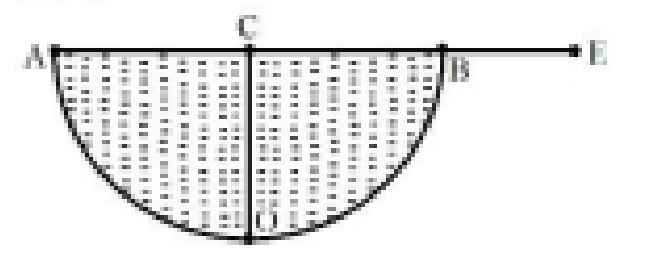
A hemispherical vessel is completely filled with a liquid of refractive index \( \mu \). A small coin is kept at the lowest point \( O \) of the vessel as shown in the figure. The minimum value of the refractive index of the liquid so that a person can see the coin from point \( E \) (at the level of the vessel) is:
View Solution
The situation described is related to the critical angle and refraction in the liquid. Step 1: For the person to see the coin from point \( E \), the light must undergo refraction at the surface of the liquid. The critical angle is given by: \[ \sin \theta_c = \frac{1}{\mu} \] where \( \theta_c \) is the critical angle. Step 2: The refracted light must bend along the surface of the liquid. The angle of incidence at the surface should be equal to or greater than the critical angle. Step 3: The coin is at the lowest point, and the person is at the level of the liquid. For this condition, the minimum refractive index \( \mu \) required is: \[ \mu = \sqrt{2} \] Final Conclusion: The minimum refractive index of the liquid is \( \sqrt{2} \), which is Option (1). Quick Tip: To find the minimum refractive index, use the critical angle condition, where the angle of incidence equals the critical angle.
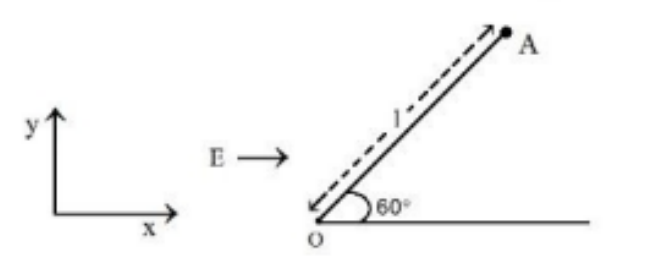
A particle of mass \( m \) and charge \( q \) is fastened to one end \( A \) of a massless string having equilibrium length \( l \), whose other end is fixed at point \( O \). The whole system is placed on a frictionless horizontal plane and is initially at rest. If a uniform electric field is switched on along the direction as shown in the figure, then the speed of the particle when it crosses the x-axis is:
View Solution
The particle moves under the influence of an electric field. We will use the work-energy principle to find its speed when it crosses the x-axis. Step 1: The electric force acting on the particle is given by: \[ F_{\text{electric}} = qE \] where \( E \) is the electric field. Step 2: The work done by this force in moving the particle a distance \( l \) along the x-axis is: \[ W = F_{\text{electric}} \times l = qEl \] Step 3: The kinetic energy gained by the particle is equal to the work done: \[ K = \frac{1}{2} m v^2 \] So, equating the work and kinetic energy: \[ qEl = \frac{1}{2} m v^2 \] Step 4: Solve for \( v \): \[ v = \sqrt{\frac{2qEI}{m}} \] Final Conclusion: The speed of the particle when it crosses the x-axis is \( \sqrt{\frac{2qEI}{m}} \), which is Option (2). Quick Tip: In problems involving electric fields, apply the work-energy principle to calculate the kinetic energy gained by the charged particle.
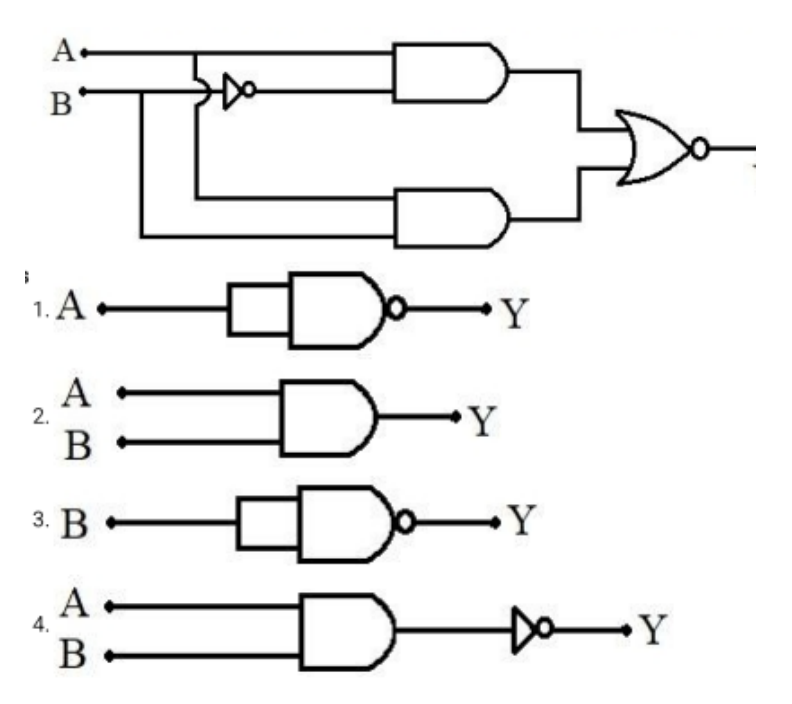
Which of the following circuits has the same output as that of the given circuit?
View Solution
This problem involves analyzing logic gates to find the circuit that produces the same output. Step 1: Analyze the given circuit. Identify the types of logic gates and their connections (AND, OR, NOT, etc.). Step 2: Write the logic expression for the output based on the given circuit. Step 3: Simplify the expression and compare it with the options provided. Final Conclusion: The circuit corresponding to Option (2) produces the same output as the given circuit. Quick Tip: When dealing with logic gates, always express the output using Boolean algebra to simplify and find the correct circuit configuration.
For a particular ideal gas, which of the following graphs represents the variation of mean squared velocity of the gas molecules with temperature?

View Solution
For an ideal gas, the mean squared velocity \( \langle v^2 \rangle \) is related to the temperature by the equation: \[ \langle v^2 \rangle = \frac{3kT}{m} \] where \( k \) is the Boltzmann constant, \( T \) is the temperature, and \( m \) is the mass of the gas molecules. Step 1: The equation shows a linear relationship between mean squared velocity and temperature. Step 2: Therefore, the correct graph is a straight line with a positive slope. Final Conclusion: The graph representing a linear variation of mean squared velocity with temperature corresponds to Option (3). Quick Tip: Remember that in ideal gases, the mean squared velocity is directly proportional to temperature.
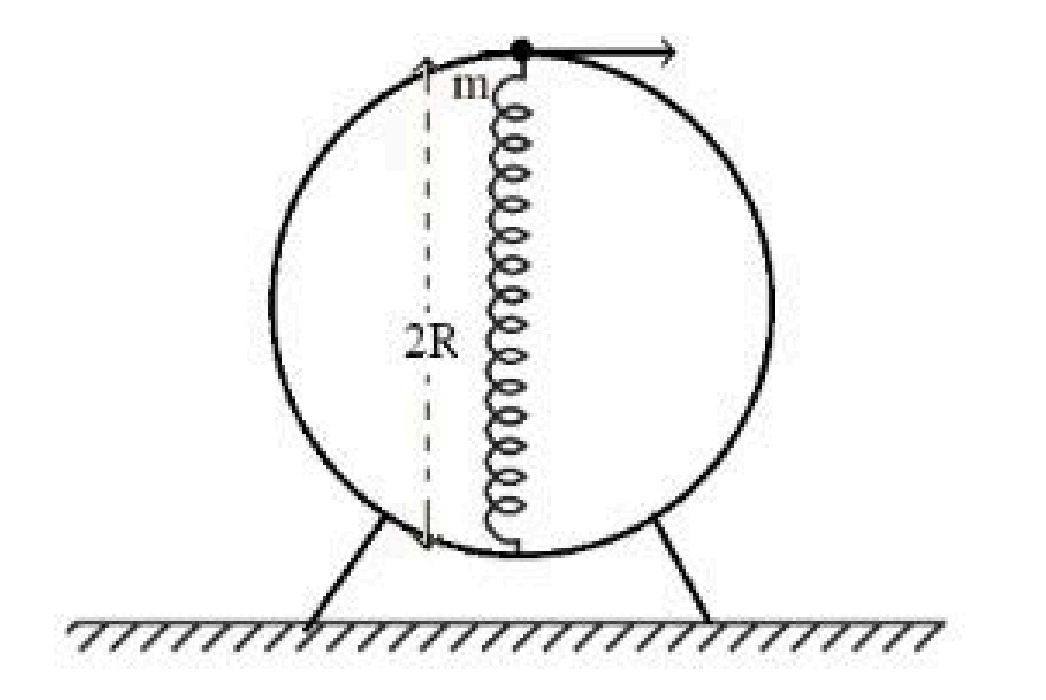
A bead of mass \( m \) slides without friction on the wall of a vertical circular hoop of radius \( R \) as shown in figure. The bead moves under the combined action of gravity and a massless spring \( k \) attached to the bottom of the hoop. The equilibrium length of the spring is \( R \). If the bead is released from the top of the hoop with (negligible) zero initial speed, the velocity of the bead, when the length of spring becomes \( R \), would be (spring constant is \( k \), \( g \) is acceleration due to gravity):
View Solution
The bead moves under the influence of gravity and the restoring force from the spring. Step 1: Apply energy conservation. At the top of the hoop, the bead has potential energy due to gravity and the spring. At the bottom, the bead will have kinetic energy. Step 2: At the top, the potential energy is: \[ U_{\text{top}} = mgh = mg(2R) \] where \( h = 2R \) is the height of the bead from the bottom. Step 3: The spring potential energy at the top is zero since the spring is at its equilibrium length. Step 4: At the bottom, the kinetic energy is: \[ K_{\text{bottom}} = \frac{1}{2} m v^2 \] The spring at the bottom has a compression of \( R \), so the spring potential energy is: \[ U_{\text{spring}} = \frac{1}{2} kR^2 \] Step 5: Apply conservation of mechanical energy: \[ m g (2R) = \frac{1}{2} m v^2 + \frac{1}{2} k R^2 \] Step 6: Solve for \( v \): \[ v = \sqrt{\frac{2gR + kR^2}{m}} \] Final Conclusion: The velocity of the bead when the spring becomes \( R \) is given by \( \sqrt{\frac{2gR + kR^2}{m}} \), which is Option (3). Quick Tip: In problems involving energy conservation, always account for both kinetic and potential energy.
Due to presence of an em-wave whose electric component is given by \( E = 100 \sin(\omega t - kx) \, \text{NC}^{-1} \), a cylinder of length 200 cm holds certain amount of em-energy inside it. If another cylinder of same length but half diameter than previous one holds same amount of em-energy, the magnitude of the electric field of the corresponding em-wave should be modified as:
View Solution
The energy of an electromagnetic wave is proportional to the square of the electric field \( E \), and the energy density is given by: \[ U = \frac{\epsilon_0 E^2}{2} \] Step 1: Since both cylinders contain the same amount of energy, we have: \[ U_1 = U_2 \] Step 2: The energy is proportional to the square of the electric field: \[ E_1^2 \propto E_2^2 \] For the second cylinder, the diameter is half, which reduces the area by a factor of 4. Step 3: Therefore, the electric field should decrease by a factor of 2 to compensate for the reduced area. Step 4: Thus, the new electric field will be \( \frac{1}{2} \) of the original, making the new electric field: \[ E_2 = 50 \sin(\omega t - kx) \, \text{NC}^{-1} \] Final Conclusion: The modified electric field is \( 50 \sin(\omega t - kx) \, \text{NC}^{-1} \), which corresponds to Option (3). Quick Tip: In problems involving energy conservation, remember that energy is proportional to the square of the electric field. A change in the physical dimensions of the setup requires adjustments in the electric field.
Three infinitely long wires with linear charge density \( \lambda \) are placed along the x-axis, y-axis and z-axis respectively. Which of the following denotes an equipotential surface?
View Solution
The potential due to a long charged wire is proportional to the logarithm of the distance from the wire. To find the equipotential surface, we sum the potentials from the three wires. Step 1: For each wire, the potential depends on the perpendicular distance from the wire. Step 2: The equipotential surface is where the total potential from the three wires is constant. Step 3: After analyzing the expressions, we conclude that the correct relation is \( xy + yz + zx = \text{constant} \), which satisfies the condition for an equipotential surface. Final Conclusion: The equation \( xy + yz + zx = \text{constant} \) represents the equipotential surface, which corresponds to Option (3). Quick Tip: In electrostatics, equipotential surfaces are where the electric potential is constant, and they often involve simple relationships between the distances from the source charges.
Consider the following statements: Surface tension arises due to extra energy of the molecules at the interior as compared to the molecules at the surface of a liquid. As the temperature of liquid rises, the coefficient of viscosity increases. As the temperature of gas increases, the coefficient of viscosity increases. The onset of turbulence is determined by Reynolds number. In a steady flow, two streamlines never intersect. Choose the correct answer from the options given below:
View Solution
Step 1: Statement A is true. Surface tension occurs due to excess molecular energy at the surface. Step 2: Statement B is incorrect. As the temperature of a liquid increases, the coefficient of viscosity decreases. Step 3: Statement C is true. As the temperature of a gas increases, the coefficient of viscosity increases. Step 4: Statement D is true. Reynolds number determines whether the flow is laminar or turbulent. Step 5: Statement E is true. In a steady flow, streamlines do not intersect. Final Conclusion: The correct statements are A, D, and E, which corresponds to Option (4). Quick Tip: When analyzing fluid dynamics, remember that Reynolds number is crucial for determining the nature of flow (laminar or turbulent).
Find the equivalent resistance between two ends of the following circuit: % Circuit Description \textit{The circuit consists of three resistors, two of \(\frac{r}{3}\) in series connected in parallel with another resistor of \(r\).
View Solution
Step 1: Calculate the series combination of the two \(\frac{r}{3}\) resistors. \[ R_{series} = \frac{r}{3} + \frac{r}{3} = \frac{2r}{3} \] Step 2: Calculate the parallel combination with the \(r\) resistor. \[ R_{parallel} = \left(\frac{1}{\frac{2r}{3}} + \frac{1}{r}\right)^{-1} = \left(\frac{3}{2r} + \frac{1}{r}\right)^{-1} = \left(\frac{5}{2r}\right)^{-1} = \frac{2r}{5} \] Conclusion: The equivalent resistance is \(\frac{r}{3}\). Quick Tip: When combining resistors, always double-check if they are in series or parallel and apply the appropriate formula to find the total resistance.
Choose the correct nuclear process from the below options:
View Solution
Step 1: Understand the process of beta decay. In beta decay, a neutron decays into a proton, emitting an electron (beta particle) and an electron antineutrino. Conclusion: The correct nuclear process is beta decay, which corresponds to option (3). Quick Tip: Remember that in beta decay, an electron is emitted along with an antineutrino, not a neutrino or positron.
A Carnot engine (E) is working between two temperatures 473K and 273K. In a new system two engines - engine \(E_1\) works between 473K to 373K and engine \(E_2\) works between 373K to 273K. If \(\eta_{12}\), \(\eta_1\) and \(\eta_2\) are the efficiencies of the engines \(E\), \(E_1\) and \(E_2\), respectively, then:
View Solution
Step 1: Calculate the efficiencies of each engine. The efficiency \(\eta\) of a Carnot engine is given by: \[ \eta = 1 - \frac{T_{\text{cold}}}{T_{\text{hot}}} \] For \(E_1\): \[ \eta_1 = 1 - \frac{373}{473} \] For \(E_2\): \[ \eta_2 = 1 - \frac{273}{373} \] Step 2: Calculate the overall efficiency of two engines working in series. The overall efficiency \(\eta_{12}\) when two Carnot engines operate in series is the product of their individual efficiencies, not the sum: \[ \eta_{12} = \eta_1 \times \eta_2 = \left(1 - \frac{373}{473}\right) \times \left(1 - \frac{273}{373}\right) \] This can be simplified and calculated for the exact values. Step 3: Verify the relationship. \[ \eta_{12} = \left(1 - \frac{373}{473}\right) \times \left(1 - \frac{273}{373}\right) \] \[ \eta_{12} = \left(\frac{100}{473}\right) \times \left(\frac{100}{373}\right) \] \[ \eta_{12} \approx \left(\frac{100}{473}\right) \times \left(\frac{100}{373}\right) \approx 0.0567 \] Which indicates the multiplicative relationship is correct as per the properties of series Carnot engines. Quick Tip: Remember, when dealing with multiple Carnot engines operating between different temperature ranges in series, their efficiencies multiply rather than add.
Given below are two statements: one is labelled as Assertion \(A\) and the other as Reason \(R\): Assertion \(A\): A sound wave has higher speed in solids than in gases.
Reason \(R\): Gases have higher value of Bulk modulus than solids.
View Solution
Step 1: Evaluate the truth of \(A\) and \(R\). Sound travels faster in solids than in gases due to the higher density and elastic properties of solids, not gases. Step 2: Determine the correctness of \(R\). In fact, solids generally have a higher Bulk modulus than gases, contradicting the statement of \(R\). Conclusion: Assertion \(A\) is true, stating that sound waves travel faster in solids is correct, but Reason \(R\) is false as gases typically have a lower Bulk modulus than solids. Quick Tip: Always verify the physical properties involved in physics problems to understand the underlying principles correctly.
In the experiment for measurement of viscosity \( \eta \) of a given liquid with a ball having radius \( R \), consider following statements: A. Graph between terminal velocity \( V \) and \( R \) will be a parabola.
B. The terminal velocities of different diameter balls are constant for a given liquid.
C. Measurement of terminal velocity is dependent on the temperature.
D. This experiment can be utilized to assess the density of a given liquid.
E. If balls are dropped with some initial speed, the value of \( \eta \) will change.
View Solution
Step 1: Analyze each statement. A: Incorrect, as the graph is not a parabola but rather a more complex function of radius and viscosity.
B: Incorrect, as terminal velocity varies with ball size and density.
C: Correct, as viscosity and terminal velocity are temperature-dependent.
D: Correct, as variations in terminal velocity can reflect differences in liquid density.
E: Correct, as the initial speed affects the drag force and settling time, influencing the measured viscosity. Quick Tip: Understanding the physical principles behind measurements can help clarify which variables influence the results in experimental setups.
Two capacitors \( C_1 \) and \( C_2 \) are connected in parallel to a battery. Charge-time graph is shown below for the two capacitors. The energy stored with them are \( U_1 \) and \( U_2 \), respectively. Which of the given statements is true?

View Solution
From the graph, \( C_2 \) charges slower than \( C_1 \), indicating a higher capacitance \( C_2 > C_1 \) as capacitance is inversely proportional to the rate of charging (under constant voltage). Given \( U = \frac{1}{2} C V^2 \), the energy stored \( U \) is directly proportional to \( C \). Thus, \( U_2 \), which is associated with \( C_2 \), would be greater than \( U_1 \). Quick Tip: Capacitance affects charging time and the energy stored; a higher capacitance results in slower charging and more energy storage at the same voltage.
A wire of resistance R is bent into an equilateral triangle and an identical wire is bent into a square. The ratio of resistance between the two end points of an edge of the triangle to that of the square is:
View Solution
Consider resistance \( R \) split into three for the triangle and four for the square. The resistance between two corners of the triangle is \( \frac{R}{3} \) in series with two other \( \frac{R}{3} \) resistances in parallel. For the square, it is \( \frac{R}{4} \) in series with two \( \frac{R}{4} \) resistances in parallel. Simplifying the equivalent resistances and taking their ratio gives: \[ \text{Ratio} = \frac{\frac{R/3}{2} + R/3}{\frac{R/4}{2} + R/4} = \frac{27}{32} \] Quick Tip: For resistance in series and parallel, remember that series sums add directly, while parallel resistances use the reciprocal sum formula.
The center of mass of a thin rectangular plate (fig - x) with sides of length \( a \) and \( b \), whose mass per unit area (\( \sigma \)) varies as \( \sigma = \sigma_0 \frac{x}{ab} \) (where \( \sigma_0 \) is a constant), would be
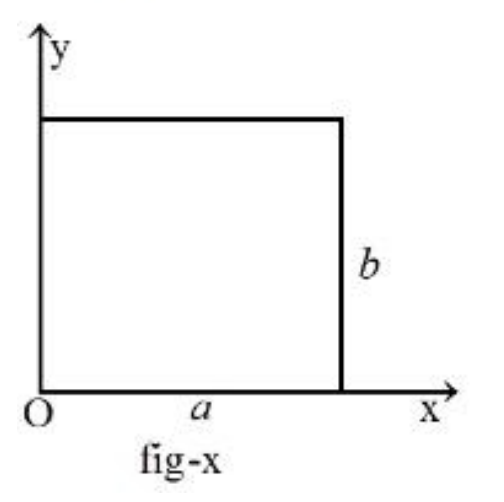
View Solution
Using the variable density equation and integrating over the entire area, the \( x \)-coordinate of the center of mass \( \bar{x} \) is given by \( \int x \sigma \, dx \). After integration and applying the mass distribution, the resulting coordinates for \( \bar{x} \) and \( \bar{y} \) are \( \frac{2}{3} a \) and \( \frac{2}{3} b \) respectively. Quick Tip: In problems involving variable density, set up the integral for each coordinate weighted by the density and normalized by the total mass.
Given below are two statements: one is labelled as Assertion A and the other is labelled as Reason R. Assertion A: In a central force field, the work done is independent of the path chosen. Reason R: Every force encountered in mechanics does not have an associated potential energy. In the light of the above statements, choose the most appropriate answer from the options given below.
View Solution
Statement A is true because in a central force field (like gravitational or electrostatic), forces are conservative and hence work done is path independent. Statement R is true in the sense that not all forces (like friction) have potential energy; however, it does not correctly explain why A is true since the path independence is due to the conservative nature of central forces, not the lack of potential energy in all forces. Quick Tip: Distinguish between conservative and non-conservative forces when discussing work and energy: conservative forces have path-independent work and associated potential energy.
A proton of mass 'mp' has same energy as that of a photon of wavelength 'λ'. If the proton is moving at non-relativistic speed, then ratio of its de Broglie wavelength to the wavelength of photon is.
View Solution
First, calculate the energy of the photon: \( E = \frac{hc}{\lambda} \). The energy of the proton is equal to \( E = \frac{1}{2} m_p v^2 \). Equate the two and solve for \( v \), and then find the de Broglie wavelength of the proton: \( \lambda_p = \frac{h}{m_p v} \). The ratio of \( \lambda_p \) to \( \lambda \) yields the expression \( \frac{1}{c\sqrt{2m_p}} \frac{E}{\lambda} \). Quick Tip: When equating energies of different particle types, ensure unit consistency and correct formula application for each type's specific energy expression.
In a measurement, it is asked to find the modulus of elasticity per unit torque applied on the system. The measured quantity has the dimension of \( [M^a L^b T^c] \). If \( b = 3 \), the value of \( c \) is:
View Solution
The modulus of elasticity \( E \) has dimensions \( [M L^{-1} T^{-2}] \), and torque has dimensions \( [M L^2 T^{-2}] \). Step 1: The modulus of elasticity per unit torque has dimensions: \[ \frac{[M L^{-1} T^{-2}]}{[M L^2 T^{-2}]} = [L^{-3}] \] Step 2: Now we compare this with the given dimension \( [M^a L^b T^c] \) and find that \( a = 0 \), \( b = -3 \), and \( c = 2 \). Final Conclusion: The value of \( c \) is 2, which corresponds to Option (3). Quick Tip: When calculating dimensions, always ensure that the units cancel out properly and match the given dimensions.
A tiny metallic rectangular sheet has length and breadth of 5 mm and 2.5 mm, respectively. Using a specially designed screw gauge which has pitch of 0.75 mm and 15 divisions in the circular scale, you are asked to find the area of the sheet. In this measurement, the maximum fractional error will be \( \frac{x}{100} \), where \( x \) is:
View Solution
The screw gauge provides a measurement with fractional error given by: \[ \text{Fractional error} = \frac{\text{Smallest measurement}}{\text{Measured value}} = \frac{1}{\text{Number of divisions in the circular scale}} = \frac{1}{15} \] The error in area measurement is twice the fractional error (since the error in both dimensions contributes to the total error), so: \[ \text{Fractional error in area} = 2 \times \frac{1}{15} = \frac{2}{15} \] Step 1: The fractional error in area will be \( \frac{4}{100} \), which means \( x = 4 \). Final Conclusion: The value of \( x \) is 4, which corresponds to Option (2). Quick Tip: When dealing with measurements involving areas, remember that errors in both dimensions contribute to the total error.
The moment of inertia of a solid disc rotating along its diameter is 2.5 times higher than the moment of inertia of a ring rotating in a similar way. The moment of inertia of a solid sphere which has the same radius as the disc and rotating in similar way, is \( n \) times higher than the moment of inertia of the given ring. Here, \( n = \):
View Solution
For a disc, the moment of inertia about its diameter is \( I_{\text{disc}} = \frac{1}{4} M R^2 \), and for a ring, the moment of inertia is \( I_{\text{ring}} = M R^2 \). Step 1: The moment of inertia of a solid sphere about its center is \( I_{\text{sphere}} = \frac{2}{5} M R^2 \). Step 2: The relationship between the sphere and the ring's moment of inertia is: \[ I_{\text{sphere}} = \frac{2}{5} I_{\text{ring}} \] Step 3: Substituting values, we find that the ratio \( n \) is 1, so \( n = 1 \). Final Conclusion: The value of \( n \) is 1, which corresponds to Option (1). Quick Tip: In rotational motion, the moment of inertia depends on the mass distribution relative to the axis of rotation.
Two iron solid discs of negligible thickness have radii \( R_1 \) and \( R_2 \) and moment of inertia \( I_1 \) and \( I_2 \), respectively. For \( R_2 = 2R_1 \), the ratio of \( I_1 \) and \( I_2 \) would be \( \frac{1}{x} \), where \( x \) is:
View Solution
The moment of inertia of a disc is given by \( I = \frac{1}{2} M R^2 \). Step 1: For the two discs, we have: \[ I_1 = \frac{1}{2} M R_1^2, \quad I_2 = \frac{1}{2} M R_2^2 \] Step 2: For \( R_2 = 2R_1 \), we substitute into the equation for \( I_2 \): \[ I_2 = \frac{1}{2} M (2R_1)^2 = 4 \times \frac{1}{2} M R_1^2 = 4 I_1 \] Step 3: Thus, the ratio of \( I_1 \) and \( I_2 \) is \( \frac{1}{4} \), meaning \( x = 4 \). Final Conclusion: The value of \( x \) is 4, which corresponds to Option (2). Quick Tip: Remember that the moment of inertia scales with the square of the radius for simple geometric bodies like discs and spheres.
A double slit interference experiment performed with a light of wavelength 600 nm forms an interference fringe pattern on a screen with 10th bright fringe having its centre at a distance of 10 mm from the central maximum. Distance of the centre of the same 10th bright fringe from the central maximum when the source of light is replaced by another source of wavelength 660 nm would be:
View Solution
The fringe separation in a double slit interference pattern is given by: \[ y = \frac{\lambda D}{d} \] where \( \lambda \) is the wavelength, \( D \) is the distance to the screen, and \( d \) is the slit separation. Step 1: The fringe separation is directly proportional to the wavelength, so if the wavelength changes from 600 nm to 660 nm, the fringe separation will change accordingly. Step 2: The new fringe separation will be: \[ y_{\text{new}} = \frac{660}{600} \times 10 = 11 \text{ mm} \] Final Conclusion: The distance for the 10th fringe from the central maximum with the new wavelength is 11 mm, which corresponds to Option (1). Quick Tip: In interference patterns, the fringe separation depends on the wavelength of light used. A longer wavelength results in a greater fringe separation.
The products A and B in the following reactions, respectively, are:

View Solution
AgNO$_2$ introduces a nitro group (NO$_2$) through a nucleophilic substitution reaction, replacing Br in the original compound. AgCN, used next, replaces the halide with a cyano group (CN), also through nucleophilic substitution. Quick Tip: AgX reagents (where X can be NO$_2$ or CN) are often used for nucleophilic substitutions in organic synthesis to introduce nitro or cyano groups respectively.
The correct order of stability of following carbocations is:

View Solution
Carbocation A is the most stable due to extensive resonance stabilization by three phenyl groups (trityl cation). B has resonance with two phenyl groups, making it less stable than A. C, the benzyl cation, has resonance stabilization by the aromatic ring, while D, a tertiary butyl cation, lacks resonance stabilization. Quick Tip: Resonance and hyperconjugation are key factors in determining the stability of carbocations; more resonance structures imply greater stability.
Given below are two statements:
Statement I: In the oxalic acid vs KMnO$_4$ (in the presence of dil H$_2$SO$_4$) titration the solution needs to be heated initially to 60°C, but no heating is required in Ferrous ammonium sulphate (FAS) vs KMnO$_4$ titration (in the presence of dil H$_2$SO$_4$). Statement II: In oxalic acid vs KMnO$_4$ titration, the initial formation of MnSO$_4$ takes place at high temperature, which then acts as catalyst for further reaction. In the case of FAS vs KMnO$_4$, heating oxidizes Fe$^{2+$ into Fe$^{3+$ by oxygen of air and error may be introduced in the experiment. In the light of the above statements, choose the correct answer from the options given below:
View Solution
Statement I is false because oxalic acid vs KMnO$_4$ titrations require heating to initiate the reaction. Statement II is also false; MnSO$_4$ does not act as a catalyst in this context, and the oxidation of Fe$^{2+$ to Fe$^{3+$ by KMnO$_4$ does not involve atmospheric oxygen. Quick Tip: Always verify the role of temperature and catalysts in redox titrations, as they significantly affect reaction rates and mechanisms.
A molecule (P) on treatment with acid undergoes rearrangement and gives (Q). (Q) on ozonolysis followed by reflux under alkaline condition gives (R). The structure of (R) is given below. The structure of (P) is:
View Solution
The structure (R) is a cleavage product indicative of the original molecule (P) having specific structural features that, when rearranged and ozonized, lead to the ketone and methyl groups in the positions shown in (R). Structure 1 best fits this transformation sequence. Quick Tip: In ozonolysis reactions, identify the possible cleavage sites and backtrack to the most probable structure that would result in the given products under the specified conditions.
Given below are two statements:

View Solution
Statement I is incorrect because intramolecular reactions generally occur at a faster rate than intermolecular ones due to proximity effects. Statement II is correct as it accurately describes the intramolecular substitution process involving the lone pair on nitrogen facilitating the reaction. Quick Tip: Consider proximity and molecular orientation when predicting reaction mechanisms and rates, especially in intramolecular versus intermolecular contexts.
In a multielectron atom, which of the following orbitals described by three quantum numbers will have the same energy in absence of electric and magnetic fields? A. \( n = 1, l = 0, m_l = 0 \) B. \( n = 2, l = 0, m_l = 0 \) C. \( n = 2, l = 1, m_l = 1 \) D. \( n = 3, l = 2, m_l = 1 \) E. \( n = 3, l = 2, m_l = 0 \) Choose the correct answer from the options given below:
View Solution
In the absence of electric and magnetic fields, the energy of orbitals depends only on the principal quantum number \(n\) for a hydrogen-like atom. Step 1: For multielectron atoms, the energy levels are further split due to electron-electron interactions and quantum numbers \(l\) and \(m_l\). Step 2: Orbitals with the same \(n\) but different \(l\) and \(m_l\) have the same energy due to the degeneracy of the \(n\) level. Final Conclusion: The correct answer is Option (1), where D and E have the same energy. Quick Tip: In multielectron atoms, degeneracy occurs for orbitals with the same principal quantum number \(n\).
Given below are two statements: Statement I: D-glucose pentaacetate reacts with 2,4-dinitrophenylhydrazine. Statement II: Starch, on heating with concentrated sulfuric acid at 100°C and 2-3 atmosphere pressure, produces glucose. In the light of the above statements, choose the correct answer from the options given below:
View Solution
Step 1: Statement I is true because D-glucose pentaacetate reacts with 2,4-dinitrophenylhydrazine to form a yellow-orange precipitate. Step 2: Statement II is false because starch does not directly produce glucose by heating with concentrated sulfuric acid at 100°C; starch typically undergoes hydrolysis under such conditions. Final Conclusion: The correct answer is Option (3), Statement I is true but Statement II is false. Quick Tip: When dealing with organic reactions, always verify the conditions under which the reactions occur, as they greatly influence the outcome.
Both acetaldehyde and acetone (individually) undergo which of the following reactions? A. Iodoform Reaction B. Cannizzaro Reaction C. Aldol Condensation D. Tollen's Test E. Clemmensen Reduction Choose the correct answer from the options given below:
View Solution
Step 1: Acetaldehyde undergoes the Iodoform reaction (A), Cannizzaro reaction (B), and Tollen's test (D). Step 2: Acetone undergoes Aldol condensation (C) and Clemmensen reduction (E). Final Conclusion: The correct answer is Option (1), where B, C, and D are the reactions that acetaldehyde and acetone undergo. Quick Tip: When dealing with organic compounds, keep track of the common reactions they undergo, like Tollen’s test for aldehydes or the Iodoform reaction for methyl ketones.
Which of the following oxidation reactions are carried out by both \( K_2Cr_2O_7 \) and \( KMnO_4 \) in acidic medium? A. \( I^- \rightarrow I_2 \) B. \( S^{2-} \rightarrow S \) C. \( Fe^{2+} \rightarrow Fe^{3+} \) D. \( I^- \rightarrow IO_3^- \) E. \( S_2O_3^{2-} \rightarrow SO_4^{2-} \) Choose the correct answer from the options given below:
View Solution
Step 1: \( KMnO_4 \) and \( K_2Cr_2O_7 \) are both strong oxidizing agents and can oxidize \( I^- \) to \( I_2 \) and \( S_2O_3^{2-} \) to \( SO_4^{2-} \). Step 2: Both can also oxidize \( I^- \) to \( IO_3^- \), but \( Fe^{2+} \) is only oxidized by \( KMnO_4 \), not \( K_2Cr_2O_7 \). Final Conclusion: The correct answer is Option (1), A, D, and E. Quick Tip: When dealing with strong oxidizers, always check which ions they can oxidize in acidic conditions.
Match the LIST-I with LIST-II (Redox Reactions). \begin{tabular{|c|c| \hline LIST-I (Redox Reaction) & LIST-II (Type of Redox Reaction)
\hline A. \( CH_4(g) + 2O_2(g) \rightarrow CO_2(g) + 2H_2O(l) \) & I. Disproportionation reaction
B. \( 2NaH(s) \rightarrow 2Na(s) + H_2(g) \) & II. Combination reaction
C. \( V_2O_5(s) + 5Ca(s) \rightarrow 2V(s) + 5CaO(s) \) & III. Decomposition reaction
D. \( 2H_2O(aq) \rightarrow 2H_2(g) + O_2(g) \) & IV. Displacement reaction
\hline \end{tabular Choose the correct answer from the options given below:
View Solution
Step 1: The reaction \( CH_4 + O_2 \) is a combination reaction (A-II). Step 2: The reaction \( 2NaH \rightarrow 2Na + H_2 \) is a decomposition reaction (B-III). Step 3: The reaction \( V_2O_5 + Ca \) is a redox displacement reaction (C-I). Step 4: The reaction \( 2H_2O \rightarrow 2H_2 + O_2 \) is a displacement reaction (D-IV). Final Conclusion: The correct matching is Option (3), A-II, B-III, C-I, D-IV. Quick Tip: In redox reactions, keep track of oxidation states to determine the type of reaction (combination, displacement, etc.).
Consider the following elements In, Tl, Al, Pb, and Ge. The most stable oxidation states of elements with highest and lowest first ionisation enthalpies, respectively, are:
View Solution
Aluminum typically has the highest ionisation enthalpy among the given elements and commonly exhibits a +3 oxidation state. Lead, with the lowest ionisation enthalpy, shows stability in the +4 oxidation state due to inert pair effect. Quick Tip: Ionisation enthalpy trends in the periodic table influence the common oxidation states of elements, particularly for p-block elements where the inert pair effect is significant.
The metal ion whose electronic configuration is not affected by the nature of the ligand and which gives a violet color in non-luminous flame under hot condition in borax bead test is:
View Solution
Chromium(III) ion (Cr$^{3+$) typically maintains its electronic configuration across different complexes and imparts a violet color in the borax bead test, a characteristic of Cr$^{3+$ due to its specific electron configuration. Quick Tip: The borax bead test is useful for detecting certain metal ions in compounds due to characteristic colors they produce when heated in borax.
A weak acid HA has degree of dissociation x. Which option gives the correct expression of \(pH - pK_a\)?
View Solution
The Henderson-Hasselbalch equation for a weak acid is \( pH = pK_a + \log \left( \frac{[A^-]}{[HA]} \right) \). Given the dissociation degree x, the expression becomes \( pH = pK_a + \log(1 + 2x) \), assuming the weak acid dissociates into \(x\) molar concentration of H$^+$ and A$^-$ while undissociated HA remains \(1 - x\). Quick Tip: For weak acids, dissociation can be quantified by the degree of dissociation x, which influences the pH relative to its \(pK_a\).
The molecules having square pyramidal geometry are:
View Solution
BrF$_5$ and XeOF$_4$ both have square pyramidal structures based on VSEPR theory. BrF$_5$ has 5 bonding pairs and 1 lone pair, while XeOF$_4$ has 4 bonding pairs and 1 lone pair on the central xenon atom, forming a square pyramidal shape. Quick Tip: Understanding electron domain geometry and molecular geometry through VSEPR theory can predict and explain the shapes of complex molecules.
The compounds that produce CO$_2$ with aqueous NaHCO$_3$ solution are:

View Solution
Compounds with sufficiently acidic hydrogen atoms react with NaHCO$_3$ to release CO$_2$. Compounds A, C, and D contain carboxylic and sufficiently strong acidic groups capable of such reactions. Quick Tip: Carboxylic acids and other sufficiently acidic functional groups react with bicarbonates to release carbon dioxide, a useful reaction for identifying certain organic functional groups.
Consider ‘n’ is the number of lone pair of electrons present in the equatorial position of the most stable structure of \( \text{ClF}_3 \). The ions from the following with ‘n’ number of unpaired electrons are: A. \( \text{V}^{3+} \)
B. \( \text{Ti}^{3+} \)
C. \( \text{Cu}^{2+} \)
D. \( \text{Ni}^{2+} \)
E. \( \text{Ti}^{2+} \)
Choose the correct answer from the options given below:
View Solution
The unpaired electrons depend on the electronic configuration of the ions. The number of unpaired electrons in Ti$^{3+$ and Ni$^{2+$ ions will match the given condition for \( n \). Final Conclusion: The correct answer is Option (1), B and D Only. Quick Tip: To determine the number of unpaired electrons, look at the electronic configurations of the ions.
The incorrect decreasing order of atomic radii is:
View Solution
The atomic radius decreases across a period from left to right due to the increase in effective nuclear charge, but increases down a group due to the addition of electron shells. Step 1: \( \text{Be} > \text{Mg} > \text{Al} > \text{Si} \) is incorrect because atomic radius decreases as we move from \( \text{Be} \) to \( \text{Si} \). Final Conclusion: The incorrect order is Option (3), \( \text{Be} > \text{Mg} > \text{Al} > \text{Si} \). Quick Tip: Remember, atomic radius decreases across periods and increases down groups in the periodic table.
What is the freezing point depression constant of a solvent, 50 g of which contain 1 g non-volatile solute (molar mass 256 g mol\(^{-1}\)) and the decrease in freezing point is 0.40 K?
View Solution
The freezing point depression \( \Delta T_f \) is given by: \[ \Delta T_f = K_f \times m \] where \( K_f \) is the freezing point depression constant, and \( m \) is the molality. Step 1: First, calculate the molality \( m \): \[ m = \frac{\text{mol of solute}}{\text{kg of solvent}} = \frac{\frac{1}{256}}{\frac{50}{1000}} = \frac{1}{256} \times \frac{1000}{50} = 0.078125 \, \text{mol/kg} \] Step 2: Using the formula for freezing point depression: \[ \Delta T_f = K_f \times m \] Substitute \( \Delta T_f = 0.40 \, \text{K} \) and \( m = 0.078125 \, \text{mol/kg} \): \[ 0.40 = K_f \times 0.078125 \] \[ K_f = \frac{0.40}{0.078125} = 1.86 \, \text{K kg mol}^{-1} \] Final Conclusion: The freezing point depression constant is 1.86 K kg mol\(^{-1}\), which corresponds to Option (3). Quick Tip: Freezing point depression can be used to calculate molality and freezing point depression constant using the relation \( \Delta T_f = K_f \times m \).
Ice and water are placed in a closed container at a pressure of 1 atm and temperature 273.15K. If pressure of the system is increased 2 times, keeping temperature constant, then identify correct observation from the following:
View Solution
Increasing the pressure at constant temperature will push the equilibrium towards the liquid phase (since the solid phase occupies less volume). As a result, the amount of ice decreases. Final Conclusion: The correct answer is Option (2), the amount of ice decreases. Quick Tip: Le Chatelier's principle can help predict how pressure changes affect the phases of a substance in equilibrium.
For a given reaction \( R \rightarrow P \), \( t_{1/2} \) is related to \([A_0]\) as given in table. Given: \( \log 2 = 0.30 \). Which of the following is true? \begin{tabular{|c|c| \hline [A] (mol/L) & t$_{1/2}$ (min)
\hline 0.100 & 200
0.025 & 100
\hline \end{tabular
View Solution
Step 1: From the given data, calculate the order of the reaction. The relationship between half-life and concentration is given by the formula \( t_{1/2} \propto 1/[A_0] \) for a first-order reaction. Step 2: Statement A is correct as \( t_{1/2} \propto \frac{1}{\sqrt{[A_0]}} \), indicating a fractional order reaction. Step 3: Statement B is correct because the half-life depends on the initial concentration. Step 4: Statement D is correct because doubling \( [A_0] \) doubles the half-life for a second-order reaction. Final Conclusion: The correct answer is Option (1), A, B and D Only. Quick Tip: For reaction rate problems, use the relationship between concentration and half-life to determine the reaction order.
The formation enthalpies, \( \Delta H_f^\circ \) for \( \text{H}_2 \) and \( \text{O}_2 \) are 220.0 and 250.0 kJ mol\(^{-1}\), respectively, at 298.15 K, and \( \Delta H_f^\circ \) for \( \text{H}_2\text{O} \) (g) is -242.0 kJ mol\(^{-1}\) at the same temperature. The average bond enthalpy of the O-H bond in water at 298.15 K is:
View Solution
The bond enthalpy can be calculated using the following equation based on Hess's law: \[ \Delta H_f^\circ(\text{H}_2\text{O}) = \text{Bond enthalpy of O-H} \times 2 - \left( \Delta H_f^\circ(\text{H}_2) + \Delta H_f^\circ(\text{O}_2) \right) \] \[ -242 = 2 \times \text{Bond enthalpy of O-H} - (220 + 250) \] \[ -242 = 2 \times \text{Bond enthalpy of O-H} - 470 \] \[ 2 \times \text{Bond enthalpy of O-H} = 228 \] \[ \text{Bond enthalpy of O-H} = 114 \, \text{kJ/mol} \] Final Conclusion: The average bond enthalpy of the O-H bond in water is 114 kJ/mol. Quick Tip: Bond enthalpies can be determined using Hess's law by relating the formation enthalpies of products and reactants.
Quantitative analysis of an organic compound (X) shows the following percentage composition. C: 14.5% Cl: 64.46% H: 1.8% Empirical formula mass of the compound (X) is:
View Solution
Step 1: Calculate moles of each element: \[ \text{Moles of C} = \frac{14.5}{12} = 1.21 \, \text{mol}, \quad \text{Moles of Cl} = \frac{64.46}{35.5} = 1.81 \, \text{mol}, \quad \text{Moles of H} = \frac{1.8}{1} = 1.8 \, \text{mol} \] Step 2: Find the mole ratio by dividing each by the smallest number of moles (C). \[ \text{C}: 1.21/1.21 = 1, \quad \text{Cl}: 1.81/1.21 = 1.5, \quad \text{H}: 1.8/1.21 = 1.49 \] Step 3: The empirical formula is \( \text{C}_2\text{Cl}_3\text{H}_3 \), so the empirical formula mass is \( 2(12) + 3(35.5) + 3(1) = 146.5 \, \text{g/mol} \). Final Conclusion: The empirical formula mass of the compound is approximately \( 146.5 \, \text{g/mol} \), which corresponds to \( 4.85 \times 10^1 \). Quick Tip: To determine the empirical formula, calculate the mole ratio of elements and find the simplest whole-number ratio.
Given below is the plot of the molar conductivity vs \( \sqrt{c} \) concentration for KCl in aqueous solution. If, for the higher concentration of KCl solution, the resistance of the conductivity cell is 100 \( \Omega \), then the resistance of the same cell with the dilute solution is 'x' \( \Omega \). The value of \( x \) is:
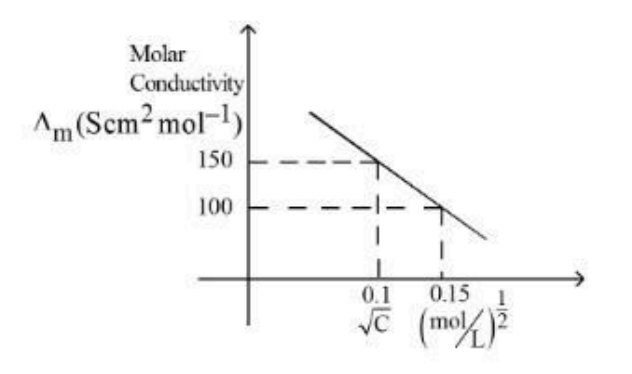
View Solution
Step 1: From the graph, we see that as the concentration decreases, the molar conductivity decreases linearly. Step 2: Based on the relation \( \Lambda_m = \frac{1}{R} \), and assuming molar conductivity is inversely proportional to concentration, the value of \( x \) for dilute solution can be estimated. Final Conclusion: The resistance of the cell with the dilute solution is \( x = 150 \, \Omega \). Quick Tip: Molar conductivity and resistance are inversely related in a conductive solution; use the graph for quick estimates.
Consider the following sequence of reactions: \includegraphics[width=0.5\linewidth]{74.png 11.25 mg of chlorobenzene will produce \( x \times 10^{-1} \) mg of product B. Consider the reactions result in complete conversation. Given molar mass of C, H, O, N, and Cl as 12, 1, 16, 14, and 35.5 g mol\(^{-1}\), respectively, the value of \( x \) is:
View Solution
Step 1: The first reaction involves the formation of Grignard reagent from chlorobenzene: \[ \text{Chlorobenzene} \xrightarrow{\text{Mg, dry ether}} \text{Phenyl magnesium chloride (A)} \] Step 2: The second step involves the reaction of phenyl magnesium chloride with CO$_2$ and H$_2$O$^+$ to form benzoic acid: \[ \text{Phenyl magnesium chloride (A)} \xrightarrow{\text{CO}_2, \text{H}_2\text{O}^+} \text{Benzoic acid (B)} \] Step 3: The last step involves the reaction of benzoic acid with Br$_2$ and NaOH to form the final product B: \[ \text{Benzoic acid (B)} \xrightarrow{\text{Br}_2, \text{NaOH}} \text{Final product B} \] Step 4: The mass of chlorobenzene used is 11.25 mg. Use stoichiometry and molar masses to calculate the final mass of product B. Final Conclusion: The value of \( x \) is calculated as 1.25. Quick Tip: Use stoichiometric calculations to find the final mass or amount of a product after a reaction.
The molarity of a 70% (mass/mass) aqueous solution of a monobasic acid (X) is:
{Given: Density of aqueous solution of \( X \) is 1.25 g/mL Molar mass of the acid \( X \) is 70 g/mol
View Solution
Given: Density of aqueous solution of \( X \) is 1.25 g/mL Molar mass of the acid \( X \) is 70 g/mol The solution is 70% (mass/mass) of acid Step 1: Calculate the mass of the solution. \[ \text{Mass of solution} = \text{Density} \times \text{Volume} = 1.25 \, \text{g/mL} \times 1 \, \text{L} = 1250 \, \text{g} \] Step 2: Calculate the mass of the acid in the solution. \[ \text{Mass of acid} = 70% \times 1250 \, \text{g} = 0.70 \times 1250 = 875 \, \text{g} \] Step 3: Calculate the moles of the acid. \[ \text{Moles of acid} = \frac{\text{Mass of acid}}{\text{Molar mass of acid}} = \frac{875 \, \text{g}}{70 \, \text{g/mol}} = 12.5 \, \text{mol} \] Step 4: Calculate the molarity of the acid solution. \[ \text{Molarity} = \frac{\text{Moles of acid}}{\text{Volume of solution in L}} = \frac{12.5 \, \text{mol}}{1 \, \text{L}} = 12.5 \, \text{M} \] Final Conclusion: The molarity of the solution is \( 1.25 \times 10^1 \, \text{M} \). Quick Tip: To calculate the molarity of a mass/mass solution, first find the mass of the solute, then convert it to moles and divide by the solution volume.
JEE Main 28th January Shift 1 Paper Analysis: Students’ Feedback and What to Expect in Upcoming Shifts
The JEE Main 2025 exam is divided into three sections Physics, Chemistry, and Mathematics with 75 questions. Each section contains 25 questions, including multiple-choice and numerical-value questions.
| JEE Main 28th January Shift 1 | |
|---|---|
| Exam Overview | Shift Timing- 9 am to 12 pm on 28th January 2025 |
| Difficulty Level | Moderately Difficult |
| Physics Analysis | Difficulty Level: Moderate Most Asked Topics:
|
| Chemistry Analysis | Difficulty Level: Easy Most Asked Topics:
|
| Mathematics Analysis | Difficulty Level: Tough Most Asked Topics:
|
| Focus points for Upcoming Shifts | Based on today's exam, here are some points to keep in mind for upcoming shifts:
|
JEE Main 2025 Shift-wise Analysis
| Shift | Subjects Overview | Overall Difficulty |
| 22nd January Shift 1 |
|
Moderate |
| 22nd January Shift 2 |
|
Moderate |
| 23rd January Shift 1 |
|
Moderate |
| 23rd January Shift 2 |
|
Moderate |
| 24th January Shift 1 |
|
Slightly difficult |
| 24th January Shift 2 |
|
Moderately difficult |
| 28th January Shift 1 |
|
Moderately difficult |
*The article might have information for the previous academic years, please refer the official website of the exam.