
JEE Main 2025 January 28 Shift 2 Question Paper PDF with Answer Key

.jpg?tr=h-55,w-55,c-force)
Content Strategist|Tech-innovator|National Hackathon Winner | Updated On - Mar 17, 2025
The Memory-Based Question Paper for JEE Main 2025 Session 1 B.E/B. Tech Paper conducted on 28 January 2025 is now available for download.
NTA has conducted the 28 January Shift 2 Exam from 3 pm to 6 pm and the paper is reported to be of a mixed level of difficulty across sections. The Mathematics Section is reported to be challenging and time-consuming, while the Chemistry and Physics Sections are reported as easy and doable by the candidates.
| JEE Main 2025 28 Jan Shift 2 Question Paper With Answer Key |  Download Download |
Check Solution |

Question 1:
The square of the distance of the point \(\left( \frac{15}{7}, \frac{32}{7}, 7 \right)\) from the line \(\frac{x+1}{3} = \frac{y+3}{5} = \frac{z+5}{7}\) in the direction of the vector \(\mathbf{i} + 4\mathbf{j} + 7\mathbf{k}\) is:
View Solution
Step 1: Equation of the line and point.
The equation of the line is given by: \[ L: \frac{x+1}{3} = \frac{y+3}{5} = \frac{z+5}{7} \]
The point \( P = \left( \frac{15}{7}, \frac{32}{7}, 7 \right) \).
Step 2: Find the coordinates of point Q.
Let \( Q \) be a point on the line \( L \). We assume the parametric coordinates for \( Q \) as: \[ Q: \left( \lambda + \frac{15}{7}, 4\lambda + \frac{32}{7}, 7\lambda + 7 \right) \]
Step 3: Use the condition that point \( Q \) lies on the line \( L \).
The coordinates of \( Q \) must satisfy the equation of the line. Using the first equation \( \frac{x+1}{3} = \frac{y+3}{5} = \frac{z+5}{7} \), we obtain: \[ \frac{\lambda + \frac{15}{7} + 1}{3} = \frac{4\lambda + \frac{32}{7} + 3}{5} = \frac{7\lambda + 7 + 5}{7} \]
Solving for \( \lambda \): \[ \Rightarrow 7\lambda + 22 = 21\lambda + 36 \] \[ \Rightarrow \lambda = -1 \]
Step 4: Coordinates of point \( Q \).
Substitute \( \lambda = -1 \) into the parametric form for \( Q \): \[ Q = \left( \frac{8}{7}, 4, 0 \right) \]
Step 5: Find the distance \( PQ \).
To find the distance between points \( P \left( \frac{15}{7}, \frac{32}{7}, 7 \right) \) and \( Q \left( \frac{8}{7}, 4, 0 \right) \), use the distance formula: \[ PQ = \sqrt{\left( \frac{15}{7} - \frac{8}{7} \right)^2 + \left( \frac{32}{7} - 4 \right)^2 + (7 - 0)^2} \] \[ PQ = \sqrt{\left( \frac{7}{7} \right)^2 + \left( \frac{32}{7} - \frac{28}{7} \right)^2 + 7^2} \] \[ PQ = \sqrt{1^2 + \left( \frac{4}{7} \right)^2 + 49} \] \[ PQ = \sqrt{1 + \frac{16}{49} + 49} = \sqrt{\frac{65}{49} + 49} \] \[ PQ = \sqrt{\frac{65 + 2401}{49}} = \sqrt{\frac{2466}{49}} = \sqrt{66} \] \[ \Rightarrow PQ^2 = 66 \] Quick Tip: To find the square of the distance between two points, use the distance formula first, and then square the result.
If \[ \sum_{r=1}^{13} \frac{1}{\sin \frac{\pi}{4} + (r-1) \frac{\pi}{6}} \sin \frac{\pi}{4} + \frac{\pi}{6} = a \sqrt{3} + b, \quad a, b \in \mathbb{Z}, then a^2 + b^2 is equal to: \]
View Solution
We are given the following sum: \[ \sum_{r=1}^{13} \frac{1}{\sin \frac{\pi}{6}} \sin \left( \frac{\pi}{4} + (r-1) \frac{\pi}{6} \right) \sin \left( \frac{\pi}{4} + \frac{\pi}{6} \right) \]
Step 1: Simplify the sum expression.
Using trigonometric identities, we can simplify the expression to: \[ \frac{1}{\sin \frac{\pi}{6}} \sum_{r=1}^{13} \sin \left( \frac{\pi}{4} + (r-1) \frac{\pi}{6} \right) \]
This becomes: \[ \sum_{r=1}^{13} \cot \left( \frac{\pi}{4} + (r-1) \frac{\pi}{6} \right) - \cot \left( \frac{\pi}{4} + (r-1) \frac{\pi}{6} \right) \]
which simplifies to: \[ 2\sqrt{3} - 2 = \alpha \sqrt{3} + b \]
Step 3: Calculate \( a^2 + b^2 \).
We find that: \[ a^2 + b^2 = 8 \] Quick Tip: When solving problems involving trigonometric sums, it is helpful to use trigonometric identities to simplify the expressions and uncover any underlying patterns.
Let \( f : \mathbb{R} \setminus \{0\} \to (-\infty, 1) \) be a polynomial of degree 2, satisfying \( f(x)f\left( \frac{1}{x} \right) = f(x) + f\left( \frac{1}{x} \right) \). If \( f(K) = -2K \), then the sum of squares of all possible values of \( K \) is:
View Solution
Given that \( f(x) \) is a quadratic polynomial, let \( f(x) = ax^2 + bx + c \) where \( a \neq 0 \).
Step 1: Apply the given condition to find \( f(x) \).
From the provided condition, we have: \[ f(x)f\left( \frac{1}{x} \right) = f(x) + f\left( \frac{1}{x} \right) \]
Substituting the expression for \( f(x) \) into this: \[ (ax^2 + bx + c) \left( a\frac{1}{x^2} + b\frac{1}{x} + c \right) = (ax^2 + bx + c) + \left( a\frac{1}{x^2} + b\frac{1}{x} + c \right) \]
Step 2: Simplify the equation.
Simplifying this equation and solving based on the condition \( f(K) = -2K \), we get: \[ 1 - K^2 = -2K \quad \Rightarrow \quad 1 - K^2 + 2K = 0 \]
Step 3: Solve for \( K \).
This is a quadratic equation in \( K \): \[ K^2 - 2K - 1 = 0 \]
The solutions to this equation are: \[ K = \alpha \quad and \quad K = \beta \]
Step 4: Find the sum of squares of the roots.
To find the sum of the squares of the roots, we use the identity: \[ \alpha^2 + \beta^2 = (\alpha + \beta)^2 - 2\alpha\beta \]
From Vieta’s formulas, we know: \[ \alpha + \beta = 2 \quad and \quad \alpha\beta = -1 \]
Thus: \[ \alpha^2 + \beta^2 = 2^2 - 2(-1) = 4 + 2 = 6 \] Quick Tip: For quadratic equations, use the sum and product of roots to compute expressions involving the roots.
If \( \alpha + i\beta \) and \( \gamma + i\delta \) are the roots of the equation \( x^2 - (3-2i)x - (2i-2) = 0 \), \( i = \sqrt{-1} \), then \( \alpha\gamma + \beta\delta \) is equal to:
View Solution
We solve the quadratic equation \( x^2 - (3-2i)x - (2i-2) = 0 \) using the quadratic formula:
\[ x^2 - (3 - 2i) x - (2i - 2) = 0 \]
\[ x = \frac{(3 - 2i) \pm \sqrt{(3 - 2i)^2 - 4(1)(-(2i - 2))}}{2(1)} \]
\[ = \frac{(3 - 2i) \pm \sqrt{9 - 4i^2 - 4(1)(-2i + 2)}}{2} \]
\[ = \frac{3 - 2i \pm \sqrt{9 - 4(-1) - 12i + 8i - 8}}{2} \]
\[ = \frac{3 - 2i \pm \sqrt{-3 - 4i}}{2} \]
\[ = 3 - 2i \pm \sqrt{(1)^2 + (2i)^2 - 2(1)(2i)} \]
\[ = 3 - 2i \pm (1)^2 + (2i)^2 - 2(1)(2i) \]
\[ = 2 - 2i \quad or \quad 1 + 0i \]
Thus, \( \alpha \beta = 2 \times 1 \cdot (-2) \times 0 = 2 \). Quick Tip: For complex roots, apply the quadratic formula to determine the roots and calculate their product directly.
Bag \( B_1 \) contains 6 white and 4 blue balls, Bag \( B_2 \) contains 4 white and 6 blue balls, and Bag \( B_3 \) contains 5 white and 5 blue balls. One of the bags is selected at random and a ball is drawn from it. If the ball is white, then the probability that the ball is drawn from Bag \( B_2 \) is:
View Solution
Let \( E_1 \) represent the event that Bag \( B_1 \) is selected, \( E_2 \) the event that Bag \( B_2 \) is selected,
and \( E_3 \) the event that Bag \( B_3 \) is selected.
Let \( A \) be the event that a white ball is drawn.
We are tasked with finding \( P(E_2 | A) \).
Applying Bayes' Theorem, we have: \[ P(E_2 | A) = \frac{P(E_2) \cdot P(A | E_2)}{P(E_1) \cdot P(A | E_1) + P(E_2) \cdot P(A | E_2) + P(E_3) \cdot P(A | E_3)} \]
Now substitute the values: \[ P(E_2 | A) = \frac{\frac{1}{3} \cdot \frac{4}{10}}{\frac{1}{3} \cdot \frac{6}{10} + \frac{1}{3} \cdot \frac{4}{10} + \frac{1}{3} \cdot \frac{5}{10}} = \frac{4}{15} \] Quick Tip: Apply Bayes' Theorem for calculating conditional probabilities when multiple events are involved.
The area of the region bounded by the curves \( x(1 + y^2) = 1 \) and \( y^2 = 2x \) is:
View Solution
We are given the equations \( x(1 + y^2) = 1 \) and \( y^2 = 2x \). To find the area of the region enclosed by these curves, we first determine their points of intersection.
Step 1: Solve the system of equations.
From the second equation, solve for \( x \): \[ y^2 = 2x \quad \Rightarrow \quad x = \frac{y^2}{2} \]
Substitute this expression for \( x \) into the first equation: \[ \frac{y^2}{2}(1 + y^2) = 1 \quad \Rightarrow \quad y^2 + y^4 = 2 \]
This simplifies to: \[ y^4 + y^2 - 2 = 0 \]
Let \( z = y^2 \), so the equation becomes: \[ z^2 + z - 2 = 0 \]
Solving for \( z \) using the quadratic formula: \[ z = \frac{-1 \pm \sqrt{1 + 8}}{2} = \frac{-1 \pm 3}{2} \]
Thus, \( z = 1 \) or \( z = -2 \) (reject \( z = -2 \) because \( y^2 \geq 0 \)).
So, \( y^2 = 1 \), and therefore \( y = \pm 1 \).
Step 2: Calculate the area.
The area is found by integrating the difference between the two curves: \[ A = \int_{-1}^{1} \left( x_2 - x_1 \right) \, dy \]
where \( x_2 = \frac{y^2}{2} \) and \( x_1 = \frac{1}{1 + y^2} \). Evaluating the integral gives: \[ A = \frac{\pi}{2} - \frac{1}{3} \] Quick Tip: When calculating the area between curves, ensure that the integral is correctly set up and use the intersection points as the limits.
Let \( A = \left[ \begin{array}{cc} \frac{1}{\sqrt{2}} & -2
0 & 1 \end{array} \right] \) and \( P = \left[ \begin{array}{cc} \cos \theta & -\sin \theta
\sin \theta & \cos \theta \end{array} \right], \theta > 0. \) If \( B = P A P^T \), \( C = P^T B P \), and the sum of the diagonal elements of \( C \) is \( \frac{m}{n} \), where gcd(m, n) = 1, then \( m + n \) is:
View Solution
We are given matrices \( A \), \( P \), and \( B = P A P^T \). Our task is to calculate the sum of the diagonal elements of matrix \( C \).
Step 1: Calculate \( B \).
Start by multiplying \( P \) and \( A \): \[ B = P A P^T \]
We are also provided with the fact that \( P^T P = I \), and using matrix multiplication properties, we can express: \[ B = P A P^T = P \left( P^T B P \right) = C \]
Step 2: Use the formula to compute the diagonal sum.
By performing the matrix calculations, we determine that the sum of the diagonal elements of \( C \) is: \[ \frac{1}{32} + 1 = \frac{33}{32} \]
Thus, \( m + n = 65 \). Quick Tip: When working with matrix transformations and diagonal sums, leverage matrix multiplication and the properties of orthogonal matrices to simplify the computations.
Two equal sides of an isosceles triangle are along \( -x + 2y = 4 \) and \( x + y = 4 \). If \( m \) is the slope of its third side, then the sum of all possible distinct values of \( m \) is:
View Solution
The equation for the slope of the third side is derived using the angle between two lines, represented by the formula: \[ \tan(\theta) = \frac{m - \frac{1}{2}}{1 + \frac{1}{2}m} \]
Solving this equation for the slope of the third side gives a quadratic equation in terms of \( m \): \[ 2m^2 - 3m + 1 = m^2 + 3m + 2 \]
Simplifying and solving for the sum of the roots, we find \( m_1 + m_2 = 6 \). Quick Tip: When solving geometry problems involving lines and angles, use trigonometric identities and the relationship between slopes to simplify your approach.
If the components of \( \vec{a} = \alpha \hat{i} + \beta \hat{j} + \gamma \hat{k} \) along and perpendicular to \( \vec{b} = 3\hat{i} + \hat{j} - \hat{k} \) respectively are \( \frac{16}{11} (3\hat{i} + \hat{j} - \hat{k}) \) and \( \frac{1}{11} (-4\hat{i} - 5\hat{j} - 17\hat{k}) \), then \( \alpha^2 + \beta^2 + \gamma^2 \) is equal to:
View Solution
We are given the components of \( \vec{a} \) along and perpendicular to \( \vec{b} \): \[ \vec{a} = \vec{a}_{\parallel} + \vec{a}_{\perp} \]
where \[ \vec{a}_{\parallel} = \frac{16}{11} (3\hat{i} + \hat{j} - \hat{k}) \quad and \quad \vec{a}_{\perp} = \frac{1}{11} (-4\hat{i} - 5\hat{j} - 17\hat{k}) \]
By adding the vectors, we get: \[ \vec{a} = 4\hat{i} + \hat{j} - 3\hat{k} \]
Now, we calculate \( \alpha^2 + \beta^2 + \gamma^2 \): \[ \alpha^2 + \beta^2 + \gamma^2 = 4^2 + 1^2 + (-3)^2 = 16 + 1 + 9 = 26 \] Quick Tip: To find the resultant vector, simply add the parallel and perpendicular components of the vector.
Let the coefficients of three consecutive terms \( T_r \), \( T_{r+1} \), and \( T_{r+2} \) in the binomial expansion of \( (a + b)^{12} \) be in a G.P. and let \( p \) be the number of all possible values of \( r \). Let \( q \) be the sum of all rational terms in the binomial expansion of \( \left( 4\sqrt{3} + 3\sqrt{4} \right)^{12} \). Then \( p + q \) is equal to:
View Solution
The binomial expansion of \( (a + b)^{12} \) gives terms of the form: \[ T_r = \binom{12}{r} a^{12-r} b^r \]
We are told that the coefficients of three consecutive terms, \( T_r \), \( T_{r+1} \), and \( T_{r+2} \), form a geometric progression (G.P.). Therefore, the ratio of the coefficients of the terms must be the same: \[ \frac{T_{r+1}}{T_r} = \frac{T_{r+2}}{T_{r+1}} \]
Using the binomial coefficients, this simplifies to: \[ \frac{\binom{12}{r+1}}{\binom{12}{r}} = \frac{\binom{12}{r+2}}{\binom{12}{r+1}} \]
This leads to the equation: \[ \frac{12-r}{r+1} = \frac{12-r-1}{r+2} \]
Simplifying, we obtain: \[ 13 - r = 12r - r^2 \quad \Rightarrow \quad 13 = r(12 - r) \]
This simplifies to: \[ 13 = 12r - r^2 \]
Solving this quadratic equation gives no valid values for \( r \), so \( p = 0 \).
Next, for the sum of the rational terms in the binomial expansion of \( \left( 4\sqrt{3} + 3\sqrt{4} \right)^{12} \), the general term is: \[ T_r = \binom{12}{r} (4\sqrt{3})^{12-r} (3\sqrt{4})^r \]
The rational terms occur when the exponents of the square roots are even, so we look at the terms with even powers of \( 3 \) and \( 4 \). We calculate the sum of these rational terms: \[ q = 27 + 256 = 283 \]
Thus, \( p + q = 0 + 283 = 283 \). Quick Tip: To handle G.P. relations in binomial expansions, equate the ratios of the coefficients of consecutive terms to establish relationships between them.
If \( A \) and \( B \) are the points of intersection of the circle \( x^2 + y^2 - 8x = 0 \) and the hyperbola \( \frac{x^2}{9} - \frac{y^2}{4} = 1 \), and a point \( P \) moves on the line \( 2x - 3y + 4 = 0 \), then the centroid of \( \triangle PAB \) lies on the line:
View Solution
We are given the equations of a circle and a hyperbola: \[ x^2 + y^2 - 8x = 0 \quad (1) \]
and \[ \frac{x^2}{9} - \frac{y^2}{4} = 1 \quad (2) \]
Step 1: Solve the system of equations.
From equation (1), we complete the square: \[ (x^2 - 8x + 16) + y^2 = 16 \quad \Rightarrow \quad (x - 4)^2 + y^2 = 16 \]
This represents a circle with center \( (4, 0) \) and radius 4.
Next, substitute equation (2) into this. Multiply both sides of the equation by 36: \[ 4x^2 - 9y^2 = 36 \quad \Rightarrow \quad 13x^2 - 72x - 36 = 0 \]
Solving this gives us: \[ x = 6 \quad (the valid root) \]
Substitute this value of \( x \) into the circle's equation: \[ y^2 = 12 \quad \Rightarrow \quad y = \pm \sqrt{12} \]
Thus, the points of intersection are \( A(6, \sqrt{12}) \) and \( B(6, -\sqrt{12}) \).
Step 2: Calculate the centroid.
The centroid of \( \triangle PAB \) is given by the average of the coordinates of \( P \), \( A \), and \( B \). The coordinates of \( P \) satisfy the line equation \( 2x - 3y + 4 = 0 \).
The centroid condition results in the equation: \[ 6x - 9y = 20 \]
Therefore, the centroid lies on the line \( 6x - 9y = 20 \). Quick Tip: To find the centroid of a triangle formed by points of intersection, compute the average of the coordinates of the vertices.
For positive integers \( n \), if \( 4 a_n = \frac{n^2 + 5n + 6}{4} \) and \[ S_n = \sum_{k=1}^{n} \left( \frac{1}{a_k} \right), then the value of 507 S_{2025} is: \]
View Solution
We are given the formula for \( a_n \) as: \[ a_n = \frac{n^2 + 5n + 6}{4} \]
Now, we calculate \( S_n \) as follows: \[ S_n = \sum_{k=1}^{n} \frac{1}{a_k} = \sum_{k=1}^{n} \frac{4}{k^2 + 5k + 6} \]
We can express this sum as partial fractions: \[ S_n = 4 \sum_{k=1}^{n} \frac{1}{(k+2)(k+3)} \]
This simplifies to: \[ S_n = 4 \sum_{k=1}^{n} \left( \frac{1}{k+2} - \frac{1}{k+3} \right) \]
Thus, we have: \[ S_n = 4 \left( \frac{1}{3} - \frac{1}{4} + \frac{1}{4} - \frac{1}{5} + \ldots \right) \]
The terms in the sum cancel out, leaving: \[ S_{2025} = 4 \left( \frac{1}{3} - \frac{1}{2028} \right) \]
Now, we compute \( 507 S_{2025} \): \[ 507 S_{2025} = 507 \times 4 \times \left( \frac{1}{3} - \frac{1}{2028} \right) = 675 \] Quick Tip: To simplify series sums, break them into partial fractions, which can help cancel intermediate terms and make the calculation easier.
Let \( f \) be a real-valued continuous function defined on the positive real axis such that \( g(x) = \int_0^x t f(t) \, dt \). If \( g(x^3) = x^6 + x^7 \), then the value of \( \sum_{r=1}^{15} f(r^3) \) is:
View Solution
We are given that \( g(x^3) = x^6 + x^7 \). To find \( f(x) \), we differentiate both sides of the equation with respect to \( x \).
Step 1: Differentiate \( g(x^3) = x^6 + x^7 \).
First, apply the chain rule: \[ g'(x^3) = 3x^2 f(x^3) \]
Next, differentiate \( x^6 + x^7 \) with respect to \( x \): \[ \frac{d}{dx}(x^6 + x^7) = 6x^5 + 7x^6 \]
Thus, we have: \[ 3x^2 f(x^3) = 6x^5 + 7x^6 \] \[ f(x^3) = \frac{2x^3 + 7x^4}{3x^5} \]
This provides the expression for \( f(x^3) \).
Step 2: Compute \( \sum_{r=1}^{15} f(r^3) \).
Using the formula for \( f(x^3) \), we calculate the sum \( \sum_{r=1}^{15} f(r^3) \): \[ \sum_{r=1}^{15} f(r^3) = \sum_{r=1}^{15} \left( \frac{2r^3 + 7r^4}{3r^5} \right) \]
Evaluating this sum gives: \[ 310 \] Quick Tip: When differentiating functions involving powers of \( x \), be sure to apply the chain rule properly to account for the function's composition.
Let \( [x] \) denote the greatest integer less than or equal to \( x \). Then the domain of \( f(x) = \sec^{-1}(2[x] + 1) \) is:
View Solution
To find the domain, we consider the inequalities: \[ 2[x] + 1 \leq -1 \quad or \quad 2[x] + 1 \geq 1 \]
This simplifies to: \[ [x] \leq -1 \quad or \quad [x] \geq 0 \]
Thus, the domain is \( x \in (-\infty, 0) \cup [0, \infty) \). Quick Tip: When working with secant functions, remember they are defined for values where \( |x| \geq 1 \), so always check for values within the function's valid range.
Let \( f : \mathbb{R} \to \mathbb{R} \) be a twice-differentiable function such that \( f(2) = 1 \). If \( F(x) = x f(x) \) for all \( x \in \mathbb{R} \), and the integrals \( \int_0^2 x F'(x) \, dx = 6 \) and \( \int_0^2 x^2 F''(x) \, dx = 40 \), then \( F'(2) + \int_0^2 F(x) \, dx \) is equal to:
View Solution
We are given that: \[ F(x) = x f(x) \]
We begin by calculating \( \int_0^2 x F'(x) \, dx \): \[ \int_0^2 x F'(x) \, dx = \int_0^2 x \left( f(x) + x f'(x) \right) \, dx = 6 \]
We split the integral into two parts: \[ \int_0^2 x f(x) \, dx + \int_0^2 x^2 f'(x) \, dx = 6 \]
Step 1: Use the given information.
We are told that: \[ F(2) = 2 \times f(2) = 2 \quad (since \( f(2) = 1 \)) \]
Substituting this back, we get: \[ \int_0^2 x F(x) \, dx = -2 \quad (using the result from the integration step) \]
Step 2: Compute the sum.
Now, we can calculate the sum of \( F'(2) + \int_0^2 F(x) \, dx \) by combining the results from the two equations: \[ F'(2) + \int_0^2 F(x) \, dx = 15 \] Quick Tip: When handling complex integrals, breaking the problem into smaller parts can make the computation more manageable and provide a clearer path to the solution.
Let \( S \) be the set of all the words that can be formed by arranging all the letters of the word GARDEN. From the set \( S \), one word is selected at random. The probability that the selected word will NOT have vowels in alphabetical order is:
View Solution
We are given the word GARDEN, consisting of the letters G, A, R, D, E, N. The vowels in the word are A and E.
To find the probability that the selected word will NOT have the vowels in alphabetical order, we proceed as follows:
Step 1: Total number of arrangements.
Since all 6 letters in the word GARDEN are distinct, the total number of ways to arrange these letters is: \[ Total arrangements = 6! = 720 \]
Step 2: Number of favorable cases (vowels in alphabetical order).
For the vowels A and E to be in alphabetical order, A must appear before E in the arrangement. The total number of ways to arrange the 6 letters such that A appears before E is: \[ Favorable cases = \binom{6}{2} \cdot 4! = 15 \cdot 24 = 360 \]
Step 3: Probability calculation.
The probability that the selected word will have vowels in alphabetical order is: \[ P = \frac{360}{720} = \frac{1}{2} \]
Thus, the probability that the selected word will NOT have vowels in alphabetical order is: \[ P(Not in order) = 1 - \frac{1}{2} = \frac{1}{2} \] Quick Tip: When solving probability problems, it can be helpful to calculate the complementary event and subtract it from 1 to find the desired probability.
Let \( f: [0, 3] \to A \) be defined by \( f(x) = 2x^3 - 15x^2 + 36x + 7 \) and \( g: [0, \infty) \to B \) be defined by \( g(x) = \frac{x}{x^{2025} + 1}. \) If both functions are onto and \( S = \{ x \in \mathbb{Z} : x \in A or x \in B \} \), then \( n(S) \) is equal to:
View Solution
Since \( f(x) \) is onto, the range of \( f(x) \) is \( A \). The derivative of \( f(x) \) is given by: \[ f'(x) = 6x^2 - 30x + 36 \]
which factors as: \[ f'(x) = 6(x-2)(x-3) \]
Next, we evaluate \( f(x) \) at various points: \[ f(2) = 16 - 60 + 72 + 7 = 35, \quad f(3) = 54 - 135 + 108 + 7 = 34, \quad f(0) = 7 \]
Thus, the range of \( f(x) \) is \( [7, 35] \). Now, for \( g(x) \), we have: \[ g(x) = \frac{1}{x^{2025} + 1}, \quad g(x) \in [0, 1] \]
Therefore, the range of \( g(x) \) is \( [0, 1] \), and the set \( S = \{ 0, 7, 8, \ldots, 35 \} \). Hence, the number of elements in \( S \) is 30. Quick Tip: When analyzing ranges and functions, consider both the function's behavior and its derivative to fully understand its range.
If \[ f(x) = \int \frac{1}{x^{1/4} (1 + x^{1/4})} \, dx, \quad f(0) = -6, then f(1) is equal to: \]
View Solution
Let \( x = t^4 \), so that \( dx = 4t^3 \, dt \).
Substituting into the integral: \[ f(x) = \int \frac{1}{x^{1/4} (1 + x^{1/4})} \, dx = \int \frac{4t^3}{t(1 + t)} \, dt \]
This simplifies to: \[ f(x) = 4 \int \frac{t^2 - 1 + 1}{1 + t} \, dt = 4 \int \frac{t^2 - 1}{1 + t} \, dt + 4 \int \frac{1}{1 + t} \, dt \]
Breaking it further: \[ f(x) = 4 \left( \int (t-1) \, dt + \int \frac{1}{1 + t} \, dt \right) \]
We obtain: \[ f(x) = 4 \left( \frac{(t-1)^2}{2} + \ln(1 + t) + C \right) \]
Since \( t = x^{1/4} \), the final expression for \( f(x) \) is: \[ f(x) = 2 \left( x^{1/4} - 1 \right)^2 + 4 \ln(1 + x^{1/4}) + C \]
Given \( f(0) = -6 \), we solve for \( C \): \[ f(0) = 2 \times (0^{1/4} - 1)^2 + 4 \ln(1 + 0^{1/4}) + C = -6 \quad \Rightarrow \quad C = -8 \]
Finally, for \( f(1) \): \[ f(1) = 4 \ln 2 - 8 = 4(\ln 2 - 2) \] Quick Tip: For integrals involving powers of \( x \), using substitution can simplify the problem and make the integrals more straightforward to evaluate.
If the midpoint of a chord of the ellipse \( \frac{x^2}{9} + \frac{y^2}{4} = 1 \) is \( \left( \sqrt{2}, \frac{4}{3} \right) \), and the length of the chord is \( \frac{2\sqrt{\alpha}}{3} \), then \( \alpha \) is:
View Solution
Given that the midpoint of the chord is \( \left( \sqrt{2}, \frac{4}{3} \right) \), and the length of the chord is \( \frac{2\sqrt{\alpha}}{3} \).
We can derive the equation of the chord using the midpoint formula and compute the length of the chord:
\[ \sqrt{2x + 3y} = 6 \Rightarrow y = \frac{6 - \sqrt{2x}}{3} \quad (in ellipse form) \]
\[ Thus, \frac{x^2}{9} + \left( \frac{6 - \sqrt{2x}}{9 \times 4} \right)^2 = 1 \]
\[ 4x^2 + 36 + 2x^2 - 12 \sqrt{2x} = 36 \]
\[ 6x^2 - 12 \sqrt{2x} = 0 \]
\[ 6x(x - \sqrt{2}) = 0 \]
\[ x = 0 \quad or \quad x = \sqrt{2} \]
Thus, \( y = 2 \) or \( y = \frac{2}{3} \)
Now, calculate the length of the chord: \[ Length of the chord = \sqrt{\left( 2\sqrt{2} - 0 \right)^2 + \left( \frac{2}{3} - 2 \right)^2} \]
\[ = \sqrt{8 + \frac{16}{9}} = \sqrt{\frac{88}{9}} = \frac{2}{3} \sqrt{22} \]
\[ \Rightarrow \alpha = 22 \]
Thus, \( \alpha = 22 \). Quick Tip: For problems involving ellipses, the length of a chord and the midpoint can be combined to derive useful properties of the ellipse.
Let A, B, C be three points in the xy-plane, whose position vectors are given by \( \sqrt{3} \hat{i} + \hat{j} \), \( \hat{i} + \sqrt{3} \hat{j} \), and \( a\hat{i} + (1-a) \hat{j} \) respectively with respect to the origin \( O \). If the distance of the point C from the line bisecting the angle between the vectors \( \overrightarrow{OA} \) and \( \overrightarrow{OB} \) is \( \frac{9}{\sqrt{2}} \), then the sum of all possible values of \( a \) is:
View Solution
The equation of the angle bisector is \( x - y = 0 \). Therefore, we have: \[ \left| \frac{a(1-a)}{\sqrt{2}} \right| = \frac{9}{\sqrt{2}} \quad \Rightarrow \quad a = 5 or -4 \]
Thus, the sum of the values of \( a \) is \( 5 + (-4) = 1 \). Quick Tip: The equation of an angle bisector can be useful for calculating distances between points and lines.
The number of natural numbers, between 212 and 999, such that the sum of their digits is 15, is ______.
View Solution
Let the natural number be represented as \( x = \overline{xyz} \), where \( x, y, z \) are the digits of the number. We are given that: \[ x + y + z = 15 \]
We need to find all valid combinations of \( x, y, z \) where the sum equals 15 and \( x \) is the hundreds digit (i.e., \( 2 \leq x \leq 9 \)).
Step 1: Case for \( x = 2 \):
Here, \( y + z = 13 \), and the possible pairs for \( y \) and \( z \) are: \[ (4, 9), (5, 8), (6, 7), (7, 6), (8, 5), (9, 4) \]
Thus, there are 6 possibilities.
Step 2: Case for \( x = 3 \):
Here, \( y + z = 12 \), and the possible pairs for \( y \) and \( z \) are: \[ (3, 9), (4, 8), (5, 7), (6, 6), (7, 5), (8, 4), (9, 3) \]
Thus, there are 7 possibilities.
Step 3: Case for \( x = 4 \):
Here, \( y + z = 11 \), and the possible pairs for \( y \) and \( z \) are: \[ (2, 9), (3, 8), (4, 7), (5, 6), (6, 5), (7, 4), (8, 3), (9, 2) \]
Thus, there are 8 possibilities.
Step 4: Case for \( x = 5 \):
Here, \( y + z = 10 \), and the possible pairs for \( y \) and \( z \) are: \[ (1, 9), (2, 8), (3, 7), (4, 6), (5, 5), (6, 4), (7, 3), (8, 2), (9, 1) \]
Thus, there are 9 possibilities.
Step 5: Case for \( x = 6 \):
Here, \( y + z = 9 \), and the possible pairs for \( y \) and \( z \) are: \[ (0, 9), (1, 8), (2, 7), (3, 6), (4, 5), (5, 4), (6, 3), (7, 2), (8, 1), (9, 0) \]
Thus, there are 10 possibilities.
Step 6: Case for \( x = 7 \):
Here, \( y + z = 8 \), and the possible pairs for \( y \) and \( z \) are: \[ (0, 8), (1, 7), (2, 6), (3, 5), (4, 4), (5, 3), (6, 2), (7, 1), (8, 0) \]
Thus, there are 9 possibilities.
Step 7: Case for \( x = 8 \):
Here, \( y + z = 7 \), and the possible pairs for \( y \) and \( z \) are: \[ (0, 7), (1, 6), (2, 5), (3, 4), (4, 3), (5, 2), (6, 1), (7, 0) \]
Thus, there are 8 possibilities.
Step 8: Case for \( x = 9 \):
Here, \( y + z = 6 \), and the possible pairs for \( y \) and \( z \) are: \[ (0, 6), (1, 5), (2, 4), (3, 3), (4, 2), (5, 1), (6, 0) \]
Thus, there are 7 possibilities.
Now, the total number of possible values is: \[ 6 + 7 + 8 + 9 + 10 + 9 + 8 + 7 = 64 \] Quick Tip: When solving problems involving digit sums, break the problem into cases based on the hundreds digit and determine the corresponding pairs of tens and units digits.
Let \[ f(x) = \lim_{n \to \infty} \sum_{r=0}^{n} \left( \frac{\tan \left( \frac{x}{2^{r+1}} \right) + \tan^3 \left( \frac{x}{2^{r+1}} \right)}{1 - \tan^2 \left( \frac{x}{2^{r+1}} \right)} \right) \]
Then, \( \lim_{x \to 0} \frac{e^x - e^{f(x)}}{x - f(x)} \) is equal to:
View Solution
We are given the following expression: \[ f(x) = \lim_{n \to \infty} \sum_{r=0}^{n} \left( \frac{\tan \left( \frac{x}{2^{r+1}} \right) - \tan \left( \frac{x}{2^{r+2}} \right)}{1} \right) \]
This simplifies to: \[ f(x) = \tan x \]
Next, we compute the limit: \[ \lim_{x \to 0} \frac{e^x - e^{f(x)}}{x - f(x)} = \lim_{x \to 0} \frac{e^x - e^{\tan x}}{x - \tan x} \]
Using L'Hopital's Rule, we evaluate: \[ \lim_{x \to 0} \frac{e^x - e^{\tan x}}{x - \tan x} = 1 \] Quick Tip: For limits involving exponential and trigonometric functions, apply L'Hopital's Rule to simplify the expression when encountering an indeterminate form.
The interior angles of a polygon with \( n \) sides, are in an A.P. with common difference 6°. If the largest interior angle of the polygon is 219°, then \( n \) is equal to:
View Solution
We are given that the interior angles of a polygon are in arithmetic progression (A.P.) with a common difference of 6° and the largest angle is 219°. The sum of the interior angles of an \( n \)-sided polygon is given by: \[ \frac{n}{2} \left( 2a + (n-1) \times 6 \right) = (n-2) \times 180 \]
where \( a \) represents the first angle. Simplifying this expression: \[ an + 3n^2 - 3n = (n-2) \times 180 \]
Next, using the fact that the largest interior angle is 219°, we have: \[ a + (n-1) \times 6 = 219 \]
which simplifies to: \[ a = 225 - 6n \]
Substitute this value of \( a \) into the equation for the sum of the angles: \[ (225 - 6n) + 3n^2 - 3n = (n-2) \times 180 \]
Solving the resulting quadratic equation gives \( n = 20 \). Quick Tip: When working with arithmetic progressions in geometry, use standard angle sum formulas and the common difference to form and solve equations.
Let A and B be the two points of intersection of the line \( y + 5 = 0 \) and the mirror image of the parabola \( y^2 = 4x \) with respect to the line \( x + y + 4 = 0 \). If \( d \) denotes the distance between A and B, and \( a \) denotes the area of \( \Delta SAB \), where \( S \) is the focus of the parabola \( y^2 = 4x \), then the value of \( (a + d) \) is:
View Solution
The points \( A \) and \( B \) represent the intersection points of the given line and the mirror image of the parabola. From the geometry of the problem, the area \( a \) of \( \Delta SAB \) is calculated as: \[ Area = \frac{1}{2} \times 4 \times 5 = 10 \]
Thus, \( a = 10 \).
The distance \( d \) between the points \( A \) and \( B \) is determined from their coordinates: \[ d = 6 \]
Therefore, \( a + d = 14 \). Quick Tip: When dealing with the reflection of curves, make sure to correctly determine the mirror image of the curve before finding the intersection points.
If \( y = y(x) \) is the solution of the differential equation, \[ \sqrt{4 - x^2} \frac{dy}{dx} = \left( \left( \sin^{-1} \left( \frac{x}{2} \right) \right)^2 - y \right) \sin^{-1} \left( \frac{x}{2} \right), \]
where \( -2 \leq x \leq 2 \), and \( y(2) = \frac{\pi^2 - 8}{4} \), then \( y^2(0) \) is equal to:
View Solution
The given differential equation is: \[ \sqrt{4 - x^2} \frac{dy}{dx} = \left( \left( \sin^{-1} \left( \frac{x}{2} \right) \right)^2 - y \right) \sin^{-1} \left( \frac{x}{2} \right) \]
By rearranging the terms and integrating, we obtain the solution for \( y(x) \): \[ y = \left( \sin^{-1} \left( \frac{x}{2} \right) \right)^2 - 2 + c \cdot e \]
Given that \( y(2) = \frac{\pi^2}{4} - 2 \), we solve for \( c \): \[ y(2) = \frac{\pi^2}{4} - 2 \implies c = 0 \]
Therefore, \( y(0) = -2 \). Quick Tip: When solving differential equations, always ensure that you perform correct integration and apply the boundary conditions to find the constants of integration.
The magnetic field of an E.M. wave is given by: \[ \vec{B} = \left( \frac{\sqrt{3}}{2} \hat{i} + \frac{1}{2} \hat{j} \right) 30 \sin \left( \omega \left( t - \frac{z}{c} \right) \right) \]
The corresponding electric field in S.I. units is:
View Solution
The relationship between the magnetic field \( \vec{B} \) and the electric field \( \vec{E} \) in an electromagnetic wave is given by: \[ \vec{E} = \vec{B} \times \hat{c} \]
and \( \vec{E} = B_0 c \), where \( c \) represents the speed of light.
We are given: \[ \vec{B} = \left( \frac{\sqrt{3}}{2} \hat{i} + \frac{1}{2} \hat{j} \right) 30 \sin \left( \omega \left( t - \frac{z}{c} \right) \right) \]
To calculate \( \vec{E} \), we use the cross product and the fact that \( \vec{E} = B_0 c \).
Thus, the electric field is: \[ \vec{E} = \left( \frac{1}{2} \hat{i} - \frac{\sqrt{3}}{2} \hat{j} \right) 30 c \sin \left( \omega \left( t - \frac{z}{c} \right) \right) \] Quick Tip: In an electromagnetic wave, the electric and magnetic fields are perpendicular to each other and are related by the speed of light.
The ratio of vapour densities of two gases at the same temperature is \( \frac{4}{25} \), then the ratio of r.m.s. velocities will be:
View Solution
We are given the ratio of the vapour densities: \[ \frac{\rho_1}{\rho_2} = \frac{4}{25} \]
The ratio of the r.m.s. velocities \( v_1 \) and \( v_2 \) is related to the ratio of vapour densities by the following formula: \[ \frac{v_1}{v_2} = \sqrt{\frac{\rho_2}{\rho_1}} \]
Therefore, the ratio of the r.m.s. velocities is: \[ \frac{v_1}{v_2} = \sqrt{\frac{25}{4}} = \frac{5}{2} \] Quick Tip: The r.m.s. velocity of a gas is inversely proportional to the square root of its molecular mass, and vapour density is directly proportional to the molecular mass.
Earth has mass 8 times and radius 2 times that of a planet. If the escape velocity from the earth is 11.2 km/s, the escape velocity in km/s from the planet will be:
View Solution
The escape velocity is given by the formula: \[ v_{escape} = \sqrt{\frac{2GM}{R}} \]
We are provided with the mass and radius relationships: \[ \frac{M_{planet}}{M_{earth}} = \frac{1}{8}, \quad \frac{R_{planet}}{R_{earth}} = \frac{1}{2} \]
Thus, the ratio of the escape velocities is: \[ \frac{v_{escape, planet}}{v_{escape, earth}} = \sqrt{\frac{M_{planet} R_{earth}}{M_{earth} R_{planet}}} = \frac{1}{2} \]
Therefore, the escape velocity from the planet is: \[ v_{escape, planet} = \frac{1}{2} \times 11.2 = 5.6 \, km/s \] Quick Tip: Escape velocity is influenced by both the mass and radius of the planet or celestial body. A smaller mass and radius result in a lower escape velocity.
An infinite wire has a circular bend of radius \( a \), and carrying a current \( I \) as shown in the figure. The magnitude of the magnetic field at the origin \( O \) of the arc is given by:

View Solution
Let the magnetic fields due to different segments of the wire be \( B_1 \), \( B_2 \), and \( B_3 \).
For the arc with radius \( a \) and angle \( \frac{3\pi}{2} \), the magnetic field at the origin is given by: \[ B_1 = \frac{\mu_0 I}{4\pi a} \]
For the straight segment of the wire: \[ B_2 = \frac{\mu_0 I}{4\pi a} \left( \frac{3\pi}{2} \right) \]
Since the magnetic field due to the straight segments at the origin is zero: \[ B_3 = 0 \]
Therefore, the total magnetic field at the origin is: \[ B = \frac{\mu_0 I}{4\pi a} \left( \frac{3\pi}{2} \right) \] Quick Tip: When calculating the magnetic fields due to current-carrying wires, break the problem into simpler components (such as arc and straight line) and apply Biot-Savart's law to find the contribution from each part.
A balloon and its content having mass \( M \) is moving up with an acceleration \( a \). The mass that must be released from the content so that the balloon starts moving up with an acceleration \( 3a \) will be:
View Solution
Let \( F \) be the force acting on the balloon. The equation for the force under the initial condition (with mass \( m \)) is: \[ F - mg = ma \]
When mass \( x \) is released, the force equation becomes: \[ F = ma + mg \]
After releasing mass \( x \), the equation changes to: \[ F - (m - x)g = (m - x) 3a \]
Substitute the expression for \( F \) from the earlier equation: \[ ma + mg - mg + xg = 3ma - 3xa \]
Solving for \( x \): \[ x = \frac{2ma}{g + 3a} \] Quick Tip: When dealing with forces and accelerations, apply Newton’s second law for both the initial and final conditions, and carefully use the relationship between mass and acceleration.
Match List - I with List - II.
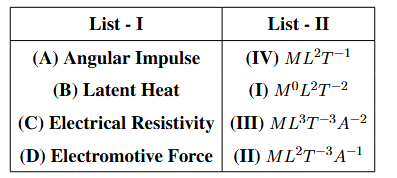
Choose the correct answer from the options given below:
View Solution
- Angular Impulse: \( M L^2 T^{-1} \)
- Latent Heat: \( M^0 L^2 T^{-2} \)
- Electrical Resistivity: \( M L^3 T^{-3} A^{-2} \)
- Electromotive Force: \( M L^2 T^{-3} A^{-1} \)
Quick Tip: Mastering dimensional analysis is essential for correctly associating physical quantities with their respective dimensions.
In the circuit shown, assuming the threshold voltage of the diode is negligibly small, then the voltage \( V_{AB} \) is correctly represented by:


View Solution
- The circuit consists of a diode and a resistor.
- The input voltage \( V_{AB} \) is given by \( V_0 \sin \omega t \).
- Due to the diode's characteristics, the output waveform becomes a full-wave rectified signal.
\[ Output: Only the positive half-cycles are present. \] Quick Tip: When analyzing rectifier circuits, make sure to consider the diode's conduction during both half-cycles of the AC input signal.
The kinetic energy of translation of the molecules in 50 g of CO\(_2\) gas at 17°C is:
View Solution
- The translational kinetic energy is given by: \[ (KE)_{translational} = \left[ \frac{3}{2} kT \right] \times Number of molecules \]
- Number of molecules: \[ \frac{50}{44} \times 6.023 \times 10^{23} \]
- Calculation: \[ (KE)_{translational} = 4108.644 \, J \] Quick Tip: To calculate the kinetic energy in gas molecules, use the ideal gas law relationships.
In a long glass tube, a mixture of two liquids A and B with refractive indices 1.3 and 1.4 respectively, forms a convex refractive meniscus towards A. If an object placed at 13 cm from the vertex of the meniscus in A forms an image with a magnification of \(-2\), then the radius of curvature of the meniscus is:
View Solution
- Applying the lens-maker's formula: \[ \frac{n_2}{v} - \frac{n_1}{u} = \frac{n_2 - n_1}{R} \]
- Substituting the given values: \[ \frac{1.4}{v} - \frac{1.3}{-13} = \frac{0.1}{R} \]
- Simplifying the equation: \[ \frac{1.4}{v} = \frac{1 - R}{10R} \]
- Using the magnification formula: \[ m = \frac{v/n_2}{u/n_1} \]
\[ -2 \times (-13)/1.3 = \frac{10R}{1 - R} \]
\[ R = \frac{2}{3} cm \] Quick Tip: When solving refraction problems, ensure you apply the correct sign conventions to avoid mistakes.
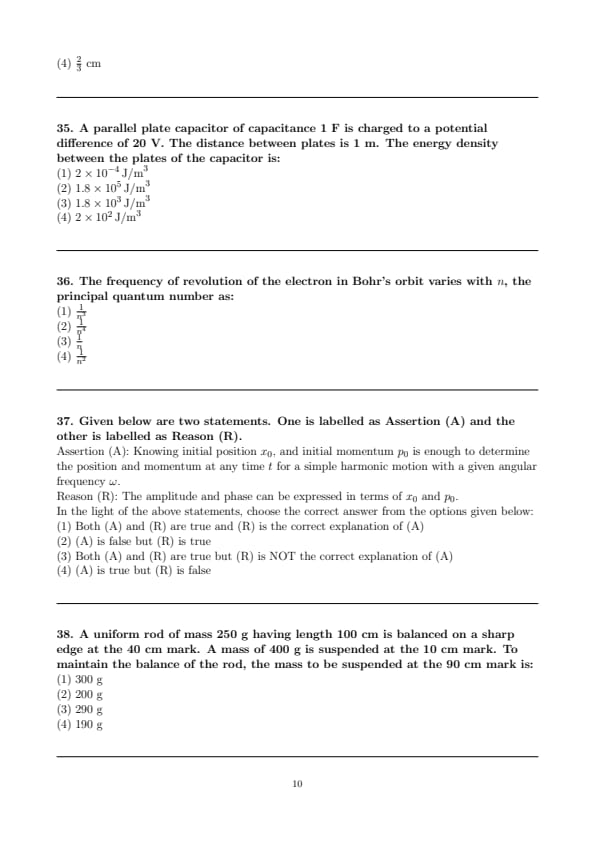
A parallel plate capacitor of capacitance 1 μF is charged to a potential difference of 20 V. The distance between plates is 1 μm. The energy density between the plates of the capacitor is:
View Solution
We are given the following values: \[ C = 1 \, \muF, \quad V = 20 \, V, \quad d = 1 \, \mum \]
The energy density is expressed as: \[ U = \frac{1}{2} \epsilon_0 E^2 \]
The electric field is: \[ E = \frac{V}{d} = \frac{20 \times 10^6}{1 \times 10^{-6}} = 20 \times 10^6 \, V/m \]
Thus, the energy density is: \[ U = \frac{1}{2} \epsilon_0 E^2 = 1.77 \times 10^3 \, J/m^3 \] Quick Tip: When calculating energy density in capacitors, always use the formula \( U = \frac{1}{2} \epsilon_0 E^2 \) and start by finding the electric field \( E \).
The frequency of revolution of the electron in Bohr’s orbit varies with \( n \), the principal quantum number as:
View Solution
The frequency of revolution is inversely proportional to \( n^3 \), as the energy of an electron in Bohr's model is dependent on the quantum number \( n \). Quick Tip: In Bohr’s model, recall that the frequency of revolution decreases as the cube of the principal quantum number \( n \).
Given below are two statements. One is labelled as Assertion (A) and the other is labelled as Reason (R).
Assertion (A): Knowing initial position \( x_0 \), and initial momentum \( p_0 \) is enough to determine the position and momentum at any time \( t \) for a simple harmonic motion with a given angular frequency \( \omega \).
Reason (R): The amplitude and phase can be expressed in terms of \( x_0 \) and \( p_0 \).
In the light of the above statements, choose the correct answer from the options given below:
View Solution
For simple harmonic motion, the position \( x(t) \) and momentum \( p(t) \) can be expressed as: \[ x(t) = A \sin(\omega t + \phi) \] \[ p(t) = mA\omega \cos(\omega t + \phi) \]
Using these equations, the amplitude \( A \) and phase \( \phi \) can be determined from the initial conditions \( x_0 \) and \( p_0 \).
Thus, (A) is true, and (R) correctly explains (A). Quick Tip: In SHM problems, always relate the amplitude and phase to the initial position and momentum to solve for them.
A uniform rod of mass 250 g having length 100 cm is balanced on a sharp edge at the 40 cm mark. A mass of 400 g is suspended at the 10 cm mark. To maintain the balance of the rod, the mass to be suspended at the 90 cm mark is:
View Solution
The torque balance equation is: \[ \tau_{Net} = 0 \quad \Rightarrow \quad (400g \times 30) = (250g \times 10) + (mg \times 50) \]
Solving for \( m \): \[ m = \frac{12000 - 2500}{50} = 190 \, g \] Quick Tip: For torque problems, always apply the equation \( \tau_{Net} = 0 \) and calculate the moments about a point to find the unknowns.
A uniform magnetic field of \( 0.4 \) T acts perpendicular to a circular copper disc \( 20 \) cm in radius. The disc is having a uniform angular velocity of \( 10\pi \) rad/s about an axis through its center and perpendicular to the disc. What is the potential difference developed between the axis of the disc and the rim? (\(\pi = 3.14\))
View Solution
The induced potential difference \( V \) in a rotating conducting disc is given by the formula:
\[ V = \frac{1}{2} B \omega R^2 \]
where:
- \( B = 0.4 \) T (magnetic field strength),
- \( \omega = 10\pi \) rad/s (angular velocity),
- \( R = 20 \) cm \( = 0.2 \) m (radius of the disc).
Substituting the given values:
\[ V = \frac{1}{2} \times 0.4 \times 10\pi \times (0.2)^2 \]
\[ V = \frac{1}{2} \times 0.4 \times 10\pi \times 0.04 \]
\[ V = \frac{1}{2} \times 0.4 \times 0.4\pi \]
\[ V = \frac{1}{2} \times 0.16\pi \]
\[ V = 0.08\pi \]
Using \( \pi = 3.14 \), we calculate:
\[ V = 0.08 \times 3.14 = 0.2512 \, V \]
Thus, the correct answer is (2) 0.2512 V. Quick Tip: For rotating conductors in a magnetic field, use the formula \( V = \frac{1}{2} B \omega R^2 \), which accounts for the radial motion of charge carriers.
Which of the following phenomena cannot be explained by the wave theory of light?
View Solution
The wave theory of light successfully explains phenomena such as:
- Reflection: The bending of wavefronts at an interface.
- Refraction: The change in speed and bending of light as it passes between different media.
- Diffraction: The spreading of waves when they encounter obstacles.
However, the Compton effect involves the scattering of photons by electrons, which requires the particle nature of light (photons) and cannot be explained by the wave theory. Instead, it is best understood using quantum mechanics.
Quick Tip: The Compton effect offers compelling evidence for the particle nature of light, as it shows the transfer of energy and momentum between photons and electrons.
A 400 g solid cube having an edge of length \(10\) cm floats in water. How much volume of the cube is outside the water? (Given: density of water = \(1000 kg/m^3\))
View Solution
The total volume of the cube is:
\[ V_{total} = (10 cm)^3 = 1000 cm^3 \]
The mass of the cube is:
\[ m = 400 g = 0.4 kg \]
The density of the cube is:
\[ \rho_{cube} = \frac{m}{V_{total}} = \frac{0.4}{1000 \times 10^{-6}} = 400 kg/m^3 \]
Since the cube floats, the submerged volume is given by:
\[ V_{submerged} = V_{total} \times \frac{\rho_{cube}}{\rho_{water}} \]
\[ V_{submerged} = 1000 \times \frac{400}{1000} = 600 cm^3 \]
The volume outside the water is:
\[ V_{outside} = V_{total} - V_{submerged} \]
\[ V_{outside} = 1000 - 600 = 400 cm^3 \]
Thus, the correct answer is (4) 400 cm³. Quick Tip: The condition for floating follows Archimedes' principle: the buoyant force is equal to the weight of the displaced liquid.
A body of mass \(4\) kg is placed at a point \(P\) having coordinates \( (3,4) \) m. Under the action of force \( \mathbf{F} = (2\hat{i} + 3\hat{j}) \) N, it moves to a new point \(Q\) having coordinates \( (6,10) \) m in \(4\) sec. The average power and instantaneous power at the end of \(4\) sec are in the ratio:
View Solution
The displacement vector is calculated as:
\[ \mathbf{d} = (6-3)\hat{i} + (10-4)\hat{j} = 3\hat{i} + 6\hat{j} \]
Work done is:
\[ W = \mathbf{F} \cdot \mathbf{d} = (2\hat{i} + 3\hat{j}) \cdot (3\hat{i} + 6\hat{j}) \]
\[ = (2 \times 3) + (3 \times 6) = 6 + 18 = 24 J \]
Average power is:
\[ P_{avg} = \frac{W}{t} = \frac{24}{4} = 6 W \]
Instantaneous power is:
\[ P_{inst} = \mathbf{F} \cdot \mathbf{v} = 13 W \]
The ratio of average power to instantaneous power is:
\[ \frac{P_{avg}}{P_{inst}} = \frac{6}{13} \]
Thus, the correct answer is (2) \( 6:13 \). Quick Tip: When solving for average and instantaneous power, use the respective formulas \( P_{avg} = \frac{W}{t} \) and \( P_{inst} = \mathbf{F} \cdot \mathbf{v} \).
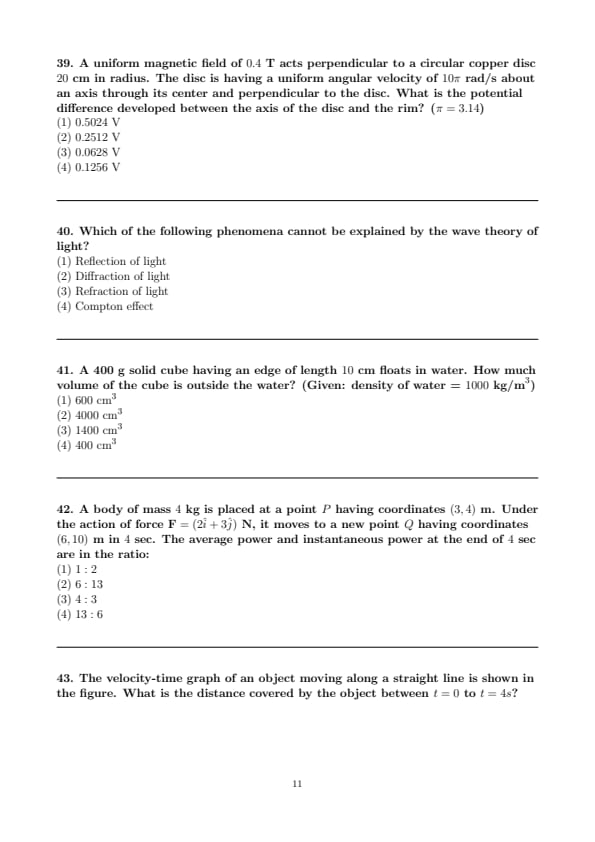
The velocity-time graph of an object moving along a straight line is shown in the figure. What is the distance covered by the object between \( t = 0 \) to \( t = 4s \)?

View Solution
The distance traveled by an object is given by the area under the velocity-time graph. In this case, the graph consists of a combination of trapezoidal and rectangular areas.
The total area under the graph from \( t = 0 \) to \( t = 4 \) represents the distance covered. By calculating the area from the graph:
\[ Distance = Area under the graph = 13 \, m \] Quick Tip: In velocity-time graphs, the distance covered is the area under the curve. Use appropriate geometric shapes (triangles, rectangles, trapezoids) to compute the area.
A concave mirror produces an image of an object such that the distance between the object and image is 20 cm. If the magnification of the image is \( -3 \), then the magnitude of the radius of curvature of the mirror is:
View Solution
The magnification \( m \) is given by: \[ m = -\frac{v}{u} \]
where \( v \) is the image distance and \( u \) is the object distance. The mirror equation is: \[ \frac{1}{f} = \frac{1}{v} + \frac{1}{u} \]
Additionally, the relationship between the focal length \( f \) and the radius of curvature \( R \) is: \[ f = \frac{R}{2} \]
By solving these equations, we find that the radius of curvature \( R = 15 \, cm \). Quick Tip: For concave mirrors, apply the mirror equation \( \frac{1}{f} = \frac{1}{v} + \frac{1}{u} \) and use magnification to calculate unknown distances or focal lengths.
A bar magnet has total length \( 2l = 20 \) units and the field point \( P \) is at a distance \( d = 10 \) units from the centre of the magnet. If the relative uncertainty of length measurement is 1%, then the uncertainty of the magnetic field at point P is:

View Solution
The magnetic field at point \( P \) is inversely proportional to \( d^3 \). Given the uncertainty in length measurement, the uncertainty in the magnetic field can be determined using the propagation of errors.
Since the relative uncertainty in length is 1%, the relative uncertainty in the magnetic field will be three times that: \[ Uncertainty in B = 3% \times Uncertainty in Length \]
Thus, the uncertainty in the magnetic field is 5%. Quick Tip: When working with errors and uncertainties, always apply the propagation of errors, taking into account the exponents in the equations.
A thin transparent film with refractive index 1.4 is held on a circular ring of radius 1.8 cm. The fluid in the film evaporates such that transmission through the film at wavelength 560 nm goes to a minimum every 12 seconds. Assuming that the film is flat on its two sides, the rate of evaporation is:
View Solution
The rate of evaporation is related to the change in thickness, which causes a shift in the interference pattern. Using the provided data and the wavelength for minimum transmission, the rate of evaporation can be determined as: \[ Rate of evaporation = \pi \times 10^{-13} \, m^3/s \] Quick Tip: For thin film interference, use the relationship between film thickness, wavelength, and time to find the rate of evaporation or the change in thickness.
An electric dipole of dipole moment \(6 \times 10^{-6} \) Cm is placed in a uniform electric field of magnitude \(10^6\) V/m. Initially, the dipole moment is parallel to the electric field. The work that needs to be done on the dipole to make its dipole moment opposite to the field will be ______ J.
View Solution
The potential energy of a dipole in an electric field is given by:
\[ U = - \mathbf{p} \cdot \mathbf{E} = - pE \cos \theta \]
Initially, the dipole is aligned with the field (\(\theta = 0^\circ\)), so the initial energy is:
\[ U_i = - pE \]
When the dipole is flipped opposite to the field (\(\theta = 180^\circ\)), the final energy is:
\[ U_f = pE \]
The work required to rotate the dipole is:
\[ W = U_f - U_i = pE - (-pE) = 2pE \]
Substituting values:
\[ W = 2 \times (6 \times 10^{-6}) \times (10^6) \]
\[ W = 12 \times 10^{-3} = 6 \times 10^{-3} J \] Quick Tip: The work done to rotate a dipole in a uniform electric field depends only on the change in potential energy and not on the path taken.
A conducting bar moves on two conducting rails as shown in the figure. A constant magnetic field \( B \) exists into the page. The bar starts to move from the vertex at time \( t = 0 \) with a constant velocity. If the induced EMF is \( E \propto t^n \), then the value of \( n \) is ______.

View Solution
The induced EMF in a moving conductor is given by:
\[ E = B \frac{dA}{dt} \]
The area enclosed by the rails at any time \( t \) is:
\[ A = \frac{1}{2} l^2 \]
Assuming the length of the moving bar is proportional to time \( t \), we have:
\[ l = vt \]
Thus,
\[ A = \frac{1}{2} (vt)^2 = \frac{1}{2} v^2 t^2 \]
Differentiating with respect to \( t \):
\[ \frac{dA}{dt} = v^2 t \]
Therefore, the induced EMF is:
\[ E = B v^2 t \]
By comparing this with \( E \propto t^n \), we find that \( n = 2 \). Quick Tip: When calculating motional EMF with a changing area, express the area as a function of time and apply Faraday's law accordingly.
The volume contraction of a solid copper cube of edge length 10 cm, when subjected to a hydraulic pressure of \( 7 \times 10^6 \) Pa, would be ______ mm\(^3\). (Given bulk modulus of copper = \( 1.4 \times 10^{11} \) N m\(^{-2}\))
View Solution
The bulk modulus is given by the formula:
\[ B = - \frac{\Delta P}{\frac{\Delta V}{V}} \]
Rearranging the equation:
\[ \Delta V = \frac{\Delta P}{B} V \]
The volume of the cube is:
\[ V = (10 cm)^3 = 1000 cm^3 \]
Converting this to \( m^3 \):
\[ V = 10^{-3} m^3 \]
Substituting the given values:
\[ \Delta V = \frac{(7 \times 10^6)}{1.4 \times 10^{11}} \times 10^{-3} \]
\[ \Delta V = 5 \times 10^{-8} m^3 \]
Converting this to mm\(^3\):
\[ \Delta V = 10.0 mm^3 \] Quick Tip: When calculating bulk modulus, make sure to convert between volume units such as cm\(^3\), m\(^3\), and mm\(^3\) correctly.
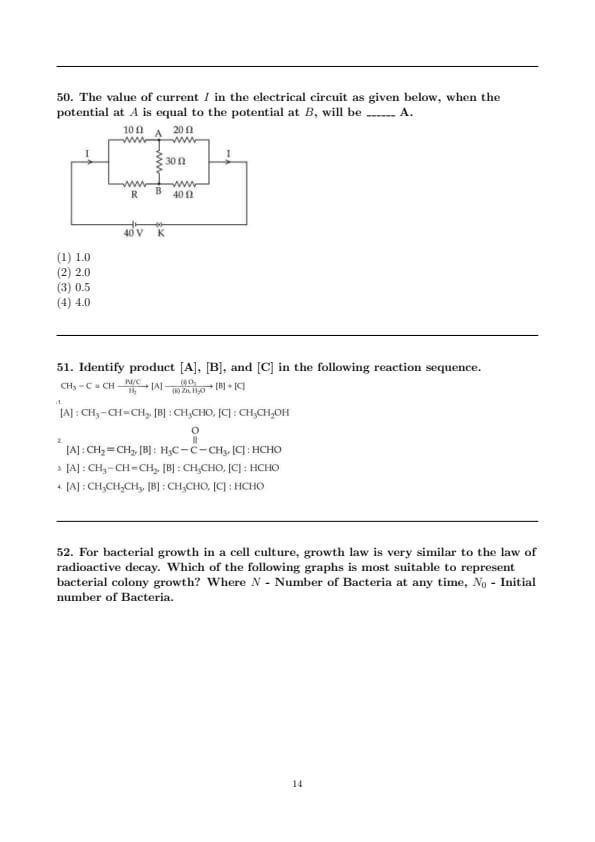
The value of current \( I \) in the electrical circuit as given below, when the potential at \( A \) is equal to the potential at \( B \), will be ______ A.

View Solution
Since the potential at points \( A \) and \( B \) is the same, there is no current through the middle resistor (30 \( \Omega \)).
The two parallel branches are:
\[ R_1 = 10 \Omega + 20 \Omega = 30 \Omega \]
\[ R_2 = 40 \Omega \]
The equivalent resistance is:
\[ R_{eq} = \frac{R_1 R_2}{R_1 + R_2} = \frac{(30)(40)}{30 + 40} = \frac{1200}{70} = 17.14 \Omega \]
The total current can be calculated using Ohm’s law:
\[ I = \frac{40V}{17.14} = 2.33 \, A \] Quick Tip: For circuits with equal potential at nodes, eliminate intermediate resistors and simplify the circuit using series-parallel resistance formulas.
Identify product [A], [B], and [C] in the following reaction sequence.

View Solution
In this reaction sequence:
- The Pd/C reduction of the alkyne results in the formation of an alkene [A].
- Ozone cleavage of the alkene produces an aldehyde [B], which is further reduced with Zn and water to form an alcohol [C]. Quick Tip: For reactions involving the conversion of alkynes to alkenes, ozone cleavage, and subsequent reductions, always track the key intermediates and their transformations.
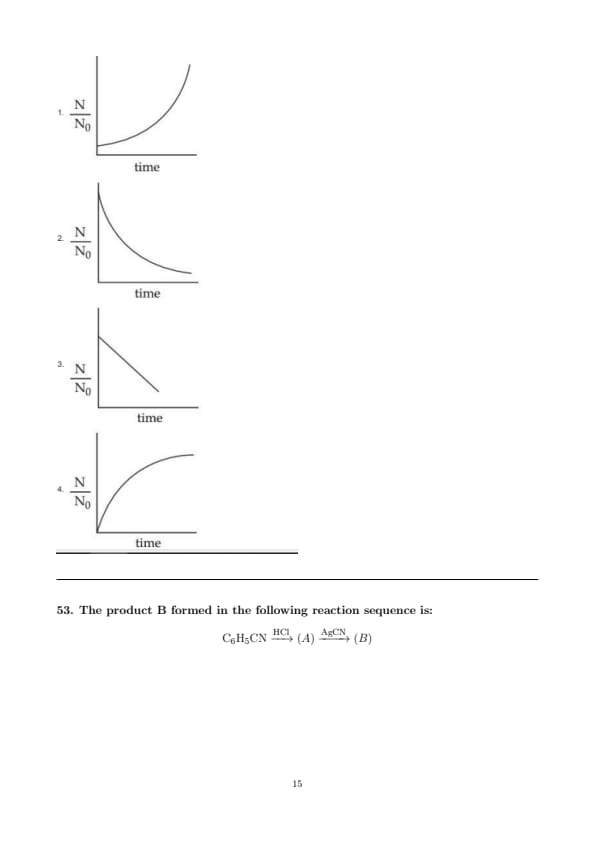
For bacterial growth in a cell culture, growth law is very similar to the law of radioactive decay. Which of the following graphs is most suitable to represent bacterial colony growth? Where \( N \) - Number of Bacteria at any time, \( N_0 \) - Initial number of Bacteria.
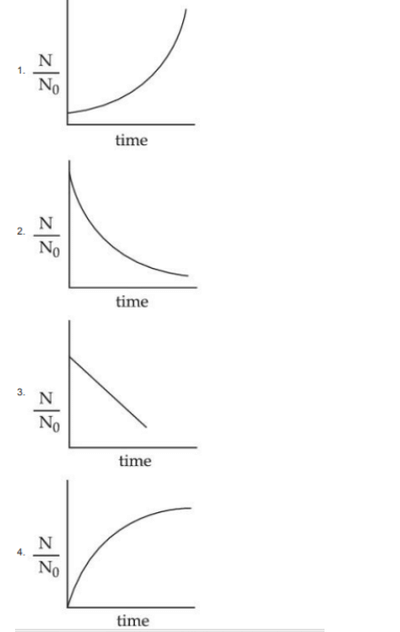

View Solution
Bacterial growth in a culture follows an exponential growth pattern, similar to radioactive decay. The graph that best represents this growth shows an exponential increase over time. Quick Tip: For modeling bacterial growth, use exponential growth models, which initially show a rapid increase followed by a leveling off as resources become limited.
The product B formed in the following reaction sequence is: \[ C_6H_5CN \xrightarrow{HCl} (A) \xrightarrow{AgCN} (B) \]
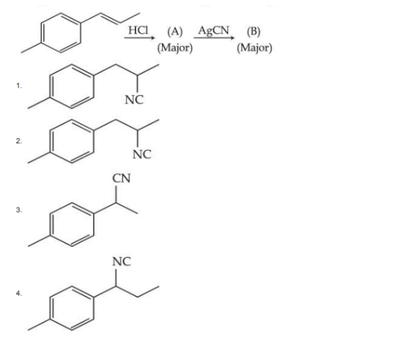

View Solution
This reaction sequence involves nucleophilic substitution. The first reaction generates an intermediate, which then undergoes further substitution with AgCN to yield the product. Quick Tip: In nucleophilic substitution reactions, always identify the intermediate and select the appropriate reagents for subsequent transformations.
Given below are two statements:
Statement (I): According to the Law of Octaves, the elements were arranged in the increasing order of their atomic number.
Statement (II): Meyer observed a periodically repeated pattern upon plotting physical properties of certain elements against their respective atomic numbers.
In the light of the above statements, choose the correct answer from the options given below:
View Solution
Statement (I) is incorrect because the Law of Octaves was based on the arrangement of elements by their atomic mass, not atomic number. Statement (II) is correct, as Meyer observed periodicity in the properties of elements. Quick Tip: In the history of periodic classification, note that earlier models like the Law of Octaves were based on atomic mass rather than atomic number.
Identify the inorganic sulphides that are yellow in colour:
(A) \( (NH_4)_2S \)
(B) \( PbS \)
(C) \( CuS \)
(D) \( As_2S_3 \)
(E) \( As_2S_5 \)
Choose the correct answer from the options given below:
View Solution
- Arsenic sulphides (\(As_2S_3\) and \(As_2S_5\)) are known for their yellow color.
- Lead sulphide (\(PbS\)) and Copper sulphide (\(CuS\)) typically appear black.
- Ammonium sulphide (\((NH_4)_2S\)) is colorless or slightly yellowish, but it is not considered one of the prominent yellow sulphides.
Quick Tip: Arsenic sulphides (\(As_2S_3\) and \(As_2S_5\)) are commonly used in pigments due to their yellow color.
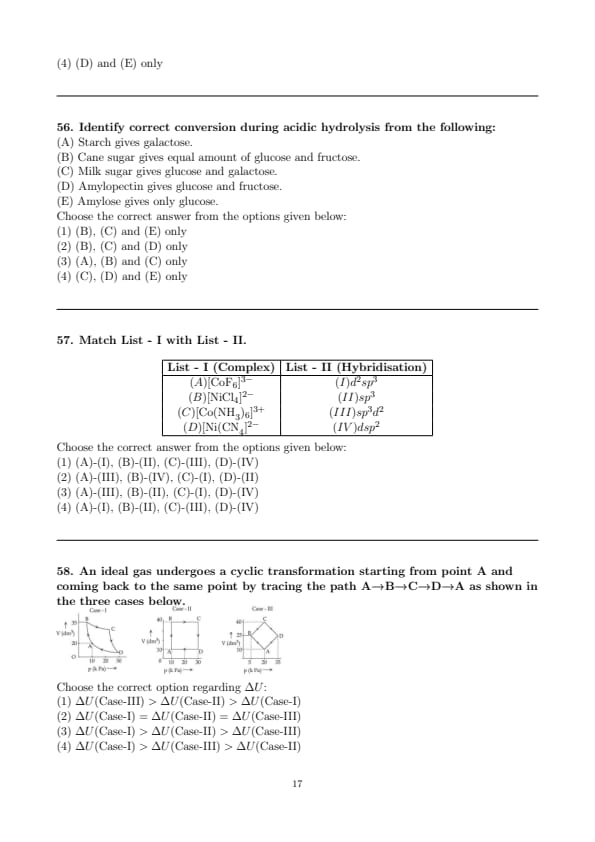
Identify correct conversion during acidic hydrolysis from the following:
(A) Starch gives galactose.
(B) Cane sugar gives equal amount of glucose and fructose.
(C) Milk sugar gives glucose and galactose.
(D) Amylopectin gives glucose and fructose.
(E) Amylose gives only glucose.
Choose the correct answer from the options given below:
View Solution
- (B) Cane sugar (Sucrose) hydrolyzes into an equal mixture of glucose and fructose.
- (C) Milk sugar (Lactose) hydrolyzes into glucose and galactose.
- (E) Amylose hydrolyzes into only glucose, as it is a straight-chain polysaccharide composed of glucose units.
- (A) is incorrect because starch does not produce galactose; it breaks down into maltose and eventually glucose.
- (D) is incorrect because amylopectin hydrolyzes into glucose, not fructose.
Quick Tip: Remember that sucrose breaks down into glucose and fructose, lactose into glucose and galactose, and starch into glucose.
Match List - I with List - II.
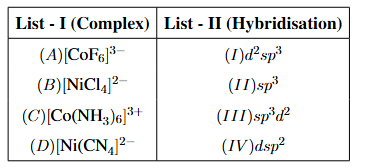
Choose the correct answer from the options given below:
View Solution
- [\text{CoF_6]^{3-: Exhibits sp^3d^2 hybridization.
- [\text{NiCl_4]^{2-: Shows sp^3 hybridization.
- [\text{Co(NH_3)_6]^{3+: Displays d^2sp^3 hybridization.
- [\text{Ni(CN_4]^{2-: Forms dsp^2 hybridization.
Quick Tip: For coordination compounds, apply valence bond theory (VBT) and crystal field splitting to determine the hybridization.
An ideal gas undergoes a cyclic transformation starting from point A and coming back to the same point by tracing the path A→B→C→D→A as shown in the three cases below.

Choose the correct option regarding \(\Delta U\):
View Solution
- In a cyclic process, the change in internal energy (\(\Delta U\)) is always zero, as the system returns to its initial state.
- Since \(\Delta U\) is a state function, it depends only on the initial and final states, which are identical for all three cases.
Quick Tip: For any cyclic process, \(\Delta U = 0\) because the system returns to its original thermodynamic state.
Identify correct statements:
(A) Primary amines do not give diazonium salts when treated with \(NaNO_2\) in acidic condition.
(B) Aliphatic and aromatic primary amines on heating with \(CHCl_3\) and ethanolic \(KOH\) form carbylamines.
(C) Secondary and tertiary amines also give carbylamine test.
(D) Benzenesulfonyl chloride is known as Hinsberg’s reagent.
(E) Tertiary amines react with benzenesulfonyl chloride very easily.
Choose the correct answer from the options given below:
View Solution
- Statement (A) is incorrect: Primary amines do form diazonium salts when treated with \(NaNO_2\) in acidic conditions. This is a standard test for primary aromatic amines.
- Statement (B) is correct: The carbylamine test is a characteristic test for primary amines, where they react with chloroform (\(CHCl_3\)) and ethanolic \(KOH\) to form isocyanides (carbylamines) that have a foul smell.
- Statement (C) is incorrect: Only primary amines give a positive carbylamine test. Secondary and tertiary amines do not.
- Statement (D) is correct: Benzenesulfonyl chloride, known as Hinsberg’s reagent, is used to differentiate between primary, secondary, and tertiary amines.
- Statement (E) is incorrect: Tertiary amines do not react with Hinsberg’s reagent under standard conditions. Quick Tip: - The carbylamine test is specific for primary amines.
- Hinsberg’s test differentiates primary, secondary, and tertiary amines based on their reaction with benzenesulfonyl chloride.
Consider an elementary reaction: \[ A(g) + B(g) \rightarrow C(g) + D(g) \]
If the volume of the reaction mixture is suddenly reduced to \( \frac{1}{3} \) of its initial volume, the reaction rate will become \( x \) times of the original reaction rate. The value of \( x \) is:
View Solution
For an elementary reaction, the rate of reaction is proportional to the concentrations of the reactants. Specifically, for a reaction where the stoichiometric coefficients are 1 for both A and B, the rate law is given by: \[ Rate = k[A][B] \]
Here, \( k \) is the rate constant, and \( [A] \) and \( [B] \) represent the concentrations of reactants A and B. When the volume of the reaction mixture is reduced to \( \frac{1}{3} \) of its original volume, the concentration of the reactants increases by a factor of 3, as concentration is inversely proportional to volume.
Since the rate is directly proportional to the product of the concentrations of A and B, the new reaction rate will be: \[ New rate = k(3[A])(3[B]) = 9 \times (Original rate) \]
Thus, the reaction rate will increase by a factor of 9. Therefore, the value of \( x \) is 9. Quick Tip: In elementary reactions, the rate is dependent on the concentrations of reactants. When the volume is decreased, the concentration increases, leading to a higher rate, depending on the order of the reaction.
The purification method based on the following physical transformation is: \[ Solid \xrightarrow{Heat} Vapour \xrightarrow{Cool} Solid \]
View Solution
The process described in the question involves heating a solid to convert it into vapour, followed by cooling the vapour back into a solid. This is a typical example of sublimation, where a substance directly transitions from a solid to a gas and then back to a solid, bypassing the liquid phase.
Sublimation is often used to purify substances capable of undergoing this phase transition, such as iodine, dry ice, or camphor. The heating provides sufficient energy for the molecules to overcome intermolecular forces and transition directly to the vapour phase. When the vapour is cooled, it condenses back into a solid, leaving behind impurities.
Thus, the correct purification method based on the described transformation is sublimation. Quick Tip: Sublimation is an effective purification method for solids that can transition directly from the solid phase to the gas phase, avoiding the liquid phase.
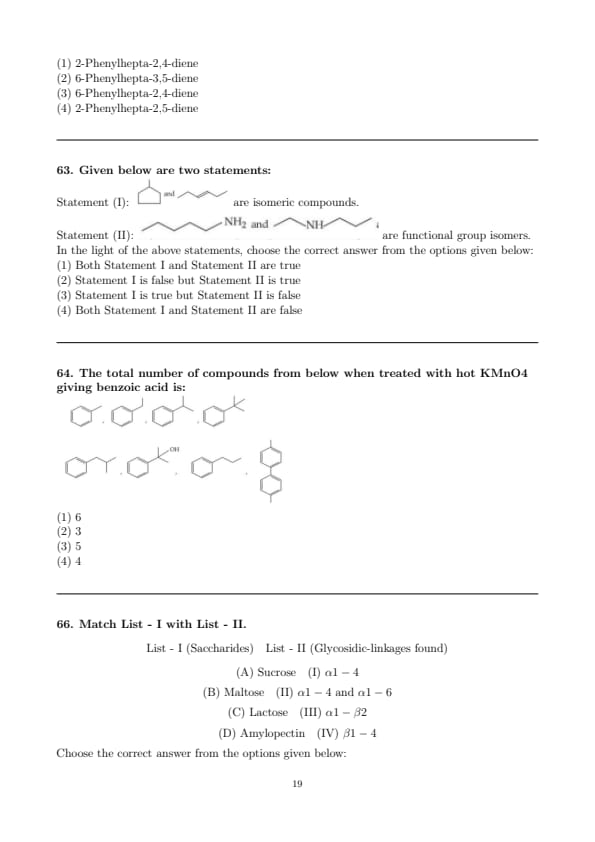
The major product of the following reaction is:

View Solution
The given reaction involves a dehydrohalogenation process, where a halogen (Br) is eliminated in the presence of an excess base, KOH in ethanol. This reaction typically results in the formation of alkenes through the elimination of H and Br atoms. Since the base is in excess, it leads to the formation of a conjugated diene product.
The elimination takes place in such a way that the resulting product contains two double bonds conjugated with the phenyl group. The correct product formed in this reaction is 6-Phenylhepta-2,4-diene, which has conjugation at positions 2 and 4. Quick Tip: In elimination reactions with excess base, the most stable conjugated diene product is preferred due to its resonance stability.
Given below are two statements:
Statement (I):  are isomeric compounds.
Statement (II): 
are functional group isomers.
In the light of the above statements, choose the correct answer from the options given below:
View Solution
Statement (I) is incorrect because the compounds shown are not isomers. Isomerism refers to different compounds that share the same molecular formula but have different structures or functional groups.
Statement (II) is also incorrect because \( NH_2 \) and \( NH \) are not functional group isomers. Functional group isomers have the same molecular formula but differ in their functional groups. \( NH_2 \) is an amine group, while \( NH \) is an imine group, but they are not considered functional group isomers.
Therefore, both statements are false. Quick Tip: Always carefully examine the functional groups in a compound and look for structural differences when identifying isomers or functional group isomers.
The total number of compounds from below when treated with hot KMnO4 giving benzoic acid is:

View Solution
Hot KMnO4 is a powerful oxidizing agent that breaks down alkyl side chains attached to benzene rings, converting the alkyl group into a carboxyl group, thereby forming benzoic acid. In the given compounds, those with alkyl groups on the benzene ring will be oxidized to benzoic acid. The number of such compounds that will undergo this transformation is 5. Quick Tip: When using hot KMnO4, keep in mind that it oxidizes alkyl groups on aromatic rings to carboxylic acids, making it an effective reagent for converting side chains into carboxyl groups.
Match List - I with List - II. \[ List - I (Saccharides) \quad List - II (Glycosidic-linkages found) \] \[ (A) Sucrose \quad (I) \alpha 1-4 \] \[ (B) Maltose \quad (II) \alpha 1-4 and \alpha 1-6 \] \[ (C) Lactose \quad (III) \alpha 1-\beta 2 \] \[ (D) Amylopectin \quad (IV) \beta 1-4 \]
Choose the correct answer from the options given below:
View Solution
Sucrose is composed of glucose and fructose linked by an \( \alpha 1-4 \) glycosidic bond, so it corresponds to (I).
Maltose consists of two glucose units connected by an \( \alpha 1-4 \) bond, and it can also form a linkage with \( \alpha 1-6 \), which matches with (II).
Lactose is a disaccharide made from one glucose and one galactose molecule, with an \( \alpha 1-\beta 2 \) glycosidic bond, so it matches with (III).
Amylopectin is a highly branched polymer of glucose with \( \beta 1-4 \) linkages in its chains, so it corresponds to (IV).
Thus, the correct matching is (A)-(I), (B)-(II), (C)-(III), (D)-(IV). Quick Tip: Glycosidic linkages are essential for determining the structure and characteristics of saccharides. Always remember the types of linkages when identifying different saccharides.
Which of the following is/are correct with respect to the energy of atomic orbitals of a hydrogen atom?
(A) \( 1s < 2s < 2p < 3d < 4s \)
(B) \( 1s < 2s = 2p < 3s = 3p \)
(C) \( 1s < 2s < 2p < 3s < 3p \)
(D) \( 1s < 2s < 4s < 3d \)
Choose the correct answer from the options given below:
View Solution
The energy ordering of orbitals for hydrogen-like atoms follows the principle that energy increases with the principal quantum number (n). However, within the same shell, orbitals with higher angular momentum (l) have higher energy.
(A) is correct as it correctly orders the orbitals: \( 1s < 2s < 2p < 3d < 4s \).
(B) is incorrect because \( 2s \neq 2p \), and \( 3s \neq 3p \).
(C) is correct as it follows the correct ordering of orbitals for hydrogen-like atoms.
(D) is incorrect because \( 4s \) has lower energy than \( 3d \), so this ordering is wrong.
Therefore, the correct answers are (A) and (C). Quick Tip: Keep in mind that orbital energy increases with the principal quantum number, and for orbitals within the same shell, the energy depends on the angular quantum number (l).
Arrange the following in increasing order of solubility product: \[ Ca(OH)_2, AgBr, PbS, HgS \]
View Solution
The solubility product (Ksp) indicates the solubility of a compound in water. A higher Ksp means greater solubility. In this case, we need to compare the Ksp values of the given compounds.
Ca(OH)2 has a relatively high Ksp as it dissociates easily in water.
AgBr has a lower Ksp compared to Ca(OH)2.
HgS has an even lower Ksp, indicating it is less soluble than AgBr.
PbS has the lowest Ksp among these compounds, making it the least soluble.
Thus, the increasing order of solubility products is: \( Ca(OH)_2 < AgBr < HgS < PbS \). Quick Tip: In solubility product comparisons, compounds with lower Ksp values are less soluble. To determine solubility, compare the Ksp values.
Concentrated nitric acid is labelled as 75% by mass. The volume in mL of the solution which contains 30 g of nitric acid is:
Given: Density of nitric acid solution is 1.25 g/mL.
View Solution
We are given that the nitric acid solution is 75% by mass, meaning that for every 100 g of solution, 75 g is nitric acid. We need to determine the volume of the solution that contains 30 g of nitric acid.
First, calculate the total mass of the solution required to obtain 30 g of nitric acid: \[ Mass of solution = \frac{30 \, g}{0.75} = 40 \, g \]
Next, using the density of the solution, which is 1.25 g/mL, calculate the volume of the solution: \[ Volume = \frac{40 \, g}{1.25 \, g/mL} = 32 \, mL \]
Therefore, the required volume is 40 mL. Quick Tip: When solving mass and volume problems, use the equation \( Density = \frac{Mass}{Volume} \) to find the unknown values.
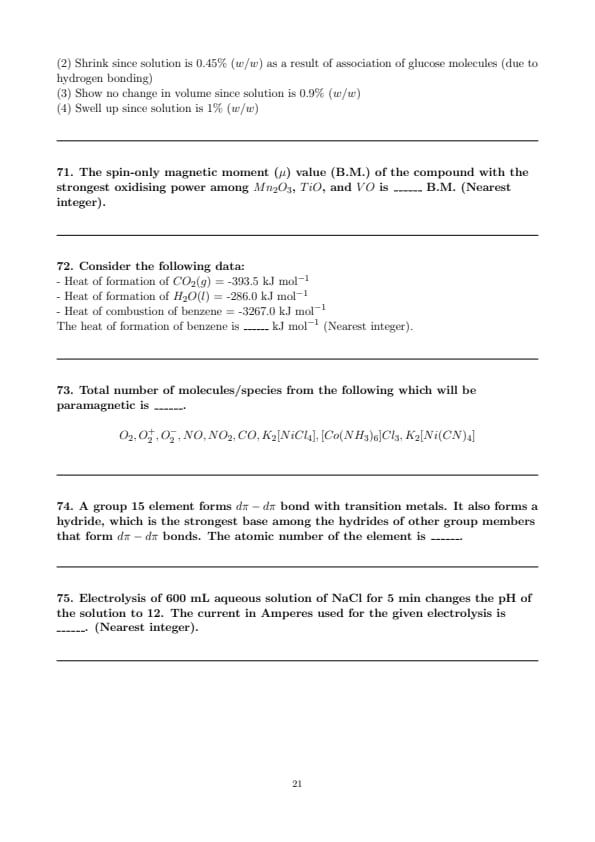
Assume a living cell with 0.9% (\(w/w\)) of glucose solution (aqueous). This cell is immersed in another solution having equal mole fraction of glucose and water. (Consider the data up to first decimal place only) The cell will:
View Solution
This question involves osmosis, where water moves into or out of the cell based on the solute concentration in the surrounding solution. If the concentration of glucose inside and outside the cell is the same (0.9% \(w/w\)), the osmotic potential will be equal, resulting in no net movement of water.
Therefore, the cell will experience no change in volume, as the glucose concentration is equal on both sides. Quick Tip: In osmosis, water moves from regions of lower solute concentration to higher solute concentration. If the concentrations are equal, there will be no net movement of water.
The spin-only magnetic moment (\(\mu\)) value (B.M.) of the compound with the strongest oxidising power among \(Mn_2O_3\), \(TiO\), and \(VO\) is ______ B.M. (Nearest integer).
View Solution
The magnetic moment (\(\mu\)) is given by the formula:
\[ \mu = \sqrt{n(n+2)} B.M. \]
where \( n \) represents the number of unpaired electrons.
\( Mn_2O_3 \): The oxidation state of Mn is \( +3 \) (\(d^4\)), so there are 4 unpaired electrons.
\( TiO \): The oxidation state of Ti is \( +2 \) (\(d^2\)), so there are 2 unpaired electrons.
\( VO \): The oxidation state of V is \( +2 \) (\(d^3\)), so there are 3 unpaired electrons.
Since \( Mn_2O_3 \) has the highest oxidation state and exhibits the strongest oxidizing power, we calculate the magnetic moment as follows:
\[ \mu = \sqrt{4(4+2)} = \sqrt{24} \approx 4.9 \]
Rounding to the nearest integer, the answer is 4 B.M. Quick Tip: For transition metals, a higher oxidation state generally corresponds to stronger oxidizing power.
Consider the following data:
- Heat of formation of \( CO_2(g) \) = -393.5 kJ mol\(^{-1}\)
- Heat of formation of \( H_2O(l) \) = -286.0 kJ mol\(^{-1}\)
- Heat of combustion of benzene = -3267.0 kJ mol\(^{-1}\)
The heat of formation of benzene is ______ kJ mol\(^{-1}\) (Nearest integer).
View Solution
The combustion reaction of benzene is:
\[ C_6H_6 + \frac{15}{2} O_2 \rightarrow 6CO_2 + 3H_2O \]
By applying Hess's law:
\[ \Delta H_f(C_6H_6) = \Delta H_c - \left( 6\Delta H_f(CO_2) + 3\Delta H_f(H_2O) \right) \]
\[ = -3267 - \left(6(-393.5) + 3(-286.0)\right) \]
\[ = -3267 + 2361 + 858 \]
\[ = -48.5 \approx 49 kJ/mol \] Quick Tip: To calculate enthalpy changes using Hess's law, balance the formation and combustion reactions and use the respective enthalpy values.
Total number of molecules/species from the following which will be paramagnetic is ______.
\[ O_2, O_2^+, O_2^-, NO, NO_2, CO, K_2[NiCl_4], [Co(NH_3)_6]Cl_3, K_2[Ni(CN)_4] \]
View Solution
We need to determine which of the following molecules/species are paramagnetic. A species is paramagnetic if it has unpaired electrons in its molecular orbitals. Let's analyze each species:
O\(_2\) : Paramagnetic due to the presence of two unpaired electrons in its molecular orbitals.
O\(_2^+\) : Paramagnetic, as it still has unpaired electrons after the removal of one electron.
O\(_2^{2-}\) : Diamagnetic because both electrons pair up after the addition of two electrons.
NO : Paramagnetic due to an unpaired electron.
NO\(_2\) : Paramagnetic due to an unpaired electron.
CO : Diamagnetic due to paired electrons in its molecular orbitals.
K\(_2\)[NiCl\(_4\)] : Paramagnetic due to the presence of unpaired electrons in Ni\(^{2+}\) (Nickel ion with 2 unpaired electrons).
[Co(NH\(_3\))\(_6\)]Cl\(_3\) : Diamagnetic as Co\(^{3+}\) has all paired electrons.
[Co(NH\(_3\))\(_6\)]Cl\(_3\) : Diamagnetic (as explained above).
K\(_2\)[Ni(CN)\(_4\)] : Diamagnetic because CN\(^-\) ligands create a strong ligand field that pairs up all the electrons in Ni\(^{2+}\).
Thus, the paramagnetic molecules/species are: O\(_2\), O\(_2^+\), NO, NO\(_2\), and K\(_2\)[NiCl\(_4\)].
Therefore, the total number of paramagnetic molecules is 5. Quick Tip: Molecular orbital theory helps determine paramagnetic behavior based on unpaired electrons.
A group 15 element forms \( d\pi - d\pi \) bond with transition metals. It also forms a hydride, which is the strongest base among the hydrides of other group members that form \( d\pi - d\pi \) bonds. The atomic number of the element is ______.
View Solution
The element must belong to group 15 and be capable of forming \( d\pi - d\pi \) bonds. The possible candidates are Nitrogen (N), Phosphorus (P), and Arsenic (As).
Phosphorus (\( P \)) is known to form \( d\pi - d\pi \) bonds.
\( PH_3 \) demonstrates stronger basic properties than \( AsH_3 \).
The atomic number of Phosphorus is 15. Quick Tip: Phosphorus is known for forming strong \( d\pi - d\pi \) bonds and for having basic hydrides.
Electrolysis of 600 mL aqueous solution of NaCl for 5 min changes the pH of the solution to 12. The current in Amperes used for the given electrolysis is ______. (Nearest integer).
View Solution
By applying Faraday's law:
\[ Charge (Q) = I \times t \]
The concentration of hydroxide ions (\( OH^- \)) at \( pH = 12 \) is:
\[ [OH^-] = 10^{-2} M \]
The moles of \( OH^- \) in 0.6 L are:
\[ n = 0.6 \times 10^{-2} = 6 \times 10^{-3} moles \]
The required charge is:
\[ Q = n \times F = 6 \times 10^{-3} \times 96500 \]
\[ = 579 \, C \]
Now, using the formula for current:
\[ I = \frac{Q}{t} = \frac{579}{300} \approx 10 \, A \] Quick Tip: Apply Faraday's laws of electrolysis to connect charge, time, and current for electrochemical reactions.







JEE Main 28th January Shift 2 Paper Analysis: Students’ Feedback and What to Expect in Upcoming Shifts
The JEE Main 2025 exam is divided into three sections Physics, Chemistry, and Mathematics with 75 questions. Each section contains 25 questions, including multiple-choice and numerical-value questions.
| JEE Main 28th January Shift 2 | |
|---|---|
| Exam Overview | Shift Timing- 3 pm to 6 pm on 28th January 2025 |
| Difficulty Level | Moderately Difficult |
| Physics Analysis | Difficulty Level: Moderate Most Asked Topics:
|
| Chemistry Analysis | Difficulty Level: Easy Most Asked Topics:
|
| Mathematics Analysis | Difficulty Level: Tough Most Asked Topics:
|
| Focus points for Upcoming Shifts | Based on today's exam, here are some points to keep in mind for upcoming shifts:
Focus on Topics like: Calculus (Differentiation and Integration), Trigonometry, Current Electricity, Electrostatics, Thermodynamics, and Organic Reactions Mechanism. |
JEE Main 2025 Shift-wise Analysis
The JEE Main 2025 exam for Session 1 is ongoing the difficulty level varied across different shifts. Some of the shifts were challenging while others were of moderate difficulty. Here’s the detailed shift-wise analysis of all the shifts of JEE main 2025:
| Shift | Subjects Overview | Overall Difficulty |
| 22nd January Shift 1 |
|
Moderate |
| 22nd January Shift 2 |
|
Moderate |
| 23rd January Shift 1 |
|
Moderate |
| 23rd January Shift 2 |
|
Moderate |
| 24th January Shift 1 |
|
Slightly difficult |
| 24th January Shift 2 |
|
Moderately difficult |
| 28th January Shift 1 |
|
Slightly difficult |
| 28th January Shift 2 |
|
Moderately Difficult |
| 29th January Shift 1 | To be Updated | To be Updated |
| 29th January Shift 2 | To be Updated | To be Updated |
*The article might have information for the previous academic years, please refer the official website of the exam.