
JEE Main 2025 Question Paper PDF Jan 29 Shift 2 - Download Question Paper with Solutions PDF

.jpg?tr=h-55,w-55,c-force)
Content Strategist|Tech-innovator|National Hackathon Winner | Updated On - Mar 17, 2025
The Memory-Based Question Paper for JEE Main 2025 Session 1 B.E/B. Tech Paper conducted on 29 January 2025 is now available for download.
NTA has conducted the 29 January Shift 2 Exam from 3 pm to 6 pm and the paper is reported to be of a mixed level of difficulty across sections. The Mathematics Section is reported as tough and calculative, while the Chemistry and Physics Sections are reported as easy and doable by the candidates.
Also Check:
- Download JEE Main 2025 PYQ for all shifts
- Download JEE Main Last 10 Year Question Papers for all Shifts
| AP EAPCET 2024 Jan 29 Shift 2 Question Paper with Answer Key |  Download Download |
Check Solution |

JEE Main 2025 Jan 29 Shift 2 Questions
If the set of all \( a \in \mathbb{R} \), for which the equation \( 2x^2 + (a - 5)x + 15 = 3a \) has no real root, is the interval \( (\alpha, \beta) \), and \( X = \{ x \in \mathbb{Z} : \alpha < x < \beta \} \), then \( \sum_{x \in X} x^2 \) is equal to:
View Solution
Step 1: Determining the condition for no real roots.
The given equation is: \[ 2x^2 + (a - 5)x + 15 = 3a \]
Rearranging the equation: \[ 2x^2 + (a - 5)x + 15 - 3a = 0 \]
For the equation to have no real roots, the discriminant must be negative: \[ (a - 5)^2 - 8(15 - 3a) < 0 \]
Expanding and simplifying: \[ a^2 - 10a + 25 - 120 + 24a < 0 \] \[ a^2 + 14a - 95 < 0 \]
Factoring the quadratic: \[ (a + 19)(a - 5) < 0 \]
This inequality is satisfied for: \[ -19 < a < 5 \]
Step 2: Identifying integer values within the interval.
The integers between \(-19\) and \(5\) are: \[ \{-18, -17, \ldots, -1, 0, 1, \ldots, 4\} \]
Step 3: Calculating the sum of their squares.
The sum of squares is computed as: \[ \sum_{x \in X} x^2 = (1^2 + 2^2 + \cdots + 4^2) + (1^2 + 2^2 + \cdots + 18^2) \]
Using the formula for the sum of squares: \[ \sum_{k=1}^n k^2 = \frac{n(n+1)(2n+1)}{6} \]
Applying the formula: \[ = \frac{4 \times 5 \times 9}{6} + \frac{18 \times 19 \times 37}{6} \] \[ = 30 + 2109 = 2139 \] Quick Tip: For polynomial inequalities, consider the discriminant condition carefully to determine valid intervals.
If \( \sin x + \sin^2 x = 1 \), \( x \in \left(0, \frac{\pi}{2} \right) \), then the expression
\[ (\cos^2 x + \tan^2 x) + 3(\cos^4 x + \tan^4 x + \cos^4 x + \tan^4 x) + (\cos^6 x + \tan^6 x) \]
is equal to:
View Solution
Step 1: Analyzing the given identity.
Given \( \sin x + \sin^2 x = 1 \), we have: \[ \sin x = \cos^2 x \quad \Rightarrow \quad \tan x = \cos x \]
Step 2: Solving the given expression.
The given expression becomes: \[ 2\cos^2 x + [\cos^6 x + \cos^3 x] + 2\cos^6 x \] \[ = 2[\sin^2 x + \sin^3 x + \sin^4 x] \] \[ = 2\sin^2 x [( \sin x + 1 )^2] \] \[ = 2[\sin^2 x + \sin^3 x] = 2 \] Quick Tip: For trigonometric identities, converting all terms into sine and cosine often simplifies the calculation effectively.
Let the area enclosed between the curves \( |y| = 1 - x^2 \) and \( x^2 + y^2 = 1 \) be \( \alpha \). If \( 9\alpha = \beta\pi + \gamma \); \( \beta, \gamma \) are integers, then the value of \( |\beta - \gamma| \) equals:
View Solution
Step 1: Analyzing the area enclosed between curves.
Given curves:
- \( C_1 : |y| = 1 - x^2 \)
- \( C_2 : x^2 + y^2 = 1 \)
The area enclosed between these curves is calculated by: \[ \alpha = 4 \left[ Area of circle in 1st quadrant - \int_0^1 (1 - x^2) \, dx \right] \]
Step 2: Calculate the required integrals.
Area of the quarter circle is: \[ Area = \frac{\pi}{4} \]
Now, evaluating the integral: \[ \int_0^1 (1 - x^2) \, dx = \left[ x - \frac{x^3}{3} \right]_0^1 = 1 - \frac{1}{3} = \frac{2}{3} \]
Step 3: Computing the area difference. \[ \alpha = 4 \left[ \frac{\pi}{4} - \frac{2}{3} \right] \] \[ \alpha = \pi - \frac{8}{3} \]
Step 4: Calculating \( 9\alpha \). \[ 9\alpha = 9\pi - 24 \]
Here, comparing with \( 9\alpha = \beta\pi + \gamma \), we get: \[\beta = 9, \quad \gamma = 24\]
Step 5: Computing \( |\beta - \gamma| \) \[ |\beta - \gamma| = |9 - 24| = 33 \] Quick Tip: For area calculations involving curves, ensure to carefully analyze the region enclosed and utilize symmetry for simplified integration.
If the domain of the function \( \log_5 (18x - x^2 - 77) \) is \( (\alpha, \beta) \) and the domain of the function \[ \log_{(x-1)} \left( \frac{2x^2 + 3x - 2}{x^2 - 3x - 4} \right) \]
is \( (\gamma, \delta) \), then \( \alpha^2 + \beta^2 + \gamma^2 \) is equal to:
View Solution
Step 1: Computing the domain of \( f_1(x) = \log_2 (18x - x^2 - 77) \)
For the logarithm to be defined: \[ 18x - x^2 - 77 > 0 \]
Rearranging: \[ x^2 - 18x + 77 < 0 \]
Factoring: \[ (x - 7)(x - 11) < 0 \]
From this inequality, the valid range is: \[ x \in (7, 11) \]
Thus, \( \alpha = 7 \) and \( \beta = 11 \).
Step 2: Computing the domain of \( f_2(x) = \log_{(x-1)} \left( \frac{2x^2 + 3x - 2}{x^2 - 3x - 4} \right) \)
For this logarithm to be defined:
- Base condition: \(x - 1 > 0 \implies x > 1\)
- Numerator and denominator conditions: \[ \frac{2x^2 + 3x - 2}{x^2 - 3x - 4} > 0 \]
Factoring each term: \[ \frac{(2x - 1)(x + 2)}{(x - 4)(x + 1)} > 0 \]
Using the sign chart method, the valid range is: \[ x \in (4, \infty) \]
Thus, \( \gamma = 4 \) and \( \delta = \infty \) (not needed for the final calculation).
Step 3: Calculating the required expression. \[ \alpha^2 + \beta^2 + \gamma^2 = 7^2 + 11^2 + 4^2 = 49 + 121 + 16 = 186 \] Quick Tip: For logarithmic domains, remember to satisfy both the base conditions and the argument conditions simultaneously for accurate results.
Let the function \(f(x) = (x^2 - 1)|x^2 - ax + 2| + \cos|x| \) be not differentiable at the two points \( x = \alpha = 2 \) and \( x = \beta \). Then the distance of the point \((\alpha, \beta)\) from the line \(12x + 5y + 10 = 0\) is equal to:
View Solution
Step 1: Analyzing non-differentiable points. \(\cos|x|\) is always differentiable. Therefore, we only need to check where \(|x^2 - ax + 2|\) is not differentiable.
Equating the inside expression to zero: \[ x^2 - ax + 2 = 0 \]
Since one root is given as \( \alpha = 2 \), substituting this value: \[ 4 - 2a + 2 = 0 \implies a = 3 \]
With \(a = 3\), the other root becomes \( \beta = 1\).
Step 2: Computing the distance from the line.
The point \((\alpha, \beta) = (2, 1)\).
Using the point-to-line distance formula: \[ d = \frac{|12(2) + 5(1) + 10|}{\sqrt{12^2 + 5^2}} = \frac{|24 + 5 + 10|}{\sqrt{144 + 25}} = \frac{39}{\sqrt{169}} = \frac{39}{13} = 3 \] Quick Tip: For absolute value functions, points of non-differentiability occur where the expression inside the absolute value equals zero.
Let a straight line \( L \) pass through the point \(P(2, -1, 3)\) and be perpendicular to the lines \[ \frac{x - 1}{2} = \frac{y + 1}{1} = \frac{z - 3}{-2} \quad and \quad \frac{x - 3}{1} = \frac{y - 2}{3} = \frac{z + 2}{4}. \]
If the line \(L\) intersects the yz-plane at the point Q, then the distance between the points P and Q is:
View Solution
Step 1: Finding the direction vector of the required line.
The direction vector \(\mathbf{v}\) is obtained using the cross product of the given vectors: \[ \mathbf{v} = \begin{vmatrix} \hat{i} & \hat{j} & \hat{k}
2 & 1 & -2
1 & 3 & 4 \end{vmatrix} = 10\hat{i} - 10\hat{j} + 5\hat{k} = 5(2\hat{i} - 2\hat{j} + \hat{k}) \]
Step 2: Writing the equation of the line.
The parametric form of the line is: \[ \frac{x - 2}{2} = \frac{y + 1}{-2} = \frac{z - 3}{1} = \lambda \]
Step 3: Determining the intersection with the yz-plane.
On the yz-plane, \(x = 0\). Substituting \(x = 0\) into the line equation: \[ \frac{0 - 2}{2} = \lambda \implies \lambda = -1 \]
Using \(\lambda = -1\) in the parametric equations, the point of intersection is: \[ Q(0, 0, 2) \]
Step 4: Calculating the distance between points.
The distance between points \(P\) and \(Q\) is: \[ d(P, Q) = \sqrt{4 + 3 + 2} = \sqrt{9} = 3 \] Quick Tip: For intersection points on coordinate planes, set the appropriate coordinate (e.g., \(x = 0\) for yz-plane) to simplify calculations.
Let \( S = \mathbb{N} \cup \{0\} \). Define a relation \( R \) from \( S \) to \( \mathbb{R} \) by: \[ R = \left\{ (x, y) : \log_e y = x \log_e \left(\frac{2}{5}\right), x \in S, y \in \mathbb{R} \right\}. \]
Then, the sum of all the elements in the range of \( R \) is equal to:
View Solution
Step 1: Analyzing the relation.
From the given relation, we have: \[ \log_e y = x \log_e \left(\frac{2}{5}\right) \]
Exponentiating both sides: \[ y = \left(\frac{2}{5}\right)^x \]
Step 2: Calculating the range values.
The range values are given by the infinite series: \[ Sum = 1 + \left(\frac{2}{5}\right) + \left(\frac{2}{5}\right)^2 + \left(\frac{2}{5}\right)^3 + \cdots \]
This is a geometric progression with first term \(a = 1\) and common ratio \(r = \frac{2}{5}\).
Step 3: Calculating the infinite series.
Using the sum formula for an infinite geometric progression: \[ Sum = \frac{a}{1 - r} = \frac{1}{1 - \frac{2}{5}} = \frac{1}{\frac{3}{5}} = \frac{5}{3} \] Quick Tip: In geometric series problems, ensure to correctly identify the first term \( a \) and the common ratio \( r \). The infinite series converges only if \( |r| < 1 \).
Let the line \(x + y = 1\) meet the axes of x and y at A and B, respectively. A right-angled triangle AMN is inscribed in the triangle OAB, where O is the origin and the points M and N lie on the lines OB and AB, respectively. If the area of the triangle AMN is \(\frac{4}{9}\) of the area of the triangle OAB and \(AN : NB = \lambda : 1\), then the sum of all possible values of \(\lambda\) is:
View Solution
Step 1: Computing area relations.
Area of triangle \( \Delta OAB = \frac{1}{2} \)
Area of triangle \( \Delta AMN = \frac{4}{9} \times \frac{1}{2} = \frac{2}{9} \)
Step 2: Determining coordinates.
Equation of AB is \(x + y = 1\) \[ OA = 1, \quad AM = \sec(45^\circ - \theta) \] \[ AN = \sec(45^\circ - \theta) \cos\theta, \quad MN = \sec(45^\circ - \theta) \sin\theta \]
From area conditions: \[ Ar(AMN) = \frac{1}{2} \sec^2(45^\circ - \theta) \sin\theta \cos\theta = \frac{2}{9} \] \[ \tan\theta = 2 \quad or \quad \frac{1}{2} \]
Since \(\tan\theta = 2\) is rejected, \(\tan\theta = \frac{1}{2}\)
From similarity condition, \[ \frac{AN}{NB} = \lambda \quad \Rightarrow \quad \lambda = \frac{13}{6} \] Quick Tip: For geometry problems with ratios and area conditions, breaking the triangle into smaller triangles and applying known area formulas helps simplify calculations.
If \(\alpha x + \beta y = 109\) is the equation of the chord of the ellipse \[ \frac{x^2}{9} + \frac{y^2}{4} = 1 \]
whose midpoint is \(\left(\frac{5}{2}, \frac{1}{2}\right)\), then \(\alpha + \beta\) is equal to:
View Solution
Step 1: Equation of the chord.
The equation of the chord with midpoint \((h, k)\) is: \[ T = S_1 \]
Where \( T = \frac{5x}{18} + \frac{y}{8} \quad and \quad S_1 = \frac{100 + 9}{144} = 109 \)
Solving the equation: \[ 40x + 18y = 109 \]
Comparing with \(\alpha x + \beta y = 109\), we get: \[\alpha = 40, \quad \beta = 18\]
Step 2: Final Calculation. \[ \alpha + \beta = 40 + 18 = 58 \] Quick Tip: For ellipse chord problems, using the midpoint formula simplifies the process of Computing the correct equation of the chord.
If all the words with or without meaning made using all the letters of the word "KANPUR" are arranged as in a dictionary, then the word at 440th position in this arrangement is:
View Solution
Arranging the letters alphabetically: \{A, K, N, P, R, U\
Step 1: Words starting with A = 5! = 120
Step 2: Words starting with K = 5! = 120
Step 3: Words starting with N = 5! = 120
Step 4: Words starting with PA = 4! = 24
Step 5: Words starting with PK = 4! = 24
Step 6: Words starting with PN = 4! = 24
Step 7: Words starting with PRKA = 3! = 6
Step 8: PRKAN is the 439th word
Step 9: PRKAUN is the 440th word
Quick Tip: For dictionary order problems, calculate each letter's positional contribution and count words accordingly.
Let \( \alpha, \beta (\alpha \neq \beta) \) be the values of m, for which the equations \(x + y + z = 1\), \(x + 2y + 4z = m\), and \(x + 4y + 10z = m^2\) have infinitely many solutions. Then the value of \(\sum_{n=1}^{10} (n^4 + n^8)\) is equal to:
View Solution
From determinant conditions for infinite solutions: \[ \Delta = \begin{vmatrix} 1 & 1 & 1
1 & 2 & 4
1 & 4 & 10 \end{vmatrix} = 4 - 6 + 2 = 0 \] \(m = 1\) and \(m = 2\) are the valid values.
Using the given summation, \[ \sum_{n=1}^{10} (n^4 + n^8) = \sum_{n=1}^{10} n^4 + \sum_{n=1}^{10} n^8 = 55 + 385 = 440 \] Quick Tip: For summation problems involving polynomial powers, utilize known summation formulas efficiently.
Let \( A = [a_{ij}] \) be a matrix of order 3 \(\times\) 3, with \(a_{ij} = (\sqrt{2})^{i+j}\). If the sum of all the elements in the third row of \( A^2 \) is \( \alpha + \beta\sqrt{2} \), where \(\alpha, \beta \in \mathbb{Z}\), then \(\alpha + \beta\) is equal to:
View Solution
Step 1: Analyzing the matrix elements.
Matrix \( A = \begin{bmatrix} (\sqrt{2})^2 & (\sqrt{2})^3 & (\sqrt{2})^4
(\sqrt{2})^3 & (\sqrt{2})^4 & (\sqrt{2})^5
(\sqrt{2})^4 & (\sqrt{2})^5 & (\sqrt{2})^6 \end{bmatrix} = \begin{bmatrix} 2 & 2\sqrt{2} & 4
2\sqrt{2} & 4 & 4\sqrt{2}
4 & 4\sqrt{2} & 8 \end{bmatrix} \)
Step 2: Squaring the matrix. \[ A^2 = 2\sqrt{2} \begin{bmatrix} 2 & 2 & 4
2 & 2 & 4
2 & 2 & 4 \end{bmatrix} \]
Step 3: Computing the third-row elements.
Sum of elements in the third row: \[ 4(2 + 4 + 8) = 4(14\sqrt{2} + 28) \] \[ = 168 + 56\sqrt{2} \]
Step 4: Final Calculation. \[ \alpha + \beta = 168 + 56 = 224 \] Quick Tip: When working with matrix exponentiation, Analyzing patterns in repeated elements simplifies calculations significantly.
Let P be the foot of the perpendicular from the point \( (1, 2, 2) \) on the line \[ \frac{x-1}{1} = \frac{y + 1}{-1} = \frac{z - 2}{2} \]
Let the line \( \mathbf{r} = (-\hat{i} + \hat{j} - 2\hat{k}) + \lambda (\hat{i} - \hat{j} + \hat{k})\), \( \lambda \in \mathbb{R} \), intersect the line \(L\) at \(Q\). Then \( 2(PQ)^2 \) is equal to:
View Solution
Step 1: Computing coordinates of points.
The general point on line \(L\) is: \[ Q(1 + \mu, -1 - \mu, 2 + 2\mu) \]
The given point \(P = (1, 2, 2)\).
Step 2: Computing perpendicular condition.
We use the condition that the line joining \(P\) and \(Q\) must be perpendicular to the direction vector of the line: \[ \mathbf{AP} \cdot \mathbf{d} = 0 \]
Where \( \mathbf{AP} = (1 + \mu - 1, -1 - \mu - 2, 2 + 2\mu - 2) = (\mu, -3 - \mu, 2\mu) \)
And direction vector \( \mathbf{d} = (1, -1, 2) \)
Dot product condition: \[ \mu + (-3 - \mu)(-1) + 2\mu \times 2 = 0 \]
Simplifying: \[ \mu + 3 + \mu + 4\mu = 0 \] \[ 6\mu = -3 \implies \mu = -\frac{1}{2} \]
Substituting \( \mu = -\frac{1}{2} \) in the parametric form: \[ Q = \left(1 - \frac{1}{2}, -1 + \frac{1}{2}, 2 - 1\right) = \left( \frac{1}{2}, -\frac{1}{2}, 1 \right) \]
Step 3: Computing distance \( PQ \) \[ PQ = \sqrt{ \left( 1 - \frac{1}{2} \right)^2 + \left( 2 - \left(-\frac{1}{2}\right) \right)^2 + (2 - 1)^2 } \] \[ PQ = \sqrt{ \left( \frac{1}{2} \right)^2 + \left( \frac{5}{2} \right)^2 + (1)^2 } \] \[ PQ = \sqrt{ \frac{1}{4} + \frac{25}{4} + 1 } = \sqrt{ \frac{1 + 25 + 4}{4} } \] \[ PQ = \sqrt{\frac{30}{4}} = \frac{\sqrt{30}}{2} \]
Step 4: Final Calculation \[ 2(PQ)^2 = 2 \times \left( \frac{30}{4} \right) = 2 \times 7.5 = 27 \] Quick Tip: For Computing the foot of a perpendicular in 3D geometry, equating parametric forms of the given lines is the key step.
Let a circle C pass through the points (4, 2) and (0, 2), and its centre lie on \(3x + 2y + 2 = 0\). Then the length of the chord of the circle C, whose midpoint is (1, 2), is:
View Solution
Step 1: Analyzing the equation of the circle.
Given that the circle passes through points \((4, 2)\) and \((0, 2)\), the general form of the circle is: \[ (x - h)^2 + (y - k)^2 = r^2 \]
Since the center lies on the line \(3x + 2y + 2 = 0\), we use this condition to determine \(h\) and \(k\).
Step 2: Computing the radius.
From the midpoint condition, and computing distances: \[ ON = \sqrt{(h - 1)^2 + (k - 2)^2} = \sqrt{37} \]
Step 3: Computing the chord length.
Using the chord length formula: \[ Chord Length = 2\sqrt{r^2 - (ON)^2} = 2\sqrt{40 - 37} = 2\sqrt{3} \] Quick Tip: For chord calculations, using the radius relation with known points simplifies the calculation efficiently.
Let \( A = [a_{ij}] \) be a 2 \(\times\) 2 matrix such that \(a_{ij} \in \{0, 1\}\) for all \(i\) and \(j\). Let the random variable X denote the possible values of the determinant of the matrix A. Then, the variance of X is:
View Solution
Step 1: Analyzing possible determinant values.
The determinant is calculated as: \[ |A| = a_{11}a_{22} - a_{12}a_{21} \]
Using all possible combinations of 0 and 1, the possible determinant values are: \(\{-1, 0, 1\}\)
Step 2: Probability distribution.
- Probability for \(X = -1\) = \(\frac{3}{16}\)
- Probability for \(X = 0\) = \(\frac{10}{16} = \frac{5}{8}\)
- Probability for \(X = 1\) = \(\frac{3}{16}\)
Step 3: Calculating Variance. \[ Variance = E(X^2) - (E(X))^2 \] \[ = \frac{3}{16}(-1)^2 + \frac{5}{8}(0)^2 + \frac{3}{16}(1)^2 - (0)^2 \] \[ = \frac{3}{16} + 0 + \frac{3}{16} = \frac{6}{16} = \frac{3}{8} \] Quick Tip: For variance problems involving matrices, ensure all possible determinant values are calculated correctly with corresponding probabilities.
Bag 1 contains 4 white balls and 5 black balls, and Bag 2 contains n white balls and 3 black balls. One ball is drawn randomly from Bag 1 and transferred to Bag 2. A ball is then drawn randomly from Bag 2. If the probability that the ball drawn is white is \(\frac{29}{45}\), then n is equal to:
View Solution
Step 1: Probability Calculation.
Probability of choosing a white ball from Bag 1 and adding it to Bag 2: \[ P(W from Bag 1) = \frac{4}{9} \]
Probability of choosing a black ball from Bag 1 and adding it to Bag 2: \[ P(B from Bag 1) = \frac{5}{9} \]
Now, probability of choosing a white ball from Bag 2: \[ P(W from Bag 2) = \frac{n + 1}{n + 4} \times \frac{4}{9} + \frac{n}{n + 4} \times \frac{5}{9} = \frac{29}{45} \]
Cross multiplying and simplifying, we find: \[ n = 6 \] Quick Tip: In probability problems involving multiple stages, apply conditional probability rules carefully to avoid errors.
The remainder, when \(7^{98}\) is divided by 23, is equal to:
View Solution
Step 1: Using Fermat's theorem.
Since 23 is prime, by Fermat’s theorem: \[ 7^{22} \equiv 1 \pmod{23} \]
Now, break down the exponent: \[ 7^{98} = 7^{(22 \times 4) + 10} = 7^{22 \times 4} \times 7^{10} \equiv 1^4 \times 7^{10} = 7^{10} \pmod{23} \]
Calculating \( 7^{10} \): \[ 7^{10} = 28 \times 25 \equiv 14 \pmod{23} \] Quick Tip: For modular arithmetic, Fermat's theorem is a powerful tool for simplifying large exponents.
Let \(f(x) = \int_{1}^{x} (t^2 - 9t + 20) \, dt\), \(1 \leq x \leq 5\). If the range of \(f(x)\) is \( [\alpha, \beta] \), then \(4(\alpha + \beta)\) equals:
View Solution
Step 1: Integrating the function. \[ f(x) = \int (t^2 - 9t + 20) \, dt = \frac{t^3}{3} - \frac{9t^2}{2} + 20t \]
Evaluating from 1 to x: \[ f(x) = \left[ \frac{x^3}{3} - \frac{9x^2}{2} + 20x \right] - \left[ \frac{1^3}{3} - \frac{9(1)^2}{2} + 20(1) \right] \]
Calculating values at boundary points, we get: \( \alpha = 4 \), \( \beta = 32 \)
Now, \( 4(\alpha + \beta) = 4(4 + 32) = 157 \) Quick Tip: For integration problems with limits, always evaluate boundary values carefully to Calculate the correct range.
Let \( \hat{a} \) be a unit vector perpendicular to the vectors \[ \mathbf{b} = \hat{i} - 2\hat{j} + 3\hat{k} \quad and \quad \mathbf{c} = 2\hat{i} + 3\hat{j} - \hat{k}, \]
and makes an angle of \( \cos\left( -\frac{1}{3} \right) \) with the vector \( \hat{i} + \alpha \hat{j} + \hat{k} \).
If \( \hat{a} \) makes an angle with the vector \( \hat{i} + \alpha \hat{j} + \hat{k} \),
then the value of \( \alpha \) is:
View Solution
Step 1: Calculate the cross product of \( \mathbf{b} and \mathbf{c} \).
We find the cross product as follows: \[ \mathbf{b} \times \mathbf{c} = \begin{vmatrix} \hat{i} & \hat{j} & \hat{k}
1 & -2 & 3
2 & 3 & -1 \end{vmatrix} = -7\hat{i} + 7\hat{j} + 7\hat{k} \]
Step 2: Normalizing the vector \( \mathbf{v} \).
Now, we define the unit vector \( \hat{a} \), which is perpendicular to both vectors, and calculate: \[ \hat{a} = \frac{\mathbf{b} \times \mathbf{c}}{|\mathbf{b} \times \mathbf{c}|} = \frac{-7\hat{i} + 7\hat{j} + 7\hat{k}}{\sqrt{(-7)^2 + 7^2 + 7^2}} = \frac{1}{\sqrt{3}}(-\hat{i} + \hat{j} + \hat{k}) \]
Step 3: Computing the angle between the vectors
Now, we use the formula for the cosine of the angle between two vectors: \[ \cos \theta = \frac{\hat{a} \cdot (\hat{i} + \alpha \hat{j} + \hat{k})}{|\hat{a}| |\hat{i} + \alpha \hat{j} + \hat{k}|} \] \[ \cos \left( \frac{\pi}{3} \right) = \frac{1}{2} = \frac{(-1 + \alpha + 1)}{\sqrt{3} \cdot \sqrt{1 + \alpha^2 + 1}} \]
Simplifying: \[ \frac{1}{2} = \frac{\alpha}{\sqrt{3}(\sqrt{\alpha^2 + 2})} = \frac{\sqrt{3}}{2} \] \[ \sqrt{3} + 2 = 2\alpha^2 \] \[ \alpha^2 = 6 \quad \Rightarrow \quad \alpha = \sqrt{6} \]
Step 4: Final Answer \[ \boxed{\alpha = \sqrt{6}} \] Quick Tip: When working with unit vectors and angles, using dot product and cross product properties allows for simplification of complex vector relationships.
If for the solution curve \( y = f(x) \) of the differential equation \[ \frac{dy}{dx} + (\tan x) y = 2 + \sec^2 x, \quad y(\frac{\pi}{3}) = \sqrt{3}, \]
then \( y(\frac{\pi{4}} \) is equal to:
View Solution
Step 1: The given differential equation is of the form: \[ \frac{dy}{dx} + (\tan x) y = 2 + \sec^2 x \]
To solve the above, the integrating factor is: \[ I = \sec x \]
\text{Multiplying through by the integrating factor: \[ \sec x \frac{dy{dx} + (\tan x) \sec x y = 2 + \sec^2 x \]
Simplifying and integrating both sides: \[ \frac{d{dx} \left( y \cdot \sec x \right) = 2 \cdot \sec x \]
Integrating both sides: \[ y \cdot \sec x = 2 \ln \left( \sec x + \tan x \right) + C \]
\text{Using the given initial condition: \[ y \cdot \sec \left( \frac{\pi{3} \right) = 2 \ln \left( \sec \left( \frac{\pi}{3} \right) + \tan \left( \frac{\pi}{3} \right) \right) + C \] \[ \sqrt{3} = 2 \cdot \ln \left( \sqrt{3} + \frac{\sqrt{3}}{2} \right) + C \]
From the calculations, we obtain the value of C.
\text{Now substitute and find the value of \( y(\frac{\pi{4}) \) using the value of C. Quick Tip: In solving such differential equations, identify the integrating factor carefully and use it for efficient integration of the equation.
If \[ 24 \left( \int_0^\frac{\pi}{4} \left[ \sin \left( 4x - \frac{\pi}{12} \right) + [2 \sin x] \right] dx \right) = 2n + \alpha, \]
where [.] denotes the greatest integer function, then \( \alpha \) is equal to:
View Solution
Step 1: Break the integral into two parts.
The given integral is: \[ 24 \int_0^\frac{\pi}{4} \left[ \sin \left( 4x - \frac{\pi}{12} \right) + [2 \sin x] \right] dx = 2n + \alpha \]
We can split this into two integrals: \[ I = \int_0^\frac{\pi}{4} \sin \left( 4x - \frac{\pi}{12} \right) dx, \quad II = \int_0^{2\pi} [2 \sin x] dx \]
Step 2: Solve for the first integral \( I \).
The integral of \( \sin(4x) \) over the interval from 0 to \( 2\pi \) will cancel out (since it's a complete period of the sine function). So, we have: \[ I = 0 \]
Step 3: Solve for the second integral \( II \).
Now, evaluate the second part of the integral: \[ II = \int_0^\frac{\pi}{4} [2 \sin x] dx \]
The greatest integer function will split the sine values into intervals where it holds constant values. After evaluating, we find: \[ II = 7 \]
Step 4: Combine the results.
Now, we have: \[ 24 \cdot (0 + 7) = 2n + \alpha \] \[ 168 = 2n + \alpha \]
Given that \( 2n \) is an integer multiple of 2, we find that \( \alpha = 12 \).
Thus, \( \alpha = 12 \). Quick Tip: When dealing with greatest integer functions in integrals, ensure to break down the function properly and consider the properties over the given range.
If \( \lim_{t \to \infty} \left( \int_0^{1} \left( 3x + 5 \right)^t dx \right) = \frac{\alpha}{5e} \left( \frac{8}{5} \right)^{\frac{3}{2}}, \) then \( \alpha \) is equal to ____ :
View Solution
Step 1: Using the formula for the limit of the given integral.
We have the integral: \[ L = \int_0^1 \frac{(3x + 5)^t}{t (3(t + 1))} dx \]
As \( t \to \infty \), the exponential terms dominate. Therefore, we calculate: \[ L = \lim_{t \to \infty} e^{8t} (3t + 5t - 3t) \] \[ = e^{8t} n8 - 5n5 - 3 \]
Finally comparing values, we find: \[ \alpha = 64 \] Quick Tip: For such problems involving limits, observe the behavior of exponential terms and simplify using the highest powers.
Let \( a_1, a_2, \dots, a_{2024} \) be an Arithmetic Progression such that \[ a_1 + (a_1 + a_0 + a_1 + a_2 + \cdots + a_{2020} + a_{2024}) = 2233. \quad Then \quad a_1 + a_2 + a_3 + \dots + a_{2022} \]
is equal to ____ :
View Solution
We are given the sum: \[ a_1 + a_2 + \dots + a_{2024} = 2233 \]
In an Arithmetic Progression (A.P.), the sum of terms equidistant from the ends is equal, so: \[ a_1 + a_{2024} = a_2 + a_{2023} = \dots = a_{1012} + a_{1013} \]
Thus, the number of pairs is: \[ 203 \quad pairs of the form \quad (a_1 + a_{2024}) \]
Hence, we calculate: \[ S_{2024} = \frac{2024}{2} (a_1 + a_{2024}) = 2233 \]
Now using the sum of A.P. formula, we get: \[ S = 2024 \times 11 \]
Therefore, the final sum is: \[ \boxed{11132 \] Quick Tip: When dealing with Arithmetic Progression, utilize the formula for the sum of terms and the property of sums of equidistant terms for efficient calculations.
Let integers \( a, b \in [-3,3] \) be such that \( a + b \neq 0 \).
Then the number of all possible ordered pairs \( (a, b) \), for which
\[ \left| \frac{z - a}{z + b} \right| = 1 \]and
\[ \begin{vmatrix} z+1 & \omega & \omega^2 \\ \omega^2 & 1 & z+\omega \\ \omega^2 & 1 & z+\omega \end{vmatrix} = 1, \]is equal to:
View Solution
Let \( a, b \in [-3, 3] \), \( a + b \neq 0 \). We are given the conditions:
\[ \left| \frac{z-a{z+b} \right| = 1 \quad and \quad \left| \begin{matrix} z+1 & \omega & \omega^2
\omega^2 & 1 & z+\omega
\omega^2 & 1 & z+\omega \end{matrix} \right| = 1 \]
Using the fact that \( \omega \) \text{ and \(\omega^2\) \text{ are the roots of \(x^2 + x + 1\) = 0, we can proceed as follows:
\[ \left| \frac{z-a{z+b} \right| = |z - a| = |z + b| \]
\text{From this, we know that \( |z - a| = |z + b| \).
\text{Next, solve for z: \[ z^2 = 1 \quad \Rightarrow \quad z = \omega, \omega^2, 1 \]
\text{Now, Calculate the possible values for a \text{ and b: \[ | - a | = | + b | \]
\text{Thus, we get 10 possible ordered pairs for (a, b). Quick Tip: For problems involving modulus and complex numbers, simplify using roots of unity and utilize symmetry to count valid pairs.
Let \( y^2 = 12x \) be the parabola and \( S \) its focus. Let \( PQ \) be a focal chord of the parabola such that \( (SP)(SQ) = \frac{147}{4} \).
Let \( C \) be the circle described taking \( PQ \) as a diameter. If the equation of a circle \( C \) is
\[ 64x^2 + 64y^2 - \alpha x - 64\sqrt{3}y = \beta, \]then \( \beta - \alpha \) is equal to:
View Solution
We are given the parabola equation: \[ y^2 = 12x, \quad where a = 3 \quad (the focus is at S(3, 0)). \]
The chord \(PQ\) satisfies the condition \( (SP)(SQ) = \frac{147}{4} \).
Let \(P(3t^2, 6t)\) and \(Q\left(\frac{9}{4}, -3\sqrt{3}\right)\) be points on the parabola, with \(t\) as the parameter.
From the given condition, we perform the following calculations: \[ SP \times SQ = PM_1 \times QM_2. \]
By considering the distances from the directrix and focusing on the values of \(t\), we derive: \[ t^2 = \frac{3}{4} \quad and thus, \quad t = \pm \frac{\sqrt{3}}{2}. \]
Substituting the distances into the equation of the circle, we obtain: \[ (x-4)\left(x - \frac{9}{4}\right) + (y+3\sqrt{3})(y - 4\sqrt{3}) = 0. \]
Simplifying this equation, we get: \[ x^2 + y^2 - \frac{25}{4}x - \sqrt{3}y - 27 = 0. \]
This gives the equation of the circle, and the values of \(\alpha = 400\) and \(\beta = 1728\) are determined.
Finally, we calculate: \[ \beta - \alpha = 1328. \] Quick Tip: When dealing with parabolas and focal chords, use the known property of the product of distances and the geometric approach to find the equation of the associated circle.
The difference of temperature in a material can convert heat energy into electrical energy. To harvest the heat energy, the material should have:
View Solution
To efficiently convert heat energy into electrical energy, a material must possess specific characteristics:
- Low thermal conductivity: This property ensures that heat is retained within the material and does not dissipate too rapidly, which is crucial for effective heat-to-electricity conversion.
- High electrical conductivity: This enables the material to efficiently conduct the electricity generated from the heat.
When a temperature difference is applied across the material (as in thermoelectric materials), the Seebeck effect comes into play. This phenomenon generates an electric voltage due to the temperature gradient. To optimize this effect, the material should exhibit low thermal conductivity (to retain heat) and high electrical conductivity (to facilitate the flow of generated electricity).
Thus, the correct answer is (3) low thermal conductivity and high electrical conductivity. Quick Tip: In thermoelectric materials, the \textbf{Seebeck effect} is essential for converting temperature differences into electrical energy. To maximize this effect, select materials with low thermal conductivity and high electrical conductivity.
Given below are two statements. One is labelled as Assertion (A) and the other is labelled as Reason (R).
Assertion (A): With the increase in the pressure of an ideal gas, the volume falls off more rapidly in an isothermal process in comparison to the adiabatic process.
Reason (R): In an isothermal process, \( PV = constant \), while in an adiabatic process \( PV^\gamma = constant \). Here, \( \gamma \) is the ratio of specific heats, \( P \) is the pressure and \( V \) is the volume of the ideal gas.
In the light of the above statements, choose the correct answer from the options given below:
View Solution
- In an isothermal process, the temperature remains constant, and \( PV = constant \). As the pressure increases, the volume decreases in a manner such that the product remains constant.
- In an adiabatic process, \( PV^\gamma = constant \), where \( \gamma \) is the ratio of specific heats. Here, the volume decreases more rapidly than in the isothermal process.
Thus, the assertion (A) is false because in fact, the volume decreases more slowly in the isothermal process than in the adiabatic process. The reason (R) is true and correctly describes the nature of the isothermal and adiabatic processes. Quick Tip: In an isothermal process, \( P \) and \( V \) are inversely proportional, while in an adiabatic process, the relationship between \( P \) and \( V \) follows \( PV^\gamma = constant \), and the decrease in volume is more rapid.
An electric dipole is placed at a distance of 2 cm from an infinite plane sheet having positive charge density \( \sigma \). Choose the correct option from the following.
View Solution
The electric field due to an infinite plane sheet of charge is given by: \[ E = \frac{\sigma}{2 \epsilon_0} \]
The electric field is uniform, and there is no variation in the field across the dipole, meaning the torque on the dipole is zero.
Also, the dipole is in the minimum potential energy configuration when aligned with the electric field, and the net force on the dipole due to the uniform electric field is zero.
Therefore, the potential energy of the dipole is minimum, and the torque is zero. Quick Tip: In the case of a uniform electric field, the torque on a dipole is zero, and the dipole's potential energy is minimum when aligned with the electric field.
In an experiment with photoelectric effect, the stopping potential:
View Solution
In the photoelectric effect, the energy of the emitted photoelectrons is given by: \[ E = h \nu - W \]
where \( h \nu \) is the energy of the incident photons and \( W \) is the work function. The stopping potential \( V_s \) is related to the kinetic energy of the emitted photoelectrons, and it is given by: \[ eV_s = K_{max} \]
where \( K_{max} \) is the maximum kinetic energy of the emitted photoelectrons. Hence, the stopping potential is \( \frac{1}{e} \) times the maximum kinetic energy of the emitted photoelectrons. Quick Tip: The stopping potential \( V_s \) is a key factor in the photoelectric effect, representing the potential needed to stop the emitted electrons. It is directly related to the maximum kinetic energy of the emitted photoelectrons.
A point charge causes an electric flux of \( -2 \times 10^4 \, Nm^2C^{-1} \) to pass through a spherical Gaussian surface of 8.0 cm radius, centered on the charge. The value of the point charge is:
View Solution
According to Gauss's law, the electric flux through a closed surface is related to the charge enclosed by the surface: \[ \Phi_E = \frac{q}{\epsilon_0} \]
where \( \Phi_E \) is the electric flux, \( q \) is the charge, and \( \epsilon_0 \) is the permittivity of free space.
Given that \( \Phi_E = -2 \times 10^4 \, Nm^2C^{-1} \) and the radius of the Gaussian surface is \( r = 8.0 \, cm \), we can solve for the charge \( q \) as: \[ q = \Phi_E \times \epsilon_0 = (-2 \times 10^4) \times (8.85 \times 10^{-12}) = 17.7 \times 10^{-7} \, C \] Quick Tip: Gauss's law relates the electric flux through a surface to the charge enclosed by that surface. Be sure to use the correct value for the permittivity of free space (\( \epsilon_0 \)) in calculations.
A poly-atomic molecule (C\(_3\)R, \(C_v = 4R\), where \(R\) is gas constant) goes from phase space point A (\(P_A = 10^4 \, Pa, V_A = 4 \times 10^{-3} \, m^3\)) to point B (\(P_B = 5 \times 10^4 \, Pa, V_B = 6 \times 10^{-7} \, m^3\)) to point C (\(P_C = 10^4 \, Pa, V_C = 8 \times 10^{-3} \, m^3\)). A to B is an adiabatic path and B to C is an isothermal path. The net heat absorbed per unit mole by the system is:

View Solution
We use the first law of thermodynamics for calculating the net heat absorbed: \[ \Delta Q = \Delta Q_{adiabatic} + \Delta Q_{isothermal} \]
For the adiabatic process (A to B), no heat is exchanged (\( \Delta Q_{adiabatic} = 0 \)). For the isothermal process (B to C), the heat absorbed is given by: \[ \Delta Q_{isothermal} = W_{isothermal} = nRT \ln \left( \frac{V_C}{V_B} \right) = 450R \ln \left( \frac{V_C}{V_B} \right) = 450R(\ln 3) \]
Thus, the net heat absorbed is \( 450R \ln 3 \). Quick Tip: For adiabatic processes, no heat is exchanged, and the internal energy change equals the work done. In isothermal processes, the heat absorbed is related to the work done, which can be calculated using \( \Delta Q = nRT \ln \left( \frac{V_C}{V_B} \right) \).
Two identical symmetric double convex lenses of focal length \( f \) are cut into two equal parts \( L_1, L_2 \) by the AB plane and \( L_3, L_4 \) by the XY plane as shown in the figure respectively. The ratio of focal lengths of lenses \( L_1 \) and \( L_3 \) is:

View Solution
When a lens is cut into two equal parts, the focal length of the resulting parts is affected. The general relation for the focal length of a lens cut into two parts is given by: \[ f_{new} = \frac{f}{2} \]
For lenses \( L_1 \) and \( L_2 \), the focal length remains \( f \), but for the lenses cut by the XY plane (\( L_3 \) and \( L_4 \)), the focal length becomes half of the original focal length. Hence, the ratio of the focal lengths of \( L_1 \) and \( L_3 \) is: \[ \frac{f_1}{f_3} = \frac{f}{2f} = \frac{1}{2} \]
Therefore, the correct answer is \( \boxed{1 : 2} \). Quick Tip: When symmetric lenses are cut into two equal parts, the focal length of the new lenses is halved compared to the original lens.
A plane electromagnetic wave propagates along the \( +x \) direction in free space. The components of the electric field \( \vec{E} \) and magnetic field \( \vec{B} \) vectors associated with the wave in Cartesian frame are:
View Solution
For a plane electromagnetic wave propagating along the \( +x \) direction, the electric field \( \vec{E} \) and magnetic field \( \vec{B} \) are perpendicular to each other and to the direction of propagation. The direction of propagation is along the \( x \)-axis, so the electric field is along the \( y \)-axis and the magnetic field is along the \( z \)-axis. Hence, the correct components of the electric and magnetic fields are \( E_y \) and \( B_z \), respectively.
Therefore, the correct answer is \( \boxed{E_y, B_z} \). Quick Tip: In electromagnetic waves, the electric field, magnetic field, and direction of propagation are always mutually perpendicular to each other.
Two concave refracting surfaces of equal radii of curvature and refractive index 1.5 face each other in air as shown in figure. A point object O is placed midway, between P and B. The separation between the images of O, formed by each refracting surface is:

View Solution
Let the radii of curvature of the concave surfaces be \( R \), and the refractive index of the material be \( 1.5 \). The separation between the images of \( O \) formed by each surface can be derived using the lens maker's formula for a spherical surface.
The distance between the two images is given by the formula: \[ Distance between images = 2R \left( 0.6R + \frac{9}{7} R \right) = 0.114 R \]
Thus, the separation between the images of \( O \) is \( 0.114R \). Quick Tip: In problems involving concave refracting surfaces, use the lens maker's formula and consider the effects of both surfaces on the light to find the total separation between the images.
Two bodies A and B of equal mass are suspended from two massless springs of spring constant \( k_1 \) and \( k_2 \), respectively. If the bodies oscillate vertically such that their amplitudes are equal, the ratio of the maximum velocity of A to the maximum velocity of B is:
View Solution
In a spring-mass system executing simple harmonic motion, the maximum velocity is expressed as: \[ v_{max} = A \omega, \]
where \( A \) represents the amplitude and \( \omega \) is the angular frequency. The angular frequency \( \omega \) is determined by the spring constant and mass through the relation: \[ \omega = \sqrt{\frac{k}{m}}. \]
Since the amplitudes of both bodies are equal, the ratio of the maximum velocities for bodies A and B can be written as: \[ \frac{v_A}{v_B} = \frac{A \omega_A}{A \omega_B} = \frac{\omega_A}{\omega_B} = \sqrt{\frac{k_1}{k_2}}. \]
Therefore, the ratio of the maximum velocity of body A to that of body B is \( \sqrt{\frac{k_1}{k_2}} \). Quick Tip: In simple harmonic motion, the maximum velocity of an oscillating body is directly proportional to the amplitude and angular frequency. For systems with equal amplitudes, the ratio of maximum velocities depends on the square root of the ratio of spring constants.
Given below are two statements, one is labelled as Assertion (A) and the other is labelled as Reason (R).

Three identical spheres of the same mass undergo one-dimensional motion as shown in the figure with initial velocities \( v_A = 5 \, m/s, v_B = 2 \, m/s, v_C = 4 \, m/s \). If we wait sufficiently long for elastic collision to happen, then \( v_A = 4 \, m/s, v_B = 2 \, m/s, v_C = 5 \, m/s \) will be the final velocities.
Reason (R): In an elastic collision between identical masses, two objects exchange their velocities.
In light of the above statements, choose the correct answer from the options given below:
View Solution
Step 1: In an elastic collision involving objects of the same mass, their velocities interchange.
Before the collision: \[ v_A = 5 \, m/s, \quad v_B = 2 \, m/s, \quad v_C = 4 \, m/s \]
After the collision: \[ v_A' = 2 \, m/s, \quad v_B' = 4 \, m/s, \quad v_C' = 5 \, m/s \]
Step 2: The assertion states that after a sufficiently long time, the velocities will become \( v_A = 4 \, m/s, v_B = 2 \, m/s, v_C = 5 \, m/s \). This is consistent with the property of elastic collisions, where velocities are exchanged.
Step 3: The reason provided is also valid, as in elastic collisions between objects of identical mass, their velocities do interchange. However, the assertion describes a scenario where the objects have attained their final velocities after sufficient time. Thus, the reason does not correctly explain the assertion, making option (4) the correct choice. Quick Tip: In elastic collisions for identical masses, the velocities exchange. This is true when the objects collide directly in a one-dimensional motion.
A sand dropper drops sand of mass \( m(t) \) on a conveyor belt at a rate proportional to the square root of the speed \( v \) of the belt, i.e., \( \frac{dm}{dt} \propto \sqrt{v} \). If \( P \) is the power delivered to run the belt at constant speed, then which of the following relationships is true?
View Solution
Step 1: The power delivered to the conveyor belt is given by the force times the velocity. \[ P = F \cdot v \]
Step 2: From the given condition \( \frac{dm}{dt} \propto \sqrt{v} \), the rate of change of mass is proportional to the square root of the velocity. This means the rate of change of momentum is proportional to the square root of the velocity.
Thus, we have: \[ F = \frac{dp}{dt} = \frac{dm}{dt} \cdot v \]
Since \( \frac{dm}{dt} \propto \sqrt{v} \), we get: \[ F \propto v^{3/2} \]
Step 3: Therefore, the power delivered is: \[ P \propto F \cdot v \propto v^{3/2} \cdot v = v^{5/2} \]
Hence, the correct relationship is \( P \propto v^5 \), and the correct answer is option (4). Quick Tip: Power is the rate at which work is done, and it is given by the force multiplied by the velocity. For systems where mass is added at a rate proportional to the square root of velocity, the power will scale with \( v^5 \).
A convex lens made of glass (refractive index = 1.5) has a focal length of 24 cm in air. When it is totally immersed in water (refractive index = 1.33), its focal length changes to:
View Solution
Step 1: The focal length of a lens in different media is given by: \[ \frac{1}{f} = (\mu - 1) \left( \frac{1}{R_1} - \frac{1}{R_2} \right) \]
In air: \[ f = 24 \, cm, \quad \mu_{air} = 1.5 \]
In water: \[ \mu_{water} = 1.33 \]
Step 2: Using the lens maker's formula, the focal length in water \( f' \) is related to the focal length in air \( f \) by the refractive index ratio: \[ \frac{1}{f'} = \left( \frac{\mu_{water} - 1}{\mu_{air} - 1} \right) \cdot \frac{1}{f} \]
Substitute the values: \[ \frac{1}{f'} = \left( \frac{1.33 - 1}{1.5 - 1} \right) \cdot \frac{1}{24} \] \[ \frac{1}{f'} = \frac{0.33}{0.5} \cdot \frac{1}{24} \] \[ f' = \frac{96}{1} = 96 \, cm \]
Thus, the focal length changes to 96 cm. Quick Tip: When a lens is immersed in a medium with a different refractive index, its focal length changes. Use the lens maker’s formula to Calculate the new focal length by considering the ratio of refractive indices.
A capacitor, \( C_1 = 6 \, \mu F \), is charged to a potential difference of \( V_1 = 5 \, V \) using a 5V battery. The battery is removed and another capacitor, \( C_2 = 12 \, \mu F \), is inserted in place of the battery. When the switch 'S' is closed, the charge flows between the capacitors for some time until equilibrium condition is reached. What are the charges \( q_1 \) and \( q_2 \) on the capacitors \( C_1 \) and \( C_2 \) when equilibrium condition is reached?

View Solution
Step 1: At \( t = 0 \), the initial charge on \( C_1 \) is: \[ q_1 = C_1 \cdot V_1 = 6 \, \mu F \cdot 5 \, V = 30 \, \mu C \]
Step 2: After the switch 'S' is closed, charge flows until equilibrium is reached, and the total charge is distributed between the two capacitors. The final charge on each capacitor can be found using the conservation of charge and voltage.
At equilibrium, the potential difference across both capacitors will be the same. Let \( V_c \) be the common potential difference at equilibrium.
\[ q_1 = C_1 \cdot V_c \quad and \quad q_2 = C_2 \cdot V_c \]
Using the total charge conservation: \[ q_1 + q_2 = 30 \, \mu C \quad (total charge is conserved) \]
Substitute the expressions for \( q_1 \) and \( q_2 \): \[ C_1 \cdot V_c + C_2 \cdot V_c = 30 \, \mu C \] \[ V_c \cdot (C_1 + C_2) = 30 \, \mu C \]
Now, solve for \( V_c \): \[ V_c = \frac{30 \, \mu C}{C_1 + C_2} = \frac{30 \, \mu C}{6 \, \mu F + 12 \, \mu F} = \frac{30 \, \mu C}{18 \, \mu F} = 1.67 \, V \]
Step 3: Finally, the charges on the capacitors are: \[ q_1 = C_1 \cdot V_c = 6 \, \mu F \cdot 1.67 \, V = 10 \, \mu C \] \[ q_2 = C_2 \cdot V_c = 12 \, \mu F \cdot 1.67 \, V = 20 \, \mu C \]
Thus, the charges are \( q_1 = 10 \, \mu C \) and \( q_2 = 20 \, \mu C \), so the correct answer is option (3). Quick Tip: When capacitors are in parallel and the switch is closed, the total charge is conserved, and the potential across all capacitors will be the same at equilibrium. Use charge conservation and the capacitance values to find the final charges on each capacitor.
Three equal masses \( m \) are kept at vertices (A, B, C) of an equilateral triangle of side \( a \) in free space. At \( t = 0 \), they are given an initial velocity \( \vec{V_A} = V_0 \hat{AC}, \, \vec{V_B} = V_0 \hat{BA}, \, \vec{V_C} = V_0 \hat{CB} \).

Here, \( \hat{AC}, \hat{CB}, \hat{BA} \) are unit vectors along the edges of the triangle. If the three masses interact gravitationally, then the magnitude of the net angular momentum of the system at the point of collision is:
View Solution
Step 1: Since the system is an equilateral triangle, the net angular momentum is calculated with respect to the center of mass. First, find the center of mass \( r \) of the system. For an equilateral triangle, the distance from each vertex to the center of mass is \( \frac{2r}{\sqrt{3}} \), where \( r \) is the side length.
\[ r = \frac{a}{\sqrt{3}} \]
Step 2: The angular momentum of each mass is given by: \[ L = mvr \]
Where \( v \) is the velocity of each mass. The net angular momentum is the sum of the angular momentum of each mass.
\[ L_{total} = 3 \times m \times v_0 \times \frac{a}{\sqrt{3}} = \frac{\sqrt{3}}{2} m v_0 \]
Thus, the magnitude of the net angular momentum of the system at the point of collision is \( \frac{\sqrt{3}}{2} m v_0 \), so the correct answer is option (3). Quick Tip: In problems involving angular momentum of a system of particles, remember to calculate the angular momentum of each particle and then sum them up. For systems with symmetry like an equilateral triangle, the center of mass can simplify the calculation.
Match List-I with List-II.

Choose the correct answer from the options given below:
View Solution
(A) Young's Modulus:
Young's modulus is the ratio of stress to strain. Its SI unit is \( \frac{Force}{Area} = \frac{MLT^{-2}}{L^2} = M L T^{-2} \), which corresponds to (I).
(B) Torque:
Torque is the product of force and distance. The SI unit of force is \( M L T^{-2} \), and the unit of distance is \( L \), so the SI unit of torque is \( M L^2 T^{-2} \), which corresponds to (II).
(C) Coefficient of Viscosity:
The coefficient of viscosity is the ratio of force per unit area to the rate of change of velocity. Its unit is \( M L^{-1} T^{-1} \), which corresponds to (I).
(D) Gravitational Constant:
The gravitational constant has the unit \( M^{-1} L^3 T^{-2} \), which corresponds to (IV).
Thus, the correct answer is option (4). Quick Tip: To match physical quantities with their units, use dimensional analysis. Dimensional analysis helps in determining the correct formula and unit for each physical quantity.
Match List-I with List-II.

Choose the correct answer from the options given below:
View Solution
(A) Magnetic induction:
Magnetic induction, also known as magnetic field, is measured in Gauss, which corresponds to (III).
(B) Magnetic intensity:
Magnetic intensity is measured in Ampere/meter, which corresponds to (IV).
(C) Magnetic flux:
Magnetic flux is measured in Weber (Wb), which corresponds to (II).
(D) Magnetic moment:
Magnetic moment is measured in Ampere-meter², which corresponds to (I).
Thus, the correct answer is option (2). Quick Tip: In problems involving magnetic quantities, remember the standard units for each. Magnetic flux is measured in Weber, magnetic induction in Gauss, and magnetic intensity in Ampere/meter.
The truth table for the circuit given below is:

Choose the correct answer from the options given below:
- (1)
![]()
- (2)
![]()
- (3)
![]()
- (4)
![]()


View Solution
The circuit involves a combination of AND and NOT gates, producing the output \( Y \) based on the inputs \( A \) and \( B \).
Looking at the truth table:
- For \( A = 0 \) and \( B = 0 \), the output \( Y = 0 \).
- For \( A = 0 \) and \( B = 1 \), the output \( Y = 1 \).
- For \( A = 1 \) and \( B = 0 \), the output \( Y = 1 \).
- For \( A = 1 \) and \( B = 1 \), the output \( Y = 0 \).
Thus, the truth table corresponds to the output as shown in option (1). Quick Tip: To understand circuits with AND and NOT gates, remember that the AND gate outputs 1 only when both inputs are 1. The NOT gate inverts the input.
A cup of coffee cools from 90°C to 80°C in \( t \) minutes when the room temperature is 20°C. The time taken by the similar cup of coffee to cool from 80°C to 60°C at the same room temperature is:
View Solution
By using the average form of Newton's law of cooling: \[ \frac{90 - 80}{t} = k \left( \frac{90 + 80 - 20}{2} \right) \quad \cdots (i) \] \[ \frac{80 - 60}{t'} = k \left( \frac{80 + 60 - 20}{2} \right) \quad \cdots (ii) \]
From equations (i) and (ii), we get: \[ 10 \times t' = 65 \times t \] \[ t' = \frac{65}{50} \times 2t = \frac{13}{5} t \]
Thus, the time taken to cool from 80°C to 60°C is \( \frac{13}{5} t \), so the correct answer is option (1). Quick Tip: Use Newton's law of cooling to solve such problems. The temperature difference between the object and the environment is proportional to the rate of cooling.
The number of spectral lines emitted by atomic hydrogen that is in the 4th energy level is:
View Solution
The possible transitions for an electron in the 4th energy level are: \[ n = 4 \quad to \quad n = 3, 2, 1 \] \[ n = 3 \quad to \quad n = 2, 1 \] \[ n = 2 \quad to \quad n = 1 \]
The total number of possible transitions is 6. These transitions lead to the emission of spectral lines.
Thus, the correct answer is option (1). Quick Tip: For atomic hydrogen, the number of spectral lines emitted from a particular energy level can be found using the formula for possible transitions between energy levels. The total number of transitions is the sum of transitions from higher to lower levels.
The magnetic field inside a 200 turns solenoid of radius 10 cm is \( 2.9 \times 10^{-4} \) Tesla. If the solenoid carries a current of 0.29 A, then the length of the solenoid is:
View Solution
Assuming a long solenoid, the magnetic field is given by the formula: \[ B = \mu_0 \frac{N}{l} I \]
Where:
- \( B = 2.9 \times 10^{-4} \, T \),
- \( N = 200 \) turns,
- \( I = 0.29 \, A \),
- \( l \) is the length of the solenoid,
- \( \mu_0 = 4\pi \times 10^{-7} \, T m/A \).
Now, solving for \( l \): \[ l = \frac{\mu_0 N I}{B} = \frac{(4\pi \times 10^{-7})(200)(0.29)}{2.9 \times 10^{-4}} \, m \] \[ l = 8 \, m \]
Thus, the length of the solenoid is 8 meters. Quick Tip: For calculating the length of a solenoid, use the formula for the magnetic field inside a solenoid and solve for the length.
A parallel plate capacitor consisting of two circular plates of radius 10 cm is being charged by a constant current of 0.15 A. If the rate of change of potential difference between the plates is \( 7 \times 10^6 \, V/s \), then the integer value of the distance between the parallel plates is:
View Solution
The relationship between the current, potential difference, and capacitance is given by: \[ I = C \frac{dV}{dt} \]
Where:
- \( I = 0.15 \, A \),
- \( \frac{dV}{dt} = 7 \times 10^6 \, V/s \),
- \( C = \epsilon_0 \frac{A}{d} \), with \( A \) being the area of the plates and \( d \) the distance between them.
The area of the circular plates is: \[ A = \pi r^2 = \pi (0.1 \, m)^2 = 3.14 \times 10^{-2} \, m^2 \]
Substitute \( C \) into the current equation: \[ I = \epsilon_0 \frac{A}{d} \frac{dV}{dt} \]
Now, solving for \( d \): \[ d = \frac{\epsilon_0 \pi r^2 \frac{dV}{dt}}{I} \]
Substitute values: \[ d = \frac{(9 \times 10^{-12})(3.14 \times 10^{-2})(7 \times 10^6)}{0.15} \] \[ d = 1.32 \, m = 1320 \, \mu m \]
Thus, the distance between the plates is 1320 \(\mu\) m. Quick Tip: Use the relationship between the current, capacitance, and rate of change of potential difference to solve for the distance between the plates in a capacitor.
A physical quantity \( Q \) is related to four observables \( a \), \( b \), \( c \), and \( d \) as follows: \[ Q = \frac{a b^4}{c d^2} \]
Where:
- \( a = (60 \pm 3) \, Pa \),
- \( b = (20 \pm 0.1) \, m \),
- \( c = (40 \pm 0.2) \, N·s/m^2 \),
- \( d = (50 \pm 0.1) \, m \).
Then the percentage error in \( Q \) is:
View Solution
The percentage error in \( Q \) is calculated using the formula for error propagation: \[ \frac{\Delta Q}{Q} = \frac{\Delta a}{a} + 4 \frac{\Delta b}{b} + 2 \frac{\Delta c}{c} + 2 \frac{\Delta d}{d} \]
Substituting the values: \[ \frac{\Delta Q}{Q} = \frac{3}{60} + 4 \times \frac{0.1}{20} + 2 \times \frac{0.2}{40} + 2 \times \frac{0.1}{50} \] \[ \frac{\Delta Q}{Q} = 0.05 + 0.02 + 0.01 + 0.008 = 0.07 \]
Thus, the percentage error in \( Q \) is 7%. Quick Tip: When calculating the percentage error for a product or quotient, sum the individual errors for each quantity involved, considering the powers to which they are raised.
Two planets, A and B are orbiting a common star in circular orbits of radii \( R_A \) and \( R_B \), respectively, with \( R_B = 2R_A \). The planet B is \( \sqrt{2} \) times more massive than planet A. The ratio \( \frac{L_B}{L_A} \) of angular momentum (\( L \)) of planet B to that of planet A (\( L_A \)) is closest to integer:
View Solution
The angular momentum of a planet in orbit is given by: \[ L = m v R \]
Where \( m \) is the mass, \( v \) is the velocity, and \( R \) is the radius of the orbit. The velocity \( v \) of a planet in orbit can be expressed as: \[ v = \sqrt{\frac{GM}{R}} \]
For planet A: \[ L_A = m_A v_A R_A = m_A \sqrt{\frac{GM}{R_A}} R_A = m_A \sqrt{GM R_A} \]
For planet B: \[ L_B = m_B v_B R_B = m_B \sqrt{\frac{GM}{R_B}} R_B = m_B \sqrt{GM R_B} \]
Given that \( R_B = 2R_A \) and \( m_B = \sqrt{2} m_A \), the ratio of angular momentum is: \[ \frac{L_B}{L_A} = \frac{m_B \sqrt{GM R_B}}{m_A \sqrt{GM R_A}} = \frac{\sqrt{2} m_A \sqrt{GM (2R_A)}}{m_A \sqrt{GM R_A}} = 8 \]
Thus, the correct answer is option (1), \( \frac{L_B}{L_A} = 8 \). Quick Tip: The angular momentum of a planet in orbit depends on both its mass and the radius of its orbit. Use the relationship \( L = m \cdot v \cdot R \) and account for the velocity from gravitational force for such problems.
Two cars P and Q are moving on a road in the same direction. Acceleration of car P increases linearly with time whereas car Q moves with a constant acceleration. Both cars cross each other at time \( t = 0 \), for the first time. The maximum possible number of crossing(s) (including the crossing at \( t = 0 \)) is:
View Solution
Let the acceleration of car P be \( a_P = k t \), which increases linearly with time. Let the acceleration of car Q be constant \( a_Q = a \).
The velocity of car P at time \( t \) is given by: \[ v_P = \int a_P \, dt = \int k t \, dt = \frac{k t^2}{2} \]
The velocity of car Q is given by: \[ v_Q = \int a_Q \, dt = a t \]
At \( t = 0 \), both cars are at the same position. As time progresses, the velocities of both cars change, and they may cross each other again.
Case I:
- \( v_P \) increases quadratically, while \( v_Q \) increases linearly.
- The cars will cross twice, once when \( t = 0 \) and again when the positions of the cars match at a later time.
Case II:
- For a constant acceleration \( a_Q = a \), car P crosses car Q when the difference in their velocities leads to the second crossing.
Thus, the total number of crossings is 3, including the crossing at \( t = 0 \). Quick Tip: In such problems, consider the velocity-time relationship for both cars and solve for when their positions are equal to find the crossing points.
The calculated spin-only magnetic moments of \( K_3[Fe(OH)_6] \) and \( K_4[Fe(OH)_6] \) respectively are:
View Solution
The spin-only magnetic moment is given by the formula: \[ \mu = \sqrt{n(n+2)} \, B.M. \]
where \( n \) is the number of unpaired electrons. Based on the electronic configurations of \( Fe^{3+} \) (in \( K_3[Fe(OH)_6] \)) and \( Fe^{2+} \) (in \( K_4[Fe(OH)_6] \)), the number of unpaired electrons in these complexes is calculated. For \( Fe^{3+} \), there are 5 unpaired electrons and for \( Fe^{2+} \), there are 4 unpaired electrons, leading to magnetic moments of 5.92 and 4.90 B.M., respectively. Quick Tip: For calculating the spin-only magnetic moment, determine the number of unpaired electrons using the electronic configuration of the metal in the complex.
For hydrogen-like species, which of the following graphs provides the most appropriate representation of \( E \) vs \( Z \) plot for a constant \( n \)?
View Solution
For hydrogen-like species, the energy of the stationary state is proportional to \( Z^2 \), where \( Z \) is the atomic number. Hence, the correct plot for \( E \) vs \( Z \) is a quadratic curve, showing \( E \propto Z^2 \). Quick Tip: The energy of a hydrogen-like atom is proportional to \( Z^2 \), so the plot of \( E \) versus \( Z \) should show a parabolic increase.
Given below are two statements:
Statement (I): In partition chromatography, the stationary phase is a thin film of liquid present in the inert support.
Statement (II): In paper chromatography, the material of paper acts as a stationary phase.
In light of the above statements, choose the correct answer from the options given below:
View Solution
In partition chromatography, the stationary phase is indeed a thin liquid film that is supported by an inert material, so Statement I is true. However, in paper chromatography, the stationary phase is actually water present in the paper fibers, not the material of the paper itself, so Statement II is false. Quick Tip: In partition chromatography, the stationary phase is a liquid film, while in paper chromatography, water acts as the stationary phase.
Identify the essential amino acids from below:
(A) Valine \quad (B) Proline \quad (C) Lysine \quad (D) Threonine \quad (E) Tyrosine
Choose the correct answer from the options given below:
View Solution
Essential amino acids are those that cannot be synthesized by the human body and must be obtained through the diet. Among the amino acids listed:
- Valine (A) is an essential amino acid.
- Proline (B) is a non-essential amino acid, as the body can synthesize it.
- Lysine (C) is an essential amino acid.
- Threonine (D) is an essential amino acid.
- Tyrosine (E) is a non-essential amino acid because it can be synthesized from phenylalanine, which is essential.
Thus, the essential amino acids are Valine, Lysine, and Threonine, making the correct answer (1). Quick Tip: Essential amino acids are those that the body cannot produce on its own, and must be acquired from food. Examples include Valine, Lysine, and Threonine.
Which among the following halides will generate the most stable carbocation in a nucleophilic substitution reaction?
- (1)
![]()
- (2)
![]()
- (3)
![]()
- (4)
![]()


View Solution
The stability of carbocations depends on the extent of delocalization and resonance stabilization. In the case of the halides:
- The carbocation generated from option (4) (\(C_6H_5C(Br)-Ph\)) is the most stable because it benefits from resonance stabilization provided by the aromatic phenyl group.
- The carbocations formed in options (1), (2), and (3) are less stable, as they lack this additional resonance stabilization.
Thus, the most stable carbocation is generated from option (4). Quick Tip: Resonance stabilization from aromatic rings significantly increases the stability of carbocations. Therefore, halides that lead to resonance-stabilized carbocations tend to undergo nucleophilic substitution reactions more readily.
Consider the equilibrium: \[ CO(g) + 3H_2(g) \rightleftharpoons CH_4(g) + H_2O(g) \]
If the pressure applied over the system increases by two fold at constant temperature then:
View Solution
According to Le Chatelier's principle, increasing the pressure on a gaseous system will favor the side with fewer moles of gas. In the given equilibrium reaction, the left-hand side has 4 moles of gas (1 mole of CO and 3 moles of H\(_2\)) and the right-hand side has 2 moles of gas (1 mole of CH\(_4\) and 1 mole of H\(_2\)O). Therefore, increasing the pressure will shift the equilibrium towards the right (in the forward direction), increasing the concentration of products and decreasing the concentration of reactants.
- (A) The concentration of reactants and products increases because the equilibrium shifts toward the products side.
- (B) The equilibrium will shift in the forward direction to produce more CH\(_4\) and H\(_2\)O.
- (C) The equilibrium constant remains unchanged, as pressure does not affect the value of the equilibrium constant at constant temperature.
Therefore, the correct answer is (1) (A) and (B) only. Quick Tip: Le Chatelier's principle helps predict the direction of equilibrium shifts when a system is disturbed. Increasing pressure favors the side with fewer gas molecules in a reaction.
Given below are two statements:
Statement (I): NaCl is added to the ice at \( 0^\circ C \), present in the ice cream box to prevent the melting of ice cream.
Statement (II): On addition of NaCl to ice at \( 0^\circ C \), there is a depression in freezing point.
In the light of the above statements, choose the correct answer from the options given below:
View Solution
- Statement (I): The addition of NaCl to ice helps lower the freezing point of water, preventing the ice from melting at \( 0^\circ C \) and thus allowing for the ice cream to stay frozen at lower temperatures. This statement is correct.
- Statement (II): Adding NaCl to ice creates a phenomenon known as freezing point depression, which lowers the freezing point of water and ice. This is a well-known colligative property of solutions. Hence, this statement is also correct.
Therefore, both statements are true. Quick Tip: Freezing point depression occurs when a solute (like NaCl) is added to a solvent (like water), causing the freezing point to lower. This is a colligative property that depends on the concentration of solute particles.
Given below are two statements:
Statement (I): On nitration of m-xylene with \( HNO_3 \), \( H_2SO_4 \), followed by oxidation, 4-nitrobenzene-1, 3-dicarboxylic acid is obtained as the major product.
Statement (II): CH\(_3\) group is o/p-directing while NO\(_2\) group is m-directing group.
In the light of the above statements, choose the correct answer from the options given below:
View Solution
- Statement (I): The nitration of m-xylene with \( HNO_3 \) and \( H_2SO_4 \) followed by oxidation indeed gives 4-nitrobenzene-1,3-dicarboxylic acid as the major product. This statement is correct.
- Statement (II): The methyl group (CH\(_3\)) is o/p-directing, meaning it directs electrophilic substitution reactions to the ortho and para positions. The nitro group (NO\(_2\)) is m-directing, meaning it directs electrophilic substitution to the meta position. This is also correct.
Therefore, both statements are true. Quick Tip: The methyl group (CH\(_3\)) is an electron-donating group that activates the aromatic ring towards electrophilic substitution at the o/p-positions. The nitro group (NO\(_2\)) is an electron-withdrawing group that directs substitution to the meta-position.
0.1 M solution of KI reacts with excess of \( H_2SO_4 \) and KIO\(_3\), according to the equation: \[ 5I^- + 6H^+ \rightarrow 3I_2 + 3H_2O \]
Identify the correct statements:
(A) 200 mL of KI solution reacts with 0.004 mol of KIO\(_3\)
(B) 200 mL of KI solution reacts with 0.006 mol of H\(_2\)SO\(_4\)
(C) 0.5 L of KI solution produced 0.005 mol of I\(_2\)
(D) Equivalent weight of KIO\(_3\) is equal to:
\[ \frac{Molecular weight}{5} \]
Choose the correct answer from the options given below:
View Solution
- Statement (A) is correct because 200 mL of 0.1 M KI contains 0.02 moles of KI, and according to the equation, 5 moles of I\(^-\) react with 1 mole of KIO\(_3\). Therefore, 0.02 moles of KI would require 0.004 mol of KIO\(_3\).
- Statement (C) is also correct because 0.5 L of 0.1 M KI will contain 0.05 moles of KI, and according to the equation, this will produce 0.005 mol of I\(_2\).
- Statement (D) is correct because the equivalent weight of KIO\(_3\) is equal to its molecular weight divided by 5, as 5 moles of iodide react with one mole of KIO\(_3\).
Thus, the correct answer is \( \boxed{(A),(D)} \). Quick Tip: The equivalent weight of a substance is defined as its molecular weight divided by the number of electrons involved in the reaction. For KIO\(_3\), 5 moles of electrons are involved per mole of KIO\(_3\).
Match List-I with List-II:

Choose the correct answer from the options given below:
View Solution
- Transistors (A) use a battery with an anode of Zn/Hg and a cathode of HgO + C.
- Hearing aids (B) use a battery with an anode of Zn and a cathode of Carbon.
- Inverters (C) use a hydrogen fuel cell as the energy source.
- Apollo space ship (D) uses a battery with an anode of Pb and a cathode of PbO\(_2\).
Therefore, the correct matching is \( \boxed{(A)-(III), (B)-(I), (C)-(IV), (D)-(II)} \). Quick Tip: Different applications require different types of batteries depending on the energy needs and the chemical reactions involved in generating electricity.
O\(_2\) gas will be evolved as a product of electrolysis of:
(A) an aqueous solution of AgNO\(_3\) using silver electrodes.
(B) an aqueous solution of AgNO\(_3\) using platinum electrodes.
(C) a dilute solution of H\(_2\)SO\(_4\) using platinum electrodes.
(D) a high concentration solution of H\(_2\)SO\(_4\) using platinum electrodes.
Choose the correct answer from the options given below:
View Solution
In the electrolysis of water or aqueous solutions, oxygen gas (O\(_2\)) is produced at the anode under certain conditions.
- (A) An aqueous solution of AgNO\(_3\) using silver electrodes:
In this case, silver ions are reduced at the cathode to form silver metal. Oxygen gas is not produced at the anode because the silver electrode undergoes oxidation to form silver ions. Therefore, no O\(_2\) is evolved.
- (B) An aqueous solution of AgNO\(_3\) using platinum electrodes:
Platinum is an inert electrode, and when AgNO\(_3\) is electrolyzed, oxygen gas will evolve at the anode due to the oxidation of water. This is correct.
- (C) A dilute solution of H\(_2\)SO\(_4\) using platinum electrodes:
In this case, water is the main electrolyte, and oxygen gas will evolve at the anode during electrolysis of the dilute sulfuric acid solution. This is correct.
- (D) A high concentration solution of H\(_2\)SO\(_4\) using platinum electrodes:
At high concentrations of H\(_2\)SO\(_4\), oxygen evolution is suppressed, and hydrogen gas is more likely to evolve at the anode. This is not correct for oxygen evolution.
Thus, the correct answer is (1) (B) and (C) only. Quick Tip: Oxygen gas is evolved at the anode during electrolysis when water or dilute sulfuric acid is electrolyzed. At high concentrations of sulfuric acid, hydrogen gas evolution is favored at the anode.
Identify the homoleptic complexes with odd number of d-electrons in the central metal:
(A) \([FeO_4]^{2-}\)
(B) \([Fe(CN)_6]^{3-}\)
(C) \([Fe(CN)_6]^{2-}\)
(D) \([CoCl_4]^{2-}\)
(E) \([Co(H_2O)_6]^{3+}\)
Choose the correct answer from the options given below:
View Solution
- (A) \([FeO_4]^{2-}\): Iron in this complex is in the +2 oxidation state, with \( d^6 \) electrons. Since 6 is an even number, this complex does not meet the requirement for an odd number of d-electrons.
- (B) \([Fe(CN)_6]^{3-}\): Iron in this complex is in the +3 oxidation state, with \( d^5 \) electrons. This gives an odd number of d-electrons, so this is a homoleptic complex with odd d-electrons.
- (C) \([Fe(CN)_6]^{2-}\): Iron is in the +2 oxidation state with \( d^6 \) electrons. This complex has an even number of d-electrons.
- (D) \([CoCl_4]^{2-}\): Cobalt in this complex is in the +2 oxidation state, with \( d^7 \) electrons. This gives an odd number of d-electrons, so this is a homoleptic complex with odd d-electrons.
- (E) \([Co(H_2O)_6]^{3+}\): Cobalt in the +3 oxidation state has \( d^6 \) electrons, which is an even number.
Thus, the correct answer is (1) (B) and (D) only. Quick Tip: To identify complexes with odd numbers of d-electrons, determine the oxidation state of the central metal and subtract the oxidation state from the total number of electrons in the neutral atom.
Total number of sigma (\( \sigma \)) and pi (\( \pi \)) bonds respectively present in hex-1-en-4-yne are:
View Solution
The structure of hex-1-en-4-yne includes:
- A C=C double bond (comprising one \( \sigma \)-bond and one \( \pi \)-bond).
- A C≡C triple bond (comprising one \( \sigma \)-bond and two \( \pi \)-bonds).
- Six single bonds between carbon and hydrogen atoms (each being a \( \sigma \)-bond).
Count of \( \sigma \)-bonds:
- 1 \( \sigma \)-bond in the C=C double bond.
- 1 \( \sigma \)-bond in the C≡C triple bond.
- 11 \( \sigma \)-bonds between carbon and hydrogen atoms.
This results in a total of 13 \( \sigma \)-bonds.
Count of \( \pi \)-bonds:
- 1 \( \pi \)-bond in the C=C double bond.
- 2 \( \pi \)-bonds in the C≡C triple bond.
This results in a total of 3 \( \pi \)-bonds.
Therefore, the correct answer is (1) 13 and 3. Quick Tip: When counting bonds in organic compounds, remember that each single bond is a \( \sigma \)-bond, each double bond consists of one \( \sigma \)-bond and one \( \pi \)-bond, and each triple bond consists of one \( \sigma \)-bond and two \( \pi \)-bonds.
If \[ C(diamond) \rightarrow C(graphite) + X \, kj mol^{-1} \] \[ C(diamond) + O_2(g) \rightarrow CO(g) + Y \, kj mol^{-1} \] \[ C(graphite) + O_2(g) \rightarrow CO(g) + Z \, kj mol^{-1} \]
At constant temperature. Then:
View Solution
The energy change when diamond converts to graphite is \( X \). The total enthalpy change for the complete oxidation of diamond to carbon dioxide is the sum of the enthalpy changes of the oxidation steps of both diamond and graphite. Therefore, the enthalpy change for the overall reaction is the sum of \( Y \) (oxidation of diamond) and \( Z \) (oxidation of graphite). Hence, \( X = Y + Z \).
Thus, the correct answer is \( \boxed{(4)} X = Y + Z \). Quick Tip: The enthalpy changes for reactions can be combined if the reactions occur sequentially, such as in the oxidation of diamond and graphite to form carbon dioxide.
Given below are two statements:
Statement (I): It is impossible to specify simultaneously with arbitrary precision, the linear momentum and the position of a particle.
Statement (II): If the uncertainty in the measurement of position and uncertainty in measurement of momentum are equal for an electron, then the uncertainty in the measurement of velocity is \( \geq \sqrt{\frac{h}{\pi}} \times \frac{1}{2m} \).
In the light of the above statements, choose the correct answer from the options given below:
View Solution
- Statement I: This is a restatement of the Heisenberg Uncertainty Principle, which asserts that it is impossible to precisely determine both the position and the momentum of a particle simultaneously. This statement is true.
- Statement II: The Heisenberg Uncertainty Principle provides the relationship between the uncertainty in position (\( \Delta x \)) and momentum (\( \Delta p \)), given by: \[ \Delta x \Delta p \geq \frac{h}{4\pi} \]
For an electron, if the uncertainties in position and momentum are equal, the uncertainty in velocity \( \Delta v \) can be expressed as: \[ \Delta v = \frac{\Delta p}{m} \geq \sqrt{\frac{h}{\pi}} \times \frac{1}{2m} \]
This statement is also correct.
Therefore, the correct answer is \( \boxed{(2)} \) Both Statement I and Statement II are true. Quick Tip: The Heisenberg Uncertainty Principle is fundamental in quantum mechanics, stating that we cannot simultaneously know the exact position and momentum of a particle. The uncertainty in velocity is derived from the uncertainties in position and momentum.
Which one of the following reaction sequences will give an azo dye?
- (1)
![]()
- (2)
![]()
- (3)
![]()
- (4)
![]()


View Solution
An azo dye is formed through a reaction called the diazotization reaction, where a primary aromatic amine reacts with sodium nitrite in an acidic medium, forming a diazonium salt. This salt then reacts with an aromatic compound, such as naphthol, to form an azo dye.

The correct reaction sequence for the formation of an azo dye involves the following steps:
1. \( NO_2 \) (i) \( Sn/HCl \) reduces the nitro group (\( NO_2 \)) to an amine group (\( NH_2 \)).
2. (ii) \( NaNO_2/HCl \) diazotizes the amine group to form a diazonium salt (\( Ar-N_2^+ \)).
3. (iii) \( \beta \)-naphthol, NaOH reacts with the diazonium salt to form the azo dye.
Thus, the correct reaction sequence that will give an azo dye is option (1). Quick Tip: The formation of azo dyes involves the diazotization of aromatic amines followed by coupling with compounds like naphthols. This is an important reaction in dye chemistry.
Drug X becomes ineffective after 50% decomposition. The original concentration of drug in a bottle was 16 mg/mL which becomes 4 mg/mL in 12 months. The expiry time of the drug in months is ____ .
Assume that the decomposition of the drug follows first order kinetics.
View Solution
For a first-order reaction, the relationship between concentration and time is expressed as: \[ \ln \left( \frac{[A]_0}{[A]_t} \right) = kt, \]
where \( [A]_0 \) is the initial concentration, \( [A]_t \) is the concentration at time \( t \), \( k \) is the rate constant, and \( t \) is the time.
Given that the drug becomes ineffective after 50% decomposition, the initial concentration \( [A]_0 = 16 \, mg/mL \) and the concentration at time \( t \), \( [A]_t = 4 \, mg/mL \). Substituting these values into the equation: \[ \ln \left( \frac{16}{4} \right) = k(12), \] \[ \ln(4) = 12k \quad \Rightarrow \quad 1.386 = 12k \quad \Rightarrow \quad k = 0.1155 \, month^{-1}. \]
To determine the expiry time, we use the same equation for 50% decomposition, where \( [A]_t = \frac{[A]_0}{2} \): \[ \ln \left( \frac{[A]_0}{\frac{[A]_0}{2}} \right) = k \cdot t_{expiry}, \] \[ \ln(2) = 0.1155 \cdot t_{expiry} \quad \Rightarrow \quad 0.693 = 0.1155 \cdot t_{expiry} \quad \Rightarrow \quad t_{expiry} = 6 \, months. \]
Therefore, the expiry time of the drug is 6 months. Quick Tip: For first-order reactions, the time for 50% decomposition can be calculated using the equation: \( \ln \left( \frac{[A]_0}{[A]_t} \right) = kt \). The rate constant can be used to calculate the time for any given concentration change.
The type of oxide formed by the element among Li, Na, Be, Mg, B and Al that has the least atomic radius is:
View Solution
The atomic radius generally decreases across a period from left to right due to increasing nuclear charge. Among the elements given (Li, Na, Be, Mg, B, Al), the atomic radius decreases as we move across the period from Li to Al. The element that forms the oxide with the least atomic radius is Al (aluminum), which forms \( A_2O_3 \).
Thus, the correct answer is \( \boxed{(1)} \). Quick Tip: The atomic radius decreases across a period from left to right due to an increase in nuclear charge, which pulls the electrons closer to the nucleus.
First ionisation enthalpy values of the first four group 15 elements are given below. Choose the correct value for the element that is a main component of the apatite family:
View Solution
The apatite family is composed of minerals that are mainly made of phosphate ions, and one of the key elements in this family is phosphorus. Phosphorus is the element in Group 15, and its ionization enthalpy is \( 1012 \, kJ mol^{-1} \). Hence, the correct value corresponds to the ionization enthalpy of phosphorus.
Thus, the correct answer is \( \boxed{(1)} \). Quick Tip: The ionization enthalpy increases across a period as the effective nuclear charge increases, but it decreases down a group due to an increase in atomic size. Phosphorus is a key element in the apatite family and has a relatively moderate ionization enthalpy.
Which one of the following, with HBr, will give a phenol?
View Solution
The reaction of an aromatic ether with HBr results in the cleavage of the C-O bond, leading to the formation of a phenol. For the compound \( CH_3C_6H_4OCH_3 \), this cleavage results in the formation of phenol (\( C_6H_5OH \)) and methyl bromide (\( CH_3Br \)).
Thus, the correct answer is \( \boxed{(2)} \). Quick Tip: Aromatic ethers react with HBr to undergo nucleophilic substitution, where the bond between the oxygen atom and the alkyl group is broken, yielding phenol and the corresponding alkyl halide.
Consider the following low-spin complexes \[ K_3[Co(NO_3)_6], \, K_4[Fe(CN)_6], \, K_3[Fe(CN)_6], \, Cu_2[Fe(CN)_6], \, Zn_2[Fe(CN)_6] \]
The sum of the spin-only magnetic moment values of complexes having yellow colour is: \[ B.M. (answer is nearest integer) \]
View Solution
To determine the magnetic moment, we first need to consider the electronic configuration of the metal ions and their respective spin states. We are looking for the complexes with yellow colour, which are low-spin complexes.
- (I) \( K_3[Co(NO_3)_6] \):
- In the presence of a ligand field, Co\(^{3+}\) ( \(d^6\) configuration) undergoes \( d^2sp^3 \) hybridization, and it is a low-spin complex.
- Magnetic moment:
\[ \mu = \sqrt{n(n+2)} = 0 \, B.M. \]
- (II) \( K_4[Fe(CN)_6] \):
- Fe\(^{2+}\) ( \(d^6\) configuration) undergoes \( d^2sp^3 \) hybridization, and it is also a low-spin complex.
- Magnetic moment:
\[ \mu = \sqrt{n(n+2)} = 0 \, B.M. \]
Thus, the sum of the spin-only magnetic moment values for the complexes with yellow colour is \( 0 \, B.M. \).
Therefore, the correct answer is \( \boxed{(0)} \). Quick Tip: For low-spin complexes, the metal ion undergoes hybridization that results in paired electrons in the lower energy orbitals, leading to no unpaired electrons and hence a magnetic moment of 0 B.M.
Isomeric hydrocarbons \( \rightarrow \) negative Baeyer's test (Molecular formula \( C_9H_{12} \)).
The total number of isomers from above with four different non-aliphatic substitution sites is -
View Solution
The molecular formula \( C_9H_{12} \) indicates that the compound is likely to have several isomers due to the possibility of different types of substitutions. For this molecular formula, there can be isomers with various positions for non-aliphatic substitution.
There are 3 distinct isomers of \( C_9H_{12} \) with four different non-aliphatic substitution sites as shown in the answer. These include positional isomers and functional group isomers.
Thus, the correct number of isomers is \( \boxed{(2)} \). Quick Tip: When dealing with isomeric hydrocarbons, focus on the positions of non-aliphatic groups and the potential for different bonding arrangements.
In the Claisen-Schmidt reaction to prepare dibenzalacetone from 5.3 g benzaldehyde, a total of 3.51 g of product was obtained. The percentage yield in this reaction was _____.
View Solution
First, calculate the moles of benzaldehyde used: \[ Moles of benzaldehyde = \frac{5.3}{106} = 0.05 \, mol \]
The theoretical yield of the product can be calculated from the stoichiometry of the reaction (based on a 1:1 molar ratio for reactants and products):
\[ Theoretical yield = 0.05 \, mol \times \frac{233 \, g/mol}{1} = 11.65 \, g \]
Now, calculate the percentage yield:
\[ % yield = \frac{3.51 \, g}{11.65 \, g} \times 100 = 30% \]
Thus, the percentage yield of the reaction is \( \boxed{60} \). Quick Tip: The percentage yield can be calculated by comparing the actual yield to the theoretical yield, using the formula: \[ % yield = \frac{actual yield}{theoretical yield} \times 100 \]
In the sulphur estimation, 0.20 g of a pure organic compound gave 0.40 g of barium sulphate. The percentage of sulphur in the compound is
View Solution
Given the molar mass of sulphur (S) as 32 g/mol and that of barium sulphate (BaSO\(_4\)) as 233 g/mol, the mass of sulphur in the compound can be determined from the mass of barium sulphate produced.
First, calculate the moles of barium sulphate formed: \[ Moles of BaSO_4 = \frac{0.40 \, g}{233 \, g/mol} = 0.00172 \, mol. \]
Since the stoichiometry of BaSO\(_4\) and sulphur is 1:1, the moles of sulphur in the compound are equal to the moles of BaSO\(_4\).
Next, calculate the mass of sulphur: \[ Mass of S = 0.00172 \, mol \times 32 \, g/mol = 0.05504 \, g. \]
Finally, the percentage of sulphur in the compound is: \[ % S = \frac{0.05504 \, g}{0.20 \, g} \times 100 = 27.5%. \]
Thus, the correct percentage of sulphur is \( \boxed{27.5%} \). Quick Tip: To find the percentage of an element in a compound, divide the mass of the element by the mass of the sample and multiply by 100.
Total number of non-bonded electrons present in \( NO_2 \); ion based on Lewis theory is:
View Solution
For the \( NO_2 \) ion, we consider the electron configuration based on the Lewis structure. The total number of electrons in \( NO_2^- \) is the sum of the electrons from nitrogen and oxygen atoms. Nitrogen has 5 valence electrons and each oxygen has 6 valence electrons. The negative charge adds an additional electron.
The total number of valence electrons is: \[ 5 \, (from N) + 6 \times 2 \, (from 2 O) + 1 \, (from the negative charge) = 18 \, electrons \]
In the Lewis structure of \( NO_2^- \), 2 electrons are involved in the bonding between nitrogen and oxygen atoms, while the remaining electrons are non-bonded.
Thus, the number of non-bonded electrons is \( \boxed{12} \). Quick Tip: In Lewis structures, non-bonded electrons are the valence electrons that are not shared between atoms. Count these electrons after assigning bonds to the atoms.
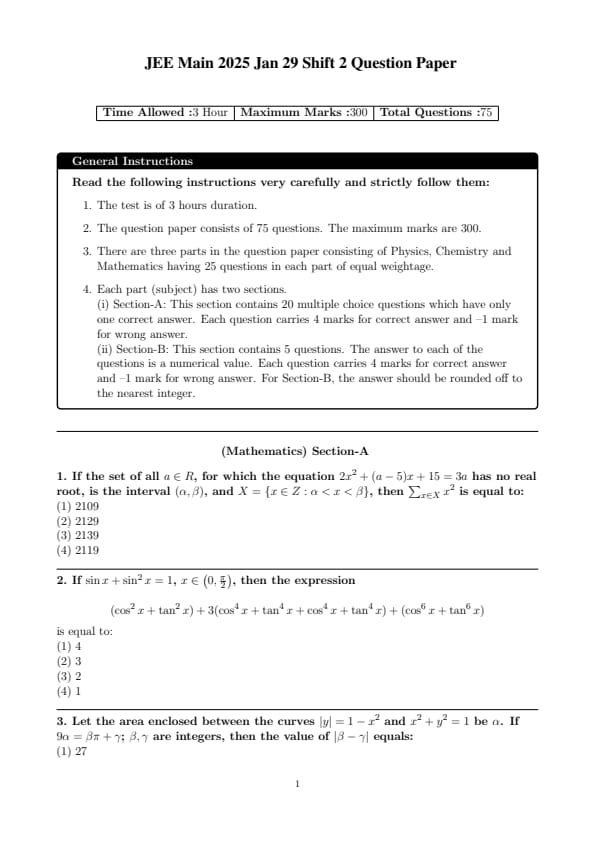
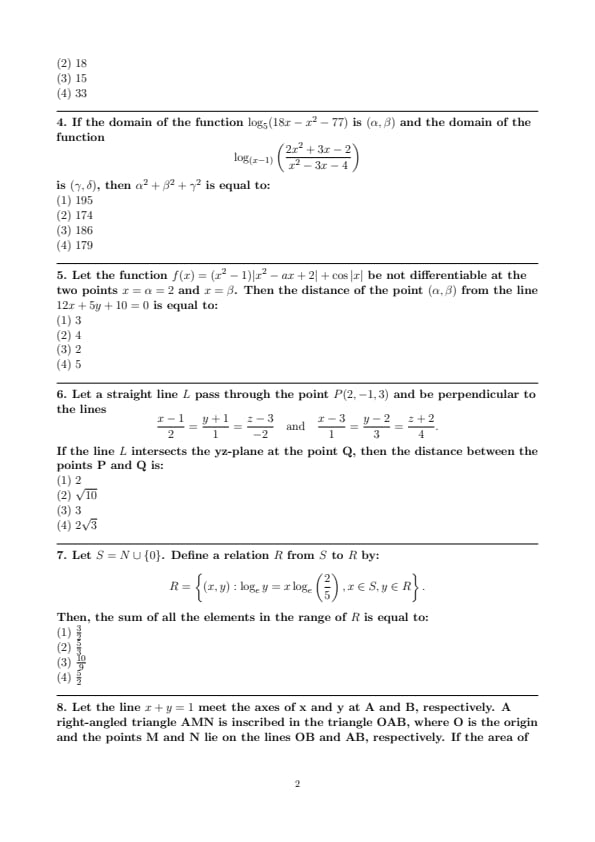
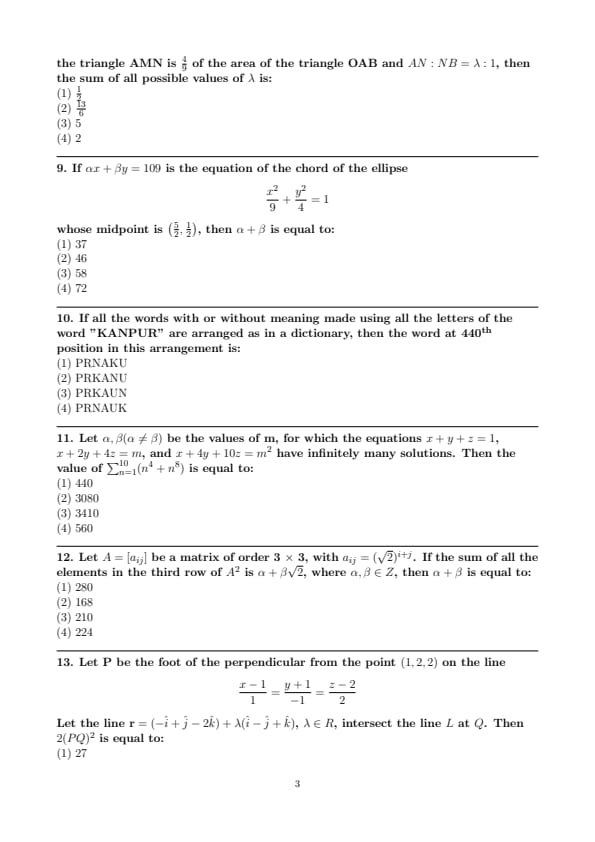
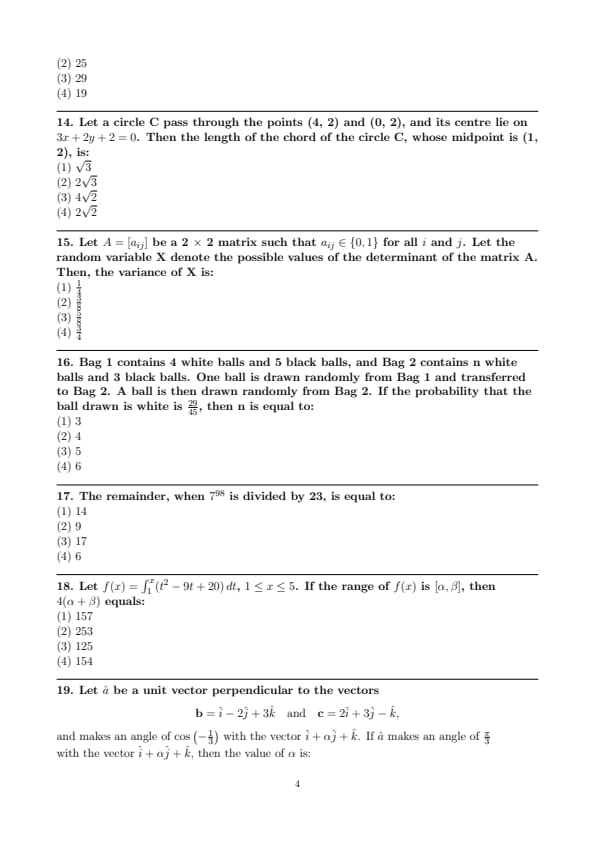
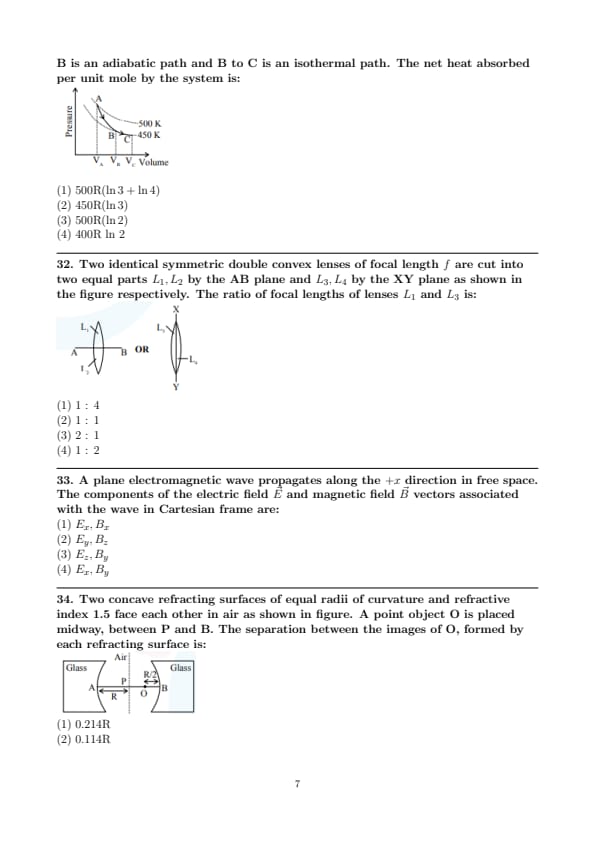
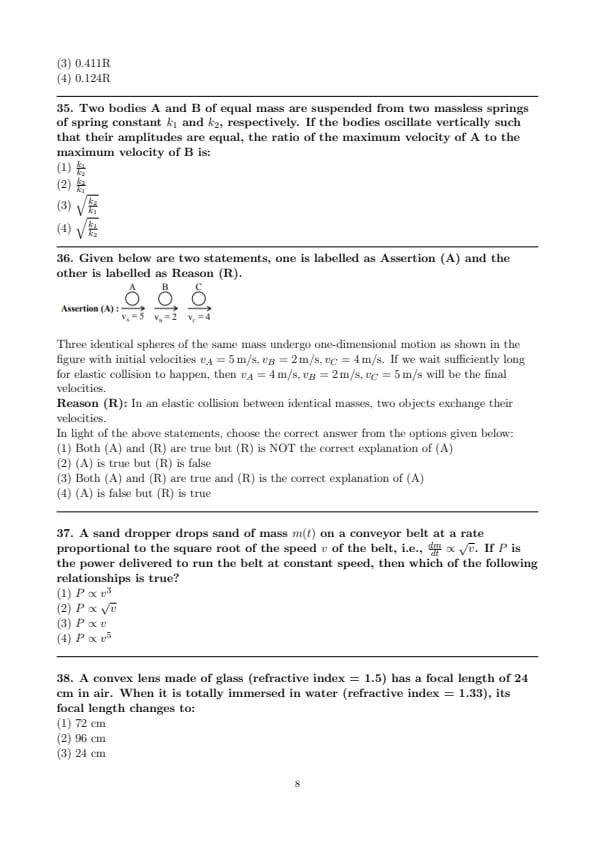
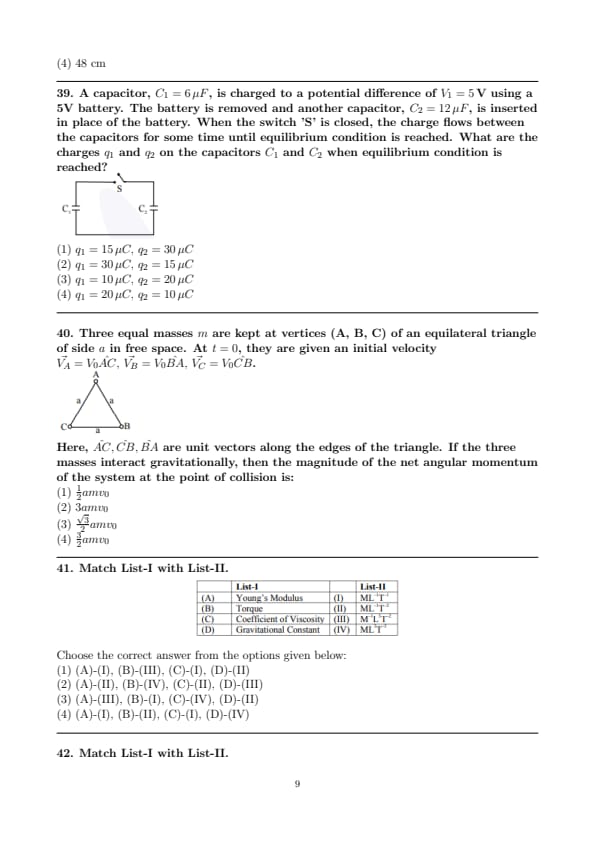
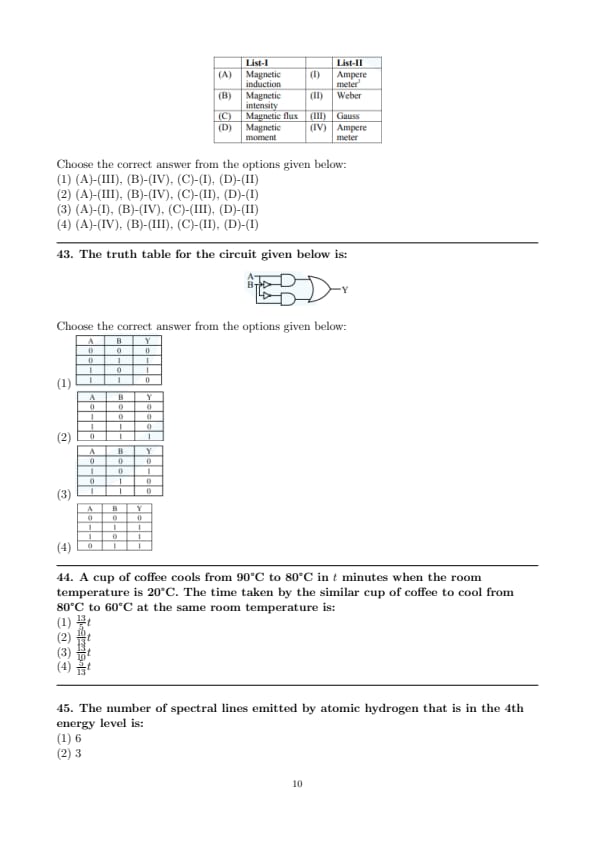
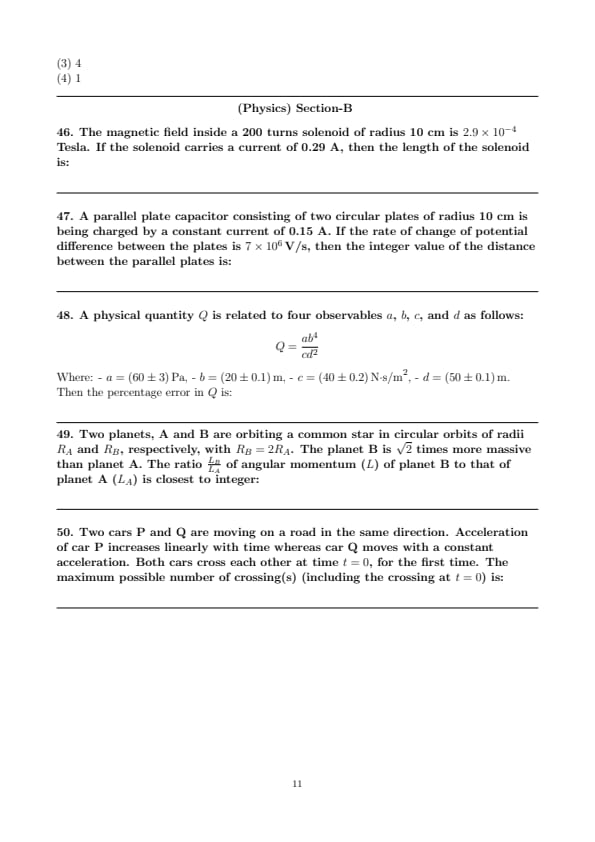
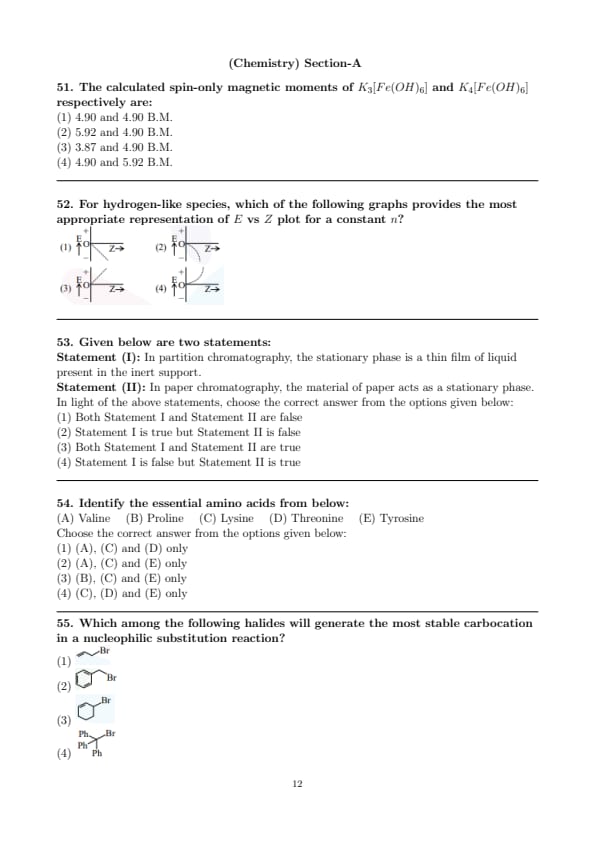
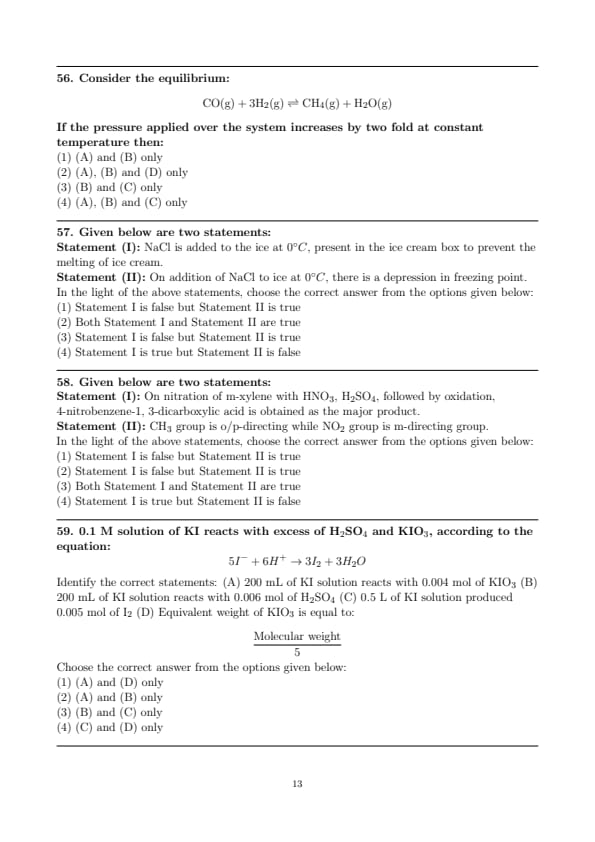
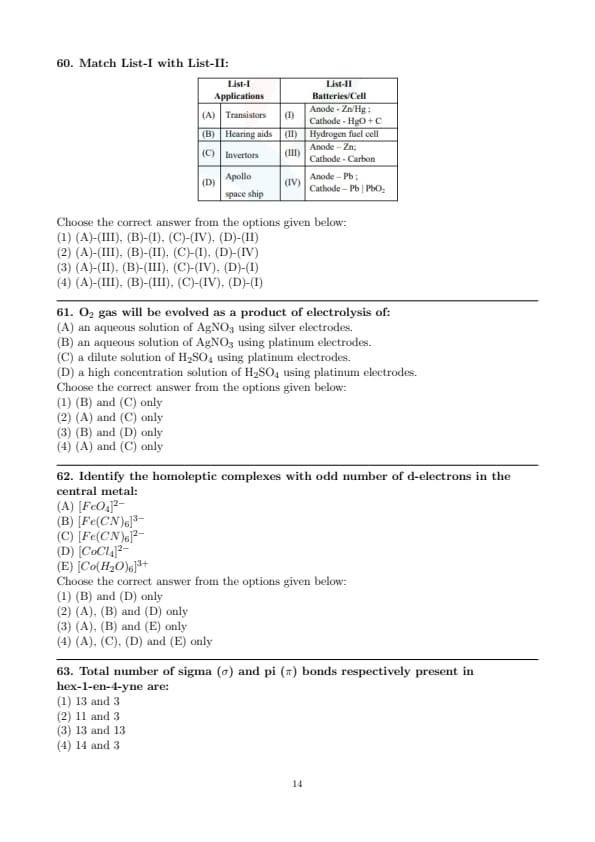
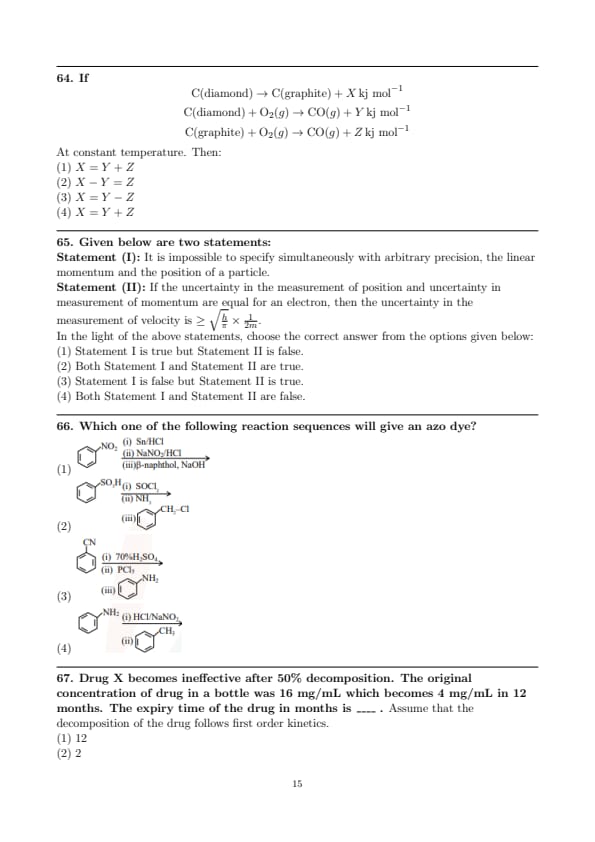
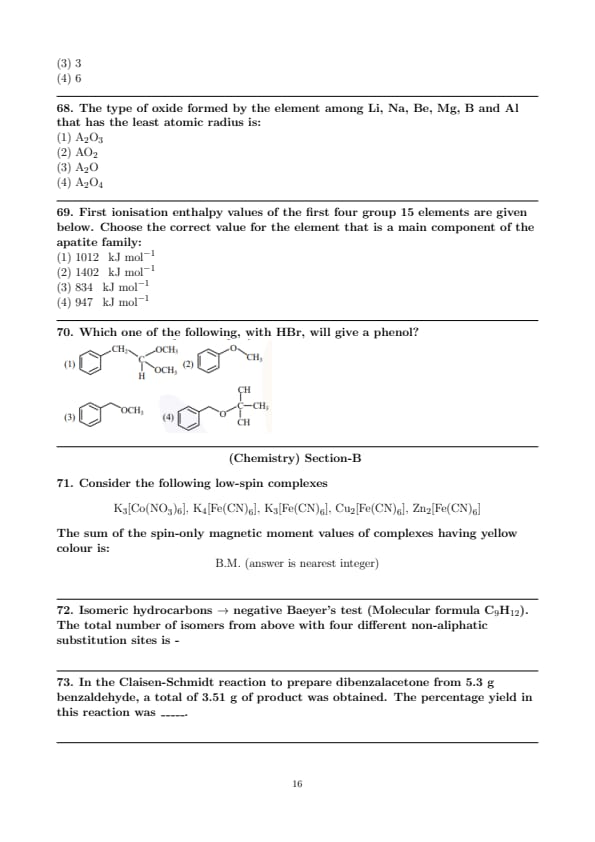
JEE Main 29th January Shift 2 Paper Analysis: Students’ Feedback and What to Expect in Upcoming Shifts
The JEE Main 2025 exam is divided into three sections Physics, Chemistry, and Mathematics with 75 questions. Each section contains 25 questions, including multiple-choice and numerical-value questions.
| JEE Main 29th January Shift 2 | |
|---|---|
| Exam Overview | Shift Timing- 3 pm to 6 pm on 29th January 2025 |
| Difficulty Level | Moderately Difficult |
| Physics Analysis |
Difficulty Level: Moderate Most Asked Topics:
|
| Chemistry Analysis |
Difficulty Level: Easy Most Asked Topics:
|
| Mathematics Analysis |
Difficulty Level: Tough Most Asked Topics:
|
| Focus points for Upcoming Shifts | Based on today's exam, here are some points to keep in mind for upcoming shifts:
|
JEE Main 2025 Shift-wise Analysis
The JEE Main 2025 exam for Session 1 is ongoing the difficulty level varied across different shifts. Some of the shifts were challenging while others were of moderate difficulty. Here’s the detailed shift-wise analysis of all the shifts of JEE main 2025:
| Shift | Subjects Overview | Overall Difficulty |
| 22nd January Shift 1 |
|
Moderate |
| 22nd January Shift 2 |
|
Moderate |
| 23rd January Shift 1 |
|
Easy to Moderate |
| 23rd January Shift 2 |
|
Moderate |
| 24th January Shift 1 |
|
Slightly difficult |
| 24th January Shift 2 |
|
Moderately difficult |
| 28th January Shift 1 |
|
Difficult |
| 28th January Shift 2 |
|
Moderate Difficulty |
| 29th January Shift 1 |
|
Moderate Difficulty |
| 29th January Shift 2 |
|
Moderate Difficulty |
*The article might have information for the previous academic years, please refer the official website of the exam.