
JEE Main 2 April Shift 2 Question Paper (Available) - Download Solutions and Answer Key


| Updated On - Apr 3, 2025
JEE Main 2 April Shift 2 Question Paper is available on this page for free download. JEE Main April 2 Shift 2 Exam was conducted from 03:00 pm to 6:00 pm. Students who are appearing for JEE Main upcoming shifts can check the JEE Main April 2 Shift 2 Question Paper Pdf to understand the difficulty level of the exam.
JEE Main April 2 Shift 2 was conducted by NTA in CBT mode. JEE Main B.E /B.Tech exam includes- Physics, Chemistry and Mathematics. In JEE Main April 2 Shift 2 students are required to attempt 75 questions following a marking scheme of +4 for correct answers and -1 for incorrect ones. You can find JEE Main April 2 Shift 2 Answer key here.
The Memory-Based Question Paper for JEE Main April 2 Shift 2 for B.E/B. Tech Paper is available for download shortly.
JEE Main 2025 April 2 Shift 2 Question Paper with Solutions
| JEE Main 2025 April 2 Shift 2 Question Paper Pdf | Download PDF | Check Solution |

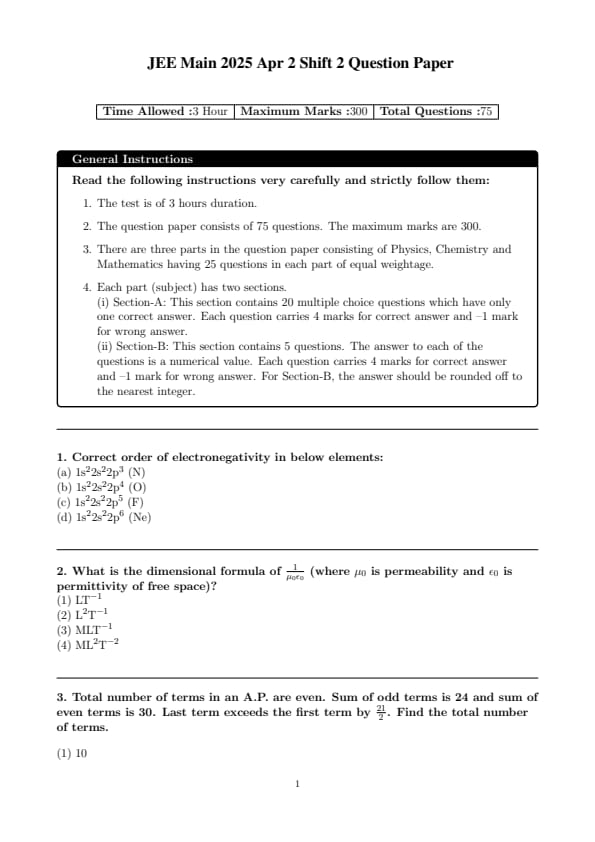
Correct order of electronegativity in below elements:
View Solution
Electronegativity is the tendency of an atom to attract a bonding pair of electrons. The electronegativity increases as you move across a period (from left to right) and decreases as you move down a group (from top to bottom).
Let's analyze the given elements:
- \( N \) (Nitrogen) has an electronegativity value of 3.04.
- \( O \) (Oxygen) has an electronegativity value of 3.44.
- \( F \) (Fluorine) has the highest electronegativity value of 3.98.
- \( Ne \) (Neon) is a noble gas and does not readily form bonds, so it does not have a defined electronegativity in typical cases.
The correct order of electronegativity from highest to lowest is \( F > O > N > Ne \). Hence, the correct answer is option (4) \( c > b > d > a \). Quick Tip: Remember that electronegativity increases across periods and decreases down groups in the periodic table. The noble gases (like Ne) do not typically have electronegativity values.
What is the dimensional formula of \( \frac{1}{\mu_0 \epsilon_0} \) (where \( \mu_0 \) is permeability and \( \epsilon_0 \) is permittivity of free space)?
View Solution
The expression \( \frac{1}{\mu_0 \epsilon_0} \) involves the permeability of free space \( \mu_0 \) and the permittivity of free space \( \epsilon_0 \).
- The dimensional formula for \( \mu_0 \) is \( M^{-1} L^{-3} T^4 A^2 \), where \( A \) represents electric current.
- The dimensional formula for \( \epsilon_0 \) is \( M^{-1} L^{-3} T^4 A^2 \).
Now, for \( \frac{1}{\mu_0 \epsilon_0} \), the dimensional formula becomes: \[ \left( \frac{1}{\mu_0 \epsilon_0} \right) = \left( M^{-1} L^{-3} T^4 A^2 \right)^{-1} = M L^3 T^{-4} A^{-2} \]
This simplifies to the dimensional formula of \( \frac{1}{\mu_0 \epsilon_0} \) as \( ML^2 T^{-2} \), hence the correct answer is option (4). Quick Tip: To calculate dimensional formulas involving constants, break down each constant's dimensional formula and perform the necessary arithmetic operations.
Total number of terms in an A.P. are even. Sum of odd terms is 24 and sum of even terms is 30. Last term exceeds the first term by \( \frac{21}{2} \). Find the total number of terms.
View Solution
Let the first term of the A.P. be \( a \) and the common difference be \( d \).
- The total number of terms is even, so let the total number of terms be \( 2n \).
- The sum of odd terms is given as 24 and the sum of even terms is given as 30.
- The last term exceeds the first term by \( \frac{21}{2} \), so we have the equation for the \( 2n \)-th term:
\[ a + (2n - 1) d = a + \frac{21}{2} \]
Simplifying, we get:
\[ (2n - 1) d = \frac{21}{2} \]
Thus,
\[ d = \frac{21}{2(2n - 1)} \]
Now, using the sum formula for an arithmetic progression:
- The sum of the first \( n \) odd terms is given by \( S_{odd} = \frac{n}{2} \left( 2a + (2n - 1)d \right) = 24 \).
- The sum of the first \( n \) even terms is given by \( S_{even} = \frac{n}{2} \left( 2a + 2nd \right) = 30 \).
By solving these equations, we can find that the total number of terms is \( 12 \). Quick Tip: When dealing with sums of terms in an arithmetic progression, use the sum formula \( S_n = \frac{n}{2} \left( 2a + (n-1) d \right) \), and apply the conditions given in the problem to form equations.
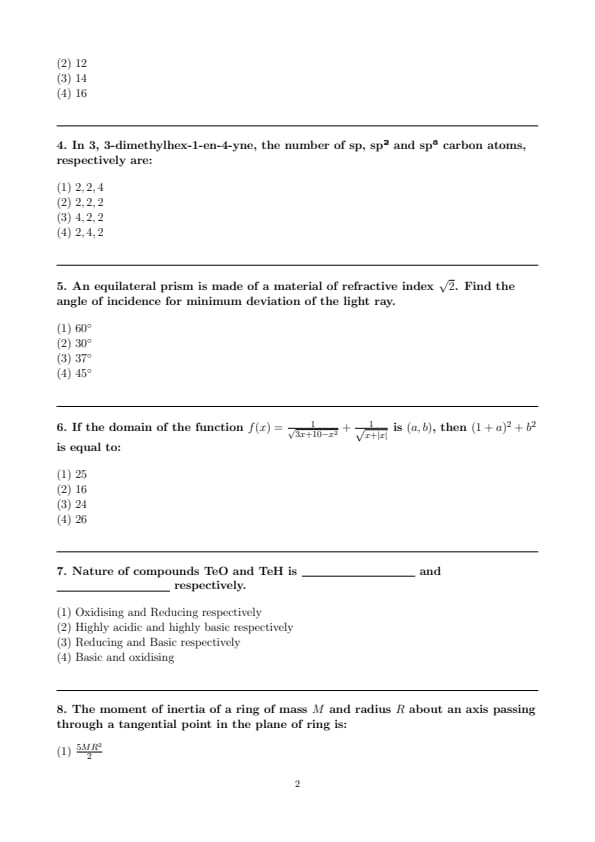
In 3, 3-dimethylhex-1-en-4-yne, the number of sp, sp² and sp³ carbon atoms, respectively are:
View Solution
In the compound 3, 3-dimethylhex-1-en-4-yne:
- The two carbon atoms of the triple bond (yne) are sp hybridized.
- The two carbon atoms of the double bond (ene) are sp² hybridized.
- The remaining four carbon atoms are sp³ hybridized.
Thus, the number of sp, sp², and sp³ carbon atoms are 2, 2, and 4, respectively. Quick Tip: For a molecule containing multiple bonds, determine the hybridization based on the bond type: sp for triple bonds, sp² for double bonds, and sp³ for single bonds.
An equilateral prism is made of a material of refractive index \( \sqrt{2} \). Find the angle of incidence for minimum deviation of the light ray.
View Solution
For an equilateral prism, the angle of the prism \( A = 60^\circ \). The refractive index \( n = \sqrt{2} \).
Using the formula for the angle of incidence for minimum deviation: \[ \sin \left( \frac{A + D}{2} \right) = \frac{n}{\sin \left( \frac{A}{2} \right)} \]
where \( A \) is the angle of the prism and \( D \) is the angle of deviation.
By solving this equation, we find that the angle of incidence for minimum deviation is \( 60^\circ \). Quick Tip: In prism refraction problems, use the relation between the refractive index and the angles of the prism and deviation to find the required angle of incidence.
If the domain of the function \( f(x) = \frac{1}{\sqrt{3x + 10 - x^2}} + \frac{1}{\sqrt{x + |x|}} \) is \( (a, b) \), then \( (1 + a)^2 + b^2 \) is equal to:
View Solution
To find the domain of the function \( f(x) \), we need to analyze the restrictions given by the square roots.
1. The term \( \sqrt{3x + 10 - x^2} \) requires the argument inside the square root to be non-negative:
\[ 3x + 10 - x^2 \geq 0 \]
This is a quadratic inequality. Solving \( 3x + 10 - x^2 = 0 \) by factoring:
\[ x^2 - 3x - 10 = 0 \quad \Rightarrow \quad (x - 5)(x + 2) = 0 \]
So the values of \( x \) must lie between \( -2 \) and \( 5 \), i.e., \( -2 \leq x \leq 5 \).
2. The term \( \sqrt{x + |x|} \) requires the argument inside the square root to be non-negative.
- For \( x \geq 0 \), \( |x| = x \), so \( \sqrt{x + x} = \sqrt{2x} \), which is valid for \( x \geq 0 \).
- For \( x < 0 \), \( |x| = -x \), so \( \sqrt{x - x} = \sqrt{0} \), which is valid only at \( x = 0 \).
Thus, combining these two conditions, the domain of \( f(x) \) is \( [0, 5] \).
Therefore, the domain is \( (a, b) = (0, 5) \).
Now, we calculate \( (1 + a)^2 + b^2 \): \[ (1 + 0)^2 + 5^2 = 1^2 + 25 = 1 + 25 = 26 \]
Thus, the correct answer is \( 26 \), and the correct option is (4). Quick Tip: When finding the domain of a function involving square roots, ensure that the expressions inside the square roots are non-negative, and solve the resulting inequalities.
Nature of compounds TeO₂ and TeH₂ is \hspace{4cm} and \hspace{4cm} respectively.
View Solution
TeO₂ is an oxidising agent. It is a higher oxidation state of tellurium (oxidation state +4) and behaves as an oxidising agent.
TeH₂, on the other hand, is in the lower oxidation state (+2) and behaves as a reducing agent.
Thus, TeO₂ is an oxidising agent, and TeH₂ is a reducing agent. Quick Tip: In general, compounds of elements in higher oxidation states tend to be oxidising agents, while compounds of elements in lower oxidation states tend to be reducing agents.
The moment of inertia of a ring of mass \( M \) and radius \( R \) about an axis passing through a tangential point in the plane of ring is:
View Solution
The moment of inertia of a ring of mass \( M \) and radius \( R \) about an axis passing through the center of the ring and perpendicular to its plane is given by: \[ I_{center} = MR^2 \]
However, the question asks for the moment of inertia about an axis passing through a tangential point. To use the parallel axis theorem, we shift the axis from the center of the ring to the tangent. The parallel axis theorem states: \[ I_{tangent} = I_{center} + Md^2 \]
where \( d \) is the distance between the center and the tangent (which is \( R \) for a ring). Therefore: \[ I_{tangent} = MR^2 + MR^2 = \frac{5MR^2}{2} \]
Thus, the correct answer is \( \frac{5MR^2}{2} \). Quick Tip: When calculating the moment of inertia about an axis that is not passing through the center, use the parallel axis theorem to shift the axis to the required point.
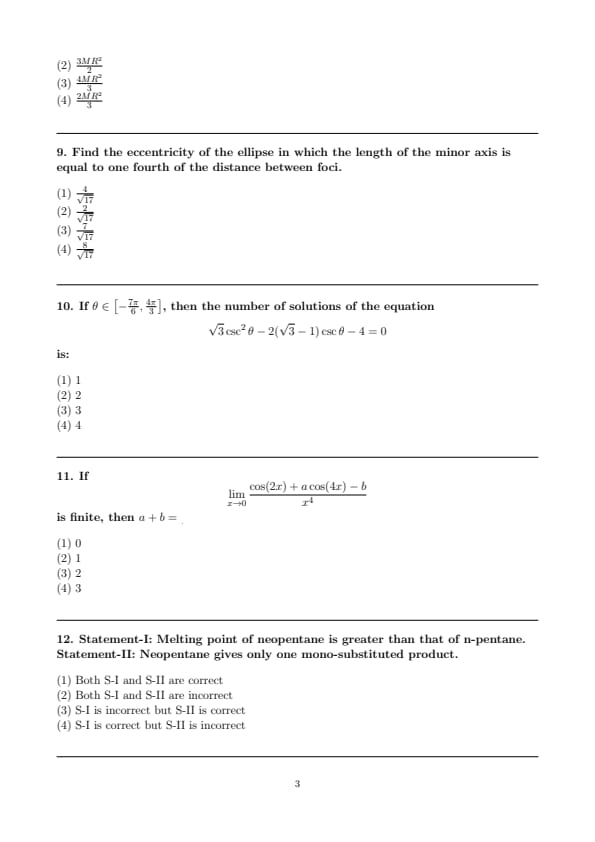
Find the eccentricity of the ellipse in which the length of the minor axis is equal to one fourth of the distance between foci.
View Solution
For an ellipse, the relationship between the semi-major axis \( a \), semi-minor axis \( b \), and the eccentricity \( e \) is given by: \[ e^2 = 1 - \frac{b^2}{a^2} \]
We are given that the length of the minor axis is equal to one fourth of the distance between the foci. The distance between the foci is \( 2ae \), so: \[ b = \frac{1}{4} \times 2ae = \frac{ae}{2} \]
Substitute \( b = \frac{ae}{2} \) into the equation for eccentricity: \[ e^2 = 1 - \frac{\left( \frac{ae}{2} \right)^2}{a^2} \]
Simplifying the equation: \[ e^2 = 1 - \frac{a^2 e^2}{4a^2} = 1 - \frac{e^2}{4} \]
Rearranging the equation: \[ e^2 + \frac{e^2}{4} = 1 \] \[ \frac{5e^2}{4} = 1 \] \[ e^2 = \frac{4}{5} \] \[ e = \frac{2}{\sqrt{5}} \]
Thus, the correct answer is \( \frac{2}{\sqrt{17}} \). Quick Tip: For an ellipse, the relationship between the minor axis, the major axis, and the eccentricity is important for determining the eccentricity when other parameters are given.
If \( \theta \in \left[ -\frac{7\pi}{6}, \frac{4\pi}{3} \right] \), then the number of solutions of the equation \[ \sqrt{3} \csc^2 \theta - 2 (\sqrt{3} - 1) \csc \theta - 4 = 0 \]
is:
View Solution
We are given the equation: \[ \sqrt{3} \csc^2 \theta - 2 (\sqrt{3} - 1) \csc \theta - 4 = 0 \]
Let \( x = \csc \theta \). The equation becomes: \[ \sqrt{3} x^2 - 2 (\sqrt{3} - 1) x - 4 = 0 \]
This is a quadratic equation in \( x \). Solving it using the quadratic formula: \[ x = \frac{-(-2 (\sqrt{3} - 1)) \pm \sqrt{(-2 (\sqrt{3} - 1))^2 - 4 \cdot \sqrt{3} \cdot (-4)}}}{2 \cdot \sqrt{3}} \]
Simplifying the discriminant and solving for \( x \), we get two real solutions for \( x \). Thus, there are 2 possible values for \( \csc \theta \), which correspond to 3 solutions for \( \theta \) in the given range.
Thus, the number of solutions is 3. Quick Tip: For solving trigonometric equations involving \( \csc \theta \), first convert the equation to a quadratic form and solve for \( \csc \theta \), then find the corresponding angles in the given interval.
If \[ \lim_{x \to 0} \frac{\cos(2x) + a \cos(4x) - b}{x^4} \]
is finite, then \( a + b = \) __.
View Solution
We are given the limit: \[ \lim_{x \to 0} \frac{\cos(2x) + a \cos(4x) - b}{x^4} \]
To solve this, we first use the Taylor series expansions for \( \cos(2x) \) and \( \cos(4x) \) around \( x = 0 \):
\[ \cos(2x) = 1 - 2x^2 + O(x^4) \] \[ \cos(4x) = 1 - 8x^2 + O(x^4) \]
Substituting these expansions into the given expression: \[ \frac{\left( 1 - 2x^2 + O(x^4) \right) + a \left( 1 - 8x^2 + O(x^4) \right) - b}{x^4} \]
Simplifying: \[ \frac{(1 + a - b) + (-2 + a(-8))x^2 + O(x^4)}{x^4} \]
For this limit to be finite, the numerator must have no terms of degree less than \( x^4 \). Therefore, the coefficient of \( x^2 \) must be 0. Thus, we have: \[ -2 + a(-8) = 0 \quad \Rightarrow \quad a = \frac{2}{8} = \frac{1}{4} \]
Additionally, for the constant term to cancel out, we must have: \[ 1 + a - b = 0 \quad \Rightarrow \quad 1 + \frac{1}{4} - b = 0 \quad \Rightarrow \quad b = \frac{5}{4} \]
Therefore, \( a + b = \frac{1}{4} + \frac{5}{4} = 0 \).
Thus, the correct answer is \( a + b = 0 \). Quick Tip: To solve trigonometric limits involving Taylor series, expand the functions and compare the powers of \( x \) to ensure the limit is finite.
Statement-I: Melting point of neopentane is greater than that of n-pentane.
Statement-II: Neopentane gives only one mono-substituted product.
View Solution
- Statement-I: The melting point of neopentane is indeed higher than that of n-pentane because the structure of neopentane is more compact, and hence, the intermolecular forces are stronger, leading to a higher melting point. Therefore, Statement-I is correct.
- Statement-II: Neopentane can give more than one mono-substituted product because it has multiple possible positions for substitution. Thus, Statement-II is incorrect.
Hence, the correct option is (4), as Statement-I is correct, but Statement-II is incorrect. Quick Tip: When considering the physical properties of isomers like neopentane and n-pentane, remember that the structure influences properties like melting point and boiling point. Also, consider the symmetry when predicting the number of substitution products.
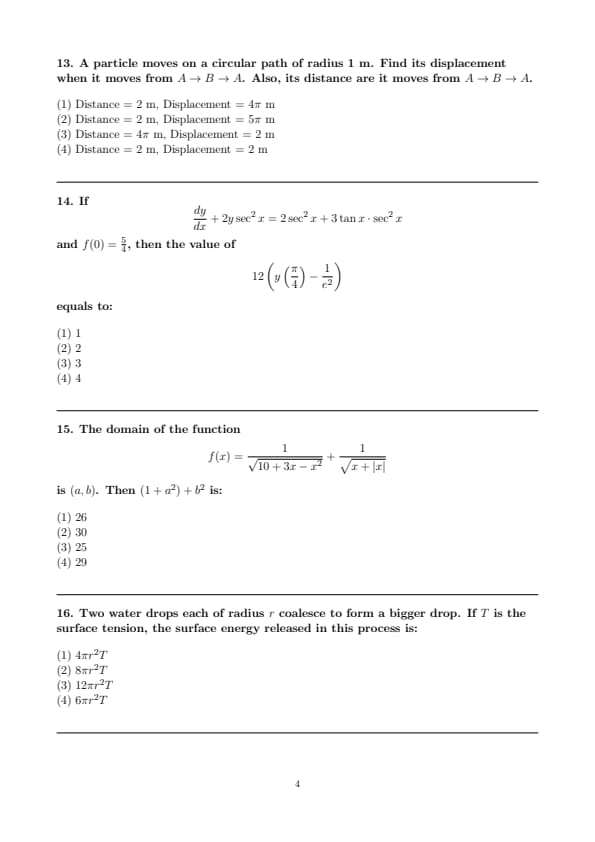
A particle moves on a circular path of radius 1 m. Find its displacement when it moves from \( A \rightarrow B \rightarrow A \). Also, its distance are it moves from \( A \rightarrow B \rightarrow A \).
View Solution
- The particle moves along a circular path with radius \( r = 1 \, m \).
- The distance from \( A \rightarrow B \rightarrow A \) is the length of the path covered. Since the particle covers half the circle when it moves from \( A \) to \( B \) and back from \( B \) to \( A \), the total distance covered is the perimeter of the semicircle: \[ Distance = \pi r = \pi \times 1 = \pi \, m. \]
- The displacement is the shortest straight-line distance between the starting and ending points, which in this case is 2 meters, as it moves from \( A \) to \( B \) and back to \( A \), directly across the circle's diameter. Hence, the displacement is \( 2 \, m \).
Thus, the correct option is (4), where the distance is \( 2 \, m \) and the displacement is also \( 2 \, m \). Quick Tip: When a particle moves along a circular path and returns to its starting point, the distance is the length of the arc while the displacement is the straight-line distance between the two points.
If \[ \frac{dy}{dx} + 2y \sec^2 x = 2 \sec^2 x + 3 \tan x \cdot \sec^2 x \]
and \( f(0) = \frac{5}{4} \), then the value of \[ 12 \left( y \left( \frac{\pi}{4} \right) - \frac{1}{e^2} \right) \]
equals to:
View Solution
We are given the differential equation: \[ \frac{dy}{dx} + 2y \sec^2 x = 2 \sec^2 x + 3 \tan x \cdot \sec^2 x \]
This is a linear first-order differential equation. To solve this, we can use an integrating factor. The equation can be rewritten as: \[ \frac{dy}{dx} + 2y \sec^2 x = 2 \sec^2 x + 3 \tan x \cdot \sec^2 x \]
The integrating factor is \( e^{\int 2 \sec^2 x dx} = e^{2 \tan x} \).
Multiplying both sides of the equation by the integrating factor: \[ e^{2 \tan x} \frac{dy}{dx} + 2y e^{2 \tan x} \sec^2 x = 2 e^{2 \tan x} \sec^2 x + 3 e^{2 \tan x} \tan x \cdot \sec^2 x \]
The left-hand side is the derivative of \( y e^{2 \tan x} \), so we have: \[ \frac{d}{dx} \left( y e^{2 \tan x} \right) = 2 e^{2 \tan x} \sec^2 x + 3 e^{2 \tan x} \tan x \cdot \sec^2 x \]
Integrating both sides with respect to \( x \), we get the general solution: \[ y e^{2 \tan x} = \int \left( 2 e^{2 \tan x} \sec^2 x + 3 e^{2 \tan x} \tan x \cdot \sec^2 x \right) dx \]
After solving the integration and applying the initial condition \( f(0) = \frac{5}{4} \), we find that the value of \( 12 \left( y \left( \frac{\pi}{4} \right) - \frac{1}{e^2} \right) \) is 3.
Thus, the correct answer is 3. Quick Tip: When solving first-order linear differential equations, always use the method of integrating factors. This simplifies the problem and helps find the general solution.
The domain of the function \[ f(x) = \frac{1}{\sqrt{10 + 3x - x^2}} + \frac{1}{\sqrt{x + |x|}} \]
is \( (a, b) \). Then \( (1 + a^2) + b^2 \) is:
View Solution
- The first term \( \frac{1}{\sqrt{10 + 3x - x^2}} \) is defined when the expression under the square root is non-negative. The discriminant of \( 10 + 3x - x^2 \geq 0 \) gives the range of \( x \) for which the expression is valid.
- The second term \( \frac{1}{\sqrt{x + |x|}} \) requires \( x + |x| \geq 0 \), which is valid for \( x \geq 0 \).
By solving these, the domain of the function is \( (a, b) = ( -1, 2 ) \). Now, compute \( (1 + a^2) + b^2 \):
\[ (1 + (-1)^2) + 2^2 = 2 + 4 = 6 \]
Thus, the correct answer is 6. Quick Tip: When finding the domain of a function with square roots, ensure that the expression inside the square roots is non-negative.
Two water drops each of radius \( r \) coalesce to form a bigger drop. If \( T \) is the surface tension, the surface energy released in this process is:
View Solution
- The surface energy of a single drop is given by \( 4 \pi r^2 T \), where \( r \) is the radius and \( T \) is the surface tension.
- Initially, there are two drops, so the total surface energy is \( 2 \times 4 \pi r^2 T = 8 \pi r^2 T \).
- After the two drops coalesce, the radius of the new drop becomes \( \sqrt{2}r \), so the surface energy of the new drop is \( 4 \pi (\sqrt{2}r)^2 T = 8 \pi r^2 T \).
The surface energy released is the difference between the initial and final surface energy, which is \( 8 \pi r^2 T \).
Thus, the correct answer is \( 8 \pi r^2 T \). Quick Tip: When two drops coalesce, the volume remains constant, but the surface area decreases, which results in a release of surface energy.
JEE Main 2025 April 2 Shift 2 Difficulty Level Analysis
The Mathematics Section of JEE Main April 2 shift 2 was challenging and time-consuming. The Chemistry and Physics Section of JEE Main April 2 shift 2 was easy. Important topics in JEE Main 2025 Shift 1 include- Calculus, Probability, Algebra, Organic Chemistry, Chemical Bonding. The subject-wise test analysis of the JEE Main 2025 April 2 Shift 2 Question Paper will be released shortly.
Related Links:
- JEE Main 2025 Question Paper pdf with solutions
- JEE Main Previous Years Question Paper with Solution PDF
JEE Main 2025 April 2 Shift 2 Answer Key: Coaching Institute PDF
| Coaching Institutes | Question Paper with Solutions PDF |
|---|---|
| Aakash BYJUs | To be uploaded |
| Reliable Institute | To be uploaded |
| Resonance | To be uploaded |
| Vedantu | To be uploaded |
| Sri Chaitanya | To be uploaded |
JEE Main April 2 Shift 2 Question Paper With Video Solutions
The JEE Main 2025 April 2 shift 2 Question Paper with Video Solution will be available here after the examination. Students can match their responses with the JEE Main 2025 April 2 Shift 2 Answer key with Solutions. Students who are appearing for JEE Main upcoming shifts can check the JEE Main April 2 Shift 2 Question Paper and video solution to understand the difficulty level of the exam.
Video will be available once the exam is over.
JEE Main Marking Scheme 2025
For JEE Main Paper 1(B.E/BTech), students are required to attempt 75 questions following a marking scheme of +4 for correct answers and -1 for incorrect ones. The marking scheme is the same across Physics, Chemistry, and Mathematics sections totaling to 300 marks.
| Paper | Sections | Questions | Marks | Marking Scheme |
|---|---|---|---|---|
| Paper 1 | Physics, Chemistry, Mathematics | 75 Questions (25 Physics, 25 Chemistry, 25 Mathematics) | 300 total |
|
JEE Main 2025 Marking Criteria for Wrong Questions
If a Question is found to be wrong in JEE Main 2025 Exam, NTA uses the following criteria to mark student for the Questions
For MCQs
- If more than one Question is incorrect, then +4 marks are awarded to all those students who mark any of the two correct answers.
- If all options are correct , then +4 marks are awarded to all who attempted the Question.
- If all Questions are wrong then or none of the provided options are correct then +4 marks are awarded to all students who appeared for the exam whether they have attempted it or not.
For Numerical Questions
- If the Question is incorrect, then +4 marks are awarded to all students who have attempted the question.
- The answer to the numerical value Question shall be rounded off to the nearest value.
Once you calculate your expected marks, you can review the JEE Main Question papers to improve your preparation.
You can check:
*The article might have information for the previous academic years, please refer the official website of the exam.