
JEE Main 2025 April 3 Shift 2 Question Paper with solution Pdf


| Updated On - Jan 9, 2026
JEE Main 2025 3 April Shift 2 Question Paper with Solution Pdf is available here for free download. The JEE Main 2025 April 3 Shift 2 Exam was scheduled from 3:00 pm to 6:00 pm. Students who will be appearing for the upcoming JEE Main 2026 exam can check the JEE Main April 3 Shift 2 Question Paper with Solution Pdf to understand the difficulty level of the exam.
JEE Main April 3 Shift 2 was conducted by NTA in CBT mode. The JEE Main B.E/B.Tech exam includes questions from Physics, Chemistry, and Mathematics. Students were required to attempt 75 questions following a marking scheme of +4 for correct answers and -1 for incorrect ones. You will be able to find the JEE Main 2025 April 3 Shift 2 Solutions here.
JEE Main 2025 Question Paper April 3 Shift 2 with Solution PDF
| JEE Main 2025 April 3 Shift 2 Question Paper | Download PDF | Check Solutions |

Let \(A = \{-2, -1, 0, 1, 2, 3\}\). Let \(R\) be a relation on \(A\) defined by \(xRy\) if and only if \(y = \max \{x, 1\}\). Let \(l\) be the number of elements in \(R\). Let \(m\) and \(n\) be the minimum number of elements required to be added in \(R\) to make it reflexive and symmetric relations, respectively. Then \(l + m + n\) is equal to
View Solution
Step 1: Understanding the Concept:
A relation \(R\) on a set \(A\) is reflexive if \((a, a) \in R\) for every \(a \in A\).
A relation \(R\) is symmetric if \((a, b) \in R \implies (b, a) \in R\).
The function \(y = \max \{x, 1\}\) returns \(x\) if \(x \ge 1\) and \(1\) if \(x < 1\).
Step 2: Identifying Elements of R:
The set \(A\) is \(\{-2, -1, 0, 1, 2, 3\}\).
For each \(x \in A\), we find \(y\):
- For \(x = -2\), \(y = \max \{-2, 1\} = 1 \implies (-2, 1) \in R\)
- For \(x = -1\), \(y = \max \{-1, 1\} = 1 \implies (-1, 1) \in R\)
- For \(x = 0\), \(y = \max \{0, 1\} = 1 \implies (0, 1) \in R\)
- For \(x = 1\), \(y = \max \{1, 1\} = 1 \implies (1, 1) \in R\)
- For \(x = 2\), \(y = \max \{2, 1\} = 2 \implies (2, 2) \in R\)
- For \(x = 3\), \(y = \max \{3, 1\} = 3 \implies (3, 3) \in R\)
Thus, \(R = \{(-2, 1), (-1, 1), (0, 1), (1, 1), (2, 2), (3, 3)\}\).
The number of elements \(l = 6\).
Step 3: Finding m and n:
- For \(R\) to be reflexive, it must contain \((a, a)\) for all \(a \in A = \{-2, -1, 0, 1, 2, 3\}\).
The pairs present are \((1, 1), (2, 2), (3, 3)\).
The missing pairs are \((-2, -2), (-1, -1), (0, 0)\).
Thus, the minimum number of elements to add for reflexivity is \(m = 3\).
- For \(R\) to be symmetric, for every \((x, y) \in R\), \((y, x)\) must be in \(R\).
For \((-2, 1) \in R\), we need \((1, -2)\).
For \((-1, 1) \in R\), we need \((1, -1)\).
For \((0, 1) \in R\), we need \((1, 0)\).
The pairs \((1, 1), (2, 2), (3, 3)\) are already symmetric.
Thus, the minimum number of elements to add for symmetry is \(n = 3\).
Step 4: Final Answer:
The value of \(l + m + n = 6 + 3 + 3 = 12\).
Quick Tip: To find the number of elements to make a relation reflexive, count the number of identity pairs \((a, a)\) missing from the set. For symmetry, identify every \((x, y)\) where \(x \neq y\) and count its counterpart \((y, x)\) if it is missing.
If the domain of the function \(f(x) = \log_7 (1 - \log_4 (x^2 - 9x + 18))\) is \((\alpha, \beta) \cup (\gamma, \delta)\), then \(\alpha + \beta + \gamma + \delta\) is equal to
View Solution
Step 1: Understanding the Concept:
For a function \(\log_b(g(x))\) to be defined, the argument must be positive, i.e., \(g(x) > 0\).
Step 2: Setting up inequalities:
There are two log functions nested.
1. For \(\log_4(x^2 - 9x + 18)\), we need:
\[ x^2 - 9x + 18 > 0 \] \[ (x - 3)(x - 6) > 0 \] \[ x \in (-\infty, 3) \cup (6, \infty) \quad \dots (i) \]
2. For the outer log, \(\log_7(\dots)\), the entire argument must be positive:
\[ 1 - \log_4(x^2 - 9x + 18) > 0 \] \[ \log_4(x^2 - 9x + 18) < 1 \] \[ x^2 - 9x + 18 < 4^1 \] \[ x^2 - 9x + 14 < 0 \] \[ (x - 2)(x - 7) < 0 \] \[ x \in (2, 7) \quad \dots (ii) \]
Step 3: Finding the Intersection:
We need the intersection of (i) and (ii):
\[ x \in \{(-\infty, 3) \cup (6, \infty)\} \cap (2, 7) \] \[ x \in (2, 3) \cup (6, 7) \]
Comparing this with the given domain \((\alpha, \beta) \cup (\gamma, \delta)\), we get:
\(\alpha = 2, \beta = 3, \gamma = 6, \delta = 7\).
Step 4: Final Answer:
\(\alpha + \beta + \gamma + \delta = 2 + 3 + 6 + 7 = 18\).
Quick Tip: When dealing with nested logarithms, work from the inside out and ensure every argument of every log function is strictly greater than zero.
Let \(f\) be a function such that \(f(x) + 3f\left(\frac{24}{x}\right) = 4x, x \neq 0\). Then \(f(3) + f(8)\) is equal to
View Solution
Step 1: Understanding the Concept:
This is a functional equation. To solve for \(f(x)\), we can substitute the argument with another expression that cycles back.
Step 2: Key Approach:
Given: \(f(x) + 3f\left(\frac{24}{x}\right) = 4x \quad \dots (i)\)
Substitute \(x\) with \(\frac{24}{x}\):
\(f\left(\frac{24}{x}\right) + 3f\left(\frac{24}{24/x}\right) = 4\left(\frac{24}{x}\right)\)
\(f\left(\frac{24}{x}\right) + 3f(x) = \frac{96}{x} \quad \dots (ii)\)
Step 3: Detailed Explanation:
Multiply equation (ii) by 3:
\(3f\left(\frac{24}{x}\right) + 9f(x) = \frac{288}{x} \quad \dots (iii)\)
Subtract equation (i) from equation (iii):
\((9f(x) - f(x)) + (3f\left(\frac{24}{x}\right) - 3f\left(\frac{24}{x}\right)) = \frac{288}{x} - 4x\)
\(8f(x) = \frac{288}{x} - 4x\)
\(f(x) = \frac{36}{x} - \frac{x}{2}\)
Now, calculate the required values:
\(f(3) = \frac{36}{3} - \frac{3}{2} = 12 - 1.5 = 10.5\)
\(f(8) = \frac{36}{8} - \frac{8}{2} = 4.5 - 4 = 0.5\)
Step 4: Final Answer:
\(f(3) + f(8) = 10.5 + 0.5 = 11\).
Quick Tip: For equations of the form \(af(x) + bf(g(x)) = h(x)\), if \(g(g(x)) = x\), you can always solve for \(f(x)\) by creating a system of two linear equations in terms of \(f(x)\) and \(f(g(x))\).
Let the equation \(x(x + 2)(12 - k) = 2\) have equal roots. Then the distance of the point \((k, k/2)\) from the line \(3x + 4y + 5 = 0\) is
View Solution
Step 1: Understanding the Concept:
A quadratic equation \(ax^2 + bx + c = 0\) has equal roots if the discriminant \(D = b^2 - 4ac = 0\).
Step 2: Simplifying the Equation:
The given equation is \((x^2 + 2x)(12 - k) = 2\).
\((12 - k)x^2 + 2(12 - k)x - 2 = 0\).
For equal roots:
\([2(12 - k)]^2 - 4(12 - k)(-2) = 0\)
\(4(12 - k)^2 + 8(12 - k) = 0\)
\(4(12 - k) [ (12 - k) + 2 ] = 0\)
\(4(12 - k)(14 - k) = 0\).
So, \(k = 12\) or \(k = 14\).
If \(k = 12\), the equation becomes \(0 = 2\), which is not possible. Thus, \(k = 14\).
Step 3: Calculating Distance:
The point is \((k, k/2) = (14, 14/2) = (14, 7)\).
The distance of point \((x_1, y_1)\) from \(Ax + By + C = 0\) is \(d = \frac{|Ax_1 + By_1 + C|}{\sqrt{A^2 + B^2}}\).
\(d = \frac{|3(14) + 4(7) + 5|}{\sqrt{3^2 + 4^2}} = \frac{|42 + 28 + 5|}{5} = \frac{75}{5} = 15\).
Step 4: Final Answer:
The distance is 15.
Quick Tip: Always check if your calculated parameter value makes the coefficient of \(x^2\) zero. If it does, the equation ceases to be quadratic, and "equal roots" might not apply in that context.
If \(z_1, z_2, z_3 \in \mathbb{C}\) are the vertices of an equilateral triangle, whose centroid is \(z_0\), then \(\sum_{k=1}^3 (z_k - z_0)^2\) is equal to
View Solution
Step 1: Understanding the Concept:
For an equilateral triangle with vertices \(z_1, z_2, z_3\), the identity \(z_1^2 + z_2^2 + z_3^2 = z_1z_2 + z_2z_3 + z_3z_1\) holds.
The centroid \(z_0\) is given by \(z_0 = \frac{z_1 + z_2 + z_3}{3}\).
Step 2: Expansion of the Sum:
\(\sum_{k=1}^3 (z_k - z_0)^2 = (z_1 - z_0)^2 + (z_2 - z_0)^2 + (z_3 - z_0)^2\)
\(= z_1^2 + z_2^2 + z_3^2 - 2z_0(z_1 + z_2 + z_3) + 3z_0^2\)
Since \(z_1 + z_2 + z_3 = 3z_0\):
\(= z_1^2 + z_2^2 + z_3^2 - 2z_0(3z_0) + 3z_0^2\)
\(= z_1^2 + z_2^2 + z_3^2 - 3z_0^2 \quad \dots (i)\)
Step 3: Detailed Explanation:
Substitute \(z_0 = \frac{z_1 + z_2 + z_3}{3}\) into \(3z_0^2\):
\(3z_0^2 = 3 \left( \frac{z_1 + z_2 + z_3}{3} \right)^2 = \frac{1}{3} (z_1 + z_2 + z_3)^2\)
\(= \frac{1}{3} [z_1^2 + z_2^2 + z_3^2 + 2(z_1z_2 + z_2z_3 + z_3z_1)]\)
For an equilateral triangle, \(z_1z_2 + z_2z_3 + z_3z_1 = z_1^2 + z_2^2 + z_3^2\).
So, \(3z_0^2 = \frac{1}{3} [z_1^2 + z_2^2 + z_3^2 + 2(z_1^2 + z_2^2 + z_3^2)] = \frac{1}{3} [3(z_1^2 + z_2^2 + z_3^2)] = z_1^2 + z_2^2 + z_3^2\).
Plugging this back into (i):
\(\sum_{k=1}^3 (z_k - z_0)^2 = (z_1^2 + z_2^2 + z_3^2) - (z_1^2 + z_2^2 + z_3^2) = 0\).
Step 4: Final Answer:
The sum is equal to 0.
Quick Tip: For any equilateral triangle with vertices \(z_1, z_2, z_3\) and centroid \(z_0\), the expressions \(z_1^2 + z_2^2 + z_3^2 - (z_1z_2 + z_2z_3 + z_3z_1) = 0\) and \(\sum (z_k - z_0)^2 = 0\) are fundamental properties.
The sum \(1 + \frac{1+3}{2!} + \frac{1+3+5}{3!} + \frac{1+3+5+7}{4!} + \dots\) upto \(\infty\) terms, is equal to
View Solution
Step 1: Understanding the Concept:
The sum of the first \(n\) odd natural numbers is given by \(1 + 3 + 5 + \dots + (2n - 1) = n^2\).
The expansion of \(e\) is \(e = \sum_{n=0}^{\infty} \frac{1}{n!}\).
Step 2: Key Formula or Approach:
Let \(T_n\) be the \(n\)-th term of the series:
\(T_n = \frac{1 + 3 + 5 + \dots + (2n - 1)}{n!} = \frac{n^2}{n!}\)
Step 3: Detailed Explanation:
\(T_n = \frac{n^2}{n!} = \frac{n}{ (n-1)! } = \frac{n - 1 + 1}{ (n-1)! } = \frac{n-1}{ (n-1)! } + \frac{1}{ (n-1)! }\)
\(T_n = \frac{1}{ (n-2)! } + \frac{1}{ (n-1)! }\)
The sum \(S = \sum_{n=1}^{\infty} T_n = \sum_{n=1}^{\infty} \frac{1}{ (n-2)! } + \sum_{n=1}^{\infty} \frac{1}{ (n-1)! }\)
In the first sum, \(1/(n-2)! = 0\) for \(n=1\). For \(n \ge 2\), it generates terms \(1/0!, 1/1!, \dots\) which sums to \(e\).
In the second sum, for \(n \ge 1\), it generates terms \(1/0!, 1/1!, \dots\) which sums to \(e\).
\(S = e + e = 2e\).
Step 4: Final Answer:
The sum is \(2e\).
Quick Tip: To sum series involving factorials, express the general term \(T_n\) as a linear combination of terms like \(\frac{1}{(n-r)!}\). Note that \(\sum_{n=r}^{\infty} \frac{1}{(n-r)!} = e\).
Line \(L_1\) of slope 2 and line \(L_2\) of slope \(1/2\) intersect at the origin O. In the first quadrant, \(P_1, P_2, \dots, P_{12}\) are 12 points on line \(L_1\) and \(Q_1, Q_2, \dots, Q_9\) are 9 points on line \(L_2\). Then the total number of triangles, that can be formed having vertices at three of the 22 points \(O, P_1, P_2, \dots, P_{12}, Q_1, Q_2, \dots, Q_9\), is:
View Solution
Step 1: Understanding the Concept:
The total number of triangles that can be formed by \(n\) points is given by \(\binom{n}{3} - (combinations of 3 collinear points)\).
Step 2: Key Formula or Approach:
Total points = 1 (Origin \(O\)) + 12 (points on \(L_1\)) + 9 (points on \(L_2\)) = 22.
Total ways to pick any 3 points from 22 is \(\binom{22}{3}\).
Triangles cannot be formed if the 3 points are collinear.
Step 3: Detailed Explanation:
- Collinear points on \(L_1\): There are \(12 + 1 = 13\) points (including \(O\)).
Number of sets of 3 collinear points on \(L_1 = \binom{13}{3} = \frac{13 \times 12 \times 11}{6} = 286\).
- Collinear points on \(L_2\): There are \(9 + 1 = 10\) points (including \(O\)).
Number of sets of 3 collinear points on \(L_2 = \binom{10}{3} = \frac{10 \times 9 \times 8}{6} = 120\).
Total triangles = \(\binom{22}{3} - \binom{13}{3} - \binom{10}{3}\).
\(\binom{22}{3} = \frac{22 \times 21 \times 20}{6} = 1540\).
Total triangles = \(1540 - 286 - 120 = 1134\).
Step 4: Final Answer:
The number of triangles is 1134.
Quick Tip: When a point is common to two lines (like the origin here), ensure it is counted correctly in the collinear subsets for each line when subtracting from the total combinations.
If the probability that the random variable \(X\) takes the value \(x\) is given by \(P(X = x) = k(x + 1)3^{-x}, x = 0, 1, 2, 3, \dots\), where \(k\) is a constant, then \(P(X \ge 3)\) is equal to
View Solution
Step 1: Understanding the Concept:
For a valid probability distribution, the sum of all probabilities must equal 1: \(\sum_{x=0}^{\infty} P(X = x) = 1\).
Step 2: Finding the constant k:
\(\sum_{x=0}^{\infty} k(x + 1) \left( \frac{1}{3} \right)^x = 1\).
Let \(S = \sum_{x=0}^{\infty} (x + 1)r^x = 1 + 2r + 3r^2 + \dots\) where \(r = 1/3\).
This is the derivative of the geometric series \(\sum_{x=0}^{\infty} r^{x+1} = \frac{r}{1-r}\).
Specifically, \(S = \frac{1}{(1 - r)^2}\) for \(|r| < 1\).
\(S = \frac{1}{(1 - 1/3)^2} = \frac{1}{(2/3)^2} = \frac{9}{4}\).
So, \(k \left( \frac{9}{4} \right) = 1 \implies k = \frac{4}{9}\).
Step 3: Calculating P(X >= 3):
\(P(X \ge 3) = 1 - P(X < 3) = 1 - [P(X = 0) + P(X = 1) + P(X = 2)]\).
\(P(X = 0) = k(1)3^0 = k = 4/9\).
\(P(X = 1) = k(2)3^{-1} = 2k/3 = 2(4/9)/3 = 8/27\).
\(P(X = 2) = k(3)3^{-2} = 3k/9 = k/3 = 4/27\).
\(P(X < 3) = \frac{12}{27} + \frac{8}{27} + \frac{4}{27} = \frac{24}{27} = \frac{8}{9}\).
\(P(X \ge 3) = 1 - \frac{8}{9} = \frac{1}{9}\).
Step 4: Final Answer:
\(P(X \ge 3) = 1/9\).
Quick Tip: The sum of an Arithmetic-Geometric Progression (AGP) of the form \(\sum (n+1)r^n\) is \(\frac{1}{(1-r)^2}\). Memorizing this saves significant time in probability problems involving infinite series.
Let the Mean and Variance of five observations \(x_1 = 1, x_2 = 3, x_3 = a, x_4 = 7\) and \(x_5 = b, a > b\), be 5 and 10 respectively. Then the Variance of the observations \(n + x_n, n = 1, 2, \dots, 5\) is
View Solution
Step 1: Understanding the Concept:
Mean \(\bar{x} = \frac{\sum x_i}{n}\) and Variance \(\sigma^2 = \frac{\sum x_i^2}{n} - (\bar{x})^2\).
Step 2: Finding a and b:
Mean = 5: \(\frac{1 + 3 + a + 7 + b}{5} = 5 \implies a + b = 14\).
Variance = 10: \(\frac{1^2 + 3^2 + a^2 + 7^2 + b^2}{5} - 5^2 = 10\)
\(\frac{59 + a^2 + b^2}{5} = 35 \implies a^2 + b^2 = 116\).
\((a + b)^2 = a^2 + b^2 + 2ab \implies 14^2 = 116 + 2ab \implies 196 - 116 = 2ab \implies ab = 40\).
Roots of \(t^2 - 14t + 40 = 0\) are 10 and 4. Since \(a > b\), \(a = 10, b = 4\).
Step 3: Calculating Variance of new observations:
The new observations \(y_n = n + x_n\) are:
\(y_1 = 1 + 1 = 2\)
\(y_2 = 2 + 3 = 5\)
\(y_3 = 3 + 10 = 13\)
\(y_4 = 4 + 7 = 11\)
\(y_5 = 5 + 4 = 9\)
New mean \(\bar{y} = \frac{2 + 5 + 13 + 11 + 9}{5} = \frac{40}{5} = 8\).
New variance \(\sigma_y^2 = \frac{2^2 + 5^2 + 13^2 + 11^2 + 9^2}{5} - 8^2\)
\(\sigma_y^2 = \frac{4 + 25 + 169 + 121 + 81}{5} - 64 = \frac{400}{5} - 64 = 80 - 64 = 16\).
Step 4: Final Answer:
The variance is 16.
Quick Tip: When variables are transformed, recalculate the individual values if specific terms like \(n+x_n\) are involved. If every \(x_n\) was increased by a constant \(c\), the variance would remain unchanged.
Consider the lines \(x(3\lambda + 1) + y(7\lambda + 2) = 17\lambda + 5\), \(\lambda\) being a parameter, all passing through a point P. One of these lines (say \(L\)) is farthest from the origin. If the distance of \(L\) from the point \((3, 6)\) is \(d\), then the value of \(d^2\) is
View Solution
Step 1: Understanding the Concept:
A family of lines \((L_1) + \lambda(L_2) = 0\) passes through the intersection of \(L_1\) and \(L_2\).
The line from a family passing through \(P\) that is farthest from the origin is the one perpendicular to \(OP\), where \(O\) is the origin.
Step 2: Finding the Fixed Point P:
Rearrange the equation: \((x + 2y - 5) + \lambda(3x + 7y - 17) = 0\).
Intersection of \(x + 2y = 5\) and \(3x + 7y = 17\):
From first, \(x = 5 - 2y\). Substitute in second: \(3(5 - 2y) + 7y = 17 \implies 15 - 6y + 7y = 17 \implies y = 2\).
\(x = 5 - 2(2) = 1\). So \(P\) is \((1, 2)\).
Step 3: Finding Line L:
The line \(L\) is perpendicular to \(OP\). Slope of \(OP = 2/1 = 2\).
Slope of line \(L = -1/2\).
Equation of \(L\): \(y - 2 = -\frac{1}{2}(x - 1) \implies 2y - 4 = -x + 1 \implies x + 2y - 5 = 0\).
Distance \(d\) from \((3, 6)\) to \(x + 2y - 5 = 0\):
\(d = \frac{|3 + 2(6) - 5|}{\sqrt{1^2 + 2^2}} = \frac{|3 + 12 - 5|}{\sqrt{5}} = \frac{10}{\sqrt{5}} = 2\sqrt{5}\).
Step 4: Final Answer:
\(d^2 = (2\sqrt{5})^2 = 4 \times 5 = 20\).
Quick Tip: The "farthest line from the origin" through a point \(P\) is always the line whose normal is the vector \(\vec{OP}\).
If the four distinct points \((4, 6), (-1, 5), (0, 0)\) and \((k, 3k)\) lie on a circle of radius \(r\), then \(10k + r^2\) is equal to
View Solution
Step 1: Finding the Circle Equation:
Let the circle be \(x^2 + y^2 + 2gx + 2fy + c = 0\).
Since \((0, 0)\) is on the circle, \(c = 0\).
For \((-1, 5)\): \((-1)^2 + 5^2 + 2g(-1) + 2f(5) = 0 \implies 26 - 2g + 10f = 0 \implies g - 5f = 13 \dots (i)\)
For \((4, 6)\): \(4^2 + 6^2 + 2g(4) + 2f(6) = 0 \implies 52 + 8g + 12f = 0 \implies 2g + 3f = -13 \dots (ii)\)
Solving (i) and (ii): From (i), \(g = 5f + 13\). Substitute in (ii): \(2(5f + 13) + 3f = -13 \implies 10f + 26 + 3f = -13 \implies 13f = -39 \implies f = -3\).
\(g = 5(-3) + 13 = -2\).
The circle is \(x^2 + y^2 - 4x - 6y = 0\).
Radius \(r^2 = g^2 + f^2 - c = (-2)^2 + (-3)^2 = 4 + 9 = 13\).
Step 2: Finding k:
Point \((k, 3k)\) lies on the circle:
\(k^2 + (3k)^2 - 4(k) - 6(3k) = 0\)
\(k^2 + 9k^2 - 4k - 18k = 0 \implies 10k^2 - 22k = 0\).
\(k(10k - 22) = 0 \implies k = 0\) or \(k = 2.2\).
If \(k = 0\), the point is \((0, 0)\), which is already one of the given points. For 4 distinct points, \(k = 2.2\) (\(22/10\)).
Step 3: Calculating Final Value:
\(10k + r^2 = 10(2.2) + 13 = 22 + 13 = 35\).
Step 4: Final Answer:
The result is 35.
Quick Tip: When a point \((0,0)\) is on the circle, the constant \(c\) in the general form \(x^2+y^2+2gx+2fy+c=0\) is zero. This simplifies the simultaneous equations significantly.
Let C be the circle of minimum area enclosing the ellipse \(E: \frac{x^2}{a^2} + \frac{y^2}{b^2} = 1\) with eccentricity \(1/2\) and foci \((\pm 2, 0)\). Let \(PQR\) be a variable triangle, whose vertex \(P\) is on the circle \(C\) and the side \(QR\) of length \(2a\) is parallel to the major axis of \(E\) and contains the point of intersection of \(E\) with the negative y-axis. Then the maximum area of the triangle \(PQR\) is:
View Solution
Step 1: Finding Parameters of Ellipse E:
Foci \(= (\pm ae, 0) = (\pm 2, 0) \implies ae = 2\).
Given \(e = 1/2\), so \(a(1/2) = 2 \implies a = 4\).
\(b^2 = a^2(1 - e^2) = 16(1 - 1/4) = 12 \implies b = 2\sqrt{3}\).
Step 2: Identifying Circle C and side QR:
The minimum area circle enclosing an ellipse is centered at the origin with radius equal to the semi-major axis \(a\).
So, Circle \(C: x^2 + y^2 = 16\).
Intersection of \(E\) with negative y-axis is \((0, -b) = (0, -2\sqrt{3})\).
Side \(QR\) has length \(2a = 8\) and is parallel to the x-axis (major axis), passing through \((0, -2\sqrt{3})\).
Thus, the side \(QR\) lies on the line \(y = -2\sqrt{3}\).
Step 3: Maximizing Area:
Area of triangle \(PQR = \frac{1}{2} \times Base \times Height = \frac{1}{2} \times 8 \times h = 4h\).
Height \(h\) is the vertical distance from vertex \(P(x, y)\) on the circle to the line \(y = -2\sqrt{3}\).
\(h = |y - (-2\sqrt{3})| = |y + 2\sqrt{3}|\).
To maximize \(h\), we take the maximum possible \(y\) on the circle \(x^2 + y^2 = 16\), which is \(y = 4\).
\(h_{max} = 4 + 2\sqrt{3}\).
Area\(_{max} = 4(4 + 2\sqrt{3}) = 8(2 + \sqrt{3})\).
Step 4: Final Answer:
The maximum area is \(8(2 + \sqrt{3})\).
Quick Tip: The circle of minimum area enclosing an ellipse has the same center as the ellipse and its radius is the semi-major axis \(a\). If the ellipse is very thin (eccentricity very high), the circle might be different, but for \(e=1/2\), this standard result holds.
The number of solutions of the equation \((4-\sqrt{3})\sin x - 2\sqrt{3}\cos^2 x = -\frac{4}{1+\sqrt{3}}\), \(x \in \left[-2\pi, \frac{5\pi}{2}\right]\) is
View Solution
Step 1: Understanding the Concept:
The problem requires solving a trigonometric equation by converting it into a quadratic equation in terms of \(\sin x\).
The domain for the number of solutions is given as \([-2\pi, 2.5\pi]\).
Step 2: Key Formula or Approach:
First, rationalize the Right Hand Side (RHS):
\[ -\frac{4}{1+\sqrt{3}} = -\frac{4(1-\sqrt{3})}{(1+\sqrt{3})(1-\sqrt{3})} = -\frac{4(1-\sqrt{3})}{1-3} = -\frac{4(1-\sqrt{3})}{-2} = 2(1-\sqrt{3}) = 2 - 2\sqrt{3} \]
Use the identity \(\cos^2 x = 1 - \sin^2 x\) to transform the equation into a quadratic in \(\sin x\).
Step 3: Detailed Explanation:
Substitute the identity and RHS into the original equation:
\[ (4-\sqrt{3})\sin x - 2\sqrt{3}(1 - \sin^2 x) = 2 - 2\sqrt{3} \]
\[ (4-\sqrt{3})\sin x - 2\sqrt{3} + 2\sqrt{3}\sin^2 x = 2 - 2\sqrt{3} \]
\[ 2\sqrt{3}\sin^2 x + (4-\sqrt{3})\sin x - 2 = 0 \]
This is a quadratic equation \(at^2 + bt + c = 0\) where \(t = \sin x\).
The discriminant \(D = (4-\sqrt{3})^2 - 4(2\sqrt{3})(-2) = 16 + 3 - 8\sqrt{3} + 16\sqrt{3} = 19 + 8\sqrt{3}\).
Notice that \(19 + 8\sqrt{3} = 16 + 3 + 2(4)(\sqrt{3}) = (4 + \sqrt{3})^2\).
So, \(\sin x = \frac{-(4-\sqrt{3}) \pm (4+\sqrt{3})}{2(2\sqrt{3})}\).
Case 1: \(\sin x = \frac{-4+\sqrt{3} + 4 + \sqrt{3}}{4\sqrt{3}} = \frac{2\sqrt{3}}{4\sqrt{3}} = \frac{1}{2}\).
Case 2: \(\sin x = \frac{-4+\sqrt{3} - 4 - \sqrt{3}}{4\sqrt{3}} = \frac{-8}{4\sqrt{3}} = -\frac{2}{\sqrt{3}}\).
Since \(\frac{2}{\sqrt{3}} > 1\), the second case provides no real solutions for \(x\).
For \(\sin x = \frac{1}{2}\) in the interval \([-2\pi, \frac{5\pi}{2}]\):
Solutions are \(x = \left\{- \frac{11\pi}{6}, - \frac{7\pi}{6}, \frac{\pi}{6}, \frac{5\pi}{6}, \frac{13\pi}{6}\right\}\).
Step 4: Final Answer:
The number of solutions is 5.
Quick Tip: Always check if the RHS can be simplified by rationalization first. Also, recognize perfect squares in discriminants to solve quadratic equations involving irrational coefficients quickly.
Each of the angles \(\beta\) and \(\gamma\) that a given line makes with the positive \(y\)- and \(z\)-axes, respectively, is half of the angle that this line makes with the positive \(x\)-axis. Then the sum of all possible values of the angle \(\beta\) is
View Solution
Step 1: Understanding the Concept:
If a line makes angles \(\alpha, \beta, \gamma\) with the positive \(x, y, z\) axes respectively, then \(\cos^2 \alpha + \cos^2 \beta + \cos^2 \gamma = 1\).
Step 2: Key Formula or Approach:
Given: \(\beta = \frac{\alpha}{2}\) and \(\gamma = \frac{\alpha}{2}\).
Substitute these into the direction cosine identity:
\[ \cos^2 \alpha + \cos^2 \left(\frac{\alpha}{2}\right) + \cos^2 \left(\frac{\alpha}{2}\right) = 1 \]
\[ \cos^2 \alpha + 2\cos^2 \left(\frac{\alpha}{2}\right) = 1 \]
Step 3: Detailed Explanation:
Using the identity \(2\cos^2 \theta = 1 + \cos 2\theta\):
\[ \cos^2 \alpha + (1 + \cos \alpha) = 1 \]
\[ \cos^2 \alpha + \cos \alpha = 0 \]
\[ \cos \alpha (\cos \alpha + 1) = 0 \]
Case 1: \(\cos \alpha = 0 \implies \alpha = \frac{\pi}{2}\).
Then \(\beta = \frac{\alpha}{2} = \frac{\pi}{4}\).
Case 2: \(\cos \alpha = -1 \implies \alpha = \pi\).
Then \(\beta = \frac{\alpha}{2} = \frac{\pi}{2}\).
The possible values of \(\beta\) are \(\frac{\pi}{4}\) and \(\frac{\pi}{2}\).
Sum \(= \frac{\pi}{4} + \frac{\pi}{2} = \frac{3\pi}{4}\).
Step 4: Final Answer:
The sum of all possible values of \(\beta\) is \(\frac{3\pi}{4}\).
Quick Tip: The sum of the squares of the direction cosines of any line is always 1. Use half-angle identities to reduce equations to a single trigonometric ratio.
The distance of the point \((7, 10, 11)\) from the line \(\frac{x-4}{1} = \frac{y-4}{0} = \frac{z-2}{3}\) along the line \(\frac{x-9}{2} = \frac{y-13}{3} = \frac{z-17}{6}\) is
View Solution
Step 1: Understanding the Concept:
Distance "along a line" means we are looking for a point \(Q\) on the target line such that the vector \(\vec{PQ}\) is parallel to the direction of the measurement line.
Step 2: Key Formula or Approach:
Let the point \(P\) be \((7, 10, 11)\).
Any point \(Q\) on line \(L_1: \frac{x-4}{1} = \frac{y-4}{0} = \frac{z-2}{3}\) can be written as \((4+r, 4, 2+3r)\).
The direction of \(\vec{PQ}\) is \((4+r-7, 4-10, 2+3r-11) = (r-3, -6, 3r-9)\).
Step 3: Detailed Explanation:
Since the distance is measured along \(L_2: \frac{x-9}{2} = \frac{y-13}{3} = \frac{z-17}{6}\), the vector \(\vec{PQ}\) must be parallel to the direction vector \(\vec{d_2} = (2, 3, 6)\).
\[ \frac{r-3}{2} = \frac{-6}{3} = \frac{3r-9}{6} \]
From the first two terms: \(\frac{r-3}{2} = -2 \implies r - 3 = -4 \implies r = -1\).
Substitute \(r = -1\) into point \(Q\): \(Q = (4-1, 4, 2-3) = (3, 4, -1)\).
Distance \(PQ = \sqrt{(7-3)^2 + (10-4)^2 + (11 - (-1))^2}\)
\(PQ = \sqrt{4^2 + 6^2 + 12^2} = \sqrt{16 + 36 + 144} = \sqrt{196} = 14\).
Step 4: Final Answer:
The distance is 14.
Quick Tip: "Distance along a line" implies the path between the two points has the same direction ratios as the specified line. Simply equate the ratio of the components of \(\vec{PQ}\) to the direction ratios of the second line.
Let \(f: \mathbb{R} \to \mathbb{R}\) be a function defined by \(f(x) = | |x+2| - 2|x| |\). If \(m\) is the number of points of local minima and \(n\) is the number of points of local maxima of \(f\), then \(m+n\) is
View Solution
Step 1: Understanding the Concept:
The function involves nested absolute values. We need to analyze its behavior by breaking it down into intervals based on the critical points \(x = -2\) and \(x = 0\), and where the inner function \(|x+2| - 2|x|\) equals zero.
Step 2: Key Formula or Approach:
Let \(g(x) = |x+2| - 2|x|\). Then \(f(x) = |g(x)|\).
Analyze \(g(x)\):
- If \(x < -2\), \(g(x) = -(x+2) - 2(-x) = x-2\).
- If \(-2 \le x < 0\), \(g(x) = (x+2) - 2(-x) = 3x+2\).
- If \(x \ge 0\), \(g(x) = (x+2) - 2x = 2-x\).
Step 3: Detailed Explanation:
Find where \(g(x) = 0\):
- In \([-2, 0]\), \(3x+2 = 0 \implies x = -2/3\).
- In \([0, \infty)\), \(2-x = 0 \implies x = 2\).
These are the points where \(f(x) = |g(x)| = 0\). Since \(f(x) \ge 0\), these are points of local minima.
So, local minima occur at \(x = -2/3\) and \(x = 2\). Thus, \(m = 2\).
Now check critical points of components:
- At \(x = -2\), \(f(-2) = |0 - 2(2)| = 4\). For \(x\) near \(-2\), values are less than 4 (slope changes from negative to positive for \(g(x)\), but \(g(x)\) is negative there, so \(|g(x)|\) slope changes from positive to negative).
- At \(x = 0\), \(f(0) = |2 - 0| = 2\). For \(x \in (-2/3, 0)\), \(f(x) = 3x+2\) (increasing). For \(x \in (0, 2)\), \(f(x) = 2-x\) (decreasing). So \(x=0\) is a local maximum.
- At \(x = -2\), comparing \(f(-2.1) = |2.1-2| = 4.1\) and \(f(-1.9) = |-3(1.9)+2| = | -5.7+2 | = 3.7\). Wait, at \(x=-2\), the slope changes from \(-1\) to \(-3\) for \(g(x)\). Since \(g(x)\) is negative, \(f(x)\) slope changes from \(1\) to \(3\)? No, \(g(-2) = -4\). Left limit slope for \(g\) is \(1\), right limit slope for \(g\) is \(3\). For \(f = |g|\), slopes are \(-1\) and \(-3\). So \(x=-2\) is a local maximum.
Local maxima occur at \(x = -2\) and \(x = 0\). Thus, \(n = 2\).
Step 4: Final Answer:
\(m + n = 2 + 2 = 4\).
Quick Tip: For functions of the form \(|g(x)|\), local minima always occur where \(g(x) = 0\). Local maxima occur where the original function \(g(x)\) had local extrema, provided \(g(x) \neq 0\).
The shortest distance between the curves \(y^2 = 8x\) and \(x^2 + y^2 + 12y + 35 = 0\) is:
View Solution
Step 1: Understanding the Concept:
The shortest distance between two curves lies along their common normal. For a circle and a parabola, the shortest distance is the distance from the circle's center to the parabola minus the circle's radius.
Step 2: Circle Analysis:
The circle is \(x^2 + y^2 + 12y + 35 = 0\).
Center \(C = (0, -6)\).
Radius \(r = \sqrt{0^2 + (-6)^2 - 35} = \sqrt{36 - 35} = 1\).
Step 3: Detailed Explanation:
Let a point on the parabola \(y^2 = 8x\) (where \(a=2\)) be \(P(2t^2, 4t)\).
The equation of the normal at \(P\) is \(y + tx = 4t + 2t^3\).
If this normal passes through the center \((0, -6)\):
\[ -6 + t(0) = 4t + 2t^3 \]
\[ 2t^3 + 4t + 6 = 0 \implies t^3 + 2t + 3 = 0 \]
By inspection, \(t = -1\) is a root (\(-1 - 2 + 3 = 0\)).
The corresponding point on the parabola is \(P(2(-1)^2, 4(-1)) = (2, -4)\).
Distance from center \(C(0, -6)\) to \(P(2, -4)\):
\[ CP = \sqrt{(2-0)^2 + (-4 - (-6))^2} = \sqrt{2^2 + 2^2} = \sqrt{8} = 2\sqrt{2} \]
Shortest distance \(= CP - r = 2\sqrt{2} - 1\).
Step 4: Final Answer:
The shortest distance is \(2\sqrt{2} - 1\).
Quick Tip: Shortest distance problems involving circles are almost always solved by finding the normal through the center. This reduces the problem to finding the distance from a point to a curve.
The integral \(\int_0^{\pi} \frac{8x \, dx}{4\cos^2 x + \sin^2 x}\) is equal to
View Solution
Step 1: Understanding the Concept:
Use the property of definite integrals: \(\int_0^a f(x) \, dx = \int_0^a f(a-x) \, dx\).
Step 2: Applying the Property:
Let \(I = \int_0^{\pi} \frac{8x \, dx}{4\cos^2 x + \sin^2 x}\).
Then \(I = \int_0^{\pi} \frac{8(\pi - x) \, dx}{4\cos^2 (\pi - x) + \sin^2 (\pi - x)} = \int_0^{\pi} \frac{8\pi - 8x \, dx}{4\cos^2 x + \sin^2 x}\).
Adding the two expressions:
\[ 2I = \int_0^{\pi} \frac{8\pi \, dx}{4\cos^2 x + \sin^2 x} \implies I = 4\pi \int_0^{\pi} \frac{dx}{4\cos^2 x + \sin^2 x} \]
Step 3: Detailed Explanation:
Using the property \(\int_0^{2a} f(x) \, dx = 2 \int_0^a f(x) \, dx\) if \(f(2a-x) = f(x)\):
\[ I = 8\pi \int_0^{\pi/2} \frac{dx}{4\cos^2 x + \sin^2 x} \]
Divide numerator and denominator by \(\cos^2 x\):
\[ I = 8\pi \int_0^{\pi/2} \frac{\sec^2 x \, dx}{4 + \tan^2 x} \]
Let \(\tan x = t\), then \(\sec^2 x \, dx = dt\). Limits: \(x=0 \to t=0, x=\pi/2 \to t=\infty\).
\[ I = 8\pi \int_0^{\infty} \frac{dt}{t^2 + 2^2} = 8\pi \left[ \frac{1}{2} \tan^{-1}\left(\frac{t}{2}\right) \right]_0^{\infty} \]
\[ I = 4\pi \left[ \tan^{-1}(\infty) - \tan^{-1}(0) \right] = 4\pi \left[ \frac{\pi}{2} - 0 \right] = 2\pi^2 \]
Step 4: Final Answer:
The integral is equal to \(2\pi^2\).
Quick Tip: Whenever you see \(x\) in the numerator of a trigonometric integral with limits \(0\) to \(\pi\), the \(\int_0^a f(x) dx = \int_0^a f(a-x) dx\) property is usually the first step to eliminate \(x\).
The area of the region \(\{(x, y) : |x-y| \le y \le 4\sqrt{x}\}\) is
View Solution
Step 1: Understanding the Concept:
The area is bounded by a parabola \(y = 4\sqrt{x}\) (or \(y^2 = 16x\)) and the inequality \(|x-y| \le y\).
Step 2: Analyzing Inequalities:
\(|x-y| \le y \iff -y \le x-y \le y\).
Left part: \(-y \le x-y \implies x \ge 0\).
Right part: \(x-y \le y \implies x \le 2y \implies y \ge x/2\).
So the region is bounded between the curve \(y = 4\sqrt{x}\) and the line \(y = x/2\) in the first quadrant.
Step 3: Detailed Explanation:
Find the intersection points of \(y = 4\sqrt{x}\) and \(y = x/2\):
\[ \frac{x}{2} = 4\sqrt{x} \implies \frac{x^2}{4} = 16x \implies x^2 = 64x \implies x(x-64) = 0 \]
Points are \((0, 0)\) and \((64, 32)\).
Area \(= \int_0^{64} (4\sqrt{x} - x/2) \, dx\)
Area \(= \left[ 4 \cdot \frac{x^{3/2}}{3/2} - \frac{x^2}{4} \right]_0^{64}\)
Area \(= \frac{8}{3}(64^{3/2}) - \frac{64^2}{4} = \frac{8}{3}(512) - \frac{4096}{4}\)
Area \(= \frac{4096}{3} - 1024 = \frac{4096 - 3072}{3} = \frac{1024}{3}\).
Step 4: Final Answer:
The area is \(\frac{1024}{3}\).
Quick Tip: To quickly solve area problems, identify the upper and lower boundaries and integrate with respect to the horizontal axis (x) or vertical axis (y) depending on which is easier.
Let \(y = y(x)\) be the solution of the differential equation \(\frac{dy}{dx} + 3(\tan^2 x)y + 3y = \sec^2 x, y(0) = \frac{1}{3} + e^3\). Then \(y\left(\frac{\pi}{4}\right)\) is equal to
View Solution
Step 1: Understanding the Concept:
This is a linear differential equation of the form \(\frac{dy}{dx} + Py = Q\).
Step 2: Key Formula or Approach:
Simplify the equation first:
\[ \frac{dy}{dx} + (3\tan^2 x + 3)y = \sec^2 x \]
\[ \frac{dy}{dx} + (3\sec^2 x)y = \sec^2 x \]
Integrating Factor (I.F.) \(= e^{\int 3\sec^2 x \, dx} = e^{3\tan x}\).
Step 3: Detailed Explanation:
The solution is \(y \cdot (I.F.) = \int Q \cdot (I.F.) \, dx\):
\[ y \cdot e^{3\tan x} = \int \sec^2 x \cdot e^{3\tan x} \, dx \]
Let \(u = 3\tan x \implies du = 3\sec^2 x \, dx\).
\[ y \cdot e^{3\tan x} = \frac{1}{3} \int e^u \, du = \frac{1}{3} e^{3\tan x} + C \]
\[ y = \frac{1}{3} + C e^{-3\tan x} \]
Apply the initial condition \(y(0) = \frac{1}{3} + e^3\):
\[ \frac{1}{3} + e^3 = \frac{1}{3} + C e^{0} \implies C = e^3 \]
So, \(y(x) = \frac{1}{3} + e^3 \cdot e^{-3\tan x} = \frac{1}{3} + e^{3 - 3\tan x}\).
Now find \(y(\pi/4)\):
\[ y(\pi/4) = \frac{1}{3} + e^{3 - 3\tan(\pi/4)} = \frac{1}{3} + e^{3-3} = \frac{1}{3} + 1 = \frac{4}{3} \].
Step 4: Final Answer:
The value is \(\frac{4}{3}\).
Quick Tip: Simplify trigonometric coefficients immediately. Recognizing identities like \(1 + \tan^2 x = \sec^2 x\) often turns a complicated expression into a standard linear differential equation.
Let \((1 + x + x^2)^{10} = a_0 + a_1x + a_2x^2 + \dots + a_{20}x^{20}\). If \((a_1 + a_3 + a_5 + \dots + a_{19}) - 11a_2 = 121k\), then \(k\) is equal to _______.
View Solution
Step 1: Understanding the Concept:
The given expression is a multinomial expansion.
To find the sum of coefficients of odd powers of \(x\), we evaluate the function at \(x = 1\) and \(x = -1\).
The sum of odd coefficients is given by \(\frac{f(1) - f(-1)}{2}\).
The coefficient \(a_2\) is found by considering the different ways to obtain \(x^2\) in the expansion.
Step 2: Key Formula or Approach:
Let \(f(x) = (1 + x + x^2)^{10} = \sum_{r=0}^{20} a_r x^r\).
Sum of odd coefficients: \(S_{odd} = a_1 + a_3 + \dots + a_{19}\).
General term in expansion of \((1 + x + x^2)^{10}\) is \(\frac{10!}{n_1! n_2! n_3!} (1)^{n_1} (x)^{n_2} (x^2)^{n_3}\), where \(n_1 + n_2 + n_3 = 10\).
Step 3: Detailed Explanation:
First, evaluate the sum of odd coefficients:
\(f(1) = (1 + 1 + 1^2)^{10} = 3^{10} = 59049\).
\(f(-1) = (1 - 1 + (-1)^2)^{10} = 1^{10} = 1\).
\(a_1 + a_3 + \dots + a_{19} = \frac{f(1) - f(-1)}{2} = \frac{59049 - 1}{2} = 29524\).
Now, find \(a_2\) (coefficient of \(x^2\)):
Power of \(x\) is \(n_2 + 2n_3 = 2\).
Possible non-negative integer solutions for \((n_2, n_3)\):
1) \(n_3 = 1, n_2 = 0 \implies n_1 = 9\). Coefficient is \(\frac{10!}{9!0!1!} = 10\).
2) \(n_3 = 0, n_2 = 2 \implies n_1 = 8\). Coefficient is \(\frac{10!}{8!2!0!} = \frac{10 \times 9}{2} = 45\).
So, \(a_2 = 10 + 45 = 55\).
Substitute these into the given equation:
\(29524 - 11(55) = 121k\).
\(29524 - 605 = 28919\).
\(121k = 28919\).
\(k = \frac{28919}{121} = 239\).
Step 4: Final Answer:
The value of \(k\) is \(239\).
Quick Tip: For any polynomial \(P(x)\), the sum of coefficients of odd powers is \(\frac{P(1) - P(-1)}{2}\) and the sum of coefficients of even powers is \(\frac{P(1) + P(-1)}{2}\). This significantly simplifies coefficient sum problems.
Let \(I\) be the identity matrix of order \(3 \times 3\) and for the matrix \(A = \begin{bmatrix} \lambda & 2 & 3
4 & 5 & 6
7 & -1 & 2 \end{bmatrix}\), \(|A| = -1\). Let \(B\) be the inverse of the matrix \(adj(A adj(A^2))\). Then \(|(\lambda B + I)|\) is equal to _______.
View Solution
Step 1: Understanding the Concept:
We need to find the scalar \(\lambda\) from \(|A| = -1\).
Then, we use adjoint properties to simplify the expression for matrix \(B\).
Finally, calculate the determinant of the resulting sum of matrices.
Step 2: Key Formula or Approach:
Properties of Adjoint:
1) \(adj(M^k) = (adj M)^k\).
2) \(adj(MN) = adj(N) adj(M)\).
3) \(adj(adj M) = |M|^{n-2} M\). For \(n=3\), \(adj(adj M) = |M| M\).
4) \(adj(kM) = k^{n-1} adj M\).
Step 3: Detailed Explanation:
Find \(\lambda\):
\(|A| = \lambda(10 + 6) - 2(8 - 42) + 3(-4 - 35) = -1\).
\(16\lambda + 68 - 117 = -1 \implies 16\lambda - 49 = -1 \implies 16\lambda = 48 \implies \lambda = 3\).
Simplify the matrix \(B\):
Let \(M = adj(A adj(A^2))\).
Using \(adj(A^2) = (adj A)^2\):
\(M = adj(A \cdot adj A \cdot adj A) = adj(|A| I \cdot adj A) = adj(|A| adj A)\).
Using property \(adj(kM) = k^{n-1} adj M\) with \(k=|A|=-1\) and \(n=3\):
\(M = (-1)^2 adj(adj A) = |A| A = -A\).
\(B = M^{-1} = (-A)^{-1} = -A^{-1}\).
Now find \(|\lambda B + I|\):
\(|3(-A^{-1}) + I| = |I - 3A^{-1}| = |(A - 3I)A^{-1}| = \frac{|A - 3I|}{|A|}\).
Calculate \(A - 3I\):
\(A - 3I = \begin{bmatrix} 3-3 & 2 & 3
4 & 5-3 & 6
7 & -1 & 2-3 \end{bmatrix} = \begin{bmatrix} 0 & 2 & 3
4 & 2 & 6
7 & -1 & -1 \end{bmatrix}\).
\(|A - 3I| = 0 - 2(-4 - 42) + 3(-4 - 14) = 92 - 54 = 38\).
So, \(|\lambda B + I| = \frac{38}{-1} = -38\).
Step 4: Final Answer:
The determinant value is \(-38\).
Quick Tip: Remember the property \(M \cdot adj M = |M| I\). This allows you to replace \((adj M)\) with \(|M| M^{-1}\) in matrix expressions, which often makes simplification much faster than using pure adjoint identities.
If the equation of the hyperbola with foci \((4, 2)\) and \((8, 2)\) is \(3x^2 - y^2 - \alpha x + \beta y + \gamma = 0\), then \(\alpha + \beta + \gamma\) is equal to _______.
View Solution
Step 1: Understanding the Concept:
The foci of the hyperbola lie on a horizontal line \(y = 2\), so the transverse axis is parallel to the x-axis.
The center of the hyperbola is the midpoint of the foci.
The distance between the foci is \(2ae\).
The given equation can be converted into standard form by completing the square.
Step 2: Key Formula or Approach:
Center \((h, k) = \left( \frac{4+8}{2}, \frac{2+2}{2} \right) = (6, 2)\).
\(2ae = 8 - 4 = 4 \implies ae = 2\).
Equation form: \(\frac{(x-h)^2}{a^2} - \frac{(y-k)^2}{b^2} = 1 \implies b^2 (x-h)^2 - a^2 (y-k)^2 = a^2 b^2\).
Step 3: Detailed Explanation:
From the given equation \(3x^2 - y^2 - \alpha x + \beta y + \gamma = 0\):
\(3(x^2 - \frac{\alpha}{3} x) - (y^2 - \beta y) = -\gamma\).
Completing the square, the center is \((\frac{\alpha}{6}, \frac{\beta}{2})\).
Comparing with \((6, 2)\), we get \(\frac{\alpha}{6} = 6 \implies \alpha = 36\) and \(\frac{\beta}{2} = 2 \implies \beta = 4\).
The equation is \(3(x-6)^2 - (y-2)^2 = K\), where \(K\) is a constant.
This simplifies to \(\frac{(x-6)^2}{K/3} - \frac{(y-2)^2}{K} = 1\).
Here, \(a^2 = K/3\) and \(b^2 = K\).
We know \(b^2 = a^2(e^2 - 1) \implies K = \frac{K}{3}(e^2 - 1) \implies 3 = e^2 - 1 \implies e^2 = 4 \implies e = 2\).
Since \(ae = 2\) and \(e = 2\), we have \(a = 1 \implies a^2 = 1\).
\(K/3 = 1 \implies K = 3\).
Expand \(3(x-6)^2 - (y-2)^2 = 3\):
\(3(x^2 - 12x + 36) - (y^2 - 4y + 4) = 3\).
\(3x^2 - 36x + 108 - y^2 + 4y - 4 - 3 = 0\).
\(3x^2 - y^2 - 36x + 4y + 101 = 0\).
Comparing coefficients, \(\alpha = 36, \beta = 4, \gamma = 101\).
\(\alpha + \beta + \gamma = 36 + 4 + 101 = 141\).
Step 4: Final Answer:
The sum \(\alpha + \beta + \gamma\) is \(141\).
Quick Tip: For a hyperbola equation \(Ax^2 - By^2 + \dots = 0\), the ratio of the denominators in standard form is inversely proportional to the coefficients of \(x^2\) and \(y^2\). Here \(a^2/b^2 = (1/3) / (1/1) = 1/3\). This allows for a very quick determination of the eccentricity.
Let \(\vec{a} = \hat{i} + 2\hat{j} + \hat{k}, \vec{b} = 3\hat{i} - 3\hat{j} + 3\hat{k}, \vec{c} = 2\hat{i} - \hat{j} + 2\hat{k}\) and \(\vec{d}\) be a vector such that \(\vec{b} \times \vec{d} = \vec{c} \times \vec{d}\) and \(\vec{a} \cdot \vec{d} = 4\). Then \(|(\vec{a} \times \vec{d})|^2\) is equal to _______.
View Solution
Step 1: Understanding the Concept:
The equation \(\vec{b} \times \vec{d} = \vec{c} \times \vec{d}\) implies \((\vec{b} - \vec{c}) \times \vec{d} = 0\).
This means the vector \(\vec{d}\) is parallel to \((\vec{b} - \vec{c})\).
We find the specific vector \(\vec{d}\) using the condition \(\vec{a} \cdot \vec{d} = 4\).
Step 2: Key Formula or Approach:
Let \(\vec{v} = \vec{b} - \vec{c}\). Then \(\vec{d} = \mu \vec{v}\) for some scalar \(\mu\).
\(|\vec{a} \times \vec{d}|^2 = |\vec{a}|^2 |\vec{d}|^2 - (\vec{a} \cdot \vec{d})^2\).
Step 3: Detailed Explanation:
Find \(\vec{v} = \vec{b} - \vec{c}\):
\(\vec{v} = (3-2)\hat{i} + (-3 - (-1))\hat{j} + (3-2)\hat{k} = \hat{i} - 2\hat{j} + \hat{k}\).
Then \(\vec{d} = \mu(\hat{i} - 2\hat{j} + \hat{k})\).
Use \(\vec{a} \cdot \vec{d} = 4\):
\((\hat{i} + 2\hat{j} + \hat{k}) \cdot \mu(\hat{i} - 2\hat{j} + \hat{k}) = 4\).
\(\mu(1 - 4 + 1) = 4 \implies -2\mu = 4 \implies \mu = -2\).
So, \(\vec{d} = -2(\hat{i} - 2\hat{j} + \hat{k}) = -2\hat{i} + 4\hat{j} - 2\hat{k}\).
Now, find \(|\vec{a} \times \vec{d}|^2\):
\(\vec{a} \times \vec{d} = \begin{vmatrix} \hat{i} & \hat{j} & \hat{k}
1 & 2 & 1
-2 & 4 & -2 \end{vmatrix} = \hat{i}(-4 - 4) - \hat{j}(-2 - (-2)) + \hat{k}(4 - (-4))\).
\(\vec{a} \times \vec{d} = -8\hat{i} + 8\hat{k}\).
\(|\vec{a} \times \vec{d}|^2 = (-8)^2 + (8)^2 = 64 + 64 = 128\).
Step 4: Final Answer:
The magnitude squared \(|\vec{a} \times \vec{d}|^2\) is \(128\).
Quick Tip: Using Lagrange's Identity \(|\vec{a} \times \vec{d}|^2 = |\vec{a}|^2 |\vec{d}|^2 - (\vec{a} \cdot \vec{d})^2\) can sometimes save time if the cross product is messy. Here, \(|\vec{a}|^2 = 6\), \(|\vec{d}|^2 = 24\), and \((\vec{a} \cdot \vec{d})^2 = 16\). Thus, \(6(24) - 16 = 144 - 16 = 128\).
If \(\lim_{x \to 0} \left( \frac{\tan x}{x} \right)^{\frac{1}{x^2}} = p\), then \(96 \log_e p\) is equal to _______.
View Solution
Step 1: Understanding the Concept:
This is a limit of the form \(1^{\infty}\) as \(x \to 0\), because \(\lim_{x \to 0} \frac{\tan x}{x} = 1\) and \(\lim_{x \to 0} \frac{1}{x^2} = \infty\).
The standard method to solve this is using the formula \(\lim e^{g(x)(f(x)-1)}\).
Step 2: Key Formula or Approach:
For \(\lim_{x \to a} [f(x)]^{g(x)}\) where \(f(x) \to 1\) and \(g(x) \to \infty\), the limit is \(e^{\lim_{x \to a} g(x)(f(x) - 1)}\).
Taylor expansion: \(\tan x = x + \frac{x^3}{3} + \dots\)
Step 3: Detailed Explanation:
\(p = e^{\lim_{x \to 0} \frac{1}{x^2} \left( \frac{\tan x}{x} - 1 \right)} = e^{\lim_{x \to 0} \frac{\tan x - x}{x^3}}\).
Using Taylor series for \(\tan x\):
\(\lim_{x \to 0} \frac{(x + \frac{x^3}{3} + \dots) - x}{x^3} = \lim_{x \to 0} \frac{\frac{x^3}{3}}{x^3} = \frac{1}{3}\).
Therefore, \(p = e^{1/3}\).
Now, calculate the required value:
\(96 \log_e p = 96 \log_e (e^{1/3}) = 96 \times \frac{1}{3} = 32\).
Step 4: Final Answer:
The result is \(32\).
Quick Tip: For limits involving \(\tan x - x\) or \(\sin x - x\) in the numerator and \(x^3\) in the denominator, remember the fundamental results: \(\lim_{x \to 0} \frac{\tan x - x}{x^3} = \frac{1}{3}\) and \(\lim_{x \to 0} \frac{x - \sin x}{x^3} = \frac{1}{6}\). Memorizing these saves time in expansion steps.
Match the LIST-I with LIST-II

Choose the correct answer from the options given below:
View Solution
Step 1: Understanding the Concept:
This question requires identifying the dimensional formulas of various physical constants based on their defining physical equations.
Step 2: Key Formula or Approach:
We derive the dimensions for each quantity:
1. Boltzmann constant (\(k\)): From kinetic energy equation, \(E = \frac{3}{2}kT\).
2. Coefficient of viscosity (\(\eta\)): From Stokes' law or Newton's formula, \(F = \eta A \frac{dv}{dx}\).
3. Planck's constant (\(h\)): From Einstein's equation, \(E = h\nu\).
4. Thermal conductivity (\(K\)): From heat conduction equation, \(\frac{dQ}{dt} = KA\frac{\Delta T}{\Delta x}\).
Step 3: Detailed Explanation:
A. Boltzmann constant (\(k\)):
\[ [k] = \frac{[E]}{[T]} = \frac{ML^2 T^{-2}}{K} = ML^2 T^{-2} K^{-1} \]
This matches with III.
B. Coefficient of viscosity (\(\eta\)):
\[ [\eta] = \frac{[F]}{[A][\frac{dv}{dx}]} = \frac{MLT^{-2}}{L^2 \cdot T^{-1}} = ML^{-1} T^{-1} \]
This matches with IV.
C. Planck's constant (\(h\)):
\[ [h] = \frac{[E]}{[\nu]} = \frac{ML^2 T^{-2}}{T^{-1}} = ML^2 T^{-1} \]
This matches with I.
D. Thermal conductivity (\(K\)):
\[ [K] = \frac{[dQ/dt]}{[A][\Delta T / \Delta x]} = \frac{ML^2 T^{-3}}{L^2 \cdot K \cdot L^{-1}} = MLT^{-3} K^{-1} \]
This matches with II.
Step 4: Final Answer:
The matching pairs are A-III, B-IV, C-I, D-II.
Quick Tip: For matching dimensional formulas, identify a simple formula involving the constant. For example, Boltzmann constant \(k\) is Energy/Temperature and Planck's constant \(h\) is Energy \(\times\) Time (Angular Momentum).
A particle is projected with velocity \(u\) so that its horizontal range is three times the maximum height attained by it. The horizontal range of the projectile is given as \(\frac{nu^2}{25g}\), where value of \(n\) is: (Given, `g' is the acceleration due to gravity.)
View Solution
Step 1: Understanding the Concept:
In projectile motion, horizontal range (\(R\)) and maximum height (\(H\)) are related through the angle of projection (\(\theta\)).
Step 2: Key Formula or Approach:
Horizontal Range \(R = \frac{u^2 \sin 2\theta}{g} = \frac{2u^2 \sin \theta \cos \theta}{g}\).
Maximum Height \(H = \frac{u^2 \sin^2 \theta}{2g}\).
The relation is \(\tan \theta = \frac{4H}{R}\).
Step 3: Detailed Explanation:
Given: \(R = 3H\).
Using the relation \(\tan \theta = \frac{4H}{R}\):
\[ \tan \theta = \frac{4H}{3H} = \frac{4}{3} \]
From \(\tan \theta = \frac{4}{3}\), we can determine \(\sin \theta\) and \(\cos \theta\) using a right-angled triangle:
\(\sin \theta = \frac{4}{5}\) and \(\cos \theta = \frac{3}{5}\).
Now, calculate the range \(R\):
\[ R = \frac{u^2 (2 \sin \theta \cos \theta)}{g} \]
\[ R = \frac{u^2 \cdot 2 \cdot \frac{4}{5} \cdot \frac{3}{5}}{g} = \frac{24u^2}{25g} \]
Comparing this with the given expression \(\frac{nu^2}{25g}\), we find:
\(n = 24\).
Step 4: Final Answer:
The value of \(n\) is 24.
Quick Tip: Remember the identity \(\tan \theta = \frac{4H}{R}\). It is a very powerful shortcut for questions involving the ratio of Maximum Height and Horizontal Range.
A particle moves along the \(x\)-axis and has its displacement \(x\) varying with time \(t\) according to the equation: \(x = c_0 (t^2 - 2) + c (t - 2)^2\) where \(c_0\) and \(c\) are constants of appropriate dimensions. Then, which of the following statements is correct?
View Solution
Step 1: Understanding the Concept:
Velocity is the first derivative of displacement with respect to time, and acceleration is the second derivative of displacement with respect to time.
Step 2: Key Formula or Approach:
\[ v = \frac{dx}{dt} \]
\[ a = \frac{dv}{dt} = \frac{d^2x}{dt^2} \]
Step 3: Detailed Explanation:
The given equation is \(x = c_0 (t^2 - 2) + c (t - 2)^2\).
Let's find the velocity \(v\):
\[ v = \frac{d}{dt} [c_0 t^2 - 2c_0 + c(t^2 - 4t + 4)] \]
\[ v = 2c_0 t + 2ct - 4c = 2(c_0 + c)t - 4c \]
At initial time \(t = 0\), the initial velocity \(v(0) = -4c\). (Statement A is incorrect).
Now, let's find the acceleration \(a\):
\[ a = \frac{dv}{dt} = \frac{d}{dt} [2(c_0 + c)t - 4c] \]
\[ a = 2(c_0 + c) \]
This shows the acceleration is constant and equals \(2(c_0 + c)\).
Step 4: Final Answer:
The acceleration of the particle is \(2(c + c_0)\).
Quick Tip: For a quadratic equation in time \(x = At^2 + Bt + C\), the acceleration is always constant and equal to \(2A\).
Consider two blocks A and B of masses \(m_1 = 10\) kg and \(m_2 = 5\) kg that are placed on a frictionless table. The block A moves with a constant speed \(v = 3\) m/s towards the block B kept at rest. A spring with spring constant \(k = 3000\) N/m is attached with the block B as shown in the figure. After the collision, suppose that the blocks A and B, along with the spring in constant compression state, move together, then the compression in the spring is, (Neglect the mass of the spring)

View Solution
Step 1: Understanding the Concept:
When blocks move together with a spring in constant compression, they have reached the maximum compression state where their velocities are equal. Momentum is conserved throughout, and energy is conserved if the surface is frictionless.
Step 2: Key Formula or Approach:
1. Law of conservation of linear momentum: \(m_1 v_1 + m_2 v_2 = (m_1 + m_2) V\).
2. Law of conservation of energy: \(\frac{1}{2} m_1 v_1^2 + \frac{1}{2} m_2 v_2^2 = \frac{1}{2} (m_1 + m_2) V^2 + \frac{1}{2} k x^2\).
Step 3: Detailed Explanation:
Applying conservation of momentum to find common velocity \(V\):
\[ 10 \times 3 + 5 \times 0 = (10 + 5) V \]
\[ 30 = 15 V \implies V = 2 m/s \]
Now, applying conservation of energy:
Initial Kinetic Energy = Final Kinetic Energy + Spring Potential Energy
\[ \frac{1}{2} m_1 v^2 = \frac{1}{2} (m_1 + m_2) V^2 + \frac{1}{2} k x^2 \]
\[ \frac{1}{2} (10) (3^2) = \frac{1}{2} (15) (2^2) + \frac{1}{2} (3000) x^2 \]
\[ 45 = 30 + 1500 x^2 \]
\[ 15 = 1500 x^2 \]
\[ x^2 = \frac{15}{1500} = \frac{1}{100} \]
\[ x = \sqrt{0.01} = 0.1 m \]
Step 4: Final Answer:
The compression in the spring is 0.1 m.
Quick Tip: At the moment of maximum compression or extension, two objects in a spring-mass system always have the same velocity. Use this common velocity in the energy conservation equation.
Two cylindrical vessels of equal cross sectional area of \(2 m^2\) contain water upto heights 10 m and 6 m, respectively. If the vessels are connected at their bottom then the work done by the force of gravity is (Density of water is \(10^3 kg/m^3\) and \(g = 10 m/s^2\))
View Solution
Step 1: Understanding the Concept:
When the vessels are connected, water flows until the heights in both vessels become equal. The work done by gravity is equal to the decrease in the potential energy of the system.
Step 2: Key Formula or Approach:
Final Height \(h_f = \frac{h_1 + h_2}{2}\).
Potential energy of a water column \(U = m g \frac{h}{2} = (\rho A h) g \frac{h}{2} = \frac{1}{2} \rho A g h^2\).
Work done \(W = U_i - U_f\).
Step 3: Detailed Explanation:
Initial heights are \(h_1 = 10\) m and \(h_2 = 6\) m.
Final height in each vessel: \(h_f = \frac{10 + 6}{2} = 8\) m.
Initial Potential Energy (\(U_i\)):
\[ U_i = \frac{1}{2} \rho A g h_1^2 + \frac{1}{2} \rho A g h_2^2 = \frac{1}{2} \rho A g (h_1^2 + h_2^2) \]
\[ U_i = \frac{1}{2} (10^3) (2) (10) (10^2 + 6^2) = 10^4 (100 + 36) = 136 \times 10^4 J \]
Final Potential Energy (\(U_f\)):
\[ U_f = 2 \times \left( \frac{1}{2} \rho A g h_f^2 \right) = \rho A g h_f^2 \]
\[ U_f = (10^3) (2) (10) (8^2) = 2 \times 10^4 \times 64 = 128 \times 10^4 J \]
Work done by gravity:
\[ W = U_i - U_f = (136 - 128) \times 10^4 = 8 \times 10^4 J \]
Step 4: Final Answer:
The work done by the force of gravity is \(8 \times 10^4\) J.
Quick Tip: The work done by gravity in redistributing liquid is simply the change in the total potential energy. The center of mass of a uniform vertical column of height \(h\) is at \(h/2\).
A block of mass 1 kg, moving along \(x\) with speed \(v_i = 10\) m/s enters a rough region ranging from \(x = 0.1\) m to \(x = 1.9\) m. The retarding force acting on the block in this range is \(F_r = -kx\) N, with \(k = 10\) N/m. Then the final speed of the block as it crosses rough region is.
View Solution
Step 1: Understanding the Concept:
The work done by the retarding force leads to a change in the kinetic energy of the block according to the work-energy theorem.
Step 2: Key Formula or Approach:
Work done \(W = \int F dx\).
Work-Energy Theorem: \(W = \Delta K = \frac{1}{2} m v_f^2 - \frac{1}{2} m v_i^2\).
Step 3: Detailed Explanation:
Calculating the work done by the retarding force \(F_r = -kx\):
\[ W = \int_{0.1}^{1.9} (-kx) dx = -k \left[ \frac{x^2}{2} \right]_{0.1}^{1.9} \]
\[ W = -\frac{10}{2} (1.9^2 - 0.1^2) = -5 (3.61 - 0.01) = -5(3.6) = -18 J \]
Applying the work-energy theorem:
\[ -18 = \frac{1}{2} (1) v_f^2 - \frac{1}{2} (1) (10^2) \]
\[ -18 = \frac{1}{2} v_f^2 - 50 \]
\[ \frac{1}{2} v_f^2 = 50 - 18 = 32 \]
\[ v_f^2 = 64 \implies v_f = 8 m/s \]
Step 4: Final Answer:
The final speed of the block is 8 m/s.
Quick Tip: When force is variable (depends on \(x\)), use integration to find work. Then use the Work-Energy Theorem to find the final speed.
A solid steel ball of diameter 3.6 mm acquired terminal velocity \(2.45 \times 10^{-2}\) m/s while falling under gravity through an oil of density 925 kg \(m^{-3}\). Take density of steel as 7825 kg \(m^{-3}\) and \(g\) as 9.8 m/\(s^2\). The viscosity of the oil in SI unit is
View Solution
Step 1: Understanding the Concept:
Terminal velocity occurs when the net force on an object falling through a viscous fluid is zero (Gravitational force = Buoyant force + Viscous drag).
Step 2: Key Formula or Approach:
The terminal velocity \(v_T\) is given by:
\[ v_T = \frac{2 r^2 (\rho - \sigma) g}{9 \eta} \]
Where \(r\) is radius, \(\rho\) is density of ball, \(\sigma\) is density of liquid, and \(\eta\) is coefficient of viscosity.
Step 3: Detailed Explanation:
Given:
Diameter \(d = 3.6\) mm \(\implies\) Radius \(r = 1.8 \times 10^{-3}\) m.
\(\rho = 7825 kg/m^3\), \(\sigma = 925 kg/m^3\).
\(v_T = 2.45 \times 10^{-2} m/s\), \(g = 9.8 m/s^2\).
Rearranging for \(\eta\):
\[ \eta = \frac{2 r^2 (\rho - \sigma) g}{9 v_T} \]
\[ \eta = \frac{2 \times (1.8 \times 10^{-3})^2 \times (7825 - 925) \times 9.8}{9 \times 2.45 \times 10^{-2}} \]
\[ \eta = \frac{2 \times 3.24 \times 10^{-6} \times 6900 \times 9.8}{22.05 \times 10^{-2}} \]
\[ \eta = \frac{438177.6 \times 10^{-6}}{0.2205} = \frac{0.4381776}{0.2205} \approx 1.987 SI units \]
Rounding off, we get 1.99.
Step 4: Final Answer:
The viscosity of the oil is 1.99 SI units.
Quick Tip: Ensure all units are in SI before calculation (convert mm to m). The density difference \((\rho - \sigma)\) determines if the object sinks or rises.
An ideal gas exists in a state with pressure \(P_0\), volume \(V_0\). It is isothermally expanded to 4 times of its initial volume(\(V_0\)), then isobarically compressed to its original volume. Finally the system is heated isochorically to bring it to its initial state. The amount of heat exchanged in this process is
View Solution
Step 1: Understanding the Concept:
For a cyclic process, the change in internal energy is zero (\(\Delta U = 0\)). From the first law of thermodynamics (\(Q = \Delta U + W\)), the net heat exchanged (\(Q_{net}\)) equals the net work done (\(W_{net}\)).
Step 2: Key Formula or Approach:
1. Isothermal work: \(W_1 = nRT \ln(V_f/V_i) = P_0 V_0 \ln(V_f/V_i)\).
2. Isobaric work: \(W_2 = P \Delta V = P_f (V_i - V_f)\).
3. Isochoric work: \(W_3 = 0\).
Step 3: Detailed Explanation:
Step 1: Isothermal expansion (\(V_0 \to 4V_0\)):
\[ W_1 = P_0 V_0 \ln\left(\frac{4V_0}{V_0}\right) = P_0 V_0 \ln 4 = 2 P_0 V_0 \ln 2 \]
At the end of this step, pressure \(P_1 = \frac{P_0 V_0}{4V_0} = \frac{P_0}{4}\).
Step 2: Isobaric compression (\(4V_0 \to V_0\) at constant pressure \(P_1 = P_0/4\)):
\[ W_2 = P_1 (V_0 - 4V_0) = \frac{P_0}{4} (-3V_0) = -0.75 P_0 V_0 \]
Step 3: Isochoric heating (\(V_0 \to V_0\)):
\[ W_3 = 0 \]
Total Work done (\(W_{net}\)):
\[ W_{net} = W_1 + W_2 + W_3 = 2 P_0 V_0 \ln 2 - 0.75 P_0 V_0 = P_0 V_0 (2 \ln 2 - 0.75) \]
Since process is cyclic, Heat exchanged \(Q_{net} = W_{net}\).
Step 4: Final Answer:
The amount of heat exchanged is \(P_0 V_0 (2 \ln 2 - 0.75)\).
Quick Tip: For a cyclic process, always remember \(Q_{total} = W_{total}\). This saves you from calculating heat for each individual process.
Pressure of an ideal gas, contained in a closed vessel, is increased by 0.4% when heated by 1\(^\circ\)C. Its initial temperature must be:
View Solution
Step 1: Understanding the Concept:
For a closed vessel, the volume is constant. According to Gay-Lussac's law, for a constant volume, the pressure of a given mass of gas is directly proportional to its absolute temperature (\(P \propto T\)).
Step 2: Key Formula or Approach:
\[ \frac{P_1}{T_1} = \frac{P_2}{T_2} \]
Or using fractional change: \(\frac{\Delta P}{P} = \frac{\Delta T}{T}\) (applicable for small changes).
Step 3: Detailed Explanation:
Percentage increase in pressure \(= 0.4%\).
So, \(\frac{\Delta P}{P} = \frac{0.4}{100} = 0.004\).
The increase in temperature is \(\Delta T = 1\) K (an increase of 1\(^\circ\)C is same as 1 K).
Using \(\frac{\Delta P}{P} = \frac{\Delta T}{T}\):
\[ 0.004 = \frac{1}{T} \]
\[ T = \frac{1}{0.004} = \frac{1000}{4} = 250 K \]
Step 4: Final Answer:
The initial temperature is 250 K.
Quick Tip: When changes are small (typically less than 5%), you can use the derivative form \(\frac{\Delta P}{P} = \frac{\Delta T}{T}\). Remember that \(T\) in gas laws must always be in Kelvin.
In the resonance experiment, two air columns (closed at one end) of 100 cm and 120 cm long, give 15 beats per second when each one is sounding in the respective fundamental modes. The velocity of sound in the air column is:
View Solution
Step 1: Understanding the Concept:
For an air column closed at one end, the fundamental frequency is given by \(f = \frac{v}{4L}\). Beats are produced due to the difference in frequencies of the two sound waves.
Step 2: Key Formula or Approach:
Fundamental frequency \(f = \frac{v}{4L}\).
Beat frequency \(f_b = |f_1 - f_2|\).
Step 3: Detailed Explanation:
Given:
\(L_1 = 100\) cm \(= 1\) m
\(L_2 = 120\) cm \(= 1.2\) m
Beat frequency \(= 15\) Hz
The frequencies are:
\[ f_1 = \frac{v}{4 \times 1} = \frac{v}{4} \]
\[ f_2 = \frac{v}{4 \times 1.2} = \frac{v}{4.8} \]
Since \(L_1 < L_2\), \(f_1 > f_2\).
\[ f_1 - f_2 = 15 \]
\[ \frac{v}{4} - \frac{v}{4.8} = 15 \]
\[ v \left( \frac{1}{4} - \frac{1}{4.8} \right) = 15 \]
\[ v \left( \frac{1.2 - 1}{4.8} \right) = 15 \]
\[ v \left( \frac{0.2}{4.8} \right) = 15 \]
\[ v \left( \frac{1}{24} \right) = 15 \]
\[ v = 15 \times 24 = 360 m/s \]
Step 4: Final Answer:
The velocity of sound in the air column is 360 m/s.
Quick Tip: For a closed organ pipe, the fundamental frequency is \(v/4L\). For an open organ pipe, it is \(v/2L\). Beat frequency is always the positive difference between two frequencies.
A magnetic dipole experiences a torque of \(80\sqrt{3}\) N m when placed in uniform magnetic field in such a way that dipole moment makes angle of \(60^\circ\) with magnetic field. The potential energy of the dipole is :
View Solution
Step 1: Understanding the Concept:
A magnetic dipole of moment \(\vec{M}\) in a uniform magnetic field \(\vec{B}\) experiences a torque \(\tau\) and possesses potential energy \(U\) depending on its orientation \(\theta\).
The torque is given by \(\tau = |\vec{M} \times \vec{B}| = MB \sin \theta\).
The potential energy is given by \(U = -\vec{M} \cdot \vec{B} = -MB \cos \theta\).
Step 2: Key Formula or Approach:
Given: \(\tau = 80\sqrt{3}\) N m and \(\theta = 60^\circ\).
We first determine the value of the product \(MB\) from the torque equation:
\[ \tau = MB \sin \theta \implies 80\sqrt{3} = MB \sin 60^\circ \]
Step 3: Detailed Explanation:
Substituting the value of \(\sin 60^\circ = \frac{\sqrt{3}}{2}\):
\[ 80\sqrt{3} = MB \left( \frac{\sqrt{3}}{2} \right) \]
\[ MB = 80 \times 2 = 160 J \]
Now, calculate the potential energy \(U\):
\[ U = -MB \cos \theta = -160 \cos 60^\circ \]
\[ U = -160 \times \frac{1}{2} = -80 J \]
Step 4: Final Answer:
The potential energy of the dipole is \(-80\) J.
Quick Tip: Remember the identity \(\frac{U}{\tau} = -\cot \theta\). This allows you to find the potential energy directly from torque without calculating \(MB\) separately: \(U = -\tau \cot \theta = -(80\sqrt{3}) \cot 60^\circ = -(80\sqrt{3}) \left( \frac{1}{\sqrt{3}} \right) = -80\) J.
An electric bulb rated as 100W-220V is connected to an ac source of rms voltage 220V. The peak value of current through the bulb is :
View Solution
Step 1: Understanding the Concept:
The power rating of an electrical appliance is given for its rated RMS voltage. The current flowing through it is also an RMS value. The peak value of current in an AC circuit is \(\sqrt{2}\) times the RMS current.
Step 2: Key Formula or Approach:
1. Power \(P = V_{rms} I_{rms}\)
2. Peak Current \(I_0 = \sqrt{2} I_{rms}\)
Step 3: Detailed Explanation:
Given: \(P = 100\) W and \(V_{rms} = 220\) V.
Calculate the RMS current:
\[ I_{rms} = \frac{P}{V_{rms}} = \frac{100}{220} = \frac{5}{11} A \approx 0.4545 A \]
Now, calculate the peak current \(I_0\):
\[ I_0 = \sqrt{2} \times I_{rms} \]
\[ I_0 = 1.414 \times \frac{5}{11} \]
\[ I_0 = 1.414 \times 0.4545 \approx 0.6427 A \]
Step 4: Final Answer:
The peak value of current through the bulb is approximately 0.64 A.
Quick Tip: Always check if the question asks for RMS current or peak current. Standard meters measure RMS. Peak values (\(V_0\), \(I_0\)) are always higher than RMS values (\(V_{rms}\), \(I_{rms}\)) by a factor of \(\sqrt{2} \approx 1.41\).
Using a battery, a 100 pF capacitor is charged to 60 V and then the battery is removed. After that, a second uncharged capacitor is connected to the first capacitor in parallel. If the final voltage across the second capacitor is 20 V, its capacitance is: (in pF)
View Solution
Step 1: Understanding the Concept:
When a charged capacitor \(C_1\) is connected to an uncharged capacitor \(C_2\), the charge is redistributed until both reach a common potential \(V\). The total charge remains conserved.
Step 2: Key Formula or Approach:
Common potential \(V = \frac{Q_{total}}{C_{total}} = \frac{C_1 V_1 + C_2 V_2}{C_1 + C_2}\).
Step 3: Detailed Explanation:
Given:
\(C_1 = 100\) pF, \(V_1 = 60\) V.
\(C_2 = ?\) (uncharged, so \(V_2 = 0\) V).
Final common potential \(V = 20\) V.
Using the formula for common potential:
\[ V = \frac{C_1 V_1 + C_2(0)}{C_1 + C_2} \]
\[ 20 = \frac{100 \times 60}{100 + C_2} \]
\[ 20(100 + C_2) = 6000 \]
\[ 100 + C_2 = \frac{6000}{20} = 300 \]
\[ C_2 = 300 - 100 = 200 pF \]
Step 4: Final Answer:
The capacitance of the second capacitor is 200 pF.
Quick Tip: In parallel sharing, the final voltage is always less than the initial voltage. The ratio of capacitances is inversely proportional to the change in their respective potentials: \(C_2/C_1 = (V_1 - V)/V\). Here, \(C_2/100 = (60-20)/20 = 40/20 = 2 \implies C_2 = 200\) pF.
A motor operating on 100 V draws a current of 1 A. If the efficiency of the motor is 91.6%, then the loss of power in units of cal/s is
View Solution
Step 1: Understanding the Concept:
The input power \(P_{in}\) to a motor is the product of voltage and current. Part of this power is converted to useful output, and the rest is lost as heat. The percentage of useful power is its efficiency \(\eta\).
Step 2: Key Formula or Approach:
1. Input Power \(P_{in} = V \times I\)
2. Power Loss \(P_{loss} = P_{in} \times (1 - \eta)\)
3. Conversion: \(1 cal \approx 4.2 J \implies 1 W (J/s) = \frac{1}{4.2} cal/s\)
Step 3: Detailed Explanation:
Input power:
\[ P_{in} = 100 V \times 1 A = 100 W (or J/s) \]
Given efficiency \(\eta = 91.6% = 0.916\).
The power loss in Watts:
\[ P_{loss} = P_{in} - (P_{in} \times \eta) = 100 - (100 \times 0.916) = 100 - 91.6 = 8.4 W \]
Now, convert the power loss to cal/s:
\[ P_{loss} (in cal/s) = \frac{8.4 J/s}{4.2 J/cal} = 2 cal/s \]
Step 4: Final Answer:
The loss of power is 2 cal/s.
Quick Tip: Efficiency \(\eta\) relates output to input. Loss is simply \((1 - \eta)\) times the input. In competitive exams, \(4.2\) is usually the standard conversion factor for Joule's mechanical equivalent of heat (\(J\)).
Given below are two statements: one is labelled as Assertion A and the other is labelled as Reason R
Assertion A : If Oxygen ion (\(O^{-2}\)) and Hydrogen ion (\(H^+\)) enter normal to the magnetic field with equal momentum, then the path of \(O^{-2}\) ion has a smaller curvature than that of \(H^+\).
Reason R : A proton with same linear momentum as an electron will form a path of smaller radius of curvature on entering a uniform magnetic field perpendicularly.
In the light of the above statements, choose the correct answer from the options given below
View Solution
Step 1: Understanding the Concept:
When a charged particle enters a uniform magnetic field perpendicularly, it moves in a circular path. The radius \(r\) of this path is determined by the balance of magnetic Lorentz force and centripetal force: \(qvB = \frac{mv^2}{r} \implies r = \frac{mv}{qB} = \frac{p}{qB}\), where \(p\) is the momentum.
Curvature is defined as the reciprocal of the radius of curvature (\(k = 1/r\)).
Step 2: Analyzing Assertion A:
For both \(O^{-2}\) and \(H^+\), the momentum \(p\) and magnetic field \(B\) are equal. Therefore, \(r \propto 1/q\).
Charge of \(O^{-2}\) ion is \(q_O = 2e\).
Charge of \(H^+\) ion is \(q_H = 1e\).
\[ \frac{r_O}{r_H} = \frac{q_H}{q_O} = \frac{e}{2e} = \frac{1}{2} \implies r_O = \frac{r_H}{2} \]
Since \(r_O < r_H\), the radius of the \(O^{-2}\) ion path is smaller.
In some contexts of competitive examinations, "smaller curvature" is incorrectly used to mean "smaller radius" (more curved path). Assuming the statement intends to say \(O^{-2}\) is "more curved" (smaller radius), A is taken as true.
Step 3: Analyzing Reason R:
For a proton and an electron with the same linear momentum \(p\):
The radius is \(r = \frac{p}{|q|B}\).
Charge of proton is \(+e\) and charge of electron is \(-e\). Their magnitudes \(|q|\) are identical.
Since \(p\), \(|q|\), and \(B\) are all the same, their radii of curvature \(r\) must be equal.
\[ r_{proton} = r_{electron} \]
The statement says the proton will have a "smaller radius of curvature", which is incorrect. Therefore, R is false.
Step 4: Final Answer:
Assertion A is true (based on radius comparison) but Reason R is false.
Quick Tip: Radius of curvature \(r = \frac{p}{qB}\). If momentum is constant, radius depends only on charge. If kinetic energy is constant, \(r \propto \frac{\sqrt{m}}{q}\). For equal \(p\), particles with the same charge magnitude always have the same radius regardless of their mass.
Two monochromatic light beams have intensities in the ratio 1:9. An interference pattern is obtained by these beams. The ratio of the intensities of maximum to minimum is
View Solution
Step 1: Understanding the Concept:
In interference, the intensity at any point is related to the amplitudes of the interfering waves. The maximum intensity occurs at constructive interference and minimum at destructive interference.
Step 2: Key Formula or Approach:
The ratio of maximum to minimum intensity is:
\[ \frac{I_{max}}{I_{min}} = \left( \frac{\sqrt{I_1} + \sqrt{I_2}}{\sqrt{I_1} - \sqrt{I_2}} \right)^2 \]
Step 3: Detailed Explanation:
Given the ratio of intensities: \(\frac{I_1}{I_2} = \frac{1}{9} \implies \frac{\sqrt{I_1}}{\sqrt{I_2}} = \frac{1}{3}\).
Let \(\sqrt{I_1} = x\) and \(\sqrt{I_2} = 3x\).
Substitute these into the formula:
\[ \frac{I_{max}}{I_{min}} = \left( \frac{3x + x}{3x - x} \right)^2 \]
\[ \frac{I_{max}}{I_{min}} = \left( \frac{4x}{2x} \right)^2 \]
\[ \frac{I_{max}}{I_{min}} = (2)^2 = 4 \]
The ratio is 4:1.
Step 4: Final Answer:
The ratio of intensities of maximum to minimum is 4:1.
Quick Tip: If intensity ratio is \(1:n^2\), then the max to min ratio is simply \((\frac{n+1}{n-1})^2\). Here \(n=3\), so \((\frac{3+1}{3-1})^2 = 4\).
A monochromatic light of frequency \(5 \times 10^{14}\) Hz travelling through air, is incident on a medium of refractive index '2'. Wavelength of the refracted light will be :
View Solution
Step 1: Understanding the Concept:
When light travels from one medium to another, its frequency remains constant, but its speed and wavelength change. The wavelength in a medium is the wavelength in vacuum (or air) divided by the refractive index.
Step 2: Key Formula or Approach:
1. Wavelength in air: \(\lambda_0 = \frac{c}{f}\)
2. Wavelength in medium: \(\lambda = \frac{\lambda_0}{\mu}\)
Step 3: Detailed Explanation:
Given: \(f = 5 \times 10^{14}\) Hz and \(\mu = 2\).
Speed of light \(c = 3 \times 10^8\) m/s.
Calculate the wavelength in air:
\[ \lambda_0 = \frac{3 \times 10^8}{5 \times 10^{14}} = 0.6 \times 10^{-6} m = 600 nm \]
Now, find the wavelength in the medium:
\[ \lambda = \frac{600 nm}{2} = 300 nm \]
Step 4: Final Answer:
The wavelength of the refracted light will be 300 nm.
Quick Tip: Wavelength decreases in a denser medium. Since \(\mu=2\), the wavelength simply becomes half of its value in air.
Width of one of the two slits in a Young's double slit interference experiment is half of the other slit. The ratio of the maximum to the minimum intensity in the interference pattern is :
View Solution
Step 1: Understanding the Concept:
In YDSE, the intensity of light from a slit is directly proportional to its width (\(I \propto w\)). Therefore, if widths are different, the intensities (and thus amplitudes) of the two interfering waves are different.
Step 2: Key Formula or Approach:
Given \(w_1 = \frac{1}{2}w_2 \implies I_1 = \frac{1}{2}I_2\).
Intensity is proportional to square of amplitude (\(I \propto a^2\)).
Ratio of maximum to minimum intensity:
\[ \frac{I_{max}}{I_{min}} = \left( \frac{a_1 + a_2}{a_1 - a_2} \right)^2 \]
Step 3: Detailed Explanation:
Let \(I_1 = I\) and \(I_2 = 2I\).
Then the amplitudes are \(a_1 = \sqrt{I}\) and \(a_2 = \sqrt{2I} = \sqrt{2}a_1\).
Substitute into the ratio:
\[ \frac{I_{max}}{I_{min}} = \left( \frac{\sqrt{2}a_1 + a_1}{\sqrt{2}a_1 - a_1} \right)^2 \]
\[ \frac{I_{max}}{I_{min}} = \left( \frac{\sqrt{2} + 1}{\sqrt{2} - 1} \right)^2 \]
Expand the numerator and denominator:
Numerator: \((\sqrt{2} + 1)^2 = 2 + 1 + 2\sqrt{2} = 3 + 2\sqrt{2}\)
Denominator: \((\sqrt{2} - 1)^2 = 2 + 1 - 2\sqrt{2} = 3 - 2\sqrt{2}\)
Thus, the ratio is \((3+2\sqrt{2}) : (3-2\sqrt{2})\).
Step 4: Final Answer:
The ratio of maximum to minimum intensity is \((3+2\sqrt{2}) : (3-2\sqrt{2})\).
Quick Tip: Slit width ratio = Intensity ratio = Square of amplitude ratio. If slit widths are in ratio \(1:k\), then intensity ratio is \((\frac{\sqrt{k}+1}{\sqrt{k}-1})^2\). Here \(k=2\).
Given below are two statements: one is labelled as Assertion A and the other is labelled as Reason R
Assertion A : The Bohr model is applicable to hydrogen and hydrogen-like atoms only.
Reason R : The formulation of Bohr model does not include repulsive force between electrons.
In the light of the above statements, choose the correct answer from the options given below
View Solution
Step 1: Understanding the Concept:
The Bohr model was developed to explain the spectral lines of the hydrogen atom.
It assumes that an electron orbits the nucleus under the influence of the electrostatic attraction between the positive nucleus and the negative electron.
Step 2: Detailed Explanation:
Assertion A is true because the Bohr model successfully explains the energy levels and spectra for single-electron systems like \(H, He^+, Li^{2+}, etc.\).
Reason R is also true because the model treats the atom as a two-body system (nucleus and one electron).
In multi-electron atoms, there are significant repulsive forces between the electrons (inter-electronic repulsion), which the Bohr model fails to account for.
This lack of consideration for electron-electron interaction is precisely why the model cannot be applied to larger atoms.
Therefore, Reason R correctly explains why Assertion A is true.
Step 3: Final Answer:
Both Assertion A and Reason R are true, and Reason R is the correct explanation of Assertion A.
Quick Tip: Bohr's model is fundamentally a single-electron model. For any multi-electron system, quantum mechanics (Schrödinger equation) is required to handle the complex inter-electronic potential.
The truth table corresponding to the circuit given below is :

- (A)
![45a_option]()
![45bcd_option]()


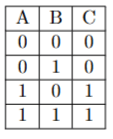
View Solution
Step 1: Understanding the Concept:
The circuit consists of an OR gate followed by an AND gate. We determine the output of each gate based on the inputs \(A\) and \(B\).
Step 2: Key Formula or Approach:
OR Gate Output: \(Y_1 = A + B\)
AND Gate Output: \(C = Y_1 \cdot A\) (since the second input to the AND gate is connected to input \(A\)).
Step 3: Detailed Explanation:
The Boolean expression for the output \(C\) is:
\[ C = (A + B) \cdot A \]
Using the distributive law:
\[ C = A \cdot A + B \cdot A \]
Since \(A \cdot A = A\):
\[ C = A + AB \]
Using the absorption law (\(A + AB = A\)):
\[ C = A(1 + B) = A \cdot 1 = A \]
This means the output \(C\) is always identical to the input \(A\).
Let's verify with the truth table:
1. \(A=0, B=0 \implies C = (0+0) \cdot 0 = 0\)
2. \(A=0, B=1 \implies C = (0+1) \cdot 0 = 0\)
3. \(A=1, B=0 \implies C = (1+0) \cdot 1 = 1\)
4. \(A=1, B=1 \implies C = (1+1) \cdot 1 = 1\)
Step 4: Final Answer:
The truth table where \(C\) follows \(A\) is Option (A).
Quick Tip: In logic circuits, look for simplified Boolean expressions. If an output depends only on one variable after simplification, the truth table becomes very easy to identify.
A physical quantity \(C\) is related to four other quantities \(p, q, r\) and \(s\) as follows
\(C = \frac{pq^2}{r^3 \sqrt{s}}\)
The percentage errors in the measurement of \(p, q, r\) and \(s\) are \(1%, 2%, 3%\) and \(2%\), respectively. The percentage error in the measurement of \(C\) will be ________%.
View Solution
Step 1: Understanding the Concept:
In error analysis, the relative error of a product or quotient of quantities is the sum of the relative errors of the individual quantities, each multiplied by the power to which it is raised.
Step 2: Key Formula or Approach:
For \(C = p^a q^b r^c s^d\), the maximum percentage error is:
\[ \frac{\Delta C}{C} \times 100 = |a| \frac{\Delta p}{p} \times 100 + |b| \frac{\Delta q}{q} \times 100 + |c| \frac{\Delta r}{r} \times 100 + |d| \frac{\Delta s}{s} \times 100 \]
Step 3: Detailed Explanation:
Given the formula \(C = p^1 q^2 r^{-3} s^{-1/2}\).
The percentage error in \(C\) is:
\[ % Error in C = 1(% Error in p) + 2(% Error in q) + 3(% Error in r) + \frac{1}{2}(% Error in s) \]
Substituting the given values:
\[ % Error in C = 1(1%) + 2(2%) + 3(3%) + \frac{1}{2}(2%) \]
\[ % Error in C = 1% + 4% + 9% + 1% \]
\[ % Error in C = 15% \]
Step 4: Final Answer:
The percentage error in \(C\) is \(15\).
Quick Tip: Always use the absolute value of the powers when calculating maximum possible error. Even if a variable is in the denominator (negative power), its error contribution is added.
The excess pressure inside a soap bubble A in air is half the excess pressure inside another soap bubble B in air. If the volume of the bubble A is \(n\) times the volume of the bubble B, then, the value of \(n\) is __________.
View Solution
Step 1: Understanding the Concept:
The excess pressure inside a soap bubble is inversely proportional to its radius. The volume of the bubble is proportional to the cube of its radius.
Step 2: Key Formula or Approach:
Excess pressure inside a soap bubble: \(P_{ex} = \frac{4T}{R}\)
Volume of a sphere: \(V = \frac{4}{3} \pi R^3\)
Step 3: Detailed Explanation:
Let \(P_A\) and \(P_B\) be the excess pressures, and \(R_A\) and \(R_B\) be the radii.
Given: \(P_A = \frac{1}{2} P_B\)
\[ \frac{4T}{R_A} = \frac{1}{2} \left( \frac{4T}{R_B} \right) \]
\[ \frac{1}{R_A} = \frac{1}{2R_B} \implies R_A = 2R_B \]
Now, compare the volumes:
\[ V_A = \frac{4}{3} \pi R_A^3 \quad and \quad V_B = \frac{4}{3} \pi R_B^3 \]
\[ V_A = \frac{4}{3} \pi (2R_B)^3 = 8 \times \left( \frac{4}{3} \pi R_B^3 \right) \]
\[ V_A = 8 V_B \]
Given \(V_A = n V_B\), by comparison, we get \(n = 8\).
Step 4: Final Answer:
The value of \(n\) is \(8\).
Quick Tip: Remember the proportionality: \(V \propto R^3\) and \(P \propto 1/R\). Thus, \(V \propto (1/P)^3\). If pressure becomes half, volume becomes \(2^3 = 8\) times.
Two cells of emfs 1 V and 2 V and internal resistances \(2 \, \Omega\) and \(1 \, \Omega\), respectively, are connected in series with an external resistance of \(6 \, \Omega\). The total current in the circuit is \(I_1\). Now the same two cells in parallel configuration are connected to same external resistance. In this case, the total current drawn is \(I_2\). The value of \(\left( \frac{I_1}{I_2} \right)\) is \(\frac{x}{3}\). The value of \(x\) is __________.
View Solution
Step 1: Understanding the Concept:
We need to calculate the current in two different circuit configurations: series and parallel combination of cells.
Step 2: Key Formula or Approach:
Series: \(E_{eq} = E_1 + E_2\), \(r_{eq} = r_1 + r_2\)
Parallel: \(E_{eq} = \frac{E_1 r_2 + E_2 r_1}{r_1 + r_2}\), \(r_{eq} = \frac{r_1 r_2}{r_1 + r_2}\)
Current \(I = \frac{E_{eq}}{R + r_{eq}}\)
Step 3: Detailed Explanation:
Case 1: Series Configuration
\(E_s = 1 + 2 = 3 \, V\)
\(r_s = 2 + 1 = 3 \, \Omega\)
\(I_1 = \frac{3}{6 + 3} = \frac{3}{9} = \frac{1}{3} \, A\)
Case 2: Parallel Configuration
\(E_p = \frac{1(1) + 2(2)}{1 + 2} = \frac{1 + 4}{3} = \frac{5}{3} \, V\)
\(r_p = \frac{2 \times 1}{2 + 1} = \frac{2}{3} \, \Omega\)
\(I_2 = \frac{5/3}{6 + 2/3} = \frac{5/3}{20/3} = \frac{5}{20} = \frac{1}{4} \, A\)
Ratio calculation:
\[ \frac{I_1}{I_2} = \frac{1/3}{1/4} = \frac{4}{3} \]
Given \(\frac{I_1}{I_2} = \frac{x}{3}\), we find \(x = 4\).
Step 4: Final Answer:
The value of \(x\) is \(4\).
Quick Tip: For cells in parallel with different EMFs and internal resistances, the equivalent EMF is the weighted average of EMFs with respect to their conductances (\(1/r\)).
Light from a point source in air falls on a spherical glass surface (refractive index, \(\mu = 1.5\) and radius of curvature = 50 cm). The image is formed at a distance of 200 cm from the glass surface inside the glass. The magnitude of distance of the light source from the glass surface is __________ m.
View Solution
Step 1: Understanding the Concept:
Refraction at a spherical surface follows a specific formula relating the object distance, image distance, radii of curvature, and refractive indices of the media.
Step 2: Key Formula or Approach:
Refraction formula: \(\frac{\mu_2}{v} - \frac{\mu_1}{u} = \frac{\mu_2 - \mu_1}{R}\)
Step 3: Detailed Explanation:
Sign Convention: Light travels from air to glass.
\(\mu_1 = 1\) (air), \(\mu_2 = 1.5\) (glass)
\(v = +200 \, cm\) (image inside glass, in direction of light)
\(R = +50 \, cm\) (convex surface, center is inside)
Substituting the values:
\[ \frac{1.5}{200} - \frac{1}{u} = \frac{1.5 - 1}{50} \]
\[ \frac{1.5}{200} - \frac{1}{u} = \frac{0.5}{50} \]
\[ \frac{0.015}{2} - \frac{1}{u} = 0.01 \]
\[ 0.0075 - \frac{1}{u} = 0.01 \]
\[ \frac{1}{u} = 0.0075 - 0.01 = -0.0025 \]
\[ u = -\frac{1}{0.0025} = -400 \, cm \]
The magnitude of the distance is \(400 \, cm = 4 \, m\).
Step 4: Final Answer:
The magnitude of the distance of the light source is \(4\).
Quick Tip: Strictly follow the sign convention: Distances measured in the direction of incident light are positive. Here, since the image is real and formed inside the denser medium, \(v\) is positive.
An electron in the hydrogen atom initially in the fourth excited state makes a transition to \(n^{th}\) energy state by emitting a photon of energy 2.86 eV. The integer value of \(n\) will be __________.
View Solution
Step 1: Understanding the Concept:
When an electron transitions from a higher energy level (\(n_2\)) to a lower energy level (\(n_1\)), the energy of the emitted photon is equal to the difference in energy between the two states.
Step 2: Key Formula or Approach:
Energy level in Hydrogen atom: \(E_n = -\frac{13.6}{n^2} \, eV\)
Photon energy: \(\Delta E = E_{n_2} - E_{n_1} = 13.6 \left( \frac{1}{n_1^2} - \frac{1}{n_2^2} \right) \, eV\)
Step 3: Detailed Explanation:
Initial state: Fourth excited state \(\implies n_2 = 4 + 1 = 5\).
Final state: \(n_1 = n\).
Emitted energy \(\Delta E = 2.86 \, eV\).
\[ 2.86 = 13.6 \left( \frac{1}{n^2} - \frac{1}{5^2} \right) \]
\[ \frac{2.86}{13.6} = \frac{1}{n^2} - 0.04 \]
\[ 0.2103 \approx \frac{1}{n^2} - 0.04 \]
\[ \frac{1}{n^2} = 0.2103 + 0.04 = 0.2503 \]
\[ n^2 \approx \frac{1}{0.25} = 4 \implies n = 2 \]
Step 4: Final Answer:
The integer value of \(n\) is \(2\).
Quick Tip: Memorizing the first few energy levels of Hydrogen (\(-13.6, -3.4, -1.51, -0.85, -0.54 \, eV\)) helps in quickly identifying transitions. Here, \(-0.54 - (-3.4) = 2.86 \, eV\), confirming the \(n=5\) to \(n=2\) transition.
Mass of magnesium required to produce 220 mL of hydrogen gas at STP on reaction with excess of dil. HCl is
Given: Molar mass of Mg is 24 g mol\(^{-1}\).
View Solution
Step 1: Understanding the Concept:
The reaction between magnesium and dilute hydrochloric acid is a single displacement reaction.
Magnesium reacts with HCl to produce magnesium chloride and hydrogen gas.
Stoichiometry allows us to relate the moles of reactant (Mg) to the volume of gas product (\(H_2\)) produced at Standard Temperature and Pressure (STP).
Step 2: Key Formula or Approach:
1. Balanced Chemical Equation: \( Mg(s) + 2HCl(aq) \rightarrow MgCl_2(aq) + H_2(g) \).
2. At STP, the molar volume of an ideal gas is \( 22.4 \, L \) or \( 22400 \, mL \).
3. Number of moles \( n = \frac{Volume at STP}{Molar Volume} \).
4. Mass \( = moles \times molar mass \).
Step 3: Detailed Explanation:
From the balanced equation, \( 1 \, mole \) of \( Mg \) produces \( 1 \, mole \) of \( H_2 \).
First, we calculate the number of moles of \( H_2 \) gas produced:
\[ n_{H_2} = \frac{220 \, mL}{22400 \, mL/mol} \approx 0.0098214 \, mol \]
According to stoichiometry, moles of \( Mg \) required (\( n_{Mg} \)) = moles of \( H_2 \) produced:
\[ n_{Mg} = 0.0098214 \, mol \]
Now, calculate the mass of Magnesium required:
\[ Mass_{Mg} = n_{Mg} \times Molar mass_{Mg} \]
\[ Mass_{Mg} = 0.0098214 \times 24 \, g \]
\[ Mass_{Mg} \approx 0.23571 \, g \]
Converting the mass into milligrams:
\[ 0.23571 \, g \times 1000 \, mg/g = 235.71 \, mg \]
Rounding to the nearest whole number as per options, we get \( 236 \, mg \).
Step 4: Final Answer:
The mass of magnesium required is \( 236 \, mg \).
Quick Tip: At STP, always remember that 1 mole of any gas occupies 22.4 Liters. In competitive exams, check if the question defines STP as 22.7 L (modern IUPAC) or 22.4 L (traditional). Here, 22.4 L yields the correct option.
For electrons in '2s' and '2p' orbitals, the orbital angular momentum values, respectively are :
View Solution
Step 1: Understanding the Concept:
The orbital angular momentum of an electron depends solely on the azimuthal quantum number (\( l \)) of the orbital in which it resides.
The principal quantum number (\( n \)) does not affect the orbital angular momentum.
Step 2: Key Formula or Approach:
The formula for orbital angular momentum (\( L \)) is:
\[ L = \sqrt{l(l+1)} \frac{h}{2\pi} or \sqrt{l(l+1)} \hbar \]
Where:
\( l = 0 \) for 's' orbital.
\( l = 1 \) for 'p' orbital.
\( l = 2 \) for 'd' orbital.
\( l = 3 \) for 'f' orbital.
Step 3: Detailed Explanation:
For '2s' orbital:
The orbital is 's', so the azimuthal quantum number \( l = 0 \).
Substituting into the formula:
\[ L_{2s} = \sqrt{0(0+1)} \frac{h}{2\pi} = 0 \]
For '2p' orbital:
The orbital is 'p', so the azimuthal quantum number \( l = 1 \).
Substituting into the formula:
\[ L_{2p} = \sqrt{1(1+1)} \frac{h}{2\pi} = \sqrt{2} \frac{h}{2\pi} \]
Step 4: Final Answer:
The values are \( 0 \) and \( \sqrt{2} \frac{h}{2\pi} \).
Quick Tip: Orbital angular momentum is zero for any 's' orbital regardless of the shell number (\( 1s, 2s, 3s, etc. \)). Always distinguish it from spin angular momentum or total angular momentum.
Given below are two statements:
Statement I : When a system containing ice in equilibrium with water (liquid) is heated, heat is absorbed by the system and there is no change in the temperature of the system until whole ice gets melted.
Statement II : At melting point of ice, there is absorption of heat in order to overcome intermolecular forces of attraction within the molecules of water in ice and kinetic energy of molecules is not increased at melting point.
In the light of the above statements, choose the correct answer from the options given below
View Solution
Step 1: Understanding the Concept:
This question involves the thermodynamics of phase transitions, specifically the melting of ice (fusion).
During a phase change, a substance absorbs heat (latent heat) at a constant temperature.
Step 2: Detailed Explanation:
Analysis of Statement I:
When ice and water are in equilibrium at \( 0^{\circ} C \), adding heat causes the ice to melt.
The temperature remains constant at \( 0^{\circ} C \) because the system is undergoing a phase change.
The heat supplied is used as latent heat of fusion. Thus, Statement I is true.
Analysis of Statement II:
Temperature is a measure of the average kinetic energy of the molecules.
Since the temperature does not change during melting, the average kinetic energy of the molecules remains constant.
The absorbed heat is utilized to break or overcome the strong intermolecular hydrogen bonding in the crystal lattice of ice to transform it into liquid water.
Therefore, the energy goes into increasing the potential energy (by changing the state), not the kinetic energy. Statement II is true and explains Statement I.
Step 3: Final Answer:
Both Statement I and Statement II are true.
Quick Tip: Phase transitions are isothermal processes. Any heat added (\( Q = mL \)) changes the potential energy and entropy of the system, while kinetic energy (which depends on temperature) stays the same.
10 mL of 2 M NaOH solution is added to 20 mL of 1 M HCl solution kept in a beaker. Now, 10 mL of this mixture is poured into a volumetric flask of 100 mL containing 2 moles of HCl and made the volume upto the mark with distilled water. The solution in this flask is :
View Solution
Step 1: Understanding the Concept:
This problem involves an acid-base neutralization followed by the preparation of a secondary solution by dilution.
We must track the millimoles of reactants to determine the nature of the intermediate and final mixtures.
Step 2: Detailed Explanation:
Initial Reaction:
Moles of NaOH = \( M \times V = 2 \, M \times 10 \, mL = 20 \, mmol \).
Moles of HCl = \( M \times V = 1 \, M \times 20 \, mL = 20 \, mmol \).
Since moles of NaOH = moles of HCl, complete neutralization occurs:
\( NaOH + HCl \rightarrow NaCl + H_2O \).
The resulting mixture is a neutral solution of \( NaCl \). Total volume = \( 10 + 20 = 30 \, mL \).
Subsequent Step:
10 mL of this neutral mixture is taken. This 10 mL contains only \( NaCl \) and water, with 0 moles of acid or base.
This is added to a 100 mL flask containing \( 2 \, moles \) of HCl.
Total moles of HCl in the final flask = \( 2 \, moles + 0 \, moles = 2 \, moles \).
The volume is made up to \( 100 \, mL = 0.1 \, L \).
Calculating Concentration:
Molarity (\( M \)) = \( \frac{Total moles of HCl}{Total volume in Liters} \)
\[ M = \frac{2 \, mol}{0.1 \, L} = 20 \, M \]
Step 3: Final Answer:
The solution in the flask is a 20 M HCl solution.
Quick Tip: Always calculate the limiting reagent in the first step. If the acid and base neutralize each other perfectly, any aliquot taken from that mixture will be neutral and won't affect the acidity of the next container.
40 mL of a mixture of \( CH_3COOH \) and \( HCl \) (aqueous solution) is titrated against 0.1 M NaOH solution conductometrically. Which of the following statement is correct?

View Solution
Step 1: Understanding the Concept:
In a mixture of a strong acid (HCl) and a weak acid (\( CH_3COOH \)), the strong acid is neutralized first.
Conductance decreases sharply during HCl neutralization because highly mobile \( H^+ \) ions are replaced by less mobile \( Na^+ \) ions.
During \( CH_3COOH \) neutralization, conductance increases slightly as the weak acid (undissociated) is converted into a strong electrolyte (\( CH_3COONa \)).
Step 2: Detailed Explanation:
Identifying points on the graph:
- Region AB: Neutralization of strong acid (\( HCl \)). At point B, HCl is completely neutralized.
- Volume of NaOH used for HCl = \( 2.0 \, mL \).
- Region BC: Neutralization of weak acid (\( CH_3COOH \)). At point C, both acids are neutralized.
- Volume of NaOH used for \( CH_3COOH = 5.0 - 2.0 = 3.0 \, mL \).
Calculating Concentration of HCl:
Molarity \( M_1 V_1 = M_2 V_2 \)
\( [HCl] \times 40 \, mL = 0.1 \, M \times 2.0 \, mL \)
\( [HCl] = \frac{0.2}{40} = 0.005 \, M \). (Statement B is Correct)
Calculating Concentration of \( CH_3COOH \):
\( [CH_3COOH] \times 40 \, mL = 0.1 \, M \times 3.0 \, mL \)
\( [CH_3COOH] = \frac{0.3}{40} = 0.0075 \, M \). (Statement C is Incorrect)
Statement A is incorrect because strong acids are always neutralized first. Statement D is incorrect because point C represents the neutralization of both acids.
Step 3: Final Answer:
The concentration of \( HCl \) in the original mixture is 0.005 M.
Quick Tip: For conductometric titrations:
1. Strong Acid + Strong Base: V-shaped graph.
2. Weak Acid + Strong Base: Gradual increase.
3. Mixture: Combinations of these shapes where the sharpest decrease always corresponds to the strongest acid.
The standard cell potential (\( E^{\circ}_{cell} \)) of a fuel cell based on the oxidation of methanol in air that has been used to power television relay station is measured as 1.21 V. The standard half cell reduction potential for \( O_2 \) (\( E^{\circ}_{O_2/H_2O} \)) is 1.229 V. Choose the correct statement:
View Solution
Step 1: Understanding the Concept:
A methanol fuel cell involves the oxidation of methanol at the anode and the reduction of oxygen at the cathode.
The cell potential is given by the difference between the reduction potentials of the cathode and the anode.
Step 2: Key Formula or Approach:
\[ E^{\circ}_{cell} = E^{\circ}_{cathode} - E^{\circ}_{anode} \]
Where \( E^{\circ} \) values are standard reduction potentials.
Step 3: Detailed Explanation:
Cathode (Reduction): \( O_2 + 4H^+ + 4e^- \rightarrow 2H_2O \), \( E^{\circ}_{red} = 1.229 \, V \).
Anode (Oxidation): \( CH_3OH + H_2O \rightarrow CO_2 + 6H^+ + 6e^- \).
The corresponding reduction potential for the anode reaction is \( E^{\circ}_{CO_2/CH_3OH} \).
Using the cell potential formula:
\[ 1.21 \, V = 1.229 \, V - E^{\circ}_{anode} \]
\[ E^{\circ}_{anode} = 1.229 - 1.21 = 0.019 \, V \]
Converting to millivolts:
\[ 0.019 \, V \times 1000 \, mV/V = 19 \, mV \]
Thus, the standard reduction potential for the \( CO_2/CH_3OH \) half-cell is \( 19 \, mV \).
Step 4: Final Answer:
The standard half cell reduction potential for the reduction of \( CO_2 \) is 19 mV.
Quick Tip: In fuel cells, remember that oxidation always happens at the anode and reduction at the cathode. Fuel (methanol) is oxidized; oxidizer (oxygen) is reduced.
Consider the following statements related to temperature dependence of rate constants. Identify the correct statements.
A. The Arrhenius equation holds true only for an elementary homogenous reaction.
B. The unit of A is same as that of k in Arrhenius equation.
C. At a given temperature, a low activation energy means a fast reaction.
D. A and Ea as used in Arrhenius equation depend on temperature.
E. When Ea \( >> \) RT, A and Ea become interdependent.
View Solution
Step 1: Understanding the Concept:
The Arrhenius equation describes the relationship between the rate constant (\( k \)) and temperature (\( T \)): \( k = A e^{-E_a/RT} \).
Step 2: Detailed Explanation:
- Statement A: Incorrect. The Arrhenius equation is applicable to both elementary and complex reactions over a wide range of temperatures.
- Statement B: Correct. In \( k = A e^{-E_a/RT} \), the term \( e^{-E_a/RT} \) is dimensionless. Therefore, the pre-exponential factor \( A \) must have the same units as the rate constant \( k \).
- Statement C: Correct. A lower activation energy (\( E_a \)) means a larger fraction of molecules have enough energy to cross the barrier, leading to a higher rate constant and a faster reaction.
- Statement D: Incorrect. In the basic Arrhenius model, \( A \) (frequency factor) and \( E_a \) (activation energy) are assumed to be independent of temperature.
- Statement E: Incorrect. \( A \) and \( E_a \) are parameters of the reaction itself and do not become "interdependent" based on the magnitude of temperature.
Step 3: Final Answer:
Statements B and C are correct.
Quick Tip: The unit of the Arrhenius constant (\( A \)) depends on the order of the reaction, just like the rate constant \( k \). For a first-order reaction, both are in \( sec^{-1} \).
Given below are two statements:
Statement I : Wet cotton clothes made of cellulose based carbohydrate takes comparatively longer time to get dried than wet nylon polymer based clothes.
Statement II : Intermolecular hydrogen bonding with water molecule is more in nylon-based clothes than in the case of cotton clothes.
In the light of above statements, choose the correct answer from the options given below
View Solution
Step 1: Understanding the Concept:
The drying time of fabrics depends on their ability to absorb water, which is influenced by the functional groups present in the polymer chains and their capacity for hydrogen bonding.
Step 2: Detailed Explanation:
Statement I analysis:
Cotton is made of cellulose, which contains a large number of hydroxyl (\( -OH \)) groups. These groups are highly hydrophilic and form extensive hydrogen bonds with water molecules.
Nylon is a synthetic polyamide. While it has amide groups (\( -CONH- \)), it is much more hydrophobic compared to cellulose.
As a result, cotton absorbs much more water and holds it more tightly, thus taking longer to dry. Statement I is true.
Statement II analysis:
As explained above, cellulose (in cotton) has a significantly higher density of \( -OH \) groups per unit mass compared to the amide groups in nylon.
Consequently, the intermolecular hydrogen bonding with water is much more in cotton than in nylon. Statement II is false.
Step 3: Final Answer:
Statement I is true but Statement II is false.
Quick Tip: Hydrophilic polymers (like cotton/cellulose) have high water retention due to numerous polar groups. Hydrophobic polymers (like nylon/polyesters) absorb very little water and dry quickly.
Match the LIST-I with LIST-II

Choose the correct answer from the options given below:
View Solution
Step 1: Understanding the Concept:
This question requires knowledge of the periodic table families and the symbols of the synthetic heavy elements (atomic numbers 115 to 118).
Step 2: Detailed Explanation:
- A. Pnictogens (Group 15): These include N, P, As, Sb, Bi, and the synthetic element Moscovium (Mc) with atomic number 115. (A-IV)
- B. Chalcogens (Group 16): These include O, S, Se, Te, Po, and the synthetic element Livermorium (Lv) with atomic number 116. (B-III)
- C. Halogens (Group 17): These include F, Cl, Br, I, At, and the synthetic element Tennessine (Ts) with atomic number 117. (C-I)
- D. Noble Gases (Group 18): These include He, Ne, Ar, Kr, Xe, Rn, and the synthetic element Oganesson (Og) with atomic number 118. (D-II)
Step 3: Final Answer:
The correct matching is A-IV, B-III, C-I, D-II.
Quick Tip: The names of group 115 to 118 elements were finalized in 2016. A useful sequence to remember is: Mc (115), Lv (116), Ts (117), Og (118). They follow the standard group properties in the 7th period.
The correct orders among the following are
Atomic radius : \(B < Al < Ga < In < Tl\)
Electronegativity : \(Al < Ga < In < Tl < B\)
Density : \(Tl < In < Ga < Al < B\)
1st Ionisation Energy : \(In < Al < Ga < Tl < B\)
Choose the correct answer from the options given below:
View Solution
Step 1: Understanding the Concept:
This question tests the periodic trends of Group 13 elements (\(B, Al, Ga, In, Tl\)). The trends in this group are often anomalous due to \(d\)-block contraction (affecting \(Ga\)) and \(f\)-block contraction/inert pair effect (affecting \(Tl\)).
Step 2: Detailed Explanation:
1. Atomic Radius: Due to the poor shielding of the \(3d\) electrons in Gallium, its effective nuclear charge increases, making its atomic radius smaller than Aluminum.
Correct order: \(B < Ga < Al < In < Tl\). (Order A is incorrect)
2. Electronegativity: Electronegativity first decreases from \(B\) to \(Al\) and then increases down the group due to the poor shielding by \(d\) and \(f\) electrons.
Values: \(B(2.0), Al(1.5), Ga(1.6), In(1.7), Tl(1.8)\).
Correct order: \(Al < Ga < In < Tl < B\). (Order B is correct)
3. Density: Density increases significantly down the group because the increase in atomic mass outweighs the increase in atomic volume.
Correct order: \(B < Al < Ga < In < Tl\). (Order C is incorrect)
4. 1st Ionisation Energy: The trend is non-linear. Boron is highest. Thallium has a higher value than \(In, Al,\) and \(Ga\) due to the poor shielding of \(4f\) electrons (lanthanoid contraction).
Correct order: \(In < Al < Ga < Tl < B\). (Order D is correct)
Step 3: Final Answer:
Orders B and D are correct.
Quick Tip: For Group 13, remember the "W" shape for Ionisation Energy: \(B > Tl > Ga > Al > In\). For Radius, always remember the "Ga-Al anomaly" where Gallium is smaller than Aluminum.
Given below are two statements:
Statement I : \(CrO_3\) is a stronger oxidizing agent than \(MoO_3\)
Statement II : \(Cr(VI)\) is more stable than \(Mo(VI)\)
In the light of the above statements, choose the correct answer from the options given below
View Solution
Step 1: Understanding the Concept:
In the \(d\)-block, the stability of higher oxidation states increases as we move down a group. This is the opposite of the trend observed in \(p\)-block elements.
Step 2: Detailed Explanation:
For Group 6 elements (\(Cr, Mo, W\)), the \(+6\) oxidation state becomes increasingly stable as we go down the group.
- \(Cr(VI)\) in \(CrO_3\) or \(Cr_2O_7^{2-}\) is relatively unstable and has a strong tendency to get reduced to \(Cr(III)\). Thus, \(CrO_3\) is a strong oxidizing agent.
- \(Mo(VI)\) and \(W(VI)\) are very stable in their \(+6\) states. They do not easily get reduced, making \(MoO_3\) a weak oxidizing agent.
Statement I says \(CrO_3\) is a stronger oxidizing agent than \(MoO_3\), which is True.
Statement II says \(Cr(VI)\) is more stable than \(Mo(VI)\), which is False.
Step 3: Final Answer:
Statement I is true, but Statement II is false.
Quick Tip: Heavier transition metals (\(4d\) and \(5d\)) are more stable in higher oxidation states than their \(3d\) counterparts. This is why \(W(VI)\) and \(Mo(VI)\) compounds are common and stable, whereas \(Cr(VI)\) is a powerful oxidant.
Identify the diamagnetic octahedral complex ions from below ;
A. \([Mn(CN)_6]^{3-}\)
B. \([Co(NH_3)_6]^{3+}\)
C. \([Fe(CN)_6]^{4-}\)
D. \([Co(H_2O)_3F_3]\)
Choose the correct answer from the options given below:
View Solution
Step 1: Understanding the Concept:
A complex is diamagnetic if all its electrons are paired. This depends on the metal's oxidation state, its \(d\)-electron configuration, and the field strength of the ligands (Strong Field Ligand or Weak Field Ligand).
Step 2: Detailed Explanation:
1. \([Mn(CN)_6]^{3-}\): \(Mn\) is in \(+3\) state (\(d^4\)). \(CN^-\) is a strong field ligand (SFL). Electrons pair up in \(t_{2g}\) orbitals. Configuration: \(t_{2g}^4 e_g^0\). There are 2 unpaired electrons. Paramagnetic.
2. \([Co(NH_3)_6]^{3+}\): \(Co\) is in \(+3\) state (\(d^6\)). \(NH_3\) acts as an SFL with \(Co^{3+}\). Electrons pair up. Configuration: \(t_{2g}^6 e_g^0\). No unpaired electrons. Diamagnetic.
3. \([Fe(CN)_6]^{4-}\): \(Fe\) is in \(+2\) state (\(d^6\)). \(CN^-\) is an SFL. Electrons pair up. Configuration: \(t_{2g}^6 e_g^0\). No unpaired electrons. Diamagnetic.
4. \([Co(H_2O)_3F_3]\): \(Co\) is in \(+3\) state (\(d^6\)). Both \(H_2O\) and \(F^-\) are weak field ligands (WFL). Configuration: \(t_{2g}^4 e_g^2\). There are 4 unpaired electrons. Paramagnetic.
Step 3: Final Answer:
Complexes B and C are diamagnetic.
Quick Tip: \(Co^{3+}\) and \(Fe^{2+}\) are \(d^6\) systems. In the presence of strong field ligands, they always form low-spin, diamagnetic octahedral complexes because the \(t_{2g}\) level is completely filled with 6 electrons.
Compounds that should not be used as primary standards in titrimetric analysis are :
A. \(Na_2Cr_2O_7\)
B. Oxalic acid
C. \(NaOH\)
D. \(FeSO_4 \cdot 6H_2O\)
E. Sodium tetraborate
Choose the most appropriate answer from the options given below:
View Solution
Step 1: Understanding the Concept:
A primary standard must be highly pure, stable in air (not hygroscopic, deliquescent, or easily oxidized), and have a high molar mass to minimize weighing errors.
Step 2: Detailed Explanation:
- A. \(Na_2Cr_2O_7\): Sodium dichromate is hygroscopic (absorbs moisture from air). Therefore, its exact mass cannot be maintained easily. \(K_2Cr_2O_7\) is used as a primary standard instead.
- B. Oxalic acid: It is available in high purity and is stable. It is a primary standard.
- C. \(NaOH\): It is deliquescent and reacts with atmospheric \(CO_2\). Its concentration changes quickly. It is not a primary standard.
- D. \(FeSO_4 \cdot 6H_2O\): Ferrous salts are easily oxidized by atmospheric oxygen to ferric states. Hence, it is not a primary standard.
- E. Sodium tetraborate (Borax): It is stable and can be obtained in high purity. It is a primary standard.
Step 3: Final Answer:
The compounds that should not be used are A, C, and D.
Quick Tip: Common primary standards include \(K_2Cr_2O_7\), Oxalic acid, \(Na_2CO_3\), and \(AgNO_3\). Common secondary standards (which are not PS) include \(NaOH, KOH, KMnO_4,\) and \(HCl\).
In Dumas' method for estimation of nitrogen 0.4 g of an organic compound gave 60 mL of nitrogen collected at 300 K temperature and 715 mm Hg pressure. The percentage composition of nitrogen in the compound is
(Given : Aqueous tension at 300 K = 15 mm Hg)
View Solution
Step 1: Understanding the Concept:
Dumas' method involves converting nitrogen in an organic compound to \(N_2\) gas. The percentage of nitrogen is calculated by finding the volume of \(N_2\) at STP.
Step 2: Key Formula or Approach:
1. Calculate pressure of dry nitrogen: \(P_{dry} = P_{total} - Aqueous Tension\)
2. Convert volume to STP (\(V_0\)) using: \(\frac{P_1 V_1}{T_1} = \frac{P_0 V_0}{T_0}\)
3. Calculate percentage nitrogen: \(%N = \frac{28 \times V_0 \times 100}{22400 \times mass of compound}\)
Step 3: Detailed Explanation:
- Mass of compound (\(m\)) = \(0.4\) g.
- \(P_{dry} = 715 - 15 = 700\) mm Hg.
- \(V_1 = 60\) mL, \(T_1 = 300\) K.
- At STP: \(P_0 = 760\) mm Hg, \(T_0 = 273\) K.
\[ V_0 = \frac{700 \times 60 \times 273}{760 \times 300} = \frac{700 \times 273}{760 \times 5} = \frac{140 \times 273}{760} \approx 50.29 mL \]
Now, find the percentage of nitrogen:
\[ %N = \frac{28 \times 50.29 \times 100}{22400 \times 0.4} \]
\[ %N = \frac{50.29}{8 \times 0.4} = \frac{50.29}{3.2} \approx 15.715 % \]
Step 4: Final Answer:
The percentage composition is 15.71 %.
Quick Tip: In Dumas' method calculations, always remember to subtract the aqueous tension from the observed pressure to get the pressure of dry nitrogen gas.
Given below are two statements:
Statement I : Hyperconjugation is not a permanent effect.
Statement II : In general, greater the number of alkyl groups attached to a positively charged C-atom, greater is the hyperconjugation interaction and stabilization of the cation.
In the light of the above statements, choose the correct answer from the options given below
View Solution
Step 1: Understanding the Concept:
Hyperconjugation involves the delocalization of \(\sigma\)-electrons of \(C-H\) bonds of an alkyl group directly attached to an atom of unsaturated system or to an atom with an unshared \(p\)-orbital (like a carbocation).
Step 2: Detailed Explanation:
- Statement I: Hyperconjugation, Resonance, and Inductive effects are all permanent electronic effects. They exist in the molecule in its ground state. Only the Electromeric effect is a temporary effect. Thus, Statement I is False.
- Statement II: Hyperconjugation depends on the number of \(\alpha\)-hydrogens. Alkyl groups provide these \(\alpha\)-hydrogens. More alkyl groups attached to a carbocation usually mean more \(\alpha\)-hydrogens, leading to more hyperconjugative structures and greater stability (e.g., \(3^\circ > 2^\circ > 1^\circ\) carbocation). Thus, Statement II is True.
Step 3: Final Answer:
Statement I is false, but Statement II is true.
Quick Tip: Remember: H-I-R-E. Hyperconjugation, Inductive, and Resonance are permanent. Electromeric is temporary (requires an external reagent).
What is the correct IUPAC name of the following structure?

View Solution
Step 1: Understanding the Concept:
IUPAC nomenclature for substituted benzenes involves identifying the principal functional group to determine the parent name and then numbering the ring to give substituents the lowest possible locants.
Step 2: Detailed Explanation:
1. Principal Functional Group: The \(-COOH\) group has the highest priority. The parent molecule is Benzoic acid. The carbon attached to \(-COOH\) is C1.
2. Numbering: We number the ring to give the substituents (\(-OH, -Br, -NO_2\)) the lowest locant set.
- Path clockwise/counter-clockwise: Numbering towards the hydroxy group gives \(2-OH, 3-Br,\) and \(5-NO_2\). This is the correct locant set.
3. Alphabetical Order: Substituents must be listed alphabetically in the name.
- Bromo (\(B\)) comes before Hydroxy (\(H\)), which comes before Nitro (\(N\)).
- Name: 3-Bromo-2-hydroxy-5-nitrobenzoic acid.
Step 3: Final Answer:
The name is 3-Bromo-2-hydroxy-5-nitrobenzoic acid.
Quick Tip: Priority of functional groups: \(-COOH > -SO_3H > -COOR > -COX > -CONH_2 > -CN > -CHO > >C=O > -OH > -NH_2 > >C=C< > -C\equiv C-\). Always alphabetize substituents regardless of their locant numbers.
In the following series of reactions identify the major products A \& B respectively

- (A)
![]()
- (B)
![]()
- (C)
![]()
- (D)
![]()


View Solution
Step 1: Understanding the Concept:
This involves Electrophilic Aromatic Substitution (EAS). Bromine is an \(ortho/para\) directing group (though deactivating). Sulfonic acid (\(-SO_3H\)) is a \(meta\) directing group (strongly deactivating).
Step 2: Detailed Explanation:
1. Reaction 1 (Sulfonation): Bromobenzene reacts with \(SO_3/H_2SO_4\). Bromine directs the incoming \(-SO_3H\) group to the \(para\) position due to steric hindrance at the \(ortho\) position.
Product A: 4-Bromobenzenesulfonic acid.
2. Reaction 2 (Bromination): Now we have two groups on the ring: \(-Br\) (o/p director) and \(-SO_3H\) (meta director). The \(-Br\) group is less deactivating than \(-SO_3H\), so it controls the orientation. The \(para\) position of \(-Br\) is already occupied by \(-SO_3H\). Therefore, the new \(Br\) electrophile enters the \(ortho\) position relative to the existing \(Br\) group.
Product B: 2,4-Dibromobenzenesulfonic acid.
Step 3: Final Answer:
Major product A is 4-Bromobenzenesulfonic acid and B is 2,4-Dibromobenzenesulfonic acid.
Quick Tip: When two groups are present on a benzene ring, the most activating (or least deactivating) group typically controls the position of the next electrophilic substitution.
The major product (P) in the following reaction is :

- (A)
![]()
- (B)
![]()
- (C)
![]()
- (D)
![]()


View Solution
Step 1: Understanding the Concept:
This is the Benzilic Acid Rearrangement. It occurs when a 1,2-diketone (like Benzil) is treated with a strong base (\(KOH\) or \(NaOH\)) to form an \(\alpha\)-hydroxy carboxylic acid salt.
Step 2: Detailed Explanation:
1. Nucleophilic Attack: \(OH^-\) from \(KOH\) attacks one of the carbonyl carbons of Benzil (\(Ph-CO-CO-Ph\)).
2. Rearrangement: The resulting tetrahedral intermediate undergoes a phenyl shift (\(1,2\)-aryl shift) to the neighboring carbonyl carbon.
3. Proton Transfer: A rapid proton transfer occurs to form the more stable carboxylate salt.
The resulting structure is Potassium benzilate, where two phenyl groups and one hydroxy group are attached to the same carbon atom, which is adjacent to the carboxylate group.
Structure: \(Ph_2C(OH)COOK\).
Step 3: Final Answer:
The major product is Potassium benzilate, \(Ph_2C(OH)COO^- K^+\).
Quick Tip: Benzilic acid rearrangement is the internal version of the Cannizzaro reaction. It is a classic method to convert 1,2-dicarbonyl compounds into \(\alpha\)-hydroxy acids.
The sequence from the following that would result in giving predominantly 3, 4, 5-Tribromoaniline is :
- (A)
![]()
- (B)
![]()
- (C)
![]()
- (D)
![]()


View Solution
Step 1: Understanding the Concept:
Synthesizing 3, 4, 5-tribromoaniline requires placing three bromine atoms meta to an amine group (which is normally ortho/para directing). This is achieved by using a protecting or directing group that can be converted or by starting with a substrate where the positions are already favorable.
Step 2: Detailed Explanation:
Let's analyze the sequence in option (C):
1. Starting material: 4-nitroaniline (Nitro group at C4, Amine group at C1).
2. Step (i): \(Br_2\)(excess), acetic acid: The \(-NH_2\) group is highly activating and ortho-directing. It directs bromine to the 2 and 6 positions. The 4-position is occupied by the nitro group.
Product: 2, 6-dibromo-4-nitroaniline.
3. Step (ii): \(NaNO_2, HCl, CuBr\) (Sandmeyer Reaction): The amino group at C1 is diazotized and then replaced by a bromine atom.
Product: 1, 2, 6-tribromo-4-nitrobenzene (which is the same as 1, 2, 3-tribromo-5-nitrobenzene).
4. Step (iii): \(Sn, HCl\): This reagent selectively reduces the nitro group (\(-NO_2\)) at C5 to an amino group (\(-NH_2\)).
Final Product: 3, 4, 5-tribromoaniline.
The bromine atoms are now at positions 3, 4, and 5 relative to the amine group.
Step 3: Final Answer:
The sequence in option (C) correctly yields 3, 4, 5-tribromoaniline.
Quick Tip: In multi-step synthesis of substituted benzenes, the Sandmeyer reaction is a powerful tool to replace an activating amino group (after it has directed other substituents) with a halogen or cyano group.
Fat soluble vitamins are:
A. Vitamin \(B_1\)
B. Vitamin C
C. Vitamin E
D. Vitamin \(B_{12}\)
E. Vitamin K
Choose the correct answer from the options given below:
View Solution
Step 1: Understanding the Concept:
Vitamins are classified into two groups based on their solubility: water-soluble and fat-soluble.
Step 2: Detailed Explanation:
1. Fat-Soluble Vitamins: These are soluble in fats and oils but insoluble in water. They are stored in the liver and adipose (fat-storing) tissues. Examples include Vitamin A, Vitamin D, Vitamin E, and Vitamin K.
2. Water-Soluble Vitamins: These are soluble in water and must be supplied regularly in the diet because they are readily excreted in urine and cannot be stored in the body (except \(B_{12}\)). Examples include Vitamin B complex (\(B_1, B_2, B_6, B_{12}\), etc.) and Vitamin C.
From the given list:
- C (Vitamin E) is fat-soluble.
- E (Vitamin K) is fat-soluble.
The others (\(B_1, C, B_{12}\)) are water-soluble.
Step 3: Final Answer:
The fat-soluble vitamins are C and E.
Quick Tip: Use the mnemonic "ADEK" to remember the fat-soluble vitamins. All other common vitamins (B-complex and C) are water-soluble.
A perfect gas (0.1 mol) having \(\bar{C}_v = 1.5R\) (independent of temperature) undergoes the transformation from point 1 to point 4 as shown in the P-V diagram. If each step is reversible, the total work done (w) while going from point 1 to point 4 is \((-)\) _______ J (nearest integer).
[Given: \(R = 0.082\) L atm K\(^{-1}\) mol\(^{-1}\)]

View Solution
Step 1: Understanding the Concept:
The total work done in a multi-step process is the algebraic sum of work done in each step. For a reversible process, work \(w = -\int P \, dV\). In isochoric processes, \(dV = 0 \implies w = 0\). In isobaric processes, \(w = -P \Delta V\).
Step 2: Key Formula or Approach:
Conversion factor: \(1 L atm = \frac{R (in Joules)}{R (in L atm)} = \frac{8.314}{0.082} J \approx 101.39 J\).
Step 3: Detailed Explanation:
Based on the graph, the path from 1 to 4 is \(1 \rightarrow 2 \rightarrow 3 \rightarrow 4\).
1. Step \(1 \rightarrow 2\): This is an isochoric process (constant volume \(V = 1000 cm^3\)).
\(w_{1-2} = 0\).
2. Step \(2 \rightarrow 3\): This is an isobaric expansion at \(P = 3.00\) atm.
Volume changes from \(V_2 = 1000 cm^3\) to \(V_3 = 2000 cm^3\).
\(w_{2-3} = -P(V_3 - V_2) = -3 atm \times (2000 - 1000) cm^3 = -3000 atm cm^3\).
Since \(1000 cm^3 = 1 L\), \(w_{2-3} = -3 L atm\).
3. Step \(3 \rightarrow 4\): This is an isochoric process (constant volume \(V = 2000 cm^3\)).
\(w_{3-4} = 0\).
Total Work Done (\(w\)):
\(w = w_{1-2} + w_{2-3} + w_{3-4} = 0 + (-3 L atm) + 0 = -3 L atm\).
Convert to Joules:
\(w = -3 \times 101.39 J = -304.17 J\).
The magnitude to be filled in the blank \((-)\) ___ is 304.
Step 4: Final Answer:
The nearest integer value is 304.
Quick Tip: In P-V diagrams, the area under the curve for an expansion is the magnitude of work done. For multiple steps, only the steps involving a change in volume contribute to the total work.
A sample of n-octane (1.14 g) was completely burnt in excess of oxygen in a bomb calorimeter, whose heat capacity is 5 kJ K\(^{-1}\). As a result of combustion reaction, the temperature of the calorimeter is increased by 5 K. The magnitude of the heat of combustion of octane at constant volume is _______ kJ mol\(^{-1}\) (nearest integer).
View Solution
Step 1: Understanding the Concept:
In a bomb calorimeter, the reaction occurs at constant volume. The heat evolved by the reaction (\(q_{rxn}\)) is absorbed by the calorimeter. The molar heat of combustion at constant volume is the change in internal energy (\(\Delta U\)).
Step 2: Key Formula or Approach:
1. Total heat evolved \(q = C_{cal} \times \Delta T\).
2. Molar heat \(\Delta U = \frac{q}{moles of substance}\).
Step 3: Detailed Explanation:
1. Calculate total heat evolved (\(q\)):
\(C_{cal} = 5 kJ K^{-1}\) and \(\Delta T = 5 K\).
\(q = 5 kJ K^{-1} \times 5 K = 25 kJ\).
2. Calculate moles of n-octane (\(C_8H_{18}\)):
Molar mass of octane \(= (8 \times 12) + (18 \times 1) = 96 + 18 = 114 g mol^{-1}\).
Mass given \(= 1.14\) g.
\(Moles (n) = \frac{1.14 g}{114 g mol^{-1}} = 0.01 mol\).
3. Calculate molar heat of combustion (\(\Delta U\)):
\(\Delta U = \frac{q}{n} = \frac{25 kJ}{0.01 mol} = 2500 kJ mol^{-1}\).
Step 4: Final Answer:
The magnitude of the heat of combustion is 2500 kJ mol\(^{-1}\).
Quick Tip: Bomb calorimetry always measures \(\Delta U\) (\(q_v\)). To find \(\Delta H\) (\(q_p\)), you must use the relation \(\Delta H = \Delta U + \Delta n_g RT\).
Among Sc, Mn, Co and Cu, identify the element with highest enthalpy of atomization. The spin only magnetic moment value of that element in its \(+2\) oxidation state is _______ BM (in nearest integer).
View Solution
Step 1: Understanding the Concept:
Enthalpy of atomization depends on the strength of metallic bonding, which is generally proportional to the number of unpaired d-electrons available for bonding. The spin-only magnetic moment is calculated using the formula \(\mu = \sqrt{n(n+2)}\) BM, where \(n\) is the number of unpaired electrons.
Step 2: Detailed Explanation:
1. Comparison of Enthalpy of Atomization (\(\Delta_a H^\circ\)):
According to standard data (NCERT), the values for the given elements are:
- Sc: 326 kJ/mol
- Mn: 281 kJ/mol (Exception: Low due to stable half-filled \(d^5\) configuration)
- Co: 425 kJ/mol
- Cu: 339 kJ/mol
Cobalt (Co) has the highest enthalpy of atomization among the choices.
2. Electronic Configuration of Cobalt (\(Z = 27\)):
Atomic state: \([Ar] 3d^7 4s^2\).
In \(+2\) oxidation state (\(Co^{2+}\)): \([Ar] 3d^7\).
3. Number of Unpaired Electrons (\(n\)):
In \(d^7\), according to Hund's Rule:
\(\uparrow\downarrow \, \uparrow\downarrow \, \uparrow \, \uparrow \, \uparrow\)
Number of unpaired electrons, \(n = 3\).
4. Magnetic Moment (\(\mu\)):
\(\mu = \sqrt{3(3+2)} = \sqrt{15} BM \approx 3.87 BM\).
The nearest integer is 4.
Step 3: Final Answer:
The value of the magnetic moment is 4 BM.
Quick Tip: Enthalpy of atomization trends can be tricky; Mn and Zn always show values lower than expected due to their stable electronic configurations which result in weaker metallic bonding.
X g of nitrobenzene on nitration gave 4.2 g of m-dinitrobenzene.
X = _______ g. (nearest integer)
[Given : molar mass (in g mol\(^{-1}\)) C : 12, H : 1, O : 16, N : 14]
View Solution
Step 1: Understanding the Concept:
The nitration of nitrobenzene yields m-dinitrobenzene. Stoichiometrically, 1 mole of nitrobenzene reacts with nitric acid to produce 1 mole of m-dinitrobenzene.
Step 2: Key Formula or Approach:
Balanced Equation: \(C_6H_5NO_2 + HNO_3 \rightarrow C_6H_4(NO_2)_2 + H_2O\).
\(Moles of Nitrobenzene = Moles of m-dinitrobenzene\).
Step 3: Detailed Explanation:
1. Calculate Molar Masses:
- Nitrobenzene (\(C_6H_5NO_2\)): \((6 \times 12) + (5 \times 1) + 14 + (2 \times 16) = 72 + 5 + 14 + 32 = 123 g mol^{-1}\).
- m-dinitrobenzene (\(C_6H_4(NO_2)_2\)): \((6 \times 12) + (4 \times 1) + (2 \times 14) + (4 \times 16) = 72 + 4 + 28 + 64 = 168 g mol^{-1}\).
2. Calculate moles of m-dinitrobenzene produced:
\(Moles = \frac{Mass}{Molar mass} = \frac{4.2 g}{168 g mol^{-1}} = 0.025 mol\).
3. Calculate required mass of nitrobenzene (\(X\)):
Moles of nitrobenzene required \(= 0.025 mol\).
\(X = 0.025 mol \times 123 g mol^{-1} = 3.075 g\).
Rounding to the nearest integer, \(X = 3\).
Step 4: Final Answer:
The value of \(X\) is 3 g.
Quick Tip: In mass-mass stoichiometry problems, always find the molar ratio from the balanced chemical equation before performing calculations.
The total number of structural isomers possible for the substituted benzene derivatives with the molecular formula \(C_9H_{12}\) is _______.
View Solution
Step 1: Understanding the Concept:
Structural isomers of a substituted benzene with formula \(C_9H_{12}\) can have one, two, or three alkyl groups attached to the ring such that the total number of aliphatic carbons is 3.
Step 2: Detailed Explanation:
Let's categorize based on the number of substituents:
1. Mono-substituted benzene: One propyl group (\(C_3H_7\)).
- n-propylbenzene
- isopropylbenzene
(2 isomers)
2. Di-substituted benzene: One ethyl group (\(C_2H_5\)) and one methyl group (\(CH_3\)).
- 1-ethyl-2-methylbenzene (ortho)
- 1-ethyl-3-methylbenzene (meta)
- 1-ethyl-4-methylbenzene (para)
(3 isomers)
3. Tri-substituted benzene: Three methyl groups (\(CH_3\)).
- 1, 2, 3-trimethylbenzene (vicinal)
- 1, 2, 4-trimethylbenzene (asymmetric)
- 1, 3, 5-trimethylbenzene (symmetric/mesitylene)
(3 isomers)
Total isomers \(= 2 + 3 + 3 = 8\).
Step 3: Final Answer:
The total number of structural isomers is 8.
Quick Tip: For disubstituted isomers of benzene, there are always 3 possibilities: ortho, meta, and para. For trisubstituted isomers with identical groups, there are also 3 possibilities.
JEE Main 2025 April 3 Shift 2 Question Paper With Video Solutions
The JEE Main 2025 April 3 shift 2 Question Paper with Video Solution are available here. Students can match their responses with the JEE Main 2025 April 3 Shift 2 Answer key with Solutions. Students who are appearing for JEE Main upcoming shifts can check the JEE Main April 3 Shift 2 Question Paper and video solution to understand the difficulty level of the exam.
JEE Main 2025 April 3 Shift 2 Difficulty Level Analysis
The Mathematics Section of JEE Main April 3 shift 2 was challenging and time-consuming. The Chemistry and Physics Section of JEE Main April 3 shift 2 is expected to be easy. Important topics in JEE Main 2025 Shift 2 include- Calculus, Probability, Algebra, Organic Chemistry, Chemical Bonding. The subject-wise test analysis of the JEE Main 2025 April 3 Shift 2 Question Paper will be released shortly.
Related Links:
- JEE Main 2025 Question Paper pdf with solutions
- JEE Main Previous Years Question Paper with Solution PDF
JEE Main 2025 April 3 Shift 2 Answer Key: Coaching Institute PDF
| Coaching Institutes | Question Paper with Solutions PDF |
|---|---|
| Aakash BYJUs | To be uploaded |
| Reliable Institute | To be uploaded |
| Resonance | To be uploaded |
| Vedantu | To be uploaded |
| Sri Chaitanya | To be uploaded |
JEE Main Marking Scheme 2025
For JEE Main Paper 1(B.E/BTech), students are required to attempt 75 questions following a marking scheme of +4 for correct answers and -1 for incorrect ones. The marking scheme is the same across Physics, Chemistry, and Mathematics sections totaling to 300 marks.
| Paper | Sections | Questions | Marks | Marking Scheme |
|---|---|---|---|---|
| Paper 1 | Physics, Chemistry, Mathematics | 75 Questions (25 Physics, 25 Chemistry, 25 Mathematics) | 300 total |
|
JEE Main 2025 Marking Criteria for Wrong Questions
If a Question is found to be wrong in JEE Main 2025 Exam, NTA uses the following criteria to mark student for the Questions
For MCQs
- If more than one Question is incorrect, then +4 marks are awarded to all those students who mark any of the two correct answers.
- If all options are correct , then +4 marks are awarded to all who attempted the Question.
- If all Questions are wrong then or none of the provided options are correct then +4 marks are awarded to all students who appeared for the exam whether they have attempted it or not.
For Numerical Questions
- If the Question is incorrect, then +4 marks are awarded to all students who have attempted the question.
- The answer to the numerical value Question shall be rounded off to the nearest value.
Once you calculate your expected marks, you can review the JEE Main Question papers to improve your preparation.
You can check:
*The article might have information for the previous academic years, please refer the official website of the exam.