
JEE Main 2026 April 2 Shift 1 Question Paper with Solution PDF (Available)


Content Curator | Updated On - Apr 9, 2026
JEE Main 2026 April 2 Shift 1 Question Paper with Solution PDF is available here for download. NTA conducted JEE Main April 2 Shift 1 from 9 AM to 12 PM in CBT Mode.NTA has released the JEE Main official Question Paper on the official website jeemain.nta.nic.in.
The JEE Main 2026 today's question paper included three sections: Physics, Chemistry, and Mathematics,with 75 Questions carrying a total 300 Marks, as per the JEE Main marking Scheme +4 marks for every correct answer, and -1 mark is deducted for every wrong answer.
Also Check: JEE Main 2026 April 2 Shift 2 Question Paper with Solution PDF
JEE Main 2026 April 2 Shift 1 Question Paper with Solution PDF
| JEE Main 2026 April 2 Shift 1 Question Paper | Download PDF | Check Solutions |

Question 1:
The dimension of \(\dfrac{1}{2}\epsilon_0 E^2\) is \(M^aL^bT^c\), then value of \(a-2b+c=?\)
If angular position of a particle is given by \(\theta=\dfrac{t^4}{4}+t^2\). Find angular acceleration at \(t=1s\):
If \(\vec r = 10t^2\hat i + 5t^3\hat j\) and mass of object \(m=0.1kg\), then at \(t=1s\):
If stress at \(x=\lambda/3\) from bottom is \(\left(\dfrac{W}{A}+\dfrac{2w}{A}\right)\), then find \(\gamma\).
A particle is moving such that its velocity vector at coordinate \((x,y,z)\) is \(\vec v=x\hat i-2y\hat j-z\hat k\). Find magnitude of acceleration at \((1,1,4)\).
Two spheres are connected with a conducting wire. \(E_1\) and \(E_2\) are electric fields at surfaces of spheres at equilibrium. Find \(\dfrac{E_1}{E_2}\).

Wavelength used in single slit diffraction is 628 nm. Width of slit is 0.2 mm. Find angular width of central maxima in degree.
A wooden cubical block of relative density 0.4 is floating is water. Side of cubical block is 10cm. When a coin is placed on the block, it dips by 0.3cm, weight of coin is:
On a metal surface if light of wavelength \( \lambda \) falls stopping potential for emitted photoelectron is \( 3V_0 \) and if light of wavelength \( 2\lambda \) falls stopping potential is \( V_0 \). Find threshold wavelength :-
A container of initial volume \( 0.15 m^3 \) is expanded adiabatically from pressure 8 bar to final pressure 1 bar. If initial temperature is 140 K, then find work done by the gas :- (\( C_p = 3R, C_v = 2R \)) :-
Diagram shows a circuit consisting of some elements. The input and output of the circuit is shown. Choose the correct option that shows the component in box. (Zener diode has a breakdown potential of 5V)

- (A)
![]()
- (B)
![]()
- (C)
![]()
- (D)
![]()


Consider two arrangement of wires. Find out ratio of magnetic field at center of semi-circular part :.

Object is placed at 40 cm from spherical surface whose radius of curvature is 20 cm. Find height of image formed.

A satellite is revolving around planet of mass 2M in orbit of radius R with time period is \( T_1 \). Another satellite is revolving around planet of mass 4M in orbit of radius 2R, with time period \( T_2 \). Find \( \frac{T_1}{T_2} \).
There is a parallel plate capacitor of capacitance C. If half of the space is filled with dielectric of dielectric constant k = 5 as in the figure. Find percentage increase in capacitance.

In Searl's experiment diameter of wire is measured with screw gauge of least count 0.001 cm and its value is 0.08 cm. Length of wire is 150 cm with least count 0.1 cm and elongation 0.5 cm with least count 0.001 cm. Weight suspended is 100 N then absolute error in Young's modulus is \( N \times 10^9 N/m^2 \). Then N is :
Thin symmetric prism of \( \mu = 1.5 \). Find ratio of incident angle and minimum deviation.:
For diatomic gas, find the ratio \( Q : \Delta U : W \) for isobaric process :-
Net electric field at point A as shown in figure is at an angle of \( 60^\circ \) with x-axis then, find \( P_2 / P_1 = ? \)

Angular momentum of the electron in a hydrogen atom is \( \frac{3h}{2\pi} \), then find the energy of the electron in the orbit :-
The equation of a plane progressive wave is given by \( y = 5 \cos\left( \pi \left( 200t - \frac{x}{150} \right) \right) \) where x and y are in cm and t is in seconds. Find the wave velocity :
\( Li^{+2} \to Li^{+3} + e^- \). Energy required for this process. Given ionisation energy for ground state of hydrogen atom is \( 2.17 \times 10^{-18} J \).
Electric field of electromagnetic wave is \( E = 800 \sin\left( \pi \left( 10^8 t + \frac{x}{150} \right) \right) V/m \). Where x in cm and 't' in sec. A charged particle is moving with speed of \( 1.5 \times 10^6 m/s \). Find the ratio of magnetic force to electric force on charge particle.
A liquid drop having diameter 2mm and surface tension 0.08 N/m. This drop splits into 512 identical small drops. Find change in surface energy ?
If power dissipated in a coil having total number of turns 'N', cross-section area 'A' and radius of coil 'R' when kept in a time varying magnetic field is P. Now if another coil having total number of turns '2N', cross-section area '2A' and radius of coil '3R' is placed is same time varying magnetic field power dissipated is \( \alpha P \), then value of \( \alpha \) is :
For first order reaction, rate constant at 27\(^{\circ}\)C and t\(^{\circ}\)C are \(1.5 \times 10^3\) and \(4.5 \times 10^3\) respectively. If activation energy of the reaction is 60 KJmol\(^{-1}\), then (R = 8.3 Jmol\(^{-1}\)K\(^{-1}\)) \(\ln3 = 1.1\). Find temperature ‘t’(in \(^{\circ}\)C).
One mole of an alkane on complete combustion required 8 mole of O\(_2\), find out sum of carbon and hydrogen atoms in one molecule of the alkane.
Relation between t1/2 & t100% for zero order & Ist order reaction respectively is:
18 g of steam reacted with iron to form Fe\(_3\)O\(_4\), how much iron will be consumed.
Angular momentum of the electron in a hydrogen atom is \(\frac{3h}{2\pi}\) then find total energy of electron (in eV/atom)
For a reversible adiabatic process involving ideal gas if initial pressure and volume are 8 bar and 0.15 m\(^3\) respectively and final pressure is 1 bar. Calculate \(|\)work done\(|\) (in Kilo Joule) [C\(_V\) = 2R, C\(_P\) = 3R]
For reaction A \(\rightleftharpoons\) B, \(\Delta\)G\(^{\circ}\) = 105 -- 35 log T. Find the transition temperature (in \(^{\circ}\)C) of the above reaction at 1 bar
Given K\(_{SP}\)(Ag\(_2\)C\(_2\)O\(_4\)) = 32X, K\(_{SP}\)(AgBr) = 4Y. Find ratio of solubility of the given salts in pure water
19.5 gm FCH\(_2\)COOH is dissolved in 500 gm water due to which depression in freezing point is found to be 1\(^{\circ}\)C. Calculate K\(_a\) of FCH\(_2\)COOH. \{K\(_f\) of water = 1.86 K-kg/mole, m = M\
Consider following reaction :
Fe(OH)\(_2\) + 2e\(^-\) \(\rightarrow\) Fe(s) + 2OH\(^-\) , E\(^{\circ}\) = --0.88 V
AgBr(s) + e\(^-\) \(\rightarrow\) Ag(s) + Br\(^-\) (aq), E\(^{\circ}\) = 0.07 V
Select the correct statement.
Match the column and select correct option:-
(i) Vit. B\(_1\) (P) Ascorbic acid
(ii) Vit. B\(_2\) (Q) Riboflavin
(iii) Vit. B\(_6\) (R) Thiamine
(iv) Vit. C (S) Pyridoxine
Organic compound C\(_5\)H\(_{10}\) does not give Baeyer’s reagent test. Calculate total number of structural monobromo isomers when react with Br\(_2\)/h\(\nu\).
Match correctly with the reagents given in column I with organic compounds given in column-II.

Write the correct order of rate of reaction of following compounds with PhN\(_2\)Cl

Most preferred site for electrophilic substitution in above example?

Which of the following order is correct for priority of functional group in IUPAC nomenclature ?
Statement-1 : Benzyl chloride reacts faster than ethyl chloride towards SN\(^1\).
Statement-2 : Positive charge on ethyl will be unstable.
Statement-I : 1, 2, 3-trihydroxy propane can be separated from water by using simple distillation.
Statement-II : Azeotropic mixture cannot be separated by using fractional distillation.
Statement-I : The correct increasing order of bond length among the following is O\(_2^{\oplus} < \) O\(_2 < \) O\(_2^- < \) O\(_2^{2-}\)
Statement-II : The correct order of number of unpaired electrons is O\(_2^{2-} < \) O\(_2^+ < \) O\(_2^- < \) O\(_2\)
Statement-I : The correct order of Ionization energy is Na \( > \) Mg \( > \) Al \( > \) Ar
Statement-II : Among the following elements Sc, Ca and Mg, Ca has highest 3\(^{rd}\) Ionisation Energy
Cation of salt A when treated in flame gives apple green colour. When salt A is heated with Chromate solution gives yellow precipitate \& when salt is heated with conc HNO\(_3\) \& Ammonium molybdate it gives canary yellow ppt. Salt A contains :
5.33 gram of CrCl\(_3\cdot\)6H\(_2\)O (1:3 electrolyte) is passed through cation exchanger. The resulting solution is then treated with an excess of AgNO\(_3\), leading to formation of 8.61 gram of precipitate. Calculate : \[\frac{number of moles of complex reacted}{number of moles of AgCl precipitated} \times 100\]
Find the correct match.

If \( y = f(x) \) is the solution of the differential equation \( (1 + \sin x) \frac{dy}{dx} + \cos x = 0 \), such that \( f(0) = 0 \), then \( f\left(\frac{\pi}{2}\right) \) is
The value of \( \int_{0}^{3} \frac{e^x + e^{-x}}{[x]!} dx \) is equal to (where [ \(\cdot\) ] denotes greatest integer function):
Number of seven digit numbers which can be formed by using all the digits 1, 2, 3, 4, 5 with at least one digit repeated is:
The Range of \( f(x) = \sin^{-1}\left( \frac{1}{x^2 - 2x + 2} \right) \) is:
Let \( x \in [-\pi, \pi] \) and \( S = \{x : \sin x(\sin x + \cos x) = a, a \in \mathbb{I}\} \), then number of elements in set \( S \) is equal to:
A circle meets coordinate axes at 3 points and cuts equal intercepts. If it cuts a chord of length \( \sqrt{14} \) unit on \( x + y = 1 \), then square of its radius is (centre lies in first quadrant):

Let \( |\vec{a}| = 2, |\vec{b}| = 3 \), then maximum value of \( 3|3\vec{a} + 2\vec{b}| + 4|3\vec{a} - 2\vec{b}| \) is:
If the probability that \( ax^2 + 2\sqrt{2}bx + c > 0 \) for all \( x \in \mathbb{R} \), where \( a, b, c \in \{1, 2, 3, 4\} \), is \( \frac{m}{n} \) where \( m \) and \( n \) are coprime, then \( (m + n) \) is:
Consider \( f(x) = \begin{cases} \frac{\sin x}{x}, & x \neq 0
1, & x = 0 \end{cases} \). The number of critical points of \( f(x) \) in the interval \( (-2\pi, 2\pi) \) is:
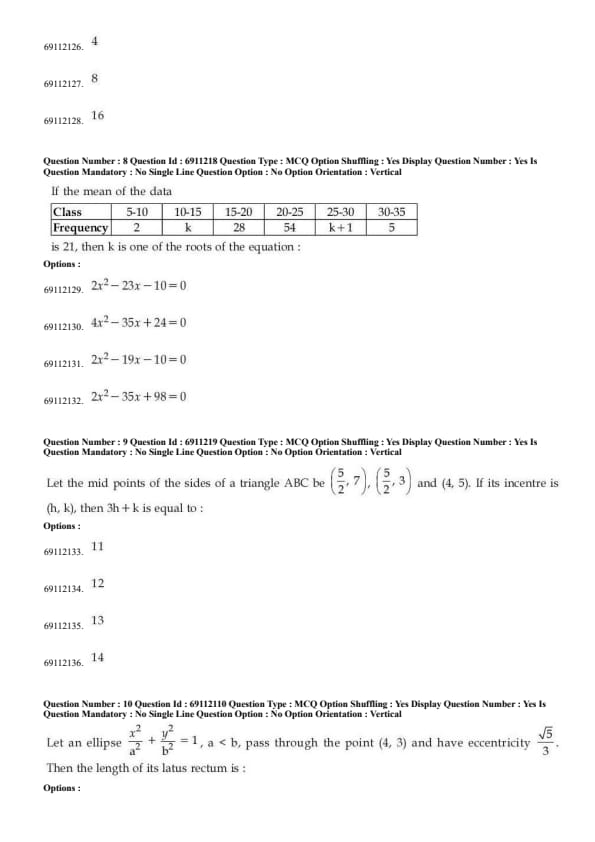
If the eccentricity of an ellipse \( \frac{x^2}{a^2} + \frac{y^2}{b^2} = 1 \), which passes through the point \( (3, 4) \), is \( \frac{\sqrt{5}}{3} \), then the length of its latus rectum is:
Foot of perpendicular from origin on a line passing through (1, 1, 1) having direction ratios \( \langle 2, 3, 4 \rangle \), is:
\( \alpha, \alpha + 2 \in \mathbb{Z} \) and \( n \in \mathbb{N} \), where \( \alpha, \alpha+2 \) are roots of equation \( x(x + 2) + (x + 1)(x + 3) + \dots + (x + n - 1)(x + n + 1) = 4n \), then \( \alpha + n = \)
Let \( K = \sin \frac{\pi}{18} \sin \frac{5\pi}{18} \sin \frac{7\pi}{18} \), then the value of \( \sin \left( \frac{10K\pi}{3} \right) \) is:
Value of definite integral \( I = \int_{0}^{2\sqrt{3}} \log_2(x^2 + 4) dx + \int_{2}^{4} \sqrt{2^x - 4} dx \) is:
If \( \sum_{k=1}^n a_k = 6n^3 \), then evaluate \( \sum_{k=1}^6 \left( \frac{a_{k+1} - a_k}{36} \right)^2 \):
If \( \lim_{x \to 2} \frac{\sin(x^3 - 5x^2 + ax + b)}{(\sqrt{x-1} - 1) \log_e(x-1)} = m \) (exists finitely), then find the value of \( a + b + m \).
A line through \( (1, 1, 1) \) and perpendicular to both \( \hat{i} + 2\hat{j} + 2\hat{k} \) and \( 2\hat{i} + 2\hat{j} + \hat{k} \), let \( (a, b, c) \) be foot of perpendicular from origin then \( 34(a + b + c) \) is:
If \( 36C_{r+1} = 6 \cdot \frac{35C_r}{k^2 - 3} \), then number of ordered pairs \( (r, k) \), where \( r, k \in \mathbb{Z} \) is:
Let mid-points of sides of \( \triangle \) are \( \left( \frac{5}{2}, 3 \right), \left( \frac{5}{2}, 7 \right) \& (4, 5) \). If incentre is \( (h, k) \) then value of \( 3h + k \) is:
If domain of \( f(x) = \sqrt{\log_{0.6} \frac{2x - 5}{x^2 - 4}} \) is \( (-\infty, a] \cup \{b\} \cup [c, d) \cup (e, \infty) \) then the value of \( (a + b + c + d + e) \) is:
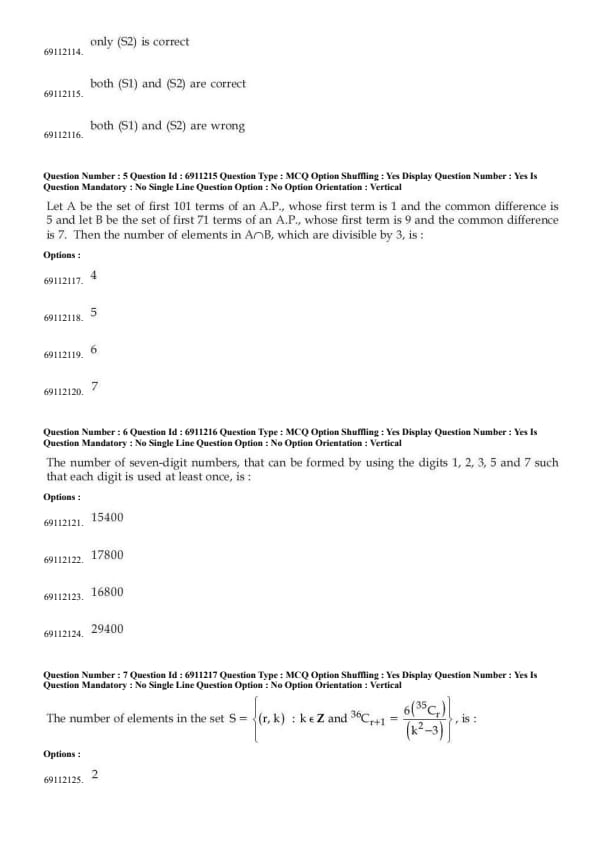
Consider two AP's \( S_1 \& S_2 \) such that \( S_1 : \{First term = 1, Common difference = 5, no. of terms = 101\} \) and \( S_2 : \{First term = 9, Common difference = 7, no. of terms = 71\} \). Find the number of common terms in both AP's.
If \( 50 \left( \frac{2x}{1 + 3i} + \frac{y}{1 - 2i} \right) = 31 + 17i \) where \( x, y \in \mathbb{R} \) then value of \( 10(x + 3y) \) is:




*The article might have information for the previous academic years, please refer the official website of the exam.