
JEE Main 2026 B.Planning: Memory Based Questions, Answer Key & Solutions PDF


| Updated On - Jan 30, 2026
JEE Main 2026 B.Planning Question Paper is available for download here. National Testing Agency (NTA) conducted JEE Main 2026 for Session 1 from January 21 to January 29. Students can check subject wise paper analysis along with memory-based question paper here. Download JEE Main 2026 B.Planning Question Paper with Answer Key and Solution PDF from the links provided below.
JEE Main 2026 B.Planning Question Paper with Solutions PDF (Memory Based)

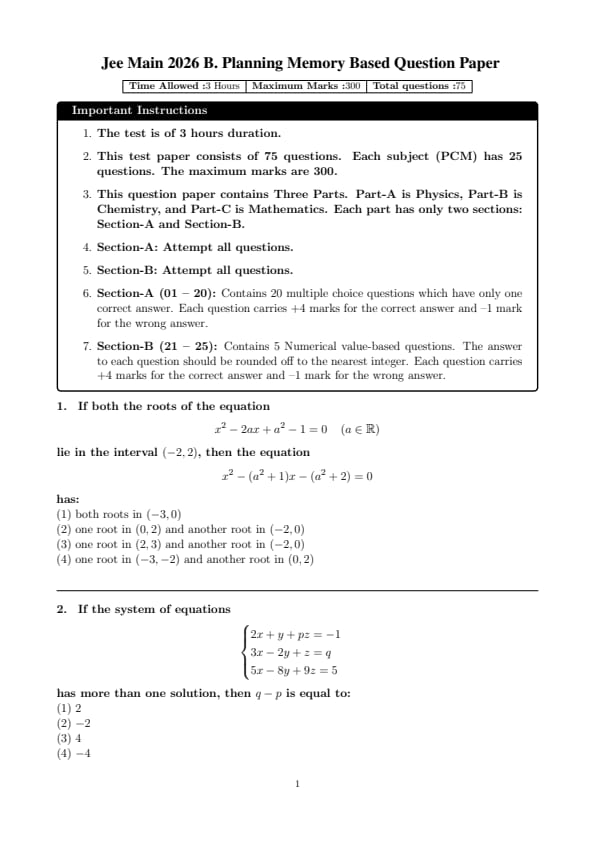
If both the roots of the equation \[ x^2-2ax+a^2-1=0 \quad (a\in\mathbb{R}) \]
lie in the interval \((-2,2)\), then the equation \[ x^2-(a^2+1)x-(a^2+2)=0 \]
has:
View Solution
Step 1: Examine the first equation
\[ x^2-2ax+a^2-1=0 \]
Rewriting, \[ (x-a)^2=1 \]
Hence, the roots are: \[ x=a\pm 1 \]
Since both roots lie in the interval \((-2,2)\), we must have: \[ -2
These inequalities give: \[ -1
Combining both conditions, \[ -1
Step 2: Analyze the second equation
\[ x^2-(a^2+1)x-(a^2+2)=0 \]
Sum of the roots: \[ \alpha+\beta=a^2+1>0 \]
Product of the roots: \[ \alpha\beta=-(a^2+2)<0 \]
Therefore, one root is positive and the other is negative.
Step 3: Locate the roots
Evaluate the polynomial at suitable points, using \(|a|<1\):
\[ f(0)=-(a^2+2)<0 \]
\[ f(2)=4-2(a^2+1)-(a^2+2)=-3a^2<0 \]
\[ f(3)=9-3(a^2+1)-(a^2+2)=4-4a^2>0 \]
Thus, the positive root lies in the interval \((2,3)\).
Now consider the negative side: \[ f(-2)=4+2(a^2+1)-(a^2+2)=4+a^2>0 \]
Since \(f(-2)>0\) and \(f(0)<0\), the negative root lies in \((-2,0)\).
Final Conclusion:
One root lies in \((2,3)\) and the other lies in \((-2,0)\).
\[ \boxed{Option (3)} \] Quick Tip: If roots are confined to a given interval, first find the allowable range of the parameter, then apply sign analysis of the polynomial to pinpoint the exact subintervals containing the roots.
If the system of equations \[ \begin{cases} 2x+y+pz=-1
3x-2y+z=q
5x-8y+9z=5 \end{cases} \]
has more than one solution, then \(q-p\) is equal to:
View Solution
For a system of three linear equations to have more than one solution, the determinant of the coefficient matrix must be zero and the system must also be consistent.
Step 1: Evaluate the determinant of the coefficient matrix
\[ \begin{vmatrix} 2 & 1 & p
3 & -2 & 1
5 & -8 & 9 \end{vmatrix} =2\big((-2)\cdot 9-1\cdot(-8)\big) -1\big(3\cdot 9-1\cdot 5\big) +p\big(3\cdot(-8)-(-2)\cdot 5\big) \]
\[ =2(-18+8)-1(27-5)+p(-24+10) =-20-22-14p \]
\[ \Rightarrow -42-14p=0 \Rightarrow p=-3 \]
Step 2: Check the consistency condition
Substituting \(p=-3\), we notice that the rows satisfy the relation: \[ -2R_1+3R_2=R_3 \]
For the system to be consistent, the constants must obey the same relation: \[ -2(-1)+3q=5 \]
\[ 2+3q=5 \Rightarrow q=1 \]
Step 3: Find \(q-p\)
\[ q-p=1-(-3)=4 \]
\[ \boxed{4} \] Quick Tip: For infinitely many solutions, verify that: the determinant of the coefficient matrix is zero, and the constants satisfy the same linear dependence as the equations.
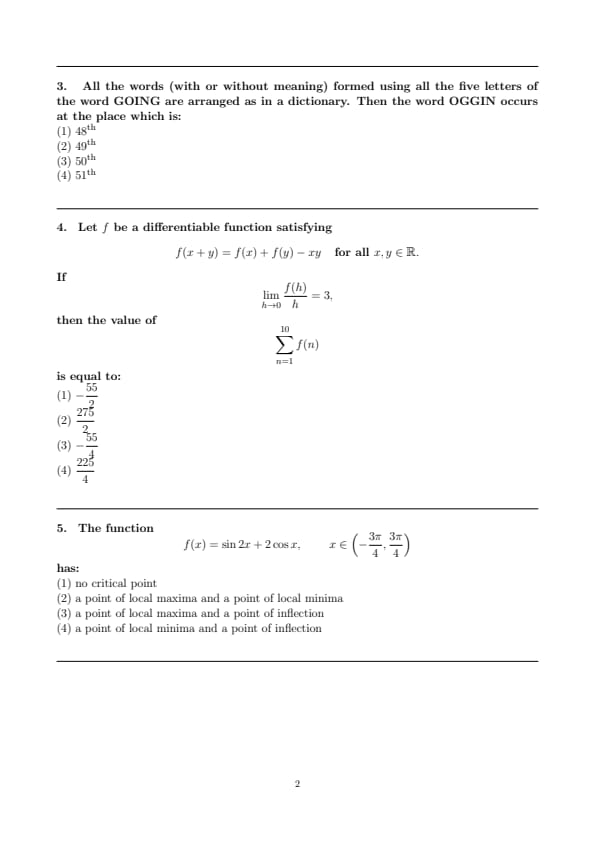
All the words (with or without meaning) formed using all the five letters of the word
\textbf{GOING} are arranged as in a dictionary.
Then the word \textbf{OGGIN} occurs at the place which is:
View Solution
Step 1: Arrange the letters alphabetically
The letters in the word GOING are: \[ G,\ O,\ I,\ N,\ G \]
Arranged in alphabetical order: \[ G,\ G,\ I,\ N,\ O \]
Step 2: Determine the rank of the word OGGIN
We count how many distinct words can be formed that come before OGGIN.
First letter: O
The letters alphabetically smaller than \(O\) are \(G, G, I, N\).
With any of these letters fixed in the first position, the remaining 4 letters (with two G’s) can be arranged in: \[ \frac{4!}{2!}=12 \]
ways.
Number of such smaller letters: \(4\)
\[ \Rightarrow 4 \times 12 = 48 \]
Step 3: Remaining letters
After fixing \(O\) in the first position, the remaining letters form GGIN,
which is already the smallest possible arrangement of these letters.
Hence, no further permutations need to be counted.
Step 4: Final rank
\[ Rank = 48 + 1 = 49 \]
\[ \boxed{49^{th}} \] Quick Tip: In ranking problems involving repeated letters, always divide by the factorial of repeated letters and count only those arrangements with letters \textbf{strictly smaller} at each position.
Let \(f\) be a differentiable function satisfying \[ f(x+y)=f(x)+f(y)-xy \quad for all x,y\in\mathbb{R}. \]
If \[ \lim_{h\to 0}\frac{f(h)}{h}=3, \]
then the value of \[ \sum_{n=1}^{10} f(n) \]
is equal to:
View Solution
Step 1: Determine the general form of \(f(x)\)
Given the functional equation: \[ f(x+y)=f(x)+f(y)-xy \]
Assume \(f(x)\) is a polynomial of degree at most 2: \[ f(x)=ax^2+bx+c \]
Substitute into the given equation: \[ a(x+y)^2+b(x+y)+c = ax^2+bx+c + ay^2+by+c - xy \]
Comparing coefficients on both sides: \[ 2a=-1 \Rightarrow a=-\frac12 \]
From constant terms: \[ c=0 \]
Thus, \[ f(x)=-\frac{x^2}{2}+bx \]
Step 2: Apply the given limit
\[ \lim_{h\to 0}\frac{f(h)}{h} =\lim_{h\to 0}\left(-\frac{h}{2}+b\right)=b \]
Since the limit equals \(3\), we get: \[ b=3 \]
Hence, \[ f(x)=3x-\frac{x^2}{2} \]
Step 3: Evaluate the required sum
\[ \sum_{n=1}^{10} f(n) =\sum_{n=1}^{10}\left(3n-\frac{n^2}{2}\right) \]
\[ =3\sum_{n=1}^{10}n-\frac12\sum_{n=1}^{10}n^2 \]
\[ =3\cdot\frac{10\cdot11}{2}-\frac12\cdot\frac{10\cdot11\cdot21}{6} \]
\[ =165-\frac{385}{2} =\frac{330-385}{2} =-\frac{55}{2} \]
\[ \boxed{-\dfrac{55}{2}} \] Quick Tip: Functional equations involving \(f(x+y)\) often suggest polynomial solutions. Use any given limit or condition to determine the remaining constants.
The function \[ f(x)=\sin 2x+2\cos x,\qquad x\in\left(-\frac{3\pi}{4},\frac{3\pi}{4}\right) \]
has:
View Solution
Step 1: Compute the first derivative
\[ f(x)=\sin 2x+2\cos x \]
\[ f'(x)=2\cos 2x-2\sin x \]
Set \(f'(x)=0\): \[ 2(\cos 2x-\sin x)=0 \Rightarrow \cos 2x=\sin x \]
Using the identity \(\cos 2x=1-2\sin^2 x\): \[ 1-2\sin^2 x=\sin x \]
\[ 2\sin^2 x+\sin x-1=0 \]
\[ (2\sin x-1)(\sin x+1)=0 \]
\[ \sin x=\frac12 \quad or \quad \sin x=-1 \]
Within the interval \(\left(-\frac{3\pi}{4},\frac{3\pi}{4}\right)\), \[ \sin x=\frac12 \Rightarrow x=\frac{\pi}{6} \]
(The solution \(\sin x=-1\) gives \(x=-\frac{\pi}{2}\), which corresponds to a critical point of different nature.)
Step 2: Apply the second derivative test
\[ f''(x)=-4\sin 2x-2\cos x \]
At \(x=\frac{\pi}{6}\): \[ f''\!\left(\frac{\pi}{6}\right) =-4\sin\frac{\pi}{3}-2\cos\frac{\pi}{6} =-4\cdot\frac{\sqrt3}{2}-2\cdot\frac{\sqrt3}{2}<0 \]
Therefore, \(x=\frac{\pi}{6}\) is a point of local maximum.
Step 3: Identify the inflection point
At \(x=-\frac{\pi}{2}\), \[ f'(x)=0 \]
and the second derivative changes sign across this point, indicating a point of inflection.
Final Conclusion:
The function possesses one point of local maximum and one point of inflection.
\[ \boxed{Option (3)} \] Quick Tip: If \(f'(x)=0\) at a point but the function does not change monotonicity, the point is not an extremum—always verify using the second derivative or sign analysis.
JEE 2026 B.Planning Strategy
*The article might have information for the previous academic years, please refer the official website of the exam.