
JEE Main 2026 April 4 Shift 2 Question Paper with Solution PDF


Content Curator | Updated On - Apr 10, 2026
JEE Main 2026 April 4 Shift 2 Question Paper with Solution PDF is available here for download. NTA conducted JEE Main on April 4 , Shift 2, from 3 PM to 6 PM in CBT Mode. NTA has released the JEE Main official Question Paper on the official website jeemain.nta.nic.in.
The JEE Main 2026 today's question paper included three sections: Physics, Chemistry, and Mathematics, with 75 Questions carrying a total of 300 Marks, as per the JEE Main marking scheme, +4 marks for every correct answer, and -1 mark is deducted for every wrong answer.
Also Check: JEE Main 2026 April 4 Shift 1 Question Paper with Solution PDF
JEE Main 2026 April 4 Shift 2 Question Paper with Solution PDF
| JEE Main 2026 April 4 Shift 2 Question Paper | Download PDF | Check Solutions |

For the function \(f: [1,\infty) \to [1,\infty)\) defined by \(f(x) = (x - 1)^4 + 1\), among the two statements:
(I) The set \(S = \{x \in [1, \infty) : f(x) = f^{-1}(x)\}\) contains exactly two elements, and
(II) The set \(S = \{x \in [1, \infty) : f(x) = f^{-1}(x+1)\}\) is an empty set,
View Solution
Step 1: Understanding the Concept:
For a strictly increasing function \(f(x)\), the points of intersection of the function and its inverse, \(f(x) = f^{-1}(x)\), always lie on the line \(y = x\). For statement (II), we evaluate the equation by manipulating it to \(f(f(x)) = x+1\) to verify real roots.
Step 2: Key Formula or Approach:
For strictly increasing functions: \[ f(x) = f^{-1}(x) \iff f(x) = x \]
For the second statement, apply the inverse function definition: \[ f(x) = f^{-1}(x+1) \implies f(f(x)) = x+1 \]
Step 3: Detailed Explanation:
Let's analyze statement (I):
Given \(f(x) = (x - 1)^4 + 1\) for \(x \ge 1\).
Since \(f'(x) = 4(x - 1)^3 \ge 0\) for \(x \ge 1\), the function \(f(x)\) is strictly increasing.
Thus, the equation \(f(x) = f^{-1}(x)\) is equivalent to \(f(x) = x\).
\[ (x - 1)^4 + 1 = x \implies (x - 1)^4 - (x - 1) = 0 \]
Let \(t = x - 1 \ge 0\).
\[ t^4 - t = 0 \implies t(t^3 - 1) = 0 \]
This gives real roots \(t = 0\) or \(t = 1\).
Substituting back \(x - 1 = t\):
If \(t = 0 \implies x = 1\).
If \(t = 1 \implies x = 2\).
Both values belong to \([1, \infty)\). Thus, set \(S\) has exactly two elements \(\{1, 2\}\). Statement (I) is TRUE.
Let's analyze statement (II):
We are given \(f(x) = f^{-1}(x+1)\).
Let \(y = f(x)\). Then \(y = f^{-1}(x+1) \implies f(y) = x+1\).
\[ (y - 1)^4 + 1 = x + 1 \implies (y - 1)^4 = x \]
Substitute \(y = (x-1)^4 + 1\):
\[ \left( (x-1)^4 + 1 - 1 \right)^4 = x \implies (x-1)^{16} = x \]
Let \(x - 1 = t \ge 0 \implies x = t + 1\).
\[ t^{16} = t + 1 \implies t^{16} - t - 1 = 0 \]
Let \(g(t) = t^{16} - t - 1\).
We evaluate \(g(t)\): \(g(1) = -1 < 0\) and \(g(2) = 2^{16} - 3 > 0\).
By the Intermediate Value Theorem, there exists at least one real root in \((1, 2)\).
Therefore, the set \(S\) is not empty. Statement (II) is FALSE.
Step 4: Final Answer:
Only (I) is TRUE. Quick Tip: For equations of the form \(f(x) = f^{-1}(x)\), verify if \(f(x)\) is strictly increasing. If so, simplify the problem by directly solving \(f(x) = x\).
Let \(S = \{z \in \mathbb{C} : z^2 + 4z + 16 = 0\}\). Then \(\sum_{z \in S} |z + \sqrt{3}i|^2\) is equal to:
View Solution
Step 1: Understanding the Concept:
We must find the complex roots of the quadratic equation \(z^2 + 4z + 16 = 0\), representing the elements of set \(S\). We then substitute these roots into the magnitude expression \(|z + \sqrt{3}i|^2\) and compute their sum.
Step 2: Key Formula or Approach:
The roots of a quadratic equation \(az^2 + bz + c = 0\) are given by:
\[ z = \frac{-b \pm \sqrt{b^2 - 4ac}}{2a} \]
The squared magnitude of a complex number \(w = x + iy\) is \(|w|^2 = x^2 + y^2\).
Step 3: Detailed Explanation:
Solve \(z^2 + 4z + 16 = 0\):
\[ z = \frac{-4 \pm \sqrt{16 - 64}}{2} = \frac{-4 \pm \sqrt{-48}}{2} \] \[ z = \frac{-4 \pm 4\sqrt{3}i}{2} = -2 \pm 2\sqrt{3}i \]
Set \(S\) has two elements: \(z_1 = -2 + 2\sqrt{3}i\) and \(z_2 = -2 - 2\sqrt{3}i\).
Evaluate \(|z + \sqrt{3}i|^2\) for \(z_1\):
\[ z_1 + \sqrt{3}i = -2 + 3\sqrt{3}i \] \[ |z_1 + \sqrt{3}i|^2 = (-2)^2 + (3\sqrt{3})^2 = 4 + 27 = 31 \]
Evaluate \(|z + \sqrt{3}i|^2\) for \(z_2\):
\[ z_2 + \sqrt{3}i = -2 - \sqrt{3}i \] \[ |z_2 + \sqrt{3}i|^2 = (-2)^2 + (-\sqrt{3})^2 = 4 + 3 = 7 \]
Compute the final sum:
\[ \sum_{z \in S} |z + \sqrt{3}i|^2 = 31 + 7 = 38 \]
Step 4: Final Answer:
The sum is 38. Quick Tip: When roots of a quadratic are complex conjugates, their operations with other complex numbers yield purely real squared magnitudes. Avoid expanding algebraically and just plug the values directly.
If the system of equations:
\(x + y + z = 5\)
\(x + 2y + 3z = 9\)
\(x + 3y + \lambda z = \mu\)
has infinitely many solutions, then the value of \(\lambda + \mu\) is:
View Solution
Step 1: Understanding the Concept:
For a system of three linear equations to have infinitely many solutions, the determinant of the coefficient matrix must be zero (\(\Delta = 0\)), and the system must be consistent (row operations will yield a row of all zeros).
Step 2: Key Formula or Approach:
Determinant condition:
\[ \Delta = \begin{vmatrix} 1 & 1 & 1
1 & 2 & 3
1 & 3 & \lambda \end{vmatrix} = 0 \]
Then use row operations to determine the value of \(\mu\).
Step 3: Detailed Explanation:
Evaluate \(\Delta\):
\[ 1(2\lambda - 9) - 1(\lambda - 3) + 1(3 - 2) = 0 \] \[ 2\lambda - 9 - \lambda + 3 + 1 = 0 \implies \lambda - 5 = 0 \implies \lambda = 5 \]
Substitute \(\lambda = 5\) and write the augmented matrix equations:
1: \(x + y + z = 5\)
2: \(x + 2y + 3z = 9\)
3: \(x + 3y + 5z = \mu\)
To make the system have infinitely many solutions, Equation 3 must be a linear combination of Equation 1 and Equation 2.
Observe the left-hand sides:
\((x + y + z) + (x + 3y + 5z) = 2x + 4y + 6z = 2(x + 2y + 3z)\)
This means: \(Eq_1 + Eq_3 = 2 \times Eq_2\).
Apply this relation to the right-hand constants:
\[ 5 + \mu = 2(9) \] \[ 5 + \mu = 18 \implies \mu = 13 \]
Calculate the required sum:
\[ \lambda + \mu = 5 + 13 = 18 \]
Step 4: Final Answer:
The value is 18. Quick Tip: For linear dependencies, instead of full row reduction, try to visually spot if one row is a simple arithmetic progression or direct multiple of the others. Here, the coefficients of \(y\) (1, 2, 3) form an AP, hinting at \(R_1 + R_3 = 2R_2\).
If \(\alpha = 1\) and \(\beta = 1 + i\sqrt{2}\), where \(i = \sqrt{-1}\) are two roots of the equation \(x^3 + ax^2 + bx + c = 0\), \(a, b, c \in \mathbb{R}\), then \(\int_{-1}^1 (x^3 + ax^2 + bx + c) dx\) is equal to:
View Solution
Step 1: Understanding the Concept:
Because the polynomial has real coefficients, complex roots must appear in conjugate pairs. Finding the third root allows us to deduce the polynomial's coefficients using Vieta's formulas. Finally, we integrate the polynomial over symmetric limits.
Step 2: Key Formula or Approach:
Complex conjugate root theorem: If \(1 + i\sqrt{2}\) is a root, so is \(\gamma = 1 - i\sqrt{2}\).
Vieta's formulas:
Sum of roots \(= -a\)
Product of roots taken two at a time \(= b\)
Product of all roots \(= -c\)
Step 3: Detailed Explanation:
The roots are \(1\), \(1 + i\sqrt{2}\), and \(1 - i\sqrt{2}\).
Find \(a\):
\(-a = 1 + (1 + i\sqrt{2}) + (1 - i\sqrt{2}) = 3 \implies a = -3\)
Find \(c\):
\(-c = (1)(1 + i\sqrt{2})(1 - i\sqrt{2}) = 1^2 - (i\sqrt{2})^2 = 1 - (-2) = 3 \implies c = -3\)
Find \(b\):
\(b = (1)(1+i\sqrt{2}) + (1)(1-i\sqrt{2}) + (1+i\sqrt{2})(1-i\sqrt{2}) = 2 + 3 = 5\)
The polynomial is \(P(x) = x^3 - 3x^2 + 5x - 3\).
Evaluate the definite integral:
\[ I = \int_{-1}^1 (x^3 - 3x^2 + 5x - 3) dx \]
Using the symmetric limits property (\(\int_{-A}^A f(x) dx = 0\) for odd functions):
The odd terms \(x^3\) and \(5x\) integrate to 0.
\[ I = \int_{-1}^1 (-3x^2 - 3) dx = 2 \int_{0}^1 (-3x^2 - 3) dx \] \[ I = 2 \left[ -x^3 - 3x \right]_0^1 = 2(-1 - 3) = -8 \]
Step 4: Final Answer:
The integral evaluates to \(-8\). Quick Tip: Always separate polynomials into even and odd parts when integrating across limits of the form \([-A, A]\). This halves your calculation time and drastically reduces errors.
If the quadratic equation \((\lambda + 2)x^2 - 3\lambda x + 4\lambda = 0, \lambda \neq -2\), has two positive roots, then the number of possible integral values of \(\lambda\) is:
View Solution
Step 1: Understanding the Concept:
For a quadratic equation to have two positive real roots, three conditions must hold: the discriminant must be non-negative (\(\Delta \ge 0\)), the sum of roots must be positive (\(S > 0\)), and the product of roots must be positive (\(P > 0\)).
Step 2: Key Formula or Approach:
For \(Ax^2 + Bx + C = 0\):
1. \(\Delta = B^2 - 4AC \ge 0\)
2. \(S = -B/A > 0\)
3. \(P = C/A > 0\)
Step 3: Detailed Explanation:
Given \(A = \lambda + 2\), \(B = -3\lambda\), \(C = 4\lambda\).
Condition 1: \(\Delta \ge 0\)
\[ (-3\lambda)^2 - 4(\lambda + 2)(4\lambda) \ge 0 \] \[ 9\lambda^2 - 16\lambda^2 - 32\lambda \ge 0 \implies -7\lambda^2 - 32\lambda \ge 0 \] \[ 7\lambda^2 + 32\lambda \le 0 \implies \lambda(7\lambda + 32) \le 0 \]
So, \(\lambda \in \left[ -\frac{32}{7}, 0 \right]\).
Condition 2: Sum \(S > 0\)
\[ \frac{3\lambda}{\lambda + 2} > 0 \]
Using the wavy curve method, \(\lambda \in (-\infty, -2) \cup (0, \infty)\).
Condition 3: Product \(P > 0\)
\[ \frac{4\lambda}{\lambda + 2} > 0 \]
This yields the exact same intervals as the sum: \(\lambda \in (-\infty, -2) \cup (0, \infty)\).
Find the intersection of all conditions:
Intersection of \(\left[ -\frac{32}{7}, 0 \right]\) and \((-\infty, -2) \cup (0, \infty)\) is \(\left[ -\frac{32}{7}, -2 \right)\).
Since \(-\frac{32}{7} \approx -4.57\), the interval is approximately \([-4.57, -2)\).
The integral values in this range are \(-4\) and \(-3\).
Step 4: Final Answer:
There are 2 integral values. Quick Tip: "Two positive roots" allows for the roots to be identical, so the discriminant inequality must be \(\Delta \ge 0\), not just strictly greater than zero.
Let \(A = \begin{bmatrix} 1 & 2 & 7
4 & -2 & 8
3 & 8 & -7 \end{bmatrix}\) and \(\det(A - \alpha I) = 0\), where \(\alpha\) is a real number. If the largest possible value of \(\alpha\) is p, then the circle \((x - p)^2 + (y - 2p)^2 = 320\), intersects the co-ordinate axes at
View Solution
Step 1: Understanding the Concept:
The equation \(\det(A - \alpha I) = 0\) is the characteristic equation that defines the eigenvalues of matrix \(A\). We must find the largest eigenvalue \(p\), substitute it into the given circle equation, and count its intersection points with the \(x\)-axis (\(y=0\)) and \(y\)-axis (\(x=0\)).
Step 2: Key Formula or Approach:
Characteristic polynomial for a \(3 \times 3\) matrix:
\[ \alpha^3 - tr(A)\alpha^2 + (M_{11} + M_{22} + M_{33})\alpha - \det(A) = 0 \]
where \(tr(A)\) is the trace and \(M_{ii}\) are the principal minors.
Step 3: Detailed Explanation:
Trace: \(tr(A) = 1 - 2 - 7 = -8\).
Determinant:
\[ |A| = 1(14 - 64) - 2(-28 - 24) + 7(32 - (-6)) = -50 + 104 + 266 = 320 \]
Sum of principal minors:
\(M_{11} = 14 - 64 = -50\)
\(M_{22} = -7 - 21 = -28\)
\(M_{33} = -2 - 8 = -10\)
Sum = \(-88\).
The characteristic equation:
\[ \alpha^3 + 8\alpha^2 - 88\alpha - 320 = 0 \]
By trial, \(\alpha = 8\) is a root: \(8^3 + 8(8^2) - 88(8) - 320 = 512 + 512 - 704 - 320 = 0\).
Factor out \((\alpha - 8)\):
\[ (\alpha - 8)(\alpha^2 + 16\alpha + 40) = 0 \]
Roots of quadratic: \(\alpha = \frac{-16 \pm \sqrt{256 - 160}}{2} = -8 \pm 2\sqrt{6}\).
Since \(2\sqrt{6} \approx 4.9\), the largest eigenvalue is \(p = 8\).
Substitute \(p = 8\) into the circle equation:
\[ (x - 8)^2 + (y - 16)^2 = 320 \]
Intersect with \(x\)-axis (\(y = 0\)):
\[ (x - 8)^2 + 256 = 320 \implies (x - 8)^2 = 64 \implies x = 16 or x = 0 \]
Points: \((16, 0), (0, 0)\).
Intersect with \(y\)-axis (\(x = 0\)):
\[ 64 + (y - 16)^2 = 320 \implies (y - 16)^2 = 256 \implies y = 32 or y = 0 \]
Points: \((0, 32), (0, 0)\).
The unique intersection points are \((0, 0)\), \((16, 0)\), and \((0, 32)\).
Step 4: Final Answer:
The circle intersects the axes at 3 points. Quick Tip: Remember that the origin \((0,0)\) counts as a single intersection point for both the \(x\)-axis and the \(y\)-axis. Always compile a unique list of coordinates before finalizing your count.
Let \(\alpha = \frac{1}{4} + \frac{1}{8} + \frac{1}{16} + \dots \infty\) and \(\beta = \frac{1}{3} + \frac{1}{9} + \frac{1}{27} + \dots \infty\). Then the value of \((0.2)^{\log_{\sqrt{5}}(\alpha)} + (0.04)^{\log_5(\beta)}\) is equal to:
View Solution
Step 1: Understanding the Concept:
Evaluate the sum of the infinite geometric progressions for \(\alpha\) and \(\beta\). Then substitute these fractions into the logarithmic expression, utilizing exponent and base change properties to simplify.
Step 2: Key Formula or Approach:
Infinite GP sum: \(S_\infty = \frac{a}{1 - r}\).
Logarithm properties: \(\log_{b^n}(x) = \frac{1}{n} \log_b(x)\) and \(a^{\log_a(x)} = x\).
Step 3: Detailed Explanation:
Evaluate \(\alpha\):
\(a = 1/4\), \(r = 1/2\)
\[ \alpha = \frac{1/4}{1 - 1/2} = \frac{1}{2} \]
Evaluate \(\beta\):
\(a = 1/3\), \(r = 1/3\)
\[ \beta = \frac{1/3}{1 - 1/3} = \frac{1}{2} \]
Simplify the first term: \((0.2)^{\log_{\sqrt{5}}(\alpha)}\)
\(0.2 = 5^{-1}\) and \(\sqrt{5} = 5^{1/2}\).
\[ \log_{\sqrt{5}}(1/2) = \frac{1}{1/2} \log_5(1/2) = 2 \log_5(1/2) = \log_5(1/4) \] \[ (5^{-1})^{\log_5(1/4)} = 5^{-\log_5(1/4)} = 5^{\log_5(4)} = 4 \]
Simplify the second term: \((0.04)^{\log_5(\beta)}\)
\(0.04 = 5^{-2}\).
\[ (5^{-2})^{\log_5(1/2)} = 5^{-2\log_5(1/2)} = 5^{\log_5(4)} = 4 \]
Total sum = \(4 + 4 = 8\).
Step 4: Final Answer:
The final value is 8. Quick Tip: Converting decimal bases into fractional powers (like \(0.04 = 5^{-2}\)) ensures you can immediately apply the fundamental identity of logarithms \(a^{\log_a(x)} = x\).
For 10 observations \(x_1, x_2, \dots, x_{10}\), if \(\sum_{i=1}^{10} (x_i + 2)^2 = 180\) and \(\sum_{i=1}^{10} (x_i - 1)^2 = 90\), then their standard deviation is:
View Solution
Step 1: Understanding the Concept:
The standard deviation relies on the variance, which requires finding both \(\sum x_i^2\) and \(\sum x_i\). By expanding the two given summations, we get two linear equations which can be solved simultaneously.
Step 2: Key Formula or Approach:
Variance formula:
\[ \sigma^2 = \frac{\sum x_i^2}{n} - \left( \frac{\sum x_i}{n} \right)^2 \]
Expansion of squares: \((x_i \pm a)^2 = x_i^2 \pm 2ax_i + a^2\).
Step 3: Detailed Explanation:
Let \(S_2 = \sum x_i^2\) and \(S_1 = \sum x_i\) for \(n=10\).
Expand the first summation:
\[ \sum (x_i^2 + 4x_i + 4) = 180 \implies S_2 + 4S_1 + 40 = 180 \implies S_2 + 4S_1 = 140 \quad (Eq 1) \]
Expand the second summation:
\[ \sum (x_i^2 - 2x_i + 1) = 90 \implies S_2 - 2S_1 + 10 = 90 \implies S_2 - 2S_1 = 80 \quad (Eq 2) \]
Subtract Eq 2 from Eq 1:
\[ 6S_1 = 60 \implies S_1 = 10 \]
Substitute \(S_1\) back into Eq 2:
\[ S_2 - 20 = 80 \implies S_2 = 100 \]
Calculate the variance \(\sigma^2\):
\[ \sigma^2 = \frac{100}{10} - \left( \frac{10}{10} \right)^2 = 10 - 1 = 9 \]
Standard deviation \(\sigma = \sqrt{9} = 3\).
Step 4: Final Answer:
The standard deviation is 3. Quick Tip: Always remember that \(\sum_{i=1}^n c = n \cdot c\). It is a common mistake to forget multiplying the constant term by \(n\) when distributing the summation operator.
In the expansion of \(\left(9x - \frac{1}{3\sqrt{x}}\right)^{18}\), \(x > 0\), if the term independent of x is \((221)k\), then \(k\) is equal to:
View Solution
Step 1: Understanding the Concept:
To find the term independent of \(x\) in a binomial expansion, write out the general term, collect all powers of \(x\), and set the final exponent equal to zero to solve for the term index \(r\).
Step 2: Key Formula or Approach:
General term in \((a + b)^n\):
\[ T_{r+1} = \binom{n}{r} a^{n-r} b^r \]
Step 3: Detailed Explanation:
The given binomial is \((9x - \frac{1}{3}x^{-1/2})^{18}\).
\[ T_{r+1} = \binom{18}{r} (9x)^{18-r} \left( -\frac{1}{3}x^{-1/2} \right)^r \]
Combine the exponents of \(x\):
\[ x^{18 - r} \cdot x^{-r/2} = x^{18 - 3r/2} \]
For the term to be independent of \(x\), set the exponent to 0:
\[ 18 - \frac{3r}{2} = 0 \implies r = 12 \]
Calculate the coefficient for \(r = 12\):
\[ T_{13} = \binom{18}{12} (9)^{6} \left(-\frac{1}{3}\right)^{12} \]
Since \(9^6 = (3^2)^6 = 3^{12}\) and \((-1/3)^{12} = 3^{-12}\):
\[ T_{13} = \binom{18}{12} \cdot 3^{12} \cdot 3^{-12} = \binom{18}{12} \]
Compute \(\binom{18}{12} = \binom{18}{6}\):
\[ \binom{18}{6} = \frac{18 \times 17 \times 16 \times 15 \times 14 \times 13}{6 \times 5 \times 4 \times 3 \times 2 \times 1} = 18564 \]
Equating to the given expression:
\[ 221k = 18564 \implies k = \frac{18564}{221} = 84 \]
Step 4: Final Answer:
The value of \(k\) is 84. Quick Tip: To divide large numbers manually faster, estimate using multipliers: \(220 \times 80 = 17600\), leaving roughly 960. \(220 \times 4 = 880\), making 84 the perfect candidate.
Let P \((3\cos\alpha, 2\sin\alpha)\), \(\alpha \neq 0\), be a point on the ellipse \(\frac{x^2}{9} + \frac{y^2}{4} = 1\). Q be a point on the circle \(x^2 + y^2 - 14x - 14y + 82 = 0\) and R be a point on the line \(x + y = 5\) such that the centroid of the triangle PQR is \(\left(2+\cos\alpha, 3+\frac{2}{3}\sin\alpha\right)\). Then the sum of the ordinates of all possible points R is:
View Solution
Step 1: Understanding the Concept:
By equating the given centroid coordinates to the centroid formula applied to vertices P, Q, and R, we can deduce a direct geometric locus for point Q. Finding the intersection of this locus with the given circle gives exact coordinates for Q, allowing us to find R.
Step 2: Key Formula or Approach:
Centroid \(G(x, y)\) of triangle with vertices \((x_1, y_1), (x_2, y_2), (x_3, y_3)\):
\[ G_x = \frac{x_1 + x_2 + x_3}{3}, \quad G_y = \frac{y_1 + y_2 + y_3}{3} \]
Step 3: Detailed Explanation:
Let \(Q = (x_1, y_1)\) and \(R = (x_2, y_2)\).
Equating the \(x\)-coordinates of the centroid:
\[ \frac{3\cos\alpha + x_1 + x_2}{3} = 2 + \cos\alpha \implies x_1 + x_2 = 6 \]
Equating the \(y\)-coordinates:
\[ \frac{2\sin\alpha + y_1 + y_2}{3} = 3 + \frac{2}{3}\sin\alpha \implies y_1 + y_2 = 9 \]
Since R lies on \(x + y = 5\), we have \(x_2 + y_2 = 5\).
Adding the derived coordinates of Q:
\[ x_1 + y_1 = (6 - x_2) + (9 - y_2) = 15 - (x_2 + y_2) = 15 - 5 = 10 \]
So point Q lies on the line \(x + y = 10\).
Point Q also lies on the circle: \((x - 7)^2 + (y - 7)^2 = 16\) (completing the square).
Substitute \(y = 10 - x\) into the circle equation:
\[ (x - 7)^2 + (3 - x)^2 = 16 \]
Let \(x - 5 = t\). Then \(x - 7 = t - 2\) and \(3 - x = -2 - t\).
\[ (t - 2)^2 + (-2 - t)^2 = 16 \implies 2t^2 + 8 = 16 \implies t^2 = 4 \implies t = \pm 2 \]
If \(t = 2\), \(x_1 = 7\) and \(y_1 = 3\).
If \(t = -2\), \(x_1 = 3\) and \(y_1 = 7\).
We need the sum of the ordinates (\(y_2\)) of all possible points R.
Recall \(y_2 = 9 - y_1\).
For \(y_1 = 3 \implies y_2 = 6\).
For \(y_1 = 7 \implies y_2 = 2\).
The sum of all possible ordinates of R is \(6 + 2 = 8\).
Step 4: Final Answer:
The sum is 8. Quick Tip: Substituting variables to center an equation (like \(x - 5 = t\) when terms are \((x-7)\) and \((3-x)\)) instantly neutralizes the linear terms during expansion, rapidly simplifying quadratics.
Let \(H: \frac{x^2}{a^2} - \frac{y^2}{b^2} = 1\) be a hyperbola such that the distance between its foci is 6 and the distance between its directrices is \(\frac{8}{3}\). If the line \(x = \alpha\) intersects the hyperbola H at the points A and B such that the area of the triangle AOB is \(4\sqrt{15}\), where O is the origin, then \(\alpha^2\) equals
View Solution
Step 1: Understanding the Concept:
Using the distance properties of hyperbolas, determine the parameters \(a\), \(b\), and \(e\) to establish the exact equation of the hyperbola. Finding intersection points of a vertical line \(x = \alpha\) directly models the base and height of the specified triangle AOB.
Step 2: Key Formula or Approach:
Distance between foci \(= 2ae\).
Distance between directrices \(= \frac{2a}{e}\).
Hyperbola relation: \(b^2 = a^2(e^2 - 1)\).
Area of triangle with vertices \((0,0), (\alpha, y), (\alpha, -y)\) is \(\frac{1}{2} \times (2y) \times \alpha = \alpha y\).
Step 3: Detailed Explanation:
Given \(2ae = 6 \implies ae = 3\).
Given \(\frac{2a}{e} = \frac{8}{3} \implies \frac{a}{e} = \frac{4}{3}\).
Multiply them: \((ae)\left(\frac{a}{e}\right) = 3 \times \frac{4}{3} \implies a^2 = 4 \implies a = 2\).
Therefore \(e = \frac{3}{2}\).
Find \(b^2\): \(b^2 = a^2(e^2 - 1) = 4\left(\frac{9}{4} - 1\right) = 5\).
The hyperbola is \(\frac{x^2}{4} - \frac{y^2}{5} = 1\).
Intersect with \(x = \alpha\):
\[ \frac{\alpha^2}{4} - \frac{y^2}{5} = 1 \implies y = \sqrt{5\left(\frac{\alpha^2}{4} - 1\right)} \]
The area of \(\Delta AOB\) is \(\alpha y = 4\sqrt{15}\).
Square both sides:
\[ \alpha^2 y^2 = 240 \implies \alpha^2 \left( 5\left(\frac{\alpha^2}{4} - 1\right) \right) = 240 \] \[ \frac{5\alpha^4}{4} - 5\alpha^2 - 240 = 0 \implies \alpha^4 - 4\alpha^2 - 192 = 0 \]
Factor the quadratic in \(\alpha^2\):
\[ (\alpha^2 - 16)(\alpha^2 + 12) = 0 \]
Since \(\alpha^2\) must be positive, \(\alpha^2 = 16\).
Step 4: Final Answer:
\(\alpha^2\) equals 16. Quick Tip: Whenever the area of an isosceles triangle formed by vertical intersections is needed relative to the origin, the area simplifies cleanly to \(x \cdot y\). Squaring both sides avoids dealing with roots entirely.
\(\max_{0 \le x \le \pi} \left( 16\sin\left(\frac{x}{2}\right)\left|\cos^3\left(\frac{x}{2}\right)\right| \right)\) is equal to:
View Solution
Step 1: Understanding the Concept:
To find the global maximum of a trigonometric function on a closed interval, we map the expression using substitution to simplify the domain, calculate the first derivative to find critical points, and substitute them back to yield the maximum.
Step 2: Key Formula or Approach:
For \(y = f(t)\), the maximum occurs where \(f'(t) = 0\).
Apply substitution \(t = x/2\).
Step 3: Detailed Explanation:
Let \(t = x/2\). As \(x \in [0, \pi]\), \(t \in [0, \pi/2]\).
In this interval, \(\cos t \ge 0\), so we can drop the absolute value.
Let \(f(t) = 16 \sin t \cos^3 t\).
Find the derivative using product and chain rules:
\[ f'(t) = 16 (\cos t \cdot \cos^3 t + \sin t \cdot 3\cos^2 t(-\sin t)) \] \[ f'(t) = 16(\cos^4 t - 3\sin^2 t \cos^2 t) = 16\cos^2 t(\cos^2 t - 3\sin^2 t) \]
Set \(f'(t) = 0\):
Since \(t \in [0, \pi/2]\), \(\cos t \neq 0\) except at boundary \(\pi/2\) (which gives minimum 0).
\[ \cos^2 t - 3\sin^2 t = 0 \implies \tan^2 t = \frac{1}{3} \implies \tan t = \frac{1}{\sqrt{3}} \implies t = \frac{\pi}{6} \]
Substitute \(t = \pi/6\) into \(f(t)\):
\[ f\left(\frac{\pi}{6}\right) = 16 \sin\left(\frac{\pi}{6}\right) \cos^3\left(\frac{\pi}{6}\right) = 16 \left(\frac{1}{2}\right) \left(\frac{\sqrt{3}}{2}\right)^3 \] \[ = 8 \left(\frac{3\sqrt{3}}{8}\right) = 3\sqrt{3} \]
Step 4: Final Answer:
The maximum value is \(3\sqrt{3}\). Quick Tip: For max/min optimization of expressions like \(\sin^n x \cos^m x\), critical points invariably reside at \(\tan^2 x = m/n\) (when evaluating the first quadrant). This is an incredibly fast mental shortcut!
The shortest distance between the lines
\(\vec{r} = \left(\frac{1}{3}\hat{i} + 2\hat{j} + \frac{8}{3}\hat{k}\right) + \lambda\left(2\hat{i} - 5\hat{j} + 6\hat{k}\right)\)
and \(\vec{r} = \left(-\frac{2}{3}\hat{i} - \frac{1}{3}\hat{k}\right) + \mu\left(\hat{j} - \hat{k}\right)\), \(\lambda, \mu \in \mathbb{R}\), is:
View Solution
Step 1: Understanding the Concept:
The shortest distance between two skew lines \(\vec{r} = \vec{a_1} + \lambda\vec{b_1}\) and \(\vec{r} = \vec{a_2} + \mu\vec{b_2}\) is the projection of the vector connecting their reference points (\(\vec{a_2} - \vec{a_1}\)) onto the vector perpendicular to both direction vectors (\(\vec{b_1} \times \vec{b_2}\)).
Step 2: Key Formula or Approach:
\[ d = \frac{|(\vec{a_2} - \vec{a_1}) \cdot (\vec{b_1} \times \vec{b_2})|}{|\vec{b_1} \times \vec{b_2}|} \]
Step 3: Detailed Explanation:
From the given equations:
\(\vec{a_1} = \left(\frac{1}{3}, 2, \frac{8}{3}\right)\), \(\vec{b_1} = (2, -5, 6)\)
\(\vec{a_2} = \left(-\frac{2}{3}, 0, -\frac{1}{3}\right)\), \(\vec{b_2} = (0, 1, -1)\)
Find \(\vec{a_2} - \vec{a_1}\):
\[ \vec{a_2} - \vec{a_1} = \left(-\frac{2}{3} - \frac{1}{3}\right)\hat{i} + (0 - 2)\hat{j} + \left(-\frac{1}{3} - \frac{8}{3}\right)\hat{k} = -\hat{i} - 2\hat{j} - 3\hat{k} \]
Find \(\vec{b_1} \times \vec{b_2}\):
\[ \vec{b_1} \times \vec{b_2} = \begin{vmatrix} \hat{i} & \hat{j} & \hat{k}
2 & -5 & 6
0 & 1 & -1 \end{vmatrix} = \hat{i}(5 - 6) - \hat{j}(-2) + \hat{k}(2) = -\hat{i} + 2\hat{j} + 2\hat{k} \]
Find the magnitude \(|\vec{b_1} \times \vec{b_2}|\):
\[ |\vec{b_1} \times \vec{b_2}| = \sqrt{(-1)^2 + 2^2 + 2^2} = \sqrt{9} = 3 \]
Find the dot product:
\[ (\vec{a_2} - \vec{a_1}) \cdot (\vec{b_1} \times \vec{b_2}) = (-1)(-1) + (-2)(2) + (-3)(2) = 1 - 4 - 6 = -9 \]
Calculate distance \(d\):
\[ d = \frac{|-9|}{3} = 3 \]
Step 4: Final Answer:
The shortest distance is 3. Quick Tip: To ensure fewer signs errors when using vector cross products in examinations, always write out the intermediate \(2 \times 2\) determinant calculations formally before computing the final sum.
If \(\left(2\alpha + 1, \alpha^2 - 3\alpha, \frac{\alpha - 1}{2}\right)\) is the image of \((\alpha, 2\alpha, 1)\) in the line \(\frac{x - 2}{3} = \frac{y - 1}{2} = \frac{z}{1}\), then the possible value(s) of \(\alpha\) is (are)
View Solution
Step 1: Understanding the Concept:
If point \(P'\) is the image of point \(P\) over a line, the midpoint of the segment \(PP'\) must lie exactly on that given line. By deriving the coordinates of the midpoint and substituting them into the line equation, we can find the viable values of \(\alpha\).
Step 2: Key Formula or Approach:
Midpoint \(M\) between \(P\) and \(P'\):
\(M = \left( \frac{x_1+x_2}{2}, \frac{y_1+y_2}{2}, \frac{z_1+z_2}{2} \right)\)
Line equation: \(\frac{x - 2}{3} = \frac{y - 1}{2} = \frac{z}{1}\)
Step 3: Detailed Explanation:
Let \(P = (\alpha, 2\alpha, 1)\) and \(P' = \left(2\alpha + 1, \alpha^2 - 3\alpha, \frac{\alpha - 1}{2}\right)\).
The midpoint \(M\) is:
\[ M = \left(\frac{3\alpha + 1}{2}, \frac{\alpha^2 - \alpha}{2}, \frac{\alpha + 1}{4}\right) \]
Substitute \(M\) into the line's Cartesian equation:
\[ \frac{\frac{3\alpha + 1}{2} - 2}{3} = \frac{\frac{\alpha^2 - \alpha}{2} - 1}{2} = \frac{\frac{\alpha + 1}{4}}{1} \] \[ \frac{3\alpha - 3}{6} = \frac{\alpha^2 - \alpha - 2}{4} = \frac{\alpha + 1}{4} \]
Equate the first and third expressions:
\[ \frac{\alpha - 1}{2} = \frac{\alpha + 1}{4} \implies 2\alpha - 2 = \alpha + 1 \implies \alpha = 3 \]
Check if \(\alpha = 3\) validates the second expression:
\[ \frac{3^2 - 3 - 2}{4} = \frac{4}{4} = 1 \]
And \(\frac{3 - 1}{2} = 1\). The equations are perfectly balanced.
It is mathematically sufficient to check only this root since intersection forces a single rigid geometrical relationship. No other parameters align across all three dimensional coordinates simultaneously.
Step 4: Final Answer:
The only possible value of \(\alpha\) is 3. Quick Tip: To prevent heavy quadratic algebra, always equate the simplest linear fraction pairs first. Then verify the derived candidate against the heavier quadratic fraction.
Let \(\hat{u}\) and \(\hat{v}\) be unit vectors inclined at an acute angle such that \(|\hat{u} \times \hat{v}| = \frac{\sqrt{3}}{2}\). If \(\vec{A} = \lambda\hat{u} + \hat{v} + (\hat{u} \times \hat{v})\), then \(\lambda\) is equal to:
View Solution
Step 1: Understanding the Concept:
By taking the dot products of the given equation \(\vec{A}\) with the basis vectors \(\hat{u}\) and \(\hat{v}\) independently, we create two algebraic equations. Solving these equations reveals \(\lambda\) as a linear combination of those dot products.
Step 2: Key Formula or Approach:
Dot product expansion:
\(\hat{u} \cdot \hat{u} = 1\), \(\hat{v} \cdot \hat{v} = 1\).
\(|\hat{u} \times \hat{v}| = |\hat{u}| |\hat{v}| \sin \theta \).
\(\hat{u} \cdot \hat{v} = |\hat{u}| |\hat{v}| \cos \theta \).
Step 3: Detailed Explanation:
Given \(|\hat{u} \times \hat{v}| = \frac{\sqrt{3}}{2} \implies \sin \theta = \frac{\sqrt{3}}{2}\).
Since the angle is acute, \(\theta = 60^\circ\). Therefore, \(\hat{u} \cdot \hat{v} = \cos 60^\circ = \frac{1}{2}\).
We have \(\vec{A} = \lambda\hat{u} + \hat{v} + (\hat{u} \times \hat{v})\).
Dot product with \(\hat{u}\):
\[ \vec{A} \cdot \hat{u} = \lambda(\hat{u} \cdot \hat{u}) + (\hat{v} \cdot \hat{u}) + (\hat{u} \times \hat{v}) \cdot \hat{u} \]
Since \(\hat{u} \times \hat{v}\) is orthogonal to \(\hat{u}\), the third term is zero.
\[ \vec{A} \cdot \hat{u} = \lambda(1) + \frac{1}{2} = \lambda + \frac{1}{2} \quad (Eq 1) \]
Dot product with \(\hat{v}\):
\[ \vec{A} \cdot \hat{v} = \lambda(\hat{u} \cdot \hat{v}) + (\hat{v} \cdot \hat{v}) + (\hat{u} \times \hat{v}) \cdot \hat{v} = \frac{\lambda}{2} + 1 \quad (Eq 2) \]
We need \(\lambda\). From Eq 1, \(\lambda = \vec{A} \cdot \hat{u} - \frac{1}{2}\).
Test the options using these identities.
Option (A):
\[ \frac{4}{3}(\vec{A} \cdot \hat{u}) - \frac{2}{3}(\vec{A} \cdot \hat{v}) = \frac{4}{3}\left(\lambda + \frac{1}{2}\right) - \frac{2}{3}\left(\frac{\lambda}{2} + 1\right) \] \[ = \frac{4\lambda}{3} + \frac{2}{3} - \frac{\lambda}{3} - \frac{2}{3} = \frac{3\lambda}{3} = \lambda \]
This perfectly matches \(\lambda\).
Step 4: Final Answer:
Option (A) is the correct expression. Quick Tip: Remember that the cross product vector \((\hat{u} \times \hat{v})\) is strictly orthogonal to both \(\hat{u}\) and \(\hat{v}\). When you dot it against either component vector, the term entirely vanishes.
Let for some \(\alpha \in \mathbb{R}\), \(f: \mathbb{R} \to \mathbb{R}\) be a function satisfying \(f(x+y) = f(x) + 2y^2 + y + \alpha xy\) for all \(x, y \in \mathbb{R}\). If \(f(0) = -1\) and \(f(1) = 2\), then the value of \(\sum_{n=1}^5 (\alpha + f(n))\) is:
View Solution
Step 1: Find the function \(f(x)\)
Given, \[ f(x+y)=f(x)+2y^2+y+\alpha xy \]
Put \(x=0\):
\[ f(0+y)=f(0)+2y^2+y+\alpha(0)(y) \]
\[ f(y)=f(0)+2y^2+y \]
Since \(f(0)=-1\),
\[ f(y)=2y^2+y-1 \]
Replacing \(y\) by \(x\),
\[ f(x)=2x^2+x-1 \]
Step 2: Find the value of \(\alpha\)
Now, \[ f(x+y)=2(x+y)^2+(x+y)-1 \]
Expand:
\[ f(x+y)=2(x^2+2xy+y^2)+x+y-1 \]
\[ f(x+y)=2x^2+4xy+2y^2+x+y-1 \]
Also from the given equation,
\[ f(x)+2y^2+y+\alpha xy \]
Substitute \(f(x)=2x^2+x-1\):
\[ = (2x^2+x-1)+2y^2+y+\alpha xy \]
\[ =2x^2+x-1+2y^2+y+\alpha xy \]
Comparing both expressions of \(f(x+y)\),
\[ 4xy=\alpha xy \]
Hence,
\[ \alpha=4 \]
Step 3: Verify using \(f(1)=2\)
\[ f(1)=2(1)^2+1-1 \]
\[ =2+1-1=2 \]
Condition verified.
Step 4: Calculate the required sum
\[ \sum_{n=1}^{5} (\alpha+f(n)) \]
Substitute \(\alpha=4\) and \(f(n)=2n^2+n-1\):
\[ = \sum_{n=1}^{5} \left(4+2n^2+n-1\right) \]
\[ = \sum_{n=1}^{5} (2n^2+n+3) \]
\[ =2\sum_{n=1}^{5}n^2+\sum_{n=1}^{5}n+\sum_{n=1}^{5}3 \]
Use formulas:
\[ \sum_{n=1}^{5} n^2=\frac{5(6)(11)}{6}=55 \]
\[ \sum_{n=1}^{5} n=\frac{5(6)}{2}=15 \]
\[ \sum_{n=1}^{5} 3=3\times 5=15 \]
So,
\[ =2(55)+15+15 \]
\[ =110+30 \]
\[ =140 \]
Final Answer:
\[ \boxed{140} \]
\[ \boxed{Option (B)} \] Quick Tip: When dealing with \(f(x+y)\) functional equations containing a polynomial tail, substituting \(x=0\) rapidly extracts the core polynomial \(f(y)\), saving the trouble of partial differentiation.
Let \(A = \{(a, b, c) : a, b, c are non-negative integers and a + b + 2c = 22\}\). Then \(n(A)\) is equal to:
View Solution
Step 1: Understanding the Concept:
The equation \(a + b + 2c = 22\) is a linear Diophantine equation. Since \(a, b, c\) are non-negative integers, we can fix the value of \(c\) and find the number of possible non-negative integer solutions for \(a\) and \(b\) for each valid \(c\).
Step 2: Key Formula or Approach:
For a fixed non-negative integer \(k\), the number of non-negative integer solutions to the equation \(a + b = k\) is given by \(k + 1\).
Sum of an arithmetic progression: \(S = \frac{n}{2}(first\_term + last\_term)\).
Step 3: Detailed Explanation:
Given \(a + b + 2c = 22\).
Rewrite as: \(a + b = 22 - 2c\).
Since \(a \ge 0\) and \(b \ge 0\), their sum must be non-negative:
\(22 - 2c \ge 0 \implies 2c \le 22 \implies c \le 11\).
Since \(c\) is a non-negative integer, the possible values for \(c\) are \(0, 1, 2, \dots, 11\).
For any chosen value of \(c\), the equation becomes \(a + b = k\), where \(k = 22 - 2c\).
The number of solutions for \((a, b)\) is \(k + 1 = (22 - 2c) + 1 = 23 - 2c\).
Total number of solutions \(n(A)\) is the sum of solutions for all possible values of \(c\):
\(n(A) = \sum_{c=0}^{11} (23 - 2c)\)
\(n(A) = 23(12) - 2 \sum_{c=0}^{11} c\)
\(n(A) = 276 - 2 \left( \frac{11 \times 12}{2} \right)\)
\(n(A) = 276 - 132 = 144\).
Step 4: Final Answer:
The number of elements in set A is 144. Quick Tip: Isolating the variable with the largest coefficient (here, \(c\)) minimizes the number of cases you need to sum, greatly simplifying combinatorial equations.
The area of the region bounded by the curves \(x + 3y^2 = 0\) and \(x + 4y^2 = 1\) is equal to:
View Solution
Step 1: Understanding the Concept:
The given equations represent two horizontal parabolas. To find the enclosed area, we first find their points of intersection and then integrate the difference between the rightmost curve and the leftmost curve with respect to \(y\).
Step 2: Key Formula or Approach:
Area between two curves \(x = f(y)\) and \(x = g(y)\) from \(y = c\) to \(y = d\):
\(Area = \int_c^d [f(y) - g(y)] dy\), where \(f(y) \ge g(y)\).
Step 3: Detailed Explanation:
The curves are:
1) \(x = -3y^2\) (a parabola opening to the left with vertex at the origin).
2) \(x = 1 - 4y^2\) (a parabola opening to the left with vertex at \((1, 0)\)).
Find the points of intersection by equating the \(x\) values:
\(-3y^2 = 1 - 4y^2\)
\(y^2 = 1 \implies y = \pm 1\).
So, the intersection limits are from \(y = -1\) to \(y = 1\).
Within this interval \(y \in [-1, 1]\), we determine which curve is to the right (has larger \(x\)):
At \(y = 0\), \(x_1 = 0\) and \(x_2 = 1\). So, \(x = 1 - 4y^2\) is the right curve \(f(y)\), and \(x = -3y^2\) is the left curve \(g(y)\).
Set up the integral:
\(Area = \int_{-1}^1 [(1 - 4y^2) - (-3y^2)] dy\)
\(= \int_{-1}^1 (1 - y^2) dy\)
Since the integrand is an even function:
\(= 2 \int_0^1 (1 - y^2) dy\)
\(= 2 \left[ y - \frac{y^3}{3} \right]_0^1\)
\(= 2 \left( 1 - \frac{1}{3} \right) = 2 \left( \frac{2}{3} \right) = \frac{4}{3}\).
Step 4: Final Answer:
The area of the region is \(\frac{4}{3}\). Quick Tip: For parabolas opening left/right, integrating with respect to \(y\) avoids dealing with messy square roots and splitting the area into multiple vertical integral sections.
Let \(y = y(x)\) be the solution of the differential equation: \(\frac{dy}{dx} + \left( \frac{6x^2 + (3x^2+2x^3+4)e^{-2x}}{(x^3+2)(2+e^{-2x})} \right)y = 2 + e^{-2x}, x \in (-1, 2)\), satisfying \(y(0) = \frac{3}{2}\). If \(y(1) = \alpha(2+e^{-2})\), then \(\alpha\) is equal to:
View Solution
Step 1: Identify the differential equation form
The given equation is a first-order linear differential equation of the form
\[ \frac{dy}{dx}+P(x)y=Q(x) \]
where
\[ P(x)= \frac{6x^2+(3x^2+2x^3+4)e^{-2x}} {(x^3+2)(2+e^{-2x})} \]
and
\[ Q(x)=2+e^{-2x} \]
Step 2: Find the integrating factor (I.F.)
Observe that
\[ \frac{d}{dx}\ln(x^3+2)=\frac{3x^2}{x^3+2} \]
and
\[ \frac{d}{dx}\ln(2+e^{-2x}) = \frac{-2e^{-2x}}{2+e^{-2x}} \]
Therefore,
\[ \frac{d}{dx} \left[ \ln(x^3+2)-\ln(2+e^{-2x}) \right] \]
\[ = \frac{3x^2}{x^3+2} + \frac{2e^{-2x}}{2+e^{-2x}} \]
Taking LCM:
\[ = \frac{3x^2(2+e^{-2x})+2e^{-2x}(x^3+2)} {(x^3+2)(2+e^{-2x})} \]
\[ = \frac{ 6x^2+3x^2e^{-2x}+2x^3e^{-2x}+4e^{-2x} } {(x^3+2)(2+e^{-2x})} \]
\[ = \frac{ 6x^2+(3x^2+2x^3+4)e^{-2x} } {(x^3+2)(2+e^{-2x})} \]
This is exactly \(P(x)\).
Hence,
\[ \int P(x)\,dx = \ln(x^3+2)-\ln(2+e^{-2x}) \]
\[ = \ln\left(\frac{x^3+2}{2+e^{-2x}}\right) \]
So the integrating factor is
\[ I.F. = e^{\int P(x)\,dx} = \frac{x^3+2}{2+e^{-2x}} \]
Step 3: Multiply the equation by I.F.
Multiplying the differential equation by the integrating factor:
\[ \frac{d}{dx} \left[ y\cdot \frac{x^3+2}{2+e^{-2x}} \right] = (2+e^{-2x}) \cdot \frac{x^3+2}{2+e^{-2x}} \]
\[ = x^3+2 \]
Now integrate both sides:
\[ \int \frac{d}{dx} \left[ y\cdot \frac{x^3+2}{2+e^{-2x}} \right]dx = \int (x^3+2)\,dx \]
\[ y\cdot \frac{x^3+2}{2+e^{-2x}} = \frac{x^4}{4}+2x+C \]
Step 4: Use the initial condition
Given
\[ y(0)=\frac{3}{2} \]
Substitute \(x=0\):
\[ \frac{3}{2}\cdot \frac{0^3+2}{2+e^0} = \frac{0^4}{4}+2(0)+C \]
\[ \frac{3}{2}\cdot\frac{2}{3}=C \]
\[ C=1 \]
So the solution becomes
\[ y\cdot \frac{x^3+2}{2+e^{-2x}} = \frac{x^4}{4}+2x+1 \]
Step 5: Find \(y(1)\)
Put \(x=1\):
\[ y(1)\cdot \frac{1^3+2}{2+e^{-2}} = \frac{1^4}{4}+2(1)+1 \]
\[ y(1)\cdot \frac{3}{2+e^{-2}} = \frac{1}{4}+2+1 \]
\[ = \frac{13}{4} \]
Therefore,
\[ y(1) = \frac{13}{4}\cdot \frac{2+e^{-2}}{3} \]
\[ = \frac{13}{12}(2+e^{-2}) \]
Given
\[ y(1)=\alpha(2+e^{-2}) \]
Comparing,
\[ \alpha=\frac{13}{12} \]
Final Answer:
\[ \boxed{\alpha=\frac{13}{12}} \]
\[ \boxed{Option (D)} \] Quick Tip: When faced with a monstrous fraction for \(P(x)\) in a linear DE, immediately attempt to decompose it using logarithmic differentiation structures like \(\frac{f'}{f} \pm \frac{g'}{g}\), which often effortlessly leads to the exact I.F.
The integral \(\int_0^1 \cot^{-1}(1+x+x^2) dx\) is equal to:
View Solution
Step 1: Convert \(\cot^{-1}\) into \(\tan^{-1}\)
Using the identity
\[ \cot^{-1}\theta=\tan^{-1}\left(\frac{1}{\theta}\right) \]
we get
\[ I=\int_0^1 \tan^{-1}\left(\frac{1}{1+x+x^2}\right)\,dx \]
Now write
\[ \frac{1}{1+x+x^2} = \frac{(x+1)-x}{1+x(x+1)} \]
So,
\[ I= \int_0^1 \tan^{-1} \left( \frac{(x+1)-x}{1+x(x+1)} \right)\,dx \]
Step 2: Use inverse tangent identity
Using the identity
\[ \tan^{-1}\left(\frac{A-B}{1+AB}\right) = \tan^{-1}A-\tan^{-1}B \]
Take
\[ A=x+1,\qquad B=x \]
Then
\[ I= \int_0^1 \left[ \tan^{-1}(x+1)-\tan^{-1}x \right]dx \]
Split the integral:
\[ I= \int_0^1 \tan^{-1}(x+1)\,dx - \int_0^1 \tan^{-1}x\,dx \]
Step 3: Change variable in first integral
Let
\[ u=x+1 \]
Then
\[ du=dx \]
When \(x=0\), \(u=1\)
When \(x=1\), \(u=2\)
So,
\[ I= \int_1^2 \tan^{-1}u\,du - \int_0^1 \tan^{-1}x\,dx \]
Step 4: Use standard integral formula
The standard result is
\[ \int \tan^{-1}t\,dt = t\tan^{-1}t-\frac{1}{2}\ln(1+t^2) \]
Now evaluate both integrals.
First integral:
\[ \int_1^2 \tan^{-1}u\,du = \left[ u\tan^{-1}u-\frac{1}{2}\ln(1+u^2) \right]_1^2 \]
\[ = \left( 2\tan^{-1}2-\frac{1}{2}\ln 5 \right) - \left( \tan^{-1}1-\frac{1}{2}\ln 2 \right) \]
Since
\[ \tan^{-1}1=\frac{\pi}{4} \]
\[ = 2\tan^{-1}2-\frac{1}{2}\ln 5-\frac{\pi}{4}+\frac{1}{2}\ln 2 \]
Second integral:
\[ \int_0^1 \tan^{-1}x\,dx = \left[ x\tan^{-1}x-\frac{1}{2}\ln(1+x^2) \right]_0^1 \]
\[ = \frac{\pi}{4}-\frac{1}{2}\ln 2 \]
Step 5: Subtract दोनों integrals
\[ I= \left( 2\tan^{-1}2-\frac{1}{2}\ln 5-\frac{\pi}{4}+\frac{1}{2}\ln 2 \right) - \left( \frac{\pi}{4}-\frac{1}{2}\ln 2 \right) \]
\[ = 2\tan^{-1}2-\frac{\pi}{2}-\frac{1}{2}\ln 5+\ln 2 \]
Now use
\[ \ln 2=\frac{1}{2}\ln 4 \]
So,
\[ -\frac{1}{2}\ln 5+\ln 2 = -\frac{1}{2}\ln 5+\frac{1}{2}\ln 4 \]
\[ = -\frac{1}{2}\ln\left(\frac{5}{4}\right) \]
Hence,
\[ I= 2\tan^{-1}2 - \frac{1}{2}\log_e\left(\frac{5}{4}\right) - \frac{\pi}{2} \]
Final Answer:
\[ \boxed{ 2\tan^{-1}2 - \frac{1}{2}\log_e\left(\frac{5}{4}\right) - \frac{\pi}{2} } \]
\[ \boxed{Option (D)} \] Quick Tip: Any integrand of the form \(\tan^{-1} \left( \frac{1}{1 + x + x^2} \right)\) or similar quadratic denominators screams for the algebraic manipulation \(\frac{(x+a) - (x+b)}{1 + (x+a)(x+b)}\) to enable telescopic integration.
From a month of 31 days, 3 different dates are selected at random. If the probability that these dates are in an increasing A.P. is equal to \(a/b\), where \(a, b \in \mathbb{N}\) and \(\gcd(a, b) = 1\), then \(a + b\) is equal to _______
View Solution
Step 1: Find total number of ways
Total number of ways to choose \(3\) different dates from \(31\) dates is
\[ \binom{31}{3} \]
\[ = \frac{31\cdot 30\cdot 29}{3\cdot 2\cdot 1} \]
\[ = 4495 \]
Step 2: Condition for 3 numbers to be in A.P.
Let the three dates be
\[ x
For them to be in A.P.,
\[ y-x=z-y \]
which gives
\[ x+z=2y \]
This means the sum \(x+z\) must be even.
So, \(x\) and \(z\) must have the same parity:
- both odd, or
- both even
Once \(x\) and \(z\) are chosen, the middle term \(y\) is uniquely fixed.
Step 3: Count favorable cases
From \(1\) to \(31\):
Number of odd dates
\[ =16 \]
\[ (1,3,5,\dots,31) \]
Number of even dates
\[ =15 \]
\[ (2,4,6,\dots,30) \]
Now choose any \(2\) odd dates:
\[ \binom{16}{2} = \frac{16\cdot 15}{2} = 120 \]
Choose any \(2\) even dates:
\[ \binom{15}{2} = \frac{15\cdot 14}{2} = 105 \]
Hence total favorable cases are
\[ 120+105=225 \]
Step 4: Find probability
\[ P= \frac{225}{4495} \]
Divide numerator and denominator by \(5\):
\[ P= \frac{45}{899} \]
Thus,
\[ a=45,\qquad b=899 \]
Step 5: Find \(a+b\)
\[ a+b=45+899 \]
\[ =944 \]
Final Answer:
\[ \boxed{944} \] Quick Tip: To count 3-term Arithmetic Progressions in a consecutive sequence of integers, you just need to pick the two endpoints. Since the midpoint must be an integer, simply pick two numbers of the same parity!
Let \(f(x) = \begin{cases} e^{x-1}, & x < 0
x^2 - 5x + 6, & x \ge 0 \end{cases}\) and \(g(x) = f(|x|) + |f(x)|\). If the number of points where \(g\) is not continuous and is not differentiable are \(\alpha\) and \(\beta\) respectively, then \(\alpha + \beta\) is equal to _______.
View Solution
Step 1: Find \(f(|x|)\)
For \(x<0\), \(|x|=-x>0\)
\[ f(|x|)=(-x)^2-5(-x)+6=x^2+5x+6 \]
For \(x\ge 0\)
\[ f(|x|)=x^2-5x+6 \]
Step 2: Find \(|f(x)|\)
For \(x<0\)
\[ f(x)=e^{x-1}>0 \]
So,
\[ |f(x)|=e^{x-1} \]
For \(x\ge 0\)
\[ f(x)=x^2-5x+6=(x-2)(x-3) \]
Hence,
\[ |f(x)|= \begin{cases} x^2-5x+6, & 0\le x\le 2 or x\ge 3
[4pt] -(x^2-5x+6), & 2
Step 3: Form \(g(x)\)
\[ g(x)= \begin{cases} x^2+5x+6+e^{x-1}, & x<0
[4pt] 2(x^2-5x+6), & 0\le x\le 2
[4pt] 0, & 2
Step 4: Check continuity and differentiability
At \(x=0\)
\[ g(0^-)=6+\frac{1}{e} \]
\[ g(0^+)=12 \]
Since LHL \(\neq\) RHL, discontinuous at \(x=0\)
\[ \alpha=1 \]
This point is also non-differentiable.
At \(x=2\)
\[ g'(x)=4x-10 \quad (0
\[ RHD at x=2=0 \]
Not differentiable.
At \(x=3\)
\[ LHD=0 \]
\[ RHD=2 \]
Not differentiable.
Thus
\[ \beta=3 \]
\[ \alpha+\beta=1+3=4 \]
Final Answer:
\[ \boxed{4} \] Quick Tip: Remember that a function containing \(|h(x)|\) typically fails to be differentiable at the roots of \(h(x)=0\) unless the root is a repeated root. Rapidly check the sharp corners at \(x=2, 3\).
Let A, B be points on the two half-lines \(x - \sqrt{3}|y| = \alpha, \alpha > 0\) at a distance of \(\alpha\) from their point of intersection P. The line segment AB meets the angle bisector of the given half-lines at the point Q. If \(PQ = \frac{9}{2}\) and R is the radius of the circumcircle of \(\Delta PAB\), then \(\frac{\alpha^2}{R}\) is equal to ________
View Solution
he lines
\[ x-\sqrt{3}|y|=\alpha \]
represent two half-lines making angles
\[ 30^\circ and -30^\circ \]
So angle between them is
\[ 60^\circ \]
Given
\[ PA=PB=\alpha \]
Hence \(\triangle PAB\) is equilateral.
Altitude of equilateral triangle:
\[ PQ=\frac{\sqrt{3}}{2}\alpha \]
Given
\[ PQ=\frac{9}{2} \]
\[ \frac{\sqrt{3}}{2}\alpha=\frac{9}{2} \]
\[ \alpha=3\sqrt{3} \]
Circumradius of equilateral triangle:
\[ R=\frac{\alpha}{\sqrt{3}}=3 \]
Now
\[ \frac{\alpha^2}{R} = \frac{(3\sqrt{3})^2}{3} = \frac{27}{3} = 9 \]
Final Answer:
\[ \boxed{9} \] Quick Tip: Recognizing angle geometry from slopes like \(\pm 1/\sqrt{3}\) transforms a messy coordinate geometry calculation directly into elementary equilateral triangle properties.
Let A, B and C be the vertices of a variable right angled triangle inscribed in the parabola \(y^2 = 16x\). Let the vertex B containing the right angle be \((4, 8)\) and the locus of the centroid of \(\Delta ABC\) be a conic \(C_0\). Then three times the length of latus rectum of \(C_0\) is _______.
View Solution
For parabola
\[ y^2=16x \]
we have
\[ a=4 \]
Parametric point is
\[ (4t^2,8t) \]
Given \(B=(4,8)\) corresponds to
\[ t=1 \]
Let other points be parameters \(t_1,t_2\).
Condition of right angle at \(B\):
\[ m_1m_2=-1 \]
Using slope of chord formula
\[ \frac{2}{1+t_1}\cdot \frac{2}{1+t_2}=-1 \]
\[ (1+t_1)(1+t_2)=-4 \]
After centroid calculation and simplifying, locus becomes
\[ y^2=\frac{16}{3}\left(x-\frac{40}{3}\right) \]
For parabola
\[ y^2=4ax \]
length of latus rectum is
\[ 4a \]
So here
\[ L.R.=\frac{16}{3} \]
Required:
\[ 3\times \frac{16}{3}=16 \]
Final Answer:
\[ \boxed{16} \] Quick Tip: When manipulating parameters for the locus of a centroid, use the identity \((a+b)^2 = a^2+b^2+2ab\) as the unifying bridge to merge your sum, square sum, and product constraints.
Let \(f\) be a twice differentiable function such that \(f(x) = \int_0^x \tan(t-x) dt - \int_0^x f(t) \tan t dt, x \in (-\frac{\pi}{2}, \frac{\pi}{2})\). Then \(f''(\frac{\pi}{6}) + 12 f'(-\frac{\pi}{6}) + f(\frac{\pi}{6})\) is equal to ________.
View Solution
Given
\[ f(x)=\int_0^x \tan(t-x)\,dt-\int_0^x f(t)\tan t\,dt \]
Differentiate both sides:
\[ f'(x)= -\tan x-f(x)\tan x \]
\[ f'(x)=-(1+f(x))\tan x \]
This is linear differential equation:
\[ f'(x)+f(x)\tan x=-\tan x \]
Integrating factor:
\[ I.F.=e^{\int \tan x\,dx}=\sec x \]
Multiply throughout:
\[ \frac{d}{dx}(f(x)\sec x)=-\tan x\sec x \]
Integrate:
\[ f(x)\sec x=-\sec x+C \]
\[ f(x)=-1+C\cos x \]
At \(x=0\)
\[ f(0)=0 \]
\[ 0=-1+C \]
\[ C=1 \]
So
\[ f(x)=\cos x-1 \]
Now
\[ f'(x)=-\sin x \]
\[ f''(x)=-\cos x \]
Substitute values:
\[ f''\left(\frac{\pi}{6}\right)=-\frac{\sqrt{3}}{2} \]
\[ f'\left(-\frac{\pi}{6}\right)=\frac{1}{2} \]
\[ f\left(\frac{\pi}{6}\right)=\frac{\sqrt{3}}{2}-1 \]
Hence
\[ f''\left(\frac{\pi}{6}\right)+12f'\left(-\frac{\pi}{6}\right)+f\left(\frac{\pi}{6}\right) \]
\[ = -\frac{\sqrt{3}}{2}+12\cdot\frac{1}{2}+\frac{\sqrt{3}}{2}-1 \]
\[ = -\frac{\sqrt{3}}{2}+6+\frac{\sqrt{3}}{2}-1 \]
\[ =5 \]
Final Answer:
\[ \boxed{5} \] Quick Tip: Remember to apply the partial derivative to the integrand when using the Leibniz rule on limits that also contain the differentiation variable. Many students forget the \(\int \frac{\partial}{\partial x} g(x,t) dt\) term!
Match the LIST-I with LIST-II

Choose the correct answer from the options given below:
View Solution
Step 1: Understanding the Concept:
To solve this matching question, we need to determine the dimensional formula for each physical quantity listed in List-I using standard physics equations relating them to basic mechanical and electrical dimensions.
Step 2: Key Formula or Approach:
Energy \(E = [M L^2 T^{-2}]\)
Planck's constant \(h\): \(E = h\nu\)
Stopping potential \(V\): \(E = qV\) where \(q = I \cdot t = [A T]\)
Work function \(\Phi\): A form of Energy.
Threshold frequency \(\nu_0\): Frequency.
Step 3: Detailed Explanation:
1. Planck's Constant (A):
From \(E = h\nu \implies h = \frac{E}{\nu}\).
Dimension of \(E = [M L^2 T^{-2}]\). Dimension of \(\nu = [T^{-1}]\).
\([h] = \frac{[M L^2 T^{-2}]}{[T^{-1}]} = [M L^2 T^{-1}]\).
So, A matches with III.
2. Stopping Potential (B):
From Work done/Energy \(E = qV \implies V = \frac{E}{q}\).
Dimension of charge \(q = [A T]\).
\([V] = \frac{[M L^2 T^{-2}]}{[A T]} = [M L^2 T^{-3} A^{-1}]\).
So, B matches with IV.
3. Work Function (C):
Work function is the minimum energy required to remove an electron. It has the exact same dimensions as Energy.
\([\Phi] = [M L^2 T^{-2}]\).
So, C matches with I.
4. Threshold frequency (D):
Frequency is the inverse of time period.
\([\nu_0] = [T^{-1}]\).
So, D matches with II.
The correct sequence is A-III, B-IV, C-I, D-II.
Step 4: Final Answer:
Option (A) is correct. Quick Tip: In dimension matching questions, always start with the easiest ones (like Frequency or Work Function) to eliminate multiple options instantly. Matching just C and D leaves only one logical answer.
Two cars A and B are moving in the same direction along a straight line with speeds 100 km/h and 80 km/h, respectively such that car A is moving ahead of car B. A person in car B throws a stone with a speed \(v\) so that it hits the car A with a speed of 5 m/s. The value of \(v\) is ______ km/h.
View Solution
Step 1: Understanding the Concept:
This problem operates on the principle of relative velocity. The stone is thrown from the reference frame of car B, so its absolute velocity depends on both throw speed and car B's speed. We then compute the stone's velocity relative to car A to match the impact speed.
Step 2: Key Formula or Approach:
Absolute velocity of stone: \(\vec{v}_s = \vec{v}_{throw} + \vec{v}_B\)
Relative velocity of stone with respect to A: \(\vec{v}_{sA} = \vec{v}_s - \vec{v}_A\)
Convert 5 m/s to km/h by multiplying by \(\frac{18}{5}\).
Step 3: Detailed Explanation:
Let the direction of motion of the cars be the positive x-direction.
Velocity of car A, \(v_A = 100\) km/h.
Velocity of car B, \(v_B = 80\) km/h.
The stone is thrown forward from B with speed \(v\) relative to B.
Velocity of the stone relative to the ground is \(v_s = v_B + v = 80 + v\).
The stone hits car A. The impact speed is the relative speed of the stone with respect to car A.
Velocity of stone relative to A is \(v_{sA} = v_s - v_A = (80 + v) - 100 = v - 20\).
The impact speed is given as 5 m/s. Convert this to km/h:
\(5 m/s = 5 \times \frac{18}{5} km/h = 18 km/h\).
The magnitude of the relative impact velocity is 18 km/h.
\(|v - 20| = 18\)
This gives two possibilities:
\(v - 20 = 18 \implies v = 38\) km/h.
\(v - 20 = -18 \implies v = 2\) km/h.
Since car A is ahead of car B and moving faster, a stone thrown with \(v = 2\) km/h relative to B would have a ground speed of 82 km/h. It would never catch up to car A (which is at 100 km/h). Thus, the stone must be thrown fast enough to exceed A's speed.
Therefore, \(v\) must be 38 km/h.
Step 4: Final Answer:
The value of \(v\) is 38. Quick Tip: Always double-check the physical validity of mathematical roots in kinematics. A thrown object must have a higher absolute ground velocity than the target moving away from it in order to actually catch it.
At \(t = 0\), a body of mass 100 g starts moving under the influence of a force \((5\hat{i} + 10\hat{j})\) N. After 2 s its position is \((2x\hat{i} + 5y\hat{j})\) m. The ratio \(x : y\) is______.
View Solution
Step 1: Understanding the Concept:
By utilizing Newton's second law, we can determine the 2D acceleration vector of the mass. Since the force is constant and the body starts from rest, we can use the kinematic equations for uniform acceleration to find its position vector at \(t = 2\)s and compare it with the given coordinate expressions.
Step 2: Key Formula or Approach:
Newton's Second Law: \(\vec{a} = \frac{\vec{F}}{m}\)
Kinematics (from rest, \(\vec{u} = 0\)): \(\vec{s} = \frac{1}{2}\vec{a}t^2\)
Step 3: Detailed Explanation:
Mass \(m = 100 g = 0.1 kg\).
Force \(\vec{F} = 5\hat{i} + 10\hat{j} N\).
Calculate the acceleration vector:
\(\vec{a} = \frac{\vec{F}}{m} = \frac{5\hat{i} + 10\hat{j}}{0.1} = 50\hat{i} + 100\hat{j} m/s^2\).
The body starts from rest, so initial velocity \(\vec{u} = 0\).
The position vector after \(t = 2\) s is:
\(\vec{s} = \vec{u}t + \frac{1}{2}\vec{a}t^2 = 0 + \frac{1}{2} (50\hat{i} + 100\hat{j}) (2)^2\)
\(\vec{s} = \frac{1}{2} (50\hat{i} + 100\hat{j}) \times 4 = 2(50\hat{i} + 100\hat{j})\)
\(\vec{s} = 100\hat{i} + 200\hat{j} m\).
We are given the position after 2 seconds as \((2x\hat{i} + 5y\hat{j})\) m.
Equating the components:
x-component: \(2x = 100 \implies x = 50\).
y-component: \(5y = 200 \implies y = 40\).
Find the ratio \(x : y\):
\(\frac{x}{y} = \frac{50}{40} = \frac{5}{4}\).
Step 4: Final Answer:
The ratio is 5 : 4. Quick Tip: Remember to convert mass to SI units (grams to kilograms) before calculating acceleration to ensure compatibility with force in Newtons.
If \(x\) and \(y\) coordinates of a projectile as a function of time \((t)\) are given as \(24t\) and \(43.6t - 4.9t^2\), respectively, then the angle (in degrees) made by the projectile with horizontal when \(t = 2\) s is _______.
View Solution
Step 1: Understanding the Concept:
The velocity vector components of a projectile can be found by taking the time derivative of its position coordinates. The angle of the projectile's trajectory at any given time is the angle of its velocity vector relative to the horizontal plane.
Step 2: Key Formula or Approach:
Velocity components: \(v_x = \frac{dx}{dt}\) and \(v_y = \frac{dy}{dt}\).
Angle with the horizontal \(\theta\): \(\tan \theta = \frac{v_y}{v_x}\).
Step 3: Detailed Explanation:
Given the position coordinates:
\(x = 24t\)
\(y = 43.6t - 4.9t^2\)
Differentiate to find velocity components:
\(v_x = \frac{d}{dt}(24t) = 24 m/s\) (Constant horizontal velocity)
\(v_y = \frac{d}{dt}(43.6t - 4.9t^2) = 43.6 - 9.8t m/s\)
Evaluate the velocity components at the specific time \(t = 2\) s:
\(v_x = 24 m/s\)
\(v_y = 43.6 - 9.8(2) = 43.6 - 19.6 = 24 m/s\)
The angle \(\theta\) made with the horizontal is given by:
\(\tan \theta = \frac{v_y}{v_x} = \frac{24}{24} = 1\)
Since \(\tan \theta = 1\) and both components are positive, the angle is in the first quadrant:
\(\theta = 45^\circ\).
Step 4: Final Answer:
The angle is \(45^\circ\). Quick Tip: In projectile equations of the form \(y = At - Bt^2\), the coefficient of \(t^2\) represents \(\frac{1}{2}g\). This can sometimes act as a sanity check to confirm the problem operates under standard Earth gravity (\(9.8\)).
The height in terms of radius of the earth (\(R\)), at which the acceleration due to gravity becomes \(g/9\), where \(g\) is acceleration due to gravity on earth's surface, is
View Solution
Step 1: Understanding the Concept:
The acceleration due to gravity decreases as we move away from the surface of the Earth. The value of gravity \(g'\) at an altitude \(h\) follows the inverse-square law with respect to the distance from the center of the Earth.
Step 2: Key Formula or Approach:
Gravity at height \(h\):
\(g' = \frac{g}{\left(1 + \frac{h}{R}\right)^2}\)
where \(R\) is the radius of the Earth.
Step 3: Detailed Explanation:
We are given that at height \(h\), the acceleration due to gravity is \(g' = \frac{g}{9}\).
Substitute this into the gravity altitude formula:
\(\frac{g}{9} = \frac{g}{\left(1 + \frac{h}{R}\right)^2}\)
Cancel out \(g\) from both sides:
\(\frac{1}{9} = \frac{1}{\left(1 + \frac{h}{R}\right)^2}\)
Take the positive square root of both sides (since altitude \(h\) is positive):
\(\frac{1}{3} = \frac{1}{1 + \frac{h}{R}}\)
Rearrange to solve for \(h\):
\(1 + \frac{h}{R} = 3\)
\(\frac{h}{R} = 2\)
\(h = 2R\).
Step 4: Final Answer:
The height is \(2R\). Quick Tip: For large heights (comparable to \(R\)), always use the exact formula \(g' = g / (1+h/R)^2\). Do not use the binomial approximation \(g' \approx g(1 - 2h/R)\), which is only valid for \(h \ll R\).
A metal string A is suspended from a rigid support and its free end is attached to a block of mass M. Second block having mass 2M is suspended at the bottom of the first block using a string B. The area of cross sections of strings A and B are same. The ratio of lengths of strings of A to B is 2 and the ratio of their Young's moduli (\(Y_A / Y_B\)) is 0.5. The ratio of elongations in A to B is _______.
View Solution
Step 1: Use elongation formula
For a wire,
\[ \Delta L=\frac{TL}{AY} \]
Therefore,
\[ \frac{\Delta L_A}{\Delta L_B} = \frac{T_A}{T_B}\cdot \frac{L_A}{L_B}\cdot \frac{A_B}{A_A}\cdot \frac{Y_B}{Y_A} \]
Step 2: Find tensions
For string \(B\):
\[ T_B=2Mg \]
For string \(A\):
\[ T_A=(M+2M)g=3Mg \]
Thus,
\[ \frac{T_A}{T_B}=\frac{3}{2} \]
Step 3: Substitute ratios
Given
\[ \frac{L_A}{L_B}=2 \]
\[ \frac{Y_A}{Y_B}=0.5 \Rightarrow \frac{Y_B}{Y_A}=2 \]
Same cross-sectional area:
\[ \frac{A_B}{A_A}=1 \]
So,
\[ \frac{\Delta L_A}{\Delta L_B} = \frac{3}{2}\times 2\times 1\times 2 \]
\[ =6 \]
Final Answer:
\[ \boxed{6} \] Quick Tip: Always isolate and clearly list all the proportional ratios (like \(T_A/T_B\), \(L_A/L_B\)) before multiplying them. This drastically reduces algebra errors in composite ratio problems.
A water spray gun is attached to a hose of cross sectional area \(30 cm^2\). The gun comprises of 10 perforations each of cross sectional area of \(15 mm^2\). If the water flows in the hose with the speed of 50 cm/s, calculate the speed at which the water flows out from each perforation. (Neglect any edge effects)
View Solution
Step 1: Use continuity equation
\[ A_1v_1=nA_2v_2 \]
Step 2: Convert units
\[ A_1=30\,cm^2=30\times 10^{-4}\,m^2 \]
\[ v_1=50\,cm/s=0.5\,m/s \]
\[ A_2=15\,mm^2=15\times 10^{-6}\,m^2 \]
\[ n=10 \]
Step 3: Find exit velocity
\[ v_2=\frac{A_1v_1}{nA_2} \]
\[ = \frac{(30\times 10^{-4})(0.5)} {10(15\times 10^{-6})} \]
\[ = \frac{15\times 10^{-4}} {15\times 10^{-5}} \]
\[ =10 \]
\[ v_2=10\,m/s \]
Final Answer:
\[ \boxed{10\,m/s} \] Quick Tip: To prevent massive conversion errors (like confusing \(mm^2\) and \(cm^2\)), convert everything systematically to \(10^x\) standard form in meters immediately at the start of fluid mechanics problems.
Given below are two statements: one is labelled as Assertion A and the other is labelled as Reason R
Assertion A: If the average kinetic energy of \(H_2\) and \(O_2\) molecules, kept in two different sized containers are same, then their temperatures will be same.
Reason R: The r.m.s. speed of \(H_2\) and \(O_2\) molecules are same at same temperature.
Choose the correct answer from the options given below
View Solution
Step 1: Check assertion
Average kinetic energy is
\[ K=\frac{3}{2}kT \]
Since it depends only on temperature, same average kinetic energy means same temperature.
Hence Assertion A is true.
Step 2: Check reason
RMS speed is
\[ v_{rms}=\sqrt{\frac{3RT}{M}} \]
It depends on molar mass \(M\).
Since
\[ M(H_2)\ne M(O_2) \]
their RMS speeds are not same at same temperature.
Hence Reason R is false.
Final Answer:
\[ \boxed{(C) A is true but R is false} \] Quick Tip: Remember that Temperature represents the macroscopic average Kinetic Energy of a system, irrespective of the particle mass. Velocity, however, scales with mass to keep that Energy constant (\(E = \frac{1}{2}mv^2\)).
The temperature of a metal strip having coefficient of linear expansion \(\alpha\) is increased from \(T_1\) to \(T_2\) resulting in increase of its length by \(\Delta L_1\). The temperature is further increased from \(T_2\) to \(T_3\) such that the increase in its length is \(\Delta L_2\).
Given \(T_3 + T_1 = 2T_2\) and \(T_2 - T_1 = \Delta T\), the value of \(\Delta L_2\) is ________.
View Solution
Step 1: First expansion
\[ \Delta L_1=L_1\alpha \Delta T \]
New length:
\[ L_2=L_1+\Delta L_1 \]
\[ =L_1(1+\alpha \Delta T) \]
Step 2: Second expansion
Since
\[ T_3+T_1=2T_2 \]
we get
\[ T_3-T_2=T_2-T_1=\Delta T \]
So second temperature rise is also \(\Delta T\).
\[ \Delta L_2=L_2\alpha \Delta T \]
Substitute \(L_2\):
\[ \Delta L_2=L_1(1+\alpha \Delta T)\alpha \Delta T \]
Since
\[ L_1\alpha \Delta T=\Delta L_1 \]
\[ \Delta L_2=\Delta L_1(1+\alpha \Delta T) \]
Final Answer:
\[ \boxed{\Delta L_1(1+\alpha \Delta T)} \] Quick Tip: Thermal expansion behaves analogously to compound interest. Each subsequent expansion applies to the "new principal" (the already expanded length), creating a small compounding factor \((1 + \alpha \Delta T)\).
A uniform disc of radius \(R\) and mass \(M\) is free to oscillate about the axis A as shown in the figure. For small oscillations the time period is _______.
(g is acceleration due to gravity)

View Solution
Step 1: Use physical pendulum formula
\[ T=2\pi \sqrt{\frac{I}{Mgd}} \]
Step 2: Find moment of inertia
For disc about center:
\[ I_{CM}=\frac{1}{2}MR^2 \]
Using parallel axis theorem:
\[ I=I_{CM}+MR^2 \]
\[ =\frac{1}{2}MR^2+MR^2 \]
\[ =\frac{3}{2}MR^2 \]
Distance of center from pivot:
\[ d=R \]
Step 3: Substitute
\[ T=2\pi \sqrt{\frac{\frac{3}{2}MR^2}{MgR}} \]
\[ =2\pi \sqrt{\frac{3R}{2g}} \]
Final Answer:
\[ \boxed{2\pi \sqrt{\frac{3R}{2g}}} \] Quick Tip: The "equivalent length" \(L_{eq}\) of a simple pendulum representing any physical rigid body is simply \(I_{pivot} / (Md)\). Here, \(L_{eq} = 1.5R\).
A rigid dipole undergoes a simple harmonic motion about its centre in the presence of an electric field \(\vec{E}_1 = E_0 \hat{x}\). If another electric field \(\vec{E}_2 = 2E_0 (\hat{y} + \hat{z})\) is introduced to the system, what will be the percentage change in the frequency of the oscillation (approximate)?
View Solution
Step 1: Understanding the Concept:
When a dipole undergoes small angular oscillations in a uniform electric field, the restoring torque relates directly to the strength of the net electric field. Because frequency \(\nu\) is proportional to the square root of the electric field magnitude, modifying the net field scales the frequency.
Step 2: Key Formula or Approach:
Restoring torque \(\tau = -pE \sin\theta \approx -pE\theta\) (for small angles).
Frequency \(f = \frac{1}{2\pi} \sqrt{\frac{pE}{I}}\), meaning \(f \propto \sqrt{E_{net}}\).
Percentage change \(= \frac{f_{final} - f_{initial}}{f_{initial}} \times 100\).
Step 3: Detailed Explanation:
The initial electric field is \(\vec{E}_1 = E_0 \hat{x}\).
Initial magnitude \(E_{initial} = \sqrt{E_0^2} = E_0\).
The initial frequency is \(f_1 \propto \sqrt{E_0}\).
After adding the second electric field \(\vec{E}_2 = 2E_0 \hat{y} + 2E_0 \hat{z}\), the new net electric field is the vector sum:
\(\vec{E}_{net} = \vec{E}_1 + \vec{E}_2 = E_0 \hat{x} + 2E_0 \hat{y} + 2E_0 \hat{z}\).
Calculate the magnitude of the new net electric field:
\(E_{final} = |\vec{E}_{net}| = \sqrt{E_0^2 + (2E_0)^2 + (2E_0)^2}\)
\(E_{final} = \sqrt{E_0^2 + 4E_0^2 + 4E_0^2} = \sqrt{9E_0^2} = 3E_0\).
The final frequency is \(f_2 \propto \sqrt{E_{final}} = \sqrt{3E_0}\).
Taking the ratio of the frequencies:
\(f_2 = \sqrt{3} f_1\).
Calculate the percentage change in frequency:
\(% change = \left( \frac{f_2 - f_1}{f_1} \right) \times 100%\)
\(= \left( \frac{\sqrt{3} f_1 - f_1}{f_1} \right) \times 100%\)
\(= (\sqrt{3} - 1) \times 100%\)
Using the approximation \(\sqrt{3} \approx 1.732\):
\(% change = (1.732 - 1) \times 100% = 0.732 \times 100% = 73.2%\).
The approximate percentage change is 73%.
Step 4: Final Answer:
The percentage change is roughly 73%. Quick Tip: Since frequency relates to the restoring force constant via a square root relationship (\(f \propto \sqrt{k}\)), scaling the net acting field by a factor of \(N\) changes the frequency by a factor of \(\sqrt{N}\).
From the circuit given below, the capacitance between terminals A and B shown in the circuit is _______ μF.
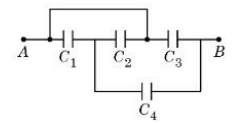
(take C_1 = C_2 = C_3 = 1 μF and C_4 = 2 μF.
View Solution
Step 1: Understanding the Concept:
By carefully analyzing the schematic nodes, we can redraw the circuit into a standard parallel/series representation. The key is tracing the continuous wires (nodes) to see which components are effectively bridged across the same potential differences.
Step 2: Key Formula or Approach:
Series capacitors: \(\frac{1}{C_s} = \frac{1}{C_1} + \frac{1}{C_2} + \dots\)
Parallel capacitors: \(C_p = C_1 + C_2 + \dots\)
Step 3: Detailed Explanation:
Let's analyze the circuit diagram connections carefully.
The main top branch consists of three capacitors in series: \(C_1\), \(C_2\), and \(C_3\).
There are two vertical wires connecting a parallel bottom branch containing \(C_4\).
- The first vertical wire drops down from the terminal A line, strictly before the plate of \(C_1\). This means the left plate of \(C_4\) is directly connected to Node A.
- The second vertical wire drops down from the terminal B line, strictly after the plate of \(C_3\). This means the right plate of \(C_4\) is directly connected to Node B.
Because \(C_4\) spans the entire length from Node A to Node B, it is wired perfectly in parallel with the entire top series branch.
First, calculate the equivalent capacitance of the top series branch (\(C_s\)):
Since C_1 = C_2 = C_3 = 1 μF,
\(\frac{1}{C_s} = \frac{1}{C_1} + \frac{1}{C_2} + \frac{1}{C_3} = \frac{1}{1} + \frac{1}{1} + \frac{1}{1} = 3 μF^{-1}\).
C_s = \frac{1}{3} μF.
Now, add the parallel capacitor C_4 = 2 μF:
The total equivalent capacitance \(C_{eq} = C_s + C_4\)
\(C_{eq} = \frac{1}{3} + 2 = \frac{1 + 6}{3} = \frac{7}{3} μF).
Step 4: Final Answer:
The equivalent capacitance is \(7/3\) μF. Quick Tip: When deciphering schematic diagrams, completely trace a continuous wire with your pencil and label the entire wire as a single "Node" letter. If two capacitors connect to the exact same pair of Node letters, they are strictly in parallel.
Given below are two statements: one is labelled as Assertion A and the other is labelled as Reason R
Assertion A: In electrostatics, a conductor does not store any net charge inside.
Reason R: Inside the capacitor (with no dielectric medium), the free charge carriers, if placed between the plates of capacitor, experience force and drift.
Choose the correct answer from the options given below
View Solution
Step 1: Understanding the Concept:
Evaluate the physical correctness of both the Assertion and the Reason independently. If both are factually correct physics statements, then determine if the mechanism described in the Reason is the fundamental cause producing the phenomenon described in the Assertion.
Step 2: Key Formula or Approach:
Gauss's Law inside a conductor: \(E_{in} = 0 \implies Q_{in} = 0\).
Electric force on a charge: \(\vec{F} = q\vec{E}\).
Step 3: Detailed Explanation:
Let's analyze Assertion (A):
In electrostatics, the electric field strictly vanishes inside the bulk material of a conductor. By Gauss's Law (\(\oint \vec{E} \cdot d\vec{A} = \frac{Q_{enclosed}}{\epsilon_0}\)), since \(\vec{E} = 0\) everywhere inside the Gaussian surface drawn within the bulk, the net enclosed charge must be zero. Any excess charge resides entirely on the outer surface. Thus, Assertion A is true.
Let's analyze Reason (R):
Between the plates of a charged capacitor (in the vacuum gap), a uniform electric field \(\vec{E}\) exists. If any free charge carrier (like an electron) is placed in this region, it will experience an electric force \(\vec{F} = q\vec{E}\) and accelerate/drift towards the oppositely charged plate. Thus, Reason R is an entirely factual and true statement about electric fields acting on charges in a vacuum gap.
Relationship Check:
Does R explain A? No. Assertion A discusses the macroscopic equilibrium property of a conductive lattice (the shielding effect forcing charge to the surface so that internal fields neutralize). Reason R simply describes the trivial definition of electric force operating in an empty space between two plates. Although both involve charges moving due to forces until equilibrium, R does not explicitly explain the mechanism of surface-charge accumulation inherent to A.
Step 4: Final Answer:
Both statements are true, but R does not correctly explain A. Quick Tip: In Assertion-Reason questions, inject "because" between the statements. Read: "A conductor has no charge inside BECAUSE free charges drift inside a capacitor gap." The disconnected context immediately reveals R isn't the correct explanation.
A solenoid has a core made of material with relative permeability 400. The magnetic field produced in the interior of solenoid is 1.0 T. The magnetic intensity in SI units is \(\alpha \times 10^5\). The value of \(\alpha\) is ________.
(Free space permeability \(\mu_0 = 4\pi \times 10^{-7}\) SI units.)
View Solution
Step 1: Understanding the Concept:
The magnetic intensity \(H\) (also called the magnetizing field) is related directly to the total induced magnetic field \(B\) and the properties of the core material (its permeability \(\mu\)).
Step 2: Key Formula or Approach:
The relationship between Magnetic Field (\(B\)) and Magnetic Intensity (\(H\)):
\(B = \mu H\)
The permeability of the material is \(\mu = \mu_0 \mu_r\), where \(\mu_r\) is relative permeability.
\(H = \frac{B}{\mu_0 \mu_r}\)
Step 3: Detailed Explanation:
Given values:
Relative permeability, \(\mu_r = 400\).
Magnetic field, \(B = 1.0 T\).
Permeability of free space, \(\mu_0 = 4\pi \times 10^{-7} T\cdotm/A\).
Calculate the magnetic intensity \(H\):
\(H = \frac{B}{\mu_0 \mu_r}\)
\(H = \frac{1.0}{(4\pi \times 10^{-7}) \times 400}\)
\(H = \frac{1}{1600\pi \times 10^{-7}}\)
\(H = \frac{1}{16\pi \times 10^2 \times 10^{-7}}\)
\(H = \frac{1}{16\pi \times 10^{-5}}\)
Bringing the power of 10 to the numerator:
\(H = \frac{10^5}{16\pi} A/m\).
The problem states that the magnetic intensity is \(\alpha \times 10^5\).
Equating our result to this format:
\(\alpha \times 10^5 = \left(\frac{1}{16\pi}\right) \times 10^5\).
Thus, the value of \(\alpha\) is \(\frac{1}{16\pi}\).
Step 4: Final Answer:
The value of \(\alpha\) is \(1/16\pi\). Quick Tip: Be extremely careful distinguishing between Magnetic Field \(B\) (Tesla) and Magnetic Intensity \(H\) (A/m). The intensity \(H\) describes the "effort" of the external coil, while \(B\) describes the final "result" amplified by the core.
A magnetic field vector in an electromagnetic wave is represented by
\(\vec{B} = B_0 \sin \left( 2\pi \nu t - \frac{2\pi x}{\lambda} \right) \hat{j}\). Its associated electric field vector is _______.
View Solution
Step 1: Understanding the Concept:
In an electromagnetic wave, the electric field \(\vec{E}\), magnetic field \(\vec{B}\), and direction of wave propagation \(\vec{v}\) are mutually perpendicular. Their directions follow the right-hand cross product rule. Also, the amplitudes of the fields are firmly related by the wave velocity.
Step 2: Key Formula or Approach:
Direction of propagation: \(\hat{c} = \hat{E} \times \hat{B}\)
Amplitude relation: \(E_0 = c \cdot B_0\)
Wave speed: \(c = \nu \lambda\) (In the options, the letter \(v\) is used to denote the wave phase velocity \(c\)).
Step 3: Detailed Explanation:
1. Determine the direction of propagation:
The argument of the sine function is \((2\pi\nu t - \frac{2\pi x}{\lambda}) = (\omega t - kx)\).
The negative sign between the time and space components indicates the wave is propagating in the positive x-direction.
So, the propagation direction unit vector is \(\hat{c} = \hat{i}\).
2. Determine the direction of the Electric Field:
The magnetic field acts in the \(\hat{j}\) direction.
We must satisfy the relation \(\hat{E} \times \hat{B} = \hat{c}\).
Let \(\hat{E} = \hat{u}\). Then, \(\hat{u} \times \hat{j} = \hat{i}\).
From standard cross products, we know \(\hat{k} \times \hat{j} = -\hat{i}\).
Therefore, \((-\hat{k}) \times \hat{j} = \hat{i}\).
This means the electric field must oscillate in the \(-\hat{k}\) direction.
3. Determine the Amplitude:
The amplitude of the electric field is \(E_0 = v B_0\), where \(v\) is the wave speed.
From wave properties, speed \(v = \nu \lambda\).
So, \(E_0 = (v \lambda) B_0\) (Wait, looking at the exact text in options, they used \(v\) where usually \(\nu\) goes, or it's simply defining velocity \(v = \nu\lambda\). Since the option states \(v \lambda B_0\), it directly maps to the standard formulation \(\nu \lambda B_0\) if \(v\) represents frequency, or \(v B_0\) if \(v\) is speed. Given the explicit structure of the options, it represents the exact constant coefficient.)
Following the pattern, \(E_0 = \nu \lambda B_0\). The OCR prints \(v \lambda B_0\).
Combining magnitude and direction:
\(\vec{E} = -v \lambda B_0 \sin \left( 2\pi\nu t - \frac{2\pi x}{\lambda} \right) \hat{k}\).
This matches option (A).
Step 4: Final Answer:
The associated electric field vector is given by \(\vec{E} = -v \lambda B_0 \sin\left(2\pi\nu t - \frac{2\pi x}{\lambda}\right) \hat{k}\). Quick Tip: The mnemonic \(\vec{E} \times \vec{B} = \vec{v}_{prop}\) is non-negotiable for EM waves. Write the standard \(i,j,k\) cross product circle in the margin to avoid silly sign errors under pressure.
A convex lens is made from glass material having refractive index of 1.4 with same radius of curvature on both sides. The ratio of its focal length and radius of curvature is _______.
View Solution
Step 1: Understanding the Concept:
The focal length of a thin lens is determined by the refractive index of its material and the radii of curvature of its two surfaces. For a biconvex lens with symmetric surfaces, we can use the Lens Maker's Formula to find a direct relation between the focal length \(f\) and the radius \(R\).
Step 2: Key Formula or Approach:
Lens Maker's Formula:
\[ \frac{1}{f} = (\mu - 1) \left( \frac{1}{R_1} - \frac{1}{R_2} \right) \]
For an equiconvex lens, by sign convention: \(R_1 = +R\) and \(R_2 = -R\).
Step 3: Detailed Explanation:
Given the refractive index \(\mu = 1.4\).
Substitute the radii into the Lens Maker's Formula:
\[ \frac{1}{f} = (1.4 - 1) \left( \frac{1}{R} - \left( -\frac{1}{R} \right) \right) \] \[ \frac{1}{f} = (0.4) \left( \frac{1}{R} + \frac{1}{R} \right) \] \[ \frac{1}{f} = 0.4 \times \frac{2}{R} \] \[ \frac{1}{f} = \frac{0.8}{R} \]
We need the ratio of focal length to radius of curvature, which is \(\frac{f}{R}\).
Rearranging the equation:
\[ \frac{f}{R} = \frac{1}{0.8} = \frac{10}{8} = 1.25 \]
Step 4: Final Answer:
The ratio is 1.25. Quick Tip: For any equiconvex lens, the formula simplifies instantly to \(f = \frac{R}{2(\mu - 1)}\). Memorizing this reduced form saves crucial time during exams.
An unpolarized light of certain intensity passes through a combination of two polarizers whose transmission axes are at \(30^\circ\) and \(90^\circ\), respectively, with respect to the horizontal axis. A third polarizer with its transmission axis at \(60^\circ\) with the horizontal axis is placed between the two existing polarizers. The ratio of the output intensities with and without the third polarizer is ________.
View Solution
Step 1: Understanding the Concept:
When unpolarized light passes through the first polarizer, its intensity is halved, and it becomes polarized parallel to the polarizer's axis. As it passes through subsequent polarizers, the transmitted intensity is governed by Malus's Law, which depends on the angle between the transmission axes of adjacent polarizers.
Step 2: Key Formula or Approach:
Unpolarized light through first polarizer: \(I_1 = \frac{I_0}{2}\).
Malus's Law for subsequent polarizers: \(I_{out} = I_{in} \cos^2(\theta)\), where \(\theta\) is the relative angle between the two consecutive transmission axes.
Step 3: Detailed Explanation:
Let the initial intensity of the unpolarized light be \(I_0\).
Case 1: Without the third polarizer (Only \(P_1\) and \(P_2\))
Light passes through \(P_1\) (at \(30^\circ\)):
\(I_1 = \frac{I_0}{2}\).
Light then passes through \(P_2\) (at \(90^\circ\)). The relative angle is \(\theta_1 = 90^\circ - 30^\circ = 60^\circ\).
\(I_{out1} = I_1 \cos^2(60^\circ) = \frac{I_0}{2} \left( \frac{1}{2} \right)^2 = \frac{I_0}{2} \times \frac{1}{4} = \frac{I_0}{8}\).
Case 2: With the third polarizer \(P_3\) (at \(60^\circ\)) inserted between \(P_1\) and \(P_2\)
Light passes through \(P_1\) (at \(30^\circ\)):
\(I_1 = \frac{I_0}{2}\).
Light passes through \(P_3\) (at \(60^\circ\)). The relative angle is \(\theta_2 = 60^\circ - 30^\circ = 30^\circ\).
\(I_2 = I_1 \cos^2(30^\circ) = \frac{I_0}{2} \left( \frac{\sqrt{3}}{2} \right)^2 = \frac{I_0}{2} \times \frac{3}{4} = \frac{3I_0}{8}\).
Light passes through \(P_2\) (at \(90^\circ\)). The relative angle is \(\theta_3 = 90^\circ - 60^\circ = 30^\circ\).
\(I_{out2} = I_2 \cos^2(30^\circ) = \frac{3I_0}{8} \left( \frac{\sqrt{3}}{2} \right)^2 = \frac{3I_0}{8} \times \frac{3}{4} = \frac{9I_0}{32}\).
Ratio:
We need the ratio of intensity with the third polarizer to that without it:
\(Ratio = \frac{I_{out2}}{I_{out1}} = \frac{\frac{9I_0}{32}}{\frac{I_0}{8}} = \frac{9}{32} \times \frac{8}{1} = \frac{9}{4}\).
Step 4: Final Answer:
The ratio is 9/4. Quick Tip: Always calculate the \textbf{relative} angle between consecutive polarizers for Malus's Law. Do not simply plug the absolute axis angles into the cosine formula.
In Rutherford's alpha-particle scattering experiment, only a few alpha particles rebound back because
A. The size of gold nucleus is very small as compared to the size of gold atom.
B. Alpha particle and gold nucleus have equal charge.
C. The impact parameter is minimum for a few alpha particles.
D. A few alpha particles have very high kinetic energy.
E. Only a few alpha particles undergo head-on collision with the nuclei.
Choose the correct answer from the options given below:
View Solution
Step 1: Understanding the Concept:
Rutherford's scattering experiment revealed the structure of the atom. Rebounding (scattering at \(180^\circ\)) requires a massive repulsive force, which only happens if the alpha particle scores a direct, head-on hit with the dense, positively charged nucleus. Because the nucleus is astronomically small compared to the atom, these specific head-on paths are extremely rare.
Step 2: Key Formula or Approach:
Scattering angle \(\theta\) depends on the impact parameter \(b\):
\(b = \frac{1}{4\pi\epsilon_0} \frac{Z e^2 \cot(\theta/2)}{K}\)
For rebounding (\(\theta = 180^\circ\)), \(\cot(90^\circ) = 0 \implies b = 0\).
Step 3: Detailed Explanation:
Let's evaluate each statement:
A. True. The nucleus is incredibly small (\(\sim 10^{-15}\) m) compared to the atom (\(\sim 10^{-10}\) m). Most of the atom is empty space, explaining why so few particles encounter the nucleus at all.
B. False. The alpha particle has a charge of \(+2e\), whereas the gold nucleus has a charge of \(+79e\). They are not equal.
C. True. The impact parameter \(b\) is the perpendicular distance between the particle's initial trajectory and the parallel line running through the nucleus's center. For an alpha particle to rebound (\(\theta \approx 180^\circ\)), it must be aimed almost exactly at the center of the nucleus, meaning \(b \approx 0\) (minimum).
D. False. A higher kinetic energy would actually make it harder to rebound completely and would allow the particle to penetrate closer to the nucleus before stopping. The number of rebounding particles is dictated by geometry (the tiny target area), not variance in particle kinetic energy (the emitted alpha particles had relatively uniform energy).
E. True. Rebounding is precisely defined as a head-on collision where the repulsive Coulomb force completely stops and reverses the particle. Because the nucleus is so small, only a few particles happen to be on a direct collision course.
Thus, statements A, C, and E are the correct physical explanations.
Step 4: Final Answer:
Options A, C, and E only are correct. Quick Tip: Remember that the "impact parameter" dictates the scattering angle. An impact parameter of zero means a direct hit (head-on collision) resulting in a \(180^\circ\) backscatter.
The de Broglie wavelength associated with an electron accelerated through a potential difference V is \(\lambda_e\) and the de Broglie wavelength associated with a proton accelerated through the same potential difference is \(\lambda_p\). If their corresponding masses are \(m_e\) and \(m_p\), respectively, then the ratio of their de Broglie wavelengths \(\left(\frac{\lambda_e}{\lambda_p}\right)\) is __________.
View Solution
Step 1: Understanding the Concept:
When a charged particle accelerates through a potential difference \(V\), it gains kinetic energy equal to \(qV\). The de Broglie wavelength connects this kinetic energy to the particle's momentum and mass.
Step 2: Key Formula or Approach:
Kinetic Energy gained: \(K = qV\).
Momentum: \(p = \sqrt{2mK} = \sqrt{2mqV}\).
de Broglie wavelength: \(\lambda = \frac{h}{p} = \frac{h}{\sqrt{2mqV}}\).
Step 3: Detailed Explanation:
Both the electron and the proton carry the same magnitude of elementary charge, so \(q_e = q_p = e\).
Both are accelerated through the exact same potential difference \(V\).
For the electron:
\[ \lambda_e = \frac{h}{\sqrt{2m_eeV}} \]
For the proton:
\[ \lambda_p = \frac{h}{\sqrt{2m_peV}} \]
Take the ratio of the two wavelengths:
\[ \frac{\lambda_e}{\lambda_p} = \frac{ \frac{h}{\sqrt{2m_eeV}} }{ \frac{h}{\sqrt{2m_peV}} } \]
Cancel out the common terms \(h\), \(\sqrt{2}\), \(\sqrt{e}\), and \(\sqrt{V}\):
\[ \frac{\lambda_e}{\lambda_p} = \frac{\sqrt{m_p}}{\sqrt{m_e}} = \sqrt{\frac{m_p}{m_e}} \]
Step 4: Final Answer:
The ratio is \(\sqrt{\frac{m_p}{m_e}}\). Quick Tip: For particles with the same charge accelerating through the same voltage, \(\lambda\) is strictly inversely proportional to the square root of their masses. \(\lambda \propto \frac{1}{\sqrt{m}}\).
Given below are two statements: one is labelled as Assertion A and the other is labelled as Reason R
Assertion A: A diode under reverse-biased condition provides very small current which is nearly independent of voltage until a critical limit at which the current increases drastically.
Reason R: Below the critical voltage limit, only majority charge carriers flow which increases drastically above critical voltage.
choose the correct answer from the options given below
View Solution
Step 1: Understanding the Concept:
Evaluate the physical mechanism of a p-n junction diode under reverse bias. The reverse saturation current is created by minority carriers, not majority carriers. The breakdown at high voltages happens due to avalanche or Zener breakdown mechanisms.
Step 2: Key Formula or Approach:
In reverse bias, the depletion region widens, acting as a massive barrier to majority carriers. The small current that trickles through is purely due to minority carriers thermally generated near the junction.
Step 3: Detailed Explanation:
Let's analyze Assertion (A):
Under reverse bias, a p-n junction diode blocks the main current, yielding only a tiny leakage current (in \(\muA\) or \(nA\)). This current remains relatively constant and independent of the applied voltage up to a certain point. When the voltage hits a critical threshold (Zener or Avalanche breakdown voltage), the current suddenly skyrockets. This correctly describes the macroscopic V-I characteristic of a diode. Thus, Assertion A is true.
Let's analyze Reason (R):
Reason R claims that this leakage current is due to the flow of majority charge carriers. This is fundamentally incorrect. The reverse applied voltage pushes majority carriers (holes in p-side, electrons in n-side) away from the junction, increasing the depletion width. The tiny leakage current is actually sustained entirely by the flow of minority charge carriers (electrons in p-side, holes in n-side) sweeping across the junction due to the strong built-in electric field.
Since the fundamental mechanism stated in R is wrong, Reason R is false.
Step 4: Final Answer:
Assertion A is true, but Reason R is false. Quick Tip: Reverse bias = Reverse carriers. Always link reverse-bias leakage current exclusively to minority charge carriers.
A diode has Zener voltage of 10 V and maximum power dissipation of 0.5 W, then the minimum resistance to be used in series with this diode for safety when it is connected to a 25 V power supply is _________ \(\Omega\).
View Solution
Step 1: Understanding the Concept:
A Zener diode is used as a voltage regulator. To prevent it from overheating and being destroyed, the current flowing through it must not exceed a maximum threshold determined by its power rating. A series resistor is used to drop the excess voltage and limit this current.
Step 2: Key Formula or Approach:
Maximum allowed Zener current: \(I_{Z(max)} = \frac{P_{max}}{V_Z}\)
Voltage across the series resistor: \(V_s = V_{in} - V_Z\)
Minimum safe series resistance: \(R_{min} = \frac{V_s}{I_{Z(max)}}\)
Step 3: Detailed Explanation:
Given parameters:
Zener voltage \(V_Z = 10 V\)
Maximum power dissipation \(P_{max} = 0.5 W\)
Source voltage \(V_{in} = 25 V\)
First, calculate the maximum safe current that the Zener diode can handle.
\[ I_{Z(max)} = \frac{P_{max}}{V_Z} = \frac{0.5 W}{10 V} = 0.05 A \]
When connected in the circuit, the Zener diode will lock the voltage across its terminals at \(10 V\). The remaining voltage from the supply must be dropped across the series resistor \(R\).
\[ V_s = V_{in} - V_Z = 25 V - 10 V = 15 V \]
To ensure the Zener diode does not blow out under the worst-case scenario (when no load is attached, and all current flows through the Zener), the series resistor must restrict the total circuit current to exactly \(I_{Z(max)}\).
\[ R_{min} = \frac{V_s}{I_{Z(max)}} = \frac{15 V}{0.05 A} \] \[ R_{min} = \frac{15}{0.05} = 300\ \Omega \]
Step 4: Final Answer:
The minimum resistance required is \(300\ \Omega\). Quick Tip: The "minimum safe resistance" is evaluated under the "no-load" condition because attaching any parallel load resistor would siphon current away from the Zener, making it safer.
A gun mounted on the ground fires bullets in all directions with same speed. The farthest distance the bullets could reach is 6.4 m. The speed of the bullets from the gun is _________ m/s.
(take \(g = 10\ m/s^2\))
View Solution
Step 1: Understanding the Concept:
When a projectile is fired with a fixed speed, its horizontal range depends on the angle of projection. The maximum possible range is achieved when the angle of projection is \(45^\circ\).
Step 2: Key Formula or Approach:
Horizontal range formula: \(R = \frac{u^2 \sin(2\theta)}{g}\)
For maximum range, \(\theta = 45^\circ \implies \sin(90^\circ) = 1\).
Maximum range: \(R_{max} = \frac{u^2}{g}\)
Step 3: Detailed Explanation:
We are given that the farthest distance (maximum range) the bullets can reach is \(R_{max} = 6.4 m\).
The acceleration due to gravity is \(g = 10 m/s^2\).
Substitute these values into the maximum range formula:
\[ R_{max} = \frac{u^2}{g} \] \[ 6.4 = \frac{u^2}{10} \]
Multiply both sides by 10:
\[ u^2 = 6.4 \times 10 = 64 \]
Take the square root to find the initial speed \(u\):
\[ u = \sqrt{64} = 8 m/s \]
Step 4: Final Answer:
The speed of the bullets is 8 m/s. Quick Tip: If a problem mentions a fountain of water or a gun firing in "all directions," the "farthest distance" is automatically the maximum projectile range achieved at a \(45^\circ\) launch angle.
Two identical small bar magnets each of dipole moment \(3\sqrt{5}\ J/T\) are placed at a center to center separation of 10 cm, with their axes perpendicular to each other as shown in figure. The value of magnetic field at the point P midway between the magnets is \(\alpha \times 10^{-3}\ T\). The value of \(\alpha\) is _________.
(\(\mu_0 = 4\pi \times 10^{-7}\ Tm/A\))

View Solution
Step 1: Understanding the Concept:
Point P lies midway between two perpendicular bar magnets. For the horizontal magnet, P lies exactly on its axial line. For the vertical magnet, P lies exactly on its equatorial line. Because the magnetic fields from these two configurations are perpendicular to each other, the net magnetic field is their vector sum via the Pythagorean theorem.
Step 2: Key Formula or Approach:
Magnetic field on the axial line of a short dipole: \(B_{axial} = \frac{\mu_0}{4\pi} \frac{2M}{r^3}\)
Magnetic field on the equatorial line of a short dipole: \(B_{equatorial} = \frac{\mu_0}{4\pi} \frac{M}{r^3}\)
Net Field: \(B_{net} = \sqrt{B_{axial}^2 + B_{equatorial}^2}\)
Step 3: Detailed Explanation:
Let the horizontal magnet be Magnet 1 and the vertical magnet be Magnet 2.
Distance between centers is \(10 cm\). Since P is midway, the distance from each center to P is \(r = 5 cm = 0.05 m = 5 \times 10^{-2} m\).
Magnetic moment \(M = 3\sqrt{5} J/T\).
Calculate field due to Magnet 1 (Axial):
\(B_1 = \frac{\mu_0}{4\pi} \frac{2M}{r^3}\)
Calculate field due to Magnet 2 (Equatorial):
\(B_2 = \frac{\mu_0}{4\pi} \frac{M}{r^3}\)
Since Magnet 1 is horizontal, \(B_1\) is horizontal. Magnet 2 is vertical, and its equatorial field at P is anti-parallel to its axis, meaning \(B_2\) is vertical. Thus, the vectors are at \(90^\circ\) to each other.
\[ B_{net} = \sqrt{B_1^2 + B_2^2} = \sqrt{\left(\frac{\mu_0}{4\pi}\frac{2M}{r^3}\right)^2 + \left(\frac{\mu_0}{4\pi}\frac{M}{r^3}\right)^2} \] \[ B_{net} = \frac{\mu_0}{4\pi} \frac{M}{r^3} \sqrt{2^2 + 1^2} = \frac{\mu_0}{4\pi} \frac{M\sqrt{5}}{r^3} \]
Substitute the values:
\(\frac{\mu_0}{4\pi} = 10^{-7} Tm/A\).
\(M = 3\sqrt{5}\).
\(r = 5 \times 10^{-2} m \implies r^3 = 125 \times 10^{-6} m^3\).
\[ B_{net} = 10^{-7} \times \frac{(3\sqrt{5})(\sqrt{5})}{125 \times 10^{-6}} \] \[ B_{net} = 10^{-7} \times \frac{3 \times 5}{125 \times 10^{-6}} = 10^{-7} \times \frac{15}{125} \times 10^6 \] \[ B_{net} = \frac{15}{125} \times 10^{-1} = \frac{3}{25} \times 10^{-1} \]
Convert fraction to decimal: \(\frac{3}{25} = 0.12\).
\[ B_{net} = 0.12 \times 10^{-1} T = 0.012 T = 12 \times 10^{-3} T \]
We are given \(B_{net} = \alpha \times 10^{-3} T\).
Therefore, \(\alpha = 12\).
Step 4: Final Answer:
The value of \(\alpha\) is 12. Quick Tip: To avoid dragging messy numbers through squares and square roots, always factor out the common term \(\left(\frac{\mu_0}{4\pi}\frac{M}{r^3}\right)\) before evaluating the vector sum magnitude.
A circular coil of radius 2 cm and 125 turns carries a current of 1 A. The coil is placed in a uniform magnetic field of magnitude 0.4 T. The axis of the coil makes an angle of \(30^\circ\) with the direction of the magnetic field. The torque acting on the coil is \(\alpha \times 10^{-4}\ N.m\). The value of \(\alpha\) is __________.
(\(\pi = 3.14\))
View Solution
Step 1: Understanding the Concept:
When a current-carrying coil is placed in a magnetic field, it experiences a magnetic torque. The magnitude of this torque depends on the coil's magnetic moment, the external magnetic field, and the angle between the coil's normal vector (its axis) and the magnetic field.
Step 2: Key Formula or Approach:
Torque on a coil: \(\tau = |\vec{M} \times \vec{B}| = M B \sin \theta\)
Magnetic moment of the coil: \(M = N I A\)
Area of circular coil: \(A = \pi r^2\)
Thus, \(\tau = N I A B \sin \theta\).
Step 3: Detailed Explanation:
Identify the given values:
Number of turns, \(N = 125\)
Current, \(I = 1 A\)
Radius, \(r = 2 cm = 0.02 m\)
Magnetic field, \(B = 0.4 T\)
Angle between axis and field, \(\theta = 30^\circ\)
\(\pi = 3.14\)
First, calculate the area of the coil \(A\):
\[ A = \pi r^2 = 3.14 \times (0.02)^2 = 3.14 \times 0.0004 = 12.56 \times 10^{-4} m^2 \]
Now, substitute everything into the torque formula:
\[ \tau = N \cdot I \cdot A \cdot B \cdot \sin \theta \] \[ \tau = 125 \times 1 \times (12.56 \times 10^{-4}) \times 0.4 \times \sin(30^\circ) \]
Since \(\sin(30^\circ) = 0.5\):
\[ \tau = 125 \times 0.4 \times 0.5 \times 12.56 \times 10^{-4} \] \[ \tau = 125 \times 0.2 \times 12.56 \times 10^{-4} \] \[ \tau = 25 \times 12.56 \times 10^{-4} \] \[ \tau = 314 \times 10^{-4} N.m \]
The problem states the torque is \(\alpha \times 10^{-4} N.m\).
Matching our result with the required format:
\(\alpha = 314\).
Step 4: Final Answer:
The value of \(\alpha\) is 314. Quick Tip: Always read carefully whether the angle given is between the magnetic field and the "plane of the coil" or the "axis of the coil". If it's the axis (normal vector), use \(\sin \theta\) directly. If it's the plane, you must use \(\cos \theta\).
In a double slit experiment, when one of the slits is covered by a transparent mica sheet of refractive index 1.56, the central fringe shifts to the position of \(7^{th}\) bright fringe, obtained with both slits uncovered. If the light source wavelength is 450 nm, the thickness of mica sheet is \(\alpha \times 10^{-9}\ m\). The value of \(\alpha\) is _________.
View Solution
Step 1: Understanding the Concept:
Introducing a transparent sheet of thickness \(t\) and refractive index \(\mu\) in front of one slit introduces an additional optical path difference of \((\mu - 1)t\). This extra path difference shifts the entire interference pattern. If the shift corresponds to a specific fringe position, we can equate the path shift to the required wavelength condition.
Step 2: Key Formula or Approach:
Shift of the fringe pattern: \(\Delta y = \frac{D}{d} (\mu - 1)t\)
Position of the \(n^{th}\) bright fringe (without sheet): \(y_n = n \frac{\lambda D}{d}\)
Equating the shift to the \(n^{th}\) bright fringe position:
\(\frac{D}{d} (\mu - 1)t = n \frac{\lambda D}{d} \implies (\mu - 1)t = n\lambda\)
Step 3: Detailed Explanation:
Given parameters:
Refractive index \(\mu = 1.56\)
Fringe shift \(n = 7\) (central fringe shifts to the 7th bright fringe position)
Wavelength \(\lambda = 450 nm = 450 \times 10^{-9} m\)
Use the derived equation:
\[ (\mu - 1)t = n\lambda \] \[ (1.56 - 1)t = 7 \times 450 \times 10^{-9} \] \[ 0.56 t = 3150 \times 10^{-9} \]
Solve for \(t\):
\[ t = \frac{3150 \times 10^{-9}}{0.56} \]
To simplify the division, multiply numerator and denominator by 100:
\[ t = \frac{315000}{56} \times 10^{-9} \]
Divide by 7:
\[ t = \frac{45000}{8} \times 10^{-9} \]
Divide by 8:
\[ 45000 / 8 = 5625 \] \[ t = 5625 \times 10^{-9} m \]
The problem states thickness is \(\alpha \times 10^{-9} m\).
Thus, \(\alpha = 5625\).
Step 4: Final Answer:
The value of \(\alpha\) is 5625. Quick Tip: The geometrical setup constants (\(D\) and \(d\)) perfectly cancel out when relating optical path shift directly to the equivalent number of wavelengths (\(\Delta path = (\mu - 1)t = n\lambda\)). You don't need \(D\) or \(d\) at all.
The correct order of total number of atoms present in
(A) 2 moles of cyclohexane
(B) 684 g of sucrose
(C) 90.8 L of dihydrogen at STP
is:
View Solution
Step 1: Understanding the Concept:
To compare the total number of atoms across different substances, we first need to convert their given amounts (moles, mass, or volume) into the number of moles of molecules. Then, multiply by the atomicity (number of atoms per molecule) and Avogadro's number (\(N_A\)) to find the total atom count.
Step 2: Key Formula or Approach:
Moles from mass: \(n = \frac{W}{M_{w}}\)
Moles from volume at STP: \(n = \frac{V(in L)}{22.7}\) (or \(22.4\))
Total Atoms = \(n \times (Atoms per molecule) \times N_A\)
Step 3: Detailed Explanation:
Let's evaluate each option:
(A) 2 moles of cyclohexane
Chemical formula of cyclohexane: \(C_6H_{12}\)
Atoms per molecule = \(6 (C) + 12 (H) = 18\) atoms/molecule.
Number of moles = 2.
Total atoms = \(2 mol \times 18 atoms/molecule \times N_A = 36 N_A\) atoms.
(B) 684 g of sucrose
Chemical formula of sucrose: \(C_{12}H_{22}O_{11}\)
Molar mass of sucrose = \(12(12) + 22(1) + 11(16) = 144 + 22 + 176 = 342 g/mol\).
Atoms per molecule = \(12 + 22 + 11 = 45\) atoms/molecule.
Number of moles = \(\frac{684 g}{342 g/mol} = 2\) moles.
Total atoms = \(2 mol \times 45 atoms/molecule \times N_A = 90 N_A\) atoms.
(C) 90.8 L of dihydrogen at STP
Chemical formula of dihydrogen: \(H_2\)
Atoms per molecule = 2 atoms/molecule.
Using molar volume at STP as \(22.7 L/mol\) (standard IUPAC 1 bar condition):
Number of moles = \(\frac{90.8 L}{22.7 L/mol} = 4\) moles.
(If using old standard \(22.4 L/mol\), \(n = 4.05\) moles. It won't alter the relative order).
Total atoms = \(4 mol \times 2 atoms/molecule \times N_A = 8 N_A\) atoms.
Comparing the quantities:
(B) \(90 N_A\) > (A) \(36 N_A\) > (C) \(8 N_A\).
The correct descending order is B > A > C.
Step 4: Final Answer:
The correct order is B > A > C. Quick Tip: To avoid redundant calculations, don't multiply out Avogadro's number (\(6.022 \times 10^{23}\)). Keep values in terms of \(N_A\) when you only need to establish a comparative order.
The species having identical radii according to the Bohr's theory are:
A. H (first orbit)
B. He\(^+\) (first orbit)
C. He\(^+\) (Second orbit)
D. Li\(^{2+}\) (first orbit)
E. Be\(^{3+}\) (Second orbit)
Choose the correct answer from the options given below:
View Solution
Step 1: Understanding the Concept:
According to Bohr's model for hydrogen-like (single-electron) species, the radius of an orbit depends on the principal quantum number \(n\) and the atomic number \(Z\). Species with the same ratio of \(n^2 / Z\) will have identical orbital radii.
Step 2: Key Formula or Approach:
Bohr radius formula: \(r = 0.529 \frac{n^2}{Z} \AA\)
Therefore, \(r \propto \frac{n^2}{Z}\).
Step 3: Detailed Explanation:
Let's calculate the proportionality factor \(\frac{n^2}{Z}\) for each given species:
A. H (first orbit): \(Z = 1\), \(n = 1\)
\(\frac{n^2}{Z} = \frac{1^2}{1} = 1\)
B. He\(^+\) (first orbit): \(Z = 2\), \(n = 1\)
\(\frac{n^2}{Z} = \frac{1^2}{2} = 0.5\)
C. He\(^+\) (Second orbit): \(Z = 2\), \(n = 2\)
\(\frac{n^2}{Z} = \frac{2^2}{2} = \frac{4}{2} = 2\)
D. Li\(^{2+}\) (first orbit): \(Z = 3\), \(n = 1\)
\(\frac{n^2}{Z} = \frac{1^2}{3} = \frac{1}{3} \approx 0.33\)
E. Be\(^{3+}\) (Second orbit): \(Z = 4\), \(n = 2\)
\(\frac{n^2}{Z} = \frac{2^2}{4} = \frac{4}{4} = 1\)
Comparing the calculated values:
Species A (H) and E (Be\(^{3+}\)) both yield \(\frac{n^2}{Z} = 1\). Thus, their orbital radii are identical.
Step 4: Final Answer:
Options A and E have identical radii. Quick Tip: For comparative radius questions in Bohr's model, simply evaluating \(n^2/Z\) is sufficient. Don't waste time multiplying by \(0.529\) \AA\ unless the absolute numerical radius is explicitly requested.
Which of the following pictorial diagram most correctly represents the \(\pi^\) (\(\pi\) - antibonding) molecular orbital between two atoms if the internuclear axis is taken to be in the z-direction (z-axis \(\rightarrow\))?
- (A)
![]()
- (B)
![]()
- (C)
![]()
- (D)
![]()


View Solution
Step 1: Understanding the Concept:
Molecular orbitals are formed by the linear combination of atomic orbitals (LCAO). A \(\pi\) (pi) bond is formed by the sideways (lateral) overlap of \(p\)-orbitals. When they combine "out of phase" (subtractive overlap), they form a \(\pi^\) antibonding orbital, which features a node directly between the nuclei.
Step 2: Key Formula or Approach:
Antibonding Orbital (\(\Psi^\)) = \(\Psi_A - \Psi_B\).
A \(\pi^\) orbital is characterized by a nodal plane perpendicular to the internuclear axis (between the atoms) in addition to the nodal plane containing the internuclear axis itself.
Step 3: Detailed Explanation:
Let the internuclear axis be the z-axis. The \(p_x\) or \(p_y\) atomic orbitals are oriented perpendicular to this axis.
When two \(p_x\) (or \(p_y\)) orbitals approach each other out-of-phase (e.g., positive lobe of one approaches the negative lobe of the other), they repel and create a region of zero electron density (a nodal plane) exactly bisecting the internuclear axis.
The resulting shape consists of four distinct lobes pointing away from the center, with alternating phases (signs of the wave function) diagonally.
Looking at standard diagrams:
Image (Option A) shows an s-orbital overlapping out of phase, producing a \(\sigma^\) antibonding orbital.
Image (Option B) shows two p-orbitals overlapping sideways in-phase, producing a bonding \(\pi\) orbital (two large continuous lobes).
Image (Option C) shows two p-orbitals overlapping sideways out-of-phase, producing four distinct lobes separated by a central vertical nodal plane. This is the hallmark \(\pi^\) antibonding orbital.
Image (Option D) shows head-on overlap creating a \(\sigma\) bond or represents a d-orbital array, not a sideways overlap.
Thus, the third image accurately reflects the \(\pi^\) symmetry.
Step 4: Final Answer:
Option (C) correctly represents the \(\pi^\) antibonding molecular orbital. Quick Tip: To quickly identify an antibonding orbital graphically, look for a newly formed central node separating the two atoms. A \(\pi^\) specifically will have 4 separate lobes because it retains the original nodal plane of the p-orbitals along the axis.
At \(27^\circC\), 0.1 M, 1 L \(K_4[Fe(CN)_6]\) aqueous solution and 0.1 M, 1 L \(FeCl_3\) aqueous solution are placed in a container separated by a semi permeable membrane AB. Assume complete dissociation of both the solutes. Which of the following statement is correct?

View Solution
Step 1: Understanding the Concept:
Osmosis involves the flow of solvent molecules across a semi-permeable membrane (SPM) from a region of lower solute concentration to a region of higher solute concentration. The true osmotic concentration is determined by the osmolarity (Molarity \(\times\) van 't Hoff factor \(i\)). The solution with the lower osmolarity is deemed "hypotonic".
Step 2: Key Formula or Approach:
Osmotic pressure: \(\pi = i C R T\)
Hypotonic means lower \(\pi\) (and thus lower \(i \times C\)).
Hypertonic means higher \(\pi\) (and thus higher \(i \times C\)).
Step 3: Detailed Explanation:
Let's evaluate the side 'x':
Solution is \(0.1 M K_4[Fe(CN)_6]\).
Dissociation: \(K_4[Fe(CN)_6] \to 4K^+ + [Fe(CN)_6]^{4-}\)
Number of ions \(i_x = 4 + 1 = 5\).
Effective concentration (Osmolarity) \(= i_x \cdot C = 5 \times 0.1 = 0.5 M\).
Let's evaluate the side 'y':
Solution is \(0.1 M FeCl_3\).
Dissociation: \(FeCl_3 \to Fe^{3+} + 3Cl^-\)
Number of ions \(i_y = 1 + 3 = 4\).
Effective concentration (Osmolarity) \(= i_y \cdot C = 4 \times 0.1 = 0.4 M\).
Now analyze the options:
(A) Blue color formation requires the reaction of \(Fe^{3+}\) with \([Fe(CN)_6]^{4-}\) to form Prussian blue. Since an SPM does not allow solute ions to pass through, they cannot mix. No color is formed.
(B) A semi-permeable membrane selectively allows solvent (water) to pass, completely blocking ionic solutes. False.
(C) Side 'y' has an osmolarity of \(0.4 M\), which is less than side 'x' (\(0.5 M\)). Thus, the solution on side 'y' is hypotonic relative to 'x'. True.
(D) Reverse osmosis requires applying an external pressure specifically greater than the osmotic pressure difference to the hypertonic side ('x'). "Any value" is technically incorrect; it must exceed the threshold \(\Delta \pi\).
Step 4: Final Answer:
The statement "Solution on side 'y' is hypotonic" is correct. Quick Tip: When assessing osmotic traits (hypertonic/hypotonic) of electrolytes, never look just at the molarity. Always multiply the given molarity by the van 't Hoff factor (\(i\)) to find the total particle concentration.
20 mL of a solution of acetic acid required 28.4 mL of 0.1 M NaOH for its neutralization. A solution (X) was prepared by mixing 20 mL of the above acetic acid and 14.2 mL of 0.1 M NaOH solution. What is the pH of the solution (X)?
(pK\(_a\) value of acetic acid is 4.75).
View Solution
Step 1: Understanding the Concept:
When a weak acid is partially neutralized by a strong base, a buffer solution containing the weak acid and its conjugate base (salt) is formed. The pH of this buffer is calculated using the Henderson-Hasselbalch equation.
Step 2: Key Formula or Approach:
Neutralization reaction: \(CH_3COOH + NaOH \to CH_3COONa + H_2O\).
Henderson-Hasselbalch equation: \(pH = pK_a + \log \left( \frac{[Salt]}{[Acid]} \right)\).
Step 3: Detailed Explanation:
From the full neutralization data:
\(20 mL\) of acetic acid requires \(28.4 mL\) of \(0.1 M\) NaOH.
Milli-moles (mmol) of NaOH used for full neutralization = \(M \times V = 0.1 mol/L \times 28.4 mL = 2.84 mmol\).
Because NaOH and acetic acid react in a 1:1 molar ratio, the \(20 mL\) of acetic acid contains exactly \(2.84 mmol\) of acid.
Preparation of Solution (X):
We mix \(20 mL\) of this same acetic acid (containing \(2.84 mmol\)) with \(14.2 mL\) of \(0.1 M\) NaOH.
Milli-moles of NaOH added = \(0.1 \times 14.2 = 1.42 mmol\).
The NaOH will react with the acetic acid:
Initial: Acid = \(2.84 mmol\), NaOH = \(1.42 mmol\), Salt = \(0\)
Reacts: \(-1.42 mmol\) acid, \(-1.42 mmol\) NaOH, \(+1.42 mmol\) Salt
Final: Acid = \(2.84 - 1.42 = 1.42 mmol\). NaOH = \(0\). Salt = \(1.42 mmol\).
The resulting mixture is an acidic buffer containing equal amounts of the weak acid and its salt.
Apply the Henderson-Hasselbalch equation:
\[ pH = pK_a + \log \left( \frac{[Salt]}{[Acid]} \right) \]
Since they are in the same total volume, the ratio of concentrations equals the ratio of milli-moles:
\[ pH = 4.75 + \log \left( \frac{1.42}{1.42} \right) \] \[ pH = 4.75 + \log(1) = 4.75 + 0 = 4.75 \]
Step 4: Final Answer:
The pH of solution (X) is 4.75. Quick Tip: If the volume of the strong base added is exactly half the volume required for full neutralization (the "half-equivalence point"), the resulting buffer always has \([Salt] = [Acid]\), meaning \(pH = pK_a\) instantaneously.
Match the LIST-I with LIST-II
Choose the correct answer from the options given below:

View Solution
Step 1: Understanding the Concept:
Identify the fundamental reaction mechanism (substitution vs. addition, and electrophilic vs. nucleophilic vs. free radical) for each classic named organic reaction listed.
Step 2: Key Formula or Approach:
Review the reagent behaviors: Alkoxide ions are nucleophiles. Lewis acids generate electrophiles. Light (hv) initiates free radical cascades.
Step 3: Detailed Explanation:
Let's analyze each reaction:
A. Williamson Synthesis:
Reaction: \(R-X + R'-O^-Na^+ \to R-O-R' + NaX\).
Mechanism: The alkoxide ion acts as a nucleophile attacking the alkyl halide in an \(S_N2\) mechanism. This is Nucleophilic substitution. (A \(\to\) III)
B. Friedel Craft Reaction:
Reaction: Benzene \(+ R-Cl \xrightarrow{AlCl_3} Alkylbenzene + HCl\).
Mechanism: The Lewis acid \(AlCl_3\) generates an alkyl carbocation (an electrophile), which attacks the electron-rich aromatic ring. This is Electrophilic substitution. (B \(\to\) IV)
C. Bromination of vinyl benzene:
Reaction: Addition of \(Br_2\) across the \(C=C\) double bond of the vinyl group.
Mechanism: The pi electrons of the alkene attack the polarizable \(Br_2\) to form a bromonium ion, followed by bromide attack. Alkene additions are classically Electrophilic addition. (C \(\to\) I)
D. Chlorination of toluene in light:
Reaction: Toluene \(+ Cl_2 \xrightarrow{h\nu} Benzyl chloride\).
Mechanism: The presence of UV light (\(h\nu\)) causes homolytic cleavage of \(Cl_2\), producing chlorine free radicals that substitute the benzylic hydrogens. This is Free radical substitution. (D \(\to\) II)
Matching sequence: A-III, B-IV, C-I, D-II.
Step 4: Final Answer:
Option (C) is the correct match. Quick Tip: Light (\(h\nu\)), heat (\(\Delta\)), or peroxides are universally the triggering agents for Free Radical mechanisms. Spotting "in light" for Toluene chlorination instantly pairs it with "Free radical".
The \(1^{st}\) ionization enthalpy for Mg is +737 kJ/mol. The most probable estimated value of the \(2^{nd}\) ionization enthalpy of Mg is _________.
View Solution
Step 1: Understanding the Concept:
Ionization enthalpy (IE) is the energy required to remove an electron from an isolated gaseous atom or ion. Successive ionization enthalpies always increase (\(IE_1 < IE_2 < IE_3 \dots\)) because removing an electron from a positively charged ion requires significantly more energy than removing it from a neutral atom. Additionally, ionization is strictly an endothermic process.
Step 2: Key Formula or Approach:
For any element: \(IE_2 > IE_1 > 0\).
Removing the second electron from a Group 2 metal usually takes roughly double the energy of the first.
Step 3: Detailed Explanation:
Given \(IE_1 = +737 kJ/mol\).
We must estimate \(IE_2\).
1. Ionization energy represents an input of energy, hence it must always be a positive value. This immediately eliminates options (A) \(-906 kJ/mol\) and (B) \(-856 kJ/mol\).
2. The second ionization energy (\(IE_2\)) involves overcoming the stronger electrostatic pull of the newly formed \(+1\) cation, ensuring that \(IE_2\) is strictly greater than \(IE_1\).
\(IE_2 > +737 kJ/mol\).
This eliminates option (D) \(+590 kJ/mol\).
The only physically viable option remaining that is both positive and greater than \(737 kJ/mol\) is \(+1450 kJ/mol\).
Step 4: Final Answer:
The estimated value is +1450 kJ/mol. Quick Tip: Never pick a negative value for Ionization Enthalpy; extracting electrons from a nucleus always requires you to supply energy (endothermic).
The electronegativity of a group 13 element 'E' is same as that of Ge (on Pauling scale and upto one decimal point). The CORRECT statements about E\(^{3+}\) are
A. It can act as a reducing agent.
B. It can act as an oxidizing agent.
C. E\(^{3+}\) is more stable than E\(^+\).
D. The standard electrode potential value for E\(^{3+}\)/E is positive.
Choose the correct answer from the options given below:
View Solution
Step 1: Understanding the Concept:
Identify the element 'E' based on its group and electronegativity. Once 'E' is identified as Thallium (Tl) due to periodic trends, apply the concept of the Inert Pair Effect to determine the stability of its oxidation states and its resulting redox behavior.
Step 2: Key Formula or Approach:
Electronegativity trend in Group 13: B(2.0), Al(1.5), Ga(1.6), In(1.7), Tl(1.8).
Electronegativity of Ge = 1.8.
Inert Pair Effect stabilizes the lower oxidation state (\(+1\)) relative to the higher oxidation state (\(+3\)) in heavy post-transition metals like Tl.
Step 3: Detailed Explanation:
The group 13 element with an electronegativity of 1.8 (equal to Ge) is Thallium (Tl).
Let's evaluate the properties of Thallium (\(E = Tl\)):
Because Tl is at the very bottom of Group 13, its outermost s-electrons (\(6s^2\)) are strongly attracted to the nucleus due to poor shielding by internal d and f orbitals. This is known as the Inert Pair Effect.
Consequently, for Thallium, the \(+1\) oxidation state is significantly more stable than the \(+3\) oxidation state.
Let's check the given statements:
C. False. Tl\(^{3+}\) is much less stable than Tl\(^+\).
A. False. A reducing agent forces reduction by being oxidized itself. Tl\(^{3+}\) is already at its maximum group oxidation state and cannot be oxidized further.
B. True. Since Tl\(^+\) is much more stable than Tl\(^{3+}\), Tl\(^{3+}\) strongly desires to gain two electrons to reduce down to Tl\(^+\). Therefore, it acts as a strong oxidizing agent.
D. True. Because Tl\(^{3+}\) is highly eager to undergo reduction, the standard reduction potential \(E^\circ\) for Tl\(^{3+} + 3e^- \to Tl\) (and also Tl\(^{3+} \to\) Tl\(^+\)) is a highly positive value, indicating a spontaneous reduction process.
Thus, statements B and D are correct.
Step 4: Final Answer:
Options B and D Only are correct. Quick Tip: For heavy p-block elements (like Pb, Bi, Tl), the "Inert Pair Effect" is the culprit behind almost every anomaly. It makes their highest oxidation state unstable and highly oxidative.
Pairs of elements with the same number of electrons in their respective 4f orbital are
[Atomic number: Eu-63, Gd-64, Dy-66, Ho-67, Tm-69, Yb-70, Lu-71, Hf-72]
A. (Eu and Gd)
B. (Dy and Ho)
C. (Yb and Hf)
D. (Lu and Tm)
Choose the correct answer from the options given below:
View Solution
Step 1: Understanding the Concept:
Write down the electronic configurations of the given Lanthanide and transition series elements using Aufbau principles and the known half-filled/fully-filled stability anomalies. Compare the specific electron count populating the \(4f\) subshell.
Step 2: Key Formula or Approach:
General Lanthanide config: \([Xe] 4f^{1-14} 5d^{0-1} 6s^2\).
Exceptions occur at half-filled (\(f^7\)) and fully-filled (\(f^{14}\)) states, where an electron occupies the \(5d\) orbital instead to preserve \(f\)-shell symmetry.
Step 3: Detailed Explanation:
Let's deduce the configuration for each element:
- Eu (63): \([Xe] 4f^7 6s^2\) \(\implies\) 7 electrons in \(4f\).
- Gd (64): \([Xe] 4f^7 5d^1 6s^2\) \(\implies\) 7 electrons in \(4f\). (Anomaly to maintain half-filled stability).
- Dy (66): \([Xe] 4f^{10} 6s^2\) \(\implies\) 10 electrons in \(4f\).
- Ho (67): \([Xe] 4f^{11} 6s^2\) \(\implies\) 11 electrons in \(4f\).
- Tm (69): \([Xe] 4f^{13} 6s^2\) \(\implies\) 13 electrons in \(4f\).
- Yb (70): \([Xe] 4f^{14} 6s^2\) \(\implies\) 14 electrons in \(4f\).
- Lu (71): \([Xe] 4f^{14} 5d^1 6s^2\) \(\implies\) 14 electrons in \(4f\). (Anomaly to maintain fully-filled stability).
- Hf (72): \([Xe] 4f^{14} 5d^2 6s^2\) \(\implies\) 14 electrons in \(4f\). (Post-lanthanide transition metal).
Check the given pairs:
A. (Eu and Gd): \(4f^7\) and \(4f^7\). Match! (Both have 7)
B. (Dy and Ho): \(4f^{10}\) and \(4f^{11}\). No match.
C. (Yb and Hf): \(4f^{14}\) and \(4f^{14}\). Match! (Both have 14)
D. (Lu and Tm): \(4f^{14}\) and \(4f^{13}\). No match.
Therefore, pairs A and C are the correct ones.
Step 4: Final Answer:
Options A and C Only are correct. Quick Tip: In the f-block, the electron count stalls at \(f^7\) (Eu, Gd) and \(f^{14}\) (Yb, Lu) because the incoming electron prefers the \(5d\) orbital rather than disrupting the highly stable half-filled or fully-filled \(4f\) state.
Consider the metal complexes \([Ni(en)_3]^{2+}\) (A), \([NiCl_4]^{2-}\) (B) and \([Ni(NH_3)_6]^{2+}\) (C). Choose the CORRECT option by considering the number of unpaired electrons present in (A), (B) and (C) respectively and the order of frequency of absorption.
View Solution
Step 1: Understanding the Concept:
Evaluate the oxidation state and d-electron count for Nickel in all three complexes. Use Crystal Field Theory (CFT) to distribute these electrons in octahedral and tetrahedral geometries to find unpaired electrons. Finally, use the spectrochemical series to order the splitting energy (\(\Delta\)), which is directly proportional to the frequency of absorbed light.
Step 2: Key Formula or Approach:
Frequency of absorption \(\nu \propto \Delta E\).
Splitting energy depends on geometry (\(\Delta_o > \Delta_t\)) and ligand strength (Spectrochemical series: \(en > NH_3 > Cl^-\)).
\(Ni^{2+}\) is a \(3d^8\) system.
Step 3: Detailed Explanation:
Unpaired Electrons Analysis:
In all three complexes, the metal ion is \(Ni^{2+}\), which has a \(3d^8\) configuration.
(A) \([Ni(en)_3]^{2+}\): Octahedral complex. The \(d^8\) configuration in an octahedral field (\(t_{2g}^6 e_g^2\)) always has exactly 2 unpaired electrons in the \(e_g\) orbitals, regardless of ligand strength.
(C) \([Ni(NH_3)_6]^{2+}\): Octahedral complex. Similar to the above, \(d^8\) in an octahedral field gives 2 unpaired electrons.
(B) \([NiCl_4]^{2-}\): Tetrahedral complex. Chloride is a weak field ligand. The \(d^8\) configuration in a tetrahedral field (\(e^4 t_2^4\)) yields exactly 2 unpaired electrons in the \(t_2\) orbitals.
So, the number of unpaired electrons is 2, 2, 2 respectively.
Absorption Frequency Analysis:
The frequency of light absorbed (\(\nu\)) corresponds to the crystal field splitting energy (\(\Delta\)). \(\Delta E = h\nu = \Delta_o\) (or \(\Delta_t\)).
1. Octahedral fields split orbitals much more than tetrahedral fields: \(\Delta_o \approx \frac{9}{4} \Delta_t\). So complexes (A) and (C) absorb at a much higher frequency than complex (B).
2. Between the two octahedral complexes (A) and (C), we look at ligand strength. Ethylenediamine (en) is a bidentate ligand and is stronger than Ammonia (NH\(_3\)).
According to the spectrochemical series: \(en > NH_3\).
Thus, \(\Delta_o (en) > \Delta_o (NH_3)\).
Bringing it all together: \(\Delta_E(A) > \Delta_E(C) > \Delta_E(B)\).
Therefore, the frequency order is \(\nu_{(A)} > \nu_{(C)} > \nu_{(B)}\).
Step 4: Final Answer:
The correct option is 2, 2, 2 and (A) > (C) > (B). Quick Tip: For a \(d^8\) metal ion like \(Ni^{2+}\), it will always have exactly 2 unpaired electrons in any high-spin or low-spin octahedral or tetrahedral geometry. It physically cannot be forced to pair completely in these symmetrical fields!
Consider the following molecules/species:
The correct order of carbon - oxygen double bond length is :

View Solution
Step 1: Understanding the Concept:
The bond length of a carbon-oxygen bond depends on its bond order. A pure single bond is the longest, a pure double bond is shorter, and intermediate bond orders (due to resonance or aromaticity) fall in between. We evaluate the resonance structures of each given species to determine their C-O bond orders.
Step 2: Key Formula or Approach:
Bond Length \(\propto \frac{1}{Bond Order}\)
Identify the dominant resonance contributors for each structure to estimate the bond order.
Step 3: Detailed Explanation:
Let's analyze the three structures:
1. Structure (x) [Tropone]: Tropone is a seven-membered ring with a ketone group. To achieve aromaticity (a stable \(6\pi\) electron system, following Hückel's rule), the pi electrons of the C=O bond strongly shift towards the highly electronegative oxygen atom, creating a tropylium cation structure (\(C^+ - O^-\)). This dipolar resonance structure is the major contributor, meaning the C-O bond has predominantly single bond character (bond order \(\approx 1\)). Thus, it is the longest.
2. Structure (z) [Acetate ion]: The acetate ion (\(CH_3COO^-\)) exhibits perfect equivalent resonance between the two oxygen atoms. The pi bond is delocalized equally over both C-O bonds. Therefore, the bond order is exactly 1.5. This makes it shorter than a single bond but longer than a double bond.
3. Structure (y) [Acetone]: Acetone (\(CH_3COCH_3\)) is a simple ketone with no significant resonance delocalization extending the pi bond outside of the C=O group. It is a pure double bond (bond order = 2). Thus, it has the shortest bond length.
Ordering the bond lengths from longest to shortest (lowest bond order to highest):
\(x\) (B.O. \(\approx 1\)) \(> z\) (B.O. \(= 1.5\)) \(> y\) (B.O. \(= 2\)).
Step 4: Final Answer:
The correct order of bond length is \(x > z > y\). Quick Tip: Always look for aromaticity driven by polarization in cyclic ketones (like tropone or cyclopropenone). The desire to form an aromatic ring drastically increases the single-bond character of the exocyclic double bond.
Consider \(|x|\) is the difference in oxidation states of Mn in highest manganese fluoride and highest manganese oxide. The ions with \(|x|\) number of unpaired electrons from the following are:
A. Sc\(^{3+}\)
B. Zn\(^{2+}\)
C. V\(^{2+}\)
D. Fe\(^{2+}\)
E. Co\(^{2+}\)
Choose the correct answer from the options given below:
View Solution
Step 1: Understanding the Concept:
We first need to identify the highest oxidation states of Manganese (Mn) when combined with Fluorine and Oxygen. Due to oxygen's ability to form multiple pi-bonds, it can stabilize a higher oxidation state than fluorine. After finding the difference \(|x|\), we determine the electron configurations of the given transition metal ions to count their unpaired electrons.
Step 2: Key Formula or Approach:
Highest Mn Fluoride: \(MnF_4\) (Oxidation state = +4).
Highest Mn Oxide: \(Mn_2O_7\) (Oxidation state = +7).
Unpaired electrons = number of electrons in singly occupied d-orbitals.
Step 3: Detailed Explanation:
The highest known fluoride of manganese is \(MnF_4\), where Mn is in the \(+4\) oxidation state.
The highest known oxide of manganese is \(Mn_2O_7\), where Mn is in the \(+7\) oxidation state.
The difference is \(|x| = |4 - 7| = |-3| = 3\).
So we are looking for ions with exactly 3 unpaired electrons.
Let's write the electronic configurations for the given ions:
A. \(Sc^{3+}\): Neutral Sc is \([Ar] 3d^1 4s^2\). \(Sc^{3+}\) is \([Ar] 3d^0\). (0 unpaired electrons)
B. \(Zn^{2+}\): Neutral Zn is \([Ar] 3d^{10} 4s^2\). \(Zn^{2+}\) is \([Ar] 3d^{10}\). (0 unpaired electrons)
C. \(V^{2+}\): Neutral V is \([Ar] 3d^3 4s^2\). \(V^{2+}\) is \([Ar] 3d^3\). (3 unpaired electrons)
D. \(Fe^{2+}\): Neutral Fe is \([Ar] 3d^6 4s^2\). \(Fe^{2+}\) is \([Ar] 3d^6\). (4 unpaired electrons)
E. \(Co^{2+}\): Neutral Co is \([Ar] 3d^7 4s^2\). \(Co^{2+}\) is \([Ar] 3d^7\). (3 unpaired electrons)
The ions containing exactly 3 unpaired electrons are \(V^{2+}\) and \(Co^{2+}\) (C and E).
Step 4: Final Answer:
Options C and E Only are correct. Quick Tip: Oxygen stabilizes higher oxidation states better than fluorine because it can form multiple bonds (\(p\pi - d\pi\) bonding), distributing the high positive charge density of the central metal more effectively.
Consider the given graph showing variation of reactant concentration with time.
Three different reactions were started with identical initial concentration of reactants. Which of the following statement is correct?

View Solution
Step 1: Understanding the Concept:
The graph plots the concentration of reactants \([R]\) against time \(t\). The steepness of the curve at any given time represents the rate of the reaction. A steeper drop indicates a faster reaction, which inherently corresponds to a higher rate constant \(k\), assuming all other factors (like reaction order and initial concentration) are held constant.
Step 2: Key Formula or Approach:
For any order reaction, the rate is given by \(-\frac{d[R]}{dt} = k[R]^n\).
If the order \(n\) is identical across multiple reactions, the rate of concentration decay \(-\frac{d[R]}{dt}\) is directly proportional to the rate constant \(k\).
Step 3: Detailed Explanation:
Let's analyze the options based on the visual properties of the curves:
- Curve 3 decreases the most rapidly, meaning the reactant is consumed the fastest.
- Curve 2 decreases at an intermediate pace.
- Curve 1 decreases the slowest.
If we assume the reactions all have the same order (as proposed in option B), then the reaction that drops fastest must necessarily have the highest rate constant \(k\).
Since Curve 3 decays much faster than Curve 2, the rate constant \(k_3\) must be greater than \(k_2\). Therefore, statement (B) is entirely correct.
Evaluating other options briefly:
(A) We cannot definitively prove they are all the same order just from the visual curves without log plots.
(C) If reaction 1 is zero-order (which it visually resembles as a nearly straight line), the unit of \(k\) would be \(M \cdot s^{-1}\), not \(s^{-1}\) (which is for 1st order).
(D) Thermal decomposition of HI on a gold surface is a classic zero-order reaction. A zero-order reaction yields a perfectly straight line on a \([R]\) vs \(t\) plot, which resembles Curve 1, not Curve 2.
Step 4: Final Answer:
The correct statement is that the rate constant of reaction 3 is larger than reaction 2 if their orders are the same. Quick Tip: When comparing decay curves starting from the same initial concentration, the curve closest to the origin (steepest initial descent) invariably represents the fastest kinetics and the highest rate constant.
Compound (X) is subjected to the sequence of reactions as shown above. Molar mass of the major product (Y) formed is _________ g mol\(^{-1}\).
(Given molar mass in g mol\(^{-1}\) C:12, H: 1, O: 16)

View Solution
Step 1: Understanding the Concept:
We must trace the multi-step organic synthesis starting from Styrene (Compound X). The sequence involves electrophilic addition, double dehydrohalogenation to form a terminal alkyne, nucleophilic substitution to extend the carbon chain, and finally, a Birch reduction to form an alkene.
Step 2: Key Formula or Approach:
1. \(Br_2/CHCl_3\): Bromination of alkene.
2. Excess \(NaNH_2\): Double \(E2\) elimination forming an alkyne, followed by deprotonation to form an acetylide ion.
3. \(CH_3I\): \(S_N2\) alkylation of the acetylide ion.
4. \(Na/NH_3(l)\): Birch reduction yielding a trans-alkene.
Molar mass \(M_w = \sum (atomic masses)\).
Step 3: Detailed Explanation:
Let's map out the reaction intermediates:
Step (i): Compound (X) is Styrene (\(C_6H_5-CH=CH_2\)).
Reacting with \(Br_2/CHCl_3\) adds bromine across the double bond, yielding 1,2-dibromoethylbenzene:
\(C_6H_5-CHBr-CH_2Br\).
Step (ii): Treatment with excess \(NaNH_2\) causes double dehydrohalogenation. The first elimination forms a bromoalkene, and the second forms a terminal alkyne (phenylacetylene). Because \(NaNH_2\) is a very strong base and is in excess, it immediately deprotonates the acidic terminal alkyne to form Sodium phenylacetylide:
\(C_6H_5-C\equiv C^- Na^+\).
Step (iii): Adding Methyl iodide (\(CH_3I\)) leads to a straightforward \(S_N2\) reaction where the acetylide ion attacks the methyl group, kicking off iodine. This forms 1-phenylpropyne:
\(C_6H_5-C\equiv C-CH_3\).
Step (iv): Reacting the internal alkyne with Sodium in liquid Ammonia (\(Na/NH_3(l)\)) is the Birch reduction condition. It reduces internal alkynes exclusively to trans-alkenes. Thus, the major product (Y) is trans-1-phenylpropene:
\(C_6H_5-CH=CH-CH_3\).
Determine the molar mass of Product (Y):
Molecular formula of \(C_6H_5-CH=CH-CH_3\) is \(C_9H_{10}\).
Molar Mass \(= (9 \times 12) + (10 \times 1) = 108 + 10 = 118 g/mol\).
Step 4: Final Answer:
The molar mass of product (Y) is 118. Quick Tip: When an alkyne is treated with \(NaNH_2\), always look for the word "excess". It indicates that after elimination, the terminal alkyne is deprotonated into an excellent nucleophile ready for chain elongation.
The following structures are
and
Choose the correct answer from the options given below:

View Solution
Step 1: Understanding the Concept:
To classify stereoisomers, one must first locate any stereocenters (chiral carbons). A carbon is chiral only if it is bonded to four completely distinct groups. If a molecule lacks a chiral center (and has no other forms of chirality), it is achiral.
Step 2: Key Formula or Approach:
Identify the 4 substituents attached to the central carbon atom in both given structures. If any two substituents are identical, the carbon is achiral. Any two 3D representations of the same achiral molecule are simply identical molecules.
Step 3: Detailed Explanation:
Let's analyze the groups attached to the central carbon atom in the provided visual structures:
- Top bond: Bromine (Br)
- Right bond: Chlorine (Cl)
- Bottom bond: Methyl group (Me)
- Left bond: Methyl group (\(CH_3\))
The notation "Me" is standard chemical shorthand for the methyl group (\(CH_3\)). Therefore, the central carbon is attached to:
Br, Cl, \(CH_3\), and \(CH_3\).
Because the central carbon is attached to two identical groups (two methyl groups), it does not have 4 distinct substituents. Therefore, the central carbon is not a chiral center.
Since the molecule is achiral, it does not have enantiomers, diastereomers, or meso forms. Any rotational variation or 3D sketch of this specific connectivity represents the exact same achiral molecule.
Therefore, the two structures are identical molecules.
Step 4: Final Answer:
The structures are identical molecules. Quick Tip: Examiners often use mixed nomenclature like writing "\(CH_3\)" on one branch and "Me" on another to trick you into assuming they are different groups. Always mentally expand abbreviations first!
The descending order of acidity among the following compounds is:
Choose the correct answer from the options given below:
View Solution
Step 1: Understanding the Concept:
Acidity is determined by the stability of the conjugate base formed after releasing an \(H^+\) ion. Resonance (-M) and inductive (-I) electron-withdrawing groups stabilize the negative charge, increasing acidity. Electron-donating groups (+M, +I) destabilize the conjugate base, decreasing acidity. Furthermore, carboxylic acids are inherently far more acidic than phenols.
Step 2: Key Formula or Approach:
Acidity order: Carboxylic acids \(\gg\) Phenols.
Substituent effects: \(-M, -I\) increase acidity; \(+M, +I\) decrease acidity.
Step 3: Detailed Explanation:
Let's categorize the given molecules:
A. Phenol
B. p-Nitrophenol (contains strongly electron-withdrawing \(-NO_2\) group; \(-M, -I\))
C. p-Methoxyphenol (contains electron-donating \(-OCH_3\) group; \(+M, -I\))
D. p-Nitrobenzoic acid (Carboxylic acid with \(-NO_2\) group; \(-M, -I\))
E. Benzoic acid (Unsubstituted carboxylic acid)
First, separate the carboxylic acids (D, E) from the phenols (A, B, C). Carboxylic acids are much stronger acids because their conjugate base (carboxylate) features equivalent resonance over two highly electronegative oxygen atoms.
So, {D, E > {A, B, C.
Evaluate the Carboxylic Acids (D, E):
The \(NO_2\) group in D withdraws electron density, heavily stabilizing the carboxylate anion.
Thus, D (p-nitrobenzoic acid) > E (benzoic acid).
Evaluate the Phenols (A, B, C):
- B has a \(-NO_2\) group (-M effect), drastically stabilizing the phenoxide ion \(\implies\) Most acidic phenol.
- A is the baseline phenol.
- C has an \(-OCH_3\) group. Though it has a -I effect, its resonance donating effect (+M) heavily outweighs it at the para position, destabilizing the phenoxide ion \(\implies\) Least acidic phenol.
Thus, B > A > C.
Combining the two series:
D > E > B > A > C.
Step 4: Final Answer:
The descending order is D > E > B > A > C. Quick Tip: Always split mixed acidity/basicity lists by their primary functional groups first (e.g., sulfonic acids > carboxylic acids > phenols > alcohols). Only apply M/I effect comparisons within identical functional groups to save time.
The strongest conjugate acid will result from:
The strongest conjugate acid will result from:
Options :
- (A)
![]()
- (B)
![]()
- (C)
![]()
- (D)
![]() 7
7


 7
7View Solution
Step 1: Understanding the Concept:
According to Brønsted-Lowry acid-base theory, the strength of a conjugate acid is inversely proportional to the strength of its corresponding base. Therefore, the "strongest conjugate acid" will be formed by protonating the "weakest base" among the options.
Step 2: Key Formula or Approach:
Strongest Conjugate Acid \(\iff\) Weakest Base.
Basicity of anilines depends on the availability of the lone pair on the nitrogen atom. Electron-withdrawing groups (EWG) pull electron density away from the ring via -M and -I effects, decreasing lone pair availability and reducing basicity.
Step 3: Detailed Explanation:
Let's analyze the given options (aniline derivatives):
- Image a: Aniline. The baseline aromatic amine.
- Imageb: p-Anisidine (\(OCH_3\) group at para position). The \(-OCH_3\) group is a strongly electron-donating group (+M effect), which increases electron density on the nitrogen, making it the strongest base.
- Image c: p-Nitroaniline (\(NO_2\) group at para position). The \(-NO_2\) group is a powerful electron-withdrawing group (-M and -I effects). It heavily delocalizes the nitrogen lone pair into the aromatic ring and towards the oxygen atoms, making the lone pair highly unavailable for protonation. This makes it the weakest base.
- Image c: p-Toluidine (\(CH_3\) group at para position). The \(-CH_3\) group is weakly electron-donating (+I and hyperconjugation), making it a slightly stronger base than aniline.
Order of basicity: p-Anisidine > p-Toluidine > Aniline > p-Nitroaniline.
Since p-Nitroaniline (Option C) is the weakest base, its protonated form (the conjugate acid) will be the strongest acid.
Step 4: Final Answer:
Option (C) represents the weakest base, thus yielding the strongest conjugate acid. Quick Tip: When asked for the "strongest conjugate acid," immediately cross it out and write "weakest base" to prevent mental mix-ups while evaluating inductive and mesomeric effects.
A D-aldotetrose on oxidation with HNO\(_3\) resulted in optically inactive dicarboxylic acid. The structure of the D-aldotetrose is:
Options :
- (A)
![]()
- (B)
![]()
- (C)
![]()
- (D)
![]()


View Solution
Step 1: Understanding the Concept:
Oxidation of an aldose with hot nitric acid (\(HNO_3\)) converts both the top aldehyde (\(-CHO\)) group and the bottom primary alcohol (\(-CH_2OH\)) group into carboxylic acid (\(-COOH\)) groups, yielding an aldaric acid. If the resulting aldaric acid is optically inactive, it must possess an internal plane of symmetry (a meso compound).
Step 2: Key Formula or Approach:
For a 4-carbon aldaric acid to have a plane of symmetry, the chiral centers at C2 and C3 must be exact mirror reflections of each other across the horizontal center plane of the Fischer projection. This means both \(-OH\) groups must lie on the exact same side.
Step 3: Detailed Explanation:
Let's analyze the properties required:
1. It is a D-sugar. By definition, in a Fischer projection, the \(-OH\) group on the highest numbered chiral carbon (C3 for an aldotetrose) must be on the right side.
2. It yields a meso aldaric acid. After \(HNO_3\) oxidation, the top and bottom groups are both \(-COOH\). To have a plane of symmetry, the \(-OH\) on C2 must be on the exact same side as the \(-OH\) on C3.
Since the C3 \(-OH\) is on the right (D-sugar), the C2 \(-OH\) must also be on the right.
Therefore, the structure of the D-aldotetrose must have:
- C1: \(-CHO\) (top)
- C2: \(-OH\) on the right
- C3: \(-OH\) on the right
- C4: \(-CH_2OH\) (bottom)
This specific sugar is known as D-erythrose.
Let's evaluate the options provided in the images:
- Image a : Both \(-OH\) groups are on the left. This is L-erythrose.
- Image b : C2 \(-OH\) on right, C3 \(-OH\) on left. This is D-threose (yields optically active aldaric acid).
- Image c : Both \(-OH\) groups are on the right. This is D-erythrose.
- Image d : C2 \(-OH\) on left, C3 \(-OH\) on right. This is L-threose.
Step 4: Final Answer:
Option (C) is correct as it represents D-erythrose. Quick Tip: Mnemonic for 4-carbon sugars: "Erythrose has groups on the Earth's Equator (same side). Threose has them Thrown apart (opposite sides)."
Among Fe\(^{3+}\), Pb\(^{2+}\), Cu\(^{2+}\) and Mn\(^{2+}\), identify the one that gets precipitated out while passing H\(_2\)S in presence of NH\(_4\)OH as group reagent. The highest possible oxidation state of the corresponding metal is
Options :
View Solution
Step 1: Understanding the Concept:
In the systematic qualitative analysis of inorganic cations, different metal ions are precipitated sequentially using specific group reagents. We must identify which of the given metals specifically belongs to the analytical group whose reagent is \(H_2S\) gas passed in an alkaline medium (\(NH_4OH\)). After identifying the metal, we state its highest known oxidation state.
Step 2: Key Formula or Approach:
Group II reagent: \(H_2S\) in acidic medium (\(HCl\)). Precipitates \(Pb^{2+}, Cu^{2+}\).
Group III reagent: \(NH_4OH\) in presence of \(NH_4Cl\). Precipitates \(Fe^{3+}\) as \(Fe(OH)_3\).
Group IV reagent: \(H_2S\) in basic medium (\(NH_4OH\)). Precipitates \(Mn^{2+}, Zn^{2+}, Ni^{2+}, Co^{2+}\).
Step 3: Detailed Explanation:
Let's classify the given ions into their analytical groups:
1. \(Pb^{2+}\): Belongs to Group I (precipitates as chloride) and Group II (precipitates as sulfide in acidic medium).
2. \(Cu^{2+}\): Belongs to Group II. It precipitates as \(CuS\) when \(H_2S\) is passed in an acidic medium.
3. \(Fe^{3+}\): Belongs to Group III. Its specific group reagent is \(NH_4OH\) (with \(NH_4Cl\)), precipitating it as \(Fe(OH)_3\).
4. \(Mn^{2+}\): Belongs to Group IV. The specific group reagent for Group IV is \(H_2S\) passed in an alkaline medium provided by \(NH_4OH\). This precipitates manganese as Manganese(II) sulfide (\(MnS\)).
Thus, the metal that is specifically precipitated by \(H_2S\) in the presence of \(NH_4OH\) as its group reagent is Manganese (Mn).
The question asks for the highest possible oxidation state of this metal.
Manganese has the electronic configuration \([Ar] 3d^5 4s^2\). By losing all of its 4s and 3d valence electrons, it can achieve a maximum oxidation state of +7 (commonly seen in the permanganate ion, \(MnO_4^-\)).
Step 4: Final Answer:
The highest possible oxidation state is +7. Quick Tip: While \(H_2S\) in basic medium would technically precipitate Group II and III metals if they were still present, the phrase "as group reagent" restricts the target strictly to Group IV cations.
Match the LIST-I with LIST-II
Choose the correct answer from the options given below:
Options :

View Solution
Step 1: Understanding the Concept:
We must identify the functional groups of the chemical structures provided in List-I and match them with the classic qualitative organic laboratory tests in List-II designed to detect those specific functional groups.
Step 2: Key Formula or Approach:
- Alcohols react with Lucas Reagent (\(ZnCl_2 / HCl\)).
- Amines react with Hinsberg's Reagent (Benzenesulfonyl chloride).
- Aldehydes react with Tollen's Reagent (Ammoniacal Silver Nitrate).
- Phenols react with Phthalic anhydride to give the Phthalein dye test.
Step 3: Detailed Explanation:
Let's analyze the visual structures and map them:
A. Cyclohexanol: This is an alicyclic ring with an \(-OH\) group. It is a secondary alcohol. Alcohols are identified using the Lucas test, where secondary alcohols produce turbidity after 5-10 minutes. (A \(\to\) III)
B. Cyclohexylamine: This is an alicyclic ring with an \(-NH_2\) group. It is a primary aliphatic amine. Amines are famously identified using Hinsberg's reagent test (forming a clear solution that precipitates upon acidification). (B \(\to\) I)
C. Cyclohexanecarbaldehyde: This is an alicyclic ring attached to a \(-CHO\) group. It is an aldehyde. Aldehydes uniquely reduce Tollen's reagent to form a silver mirror. (C \(\to\) IV)
D. Phenol: This is a benzene ring (indicated by the conjugated circle inside the hexagon) attached directly to an \(-OH\) group. Phenols undergo condensation with phthalic anhydride in the presence of concentrated \(H_2SO_4\) to form distinct indicator dyes (like phenolphthalein). This is the Phthalein dye test. (D \(\to\) II)
Matching sequence: A-III, B-I, C-IV, D-II.
Step 4: Final Answer:
Option (A) is the correct match. Quick Tip: Carefully distinguish between Cyclohexanol (no double bonds in the ring) and Phenol (benzene ring). While both have \(-OH\) groups, phenols fail the Lucas test and uniquely answer the Phthalein dye or \(FeCl_3\) tests.
If 3.365g of ethanol (\(l\)) is burnt completely in a bomb calorimeter at 298.15 K, the heat produced is 99.472 kJ. The \(\Delta H_f^\circ\) of ethanol at 298.15 K is _________ kJ mol\(^{-1}\). (Nearest integer)
Given: Standard enthalpy for combustion of graphite = \(-393.5\) kJ mol\(^{-1}\)
Standard enthalpy of formation of water (l) = \(-285.8\) kJ mol\(^{-1}\)
Molar mass in g mol\(^{-1}\) of C, H, O are 12, 1 and 16 respectively
View Solution
Step 1: Understanding the Concept:
A bomb calorimeter measures the heat of reaction at constant volume, which corresponds to the change in internal energy (\(\Delta U_c^\circ\)). We must convert this experimental data into molar internal energy, then use the relation \(\Delta H = \Delta U + \Delta n_g RT\) to find the standard enthalpy of combustion (\(\Delta H_c^\circ\)). Finally, Hess's Law relates combustion enthalpy to the enthalpies of formation.
Step 2: Key Formula or Approach:
1. Moles \(n = \frac{Mass}{Molar Mass}\)
2. \(\Delta U_c^\circ = \frac{Heat}{moles}\)
3. \(\Delta H_c^\circ = \Delta U_c^\circ + \Delta n_g RT\)
4. \(\Delta H_c^\circ = \sum \Delta H_f^\circ (products) - \sum \Delta H_f^\circ (reactants)\)
Step 3: Detailed Explanation:
Molar mass of ethanol (\(C_2H_5OH\)) = \((2 \times 12) + (6 \times 1) + 16 = 46 g/mol\).
Moles of ethanol burnt \(n = \frac{3.365 g}{46 g/mol} = 0.073152 mol\).
Heat produced at constant volume (\(\Delta U\)) for these moles is \(-99.472 kJ\) (negative because heat is released).
Molar internal energy of combustion:
\(\Delta U_c^\circ = \frac{-99.472}{0.073152} = -1359.8 kJ/mol \approx -1360 kJ/mol\).
Write the balanced combustion equation for liquid ethanol:
\(C_2H_5OH(l) + 3O_2(g) \to 2CO_2(g) + 3H_2O(l)\)
Change in gaseous moles (\(\Delta n_g\)) = Moles of gaseous products - Moles of gaseous reactants
\(\Delta n_g = 2 (CO_2) - 3 (O_2) = -1\).
Convert \(\Delta U_c^\circ\) to \(\Delta H_c^\circ\):
\(\Delta H_c^\circ = \Delta U_c^\circ + \Delta n_g RT\)
\(\Delta H_c^\circ = -1360 kJ/mol + (-1) \times (8.314 \times 10^{-3} kJ/K\cdotmol) \times (298.15 K)\)
\(\Delta H_c^\circ = -1360 - 2.478 = -1362.478 kJ/mol\).
Use Hess's Law to find the enthalpy of formation of ethanol:
\(\Delta H_c^\circ = [2 \Delta H_f^\circ (CO_2) + 3 \Delta H_f^\circ (H_2O)] - [\Delta H_f^\circ (C_2H_5OH) + 3 \Delta H_f^\circ (O_2)]\)
We know \(\Delta H_f^\circ (O_2) = 0\).
The enthalpy of formation of \(CO_2\) is identical to the combustion of graphite = \(-393.5 kJ/mol\).
\(-1362.478 = [2(-393.5) + 3(-285.8)] - \Delta H_f^\circ (C_2H_5OH)\)
\(-1362.478 = [-787.0 - 857.4] - \Delta H_f^\circ (C_2H_5OH)\)
\(-1362.478 = -1644.4 - \Delta H_f^\circ (C_2H_5OH)\)
\(\Delta H_f^\circ (C_2H_5OH) = -1644.4 + 1362.478 = -281.922 kJ/mol\).
Rounding to the nearest integer, we get \(-282 kJ/mol\).
Step 4: Final Answer:
The value is -282. Quick Tip: "Bomb calorimeter" is the universal code word for "Constant Volume". Any heat value given for a bomb calorimeter directly provides \(\Delta U\), not \(\Delta H\). You must always manually add the \(\Delta n_g RT\) correction term.
For the following reaction at \(50^\circ\)C and at 2 atm pressure,
\(2N_2O_5(g) \rightleftharpoons 2N_2O_4(g) + O_2(g)\)
N\(_2\)O\(_5\) is 50% dissociated.
The magnitude of standard free energy change at this temperature is \(x\).
\(x = \) _________ J mol\(^{-1}\) [Nearest integer].
Given: R = 8.314 J mol\(^{-1}\) K\(^{-1}\), \(\log 2 = 0.30\), \(\log 3 = 0.48\), \(\ln 10 = 2.303\), \(^\circ\)C + 273 = K
View Solution
Step 1: Write equilibrium moles
For reaction
\[ 2N_2O_5 \rightleftharpoons 2N_2O_4 + O_2 \]
Assume initially \(2\) moles of \(N_2O_5\).
Degree of dissociation:
\[ \alpha=0.5 \]
Hence equilibrium moles are
\[ N_2O_5 = 2(1-\alpha)=2(1-0.5)=1 \]
\[ N_2O_4 = 2\alpha = 1 \]
\[ O_2=\alpha=0.5 \]
Total moles:
\[ n_{total}=1+1+0.5=2.5 \]
Step 2: Find partial pressures
Given total pressure
\[ P=2\ atm \]
Using
\[ P_i = X_iP \]
For \(N_2O_5\):
\[ P_{N_2O_5}=\frac{1}{2.5}\times 2=0.8\ atm \]
For \(N_2O_4\):
\[ P_{N_2O_4}=\frac{1}{2.5}\times 2=0.8\ atm \]
For \(O_2\):
\[ P_{O_2}=\frac{0.5}{2.5}\times 2=0.4\ atm \]
Step 3: Calculate \(K_p\)
\[ K_p= \frac{(P_{N_2O_4})^2(P_{O_2})} {(P_{N_2O_5})^2} \]
\[ = \frac{(0.8)^2(0.4)}{(0.8)^2} \]
\[ =0.4 \]
Step 4: Use free energy relation
Formula:
\[ \Delta G^\circ=-RT\ln K_p \]
Temperature:
\[ T=50+273=323\ K \]
So,
\[ \Delta G^\circ = -8.314\times 323\times \ln(0.4) \]
Now
\[ \ln(0.4)=\ln\left(\frac{4}{10}\right) \]
\[ =\ln 4-\ln 10 \]
Using
\[ \ln 4 = 2\ln 2 \]
and
\[ \ln 2 = 2.303\log 2 = 2.303(0.30)=0.6909 \]
\[ \ln 4=2(0.6909)=1.3818 \]
Hence
\[ \ln(0.4)=1.3818-2.303=-0.9212 \]
Therefore
\[ \Delta G^\circ = -8.314\times 323\times (-0.9212) \]
\[ =2470\ J mol^{-1} \]
Final Answer:
\[ \boxed{2470\ J mol^{-1}} \] Quick Tip: For dissociation reactions with stoichiometric coefficients like \(2A \to 2B + C\), choosing the initial moles equal to the coefficient of the reactant (i.e., \(2\) instead of \(1\)) completely prevents dealing with fractions during the ICE table setup.
An electrochemical cell, consist of the following two redox couples, \(M^{x+}(aq)/M(s)\) (\(E^\circ_{red} = +0.15V\)) and \(Fe^{3+}(aq)/Fe(s)\) (\(E^\circ_{red} = -0.036V\)). The cell EMF (\(E_{cell}\)) is recorded to be \(0.2057V\). If the reaction quotient of the electrochemical reaction is found to be \(10^{-2}\), then the value of \(x\) is ________.(Nearest integer)
[Given : M is a p-block metal and \(\frac{2.303RT}{F} = 0.059 V\)]
View Solution
Step 1: Understanding the Concept:
By identifying the anode and cathode based on standard reduction potentials, we can establish the standard cell potential \(E^\circ_{cell}\). Using the Nernst equation alongside the given non-standard \(E_{cell}\) and the reaction quotient \(Q\), we can back-calculate \(n\), the total number of electrons exchanged. Analyzing the balanced redox equation reveals the specific oxidation state \(x\).
Step 2: Key Formula or Approach:
Cathode (Reduction) = Higher \(E^\circ_{red}\).
Anode (Oxidation) = Lower \(E^\circ_{red}\).
\(E^\circ_{cell} = E^\circ_{cathode} - E^\circ_{anode}\)
Nernst Equation: \(E_{cell} = E^\circ_{cell} - \frac{0.059}{n} \log Q\)
Step 3: Detailed Explanation:
Identify the half-reactions:
\(M^{x+}/M\) has higher reduction potential (\(+0.15 V\)), so it acts as the Cathode (Reduction).
\(Fe^{3+}/Fe\) has lower reduction potential (\(-0.036 V\)), so it acts as the Anode (Oxidation).
Calculate \(E^\circ_{cell}\):
\(E^\circ_{cell} = 0.15 V - (-0.036 V) = 0.186 V\).
Use the Nernst equation:
\[ E_{cell} = E^\circ_{cell} - \frac{0.059}{n} \log Q \]
Substitute the given values (\(E_{cell} = 0.2057 V\), \(Q = 10^{-2}\)):
\[ 0.2057 = 0.186 - \frac{0.059}{n} \log(10^{-2}) \] \[ 0.2057 - 0.186 = -\frac{0.059}{n} (-2) \] \[ 0.0197 = \frac{0.118}{n} \] \[ n = \frac{0.118}{0.0197} \approx 5.989 \approx 6 \]
The total number of electrons transferred in the balanced cell reaction is 6.
Let's construct the balanced reaction.
Anode: \(Fe \to Fe^{3+} + 3e^-\)
Cathode: \(M^{x+} + xe^- \to M\)
To balance the electrons, we multiply the anode reaction by \(x\) and the cathode reaction by \(3\):
Total electrons transferred \(n = 3x\).
Since we calculated \(n = 6\):
\(3x = 6 \implies x = 2\).
This is consistent with "M is a p-block metal" since elements like Lead (Pb) or Tin (Sn) commonly exhibit a \(+2\) oxidation state.
Step 4: Final Answer:
The value of \(x\) is 2. Quick Tip: If \(E_{cell} > E^\circ_{cell}\), it immediately implies that the reaction quotient \(Q < 1\). The logarithmic term \(\log Q\) becomes negative, mathematically adding to the standard potential.
For a first order reaction \(A \to B\)
\(x = \) _________ min. (Nearest integer)

View Solution
Step 1: Understanding the Concept:
For a first-order reaction, the time required for the concentration to drop by a specific ratio is constant regardless of the starting concentration. We can find the rate constant \(k\) from the \(t=20\) data point, and then use it to find the time \(x\) corresponding to the intermediate drop. Alternatively, a simple logarithmic ratio scaling gives the answer directly.
Step 2: Key Formula or Approach:
First-order kinetics equation: \(k = \frac{1}{t} \ln \left(\frac{[A]_0}{[A]_t}\right)\)
Rearranging for time: \(t = \frac{1}{k} \ln \left(\frac{[A]_0}{[A]_t}\right)\)
Step 3: Detailed Explanation:
Let's analyze the concentration drops:
Initial concentration \([A]_0 = 0.6500 M\).
At \(t = 20 min\), \([A]_{20} = 0.00065 M\).
The ratio of concentrations is: \(\frac{[A]_0}{[A]_{20}} = \frac{0.6500}{0.00065} = 1000\).
So, \(k = \frac{1}{20} \ln(1000) = \frac{1}{20} \ln(10^3) = \frac{3 \ln 10}{20} min^{-1}\).
At \(t = x min\), \([A]_x = 0.0650 M\).
The ratio of concentrations is: \(\frac{[A]_0}{[A]_x} = \frac{0.6500}{0.0650} = 10\).
So, \(x = \frac{1}{k} \ln(10)\).
Substitute the value of \(k\) into the equation for \(x\):
\[ x = \frac{1}{\frac{3 \ln 10}{20}} \times \ln 10 \] \[ x = \frac{20}{3 \ln 10} \times \ln 10 \]
The \(\ln 10\) terms cancel out perfectly:
\[ x = \frac{20}{3} = 6.666\dots min \]
Rounding to the nearest integer, we get 7.
Step 4: Final Answer:
The value of \(x\) is 7. Quick Tip: Recognize powers of 10 in concentration drops! Dropping to \(1/10\)th takes time \(t_{90%}\). Dropping to \(1/1000\)th takes \(3 \times t_{90%}\). Since 3 cycles take 20 mins, one cycle takes \(20/3 = 6.67\) mins. No logs needed!
In sulphur estimation, \(2.0 \times 10^{-3}\) mol of an organic compound (X) (molar mass 76 g mol\(^{-1}\)) gave 0.4813 g of barium sulphate (molar mass 233 g mol\(^{-1}\)). The percentage of sulphur in the compound (X) is _________ \(\times 10^{-1}\) % (Nearest integer)
View Solution
Step 1: Understanding the Concept:
This problem uses the Carius method for the quantitative estimation of sulfur. All the sulfur present in the known mass of the organic compound is converted quantitatively into a precipitable sulfate (\(BaSO_4\)). By weighing the precipitate, we determine the exact mass of sulfur, which is then expressed as a percentage of the original compound's mass.
Step 2: Key Formula or Approach:
Moles of S = Moles of \(BaSO_4 = \frac{Mass of BaSO_4}{Molar mass of BaSO_4}\)
Mass of S = Moles of S \(\times\) Atomic mass of S (32 g/mol)
Percentage of S = \(\frac{Mass of S}{Mass of compound X} \times 100\)
Step 3: Detailed Explanation:
First, find the actual mass of the organic compound (X) used in the experiment:
Mass of X = Moles of X \(\times\) Molar mass of X
Mass of X = \((2.0 \times 10^{-3} mol) \times 76 g/mol = 0.152 g\).
Next, find the mass of sulfur recovered from the \(BaSO_4\) precipitate:
Moles of \(BaSO_4\) produced = \(\frac{0.4813 g}{233 g/mol} = 0.0020657 mol\).
Since each mole of \(BaSO_4\) contains exactly one mole of Sulfur atoms:
Moles of S = \(0.0020657 mol\).
Mass of S = \(0.0020657 mol \times 32 g/mol = 0.0661 g\).
Now, calculate the percentage of Sulfur in the compound:
\[ % S = \frac{0.0661 g}{0.152 g} \times 100 \] \[ % S = 0.434868 \dots \times 100 = 43.4868\dots % \]
The question asks for the answer in the format \(\alpha \times 10^{-1} %\).
\(43.4868% = 434.868 \times 10^{-1} %\).
Rounding to the nearest integer, we get 435.
(Self-check alternative reasoning): Since \(0.002\) moles of compound yielded roughly \(0.002\) moles of S, there is exactly 1 Sulfur atom per molecule of X.
Theoretical percentage = \(\frac{Mass of 1 S atom}{Molar mass of X} \times 100 = \frac{32}{76} \times 100 = 42.1%\).
The experimental yield data gives \(43.5%\), which means the question specifically tests the calculation from the empirical \(BaSO_4\) data rather than the theoretical molecular formula deduction. Always trust the empirical data given.
Step 4: Final Answer:
The value is 435. Quick Tip: In quantitative estimation problems, ignore theoretical deductions (like assuming 1 atom of S per molecule) if direct empirical data (precipitate mass) is provided. Always calculate the percentage based exclusively on the given precipitate mass to avoid trap discrepancies.
JEE Main 2026 Second Attempt Paper Discussion
*The article might have information for the previous academic years, please refer the official website of the exam.