
JEE Main 2026 April 6 Shift 2 Question Paper with Solution PDF


Content Curator | Updated On - Jun 6, 2026
JEE Main 2026 April 6 Shift 2 Question Paper with Solution PDF is available here for download. NTA Conducted JEE Main on April 6, Shift 2, from 3 PM to 6 PM in CBT Mode.NTA has released the JEE Main official Question Paper on the official website jeemain.nta.nic.in.
The JEE Main 2026 today's question paper included three sections: Physics, Chemistry, and Mathematics, with 75 Questions carrying a total of 300 Marks, as per the JEE Main marking scheme, +4 marks for every correct answer, and -1 mark is deducted for every wrong answer.
Also Check: JEE Main 2026 April 6 Shift 1 Question Paper with Solution PDF
JEE Main 2026 April 6 Shift 2 Question Paper with Solution Pdf
| JEE Main 2026 April 6 Shift 2 Question Paper | Download PDF | Check Solutions |

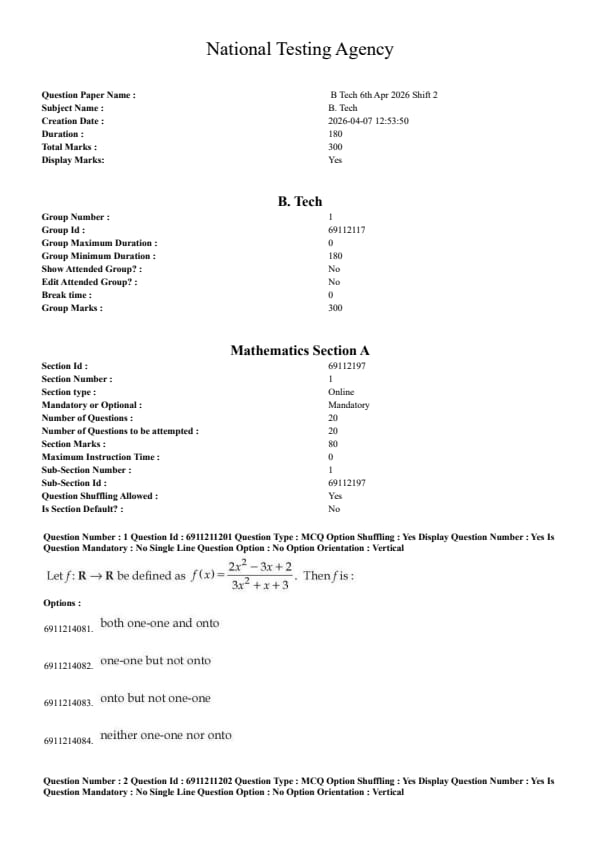
Let \( f : \mathbb{R} \to \mathbb{R} \) be defined as \( f(x) = \dfrac{2x^2 - 3x + 2}{3x^2 + x + 3} \). Then \( f \) is:
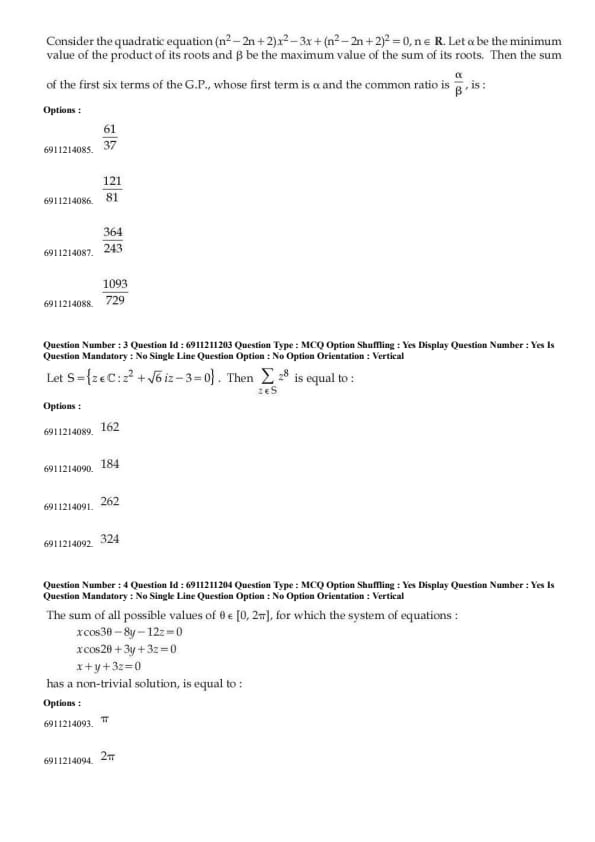
Consider the quadratic equation \( (n^2 - 2n + 2)x^2 - 3x + (n^2 - 2n + 2)^2 = 0, \; n \in \mathbb{R}. \)
Let \( \alpha \) be the minimum value of the product of its roots and \( \beta \) be the maximum value of the sum of its roots. Then the sum of the first six terms of the G.P., whose first term is \( \alpha \) and the common ratio is \( \dfrac{\alpha}{\beta} \), is:
Let \( S = \{z \in \mathbb{C} : z^2 + \sqrt{6}\,iz - 3 = 0 \}. \) Then \( \displaystyle \sum_{z \in S} z^8 \) is equal to:
The sum of all possible values of \( \theta \in [0,2\pi] \), for which the system of equations : \[ x\cos3\theta - 8y - 12z = 0 \] \[ x\cos2\theta + 3y + 3z = 0 \] \[ x + y + 3z = 0 \]
has a non-trivial solution, is equal to :
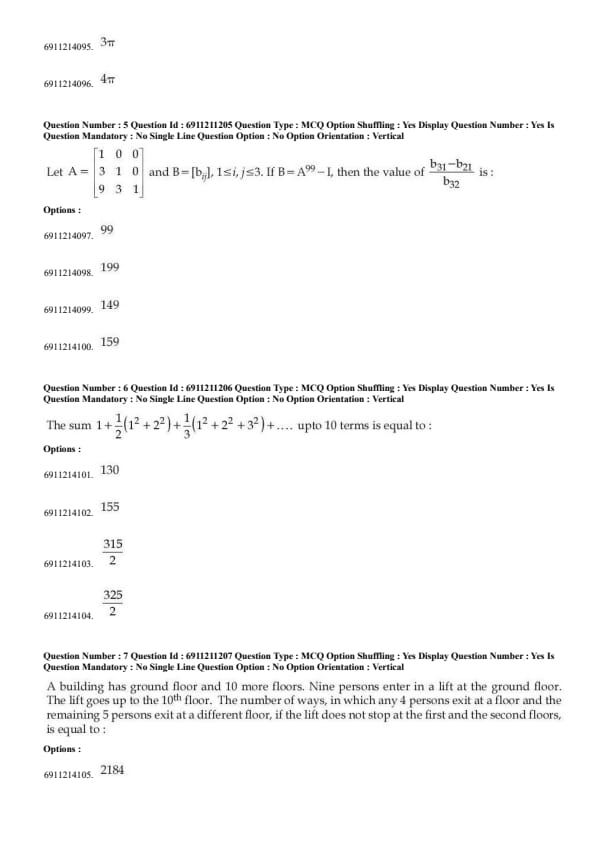
Let \( A = \begin{bmatrix} 1 & 0 & 0
3 & 1 & 0
9 & 3 & 1 \end{bmatrix} \) and \( B = [b_{ij}], 1 \le i,j \le 3 \). If \( B = A^{99} - I \), then the value of \( \dfrac{b_{31}-b_{21}}{b_{32}} \) is:
The sum \( 1 + \frac{1}{2}(1^2+2^2) + \frac{1}{3}(1^2+2^2+3^2) + \ldots \) upto \(10\) terms is equal to:
A building has ground floor and 10 more floors. Nine persons enter in a lift at the ground floor. The lift goes up to the 10th floor. The number of ways, in which any 4 persons exit at a floor and the remaining 5 persons exit at a different floor, if the lift does not stop at the first and the second floors, is equal to :
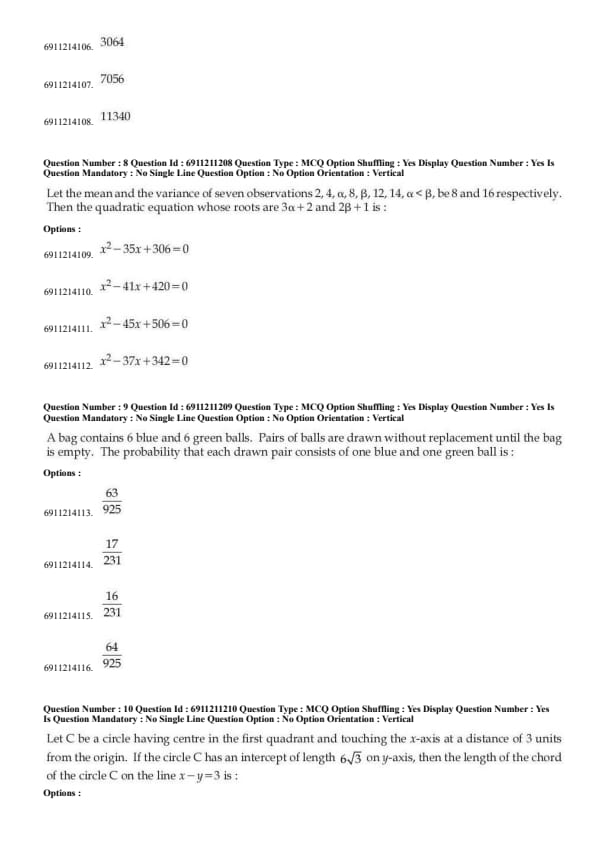
Let the mean and the variance of seven observations \(2,4,\alpha,8,\beta,12,14\), \( \alpha < \beta \), be \(8\) and \(16\) respectively. Then the quadratic equation whose roots are \(3\alpha+2\) and \(2\beta+1\) is :
A bag contains 6 blue and 6 green balls. Pairs of balls are drawn without replacement until the bag is empty. The probability that each drawn pair consists of one blue ball and one green ball is:
Let \(C\) be a circle having centre in the first quadrant and touching the \(x\)-axis at a distance of \(3\) units from the origin. If the circle \(C\) has an intercept of length \(6\sqrt{3}\) on \(y\)-axis, then the length of the chord of the circle \(C\) on the line \(x-y=3\) is:
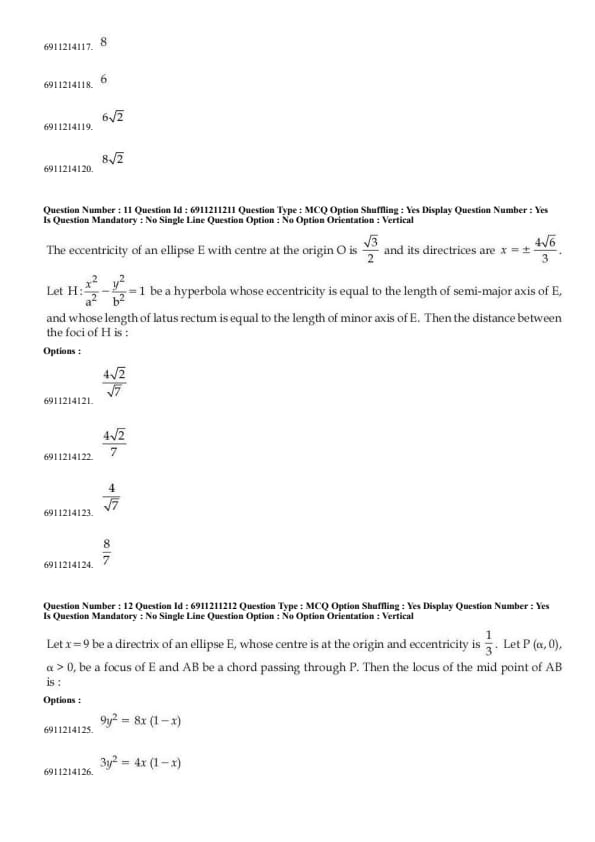
The eccentricity of an ellipse \(E\) with centre at the origin \(O\) is \( \frac{\sqrt3}{2} \) and its directrices are \( x=\pm \frac{4\sqrt6}{3} \).
Let \( H:\frac{x^2}{a^2}-\frac{y^2}{b^2}=1 \) be a hyperbola whose eccentricity is equal to the length of semi-major axis of \(E\), and whose length of latus rectum is equal to the length of minor axis of \(E\). Then the distance between the foci of \(H\) is :
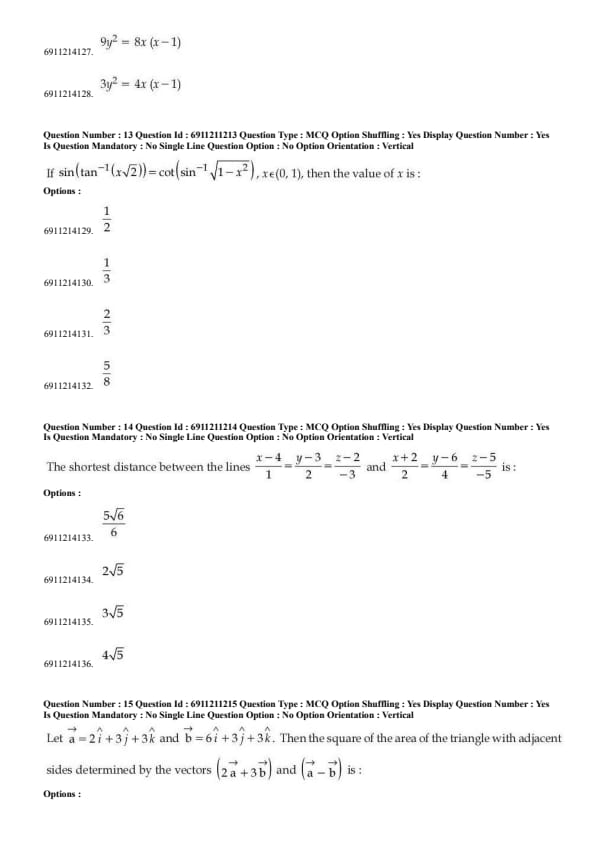
Let \(x=-9\) be a directrix of an ellipse \(E\), whose centre is at the origin and eccentricity is \( \frac13 \). Let \(P(\alpha,0), \alpha>0\), be a focus of \(E\) and \(AB\) be a chord passing through \(P\). Then the locus of the mid point of \(AB\) is :
If \( \sin\!\left(\tan^{-1}(x\sqrt2)\right)=\cot\!\left(\sin^{-1}\!\sqrt{1-x^2}\right),\; x\in(0,1) \), then the value of \(x\) is :
The shortest distance between the lines \[ \frac{x-4}{1}=\frac{y-3}{2}=\frac{z-2}{-3} \]
and \[ \frac{x+2}{2}=\frac{y-6}{4}=\frac{z-5}{-5} \]
is :
Let \( \vec a = 2\hat i + 3\hat j + 3\hat k \) and \( \vec b = 6\hat i + 3\hat j + 3\hat k \). Then the square of the area of the triangle with adjacent sides determined by the vectors \( (2\vec a + 3\vec b) \) and \( (\vec a - \vec b) \) is :
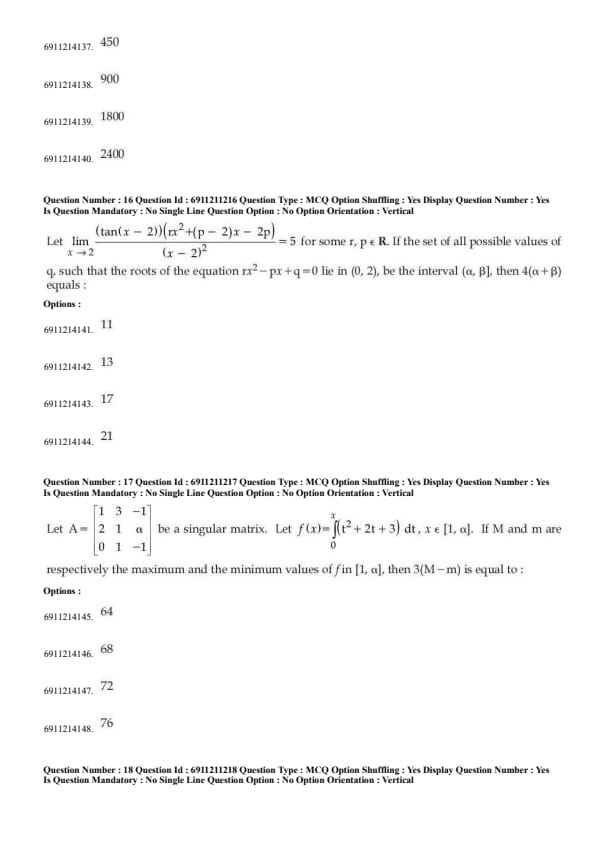
Let \( \lim_{x \to 2} \frac{(\tan(x - 2))(rx^2 + (p - 2)x - 2p)}{(x - 2)^2} = 5 \) for some \( r, p \in \mathbb{R} \). If the set of all possible values of \( q \), such that the roots of the equation \( rx^2 - px + q = 0 \) lie in \( (0, 2) \), be the interval \( (\alpha, \beta] \), then \( 4(\alpha + \beta) \) equals :
Let \( A = \begin{bmatrix} 1 & 3 & -1
2 & 1 & \alpha
0 & 1 & -1 \end{bmatrix} \) be a singular matrix. Let \( f(x) = \int_{0}^{x} (t^2 + 2t + 3) dt, \; x \in [1, \alpha] \). If M and m are respectively the maximum and the minimum values of f in \( [1, \alpha] \), then \( 3(M - m) \) is equal to :
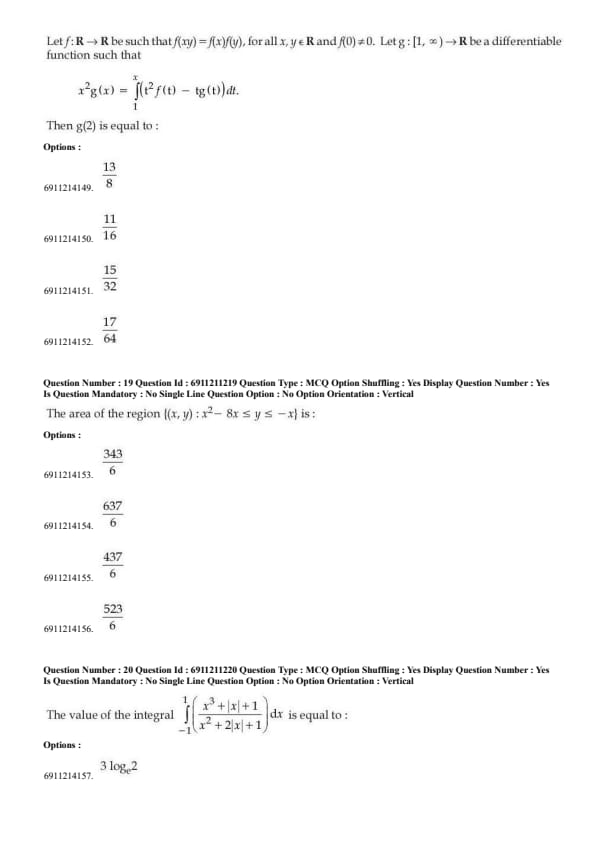
Let \( f: \mathbb{R} \to \mathbb{R} \) be such that \( f(xy) = f(x)f(y) \), for all \( x, y \in \mathbb{R} \) and \( f(0) \neq 0 \). Let \( g: [1, \infty) \to \mathbb{R} \) be a differentiable function such that \[ x^2 g(x) = \int_{1}^{x} (t^2 f(t) - tg(t))dt. \]
Then \( g(2) \) is equal to :
The area of the region \( \{(x, y): x^2 - 8x \le y \le -|x|\} \) is:
The value of the integral \( \int_{-1}^{1} \frac{x^3 + |x| + 1}{x^2 + 2|x| + 1} dx \) is equal to :
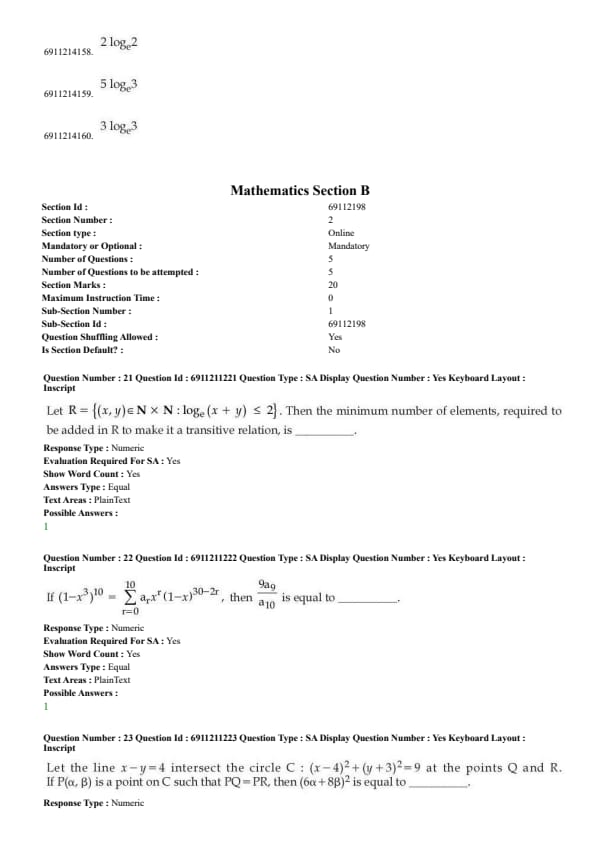
Let \( R = \{(x, y) \in \mathbb{N} \times \mathbb{N} : \log_e(x + y) \le 2\} \). Then the minimum number of elements, required to be added in R to make it a transitive relation, is __________.
If \( (1-x^3)^{10} = \sum_{r=0}^{10} a_r x^r (1-x)^{30-2r} \), then \( \frac{9a_9}{a_{10}} \) is equal to __________.
Let the line \( x-y=4 \) intersect the circle \( C: (x-4)^2 + (y+3)^2 = 9 \) at the points Q and R. If \( P(\alpha, \beta) \) is a point on C such that PQ = PR, then \( (6\alpha + 8\beta)^2 \) is equal to __________.
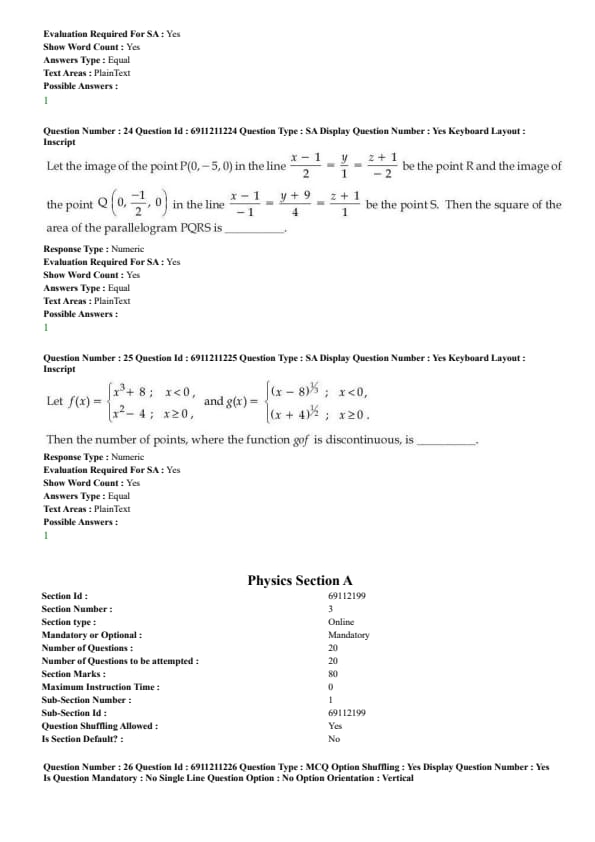
Let the image of the point \( P(0, -5, 0) \) in the line \( \frac{x-1}{2} = \frac{y}{1} = \frac{z+1}{-2} \) be the point R and the image of the point \( Q(0, -1/2, 0) \) in the line \( \frac{x-1}{1} = \frac{y+9}{4} = \frac{z+1}{1} \) be the point S. Then the square of the area of the parallelogram PQRS is __________.
Let \( f(x) = \begin{cases} x^3 + 8; & x<0,
x^2 - 4; & x \ge 0, \end{cases} \) and \( g(x) = \begin{cases} (x-8)^{1/3}; & x<0,
(x+4)^{1/2}; & x \ge 0. \end{cases} \) Then the number of points, where the function gof is discontinuous, is __________.
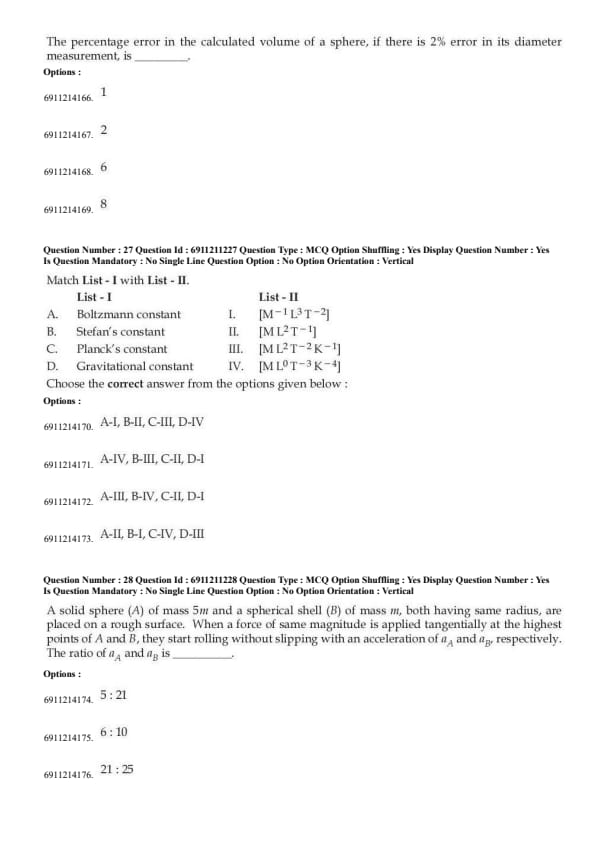
The percentage error in the calculated volume of a sphere, if there is 2% error in its diameter measurement, is __________.
Match List - I with List - II.

Choose the correct answer from the options given below :
A solid sphere (A) of mass 5m and a spherical shell (B) of mass m, both having same radius, are placed on a rough surface. When a force of same magnitude is applied tangentially at the highest points of A and B, they start rolling without slipping with an acceleration of \( a_A \) and \( a_B \), respectively. The ratio of \( a_A \) and \( a_B \) is __________.
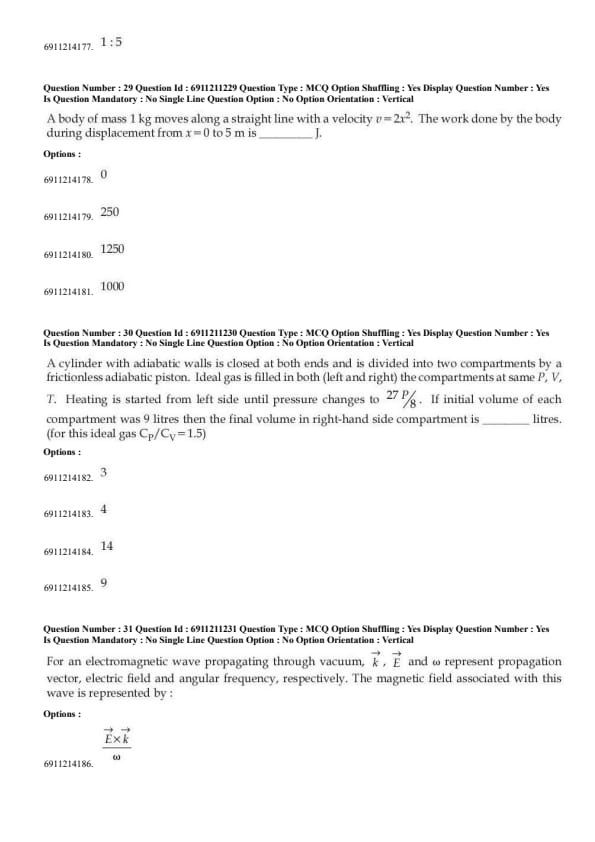
A body of mass 1 kg moves along a straight line with a velocity \( v = 2x^2 \). The work done by the body during displacement from x = 0 to 5 m is __________ J.
A cylinder with adiabatic walls is closed at both ends and is divided into two compartments by a frictionless adiabatic piston. Ideal gas is filled in both (left and right) the compartments at same P, V, T. Heating is started from left side until pressure changes to \( \frac{27P}{8} \). If initial volume of each compartment was 9 litres then the final volume in right-hand side compartment is __________ litres. (for this ideal gas \( C_p/C_v = 1.5 \))
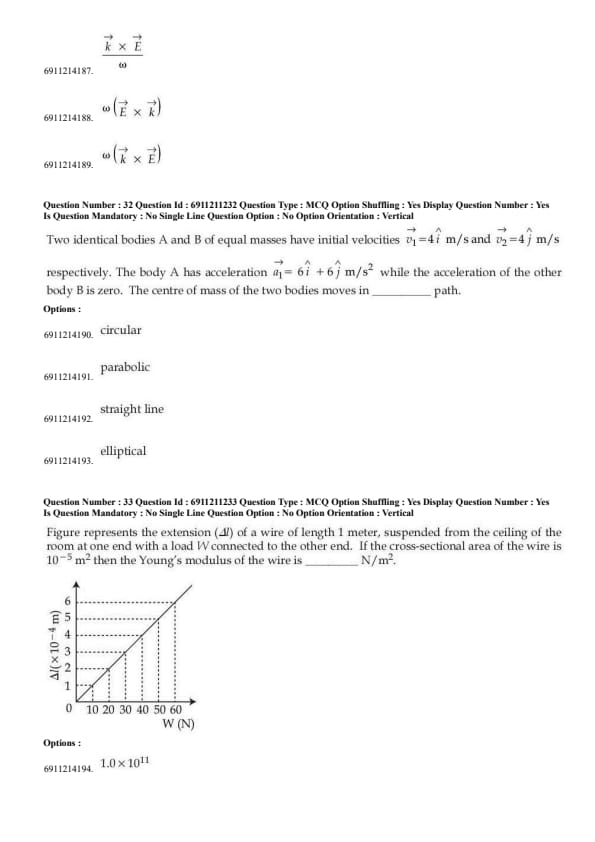
For an electromagnetic wave propagating through vacuum, \(\vec{k}\), \(\vec{E}\) and \(\omega\) represent propagation vector, electric field and angular frequency, respectively. The magnetic field associated with this wave is represented by :
Two identical bodies A and B of equal masses have initial velocities \(\vec{v}_1 = 4\hat{i} m/s\) and \(\vec{v}_2 = 4\hat{j} m/s\) respectively. The body A has acceleration \(\vec{a}_1 = 6\hat{i} + 6\hat{j} m/s^2\) while the acceleration of the other body B is zero. The centre of mass of the two bodies moves in _______ path.
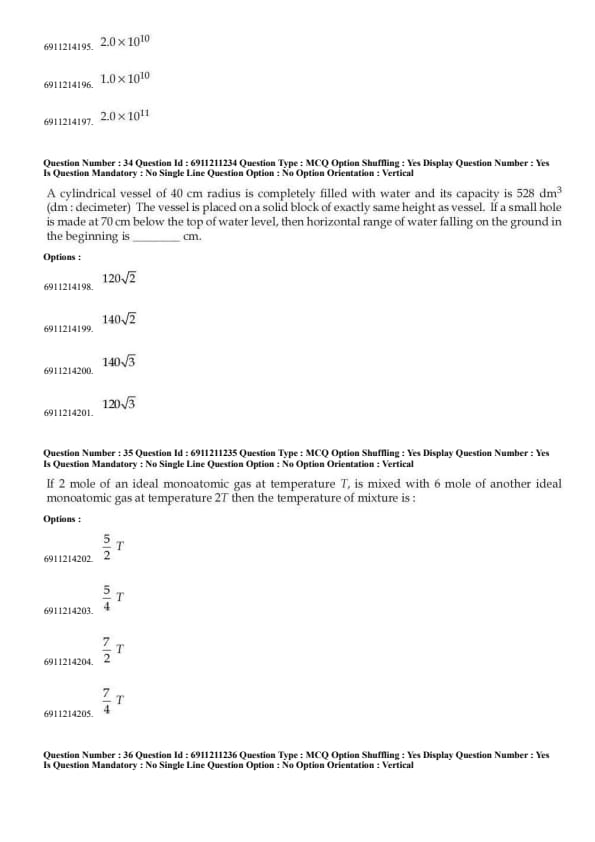
Figure represents the extension \((\Delta l)\) of a wire of length 1 meter, suspended from the ceiling of the room at one end with a load W connected to the other end. If the cross-sectional area of the wire is \(10^{-5} m^2\) then the Young's modulus of the wire is _______ \(N/m^2\).

A cylindrical vessel of \(40 cm\) radius is completely filled with water and its capacity is \(528 dm^3\) (\(dm: decimeter\)). The vessel is placed on a solid block of exactly same height as vessel. If a small hole is made at \(70 cm\) below the top of water level, then horizontal range of water falling on the ground in the beginning is _______ cm.
If 2 mole of an ideal monoatomic gas at temperature T, is mixed with 6 mole of another ideal monoatomic gas at temperature 2T then the temperature of mixture is :
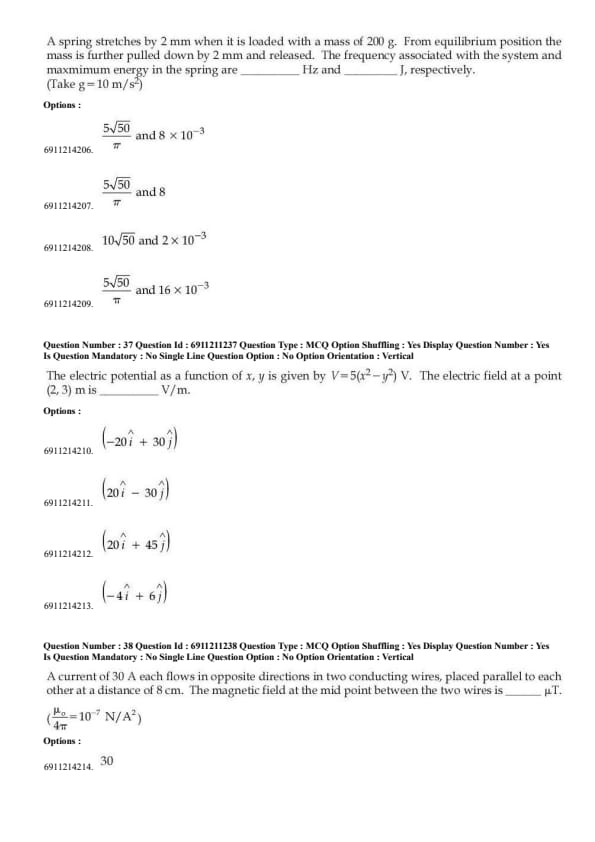
A spring stretches by \(2 mm\) when it is loaded with a mass of \(200 g\). From equilibrium position the mass is further pulled down by \(2 mm\) and released. The frequency associated with the system and maximum energy in the spring are _______ Hz and _______ J, respectively. (Take \(g = 10 m/s^2\))
The electric potential as a function of \(x, y\) is given by \(V=5(x^2 - y^2) V\). The electric field at a point \((2, 3) m\) is _______ \(V/m\).
A current of \(30 A\) each flows in opposite directions in two conducting wires, placed parallel to each other at a distance of \(8 cm\). The magnetic field at the mid point between the two wires is _______ \(\mu T\). \((\frac{\mu_0}{4\pi} = 10^{-7} N/A^2)\)
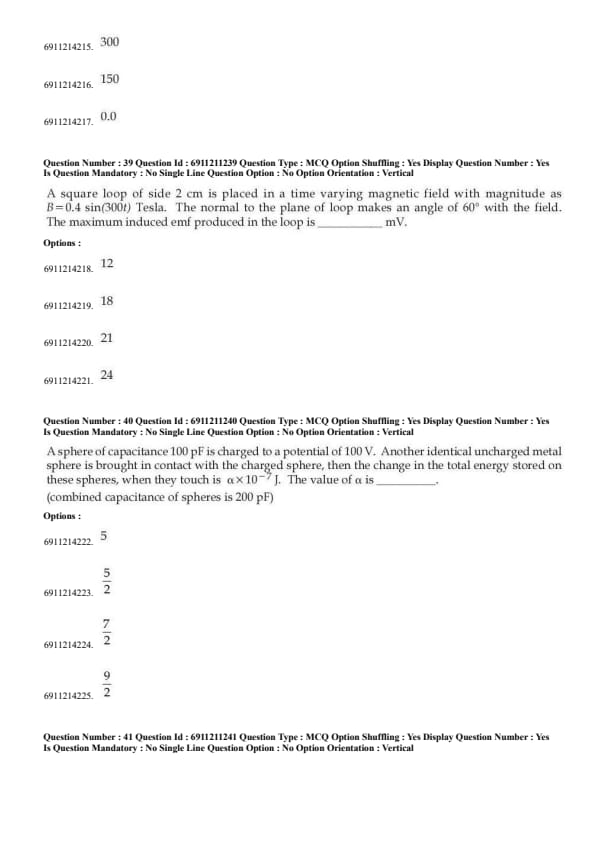
A square loop of side \(2 cm\) is placed in a time varying magnetic field with magnitude as \(B = 0.4 \sin(300t) Tesla\). The normal to the plane of loop makes an angle of \(60^\circ\) with the field. The maximum induced emf produced in the loop is _______ mV.
A sphere of capacitance \(100 pF\) is charged to a potential of \(100 V\). Another identical uncharged metal sphere is brought in contact with the charged sphere, then the change in the total energy stored on these spheres, when they touch is \(\alpha \times 10^{-7} J\). The value of \(\alpha\) is _______ (combined capacitance of spheres is \(200 pF\))
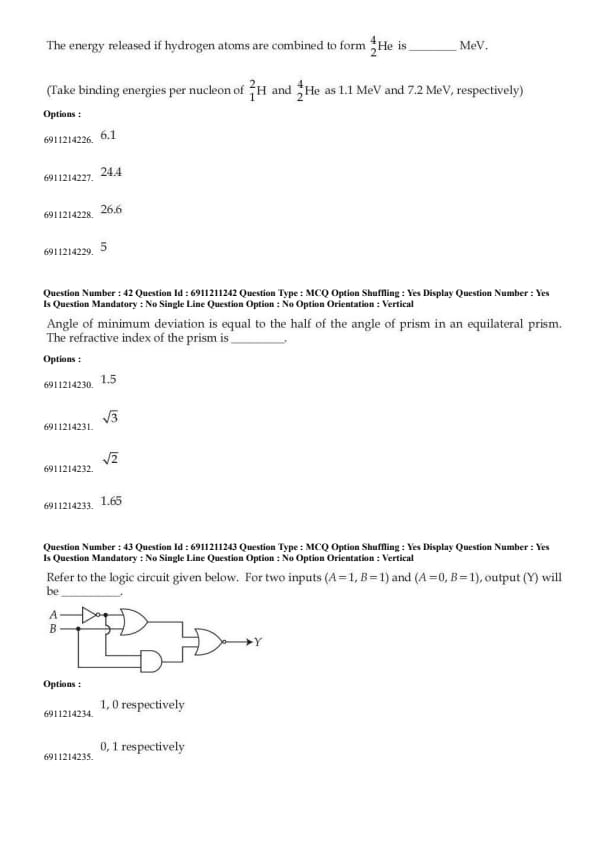
The energy released if hydrogen atoms are combined to form \({}_{2}^{4}He\) is _______ MeV.
(Take binding energies per nucleon of \({}_{1}^{2}H\) and \({}_{2}^{4}He\) as 1.1 MeV and 7.2 MeV, respectively)
Angle of minimum deviation is equal to the half of the angle of prism in an equilateral prism. The refractive index of the prism is ________ .
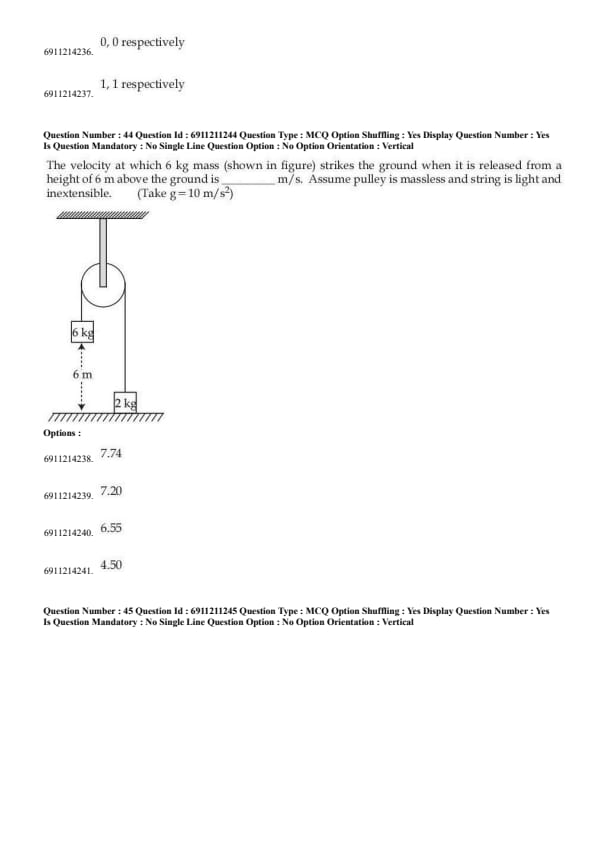
Refer to the logic circuit given below. For two inputs \((A = 1, B = 1)\) and \((A = 0, B = 1)\), output (Y) will be ________ .

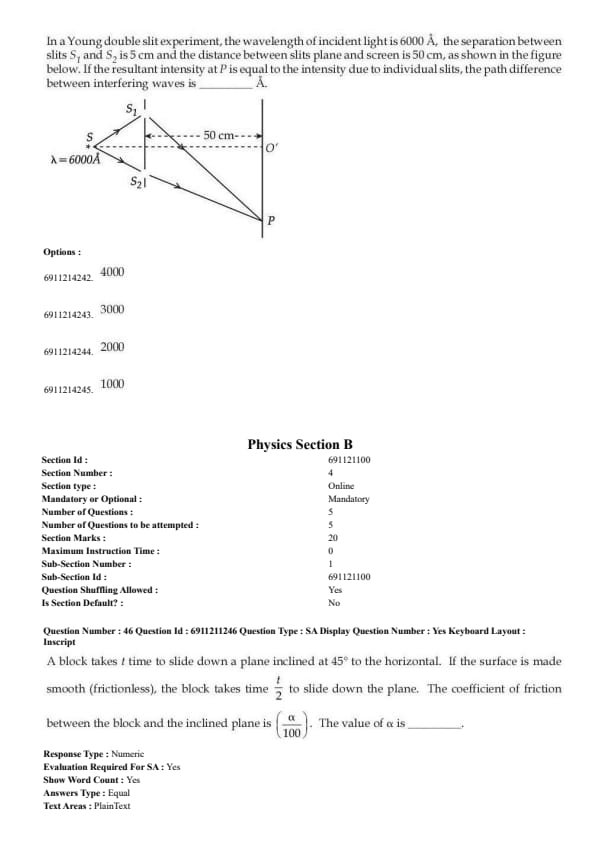
The velocity at which 6 kg mass (shown in figure) strikes the ground when it is released from a height of 6 m above the ground is _______ m/s. Assume pulley is massless and string is light and inextensible. (Take \(g = 10 m/s^{2}\))

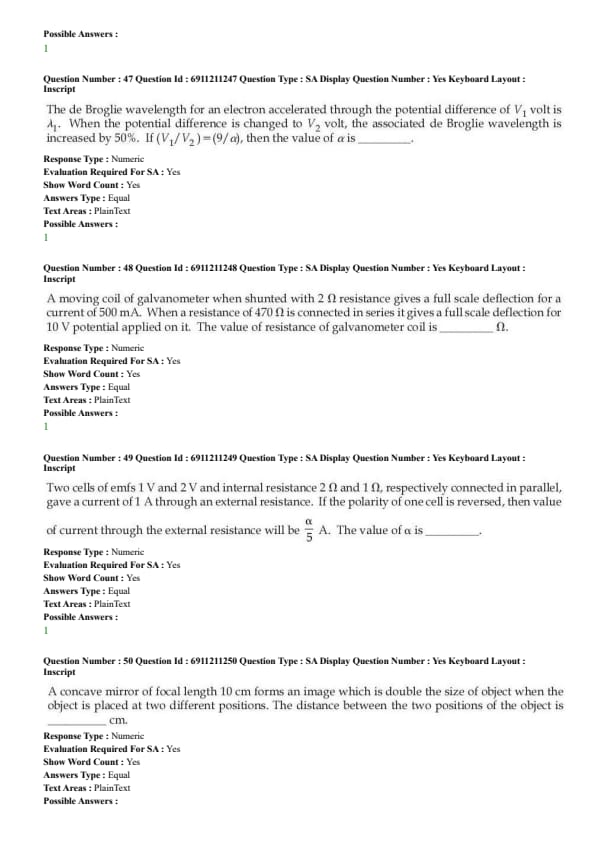
In a Young double slit experiment, the wavelength of incident light is \(6000 \AA\), the separation between slits \(S_1\) and \(S_2\) is 5 cm and the distance between slits plane and screen is 50 cm, as shown in the figure below. If the resultant intensity at P is equal to the intensity due to individual slits, the path difference between interfering waves is _______ \(\AA\).

A block takes \(t\) time to slide down a plane inclined at \(45^{\circ}\) to the horizontal. If the surface is made smooth (frictionless), the block takes time \(t/2\) to slide down the plane. The coefficient of friction between the block and the inclined plane is \(\left( \frac{\alpha}{100} \right)\). The value of \(\alpha\) is ________ .
The de Broglie wavelength for an electron accelerated through the potential difference of \(V_1\) volt is \(\lambda_1\). When the potential difference is changed to \(V_2\) volt, the associated de Broglie wavelength is increased by 50%. If \((V_1/V_2) = (9/\alpha)\), then the value of \(\alpha\) is ________ .
A moving coil of galvanometer when shunted with \(2 \Omega\) resistance gives a full scale deflection for a current of 500 mA. When a resistance of \(470 \Omega\) is connected in series it gives a full scale deflection for 10 V potential applied on it. The value of resistance of galvanometer coil is _______ \(\Omega\).
Two cells of emfs 1 V and 2 V and internal resistance \(2 \Omega\) and \(1 \Omega\), respectively connected in parallel, gave a current of 1 A through an external resistance. If the polarity of one cell is reversed, then value of current through the external resistance will be \(\frac{\alpha}{5}\) A. The value of \(\alpha\) is ________ .
A concave mirror of focal length 10 cm forms an image which is double the size of object when the object is placed at two different positions. The distance between the two positions of the object is _______ cm.
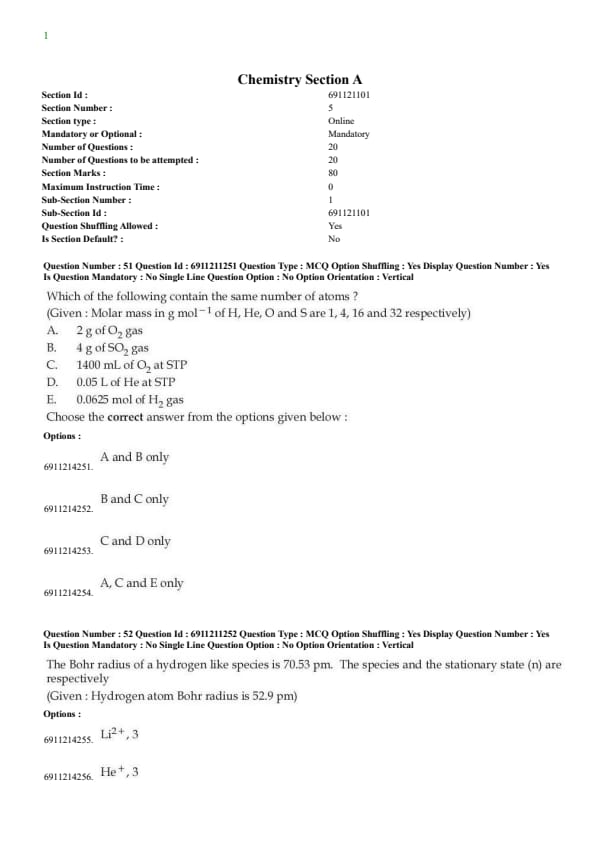
Which of the following contain the same number of atoms ?
(Given : Molar mass in g mol\({}^{-1}\) of H, He, O and S are 1, 4, 16 and 32 respectively)
A. 2 g of \(O_2\) gas
B. 4 g of \(SO_2\) gas
C. 1400 mL of \(O_2\) at STP
D. 0.05 L of He at STP
E. 0.0625 mol of \(H_2\) gas
Choose the correct answer from the options given below :
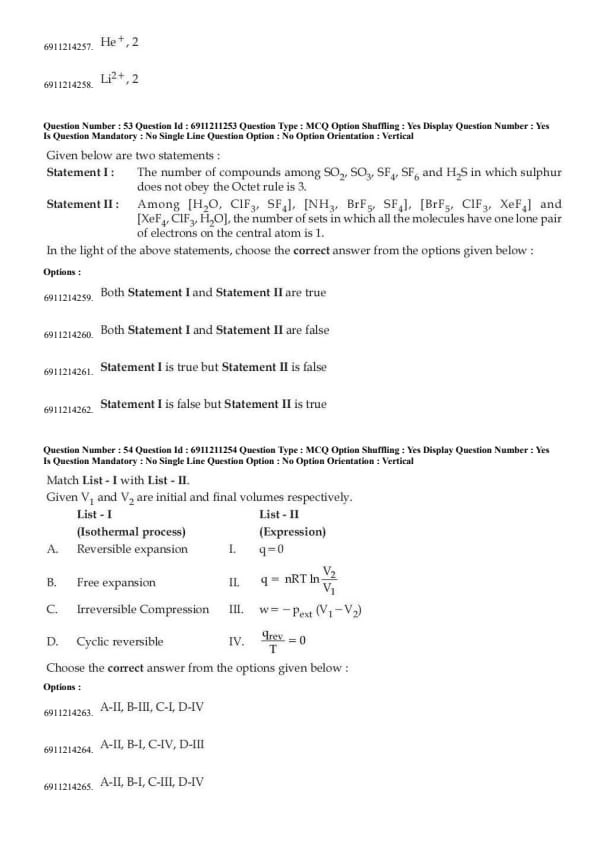
The Bohr radius of a hydrogen like species is 70.53 pm. The species and the stationary state (n) are respectively
(Given : Hydrogen atom Bohr radius is 52.9 pm)
Given below are two statements :
Statement I : The number of compounds among \(SO_2, SO_3, SF_4, SF_6\) and \(H_2S\) in which sulphur does not obey the Octet rule is 3.
Statement II : Among [\(H_2O, ClF_3, SF_4\)], [\(NH_3, BrF_5, SF_4\)], [\(BrF_5, ClF_3, XeF_4\)] and [\(XeF_4, ClF_3, H_2O\)], the number of sets in which all the molecules have one lone pair of electrons on the central atom is 1.
In the light of the above statements, choose the correct answer from the options given below :
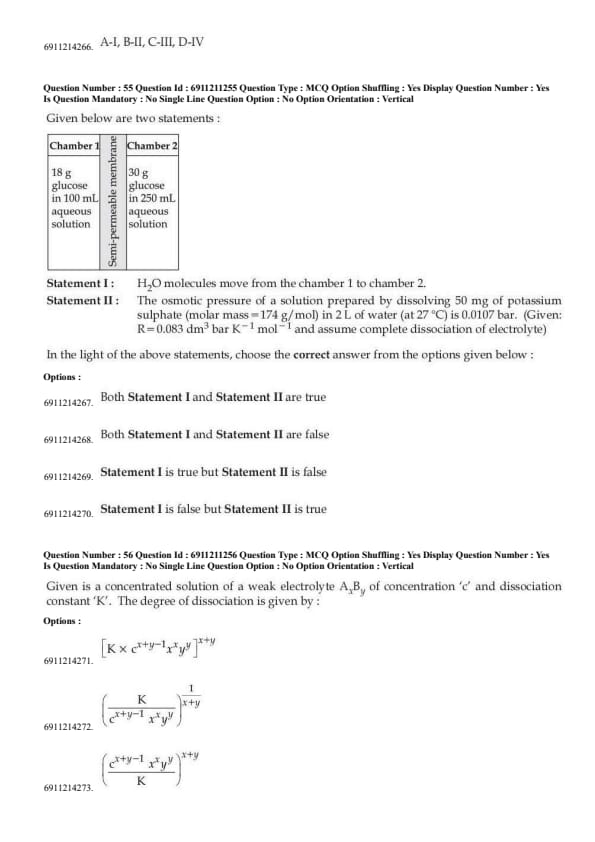
Match List - I with List - II.

Choose the correct answer from the options given below :
Given below are two statements :

Statement I : \(H_2O\) molecules move from the chamber 1 to chamber 2.
Statement II : The osmotic pressure of a solution prepared by dissolving 50 mg of potassium sulphate (molar mass = 174 g/mol) in 2 L of water (at \(27^{\circ}C\)) is 0.0107 bar.
In the light of the above statements, choose the correct answer from the options given below :
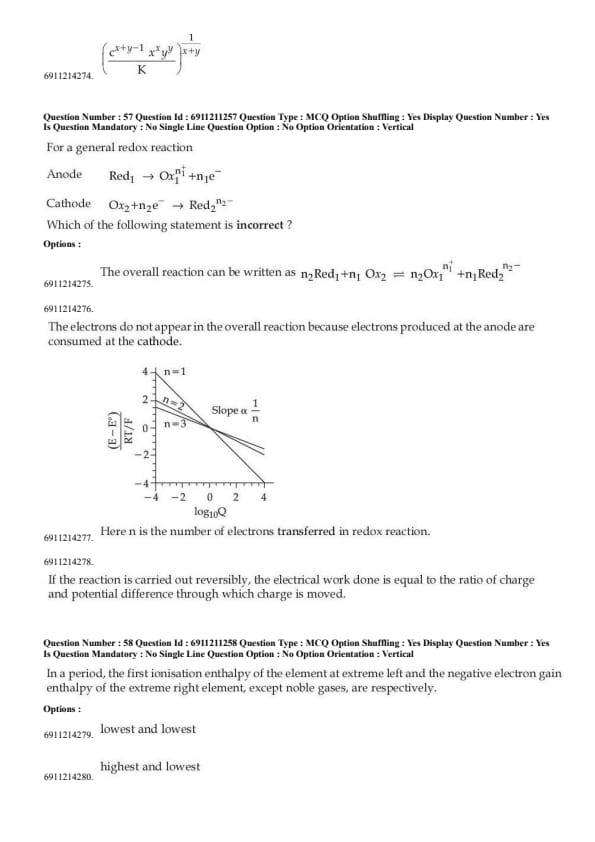
Given is a concentrated solution of a weak electrolyte \(A_xB_y\) of concentration 'c' and dissociation constant 'K'. The degree of dissociation is given by :
Which of the following statement is incorrect ?
(Graph of \((E - E^0) / (RT/F)\) vs \(\log_{10} Q\) for redox reaction)
In a period, the first ionisation enthalpy of the element at extreme left and the negative electron gain enthalpy of the extreme right element, except noble gases, are respectively.
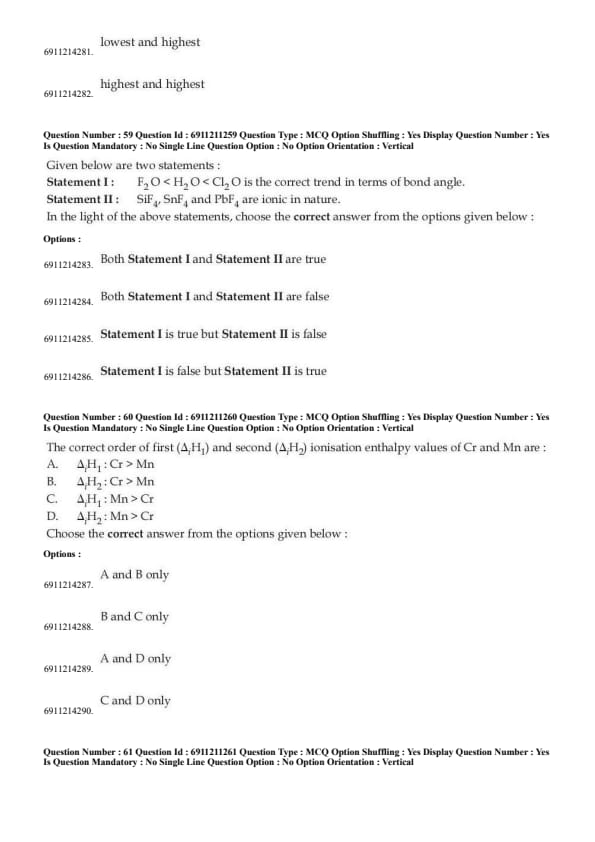
Given below are two statements :
Statement I : \(F_2O < H_2O < Cl_2O\) is the correct trend in terms of bond angle.
Statement II : \(SiF_4, SnF_4\) and \(PbF_4\) are ionic in nature.
In the light of the above statements, choose the correct answer from the options given below :
The correct order of first (\(\Delta_i H_1\)) and second (\(\Delta_i H_2\)) ionisation enthalpy values of Cr and Mn are :
A. \(\Delta_i H_1 : Cr > Mn\)
B. \(\Delta_i H_2 : Cr > Mn\)
C. \(\Delta_i H_1 : Mn > Cr\)
D. \(\Delta_i H_2 : Mn > Cr\)
Choose the correct answer from the options given below :
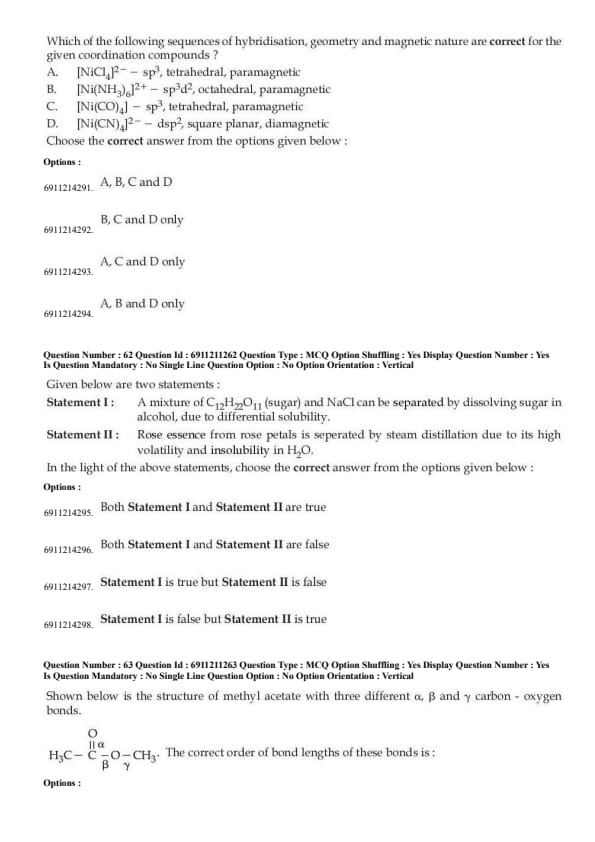
Which of the following sequences of hybridisation, geometry and magnetic nature are correct for the given coordination compounds ?
A. \([NiCl_{4}]^{2-} - sp^{3}\), tetrahedral, paramagnetic
B. \([Ni(NH_{3})_{6}]^{2+} - sp^{3}d^{2}\), octahedral, paramagnetic
C. \([Ni(CO)_{4}] - sp^{3}\), tetrahedral, paramagnetic
D. \([Ni(CN)_{4}]^{2-} - dsp^{2}\), square planar, diamagnetic
Choose the correct answer from the options given below :
Given below are two statements :
Statement I : A mixture of \(C_{12}H_{22}O_{11}\) (sugar) and NaCl can be separated by dissolving sugar in alcohol, due to differential solubility.
Statement II : Rose essence from rose petals is separated by steam distillation due to its high volatility and insolubility in \(H_{2}O\).
In the light of the above statements, choose the correct answer from the options given below :
Shown below is the structure of methyl acetate with three different \(\alpha, \beta\) and \(\gamma\) carbon - oxygen bonds.

The correct order of bond lengths of these bonds is :
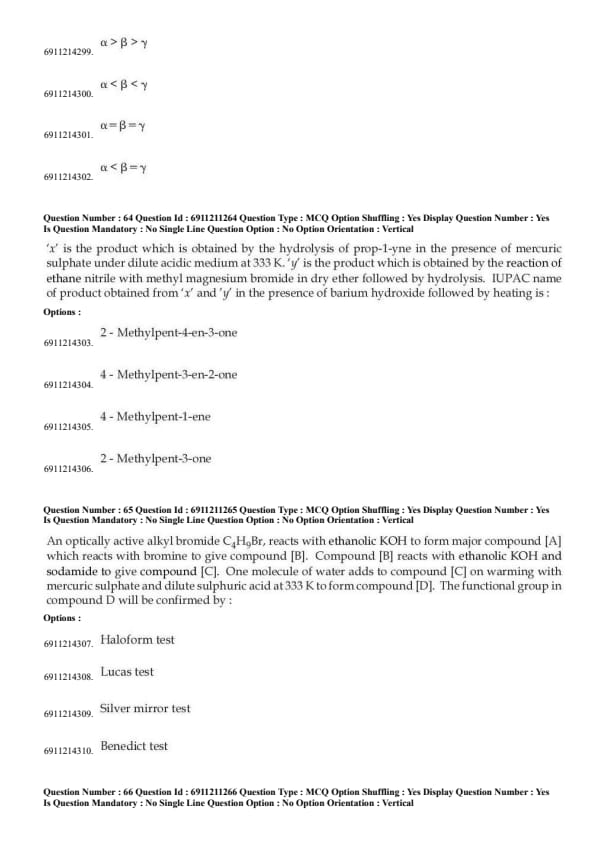
'x' is the product which is obtained by the hydrolysis of prop-1-yne in the presence of mercuric sulphate under dilute acidic medium at 333 K. 'y' is the product which is obtained by the reaction of ethane nitrile with methyl magnesium bromide in dry ether followed by hydrolysis. IUPAC name of product obtained from 'x' and 'y' in the presence of barium hydroxide followed by heating is :
An optically active alkyl bromide \(C_{4}H_{9}Br\), reacts with ethanolic KOH to form major compound [A] which reacts with bromine to give compound [B]. Compound [B] reacts with ethanolic KOH and sodamide to give compound [C]. One molecule of water adds to compound [C] on warming with mercuric sulphate and dilute sulphuric acid at 333 K to form compound [D]. The functional group in compound D will be confirmed by :
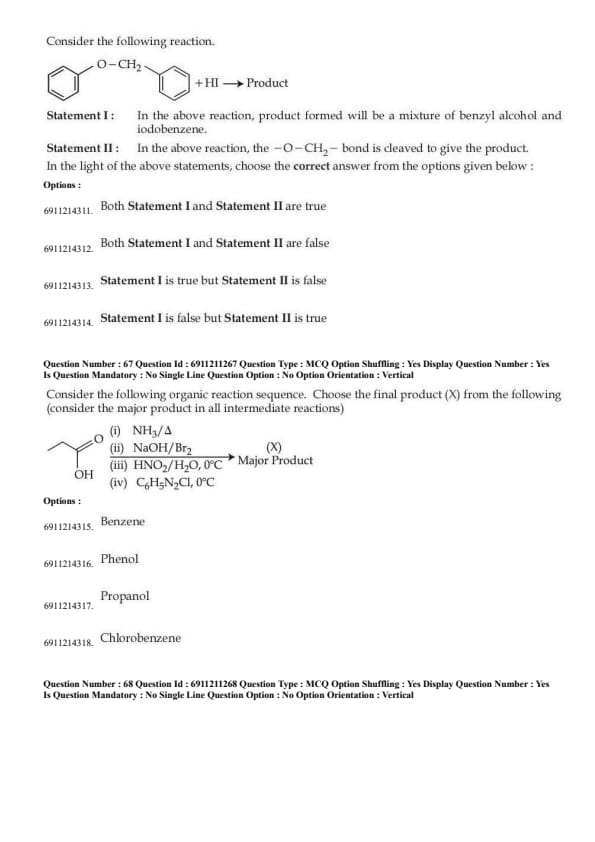
Consider the following reaction.

Statement I : In the above reaction, product formed will be a mixture of benzyl alcohol and iodobenzene.
Statement II : In the above reaction, the \(-O-CH_{2}-\) bond is cleaved to give the product.
In the light of the above statements, choose the correct answer from the options given below :
Consider the following organic reaction sequence. Choose the final product (X) from the following (consider the major product in all intermediate reactions)

(i) \(NH_{3}/\Delta\)
(ii) \(NaOH/Br_{2} \rightarrow (X)\)
(iii) \(HNO_{2}/H_{2}O, 0^{\circ}C\)
(iv) \(C_{6}H_{5}N_{2}Cl, 0^{\circ}C\)
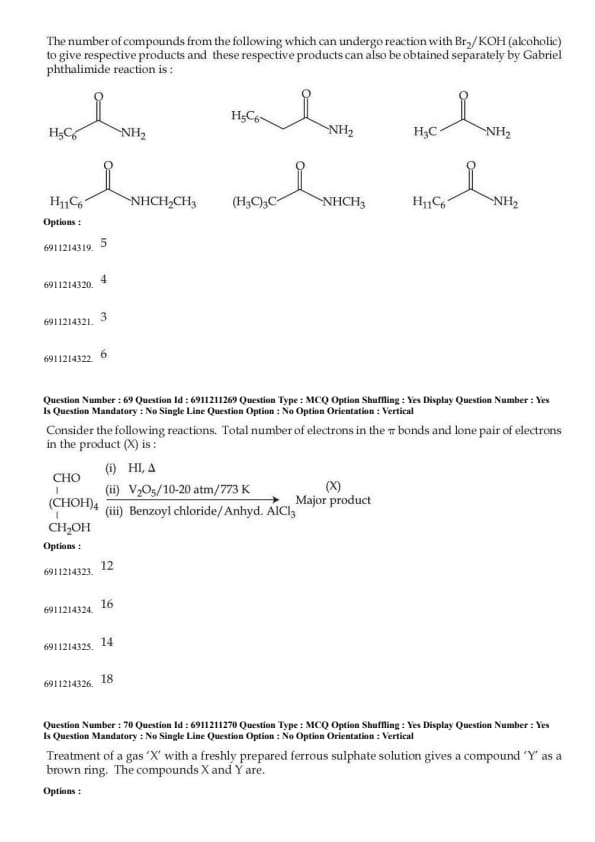
The number of compounds from the following which can undergo reaction with \(Br_{2}/KOH\) (alcoholic) to give respective products and these respective products can also be obtained separately by Gabriel phthalimide reaction is :

Consider the following reactions. Total number of electrons in the \(\pi\) bonds and lone pair of electrons in the product (X) is :

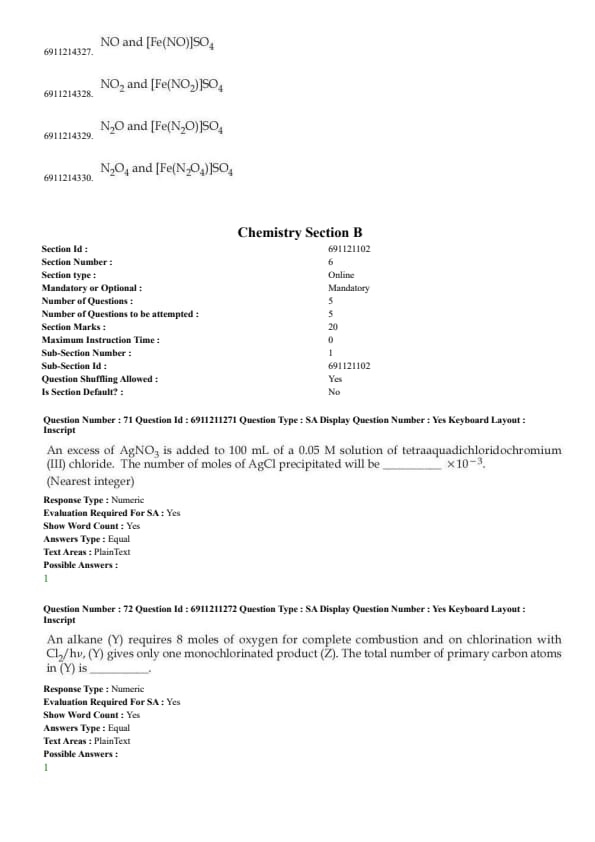
Treatment of a gas 'X' with a freshly prepared ferrous sulphate solution gives a compound 'Y' as a brown ring. The compounds X and Y are.
An excess of \(AgNO_{3}\) is added to 100 mL of a 0.05 M solution of tetraquadichloridochromium (III) chloride. The number of moles of AgCl precipitated will be _______ \(\times 10^{-3}\). (Nearest integer)
An alkane (Y) requires 8 moles of oxygen for complete combustion and on chlorination with \(Cl_{2}/h\nu\), (Y) gives only one monochlorinated product (Z). The total number of primary carbon atoms in (Y) is _______ .
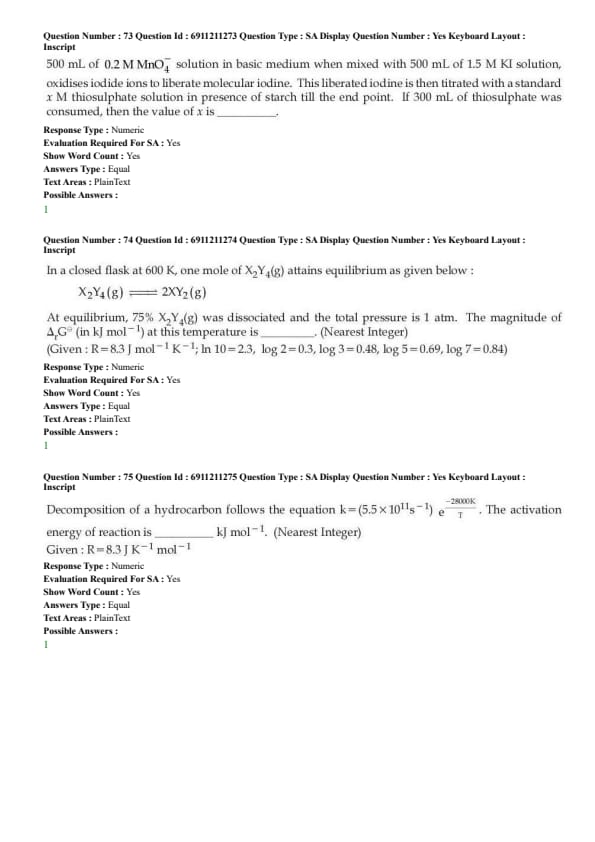
500 mL of 0.2 M \(MnO_{4}^{-}\) solution in basic medium when mixed with 500 mL of 1.5 M KI solution, oxidises iodide ions to liberate molecular iodine. This liberated iodine is then titrated with a standard \(x\) M thiosulphate solution in presence of starch till the end point. If 300 mL of thiosulphate was consumed, then the value of \(x\) is _______ .
In a closed flask at 600 K, one mole of \(X_{2}Y_{4}(g)\) attains equilibrium as given below :
\(X_{2}Y_{4}(g) \rightleftharpoons 2XY_{2}(g)\)
At equilibrium, 75% \(X_{2}Y_{4}(g)\) was dissociated and the total pressure is 1 atm. The magnitude of \(\Delta_{r}G^{\ominus}\) (in kJ mol\(^{-1}\)) at this temperature is _______ . (Nearest Integer)
(Given : \(R=8.3 J mol^{-1} K^{-1}\); \(\ln 10 = 2.3, \log 2 = 0.3, \log 3 = 0.48, \log 5 = 0.69, \log 7 = 0.84\))
Decomposition of a hydrocarbon follows the equation \(k = (5.5 \times 10^{11} s^{-1}) e^{\frac{-28000 K}{T}}\). The activation energy of reaction is _______ kJ mol\(^{-1}\). (Nearest Integer)
Given : \(R = 8.3 J K^{-1} mol^{-1}\)
JEE Main 2026 Second Attempt Paper Discussion
*The article might have information for the previous academic years, please refer the official website of the exam.