
VITEEE 2018 Question Paper with Answer Key PDF for Physics


Content Writer | Updated On - Jan 14, 2026
VITEEE Question Papers are the most important study material for effective exam preparation. We at Zollege have provided all VITEEE Previous Year Papers with Solution PDFs here. VITEEE 2018 Physics exam was conducted successfully on Vellore Institute of Technology (VIT).
Students can freely download the VITEEE previous year's question paper PDFs along with their solutions here.We strongly encourage VITEEE aspirants to scan through all the VITEEE Question Paper to know the overall difficulty level,VITEEE Syllabus and understand the changes in VITEEE Exam Pattern over the years.
VITEEE 2018 Physics Question Paper with Answer Key PDF
| VITEEE 2018 Physics Question Paper PDF | VITEEE 2018 Physics Solution PDF |
|---|---|
| Download PDF | Check Solutions |

If a force F = \((2x + 3x^2)\hat{i}\) N acts along x-axis on an object and moves it from x = 2m to x = 4m, the work done is
View Solution
Work done \(W\) by a variable force is given by the integral \(\int F \cdot dx\).
Given \(F = 2x + 3x^2\) acting along the x-axis.
The limits of integration are from \(x_1 = 2\) to \(x_2 = 4\).
\(W = \int_{2}^{4} (2x + 3x^2) \, dx\).
Integration yields: \([\frac{2x^2}{2} + \frac{3x^3}{3}]_2^4 = [x^2 + x^3]_2^4\).
Substitute upper limit (\(x=4\)): \((4^2 + 4^3) = 16 + 64 = 80\).
Substitute lower limit (\(x=2\)): \((2^2 + 2^3) = 4 + 8 = 12\).
\(W = 80 - 12 = 68\) J.
Quick Tip: For variable forces, always integrate \(F \cdot dx\). Remember that \(\int x^n dx = \frac{x^{n+1}}{n+1}\).
A vessel contains 1 mol of O\(_2\) and 2 mol of He. What is the value of '\(C_P/C_V\)' of the mixture?
View Solution
Let \(n_1 = 1\) mol of O\(_2\) (Diatomic) and \(n_2 = 2\) mol of He (Monoatomic).
For O\(_2\): \(C_{V1} = \frac{5}{2}R\) and \(C_{P1} = \frac{7}{2}R\).
For He: \(C_{V2} = \frac{3}{2}R\) and \(C_{P2} = \frac{5}{2}R\).
The molar heat capacity of the mixture at constant volume is \(C_{V(mix)} = \frac{n_1 C_{V1} + n_2 C_{V2}}{n_1 + n_2}\).
\(C_{V(mix)} = \frac{1(\frac{5}{2}R) + 2(\frac{3}{2}R)}{1+2} = \frac{2.5R + 3R}{3} = \frac{5.5R}{3} = \frac{11}{6}R\).
The molar heat capacity of the mixture at constant pressure is \(C_{P(mix)} = \frac{n_1 C_{P1} + n_2 C_{P2}}{n_1 + n_2}\).
\(C_{P(mix)} = \frac{1(\frac{7}{2}R) + 2(\frac{5}{2}R)}{3} = \frac{3.5R + 5R}{3} = \frac{8.5R}{3} = \frac{17}{6}R\).
The ratio \(\gamma_{mix} = \frac{C_{P(mix)}}{C_{V(mix)}} = \frac{17/6 R}{11/6 R} = \frac{17}{11}\).
Quick Tip: Remember degrees of freedom (\(f\)): Monoatomic \(f=3\), Diatomic \(f=5\). \(C_V = \frac{f}{2}R\) and \(C_P = (1 + \frac{f}{2})R\).
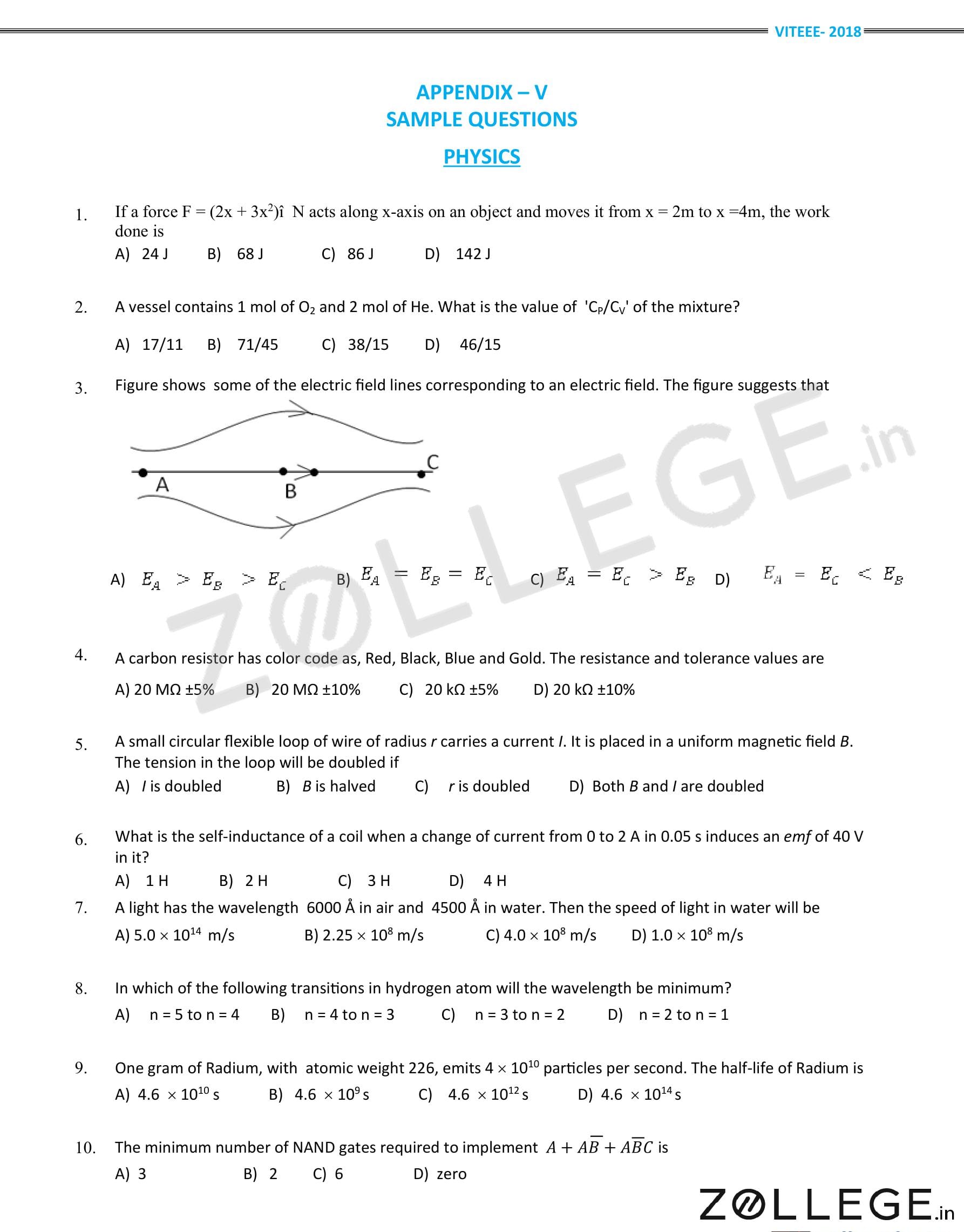
Figure shows some of the electric field lines corresponding to an electric field. The figure suggests that

View Solution
The magnitude of the electric field intensity is directly proportional to the density of the electric field lines.
In the given figure, the field lines are crowded (closer together) near points A and C.
The field lines are spread out (farther apart) near point B.
Therefore, the electric field is stronger at A and C compared to B (\(E_A > E_B\) and \(E_C > E_B\)).
Assuming symmetry in the diagram, the density at A and C appears equal, so \(E_A = E_C\).
Combining these observations: \(E_A = E_C > E_B\).
Quick Tip: Crowded lines \(\Rightarrow\) Strong Field. Spaced out lines \(\Rightarrow\) Weak Field.
A carbon resistor has color code as, Red, Black, Blue and Gold. The resistance and tolerance values are
View Solution
The color code sequence is: 1st digit, 2nd digit, Multiplier, Tolerance.
Red corresponds to the digit 2.
Black corresponds to the digit 0.
Blue corresponds to the multiplier \(10^6\).
Gold corresponds to a tolerance of \(\pm 5%\).
Combining these, the resistance is \(20 \times 10^6 \, \Omega\) with \(\pm 5%\) tolerance.
Since \(10^6 \, \Omega = 1 \, M\Omega\), the value is \(20 \, M\Omega \pm 5%\).
Quick Tip: Mnemonic: B B R O Y G B V G W (Black Brown Red Orange Yellow Green Blue Violet Grey White) \(\rightarrow\) 0 1 2 3 4 5 6 7 8 9. Gold=5%, Silver=10%.
A small circular flexible loop of wire of radius r carries a current I. It is placed in a uniform magnetic field B. The tension in the loop will be doubled if
View Solution
Consider a small element \(dl\) of the circular loop placed in a uniform magnetic field \(\vec{B}\) perpendicular to the plane of the loop.
The magnetic force acting on this element is given by \[ dF = I\, dl \, B \]
This force acts radially outward and tends to stretch the loop, producing tension in the wire.
For a circular loop of radius \(r\), the total outward force is balanced by the tension \(T\) in the loop.
The standard result for the tension in a circular current-carrying loop placed in a uniform magnetic field is \[ T = B I r \]
Now, examine each option:
Option (A): If current \(I\) is doubled, \[ T' = B (2I) r = 2T \]
Hence, the tension is doubled. \checkmark
Option (B): If \(B\) is halved, \[ T' = \frac{B}{2} I r = \frac{T}{2} \]
The tension decreases, not doubles. \(\times\)
Option (C): If \(r\) is doubled, \[ T' = B I (2r) = 2T \]
Although this mathematically doubles the tension, doubling the radius changes the physical size (and length) of the loop. The question refers to the same loop, so this is not the intended operational change. \(\times\)
Option (D): If both \(B\) and \(I\) are doubled, \[ T' = (2B)(2I)r = 4T \]
The tension becomes four times, not twice. \(\times\)
Hence, the correct and physically appropriate option is (A) \(I\) is doubled. Quick Tip: The tension \(T\) balances the magnetic force. Derivation from small element \(dl\): \(2T\sin(d\theta/2) = B I (dl) \approx B I (r d\theta) \Rightarrow T = B I r\).
What is the self-inductance of a coil when a change of current from 0 to 2 A in 0.05 s induces an emf of 40 V in it?
View Solution
The magnitude of induced emf \(|\varepsilon|\) in a self-inductor is given by \(|\varepsilon| = L \frac{dI}{dt}\).
Given: \(|\varepsilon| = 40\) V.
Change in current \(dI = 2 - 0 = 2\) A.
Time interval \(dt = 0.05\) s.
Substituting the values: \(40 = L \times \frac{2}{0.05}\).
\(40 = L \times 40\).
\(L = 1\) H.
Quick Tip: Use the formula \(\varepsilon = -L \frac{dI}{dt}\). Ignore the negative sign if only magnitude is required.
A light has the wavelength 6000 \AA\ in air and 4500 \AA\ in water. Then the speed of light in water will be
View Solution
Refractive index \(n = \frac{Speed in vacuum}{Speed in medium} = \frac{Wavelength in vacuum}{Wavelength in medium}\).
\(\frac{v_{air}}{v_{water}} = \frac{\lambda_{air}}{\lambda_{water}}\).
Given \(\lambda_{air} = 6000\) \AA\ and \(\lambda_{water} = 4500\) \AA.
We assume \(v_{air} \approx c = 3 \times 10^8\) m/s.
\(\frac{3 \times 10^8}{v_{water}} = \frac{6000}{4500} = \frac{4}{3}\).
\(v_{water} = 3 \times 10^8 \times \frac{3}{4}\).
\(v_{water} = 2.25 \times 10^8\) m/s.
Quick Tip: Frequency remains constant when light travels between media. \(v = f\lambda\), so \(v \propto \lambda\).
In which of the following transitions in hydrogen atom will the wavelength be minimum?
View Solution
The energy of a photon emitted during a transition is given by \(E = \frac{hc}{\lambda}\), so \(\lambda \propto \frac{1}{E}\).
Minimum wavelength corresponds to maximum energy difference.
The energy difference is \(\Delta E = 13.6 Z^2 (\frac{1}{n_f^2} - \frac{1}{n_i^2})\) eV.
Let's check the energy gaps for the options (proportional to difference of inverse squares):
(A) \(5 \to 4\): \(\frac{1}{16} - \frac{1}{25} \approx 0.02\).
(B) \(4 \to 3\): \(\frac{1}{9} - \frac{1}{16} \approx 0.05\).
(C) \(3 \to 2\): \(\frac{1}{4} - \frac{1}{9} \approx 0.14\).
(D) \(2 \to 1\): \(1 - \frac{1}{4} = 0.75\).
The transition \(n=2\) to \(n=1\) involves the largest energy change, thus the shortest (minimum) wavelength.
Quick Tip: Energy gaps decrease as 'n' increases. The jump to n=1 (Lyman series) always has much higher energy than jumps to higher shells.
One gram of Radium, with atomic weight 226, emits \(4 \times 10^{10}\) particles per second. The half-life of Radium is
View Solution
Activity \(A = \lambda N\), where \(\lambda\) is the decay constant and \(N\) is the number of nuclei.
Number of nuclei in 1g of Ra-226: \(N = \frac{mass}{molar mass} \times N_A = \frac{1}{226} \times 6.02 \times 10^{23}\).
\(N \approx 2.66 \times 10^{21}\) nuclei.
Given Activity \(A = 4 \times 10^{10}\) decays/s.
\(\lambda = \frac{A}{N} = \frac{4 \times 10^{10}}{2.66 \times 10^{21}} \approx 1.5 \times 10^{-11}\) s\(^{-1}\).
Half-life \(T_{1/2} = \frac{\ln 2}{\lambda} = \frac{0.693}{1.5 \times 10^{-11}}\).
\(T_{1/2} \approx 4.6 \times 10^{10}\) s.
Quick Tip: Remember: Activity = \(\lambda N\). \(T_{1/2} = 0.693 / \lambda\). Don't forget to calculate N using Avogadro's number.
The minimum number of NAND gates required to implement \(A + \bar{A}B + \bar{A}\bar{B}C\) is
View Solution
First, simplify the Boolean expression \(Y = A + \bar{A}B + \bar{A}\bar{B}C\).
Using the absorption law (\(X + \bar{X}Y = X + Y\)), we simplify stepwise:
Step 1: \(A + \bar{A}B = A + B\).
Step 2: Substitute back: \(Y = (A + B) + \bar{A}\bar{B}C\).
Since \(\bar{A}\bar{B} = \overline{A+B}\), let \(X = A+B\). Then \(Y = X + \bar{X}C\).
Again using absorption law: \(X + \bar{X}C = X + C = A + B + C\).
So, the expression simplifies to a 3-input OR gate: \(A + B + C\).
To implement an OR operation (\(A+B\)) using universal NAND gates, 3 gates are required.
To implement a 3-input OR (\( (A+B)+C \)) using 2-input NAND gates, we treat (\(A+B\)) as one input and \(C\) as the other, cascading the structure.
Total NAND gates = 3 (for \(A+B\)) + 3 (to OR the result with \(C\)) = 6 gates.
Quick Tip: Simplify the Boolean expression first. Implementing \(A+B\) (OR) takes 3 NANDs. Implementing \(AB\) (AND) takes 2 NANDs.
*The article might have information for the previous academic years, please refer the official website of the exam.