
VITEEE 2019 Question Paper with Answer Key PDF for Biology


Content Writer | Updated On - Jan 14, 2026
VITEEE Question Papers are the most important study material for effective exam preparation. We at Zollege have provided all VITEEE Previous Year Papers with Solution PDFs here. VITEEE 2019 Biology exam was conducted successfully on Vellore Institute of Technology (VIT).
Students can freely download the VITEEE previous year's question paper PDFs along with their solutions here.We strongly encourage VITEEE aspirants to scan through all the VITEEE Question Paper to know the overall difficulty level,VITEEE Syllabus and understand the changes in VITEEE Exam Pattern over the years.
VITEEE 2019 Biology Question Paper with Answer Key PDF
| VITEEE 2019 Biology Question Paper PDF | VITEEE 2019 Biology Solution PDF |
|---|---|
| Download PDF | Check Solutions |
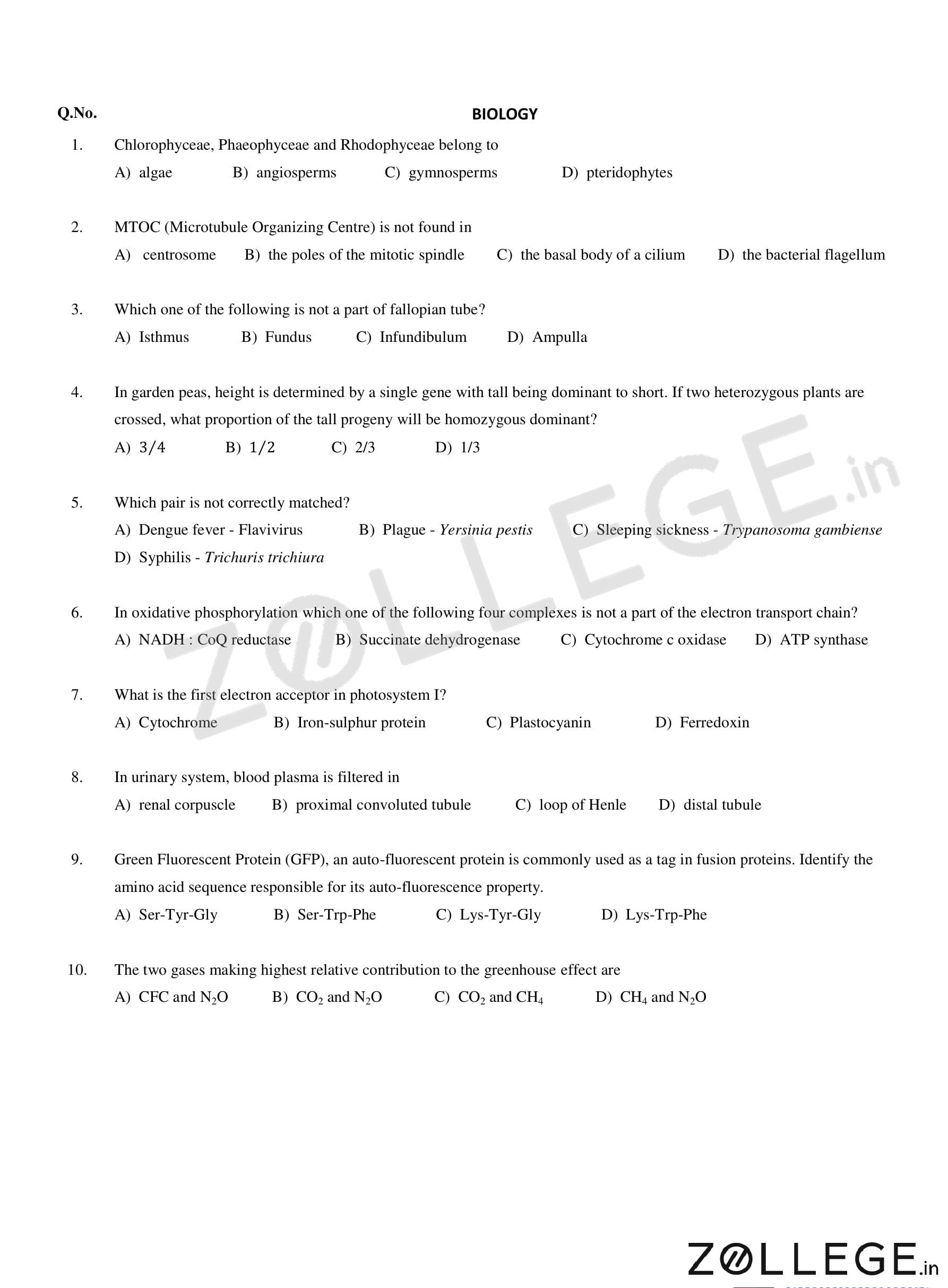
Chlorophyceae, Phaeophyceae and Rhodophyceae belong to
View Solution
Chlorophyceae, Phaeophyceae, and Rhodophyceae are the three major classes of algae based on their pigments.
Chlorophyceae are known as Green Algae (pigments chlorophyll a and b).
Phaeophyceae are known as Brown Algae (pigments chlorophyll a, c, and fucoxanthin).
Rhodophyceae are known as Red Algae (pigments chlorophyll a, d, and r-phycoerythrin).
These groups are thallophytes and are distinct from embryophytes like angiosperms, gymnosperms, and pteridophytes.
Quick Tip: The suffixes "-phyceae" usually denote algal classes. Remember the color coding: Chloro (Green), Phaeo (Brown), Rhodo (Red).
MTOC (Microtubule Organizing Centre) is not found in
View Solution
A Microtubule Organizing Centre (MTOC) is a structure in eukaryotic cells where microtubules originate.
The centrosome is the primary MTOC in animal cells.
The spindle poles act as MTOCs during cell division to organize the spindle fibers.
The basal body is the MTOC for cilia and flagella in eukaryotes.
However, the bacterial flagellum is a prokaryotic structure made of the protein flagellin, not microtubules.
Since bacteria lack microtubules and the associated organizing centers, MTOCs are not found in bacterial flagella.
Quick Tip: Distinguish between Eukaryotic flagella (tubulin-based, 9+2 arrangement) and Prokaryotic flagella (flagellin-based, no microtubules).
Which one of the following is not a part of fallopian tube?
View Solution
The fallopian tube (oviduct) is divided into three main anatomical regions.
The Infundibulum is the funnel-shaped opening near the ovary.
The Ampulla is the wider, middle portion where fertilization occurs.
The Isthmus is the narrow section connecting to the uterus.
The Fundus is the upper, rounded part of the uterus itself, not a part of the fallopian tube.
Quick Tip: The Fundus is the "roof" of the uterus. The fallopian tubes are the "hallways" leading to the main room (uterus).
In garden peas, height is determined by a single gene with tall being dominant to short. If two heterozygous plants are crossed, what proportion of the tall progeny will be homozygous dominant?
View Solution
Let the dominant allele for Tall be T and the recessive allele for Short be t.
The cross between two heterozygotes is: Tt \(\times\) Tt.
The genotypic ratio of the offspring is: 1 TT : 2 Tt : 1 tt.
The phenotypic ratio is: 3 Tall (TT + 2 Tt) : 1 Short (tt).
The question asks for the proportion of the tall progeny (Total = 3) that are homozygous dominant (TT = 1).
Therefore, the proportion is \(1/3\).
Quick Tip: Read the question carefully: "proportion of the tall progeny" means the denominator is the number of tall offspring (3), not the total offspring (4).
Which pair is not correctly matched?
View Solution
Dengue fever is caused by the Dengue virus, a member of the Flavivirus genus. (Correct match).
Plague is caused by the bacterium Yersinia pestis. (Correct match).
African Sleeping Sickness is caused by the protozoan parasite \textit{Trypanosoma brucei gambiense. (Correct match).
Syphilis is caused by the spirochete bacterium \textit{Treponema pallidum.
\textit{Trichuris trichiura is a nematode (whipworm) that causes trichuriasis.
Therefore, pair (D) is incorrect.
Quick Tip: Do not confuse \textit{Treponema (bacteria causing Syphilis) with Trichuris (worm causing Trichuriasis).
In oxidative phosphorylation which one of the following four complexes is not a part of the electron transport chain?
View Solution
The Electron Transport Chain (ETC) consists of four complexes that transfer electrons and pump protons:
Complex I: NADH: CoQ reductase.
Complex II: Succinate dehydrogenase.
Complex III: Cytochrome bc1 complex.
Complex IV: Cytochrome c oxidase.
Complex V is ATP synthase. While it acts in oxidative phosphorylation to generate ATP using the proton gradient, it does not transport electrons itself.
Therefore, ATP synthase is not considered a part of the electron transport chain proper.
Quick Tip: The "Chain" refers to the flow of electrons. ATP synthase is the "Generator" that uses the energy from the chain but is not part of the electron flow itself.
What is the first electron acceptor in photosystem I?
View Solution
In Photosystem I (PS I), the reaction center P700 is excited by light and expels an electron.
The primary electron acceptor is a modified chlorophyll molecule (A0), followed by phylloquinone (A1).
The electron is then passed to a series of Iron-Sulphur (Fe-S) centers (\(F_X, F_A, F_B\)) within the PS I complex.
From the Fe-S centers, the electron is transferred to Ferredoxin (Fd).
Among the given options, the Iron-sulphur protein is the first acceptor in the sequence before Ferredoxin.
Quick Tip: The sequence in PS I is P700 \(\rightarrow\) A0 \(\rightarrow\) A1 \(\rightarrow\) Fe-S \(\rightarrow\) Ferredoxin. Fe-S comes before Ferredoxin.
In urinary system, blood plasma is filtered in
View Solution
Urine formation begins with the filtration of blood.
This process, known as ultrafiltration, occurs in the Renal Corpuscle (also called the Malpighian body).
The Renal Corpuscle consists of the Glomerulus (a tuft of capillaries) and Bowman's capsule.
Blood pressure forces plasma through the filtration membrane in the corpuscle into the lumen of Bowman's capsule.
The other parts (PCT, Loop of Henle, DCT) are involved in reabsorption and secretion, not the initial filtration.
Quick Tip: Filtration = Glomerulus + Bowman's Capsule (Renal Corpuscle). Reabsorption/Secretion = Tubules.
Green Fluorescent Protein (GFP), an auto-fluorescent protein is commonly used as a tag in fusion proteins. Identify the amino acid sequence responsible for its auto-fluorescence property.
View Solution
The Green Fluorescent Protein (GFP) contains a chromophore responsible for its light emission.
This chromophore is formed by an autocatalytic post-translational cyclization and oxidation reaction.
The specific tripeptide sequence involved is Serine-Tyrosine-Glycine (Ser-Tyr-Gly) at positions 65, 66, and 67 of the protein chain.
Therefore, the correct sequence is Ser-Tyr-Gly.
Quick Tip: The magic trio for GFP fluorescence is Ser-Tyr-Gly (Sequence 65-67).
The two gases making highest relative contribution to the greenhouse effect are
View Solution
The relative contribution of various greenhouse gases to total global warming is as follows:
Carbon dioxide (CO\(_2\)): approximately 60%
Methane (CH\(_4\)): approximately 20%
Chlorofluorocarbons (CFCs): approximately 14%
Nitrous oxide (N\(_2\)O): approximately 6%
The two gases with the highest contributions are CO\(_2\) and CH\(_4\) (Totaling approx 80%).
Quick Tip: Remember the order of contribution: CO\(_2\) \(>\) CH\(_4\) \(>\) CFCs \(>\) N\(_2\)O.
*The article might have information for the previous academic years, please refer the official website of the exam.