
VITEEE 2019 Question Paper with Answer Key PDF for Chemistry


Content Writer | Updated On - Jan 14, 2026
VITEEE Question Papers are the most important study material for effective exam preparation. We at Zollege have provided all VITEEE Previous Year Papers with Solution PDFs here. VITEEE 2019 Chemistry exam was conducted successfully on Vellore Institute of Technology (VIT).
Students can freely download the VITEEE previous year's question paper PDFs along with their solutions here.We strongly encourage VITEEE aspirants to scan through all the VITEEE Question Paper to know the overall difficulty level,VITEEE Syllabus and understand the changes in VITEEE Exam Pattern over the years.
VITEEE 2019 Chemistry Question Paper with Answer Key PDF
| VITEEE 2019 Chemistry Question Paper PDF | VITEEE 2019 Chemistry Solution PDF |
|---|---|
| Download PDF | Check Solutions |

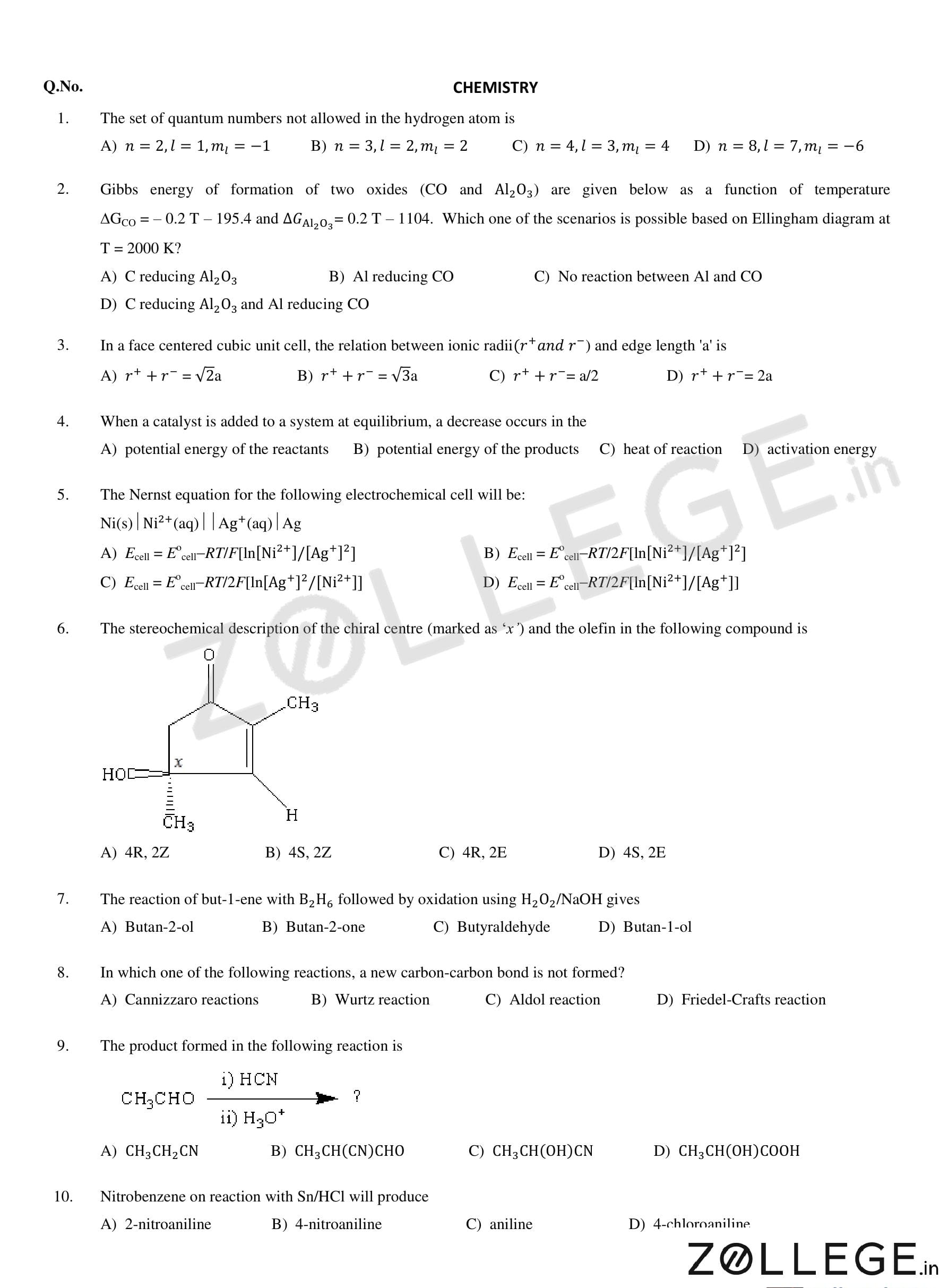
The set of quantum numbers not allowed in the hydrogen atom is
View Solution
The allowed values for the magnetic quantum number (\(m_l\)) depend on the azimuthal quantum number (\(l\)).
The condition is that \(m_l\) must be an integer in the range \(-l \le m_l \le +l\).
In option (C), the given values are \(l=3\) and \(m_l=4\).
Since \(4 > 3\), the value \(m_l = 4\) is not permitted for an \(l=3\) subshell.
All other options satisfy the conditions \(0 \le l < n\) and \(|m_l| \le l\).
Quick Tip: Remember the hierarchy: \(n\) defines shell, \(l\) (0 to \(n-1\)) defines subshell, and \(m_l\) (\(-l\) to \(+l\)) defines orbital orientation. \(m_l\) can never exceed \(l\).
Gibbs energy of formation of two oxides (CO and \(Al_2O_3\)) are given below as a function of temperature
\(\Delta G_{CO} = -0.2T - 195.4\) and \(\Delta G_{Al_2O_3} = 0.2T - 1104\). Which one of the scenarios is possible based on Ellingham diagram at T = 2000 K?
View Solution
Calculate the \(\Delta G\) values at \(T = 2000\) K for both oxides.
For CO: \(\Delta G = -0.2(2000) - 195.4 = -400 - 195.4 = -595.4\).
For \(Al_2O_3\): \(\Delta G = 0.2(2000) - 1104 = 400 - 1104 = -704\).
In an Ellingham diagram, the metal whose oxide formation has a more negative \(\Delta G\) (lower position) is more stable and can reduce the oxide of a metal with a less negative \(\Delta G\) (higher position).
Since \(-704 < -595.4\), Aluminium has a stronger affinity for oxygen than Carbon at this temperature.
Therefore, Al will reduce CO to form \(Al_2O_3\) and C.
Quick Tip: In Pyrometallurgy, "lower reduces higher". The element whose \(\Delta G^\circ_f\) line is lower on the graph acts as the reducing agent for the oxide above it.
In a face centered cubic unit cell, the relation between ionic radii (\(r^+\) and \(r^-\)) and edge length 'a' is
View Solution
An ionic face-centered cubic (FCC) unit cell typically refers to the Rock Salt (NaCl) structure.
In this structure, anions (\(r^-\)) occupy the corners and face centers, while cations (\(r^+\)) occupy the octahedral voids at the edge centers and body center.
The ions are in contact along the edge of the unit cell.
The edge length \(a\) consists of two anion radii and two cation radii: \(a = 2r^- + 2r^+\).
Dividing the equation by 2 gives the relation: \(r^+ + r^- = a/2\).
Quick Tip: Visualize the edge of NaCl: \(Cl^- - Na^+ - Cl^-\). The total distance is \(r^- + 2r^+ + r^- = 2(r^+ + r^-) = a\).
When a catalyst is added to a system at equilibrium, a decrease occurs in the
View Solution
A catalyst works by providing an alternative reaction pathway.
This new pathway has a lower activation energy (\(E_a\)) compared to the uncatalyzed reaction.
A catalyst does not alter the thermodynamic parameters such as the potential energy of reactants/products or the enthalpy change (\(\Delta H\)) of the reaction.
Therefore, the only quantity among the options that decreases is the activation energy.
Quick Tip: Catalysts change the rate (kinetics) by lowering the energy barrier (\(E_a\)), but they never change the equilibrium position (thermodynamics).
The Nernst equation for the following electrochemical cell will be:
Ni(s) \(|\) Ni\(^{2+}\)(aq) \(||\) Ag\(^{+}\)(aq) \(|\) Ag
View Solution
First, write the balanced cell reaction. Oxidation: \(Ni \rightarrow Ni^{2+} + 2e^-\). Reduction: \(2Ag^+ + 2e^- \rightarrow 2Ag\).
Overall reaction: \(Ni(s) + 2Ag^+(aq) \rightarrow Ni^{2+}(aq) + 2Ag(s)\).
The number of electrons transferred (\(n\)) is 2.
The reaction quotient \(Q = \frac{[products]}{[reactants]} = \frac{[Ni^{2+}]}{[Ag^+]^2}\) (solids are omitted).
Substitute these into the Nernst equation: \(E_{cell} = E^{\circ}_{cell} - \frac{RT}{nF} \ln Q\).
Result: \(E_{cell} = E^{\circ}_{cell} - \frac{RT}{2F} \ln \frac{[Ni^{2+}]}{[Ag^+]^2}\).
Quick Tip: Always balance the number of electrons to determine '\(n\)' and the exponents in the reaction quotient \(Q\). The coefficient becomes the power in the log term.
The stereochemical description of the chiral centre (marked as 'x') and the olefin in the following compound is
View Solution
Determine the configuration of the chiral center (C4). The priorities are: (1) -OH, (2) C3 (alkene carbon), (3) C5 (alkane carbon), (4) -CH\(_3\).
The -OH group is on a wedge (front) and -CH\(_3\) is on a hash (back).
Tracing the priority sequence 1 \(\rightarrow\) 2 \(\rightarrow\) 3 (OH \(\rightarrow\) Alkene \(\rightarrow\) Alkane) reveals a Clockwise direction. Since the lowest priority group (4) is in the back, the configuration is R.
For the alkene (olefin) at C2-C3: In a six-membered ring, a double bond is geometrically constrained to the cis configuration to avoid ring strain.
The cis configuration corresponds to Z stereochemistry here.
Thus, the full description is 4R, 2Z.
Quick Tip: For cyclohexene derivatives, the endocyclic double bond is always Z (cis). For R/S, if the lowest priority group is in the back, Clockwise = R; if in front, Clockwise = S.
The reaction of but-1-ene with B\(_2\)H\(_6\) followed by oxidation using H\(_2\)O\(_2\)/NaOH gives
View Solution
The reaction sequence described is Hydroboration-Oxidation.
Reagents B\(_2\)H\(_6\) followed by H\(_2\)O\(_2\)/OH\(^-\) perform the net addition of water (H-OH) across the double bond.
This reaction follows an Anti-Markovnikov regioselectivity, where the -OH group attaches to the less substituted carbon.
Starting with but-1-ene (\(CH_3CH_2CH=CH_2\)), the Anti-Markovnikov addition places the -OH on the terminal carbon.
The product formed is the primary alcohol: Butan-1-ol (\(CH_3CH_2CH_2CH_2OH\)).
Quick Tip: Hydroboration-Oxidation = Anti-Markovnikov Hydration. (Acid catalyzed hydration = Markovnikov).
In which one of the following reactions, a new carbon-carbon bond is not formed?
View Solution
Analyze the bond formation in each reaction type.
Wurtz reaction couples two alkyl halides (\(2R-X \rightarrow R-R\)), forming a C-C bond.
Aldol reaction connects an enolate to a carbonyl carbon, forming a C-C bond.
Friedel-Crafts reaction attaches an alkyl or acyl group to an aromatic ring, forming a C-C bond.
Cannizzaro reaction involves the disproportionation of aldehydes lacking alpha-hydrogens via hydride transfer. No new C-C bonds are created; only C-H and C-O bonds change.
Quick Tip: The Cannizzaro reaction is unique among name reactions of aldehydes as it is a redox process (disproportionation) rather than a condensation, involving no carbon chain extension.
The product formed in the following reaction is
CH\(_3\)CHO \(\xrightarrow{i) HCN}\) \(\xrightarrow{ii) H_3O^+}\) ?
View Solution
Step i: Reaction of Acetaldehyde (CH\(_3\)CHO) with HCN involves nucleophilic addition of CN\(^-\) to the carbonyl carbon.
This forms Acetaldehyde Cyanohydrin: CH\(_3\)CH(OH)CN.
Step ii: Acid hydrolysis (H\(_3\)O\(^+\)) converts the nitrile group (-CN) into a carboxylic acid group (-COOH).
The final product is 2-hydroxypropanoic acid (Lactic acid): CH\(_3\)CH(OH)COOH.
Quick Tip: Sequence: Carbonyl + HCN \(\rightarrow\) Cyanohydrin \(\xrightarrow{Hydrolysis}\) \(\alpha\)-Hydroxy Acid.
Nitrobenzene on reaction with Sn/HCl will produce
View Solution
The reagents Sn (Tin) and HCl form a strong reducing mixture.
When applied to Nitrobenzene (\(C_6H_5NO_2\)), this mixture reduces the nitro group (-NO\(_2\)) completely to an amino group (-NH\(_2\)).
The reaction is: \(Ph-NO_2 + 6[H] \rightarrow Ph-NH_2 + 2H_2O\).
The product obtained is Aniline (Benzenamine).
Quick Tip: Metals in acid (Sn/HCl, Fe/HCl) are standard reagents for reducing aromatic nitro compounds to primary aromatic amines.
*The article might have information for the previous academic years, please refer the official website of the exam.