
VITEEE 2019 Question Paper with Answer Key PDF for Mathematics


Content Writer | Updated On - Jan 14, 2026
VITEEE Question Papers are the most important study material for effective exam preparation. We at Zollege have provided all VITEEE Previous Year Papers with Solution PDFs here. VITEEE 2019 Mathematics exam was conducted successfully on Vellore Institute of Technology (VIT).
Students can freely download the VITEEE previous year's question paper PDFs along with their solutions here.We strongly encourage VITEEE aspirants to scan through all the VITEEE Question Paper to know the overall difficulty level,VITEEE Syllabus and understand the changes in VITEEE Exam Pattern over the years.
VITEEE 2019 Mathematics Question Paper with Answer Key PDF
| VITEEE 2019 Mathematics Question Paper PDF | VITEEE 2019 Mathematics Solution PDF |
|---|---|
| Download PDF | Check Solutions |

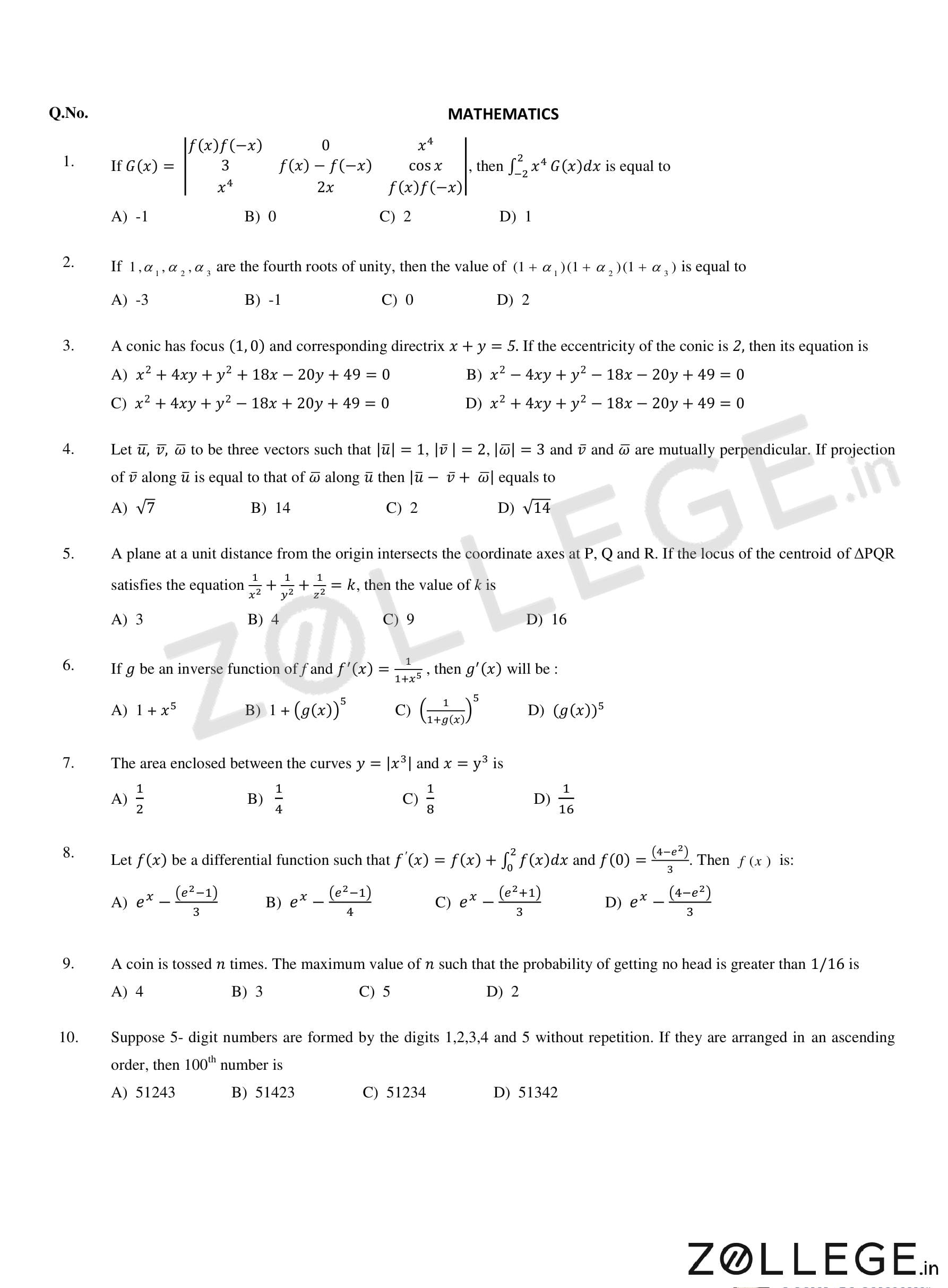
If \(G(x) = \begin{vmatrix} f(x)f(-x) & 0 & x^4
3 & f(x) - f(-x) & \cos x
x^4 & 2x & f(x)f(-x) \end{vmatrix}\), then \(\int_{-2}^{2} x^4 G(x) dx\) is equal to
View Solution
First, let's determine the parity (even or odd nature) of the function \(G(x)\).
Let \(A(x) = f(x)f(-x)\). Note that \(A(-x) = f(-x)f(x) = A(x)\), so \(A(x)\) is an even function.
Let \(B(x) = f(x) - f(-x)\). Note that \(B(-x) = f(-x) - f(x) = -(f(x) - f(-x)) = -B(x)\), so \(B(x)\) is an odd function.
The determinant is \(G(x) = \begin{vmatrix} A(x) & 0 & x^4
3 & B(x) & \cos x
x^4 & 2x & A(x) \end{vmatrix}\).
Expanding along the second row:
\(G(x) = -3 \begin{vmatrix} 0 & x^4
2x & A(x) \end{vmatrix} + B(x) \begin{vmatrix} A(x) & x^4
x^4 & A(x) \end{vmatrix} - \cos x \begin{vmatrix} A(x) & 0
x^4 & 2x \end{vmatrix}\).
Term 1: \(-3(0 - 2x^5) = 6x^5\). This is an Odd function.
Term 2: \(B(x) ( (A(x))^2 - x^8 )\). Since \(B\) is Odd and \(A^2, x^8\) are Even, Odd \(\times\) Even = Odd function.
Term 3: \(-\cos x ( 2x A(x) - 0 ) = -2x \cos x A(x)\). Since \(x\) is Odd and \(\cos x, A(x)\) are Even, Odd \(\times\) Even = Odd function.
Since \(G(x)\) is the sum of three odd functions, \(G(x)\) is an Odd function.
The integral is \(I = \int_{-2}^{2} x^4 G(x) dx\).
The integrand is \(x^4 \cdot G(x) = (Even) \cdot (Odd) = Odd\).
The definite integral of an odd function over a symmetric interval \([-a, a]\) is always 0.
Therefore, the value is 0.
Quick Tip: Always check for symmetry (even/odd) when integrating over limits like \([-a, a]\). If \(f(-x) = -f(x)\), \(\int_{-a}^a f(x) dx = 0\).
If \(1, \alpha_1, \alpha_2, \alpha_3\) are the fourth roots of unity, then the value of \((1+\alpha_1)(1+\alpha_2)(1+\alpha_3)\) is equal to
View Solution
The fourth roots of unity are the roots of the equation \(x^4 - 1 = 0\).
The roots are given as \(1, \alpha_1, \alpha_2, \alpha_3\).
Since \(x^4 - 1 = (x-1)(x+1)(x-i)(x+i)\), the roots are \(1, -1, i, -i\).
So, the set \(\{\alpha_1, \alpha_2, \alpha_3\}\) is equal to \(\{-1, i, -i\}\).
We need to calculate \((1+\alpha_1)(1+\alpha_2)(1+\alpha_3)\).
One of these roots must be \(-1\). Let \(\alpha_1 = -1\).
Then the first factor is \((1 + (-1)) = 0\).
Consequently, the entire product \((0)(1+i)(1-i)\) becomes 0.
Alternatively, using polynomial properties:
\(\frac{x^4-1}{x-1} = x^3 + x^2 + x + 1 = (x-\alpha_1)(x-\alpha_2)(x-\alpha_3)\).
We want the value of \((1+\alpha_1)(1+\alpha_2)(1+\alpha_3)\). This is not directly \(P(1)\) or \(P(-1)\).
However, rewriting the expression: \((1+\alpha_1) = -((-1)-\alpha_1)\).
Product \(= (-1)^3 ((-1)-\alpha_1)((-1)-\alpha_2)((-1)-\alpha_3) = -1 \cdot P(-1)\).
\(P(-1) = (-1)^3 + (-1)^2 + (-1) + 1 = -1 + 1 - 1 + 1 = 0\).
Thus, the value is 0.
Quick Tip: Recognize that if roots are \(n\)-th roots of unity, one of the roots is \(-1\) (if \(n\) is even). Factors involving \((1+root)\) will become zero.
A conic has focus \((1, 0)\) and corresponding directrix \(x + y = 5\). If the eccentricity of the conic is 2, then its equation is
View Solution
Let \(P(x, y)\) be any point on the conic.
The definition of a conic is \(\frac{SP}{PM} = e\), where \(S\) is the focus, \(M\) is the perpendicular distance to the directrix, and \(e\) is the eccentricity.
Here, \(S = (1, 0)\), Directrix line \(L: x + y - 5 = 0\), and \(e = 2\).
\(SP^2 = e^2 \cdot PM^2\).
\((x-1)^2 + (y-0)^2 = 2^2 \cdot \left( \frac{x + y - 5}{\sqrt{1^2 + 1^2}} \right)^2\).
\((x-1)^2 + y^2 = 4 \cdot \frac{(x + y - 5)^2}{2}\).
\(x^2 - 2x + 1 + y^2 = 2 (x^2 + y^2 + 25 + 2xy - 10x - 10y)\).
\(x^2 + y^2 - 2x + 1 = 2x^2 + 2y^2 + 50 + 4xy - 20x - 20y\).
Rearranging all terms to the right side:
\((2x^2 - x^2) + 4xy + (2y^2 - y^2) + (-20x + 2x) + (-20y) + (50 - 1) = 0\).
\(x^2 + 4xy + y^2 - 18x - 20y + 49 = 0\).
Quick Tip: For any conic section problem given Focus, Directrix, and Eccentricity, directly apply the definition \(SP^2 = e^2 PM^2\).
Let \(\vec{u}, \vec{v}, \vec{w}\) be three vectors such that \(|\vec{u}| = 1, |\vec{v}| = 2, |\vec{w}| = 3\) and \(\vec{v}\) and \(\vec{w}\) are mutually perpendicular. If projection of \(\vec{v}\) along \(\vec{u}\) is equal to that of \(\vec{w}\) along \(\vec{u}\) then \(|\vec{u} - \vec{v} + \vec{w}|\) equals to
View Solution
Given: \(|\vec{u}| = 1, |\vec{v}| = 2, |\vec{w}| = 3\).
\(\vec{v} \perp \vec{w} \implies \vec{v} \cdot \vec{w} = 0\).
Projection of \(\vec{v}\) along \(\vec{u}\) = Projection of \(\vec{w}\) along \(\vec{u}\).
\(\frac{\vec{v} \cdot \vec{u}}{|\vec{u}|} = \frac{\vec{w} \cdot \vec{u}}{|\vec{u}|} \implies \vec{v} \cdot \vec{u} = \vec{w} \cdot \vec{u}\).
Let \(k = \vec{v} \cdot \vec{u} = \vec{w} \cdot \vec{u}\).
We need to find \(|\vec{u} - \vec{v} + \vec{w}|\). Let's calculate its square.
\(|\vec{u} - \vec{v} + \vec{w}|^2 = (\vec{u} - \vec{v} + \vec{w}) \cdot (\vec{u} - \vec{v} + \vec{w})\).
\(= |\vec{u}|^2 + |\vec{v}|^2 + |\vec{w}|^2 - 2(\vec{u} \cdot \vec{v}) + 2(\vec{u} \cdot \vec{w}) - 2(\vec{v} \cdot \vec{w})\).
Substitute the known values:
\(= 1^2 + 2^2 + 3^2 - 2k + 2k - 2(0)\).
\(= 1 + 4 + 9 = 14\).
Therefore, \(|\vec{u} - \vec{v} + \vec{w}| = \sqrt{14}\).
Quick Tip: Expand the square of the magnitude \(|\vec{A} + \vec{B} + \vec{C}|^2 = A^2 + B^2 + C^2 + 2(\vec{A}\cdot\vec{B} + \vec{B}\cdot\vec{C} + \vec{C}\cdot\vec{A})\).
A plane at a unit distance from the origin intersects the coordinate axes at P, Q and R. If the locus of the centroid of \(\Delta\)PQR satisfies the equation \(\frac{1}{x^2} + \frac{1}{y^2} + \frac{1}{z^2} = k\), then the value of k is
View Solution
Let the equation of the plane be \(\frac{x}{a} + \frac{y}{b} + \frac{z}{c} = 1\).
The intercepts are \(P(a, 0, 0)\), \(Q(0, b, 0)\), and \(R(0, 0, c)\).
The distance of this plane from the origin \((0,0,0)\) is given as 1.
\(\frac{1}{\sqrt{\frac{1}{a^2} + \frac{1}{b^2} + \frac{1}{c^2}}} = 1 \implies \frac{1}{a^2} + \frac{1}{b^2} + \frac{1}{c^2} = 1\).
Let the centroid of \(\Delta PQR\) be \((X, Y, Z)\).
\(X = \frac{a+0+0}{3} \implies a = 3X\).
\(Y = \frac{0+b+0}{3} \implies b = 3Y\).
\(Z = \frac{0+0+c}{3} \implies c = 3Z\).
Substitute these into the distance equation:
\(\frac{1}{(3X)^2} + \frac{1}{(3Y)^2} + \frac{1}{(3Z)^2} = 1\).
\(\frac{1}{9X^2} + \frac{1}{9Y^2} + \frac{1}{9Z^2} = 1\).
Multiply by 9: \(\frac{1}{X^2} + \frac{1}{Y^2} + \frac{1}{Z^2} = 9\).
Comparing with the given equation \(\frac{1}{x^2} + \frac{1}{y^2} + \frac{1}{z^2} = k\), we get \(k = 9\).
Quick Tip: The centroid of a triangle with vertices \((x_1, y_1, z_1)\) etc., is \((\frac{\Sigma x}{3}, \frac{\Sigma y}{3}, \frac{\Sigma z}{3})\).
If g be an inverse function of f and \(f'(x) = \frac{1}{1+x^5}\), then \(g'(x)\) will be :
View Solution
Since \(g\) is the inverse function of \(f\), we have \(f(g(x)) = x\).
Differentiating both sides with respect to \(x\) using the chain rule:
\(f'(g(x)) \cdot g'(x) = 1\).
Therefore, \(g'(x) = \frac{1}{f'(g(x))}\).
We are given \(f'(x) = \frac{1}{1+x^5}\).
To find \(f'(g(x))\), substitute \(g(x)\) for \(x\) in the expression for \(f'\):
\(f'(g(x)) = \frac{1}{1+(g(x))^5}\).
Now substitute this back into the equation for \(g'(x)\):
\(g'(x) = \frac{1}{\frac{1}{1+(g(x))^5}} = 1 + (g(x))^5\).
Quick Tip: If \(g = f^{-1}\), then \(g'(x) = \frac{1}{f'(g(x))}\). This is a standard property of derivatives of inverse functions.
The area enclosed between the curves \(y = |x^3|\) and \(x = y^3\) is
View Solution
The curves are \(C_1: y = |x^3|\) and \(C_2: x = y^3 \implies y = x^{1/3}\).
Let's find the points of intersection.
For \(x \ge 0\), \(y = x^3\). So \(x^3 = x^{1/3} \implies x^9 = x \implies x(x^8 - 1) = 0\).
The real roots are \(x = 0\) and \(x = 1\). The points are \((0,0)\) and \((1,1)\).
In the interval \((0, 1)\), take \(x = 1/8\). \(y_1 = (1/8)^3 = 1/512\). \(y_2 = (1/8)^{1/3} = 1/2\).
So \(y = x^{1/3}\) lies above \(y = x^3\).
For \(x < 0\), \(y = -x^3\) (since \(|x^3| = -x^3\)) and \(y = x^{1/3}\) (which is negative).
Intersection: \(-x^3 = x^{1/3} \implies -x^9 = x \implies x(1 + x^8) = 0\).
The only real root is \(x = 0\). The curves do not enclose a finite area in the 2nd/3rd quadrants as they only meet at the origin and diverge.
Thus, the enclosed area is only in the first quadrant.
Area \(= \int_{0}^{1} (x^{1/3} - x^3) dx\).
\(= \left[ \frac{x^{4/3}}{4/3} - \frac{x^4}{4} \right]_0^1\).
\(= \left[ \frac{3}{4}x^{4/3} - \frac{1}{4}x^4 \right]_0^1\).
\(= (\frac{3}{4} - \frac{1}{4}) - 0 = \frac{2}{4} = \frac{1}{2}\).
Quick Tip: Always visualize or sketch the curves to check which lies above the other and to verify the bounds of integration.
Let f(x) be a differential function such that \(f'(x) = f(x) + \int_{0}^{2} f(x)dx\) and \(f(0) = \frac{(4-e^2)}{3}\). Then \(f(x)\) is:
View Solution
Let \(K = \int_{0}^{2} f(x)dx\). Note that \(K\) is a constant.
The differential equation becomes \(f'(x) = f(x) + K\).
\(\frac{dy}{dx} - y = K\). This is a linear differential equation.
Integrating Factor (I.F.) \(= e^{\int -1 dx} = e^{-x}\).
\(y \cdot e^{-x} = \int K e^{-x} dx = -K e^{-x} + C\).
\(y = f(x) = C e^x - K\).
Given \(f(0) = \frac{4-e^2}{3}\).
Substituting \(x=0\): \(C - K = \frac{4-e^2}{3}\) \quad ...(1)
Now use the definition of K: \(K = \int_{0}^{2} (Ce^x - K) dx\).
\(K = [Ce^x - Kx]_0^2 = (Ce^2 - 2K) - (C - 0)\).
\(K = Ce^2 - 2K - C\).
\(3K = C(e^2 - 1) \implies K = C \frac{e^2 - 1}{3}\).
Substitute \(K\) into (1):
\(C - C \frac{e^2 - 1}{3} = \frac{4-e^2}{3}\).
\(C \left( 1 - \frac{e^2 - 1}{3} \right) = \frac{4-e^2}{3}\).
\(C \left( \frac{3 - e^2 + 1}{3} \right) = \frac{4-e^2}{3}\).
\(C \left( \frac{4 - e^2}{3} \right) = \frac{4-e^2}{3}\).
Since \(e^2 \approx 7.4\), \(4-e^2 \ne 0\), so \(C = 1\).
Then \(K = \frac{e^2 - 1}{3}\).
The function is \(f(x) = 1 \cdot e^x - \frac{e^2 - 1}{3}\).
Quick Tip: When an integral with fixed limits appears in an equation for \(f(x)\), treat it as a constant (\(K\)) and solve for it at the end.
A coin is tossed n times. The maximum value of n such that the probability of getting no head is greater than 1/16 is
View Solution
Let \(X\) be the random variable representing the number of heads.
The probability of getting a head in a single toss is \(p = 1/2\). Probability of tails is \(q = 1/2\).
The probability of getting no head in \(n\) tosses is \(P(X=0) = \binom{n}{0} p^0 q^n = (1/2)^n\).
We are given the condition: \(P(X=0) > \frac{1}{16}\).
\(\left(\frac{1}{2}\right)^n > \frac{1}{16}\).
\(\left(\frac{1}{2}\right)^n > \left(\frac{1}{2}\right)^4\).
Since the base \((1/2)\) is less than 1, the inequality sign reverses for the exponents:
\(n < 4\).
Since \(n\) must be a positive integer (number of tosses), the possible values are 1, 2, 3.
The maximum value of \(n\) satisfying the condition is 3.
Quick Tip: Remember that for \(0 < b < 1\), \(b^x > b^y \implies x < y\).
Suppose 5- digit numbers are formed by the digits 1,2,3,4 and 5 without repetition. If they are arranged in an ascending order, then \(100^{th}\) number is
View Solution
Total numbers formed using digits 1, 2, 3, 4, 5 without repetition = \(5! = 120\).
We need to find the \(100^{th}\) number in ascending order.
Number of numbers starting with 1: \(4! = 24\). (Ranks 1-24)
Number of numbers starting with 2: \(4! = 24\). (Ranks 25-48)
Number of numbers starting with 3: \(4! = 24\). (Ranks 49-72)
Number of numbers starting with 4: \(4! = 24\). (Ranks 73-96)
Total so far = \(24 \times 4 = 96\).
The \(100^{th}\) number must start with 5.
Next, consider the second digit (ascending order of remaining digits {1, 2, 3, 4).
Numbers starting with 51... : Remainder 3 digits ({2,3,4). \(3! = 6\) numbers.
Ranks 97 to \(96+6 = 102\).
So the \(100^{th}\) number lies in the block 51...
Let's list these numbers starting from rank 97:
Digits available: 2, 3, 4. Ascending order: 2, 3, 4.
97: 51234
98: 51243
99: 51324
100: 51342
The \(100^{th}\) number is 51342.
Quick Tip: Break the problem down by fixing the first digit and counting the permutations (\(n!\)) until you get close to the target rank.
*The article might have information for the previous academic years, please refer the official website of the exam.