
VITEEE 2020 Question Paper with Answer Key PDF for Aptitude


Content Writer | Updated On - Jan 14, 2026
VITEEE Question Papers are the most important study material for effective exam preparation. We at Zollege have provided all VITEEE Previous Year Papers with Solution PDFs here. VITEEE 2020 Aptitude exam was conducted successfully on Vellore Institute of Technology (VIT).
Students can freely download the VITEEE previous year's question paper PDFs along with their solutions here.We strongly encourage VITEEE aspirants to scan through all the VITEEE Question Paper to know the overall difficulty level,VITEEE Syllabus and understand the changes in VITEEE Exam Pattern over the years.
VITEEE 2020 Aptitude Question Paper with Answer Key PDF
| VITEEE 2020 Aptitude Question Paper PDF | VITEEE 2020 Aptitude Solution PDF |
|---|---|
| Download PDF | Check Solutions |

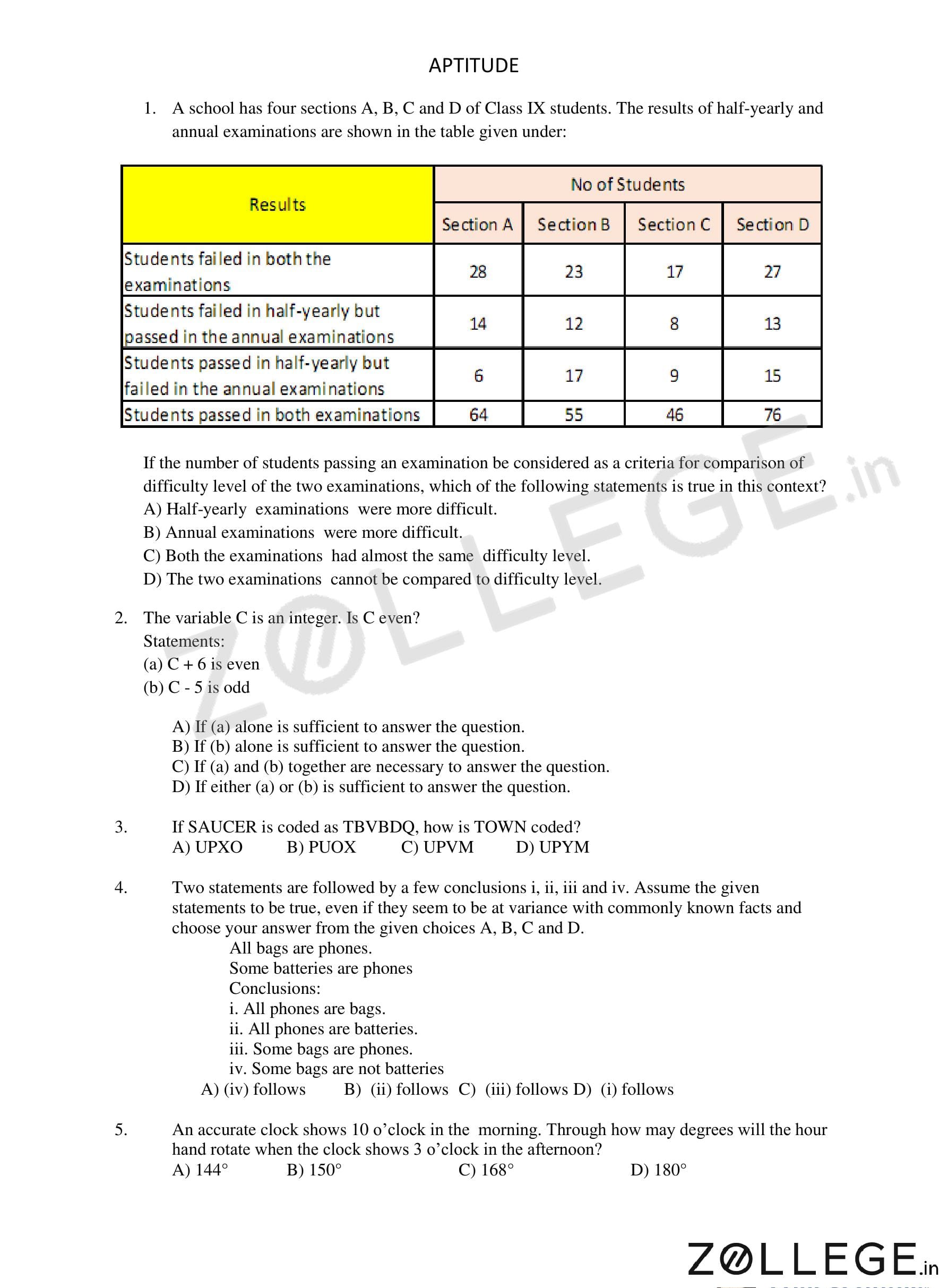
A school has four sections A, B, C and D of Class IX students. The results of half-yearly and annual examinations are shown in the table given under:

If the number of students passing an examination be considered as a criteria for comparison of difficulty level of the two examinations, which of the following statements is true in this context?
View Solution
To compare the difficulty, we calculate the total number of students passing each exam across all sections.
Pass counts for Half-yearly Examination:
Students pass if they are in the "Students passed in half-yearly but failed in annual" row OR the "Students passed in both" row.
Row 3 (Pass Half/Fail Annual) Total = \(6 + 17 + 9 + 15 = 47\).
Row 4 (Pass Both) Total = \(64 + 55 + 46 + 76 = 241\).
Total Passing Half-yearly = \(47 + 241 = 288\).
Pass counts for Annual Examination:
Students pass if they are in the "Students failed in half-yearly but passed in annual" row OR the "Students passed in both" row.
Row 2 (Fail Half/Pass Annual) Total = \(14 + 12 + 8 + 13 = 47\).
Row 4 (Pass Both) Total = \(241\).
Total Passing Annual = \(47 + 241 = 288\).
Since the total number of students passing the Half-yearly exam (288) is exactly equal to the number of students passing the Annual exam (288), the pass percentage is the same.
Therefore, both examinations had almost the same difficulty level.
Quick Tip: Instead of calculating percentages, simply comparing the raw number of passing students is sufficient since the total number of students is the same for both calculations.
The variable C is an integer. Is C even?
Statements:
(a) C + 6 is even
(b) C - 5 is odd
View Solution
We need to determine if \(C\) is even.
Analyze Statement (a): \(C + 6\) is even.
We know that an Even number + Even number = Even number.
Since 6 is even, for the sum to be even, \(C\) must be even.
Thus, statement (a) alone is sufficient to deduce that \(C\) is even.
Analyze Statement (b): \(C - 5\) is odd.
We know that an Even number - Odd number = Odd number.
Since 5 is odd, for the difference to be odd, \(C\) must be even.
Thus, statement (b) alone is sufficient to deduce that \(C\) is even.
Since each statement alone provides the answer, option (D) is correct.
Quick Tip: Recall parity rules: Even \(\pm\) Even = Even; Odd \(\pm\) Odd = Even; Even \(\pm\) Odd = Odd. Use these to quickly isolate the variable's parity.
If SAUCER is coded as TBVBDQ, how is TOWN coded?
View Solution
Let's analyze the pattern in the word SAUCER to TBVBDQ.
The word has 6 letters. It appears the first half follows one rule and the second half follows another.
First half (S-A-U):
S \(\rightarrow\) (+1) \(\rightarrow\) T
A \(\rightarrow\) (+1) \(\rightarrow\) B
U \(\rightarrow\) (+1) \(\rightarrow\) V
Rule: Next letter (+1).
Second half (C-E-R):
C \(\rightarrow\) (-1) \(\rightarrow\) B
E \(\rightarrow\) (-1) \(\rightarrow\) D
R \(\rightarrow\) (-1) \(\rightarrow\) Q
Rule: Previous letter (-1).
Now apply this logic to TOWN (4 letters). We split it into two halves: TO and WN.
First half (T-O) \(\rightarrow\) +1:
T \(\rightarrow\) U
O \(\rightarrow\) P
Second half (W-N) \(\rightarrow\) -1:
W \(\rightarrow\) V
N \(\rightarrow\) M
Combining them gives UPVM.
Quick Tip: When encoding words, check if the word is split into parts (halves or thirds) where the logic (forward/backward shift) might change.
Two statements are followed by a few conclusions i, ii, iii and iv. Assume the given statements to be true, even if they seem to be at variance with commonly known facts and choose your answer from the given choices A, B, C and D.
Statements:
All bags are phones.
Some batteries are phones.
Conclusions:
i. All phones are bags.
ii. All phones are batteries.
iii. Some bags are phones.
iv. Some bags are not batteries
View Solution
Let's analyze the statements using Set Theory or Venn Diagrams.
Statement 1: All bags are phones.
This means the set of Bags (\(B\)) is a subset of the set of Phones (\(P\)). (\(B \subseteq P\)).
Statement 2: Some batteries are phones.
This means there is an intersection between the set of Batteries (\(Bt\)) and the set of Phones (\(P\)). (\(Bt \cap P \neq \emptyset\)).
Note: We do not know if Batteries intersect with Bags.
Now evaluate the conclusions:
i. All phones are bags: Incorrect. \(P\) is the superset, not the subset.
ii. All phones are batteries: Incorrect. Only "Some" overlap is given.
iii. Some bags are phones: Correct. Since All bags are phones, it logically implies that at least some bags (in fact, all of them) are phones. In syllogisms, \(A \subseteq B \implies A \cap B \neq \emptyset\) (assuming sets are non-empty).
iv. Some bags are not batteries: Incorrect. It is possible that all bags are batteries (if the Bag circle is inside the intersection of Phones and Batteries). We cannot conclude this definitely.
Thus, only conclusion (iii) definitely follows.
Quick Tip: In Syllogisms, if "All A are B" is true, then "Some A are B" and "Some B are A" are implicitly true. Avoid assumptions about relations not explicitly stated (like Bags vs Batteries).
An accurate clock shows 10 o'clock in the morning. Through how many degrees will the hour hand rotate when the clock shows 3 o'clock in the afternoon?
View Solution
Calculate the total duration between the two times.
Start time: 10:00 AM.
End time: 3:00 PM.
Duration = (12:00 PM - 10:00 AM) + (3:00 PM - 12:00 PM)
Duration = 2 hours + 3 hours = 5 hours.
Calculate the speed of the hour hand.
The hour hand completes one full circle (360\(^\circ\)) in 12 hours.
Speed of hour hand = \(\frac{360^\circ}{12 hours} = 30^\circ\) per hour.
Calculate the total rotation.
Rotation = Speed \(\times\) Time
Rotation = \(30^\circ/hr \times 5 hours = 150^\circ\).
Quick Tip: Standard angular speeds for clocks: Hour hand = 0.5\(^\circ\)/min or 30\(^\circ\)/hour. Minute hand = 6\(^\circ\)/min.
*The article might have information for the previous academic years, please refer the official website of the exam.