
VITEEE 2020 Question Paper with Answer Key PDF for Chemistry


Content Writer | Updated On - Jan 14, 2026
VITEEE Question Papers are the most important study material for effective exam preparation. We at Zollege have provided all VITEEE Previous Year Papers with Solution PDFs here. VITEEE 2020 Chemistry exam was conducted successfully on Vellore Institute of Technology (VIT).
Students can freely download the VITEEE previous year's question paper PDFs along with their solutions here.We strongly encourage VITEEE aspirants to scan through all the VITEEE Question Paper to know the overall difficulty level,VITEEE Syllabus and understand the changes in VITEEE Exam Pattern over the years.
VITEEE 2020 Chemistry Question Paper with Answer Key PDF
| VITEEE 2020 Chemistry Question Paper PDF | VITEEE 2020 Chemistry Solution PDF |
|---|---|
| Download PDF | Check Solutions |

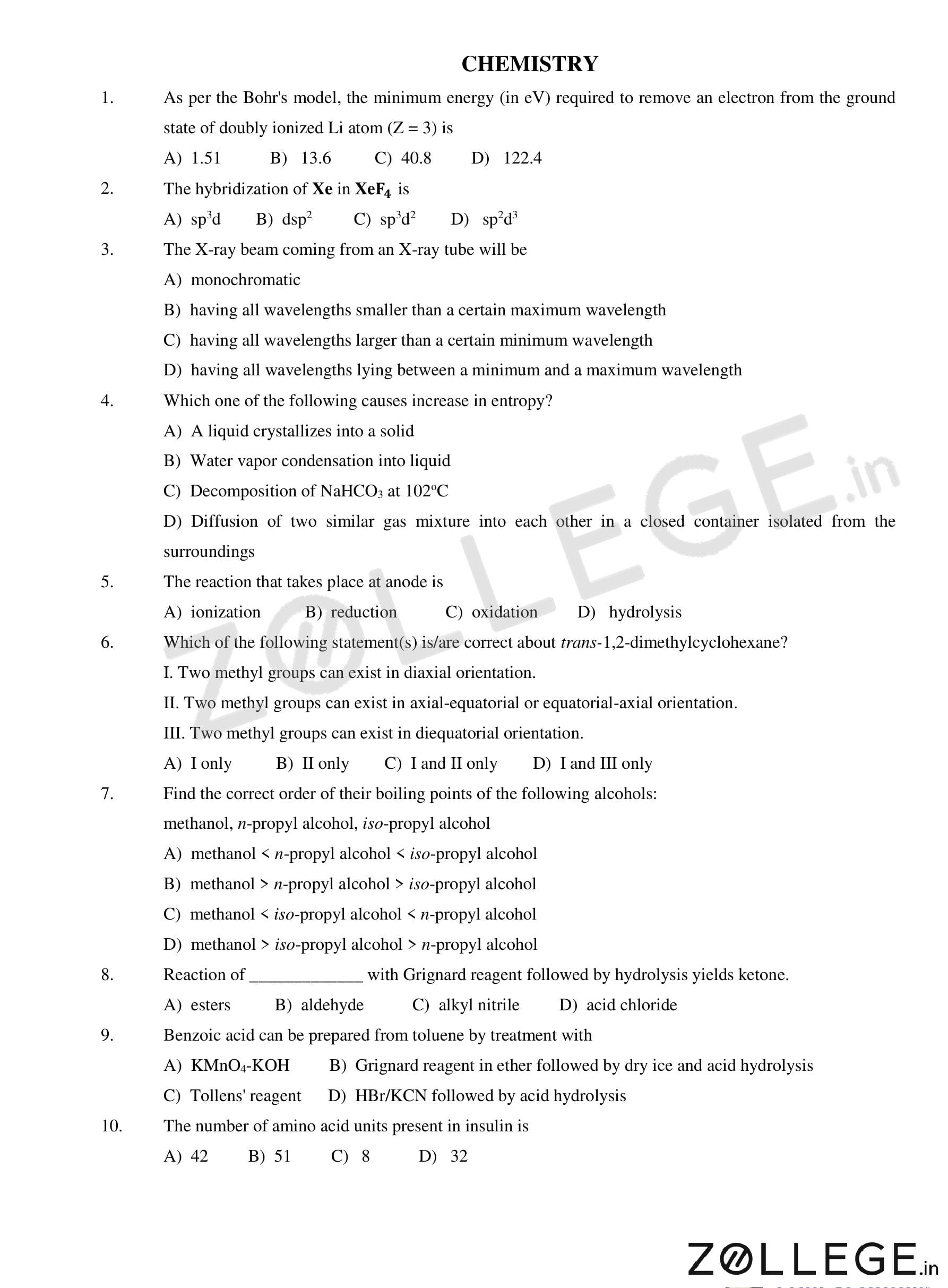
As per the Bohr's model, the minimum energy (in eV) required to remove an electron from the ground state of doubly ionized Li atom (Z = 3) is
View Solution
The energy of an electron in the \(n\)-th orbit of a hydrogen-like species is given by the Bohr formula: \(E_n = -13.6 \frac{Z^2}{n^2}\) eV.
For a doubly ionized Lithium atom (Li\(^{2+}\)), the atomic number \(Z = 3\).
The electron is in the ground state, so \(n = 1\).
Substituting the values into the formula: \(E_1 = -13.6 \times \frac{3^2}{1^2}\) eV.
\(E_1 = -13.6 \times 9 = -122.4\) eV.
The energy required to remove this electron (Ionization Energy) is the magnitude of the binding energy, which is \(+122.4\) eV.
Quick Tip: The ionization energy scales with \(Z^2\). For hydrogen (\(Z=1\)) it is 13.6 eV; for Li\(^{2+}\) (\(Z=3\)) it is \(13.6 \times 9\).
The hybridization of Xe in XeF\(_4\) is
View Solution
Xenon (Xe) has 8 valence electrons.
In XeF\(_4\), Xenon forms 4 sigma bonds with 4 Fluorine atoms, using 4 electrons.
The remaining valence electrons on Xenon are \(8 - 4 = 4\) electrons, which form 2 lone pairs.
The steric number (total electron domains) is the sum of sigma bonds and lone pairs: \(4 + 2 = 6\).
A steric number of 6 corresponds to \(sp^3d^2\) hybridization.
The geometry is octahedral, and the molecular shape is square planar.
Quick Tip: Formula for Steric Number: \(\frac{1}{2} (V + M - C + A)\). For XeF\(_4\): \(\frac{1}{2}(8 + 4 - 0 + 0) = 6 \rightarrow sp^3d^2\).
The X-ray beam coming from an X-ray tube will be
View Solution
The spectrum of X-rays emitted from an X-ray tube consists of a continuous spectrum (Bremsstrahlung) and a characteristic spectrum.
When electrons strike the target, their kinetic energy is converted into photons. The maximum energy of a photon corresponds to the complete conversion of the electron's kinetic energy (\(eV\)).
Since energy is inversely proportional to wavelength (\(E = hc/\lambda\)), the maximum energy corresponds to a minimum wavelength (\(\lambda_{min}\)).
\(\lambda_{min} = \frac{hc}{eV}\).
No photon can have a wavelength shorter than this cutoff. Therefore, the beam contains wavelengths larger than this minimum limit.
Quick Tip: The "cutoff wavelength" (\(\lambda_{min}\)) depends inversely on the accelerating voltage (\(V\)). \(\lambda_{min} (\AA) \approx \frac{12400}{V (volts)}\).
Which one of the following causes increase in entropy?
View Solution
Entropy (\(S\)) is a measure of disorder. The order of entropy is usually Gas \(>\) Liquid \(>\) Solid.
(A) Liquid \(\rightarrow\) Solid: Disorder decreases, so entropy decreases.
(B) Gas \(\rightarrow\) Liquid: Disorder decreases, so entropy decreases.
(C) Decomposition of NaHCO\(_3\): \(2NaHCO_3(s) \xrightarrow{\Delta} Na_2CO_3(s) + CO_2(g) + H_2O(g)\).
This reaction produces gaseous products from a solid reactant. The generation of gas significantly increases disorder.
Therefore, entropy increases in option (C).
Quick Tip: Look for the reaction where the number of moles of gaseous products is greater than the moles of gaseous reactants (\(\Delta n_g > 0\)).
The reaction that takes place at anode is
View Solution
In an electrochemical cell (both galvanic and electrolytic), the electrodes are defined by the reactions occurring at them.
The Anode is the electrode where oxidation (loss of electrons) takes place.
The Cathode is the electrode where reduction (gain of electrons) takes place.
Therefore, the reaction at the anode is oxidation.
Quick Tip: Remember the mnemonics: "An Ox" (Anode Oxidation) and "Red Cat" (Reduction Cathode).
Which of the following statement(s) is/are correct about trans-1,2-dimethylcyclohexane?
I. Two methyl groups can exist in diaxial orientation.
II. Two methyl groups can exist in axial-equatorial or equatorial-axial orientation.
III. Two methyl groups can exist in diequatorial orientation.
View Solution
For 1,2-disubstituted cyclohexanes, the relative positions (cis/trans) determine the conformational possibilities (axial/equatorial).
In the \textit{trans-1,2 isomer, the substituents are on opposite sides of the ring plane.
To maintain the trans relationship (dihedral angle approx 180\(^\circ\) or 60\(^\circ\) projection), the groups must be either both axial (\(a,a\)) or both equatorial (\(e,e\)).
The ring flip converts the diaxial conformer (\(1a, 2a\)) to the diequatorial conformer (\(1e, 2e\)).
The \textit{cis-1,2 isomer exists in (\(a,e\)) or (\(e,a\)) conformations.
Therefore, statements I (diaxial) and III (diequatorial) are correct for the trans isomer.
Quick Tip: For 1,2-substitution: Trans = aa or ee; Cis = ae or ea. Diequatorial is generally the most stable conformer.
Find the correct order of their boiling points of the following alcohols: methanol, n-propyl alcohol, iso-propyl alcohol
View Solution
Boiling point generally increases with molecular mass due to stronger Van der Waals forces.
Methanol (CH\(_3\)OH, Mass \(\approx\) 32) has a lower molecular mass than propyl alcohols (C\(_3\)H\(_7\)OH, Mass \(\approx\) 60). Thus, methanol has the lowest boiling point.
Between isomers, branching decreases the surface area, which weakens Van der Waals forces and lowers the boiling point.
n-propyl alcohol is a straight chain, while iso-propyl alcohol is branched.
Therefore, n-propyl alcohol has a higher boiling point than iso-propyl alcohol.
The correct order is: methanol \(<\) iso-propyl alcohol \(<\) n-propyl alcohol.
Quick Tip: Boiling Point Rules: 1. Increases with Molar Mass. 2. Decreases with Branching (for isomers).
Reaction of _______ with Grignard reagent followed by hydrolysis yields ketone.
View Solution
The reaction of Grignard reagents (RMgX) varies with different substrates:
(A) Esters usually react with 2 equivalents of Grignard reagent to yield tertiary alcohols.
(B) Aldehydes yield secondary alcohols (Formaldehyde yields primary).
(C) Alkyl nitriles (R-CN) react with Grignard reagents to form an imine salt intermediate (\(R-C(R')=NMgX\)). Upon acid hydrolysis, this imine converts to a ketone (\(R-C(=O)-R'\)).
(D) Acid chlorides usually react with 2 equivalents to yield tertiary alcohols.
Therefore, alkyl nitriles are the correct substrate to produce ketones.
Quick Tip: Nitriles stop at the ketone stage because the intermediate formed is a stable imine salt that does not react further with Grignard reagent. Hydrolysis then releases the ketone.
Benzoic acid can be prepared from toluene by treatment with
View Solution
Alkylbenzenes containing at least one benzylic hydrogen can be oxidized to benzoic acid by strong oxidizing agents.
Alkaline Potassium Permanganate (KMnO\(_4\)-KOH) followed by acidification is a standard reagent for this transformation.
Toluene (Methylbenzene) is oxidized directly to the benzoate ion, which gives Benzoic acid upon acidification.
Option (B) would require starting with a halobenzene, not toluene.
Option (C) oxidizes aldehydes.
Option (D) converts Toluene to Phenylacetic acid (adding an extra carbon).
Quick Tip: Side-chain oxidation of alkylbenzenes always yields Benzoic acid, regardless of the length of the alkyl chain, provided there is a benzylic hydrogen.
The number of amino acid units present in insulin is
View Solution
Insulin is a peptide hormone responsible for regulating blood glucose levels.
It is composed of two polypeptide chains connected by disulfide bridges.
Chain A consists of 21 amino acid residues.
Chain B consists of 30 amino acid residues.
The total number of amino acid units is \(21 + 30 = 51\).
Quick Tip: Insulin structure: Chain A (21) + Chain B (30) = 51 amino acids. It was the first protein to have its sequence determined (by Frederick Sanger).
*The article might have information for the previous academic years, please refer the official website of the exam.