
VITEEE 2021 Question Paper with Answer Key PDF for (May 28 Slot 4)


Content Writer | Updated On - Jan 17, 2026
VITEEE Question Papers are the most important study material for effective exam preparation. We at Zollege have provided all VITEEE Previous Year Papers with Solution PDFs here. VITEEE 2021 exam was conducted successfully on May 28 by Vellore Institute of Technology (VIT).
Students can freely download the VITEEE previous year's question paper PDFs along with their solutions here.We strongly encourage VITEEE aspirants to scan through all the VITEEE Question Paper to know the overall difficulty level,VITEEE Syllabus and understand the changes in VITEEE Exam Pattern over the years.
VITEEE 2021 Question Paper with Answer Key PDF Slot 4
| VITEEE 2021 Question Paper PDF | VITEEE 2021 Answer Key PDF |
|---|---|
| Download PDF | Check Solutions |

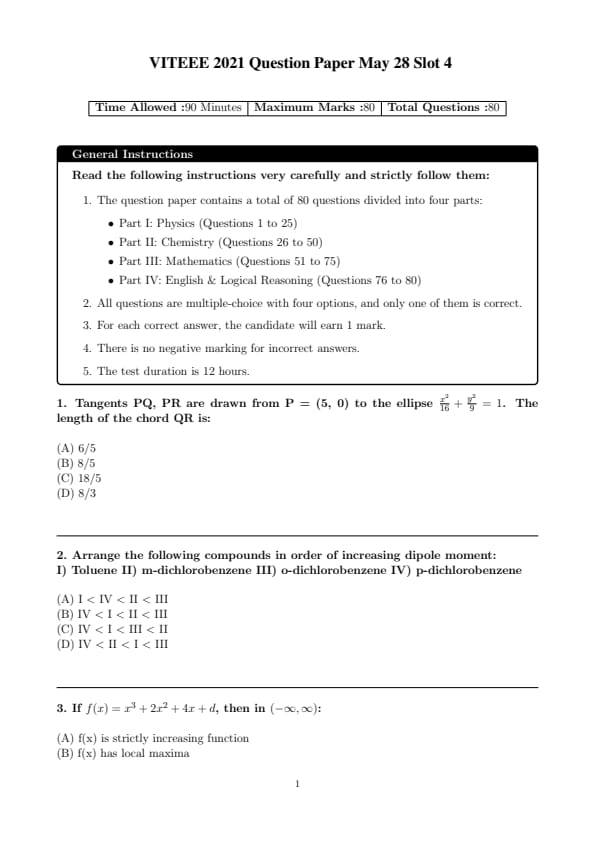
Tangents PQ, PR are drawn from P = (5, 0) to the ellipse \(\frac{x^2}{16} + \frac{y^2}{9} = 1\). The length of the chord QR is:
View Solution
Step 1: Understanding the Question:
The point \(P(5,0)\) lies outside the ellipse. Tangents drawn from this point touch the ellipse at \(Q\) and \(R\). \(QR\) is the chord of contact for point \(P\). We need to find the length of this chord.
Step 2: Key Formula or Approach:
The equation of the chord of contact of tangents drawn from \(P(x_1, y_1)\) to the ellipse \(\frac{x^2}{a^2} + \frac{y^2}{b^2} = 1\) is given by \(T = 0\), which is:
\[ \frac{xx_1}{a^2} + \frac{yy_1}{b^2} = 1 \]
Step 3: Detailed Explanation:
Given ellipse: \(\frac{x^2}{16} + \frac{y^2}{9} = 1\) and point \(P(5,0)\).
Equation of chord of contact \(QR\):
\[ \frac{x(5)}{16} + \frac{y(0)}{9} = 1 \implies \frac{5x}{16} = 1 \implies x = \frac{16}{5} \]
To find the coordinates of \(Q\) and \(R\), substitute \(x = \frac{16}{5}\) into the ellipse equation:
\[ \frac{(16/5)^2}{16} + \frac{y^2}{9} = 1 \]
\[ \frac{16^2}{25 \cdot 16} + \frac{y^2}{9} = 1 \implies \frac{16}{25} + \frac{y^2}{9} = 1 \]
\[ \frac{y^2}{9} = 1 - \frac{16}{25} = \frac{9}{25} \]
\[ y^2 = \frac{81}{25} \implies y = \pm \frac{9}{5} \]
The endpoints of the chord are \(Q(16/5, 9/5)\) and \(R(16/5, -9/5)\).
Length of \(QR = \sqrt{(16/5 - 16/5)^2 + (9/5 - (-9/5))^2} = \sqrt{0 + (18/5)^2} = \frac{18}{5}\).
Step 4: Final Answer.
The length of the chord \(QR\) is 18/5.
Quick Tip: For any conic, the equation of the chord of contact of tangents from an external point is \(T = 0\).
If the chord is vertical (like \(x = k\)), its length is simply the difference in the \(y\)-coordinates of its intersection points with the conic.
Arrange the following compounds in order of increasing dipole moment:
I) Toluene II) m-dichlorobenzene III) o-dichlorobenzene IV) p-dichlorobenzene
View Solution
Step 1: Understanding the Question:
Dipole moment is a vector quantity. We need to compare the net dipole moments of these benzene derivatives based on the positioning of substituents and the resultant vector sum of bond dipoles.
Step 2: Detailed Explanation:
1. p-dichlorobenzene (IV): The two \(C-Cl\) bond dipoles are equal and opposite (angle \(= 180^\circ\)), so they cancel out exactly. Dipole moment \(\mu \approx 0\).
2. Toluene (I): The methyl group is weakly electron-donating (\(+I\) effect), creating a small dipole moment (\(\mu \approx 0.36\) D).
3. m-dichlorobenzene (II): The two \(C-Cl\) bond dipoles are at an angle of \(120^\circ\). The resultant is \(\mu = \sqrt{\mu_1^2 + \mu_2^2 + 2\mu_1\mu_2\cos(120^\circ)}\).
4. o-dichlorobenzene (III): The two \(C-Cl\) bond dipoles are at an angle of \(60^\circ\). Since \(\cos(60^\circ) > \cos(120^\circ)\), the resultant dipole moment is largest for the ortho isomer.
Comparing these: \(0 (IV) < 0.36 (I) < \mu_m (II) < \mu_o (III)\).
Step 3: Final Answer.
The increasing order is IV \(<\) I \(<\) II \(<\) III.
Quick Tip: For disubstituted benzenes with the same group, the dipole moment order is generally: Ortho \(>\) Meta \(>\) Para (\(=0\) if groups are same).
Symmetrical para-substituted benzenes (like p-dichlorobenzene or p-dinitrobenzene) always have zero dipole moment.
If \(f(x) = x^3 + 2x^2 + 4x + d\), then in \((-\infty, \infty)\):
View Solution
Step 1: Understanding the Question:
To find the behavior of the function (increasing or decreasing), we need to examine the sign of its first derivative \(f'(x)\) over its domain.
Step 2: Key Formula or Approach:
A function \(f(x)\) is strictly increasing if \(f'(x) > 0\) for all \(x\) in the domain.
Step 3: Detailed Explanation:
Given: \(f(x) = x^3 + 2x^2 + 4x + d\)
Differentiating with respect to \(x\):
\[ f'(x) = 3x^2 + 4x + 4 \]
This is a quadratic expression \(ax^2 + bx + c\) where \(a = 3\), \(b = 4\), and \(c = 4\).
To check the sign of this quadratic, calculate its discriminant \(D\):
\[ D = b^2 - 4ac = 4^2 - 4(3)(4) = 16 - 48 = -32 \]
Since the coefficient of \(x^2\) is positive (\(a = 3 > 0\)) and the discriminant is negative (\(D < 0\)), the quadratic \(3x^2 + 4x + 4\) is always positive for all real \(x\).
Because \(f'(x) > 0\) for all \(x \in (-\infty, \infty)\), \(f(x)\) is a strictly increasing function.
Step 4: Final Answer.
The function \(f(x)\) is strictly increasing in \((-\infty, \infty)\).
Quick Tip: For a cubic function \(f(x) = ax^3 + bx^2 + cx + d\), it is strictly monotonic if the discriminant of its derivative (\(b^2 - 3ac\)) is less than or equal to zero.
If \(a > 0\) and \(D \leq 0\), it is strictly increasing.
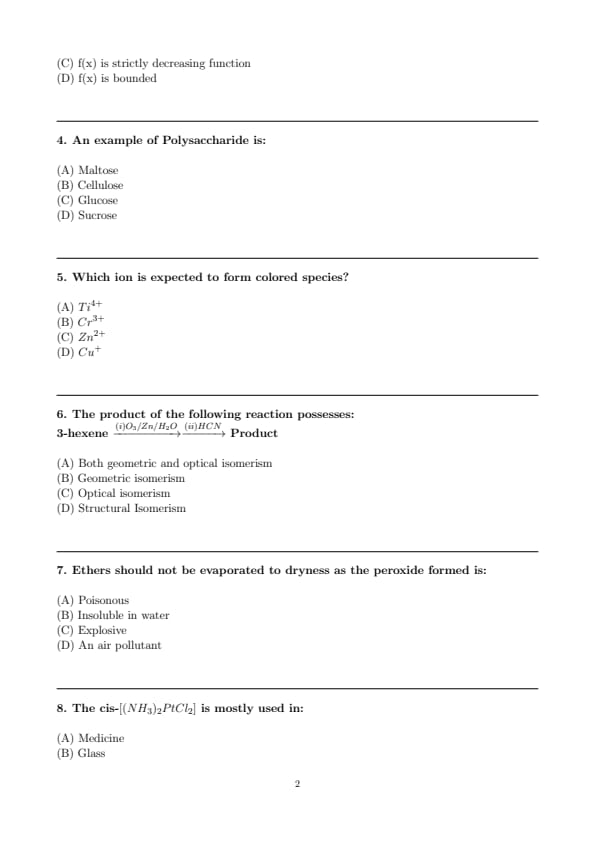
An example of Polysaccharide is:
View Solution
Step 1: Understanding the Question:
Carbohydrates are classified based on the number of sugar units they produce upon hydrolysis: Monosaccharides (1 unit), Disaccharides (2 units), and Polysaccharides (many units).
Step 2: Detailed Explanation:
1. Glucose (C): It is a simple sugar and cannot be hydrolyzed further. It is a monosaccharide.
2. Sucrose (D): Upon hydrolysis, it gives one glucose and one fructose unit. It is a disaccharide.
3. Maltose (A): Upon hydrolysis, it gives two glucose units. It is a disaccharide.
4. Cellulose (B): It is a long chain of \(\beta\)-D-glucose units. It consists of hundreds to thousands of glycosidically linked sugar units. Thus, it is a polysaccharide.
Step 3: Final Answer.
Cellulose is an example of a polysaccharide.
Quick Tip: Common polysaccharides: Starch, Cellulose, Glycogen.
Common disaccharides: Sucrose, Lactose, Maltose.
Cellulose is the most abundant organic compound on Earth and forms the cell wall of plants.
Which ion is expected to form colored species?
View Solution
Step 1: Understanding the Question:
Color in transition metal ions is generally due to d-d transitions. For these transitions to occur, the ion must have partially filled d-orbitals (\(d^1\) to \(d^9\)).
Step 2: Detailed Explanation:
1. \(Ti^{4+}\): Atomic number of Ti is 22. Electronic configuration is \([Ar]3d^2 4s^2\). In \(Ti^{4+}\), configuration is \([Ar]3d^0\). No d-electrons means no d-d transition. It is colorless.
2. \(Cr^{3+}\): Atomic number of Cr is 24. Electronic configuration is \([Ar]3d^5 4s^1\). In \(Cr^{3+}\), configuration is \([Ar]3d^3\). It has 3 unpaired electrons in d-orbitals. d-d transitions are possible, so it is colored (usually green/violet).
3. \(Zn^{2+}\): Atomic number of Zn is 30. Electronic configuration is \([Ar]3d^{10} 4s^2\). In \(Zn^{2+}\), configuration is \([Ar]3d^{10}\). Orbitals are completely filled, no d-d transitions. It is colorless.
4. \(Cu^+\): Atomic number of Cu is 29. Electronic configuration is \([Ar]3d^{10} 4s^1\). In \(Cu^+\), configuration is \([Ar]3d^{10}\). Completely filled d-orbitals make it colorless.
Step 3: Final Answer.
\(Cr^{3+}\) is expected to form colored species.
Quick Tip: Transition metal ions with \(d^0\) or \(d^{10}\) configurations are colorless.
Ions with \(d^1\) to \(d^9\) configurations are generally colored due to the excitation of an electron from lower energy d-orbitals to higher energy d-orbitals.
The product of the following reaction possesses:
3-hexene \(\xrightarrow{(i) O_3 / Zn / H_2O} \xrightarrow{(ii) HCN}\) Product
View Solution
Step 1: Understanding the Question:
We need to determine the structure of the final product formed after a sequence of ozonolysis followed by addition of \(HCN\), and identify its isomerism.
Step 2: Detailed Explanation:
1. Ozonolysis of 3-hexene (\(CH_3CH_2CH=CHCH_2CH_3\)):
Ozonolysis followed by reductive workup (\(Zn/H_2O\)) breaks the double bond and adds oxygen to both carbons.
Product: 2 moles of Propanal (\(CH_3CH_2CHO\)).
2. Reaction with \(HCN\):
Propanal reacts with \(HCN\) (Nucleophilic Addition) to form propanal cyanohydrin.
\[ CH_3CH_2CHO + HCN \rightarrow CH_3CH_2CH(OH)CN \]
3. Analyzing the Product Structure:
The product is 2-hydroxybutanenitrile. The central carbon atom is bonded to four different groups: \(-H\), \(-OH\), \(-CN\), and \(-CH_2CH_3\).
Since it has a chiral center, it exhibits optical isomerism. It does not have a double bond or ring required for geometric isomerism.
Step 3: Final Answer.
The product possesses optical isomerism.
Quick Tip: Aldehydes (except formaldehyde) react with \(HCN\) to produce cyanohydrins with a chiral center, leading to a racemic mixture of enantiomers.
Reductive ozonolysis of symmetrical alkenes always yields two identical molecules of a carbonyl compound.
Ethers should not be evaporated to dryness as the peroxide formed is:
View Solution
Step 1: Understanding the Question:
This question relates to the safety hazards associated with the storage and distillation of ethers.
Step 2: Detailed Explanation:
Ethers, upon long exposure to air and light, undergo auto-oxidation to form organic peroxides and hydroperoxides.
These peroxides have much higher boiling points than the corresponding ethers.
If an ether sample containing peroxides is evaporated to dryness, the concentration of these peroxides increases.
Organic peroxides are highly unstable and thermally sensitive; they can decompose violently when concentrated or heated, causing powerful explosions.
Therefore, ethers should never be distilled to dryness.
Step 3: Final Answer.
The peroxide formed is explosive.
Quick Tip: Before distilling ether, always test for peroxides by shaking with a solution of \(FeSO_4\) and \(KSCN\). A red color indicates the presence of peroxides.
Peroxides can be removed by treating the ether with reducing agents like ferrous salts or sodium bisulfite.
The cis-\([(NH_3)_2PtCl_2]\) is mostly used in:
View Solution
Step 1: Understanding the Question:
The compound \(cis-[(NH_3)_2PtCl_2]\) is a well-known coordination complex commonly called "Cisplatin".
Step 2: Detailed Explanation:
Cisplatin is one of the most widely used and effective chemotherapy drugs.
It works by binding to the DNA of cancer cells, causing cross-linking which interferes with DNA replication and ultimately leads to cell death (apoptosis).
It is used in the treatment of various cancers, including testicular, ovarian, bladder, and head and neck cancers.
The trans-isomer (transplatin) is much less biologically active and is not used as a drug.
Step 3: Final Answer.
Cisplatin is used in medicine (cancer treatment).
Quick Tip: Cisplatin is a square planar complex with Platinum in the \(+2\) oxidation state.
Remember the difference: cis-isomer is a drug, trans-isomer is not.
Its discovery revolutionized the field of bioinorganic chemistry.
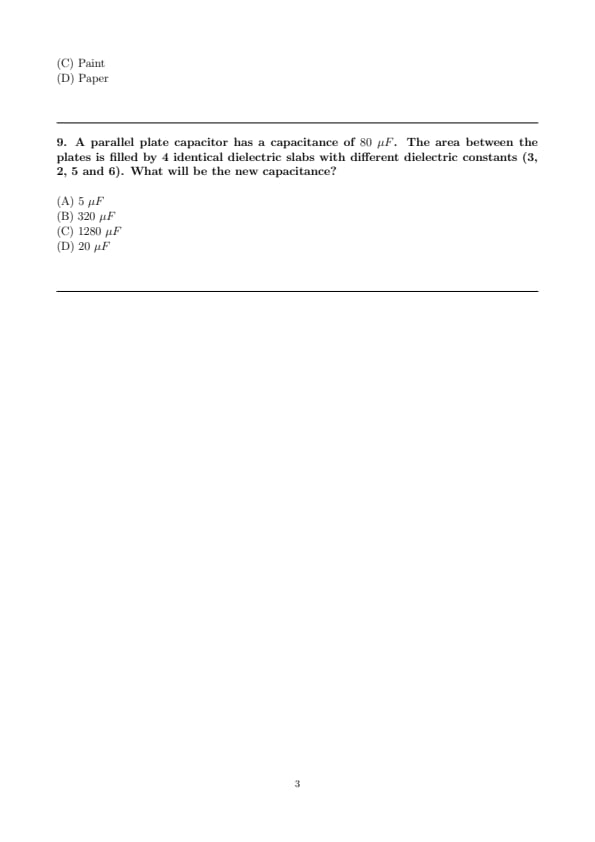
A parallel plate capacitor has a capacitance of \(80\ \mu F\). The area between the plates is filled by 4 identical dielectric slabs with different dielectric constants (3, 2, 5 and 6). What will be the new capacitance?
View Solution
Step 1: Understanding the Question:
The question describes a capacitor where the dielectric material is divided into four identical parts. "Identical slabs filling the area" implies that the total area \(A\) is divided into 4 equal parts (\(A/4\)), and each part is filled with a different dielectric while keeping the plate separation \(d\) constant.
Step 2: Key Formula or Approach:
When the area is divided, the sections act as capacitors connected in parallel.
Total Capacitance \(C = C_1 + C_2 + C_3 + C_4\)
Capacitance with dielectric \(K\) is \(C = K \frac{\epsilon_0 A'}{d}\).
Step 3: Detailed Explanation:
Let the initial capacitance be \(C_0 = \frac{\epsilon_0 A}{d} = 80\ \mu F\).
Since the slabs are identical and fill the area, each slab has area \(A/4\).
The individual capacitances are:
\(C_1 = 3 \frac{\epsilon_0 (A/4)}{d} = \frac{3}{4} C_0\)
\(C_2 = 2 \frac{\epsilon_0 (A/4)}{d} = \frac{2}{4} C_0\)
\(C_3 = 5 \frac{\epsilon_0 (A/4)}{d} = \frac{5}{4} C_0\)
\(C_4 = 6 \frac{\epsilon_0 (A/4)}{d} = \frac{6}{4} C_0\)
Total Capacitance \(C = \frac{C_0}{4} (K_1 + K_2 + K_3 + K_4)\)
\(C = \frac{80}{4} (3 + 2 + 5 + 6)\)
\(C = 20 \times 16 = 320\ \mu F\).
Step 4: Final Answer.
The new capacitance is \(320\ \mu F\).
Quick Tip: If dielectrics are placed side-by-side (dividing the area), they are in \textbf{parallel}.
If dielectrics are stacked on top of each other (dividing the thickness), they are in \textbf{series}.
For parallel: \(C_{new} = C_0 \times (Average value of K)\).
In this case: \(C_{new} = 80 \times \frac{3+2+5+6}{4} = 80 \times 4 = 320\ \mu F\).
*The article might have information for the previous academic years, please refer the official website of the exam.