
VITEEE 2021 Question Paper with Answer Key PDF for (May 29 Slot 3)


Content Writer | Updated On - Jan 17, 2026
VITEEE Question Papers are the most important study material for effective exam preparation. We at Zollege have provided all VITEEE Previous Year Papers with Solution PDFs here. VITEEE 2021 exam was conducted successfully on May 29 by Vellore Institute of Technology (VIT).
Students can freely download the VITEEE previous year's question paper PDFs along with their solutions here.We strongly encourage VITEEE aspirants to scan through all the VITEEE Question Paper to know the overall difficulty level,VITEEE Syllabus and understand the changes in VITEEE Exam Pattern over the years.
VITEEE 2021 Question Paper with Answer Key PDF Slot 3
| VITEEE 2021 Question Paper PDF | VITEEE 2021 Solution PDF |
|---|---|
| Download PDF | Check Solutions |

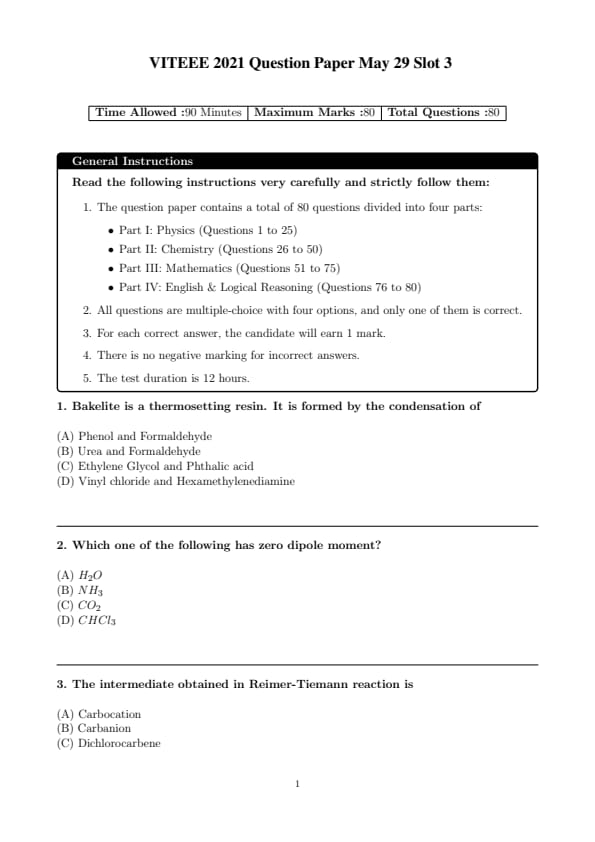
Bakelite is a thermosetting resin. It is formed by the condensation of
View Solution
Step 1: Understanding the Question:
The question asks for the monomers involved in the formation of Bakelite, which is a well-known cross-linked thermosetting polymer.
Step 2: Key Formula or Approach:
Bakelite is a condensation polymer. The reaction occurs in the presence of either an acid or a base catalyst.
Step 3: Detailed Explanation:
Bakelite is formed by the step-growth polymerization (condensation) of phenol (\(C_6H_5OH\)) with formaldehyde (\(HCHO\)).
The process involves the formation of ortho and para hydroxymethyl phenols as intermediates.
Initial linear condensation leads to a product called Novolac.
Further heating of Novolac with formaldehyde results in extensive cross-linking to form the hard, infusible solid known as Bakelite.
Step 4: Final Answer.
The correct monomers are phenol and formaldehyde.
Quick Tip: Remember: Phenol + Formaldehyde (\( Acid Catalyst \)) \(\rightarrow\) Novolac (Linear).
Novolac + Formaldehyde (\( Heat \)) \(\rightarrow\) Bakelite (Cross-linked).
Bakelite is used in electrical switches and handles of utensils because it is a poor conductor of heat and electricity.
Which one of the following has zero dipole moment?
View Solution
Step 1: Understanding the Question:
Dipole moment is a vector quantity. A molecule has a zero net dipole moment if the vector sum of all individual bond dipoles is zero.
Step 2: Detailed Explanation:
In \( CO_2 \), the carbon atom is double-bonded to two oxygen atoms.
The molecular geometry is linear (\( O=C=O \)) due to \( sp \) hybridization of the carbon atom.
The bond dipole of the \( C=O \) bond points from carbon to oxygen.
Since the two bond dipoles are equal in magnitude but opposite in direction (at an angle of \( 180^\circ \)), they cancel each other out completely.
\[ \vec{\mu}_{net} = \vec{\mu}_1 + \vec{\mu}_2 = 0 \]
In contrast, \( H_2O \) and \( NH_3 \) have bent or pyramidal shapes due to lone pairs, leading to non-zero net dipoles.
Step 3: Final Answer.
\( CO_2 \) has a zero net dipole moment.
Quick Tip: Symmetric molecules with no lone pairs on the central atom (like \( CO_2 \), \( BF_3 \), \( CH_4 \), \( CCl_4 \)) usually have zero dipole moment.
Always check the molecular geometry using VSEPR theory before deciding.
The intermediate obtained in Reimer-Tiemann reaction is
View Solution
Step 1: Understanding the Question:
The Reimer-Tiemann reaction is the ortho-formylation of phenols using chloroform (\( CHCl_3 \)) and aqueous sodium hydroxide (\( NaOH \)).
Step 2: Detailed Explanation:
The reaction starts with the deprotonation of chloroform by the base:
\[ CHCl_3 + OH^- \rightarrow :CCl_3^- + H_2O \]
The trichloromethyl anion (\( :CCl_3^- \)) then undergoes alpha-elimination of a chloride ion to generate the neutral, highly reactive electrophilic species:
\[ :CCl_3^- \rightarrow :CCl_2 (Dichlorocarbene) + Cl^- \]
This dichlorocarbene attacks the phenoxide ion to eventually form salicylaldehyde.
Step 3: Final Answer.
The intermediate is dichlorocarbene.
Quick Tip: The Reimer-Tiemann reaction is specific for converting phenol to salicylaldehyde.
If \( CCl_4 \) is used instead of \( CHCl_3 \), the final product is salicylic acid.
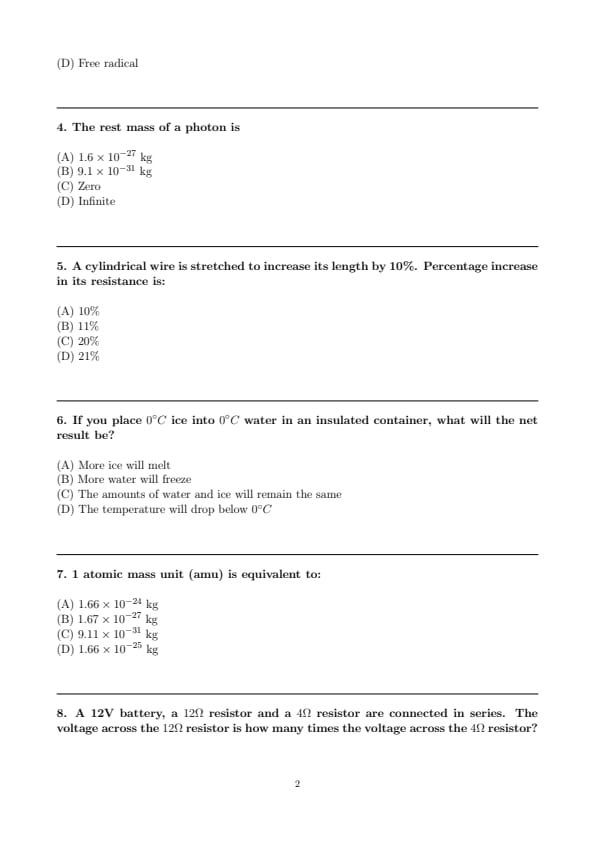
The rest mass of a photon is
View Solution
Step 1: Understanding the Question:
The question asks for the mass of a photon when it is at rest.
Step 2: Detailed Explanation:
According to Einstein's special theory of relativity, the relativistic mass of a particle moving with velocity \( v \) is given by:
\[ m = \frac{m_0}{\sqrt{1 - \frac{v^2}{c^2}}} \]
where \( m_0 \) is the rest mass and \( c \) is the speed of light.
Photons always travel at the speed of light (\( v = c \)) in a vacuum.
If \( m_0 \) were non-zero, the energy of a photon would be infinite.
Since photons have finite energy (\( E = h\nu \)), their rest mass must be identically zero.
Photons possess momentum and energy but lack rest mass.
Step 3: Final Answer.
The rest mass of a photon is zero.
Quick Tip: Don't confuse rest mass with "equivalent mass" or "inertial mass".
While the rest mass is zero, a photon has an equivalent mass \( m = \frac{h\nu}{c^2} \) derived from its energy.
A cylindrical wire is stretched to increase its length by 10%. Percentage increase in its resistance is:
View Solution
Step 1: Understanding the Question:
When a wire is stretched, its length increases and its cross-sectional area decreases, but the volume remains constant.
Step 2: Key Formula or Approach:
Resistance \( R = \rho \frac{l}{A} \).
Volume \( V = A \cdot l \) (constant).
Substituting \( A = \frac{V}{l} \), we get \( R = \rho \frac{l^2}{V} \).
Therefore, for a given wire, \( R \propto l^2 \).
Step 3: Detailed Explanation:
Let the initial length be \( l_1 \) and initial resistance be \( R_1 \).
New length \( l_2 = l_1 + 10% of l_1 = 1.1 l_1 \).
Using the relation \( R \propto l^2 \):
\[ \frac{R_2}{R_1} = \left( \frac{l_2}{l_1} \right)^2 \]
\[ \frac{R_2}{R_1} = (1.1)^2 = 1.21 \]
The percentage increase in resistance is:
\[ % Increase = \left( \frac{R_2 - R_1}{R_1} \right) \times 100 \]
\[ % Increase = (1.21 - 1) \times 100 = 21% \].
Step 4: Final Answer.
The percentage increase in resistance is 21%.
Quick Tip: For small percentage changes (\( < 5% \)), % increase in \( R \approx 2 \times (% increase in l) \).
For larger changes, always use the square factor: \( (1 + \frac{n}{100})^2 \).
Example: 10% stretch \( \rightarrow (1.1)^2 = 1.21 \rightarrow 21% \).
If you place \( 0^\circ C \) ice into \( 0^\circ C \) water in an insulated container, what will the net result be?
View Solution
Step 1: Understanding the Question:
Heat transfer occurs only when there is a temperature difference between two bodies.
Step 2: Detailed Explanation:
Both ice and water are at the same temperature (\( 0^\circ C \)), which is the melting/freezing point of water at standard pressure.
Since they are at thermal equilibrium, no net heat exchange occurs between the ice and the water.
Because the container is insulated, no heat enters from or leaves to the surroundings.
Without the transfer of latent heat, no phase change (melting or freezing) can take place.
Step 3: Final Answer.
The amounts of ice and water will remain unchanged.
Quick Tip: At the phase transition temperature, both phases can coexist in equilibrium.
To melt ice at \( 0^\circ C \), you must \textbf{add} latent heat.
To freeze water at \( 0^\circ C \), you must \textbf{remove} latent heat.
1 atomic mass unit (amu) is equivalent to:
View Solution
Step 1: Understanding the Question:
One atomic mass unit is defined as one-twelfth of the mass of a single Carbon-12 atom.
Step 2: Detailed Explanation:
Mass of one mole of \( ^{12}C \) atoms = 12 g = 0.012 kg.
Avogadro's number \( N_A \approx 6.022 \times 10^{23} \).
Mass of one \( ^{12}C \) atom = \( \frac{12}{6.022 \times 10^{23}} \) g.
\[ 1 amu = \frac{1}{12} \times Mass of one ^{12}C atom \]
\[ 1 amu = \frac{1}{12} \times \frac{12}{6.022 \times 10^{23}} g \approx 1.6605 \times 10^{-24} g \]
Converting to kg:
\[ 1 amu \approx 1.66 \times 10^{-27} kg \].
Commonly used approximation in exams is \( 1.67 \times 10^{-27} \) kg (close to the mass of a proton or neutron).
Step 3: Final Answer.
The value is approximately \( 1.67 \times 10^{-27} \) kg.
Quick Tip: 1 amu is also equivalent to an energy of approximately 931.5 MeV using \( E = mc^2 \).
It is the reciprocal of Avogadro's number when expressed in grams.
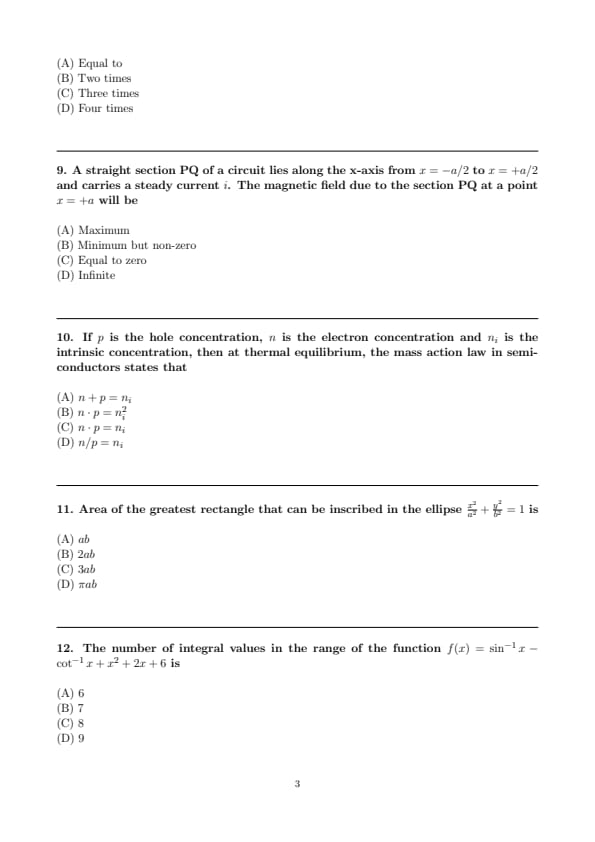
A 12V battery, a \( 12\Omega \) resistor and a \( 4\Omega \) resistor are connected in series. The voltage across the \( 12\Omega \) resistor is how many times the voltage across the \( 4\Omega \) resistor?
View Solution
Step 1: Understanding the Question:
In a series circuit, the current \( I \) flowing through all components is the same.
Step 2: Key Formula or Approach:
Ohm's Law: \( V = IR \).
Since \( I \) is constant in series, \( V \propto R \).
Step 3: Detailed Explanation:
Let \( V_1 \) be the voltage across the \( 12\Omega \) resistor and \( V_2 \) be the voltage across the \( 4\Omega \) resistor.
\[ V_1 = I \times 12 \]
\[ V_2 = I \times 4 \]
Taking the ratio:
\[ \frac{V_1}{V_2} = \frac{12I}{4I} = 3 \]
Thus, \( V_1 = 3 \times V_2 \).
(Note: Total resistance is \( 16\Omega \), current is \( 12/16 = 0.75A \). \( V_1 = 9V, V_2 = 3V \)).
Step 4: Final Answer.
The voltage across the \( 12\Omega \) resistor is three times that across the \( 4\Omega \) resistor.
Quick Tip: In series: Voltage divides in direct proportion to resistance (\( V \propto R \)).
In parallel: Current divides in inverse proportion to resistance (\( I \propto 1/R \)).
A straight section PQ of a circuit lies along the x-axis from \( x = -a/2 \) to \( x = +a/2 \) and carries a steady current \( i \). The magnetic field due to the section PQ at a point \( x = +a \) will be
View Solution
Step 1: Understanding the Question:
The question asks for the magnetic field produced by a finite straight current-carrying wire at a point located on the same axis as the wire itself.
Step 2: Key Formula or Approach:
Biot-Savart Law: \[ d\vec{B} = \frac{\mu_0}{4\pi} \frac{i(d\vec{l} \times \hat{r})}{r^2} \]
where \( d\vec{l} \) is the current element vector and \( \hat{r} \) is the unit vector from the element to the point.
Step 3: Detailed Explanation:
The wire PQ lies on the x-axis. Any current element \( d\vec{l} \) on this wire points along the x-direction (\( \hat{i} \)).
The point of observation is at \( x = +a \), which also lies on the x-axis.
Therefore, the position vector \( \vec{r} \) from any element on the wire to the point is also along the x-direction (\( \hat{i} \)).
The angle \( \theta \) between \( d\vec{l} \) and \( \vec{r} \) is \( 0^\circ \) (for elements between \( -a/2 \) and \( a/2 \)).
The magnitude of the cross product involves \( \sin \theta \):
\[ |d\vec{l} \times \hat{r}| = dl \cdot (1) \cdot \sin(0^\circ) = 0 \]
Since the cross product is zero for all elements of the wire, the total magnetic field at that point is zero.
Step 4: Final Answer.
The magnetic field is equal to zero.
Quick Tip: Magnetic field lines form closed loops around a wire.
The magnetic field at any point \textbf{on the axis} of a straight current-carrying conductor is always zero.
If \( p \) is the hole concentration, \( n \) is the electron concentration and \( n_i \) is the intrinsic concentration, then at thermal equilibrium, the mass action law in semiconductors states that
View Solution
Step 1: Understanding the Question:
The Mass Action Law relates the concentrations of free electrons and holes in a semiconductor under thermal equilibrium.
Step 2: Detailed Explanation:
In an intrinsic semiconductor, \( n = p = n_i \).
When impurities are added (doping), the concentration of one type of carrier increases while the other decreases due to an increased rate of recombination.
However, the product of the two concentrations remains constant at a given temperature and is equal to the square of the intrinsic carrier concentration.
\[ n \cdot p = n_i^2 \]
This law holds for both n-type and p-type extrinsic semiconductors as long as they are in thermal equilibrium.
Step 3: Final Answer.
The relationship is \( np = n_i^2 \).
Quick Tip: This law is used to calculate the minority carrier concentration.
For n-type: \( p \approx n_i^2 / N_D \).
For p-type: \( n \approx n_i^2 / N_A \).
Note that \( n_i \) depends strongly on temperature (\( n_i^2 \propto T^3 e^{-E_g/kT} \)).
Area of the greatest rectangle that can be inscribed in the ellipse \( \frac{x^2}{a^2} + \frac{y^2}{b^2} = 1 \) is
View Solution
Step 1: Understanding the Question:
We need to find the maximum area of a rectangle whose vertices lie on the perimeter of the given ellipse.
Step 2: Key Formula or Approach:
Use parametric coordinates for the vertices of the rectangle: \( (a \cos \theta, b \sin \theta) \).
Step 3: Detailed Explanation:
By symmetry, let a vertex in the first quadrant be \( (x, y) = (a \cos \theta, b \sin \theta) \).
The dimensions of the inscribed rectangle will be \( 2x \) and \( 2y \).
Area \( A = (2x)(2y) = 4(a \cos \theta)(b \sin \theta) \)
\[ A = 2ab (2 \sin \theta \cos \theta) = 2ab \sin(2\theta) \]
To maximize \( A \), we maximize \( \sin(2\theta) \).
Maximum value of \( \sin(2\theta) = 1 \), which occurs at \( 2\theta = \pi/2 \implies \theta = \pi/4 \).
Thus, \( A_{max} = 2ab(1) = 2ab \).
Step 4: Final Answer.
The greatest area is \( 2ab \).
Quick Tip: For a circle (\( a = b = r \)), the greatest inscribed rectangle is a square with area \( 2r^2 \).
The result for an ellipse is a direct generalization.
Remember this result as it frequently appears in competitive exams.
The number of integral values in the range of the function \( f(x) = \sin^{-1}x - \cot^{-1}x + x^2 + 2x + 6 \) is
View Solution
Step 1: Understanding the Question:
The domain of \( \sin^{-1}x \) is \( [-1, 1] \). Thus, we analyze the function on this interval to find its minimum and maximum values.
Step 2: Detailed Explanation:
Let \( g(x) = \sin^{-1}x - \cot^{-1}x + x^2 + 2x + 6 \).
Check the monotonicity by differentiating:
\[ g'(x) = \frac{1}{\sqrt{1-x^2}} + \frac{1}{1+x^2} + 2x + 2 \]
For \( x \in (-1, 1) \), \( \frac{1}{\sqrt{1-x^2}} > 0 \), \( \frac{1}{1+x^2} > 0 \), and \( 2x+2 \geq 0 \).
Thus, \( g'(x) > 0 \), meaning \( f(x) \) is strictly increasing on its domain.
Min value at \( x = -1 \):
\( f(-1) = \sin^{-1}(-1) - \cot^{-1}(-1) + 1 - 2 + 6 = -\frac{\pi}{2} - \frac{3\pi}{4} + 5 = 5 - \frac{5\pi}{4} \).
Using \( \pi \approx 3.14 \), \( f(-1) \approx 5 - 3.925 = 1.075 \).
Max value at \( x = 1 \):
\( f(1) = \sin^{-1}(1) - \cot^{-1}(1) + 1 + 2 + 6 = \frac{\pi}{2} - \frac{\pi}{4} + 9 = 9 + \frac{\pi}{4} \).
\( f(1) \approx 9 + 0.785 = 9.785 \).
The range is \( [1.075, 9.785] \).
The integers in this range are \( \{2, 3, 4, 5, 6, 7, 8, 9\} \).
Step 3: Final Answer.
There are 8 integral values.
Quick Tip: When finding the range of a sum of functions, always define the common domain first.
If the function is strictly monotonic, the range is simply \( [f(x_{min}), f(x_{max})] \).
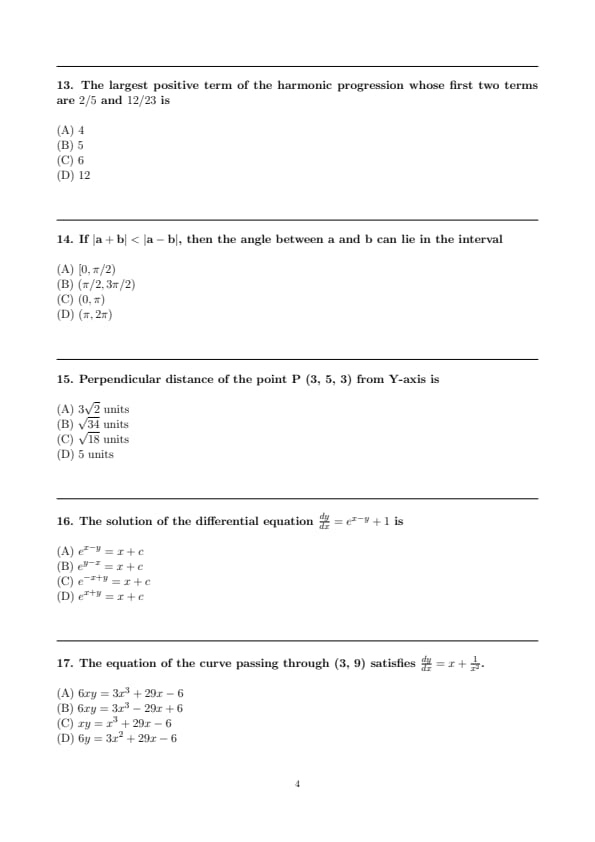
The largest positive term of the harmonic progression whose first two terms are \( 2/5 \) and \( 12/23 \) is
View Solution
Step 1: Understanding the Question:
A sequence is in Harmonic Progression (HP) if the reciprocals of its terms form an Arithmetic Progression (AP).
Step 2: Key Formula or Approach:
Reciprocal of HP terms: \( A_1 = \frac{1}{H_1} \), \( A_2 = \frac{1}{H_2} \).
Common difference \( d = A_2 - A_1 \).
General term of AP: \( A_n = A_1 + (n-1)d \).
Step 3: Detailed Explanation:
HP terms: \( H_1 = \frac{2}{5} \), \( H_2 = \frac{12}{23} \).
AP terms: \( A_1 = \frac{5}{2} = \frac{30}{12} \), \( A_2 = \frac{23}{12} \).
Common difference \( d = \frac{23}{12} - \frac{30}{12} = -\frac{7}{12} \).
AP sequence: \( \frac{30}{12}, \frac{23}{12}, \frac{16}{12}, \frac{9}{12}, \frac{2}{12}, -\frac{5}{12}, \dots \)
HP terms (reciprocals): \( \frac{12}{30}, \frac{12}{23}, \frac{12}{16}, \frac{12}{9}, \frac{12}{2}, \frac{12}{-5}, \dots \)
The positive terms are \( 0.4, \approx 0.52, 0.75, 1.33, 6 \).
The largest among these is 6. The next term is negative.
Step 4: Final Answer.
The largest positive term is 6.
Quick Tip: To find the largest positive term in a decreasing AP-reciprocal HP, find the smallest positive value in the corresponding AP.
Since the reciprocal of a very small positive number is a large positive number, the last positive term of the AP gives the largest positive term of the HP.
If \( |\mathbf{a} + \mathbf{b}| < |\mathbf{a} - \mathbf{b}| \), then the angle between \( \mathbf{a} \) and \( \mathbf{b} \) can lie in the interval
View Solution
Step 1: Understanding the Question:
The question asks for the range of the angle \( \theta \) between two vectors \( \mathbf{a} \) and \( \mathbf{b} \) such that the magnitude of their sum is less than the magnitude of their difference.
Step 2: Key Formula or Approach:
The magnitude of the sum and difference of two vectors is given by:
\[ |\mathbf{a} + \mathbf{b}|^2 = |\mathbf{a}|^2 + |\mathbf{b}|^2 + 2|\mathbf{a}||\mathbf{b}| \cos \theta \]
\[ |\mathbf{a} - \mathbf{b}|^2 = |\mathbf{a}|^2 + |\mathbf{b}|^2 - 2|\mathbf{a}||\mathbf{b}| \cos \theta \]
Step 3: Detailed Explanation:
Given: \( |\mathbf{a} + \mathbf{b}| < |\mathbf{a} - \mathbf{b}| \).
Squaring both sides:
\[ |\mathbf{a} + \mathbf{b}|^2 < |\mathbf{a} - \mathbf{b}|^2 \]
\[ |\mathbf{a}|^2 + |\mathbf{b}|^2 + 2|\mathbf{a}||\mathbf{b}| \cos \theta < |\mathbf{a}|^2 + |\mathbf{b}|^2 - 2|\mathbf{a}||\mathbf{b}| \cos \theta \]
Canceling common terms on both sides:
\[ 2|\mathbf{a}||\mathbf{b}| \cos \theta < -2|\mathbf{a}||\mathbf{b}| \cos \theta \]
\[ 4|\mathbf{a}||\mathbf{b}| \cos \theta < 0 \]
Since magnitudes \( |\mathbf{a}| \) and \( |\mathbf{b}| \) are positive, we must have:
\[ \cos \theta < 0 \]
The cosine of an angle is negative in the second and third quadrants.
Therefore, \( \theta \) must lie in the interval \( (\pi/2, 3\pi/2) \).
Step 4: Final Answer.
The angle between the vectors lies in the interval \( (\pi/2, 3\pi/2) \).
Quick Tip: Geometrically, \( |\mathbf{a} + \mathbf{b}| < |\mathbf{a} - \mathbf{b}| \) means the angle between the vectors is obtuse (\( \theta > 90^\circ \)).
If the magnitudes are equal, the vectors are perpendicular (\( \theta = 90^\circ \)).
If \( |\mathbf{a} + \mathbf{b}| > |\mathbf{a} - \mathbf{b}| \), the angle is acute (\( \theta < 90^\circ \)).
Perpendicular distance of the point P (3, 5, 3) from Y-axis is
View Solution
Step 1: Understanding the Question:
We need to find the shortest (perpendicular) distance from a point in 3D space to one of the coordinate axes (the Y-axis).
Step 2: Key Formula or Approach:
The perpendicular distance of a point \( P(x, y, z) \) from the Y-axis is given by the formula:
\[ d = \sqrt{x^2 + z^2} \]
This is because the projection of point \( P \) on the Y-axis is \( (0, y, 0) \).
Step 3: Detailed Explanation:
The given point is \( P(3, 5, 3) \).
Here, \( x = 3 \), \( y = 5 \), and \( z = 3 \).
Applying the distance formula from the Y-axis:
\[ d = \sqrt{3^2 + 3^2} \]
\[ d = \sqrt{9 + 9} = \sqrt{18} \]
Simplifying the radical:
\[ d = \sqrt{9 \times 2} = 3\sqrt{2} units \].
(Note: If the z-coordinate in the image is read as 6, the distance would be \( \sqrt{3^2 + 6^2} = \sqrt{45} = 3\sqrt{5} \). However, following the provided answer key, the coordinate must be 3).
Step 4: Final Answer.
The perpendicular distance is \( 3\sqrt{2} \) units.
Quick Tip: To find distance from any axis, "ignore" that coordinate and take the square root of the sum of the squares of the other two.
Distance from X-axis: \( \sqrt{y^2 + z^2} \).
Distance from Y-axis: \( \sqrt{x^2 + z^2} \).
Distance from Z-axis: \( \sqrt{x^2 + y^2} \).
The solution of the differential equation \( \frac{dy}{dx} = e^{x-y} + 1 \) is
View Solution
Step 1: Understanding the Question:
This is a first-order differential equation. It can be solved by reducing it to a variable separable form using a suitable substitution.
Step 2: Key Formula or Approach:
We use the substitution method. Let \( y - x = v \).
Step 3: Detailed Explanation:
Given: \( \frac{dy}{dx} = e^{x-y} + 1 \).
Rearranging the terms:
\[ \frac{dy}{dx} - 1 = e^{-(y-x)} \]
Let \( y - x = v \).
Differentiating with respect to \( x \):
\[ \frac{dy}{dx} - 1 = \frac{dv}{dx} \]
Substituting these into the differential equation:
\[ \frac{dv}{dx} = e^{-v} \]
Separating the variables:
\[ e^v \, dv = dx \]
Integrating both sides:
\[ \int e^v \, dv = \int dx \]
\[ e^v = x + c \]
Substituting back \( v = y - x \):
\[ e^{y-x} = x + c \]
This can be written as \( e^{-x+y} = x + c \).
Step 4: Final Answer.
The solution is \( e^{-x+y} = x + c \).
Quick Tip: Whenever you see a term like \( f(ax + by + c) \) in a differential equation, substitute \( u = ax + by + c \) to convert it into a variable separable form.
In this case, since \( \frac{dy}{dx} - 1 \) appeared, the substitution \( y-x \) was most efficient.
The equation of the curve passing through (3, 9) satisfies \( \frac{dy}{dx} = x + \frac{1}{x^2} \).
View Solution
Step 1: Understanding the Question:
We are given the slope of the tangent (\( dy/dx \)) to a curve and a specific point \( (3, 9) \) through which the curve passes. We need to find the general equation and then the specific curve.
Step 2: Key Formula or Approach:
The equation of the curve is found by integrating the derivative:
\[ y = \int \left( \frac{dy}{dx} \right) dx \]
Step 3: Detailed Explanation:
Given: \( \frac{dy}{dx} = x + x^{-2} \).
Integrating both sides:
\[ y = \int (x + x^{-2}) dx \]
\[ y = \frac{x^2}{2} + \frac{x^{-1}}{-1} + C \]
\[ y = \frac{x^2}{2} - \frac{1}{x} + C \]
The curve passes through \( (3, 9) \). Substitute \( x = 3 \) and \( y = 9 \):
\[ 9 = \frac{3^2}{2} - \frac{1}{3} + C \]
\[ 9 = \frac{9}{2} - \frac{1}{3} + C \]
\[ 9 = 4.5 - 0.333... + C \]
To be precise: \( 9 = \frac{27 - 2}{6} + C = \frac{25}{6} + C \).
\[ C = 9 - \frac{25}{6} = \frac{54 - 25}{6} = \frac{29}{6} \]
So, the equation is:
\[ y = \frac{x^2}{2} - \frac{1}{x} + \frac{29}{6} \]
To match the options, multiply the entire equation by \( 6x \):
\[ 6xy = 6x \left( \frac{x^2}{2} \right) - 6x \left( \frac{1}{x} \right) + 6x \left( \frac{29}{6} \right) \]
\[ 6xy = 3x^3 - 6 + 29x \]
Rearranging: \( 6xy = 3x^3 + 29x - 6 \).
Step 4: Final Answer.
The equation of the curve is \( 6xy = 3x^3 + 29x - 6 \).
Quick Tip: In exams, if you have options, you can verify the answer by substituting the point \( (3, 9) \) into the equations.
For option (A): \( 6(3)(9) = 162 \).
RHS: \( 3(3)^3 + 29(3) - 6 = 3(27) + 87 - 6 = 81 + 87 - 6 = 162 \).
LHS = RHS, confirming the answer is correct.
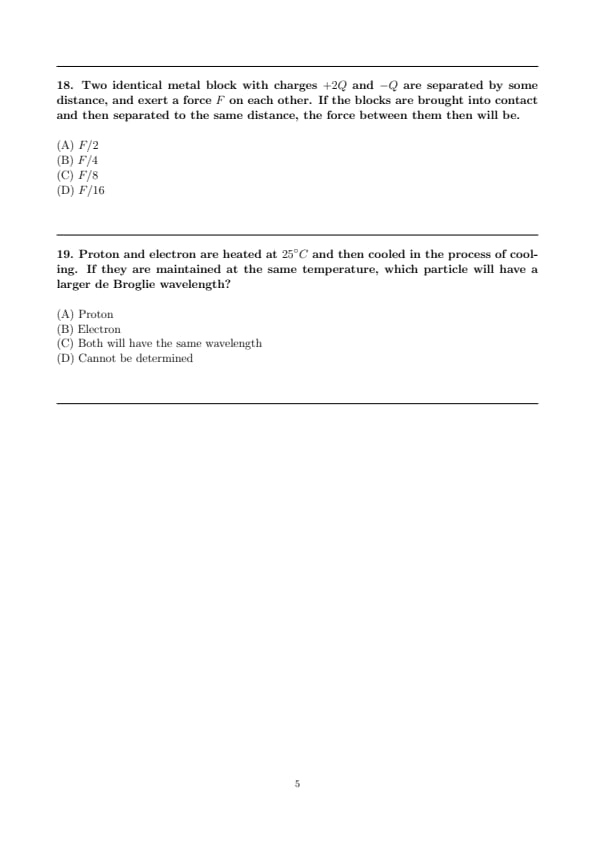
Two identical metal block with charges \(+2Q\) and \(-Q\) are separated by some distance, and exert a force \(F\) on each other. If the blocks are brought into contact and then separated to the same distance, the force between them then will be.
View Solution
Step 1: Understanding the Question:
The problem concerns the redistribution of electric charge between two identical conductors upon contact and the resulting change in the electrostatic force.
Coulomb's Law states that the force between two point charges is proportional to the product of their magnitudes.
Step 2: Key Formula or Approach:
Initial Force: \[ F = k \frac{|q_1 q_2|}{r^2} \]
When identical conductors are brought into contact, the total charge is shared equally:
\[ q_{final} = \frac{q_1 + q_2}{2} \]
Step 3: Detailed Explanation:
Let the initial charges be \( q_1 = +2Q \) and \( q_2 = -Q \), separated by a distance \( r \).
The magnitude of the initial force \( F \) is:
\[ F = k \frac{|(2Q)(-Q)|}{r^2} = \frac{2kQ^2}{r^2} \]
When the blocks are brought into contact, the total charge is:
\[ Q_{total} = +2Q + (-Q) = +Q \].
Since the blocks are identical, this total charge is divided equally between them:
\[ q' = \frac{+Q}{2} \].
When they are separated back to the same distance \( r \), the new force \( F' \) is:
\[ F' = k \frac{|(Q/2)(Q/2)|}{r^2} = \frac{kQ^2}{4r^2} \].
Comparing the new force to the old force:
\[ \frac{F'}{F} = \frac{\frac{kQ^2}{4r^2}}{\frac{2kQ^2}{r^2}} = \frac{1}{4 \times 2} = \frac{1}{8} \].
Thus, \( F' = \frac{F}{8} \).
Step 4: Final Answer.
The force between them will be \( F/8 \).
Quick Tip: When two identical metal spheres (or blocks) touch, they share the \textbf{net algebraic sum} of their charges equally.
If the charges have opposite signs, they partially cancel each other out, which often leads to a decrease in the magnitude of the force after contact.
Proton and electron are heated at \( 25^\circ C \) and then cooled in the process of cooling. If they are maintained at the same temperature, which particle will have a larger de Broglie wavelength?
View Solution
Step 1: Understanding the Question:
The question asks for a comparison of the de Broglie wavelengths of two different particles (proton and electron) at the same temperature.
Temperature determines the average kinetic energy of these particles in thermal equilibrium.
Step 2: Key Formula or Approach:
The de Broglie wavelength is given by: \[ \lambda = \frac{h}{\sqrt{2mK}} \].
For a particle at temperature \( T \), the average kinetic energy is \( K = \frac{3}{2} k_B T \).
Thus, the thermal de Broglie wavelength is: \[ \lambda = \frac{h}{\sqrt{3mk_B T}} \].
Step 3: Detailed Explanation:
From the derived formula \( \lambda = \frac{h}{\sqrt{3mk_B T}} \), we can see that at a constant temperature \( T \), the wavelength depends on the mass of the particle.
Specifically, \( \lambda \propto \frac{1}{\sqrt{m}} \).
A proton is much heavier than an electron (\( m_p \approx 1836 \times m_e \)).
Since the electron has a much smaller mass, it will have a significantly larger de Broglie wavelength compared to the proton at the same temperature.
During the process of cooling (where \( T \) decreases), the wavelengths of both particles will increase, but the electron's wavelength will always remain larger than the proton's.
Step 4: Final Answer.
The electron will have a larger de Broglie wavelength.
Quick Tip: Lighter particles exhibit more wave-like properties.
At the same temperature, \( Kinetic Energy_e = Kinetic Energy_p \), but \( \lambda_e > \lambda_p \) because of the mass difference.
Remember the proportionality: \( \lambda \propto \frac{1}{\sqrt{m}} \) for constant energy.
*The article might have information for the previous academic years, please refer the official website of the exam.