
VITEEE 2021 Question Paper with Answer Key PDF for (May 31 Slot 2)


Content Writer | Updated On - Jan 17, 2026
VITEEE Question Papers are the most important study material for effective exam preparation. We at Zollege have provided all VITEEE Previous Year Papers with Solution PDFs here. VITEEE 2021 exam was conducted successfully on May 31 by Vellore Institute of Technology (VIT).
Students can freely download the VITEEE previous year's question paper PDFs along with their solutions here.We strongly encourage VITEEE aspirants to scan through all the VITEEE Question Paper to know the overall difficulty level,VITEEE Syllabus and understand the changes in VITEEE Exam Pattern over the years.
VITEEE 2021 Question Paper with Answer Key PDF Slot 2
| VITEEE 2021 Question Paper PDF | VITEEE 2021 Solution PDF |
|---|---|
| Download PDF | Check Solutions |

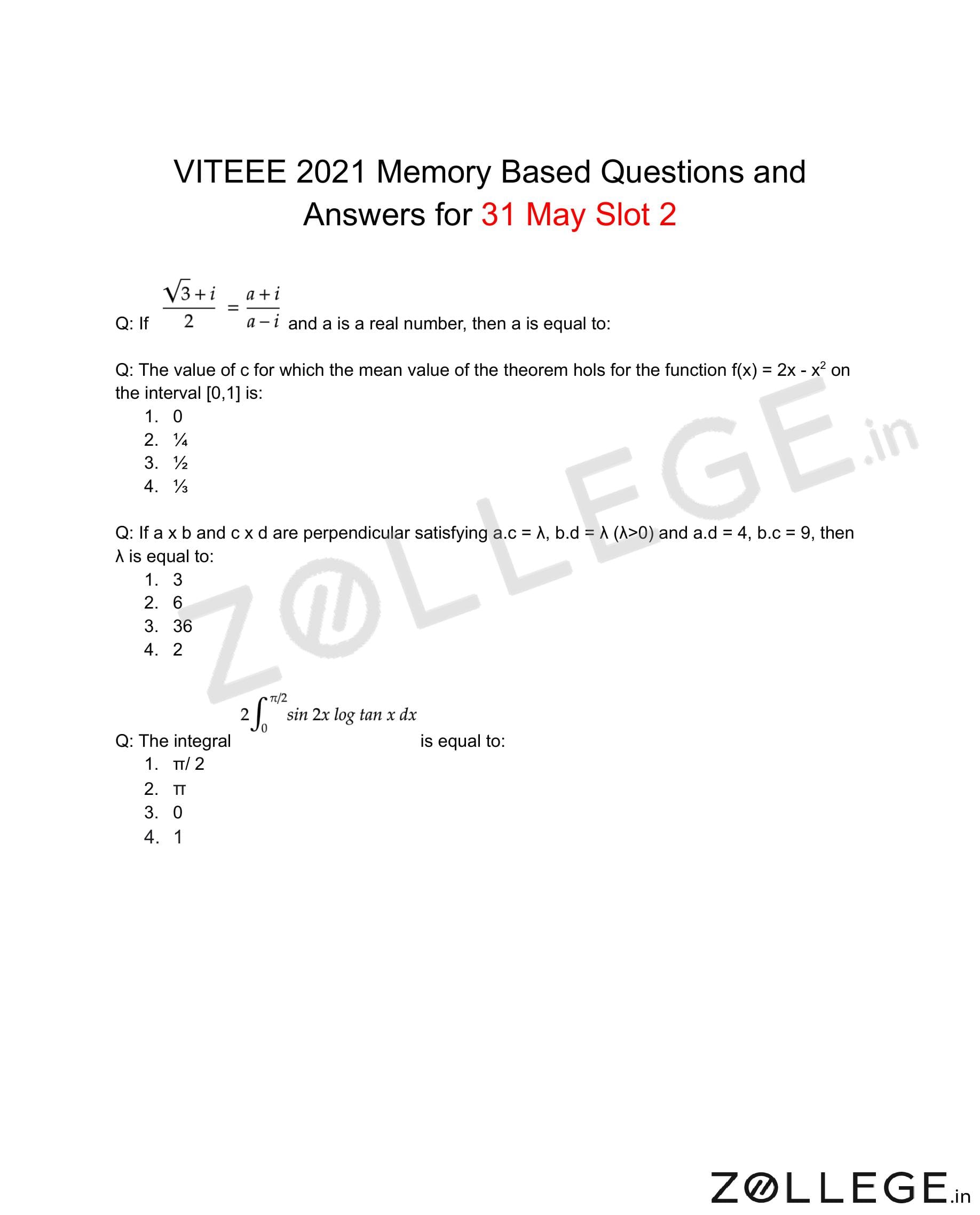
If \( \dfrac{\sqrt{3}+i}{2} = \dfrac{a+i}{a-i} \) and \( a \) is a real number, then \( a \) is equal to:
View Solution
Step 1: Understanding the Concept:
If two complex numbers are equal, then their real parts are equal and their imaginary parts are equal.
To compare them easily, the complex fraction on the right-hand side must be simplified.
Step 2: Key Formula or Approach:
Rationalize the denominator by multiplying numerator and denominator by the conjugate of \( a-i \).
Step 3: Detailed Explanation:
\[ \dfrac{a+i}{a-i} = \dfrac{(a+i)(a+i)}{(a-i)(a+i)}. \] \[ = \dfrac{a^2 + 2ai - 1}{a^2 + 1}. \]
Thus, \[ \dfrac{a+i}{a-i} = \frac{a^2-1}{a^2+1} + i\frac{2a}{a^2+1}. \]
Given: \[ \dfrac{\sqrt{3}+i}{2} = \frac{\sqrt{3}}{2} + i\frac{1}{2}. \]
Equating real and imaginary parts: \[ \frac{a^2-1}{a^2+1} = \frac{\sqrt{3}}{2}, \quad \frac{2a}{a^2+1} = \frac{1}{2}. \]
From the imaginary part: \[ 4a = a^2 + 1 \Rightarrow a^2 - 4a + 1 = 0. \]
Solving: \[ a = 2 \pm \sqrt{3}. \]
Checking these values in the real-part equation, only \[ a = \sqrt{3} \]
satisfies the given equality.
Step 4: Final Answer:
The value of \( a \) is \( \sqrt{3}. \)
Quick Tip: Always rationalize complex fractions first, then equate real and imaginary parts separately.
The value of \( c \) for which the Mean Value Theorem holds for the function \( f(x)=2x-x^2 \) on the interval \( [0,1] \) is:
View Solution
Step 1: Understanding the Concept:
The Mean Value Theorem states that if a function is continuous on \( [a,b] \) and differentiable on \( (a,b) \), then there exists at least one \( c \in (a,b) \) such that: \[ f'(c) = \frac{f(b)-f(a)}{b-a}. \]
Step 2: Key Formula or Approach:
Compute the average rate of change and equate it with the derivative of the function.
Step 3: Detailed Explanation:
Given \( f(x)=2x-x^2 \): \[ f(1)=2-1=1, \quad f(0)=0. \]
Average rate of change: \[ \frac{f(1)-f(0)}{1-0} = 1. \]
Derivative: \[ f'(x)=2-2x. \]
Equating: \[ 2-2c = 1 \Rightarrow 2c = 1 \Rightarrow c = \frac{1}{2}. \]
Clearly, \( \frac{1}{2} \in (0,1) \), so it satisfies the theorem.
Step 4: Final Answer:
The required value of \( c \) is \( \frac{1}{2}. \)
Quick Tip: For MVT problems, first compute the average slope, then equate it with the derivative.
If \( a \times b \) and \( c \times d \) are perpendicular vectors satisfying \( a \cdot c=\lambda \), \( b \cdot d=\lambda \ (\lambda>0) \) and \( a \cdot d=4 \), \( b \cdot c=9 \), then \( \lambda \) is equal to:
View Solution
Step 1: Understanding the Concept:
If two vectors are perpendicular, then their dot product is zero.
Here, the vectors are cross products.
Step 2: Key Formula or Approach:
Use the vector identity: \[ (a\times b)\cdot(c\times d) = (a\cdot c)(b\cdot d) - (a\cdot d)(b\cdot c). \]
Step 3: Detailed Explanation:
Since \( a\times b \) and \( c\times d \) are perpendicular: \[ (a\times b)\cdot(c\times d) = 0. \]
Substituting given values: \[ \lambda \cdot \lambda - (4)(9) = 0. \] \[ \lambda^2 = 36. \]
Since \( \lambda > 0 \): \[ \lambda = 6. \]
Step 4: Final Answer:
The value of \( \lambda \) is \( 6. \)
Quick Tip: Memorize the dot product identity of cross products for fast vector calculations.
The integral \( 2\int_{0}^{\pi/2} \sin 2x \log (\tan x)\,dx \) is equal to:
View Solution
Step 1: Understanding the Concept:
Certain definite integrals vanish due to symmetry when limits are \( 0 \) to \( \frac{\pi}{2} \).
Step 2: Key Formula or Approach:
Use the property: \[ \int_0^{\pi/2} f(x)\,dx = \int_0^{\pi/2} f\!\left(\frac{\pi}{2}-x\right) dx. \]
Step 3: Detailed Explanation:
Let: \[ I = 2\int_{0}^{\pi/2} \sin 2x \log(\tan x)\,dx. \]
Using substitution \( x \to \frac{\pi}{2}-x \): \[ \sin 2x \to \sin 2x, \quad \log(\tan x) \to \log(\cot x) = -\log(\tan x). \]
Hence: \[ I = -2\int_{0}^{\pi/2} \sin 2x \log(\tan x)\,dx = -I. \]
Thus: \[ I = 0. \]
Step 4: Final Answer:
The value of the integral is \( 0. \)
Quick Tip: Whenever logarithmic functions appear in symmetric limits, always test symmetry first.
*The article might have information for the previous academic years, please refer the official website of the exam.