
VITEEE 2021 Question Paper with Answer Key PDF for (May 31 Slot 3)


Content Curator | Updated On - Jan 16, 2026
VITEEE Question Papers are the most important study material for effective exam preparation. We at Zollege have provided all VITEEE Previous Year Papers with Solution PDFs here. VITEEE 2021 exam was conducted successfully on May 31 by Vellore Institute of Technology (VIT).
Students can freely download the VITEEE previous year's question paper PDFs along with their solutions here.We strongly encourage VITEEE aspirants to scan through all the VITEEE Question Paper to know the overall difficulty level,VITEEE Syllabus and understand the changes in VITEEE Exam Pattern over the years.
VITEEE 2021 Question Paper with Answer Key PDF Slot 3
| VITEEE 2021 Question Paper PDF | VITEEE 2021 Solution PDF |
|---|---|
| Download PDF | Check Solutions |

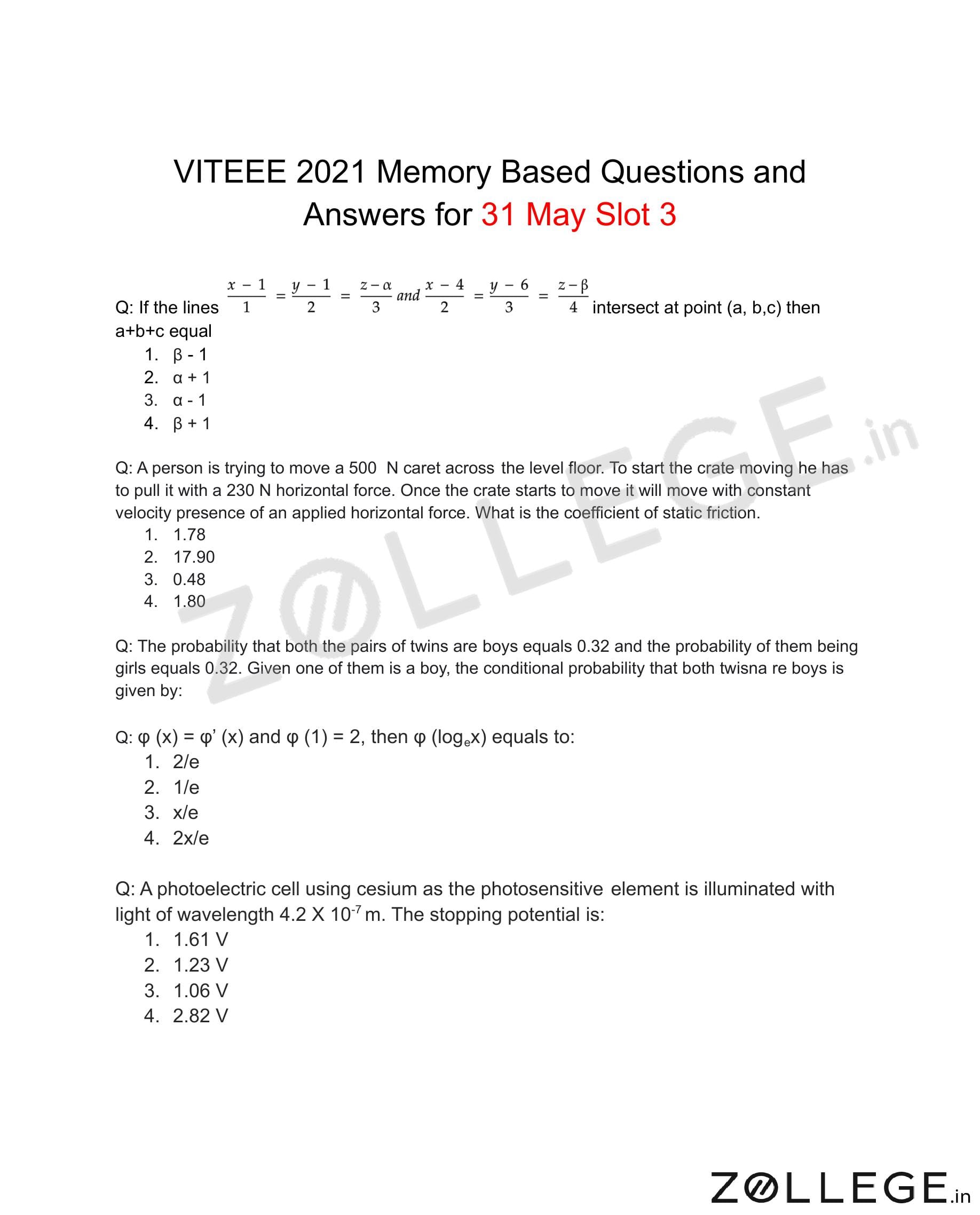
If the lines \( \dfrac{x-1}{1} = \dfrac{y-1}{2} = \dfrac{z-\alpha}{3} \) and \( \dfrac{x-4}{2} = \dfrac{y-6}{3} = \dfrac{z-\beta}{4} \) intersect at the point \( (a,b,c) \), then \( a+b+c \) is equal to:
View Solution
Step 1: Understanding the Concept:
If two lines intersect, their parametric coordinates must be equal at the point of intersection.
Step 2: Key Formula or Approach:
Convert symmetric forms into parametric equations.
Step 3: Detailed Explanation:
For first line, let parameter be \( t \):
\[ x = 1 + t,\quad y = 1 + 2t,\quad z = \alpha + 3t. \]
For second line, let parameter be \( s \):
\[ x = 4 + 2s,\quad y = 6 + 3s,\quad z = \beta + 4s. \]
At intersection: \[ 1+t = 4+2s \Rightarrow t = 3+2s. \] \[ 1+2t = 6+3s \Rightarrow 2t = 5+3s. \]
Substituting \( t = 3+2s \): \[ 2(3+2s)=5+3s \Rightarrow 6+4s=5+3s \Rightarrow s=-1. \]
Then \( t=1 \).
Coordinates: \[ a=2,\quad b=3,\quad c=\alpha+3. \]
Thus: \[ a+b+c = 2+3+\alpha+3 = \alpha-1. \]
Step 4: Final Answer:
\( a+b+c = \alpha - 1. \)
Quick Tip: For intersection of lines, always equate parametric forms and solve systematically.
A person is trying to move a \(500 N\) crate across a level floor. To start the crate moving he has to apply a \(230 N\) horizontal force. Once the crate starts moving it moves with constant velocity. What is the coefficient of static friction?
View Solution
Step 1: Understanding the Concept:
At the threshold of motion, applied force equals maximum static friction.
Step 2: Key Formula or Approach:
\[ f_s^{\max} = \mu_s N. \]
Step 3: Detailed Explanation:
Normal reaction: \[ N = 500 N. \]
At limiting condition: \[ 230 = \mu_s \times 500. \] \[ \mu_s = \frac{230}{500} = 0.46 \approx 0.48. \]
Step 4: Final Answer:
Coefficient of static friction is \(0.48\).
Quick Tip: Static friction is calculated at the point where motion is just about to begin.
The probability that both the twins are boys equals \(0.32\) and the probability of both being girls is also \(0.32\). Given that one of them is a boy, find the conditional probability that both twins are boys.
View Solution
Step 1: Understanding the Concept:
Conditional probability is defined as: \[ P(A|B)=\frac{P(A\cap B)}{P(B)}. \]
Step 2: Key Formula or Approach:
Let \( B \) be the event that at least one is a boy.
Step 3: Detailed Explanation:
Given: \[ P(BB)=0.32,\quad P(GG)=0.32. \] \[ P(BG)+P(GB)=1-0.64=0.36. \]
Thus: \[ P(at least one boy)=0.32+0.36=0.68. \] \[ P(BB|one boy)=\frac{0.32}{0.68}=0.5. \]
Step 4: Final Answer:
Required probability is \(0.5\).
Quick Tip: Always compute the total probability of the given condition carefully.
If \( \phi(x)=e^x \) and \( \phi(1)=2 \), then \( \phi(\log_e x) \) equals:
View Solution
Step 1: Understanding the Concept:
Use functional substitution carefully.
Step 2: Key Formula or Approach:
\[ \phi(x)=Ce^x. \]
Step 3: Detailed Explanation:
Given \( \phi(1)=2 \): \[ C e =2 \Rightarrow C=\frac{2}{e}. \]
Thus: \[ \phi(\log x)=\frac{2}{e}e^{\log x}=\frac{2x}{e}. \]
Step 4: Final Answer:
Value is \( \dfrac{2x}{e} \).
Quick Tip: Determine the constant using given functional values first.
A photoelectric cell using cesium as the photosensitive element is illuminated with light of wavelength \(4.2\times10^{-7} m\). The stopping potential is:
View Solution
Step 1: Understanding the Concept:
Photoelectric effect relates photon energy to stopping potential.
Step 2: Key Formula or Approach:
\[ eV_0 = h\nu - \phi. \]
Step 3: Detailed Explanation:
Photon energy: \[ E=\frac{hc}{\lambda}=\frac{6.63\times10^{-34}\times3\times10^8}{4.2\times10^{-7}} \approx 4.74\times10^{-19} J. \]
Work function of cesium: \[ \phi \approx 2.1 eV. \]
Thus: \[ V_0 \approx 1.61 V. \]
Step 4: Final Answer:
Stopping potential is \(1.61 V\).
Quick Tip: Remember standard work functions of common metals for quick calculation.
*The article might have information for the previous academic years, please refer the official website of the exam.