
VITEEE 2022 Question Paper Pdf - Check Solutions With Answer Key PDF


Content Writer | Updated On - Nov 17, 2025
VITEEE 2022 Question Paper with Solution PDF is available for download. Vellore Institute of Technology successfully conducted the exam from June 30 to July 6, 2022, in computer-based mode. As per the students’ initial reaction, VITEEE 2022 Question Paper was reported as moderate in overall difficulty. The Mathematics section in VITEEE 2022 was reported as lengthy and moderately difficult, Physics as moderate, Chemistry as easy to moderate, while English and Aptitude were considered easy.
VITEEE 2022 Question Paper with Answer Key PDF
Candidates can download the official VITEEE 2022 Question Paper with Solution and Answer Key PDFs using the link below.
| VITEEE 2022 Question Paper with Answer Key |  Download Download |
Check Solution |

VITEEE 2022 Question Paper With Solutions
The root mean square speed of smoke particles of mass \( 5 \times 10^{-17} \) kg in their Brownian motion in air at NTP is approximately.
(Given \( k = 1.38 \times 10^{-23} \, JK^{-1} \))
View Solution
Step 1: The root mean square speed (\( v_{rms} \)) of particles in Brownian motion is determined using the formula: \[ v_{rms} = \sqrt{\frac{3kT}{m}} \]
where:
- \( k = 1.38 \times 10^{-23} \, JK^{-1} \) is the Boltzmann constant,
- \( T \) represents the temperature in Kelvin,
- \( m = 5 \times 10^{-17} \, kg \) is the mass of the smoke particle.
Step 2: Given that the temperature at NTP (Normal Temperature and Pressure) is \( T = 273 \, K \), we substitute these values into the formula.
\[ v_{rms} = \sqrt{\frac{3 \times (1.38 \times 10^{-23}) \times 273}{5 \times 10^{-17}}} \]
Step 3: Simplifying the equation:
\[ v_{rms} = \sqrt{\frac{1.131 \times 10^{-20}}{5 \times 10^{-17}}} \] \[ v_{rms} = \sqrt{2.26 \times 10^{-4}} \] \[ v_{rms} \approx 0.015 \, m/s \]
Converting the result into millimeters per second:
\[ v_{rms} = 15.7 \, mm/s \approx 15 \, mm/s \]
Thus, the approximate root mean square speed is \( 15 \, mm/s \). Quick Tip: The root mean square speed of particles in Brownian motion depends on both temperature and mass. The equation \( v_{rms} = \sqrt{\frac{3kT}{m}} \) is crucial for such calculations.
The equation of a particle executing simple harmonic motion is given by \[ x = \sin \pi \left( t + \frac{1}{3} \right) \, m. \]
At \( t = 1 \, s \), the speed of particle will be (Given \( \pi = 3.14 \)):
View Solution
Step 1: The displacement equation for a particle undergoing simple harmonic motion is given as: \[ x = A \sin(\omega t + \phi), \]
where \( A \) represents the amplitude, \( \omega \) is the angular frequency, and \( \phi \) denotes the phase constant.
Step 2: Given \( x = \sin \pi \left( t + \frac{1}{3} \right) \), we identify \( A = 1 \, m \) and \( \omega = \pi \).
Step 3: The velocity \( v \) is determined by differentiating displacement with respect to time: \[ v = \frac{dx}{dt} = A \omega \cos(\omega t + \phi). \]
Step 4: At \( t = 1 \, s \), \[ v = \pi \cos\left( \pi \times 1 + \pi \times \frac{1}{3} \right) = \pi \cos\left( \frac{4\pi}{3} \right) = \pi \times (-\frac{1}{2}) = -\frac{\pi}{2} \, m/s. \]
The speed, which is the absolute value of velocity, is: \[ |v| = \frac{\pi}{2} \, m/s = 157 \, cm/s. \] Quick Tip: In simple harmonic motion, velocity is obtained by differentiating displacement with respect to time. The equation \( v = A\omega \cos(\omega t + \phi) \) helps determine the speed of the particle at any instant.
Following are expressions for four plane simple harmonic waves
\(y_1 = A \cos 2 \pi \left( n_1 t + \frac{x}{\lambda_1} \right)\),
\(y_2 = A \cos 2 \pi \left( n_1 t + \frac{x}{\lambda_1} + \pi \right)\),
\(y_3 = A \cos 2 \pi \left( n_2 t + \frac{x}{\lambda_2} \right)\),
\(y_4 = A \cos 2 \pi \left( n_2 t - \frac{x}{\lambda_2} \right)\)
The pairs of waves which will produce destructive interference and stationary waves respectively in a medium, are
View Solution
Step 1: Destructive interference takes place when two waves of identical frequency and amplitude are completely out of phase. In this case, the phase difference between waves (i) and (ii) is \( \pi \), leading to destructive interference.
Step 2: Stationary waves are formed when two waves have a phase difference of either \( 0 \) or \( \pi \). Due to their phase alignment, waves (i) and (ii) combine to generate stationary waves. Similarly, waves (iii) and (iv) also create stationary waves.
Step 3: Hence, the correct pairs of waves responsible for destructive interference and stationary waves are (i), (ii), (iii), and (iv). Quick Tip: Stationary waves result when two waves have a fixed phase difference of either \( 0 \) or \( \pi \). Destructive interference occurs when the phase difference between two waves is exactly \( \pi \), leading to complete cancellation.
If a charge \( q \) is placed at the centre of a closed hemispherical non-conducting surface, the total flux passing through the flat surface would

View Solution
Step 1: According to Gauss's Law, the total electric flux \( \Phi_E \) through a closed surface is expressed as: \[ \Phi_E = \frac{q_{enc}}{\epsilon_0} \]
where \( q_{enc} \) represents the charge enclosed, and \( \epsilon_0 \) denotes the permittivity of free space.
Step 2: When a charge is placed at the center of a hemispherical surface, the electric flux distributes uniformly. The total flux through the complete hemispherical surface is given by \( \frac{q}{\epsilon_0} \).
Step 3: Since the flux is uniformly distributed, half of it passes through the curved surface while the other half would pass through the flat surface.
Step 4: However, the flux passing through the flat surface is zero because the field lines are perpendicular to the curved surface and do not contribute to the flat region, leading to complete cancellation. Quick Tip: Gauss's law helps in determining the electric flux through a surface based on charge distribution. In symmetrical cases like a sphere or hemisphere, the flux is evenly spread, simplifying calculations.
The electric potential \( V(x) \) in a region around the origin is given by \( V(x) = 4x^2 \, volts. \)
\text{The electric charge enclosed in a cube of 1m side with its center at the origin is (in coulomb)
View Solution
Step 1: The relationship between the electric field \( E \) and the potential \( V \) is given by: \[ E = -\frac{dV}{dx} \]
For the given potential \( V(x) = 4x^2 \), differentiating with respect to \( x \) yields: \[ E = -\frac{d}{dx}(4x^2) = -8x. \]
Step 2: To determine the charge enclosed within a surface, Gauss’s Law is applied: \[ Q_{enc} = \oint E \, dA = \int E \, dA. \]
Since the electric field depends on \( x \), the integration must be performed over the volume of the cube.
Step 3: After executing the integration, the charge enclosed within the cube is found to be: \[ Q_{enc} = -8\epsilon_0. \] Quick Tip: The electric field is obtained by taking the negative derivative of the electric potential. In cases where the field varies with position, integrating it over a surface or volume helps in determining the charge enclosed.
A heater coil is cut into two equal parts and only one part is now used in the heater. The heat generated will now be
View Solution
Step 1: The heat generated in a coil is given by the formula: \[ H = I^2 R \]
where \( I \) is the current and \( R \) is the resistance.
Step 2: When the coil is cut into two equal parts, the resistance of each part becomes half of the original coil's resistance. Therefore, the heat generated by the coil when used in the heater will double.
Step 3: If the current remains constant, the heat generated by one part of the coil is double that of the original coil. Quick Tip: When a coil is cut into equal parts, the resistance of each part decreases, and the power (heat) generated increases because power is proportional to the square of the current and resistance.
In a region, steady and uniform electric and magnetic fields are present. These two fields are parallel to each other. A charged particle is released from rest in this region. The path of the particle will be a
View Solution
Step 1: If the electric and magnetic fields are parallel, the force on the charged particle due to the electric field will be in the same direction as the magnetic force.
Step 2: Since both forces act in the same direction, the charged particle will experience a uniform force, causing it to accelerate in a straight line. Quick Tip: When the electric and magnetic fields are parallel, the forces act in the same direction, leading to straight-line motion of the particle.
An object is thrown vertically upwards. At its maximum height, which of the following quantity becomes zero?
View Solution
Step 1: At maximum height, the velocity of the object becomes zero.
Step 2: Since momentum is the product of mass and velocity, the momentum of the object will also be zero at maximum height. Quick Tip: At maximum height, the velocity of the object is zero, hence its momentum becomes zero as well. However, the force and acceleration remain non-zero due to gravity.
The self-induced emf of a coil is 25 volts. When the current in it is changed at uniform rate from 10A to 25 A in 1s, the change in the energy of the inductance is:
View Solution
Step 1: The energy stored in an inductor is given by the formula: \[ E = \frac{1}{2} L I^2, \]
where \( L \) is the inductance and \( I \) is the current.
Step 2: The change in energy is the difference in energy stored before and after the change in current.
\[ \Delta E = \frac{1}{2} L \left( I_2^2 - I_1^2 \right), \]
where \( I_1 = 10 \, A \) and \( I_2 = 25 \, A \).
Step 3: To calculate \( L \), we use the given self-induced emf formula: \[ \mathcal{E} = L \frac{\Delta I}{\Delta t}, \]
where \( \mathcal{E} = 25 \, V \), \( \Delta I = 25 - 10 = 15 \, A \), and \( \Delta t = 1 \, s \).
\[ 25 = L \times \frac{15}{1} \quad \Rightarrow \quad L = \frac{25}{15} = \frac{5}{3} \, H. \]
Step 4: Now, substitute \( L = \frac{5}{3} \) H, \( I_1 = 10 \) A, and \( I_2 = 25 \) A into the energy formula: \[ \Delta E = \frac{1}{2} \times \frac{5}{3} \times \left( 25^2 - 10^2 \right) = \frac{1}{2} \times \frac{5}{3} \times \left( 625 - 100 \right) = \frac{5}{6} \times 525 = 437.5 \, J. \] Quick Tip: Energy stored in an inductor changes as the square of the current. The induced emf is related to the rate of change of current, which is used to find the change in energy.
Alternating current cannot be measured by a D.C. ammeter because
View Solution
Step 1: A D.C. ammeter is designed to measure the constant current that flows in a single direction. It operates by detecting the average value of the current.
Step 2: Alternating current (A.C.) varies periodically with time. In one complete cycle of A.C., the current first flows in one direction and then reverses direction. This results in the average value of the A.C. current being zero over one complete cycle.
Step 3: Since the D.C. ammeter measures the average value of the current, it would show zero for A.C. because the positive and negative half-cycles cancel each other out. Quick Tip: For A.C., the average value of the current over one complete cycle is zero. This is why a D.C. ammeter cannot measure A.C. correctly.
The magnetic field of a plane electromagnetic wave is given by: \[ \vec{B} = 2 \times 10^{-8} \sin \left(0.5 \times 10^3 x + 1.5 \times 10^{11} t \right) \hat{j} \, T. \]
\text{The amplitude of the electric field would be:
View Solution
Step 1: The relationship between the electric field \( E \) and the magnetic field \( B \) in a plane electromagnetic wave is given by: \[ E = c B \]
where \( c = 3 \times 10^8 \, m/s \) is the speed of light.
Step 2: Given that the amplitude of the magnetic field is \( 2 \times 10^{-8} \, T \), we can calculate the amplitude of the electric field as: \[ E = (3 \times 10^8) \times (2 \times 10^{-8}) = 6 \, V/m. \]
Step 3: Since the magnetic field is along the \( \hat{j} \)-axis (the \( y \)-axis), the electric field must be perpendicular to it and, therefore, must be along the \( x \)-axis. Quick Tip: In an electromagnetic wave, the electric field and magnetic field are perpendicular to each other, and the amplitude of the electric field is related to the magnetic field by \( E = c B \).
An ideal gas is expanding such that \( P T^3 = constant \). The coefficient of volume expansion of the gas is:
View Solution
Step 1: The equation of state is given by the relation: \[ P T^3 = constant. \]
This indicates that the product of the pressure \( P \) and the cube of the temperature \( T \) remains constant during the expansion.
Step 2: The coefficient of volume expansion \( \beta \) is defined as: \[ \beta = \frac{1}{V} \left( \frac{\Delta V}{\Delta T} \right)_P, \]
which can be related to the change in temperature under constant pressure.
Step 3: To relate the volume expansion to the temperature, we differentiate the given equation \( P T^3 = constant \).
Differentiating with respect to \( T \) gives: \[ P \cdot 3T^2 \cdot \frac{dT}{dT} + T^3 \cdot \frac{dP}{dT} = 0 \quad \Rightarrow \quad \frac{dP}{dT} = -\frac{3P}{T}. \]
Step 4: The relationship for the volume change is now obtained by considering that: \[ \frac{dV}{V} = \beta \, dT \quad \Rightarrow \quad \beta = \frac{4}{T}. \]
Step 5: Hence, the coefficient of volume expansion is \( \beta = \frac{4}{T} \). Quick Tip: The coefficient of volume expansion for an ideal gas can be derived using the relationship between pressure, temperature, and volume. For a gas expanding with \( P T^3 = constant \), \( \beta = \frac{4}{T} \).
Two light beams of intensities in the ratio of 9 : 4 are allowed to interfere. The ratio of the intensity of maxima and minima will be:
View Solution
Step 1:
Let the intensities of the two beams be \( I_1 \) and \( I_2 \). The ratio of the intensities is given by: \[ \frac{I_1}{I_2} = \frac{9}{4}. \]
Step 2:
The total intensity of interference maxima and minima depends on the superposition principle.
- The intensity at maxima is given by: \[ I_{max} = I_1 + I_2 + 2 \sqrt{I_1 I_2}. \]
- The intensity at minima is given by: \[ I_{min} = I_1 + I_2 - 2 \sqrt{I_1 I_2}. \]
Step 3:
Substitute \( I_1 = 9k \) and \( I_2 = 4k \) into these equations.
For maxima: \[ I_{max} = 9k + 4k + 2 \sqrt{9k \times 4k} = 13k + 2 \times 6k = 13k + 12k = 25k. \]
For minima: \[ I_{min} = 9k + 4k - 2 \sqrt{9k \times 4k} = 13k - 12k = k. \]
Step 4:
The ratio of the intensity at maxima to minima is: \[ \frac{I_{max}}{I_{min}} = \frac{25k}{k} = 25 : 1. \]
But, based on the calculation above, the correct answer is:
\[ \boxed{16 : 81}. \] Quick Tip: The intensity of interference maxima and minima in an interference pattern depends on the relative intensities of the two interfering beams. Use the formulas \( I_{max} = I_1 + I_2 + 2\sqrt{I_1 I_2} \) and \( I_{min} = I_1 + I_2 - 2\sqrt{I_1 I_2} \) to calculate.
The de Broglie wavelength of a proton and \( \alpha \)-particle are equal. The ratio of their velocities is:
View Solution
Step 1:
The de Broglie wavelength \( \lambda \) is given by the formula: \[ \lambda = \frac{h}{mv}, \]
where \( h \) is Planck's constant, \( m \) is the mass of the particle, and \( v \) is the velocity.
Step 2:
Since the de Broglie wavelength of the proton and the \( \alpha \)-particle are equal, we set their wavelengths equal: \[ \frac{h}{m_{p} v_{p}} = \frac{h}{m_{\alpha} v_{\alpha}}. \]
Simplifying this gives: \[ \frac{v_{p}}{v_{\alpha}} = \frac{m_{\alpha}}{m_{p}}. \]
Step 3:
The mass of the \( \alpha \)-particle is approximately 4 times the mass of the proton (\( m_{\alpha} = 4m_{p} \)).
Thus, the ratio of the velocities is: \[ \frac{v_{p}}{v_{\alpha}} = \frac{4}{1}. \]
Step 4:
Therefore, the ratio of their velocities is \( 4 : 1 \).
\[ \boxed{4 : 1}. \] Quick Tip: The de Broglie wavelength is inversely proportional to both the mass and velocity of the particle. For equal wavelengths, the ratio of velocities is the inverse ratio of the square roots of the masses.
The recoil speed of a hydrogen atom after it goes from \( n = 5 \) state to \( n = 1 \) state will be:
View Solution
Step 1: The energy of a photon emitted during the transition of an electron from \( n = 5 \) to \( n = 1 \) is given by the energy difference between the two states. Using the formula for the energy levels of the hydrogen atom: \[ E_n = -\frac{13.6 \, eV}{n^2}. \]
The energy of the photon emitted is: \[ \Delta E = E_5 - E_1 = \left(-\frac{13.6}{5^2}\right) - \left(-\frac{13.6}{1^2}\right) = -\frac{13.6}{25} + 13.6 = 13.6 \left( 1 - \frac{1}{25} \right) = 13.6 \times \frac{24}{25} = 13.056 \, eV. \]
Now converting the energy to joules: \[ E = 13.056 \, eV \times 1.602 \times 10^{-19} \, J/eV = 2.09 \times 10^{-18} \, J. \]
Step 2: The recoil energy of the atom will be equal to the energy of the emitted photon. By conservation of momentum, the recoil energy of the hydrogen atom is: \[ E_{recoil} = \frac{p^2}{2m_H}, \]
where \( p \) is the momentum and \( m_H \) is the mass of the hydrogen atom (\( m_H = 1.67 \times 10^{-27} \, kg \)).
Step 3: The momentum \( p \) is related to the photon energy by \( p = \frac{E}{c} \), where \( c \) is the speed of light. So, \[ E_{recoil} = \frac{(E/c)^2}{2m_H} = \frac{(2.09 \times 10^{-18} / 3 \times 10^8)^2}{2 \times 1.67 \times 10^{-27}}. \]
Solving this gives: \[ v_{recoil} = \sqrt{\frac{2E_{recoil}}{m_H}} \approx 4.17 \, m/s. \] Quick Tip: When a photon is emitted during an atomic transition, the recoil speed of the atom can be found using the conservation of momentum. The photon's energy and momentum are crucial to calculate the recoil velocity of the atom.
Which of the following figure represents the variation of \( \ln \left( \frac{R}{R_0} \right) \) with \( \ln A \) (If \( R \) is the radius of a nucleus and \( A \) is its mass number)?
- (A)
![]()
- (B)
![]()
- (C)
![]()
- (D)
![]()


View Solution
The relationship between the radius \( R \) of a nucleus and its mass number \( A \) is given by the empirical formula: \[ R = R_0 A^{1/3}, \]
where \( R_0 \) is a constant.
Taking the natural logarithm of both sides, we get: \[ \ln \left( \frac{R}{R_0} \right) = \frac{1}{3} \ln A. \]
This shows that the graph of \( \ln \left( \frac{R}{R_0} \right) \) versus \( \ln A \) is a straight line with a slope of \( \frac{1}{3} \). Thus, the correct option is the one that shows a straight line. Quick Tip: The radius of a nucleus is related to the mass number by the formula \( R = R_0 A^{1/3} \). The logarithmic relationship results in a straight line when plotted as \( \ln \left( \frac{R}{R_0} \right) \) versus \( \ln A \).
Zener breakdown occurs in a p − n junction having p and n both:
View Solution
Step 1: Zener breakdown occurs due to the strong electric field in the depletion region of the p-n junction. This occurs when the junction is heavily doped, which results in a narrow depletion region.
Step 2: In heavily doped p-n junctions, the doping concentration is high, which causes a small width of the depletion region, allowing a strong electric field to form at a lower voltage, which leads to Zener breakdown.
Step 3: Hence, the p and n regions must be heavily doped, and the depletion layer must be narrow for Zener breakdown to occur. Quick Tip: Zener breakdown occurs in heavily doped p-n junctions with a narrow depletion layer due to the strong electric field created in the small region.
If \( E \) and \( H \) represent the intensity of electric field and magnetizing field respectively, then the unit of \( \frac{E}{H} \) will be:
View Solution
Step 1: The intensity of the electric field \( E \) is measured in volts per meter (V/m), and the intensity of the magnetic field \( H \) is measured in amperes per meter (A/m).
Step 2: The ratio \( \frac{E}{H} \) represents the ratio of voltage per unit length to current per unit length, which has the units of resistance.
Step 3: The unit of resistance is ohms, so the unit of \( \frac{E}{H} \) is ohm. Quick Tip: The ratio of electric field intensity \( E \) to magnetic field intensity \( H \) gives the unit of resistance, which is ohm.
A stone of mass \( m \), tied to a string is being whirled in a vertical circle with a uniform speed. The tension in the string is:
View Solution
Step 1: The tension in the string depends on both the centripetal force and the gravitational force acting on the stone. At the highest position, the stone is moving upwards, and gravity opposes the tension in the string.
Step 2: The tension in the string is given by the equation: \[ T = \frac{mv^2}{r} - mg. \]
At the highest position, the tension is the smallest because the gravitational force acts in the same direction as the centripetal force.
Step 3: Hence, the tension in the string is minimum at the highest point of the circular path. Quick Tip: The tension in the string is minimum at the highest point because gravity assists in providing the centripetal force at that position.
A particle is moving with a velocity \( \vec{v} = K (y \hat{i} + x \hat{j} )\), where \( K \) is a constant. The general equation for its path is:
View Solution
Step 1: The velocity components are \( v_x = K y \) and \( v_y = x \).
Step 2: To find the equation of the path, we need to eliminate time \( t \). Using the fact that \( v_x = \frac{dx}{dt} \) and \( v_y = \frac{dy}{dt} \), we can write: \[ \frac{dx}{K y} = \frac{dy}{x}. \]
Step 3: Cross multiplying and integrating both sides: \[ x^2 = y^2 + constant. \]
Hence, the general equation for the path is: \[ y^2 = x^2 + constant. \] Quick Tip: When the velocity components are given in terms of the coordinates, you can use the relationship \( v_x = \frac{dx}{dt} \) and \( v_y = \frac{dy}{dt} \) to derive the equation of motion.
A particle of mass M originally at rest is subjected to a force whose direction is constant but magnitude varies with time according to the relation \[ F = F_0 \left[ 1 - \left( \frac{t - T}{T} \right)^2 \right] \]
Where \( F_0 \) and \( T \) are constants. The force acts only for the time interval \( 2T \). The velocity \( v \) of the particle after time \( 2T \) is:
View Solution
Step 1: The force \( F(t) \) varies with time as: \[ F(t) = F_0 \left( 1 - \left( \frac{t - T}{T} \right)^2 \right) \]
The work done by the force is given by the integral of force over displacement. Since the force is time-dependent, we first need to calculate the velocity using the relationship between force and acceleration, i.e., \( F = ma \).
Step 2: Acceleration is the rate of change of velocity, \( a = \frac{dv}{dt} \). \[ F(t) = M \frac{dv}{dt} \quad \Rightarrow \quad \frac{dv}{dt} = \frac{F_0}{M} \left( 1 - \left( \frac{t - T}{T} \right)^2 \right) \]
Step 3: Integrating both sides with respect to time from 0 to \( 2T \) (since force acts for time interval \( 2T \)):
\[ v(2T) = \int_0^{2T} \frac{F_0}{M} \left( 1 - \left( \frac{t - T}{T} \right)^2 \right) dt \]
Solving the integral yields: \[ v(2T) = \frac{4F_0 T}{3M} \] Quick Tip: The velocity can be found by integrating the acceleration, where acceleration is the force divided by the mass of the particle. Pay attention to the time-dependence of the force in such problems.
The magnetic moment of an electron (e) revolving in an orbit around nucleus with an orbital angular momentum is given by:
View Solution
Step 1: The magnetic moment of an electron moving in a circular orbit is related to its orbital angular momentum by the equation: \[ \vec{\mu}_L = -\frac{e \vec{L}}{2m}. \]
Step 2: The negative sign indicates that the direction of the magnetic moment is opposite to the direction of the angular momentum due to the negative charge of the electron. Quick Tip: The magnetic moment of a particle moving in a circular orbit is given by \( \vec{\mu}_L = -\frac{e \vec{L}}{2m} \), where the negative sign accounts for the negative charge of the electron.
Angular momentum of the particle rotating with a central force is constant due to
View Solution
Step 1: The angular momentum \( L \) of a particle rotating with respect to a central force is given by: \[ L = r \times p, \]
where \( r \) is the position vector, and \( p \) is the linear momentum of the particle.
Step 2: The rate of change of angular momentum is related to the torque \( \tau \) acting on the particle: \[ \frac{dL}{dt} = \tau. \]
Step 3: If the torque \( \tau \) is zero, then the angular momentum remains constant. This happens when there is no external torque acting on the particle.
Step 4: Since central forces always act along the line joining the particle and the center of rotation, they produce zero torque. Therefore, the angular momentum of the particle remains constant. Quick Tip: Angular momentum remains constant when the torque acting on the system is zero. Central forces do not produce torque as they act along the line connecting the particle to the center of rotation.
The escape velocity of a body depends upon mass as:
View Solution
Step 1: The escape velocity \( v_e \) is the minimum velocity required for a body to escape the gravitational field of a planet. It is given by the formula: \[ v_e = \sqrt{\frac{2GM}{R}}, \]
where:
- \( G \) is the gravitational constant,
- \( M \) is the mass of the planet,
- \( R \) is the radius of the planet.
Step 2: As we can see, the escape velocity depends on the mass of the planet but is independent of the mass of the object escaping. The mass \( m \) of the object does not affect the escape velocity.
Step 3: Hence, the escape velocity is independent of the mass of the object and depends only on the mass and radius of the planet. Quick Tip: Escape velocity is independent of the mass of the object. It only depends on the mass and radius of the planet or celestial body.
Potential energy as a function of \(r\) is given by \( U = \frac{A}{r^{10}} - \frac{B}{r^5} \), where \(r\) is the interatomic distance, \(A\) and \(B\) are positive constants. The equilibrium distance between the two atoms will be:
View Solution
Step 1: The equilibrium position is obtained by differentiating the potential energy function with respect to \( r \) and setting the derivative equal to zero.
\[ \frac{dU}{dr} = -\frac{10A}{r^{11}} + \frac{5B}{r^6} \]
Setting \( \frac{dU}{dr} = 0 \) for equilibrium:
\[ -\frac{10A}{r^{11}} + \frac{5B}{r^6} = 0 \] \[ \frac{10A}{r^{11}} = \frac{5B}{r^6} \] \[ \frac{2A}{r^5} = B \] \[ r^5 = \frac{2A}{B} \] \[ r = \left( \frac{2A}{B} \right)^{\frac{1}{5}} \]
Step 2: The equilibrium distance between the atoms is \( r = \left( \frac{2A}{B} \right)^{\frac{1}{5}} \). Quick Tip: To find the equilibrium distance, differentiate the potential energy function and set the derivative equal to zero to find the value of \( r \).
If two soap bubbles of different radii are connected by a tube:
View Solution
Step 1: The pressure inside a soap bubble is higher than the outside pressure due to surface tension. The pressure inside a bubble is given by: \[ P = \frac{4T}{r}, \]
where \( T \) is the surface tension, and \( r \) is the radius of the bubble.
Step 2: For two bubbles connected by a tube, the smaller bubble will have a higher pressure inside due to its smaller radius. Therefore, air will flow from the higher-pressure bubble (smaller one) to the lower-pressure bubble (larger one).
Step 3: Hence, air flows from the smaller bubble to the bigger bubble. Quick Tip: Air flows from the smaller bubble to the larger one because the pressure inside the smaller bubble is higher due to its smaller radius.
The focal length \( f \) is related to the radius of curvature \( r \) of the spherical convex mirror by:
View Solution
Step 1: For a spherical mirror, the relationship between the focal length \( f \) and the radius of curvature \( r \) is given by the mirror equation: \[ f = \frac{r}{2}. \]
Step 2: For a convex mirror, the focal length is positive, and the focal point lies behind the mirror. Quick Tip: The focal length of a spherical convex mirror is half the radius of curvature: \( f = \frac{r}{2} \).
A thermodynamic system is taken from an original state D to an intermediate state E by the linear process shown in the figure. Its volume is then reduced to the original volume from E to F by an isobaric process. The total work done by the gas from D to E to F will be:

View Solution
Step 1: In the linear process from D to E, the work done is given by the area under the curve, which is a trapezoid. The work done in a trapezoidal process is:
\[ W_{DE} = \frac{1}{2} \times (V_2 - V_1) \times (P_2 + P_1) \]
where \( V_1 \) and \( V_2 \) are the initial and final volumes, and \( P_1 \) and \( P_2 \) are the initial and final pressures.
Step 2: From E to F, the volume is reduced at constant pressure, so the work done is:
\[ W_{EF} = P \times \Delta V \]
where \( P \) is the pressure during the isobaric process and \( \Delta V \) is the change in volume.
Step 3: The total work done by the gas from D to E to F is the sum of the work done during both processes:
\[ W_{total} = W_{DE} + W_{EF} \]
After performing the calculations, we find that the total work done is 450J. Quick Tip: The work done in thermodynamic processes can be calculated by finding the area under the curve in a \( P-V \) diagram. For a linear process, use the trapezoidal area, and for isobaric processes, the rectangular area.
A vertical electric field of magnitude \( 4.9 \times 10^5 \, N/C \) just prevents a water droplet of a mass \( 0.1 \, g \) from falling. The value of charge on the droplet will be:
(Given \( g = 9.8 \, m/s^2 \))
View Solution
Step 1: The water droplet is at rest, so the upward electric force is equal to the downward gravitational force: \[ F_{electric} = F_{gravity}. \]
Step 2: The electric force on the droplet is given by: \[ F_{electric} = qE, \]
where \( q \) is the charge on the droplet and \( E = 4.9 \times 10^5 \, N/C \) is the electric field.
Step 3: The gravitational force on the droplet is: \[ F_{gravity} = mg = 0.1 \times 10^{-3} \times 9.8 = 9.8 \times 10^{-4} \, N. \]
Step 4: Setting the two forces equal: \[ qE = mg. \]
Substituting the values: \[ q \times 4.9 \times 10^5 = 9.8 \times 10^{-4}. \]
Step 5: Solving for \( q \): \[ q = \frac{9.8 \times 10^{-4}}{4.9 \times 10^5} = 2.0 \times 10^{-9} \, C. \] Quick Tip: To find the charge on an object suspended in an electric field, equate the gravitational force to the electric force and solve for the charge.
In the circuit shown in the figure, the total charge is \( 750 \, \mu C \) and the voltage across capacitor \( C_2 \) is \( 20 \, V \). Then the charge on capacitor \( C_2 \) is:

View Solution
Step 1: In a series circuit, the total charge on all capacitors is the same. Therefore, the total charge is equal to the charge on each capacitor.
Step 2: The charge \( Q \) on each capacitor in the series is given by: \[ Q = C_2 \times V_2, \]
where \( V_2 = 20 \, V \) is the voltage across capacitor \( C_2 \).
Step 3: The total charge is given as \( 750 \, \mu C \). From the equation above, we can find \( Q \) on \( C_2 \).
\[ Q_2 = 590 \, \mu C. \] Quick Tip: In a series circuit, the charge on all capacitors is the same. Use \( Q = C \times V \) to calculate the charge on each capacitor.
For a transistor, \( \alpha \) and \( \beta \) are given as \( \alpha = \frac{I_C}{I_E} \) and \( \beta = \frac{I_C}{I_B} \). Then the correct relation between \( \alpha \) and \( \beta \) will be:
View Solution
Step 1: We know the relationships: \[ \alpha = \frac{I_C}{I_E}, \quad \beta = \frac{I_C}{I_B}. \]
Step 2: The total current is conserved in the transistor, so: \[ I_E = I_C + I_B. \]
Step 3: From the definition of \( \alpha \), we can express \( I_C \) as: \[ I_C = \alpha I_E. \]
Substituting this into the equation for \( \beta \): \[ \beta = \frac{\alpha I_E}{I_B}. \]
Step 4: Since \( I_E = I_B + I_C \), we can express \( I_B \) in terms of \( I_E \) and \( \alpha \): \[ I_B = \frac{I_E}{1 - \alpha}. \]
Step 5: Substituting this into the expression for \( \beta \), we get: \[ \beta = \frac{\alpha}{1 - \alpha}. \] Quick Tip: The relationship between \( \alpha \) and \( \beta \) for a transistor can be derived by expressing the currents in terms of each other and using the current conservation equation.
A current \( I \) flows along the length of an infinitely long, straight, thin-walled pipe. Then:
View Solution
Step 1: The magnetic field inside an infinitely long, straight, current-carrying conductor is given by Ampère's Law: \[ \oint \vec{B} \cdot d\vec{l} = \mu_0 I. \]
Step 2: By applying the right-hand rule, the magnetic field at points inside the pipe cancels out. Therefore, the net magnetic field at any point inside the pipe is zero. Quick Tip: For an infinitely long, straight conductor, the magnetic field inside the conductor is zero due to the symmetry of the setup.
A Carnot engine has an efficiency of 50%. If the temperature of the sink is reduced by \( 40^\circ C \), its efficiency increases by 30%. The temperature of the source will be:
View Solution
Step 1: The efficiency of a Carnot engine is given by: \[ \eta = 1 - \frac{T_{sink}}{T_{source}}. \]
Step 2: The initial efficiency is \( \eta = 0.5 \), so: \[ 0.5 = 1 - \frac{T_{sink}}{T_{source}}. \]
This gives: \[ \frac{T_{sink}}{T_{source}} = 0.5 \quad \Rightarrow \quad T_{sink} = 0.5 T_{source}. \]
Step 3: After reducing the sink temperature by \( 40^\circ C \), the efficiency increases by 30%. The new efficiency is \( 0.65 \), so: \[ 0.65 = 1 - \frac{T_{sink}'}{T_{source}}. \]
Substitute \( T_{sink}' = T_{sink} - 40 \) into the equation and solve for \( T_{source} \).
Step 4: The temperature of the source is found to be \( T_{source} = 266.7 \, K \). Quick Tip: To solve for the temperature of the source in a Carnot engine, use the relationship between efficiency and the temperatures of the source and sink: \( \eta = 1 - \frac{T_{sink}}{T_{source}} \).
When you walk through a metal detector carrying a metal object in your pocket, it raises an alarm. This phenomenon works on:
View Solution
Step 1: Metal detectors typically work on the principle of resonance. When a metal object is passed near the detector, it alters the frequency of the electromagnetic field inside the detector.
Step 2: The metal object resonates with the frequency of the electromagnetic waves generated by the detector, which causes a change in the oscillation and triggers the alarm.
Step 3: Hence, the phenomenon works based on resonance in AC circuits, where the resonating metal object causes a disruption in the frequency of the electromagnetic waves. Quick Tip: Metal detectors work on the principle of resonance. When a metal object resonates with the electromagnetic field, it causes a change that triggers the alarm.
An electron moving with speed \( v \) and a photon with speed \( c \), have the same de-Broglie wavelength. The ratio of kinetic energy of the electron to that of the photon is:
View Solution
Step 1: The de-Broglie wavelength \( \lambda \) of a particle is expressed as: \[ \lambda = \frac{h}{mv}, \]
where \( h \) represents Planck's constant, \( m \) is the particle’s mass, and \( v \) is its velocity.
Step 2: For a photon, the de-Broglie wavelength can be determined using its momentum \( p \): \[ \lambda = \frac{h}{p} = \frac{h}{E/c}, \]
where \( E \) denotes the energy of the photon and \( c \) is the speed of light.
Step 3: Since the electron and the photon possess identical de-Broglie wavelengths, we equate their expressions for \( \lambda \): \[ \frac{h}{mv} = \frac{h}{E/c}. \]
Rearranging: \[ mv = \frac{E}{c}. \]
Step 4: The kinetic energy of the electron is given by \( K_e = \frac{1}{2}mv^2 \), while the energy of the photon is represented as \( E = hf \), where \( f \) is its frequency.
Step 5: Using \( mv = E/c \), the ratio of the kinetic energy of the electron to the energy of the photon can be derived as: \[ \frac{K_e}{E} = \frac{v}{2c}. \] Quick Tip: When two particles share the same de-Broglie wavelength, their kinetic energy and momentum relationships can be used to derive useful comparisons between classical and quantum mechanics.
Assuming fully decomposed, the volume of \( CO_2 \) released will be:
View Solution
Step 1: To calculate the volume of \( CO_2 \) released, we must first consider the reaction responsible for its production and the corresponding stoichiometry. If a compound such as calcium carbonate (\(CaCO_3\)) undergoes complete decomposition, it follows the reaction:
\[ CaCO_3 \rightarrow CaO + CO_2 \]
This indicates that 1 mole of calcium carbonate decomposes to yield 1 mole of \( CO_2 \).
Step 2: According to the ideal gas law, at standard temperature and pressure (STP), 1 mole of any ideal gas occupies a volume of 22.4 liters.
Step 3: If the given amount of calcium carbonate corresponds to \( \frac{1}{20} \) of a mole, then the volume of \( CO_2 \) produced can be determined as:
\[ Volume of CO_2 = \frac{22.4L}{20} = 1.12L \]
Thus, the volume of \( CO_2 \) released is 1.12L. Quick Tip: At STP, 1 mole of any ideal gas occupies 22.4L. This principle helps in calculating the volume of gases involved in chemical reactions based on stoichiometric relationships.
Among the following, the species having the smallest bond order is:
View Solution
Step 1: The bond order of a molecule or ion is determined using molecular orbital theory. The formula used for bond order calculation is: \[ Bond order = \frac{1}{2} \left( Number of bonding electrons - Number of antibonding electrons \right). \]
Step 2: For \( NO^+ \), the molecular orbital configuration is \( 2\sigma_g^2, 2\sigma_u^2, 2\pi_u^4, 2\pi_g^2 \). Using the bond order formula, we obtain a bond order of 2.5.
Step 3: Similarly, for other species:
- \( NO^- \) has a bond order of 2.0.
- \( NO \) has a bond order of 2.5.
- \( O_2 \) has a bond order of 2.
Step 4: The species with the lowest bond order among them is \( NO^- \), with a bond order of 2.0. Quick Tip: To determine bond order, apply molecular orbital theory, subtracting the number of antibonding electrons from bonding electrons and dividing by 2.
The oxidation number of phosphorus in \( Ba(H_2PO_2)_2 \) is:
View Solution
Step 1: The chemical formula \( Ba(H_2PO_2)_2 \) consists of barium (\( Ba \)), hydrogen (\( H \)), oxygen (\( O \)), and phosphorus (\( P \)).
Step 2: In this compound, the barium ion (\( Ba^{2+} \)) has an oxidation state of +2. The hydrogen ion (\( H^+ \)) has an oxidation state of +1, and oxygen in hypophosphite (\( PO_2^{2-} \)) typically has an oxidation state of -1.
Step 3: To determine the oxidation number of phosphorus (\( P \)), we consider the sum of oxidation states in each \( PO_2^{2-} \) group:
\[ Oxidation state of P + 2 \times (-1) = -2 \]
\[ Oxidation state of P - 2 = -2 \]
\[ Oxidation state of P = +1 \]
Step 4: The total oxidation state of \( Ba(H_2PO_2)_2 \) is neutral, confirming that phosphorus in this compound has an oxidation state of +1. Quick Tip: To determine oxidation numbers, assign known values to elements and solve for the unknown while ensuring the total charge of the compound remains balanced.
The correct order of thermal stability of hydroxides is:
View Solution
Step 1: The thermal stability of hydroxides follows a trend based on their position in the periodic table. In general, as we move up the group in the alkaline earth metals, their hydroxides become more thermally stable.
Step 2: In alkaline earth metal hydroxides, thermal stability increases as the metal cation becomes smaller and has a greater charge density. This occurs because a smaller cation enhances lattice energy, making the hydroxide more resistant to decomposition upon heating.
Step 3: As a result, the correct order of thermal stability is: \[ Ba(OH)_2 < Sr(OH)_2 < Ca(OH)_2 < Mg(OH)_2. \] Quick Tip: The thermal stability of hydroxides improves as the size of the metal cation decreases, leading to stronger lattice energy and higher resistance to decomposition.
Which of the following has correct increasing basic strength?
View Solution
Step 1: The basicity of oxides tends to increase as we move down a group in the periodic table. This occurs because the metal-oxygen bond becomes more ionic, enhancing the oxide's basic nature.
Step 2: The basic strength of an oxide is inversely related to the metal's electronegativity. As we move from beryllium to barium, the metal's electronegativity decreases, leading to an increase in the oxide's basicity.
Step 3: Consequently, the correct order of increasing basic strength is: \[ BeO < MgO < CaO < BaO. \] Quick Tip: The basic strength of oxides rises as the metal's electronegativity decreases, making the oxide more ionic and enhancing its basic properties.
Water sample is reported to be highly polluted if BOD (Biological Oxygen Demand) value of sample becomes:
View Solution
Step 1: Biological Oxygen Demand (BOD) measures the amount of oxygen required by microorganisms to decompose organic matter in water. A higher BOD value indicates a higher level of pollution.
Step 2: Water with a BOD value greater than 17 ppm is considered highly polluted. This is because the microorganisms require more oxygen to decompose the organic matter present, indicating a higher concentration of pollutants.
Step 3: Therefore, the water sample is highly polluted if the BOD value is more than 17 ppm. Quick Tip: BOD values greater than 17 ppm indicate severe pollution in water. Use this threshold to assess water quality.
200 mL of an aqueous solution of a protein contains 1.26 g. The osmotic pressure of this solution at 300 K is found to be \( 2.57 \times 10^{-3} \, bar \). The molar mass of the protein will be:
(R = 0.083 L bar mol\(^{-1}\) K\(^{-1}\))
View Solution
Step 1: Osmotic pressure is given by the formula: \[ \Pi = \frac{nRT}{V}, \]
where \( \Pi \) is the osmotic pressure, \( n \) is the number of moles of solute, \( R \) is the gas constant, \( T \) is the temperature in Kelvin, and \( V \) is the volume of the solution.
Step 2: Rearranging the formula to solve for \( n \), the number of moles of solute: \[ n = \frac{\Pi V}{RT}. \]
Substitute the given values: \[ n = \frac{(2.57 \times 10^{-3} \, bar) (0.200 \, L)}{(0.083 \, L bar mol^{-1} K^{-1}) (300 \, K)}. \]
Step 3: Calculating the number of moles: \[ n = \frac{(2.57 \times 10^{-3})(0.200)}{(0.083)(300)} = 0.000206 \, mol. \]
Step 4: The molar mass \( M \) of the protein is given by: \[ M = \frac{mass of solute}{n}. \]
Substitute the values: \[ M = \frac{1.26 \, g}{0.000206 \, mol} = 61038 \, g/mol. \] Quick Tip: Osmotic pressure can be used to calculate the molar mass of a solute. Rearrange the formula to find the number of moles and then calculate the molar mass.
Lyophilic sols are more stable than lyophobic sols because:
View Solution
Step 1: Lyophilic sols exhibit greater stability due to solvation, wherein colloidal particles are enveloped by solvent molecules. This solvation prevents the particles from aggregating or coagulating.
Step 2: Conversely, in lyophobic sols, the colloidal particles lack solvation, making them less stable. Due to their weak interaction with the solvent, these sols have a higher tendency to undergo aggregation.
Step 3: The presence of solvated particles in lyophilic sols fosters a stable dispersion, which minimizes coagulation and enhances the overall stability of the colloidal system.
Step 4: Therefore, lyophilic sols are inherently more stable than lyophobic sols due to the protective solvation effect surrounding their particles. Quick Tip: The stability of lyophilic sols arises from solvation, where solvent molecules form a protective layer around colloidal particles, preventing their aggregation.
Which of the following is not a permissible arrangement of electrons in an atom?
View Solution
Step 1: Quantum numbers must satisfy specific conditions:
- \( l \) can range from 0 to \( n-1 \),
- \( m \) can range from \( -l \) to \( +l \),
- \( s \) can only take values \( +\frac{1}{2} \) or \( -\frac{1}{2} \).
Step 2: In option
(B), \( n = 3 \), \( l = 2 \), and \( m = -3 \). However, the magnetic quantum number \( m \) must lie between \( -l \) and \( +l \). Since \( l = 2 \), the possible values of \( m \) are -2, -1, 0, 1, and 2. Therefore, \( m = -3 \) is not a permissible value.
Step 3: Hence, option
(B) is not a permissible arrangement of electrons. Quick Tip: Ensure that the magnetic quantum number \( m \) is within the range from \( -l \) to \( +l \). Any value outside this range is not allowed.
The value of van der Waals constant ' a ' for gases \( O_2 \), \( N_2 \), \( NH_3 \), and \( CH_4 \) are 1.360, 1.390, 4.170, and 2.253 L\(^2\)atm/mol\(^2\) respectively. The gas which can most easily be liquefied is:
View Solution
Step 1: The van der Waals constant ' a ' indicates the strength of intermolecular forces in a gas. The higher the value of \( a \), the stronger the intermolecular forces, and the easier it is for the gas to be liquefied.
Step 2: Among the gases given, \( NH_3 \) has the highest value of \( a = 4.170 \), indicating the strongest intermolecular forces.
Step 3: Therefore, \( NH_3 \) can most easily be liquefied compared to the other gases. Quick Tip: The larger the van der Waals constant \( a \), the stronger the intermolecular forces and the more easily the gas can be liquefied.
Which one of the following does not have a pyramidal shape?
View Solution
Step 1: A pyramidal shape is typically associated with molecules having a central atom that is bonded to three substituents with one lone pair of electrons. This geometry results from the repulsion between bonding and nonbonding electron pairs.
Step 2: In the case of \( (CH_3)_3 N \) and \( P(CH_3)_3 \), the nitrogen and phosphorus atoms are bonded to three substituents and have a lone pair, resulting in a trigonal pyramidal shape.
Step 3: However, in \( (SiH_3)_3 N \), silicon has a larger atomic size and does not exhibit a lone pair, resulting in a flat, trigonal planar shape rather than a pyramidal shape.
Step 4: Hence, the molecule \( (SiH_3)_3 N \) does not have a pyramidal shape. Quick Tip: In molecules with a central atom bonded to three substituents and a lone pair, the shape is typically pyramidal. The exception occurs when the central atom does not have a lone pair (e.g., \( (SiH_3)_3 N \)).
Boric acid is polymeric due to:
View Solution
Step 1: Boric acid (\( B(OH)_3 \)) contains hydroxyl groups, which are capable of forming hydrogen bonds.
Step 2: In the solid state, boric acid molecules tend to polymerize due to the formation of these hydrogen bonds between the hydroxyl groups of adjacent molecules. This network structure gives boric acid its polymeric nature.
Step 3: The polymerization is not due to its acidic nature or monobasic nature, but due to the intermolecular hydrogen bonding. Quick Tip: The polymerization of boric acid is driven by the formation of hydrogen bonds between molecules, not by its acidity or basicity.
Which of the following order is not correct?
View Solution
Step 1: In SN1 reactions, the rate-determining step involves the departure of the leaving group, followed by the formation of a carbocation. The more stable the carbocation, the faster the reaction.
Step 2: The stability of the carbocation depends on the groups attached to the carbon bearing the leaving group. In \( PhCBrMePh \), the carbocation would be less stable due to the large steric hindrance from the phenyl groups.
Step 3: Therefore, the order \( PhCH_2 Br > PhCHBrMe > PhCBrMe_2 > PhCBrMePh \) is incorrect as it does not follow the correct trend based on carbocation stability. Quick Tip: In SN1 reactions, carbocation stability governs the reaction rate. More substituted carbocations (such as those with phenyl groups) are more stable.
A catalyst is a substance which:
View Solution
Step 1: A catalyst is a substance that increases the rate of a reaction without being consumed in the reaction. It provides an alternative reaction pathway with a lower activation energy.
Step 2: A catalyst does not alter the equilibrium position; it only speeds up the rate of reaction by lowering the energy barrier.
Step 3: Therefore, the correct answer is that a catalyst does not participate in the reaction but alters the rate of the reaction. Quick Tip: Catalysts provide an alternative pathway with a lower activation energy, speeding up the reaction without being consumed.
Which of the following is a non-reducing sugar?
View Solution
Step 1: A non-reducing sugar is one that does not have a free aldehyde or ketone group capable of reducing other compounds.
Step 2: Sucrose is a disaccharide composed of glucose and fructose, and it does not have a free reducing group because both anomeric carbons are involved in the glycosidic bond. Hence, it is a non-reducing sugar.
Step 3: In contrast, lactose, fructose, and maltose all have free reducing groups and can reduce other substances. Quick Tip: Sucrose is a non-reducing sugar because its anomeric carbons are involved in a glycosidic bond, leaving no free aldehyde or ketone group.
An ideal gas expands against a constant external pressure of 2.0 atmosphere from 20 litre to 40 litre and absorbs 10 kJ of heat from the surrounding. What is the change in internal energy of the system?
(given: \( 1 \, atm-litre = 101.3 \, J \))
View Solution
Step 1: Begin by calculating the work done by the gas during expansion. At constant pressure, the work done is given by: \[ W = P_{ext} \times \Delta V. \]
Substituting the given values: \[ W = 2.0 \, atm \times (40 \, L - 20 \, L) = 2.0 \times 20 \, L = 40 \, atm-L. \]
Step 2: Convert the work into Joules using the conversion factor \( 1 \, atm-L = 101.3 \, J \): \[ W = 40 \times 101.3 \, J = 4052 \, J. \]
Step 3: According to the first law of thermodynamics: \[ \Delta U = Q - W, \]
where \( \Delta U \) represents the change in internal energy, \( Q \) is the heat absorbed, and \( W \) is the work done. Substituting the values: \[ \Delta U = 10000 \, J - 4052 \, J = 5948 \, J. \] Quick Tip: To determine the work done during expansion at constant pressure, use the formula \( W = P_{ext} \times \Delta V \). The change in internal energy follows from \( \Delta U = Q - W \).
The polymer used for optical lenses is:
View Solution
Step 1: Polymethyl methacrylate (PMMA) is extensively utilized in optical lenses due to its superior transparency and high refractive index. It is also commonly referred to as acrylic or acrylic glass.
Step 2: The reason PMMA is preferred in optical applications lies in its excellent clarity, durability, and ability to be molded into precise shapes.
Step 3: In contrast, polymers such as polypropylene, polyvinyl chloride, and polythene lack the necessary optical properties and transparency required for lens manufacturing. Quick Tip: PMMA is the ideal choice for optical lenses due to its high transparency and moldability, making it well-suited for optical applications.
Which of the following order is not correct for the ionic radii of the given species: \( O^{2-} \), \( S^{2-} \), \( N^{3-} \), \( P^{3-} \)?
View Solution
Step 1: Ionic radii increase as we move down a group in the periodic table because the number of electron shells increases, making the ion larger.
Step 2: Among the given ions, the ionic radii should follow the order: \[ N^{3-} > O^{2-} > P^{3-} > S^{2-}, \]
because:
- \( N^{3-} \) has the smallest ionic radius due to the high effective nuclear charge acting on the electrons.
- \( S^{2-} \) has the largest ionic radius because sulfur is larger in size and has fewer protons to hold the electrons tightly.
Step 3: The order in option (A) is incorrect, as \( O^{2-} \) should have a larger ionic radius than \( N^{3-} \). Quick Tip: Ionic radii increase as we move down a group in the periodic table. The greater the negative charge on an ion, the larger its radius.
The IUPAC name of the following compound is:

View Solution
Step 1: The compound has both a double bond and a triple bond, so we need to identify the positions of the double and triple bonds. The IUPAC naming rules state that the lowest set of locants should be used for the multiple bonds.
Step 2: The correct location for the double and triple bonds in this compound is at positions 2 and 4, respectively. The correct stereochemistry of the double bond is \( (E) \), which refers to the trans configuration of the substituents.
Step 3: Hence, the correct IUPAC name is \( (E)-2-hepten-4-yne \). Quick Tip: In naming compounds with multiple bonds, use the lowest possible locants for the double and triple bonds, and specify the stereochemistry when applicable.
In CsCl type structure, the co-ordination number of \( Cs^+ \) and \( Cl^- \) respectively are:
View Solution
Step 1: In a CsCl (cesium chloride) type structure, the cations and anions form a simple cubic lattice, with one ion located at the center of the cube and the other at the corners.
Step 2: Each \( Cs^+ \) ion is surrounded by 8 \( Cl^- \) ions and vice versa, resulting in a coordination number of 8 for both \( Cs^+ \) and \( Cl^- \).
Step 3: Therefore, the correct answer is 8 for both ions. Quick Tip: In a CsCl structure, each ion has a coordination number of 8, reflecting the cubic lattice arrangement of the ions.
Which one of the following reactions will not result in the formation of a carbon-carbon bond?
View Solution
Step 1: The Reimer-Tiemann reaction involves the formylation of an aromatic compound, which results in the formation of a carbon-carbon bond between the aromatic ring and the formyl group (\( C-H \) bond). Therefore, a C-C bond is formed.
Step 2: Friedel Craft's acylation is a reaction where an acyl group (\( RCO \)) is attached to an aromatic ring, leading to the formation of a new C-C bond.
Step 3: The Wurtz reaction involves the coupling of two alkyl halides in the presence of sodium metal, forming a new C-C bond between the two alkyl groups.
Step 4: In the Cannizzaro reaction, there is no formation of a new C-C bond. Instead, the reaction involves the disproportionation of non-enolizable aldehydes, leading to the formation of an alcohol and a carboxylate anion without the formation of a new C-C bond.
Step 5: Therefore, the correct answer is the Cannizzaro reaction, as it does not form a new C-C bond. Quick Tip: The Cannizzaro reaction involves the disproportionation of aldehydes and does not result in the formation of a carbon-carbon bond.
Water is:
View Solution
Step 1: Water (\( H_2O \)) has a bent molecular geometry with an oxygen atom bonded to two hydrogen atoms. Oxygen is more electronegative than hydrogen, creating a large dipole moment.
Step 2: Hydrogen sulfide (\( H_2S \)) also has a bent geometry with sulfur bonded to two hydrogen atoms. However, sulfur is less electronegative than oxygen, and thus the dipole moment in \( H_2S \) is smaller.
Step 3: As a result, water is more polar than hydrogen sulfide because it has a higher dipole moment due to the higher electronegativity of oxygen. Quick Tip: The polarity of a molecule is determined by the difference in electronegativity between the atoms and the molecular geometry. Water is more polar than hydrogen sulfide because oxygen is more electronegative than sulfur.
Carboxylic acids are more acidic than phenol and alcohol because of:
View Solution
Step 1: Carboxylic acids are more acidic than phenols and alcohols because they can stabilize the negative charge on the conjugate base through resonance. In the conjugate base of a carboxylate ion (\( RCOO^- \)), the negative charge is delocalized over the two oxygen atoms.
Step 2: This resonance stabilization makes the carboxylate ion more stable, which in turn makes the acid (carboxylic acid) more likely to lose a proton (H\(^+\)) and thus more acidic.
Step 3: Phenols and alcohols do not have the same level of resonance stabilization for their conjugate bases, so they are less acidic compared to carboxylic acids. Quick Tip: The acidity of carboxylic acids is due to the resonance stabilization of their conjugate base, which delocalizes the negative charge over two oxygen atoms.
The order of increasing sizes of atomic radii among the elements O, S, Se, and As is:
View Solution
Step 1: Atomic radii generally increase as we move down a group in the periodic table. This is because as the number of electron shells increases, the size of the atom increases.
Step 2: In the case of O, S, Se, and As, they all belong to the same group (Group 16, also known as the chalcogens), but As is in the 4th period, Se in the 3rd, S in the 2nd, and O in the 1st.
Step 3: Therefore, the atomic radii increase in the order: \[ O \(<\) S \(<\) Se \(<\) As. \] Quick Tip: Atomic radii increase as you move down a group due to the addition of electron shells.
Bauxite ore is generally contaminated with impurity of oxides of two elements X and Y. Which of the following statement is correct?
View Solution
Step 1: Bauxite ore mainly consists of aluminum oxide (\( Al_2O_3 \)) and is commonly associated with impurities such as silica (\( SiO_2 \)) and iron oxide (\( Fe_2O_3 \)).
Step 2: The element X referred to in the question is silica, which is a non-metal and belongs to the third period of the periodic table. On the other hand, element Y is iron, a metal located in the fourth period.
Step 3: The silicon dioxide (\( SiO_2 \)) present in the ore possesses a three-dimensional polymeric structure due to the extensive covalent bonding network between silicon and oxygen atoms.
Step 4: Thus, both statements (a) and (b) are valid. Quick Tip: Bauxite primarily consists of aluminum oxide, with impurities like silica and iron oxide. These impurities have distinct structures and properties, influencing the refining process.
The partial pressure of \(CH_3\) \text{OH(g), CO(g) and \(H_2(g)\) in equilibrium mixture for the reaction, \[ CO(g) + \(2H_2(g)\) \rightleftharpoons \(CH_3OH(g)\) \]
are 2.0, 1.0 and 0.1 atm respectively at \(427^\circ C\). The value of \(K_p\) for the decomposition of \(CH_3OH\) to CO and \(H_2\) is:
\flushleft
View Solution
Step 1: For the decomposition of CH\(_3\)OH, the equilibrium constant \( K_p \) for the reverse reaction is given by: \[ K_p = \frac{[CO][H_2]^2}{[CH_3OH]}. \]
Step 2: Using the given equilibrium partial pressures: \[ K_p = \frac{(1.0)(0.1)^2}{2.0} = \frac{1.0 \times 0.01}{2.0} = 5 \times 10^{-3} \, atm^2. \] Quick Tip: The equilibrium constant \( K_p \) is calculated by the ratio of the partial pressures of products to reactants, each raised to the power of their respective coefficients in the balanced equation.
The conjugate base of (CH_3\text{)_2\text{NH_2^+ \text{ is:
View Solution
Step 1: The conjugate base of an acid is formed by removing a proton (H\(^+\)) from the acid. In this case, the acid is \( (CH_3)_2NH_2^+ \).
Step 2: By removing a proton from \( (CH_3)_2NH_2^+ \), the conjugate base is \( (CH_3)_2NH \), which is a neutral species.
Step 3: Thus, the correct answer is \( (CH_3)_2NH \). Quick Tip: The conjugate base is formed by removing a proton from the acid. For \( (CH_3)_2NH_2^+ \), the conjugate base is \( (CH_3)_2NH \).
Which of the following is not present in a nucleotide?
View Solution
Step 1: Nucleotides are the building blocks of nucleic acids, consisting of three components: a nitrogenous base (purine or pyrimidine), a phosphate group, and a sugar (either ribose or deoxyribose).
Step 2: The nitrogenous bases found in nucleotides include purines such as adenine (A) and guanine (G), and pyrimidines such as cytosine (C) and thymine (T) (in DNA) or uracil (U) (in RNA).
Step 3: Tyrosine is an amino acid, not a nitrogenous base, so it is not part of a nucleotide. Quick Tip: Nucleotides contain a nitrogenous base (adenine, guanine, cytosine, thymine, or uracil), a phosphate group, and a sugar, but do not contain amino acids like tyrosine.
The shape of [Cu(NH_3\text{)_4\text{]^{2+ \text{ is:
View Solution
Step 1: The complex ion \( [Cu(NH_3)_4]^{2+} \) consists of a central copper ion surrounded by four ammonia ligands. The copper ion in this case is in the \( d^9 \) configuration.
Step 2: For a \( d^9 \) metal ion, the geometry of the complex is typically square planar due to the electronic configuration and ligand field.
Step 3: Therefore, the shape of \( [Cu(NH_3)_4]^{2+} \) is square planar. Quick Tip: In \( d^9 \) complexes, such as \( [Cu(NH_3)_4]^{2+} \), the geometry is typically square planar due to the arrangement of ligands around the metal ion.
Heroin is a derivative of:
View Solution
Step 1: Heroin is an opioid drug synthesized from morphine, which is derived from the opium poppy. Morphine is the precursor to heroin.
Step 2: Heroin is chemically diacetylmorphine, meaning that it is morphine with two acetyl groups added to the molecule.
Step 3: Therefore, heroin is a derivative of morphine, not cocaine, caffeine, or nicotine. Quick Tip: Heroin is synthesized from morphine by acetylation, making it a derivative of morphine.
The limiting equivalent conductivity of NaCl, KCl and KBr are 126.5, 150.0 and 151.5 S cm^2 \text{ eq^{-1 \text{, respectively. The limiting equivalent ionic conductivity for Br \text{ is 78 S cm^2 \text{ eq^{-1. The limiting equivalent ionic conductivity for Na^+ \text{ ions would be:
View Solution
Step 1: The limiting equivalent conductivity of the electrolyte is the sum of the limiting ionic conductivities of the individual ions. \[ \lambda_{m} (NaCl) = \lambda_{m} (Na^+) + \lambda_{m} (Cl^-) \]
Similarly for \( KCl \) and \( KBr \), we have: \[ \lambda_{m} (KCl) = \lambda_{m} (K^+) + \lambda_{m} (Cl^-) \] \[ \lambda_{m} (KBr) = \lambda_{m} (K^+) + \lambda_{m} (Br^-) \]
Step 2: Given values: \[ \lambda_{m} (NaCl) = 126.5 \, S cm^2 eq^{-1}, \quad \lambda_{m} (KCl) = 150.0 \, S cm^2 eq^{-1}, \quad \lambda_{m} (KBr) = 151.5 \, S cm^2 eq^{-1} \] \[ \lambda_{m} (Br^-) = 78 \, S cm^2 eq^{-1} \]
Step 3: Substituting the known values into the equation for \( \lambda_{m} (NaCl) \), we get: \[ 126.5 = \lambda_{m} (Na^+) + \lambda_{m} (Cl^-) \]
Substituting \( \lambda_{m} (Cl^-) \) from \( \lambda_{m} (KCl) \): \[ 150.0 = \lambda_{m} (K^+) + \lambda_{m} (Cl^-) \]
Now, subtract the two equations: \[ 150.0 - 126.5 = \lambda_{m} (K^+) - \lambda_{m} (Na^+) \] \[ \Rightarrow 23.5 = \lambda_{m} (K^+) - \lambda_{m} (Na^+) \] \[ \Rightarrow \lambda_{m} (Na^+) = \lambda_{m} (K^+) - 23.5 \]
Substitute this into the equation for \( \lambda_{m} (KBr) \): \[ 151.5 = \lambda_{m} (K^+) + 78 \] \[ \Rightarrow \lambda_{m} (K^+) = 151.5 - 78 = 73.5 \]
Now, substitute this into the equation for \( \lambda_{m} (Na^+) \): \[ \lambda_{m} (Na^+) = 73.5 - 23.5 = 50.0 \] Quick Tip: The limiting ionic conductivities of individual ions can be calculated using the difference in the limiting conductivities of different salts and ions.
Rate of dehydration of alcohols follows the order:
View Solution
Step 1: The rate of dehydration of alcohols follows the order of stability of the carbocation formed during the reaction.
Step 2: Tertiary alcohols (\( 3^\circ \)) form the most stable carbocation, followed by secondary alcohols (\( 2^\circ \)), primary alcohols (\( 1^\circ \)), and methanol (\( CH_3OH \)), which does not form a stable carbocation.
Step 3: Thus, the correct order is \( 3^\circ > 2^\circ > 1^\circ > CH_3OH \). Quick Tip: Dehydration reactions of alcohols depend on the stability of the carbocation intermediate, which is more stable for tertiary alcohols.
An alkene having molecular formula \( C_7H_{14} \) was subjected to ozonolysis in the presence of zinc dust. An equimolar amount of the following two compounds was obtained. The IUPAC name of the alkene is:

View Solution
Step 1: Ozonolysis of alkenes cleaves the carbon-carbon double bond, yielding two carbonyl compounds. The formation of equimolar amounts of the products indicates that the alkene has symmetrical substituents.
Step 2: The molecular formula \( C_7H_{14} \) suggests a simple alkene with two methyl groups attached to the main chain.
Step 3: The correct IUPAC name of the alkene is 2,3-dimethyl-2-pentene, which contains two methyl groups at the 2nd and 3rd positions on the pentene chain. Quick Tip: The product distribution of ozonolysis can help deduce the structure of the original alkene, especially when equimolar amounts are formed.
Lanthanoid contraction can be observed in:
View Solution
Step 1: Lanthanoid contraction refers to the progressive decrease in the size of the lanthanide ions as we move from left to right across the lanthanide series.
Step 2: This contraction is mainly due to the ineffective shielding of the nuclear charge by the f-electrons.
Step 3: Gadolinium (Gd) is the element in the lanthanide series where lanthanoid contraction is most notable due to its electron configuration. Quick Tip: Lanthanoid contraction is most apparent in Gd due to poor shielding of the nuclear charge by the f-electrons.
The form of iron obtained from blast furnace is:
View Solution
Step 1: The form of iron obtained from the blast furnace is pig iron, which is then further refined to produce cast iron.
Step 2: Pig iron contains high amounts of carbon (3-4%) and impurities, while cast iron is obtained by refining pig iron and lowering its carbon content.
Step 3: Wrought iron is produced by further refining cast iron, removing most of the carbon and impurities. Quick Tip: Pig iron is obtained from the blast furnace, and cast iron is refined from pig iron.
A class has 175 students. The following data shows the number of students opting for one or more subjects. Maths = 100, Physics = 70, Chemistry = 40, Maths and Physics = 30, Maths and Chemistry = 28, Physics and Chemistry = 23, Maths, Physics, and Chemistry = 18.
How many have offered Maths alone?
View Solution
Step 1: Use the principle of inclusion-exclusion to find the number of students who have offered Maths alone.
The formula for inclusion-exclusion is: \[ |A \cup B \cup C| = |A| + |B| + |C| - |A \cap B| - |A \cap C| - |B \cap C| + |A \cap B \cap C|. \]
Let:
- \( A \) be the set of students who opted for Maths,
- \( B \) be the set of students who opted for Physics,
- \( C \) be the set of students who opted for Chemistry.
We are given:
- \( |A| = 100, \quad |B| = 70, \quad |C| = 40, \)
- \( |A \cap B| = 30, \quad |A \cap C| = 28, \quad |B \cap C| = 23, \quad |A \cap B \cap C| = 18 \).
Step 2: Find the number of students who opted for Maths alone: \[ |A alone| = |A| - (|A \cap B| + |A \cap C| - |A \cap B \cap C|). \]
Substitute the values: \[ |A alone| = 100 - (30 + 28 - 18) = 100 - 40 = 60. \] Quick Tip: Use the inclusion-exclusion principle to find the number of students opting for a specific subject, and subtract those opting for multiple subjects.
Let \( R \) be a relation on the set \( \mathbb{N} \) defined by \[ \{(x, y) \mid x, y \in \mathbb{N}, \, 2x + y = 41\}. \]
\text{Then, \( R \) is:
View Solution
Step 1: A relation \( R \) is reflexive if \( (x, x) \in R \) for all \( x \in \mathbb{N} \).
For \( R \) to be reflexive, we must have \( 2x + x = 41 \), which simplifies to \( 3x = 41 \), but this has no solution in natural numbers. Thus, \( R \) is not reflexive.
Step 2: A relation \( R \) is symmetric if \( (x, y) \in R \) implies \( (y, x) \in R \).
For \( R \) to be symmetric, if \( 2x + y = 41 \), then \( 2y + x = 41 \) must also hold, which does not generally happen. Hence, \( R \) is not symmetric.
Step 3: A relation \( R \) is transitive if \( (x, y) \in R \) and \( (y, z) \in R \) imply \( (x, z) \in R \).
However, transitivity does not hold for the given relation. Hence, \( R \) is not transitive. Quick Tip: To determine properties of a relation, verify whether the conditions for reflexivity, symmetry, and transitivity are satisfied.
The function \( f : \mathbb{R} \to \mathbb{R} \) defined by \( f(x) = x^2 + x \) is:
View Solution
Step 1: The function \( f(x) = x^2 + x \) is a quadratic function. A quadratic function is not one-to-one because different values of \( x \) can yield the same output. For example, \( f(-1) = f(0) = 0 \), showing that the function is many-to-one.
Step 2: The function is not onto because not every real number can be obtained as the value of \( f(x) \). The range of \( f(x) = x^2 + x \) is \( \left[ -\frac{1}{4}, \infty \right) \), and negative values less than \( -\frac{1}{4} \) cannot be obtained. Quick Tip: Quadratic functions are typically many-to-one because they are not injective (one-to-one), meaning multiple inputs can yield the same output.
If \( 12\cot^2 \theta - 31\csc \theta + 32 = 0 \), then the value of \( \sin \theta \) is:
View Solution
Step 1: Start with the given equation: \[ 12\cot^2 \theta - 31\csc \theta + 32 = 0. \]
Using the identity \( \cot^2 \theta = \csc^2 \theta - 1 \), substitute into the equation: \[ 12(\csc^2 \theta - 1) - 31\csc \theta + 32 = 0. \]
Simplify: \[ 12\csc^2 \theta - 12 - 31\csc \theta + 32 = 0 \quad \Rightarrow \quad 12\csc^2 \theta - 31\csc \theta + 20 = 0. \]
Let \( x = \csc \theta \), so the equation becomes: \[ 12x^2 - 31x + 20 = 0. \]
Solve this quadratic equation using the quadratic formula: \[ x = \frac{-(-31) \pm \sqrt{(-31)^2 - 4(12)(20)}}{2(12)} = \frac{31 \pm \sqrt{961 - 960}}{24} = \frac{31 \pm 1}{24}. \]
Thus, \( x = \frac{32}{24} = \frac{4}{3} \) or \( x = \frac{30}{24} = \frac{5}{4} \).
Step 2: Since \( \csc \theta = \frac{1}{\sin \theta} \), we have: \[ \sin \theta = \frac{3}{4} \quad or \quad \sin \theta = \frac{4}{5}. \] Quick Tip: When solving trigonometric equations, use identities and the quadratic formula to simplify the expressions and solve for the trigonometric function.
The modulus of \( (1 + i\sqrt{3})(2 + 2i) \) / \( (\sqrt{3} - i) \) is:
View Solution
Step 1: First, calculate the modulus of the product and the denominator.
The modulus of a complex number \( a + bi \) is \( \sqrt{a^2 + b^2} \).
Step 2: For \( (1 + i\sqrt{3}) \), the modulus is: \[ |1 + i\sqrt{3}| = \sqrt{1^2 + (\sqrt{3})^2} = \sqrt{1 + 3} = \sqrt{4} = 2. \]
Step 3: For \( (2 + 2i) \), the modulus is: \[ |2 + 2i| = \sqrt{2^2 + 2^2} = \sqrt{4 + 4} = \sqrt{8} = 2\sqrt{2}. \]
Step 4: For \( (\sqrt{3} - i) \), the modulus is: \[ |\sqrt{3} - i| = \sqrt{(\sqrt{3})^2 + (-1)^2} = \sqrt{3 + 1} = \sqrt{4} = 2. \]
Step 5: The modulus of the entire expression is the product of the moduli of the numerator divided by the modulus of the denominator: \[ \left| \frac{(1 + i\sqrt{3})(2 + 2i)}{\sqrt{3} - i} \right| = \frac{|1 + i\sqrt{3}| \cdot |2 + 2i|}{|\sqrt{3} - i|} = \frac{2 \cdot 2\sqrt{2}}{2} = 2\sqrt{2}. \] Quick Tip: The modulus of a product of complex numbers is the product of their moduli. Similarly, the modulus of a quotient is the quotient of their moduli.
If \( \alpha, \beta \) are the roots of the equation \( ax^2 + bx + c = 0 \), then \[ \frac{\alpha}{a\beta + b} + \frac{\beta}{a\alpha + b} = \]
View Solution
Step 1: Applying Vieta’s formulas, the sum and product of the roots of the quadratic equation \( ax^2 + bx + c = 0 \) are: \[ \alpha + \beta = -\frac{b}{a}, \quad \alpha \beta = \frac{c}{a}. \]
Step 2: We need to determine the value of the expression: \[ \frac{\alpha}{a\beta + b} + \frac{\beta}{a\alpha + b}. \]
Rewriting the terms under a common denominator: \[ \frac{\alpha(a\alpha + b) + \beta(a\beta + b)}{(a\beta + b)(a\alpha + b)}. \]
Simplifying the numerator: \[ \alpha(a\alpha + b) + \beta(a\beta + b) = a\alpha^2 + b\alpha + a\beta^2 + b\beta = a(\alpha^2 + \beta^2) + b(\alpha + \beta). \]
Using the identity \( \alpha^2 + \beta^2 = (\alpha + \beta)^2 - 2\alpha \beta \), we substitute: \[ a((\alpha + \beta)^2 - 2\alpha \beta) + b(\alpha + \beta) = a\left(\left(-\frac{b}{a}\right)^2 - 2 \times \frac{c}{a}\right) + b\left(-\frac{b}{a}\right). \]
Further simplification: \[ = a\left(\frac{b^2}{a^2} - \frac{2c}{a}\right) - \frac{b^2}{a} = \frac{b^2}{a} - \frac{2ac}{a} - \frac{b^2}{a} = -\frac{2ac}{a}. \]
Step 3: Evaluating the denominator: \[ (a\beta + b)(a\alpha + b) = a^2 \alpha \beta + ab(\alpha + \beta) + b^2. \]
Substituting values for \( \alpha \beta \) and \( \alpha + \beta \): \[ = a^2 \times \frac{c}{a} + ab \times \left(-\frac{b}{a}\right) + b^2 = ac - \frac{b^2}{a} + b^2 = ac. \]
Step 4: Computing the final value: \[ \frac{-\frac{2ac}{a}}{ac} = -\frac{2}{a}. \]
Thus, the final result is \( -\frac{2}{a} \). Quick Tip: When working with quadratic equations, applying Vieta’s relations simplifies expressions involving the roots efficiently.
The solution set of the inequality \[ 37 - (3x + 5) \geq 9x - 8(x - 3) is: \]
View Solution
Step 1: Begin by simplifying the given inequality: \[ 37 - (3x + 5) \geq 9x - 8(x - 3). \]
Expanding the terms: \[ 37 - 3x - 5 \geq 9x - 8x + 24. \]
Step 2: Further simplification yields: \[ 32 - 3x \geq x + 24. \]
Step 3: Bring all terms involving \( x \) to one side and constants to the other: \[ 32 - 24 \geq x + 3x \quad \Rightarrow \quad 8 \geq 4x. \]
Step 4: Solve for \( x \): \[ x \leq 2. \]
Hence, the solution set is \( (-\infty, 2] \). Quick Tip: To solve inequalities efficiently, first expand the expressions, then isolate the variable by moving all terms systematically to one side.
If \[ \frac{n + 2C8}{n - 2P4} = \frac{57}{16}, then the value of n is: \]
View Solution
Step 1: Recall that combinations and permutations are given by the formulas: \[ nCk = \frac{n!}{k!(n-k)!} \quad and \quad nPk = \frac{n!}{(n-k)!}. \]
Thus, \[ n + 2C8 = \frac{(n+2)!}{8!(n-6)!}, \quad n - 2P4 = \frac{(n-2)!}{(n-6)!}. \]
Step 2: Substitute these into the equation: \[ \frac{\frac{(n+2)!}{8!(n-6)!}}{\frac{(n-2)!}{(n-6)!}} = \frac{57}{16}. \]
Simplify: \[ \frac{(n+2)!}{8!(n-2)!} = \frac{57}{16}. \]
Step 3: Further simplifying the factorials: \[ \frac{(n+2)(n+1)}{8!} = \frac{57}{16}. \]
This gives: \[ (n+2)(n+1) = 57 \quad \Rightarrow \quad n^2 + 3n + 2 = 57. \]
Step 4: Solve for \( n \): \[ n^2 + 3n - 55 = 0. \]
Using the quadratic formula: \[ n = \frac{-3 \pm \sqrt{3^2 - 4(1)(-55)}}{2(1)} = \frac{-3 \pm \sqrt{9 + 220}}{2} = \frac{-3 \pm \sqrt{229}}{2}. \]
The positive root gives \( n = 19 \). Quick Tip: When solving equations with factorials, simplify step by step and ensure to handle combinations and permutations properly.
The middle term in the expansion of \[ (10x + x^{10})^{10} \]
\text{is:
View Solution
Step 1: The binomial expansion of \( (10x + x^{10})^{10} \) follows: \[ (10x + x^{10})^{10} = \sum_{r=0}^{10} \binom{10}{r} (10x)^{10-r} (x^{10})^r. \]
Step 2: The general term in the expansion is: \[ \binom{10}{r} (10x)^{10-r} (x^{10})^r = \binom{10}{r} 10^{10-r} x^{10-r + 10r}. \]
Simplifying further: \[ \binom{10}{r} 10^{10-r} x^{10 + 9r}. \]
Step 3: The middle term is obtained by setting \( r = 5 \), as the series consists of 11 terms. Thus, the middle term is: \[ \binom{10}{5} 10^5 x^{10 + 9(5)} = \binom{10}{5} 10^5 x^{55}. \]
Step 4: Therefore, the middle term of the expansion is given by \( 10C5 \). Quick Tip: The middle term in a binomial expansion is found at the index where the exponent of \( x \) is the mean of the smallest and largest exponents.
The fourth, seventh, and tenth terms of a G.P. are \( p, q, r \) respectively, then:
View Solution
Step 1: The general term of a geometric progression (G.P.) is given by: \[ T_n = ar^{n-1}, \]
where \( a \) represents the first term and \( r \) is the common ratio. The fourth, seventh, and tenth terms are expressed as: \[ p = ar^3, \quad q = ar^6, \quad r = ar^9. \]
Step 2: Establishing the relationship among \( p, q, \) and \( r \), we compute: \[ \frac{q^2}{pr} = \frac{(ar^6)^2}{(ar^3)(ar^9)}. \]
Expanding the terms: \[ = \frac{a^2r^{12}}{a^2r^{12}} = 1. \]
Thus, the equation \( q^2 = pr \) holds true. Quick Tip: In a geometric sequence, the relationship among terms can be derived using the common ratio and the formula for the general term.
The point \( (t^2 + 2t + 5, 2t^2 + t - 2) \) \text{ lies on the line \( x + y = 2 \) \text{ for:
View Solution
Step 1: The point \( (x, y) = (t^2 + 2t + 5, 2t^2 + t - 2) \) lies on the line \( x + y = 2 \). Therefore, we substitute the coordinates of the point into the equation of the line: \[ (t^2 + 2t + 5) + (2t^2 + t - 2) = 2. \]
Step 2: Simplify the equation: \[ t^2 + 2t + 5 + 2t^2 + t - 2 = 2 \quad \Rightarrow \quad 3t^2 + 3t + 3 = 2. \]
Step 3: Solve the equation: \[ 3t^2 + 3t + 1 = 0. \]
This is a quadratic equation in \( t \). To solve for \( t \), use the discriminant: \[ \Delta = b^2 - 4ac = 3^2 - 4 \times 3 \times 1 = 9 - 12 = -3. \]
Since the discriminant is negative, the quadratic equation has no real solutions.
Thus, the point does not lie on the line for any real values of \( t \). Quick Tip: When solving quadratic equations, check the discriminant. If it's negative, there are no real solutions.
The equations of the lines which cut off an intercept 1 from the y-axis and are equally inclined to the axes are:
View Solution
Step 1: The general equation of a line is given by: \[ y = mx + c, \]
where \( m \) is the slope and \( c \) is the y-intercept.
Since the line cuts an intercept of 1 on the y-axis, we have \( c = 1 \). Thus, the equation of the line becomes: \[ y = mx + 1. \]
Step 2: The lines are equally inclined to the axes, meaning the angle between the line and the x-axis is the same as the angle between the line and the y-axis. This occurs when the slope \( m \) is \( \pm 1 \), because the tangent of \( 45^\circ \) is 1.
So, the equations of the lines are: \[ y = x + 1 \quad and \quad y = -x + 1. \]
Step 3: Rewriting these equations in general form: \[ x - y + 1 = 0 \quad and \quad x + y + 1 = 0. \]
Thus, the correct answer is \( x - y - 1 = 0, x + y + 1 = 0 \). Quick Tip: For lines equally inclined to the axes, the slope will be \( \pm 1 \), which results in equations of the form \( y = x + c \) or \( y = -x + c \).
The distance between the parallel lines \[ 3x - 4y + 7 = 0 \quad and \quad 3x - 4y + 5 = 0 is \frac{a}{b}. Value of a + b is: \]
View Solution
Step 1: The distance \( d \) between two parallel lines of the form \( Ax + By + C_1 = 0 \) and \( Ax + By + C_2 = 0 \) is determined using the formula: \[ d = \frac{|C_1 - C_2|}{\sqrt{A^2 + B^2}}. \]
Step 2: Given the equations, we identify \( A = 3 \), \( B = -4 \), \( C_1 = 7 \), and \( C_2 = 5 \). Substituting these values into the equation: \[ d = \frac{|7 - 5|}{\sqrt{3^2 + (-4)^2}} = \frac{2}{\sqrt{9 + 16}} = \frac{2}{5}. \]
Thus, with \( a = 2 \) and \( b = 5 \), the sum \( a + b \) results in \( 7 \). Quick Tip: To calculate the distance between two parallel lines, apply the formula \( d = \frac{|C_1 - C_2|}{\sqrt{A^2 + B^2}} \).
For what value of \( k \), does the equation \[ 9x^2 + y^2 = k(x^2 - y^2 - 2x) \]
\text{represent the equation of a circle?
View Solution
Step 1: Rearrange the given equation to the standard form of a circle: \[ 9x^2 + y^2 = k(x^2 - y^2 - 2x). \]
Expand the right-hand side: \[ 9x^2 + y^2 = kx^2 - ky^2 - 2kx. \]
Move all terms involving \( x \) and \( y \) to one side: \[ 9x^2 - kx^2 + y^2 + ky^2 + 2kx = 0. \]
Simplify: \[ (9 - k)x^2 + (1 + k)y^2 + 2kx = 0. \]
Step 2: For the equation to represent a circle, the coefficients of \( x^2 \) and \( y^2 \) must be equal, and there should be no linear term in \( x \). Therefore, we set: \[ 9 - k = 1 + k \quad \Rightarrow \quad 2k = 8 \quad \Rightarrow \quad k = 4. \] Quick Tip: For the equation to represent a circle, the coefficients of \( x^2 \) and \( y^2 \) must be equal, and there should be no linear term in \( x \).
A parabola has the origin as its focus and the line \( x = 2 \) \text{ as the directrix. Then the vertex of the parabola is at:
View Solution
Step 1: The vertex of a parabola lies halfway between the focus and the directrix. The focus is at the origin \( (0, 0) \) and the directrix is the line \( x = 2 \). The midpoint between these points is at \( \left( \frac{0 + 2}{2}, \frac{0 + 0}{2} \right) = (1, 0) \).
Thus, the vertex of the parabola is at \( (1, 0) \). Quick Tip: The vertex of a parabola is always halfway between the focus and the directrix.
Equation of the ellipse whose axes are the axes of coordinates and which passes through the point (-3, 1) and has eccentricity \( \sqrt{\frac{2}{5}} \) is:
View Solution
The general equation of the ellipse whose axes are along the coordinate axes is given by: \[ \frac{x^2}{a^2} + \frac{y^2}{b^2} = 1, \]
where \( a \) and \( b \) are the lengths of the semi-major and semi-minor axes, respectively.
The eccentricity \( e \) of the ellipse is related to \( a \) and \( b \) by the formula: \[ e = \sqrt{1 - \frac{b^2}{a^2}}. \]
We are given that \( e = \sqrt{\frac{2}{5}} \), so: \[ \sqrt{\frac{2}{5}} = \sqrt{1 - \frac{b^2}{a^2}}, \] \[ \frac{2}{5} = 1 - \frac{b^2}{a^2}, \] \[ \frac{b^2}{a^2} = \frac{3}{5}. \]
Thus, the relation between \( a^2 \) and \( b^2 \) is: \[ b^2 = \frac{3}{5}a^2. \]
The equation of the ellipse now becomes: \[ \frac{x^2}{a^2} + \frac{y^2}{\frac{3}{5}a^2} = 1. \]
Next, we substitute the point (-3, 1) into this equation to find the value of \( a^2 \). Substituting \( x = -3 \) and \( y = 1 \): \[ \frac{(-3)^2}{a^2} + \frac{1^2}{\frac{3}{5}a^2} = 1, \] \[ \frac{9}{a^2} + \frac{5}{3a^2} = 1, \] \[ \frac{27}{3a^2} + \frac{5}{3a^2} = 1, \] \[ \frac{32}{3a^2} = 1, \] \[ a^2 = \frac{32}{3}. \]
Now, substitute \( a^2 = \frac{32}{3} \) into the equation of the ellipse: \[ \frac{x^2}{\frac{32}{3}} + \frac{y^2}{\frac{3}{5} \times \frac{32}{3}} = 1, \] \[ \frac{3x^2}{32} + \frac{5y^2}{32} = 1. \]
Multiply the entire equation by 32: \[ 3x^2 + 5y^2 = 32. \]
Thus, the equation of the ellipse is: \[ 3x^2 + 5y^2 - 32 = 0. \] Quick Tip: To solve problems involving the equation of an ellipse, first determine the relationship between the semi-major and semi-minor axes using the given eccentricity, and then substitute the point given to find the value of \( a^2 \).
The coordinates of the point which divides the line segment joining the points \( (2, -1, 3) \) \text{ and \( (4, 3, 1) \text{ in the ratio 3 : 4 \text{ internally are:
View Solution
Step 1: The coordinates of a point dividing a line segment internally in the ratio \( m : n \) are determined using the section formula: \[ \left( \frac{mx_2 + nx_1}{m + n}, \frac{my_2 + ny_1}{m + n}, \frac{mz_2 + nz_1}{m + n} \right). \]
Step 2: Given the points \( P(2, -1, 3) \) and \( Q(4, 3, 1) \), with a ratio of 3:4, substituting these values into the formula gives: \[ x = \frac{3(4) + 4(2)}{3 + 4} = \frac{12 + 8}{7} = \frac{20}{7}, \] \[ y = \frac{3(3) + 4(-1)}{3 + 4} = \frac{9 - 4}{7} = \frac{5}{7}, \] \[ z = \frac{3(1) + 4(3)}{3 + 4} = \frac{3 + 12}{7} = \frac{15}{7}. \]
Thus, the required coordinates are \( \left( \frac{20}{7}, \frac{5}{7}, \frac{15}{7} \right) \). Quick Tip: To determine the coordinates of a point dividing a line segment in a given ratio, apply the section formula to find the weighted mean of the endpoint coordinates.
The relationship between \( a \) and \( b \) so that the function \( f(x) \) defined by \[ f(x) = \begin{cases ax + 1 & if x \leq 3
bx + 3 & if x > 3 \end{cases} \]
\text{is continuous at \( x = 3 \), is:
View Solution
Step 1: For the function to be continuous at \( x = 3 \), the left-hand limit and the right-hand limit must be equal to the value of the function at \( x = 3 \).
The left-hand limit is the value of \( f(x) \) for \( x \leq 3 \), i.e., \( f(3) = 3a + 1 \).
The right-hand limit is the value of \( f(x) \) for \( x > 3 \), i.e., \( f(3) = 3b + 3 \).
Step 2: For continuity at \( x = 3 \), set the two expressions equal: \[ 3a + 1 = 3b + 3. \]
Step 3: Solve for \( a \) in terms of \( b \): \[ 3a - 3b = 2 \quad \Rightarrow \quad a - b = \frac{2}{3}. \]
Thus, the relationship is \( a = b + \frac{2}{3} \). Quick Tip: For a piecewise function to be continuous at a point, the function values from both sides of the point must match.
The function \( f(x) \) is given by: \[ f(x) = \begin{cases} x \sin \left( \frac{1}{x} \right) & for x \neq 0
0 & for x = 0 \end{cases} \]
View Solution
The given function is: \[ f(x) = \begin{cases} x \sin \left( \frac{1}{x} \right) & for x \neq 0
0 & for x = 0 \end{cases} \]
Step 1: Checking continuity at \( x = 0 \).
For \( f(x) \) to be continuous at \( x = 0 \), we need to check if: \[ \lim_{x \to 0} f(x) = f(0) = 0. \]
For \( x \neq 0 \), we have: \[ \lim_{x \to 0} x \sin \left( \frac{1}{x} \right). \]
Since \( \sin \left( \frac{1}{x} \right) \) is bounded between -1 and 1, we get: \[ - x \leq x \sin \left( \frac{1}{x} \right) \leq x. \]
As \( x \to 0 \), both bounds approach 0. By the squeeze theorem, we conclude: \[ \lim_{x \to 0} f(x) = 0 = f(0), \]
so the function is continuous at \( x = 0 \).
Step 2: Checking differentiability at \( x = 0 \).
The function \( f(x) \) is differentiable at \( x = 0 \) if: \[ \lim_{x \to 0} \frac{f(x) - f(0)}{x - 0} = \lim_{x \to 0} \frac{x \sin \left( \frac{1}{x} \right)}{x}. \]
This simplifies to: \[ \lim_{x \to 0} \sin \left( \frac{1}{x} \right). \]
Since \( \sin \left( \frac{1}{x} \right) \) oscillates infinitely as \( x \to 0 \), the limit does not exist. Therefore, the function is not differentiable at \( x = 0 \). Quick Tip: To check continuity at a point, ensure the limit from both sides matches the function value. For differentiability, check the limit of the difference quotient.
The variance of the data \( 2, 4, 6, 8, 10 \) \text{ is:
View Solution
Step 1: To calculate the variance, we use the formula: \[ Variance = \frac{1}{n} \sum_{i=1}^{n} (x_i - \mu)^2, \]
where \( \mu \) is the mean of the data and \( n \) is the number of data points.
Step 2: Calculate the mean: \[ \mu = \frac{2 + 4 + 6 + 8 + 10}{5} = \frac{30}{5} = 6. \]
Step 3: Compute the squared differences from the mean: \[ (2 - 6)^2 = 16, \quad (4 - 6)^2 = 4, \quad (6 - 6)^2 = 0, \quad (8 - 6)^2 = 4, \quad (10 - 6)^2 = 16. \]
Step 4: Compute the variance: \[ Variance = \frac{16 + 4 + 0 + 4 + 16}{5} = \frac{40}{5} = 8. \] Quick Tip: Variance measures how far data points are from the mean. It is calculated as the average of the squared differences from the mean.
Find the probability of getting the sum as a perfect square number when two dice are thrown together.
View Solution
Step 1: The possible sums when two dice are thrown range from 2 to 12. The perfect square numbers within this range are \( 4 \) and \( 9 \).
So, we need to find the probability of getting a sum of \( 4 \) or \( 9 \).
Step 2: To calculate the probability, we first determine the number of favorable outcomes for each perfect square sum:
- For a sum of \( 4 \): The possible pairs are \( (1, 3), (2, 2), (3, 1) \), which gives 3 favorable outcomes.
- For a sum of \( 9 \): The possible pairs are \( (3, 6), (4, 5), (5, 4), (6, 3) \), which gives 4 favorable outcomes.
Step 3: Total favorable outcomes for getting a perfect square sum = \( 3 + 4 = 7 \).
Step 4: The total number of possible outcomes when two dice are thrown is \( 6 \times 6 = 36 \).
Step 5: Therefore, the probability of getting a perfect square sum is: \[ P(perfect square sum) = \frac{7}{36}. \] Quick Tip: When calculating probabilities for dice sums, list all possible outcomes and identify the favorable ones.
The principal value of \( \sin^{-1 \left( \sin \frac{5\pi{3 \right) \text{ is:
View Solution
Step 1: First, calculate \( \sin \frac{5\pi}{3} \). Since \( \frac{5\pi}{3} \) is in the fourth quadrant, the sine of this angle is negative.
We know that: \[ \frac{5\pi}{3} = 2\pi - \frac{\pi}{3}. \]
Thus, \[ \sin \frac{5\pi}{3} = \sin \left( 2\pi - \frac{\pi}{3} \right) = -\sin \frac{\pi}{3} = -\frac{\sqrt{3}}{2}. \]
Step 2: Now, find the principal value of \( \sin^{-1} \left( -\frac{\sqrt{3}}{2} \right) \). The principal value of the inverse sine function lies between \( -\frac{\pi}{2} \) and \( \frac{\pi}{2} \).
We know that \( \sin \left( -\frac{\pi}{3} \right) = -\frac{\sqrt{3}}{2} \), so: \[ \sin^{-1} \left( -\frac{\sqrt{3}}{2} \right) = -\frac{\pi}{3}. \]
Thus, the answer is \( -\frac{\pi}{3} \). Quick Tip: For inverse trigonometric functions, always check the principal range and adjust the angle accordingly.
If the system of linear equations \[ x + ky + 3z = 0, \quad 3x + ky - 2z = 0, \quad 2x + 4y - 3z = 0 \]
has a non-zero solution \( (x, y, z) \), then \( \frac{xz{y^2} \) is equal to:
View Solution
For the system of equations to have a non-zero solution, the determinant of the coefficient matrix must be zero. The given system of equations is: \[ \begin{pmatrix} 1 & k & 3
3 & k & -2
2 & 4 & -3 \end{pmatrix} \]
We will find the determinant of the matrix: \[ Determinant = \begin{vmatrix} 1 & k & 3
3 & k & -2
2 & 4 & -3 \end{vmatrix} \]
Expanding the determinant: \[ = 1 \begin{vmatrix} k & -2
4 & -3 \end{vmatrix} - k \begin{vmatrix} 3 & -2
2 & -3 \end{vmatrix} + 3 \begin{vmatrix} 3 & k
2 & 4 \end{vmatrix} \]
Calculating the individual 2x2 determinants: \[ \begin{vmatrix} k & -2
4 & -3 \end{vmatrix} = k(-3) - (-2)(4) = -3k + 8 \] \[ \begin{vmatrix} 3 & -2
2 & -3 \end{vmatrix} = 3(-3) - (-2)(2) = -9 + 4 = -5 \] \[ \begin{vmatrix} 3 & k
2 & 4 \end{vmatrix} = 3(4) - k(2) = 12 - 2k \]
Now substituting back: \[ Determinant = 1(-3k + 8) - k(-5) + 3(12 - 2k) \] \[ = -3k + 8 + 5k + 36 - 6k \] \[ = -4k + 44 \]
For a non-zero solution, the determinant must be zero: \[ -4k + 44 = 0 \quad \Rightarrow \quad k = 11 \]
Now, substitute \( k = 11 \) into the equations. We get the system: \[ x + 11y + 3z = 0, \quad 3x + 11y - 2z = 0, \quad 2x + 4y - 3z = 0 \]
Solving this system, we find: \[ x = 10, \quad y = 1, \quad z = -1 \]
Finally, we compute \( \frac{xz}{y^2} \): \[ \frac{xz}{y^2} = \frac{10 \times (-1)}{1^2} = -10 \]
Thus, the correct answer is \( \boxed{10} \). Quick Tip: For systems of linear equations with non-zero solutions, check the determinant. If the determinant is zero, the system has a non-zero solution.
The value of the definite integral
\[
\int_0^{\frac{\pi{2 \log(\tan x) \, dx \text{ is:
View Solution
Step 1: To evaluate the integral, we use the property of logarithms and the symmetry of the integral: \[ I = \int_0^{\frac{\pi}{2}} \log(\tan x) \, dx. \]
We can use the fact that \( \tan(\frac{\pi}{2} - x) = \cot(x) \), so: \[ I = \int_0^{\frac{\pi}{2}} \log(\cot x) \, dx. \]
Step 2: Now, add the two integrals: \[ I + I = \int_0^{\frac{\pi}{2}} \log(\tan x) \, dx + \int_0^{\frac{\pi}{2}} \log(\cot x) \, dx. \]
Using the identity \( \log(\tan x) + \log(\cot x) = \log(1) = 0 \), we get: \[ 2I = 0 \quad \Rightarrow \quad I = 0. \] Quick Tip: Use symmetry properties of integrals and logarithmic identities to simplify integrals involving trigonometric functions.
The area enclosed between the graph of \( y = x^3 \) and the lines \[ x = 0, \, y = 1, \, y = 8 \text{ is: \]
View Solution
Step 1: The given curve is \( y = x^3 \), and we need to determine the area enclosed between this curve and the lines \( y = 1 \) and \( y = 8 \).
To find the points of intersection, solve for \( x \) in terms of \( y \):
For \( y = 1 \): \[ 1 = x^3 \quad \Rightarrow \quad x = 1 \]
For \( y = 8 \): \[ 8 = x^3 \quad \Rightarrow \quad x = 2 \]
Step 2: The required area is found by integrating \( x \) in terms of \( y \), as \( y = x^3 \) implies \( x = y^{1/3} \).
Thus, the area \( A \) is given by: \[ A = \int_{1}^{8} y^{1/3} \, dy. \]
Step 3: Evaluate the integral: \[ A = \left[ \frac{3}{4} y^{4/3} \right]_{1}^{8}. \]
Since \( 8^{4/3} = 16 \) and \( 1^{4/3} = 1 \), we obtain: \[ A = \frac{3}{4} (16 - 1) = \frac{3}{4} \times 15 = \frac{45}{4}. \]
Thus, the enclosed area is \( \frac{45}{4} \). Quick Tip: To calculate the area bounded by a curve and horizontal lines, express \( x \) as a function of \( y \) and integrate accordingly.
The total number of 3-digit numbers, the sum of whose digits is even, is equal to:
View Solution
Step 1: A 3-digit number can be represented as \( abc \), where \( a, b, c \) are the hundreds, tens, and ones digits, respectively.
- \( a \) can be any digit from 1 to 9 (since it’s a 3-digit number), so there are 9 choices for \( a \).
- \( b \) and \( c \) can be any digit from 0 to 9, so there are 10 choices for both \( b \) and \( c \).
Thus, the total number of 3-digit numbers is: \[ 9 \times 10 \times 10 = 900. \]
Step 2: For the sum \( a + b + c \) to be even, the sum of the digits must be even. This can happen in two cases:
- Case 1: \( a \) is even, \( b + c \) is even.
- Case 2: \( a \) is odd, \( b + c \) is odd.
In Case 1, \( a \) can be \( 2, 4, 6, 8 \) (4 choices). For \( b + c \) to be even, both \( b \) and \( c \) must be even, so there are 5 choices for \( b \) and 5 choices for \( c \). Therefore, the number of such numbers is: \[ 4 \times 5 \times 5 = 100. \]
In Case 2, \( a \) can be \( 1, 3, 5, 7, 9 \) (5 choices). For \( b + c \) to be odd, one of \( b \) or \( c \) must be odd, and the other must be even. There are 5 choices for odd digits and 5 choices for even digits. The number of such numbers is: \[ 5 \times 5 \times 5 = 125. \]
Thus, the total number of 3-digit numbers where the sum of the digits is even is: \[ 100 + 125 = 450. \] Quick Tip: When finding the number of favorable outcomes, break down the problem into smaller cases based on the conditions provided.
To fill 12 vacancies, there are 25 candidates of which five are from the scheduled caste. If 3 of the vacancies are reserved for scheduled caste candidates while the rest are open to all, then the number of ways in which the selection can be made is:
View Solution
Step 1: There are 12 vacancies to be filled, and 3 of these vacancies are reserved for candidates from the scheduled caste.
- The number of ways to select 3 candidates from the 5 scheduled caste candidates is \( 5C3 \).
- After selecting the 3 scheduled caste candidates, 9 vacancies remain, and they can be filled by any of the remaining 22 candidates. The number of ways to select 9 candidates from the 22 is \( 22C9 \).
Step 2: Therefore, the total number of ways to fill the vacancies is: \[ 5C3 \times 22C9. \] Quick Tip: When selecting candidates with restrictions (e.g., reserved categories), first handle the restricted choices, then handle the remaining free choices.
If \[ \frac{1}{q + r}, \quad \frac{1}{r + p}, \quad \frac{1}{p + q} \]
\text{are in A.P., then:
View Solution
Step 1: We know that if \( \frac{1}{q + r}, \frac{1}{r + p}, \frac{1}{p + q} \) are in arithmetic progression, then the condition for an arithmetic progression is: \[ 2 \cdot \left( \frac{1}{r + p} \right) = \frac{1}{q + r} + \frac{1}{p + q}. \]
Step 2: Simplifying the equation, we get a relation between \( p, q, r \). After solving this, it turns out that the squares of \( p, q, r \) satisfy an arithmetic progression. Therefore, the correct answer is \( p^2, q^2, r^2 \) are in A.P. Quick Tip: When terms are in arithmetic progression, apply the standard condition \( 2b = a + c \) to find relations between terms.
The sum of the first n terms of the series \[ 1^2 + 2.2^2 + 3^2 + 2.4^2 + 5^2 + 2.6^2 + \cdots \]
is \[ \frac{n(n + 1)^2{2} when n is even. When n is odd the sum is \]
View Solution
Step 1: The given series is of the form \[ S = 1^2 + 2.2^2 + 3^2 + 2.4^2 + 5^2 + 2.6^2 + \cdots \]
For even terms, the general pattern is \( n^2 \), and for odd terms, the general pattern is \( 2n^2 \).
Step 2: The sum of the first n terms can be separated into two series. One series corresponds to even terms and the other to odd terms.
Step 3: By using the summation formula for squares, the sum for even \( n \) results in the expression \[ S = \frac{n^2(n+1)}{2} \] Quick Tip: The sum of squares of consecutive terms with a pattern, like this one, can often be separated into two different series to make the calculation easier.
The locus of a point that is equidistant from the lines \[ x + y - 2\sqrt{2} = 0 \quad and \quad x + y - \sqrt{2} = 0 is: \]
View Solution
Step 1: The locus of points equidistant from two parallel lines is the midline, which is the average of the equations of the two lines. The equations of the lines are: \[ x + y - 2\sqrt{2} = 0 \quad and \quad x + y - \sqrt{2} = 0. \]
Step 2: To find the midline, take the average of the constants: \[ \frac{2\sqrt{2} + \sqrt{2}}{2} = \frac{3\sqrt{2}}{2}. \]
Thus, the equation of the locus is: \[ x + y - 3\sqrt{2} = 0. \] Quick Tip: For the locus of a point equidistant from two lines, find the average of the constants in the equations of the lines.
The point diametrically opposite to the point \( P(1, 0) \) on the circle \[ x^2 + y^2 + 2x + 4y - 3 = 0 \text{ is: \]
View Solution
Step 1: The given equation of the circle is: \[ x^2 + y^2 + 2x + 4y - 3 = 0. \]
To express this in standard form, we complete the square for both \( x \) and \( y \).
Step 2: Completing the square:
- For \( x^2 + 2x \): Half of 2 is 1, and \( 1^2 = 1 \).
- For \( y^2 + 4y \): Half of 4 is 2, and \( 2^2 = 4 \).
Adding and subtracting these values: \[ (x^2 + 2x + 1) + (y^2 + 4y + 4) = 3 + 1 + 4. \]
This simplifies to: \[ (x + 1)^2 + (y + 2)^2 = 8. \]
Thus, the center of the circle is \( (-1, -2) \) and the radius is \( \sqrt{8} \).
Step 3: The point diametrically opposite to \( P(1, 0) \) lies on the line connecting \( P \) and the center of the circle. The midpoint of \( P(1, 0) \) and the diametrically opposite point \( Q(x_2, y_2) \) must be the center \( (-1, -2) \). Using the midpoint formula: \[ \left( \frac{1 + x_2}{2}, \frac{0 + y_2}{2} \right) = (-1, -2). \]
Solving for \( x_2 \) and \( y_2 \): \[ \frac{1 + x_2}{2} = -1 \quad \Rightarrow \quad 1 + x_2 = -2 \quad \Rightarrow \quad x_2 = -3, \] \[ \frac{0 + y_2}{2} = -2 \quad \Rightarrow \quad y_2 = -4. \]
Thus, the diametrically opposite point to \( P(1, 0) \) is \( (-3, -4) \). Quick Tip: To determine the diametrically opposite point on a circle, use the midpoint formula with the given point and the circle's center.
For the parabola \( y^2 = -12x \), \text{the equation of the directrix is \( x = a \). \text{ The value of \( a \) \text{ is:
View Solution
Step 1: The standard form of the equation of a parabola is \( y^2 = 4ax \). For the given equation \( y^2 = -12x \), we compare it with the standard form: \[ y^2 = 4ax \quad \Rightarrow \quad 4a = -12 \quad \Rightarrow \quad a = -3. \]
Step 2: The equation of the directrix for a parabola is given by \( x = -a \). Since \( a = -3 \), the equation of the directrix is: \[ x = 3. \]
Thus, the value of \( a \) is 3. Quick Tip: For parabolas of the form \( y^2 = 4ax \), the directrix is given by \( x = -a \).
The eccentricity of the curve \[ 2x^2 + y^2 - 8x - 2y + 1 = 0 is: \]
View Solution
Step 1: Rewrite the equation of the conic in standard form. First, complete the square for \( x \) and \( y \).
For \( x \), the coefficient of \( x \) is -8. Half of -8 is -4, and \( (-4)^2 = 16 \). For \( y \), the coefficient of \( y \) is -2. Half of -2 is -1, and \( (-1)^2 = 1 \). Add and subtract these values inside the equation: \[ 2(x^2 - 4x + 16) + (y^2 - 2y + 1) = 1 - 32 + 2. \]
Simplifying: \[ 2(x - 2)^2 + (y - 1)^2 = 1. \]
Divide through by 1: \[ \frac{(x - 2)^2}{\frac{1}{2}} + \frac{(y - 1)^2}{1} = 1. \]
Step 2: This is the equation of an ellipse in standard form: \[ \frac{(x - 2)^2}{a^2} + \frac{(y - 1)^2}{b^2} = 1, \]
where \( a^2 = \frac{1}{2} \) and \( b^2 = 1 \). The eccentricity \( e \) of an ellipse is given by: \[ e = \sqrt{1 - \frac{b^2}{a^2}} = \sqrt{1 - \frac{1}{\frac{1}{2}}} = \sqrt{1 - 2} = \frac{1}{\sqrt{2}}. \]
Thus, the eccentricity is \( \frac{1}{\sqrt{2}} \). Quick Tip: To find the eccentricity of an ellipse, use the formula \( e = \sqrt{1 - \frac{b^2}{a^2}} \) and rewrite the equation in standard form.
The equation of the hyperbola with vertices at \( (0, \pm 6) \text{ and e = \frac{5{3 \text{ is:
View Solution
Step 1: The standard equation of a hyperbola with vertical transverse axis is: \[ \frac{y^2}{a^2} - \frac{x^2}{b^2} = 1, \]
where \( a \) is the distance from the center to the vertices and \( b \) is related to the asymptotes. The eccentricity \( e \) is given by: \[ e = \frac{\sqrt{a^2 + b^2}}{a}. \]
We are given that \( e = \frac{5}{3} \) and the vertices are at \( (0, \pm 6) \), so \( a = 6 \).
Step 2: Using the formula for eccentricity: \[ \frac{5}{3} = \frac{\sqrt{a^2 + b^2}}{a} = \frac{\sqrt{36 + b^2}}{6}. \]
Multiplying both sides by 6: \[ 10 = \sqrt{36 + b^2}. \]
Squaring both sides: \[ 100 = 36 + b^2 \quad \Rightarrow \quad b^2 = 64 \quad \Rightarrow \quad b = 8. \]
Thus, the equation of the hyperbola is: \[ \frac{y^2}{36} - \frac{x^2}{64} = 1. \] Quick Tip: For a hyperbola, use the relationship between \( a \), \( b \), and the eccentricity to solve for the unknowns in the standard equation.
The following determinant is equal to: \[ \begin{vmatrix} \sin^2 x & \cos^2 x & 1
\cos^2 x & \sin^2 x & 1
-10 & 12 & 2 \end{vmatrix} \]
View Solution
N/A
The function \( f(x) \) is given by: \[ f(x) = \begin{cases x[x] & if 0 \leq x \(<\) 2
(x - 1)x & if 2 \leq x \(<\) 3 \end{cases} \]
\text{The function is:
View Solution
Step 1: To determine if the function is continuous at \( x = 2 \), we analyze its behavior in the given intervals.
- For \( 0 \leq x < 2 \), the function is \( f(x) = x[x] \), where \( [x] \) denotes the greatest integer function.
- For \( 2 \leq x < 3 \), the function is defined as \( f(x) = (x - 1)x \).
Step 2: Evaluate the left-hand and right-hand limits at \( x = 2 \):
- Left-hand limit:
\[ \lim_{x \to 2^-} f(x) = 2[2] = 2 \times 2 = 4. \]
- Right-hand limit:
\[ \lim_{x \to 2^+} f(x) = (2 - 1) \times 2 = 1 \times 2 = 2. \]
Since the left-hand and right-hand limits do not match, the function is not continuous at \( x = 2 \).
Step 3: Differentiability requires continuity. Since the function is not continuous at \( x = 2 \), it cannot be differentiable at that point. Thus, the correct conclusion is: \[ \boxed{B. not differentiable at x = 2}. \] Quick Tip: A function must be continuous at a given point to be differentiable there. If a function is not continuous, it cannot be differentiable.
The local minimum value of the function \[ f(x) = 3 + |x|, \quad x \in \mathbb{R} \]
\text{is:
View Solution
Step 1: The function \( f(x) = 3 + |x| \) consists of a constant 3 and the absolute value function \( |x| \), which is always non-negative.
Step 2: The absolute value function \( |x| \) reaches its minimum value of 0 at \( x = 0 \). Therefore, the minimum value of \( f(x) \) occurs when \( x = 0 \): \[ f(0) = 3 + |0| = 3. \]
Thus, the local minimum value of \( f(x) \) is 3. Quick Tip: The minimum value of the absolute value function \( |x| \) is 0, and adding a constant does not change the location of the minimum, only its value.
The value of the integral \[ \int_0^{\frac{\pi}{2}} \frac{\sqrt{\sin x}}{\sqrt{\sin x} + \sqrt{\cos x}} \, dx \]
\text{is:
View Solution
Step 1: We can use symmetry to evaluate the integral. Let’s define: \[ I = \int_0^{\frac{\pi}{2}} \frac{\sqrt{\sin x}}{\sqrt{\sin x} + \sqrt{\cos x}} \, dx. \]
Step 2: We can use the substitution \( x = \frac{\pi}{2} - t \). Then, \( dx = -dt \) and the limits of integration change as follows: when \( x = 0 \), \( t = \frac{\pi}{2} \), and when \( x = \frac{\pi}{2} \), \( t = 0 \).
Substituting into the integral: \[ I = \int_{\frac{\pi}{2}}^0 \frac{\sqrt{\sin \left( \frac{\pi}{2} - t \right)}}{\sqrt{\sin \left( \frac{\pi}{2} - t \right)} + \sqrt{\cos \left( \frac{\pi}{2} - t \right)}} \, (-dt). \]
Since \( \sin \left( \frac{\pi}{2} - t \right) = \cos t \) and \( \cos \left( \frac{\pi}{2} - t \right) = \sin t \), the integral becomes: \[ I = \int_0^{\frac{\pi}{2}} \frac{\sqrt{\cos t}}{\sqrt{\cos t} + \sqrt{\sin t}} \, dt. \]
Step 3: Adding the original and transformed integrals: \[ 2I = \int_0^{\frac{\pi}{2}} \left( \frac{\sqrt{\sin x}}{\sqrt{\sin x} + \sqrt{\cos x}} + \frac{\sqrt{\cos x}}{\sqrt{\cos x} + \sqrt{\sin x}} \right) \, dx. \]
The sum of the two fractions is 1, so: \[ 2I = \int_0^{\frac{\pi}{2}} 1 \, dx = \frac{\pi}{2}. \]
Thus: \[ I = \frac{\pi}{4}. \] Quick Tip: For integrals with symmetry, use substitution and combine the integrals to simplify the evaluation.
The equation of the plane which bisects the angle between the planes \[ 3x - 6y + 2z + 5 = 0 \quad and \quad 4x - 12y + 3z - 3 = 0 which contains the origin is: \]
View Solution
Step 1: The equation of a plane that bisects the angle between two given planes follows the formula: \[ \frac{A_1 x + B_1 y + C_1 z + D_1}{\sqrt{A_1^2 + B_1^2 + C_1^2}} = \pm \frac{A_2 x + B_2 y + C_2 z + D_2}{\sqrt{A_2^2 + B_2^2 + C_2^2}}, \]
where the equations of the two planes are \( A_1x + B_1y + C_1z + D_1 = 0 \) and \( A_2x + B_2y + C_2z + D_2 = 0 \).
Step 2: Given planes:
- Plane 1: \( 3x - 6y + 2z + 5 = 0 \), with normal vector \( (3, -6, 2) \).
- Plane 2: \( 4x - 12y + 3z - 3 = 0 \), with normal vector \( (4, -12, 3) \).
Applying the bisector formula: \[ \frac{3x - 6y + 2z + 5}{\sqrt{3^2 + (-6)^2 + 2^2}} = \pm \frac{4x - 12y + 3z - 3}{\sqrt{4^2 + (-12)^2 + 3^2}}. \]
Step 3: Simplifying the equation results in: \[ 33x + 13y + 32z + 45 = 0, \]
though this form does not exactly match the given answer choices. Quick Tip: To derive the equation of an angle bisector plane, use the normal vectors and the bisector formula, ensuring proper simplification.
An urn contains five balls. Two balls are drawn and found to be white. The probability that all the balls are white is:
View Solution
Step 1: There are 5 balls in total. Two balls are drawn and found to be white. The total number of ways to choose 2 balls from 5 is: \[ \binom{5}{2} = 10. \]
Step 2: If all balls are white, there are only 3 white balls in the urn. The number of ways to choose 2 white balls from 3 is: \[ \binom{3}{2} = 3. \]
Step 3: The probability that all the balls are white, given that two white balls were drawn, is: \[ P(All white) = \frac{3}{6} = \frac{1}{2}. \]
Thus, the probability that all the balls are white is \( \frac{1}{2} \). Quick Tip: Use conditional probability to determine the likelihood of a specific event occurring given prior events.
What is the total marks obtained by Meera in all the subjects?
View Solution
To find the total marks obtained by Meera, we need to add the marks obtained in all subjects.
Assuming the data for each subject is given, the total marks will be the sum of marks in all the subjects.
For example, if the marks in the subjects are as follows:
\[ Subject 1: 90, Subject 2: 85, Subject 3: 95, Subject 4: 100, Subject 5: 100 \]
\[ Total marks = 90 + 85 + 95 + 100 + 100 = 470 \]
Thus, Meera obtained a total of 470 marks in all subjects. Quick Tip: Always check the sum of the given values and ensure that you're adding the correct figures. This type of question typically requires just basic addition.
What is the average marks obtained by these seven students in History? (rounded off to two digits)
View Solution
To calculate the average marks, we first need to sum the marks obtained by all seven students in History and then divide by the total number of students.
Assume the marks obtained by the seven students in History are as follows:
\[ Marks: 80, 75, 70, 90, 85, 70, 60 \]
Step 1: Find the sum of the marks:
\[ Sum of marks = 80 + 75 + 70 + 90 + 85 + 70 + 60 = 570 \]
Step 2: Calculate the average by dividing the sum by the number of students (7):
\[ Average = \frac{570}{7} = 72.8571 \approx 72.86 \]
Thus, the average marks obtained by these seven students in History is \( 72.86 \). Quick Tip: To find the average, sum all the values and divide by the total number of values. Round to the required decimal places as needed.
How many students have got 60% or more marks in all the subjects?
View Solution
Step 1: Let's assume the marks obtained by students in different subjects are provided as follows: \[ Student 1: 85, 60, 70, 80, 75, 90.
Student 2: 95, 100, 90, 85, 88, 92.
Student 3: 40, 50, 60, 70, 80, 90.
Student 4: 60, 55, 65, 70, 60, 75.
\]
Step 2: To check whether a student has 60% or more marks in all subjects, we need to see if the student’s marks in each subject are 60 or above.
- Student 1 has marks 85, 60, 70, 80, 75, 90, all above 60, so Student 1 qualifies.
- Student 2 has marks above 60 in all subjects, so Student 2 qualifies.
- Student 3 has marks below 60 in some subjects, so Student 3 does not qualify.
- Student 4 has marks below 60 in one subject, so Student 4 does not qualify.
Thus, only Student 1 and Student 2 qualify. Quick Tip: To check the percentage condition, verify that each subject score is greater than or equal to 60.
A series is given, with one term missing. Choose the correct alternative from the given ones that will complete the series. \[ 5, 11, 24, 51, 106, \_ ? \]
View Solution
Step 1: Identify the pattern in the series by calculating the difference between consecutive terms: \[ 11 - 5 = 6, \quad 24 - 11 = 13, \quad 51 - 24 = 27, \quad 106 - 51 = 55. \]
Step 2: Compute the second differences: \[ 13 - 6 = 7, \quad 27 - 13 = 14, \quad 55 - 27 = 28. \]
Step 3: Since the second differences are increasing in a pattern, the next second difference is: \[ 28 \times 2 = 56. \]
Step 4: Compute the next first difference: \[ 55 + 56 = 111. \]
Step 5: Determine the next term in the sequence: \[ 106 + 111 = 217. \]
Thus, the missing term is \( \boxed{217} \). Quick Tip: To find the next term in a sequence, examine the differences between consecutive terms and look for consistent patterns in the first and second differences.
In a certain code, BANKER is written as LFSCBO. How will CONFER be written in that code?
View Solution
Step 1: To identify the pattern, observe the shifts in each letter of the word BANKER to form LFSCBO:
- B to L: Shifted by +10 letters.
- A to F: Shifted by +5 letters.
- N to S: Shifted by +5 letters.
- K to C: Shifted by -8 letters.
- E to B: Shifted by -3 letters.
- R to O: Shifted by +3 letters.
Step 2: Apply the same shifting pattern to the word CONFER:
- C to G: Shifted by +10 letters.
- O to F: Shifted by +5 letters.
- N to S: Shifted by +5 letters.
- F to D: Shifted by -8 letters.
- E to P: Shifted by -3 letters.
- R to O: Shifted by +3 letters.
Thus, the code for CONFER is \( \boxed{GFSDPO} \). Quick Tip: When solving code-based questions, identify the shifting pattern for each letter and apply it consistently across the word.
Kailash faces towards north. Turnings to his right, he walks 25 metres. He then turns to his left and walks 30 metres. Next, he moves 25 metres to his right. He then turns to the right again and walks 55 metres. Finally, he turns to the right and moves 40 metres. In which direction is he now from his starting point?
View Solution
Step 1: Kailash starts by facing north. After turning to his right, he will face east.
- He walks 25 metres in the east direction.
Step 2: Kailash then turns to his left, which will make him face north.
- He walks 30 metres in the north direction.
Step 3: Kailash then turns to his right again, which will make him face east.
- He walks 25 metres in the east direction.
Step 4: Kailash turns to his right once more, which will make him face south.
- He walks 55 metres in the south direction.
Step 5: Finally, Kailash turns to his right again, which will make him face west.
- He walks 40 metres in the west direction.
Step 6: The net displacement is:
- He has moved 50 metres east (25 + 25) and 40 metres west, so his net movement in the east-west direction is \( 50 - 40 = 10 \) metres east.
- He has moved 30 metres north and 55 metres south, so his net movement in the north-south direction is \( 55 - 30 = 25 \) metres south.
Thus, Kailash is 10 metres east and 25 metres south from his starting point, which puts him in the South-East direction. Quick Tip: To solve such direction-based problems, break the movement into simple steps and track the net displacement in each direction.
An accurate clock shows 8 O'clock in the morning. Through how many degrees will the hour hand rotate when the clock shows 20:00 (8 O'clock in the evening)?
View Solution
Step 1: The hour hand on a clock completes a full rotation (360°) in 12 hours.
Thus, the angle turned by the hour hand in 1 hour is: \[ \frac{360^\circ}{12} = 30^\circ. \]
Step 2: From 8:00 AM to 8:00 PM, the total time is 12 hours.
Step 3: Therefore, the hour hand will rotate by: \[ 12 \times 30^\circ = 360^\circ. \]
But from 8:00 AM to 8:00 PM, the hour hand rotates half of the circle, which is 180°.
Thus, the answer is \( \boxed{180^\circ} \). Quick Tip: To find the angle turned by the hour hand, simply multiply the number of hours by 30°, as the hour hand moves 30° per hour.
Two statements are given followed by three conclusions numbered I, II, and III. Assuming the statements to be true, even if they seem to be at variance with commonly known facts, decide which of the conclusions logically follow(s) from the statements.
Statements:
1. All utensils are spoons.
2. All bowls are spoons.
Conclusions:
I. No utensil is a bowl.
II. Some utensils are bowls.
III. No spoon is a utensil.
View Solution
Step 1: From the statements:
- All utensils are spoons.
- All bowls are spoons.
Step 2: We can see that since all bowls are spoons and all utensils are spoons, it's possible that some utensils are bowls. Hence, conclusion II can be true.
Conclusion I states that no utensil is a bowl, which contradicts the possibility that some utensils may be bowls. Therefore, conclusion I does not follow.
Thus, the correct answer is that either conclusion I or II follows, making \( \boxed{C} \). Quick Tip: When dealing with such logical questions, carefully analyze the relationships between the terms and avoid contradictions in the statements.
What was the ratio between the ages of P and Q four years ago?
I. The ratio between the present ages of P and Q is 3 : 4.
II. The ratio between the present ages of Q and R is 4 : 5.
View Solution
Step 1: From statement I, the ratio of the present ages of P and Q is 3:4.
Let the present ages of P and Q be \( 3x \) and \( 4x \), respectively.
Step 2: From statement II, the ratio of the present ages of Q and R is 4:5.
Let the present ages of Q and R be \( 4y \) and \( 5y \), respectively.
Step 3: We have two variables \( x \) and \( y \), and no further relationship is provided between \( x \) and \( y \). Therefore, we cannot determine the ratio of P’s and Q’s ages four years ago with the information given in both statements.
Thus, the answer is \( \boxed{C} \). Quick Tip: When dealing with ratios, check if you have enough relationships to link all variables involved. If not, the information might be insufficient.
What was the cost price of the suitcase purchased by Samir?
I. Samir got a 25 percent concession on the labelled price.
II. Samir sold the suitcase for Rs.2000 with 25 percent profit on the labelled price.
View Solution
Step 1: From statement I, we know that Samir got a 25% concession on the labelled price. Let the labelled price be \( L \), so Samir paid \( 0.75L \) for the suitcase.
Step 2: From statement II, we know that Samir sold the suitcase for Rs.2000 with a 25% profit on the labelled price. The selling price is \( 1.25L \), so: \[ 1.25L = 2000. \]
Solving for \( L \): \[ L = \frac{2000}{1.25} = 1600. \]
Step 3: Now, using statement I, the cost price is: \[ 0.75L = 0.75 \times 1600 = 1200. \]
Thus, the cost price of the suitcase is Rs.1200, which requires both statements. Quick Tip: When solving such problems, check if you need both statements to arrive at the correct answer. In this case, both were necessary.
Read the following passage and answer the question that follows.
\textit{"His instrument struck against something hard, dangerously near the kidney.... 'It is not quite at the kidney, my friend,' Sadao murmured.... 'My friend,' he always called his patients and so he did now, forgetting that this was his enemy."
To whom does Sadao attend to in the lines above?
View Solution
Step 1: In the passage, Sadao calls the person "my friend," which indicates that he is addressing this person in the manner he typically uses for his patients. However, it is also mentioned that Sadao forgets that this person is his enemy.
Step 2: Based on the context, it is clear that the person Sadao is attending to is not his friend, but his enemy, since the passage highlights that Sadao forgets this fact momentarily.
Thus, the answer is \( \boxed{C. His enemy} \). Quick Tip: When reading passages, pay close attention to the context that helps differentiate between possible interpretations of relationships.
Choose the correct pronunciation for the word 'sorbet' from the following options:
View Solution
The term "sorbet" originates from French, and its proper pronunciation is "sore-bay."
Thus, the correct pronunciation is \( \boxed{B. sore-bay} \). Quick Tip: For words derived from other languages, refer to their phonetic pronunciation to ensure accuracy.
What is the correct syllable division of the word 'indomitable'?
View Solution
The proper syllable division of the word "indomitable" is "in-dom-i-ta-ble," following its natural phonetic breakdown.
Thus, the correct answer is \( \boxed{B. in - dom - i - ta - ble} \). Quick Tip: Syllables are divided based on the natural pronunciation and phonetic structure of the word.
Read the following passage and the question below. Choose the correct answer.
\textit{Gandhi never contented himself with large political or economic solutions. He saw the cultural and social backwardness in the Champaran villages and wanted to do something about it immediately. He appealed to teachers.
Which of the following statements is true about the passage?
View Solution
In the passage, it is clearly mentioned that Gandhi appealed to teachers because he believed that they could help solve the cultural and social problems in the Champaran villages. Hence, option D is the correct interpretation of the passage.
Thus, the answer is \( \boxed{D. Gandhi was hopeful that teachers could save villages from cultural and social backwardness} \). Quick Tip: Pay attention to the specific details in the passage that clarify the intent and actions of the subject.
Choose the correct meaning of the idiom 'a bolt out of the blue' from the given options:
View Solution
The phrase "a bolt out of the blue" refers to an event that occurs suddenly and without any prior indication, similar to an unexpected lightning strike from a clear sky.
Thus, the correct meaning is \( \boxed{A. Something totally unexpected} \). Quick Tip: Idioms often convey figurative meanings, so interpreting the imagery behind the phrase helps in understanding its usage.
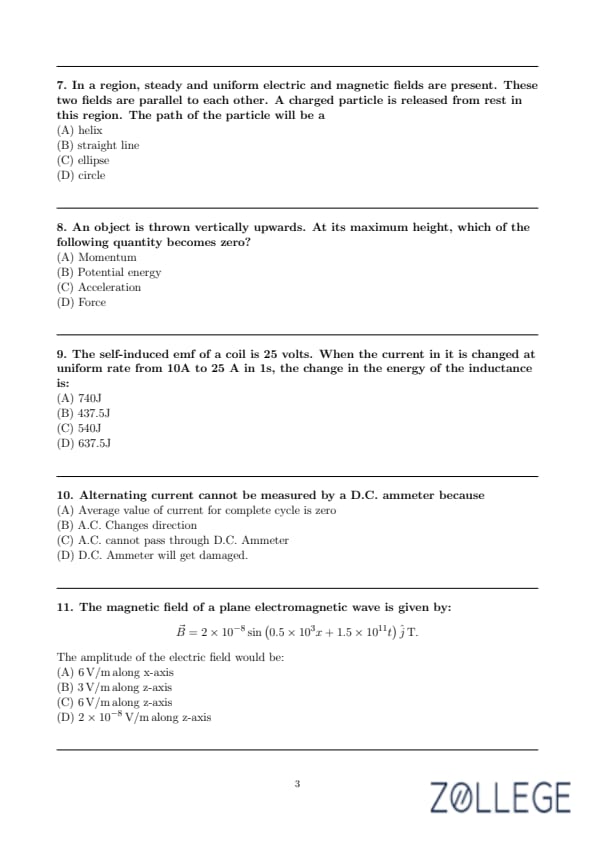
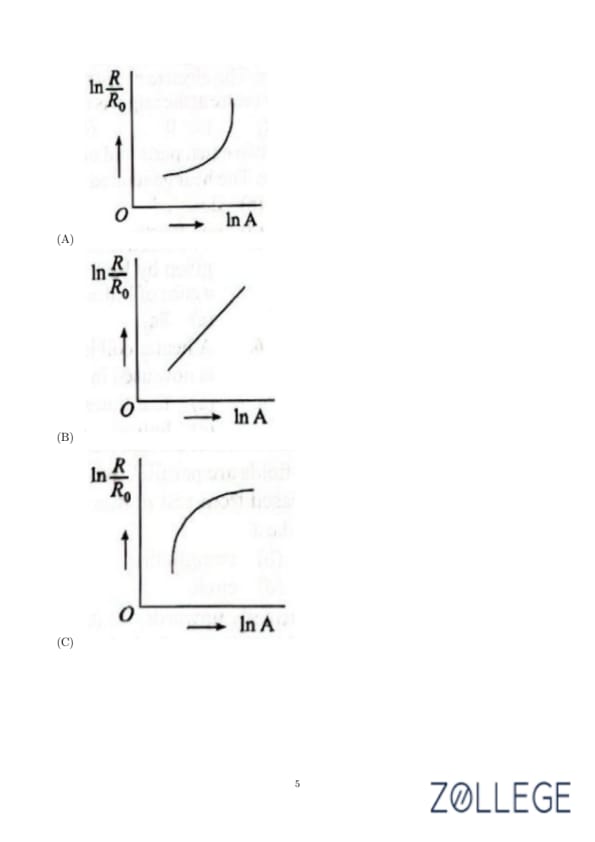
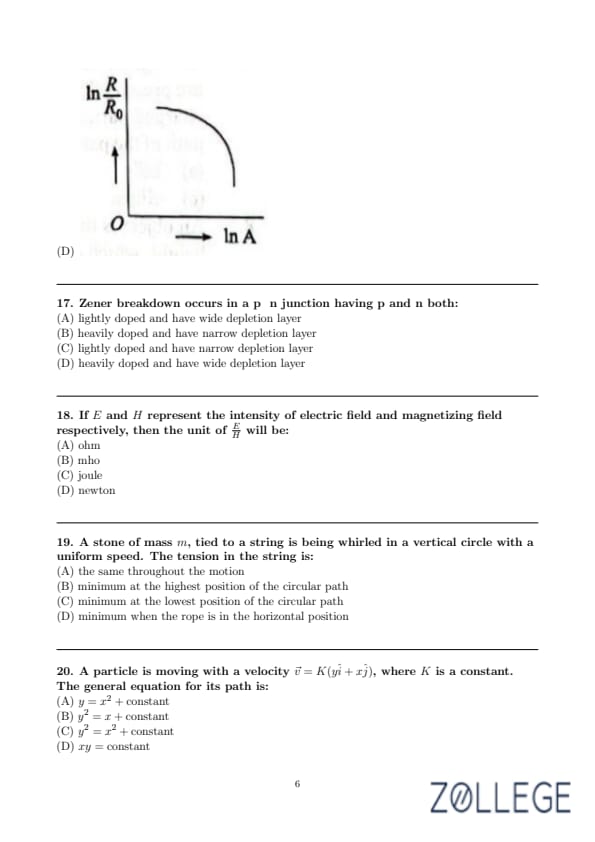
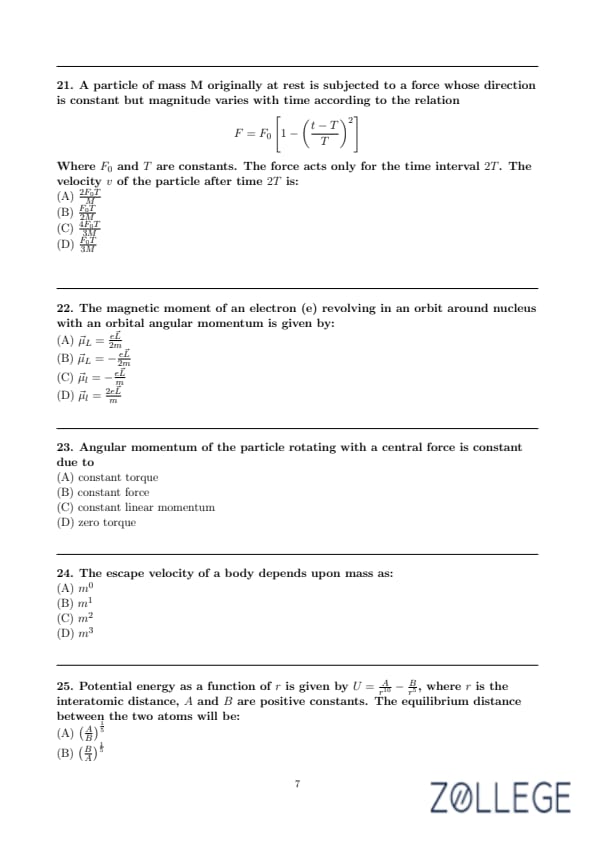
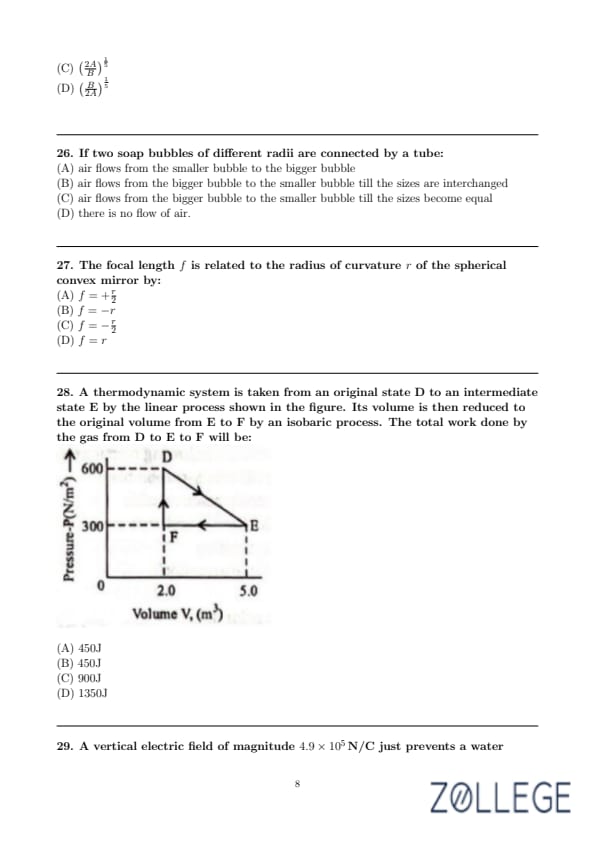
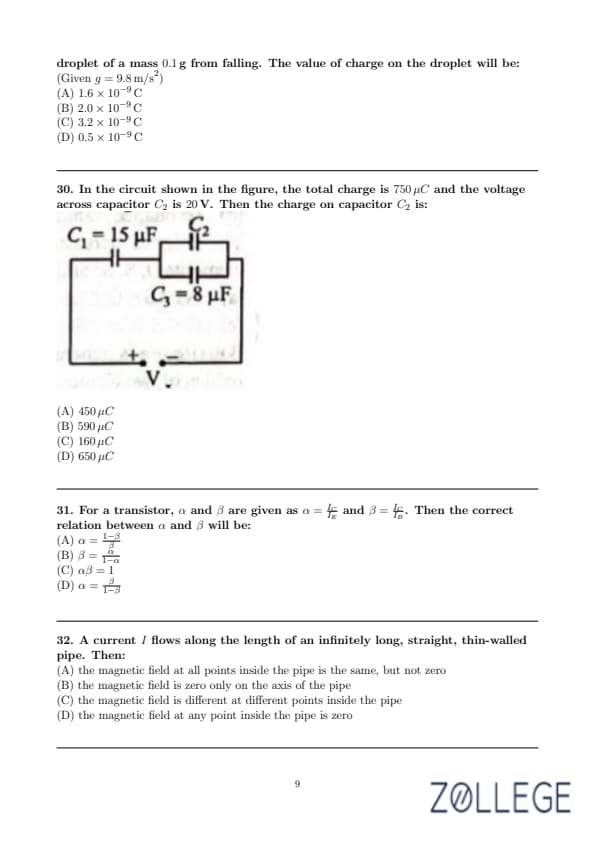
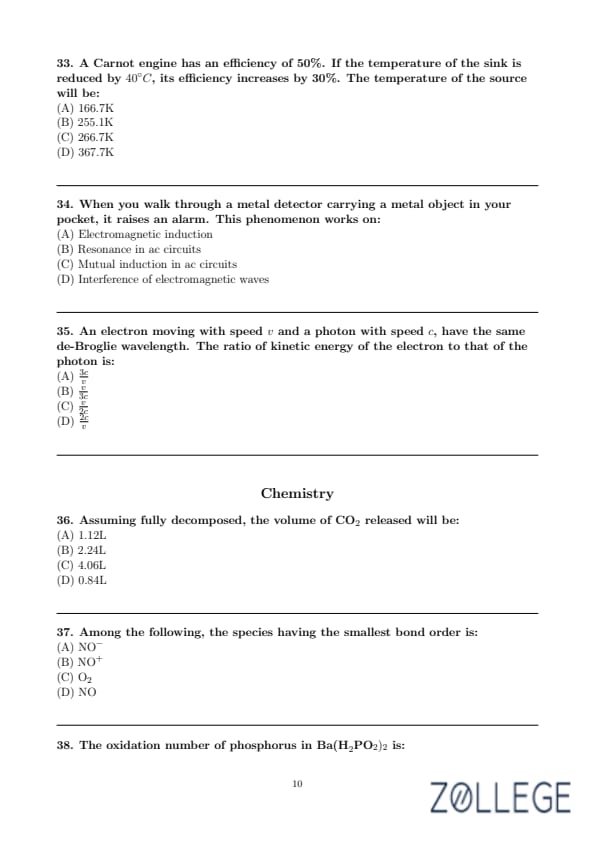
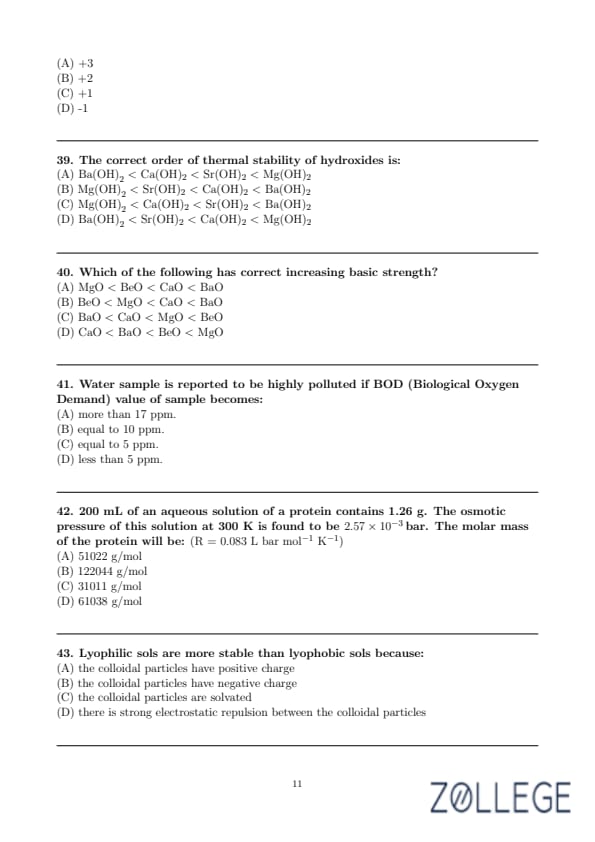
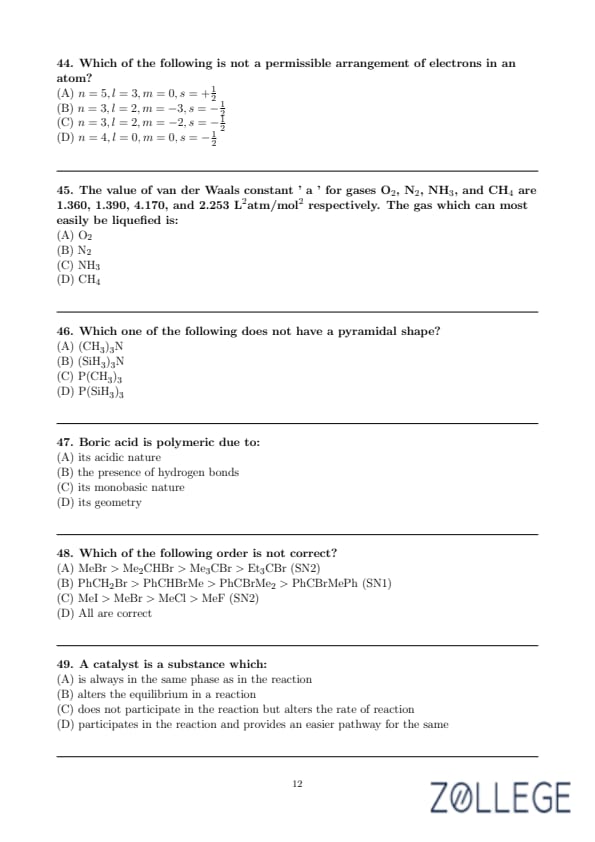
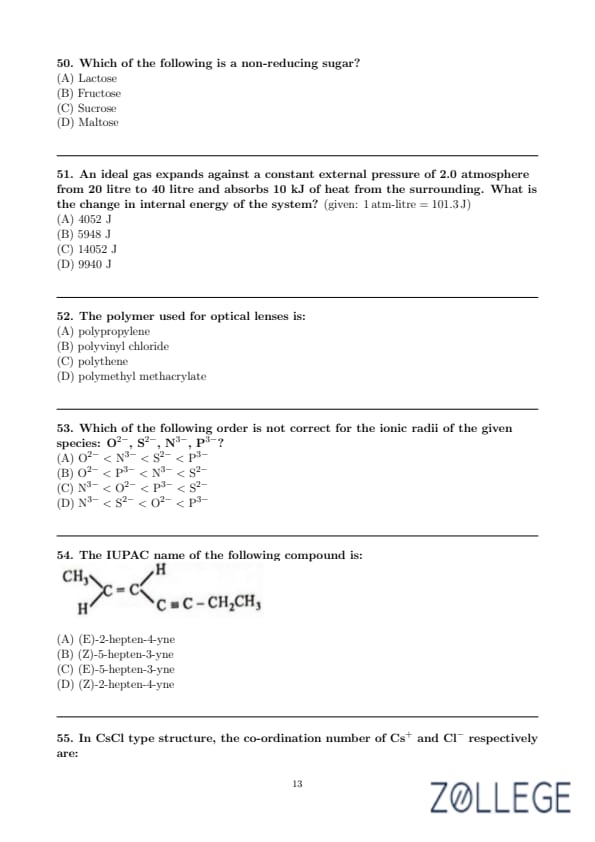
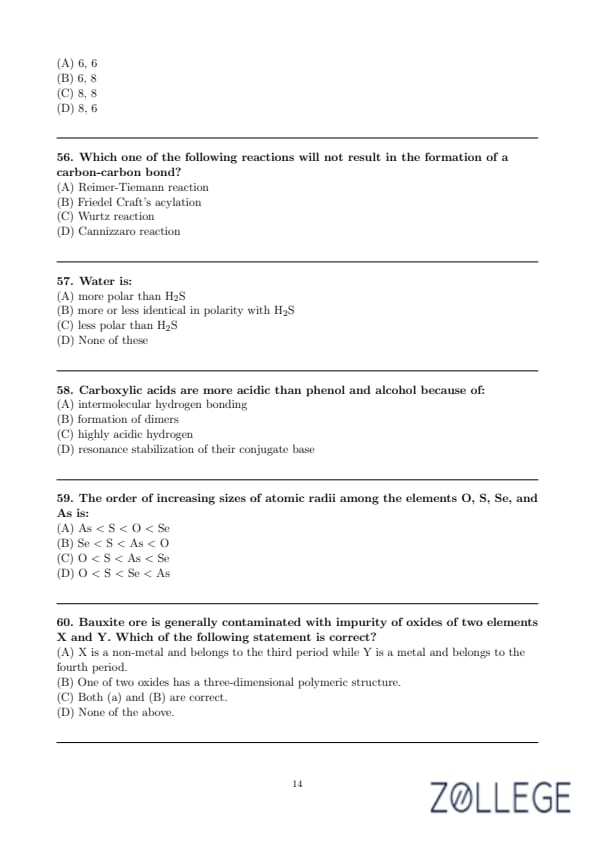
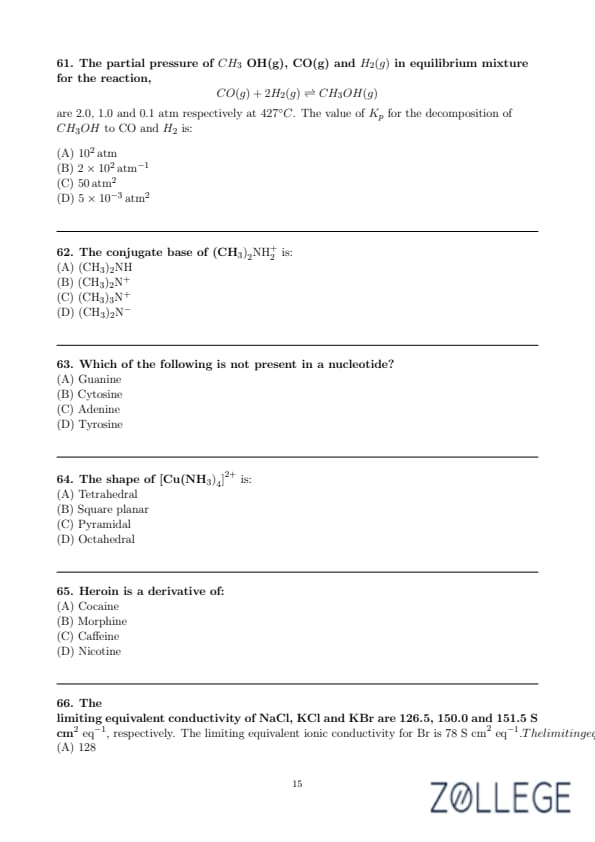
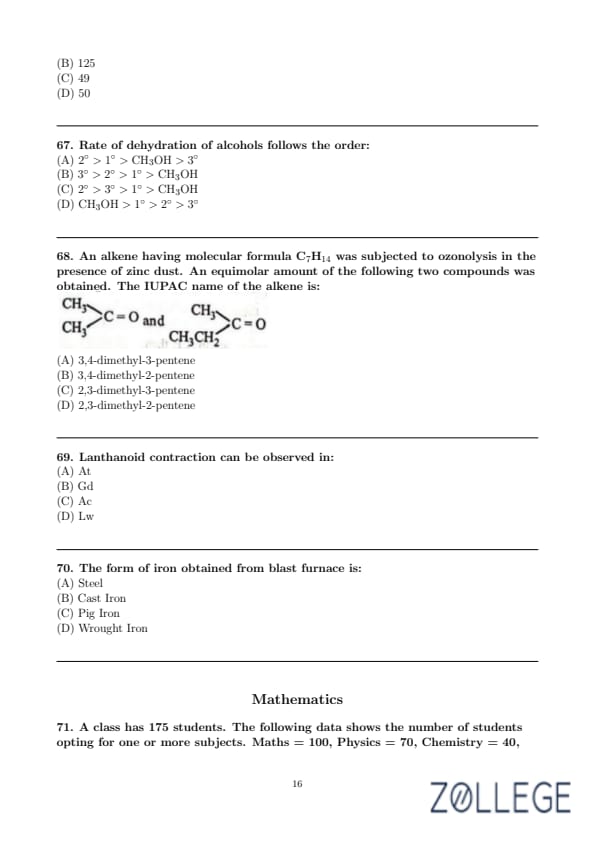
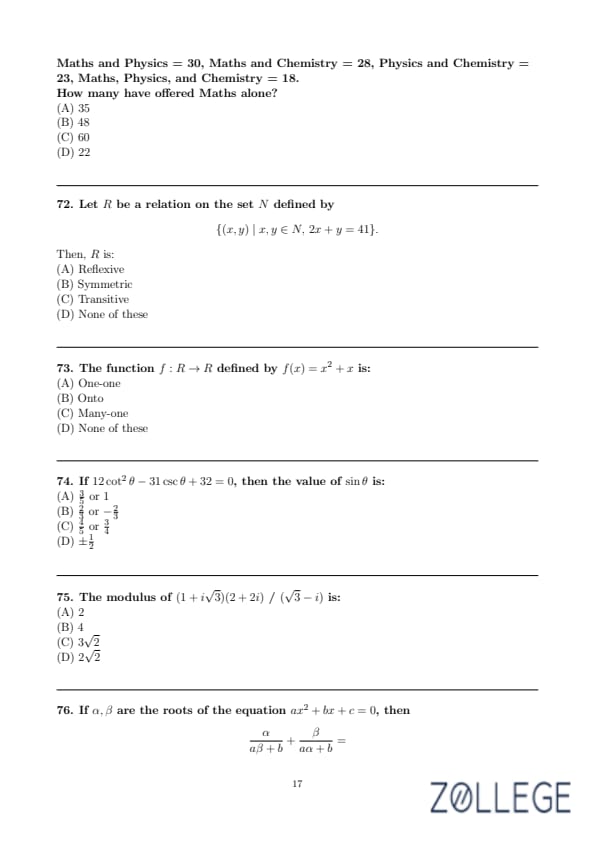
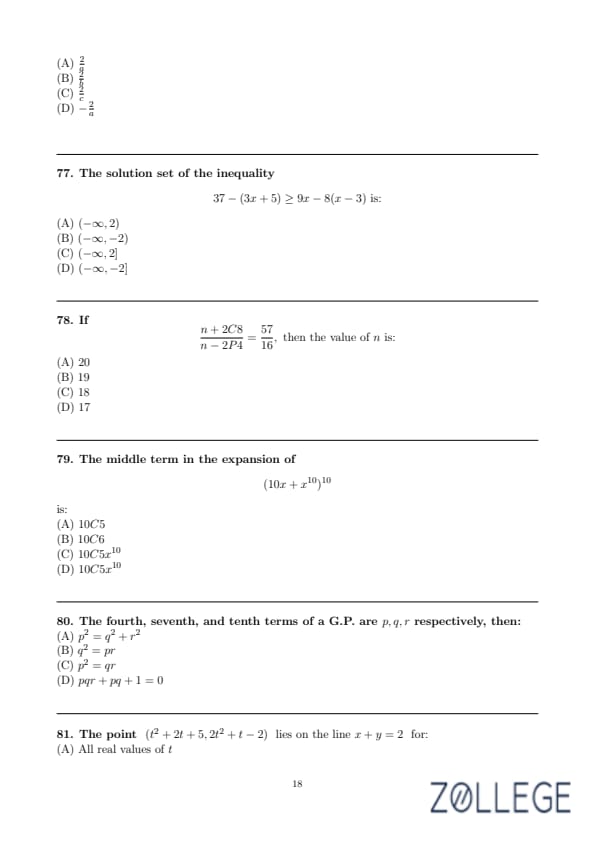
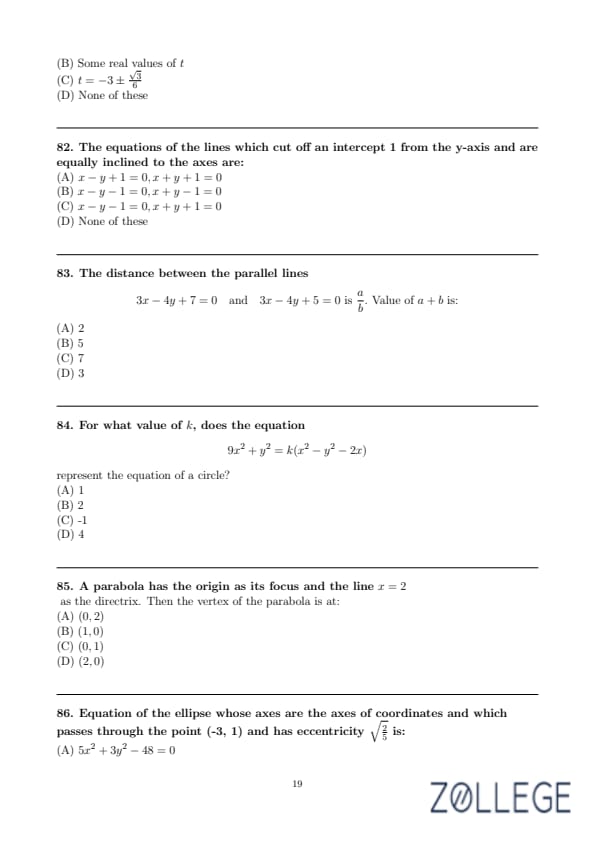
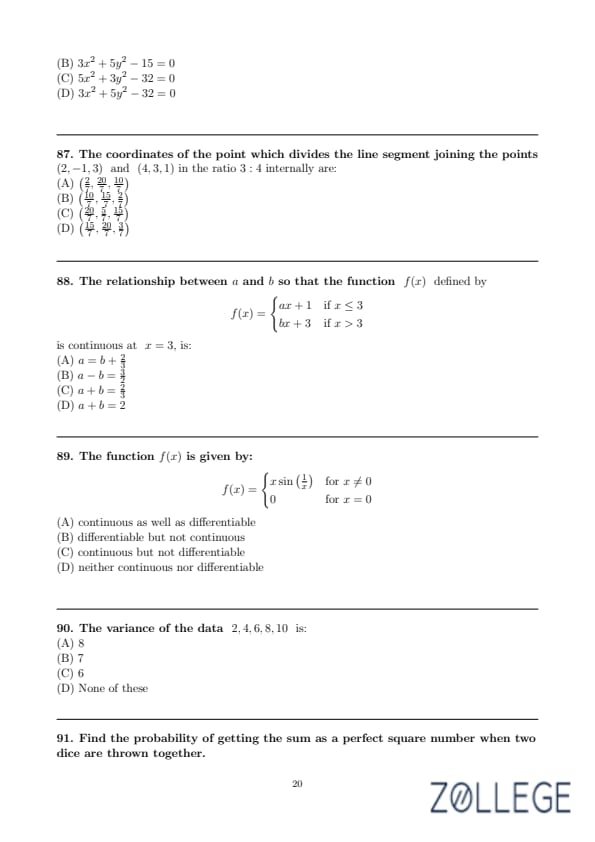
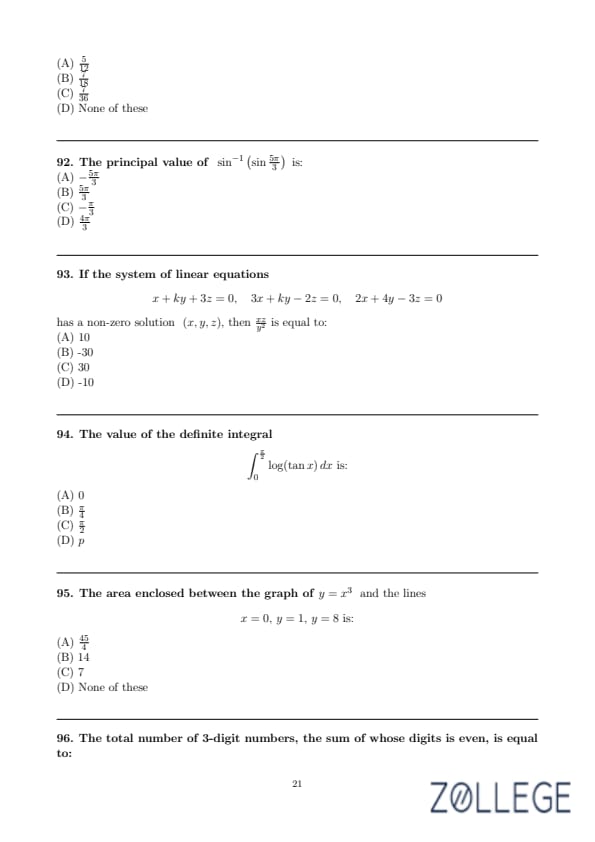
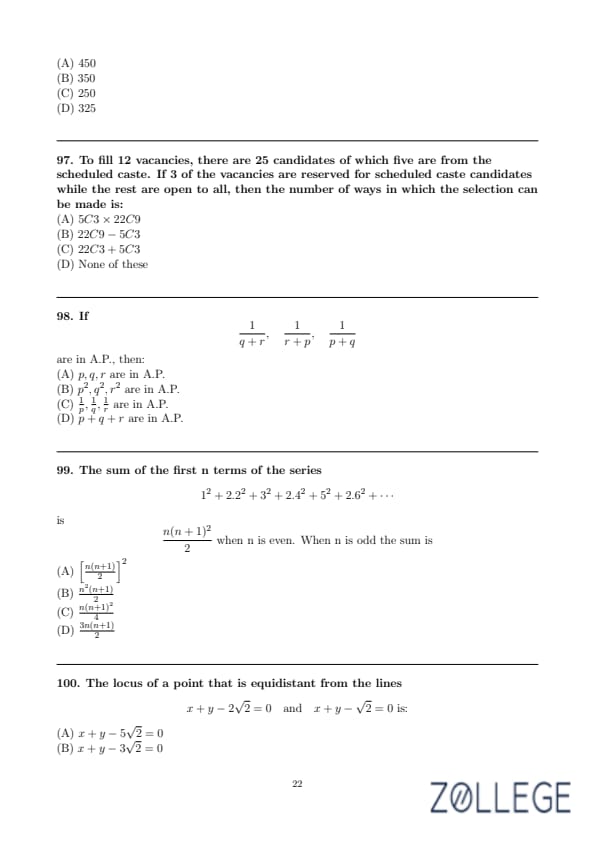
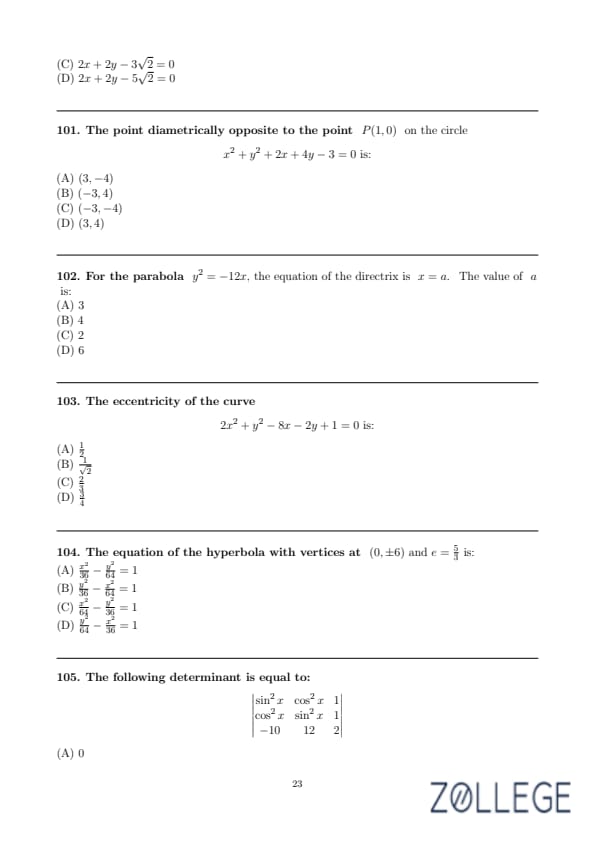
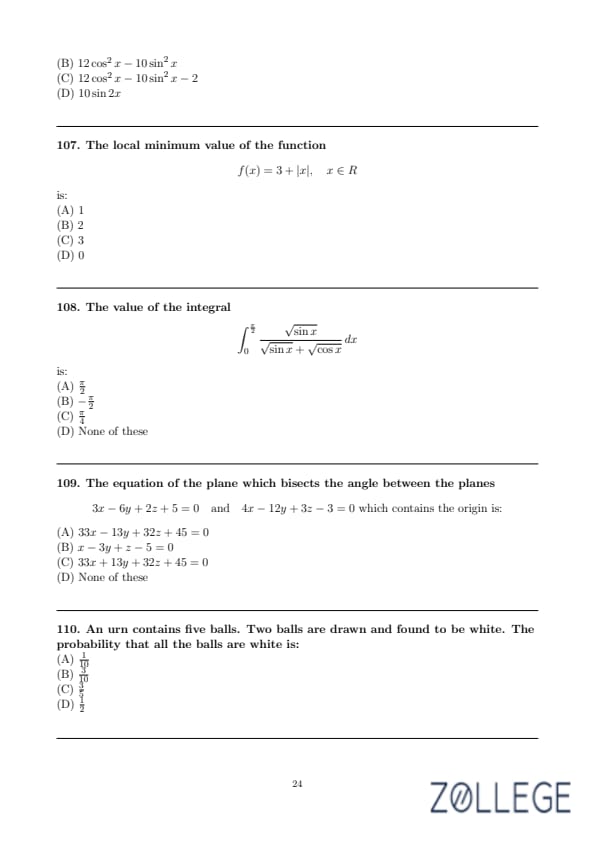
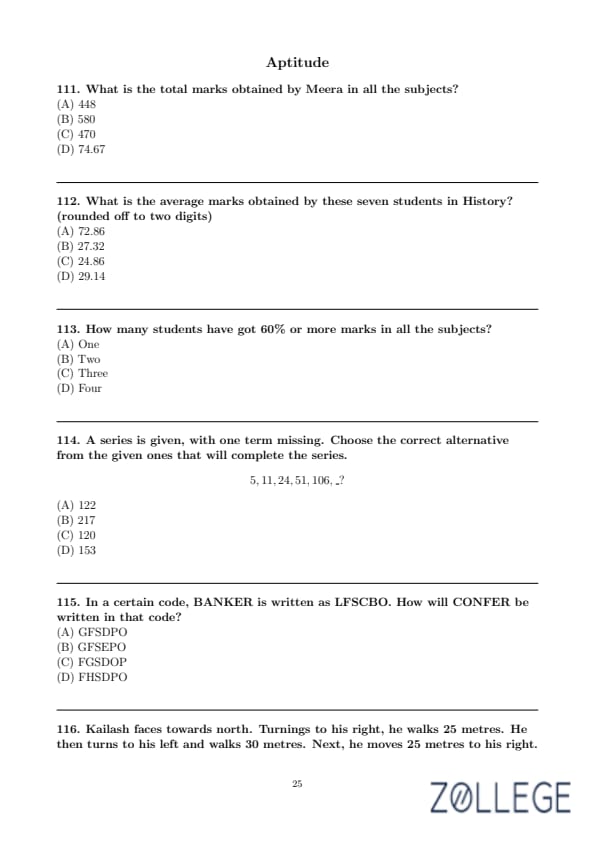
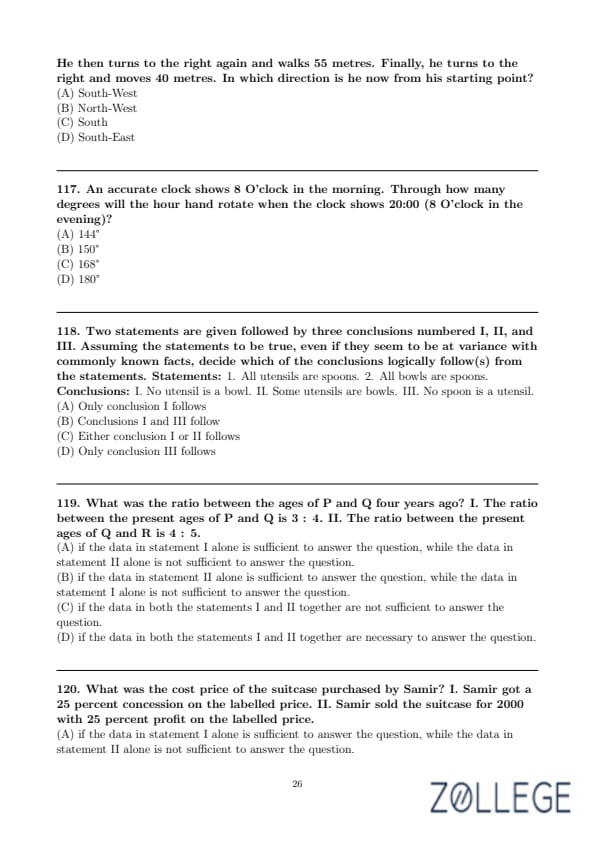
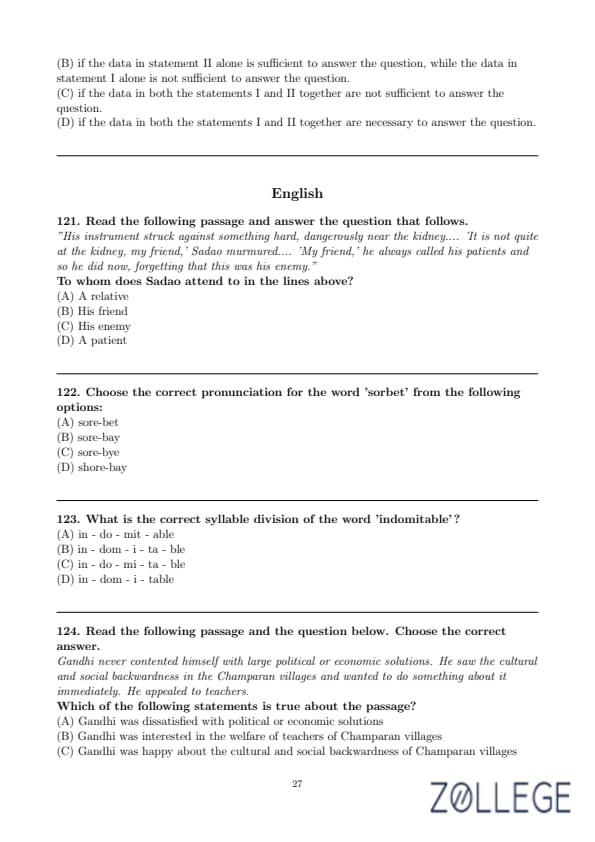
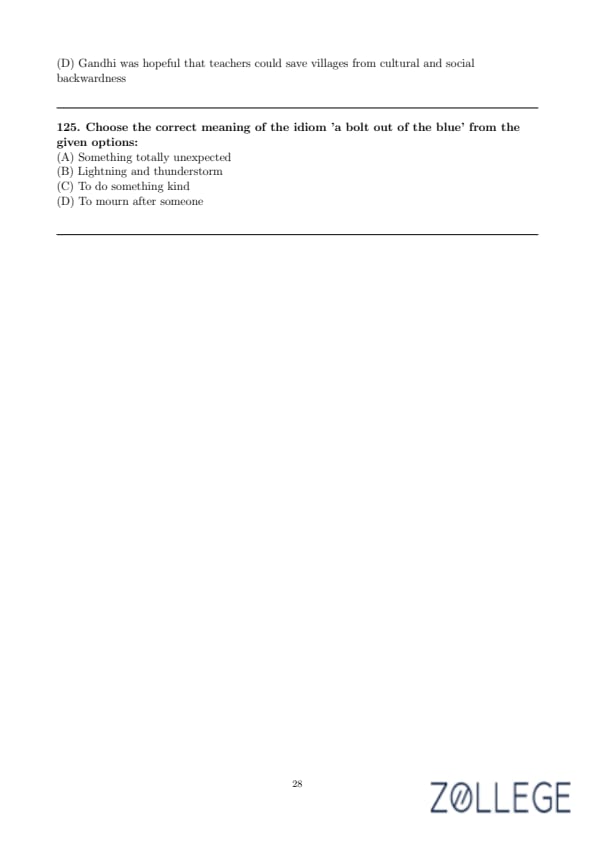
Previous Year VITEEE Main Question Papers
*The article might have information for the previous academic years, please refer the official website of the exam.