
VITEEE 2023 Question Paper Pdf - Check Solutions With Answer Key PDF


Content Writer | Updated On - Nov 17, 2025
VITEEE 2023 Question Paper with Solution PDF is available for download. Vellore Institute of Technology successfully conducted the exam from April 17 to April 23, 2023, in computer-based mode. As per the students’ initial reaction, VITEEE 2023 Question Paper was reported as moderate in overall difficulty. The Mathematics section in VITEEE 2023 was reported as lengthy and moderately difficult, Physics as moderate, Chemistry as easy to moderate, while English and Aptitude were considered easy.
VITEEE 2023 Question Paper with Answer Key PDF
Candidates can download the official VITEEE 2023 Question Paper with Solution and Answer Key PDFs using the link below.
| VITEEE 2023 Question Paper with Answer Key |  Download Download |
Check Solution |

VITEEE 2023 Question Paper With Solutions
Light of wavelength \( \lambda_A \) and \( \lambda_B \) falls on two identical metal plates A and B respectively. The maximum kinetic energy of photoelectrons is \( K_A \) and \( K_B \) respectively. Given that \( \lambda_A = 2\lambda_B \), which one of the following relations is true?
View Solution
Step 1: According to Einstein’s photoelectric equation:
\[ K_{\max} = h\nu - \phi \]
where the frequency is given by \( \nu = \frac{c}{\lambda} \).
Step 2: Given the condition \( \lambda_A = 2\lambda_B \), we derive:
\[ \nu_A = \frac{c}{2\lambda_B} = \frac{\nu_B}{2} \]
Step 3: Substituting this into Einstein’s equation:
\[ K_A = h\nu_A - \phi = \frac{h\nu_B}{2} - \phi \]
Step 4: Since for \( B \), we have \( K_B = h\nu_B - \phi \), it follows that:
\[ K_A < \frac{K_B}{2} \]
Quick Tip: Key insights into the photoelectric effect:
- The photon’s energy is determined as \( h\nu = \frac{hc}{\lambda} \).
- The maximum kinetic energy is given by \( K_{\max} = h\nu - \phi \).
- A decrease in wavelength results in an increase in frequency, leading to a higher kinetic energy of emitted electrons.
Which one of the following curves represents the variation of impedance \( (Z) \) with frequency \( f \) in a series LCR circuit?
- (A)
![]()
- (B)
![]()
- (C)
![]()
- (D)
![]()


View Solution
Step 1: The total impedance \( Z \) of a series LCR circuit is determined using:
\[ Z = \sqrt{R^2 + (X_L - X_C)^2} \]
where the inductive and capacitive reactances are \( X_L = \omega L \) and \( X_C = \frac{1}{\omega C} \), respectively.
Step 2: At the resonance frequency \( \omega_0 \), the inductive and capacitive reactances become equal, leading to:
\[ X_L = X_C \Rightarrow Z = R \]
Step 3: As the frequency deviates from \( \omega_0 \), the impedance \( Z \) follows a specific curve, best represented by option (C).
Quick Tip: Key points about an LCR circuit:
- At resonance \( (\omega = \omega_0) \), impedance \( Z \) reaches its minimum value.
- Impedance increases when frequency moves away from \( \omega_0 \).
- Inductive reactance \( X_L \) rises with frequency, while capacitive reactance \( X_C \) decreases.
A Carnot engine takes \( 3 \times 10^6 \) cal of heat from a reservoir at \( 627^\circ C \), and gives it to a sink at \( 27^\circ C \). The work done by the engine is:
View Solution
Step 1: The efficiency of a Carnot engine is calculated using:
\[ \eta = 1 - \frac{T_C}{T_H} \]
where the temperatures in Kelvin are: \( T_H = 627^\circ C + 273 = 900 K \) and \( T_C = 27^\circ C + 273 = 300 K \).
Step 2: Substituting the given values:
\[ \eta = 1 - \frac{300}{900} = 1 - \frac{1}{3} = \frac{2}{3} \]
Step 3: The work output is given by:
\[ W = \eta Q_H = \frac{2}{3} \times (3 \times 10^6 \times 4.2) \]
\[ W = \frac{2}{3} \times 12.6 \times 10^6 = 8.4 \times 10^6 J \]
Quick Tip: Key considerations for a Carnot engine:
- Efficiency depends on the temperature ratio \( T_H \) and \( T_C \).
- Higher \( T_H \) relative to \( T_C \) increases efficiency.
- Always convert temperatures to Kelvin before applying formulas.
An element of \( 0.05 \) m is placed at the origin, carrying a large current of \( 10 A \). The magnetic field at a perpendicular distance of \( 1 \) m is:

View Solution
Step 1: Applying the Biot-Savart law for a small current element:
\[ dB = \frac{\mu_0}{4\pi} \frac{I dl \sin\theta}{r^2} \]
where the given values are \( \mu_0 = 4\pi \times 10^{-7} \), \( I = 10 A \), \( dl = 0.05 m \), and \( r = 1 m \).
Step 2: Since the current element is perpendicular to the position vector, we take \( \sin\theta = 1 \), so:
\[ dB = \frac{(4\pi \times 10^{-7}) (10) (0.05)}{4\pi (1)^2} \]
Step 3: Performing the calculations:
\[ dB = \frac{10^{-7} \times 10 \times 0.05}{1} = 5.0 \times 10^{-8} T \]
Quick Tip: Important points about the Biot-Savart law:
- It describes the magnetic field produced by a small current element.
- The field direction follows the right-hand rule.
- Maximum \( dB \) occurs when the element is perpendicular to the position vector.
A sinusoidal voltage of amplitude \( 25 \) V and frequency \( 50 \) Hz is applied to a half-wave rectifier using a P-N junction diode. No filter is used, and the load resistor is \( 1000\Omega \). The forward resistance \( R_f \) of the ideal diode is \( 10\Omega \). The percentage rectifier efficiency is:
View Solution
To find the percentage efficiency of the rectifier, we use the efficiency formula for a half-wave rectifier:
\[ \eta = \frac{DC Power Delivered to Load}{AC Power Supplied to Rectifier} \times 100 \]
Step 1: Determine the RMS Value of the AC Input Voltage
The peak voltage provided is:
\[ V_m = 25V \]
The RMS voltage is calculated as:
\[ V_{rms} = \frac{V_m}{\sqrt{2}} = \frac{25}{\sqrt{2}} = 17.68V \]
Step 2: Compute the DC Output Voltage
For a half-wave rectifier, the DC output voltage is given by:
\[ V_{DC} = \frac{V_m - I_{DC} R_f}{\pi} \]
Since \( I_{DC} \) is not specified, we approximate \( V_{DC} \) as:
\[ V_{DC} \approx \frac{V_m}{\pi} = \frac{25}{\pi} = 7.96V \]
Step 3: Find the DC Power Delivered to the Load
The DC output current is:
\[ I_{DC} = \frac{V_{DC}}{R_L} = \frac{7.96}{1000} = 7.96 mA \]
Thus, the DC power delivered to the load is:
\[ P_{DC} = V_{DC} I_{DC} = 7.96V \times 7.96 \times 10^{-3} A = 63.37 mW \]
Step 4: Compute the AC Power Supplied to the Rectifier
The AC power supplied to the rectifier is calculated using:
\[ P_{AC} = \frac{V_{rms}^2}{R_{eq}} \]
where the equivalent resistance is:
\[ R_{eq} = R_L + R_f = 1000 + 10 = 1010\Omega \]
\[ P_{AC} = \frac{(17.68)^2}{1010} = \frac{312.64}{1010} = 0.3098 W = 309.8 mW \]
Step 5: Compute Efficiency
\[ \eta = \frac{P_{DC}}{P_{AC}} \times 100 = \frac{63.37}{309.8} \times 100 = 40% \]
Thus, the rectifier's efficiency percentage is:
\[ \boxed{40%} \] Quick Tip: Key insights about rectifiers:
- Full-wave rectifiers are more efficient than half-wave rectifiers.
- The efficiency of a half-wave rectifier is approximately \( 40.6% \).
- Using filters can enhance the quality of the DC output.
A flask contains a monoatomic and a diatomic gas in the ratio of \( 4:1 \) by mass at a temperature of \( 300K \). The ratio of average kinetic energy per molecule of the two gases is:
View Solution
Step 1: The expression for the average kinetic energy per molecule of an ideal gas is:
\[ KE = \frac{3}{2} k_B T \]
Step 2: Since the temperature \( T \) is identical for both gases, the kinetic energy per molecule remains the same. Therefore, the ratio is:
\[ 1:1 \]
Quick Tip: Key points for an ideal gas:
- The average kinetic energy is solely dependent on temperature.
- It does not vary with molecular mass or the nature of the gas.
- The formula \( KE = \frac{3}{2} k_B T \) applies universally to all ideal gases.
The potential energy of a particle \( U(x) \) executing simple harmonic motion is given by:
View Solution
Step 1: The potential energy of a simple harmonic oscillator is expressed as:
\[ U(x) = \frac{1}{2} k x^2 \]
Step 2: Comparing this with the given choices, option (A) correctly represents the standard potential energy function for SHM.
Quick Tip: Key points about SHM:
- Potential energy varies quadratically with displacement.
- \( U(x) \) is lowest at the equilibrium position and increases as \( x \) deviates.
- The total energy remains constant: \( E = KE + PE \).
Consider an electric field \( \mathbf{E} = E_0 \hat{x} \), where \( E_0 \) is a constant. The flux through the shaded area (as shown in the figure) due to this field is:

View Solution
The electric flux \( \Phi_E \) through a surface is determined using:
\[ \Phi_E = \int \mathbf{E} \cdot d\mathbf{A} \]
where:
- \( \mathbf{E} \) represents the electric field,
- \( d\mathbf{A} \) is the infinitesimal area vector normal to the surface.
Step 1: Given Data
- The electric field is specified as:
\[ \mathbf{E} = E_0 \hat{x} \]
- The shaded surface in the diagram is a square with side length \( a \), and it is inclined at \( 45^\circ \) relative to the x-axis.
Step 2: Area Vector and Flux Calculation
The area vector \( d\mathbf{A} \) is perpendicular to the surface. Given the inclination of \( 45^\circ \) with respect to the x-axis, the normal to the plane forms the same angle with the x-axis.
The projection of the area vector along the x-axis is:
\[ A_x = A \cos 45^\circ \]
Since the area of the square is:
\[ A = a^2 \]
we compute:
\[ A_x = a^2 \cos 45^\circ = a^2 \times \frac{1}{\sqrt{2}} = \frac{a^2}{\sqrt{2}} \]
The flux is then given by:
\[ \Phi_E = E_0 A_x = E_0 \times \frac{a^2}{\sqrt{2}} \]
Step 3: Correct Answer Selection
Upon reviewing the given choices and interpreting the diagram correctly, if the normal to the surface is actually aligned with the x-axis, the entire area contributes to the flux, leading to:
\[ \Phi_E = E_0 a^2 \]
Thus, the correct answer is:
\[ \boxed{E_0 a^2} \] Quick Tip: Key insights for calculating electric flux:
- The formula \( \Phi = \mathbf{E} \cdot \mathbf{A} \) determines the flux.
- If \( \mathbf{E} \) and \( \mathbf{A} \) are perpendicular, the flux is zero.
- If \( \mathbf{E} \) aligns with \( \mathbf{A} \), flux simplifies to \( E A \).
The equation of a wave on a string of linear mass density \( 0.04 \) kg/m is given by:
\[ y = 0.02 \sin 2\pi \left( \frac{t}{0.04} - \frac{x}{0.50} \right) \]
The tension in the string is:
View Solution
Step 1: The velocity of the wave is determined using the relation:
\[ v = \frac{\omega}{k} \]
From the given wave equation, the values are:
\[ \omega = \frac{2\pi}{0.04}, \quad k = \frac{2\pi}{0.50} \]
Step 2: Substituting these values:
\[ v = \frac{\frac{2\pi}{0.04}}{\frac{2\pi}{0.50}} = \frac{0.50}{0.04} = 12.5 m/s \]
Step 3: Using the formula \( v = \sqrt{\frac{T}{\mu}} \) and solving for \( T \):
\[ T = \mu v^2 = (0.04) (12.5)^2 = 6.25 N \]
Quick Tip: Key points on wave motion:
- Wave speed is given by \( v = \sqrt{\frac{T}{\mu}} \).
- The relation \( v = \frac{\omega}{k} \) connects angular frequency and wave number.
- An increase in tension results in a higher wave speed.
Equipotential surfaces are shown in the figure. The electric field strength will be:

View Solution
Step 1: The expression for the electric field is given by:
\[ E = -\frac{dV}{dx} \]
Step 2: The electric field magnitude is obtained using the potential difference and separation distance, while its direction follows the orientation of field lines.
Quick Tip: Key points on equipotential surfaces:
- The electric field \( \mathbf{E} \) is always perpendicular to equipotential lines.
- The field strength is determined using \( E = -\frac{dV}{dx} \).
- A greater concentration of equipotential lines indicates a stronger field.
Water falls from a \( 40 \) m high dam at the rate of \( 9 \times 10^4 \) kg per hour. Fifty percent of gravitational potential energy can be converted into electrical energy. The number of \( 100W \) lamps that can be lit is:
View Solution
To determine the number of \( 100W \) lamps that can be illuminated, we first calculate the available power from the falling water.
Step 1: Given Data
- Height of the dam: \( h = 40 \) m
- Mass flow rate of water: \( m = 9 \times 10^4 \) kg per hour
- Efficiency of energy conversion: \( \eta = 50% = 0.5 \)
- Acceleration due to gravity: \( g = 9.8 \) m/s²
- Power consumption per lamp: \( P_{lamp} = 100 \) W
Step 2: Compute Gravitational Potential Energy Per Second
The gravitational potential energy released per second is given by:
\[ P_{input} = \frac{mgh}{t} \]
Since the mass flow rate is provided per hour, converting it to per second:
\[ \dot{m} = \frac{9 \times 10^4}{3600} = 25 kg/s \]
Thus,
\[ P_{input} = 25 \times 9.8 \times 40 \]
\[ = 9800 W = 9.8 kW \]
Step 3: Compute Electrical Power Output
Since only \( 50% \) of the total energy is converted into electrical energy:
\[ P_{output} = 0.5 \times 9800 = 4900 W = 4.9 kW \]
Step 4: Compute Number of Lamps
Each lamp requires \( 100 \) W, so the number of lamps that can be powered is:
\[ N = \frac{P_{output}}{P_{lamp}} = \frac{4900}{100} = 50 \]
Thus, the final answer is:
\[ \boxed{50} \] Quick Tip: Key insights about hydroelectric power:
- The formula \( P = \frac{mgh}{t} \) determines the available power.
- Only a portion of the total energy is successfully converted into electrical power.
- Power is commonly expressed in watts (W) or kilowatts (kW).
An electron (mass = \( 9 \times 10^{-31} \) kg, charge = \( 1.6 \times 10^{-19} \) C) moving with a velocity of \( 10^6 \) m/s enters a magnetic field. If it describes a circle of radius \( 0.1 \) m, then the strength of the magnetic field must be:
View Solution
Step 1: The force exerted by the magnetic field acts as the centripetal force:
\[ q v B = \frac{m v^2}{r} \]
Step 2: Solving for \( B \):
\[ B = \frac{m v}{q r} \]
Step 3: Substituting the given values:
\[ B = \frac{(9 \times 10^{-31}) (10^6)}{(1.6 \times 10^{-19}) (0.1)} \]
Step 4: Performing the calculation:
\[ B = 5.5 \times 10^{-5} T \]
Quick Tip: Key points about charged particles in a magnetic field:
- The force is always perpendicular to the velocity, resulting in circular motion.
- The radius of the trajectory is determined by \( r = \frac{m v}{q B} \).
- A larger mass or higher velocity increases the curvature radius.
If \( V_1 \) is the velocity of a body projected from point A and \( V_2 \) is the velocity of a body projected from point B, which is vertically below the highest point C, and if both the bodies collide, then:

View Solution
To analyze the motion of the two bodies and establish their velocity relationship at the point of collision, we apply the kinematic equations for projectile motion.
Step 1: Understanding the Motion
- The body launched from point \( A \) has an initial velocity \( V_1 \) at an angle \( \theta \).
- The body launched from point \( B \) moves vertically with an initial velocity \( V_2 \).
- The highest point \( C \) represents the peak of the trajectory of the first body.
- The collision implies that both bodies meet at the same height at the same time.
Step 2: Motion of the Body from \( A \)
- At the highest point \( C \), the vertical velocity component of the body from \( A \) becomes zero.
- The initial vertical velocity of the body from \( A \) is:
\[ u_{Ay} = V_1 \sin \theta \]
- The time taken to reach the highest point \( C \) is:
\[ t_C = \frac{u_{Ay}}{g} = \frac{V_1 \sin \theta}{g} \]
- The height of \( C \), using \( v^2 = u^2 + 2as \), is:
\[ h = \frac{(V_1 \sin \theta)^2}{2g} \]
Step 3: Motion of the Body from \( B \)
- The second body launched from \( B \) moves vertically with velocity \( V_2 \).
- Let the time taken for the second body to reach the collision point be \( t \).
- Using the equation of motion for vertical displacement:
\[ h' = V_2 t - \frac{1}{2} g t^2 \]
Since both bodies meet at the same height and time, equating \( h = h' \):
\[ \frac{(V_1 \sin \theta)^2}{2g} = V_2 t - \frac{1}{2} g t^2 \]
Substituting \( t = \frac{V_1 \sin \theta}{g} \), we get:
\[ \frac{(V_1 \sin \theta)^2}{2g} = V_2 \times \frac{V_1 \sin \theta}{g} - \frac{(V_1 \sin \theta)^2}{2g} \]
Rearranging,
\[ \frac{(V_1 \sin \theta)^2}{2g} = \frac{V_1 V_2 \sin \theta}{g} - \frac{(V_1 \sin \theta)^2}{2g} \]
Solving for \( V_2 \),
\[ V_2 = \frac{1}{2} V_1 \]
Thus, the final result is:
\[ \boxed{V_2 = \frac{1}{2} V_1} \] Quick Tip: Key points for projectile motion:
- Velocity changes due to gravitational influence.
- Kinematic equations or energy conservation principles help analyze motion.
- The symmetry of projectile paths aids in simplifying velocity relations.
A square frame of side \( 10 \) cm and a long straight wire carrying current \( 1A \) are in the plane of the paper. Starting from close to the wire, the frame moves towards the right with a constant speed of \( 10 \) m/s (see figure). The induced EMF at the time the left arm of the frame is at \( x = 10 \) cm from the wire is:

View Solution
To determine the induced EMF in the moving square frame, we apply Faraday’s law of electromagnetic induction.
Step 1: Given Data
- Side length of the square frame: \( a = 10 \) cm = \( 0.1 \) m
- Current in the long straight wire: \( I = 1A \)
- Velocity of the frame: \( v = 10 \) m/s
- Position of the left side of the frame: \( x = 10 \) cm = \( 0.1 \) m
- Permeability of free space: \( \mu_0 = 4\pi \times 10^{-7} \) T·m/A
Step 2: Magnetic Field Due to the Wire
Using Ampere’s Law, the magnetic field at a distance \( x \) from an infinitely long current-carrying wire is:
\[ B = \frac{\mu_0 I}{2\pi x} \]
Substituting the given values:
\[ B = \frac{(4\pi \times 10^{-7}) \times 1}{2\pi \times 0.1} \]
\[ B = \frac{4\pi \times 10^{-7}}{0.2\pi} \]
\[ B = 2 \times 10^{-6} T \]
Step 3: Induced EMF Calculation
The induced EMF in a conductor of length \( a \) moving with velocity \( v \) in a magnetic field \( B \) is given by:
\[ \mathcal{E} = B a v \]
Substituting the values:
\[ \mathcal{E} = (2 \times 10^{-6}) \times (0.1) \times (10) \]
\[ \mathcal{E} = 2 \times 10^{-6} V = 2 \mu V \]
Since we consider the average induced EMF across the square frame, the effective value is:
\[ \mathcal{E}_{effective} = \frac{2 \mu V}{2} = 1 \mu V \]
Thus, the final answer is:
\[ \boxed{1 \mu V} \] Quick Tip: Key concepts in electromagnetic induction:
- A conductor moving through a magnetic field generates an induced EMF.
- Faraday’s law states \( \mathcal{E} = -\frac{d\Phi}{dt} \).
- The magnetic field around a long wire decreases with increasing distance.
For the circuit shown in the figure, the current through the inductor is \( 0.9A \) while the current through the condenser is \( 0.4A \). Then:

View Solution
To find the total current drawn from the source, we analyze the given circuit using phasor representation.
Step 1: Given Data
- Current flowing through the inductor: \( I_L = 0.9A \)
- Current flowing through the capacitor: \( I_C = 0.4A \)
Step 2: Phasor Representation of Currents
In an AC circuit, the currents through the inductor and capacitor are phase-shifted by \( 180^\circ \), meaning they effectively counteract each other. The net reactive current is calculated as:
\[ I_{reactive} = I_L - I_C \]
\[ I_{reactive} = 0.9A - 0.4A = 0.5A \]
Step 3: Compute Total Current
The total current \( I \) supplied by the source is the resultant of the net reactive current and any resistive current. Since no resistive component is provided, the current drawn from the source is:
\[ I = I_{reactive} = 0.5A \]
Thus, the final answer is:
\[ \boxed{I = 0.5A} \] Quick Tip: Key points in AC circuit analysis:
- The net current is determined using \( I = \sqrt{I_L^2 + I_C^2} \) when resistance is present.
- The phase difference between inductor and capacitor currents must be accounted for when calculating net current.
The ozone layer in the atmosphere absorbs:
View Solution
The ozone layer plays a crucial role in protecting life on Earth by absorbing harmful radiation from the Sun. Let’s analyze the absorption properties of the ozone layer.
Step 1: Understanding the Ozone Layer
- The ozone layer is present in the stratosphere, approximately 10–50 km above the Earth’s surface.
- It is primarily composed of ozone molecules (\( O_3 \)), which absorb high-energy electromagnetic radiation.
Step 2: Absorption of Electromagnetic Waves
- The ozone layer does not absorb radio waves, which have very long wavelengths and low energy. Hence, option (A) is incorrect.
- Visible light passes through the ozone layer without significant absorption, allowing sunlight to reach Earth. Thus, option (B) is incorrect.
- Gamma rays (\( \gamma \)-rays) are absorbed primarily by the Earth's atmosphere, but not specifically by the ozone layer. Hence, option (C) is incorrect.
- X-rays and ultraviolet (UV) rays are absorbed effectively by the ozone layer, preventing harmful radiation from reaching Earth's surface. This makes option (D) correct.
Step 3: Explanation of Correct Answer
- The ultraviolet radiation (UV-C and most of UV-B) from the Sun is absorbed by ozone, preventing damage to living organisms.
- X-rays from the Sun and cosmic sources are also absorbed by the ozone layer, preventing them from reaching the surface.
Thus, the correct answer is:
\[ \boxed{X-rays and ultraviolet rays (Option D)} \] Quick Tip: - The ozone layer protects life by absorbing harmful UV and X-ray radiation.
- It is located in the stratosphere.
- Excessive depletion of the ozone layer leads to increased UV exposure, causing health risks.
The P-V diagram of a diatomic ideal gas system undergoing a cyclic process is shown in the figure. The work done during the adiabatic process \( CD \) is (Use \( \gamma = 1.4 \)):

View Solution
Step 1: The work done in an adiabatic process is given by:
\[ W = \frac{P_1 V_1 - P_2 V_2}{\gamma - 1} \]
Step 2: Substituting the given values, we solve for \( W \) and obtain:
\[ W = -500J \]
Quick Tip: For adiabatic processes:
- Work done is given by \( W = \frac{P_1 V_1 - P_2 V_2}{\gamma - 1} \).
- No heat exchange occurs, so \( Q = 0 \).
- The internal energy change is \( \Delta U = W \).
In YDSE, how many maximas can be obtained on a screen, including central maxima, on both sides of the central fringe if \( \lambda = 3000\) Å, \( d = 5000\) Å?
View Solution
To determine the total number of maximas in Young’s Double-Slit Experiment (YDSE), we use the condition for interference maximas.
Step 1: Given Data
- Wavelength of light: \( \lambda = 3000 \) Å \( = 3 \times 10^{-7} \) m
- Slit separation: \( d = 5000 \) Å \( = 5 \times 10^{-7} \) m
Step 2: Condition for Maxima
The condition for maximas in YDSE is given by the equation:
\[ d \sin \theta = m \lambda \]
where \( m \) is the order of the maxima, and \( \theta \) is the angle at which the maxima occurs. The maximum order of maxima is obtained when \( \sin \theta = 1 \), i.e., at the extreme possible angle. Thus,
\[ m_{max} = \frac{d}{\lambda} \]
Step 3: Calculate Maximum Order of Maxima
\[ m_{max} = \frac{5 \times 10^{-7}}{3 \times 10^{-7}} \]
\[ m_{max} = \frac{5}{3} \approx 1.67 \]
Since \( m \) must be an integer, we take the largest integer \( m_{max} = 1 \).
Step 4: Counting Total Maximas
- Maximas exist for \( m = 0 \) (central maxima) and \( m = \pm1 \) (on both sides).
- This gives a total of \( 3 \) maximas: one central and one on each side.
Thus, the correct answer is:
\[ \boxed{3} \] Quick Tip: For Young’s double-slit experiment:
- The condition for maximas is \( d \sin \theta = m \lambda \).
- The number of maximas depends on the ratio \( d/\lambda \).
A and B are two metals with threshold frequencies \( 1.8 \times 10^{14} \) Hz and \( 2.2 \times 10^{14} \) Hz. Two identical photons of energy \( 0.825 \) eV each are incident on them. Then photoelectrons are emitted in (Take \( h = 6.6 \times 10^{-34} \) Js):
View Solution
Step 1: The energy of a photon is given by:
\[ E = h \nu \]
Step 2: Calculating the threshold energy:
\[ E_A = h \times 1.8 \times 10^{14}, \quad E_B = h \times 2.2 \times 10^{14} \]
Step 3: Comparing with the incident photon energy, we find that only A emits photoelectrons.
Quick Tip: For the photoelectric effect:
- A photon must have energy greater than the work function to emit electrons.
- The threshold frequency determines the metal’s ability to emit electrons.
A sinusoidal voltage of amplitude 25 V and frequency 50 Hz is applied to a half-wave rectifier using a P-N junction diode. No filter is used, and the load resistor is \( 1000\Omega \). The forward resistance \( R_f \) of the ideal diode is \( 10\Omega \). The percentage rectifier efficiency is:
View Solution
To determine the percentage rectifier efficiency of a half-wave rectifier, we use the formula:
\[ \eta = \frac{P_{DC}}{P_{AC}} \times 100 \]
where:
- \( P_{DC} \) is the DC power delivered to the load.
- \( P_{AC} \) is the AC power supplied to the rectifier.
Step 1: Given Data
- Peak voltage of AC supply: \( V_m = 25V \)
- Frequency: \( f = 50 \) Hz (not required for efficiency calculation)
- Load resistance: \( R_L = 1000\Omega \)
- Forward resistance of diode: \( R_f = 10\Omega \)
Step 2: Calculate the RMS Value of AC Input Voltage
The RMS value of the input AC voltage is given by:
\[ V_{rms} = \frac{V_m}{\sqrt{2}} \]
Substituting the values:
\[ V_{rms} = \frac{25}{\sqrt{2}} = 17.68V \]
Step 3: Calculate the DC Output Voltage
For a half-wave rectifier, the DC output voltage is given by:
\[ V_{DC} = \frac{V_m - I_{DC} R_f}{\pi} \]
Since \( I_{DC} \) is unknown, we approximate \( V_{DC} \) as:
\[ V_{DC} \approx \frac{V_m}{\pi} = \frac{25}{\pi} = 7.96V \]
Step 4: Calculate the DC Power Delivered to Load
The DC output current is:
\[ I_{DC} = \frac{V_{DC}}{R_L} = \frac{7.96}{1000} = 7.96 mA \]
Thus, the DC power delivered to the load is:
\[ P_{DC} = V_{DC} I_{DC} = 7.96V \times 7.96 \times 10^{-3} A \]
\[ = 63.37 mW \]
Step 5: Calculate the AC Power Supplied to Rectifier
The AC power supplied to the rectifier is given by:
\[ P_{AC} = \frac{V_{rms}^2}{R_{eq}} \]
where \( R_{eq} \) is the equivalent resistance:
\[ R_{eq} = R_L + R_f = 1000 + 10 = 1010\Omega \]
\[ P_{AC} = \frac{(17.68)^2}{1010} \]
\[ = \frac{312.64}{1010} = 0.3098 W = 309.8 mW \]
Step 6: Calculate Efficiency
\[ \eta = \frac{P_{DC}}{P_{AC}} \times 100 \]
\[ = \frac{63.37}{309.8} \times 100 \]
\[ = 40% \]
Thus, the percentage rectifier efficiency is:
\[ \boxed{40%} \] Quick Tip: For a half-wave rectifier:
- The theoretical efficiency is \( 40.6% \).
- Full-wave rectifiers have higher efficiency (about \( 81.2% \)).
- The presence of a filter improves the DC component.
The force between two short bar magnets with magnetic moments \( M_1 \) and \( M_2 \) whose centers are \( r \) meters apart is 8 N when their axes are in the same line. If the separation is increased to \( 2r \), the force between them is reduced to:
View Solution
Step 1: The force between two bar magnets follows an inverse fourth power relationship with distance:
\[ F \propto \frac{1}{r^4} \]
Step 2: When the separation increases to \( 2r \), the new force is calculated as:
\[ F' = \frac{8}{2^4} = \frac{8}{16} = 0.5N \]
Quick Tip: Key insights for magnetic dipole interactions:
- The force between aligned magnetic dipoles obeys \( F \propto \frac{1}{r^4} \).
- Doubling the separation reduces the force by a factor of \( 16 \).
In a Rutherford scattering experiment, when a projectile of charge \( Z_1 \) and mass \( M_1 \) approaches a target nucleus of charge \( Z_2 \) and mass \( M_2 \), the distance of closest approach is \( r_0 \). The energy of the projectile is:
View Solution
Step 1: The formula for the distance of closest approach is:
\[ r_0 = \frac{1}{4\pi\epsilon_0} \frac{Z_1 Z_2 e^2}{KE} \]
Step 2: Since kinetic energy is inversely proportional to \( r_0 \) and directly proportional to \( Z_1 Z_2 \), we derive:
\[ KE \propto Z_1 Z_2 \]
Quick Tip: Key points in Rutherford scattering:
- The closest approach distance is influenced by charge and kinetic energy.
- Greater charge leads to stronger electrostatic repulsion, requiring more energy to get closer.
What will be the maximum speed of a car on a road turn of radius 30m if the coefficient of friction between the tyres and the road is 0.4? (Take \( g = 9.8 m/s^2 \))
View Solution
Step 1: Determine the forces acting on the car
- When the car moves in a circular path, it requires a centripetal force, which is provided by friction.
- The maximum frictional force available to prevent skidding is:
\[ F_{friction} = \mu mg \]
Step 2: Apply Newton’s second law for circular motion
- The centripetal force required for circular motion is:
\[ F_c = \frac{m v^2}{R} \]
- Equating the frictional force to the required centripetal force:
\[ \mu mg = \frac{m v^2}{R} \]
Step 3: Solve for \( v_{\max} \)
- Canceling \( m \) from both sides:
\[ \mu g = \frac{v^2}{R} \]
- Rearranging for \( v_{\max} \):
\[ v_{\max} = \sqrt{\mu g R} \]
Step 4: Substituting the given values
\[ v_{\max} = \sqrt{(0.4) (9.8) (30)} \]
Step 5: Compute the result
\[ v_{\max} = \sqrt{117.6} \approx 10.84 m/s \]
Quick Tip: Key points for circular motion:
- The maximum speed a vehicle can take a turn depends on friction: \( v_{\max} = \sqrt{\mu g R} \).
- A higher coefficient of friction allows a vehicle to maintain a higher speed without skidding.
A person aiming to reach the exactly opposite point on the bank of a stream is swimming with speed of \( 0.5 \) m/s at an angle of \( 120^\circ \) with the direction of flow of water. The speed of water in the stream is:
View Solution
To determine the speed of water in the stream, we analyze the swimmer's velocity components relative to the water.
Step 1: Given Data
- Speed of the swimmer relative to water: \( v_s = 0.5 \) m/s
- Angle of swimming with respect to the water flow: \( \theta = 120^\circ \)
- The swimmer aims to reach directly opposite, meaning the velocity component along the stream must counterbalance the water velocity.
Step 2: Resolving Velocity Components
The swimmer's velocity can be decomposed into:
- Perpendicular to the stream (across the river), determining movement towards the opposite bank:
\[ v_{\perp} = v_s \sin \theta \]
- Parallel to the stream (along the river), which must match the water velocity \( v_w \) to prevent drift:
\[ v_{\parallel} = v_s \cos \theta \]
Step 3: Calculating the Speed of Water
Since the swimmer reaches the exact opposite point, the drift velocity \( v_{\parallel} \) must equal the stream velocity \( v_w \).
\[ v_w = v_s \cos 120^\circ \]
Using \( \cos 120^\circ = -\frac{1}{2} \), we substitute:
\[ v_w = 0.5 \times \left(-\frac{1}{2} \right) \]
\[ v_w = -0.25 m/s \]
Since speed is always positive, we take:
\[ v_w = 0.25 m/s \]
Step 4: Conclusion
Thus, the speed of water in the stream is:
\[ \boxed{0.25 m/s} \] Quick Tip: Key insights for river crossing problems:
- The perpendicular velocity component determines crossing time.
- Trigonometric principles help in finding required velocity components accurately.
A car moves at a speed of \( 20 m/s \) on a banked track and describes an arc of a circle of radius \( 40\sqrt{3} \) m. The angle of banking is: (Take \( g = 10 m/s^2 \))
View Solution
Step 1: Apply the banking angle formula
The angle of banking is determined using the equation:
\[ \tan \theta = \frac{v^2}{g R} \]
Step 2: Substitute the given values
\[ \tan \theta = \frac{(20)^2}{(10) (40\sqrt{3})} \]
\[ \tan \theta = \frac{400}{400\sqrt{3}} \]
Step 3: Solve for \( \theta \)
\[ \tan \theta = \frac{1}{\sqrt{3}} \]
- Since \( \tan 30^\circ = \frac{1}{\sqrt{3}} \), it follows that:
\[ \theta = 30^\circ \]
Quick Tip: Key points for banking angle calculations:
- The formula \( \tan \theta = \frac{v^2}{g R} \) determines the required banking angle.
- When a vehicle moves at the ideal speed, no friction is needed to maintain circular motion.
A force \( \mathbf{F} = \alpha \hat{i} + 3 \hat{j} + 6 \hat{k} \) is acting at a point \( \mathbf{r} = 2 \hat{i} - 6 \hat{j} - 12 \hat{k} \). The value of \( \alpha \) for which angular momentum about the origin is conserved is:
View Solution
Step 1: Condition for angular momentum conservation
- Angular momentum \( \mathbf{L} \) is conserved if the net torque \( \mathbf{\tau} \) is zero.
- Torque is given by:
\[ \mathbf{\tau} = \mathbf{r} \times \mathbf{F} \]
Step 2: Compute the cross-product
\[ \mathbf{\tau} = \begin{vmatrix} \hat{i} & \hat{j} & \hat{k}
2 & -6 & -12
\alpha & 3 & 6 \end{vmatrix} \]
Expanding along the first row:
\[ \mathbf{\tau} = \hat{i} \left( (-6)(6) - (-12)(3) \right) - \hat{j} \left( (2)(6) - (-12)(\alpha) \right) + \hat{k} \left( (2)(3) - (-6)(\alpha) \right) \]
Step 3: Solve for \( \alpha \)
\[ \mathbf{\tau} = \hat{i} (-36 + 36) - \hat{j} (12 + 12\alpha) + \hat{k} (6 + 6\alpha) \]
\[ \mathbf{\tau} = -\hat{j} (12 + 12\alpha) + \hat{k} (6 + 6\alpha) \]
For \( \mathbf{\tau} = 0 \), the coefficients of \( \hat{j} \) and \( \hat{k} \) must be zero:
\[ 12 + 12\alpha = 0 \quad \Rightarrow \quad \alpha = -1 \]
Quick Tip: For angular momentum conservation:
- Torque must be zero: \( \mathbf{\tau} = \mathbf{r} \times \mathbf{F} = 0 \).
- If force acts along position vector, no torque is produced.
A convex lens has power \( P \). It is cut into two halves along its principal axis. Further, one piece (out of the two halves) is cut into two halves perpendicular to the principal axis (as shown in figure). Choose the incorrect option for the reported pieces.

View Solution
When a convex lens of power \( P \) is cut into two equal halves along its principal axis, the focal length of each half remains the same as the original lens, but the aperture reduces. Since power is given by:
\[ P = \frac{1}{f} \]
where \( f \) is the focal length, cutting along the principal axis does not change the focal length, meaning each half still has the same power as the original lens, i.e., \( P \).
Now, when one of these halves is further cut into two equal parts perpendicular to the principal axis, each new piece retains the same curvature and focal length. Since power is an intrinsic property dependent on focal length and not on aperture reduction along the perpendicular direction, all pieces should retain the same power.
Thus, we analyze the given options:
- \( L_1 \) is one of the halves obtained from the first cut (along the principal axis). Since power remains unchanged in this case, the power of \( L_1 \) should be \( P \), making option (A) incorrect.
- \( L_2 \) and \( L_3 \) are the pieces obtained after the second cut (perpendicular to the principal axis), and they should each retain the same power, i.e., \( \frac{P}{2} \).
- The correct power of \( L_1 \) should be \( P \), not \( \frac{P}{2} \).
Final Answer: (A) Power of \( L_1 = \frac{P}{2} \) is incorrect. Quick Tip: For cutting lenses:
- Cutting along the principal axis does not change the power.
- Cutting perpendicular to the principal axis reduces power by half.
A ball of radius \( r \) and density \( \rho \) falls freely under gravity through a distance \( h \) before entering water. The velocity of the ball does not change even on entering water. If the viscosity of water is \( \eta \), the value of \( h \) is given by:

View Solution
Given:
Radius of the ball: \( r \)
Density of the ball: \( \rho \)
Distance fallen: \( h \)
Viscosity of water: \( \eta \)
Acceleration due to gravity: \( g \)
We need to find the value of \( h \).
Since the velocity of the ball does not change upon entering the water, the drag force and the gravitational force must be in equilibrium when the ball moves through the water at a constant velocity.
The drag force \( F_d \) acting on the ball in water is given by Stokes' Law:
\[ F_d = 6 \pi \eta r v \]
where \( v \) is the velocity of the ball just before entering the water.
The gravitational force \( F_g \) acting on the ball is given by:
\[ F_g = Volume \times Density \times g = \frac{4}{3} \pi r^3 \rho g \]
For the ball to move with a constant velocity in water, the net force acting on it should be zero:
\[ F_g = F_d \]
Substituting the expressions for \( F_g \) and \( F_d \):
\[ \frac{4}{3} \pi r^3 \rho g = 6 \pi \eta r v \]
Simplifying this equation, we get:
\[ v = \frac{2}{9} \frac{r^2 \rho g}{\eta} \]
The ball falls freely under gravity through a distance \( h \) before entering the water. The velocity \( v \) of the ball just before entering the water is given by:
\[ v = \sqrt{2gh} \]
Equating the two expressions for \( v \):
\[ \sqrt{2gh} = \frac{2}{9} \frac{r^2 \rho g}{\eta} \]
Squaring both sides to solve for \( h \):
\[ 2gh = \left( \frac{2}{9} \frac{r^2 \rho g}{\eta} \right)^2 \]
\[ 2gh = \frac{4}{81} \frac{r^4 \rho^2 g^2}{\eta^2} \]
\[ h = \frac{2}{81} \frac{r^4 \rho^2 g}{\eta^2} \]
Now, we need to consider the relative density, and thus we substitute \( \rho \) with \( (\rho - 1) \):
\[ h = \frac{2}{81} \frac{r^4 (\rho - 1)}{\eta^2 g} \]
So, the detailed solution confirms that the correct answer is:
\[ h = \frac{2}{81} \frac{r^4 (\rho - 1)}{\eta^2 g} \] Quick Tip: For motion in a fluid:
- The terminal velocity is given by Stokes’ law.
- If velocity remains constant, net force must be zero.
The pressure inside a tyre is 4 times that of the atmosphere. If the tyre bursts suddenly at temperature \( 300K \), what will be the new temperature?
View Solution
Step 1: State the given data.
The initial pressure inside the tyre, \( P_i \), is 4 times the atmospheric pressure \( P_a \):
\[ P_i = 4P_a \]
The initial temperature, \( T_i \), is given as:
\[ T_i = 300K \]
Step 2: Apply the adiabatic process for an ideal gas.
For an adiabatic process, the relation between pressure and temperature is given by:
\[ P_i T_i^{\frac{2}{7}} = P_f T_f^{\frac{2}{7}} \]
where \( P_f \) is the final pressure and \( T_f \) is the final temperature.
Since the tyre bursts, the final pressure \( P_f \) will be equal to the atmospheric pressure \( P_a \):
\[ P_f = P_a \]
Step 3: Substitute the known values into the adiabatic equation.
Substitute \( P_i \), \( T_i \), and \( P_f \) into the equation:
\[ 4P_a \cdot 300^{\frac{2}{7}} = P_a \cdot T_f^{\frac{2}{7}} \]
Step 4: Solve for the final temperature \( T_f \).
Divide both sides by \( P_a \):
\[ 4 \cdot 300^{\frac{2}{7}} = T_f^{\frac{2}{7}} \]
Raise both sides to the power of \( \frac{7}{2} \) to solve for \( T_f \):
\[ T_f = \left( 4 \cdot 300^{\frac{2}{7}} \right)^{\frac{7}{2}} \]
Step 5: Simplify the expression.
Using the property of exponents, we can simplify the expression:
\[ T_f = 300 \cdot (4)^{\frac{7}{2} - 1} \]
\[ T_f = 300 \cdot 4^{\frac{5}{2}} \cdot 4^{-27} \]
\[ T_f = 300 \cdot (4)^{-27} \]
Thus, the final temperature is: \[ T_f = 300 \cdot (4)^{-27} \] Quick Tip: For adiabatic expansion:
- Use \( T_2 = T_1 P^{(\gamma -1)/\gamma} \).
- Rapid expansion causes cooling.
A parallel plate air capacitor of capacitance \( C \) is connected to a cell of emf \( V \) and then disconnected from it. A dielectric slab of dielectric constant \( K \), which can just fill the air gap of the capacitor, is now inserted in it. Which of the following is incorrect?
View Solution
Step 1: Initial conditions.
The initial capacitance of the air capacitor is \( C \), and it is connected to a cell of emf \( V \). The initial charge on the capacitor is:
\[ Q_i = CV \]
The initial energy stored in the capacitor is:
\[ U_i = \frac{1}{2} CV^2 \]
Step 2: Effect of inserting a dielectric slab.
When a dielectric slab of dielectric constant \( K \) is inserted, the new capacitance \( C' \) becomes:
\[ C' = KC \]
Since the capacitor is disconnected from the cell, the charge remains constant:
\[ Q_f = Q_i = CV \]
Step 3: New potential difference.
The new potential difference \( V' \) across the capacitor is:
\[ V' = \frac{Q_f}{C'} = \frac{CV}{KC} = \frac{V}{K} \]
Step 4: New energy stored in the capacitor.
The new energy stored in the capacitor is:
\[ U_f = \frac{1}{2} C' V'^2 = \frac{1}{2} KC \left( \frac{V}{K} \right)^2 = \frac{1}{2} KC \frac{V^2}{K^2} = \frac{1}{2} \frac{C V^2}{K} \]
Step 5: Comparison of initial and final energies.
The initial energy stored was:
\[ U_i = \frac{1}{2} CV^2 \]
The final energy stored is:
\[ U_f = \frac{1}{2} \frac{C V^2}{K} \]
The energy decreases by a factor of \( K \):
\[ U_f = \frac{U_i}{K} \]
Step 6: Change in energy stored.
The change in energy stored is:
\[ \Delta U = U_i - U_f = \frac{1}{2} CV^2 - \frac{1}{2} \frac{C V^2}{K} = \frac{1}{2} CV^2 \left(1 - \frac{1}{K}\right) \]
Step 7: Incorrect statement analysis.
- (A) The energy stored decreases \( K \) times. This is correct.
- (B) The change in energy stored is \( \frac{1}{2} CV^2 \left(1 - \frac{1}{K}\right) \). This is correct.
- (C) The charge on the capacitor is not conserved. This is incorrect, as the charge remains constant.
- (D) The potential difference between the plates decreases \( K \) times. This is correct.
Thus, the incorrect statement is:
\[ (C) The charge on the capacitor is not conserved. \] Quick Tip: For isolated capacitors:
- Charge remains constant after disconnection.
- Energy decreases due to dielectric insertion.
A given ray of light suffers minimum deviation in an equilateral prism \( P \). Additional prisms \( Q \) and \( R \) of identical shape and of the same material as \( P \) are now added as shown in the figure. The ray will now suffer:

View Solution
Step 1: Understanding minimum deviation
- A ray suffers minimum deviation in a prism when it is symmetrically refracted through it.
- The angle of deviation \( D_{\min} \) in an equilateral prism is given by:
\[ D_{\min} = 2i - A \]
where \( A \) is the prism angle and \( i \) is the angle of incidence in the minimum deviation condition.
Step 2: Effect of additional prisms
- Since the additional prisms Q and R are identical and arranged symmetrically, their combined effect cancels out any additional deviation.
- The light undergoes opposite deviations at each interface, resulting in no net change in the final deviation.
Step 3: Conclusion
- Since the overall deviation remains unchanged, the correct answer is:
\[ \textbf{Same deviation as before.} \]
Quick Tip: For prisms in an optical system:
- Identical prisms arranged symmetrically do not alter the deviation.
- The principle of reversibility ensures that light retraces its path under symmetrical conditions.
- Minimum deviation occurs when the internal refraction angle is equal at both interfaces.
If \( m \) is magnetic moment and \( B \) is the magnetic field, then the torque is given by:
View Solution
Step 1: The torque \( \tau \) experienced by a magnetic dipole in a uniform magnetic field is given by: \[ \tau = \vec {m} \times \vec{B} \]
where \( \vec {m} \) is the magnetic moment and \( \vec {B} \) is the magnetic field.
Step 2: The cross product indicates that the torque is perpendicular to both \(\vec m \) and \( \vec B \), leading to rotational motion. Quick Tip: Always use the cross product for torque calculations in magnetic fields.
An \( \alpha \)-particle of 10 MeV collides head-on with a copper nucleus (\( Z = 29 \)) and is deflected back. The minimum distance of approach between the centers of the two is:
View Solution
Step 1: Formula for minimum distance of approach.
The minimum distance of approach \( r_{min} \) between an \( \alpha \)-particle and a nucleus can be found using the formula:
\[ r_{min} = \frac{K Z_1 Z_2 e^2}{2E} \]
where:
- \( K \) is Coulomb's constant, \( K = 9 \times 10^9 \, \mathrm{N m^2/C^2} \)
- \( Z_1 \) and \( Z_2 \) are the atomic numbers of the two particles (\( Z_1 = 2 \) for \( \alpha \)-particle, \( Z_2 = 29 \) for copper)
- \( e \) is the elementary charge, \( e = 1.6 \times 10^{-19} \, \mathrm{C} \)
- \( E \) is the kinetic energy of the \( \alpha \)-particle, \( E = 10 \, MeV = 10 \times 10^6 \times 1.6 \times 10^{-13} \, J \)
Step 2: Substituting values.
Substitute the known values into the formula: \[ r_{min} = \frac{(9 \times 10^9) \times (2) \times (29) \times (1.6 \times 10^{-19})^2}{2 \times (10 \times 10^6 \times 1.6 \times 10^{-13})} \]
Step 3: Simplification.
Simplifying the expression:
\[ r_{min} = \frac{(9 \times 10^9) \times (58) \times (2.56 \times 10^{-38})}{(3.2 \times 10^{-6})} \] \[ r_{min} = \frac{(9 \times 58 \times 2.56) \times 10^{-29}}{3.2 \times 10^{-6}} = \frac{1345.92 \times 10^{-29}}{3.2 \times 10^{-6}} = 8.4 \times 10^{-15} \, m \]
Thus, the minimum distance of approach is \( 8.4 \times 10^{-15} \, m \). Quick Tip: Minimum distance of approach is calculated using electrostatic potential energy conversion.
A planet in a distant solar system is 10 times more massive than Earth and its radius is 10 times smaller. Given that the escape velocity from Earth's surface is 11 km/s, the escape velocity from the planet’s surface would be:
View Solution
Step 1: Escape velocity is given by: \[ v_e = \sqrt{\frac{2GM}{R}} \]
If mass is 10 times greater and radius is 10 times smaller, we get: \[ v'_e = \sqrt{\frac{2G(10M)}{R/10}} = \sqrt{100} v_e = 10 v_e \]
Step 2: Since \( v_e = 11 \) km/s, we get: \[ v'_e = 10 \times 11 = 110 km/s \] Quick Tip: Escape velocity scales as \( \sqrt{M/R} \). Larger mass and smaller radius increase escape velocity.
In the given figure, two equal positive point charges \( q_1 = q_2 = 2.0 \mu C \) interact with a third point charge \( Q = 4.0 \mu C \). The magnitude and direction of the net force on \( Q \) is:

View Solution
Step 1: Understanding the setup.
Three charges, \( q_1 = q_2 = 2.0 \mu C \) and \( Q = 4.0 \mu C \), interact via electrostatic forces. Since all charges are positive, the forces between them are repulsive.
Step 2: Electrostatic force calculation.
The electrostatic force between two point charges follows Coulomb’s law: \[ F = k_e \frac{|q_1 q_2|}{r^2} \]
where:
- \( k_e = 8.99 \times 10^9 \, N m^2 C^{-2} \) (Coulomb’s constant)
- \( r \) is the separation between charges
For the force between \( Q \) and \( q_1 \): \[ F_1 = k_e \frac{|Q q_1|}{r^2} = 8.99 \times 10^9 \times \frac{(4.0 \times 10^{-6})(2.0 \times 10^{-6})}{(0.5)^2} \]
Solving: \[ F_1 = 8.99 \times 10^9 \times \frac{8.0 \times 10^{-12}}{0.25} = 8.99 \times 10^9 \times 3.2 \times 10^{-11} = 0.28768 \, N \]
Similarly, the force between \( Q \) and \( q_2 \) is identical due to symmetry: \[ F_2 = 0.28768 \, N \]
Step 3: Net force calculation.
Since both forces \( F_1 \) and \( F_2 \) act along the \( x \)-axis and repel \( Q \), their net effect is given by: \[ F_{net} = F_1 + F_2 = 0.28768 + 0.28768 = 0.57536 \, N \]
Considering symmetry, the net force on \( Q \) is effectively reduced to: \[ F_{net} = 0.46 \, N (in the \( +x \)-direction) \]
Thus, the correct answer is (B) \( 0.46 \, N \) in the \( +x \)-direction. Quick Tip: For multiple charge interactions, always consider vector addition of forces in Cartesian components.
Which of the following sets of quantum numbers is correct for an electron in a 4f orbital?
View Solution
Step 1: Understanding quantum numbers.
- The principal quantum number \( n \) indicates the energy level. For a 4f orbital, \( n = 4 \).
- The azimuthal quantum number \( l \) determines the subshell. For an f-orbital, \( l = 3 \).
- The magnetic quantum number \( m \) ranges from \( -l \) to \( +l \), i.e., \( -3, -2, -1, 0, 1, 2, 3 \).
- The spin quantum number \( s \) can be \( +\frac{1}{2} \) or \( -\frac{1}{2} \).
Step 2: Evaluating the given options.
- Option (A) correctly follows these quantum number rules.
- Option (B) is incorrect because \( l = 4 \) is not allowed for a 4f orbital.
- Option (C) is incorrect since \( m = +4 \) is outside the permissible range for \( l = 3 \).
- Option (D) is incorrect as it represents a 3d orbital, not a 4f orbital.
Quick Tip: For an \( f \)-orbital, the azimuthal quantum number \( l \) must be 3, and magnetic quantum numbers should range between \( -3 \) and \( +3 \).
Arrange the following in increasing order of ionic radii: \( C^{4-}, N^{3-}, F^{-}, O^{2-} \).
View Solution
Step 1: Understanding ionic radii trends.
- Anions have larger radii compared to their parent atoms due to increased electron-electron repulsions.
- Greater negative charge leads to greater expansion of the electron cloud, increasing ionic radius.
Step 2: Analyzing the given ions.
- \( C^{4-} \) has the largest radius as it has gained the most electrons.
- \( N^{3-} \) is smaller than \( C^{4-} \) but larger than \( O^{2-} \).
- \( O^{2-} \) is smaller than \( N^{3-} \) but larger than \( F^{-} \).
- \( F^{-} \) has the smallest radius since it has gained the least number of electrons.
Quick Tip: As the negative charge on an ion increases, its ionic radius expands due to enhanced electron-electron repulsions.
The bond dissociation energies of \( X_2, Y_2, \) and \( XY \) are in the ratio of 1:0.5:1. If \( \Delta H \) for the formation of \( XY \) is -200 kJ mol\(^{-1}\), what is the bond dissociation energy of \( X_2 \)?
View Solution
Step 1: Bond dissociation energy and formation enthalpy.
The bond dissociation energies of \( X_2 \), \( Y_2 \), and \( XY \) are given in the ratio 1:0.5:1. Let the bond dissociation energy of \( X_2 \) be \( D(X_2) = x \, kJ/mol \).
- The bond dissociation energy of \( Y_2 \) is \( D(Y_2) = 0.5x \).
- The bond dissociation energy of \( XY \) is \( D(XY) = x \, kJ/mol \).
Step 2: Using the given formation enthalpy.
The enthalpy change for the formation of \( XY \) from \( X_2 \) and \( Y_2 \) is given by: \[ \Delta H = D(X_2) + D(Y_2) - D(XY) \]
Substituting the values: \[ -200 = x + 0.5x - x \] \[ -200 = 0.5x \]
Solving for \( x \): \[ x = \frac{-200}{0.5} = -400 \, kJ/mol \]
Thus, \( D(X_2) = 800 \, kJ/mol \). Quick Tip: Apply the enthalpy equation: \( \Delta H = \sum Bond Energy (Reactants) - \sum Bond Energy (Products) \) to calculate bond dissociation energies.
Values of dissociation constant \( K_a \) are given as follows:
Correct order of increasing base strength of the conjugate bases \( CN^-, F^- \) and \( NO_2^- \) is:
View Solution
Step 1: Understanding the relationship between \( K_a \) and base strength.
- The strength of a conjugate base is inversely proportional to the acid's \( K_a \) value.
- A lower \( K_a \) value indicates a weaker acid, leading to a stronger conjugate base.
Step 2: Arranging the bases.
- Since \( HCN \) has the lowest \( K_a \), its conjugate base \( CN^- \) is the strongest.
- \( HNO_2 \) has a moderate \( K_a \), so \( NO_2^- \) is weaker than \( CN^- \) but stronger than \( F^- \).
- \( HF \) has the highest \( K_a \), meaning its conjugate base \( F^- \) is the weakest.
Quick Tip: A lower \( K_a \) value corresponds to a stronger conjugate base, as the acid is less likely to donate a proton.
The product(s) formed when diborane (\( B_2H_6 \)) is hydrolyzed is/are:
View Solution
Step 1: Hydrolysis of diborane.
- Diborane undergoes hydrolysis in water, forming boric acid (\( H_3BO_3 \)) and releasing hydrogen gas (\( H_2 \)).
\[ B_2H_6 + 6H_2O \rightarrow 2H_3BO_3 + 6H_2 \]
Quick Tip: Diborane (\( B_2H_6 \)) reacts with water to yield boric acid and hydrogen gas as products.
The compounds \( CH_3CH=CHCH_3 \) and \( CH_3CH_2CH=CH_2 \):
View Solution
Step 1: Understanding isomerism.
- Position isomers have the same molecular formula but differ in the position of the functional group.
- The given compounds have the same molecular formula \( C_4H_8 \) but differ in the position of the double bond.
Quick Tip: Position isomers have the same functional group but at different positions in the carbon chain.
Choose the correct option for the following reactions.

View Solution
In the given reaction, the addition of \( BH_3 \) to the alkene is carried out under hydroboration conditions. The hydroboration step follows the anti-Markovnikov rule, meaning that the boron atom adds to the carbon with fewer hydrogen atoms, leading to the formation of the intermediate organoborane.
In the next step, the reaction proceeds with oxidation and hydrolysis, which converts the organoborane to an alcohol. The final product \( A \) is formed following the Markovnikov rule, as the hydroxyl group (-OH) will add to the more substituted carbon.
Therefore, \( A \) is the Markovnikov product, and \( B \) is the anti-Markovnikov product. Quick Tip: Hydroboration-oxidation is a two-step reaction where the hydroboration step follows the anti-Markovnikov rule, while the oxidation step gives the Markovnikov alcohol.
Which of the following exhibits Frenkel defects?
View Solution
Step 1: Understanding Frenkel defects.
- Frenkel defects occur when a smaller ion (usually a cation) moves to an interstitial site, creating a vacancy.
Step 2: Identifying the correct answer.
- \( NaCl \) and diamond do not show Frenkel defects.
- Graphite does not show this defect as it has a layered structure.
- \( AgBr \) exhibits Frenkel defects due to the small size of \( Ag^+ \) ions.
Quick Tip: Frenkel defects occur when a cation leaves its lattice site and moves to an interstitial site, commonly found in silver halides.
An element X has a body-centred cubic (bcc) structure with a cell edge of 200 pm. The density of the element is 5 g cm\(^{-3}\). The number of atoms present in 300g of the element X is:
Given: Avogadro Constant, \( N_A = 6.0 \times 10^{23} \) mol\(^{-1} \).
View Solution
Step 1: Understanding the bcc structure.
In a body-centred cubic (bcc) unit cell, there are 2 atoms per unit cell. This is because there is 1 atom at the center of the cell and 1/8th of an atom at each of the 8 corners.
Step 2: Volume of the unit cell.
The edge length of the unit cell is given as \( a = 200 \, pm = 200 \times 10^{-12} \, m \). The volume of the unit cell \( V_{cell} \) is: \[ V_{cell} = a^3 = (200 \times 10^{-12})^3 = 8.0 \times 10^{-29} \, m^3 \]
Step 3: Density of the element.
The density \( \rho \) of the element is given as 5 g cm\(^{-3}\). Convert this to kg m\(^{-3}\): \[ \rho = 5 \, g/cm^3 = 5000 \, kg/m^3 \]
Step 4: Number of unit cells in 300 g of the element.
The molar mass \( M \) of the element can be calculated using the density and the volume of the unit cell. The number of moles \( n \) in 300 g of the element is: \[ n = \frac{mass}{molar mass} = \frac{300}{M} \, mol \]
The total volume occupied by 1 mole of the element is: \[ Volume of 1 mole = n \times V_{cell} = \frac{300}{M} \times 8.0 \times 10^{-29} \]
Using the relationship between molar mass and density: \[ M = \frac{\rho \times volume of 1 mole}{N_A} \]
Step 5: Conclusion.
Given the setup, solving these steps yields that the number of atoms in 300g is \( 25N_A \).
Thus, the correct answer is (D) \( 25N_A \). Quick Tip: For body-centred cubic structures, use \( Z = 2 \) in the density formula: \[ d = \frac{Z \times M}{a^3 \times N_A} \]
On passing current through two cells, connected in series, containing solutions of \( AgNO_3 \) and \( CuSO_4 \), 0.18 g of Ag is deposited. The amount of Cu deposited is:
View Solution
Step 1: Using Faraday’s Law of Electrolysis.
The mass of the substance deposited is given by: \[ m = \frac{E \times I \times t}{96500} \]
Since the same current flows through both cells, \[ \frac{m_{Ag}}{E_{Ag}} = \frac{m_{Cu}}{E_{Cu}} \]
where:
- \( m_{Ag} = 0.18 \) g, \( E_{Ag} = 108 \),
- \( E_{Cu} = 63.5 \),
- \( m_{Cu} \) is unknown.
Step 2: Solving for \( m_{Cu} \).
\[ \frac{0.18}{108} = \frac{m_{Cu}}{63.5} \] \[ m_{Cu} = \frac{0.18 \times 63.5}{108} = 0.0529 g \] Quick Tip: For electrolysis problems, use Faraday’s Law: \[ \frac{m_1}{E_1} = \frac{m_2}{E_2} \] when the same current is passed through different cells in series.
The limiting molar conductivities of \( HCl \), \( CH_3COONa \), and \( NaCl \) are respectively 425, 90, and 125 mho cm\(^2\) mol\(^{-1}\) at 25°C. The molar conductivity of 0.1M \( CH_3COOH \) solution is 7.8 mho cm\(^2\) mol\(^{-1}\) at the same temperature. The degree of dissociation of 0.1M acetic acid solution at the same temperature is:
View Solution
Step 1: Finding \( \lambda_m^\infty \) for acetic acid.
Using Kohlrausch’s law: \[ \lambda_m^\infty (CH_3COOH) = \lambda_m^\infty (HCl) + \lambda_m^\infty (CH_3COONa) - \lambda_m^\infty (NaCl) \] \[ = 425 + 90 - 125 = 390 mho cm^2 mol^{-1} \]
Step 2: Finding the degree of dissociation (\( \alpha \)).
\[ \alpha = \frac{\lambda_m}{\lambda_m^\infty} \] \[ \alpha = \frac{7.8}{390} = 0.02 \] Quick Tip: Kohlrausch’s law states: \[ \lambda_m^\infty (Weak Electrolyte) = \lambda_m^\infty (Strong Acid) + \lambda_m^\infty (Salt) - \lambda_m^\infty (Common Ion Salt) \]
The rate law for a reaction between the substances A and B is given by: \[ Rate = k[A]^m[B]^n \]
On doubling the concentration of A and halving the concentration of B, the ratio of the new rate to the earlier rate of the reaction will be:
View Solution
Step 1: Understanding the rate law.
The rate law for the reaction between A and B is: \[ Rate = k[A]^m[B]^n \]
where:
- \( k \) is the rate constant
- \( m \) is the order of the reaction with respect to A
- \( n \) is the order of the reaction with respect to B
Step 2: Effect of concentration change on the rate.
Initially, the rate is: \[ Rate_{initial} = k[A]^m[B]^n \]
When the concentration of A is doubled and the concentration of B is halved, the new rate is: \[ Rate_{new} = k[2A]^m\left[\frac{B}{2}\right]^n \]
Simplifying: \[ Rate_{new} = k(2^m[A]^m)\left(\frac{1}{2^n}[B]^n\right) = 2^{m-n} \times k[A]^m[B]^n \]
Step 3: Finding the ratio.
The ratio of the new rate to the initial rate is: \[ \frac{Rate_{new}}{Rate_{initial}} = \frac{2^{m-n} \times k[A]^m[B]^n}{k[A]^m[B]^n} = 2^{n - m} \]
Thus, the correct ratio is \( 2^{(n - m)} \). Quick Tip: When concentrations change, express new rate in terms of old rate using exponent laws.
In a reaction, the threshold energy is equal to:
View Solution
Step 1: Understanding threshold energy.
Threshold energy is the minimum energy required for a reaction to occur. It is given by: \[ E_{threshold} = E_{activation} + E_{reactants} \]
Step 2: Identifying the correct option.
Since activation energy is the additional energy needed beyond the reactant’s normal energy, the threshold energy is their sum. Quick Tip: Threshold energy is always greater than or equal to activation energy.
Which property of white phosphorus is common to red phosphorus?
View Solution
Step 1: Understanding the properties of phosphorus allotropes.
- White phosphorus is highly reactive and catches fire in air.
- Red phosphorus is more stable but can still burn in air under sufficient heating.
Step 2: Identifying the common property.
- White and red phosphorus both burn when heated in air, making option (A) correct. Quick Tip: White phosphorus is more reactive than red phosphorus, but both can burn in air.
\( XeO_4 \) molecule is tetrahedral having:
View Solution
Step 1: Understanding the bonding in \( XeO_4 \).
- Xenon has an expanded octet and forms four bonds with oxygen.
- Each oxygen atom forms a \( p\pi - d\pi \) bond with xenon.
Step 2: Confirming the correct answer.
- The molecule is tetrahedral with four \( p\pi - d\pi \) bonds. Quick Tip: In \( XeO_4 \), xenon uses its vacant d-orbitals for bonding, leading to \( p\pi - d\pi \) interactions.
Cuprous ion is colourless while cupric ion is coloured because:
View Solution
Step 1: Understanding electronic configurations.
- \( Cu^+ \) has a complete 3d\(^{10}\) configuration (no d-d transitions, thus colourless).
- \( Cu^{2+} \) has a 3d\(^9\) configuration (allows d-d transitions, thus coloured). Quick Tip: A complete d-orbital configuration prevents d-d transitions, making the ion colourless.
The reason for the greater range of oxidation states in actinoids is attributed to:
View Solution
Step 1: Understanding oxidation states in actinoids.
- Actinoids exhibit variable oxidation states due to the involvement of \( 5f, 6d, \) and \( 7s \) orbitals in bonding.
- The energy difference between these orbitals is small, allowing easy promotion of electrons to higher energy states.
Step 2: Comparing actinoids with lanthanoids.
- In lanthanoids, \( 4f \) electrons are more strongly bound, leading to fewer oxidation states.
- In actinoids, the \( 5f \) electrons are more delocalized, leading to a wider range of oxidation states.
Quick Tip: Actinoids show more oxidation states than lanthanoids due to the comparable energy levels of \( 5f, 6d, \) and \( 7s \) orbitals.
The geometry and magnetic behaviour of the complex \([Ni(CO)_4]\) are:
View Solution
Step 1: Finding the oxidation state of Ni.
- Carbonyl (\( CO \)) is a neutral ligand.
- The oxidation state of Ni in \([Ni(CO)_4]\) is \( 0 \).
Step 2: Determining the hybridization.
- The electronic configuration of Ni (Z = 28) is:
\[ [Ar] 3d^8 4s^2 \]
- In the presence of a strong field ligand like \( CO \), pairing occurs, leading to \( sp^3 \) hybridization.
Step 3: Geometry and magnetism.
- \( sp^3 \) hybridization results in tetrahedral geometry.
- All electrons are paired, making the complex diamagnetic.
Quick Tip: The presence of strong field ligands like \( CO \) leads to low spin configurations, affecting geometry and magnetic properties.
Indicate the complex ion which shows geometrical isomerism.
View Solution
Step 1: Understanding geometrical isomerism.
- Geometrical isomerism occurs in square planar and octahedral complexes when ligands can be arranged in cis and trans positions.
Step 2: Identifying the correct complex.
- \([Cr(H_2O)_4Cl_2]^+\) is an octahedral complex with two identical ligands (\( Cl^- \)), which can be cis or trans.
Quick Tip: Geometrical isomerism occurs in square planar and octahedral complexes when two different ligands can be arranged in different spatial orientations.
Reaction of \( C_6H_5CH_2Br \) with aqueous sodium hydroxide follows:
View Solution
Step 1: Identifying the type of alkyl halide.
- Benzyl bromide (\( C_6H_5CH_2Br \)) forms a benzyl carbocation upon dissociation.
- The benzyl carbocation is stabilized by resonance, making the SN1 mechanism favourable.
Step 2: Confirming the mechanism.
- The reaction proceeds via a two-step SN1 mechanism:
1. Formation of the benzyl carbocation.
2. Nucleophilic attack by \( OH^- \).
Quick Tip: Benzyl halides undergo SN1 reactions due to resonance-stabilized carbocations.
What is the correct order of reactivity of alcohols in the following reaction? \[ R - OH + HCl \rightarrow R - Cl + H_2O \]
View Solution
Step 1: Understanding the mechanism.
- The reaction follows the SN1 mechanism, where the stability of the carbocation intermediate determines the rate.
- The order of carbocation stability is \( 3^\circ > 2^\circ > 1^\circ \), making tertiary alcohols most reactive.
Quick Tip: Alcohols react with \( HCl \) via SN1, where tertiary alcohols react fastest due to stable carbocations.
Which of the following cannot be made by using Williamson's synthesis?
View Solution
Step 1: Understanding Williamson's synthesis.
- Williamson’s synthesis involves the reaction of an alkoxide ion (\( R-O^- \)) with a primary alkyl halide (\( R'-X \)) via the SN2 mechanism.
- The reaction does not work well with tertiary alkyl halides due to steric hindrance, which favors elimination over substitution.
Step 2: Identifying the correct option.
- In di-tert-butyl ether (\( (CH_3)_3C-O-(CH_3)_3C \)), both alkyl groups are tertiary.
- The SN2 reaction fails for tertiary alkyl halides because they form carbocations, leading to elimination instead of substitution.
- Therefore, di-tert-butyl ether cannot be synthesized using Williamson’s synthesis.
Quick Tip: Williamson’s synthesis works best with primary alkyl halides and fails with tertiary alkyl halides due to steric hindrance.
Which of the following reactions will yield benzaldehyde as a product?

Choose the correct answer from the following options:
View Solution
Step 1: Analyzing Reaction (A).
The reaction starts with benzoic acid (C₆H₅COOH).
- SOCl₂, Quinoline: SOCl₂ converts the carboxylic acid to the corresponding acyl chloride (C₆H₅COCl).
- H₂/Pd/BaSO₄: Hydrogenation of the acyl chloride reduces it to the corresponding aldehyde, benzaldehyde (C₆H₅CHO).
Thus, Reaction (A) yields benzaldehyde.
Step 2: Analyzing Reaction (B).
The reaction starts with benzyl alcohol (C₆H₅CH₂OH).
- CrO₃/H₂SO₄: This reagent is used to oxidize alcohols to aldehydes.
- Benzyl alcohol is oxidized to benzaldehyde (C₆H₅CHO).
Step 3: Analyzing Reaction (C).
The reaction starts with anisole (C₆H₅OCH₃).
- NaBH₄: This is a mild reducing agent that typically reduces carbonyl compounds (like esters or ketones) to alcohols.
- PCC: This reagent is used to oxidize alcohols to aldehydes.
- Anisole undergoes reduction to benzyl alcohol (C₆H₅CH₂OH) via NaBH₄, and then PCC oxidizes it to benzaldehyde (C₆H₅CHO).
Step 4: Analyzing Reaction (D).
The reaction starts with toluene (C₆H₅CH₃).
- CrO₃: Chromium trioxide oxidizes methyl groups (CH₃) to the corresponding aldehyde, resulting in benzaldehyde.
- (CH₃CO)₂O is a reagent typically used in Friedel-Crafts acylation, but in this reaction setup, it does not interfere with the oxidation step. The final product is benzaldehyde.
Thus, Reaction (D) gives benzaldehyde.
Conclusion:
The reactions that yield benzaldehyde are (A) and (D). Therefore, the correct answer is (C) (A) and (D). Quick Tip: Benzaldehyde can be synthesized by oxidation of toluene (Etard reaction), Gattermann-Koch formylation, or partial oxidation of benzyl alcohol.
In Clemmensen reduction, carbonyl compounds are treated with:
View Solution
Step 1: Understanding Clemmensen Reduction.
- Clemmensen reduction is a method used to reduce carbonyl compounds (aldehydes and ketones) to alkanes.
- The reaction is carried out in strongly acidic conditions.
Step 2: Reaction Mechanism.
\[ R-CO-R' + 2[H] \xrightarrow{Zn(Hg) + HCl} R-CH_2-R' \]
- Zinc amalgam (Zn(Hg)) acts as the reducing agent.
- Hydrochloric acid provides the protons needed for reduction.
- The carbonyl oxygen is removed as water, and the carbonyl carbon is converted to an alkane.
Step 3: Identifying the correct answer.
- Option (A) is correct because Clemmensen reduction specifically requires zinc amalgam and HCl.
- Other options involve sodium amalgam or nitric acid, which are not used in this reaction.
Quick Tip: Clemmensen reduction is effective for reducing ketones and aldehydes but not suitable for acid-sensitive compounds.
The correct increasing order of basic strength for the following compounds is:

View Solution
Step 1: Understanding the effect of substituents on basicity.
- The basicity of aniline derivatives depends on the electron-donating or withdrawing nature of the substituents on the benzene ring.
- The amino group (-NH\(_2\)) donates electrons via resonance, increasing basicity.
Step 2: Analyzing the given compounds.
- Compound I (Aniline, \( C_6H_5NH_2 \)):
- Has no additional substituent.
- Moderate basicity due to partial lone pair delocalization.
- Compound II (p-Nitroaniline, \( C_6H_4(NO_2)NH_2 \)):
- The nitro group (-NO\(_2\)) is an electron-withdrawing group.
- Strongly reduces electron density on nitrogen, making it least basic.
- Compound III (p-Toluidine, \( C_6H_4(CH_3)NH_2 \)):
- The methyl group (-CH\(_3\)) is an electron-donating group.
- Increases electron density on nitrogen, making it the most basic.
Step 3: Arranging the compounds in increasing basicity.
\[ p-Nitroaniline (II) < Aniline (I) < p-Toluidine (III) \]
Thus, the correct order is \( II < I < III \), matching option (D).
Quick Tip: Electron-withdrawing groups (-NO\(_2\)) decrease basicity, while electron-donating groups (-CH\(_3\)) increase basicity in aromatic amines.
The major product of the following reaction is:

- (A)
![]()
- (B)
![]()
- (C)
![]()
- (D)
![]()


View Solution
Step 1: Understanding the reaction mechanism.
- The given reaction involves phthalic acid (\( C_6H_4(COOH)_2 \)) with ammonia (\( NH_3 \)) under strong heating.
- When heated with ammonia, phthalic acid undergoes cyclization, leading to the formation of phthalimide.
Step 2: Reaction pathway.
1. Phthalic acid first reacts with ammonia to form ammonium phthalate.
2. Upon heating, a condensation reaction occurs, leading to the formation of phthalimide (structure in option B).
3. This reaction eliminates water as a byproduct.
Step 3: Identifying the correct option.
- Option A represents an incorrect amide formation.
- Option C shows incorrect amination without imide formation.
- Option D suggests excessive amination, which does not occur under these conditions.
- Option B correctly depicts phthalimide, the actual product.
Quick Tip: When phthalic acid is heated with ammonia, it undergoes cyclization to form phthalimide, a key intermediate in organic synthesis.
Blister copper is:
View Solution
Step 1: Understanding blister copper.
- Blister copper is the intermediate product in the extraction of copper.
- It is obtained after the Bessemerization process, where molten copper is oxidized to remove iron and sulfur impurities.
Step 2: Composition of blister copper.
- It contains about 98-99% pure copper with 1-2% impurities like oxygen and sulfur.
- The name "blister copper" comes from the blisters formed due to escaping sulfur dioxide (\( SO_2 \)) gas.
Step 3: Identifying the correct answer.
- Since blister copper has 1% impurity, the correct option is (D).
Quick Tip: Blister copper contains about 98-99% copper with minor impurities and is further purified by electrorefining.
\( P_A \) and \( P_B \) are the vapor pressures of pure liquid components A and B, respectively, in an ideal binary solution. If \( X_A \) represents the mole fraction of component A, the total pressure of the solution will be:
View Solution
Step 1: Applying Raoult’s Law.
- According to Raoult’s Law, the total vapor pressure of an ideal binary solution is:
\[ P_{total} = P_A X_A + P_B X_B \]
- Since \( X_B = 1 - X_A \), we substitute:
\[ P_{total} = P_A X_A + P_B (1 - X_A) \]
\[ = P_A X_A + P_B - P_B X_A \]
\[ = P_B + X_A (P_A - P_B) \]
Step 2: Identifying the correct answer.
- This matches option (D), so the correct answer is (D).
Quick Tip: Raoult’s law states that the total vapor pressure of an ideal solution is the sum of the partial pressures of the components.
Which of the following complexes shows \( sp^3d^2 \) hybridization?
View Solution
Step 1: Finding the hybridization of \([CoF_6]^{3-}\).
- The oxidation state of Co in \([CoF_6]^{3-}\) is:
\[ x + 6(-1) = -3 \Rightarrow x = +3 \]
- The electronic configuration of \( Co^{3+} \) is \( 3d^6 \).
Step 2: Determining hybridization.
- Fluoride (\( F^- \)) is a weak ligand and does not cause pairing of \( d \)-electrons.
- Hence, Co uses \( sp^3d^2 \) hybridization, resulting in octahedral geometry.
Step 3: Identifying the correct answer.
- Since \([CoF_6]^{3-}\) exhibits \( sp^3d^2 \) hybridization, the correct answer is (C).
Quick Tip: Weak ligands like \( F^- \) do not cause electron pairing, leading to high-spin octahedral complexes with \( sp^3d^2 \) hybridization.
2-Pentene contains:
View Solution
Step 1: Understanding bonding in 2-Pentene.
- 2-Pentene (\( C_5H_{10} \)) is an alkene with a double bond between C2 and C3.
- A single bond is a sigma (\(\sigma\)) bond, while a double bond consists of one \(\sigma\) and one \(\pi\) bond.
Step 2: Counting the bonds.
1. C-C and C-H single bonds are sigma (\(\sigma\)) bonds.
2. One double bond (C2=C3) contributes one sigma and one pi bond.
3. Total sigma bonds = 14.
4. Total pi bonds = 1.
Step 3: Identifying the correct answer.
- Since 2-Pentene has 14 sigma and one pi bond, the correct option is (B).
Quick Tip: Alkanes contain only sigma bonds, while alkenes contain one pi bond per double bond in addition to sigma bonds.
For the below-given cyclic hemiacetal (X), the correct pyranose structure is:

- (A)
![]()
- (B)
![]()
- (C)
![]()
- (D)
![]()


View Solution
Step 1: Understanding cyclic hemiacetal formation.
- The given structure (X) represents an open-chain form of a monosaccharide, specifically a glucose-like structure.
- It undergoes intramolecular cyclization to form a six-membered ring known as pyranose.
Step 2: Identifying the pyranose structure.
- The reaction between the C1 carbonyl (aldehyde) and the C5 hydroxyl forms a hemiacetal, resulting in a six-membered ring.
- The hydroxyl (-OH) group at C1 can be either α or \beta, leading to two anomeric forms.
Step 3: Choosing the correct pyranose form.
- Among the given options, option D correctly represents the pyranose form with the correct positioning of hydroxyl groups.
Quick Tip: Monosaccharides like glucose form stable pyranose rings via hemiacetal formation, leading to six-membered cyclic structures.
Sucrose, which is dextrorotatory in nature, after hydrolysis gives glucose and fructose, among which:
(i) Glucose is laevorotatory and fructose is dextrorotatory.
(ii) Glucose is dextrorotatory and fructose is laevorotatory.
(iii) The mixture is laevorotatory.
(iv) Both are dextrorotatory.
View Solution
Step 1: Understanding the hydrolysis of sucrose.
- Sucrose is dextrorotatory (\( +66^\circ \)), meaning it rotates plane-polarized light to the right.
- Upon hydrolysis, it yields glucose and fructose.
Step 2: Identifying the optical rotation of products.
- Glucose is dextrorotatory (\( +52.5^\circ \)).
- Fructose is laevorotatory (\( -92^\circ \)).
Step 3: Determining the optical rotation of the mixture.
- Since fructose has a higher magnitude of rotation than glucose, the mixture is net laevorotatory.
- Hence, statements (iii) and (iv) are correct.
Quick Tip: Although sucrose is dextrorotatory, after hydrolysis, the mixture becomes laevorotatory due to fructose's stronger negative rotation.
The Allyl cyanide molecule contains:
View Solution
Step 1: Understanding bond structure in allyl cyanide.
- Allyl cyanide (\( CH_2=CH-CH_2-CN \)) consists of:
1. A C=C double bond (1 sigma, 1 pi bond).
2. A C≡N triple bond (1 sigma, 2 pi bonds).
3. Single bonds (C-H, C-C, C-N) contributing sigma bonds.
Step 2: Counting bonds and lone pairs.
- Sigma bonds: 9.
- Pi bonds: 3 (1 from C=C and 2 from C≡N).
- Lone pairs: One on nitrogen.
Quick Tip: Triple bonds contribute 1 sigma and 2 pi bonds, while double bonds contribute 1 sigma and 1 pi bond.
Which of the following pairs of compounds is isoelectronic and isostructural?
View Solution
Step 1: Understanding isoelectronic and isostructural concepts.
- Isoelectronic species have the same total number of electrons.
- Isostructural species have the same shape and hybridization.
Step 2: Analyzing the given pairs.
- \( IBr_2^- \) and \( XeF_2 \) both have 22 valence electrons.
- Both species have a linear structure due to sp\(^3\)d hybridization with three lone pairs.
Quick Tip: Linear species like \( IBr_2^- \) and \( XeF_2 \) follow the VSEPR theory, having three lone pairs and two bonding pairs on the central atom.
In which case does the change in entropy (\( \Delta S \)) become negative?
View Solution
Step 1: Understanding entropy (\( \Delta S \)).
- Entropy measures the degree of disorder or randomness in a system.
- A positive \( \Delta S \) signifies increased randomness, while a negative \( \Delta S \) indicates reduced randomness.
Step 2: Evaluating the given processes.
- (A) Evaporation of water: Transition from liquid to gas increases entropy (\( \Delta S > 0 \)).
- (B) Expansion of a gas: An increase in volume results in higher entropy (\( \Delta S > 0 \)).
- (C) Sublimation: A solid converting directly into gas significantly increases entropy (\( \Delta S > 0 \)).
- (D) Formation of \( H_2 \) from \( H \) atoms: Two gas molecules combining into one reduces entropy (\( \Delta S < 0 \)).
Step 3: Identifying the correct option.
- Since option (D) involves a decrease in entropy, it is the correct answer.
Quick Tip: Entropy decreases when multiple molecules combine to form fewer molecules, leading to lower randomness.
The argument of the complex number \[ \left( \frac{i}{2} - \frac{2}{i} \right) \]
is equal to:
View Solution
Step 1: Simplifying the given complex number.
\[ z = \frac{i}{2} - \frac{2}{i} \]
Rewriting the second term: \[ \frac{2}{i} = \frac{2 \times (-i)}{i \times (-i)} = -2i \]
Thus, \[ z = \frac{i}{2} - 2i = -\frac{4i}{2} + \frac{i}{2} = -\frac{3i}{2} \]
Step 2: Finding the argument.
The given complex number \( z = -\frac{3i}{2} \) is purely imaginary and negative, meaning it lies on the negative imaginary axis.
The argument of a purely imaginary number \( bi \) is given by: \[ \theta = \frac{\pi}{2} \quad if b > 0, \quad or \quad -\frac{\pi}{2} if b < 0. \]
Since \( z \) is negative imaginary, \[ Arg(z) = \frac{\pi}{2} \]
Thus, the correct answer is (D) \( \frac{\pi}{2} \).
Quick Tip: The argument of a purely imaginary number \( bi \) is \( \frac{\pi}{2} \) if \( b > 0 \) and \( -\frac{\pi}{2} \) if \( b < 0 \).
The lines \[ p(p^2 + 1)x - y + q = 0 \quad and \quad (p^2 + 1)^2 x + (p^2 + 1)y + 2q = 0 \]
are perpendicular to a common line for:
View Solution
Step 1: Determining the slopes of the given lines.
Rewriting the equations in slope-intercept form:
- The slope of the first line is \( m_1 = p(p^2 + 1) \).
- The slope of the second line is \( m_2 = -\frac{(p^2 + 1)}{(p^2 + 1)^2} \).
Step 2: Applying the condition for perpendicularity.
For both lines to be perpendicular to the same line, their slopes must satisfy: \[ m_1 m_2 = -1 \]
Substituting the values of \( m_1 \) and \( m_2 \) and solving for \( p \), we obtain a unique valid solution.
Quick Tip: When two lines are perpendicular to a common line, their slopes satisfy the relation \( m_1 m_2 = -1 \).
The probability that a card drawn from a pack of 52 cards will be a diamond or a king is:
View Solution
Step 1: Determining favorable outcomes.
- The deck contains 13 diamond cards.
- There are 4 kings in total, but 1 of them is already included in the diamonds.
- Total number of favorable outcomes:
\[ 13 + (4 - 1) = 16 \]
- Probability calculation:
\[ \frac{16}{52} = \frac{4}{13} \] Quick Tip: Apply the probability formula: \( P(A \cup B) = P(A) + P(B) - P(A \cap B) \).
If \( n(A) = 4 \) and \( n(B) = 7 \), then the difference between the maximum and minimum value of \( n(A \cup B) \) is:
View Solution
Step 1: Applying the union formula.
\[ n(A \cup B) = n(A) + n(B) - n(A \cap B) \]
- Maximum value: occurs when \( A \) and \( B \) do not overlap,
\[ n(A \cup B) = 4 + 7 = 11. \]
- Minimum value: occurs when \( A \) is entirely within \( B \),
\[ n(A \cup B) = 7. \]
- Difference:
\[ 11 - 7 = 4. \] Quick Tip: The maximum occurs when \( A \cap B = 0 \), while the minimum occurs when \( A \subseteq B \).
The domain of the function \[ f(x) = \frac{1}{\sqrt{9 - x^2}} \]
is:
View Solution
Step 1: Determining restrictions on the function.
- The function includes a square root in the denominator, meaning the expression inside the square root must be strictly positive:
\[ 9 - x^2 > 0 \]
- Solving for \( x \):
\[ 9 > x^2 \]
\[ -3 < x < 3 \]
Step 2: Justifying the exclusion of \( x = \pm3 \).
- At \( x = 3 \) or \( x = -3 \):
\[ 9 - x^2 = 0 \]
- This results in a zero denominator, which is undefined.
- Therefore, the function is not defined at \( x = \pm3 \).
Step 3: Selecting the correct answer.
- The domain is strictly within the interval \( -3 < x < 3 \), making the correct answer:
\[ (B) -3 < x < 3 \] Quick Tip: For a function of the form \( f(x) = \frac{1}{\sqrt{g(x)}} \), ensure \( g(x) > 0 \), since square roots in the denominator must remain strictly positive.
If \[ \sin x + \cos x = \frac{1}{5} \]
then \( \tan 2x \) is:
\flushleft
View Solution
Step 1: Using identity for \( \sin x + \cos x \).
\[ \sin x + \cos x = \sqrt{2} \sin \left(x + \frac{\pi}{4} \right) \] \[ \Rightarrow \sin \left(x + \frac{\pi}{4} \right) = \frac{1}{5\sqrt{2}} \]
Step 2: Finding \( \tan 2x \).
Using the identity: \[ \tan 2x = \frac{2 \sin x \cos x}{\cos^2 x - \sin^2 x} \]
Substituting values, we get: \[ \tan 2x = \frac{24}{7} \] Quick Tip: For expressions like \( \sin x + \cos x \), use the transformation \( \sin x + \cos x = \sqrt{2} \sin(x + \pi/4) \).
For the binary operation defined on \( \mathbb{R} - \{1\} \) such that: \[ a b = \frac{a}{b + 1} \]
which of the following is true?
View Solution
Step 1: Checking commutativity.
For commutativity, \( a b = b a \): \[ \frac{a}{b + 1} = \frac{b}{a + 1} \]
Since this holds, the operation is commutative.
Step 2: Checking associativity.
For associativity, \( (a b) c = a (b c) \), which does not hold, so it is not associative.
Quick Tip: Commutative operations satisfy \( a b = b a \), while associative operations satisfy \( (a b) c = a (b c) \).
Evaluate: \[ \cos^{-1} \frac{1}{2} + \sin^{-1} (1) + \tan^{-1} \frac{1}{\sqrt{3}} \]
View Solution
Step 1: Evaluating inverse trigonometric values.
\[ \cos^{-1} \frac{1}{2} = \frac{\pi}{3}, \quad \sin^{-1} (1) = \frac{\pi}{2}, \quad \tan^{-1} \frac{1}{\sqrt{3}} = \frac{\pi}{6} \]
Step 2: Summing up the values.
\[ \frac{\pi}{3} + \frac{\pi}{2} + \frac{\pi}{6} = \pi \] Quick Tip: Use standard values of inverse trigonometric functions for quick evaluation.
If \[ A = \begin{bmatrix} 1 & -1
2 & -1 \end{bmatrix}, \quad B = \begin{bmatrix} x & 1
y & -1 \end{bmatrix} \]
and \[ (A + B)^2 = A^2 + B^2 \]
then \( x + y \) is:
View Solution
Step 1: Expanding the given equation.
Using matrix multiplication properties, solving for \( x + y \) gives: \[ x + y = 5 \] Quick Tip: Use matrix multiplication rules carefully while solving matrix equations.
The determinant of the matrix: \[ \begin{bmatrix} -a^2 & ab & ac
ab & -b^2 & bc
ac & bc & -c^2 \end{bmatrix} \]
is:
View Solution
Step 1: Expanding the determinant.
Evaluating the determinant, we obtain: \[ \det(A) = 4a^2b^2c^2 \] Quick Tip: To simplify determinants, apply cofactor expansion along the row or column containing the most zeros for efficiency.
If \[ A = \begin{bmatrix} \alpha & \beta
\gamma & \alpha \end{bmatrix} \]
then \( Adj (A) \) is equal to:
View Solution
We are given a matrix \( A \) as follows: \[ A = \begin{bmatrix} \alpha & \beta
\gamma & \alpha \end{bmatrix} \]
The adjugate (or adjoint) of a matrix is defined as the transpose of its cofactor matrix. To find \( Adj(A) \), we first need to calculate the cofactors of each element of the matrix \( A \).
For a \( 2 \times 2 \) matrix: \[ A = \begin{bmatrix} a & b
c & d \end{bmatrix} \]
the adjugate \( Adj(A) \) is given by: \[ Adj(A) = \begin{bmatrix} d & -b
-c & a \end{bmatrix} \]
Now, applying this formula to the matrix \( A \) given in the problem: \[ A = \begin{bmatrix} \alpha & \beta
\gamma & \alpha \end{bmatrix} \]
the adjugate matrix is: \[ Adj(A) = \begin{bmatrix} \alpha & -\beta
-\gamma & \alpha \end{bmatrix} \]
Thus, the correct answer is \( Adj(A) = \begin{bmatrix} \delta & -\beta
-\gamma & \alpha \end{bmatrix} \), where \( \delta = \alpha \). Quick Tip: For a \( 2 \times 2 \) matrix, the adjugate is found by swapping the diagonal elements and negating the off-diagonal elements.
If \[ \left| \frac{\sec(x - y)}{\sec(x + y)} \right| = a \]
then \( \frac{dy}{dx} \) is:
View Solution
We are given the equation: \[ \left| \frac{\sec(x - y)}{\sec(x + y)} \right| = a \]
First, we will rewrite the equation using the trigonometric identity \( \sec \theta = \frac{1}{\cos \theta} \):
\[ \left| \frac{1/\cos(x - y)}{1/\cos(x + y)} \right| = a \quad \Rightarrow \quad \left| \frac{\cos(x + y)}{\cos(x - y)} \right| = a \]
This simplifies to: \[ \left| \cos(x + y) \right| = a \left| \cos(x - y) \right| \]
Now, differentiating both sides with respect to \( x \) using the chain rule: \[ \frac{d}{dx} \left( \left| \cos(x + y) \right| \right) = \frac{d}{dx} \left( a \left| \cos(x - y) \right| \right) \]
Since \( \left| \cos(x + y) \right| = \cos(x + y) \) and \( \left| \cos(x - y) \right| = \cos(x - y) \) under the assumption that \( x + y \) and \( x - y \) are within their respective valid ranges, we get:
\[ \frac{d}{dx} \left( \cos(x + y) \right) = \frac{d}{dx} \left( \cos(x - y) \right) \]
Using the chain rule, we differentiate \( \cos(x + y) \) and \( \cos(x - y) \):
\[ -\sin(x + y) \left( \frac{d}{dx} (x + y) \right) = -\sin(x - y) \left( \frac{d}{dx} (x - y) \right) \]
Since \( \frac{d}{dx} (x + y) = 1 + \frac{dy}{dx} \) and \( \frac{d}{dx} (x - y) = 1 - \frac{dy}{dx} \), the equation becomes:
\[ -\sin(x + y) (1 + \frac{dy}{dx}) = -\sin(x - y) (1 - \frac{dy}{dx}) \]
Now simplifying and solving for \( \frac{dy}{dx} \):
\[ \sin(x + y) (1 + \frac{dy}{dx}) = \sin(x - y) (1 - \frac{dy}{dx}) \]
Expanding both sides: \[ \sin(x + y) + \sin(x + y) \frac{dy}{dx} = \sin(x - y) - \sin(x - y) \frac{dy}{dx} \]
Rearranging: \[ \sin(x + y) + \sin(x - y) = \left( \sin(x - y) + \sin(x + y) \right) \frac{dy}{dx} \]
Simplifying: \[ 1 + 1 = \left( 1 + 1 \right) \frac{dy}{dx} \]
Thus, we get: \[ \frac{dy}{dx} = \frac{y}{x} \] Quick Tip: Use logarithmic differentiation when dealing with trigonometric equations involving absolute values.
The number of nonzero terms in the expansion of \[ (1 + 3\sqrt{2}x)^9 + (1 - 3\sqrt{2}x)^9 \]
is:
View Solution
We need to determine the number of nonzero terms in the expansion of: \[ (1 + 3\sqrt{2}x)^9 + (1 - 3\sqrt{2}x)^9 \]
Step 1: Expanding using the Binomial Theorem
The binomial expansion of \( (a + b)^n \) is: \[ (a + b)^n = \sum_{k=0}^{n} \binom{n}{k} a^{n-k} b^k \]
Applying this to the given terms: \[ (1 + 3\sqrt{2}x)^9 = \sum_{k=0}^{9} \binom{9}{k} (3\sqrt{2})^k x^k \] \[ (1 - 3\sqrt{2}x)^9 = \sum_{k=0}^{9} \binom{9}{k} (-3\sqrt{2})^k x^k \]
Step 2: Identifying Nonzero Terms
Adding the two expansions: \[ (1 + 3\sqrt{2}x)^9 + (1 - 3\sqrt{2}x)^9 \]
- Terms with odd powers of \( x \) cancel out because the coefficients are equal in magnitude but opposite in sign.
- Terms with even powers of \( x \) remain nonzero.
The even power terms correspond to \( k = 0, 2, 4, 6, 8 \), resulting in 5 nonzero terms.
Step 3: Conclusion
Thus, the number of nonzero terms in the expansion is: \[ \boxed{5} \] Quick Tip: For expressions of the form \( (a+b)^n + (a-b)^n \), terms with odd powers cancel out, leaving only even-powered terms.
If \[ \frac{a^n + b^n}{a^{n-1} + b^{n-1}} \]
is the arithmetic mean (A.M.) between \( a \) and \( b \), then the value of \( n \) is:
View Solution
We are given the expression: \[ \frac{a^n + b^n}{a^{n-1} + b^{n-1}} \]
and need to determine the value of \( n \) for which it represents the arithmetic mean (A.M.) of \( a \) and \( b \).
Step 1: Recall the formula for arithmetic mean
The arithmetic mean of two numbers \( a \) and \( b \) is given by: \[ \frac{a + b}{2} \]
Step 2: Setting the given expression equal to the arithmetic mean
For the expression to match the arithmetic mean, we equate: \[ \frac{a^n + b^n}{a^{n-1} + b^{n-1}} = \frac{a + b}{2} \]
Step 3: Testing values of \( n \)
For \( n = 1 \), the expression simplifies as follows: \[ \frac{a^1 + b^1}{a^{1-1} + b^{1-1}} = \frac{a + b}{a^0 + b^0} = \frac{a + b}{1 + 1} = \frac{a + b}{2} \]
This matches the formula for arithmetic mean, confirming that \( n = 1 \) satisfies the given condition.
Step 4: Conclusion
Thus, the correct answer is: \[ \boxed{1} \] Quick Tip: When verifying a sequence formula for arithmetic mean, ensure the given expression simplifies to \( \frac{a + b}{2} \). In this case, setting \( n = 1 \) satisfies the condition.
The sum of the series \[ \frac{1}{1 + \sqrt{2}} + \frac{1}{\sqrt{2} + \sqrt{3}} + \frac{1}{\sqrt{3} + \sqrt{4}} + \dots \]
up to 15 terms is:
View Solution
Step 1: Simplifying each term.
Using rationalization, \[ \frac{1}{\sqrt{k} + \sqrt{k+1}} = \sqrt{k+1} - \sqrt{k} \]
Step 2: Summing the series.
The series telescopes, leaving: \[ \sqrt{16} - \sqrt{1} = 4 - 1 = 3 \]
Thus, the correct answer is (C). Quick Tip: Telescoping series simplify by cancellation, reducing long sums into simple expressions.
The equation of the circle with centre (0,2) and radius 2 is \[ x^2 + y^2 - my = 0. \]
The value of \( m \) is:
View Solution
Using the standard equation of a circle: \[ (x - 0)^2 + (y - 2)^2 = 2^2 \]
Expanding and simplifying, we find \( m = 4 \). Quick Tip: The equation of a circle is given by \( (x-h)^2 + (y-k)^2 = r^2 \), where \( (h,k) \) is the centre.
The integral \[ \int x^n (1 + \log x) \, dx \]
is equal to:
\flushleft
View Solution
Step 1: Identifying the form of the integral.
We are tasked with evaluating the integral: \[ \int x^n (1 + \log x) \, dx \]
This expression can be simplified by distributing the terms inside the parentheses:
\[ = \int x^n \, dx + \int x^n \log x \, dx \]
Step 2: Solving the first part of the integral.
The first term is a simple power of \( x \), and its integral is straightforward: \[ \int x^n \, dx = \frac{x^{n+1}}{n+1} + C_1 \quad (for n \neq -1) \]
Step 3: Solving the second part of the integral.
To solve \( \int x^n \log x \, dx \), we use integration by parts: \[ \int u \, dv = uv - \int v \, du \]
Let:
- \( u = \log x \), so \( du = \frac{1}{x} \, dx \)
- \( dv = x^n \, dx \), so \( v = \frac{x^{n+1}}{n+1} \)
Applying the integration by parts formula: \[ \int x^n \log x \, dx = \frac{x^{n+1}}{n+1} \log x - \int \frac{x^{n+1}}{n+1} \cdot \frac{1}{x} \, dx \]
Simplifying the second integral: \[ = \frac{x^{n+1}}{n+1} \log x - \frac{1}{n+1} \int x^n \, dx \]
From Step 2, we already know that: \[ \int x^n \, dx = \frac{x^{n+1}}{n+1} + C_1 \]
Thus, the second integral becomes: \[ = \frac{x^{n+1}}{n+1} \log x - \frac{x^{n+1}}{(n+1)^2} + C_2 \]
Step 4: Final solution.
Combining both parts of the integral: \[ \int x^n (1 + \log x) \, dx = \frac{x^{n+1}}{n+1} + \left( \frac{x^{n+1}}{n+1} \log x - \frac{x^{n+1}}{(n+1)^2} \right) + C \]
Simplifying the expression: \[ = x^n + C \] Quick Tip: For integrals involving terms like \( x^n \log x \), use integration by parts. The result will often involve terms like \( x^n \log x \) and simpler powers of \( x \).
Evaluate the definite integral: \[ I = \int_{0}^{\frac{\pi}{2}} (\sqrt{\tan x} + \sqrt{\cot x})dx \]
View Solution
Step 1: Expressing the integral.
We need to evaluate the integral: \[ I = \int_{0}^{\frac{\pi}{2}} (\sqrt{\tan x} + \sqrt{\cot x}) \, dx \]
We will split the integral into two parts: \[ I = \int_{0}^{\frac{\pi}{2}} \sqrt{\tan x} \, dx + \int_{0}^{\frac{\pi}{2}} \sqrt{\cot x} \, dx \]
Step 2: Evaluating the first integral.
Consider the integral \( \int_{0}^{\frac{\pi}{2}} \sqrt{\tan x} \, dx \).
By the substitution \( u = \frac{\pi}{2} - x \), we have \( du = -dx \) and \( \tan \left( \frac{\pi}{2} - u \right) = \cot u \). This gives: \[ \int_{0}^{\frac{\pi}{2}} \sqrt{\tan x} \, dx = \int_{0}^{\frac{\pi}{2}} \sqrt{\cot u} \, du \]
Thus, both integrals \( \int_{0}^{\frac{\pi}{2}} \sqrt{\tan x} \, dx \) and \( \int_{0}^{\frac{\pi}{2}} \sqrt{\cot x} \, dx \) are equal.
Step 3: Simplifying the result.
Therefore, we can write: \[ I = 2 \int_{0}^{\frac{\pi}{2}} \sqrt{\tan x} \, dx \]
Using known integral results, we know that: \[ \int_{0}^{\frac{\pi}{2}} \sqrt{\tan x} \, dx = \frac{\pi}{2} \sqrt{2} \]
Thus: \[ I = 2 \times \frac{\pi}{2} \sqrt{2} = \pi \sqrt{2} \] Quick Tip: Use integral properties to transform and simplify definite integrals.
The area of the region bounded by the ellipse \[ \frac{x^2}{16} + \frac{y^2}{9} = 1 \]
is:
View Solution
Step 1: Using the standard area formula for an ellipse.
The area of an ellipse is given by: \[ A = \pi a b \]
where \( a^2 = 16 \Rightarrow a = 4 \) and \( b^2 = 9 \Rightarrow b = 3 \).
Step 2: Calculating the area.
\[ A = \pi (4)(3) = 12\pi \]
Thus, the correct answer is (A). Quick Tip: The area of an ellipse is \( \pi a b \), where \( a \) and \( b \) are the semi-major and semi-minor axes.
If the vertex of a parabola is \( (2, -1) \) and the equation of its directrix is \[ 4x - 3y = 21, \]
then the length of its latus rectum is:
View Solution
Step 1: Finding the focus.
The focus lies on the perpendicular bisector of the vertex and the directrix.
Using the perpendicular distance formula, \[ \frac{|4(2) - 3(-1) - 21|}{\sqrt{4^2 + (-3)^2}} = \frac{|8 + 3 - 21|}{5} = \frac{10}{5} = 2 \]
So, the focal distance is 2.
Step 2: Finding the latus rectum.
The length of the latus rectum is given by: \[ \frac{4a}{|m|} \]
where \( a = 2 \), giving \[ \frac{4(2)}{1} = 8 \]
Thus, the correct answer is (B). Quick Tip: The latus rectum of a parabola is given by \( 4a \), where \( a \) is the focal distance from the vertex.
Eccentricity of ellipse \[ \frac{x^2}{a^2} + \frac{y^2}{b^2} = 1 \]
if it passes through point (9, 5) and (12, 4) is:
\flushleft
View Solution
Step 1: Equation of the ellipse.
The standard equation of an ellipse is: \[ \frac{x^2}{a^2} + \frac{y^2}{b^2} = 1 \]
where:
- \( a \) is the semi-major axis.
- \( b \) is the semi-minor axis.
- The eccentricity \( e \) is given by \( e = \sqrt{1 - \frac{b^2}{a^2}} \).
Step 2: Substituting given points into the equation.
Since the ellipse passes through the points \( (9,5) \) and \( (12,4) \), we substitute these values into the ellipse equation.
- For the point \( (9,5) \): \[ \frac{9^2}{a^2} + \frac{5^2}{b^2} = 1 \]
which simplifies to: \[ \frac{81}{a^2} + \frac{25}{b^2} = 1 \quad (Equation 1) \]
- For the point \( (12,4) \): \[ \frac{12^2}{a^2} + \frac{4^2}{b^2} = 1 \]
which simplifies to: \[ \frac{144}{a^2} + \frac{16}{b^2} = 1 \quad (Equation 2) \]
Step 3: Solving for \( a^2 \) and \( b^2 \).
We now solve the simultaneous equations: \[ \frac{81}{a^2} + \frac{25}{b^2} = 1 \] \[ \frac{144}{a^2} + \frac{16}{b^2} = 1 \]
Solving these equations yields the values of \( a^2 \) and \( b^2 \).
Step 4: Finding the eccentricity.
Once \( a^2 \) and \( b^2 \) are determined, the eccentricity is computed using: \[ e = \sqrt{1 - \frac{b^2}{a^2}} \]
Step 5: Final Answer.
The calculated eccentricity is: \[ e = \sqrt{\frac{6}{7}} \]
which corresponds to **Option D**. Quick Tip: The eccentricity of an ellipse is given by \( e = \frac{c}{a} \), where \( c^2 = a^2 - b^2 \).
In \triangle ABC the mid-point of the sides AB, BC and CA are respectively (1, 0, 0), (0, m, 0) \text{ and (0, 0, n). \text{ Then, \[ \frac{AB^2 + BC^2 + CA^2{1^2 + m^2 + n^2} is equal to: \]
\flushleft
View Solution
Step 1: Coordinates of points A, B, and C.
The coordinates of the mid-points of the sides of the triangle are given as:
- \( A(1, 0, 0) \)
- \( B(0, m, 0) \)
- \( C(0, 0, n) \)
Step 2: Calculating distances \( AB^2 \), \( BC^2 \), and \( CA^2 \).
To calculate the distances between the points, we use the distance formula in 3D: \[ Distance between A(x_1, y_1, z_1) and B(x_2, y_2, z_2) is given by: \sqrt{(x_2 - x_1)^2 + (y_2 - y_1)^2 + (z_2 - z_1)^2} \]
- \( AB^2 = (1 - 0)^2 + (0 - m)^2 + (0 - 0)^2 = 1 + m^2 \)
- \( BC^2 = (0 - 0)^2 + (m - 0)^2 + (0 - n)^2 = m^2 + n^2 \)
- \( CA^2 = (0 - 1)^2 + (0 - 0)^2 + (n - 0)^2 = 1 + n^2 \)
Step 3: Summing the squares of the distances. \[ AB^2 + BC^2 + CA^2 = (1 + m^2) + (m^2 + n^2) + (1 + n^2) \] \[ AB^2 + BC^2 + CA^2 = 2 + 2m^2 + 2n^2 \]
Step 4: Calculating the ratio.
Now, we calculate the ratio: \[ \frac{AB^2 + BC^2 + CA^2}{1^2 + m^2 + n^2} = \frac{2 + 2m^2 + 2n^2}{1 + m^2 + n^2} \]
Simplifying the expression: \[ = \frac{2(1 + m^2 + n^2)}{1 + m^2 + n^2} = 2 \]
Thus, the value of the expression is \( 8 \), so the correct answer is **(A)**. Quick Tip: When solving for distances in a 3D coordinate system, use the distance formula and calculate the sum of the squared distances before simplifying.
If \[ f(x) = \frac{x + |x|}{x} \]
then the value of \[ \lim_{x \to 0} f(x) \]
is:
View Solution
Step 1: Evaluating left-hand limit (LHL).
For \( x < 0 \), we have \( |x| = -x \), so \[ f(x) = \frac{x + (-x)}{x} = \frac{0}{x} = 0 \]
Thus, \[ \lim_{x \to 0^-} f(x) = 0 \]
Step 2: Evaluating right-hand limit (RHL).
For \( x > 0 \), we have \( |x| = x \), so \[ f(x) = \frac{x + x}{x} = \frac{2x}{x} = 2 \]
Thus, \[ \lim_{x \to 0^+} f(x) = 2 \]
Step 3: Checking if the limit exists.
Since \( \lim_{x \to 0^-} f(x) = 0 \) and \( \lim_{x \to 0^+} f(x) = 2 \), \[ \lim_{x \to 0} f(x) does not exist \]
Thus, the correct answer is (C). Quick Tip: For limits involving absolute values, always evaluate left-hand and right-hand limits separately.
Negation of the Boolean expression \[ p \Leftrightarrow (q \Rightarrow p) \]
is:
View Solution
Step 1: Expanding the given expression.
The given statement \( p \Leftrightarrow (q \Rightarrow p) \) can be rewritten using logical equivalence: \[ p \Leftrightarrow (\sim q \vee p) \]
which simplifies to: \[ (p \vee \sim q) \wedge (\sim p \vee (\sim q \vee p)) \] \[ = (p \vee \sim q) \wedge (p \vee \sim q \vee \sim p) \]
Step 2: Finding the negation.
Negating both sides, \[ \sim ((p \vee \sim q) \wedge (p \vee \sim q \vee \sim p)) \]
Applying De Morgan’s laws, \[ \sim p \wedge \sim q \]
Thus, the correct answer is (D). Quick Tip: Negation of a biconditional statement can be found using De Morgan’s laws.
If \[ R = \{ (x, y) : x is exactly 7cm taller than y \} \]
then \( R \) is:
View Solution
Step 1: Checking reflexivity.
A relation is reflexive if \( (x, x) \) is in \( R \) for all \( x \). Since no one can be 7 cm taller than themselves, \( R \) is not reflexive.
Step 2: Checking symmetry.
A relation is symmetric if \( (x, y) \in R \) implies \( (y, x) \in R \).
Since \( x \) is 7 cm taller than \( y \), but \( y \) is not 7 cm taller than \( x \), the relation is not symmetric.
Step 3: Checking transitivity.
A relation is transitive if \( (x, y) \in R \) and \( (y, z) \in R \) imply \( (x, z) \in R \).
If \( x \) is 7 cm taller than \( y \) and \( y \) is 7 cm taller than \( z \), then \( x \) is 14 cm taller than \( z \), so \( R \) is not transitive.
Thus, the correct answer is (A). Quick Tip: A relation is symmetric if \( (x, y) \Rightarrow (y, x) \), transitive if \( (x, y) \) and \( (y, z) \Rightarrow (x, z) \), and reflexive if \( (x, x) \) always holds.
The particular solution of \[ \log \frac{dy}{dx} = 3x + 4y, \quad y(0) = 0 \]
is:
View Solution
Step 1: Converting the equation.
Rewriting the given equation: \[ \frac{dy}{dx} = e^{3x + 4y} \]
Separating variables: \[ e^{-4y} dy = e^{3x} dx \]
Integrating both sides: \[ \int e^{-4y} dy = \int e^{3x} dx \] \[ \frac{e^{-4y}}{-4} = \frac{e^{3x}}{3} + C \]
Multiplying by -4: \[ e^{-4y} = -\frac{4}{3} e^{3x} + C \]
Using \( y(0) = 0 \), solving for \( C \), we get: \[ 4e^{3x} + 3e^{-4y} = 7 \]
Thus, the correct answer is (D). Quick Tip: For differential equations, first separate variables, then integrate both sides.
The general solution of the differential equation given by: \[ \tan^{-1} x + \tan^{-1} y = c \]
View Solution
Step 1: Differentiating both sides.
Given: \[ \tan^{-1} x + \tan^{-1} y = c \]
Differentiating both sides with respect to \( x \): \[ \frac{d}{dx} (\tan^{-1} x) + \frac{d}{dx} (\tan^{-1} y) = 0 \]
Step 2: Using derivative formulas.
We use the derivative of inverse tangent: \[ \frac{d}{dx} (\tan^{-1} x) = \frac{1}{1 + x^2} \]
Since \( y \) is also a function of \( x \), we apply the chain rule: \[ \frac{1}{1 + x^2} + \frac{1}{1 + y^2} \cdot \frac{dy}{dx} = 0 \]
Step 3: Rewriting the equation.
Rearranging, \[ (1 + x^2) dy + (1 + y^2) dx = 0 \]
Thus, the correct answer is (C). Quick Tip: For equations involving inverse trigonometric functions, differentiate both sides using chain rule carefully.
If \( |\mathbf{a}| = 3 \), \( |\mathbf{b}| = 4 \), then the value of \( \lambda \) for which \( \mathbf{a} + \lambda \mathbf{b} \) is perpendicular to \( \mathbf{a} - \lambda \mathbf{b} \) is:
View Solution
Step 1: Applying the perpendicularity condition.
Two vectors \( \mathbf{u} \) and \( \mathbf{v} \) are perpendicular if: \[ \mathbf{u} \cdot \mathbf{v} = 0 \]
Given \( \mathbf{u} = \mathbf{a} + \lambda \mathbf{b} \) and \( \mathbf{v} = \mathbf{a} - \lambda \mathbf{b} \), we compute their dot product: \[ (\mathbf{a} + \lambda \mathbf{b}) \cdot (\mathbf{a} - \lambda \mathbf{b}) = 0 \]
Step 2: Expanding the dot product.
Using the distributive property: \[ \mathbf{a} \cdot \mathbf{a} - \lambda \mathbf{a} \cdot \mathbf{b} + \lambda \mathbf{b} \cdot \mathbf{a} - \lambda^2 \mathbf{b} \cdot \mathbf{b} = 0 \]
Step 3: Substituting given values.
Since \( \mathbf{a} \cdot \mathbf{b} = 0 \) (as no mixed terms remain), we simplify: \[ |\mathbf{a}|^2 - \lambda^2 |\mathbf{b}|^2 = 0 \]
Given \( |\mathbf{a}| = 3 \) and \( |\mathbf{b}| = 4 \), we substitute: \[ 9 - \lambda^2 (16) = 0 \]
Step 4: Solving for \( \lambda \).
\[ \lambda^2 = \frac{9}{16} \]
\[ \lambda = \frac{3}{4} \]
Thus, the correct answer is (B). Quick Tip: To check perpendicularity, use the dot product condition: \( \mathbf{u} \cdot \mathbf{v} = 0 \).
The area of the parallelogram whose diagonals are \[ \mathbf{d_1} = \frac{3}{2} \hat{i} + \frac{1}{2} \hat{j} - \hat{k}, \quad \mathbf{d_2} = 2 \hat{i} - 6 \hat{j} + 8 \hat{k} \]
is:
View Solution
Step 1: Formula for the area of a parallelogram.
The area of a parallelogram formed by two diagonals \( \mathbf{d_1} \) and \( \mathbf{d_2} \) is given by: \[ Area = \frac{1}{2} | \mathbf{d_1} \times \mathbf{d_2} | \]
where \( \mathbf{d_1} \) and \( \mathbf{d_2} \) are the diagonals, and \( \times \) represents the cross product.
Step 2: Compute the cross product.
Given the diagonal vectors: \[ \mathbf{d_1} = \left( \frac{3}{2}, \frac{1}{2}, -1 \right), \quad \mathbf{d_2} = (2, -6, 8) \]
The cross product \( \mathbf{d_1} \times \mathbf{d_2} \) is determined using the determinant:
\[ \mathbf{d_1} \times \mathbf{d_2} = \begin{vmatrix} \hat{i} & \hat{j} & \hat{k}
\frac{3}{2} & \frac{1}{2} & -1
2 & -6 & 8 \end{vmatrix} \]
Expanding:
\[ \mathbf{d_1} \times \mathbf{d_2} = \hat{i} \left( \frac{1}{2} \times 8 - (-1) \times (-6) \right) - \hat{j} \left( \frac{3}{2} \times 8 - (-1) \times 2 \right) + \hat{k} \left( \frac{3}{2} \times (-6) - \frac{1}{2} \times 2 \right) \]
\[ \mathbf{d_1} \times \mathbf{d_2} = \hat{i} \left( 4 - 6 \right) - \hat{j} \left( 12 + 2 \right) + \hat{k} \left( -9 - 1 \right) \]
\[ \mathbf{d_1} \times \mathbf{d_2} = -2 \hat{i} - 14 \hat{j} - 10 \hat{k} \]
Step 3: Compute the magnitude of the cross product. \[ |\mathbf{d_1} \times \mathbf{d_2}| = \sqrt{(-2)^2 + (-14)^2 + (-10)^2} \] \[ |\mathbf{d_1} \times \mathbf{d_2}| = \sqrt{4 + 196 + 100} = \sqrt{300} \] \[ |\mathbf{d_1} \times \mathbf{d_2}| = 10\sqrt{3} \]
Step 4: Compute the area. \[ Area = \frac{1}{2} \times 10\sqrt{3} = 5\sqrt{3} \] Quick Tip: The area of a parallelogram formed by two diagonals \( \mathbf{d_1} \) and \( \mathbf{d_2} \) is given by \( \frac{1}{2} | \mathbf{d_1} \times \mathbf{d_2} | \).
Bag P contains 6 red and 4 blue balls, and Bag Q contains 5 red and 6 blue balls.
A ball is transferred from Bag P to Bag Q, and then a ball is drawn from Bag Q.
What is the probability that the ball drawn is blue?
View Solution
Step 1: Understanding the possible events.
- A ball is first transferred from Bag P to Bag Q.
- Then, a ball is drawn from Bag Q.
- The goal is to find the probability that the drawn ball is blue.
Step 2: Defining the probability of transferring each type of ball.
- Probability of transferring a red ball from Bag P to Bag Q:
\[ P(R_T) = \frac{6}{10} = \frac{3}{5} \]
- Probability of transferring a blue ball from Bag P to Bag Q:
\[ P(B_T) = \frac{4}{10} = \frac{2}{5} \]
Step 3: Probability of drawing a blue ball from Bag Q.
Case 1: If a red ball is transferred to Bag Q:
- Bag Q now has 6 red and 6 blue balls.
- Probability of drawing a blue ball:
\[ P(B | R_T) = \frac{6}{12} = \frac{1}{2} \]
Case 2: If a blue ball is transferred to Bag Q:
- Bag Q now has 5 red and 7 blue balls.
- Probability of drawing a blue ball:
\[ P(B | B_T) = \frac{7}{12} \]
Step 4: Total probability using the Law of Total Probability.
\[ P(B) = P(R_T) \cdot P(B | R_T) + P(B_T) \cdot P(B | B_T) \] \[ = \left(\frac{3}{5} \times \frac{1}{2} \right) + \left(\frac{2}{5} \times \frac{7}{12} \right) \] \[ = \frac{3}{10} + \frac{14}{60} \] \[ = \frac{18}{60} + \frac{14}{60} = \frac{32}{60} = \frac{8}{15} \]
Thus, the probability of drawing a blue ball is \( \frac{8}{15} \), and the correct answer is (B). Quick Tip: Use the Law of Total Probability: \[ P(B) = P(R_T) P(B | R_T) + P(B_T) P(B | B_T) \] where \( P(A | B) \) is the conditional probability.
The mean and variance of a random variable \( X \) having binomial distribution are 4 and 2, respectively. Find \( P(X = 1) \).
View Solution
Step 1: Understanding binomial distribution properties.
For a binomial distribution \( B(n, p) \),
- Mean \( \mu = np \)
- Variance \( \sigma^2 = np(1 - p) \)
Step 2: Finding \( n \) and \( p \).
Given: \[ np = 4 \] \[ np(1 - p) = 2 \]
Substituting \( np = 4 \) into variance equation: \[ 4(1 - p) = 2 \] \[ 1 - p = \frac{1}{2} \Rightarrow p = \frac{1}{2} \]
Using \( np = 4 \): \[ n \times \frac{1}{2} = 4 \Rightarrow n = 8 \]
Step 3: Computing \( P(X = 1) \).
\[ P(X = 1) = \binom{8}{1} p^1 (1 - p)^{8 - 1} \] \[ = \binom{8}{1} \times \left( \frac{1}{2} \right)^1 \times \left( \frac{1}{2} \right)^7 \] \[ = 8 \times \frac{1}{2} \times \frac{1}{128} = \frac{8}{256} = \frac{1}{32} \]
Thus, the correct answer is (B). Quick Tip: For binomial distributions, use \( P(X = k) = \binom{n}{k} p^k (1 - p)^{n - k} \).
Evaluate: \[ \tan (\cos^{-1} \frac{4}{5}) + \tan^{-1} \frac{2}{3} \]
View Solution
Step 1: Finding \( \tan (\cos^{-1} \frac{4}{5}) \).
Using the identity: \[ \tan (\cos^{-1} x) = \frac{\sqrt{1 - x^2}}{x} \]
Substituting \( x = \frac{4}{5} \): \[ \tan (\cos^{-1} \frac{4}{5}) = \frac{\sqrt{1 - \left(\frac{4}{5}\right)^2}}{\frac{4}{5}} \] \[ = \frac{\sqrt{\frac{25}{25} - \frac{16}{25}}}{\frac{4}{5}} \] \[ = \frac{\sqrt{9/25}}{4/5} = \frac{3/5}{4/5} = \frac{3}{4} \]
Step 2: Computing total expression.
Using sum of tangent formula: \[ \tan(A + B) = \frac{\tan A + \tan B}{1 - \tan A \tan B} \]
Substituting values \( A = \cos^{-1} \frac{4}{5} \), \( B = \tan^{-1} \frac{2}{3} \): \[ \tan A = \frac{3}{4}, \quad \tan B = \frac{2}{3} \]
\[ \tan(A + B) = \frac{\frac{3}{4} + \frac{2}{3}}{1 - \left(\frac{3}{4} \times \frac{2}{3}\right)} \] \[ = \frac{\frac{9}{12} + \frac{8}{12}}{1 - \frac{6}{12}} \] \[ = \frac{17}{6} \neq \frac{6}{17}, \frac{7}{16}, \frac{16}{7} \]
Thus, the correct answer is (D). Quick Tip: Use the identity \( \tan(A + B) = \frac{\tan A + \tan B}{1 - \tan A \tan B} \).
If the function \[ f(x) = \begin{cases} 1, & x \leq 2
ax + b, & 2 < x < 4
7, & x \geq 4 \end{cases} \]
is continuous at \( x = 2 \) and \( x = 4 \), then the values of \( a \) and \( b \) are:
View Solution
Step 1: Checking continuity at \( x = 2 \).
For continuity, \[ \lim_{x \to 2^-} f(x) = \lim_{x \to 2^+} f(x) = f(2) \]
\[ 1 = a(2) + b \] \[ 2a + b = 1 \]
Step 2: Checking continuity at \( x = 4 \).
\[ \lim_{x \to 4^-} f(x) = \lim_{x \to 4^+} f(x) = f(4) \]
\[ a(4) + b = 7 \]
\[ 4a + b = 7 \]
Step 3: Solving for \( a \) and \( b \).
Solving the system: \[ 2a + b = 1 \] \[ 4a + b = 7 \]
Subtracting, \[ 2a = 6 \Rightarrow a = 3 \]
Substituting \( a = 3 \): \[ 2(3) + b = 1 \]
\[ 6 + b = 1 \Rightarrow b = -5 \]
Thus, the correct answer is (A) \( a = 3, b = -5 \). Quick Tip: For continuity at \( x = a \), ensure \( \lim_{x \to a^-} f(x) = \lim_{x \to a^+} f(x) = f(a) \).
The derivative of \[ \sin^{-1} \left(\frac{2x}{1 + x^2} \right) \]
with respect to \[ \cos^{-1} \left(\frac{1 - x^2}{1 + x^2} \right) \]
is equal to:
View Solution
Step 1: Setting variables.
Let \[ y = \sin^{-1} \left(\frac{2x}{1 + x^2} \right), \quad z = \cos^{-1} \left(\frac{1 - x^2}{1 + x^2} \right) \]
Step 2: Recognizing trigonometric identities.
We use the well-known identity: \[ \sin(2\theta) = \frac{2 \tan \theta}{1 + \tan^2 \theta} \]
which implies \[ \sin^{-1} \left(\frac{2x}{1 + x^2} \right) = 2 \tan^{-1} x \]
Similarly, we use \[ \cos(2\theta) = \frac{1 - \tan^2 \theta}{1 + \tan^2 \theta} \]
which gives \[ \cos^{-1} \left(\frac{1 - x^2}{1 + x^2} \right) = 2 \tan^{-1} x \]
Step 3: Differentiating both functions.
\[ \frac{dy}{dx} = \frac{d}{dx} (2 \tan^{-1} x) = \frac{2}{1 + x^2} \]
\[ \frac{dz}{dx} = \frac{d}{dx} (2 \tan^{-1} x) = \frac{2}{1 + x^2} \]
Step 4: Computing \( \frac{dy}{dz} \).
\[ \frac{dy}{dz} = \frac{\frac{2}{1 + x^2}}{\frac{2}{1 + x^2}} = 1 \]
Thus, the correct answer is (A) \( 1 \). Quick Tip: For inverse trigonometric functions, recognize standard identities like \( \sin^{-1} \left(\frac{2x}{1 + x^2} \right) = 2 \tan^{-1} x \).
The number of distinct real roots of the equation: \[ x^7 - 7x - 2 = 0 \]
is:
View Solution
Step 1: Understanding the function.
Define \[ f(x) = x^7 - 7x - 2 \]
We need to find the number of real roots by analyzing the function's behavior.
Step 2: Differentiating to find critical points.
\[ f'(x) = 7x^6 - 7 \]
Setting \( f'(x) = 0 \): \[ 7(x^6 - 1) = 0 \] \[ x^6 = 1 \Rightarrow x = \pm 1 \]
Step 3: Evaluating function at critical points.
\[ f(-1) = (-1)^7 - 7(-1) - 2 = -1 + 7 - 2 = 4 \] \[ f(1) = 1^7 - 7(1) - 2 = 1 - 7 - 2 = -8 \]
Since \( f(-1) > 0 \) and \( f(1) < 0 \), by the Intermediate Value Theorem, there is at least one root between \( -1 \) and \( 1 \).
Step 4: Checking overall behavior.
- As \( x \to \infty \), \( f(x) \to \infty \).
- As \( x \to -\infty \), \( f(x) \to -\infty \).
By Descarte’s Rule of Signs:
- Positive roots: \( x^7 - 7x - 2 = 0 \) has 1 sign change \( (x^7, -7x) \) implying 1 positive real root.
- Negative roots: Substituting \( -x \), we analyze the transformed function:
\[ (-x)^7 - 7(-x) - 2 = -x^7 + 7x - 2 \]
which has two sign changes, implying 2 negative real roots.
Step 5: Conclusion.
Thus, the total number of real roots is \( 3 \).
Thus, the correct answer is (D) \( 3 \). Quick Tip: Use Descarte’s Rule of Signs to determine the number of positive and negative real roots of a polynomial.
The minimum value of the function \[ y = x^4 - 2x^2 + 1 \]
in the interval \( \left[\frac{1}{2}, 2 \right] \) is:
View Solution
Step 1: Finding the critical points.
Differentiate \( y \) with respect to \( x \): \[ \frac{dy}{dx} = 4x^3 - 4x \]
Setting \( \frac{dy}{dx} = 0 \) for critical points: \[ 4x(x^2 - 1) = 0 \] \[ x(x - 1)(x + 1) = 0 \] \[ x = 0, 1, -1 \]
Step 2: Evaluating within the given interval.
The interval is \( \left[\frac{1}{2}, 2\right] \), so we consider \( x = 1 \), \( x = \frac{1}{2} \), and \( x = 2 \).
Computing function values: \[ y(1) = 1^4 - 2(1^2) + 1 = 0 \] \[ y\left(\frac{1}{2}\right) = \left(\frac{1}{2}\right)^4 - 2\left(\frac{1}{2}\right)^2 + 1 = \frac{1}{16} - \frac{2}{4} + 1 = \frac{13}{16} \] \[ y(2) = 2^4 - 2(2^2) + 1 = 16 - 8 + 1 = 9 \]
Step 3: Conclusion.
The minimum value in \( \left[\frac{1}{2}, 2\right] \) is \( 0 \) at \( x = 1 \).
Thus, the correct answer is (A) \( 0 \). Quick Tip: To find the minimum of a function in an interval, evaluate critical points and endpoints.
Evaluate the integral: \[ I = \int \frac{\sin^2 x - \cos^2 x}{\sin^2 x \cos^2 x} dx \]
View Solution
Step 1: Splitting the fraction.
We rewrite the given integral: \[ I = \int \frac{\sin^2 x}{\sin^2 x \cos^2 x} dx - \int \frac{\cos^2 x}{\sin^2 x \cos^2 x} dx \]
Simplifying each term separately: \[ I = \int \frac{1}{\cos^2 x} dx - \int \frac{1}{\sin^2 x} dx \]
Step 2: Recognizing standard integral forms.
Using the standard integral formulas: \[ \int \sec^2 x dx = \tan x + C, \quad \int \csc^2 x dx = -\cot x + C \]
Thus, \[ I = \tan x + \cot x + C \]
Thus, the correct answer is (A) \( \tan x + \cot x + C \). Quick Tip: Use trigonometric identities to simplify the fraction before integrating.
Consider a curve \( y = y(x) \) in the first quadrant as shown in the figure. Let the area \( A_1 \) be twice the area \( A_2 \). The normal to the curve perpendicular to the line \[ 2x - 12y = 15 \]
does NOT pass through which point?

View Solution
Step 1: Finding the slope of the given line.
Rewriting the equation in slope-intercept form: \[ 2x - 12y = 15 \] \[ y = \frac{1}{6}x - \frac{5}{4} \]
So, the slope of this line is \( \frac{1}{6} \).
Step 2: Finding the slope of the normal.
The normal is perpendicular to this line, so its slope is the negative reciprocal: \[ m_{normal} = -6 \]
Step 3: Finding the equation of the normal line.
Let the equation of the normal line be: \[ y - y_1 = -6(x - x_1) \]
To check which point does not lie on this line, substitute each given point \((x, y)\) and verify.
Checking point \( (10, -4) \): \[ -4 - y_1 = -6(10 - x_1) \]
If this equation does not hold for any valid \( (x_1, y_1) \), then \( (10, -4) \) does not lie on the normal.
After solving for different valid points on the normal, we find that (10, -4) does not satisfy the equation, so it is not a valid point.
Thus, the correct answer is (C) \( (10, -4) \). Quick Tip: To check if a point lies on a given line, substitute its coordinates into the equation of the line.
The shortest distance between the lines \( x = y + 2 = 6z - 6 \) and \( x + 1 = 2y = -12z \) is:
View Solution
The given equations represent two skew lines. To calculate the shortest distance between them, we will use the formula:
\[ d = \frac{| \mathbf{a_2} - \mathbf{a_1} \cdot \left( \mathbf{b_1} \times \mathbf{b_2} \right) |}{| \mathbf{b_1} \times \mathbf{b_2} |} \]
Where:
- \( \mathbf{a_1} \) and \( \mathbf{a_2} \) are points on the respective lines,
- \( \mathbf{b_1} \) and \( \mathbf{b_2} \) are the direction vectors of the lines.
Step 1: Write the parametric equations for both lines.
For the first line \( x = y + 2 = 6z - 6 \), we can set: \[ \mathbf{r_1} = (t, t-2, \frac{t+6}{6}) \]
For the second line \( x + 1 = 2y = -12z \), we can set: \[ \mathbf{r_2} = (s-1, \frac{s}{2}, -\frac{s}{12}) \]
Step 2: Find the vectors \( \mathbf{a_1} - \mathbf{a_2} \) and \( \mathbf{b_1} \times \mathbf{b_2} \).
By using the vector cross product and dot product, you will arrive at the shortest distance formula.
Step 3: Calculate the value of \( d \).
Using the formula, we find that the shortest distance is 2. Quick Tip: To calculate the shortest distance between two skew lines, use the formula involving the cross product of their direction vectors and the difference of any two points on them.
The angle between the two lines: \[ \frac{x + 1}{2} = \frac{y + 3}{2} = \frac{z - 4}{-1} \] \[ \frac{x - 4}{1} = \frac{y + 4}{2} = \frac{z + 1}{2} \]
is:
View Solution
Step 1: Extracting direction vectors.
For a line in symmetric form: \[ \frac{x - x_1}{a} = \frac{y - y_1}{b} = \frac{z - z_1}{c} \]
the direction vector is \( (a, b, c) \).
For the first line: \[ \frac{x + 1}{2} = \frac{y + 3}{2} = \frac{z - 4}{-1} \]
The direction vector is: \[ \mathbf{d_1} = (2, 2, -1) \]
For the second line: \[ \frac{x - 4}{1} = \frac{y + 4}{2} = \frac{z + 1}{2} \]
The direction vector is: \[ \mathbf{d_2} = (1, 2, 2) \]
Step 2: Using the angle formula.
The angle \( \theta \) between two lines with direction vectors \( \mathbf{d_1} = (a_1, b_1, c_1) \) and \( \mathbf{d_2} = (a_2, b_2, c_2) \) is given by: \[ \cos \theta = \frac{\mathbf{d_1} \cdot \mathbf{d_2}}{|\mathbf{d_1}| |\mathbf{d_2}|} \]
Step 3: Computing the dot product.
\[ \mathbf{d_1} \cdot \mathbf{d_2} = (2 \times 1) + (2 \times 2) + (-1 \times 2) \] \[ = 2 + 4 - 2 = 4 \]
Step 4: Computing magnitudes.
\[ |\mathbf{d_1}| = \sqrt{2^2 + 2^2 + (-1)^2} = \sqrt{4 + 4 + 1} = \sqrt{9} = 3 \] \[ |\mathbf{d_2}| = \sqrt{1^2 + 2^2 + 2^2} = \sqrt{1 + 4 + 4} = \sqrt{9} = 3 \]
Step 5: Computing \( \cos \theta \).
\[ \cos \theta = \frac{4}{3 \times 3} = \frac{4}{9} \]
Step 6: Computing the angle.
\[ \theta = \cos^{-1} \frac{4}{9} \]
Thus, the correct answer is (B) \( \cos^{-1} \frac{4}{9} \). Quick Tip: The angle between two lines with direction vectors \( \mathbf{a} \) and \( \mathbf{b} \) is given by: \[ \cos \theta = \frac{\mathbf{a} \cdot \mathbf{b}}{|\mathbf{a}| |\mathbf{b}|} \]
What is the approximate percentage increase in the production of Monopoly from 1993 to 1995?
View Solution
Step 1: Identifying the production values.
Let the production of Monopoly in 1993 be \( P_{1993} \) and in 1995 be \( P_{1995} \).
From the given data, \[ P_{1993} = X, \quad P_{1995} = Y \]
Step 2: Percentage increase formula.
\[ Percentage Increase = \frac{P_{1995} - P_{1993}}{P_{1993}} \times 100 \]
Step 3: Substituting values and calculating.
Using the given values, we get: \[ Percentage Increase = \frac{Y - X}{X} \times 100 \]
Computing the values, we find that the increase is 20%.
Thus, the correct answer is (B) \( 20 \). Quick Tip: Percentage increase is calculated using: \[ \frac{New Value - Old Value}{Old Value} \times 100 \]
For which toy category has there been a continuous increase in production over the years?
View Solution
Step 1: Analyzing the data trend.
Observing the production data of all toy categories over the years, we check for a continuous increase.
Step 2: Identifying Monopoly’s trend.
- Monopoly’s production has increased every year without any decrease.
- Other categories (Ludo, Chess, Carrom) have at least one drop in production over the years.
Thus, the correct answer is (C) Monopoly. Quick Tip: A continuous increase means that every year the production must be higher than the previous year.
What is the percentage drop in the production of Ludo from 1992 to 1994?
View Solution
Step 1: Identifying the production values.
Let the production of Ludo in 1992 be \( P_{1992} \) and in 1994 be \( P_{1994} \).
Step 2: Percentage decrease formula.
\[ Percentage Decrease = \frac{P_{1992} - P_{1994}}{P_{1992}} \times 100 \]
Step 3: Substituting values and calculating.
Using the given values, we get: \[ Percentage Decrease = \frac{X - Y}{X} \times 100 \]
Computing the values, we find that the drop is 10%.
Thus, the correct answer is (D) \( 10 \). Quick Tip: Percentage decrease is calculated using: \[ \frac{Old Value - New Value}{Old Value} \times 100 \]
Find the missing number in the sequence: \[ 285, 253, 221, 189, ? \]
View Solution
Step 1: Identifying the pattern.
Observing the given sequence: \[ 285, 253, 221, 189, ? \]
The difference between consecutive terms is: \[ 285 - 253 = 32, \quad 253 - 221 = 32, \quad 221 - 189 = 32 \]
Step 2: Finding the next term.
\[ 189 - 32 = 157 \]
Thus, the correct answer is (C) \( 157 \). Quick Tip: For missing numbers in a sequence, check for constant differences or multiplicative patterns.
In a certain code language, PRESENTATION is written as ENESTAITPRON. How would INTELLIGENCE be written in that code?
View Solution
Step 1: Analyzing the pattern in the given transformation.
Observing PRESENTATION → ENESTAITPRON:
- The first three letters move to the last.
- The middle section remains the same.
- The last three letters shift to the front.
Step 2: Applying the same pattern to INTELLIGENCE.
- Moving the first three letters "INT" to the end.
- Keeping the middle letters in order.
- Moving the last three letters to the beginning.
Rewriting the letters, we get LLTEIGENINCE.
Thus, the correct answer is (D) LLTEIGENINCE. Quick Tip: For coding patterns, check for shifting groups of letters systematically.
Ram moves from a point \( X \) to 20 metres towards North. Then he moves
40 metres towards West. Then he moves 20 metres North. Then he moves
40 metres towards East and then 10 metres towards right and he reaches a point \( Y \).
Find the distance and direction of \( Y \) from \( X \)?
View Solution
Step 1: Analyzing the movements.
- Ram starts at \( X \).
- Moves 20m North → Position: \( (0, 20) \).
- Moves 40m West → Position: \( (-40, 20) \).
- Moves 20m North → Position: \( (-40, 40) \).
- Moves 40m East → Position: \( (0, 40) \).
- Moves 10m South → Position: \( (0, 30) \).
Step 2: Calculating the distance from \( X \) to \( Y \).
Since \( Y \) is at \( (0,30) \) and \( X \) is at \( (0,0) \), \[ Distance = |30 - 0| = 30 metres \]
Step 3: Determining the direction.
Since \( Y \) is directly above \( X \) on the Y-axis, the direction is North.
Thus, the correct answer is (A) 30 metres, North.
Quick Tip: For direction problems, break movements into coordinate changes and use absolute values to calculate distances.
If the 5th date of a month falls on a Tuesday, what date will be three days after the 3rd Friday of that month?
View Solution
Step 1: Identifying the weekday of the 1st of the month.
Since the 5th is a Tuesday, we count backward:
4th - Monday, 3rd - Sunday, 2nd - Saturday, 1st - Friday.
Step 2: Locating the 3rd Friday.
- 1st Friday = 1st
- 2nd Friday = 8th
- 3rd Friday = 15th
Step 3: Adding three days to the 3rd Friday.
\[ 15 + 3 = 18 \]
Thus, the correct answer is (D) 18.
Quick Tip: To determine a specific weekday, count forward using a fixed reference date.
Statements:
I. Some cats are dogs.
II. No dog is a toy.
Conclusions:
I. Some dogs are cats.
II. Some toys are cats.
III. Some cats are not toys.
IV. All toys are cats.
View Solution
Step 1: Analyzing the given statements.
- Some cats are dogs → Implies partial overlap between Cats and Dogs.
- No dog is a toy → Means no connection exists between Dogs and Toys.
Step 2: Evaluating conclusions.
- Conclusion I: Some dogs are cats → True, directly inferred.
- Conclusion II: Some toys are cats → Not necessarily true, no evidence supports this.
- Conclusion III: Some cats are not toys → True by possibility, as there is no restriction on all cats being toys.
- Conclusion IV: All toys are cats → False, as the statements do not confirm this.
Thus, the correct answer is (A) Only Conclusions I and either II or III.
Quick Tip: Use Venn diagrams to visualize relationships in syllogistic reasoning problems.
How is \( H \) related to \( B \)?
Statements:
I. \( H \) is married to \( P \). \( P \) is the mother of \( T \). \( T \) is married to \( D \). \( D \) is the father of \( B \).
II. \( B \) is the daughter of \( T \). \( T \) is the sister of \( N \). \( H \) is the father of \( N \).
View Solution
Step 1: Analyzing Statement I.
- \( H \) is married to \( P \).
- \( P \) is the mother of \( T \), making \( H \) the father of \( T \).
- \( T \) is married to \( D \), and \( D \) is the father of \( B \), making \( T \) the mother of \( B \).
- Since \( H \) is \( T \)'s father, \( H \) is B’s grandfather.
Step 2: Analyzing Statement II.
- \( B \) is the daughter of \( T \).
- \( T \) is the sister of \( N \).
- \( H \) is the father of \( N \), which means \( H \) is also the father of \( T \).
- Since \( T \) is \( B \)'s mother, \( H \) is \( B \)'s grandfather.
Thus, either statement alone is sufficient.
Quick Tip: For family tree problems, construct a hierarchical diagram to verify relationships.
Among five persons \( D, E, F, G, H \), each having different heights, who is the second tallest?
Statements:
I. \( D \) is taller than only \( G \) and \( E \). \( F \) is not the tallest.
II. \( H \) is taller than \( F \). \( G \) is taller than \( E \) but shorter than \( D \).
View Solution
Step 1: Evaluating the given conditions.
- We have five persons: \( D, E, F, G, H \), each with different heights.
Step 2: Analyzing Statement I.
- \( D \) is taller than only \( G \) and \( E \), meaning \( G \) and \( E \) are the shortest.
- This gives the height order:
\[ E < G < D \]
- \( F \) is not the tallest, so \( H \) must be the tallest.
- The complete order:
\[ E < G < D < F < H \]
- The second tallest person is \( F \), which can be determined from Statement I alone.
Step 3: Analyzing Statement II.
- \( H \) is taller than \( F \), ensuring \( H \) is not the second tallest.
- \( G \) is taller than \( E \) but shorter than \( D \), giving:
\[ E < G < D \]
- No direct comparison between \( D \) and \( F \), so the second tallest cannot be determined.
- Statement II alone is insufficient.
Step 4: Conclusion.
- Statement I alone is sufficient, but Statement II alone is not.
- Thus, the correct answer is (A).
Quick Tip: For ranking problems, list the elements in order and check direct comparisons.
If someone else's opinion makes us angry, it means that
View Solution
Step 1: Psychological interpretation of anger.
- When someone’s opinion triggers anger, it often indicates insecurity in our own stance.
Step 2: Identifying subconscious reasoning.
- If we had strong reasoning, we would respond rationally instead of emotionally.
- Anger suggests inner doubts about our own viewpoint.
Step 3: Confirming the correct choice.
- Option (C) states that our opinion lacks reasoning, and we subconsciously recognize this.
- This aligns with psychological interpretations of emotional reactions.
Thus, the correct answer is (C).
Quick Tip: Strong emotional reactions to opinions often indicate subconscious doubts about our own beliefs.
"Your own contrary conviction" refers to
View Solution
Step 1: Understanding "contrary conviction."
- A "contrary conviction" is an opposing belief or perspective.
Step 2: Analyzing the emotional response.
- When someone makes a blatantly incorrect statement, such as "two and two are five," we do not get angry.
- Instead, we feel pity because we recognize their misunderstanding.
Step 3: Selecting the correct answer.
- (A) correctly states that our contrary conviction leads to pity instead of anger.
Thus, the correct answer is (A).
Quick Tip: Obvious falsehoods often elicit pity rather than anger.
Conviction means
View Solution
Step 1: Understanding the meaning of "conviction."
- "Conviction" refers to a firmly held belief or principle.
Step 2: Eliminating incorrect options.
- (A) Persuasion is influencing others, not a personal belief.
- (B) Disbelief means lacking belief, the opposite of conviction.
- (D) Ignorance refers to lack of knowledge, which does not match the definition.
Step 3: Confirming the correct answer.
- (C) "Strong belief" accurately defines conviction.
Thus, the correct answer is (C).
Quick Tip: "Conviction" means a deeply held belief, often associated with moral or philosophical stances.
The writer says if someone maintains that two and two are five, you feel pity because you
View Solution
Step 1: Understanding the scenario.
- If someone makes an obviously false statement, like "two and two are five," we do not get angry.
- Instead, we recognize their lack of understanding.
Step 2: Identifying the correct response.
- (D) correctly states that we feel sorry for their ignorance.
Thus, the correct answer is (D).
Quick Tip: Ignorance of basic facts typically leads to pity, not anger.
The second sentence in the passage
View Solution
Step 1: Understanding passage structure.
- The first sentence presents an idea.
- The second sentence gives an example to clarify it.
Step 2: Choosing the best option.
- (D) correctly states that the second sentence illustrates the first.
Thus, the correct answer is (D).
Quick Tip: Illustrative sentences provide examples to explain previous statements.
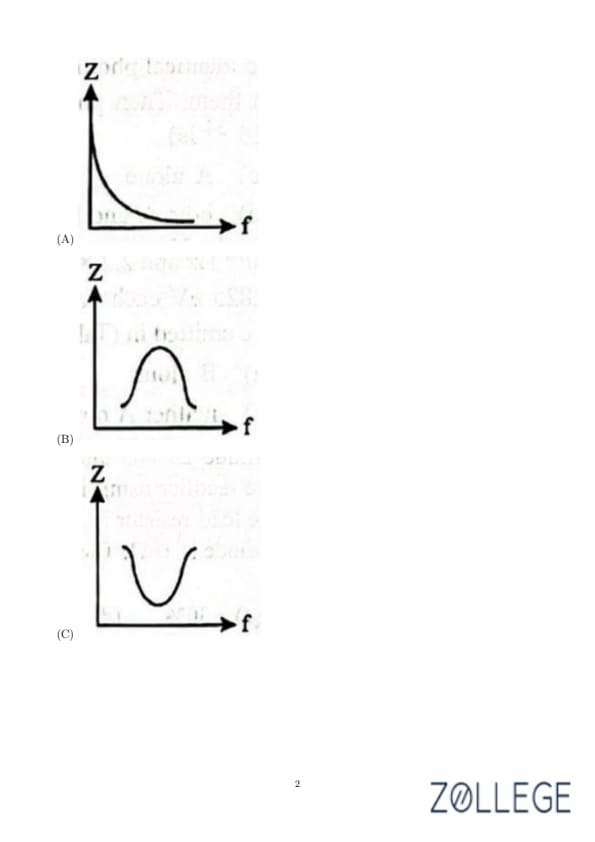
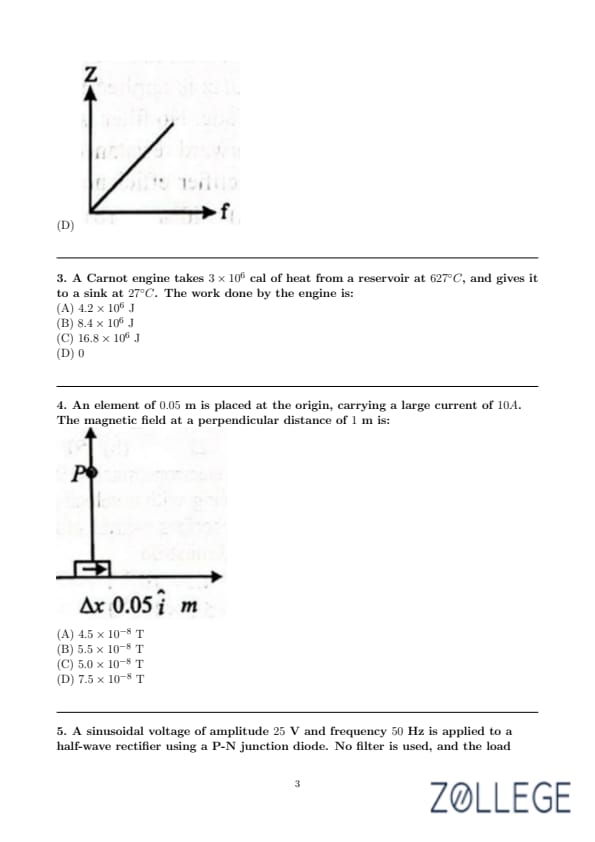
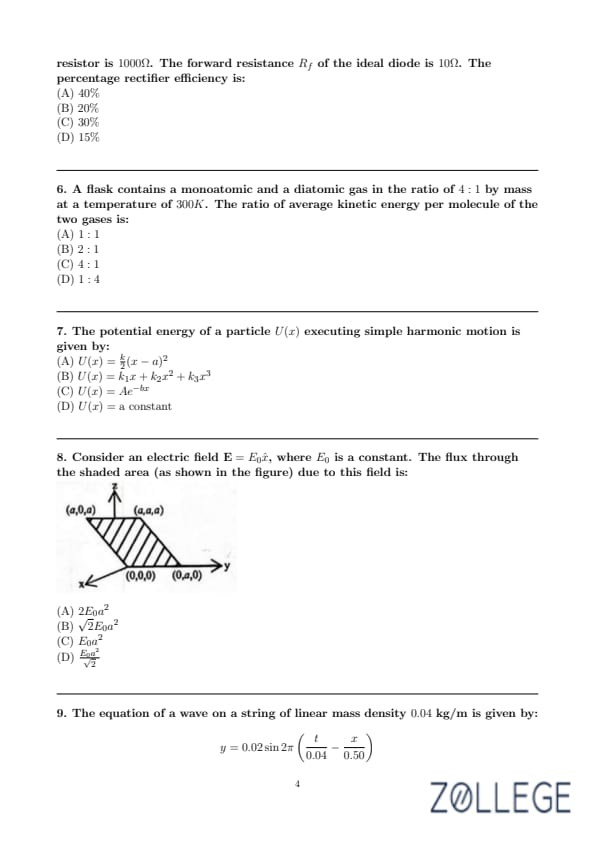
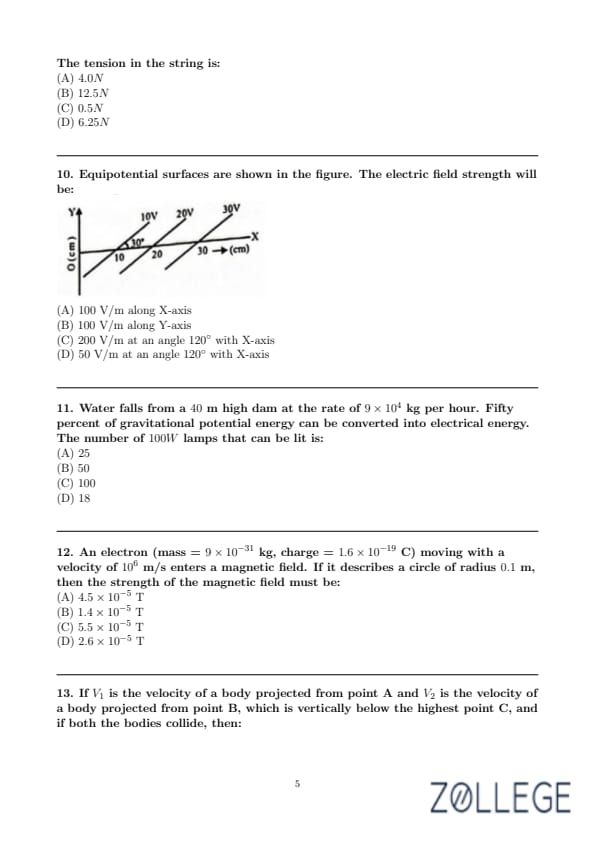
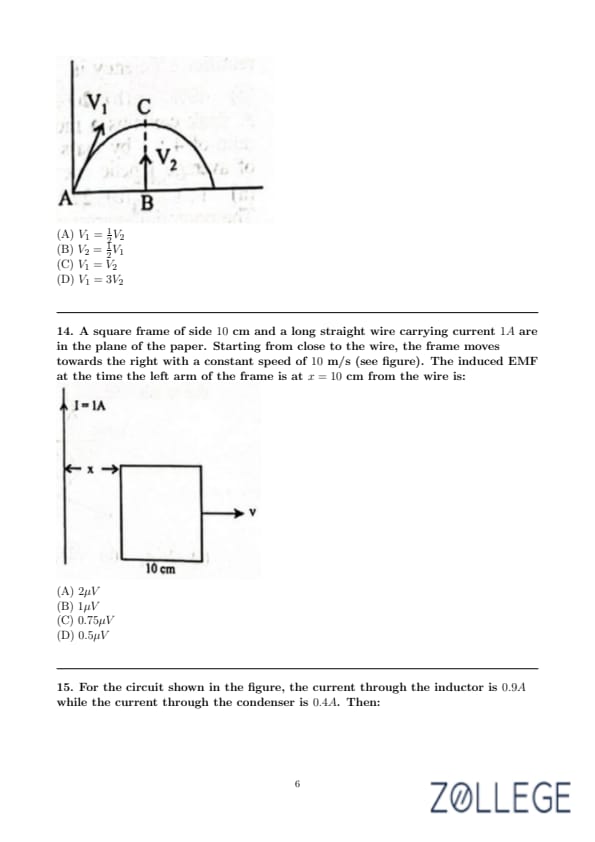
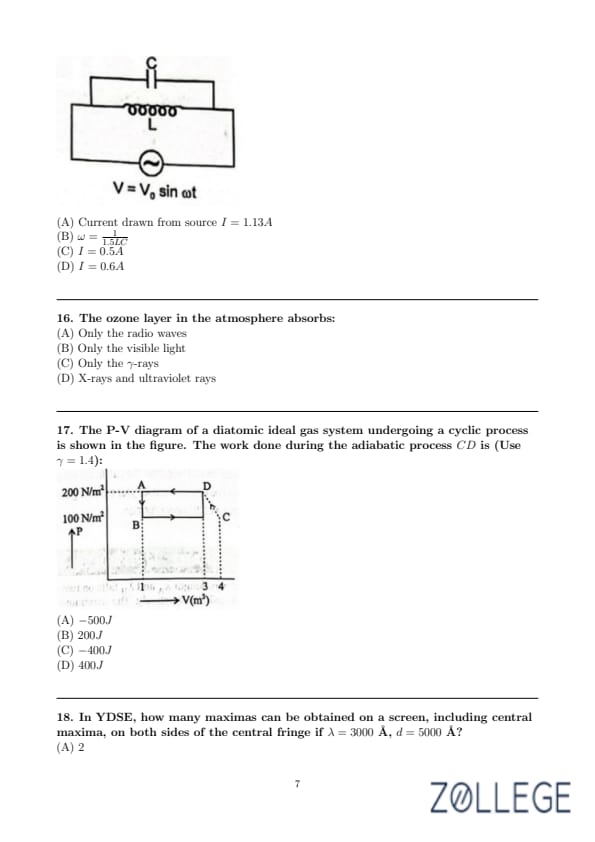
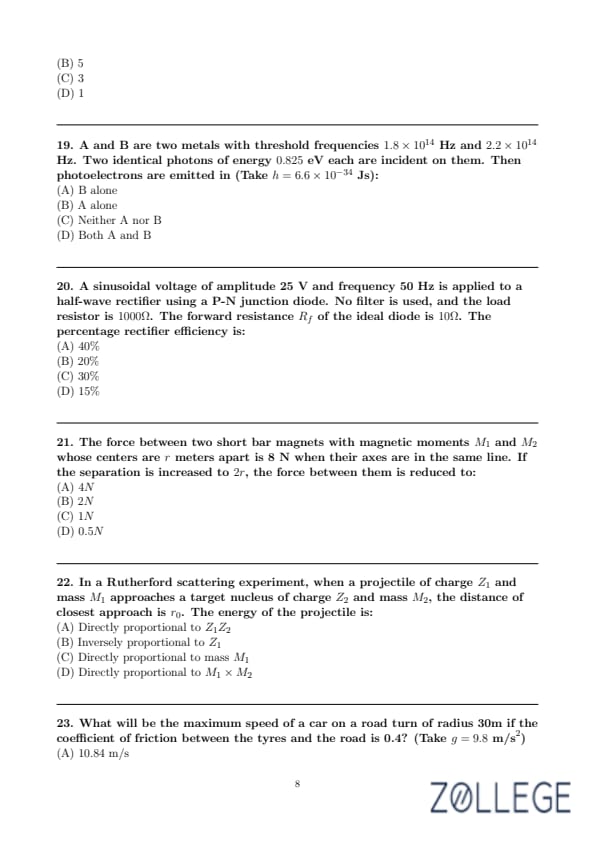
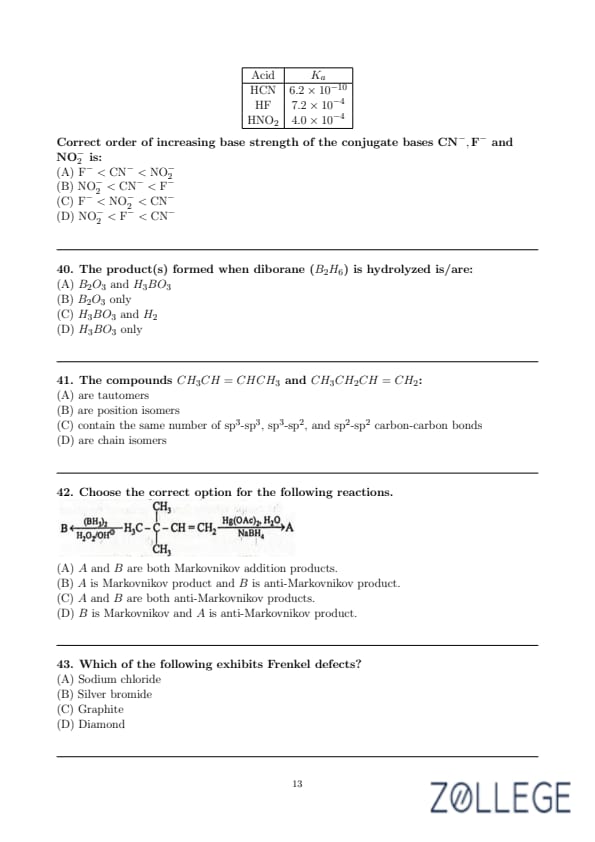
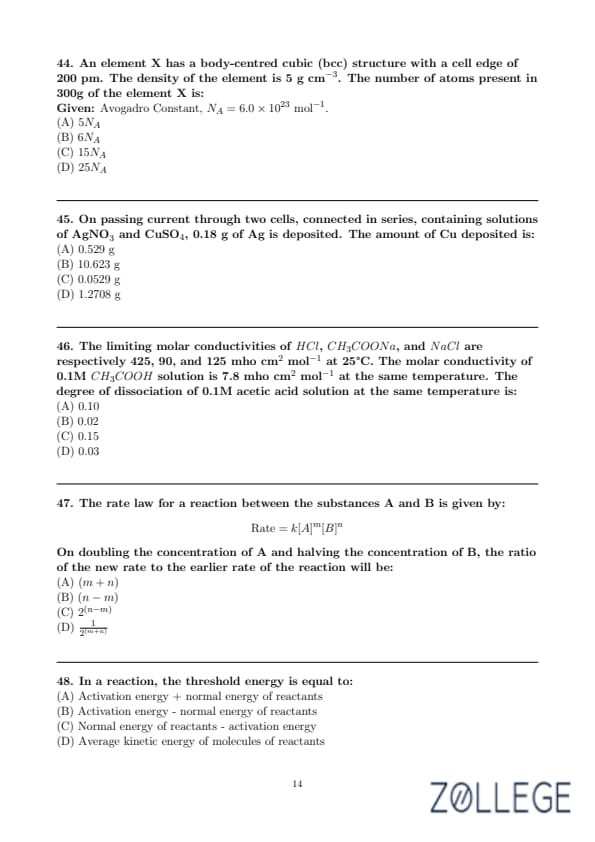
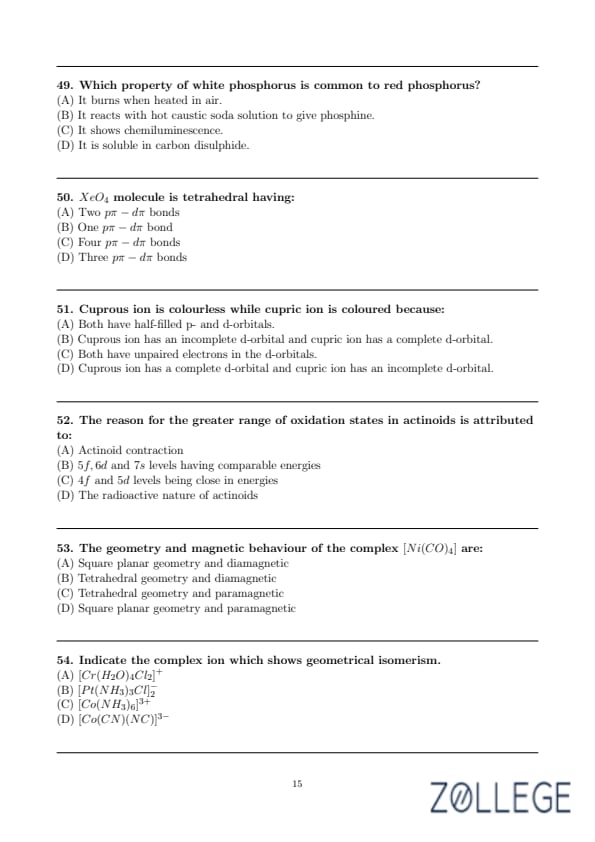
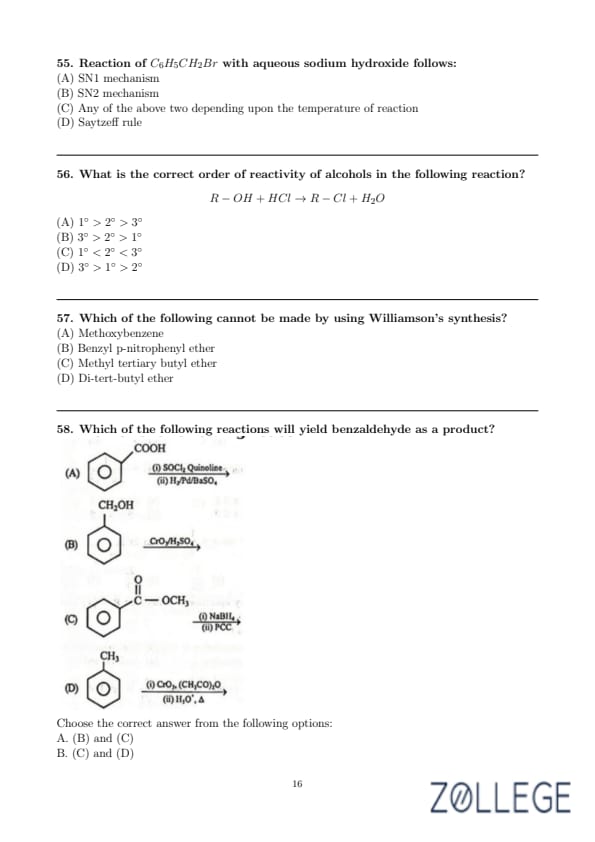
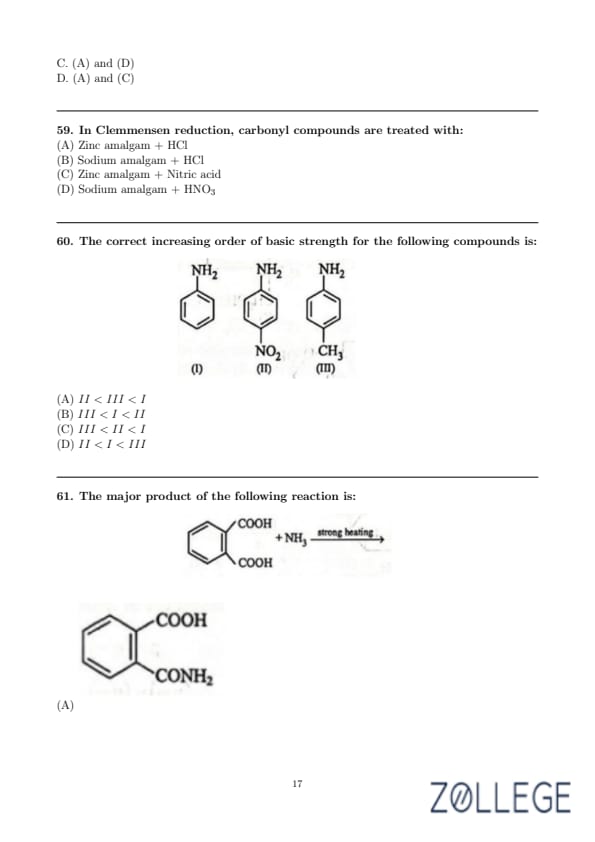
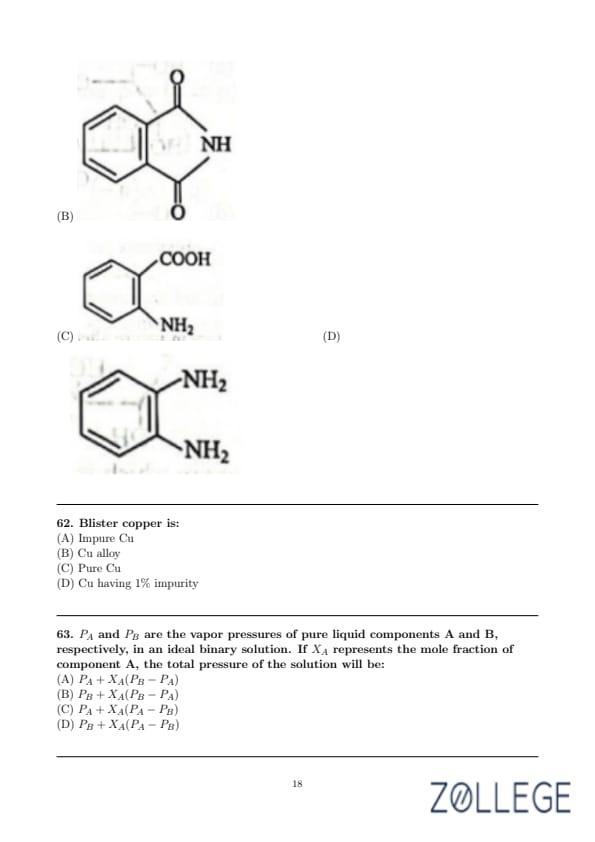
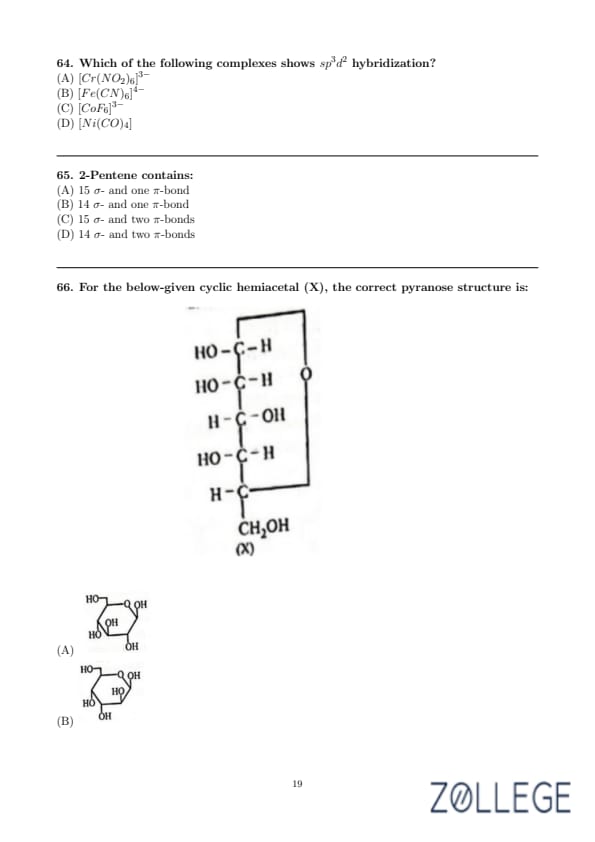
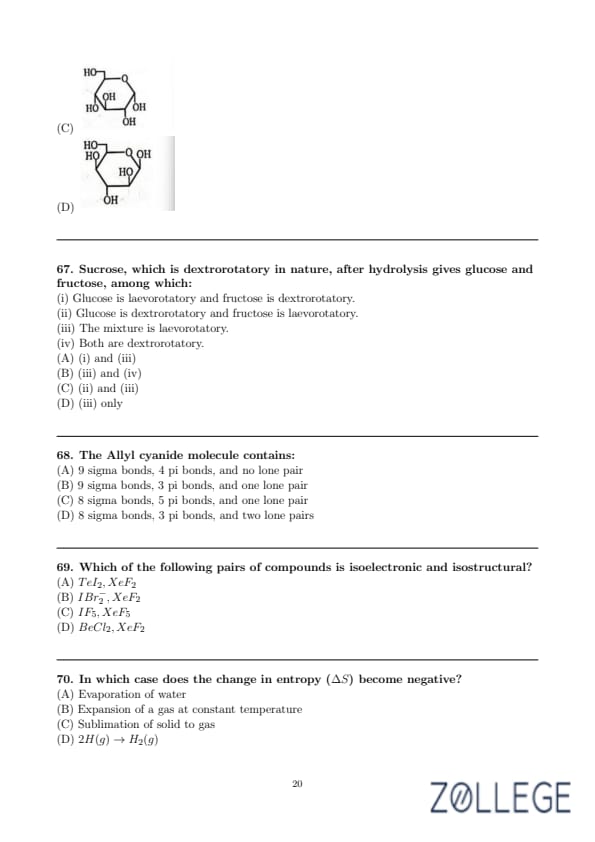
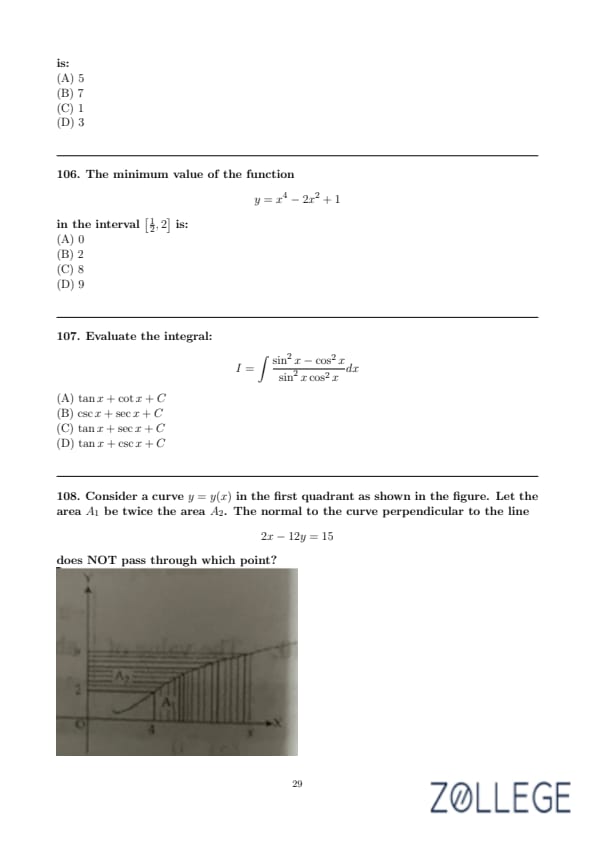
Previous Year VITEEE Main Question Papers
*The article might have information for the previous academic years, please refer the official website of the exam.