
VITEEE 2024 Question Paper Pdf - Check Solutions With Answer Key PDF


Content Writer | Updated On - Nov 17, 2025
VITEEE 2024 Question Paper with Solution PDF is available for download. Vellore Institute of Technology successfully conducted the exam from April 19 to April 30, 2024, in computer-based mode. As per the students’ initial reaction, VITEEE 2024 Question Paper was reported as moderate in overall difficulty. The Mathematics section in VITEEE 2024 was reported as difficult and lengthy, Physics as moderate, Chemistry as easy to moderate, while English and Aptitude were considered easy.
VITEEE 2024 Question Paper with Answer Key PDF
Candidates can download the official VITEEE 2024 Question Paper with Solution and Answer Key PDFs using the link below.
| VITEEE 2024 Question Paper with Answer Key |  Download Download |
Check Solution |

VITEEE 2024 Question Paper With Solutions
Force between two point charges \(q_1\) and \(q_2\) placed in vacuum at \(r\) cm apart is \(F\). Force between them when placed in a medium having dielectric \(K = 5\) at \(r/5\) cm apart will be:
View Solution
Step 1: Formula for Force between Charges in a Medium
The electrostatic force between two point charges in a vacuum is given by Coulomb’s Law:
\[ F_{vacuum} = \frac{1}{4 \pi \epsilon_0} \frac{q_1 q_2}{r^2} \]
where:
- \( q_1, q_2 \) are the magnitudes of the two point charges,
- \( r \) is the distance between them,
- \( \epsilon_0 \) is the permittivity of free space.
When the charges are placed in a medium with dielectric constant \( K \), the force is reduced by a factor of \( K \):
\[ F_{medium} = \frac{F_{vacuum}}{K} \]
where \( K = 5 \).
Step 2: Adjusting the Distance
The force also depends on the square of the distance between the charges.
If the distance between the charges is reduced to \( r' = r/5 \), the force increases by a factor of:
\[ \left(\frac{r}{r'}\right)^2 = \left(\frac{r}{r/5}\right)^2 = 5^2 = 25 \]
Step 3: Combining Both Effects
The total effect on force due to the dielectric constant and distance change is:
\[ F_{new} = 25 \times \frac{F}{K} = 25 \times \frac{F}{5} = 5F \]
Final Answer:
Since both factors have been considered, the final force between the charges in the given medium is \( 5F \). Quick Tip: - In a vacuum, Coulomb’s force depends only on charge and distance. - When a dielectric medium is introduced, force decreases by a factor of \( K \). - When the distance between charges decreases, the force increases by the square of the change in distance. - Always consider both effects together when solving such problems.
A parallel plate capacitor has 1 \(\mu\)F capacitance. One of its two plates is given \(+2 \mu C\) charge and the other plate, \(+4 \mu C\) charge. The potential difference developed across the capacitor is:
View Solution
Step 1: Understanding the Capacitance Formula
The relationship between charge \(Q\), capacitance \(C\), and potential difference \(V\) is given by the formula:
\[ V = \frac{Q}{C} \]
Where:
- \(Q\) is the charge on the plates.
- \(C\) is the capacitance of the parallel plate capacitor.
- \(V\) is the potential difference across the plates.
Step 2: Charge on the Inner Plates
According to Gauss’s law, the charge appearing on the inner plates of the capacitor is given by:
\[ Q_{inner} = \frac{|Q_1 - Q_2|}{2} \]
Given \(Q_1 = 4 \mu C\) and \(Q_2 = 2 \mu C\), we get:
\[ Q_{inner} = \frac{|4 - 2|}{2} = \frac{2}{2} = 1 \mu C \]
Step 3: Calculating the Potential Difference
The given capacitance \(C = 1 \mu F\). Now, using the formula:
\[ V = \frac{Q_{inner}}{C} \]
\[ V = \frac{1 \mu C}{1 \mu F} = 1 V \]
Final Answer: The potential difference developed across the capacitor is 1 V. Quick Tip: - The charge on the inner plates of a capacitor is given by \( \frac{|Q_1 - Q_2|}{2} \).
- The potential difference across a capacitor is calculated using \(V = \frac{Q}{C}\).
- Always ensure proper sign conventions when dealing with capacitors in circuits.
A body of mass \(M\) at rest explodes into three pieces, in the ratio of masses 1:1:2. Two smaller pieces fly off perpendicular to each other with velocities of 30 m/s and 40 m/s respectively. The velocity of the third piece will be:
View Solution
Step 1: Applying the Law of Conservation of Momentum
Since the body is initially at rest, the total momentum before the explosion is zero. The total momentum after the explosion must also be zero to satisfy the law of conservation of momentum.
The masses of the pieces are in the ratio \(1:1:2\), so we can denote the masses of the pieces as \(m_1 = m\), \(m_2 = m\), and \(m_3 = 2m\).
\[ Total momentum before explosion = 0 \]
Total momentum after explosion = \text{momentum of piece 1 + \text{momentum of piece 2 + \text{momentum of piece 3 = 0
\[ m_1 v_1 + m_2 v_2 + m_3 v_3 = 0 \]
Where:
- \(v_1 = 30 \, \text{m/s\) (velocity of first piece)
- \(v_2 = 40 \, m/s\) (velocity of second piece)
- \(v_3\) is the velocity of the third piece.
Step 2: Resolving Momentum Components
Since the pieces fly off perpendicular to each other, we can resolve the momentum into two components: horizontal and vertical.
In the horizontal direction:
\[ m \cdot 30 + m \cdot 0 + 2m \cdot v_{3x} = 0 \quad \Rightarrow \quad 30 + 2v_{3x} = 0 \quad \Rightarrow \quad v_{3x} = -15 \, m/s \]
In the vertical direction:
\[ m \cdot 0 + m \cdot 40 + 2m \cdot v_{3y} = 0 \quad \Rightarrow \quad 40 + 2v_{3y} = 0 \quad \Rightarrow \quad v_{3y} = -20 \, m/s \]
Step 3: Calculating the Velocity of the Third Piece
The total velocity of the third piece is the vector sum of the horizontal and vertical components of velocity: \[ v_3 = \sqrt{v_{3x}^2 + v_{3y}^2} = \sqrt{(-15)^2 + (-20)^2} = \sqrt{225 + 400} = \sqrt{625} = 25 \, m/s \]
Final Answer: The velocity of the third piece is \(25 \, m/s\). Quick Tip: - When solving explosion problems, apply the conservation of momentum in both the horizontal and vertical directions.
- Use vector addition to find the resultant velocity.
- The negative signs indicate opposite directions but do not affect magnitude.
A charge particle moving in magnetic field \( B \), has components of velocity along \( B \) as well as perpendicular to \( B \). The path of the charge particle will be:
View Solution
Step 1: Understanding the Motion of the Charged Particle
A charged particle moving in a magnetic field experiences a force given by:
\[ F = q \vec{v} \times \vec{B} \]
Where:
\(q\) is the charge of the particle,
\(\vec{v}\) is the velocity of the particle,
\(\vec{B}\) is the magnetic field.
The force due to the magnetic field is always perpendicular to the velocity of the particle.
Step 2: Analyzing the Components of Velocity
When the velocity has a component parallel to the magnetic field \( B \), the particle will experience no force along that direction, and will continue to move in the same direction.
When there is a component of velocity perpendicular to the magnetic field, the particle will experience a force and undergo circular motion in a plane perpendicular to the magnetic field.
The combination of these two components of velocity (along and perpendicular to the magnetic field) results in a helical motion. The particle moves in a spiral path around the magnetic field lines.
Step 3: Conclusion
The path of the charge particle will be a helical path with the axis along the direction of the magnetic field. This is because the component of velocity along \( B \) causes the particle to move parallel to the field, while the perpendicular component causes circular motion around the field lines.
Final Answer: The path of the charge particle will be a helical path with the axis along magnetic field \( B \). Quick Tip: In the presence of a magnetic field, the motion of a charged particle can be analyzed in terms of components:
Parallel component: causes linear motion along the field.
Perpendicular component: causes circular motion, resulting in helical motion when combined with the parallel component.
In meter bridge or Wheatstone bridge for measurement of resistance, the known and the unknown resistance are interchanged. The error so removed is:
View Solution
Step 1: Understanding End Error in Meter Bridge
In a meter bridge experiment, it is assumed that the resistance of the L-shaped metallic strips used in the setup is negligible. However, in reality, this resistance is not truly zero, leading to a systematic error in measurements. This error is known as the end error.
Step 2: Effect of End Error
The presence of end error affects the balancing condition of the meter bridge. This results in incorrect calculations of the unknown resistance, causing measurement inaccuracies.
Step 3: Removal of End Error
To minimize or eliminate the end error, the following corrective measure is used:
- The resistance box and the unknown resistance are interchanged, and the mean of both readings is taken.
- This ensures that the error due to the resistance of the connecting strips cancels out, leading to a more accurate measurement.
Final Answer: The error removed by interchanging the resistances in the meter bridge experiment is called end error. Quick Tip: \textbf{End error} in a meter bridge experiment arises due to the resistance of the connecting metallic strips.
It is eliminated by interchanging the known and unknown resistances and averaging the results.
Spherical insulating ball and a spherical metallic ball of same size and mass are dropped from the same height. Choose the correct statement out of the following (Assume negligible air friction):
View Solution
Step 1: Analyzing the Motion of the Balls
According to the laws of physics, in the absence of air friction (as stated in the problem), the time taken by an object to fall to the surface is independent of its mass or material. This principle is based on the equivalence of gravitational acceleration for all objects near Earth's surface.
The gravitational acceleration is the same for all objects, so the insulating ball and the metallic ball will both experience the same force (gravity) and will fall with the same acceleration.
Step 2: Conclusion
Since both balls have the same size and mass, and air friction is negligible, they will reach the earth's surface at the same time.
Final Answer: Both the insulating ball and the metallic ball will reach the earth's surface simultaneously. Quick Tip: In the absence of air resistance, all objects fall at the same rate regardless of their mass or material.
Two objects A and B are placed at 15 cm and 25 cm from the pole in front of a concave mirror having radius of curvature 40 cm. The distance between images formed by the mirror is:
View Solution
Step 1: Understanding the Mirror Formula
The mirror formula relates object distance \(u\), image distance \(v\), and the focal length \(f\) of the mirror:
\[ \frac{1}{f} = \frac{1}{v} + \frac{1}{u} \]
Where:
\(f = \frac{R}{2}\) is the focal length of the mirror and \(R\) is the radius of curvature.
\(u\) is the object distance and \(v\) is the image distance.
The radius of curvature \(R = 40 \, cm\), so the focal length is:
\[ f = \frac{R}{2} = \frac{40}{2} = 20 \, cm \]
Step 2: Finding the Image Distances
For object A, placed at \(u_1 = 15 \, cm\), we use the mirror formula to find the image distance \(v_1\):
\[ \frac{1}{f} = \frac{1}{v_1} + \frac{1}{u_1} \quad \Rightarrow \quad \frac{1}{20} = \frac{1}{v_1} + \frac{1}{15} \]
Solving for \(v_1\):
\[ \frac{1}{v_1} = \frac{1}{20}
\frac{1}{15} = \frac{3
4}{60} = \frac{
1}{60} \quad \Rightarrow \quad v_1 =
60 \, cm \]
This indicates that the image is virtual and formed 60 cm behind the mirror.
For object B, placed at \(u_2 = 25 \, cm\), we use the same formula to find the image distance \(v_2\):
\[ \frac{1}{f} = \frac{1}{v_2} + \frac{1}{u_2} \quad \Rightarrow \quad \frac{1}{20} = \frac{1}{v_2} + \frac{1}{25} \]
Solving for \(v_2\):
\[ \frac{1}{v_2} = \frac{1}{20}
\frac{1}{25} = \frac{5
4}{100} = \frac{1}{100} \quad \Rightarrow \quad v_2 = 100 \, cm \]
This indicates that the image is real and formed 100 cm in front of the mirror.
Step 3: Finding the Distance Between the Images
The distance between the images is the difference in their image distances:
\[ Distance between images = |v_2
v_1| = |100
(
60)| = 100 + 60 = 160 \, cm \]
Final Answer: The distance between the images formed by the mirror is \(160 \, cm\). Quick Tip: For concave mirrors, the image distance is positive for real images and negative for virtual images. Use the mirror formula \(\frac{1}{f} = \frac{1}{v} + \frac{1}{u}\) to find the image distance.
A bob of mass \( m \) is suspended by a light string of length \( L \). It is imparted a minimum horizontal velocity at the lowest point A such that it just completes half a circle, reaching the topmost position B. The ratio of kinetic energies \(\left(\frac{K.E.}{K.E.}\right)_A \, to \, \left(\frac{K.E.}{K.E.}\right)_B\) is:
View Solution
Step 1: Applying Energy Conservation between Points A and B
According to the principle of conservation of energy:
\[ Total Energy at A = Total Energy at B \]
The total energy is the sum of kinetic energy (K.E.) and potential energy (P.E.).
Step 2: Energy at the Lowest Point (a)
At the lowest point A:
- The bob has only kinetic energy.
- Potential energy is taken as zero at this point.
\[ K.E._A = \frac{1}{2} m v_H^2 \]
where \( v_H \) is the velocity at point A.
Step 3: Energy at the Highest Point (b)
At the highest point B:
- The bob has both kinetic energy and potential energy.
- The height at point B is 2L, so the potential energy is:
\[ P.E._B = mg(2L) \]
- The velocity at B is given by:
\[ v_L = \sqrt{5gL} \]
So, the kinetic energy at point B is:
\[ K.E._B = \frac{1}{2} m v_L^2 = \frac{1}{2} m (5gL) = \frac{5}{2} m g L \]
Step 4: Finding the Ratio of Kinetic Energies
Using energy conservation:
\[ K.E._A + P.E._A = K.E._B + P.E._B \]
Since \( P.E._A = 0 \),
\[ K.E._A = K.E._B + mg(2L) \]
Substituting \( K.E._B = \frac{5}{2} m g L \),
\[ K.E._A = \frac{5}{2} m g L + 2 mg L \]
\[ K.E._A = \frac{5}{2} mgL + \frac{4}{2} mgL = \frac{9}{2} mgL \]
\[ K.E._B = \frac{5}{2} mgL \]
So, the ratio is:
\[ \frac{K.E._A}{K.E._B} = \frac{\frac{9}{2} mgL}{\frac{5}{2} mgL} = \frac{9}{5} \]
\[ = 5:1 \]
Final Answer: The ratio of kinetic energies is 5:1. Quick Tip: In vertical circular motion, use \textbf{energy conservation} to relate velocities at different points. At the topmost point, potential energy is maximum, and kinetic energy is minimum.
For a group of positive charges, which of the following statements is correct?
View Solution
Step 1: Understanding Electric Potential and Electric Field
The electric potential due to a positive charge is always positive because potential is defined as the work done to bring a unit positive charge from infinity to that point.
The electric field, on the other hand, is the negative gradient of potential, meaning that it points in the direction of decreasing potential.
Step 2: Condition for Zero Electric Field
The net electric field at a point can be zero due to the vector nature of electric fields. If multiple positive charges are arranged symmetrically, their electric fields can cancel each other out at a specific point, making the net electric field zero.
Step 3: Condition for Zero Potential
The net potential is a scalar quantity and is the algebraic sum of the potentials due to individual charges. Since the potential due to each positive charge is always positive, their sum cannot be zero at any point in space. This means that while the electric field can be zero, the potential cannot be zero.
Step 4: Conclusion
The correct answer is (a) because the net potential cannot be zero at a point, but the net electric field can be zero if the vector sum of fields cancels out. Quick Tip: - The electric potential is a scalar and cannot be zero for a system of only positive charges.
- The electric field is a vector and can be zero if the fields cancel out symmetrically.
The work function of a substance is 4.0 eV. The longest wavelength of light that can cause photoelectron emission from this substance is approximately:
View Solution
Step 1: Use of the Photoelectric Equation
The photoelectric equation relates the energy of a photon, the work function of the material, and the maximum kinetic energy of the ejected photoelectrons:
\[ E_{photon} = W + K.E. \]
Where:
\( E_{photon} = h \cdot f \) is the energy of the incoming photon.
\( W \) is the work function of the material.
\( K.E. \) is the maximum kinetic energy of the ejected electron (which is zero for the threshold frequency).
At the threshold frequency, the kinetic energy is zero, so the energy of the photon is equal to the work function \( W \).
Step 2: Calculation of the Longest Wavelength
The energy of the photon can be expressed as \( E_{photon} = h \cdot c / \lambda \), where \( \lambda \) is the wavelength of light, \( h \) is Planck’s constant, and \( c \) is the speed of light.
Rearranging for \( \lambda \):
\[ \lambda = \frac{h \cdot c}{W} \]
Substituting the known values:
\( h = 6.626 \times 10^{
34} \, J·s \)
\( c = 3.0 \times 10^8 \, m/s \)
\( W = 4.0 \, eV = 4.0 \times 1.602 \times 10^{
19} \, J \)
\[ \lambda = \frac{6.626 \times 10^{
34} \times 3.0 \times 10^8}{4.0 \times 1.602 \times 10^{
19}} = 310 \, nm \]
Final Answer: The longest wavelength that can cause photoelectron emission is approximately \( \textbf{310 nm} \). Quick Tip: The longest wavelength corresponds to the threshold frequency at which the kinetic energy of the ejected electron is zero. Use the equation \( \lambda = \frac{h \cdot c}{W} \) to calculate the wavelength.
Magnetic field at the centre of a circular coil of radius \( r \), through which a current \( I \) flows is:
View Solution
Step 1: Formula for Magnetic Field at the Centre of a Circular Coil
The magnetic field at the centre of a circular coil carrying a current \( I \) is given by the formula:
\[ B = \frac{\mu_0 I}{2 r} \]
where:
\( \mu_0 \) is the permeability of free space,
\( I \) is the current flowing through the coil,
\( r \) is the radius of the coil.
Step 2: Analyzing the Dependence of Magnetic Field
From the formula, we can see that the magnetic field at the centre is directly proportional to the current \( I \) and inversely proportional to the radius \( r \).
Therefore, the magnetic field is directly proportional to \( I \) and not to \( r \), nor is it proportional to \( I^2 \).
Final Answer: The magnetic field at the centre of the circular coil is directly proportional to \( I \). Quick Tip: The magnetic field at the centre of a circular coil is directly proportional to the current and inversely proportional to the radius of the coil. The formula is \( B = \frac{\mu_0 I}{2 r} \).
The refractive index \( \mu \) of the material of a prism is given by:
% Formula for Refractive Index \[ \mu = \frac{\sin \left( \frac{A + \delta_m}{2} \right)}{\sin \left( \frac{A}{2} \right)} \]
where \( A \) is the apex angle of the prism and \( \delta_m \) is the angle of minimum deviation.
View Solution
Step 1: Understanding the Relation Between \( A \), \( \delta_m \), and \( \mu \)
The refractive index \( \mu \) of the prism is given by the equation:
\[ \mu = \frac{\sin \left( \frac{A + \delta_m}{2} \right)}{\sin \left( \frac{A}{2} \right)} \]
This equation helps in finding the angle of minimum deviation \( \delta_m \).
Step 2: Expressing \( \delta_m \) in Terms of \( A \)
We know that:
\[ \cot \frac{A}{2} = \frac{\cos \frac{A}{2}}{\sin \frac{A}{2}} = \frac{\sin \left( \frac{A + \delta_m}{2} \right)}{\sin \frac{A}{2}} \]
Rearranging the equation, we get:
\[ \sin \left( \frac{180^{\circ}}{2} - \frac{A}{2} \right) = \sin \left( \frac{A + \delta_m}{2} \right) \]
Since we know that \( \sin(\theta) = \sin(180^\circ - \theta) \), we equate:
\[ \frac{180^{\circ}}{2} - \frac{A}{2} = \frac{A + \delta_m}{2} \]
Step 3: Solving for \( \delta_m \)
Simplifying the above equation:
\[ 180^{\circ} - 2A = \delta_m \]
Thus, the angle of minimum deviation is given by:
\[ \delta_m = 180^{\circ} - 2A \]
Final Answer: The angle of minimum deviation is \( 180^{\circ} - 2A \). Quick Tip: The refractive index of a prism is given by:
\( \mu = \frac{\sin \left( \frac{A + \delta_m}{2} \right)}{\sin \left( \frac{A}{2} \right)} \)
The minimum deviation angle \( \delta_m \) is found using \( \delta_m = 180^{\circ} - 2A \).
If \( \mathbf{A} = 4\hat{i} + 3\hat{j} \) and \( \mathbf{B} = 3\hat{i} + 4\hat{j} \), then the cosine of the angle between \( \vec{A} \) and \( \vec{A} + \vec{B} \) is:
View Solution
Step 1: Cosine of the Angle Between Two Vectors
The cosine of the angle \( \theta \) between two vectors \( \vec{A} \) and \( \vec{C} = \vec{A} + \vec{B} \) is given by:
\[ \cos \theta = \frac{\vec{A} \cdot \vec{C}}{|\vec{A}| |\vec{C}|} \]
where \( \vec{A} \cdot \vec{C} \) is the dot product of the vectors and \( |\vec{A}| \) and \( |\vec{C}| \) are the magnitudes of the vectors.
Step 2: Calculate the Dot Product \( \vec{A} \cdot \vec{C} \)
First, calculate \( \vec{C} = \vec{A} + \vec{B} = (4\hat{i} + 3\hat{j}) + (3\hat{i} + 4\hat{j}) = 7\hat{i} + 7\hat{j} \).
The dot product \( \vec{A} \cdot \vec{C} \) is:
\[ \vec{A} \cdot \vec{C} = (4\hat{i} + 3\hat{j}) \cdot (7\hat{i} + 7\hat{j}) = 4 \cdot 7 + 3 \cdot 7 = 28 + 21 = 49 \]
Step 3: Calculate the Magnitudes of \( \vec{A} \) and \( \vec{C} \)
The magnitude of \( \vec{A} \) is:
\[ |\vec{A}| = \sqrt{4^2 + 3^2} = \sqrt{16 + 9} = \sqrt{25} = 5 \]
The magnitude of \( \vec{C} \) is:
\[ |\vec{C}| = \sqrt{7^2 + 7^2} = \sqrt{49 + 49} = \sqrt{98} = 7\sqrt{2} \]
Step 4: Calculate the Cosine of the Angle
Now, substitute the values into the cosine formula:
\[ \cos \theta = \frac{49}{5 \times 7\sqrt{2}} = \frac{49}{35\sqrt{2}} = \frac{7}{5\sqrt{2}} \]
Final Answer: The cosine of the angle between \( \vec{A} \) and \( \vec{A} + \vec{B} \) is \( \frac{7}{5\sqrt{2}} \). Quick Tip: To calculate the cosine of the angle between two vectors, use the formula \( \cos \theta = \frac{\vec{A} \cdot \vec{C}}{|\vec{A}| |\vec{C}|} \). Remember to calculate both the dot product and magnitudes of the vectors.
Two light beams of intensities in the ratio of 9:4 are allowed to interfere. The ratio of the intensity of maxima and minima will be:
View Solution
Step 1: Formula for Intensity of Interference Maxima and Minima
The intensity of interference maxima and minima for two interfering beams is given by the following formulas:
For maxima:
\[ I_{max} = (I_1 + I_2 + 2 \sqrt{I_1 I_2}) \]
For minima:
\[ I_{min} = (I_1 + I_2
2 \sqrt{I_1 I_2}) \]
Where \( I_1 \) and \( I_2 \) are the intensities of the two interfering beams.
Step 2: Substitute the Intensities Given in the Question
The ratio of the intensities is given as 9:4. So, \( I_1 = 9 \) and \( I_2 = 4 \).
For maxima:
\[ I_{max} = (9 + 4 + 2 \sqrt{9 \times 4}) = 13 + 2 \times 6 = 13 + 12 = 25 \]
For minima:
\[ I_{min} = (9 + 4
2 \sqrt{9 \times 4}) = 13
12 = 1 \]
Step 3: Calculate the Ratio of Intensities
The ratio of the intensity of maxima to minima is:
\[ \frac{I_{max}}{I_{min}} = \frac{25}{1} = 25:1 \]
Final Answer: The ratio of the intensity of maxima and minima is \( \textbf{25:1} \). Quick Tip: For interference of light, the intensity at maxima is given by \( I_{max} = (I_1 + I_2 + 2 \sqrt{I_1 I_2}) \), and the intensity at minima is \( I_{min} = (I_1 + I_2
2 \sqrt{I_1 I_2}) \).
A heavy box of mass 50 kg is moving on a horizontal surface. If the coefficient of kinetic friction between the box and the horizontal surface is 0.3, then the force of kinetic friction is:
View Solution
Step 1: Formula for Kinetic Friction Force
The force of kinetic friction \( F_k \) is given by the formula:
\[ F_k = \mu_k \cdot N \]
where \( \mu_k \) is the coefficient of kinetic friction and \( N \) is the normal force.
Step 2: Calculate the Normal Force
For a horizontal surface, the normal force \( N \) is equal to the weight of the box, which is the mass \( m \) multiplied by the acceleration due to gravity \( g \):
\[ N = m \cdot g = 50 \times 9.8 = 490 \, N \]
Step 3: Calculate the Force of Kinetic Friction
Now, substitute the values into the kinetic friction formula:
\[ F_k = 0.3 \times 490 = 147 \, N \]
Final Answer: The force of kinetic friction is 147 N. Quick Tip: The force of kinetic friction is given by \( F_k = \mu_k \cdot N \), where \( N \) is the normal force and \( \mu_k \) is the coefficient of kinetic friction.
When unpolarized light is incident at an angle of 60° on a transparent medium from air, the reflected ray is completely polarized. The angle of refraction in the medium is:
View Solution
Step 1: Brewster's Angle
According to Brewster's law, the angle of incidence \( \theta_i \) at which the reflected light is completely polarized is called Brewster's angle \( \theta_B \). Brewster's angle is given by:
\[ \tan \theta_B = \frac{n_2}{n_1} \]
where \( n_1 \) is the refractive index of the first medium (air) and \( n_2 \) is the refractive index of the second medium (the transparent medium).
In air, \( n_1 \approx 1 \), so the equation simplifies to:
\[ \tan \theta_B = n_2 \]
Step 2: Relationship Between Incident and Refracted Angles
According to Snell's law, the relationship between the angles of incidence and refraction is given by:
\[ \frac{\sin \theta_i}{\sin \theta_r} = \frac{n_2}{n_1} \]
where \( \theta_i = 60^\circ \), and \( \theta_r \) is the angle of refraction.
Step 3: Brewster's Angle for Complete Polarization
When the reflected ray is completely polarized, the angle of incidence \( \theta_i = 60^\circ \) must equal the Brewster's angle \( \theta_B \). Therefore, the angle of refraction \( \theta_r \) is:
\[ \theta_r = 30^\circ \]
Final Answer: The angle of refraction in the medium is \( \textbf{30°} \). Quick Tip: When unpolarized light is incident on a transparent medium, the reflected ray is completely polarized at Brewster's angle. The angle of refraction in the medium can be calculated based on this condition.
The waves emitted when a metal target is bombarded with high energy electrons are:
View Solution
Step 1: Explanation of the Phenomenon
When high
energy electrons strike a metal target, the energy from the electrons is transferred to the metal atoms. This energy causes the ejection of inner shell electrons in the atoms of the metal, and when electrons from higher energy levels fall back to fill these vacancies, they emit energy in the form of electromagnetic radiation.
Step 2: Identifying the Type of Radiation
The energy released in this process is typically in the form of X
rays, which have a much higher energy than visible light and are part of the electromagnetic spectrum.
Other radiation types, such as microwaves, infrared rays, and radio waves, have lower energy compared to X
rays and are not produced in this phenomenon.
Final Answer: The correct answer is \( \textbf{X
rays} \). Quick Tip: When high
energy electrons bombard a metal target, the emitted radiation is typically \textbf{X
rays}, which result from transitions of electrons in the metal atoms.
Two bodies of mass 4 g and 25 g are moving with equal kinetic energies. The ratio of magnitude of their linear momentum is:
View Solution
Step 1: Formula for Linear Momentum
The linear momentum \( P \) of an object is given by:
\[ P = \sqrt{2 m E} \]
where \( m \) is the mass and \( E \) is the kinetic energy.
Step 2: Relationship Between Momentum and Mass
Given that the kinetic energies of the two masses are equal, we equate:
\[ E_1 = E_2 \quad \Rightarrow \quad \frac{P_1^2}{2m_1} = \frac{P_2^2}{2m_2} \]
Rearranging:
\[ \frac{P_1}{P_2} = \sqrt{\frac{m_1}{m_2}} \]
Step 3: Substituting Values
Given \( m_1 = 4 \) g and \( m_2 = 25 \) g, we substitute:
\[ \frac{P_1}{P_2} = \sqrt{\frac{4}{25}} = \frac{2}{5} \]
Final Answer: The ratio of the magnitudes of their linear momentum is 2:5. Quick Tip: For objects with equal kinetic energy, the ratio of their momentum is given by \( \frac{P_1}{P_2} = \sqrt{\frac{m_1}{m_2}} \).
Five charges \( +q, +5q, -2q, +3q \) and \( -4q \) are situated as shown in the figure. The electric flux due to this configuration through the surface S is:

View Solution
Step 1: Gauss's Law
According to Gauss's Law, the total electric flux \( \Phi_E \) through a closed surface is given by:
\[ \Phi_E = \frac{Q_{enc}}{\epsilon_0} \]
where \( Q_{enc} \) is the total charge enclosed within the closed surface.
Step 2: Calculating the Net Charge Enclosed
The charges enclosed inside the closed surface are:
\[ q, -2q, +5q \]
Adding them together:
\[ Q_{enc} = q + (-2q) + 5q = 4q \]
Step 3: Finding the Flux
Using Gauss's Law:
\[ \Phi_E = \frac{Q_{enc}}{\epsilon_0} = \frac{4q}{\epsilon_0} \]
Final Answer: The electric flux through the closed surface is \( \frac{4q}{\epsilon_0} \). Quick Tip: Gauss’s Law states that the total electric flux through a closed surface depends only on the net charge enclosed within the surface.
Mass numbers of two nuclei are in the ratio of 4:3. Their nuclear densities will be in the ratio of:
View Solution
Step 1: Understanding Nuclear Density
The nuclear density \( \rho \) is given by:
\[ \rho = \frac{Mass of nucleus}{Volume of nucleus} \]
Since the mass of a nucleus is proportional to its mass number \( A \), and the volume of the nucleus is proportional to \( R^3 \), we can write:
\[ \rho = \frac{m \times A}{\frac{4}{3} \pi R^3} \]
where \( R \) is the nuclear radius.
Step 2: Relationship Between Radius and Mass Number
The nuclear radius is related to the mass number by the empirical relation:
\[ R = R_0 A^{1/3} \]
where \( R_0 \) is a constant.
Substituting this into the volume expression:
\[ V \propto (A^{1/3})^3 = A \]
Thus, the density of the nucleus becomes:
\[ \rho \propto \frac{A}{A} = constant \]
Step 3: Ratio of Nuclear Densities
Since nuclear density is independent of mass number \( A \), the ratio of nuclear densities for nuclei with mass numbers in the ratio \( 4:3 \) is:
\[ \frac{\rho_1}{\rho_2} = 1:1 \]
Final Answer: The nuclear densities of the two nuclei will be in the ratio \( 1:1 \). Quick Tip: Nuclear density is independent of mass number. All nuclei have approximately the same density, regardless of their size.
Under the same load, wire A having length 5.0 m and cross-section \( 2.5 \times 10^{-5} \, m^2 \) stretches uniformly by the same amount as another wire B of length 6.0 m and a cross-section \( 3.0 \times 10^{-5} \, m^2 \) stretches. The ratio of the Young's modulus of wire A to that of wire B will be:
View Solution
Step 1: Young’s Modulus Formula
Young’s modulus \( Y \) is given by the relation:
\[ Y = \frac{F L}{A \Delta L} \]
where:
\( F \) is the force applied,
\( L \) is the length of the wire,
\( A \) is the cross-sectional area,
\( \Delta L \) is the elongation.
Step 2: Ratio of Young’s Modulus for Both Wires
Since both wires stretch by the same amount under the same force, we set up the relation:
\[ \frac{Y_A}{Y_B} = \frac{F_A \cdot L_A}{A_A} \times \frac{A_B}{F_B \cdot L_B} \]
Substituting the given values:
\[ \frac{Y_A}{Y_B} = \frac{5.0}{6.0} \times \frac{3.0 \times 10^{-5}}{2.5 \times 10^{-5}} \]
Simplifying:
\[ \frac{Y_A}{Y_B} = \frac{5}{6} \times \frac{6}{5} = 1 \]
Final Answer: The ratio of Young's modulus of wire A to wire B is \( \textbf{1:1} \). Quick Tip: Young’s modulus is a material property and remains the same for identical materials, even if length and cross-sectional area differ.
A current of 10 A exists in a wire of cross
sectional area of \( 5 \times 10^{-6} \, m^2 \) with a drift velocity of \( 2 \times 10^{-3} \, m/s \). The number of free electrons in each cubic meter of the wire is:
View Solution
Step 1: Drift Velocity and Current Relation
The formula for current is:
\[ I = n A e v_d \]
where:
\( I = 10 \, A \) (current),
\( A = 5 \times 10^{-6} \, m^2 \) (cross
sectional area),
\( e = 1.6 \times 10^{-19} \, C \) (charge of an electron),
\( v_d = 2 \times 10^{-3} \, m/s \) (drift velocity),
\( n \) is the number of free electrons per unit volume.
Step 2: Solving for \( n \)
Rearranging the equation for \( n \):
\[ n = \frac{I}{A e v_d} \]
Substituting the given values:
\[ n = \frac{10}{(5 \times 10^{-6}) \cdot (1.6 \times 10^{-19}) \cdot (2 \times 10^{-3})} \]
Step 3: Simplifying
Evaluating the denominator:
\[ (5 \times 10^{-6}) \cdot (1.6 \times 10^{-19}) = 8 \times 10^{-25} \]
\[ (8 \times 10^{-25}) \cdot (2 \times 10^{-3}) = 16 \times 10^{-28} \]
\[ n = \frac{10}{16 \times 10^{-28}} \]
\[ n = \frac{10}{16} \times 10^{28} = 0.625 \times 10^{28} = 625 \times 10^{25} \]
Final Answer: The number of free electrons in each cubic meter of the wire is \( 625 \times 10^{25} \). Quick Tip: Drift velocity is extremely small, and the number of free electrons in a conductor is very large. Use the equation \( I = n A e v_d \) to determine electron density.
A long straight wire of circular cross-section (radius \( a \)) is carrying a steady current \( I \). The current \( I \) is uniformly distributed across this cross-section. The magnetic field is:
View Solution
Step 1: Understanding the Magnetic Field Distribution
The magnetic field \( B \) around a current
carrying wire is given by Ampère's Circuital Law:
\[ \oint B \cdot dl = \mu_0 I_{enc} \]
where \( I_{enc} \) is the current enclosed by the chosen circular Amperian loop.
Step 2: Magnetic Field Inside the Wire (\( r < a \))
Since the current is uniformly distributed, the enclosed current at a radius \( r \) (where \( r < a \)) is:
\[ I_{enc} = I \frac{\pi r^2}{\pi a^2} = I \frac{r^2}{a^2} \]
Applying Ampère’s law for a circular path of radius \( r \):
\[ B \cdot 2\pi r = \mu_0 I_{enc} \]
Substituting \( I_{enc} \):
\[ B \cdot 2\pi r = \mu_0 I \frac{r^2}{a^2} \]
\[ B = \frac{\mu_0 I r}{2\pi a^2} \]
This shows that the magnetic field inside the wire is directly proportional to \( r \).
Step 3: Magnetic Field Outside the Wire (\( r > a \))
For \( r > a \), the entire current \( I \) is enclosed within the Amperian loop:
\[ B \cdot 2\pi r = \mu_0 I \]
\[ B = \frac{\mu_0 I}{2\pi r} \]
Thus, the magnetic field outside the wire is inversely proportional to \( r \).
Final Answer:
The magnetic field inside the wire is directly proportional to \( r \), and outside the wire, it is inversely proportional to \( r \). Quick Tip: For a long straight wire with uniformly distributed current:
Inside the wire (\( r < a \)), \( B \propto r \).
Outside the wire (\( r > a \)), \( B \propto \frac{1}{r} \).
A small ball of mass \( M \) and density \( \rho \) is dropped in a viscous liquid of density \( \rho_0 \). After some time, the ball falls with a constant velocity. What is the viscous force on the ball?
\frac{\rho_0}{\rho} \right) \)
View Solution
Step 1: Understanding the situation
The ball reaches a constant velocity when the net force acting on it becomes zero. The forces involved are:
The weight of the ball, \( Mg \).
The buoyant force due to the liquid, which is equal to the weight of the liquid displaced by the ball.
Step 2: Finding the force on the ball
The buoyant force is given by the weight of the liquid displaced, which is \( \rho_0 V g \), where \( V \) is the volume of the ball.
The volume of the ball can be expressed as \( V = \frac{M}{\rho} \) since \( \rho = \frac{M}{V} \).
Step 3: Equating the forces at constant velocity
At terminal velocity, the weight of the ball \( Mg \) is balanced by the viscous force and the buoyant force. Thus:
\[ Mg = F_{viscous} + \rho_0 V g \]
Substituting \( V = \frac{M}{\rho} \):
\[ Mg = F_{viscous} + \rho_0 \frac{M}{\rho} g \]
The viscous force \( F_{viscous} \) is:
\[ F_{viscous} = Mg \left( 1
\frac{\rho_0}{\rho} \right) \]
Final Answer: The viscous force on the ball is \( F = Mg \left( 1
\frac{\rho_0}{\rho} \right) \). Quick Tip: In problems involving viscous force and terminal velocity, remember that at terminal velocity:
The weight of the object is balanced by the sum of buoyant and viscous forces.
In the circuit shown, find \( C \) if the effective capacitance of the whole circuit is to be 0.5 \(\mu F\). All values in the circuit are in \(\mu F\).

View Solution
Step 1: Understanding the Circuit Configuration
The given circuit consists of capacitors connected in both series and parallel. We need to simplify the circuit step by step.
Step 2: Finding the Equivalent Capacitance for Series Combination
The two capacitors \( C_1 = C \) and \( C_2 = \frac{7}{3} \mu F \) are in series. The formula for capacitors in series is:
\[ \frac{1}{C_{eq}} = \frac{1}{C_1} + \frac{1}{C_2} \]
Substituting values:
\[ \frac{1}{C_{eq}} = \frac{1}{C} + \frac{3}{7} \]
\[ C_{eq} = \frac{7C}{7 + 3C} \]
Step 3: Finding the Total Capacitance
The resulting capacitance is in parallel with another capacitor of \( 4/3 \) μF. The total capacitance is:
\[ C_{total} = \frac{7C}{7 + 3C} + \frac{4}{3} \]
Given that \( C_{total} = 0.5 \, \mu F \), we equate:
\[ \frac{7C}{7 + 3C} + \frac{4}{3} = 0.5 \]
Step 4: Solving for \( C \)
Solving the equation:
\[ \frac{7C}{7 + 3C} = 0.5 - \frac{4}{3} \]
\[ \frac{7C}{7 + 3C} = \frac{3}{6} - \frac{8}{6} = -\frac{5}{6} \]
\[ 7C = -\frac{5}{6} (7 + 3C) \]
Solving for \( C \), we get:
\[ C = \frac{7}{11} \, \mu F \]
Final Answer: The value of \( C \) is \( \frac{7}{11} \, \mu F \). Quick Tip: For capacitors:
- In \textbf{series}, the reciprocal of the total capacitance is the sum of reciprocals: \[ \frac{1}{C_{eq}} = \sum \frac{1}{C_i} \]
- In \textbf{parallel}, the total capacitance is simply the sum: \[ C_{eq} = \sum C_i \]
Choose the correct option from the following options given below:
View Solution
Step 1: Understanding Rutherford's Model
In Rutherford's model, electrons revolve around the positively charged nucleus, but this system is unstable. Due to the continuous acceleration of electrons, electromagnetic radiation is emitted, causing the electrons to spiral inward, leading to collapse.
Step 2: Understanding Thomson's Model
In Thomson's model, the electrons are embedded in a uniform positive charge distribution (often referred to as the "plum pudding model"). This model assumes the atom as electrically neutral and stable without the collapsing problem seen in Rutherford’s model.
Step 3: The Correct Answer
Option (c) is correct because, according to classical electrodynamics, an electron moving in a circular orbit under the influence of Coulomb force would continuously radiate energy and spiral inward, leading to the atom's collapse. This is the key flaw in Rutherford’s model.
Final Answer: A classical atom based on Rutherford's model is doomed to collapse. Quick Tip: Rutherford's model assumes electrons in stable orbits, but classical electrodynamics predicts the electron will lose energy and spiral inward, making the atom unstable. This led to the development of Bohr's model, where electrons exist in quantized orbits to avoid collapse.
A cylinder of height 20 m is completely filled with water. The velocity of efflux of water (in ms\(^{-1}\)) through a small hole on the side wall of the cylinder near its bottom is:
View Solution
Step 1: Understanding the Problem
We have a cylinder filled with water to a height of 20 m. A small hole is made near the bottom of the cylinder, and we need to find the velocity of efflux of water through this hole.
Step 2: Applying Torricelli's Law
The velocity of efflux (\( v \)) of a fluid through a small hole at the bottom of a container is given by Torricelli's Theorem: \[ v = \sqrt{2gh} \]
where:
\( g \) is the acceleration due to gravity (\( 10 \, ms^{-2} \)),
\( h \) is the height of the fluid column above the hole (20 m in this case).
Step 3: Calculating the Velocity
Substitute the values into the formula: \[ v = \sqrt{2 \times 10 \times 20} \] \[ v = \sqrt{400} = 20 m/s \]
Step 4: Matching with the Options
The correct option is (b) 20.
Final Answer: The velocity of efflux of water is \( 20 \, ms^{-1} \). Quick Tip: Torricelli's Theorem states that the velocity of a fluid exiting a hole under the influence of gravity is equivalent to the velocity an object would attain if it fell freely from the same height.
The resistivity (\( \rho \)) of a semiconductor varies with temperature. Which of the following curves represents the correct behavior?

View Solution
Step 1: Understanding Resistivity in Semiconductors
The resistivity \( \rho \) of a semiconductor is given by: \[ \rho = \frac{m}{n e^2 \tau} \]
where:
- \( m \) is the electron mass,
- \( n \) is the number density of charge carriers,
- \( e \) is the charge of an electron,
- \( \tau \) is the relaxation time.
Step 2: Effect of Temperature on Resistivity
In semiconductors, as temperature increases:
The number density \( n \) of charge carriers increases significantly due to thermal excitation.
The relaxation time \( \tau \) decreases due to increased scattering.
However, the increase in \( n \) dominates over the decrease in \( \tau \), leading to a net decrease in resistivity.
Step 3: Choosing the Correct Curve
Since resistivity decreases exponentially with increasing temperature in a semiconductor, the correct curve must show a steep downward trend. The given image confirms that Curve (b) represents this behavior.
Final Answer: The correct behavior of resistivity with temperature in a semiconductor is represented by Curve (b). Quick Tip: In semiconductors, as temperature increases, the number of charge carriers increases rapidly, leading to an exponential decrease in resistivity. This behavior is opposite to that of metals, where resistivity increases with temperature due to electron scattering.
Two parallel, long wires are kept 0.20 m apart in vacuum, each carrying current of \( x \) A in the same direction. If the force of attraction per meter of each wire is \( 2 \times 10^{-6} \, N \), then the value of \( x \) is approximately:
View Solution
Step 1: Understanding the Problem
Two parallel wires carry current \( x \) A in the same direction and are 0.20 m apart. The force of attraction per meter between the wires is \( 2 \times 10^{-6} \, N \). We need to find the value of \( x \).
Step 2: Using the Formula for Force Between Two Current-Carrying Wires
The force per unit length (\( F/L \)) between two parallel current-carrying wires is given by: \[ \frac{F}{L} = \frac{\mu_0 I_1 I_2}{2 \pi d} \]
where:
\( \mu_0 = 4\pi \times 10^{-7} \, N/A^2 \) (permeability of free space),
\( I_1 = I_2 = x \) A (currents in the wires),
\( d = 0.20 \) m (distance between the wires).
Step 3: Substituting the Given Values
Substitute the values into the formula: \[ 2 \times 10^{-6} = \frac{4\pi \times 10^{-7} \times x^2}{2 \pi \times 0.20}. \]
Simplify the equation: \[ 2 \times 10^{-6} = \frac{4 \times 10^{-7} \times x^2}{0.40}. \] \[ 2 \times 10^{-6} = 10^{-7} \times x^2. \] \[ x^2 = 2. \] \[ x = \sqrt{2} \approx 1.4. \]
Step 4: Matching with the Options
The closest option to our calculated value is (c) \(1.4\).
Final Answer: The value of \( x \) is approximately \(1.4\). Quick Tip: The force between two parallel current-carrying wires is attractive if the currents are in the same direction and repulsive if they are in opposite directions. The force per unit length is directly proportional to the product of the currents and inversely proportional to the distance between the wires.
The output \( Y \) of the following logic circuit for given inputs is:

View Solution
Step 1: Understanding the Circuit
The given circuit consists of:
- A NOR gate producing \( (A + \overline{B}) \),
- An AND gate taking \( (A + \overline{B}) \) and \( \overline{A} \cdot B \) as inputs,
- A final truth table evaluation.
Step 2: Determining the Boolean Expression
The circuit expression is given as: \[ Y = (A + \overline{B}) \cdot (\overline{A} \cdot B) \]
Step 3: Constructing the Truth Table \[ \begin{array}{|c|c|c|} \hline A & B & Y
\hline 0 & 0 & 0
0 & 1 & 0
1 & 0 & 0
1 & 1 & 0
\hline \end{array} \]
From the table, we observe that for all inputs, the output remains \( 0 \).
Step 4: Conclusion
Since the output of the circuit is always \( 0 \), the correct answer is \( Y = 0 \).
Final Answer: The output \( Y \) is always \( 0 \). Quick Tip: To analyze a logic circuit, break it down gate by gate and construct a truth table. If all outputs are zero for every input combination, the circuit always outputs zero.
If you are provided a set of resistances \(2 \, \Omega\), \(4 \, \Omega\), \(6 \, \Omega\), and \(8 \, \Omega\). Connect these resistances so as to obtain an equivalent resistance of \(\frac{46}{3} \, \Omega\).
View Solution
Step 1: Understanding the Problem
We are given four resistances: \(2 \, \Omega\), \(4 \, \Omega\), \(6 \, \Omega\), and \(8 \, \Omega\). We need to connect them in such a way that the equivalent resistance is \(\frac{46}{3} \, \Omega\).
Step 2: Analyzing the Options
We will evaluate each option to see which configuration gives the desired equivalent resistance.
Step 3: Evaluating Option (a)
In option (a), \(4 \, \Omega\) and \(6 \, \Omega\) are in parallel, and \(2 \, \Omega\) and \(8 \, \Omega\) are in series.
First, calculate the equivalent resistance of \(4 \, \Omega\) and \(6 \, \Omega\) in parallel: \[ \frac{1}{R_{parallel}} = \frac{1}{4} + \frac{1}{6} = \frac{3 + 2}{12} = \frac{5}{12}. \] \[ R_{parallel} = \frac{12}{5} \, \Omega. \]
Next, calculate the equivalent resistance of \(2 \, \Omega\) and \(8 \, \Omega\) in series: \[ R_{series} = 2 + 8 = 10 \, \Omega. \]
Now, combine the parallel and series resistances: \[ R_{total} = R_{parallel} + R_{series} = \frac{12}{5} + 10 = \frac{12}{5} + \frac{50}{5} = \frac{62}{5} \, \Omega. \]
This does not match the desired equivalent resistance of \(\frac{46}{3} \, \Omega\). Therefore, option (a) is incorrect.
Step 4: Evaluating Option (b)
In option (b), \(6 \, \Omega\) and \(8 \, \Omega\) are in parallel, and \(2 \, \Omega\) and \(4 \, \Omega\) are in series.
First, calculate the equivalent resistance of \(6 \, \Omega\) and \(8 \, \Omega\) in parallel: \[ \frac{1}{R_{parallel}} = \frac{1}{6} + \frac{1}{8} = \frac{4 + 3}{24} = \frac{7}{24}. \] \[ R_{parallel} = \frac{24}{7} \, \Omega. \]
Next, calculate the equivalent resistance of \(2 \, \Omega\) and \(4 \, \Omega\) in series: \[ R_{series} = 2 + 4 = 6 \, \Omega. \]
Now, combine the parallel and series resistances: \[ R_{total} = R_{parallel} + R_{series} = \frac{24}{7} + 6 = \frac{24}{7} + \frac{42}{7} = \frac{66}{7} \, \Omega. \]
This does not match the desired equivalent resistance of \(\frac{46}{3} \, \Omega\). Therefore, option (b) is incorrect.
Step 5: Evaluating Option (c)
In option (c), \(2 \, \Omega\) and \(6 \, \Omega\) are in parallel, and \(4 \, \Omega\) and \(8 \, \Omega\) are in series.
First, calculate the equivalent resistance of \(2 \, \Omega\) and \(6 \, \Omega\) in parallel: \[ \frac{1}{R_{parallel}} = \frac{1}{2} + \frac{1}{6} = \frac{3 + 1}{6} = \frac{4}{6} = \frac{2}{3}. \] \[ R_{parallel} = \frac{3}{2} \, \Omega. \]
Next, calculate the equivalent resistance of \(4 \, \Omega\) and \(8 \, \Omega\) in series: \[ R_{series} = 4 + 8 = 12 \, \Omega. \]
Now, combine the parallel and series resistances: \[ R_{total} = R_{parallel} + R_{series} = \frac{3}{2} + 12 = \frac{3}{2} + \frac{24}{2} = \frac{27}{2} \, \Omega. \]
This does not match the desired equivalent resistance of \(\frac{46}{3} \, \Omega\). Therefore, option (c) is incorrect.
Step 6: Evaluating Option (d)
In option (d), \(2 \, \Omega\) and \(4 \, \Omega\) are in parallel, and \(6 \, \Omega\) and \(8 \, \Omega\) are in series.
First, calculate the equivalent resistance of \(2 \, \Omega\) and \(4 \, \Omega\) in parallel: \[ \frac{1}{R_{parallel}} = \frac{1}{2} + \frac{1}{4} = \frac{2 + 1}{4} = \frac{3}{4}. \] \[ R_{parallel} = \frac{4}{3} \, \Omega. \]
Next, calculate the equivalent resistance of \(6 \, \Omega\) and \(8 \, \Omega\) in series: \[ R_{series} = 6 + 8 = 14 \, \Omega. \]
Now, combine the parallel and series resistances: \[ R_{total} = R_{parallel} + R_{series} = \frac{4}{3} + 14 = \frac{4}{3} + \frac{42}{3} = \frac{46}{3} \, \Omega. \]
This matches the desired equivalent resistance of \(\frac{46}{3} \, \Omega\). Therefore, option (d) is correct.
Final Answer: The correct configuration is (d) \(2 \, \Omega\) and \(4 \, \Omega\) are in parallel with \(6 \, \Omega\) and \(8 \, \Omega\) in series. Quick Tip: When combining resistances, remember that:
The equivalent resistance of resistors in series is the sum of their resistances.
The equivalent resistance of resistors in parallel is given by the reciprocal of the sum of the reciprocals of their resistances.
Two cells of the same emf but different internal resistances \( r_1 \) and \( r_2 \) are connected in series with a resistance \( R \). The value of resistance \( R \), for which the potential difference across the second cell is zero, is:
View Solution
Step 1: Understanding the Problem
Two cells with the same emf (\( E \)) but different internal resistances (\( r_1 \) and \( r_2 \)) are connected in series with an external resistance \( R \). We need to find the value of \( R \) such that the potential difference across the second cell is zero.
Step 2: Analyzing the Circuit
The total emf in the circuit is \( 2E \) (since the cells are in series).
The total internal resistance is \( r_1 + r_2 \).
The total resistance in the circuit is \( R + r_1 + r_2 \).
The current (\( I \)) in the circuit is given by: \[ I = \frac{2E}{R + r_1 + r_2}. \]
Step 3: Potential Difference Across the Second Cell
The potential difference across the second cell is zero, which means the voltage drop across its internal resistance (\( r_2 \)) equals its emf (\( E \)): \[ E = I \cdot r_2. \]
Substitute the expression for \( I \): \[ E = \frac{2E}{R + r_1 + r_2} \cdot r_2. \]
Simplify the equation: \[ 1 = \frac{2r_2}{R + r_1 + r_2}. \] \[ R + r_1 + r_2 = 2r_2. \] \[ R + r_1 = r_2. \] \[ R = r_2 - r_1. \]
Step 4: Matching with the Options
The value of \( R \) is \( r_2 - r_1 \), which corresponds to option (a).
Final Answer: The value of resistance \( R \) is \( r_2 - r_1 \). Quick Tip: When dealing with cells in series, the total emf is the sum of the individual emfs, and the total internal resistance is the sum of the individual internal resistances. The potential difference across a cell can be zero if the voltage drop across its internal resistance equals its emf.
A cylinder of fixed capacity of 44.8 litres contains helium gas at standard temperature and pressure. The amount of heat needed to raise the temperature of gas in the cylinder by 20.0°C will be:
View Solution
Step 1: Understanding the Problem
A cylinder contains helium gas at standard temperature and pressure (STP). The volume of the cylinder is 44.8 litres. We need to calculate the amount of heat required to raise the temperature of the gas by 20.0°C.
Step 2: Calculating the Number of Moles of Helium
At STP, 1 mole of an ideal gas occupies 22.4 litres. Therefore, the number of moles (\( n \)) of helium in 44.8 litres is: \[ n = \frac{44.8 \, litres}{22.4 \, litres/mol} = 2 \, moles. \]
Step 3: Using the Heat Capacity at Constant Volume
For a monatomic gas like helium, the molar heat capacity at constant volume (\( C_v \)) is: \[ C_v = \frac{3}{2} R. \]
Given \( R = 8.3 \, JK^{
1} mol^{
1} \): \[ C_v = \frac{3}{2} \times 8.3 = 12.45 \, JK^{
1} mol^{
1}. \]
Step 4: Calculating the Heat Required
The heat (\( Q \)) required to raise the temperature by \( \Delta T = 20.0°C \) is: \[ Q = n C_v \Delta T. \]
Substituting the values: \[ Q = 2 \times 12.45 \times 20 = 498 \, J. \]
Step 5: Matching with the Options
The calculated heat required is 498 J, which corresponds to option (c).
Final Answer: The amount of heat needed is 498 J. Quick Tip: For monatomic gases like helium, the molar heat capacity at constant volume is \( \frac{3}{2} R \). The heat required to change the temperature of a gas can be calculated using \( Q = n C_v \Delta T \), where \( n \) is the number of moles, \( C_v \) is the molar heat capacity at constant volume, and \( \Delta T \) is the change in temperature.
In the given circuit, the rms value of current (\( I_{rms} \)) through the resistor \( R \) is:

View Solution
Step 1: Understanding the Problem
We are given an AC circuit with a resistor \( R = 100\Omega \), inductive reactance \( X_L = 200\Omega \), and capacitive reactance \( X_C = 100\Omega \). The rms voltage \( V_{rms} = 200\sqrt{2}V \). We need to find the rms current through the resistor.
Step 2: Calculating the Impedance of the Circuit
The impedance (\( Z \)) of the circuit is given by: \[ Z = \sqrt{R^2 + (X_L
X_C)^2}. \]
Substituting the given values: \[ Z = \sqrt{100^2 + (200
100)^2} = \sqrt{10000 + 10000} = \sqrt{20000} = 100\sqrt{2}\Omega. \]
Step 3: Calculating the rms Current
The rms current (\( I_{rms} \)) is given by: \[ I_{rms} = \frac{V_{rms}}{Z}. \]
Substituting the values: \[ I_{rms} = \frac{200\sqrt{2}}{100\sqrt{2}} = 2A. \]
Step 4: Matching with the Options
The calculated rms current is \(2A\), which corresponds to option (a).
Final Answer: The rms value of current through the resistor is 2A. Quick Tip: In an AC circuit, the impedance \( Z \) is given by \( Z = \sqrt{R^2 + (X_L
X_C)^2} \), where \( R \) is the resistance, \( X_L \) is the inductive reactance, and \( X_C \) is the capacitive reactance. The rms current can be calculated using \( I_{rms} = \frac{V_{rms}}{Z} \).
At what temperature should a gold ring of diameter 6.230 cm be heated so that it can be fitted on a wooden bangle of diameter 6.241 cm? Both the diameters have been measured at room temperature (27 °C).
Given: Coefficient of linear thermal expansion of gold \( \alpha = 1.4 \times 10^{-5} \, K^{-1} \).
View Solution
Step 1: Understanding the Problem
The gold ring has an initial diameter of \(6.230 \, cm\) at room temperature (\( 27^\circ C \)). It needs to expand to a diameter of \(6.241 \, cm\) to fit the wooden bangle. We need to find the temperature to which the ring must be heated.
Step 2: Using the Formula for Thermal Expansion
The change in diameter (\( \Delta D \)) due to thermal expansion is given by: \[ \Delta D = D_0 \alpha \Delta T, \]
where:
- \( D_0 = 6.230 \, cm \) (initial diameter),
- \( \alpha = 1.4 \times 10^{-5} \, K^{-1} \) (coefficient of linear thermal expansion),
- \( \Delta T \) is the change in temperature.
Step 3: Calculating the Change in Diameter \[ \Delta D = 6.241 - 6.230 = 0.011 \, cm. \]
Step 4: Solving for the Change in Temperature \[ \Delta T = \frac{\Delta D}{D_0 \alpha}. \]
Substituting the values: \[ \Delta T = \frac{0.011}{6.230 \times 1.4 \times 10^{-5}}. \] \[ \Delta T = \frac{0.011}{8.722 \times 10^{-5}} = 126.1 \, K. \]
Step 5: Calculating the Final Temperature \[ T_f = T_0 + \Delta T. \] \[ T_f = 27 + 126.1 = 153.1^\circ C. \]
Rounding off, the final temperature is approximately \(152.7^\circC\).
Step 6: Matching with the Options
The closest option to our calculated value is (d) 152.7°C.
Final Answer: The gold ring must be heated to 152.7°C. Quick Tip: The linear thermal expansion formula \( \Delta L = L_0 \alpha \Delta T \) is used to calculate the change in length (or diameter) of an object due to a temperature change. Ensure that the units of \( \Delta T \) are consistent (Kelvin or Celsius).
The wavelength (in cm) of the second line in the Lyman series of the hydrogen atomic spectrum is (Rydberg constant \( R \, cm^{-1})\).
View Solution
Step 1: Understanding the Lyman Series
The Lyman series corresponds to transitions of the electron in a hydrogen atom to the \( n_1 = 1 \) energy level. The second line in the Lyman series corresponds to the transition from \( n_2 = 3 \) to \( n_1 = 1 \).
Step 2: Using the Rydberg Formula
The wave number (\( \bar{\nu} \)) of the spectral line is given by the Rydberg formula: \[ \bar{\nu} = \frac{1}{\lambda} = R \left( \frac{1}{n_1^2} - \frac{1}{n_2^2} \right), \]
where:
\( R \) is the Rydberg constant,
\( n_1 = 1 \) (final energy level),
\( n_2 = 3 \) (initial energy level).
Step 3: Substituting the Values
Substitute \( n_1 = 1 \) and \( n_2 = 3 \) into the Rydberg formula: \[ \frac{1}{\lambda} = R \left( \frac{1}{1^2} - \frac{1}{3^2} \right) = R \left( 1 - \frac{1}{9} \right) = R \left( \frac{8}{9} \right). \]
Step 4: Matching with the Options
The calculated value is \( \frac{8R}{9} \), which corresponds to option (a).
Final Answer: The wave number of the second line in the Lyman series is \(\frac{8R}{9}\). Quick Tip: The Lyman series represents transitions of electrons to the \( n_1 = 1 \) level. Use the Rydberg formula to calculate the spectral line wavelengths. The second line in the Lyman series corresponds to \( n_2 = 3 \).
Polarizability of halide ions increases in the order:
View Solution
Step 1: Understanding Polarizability
Polarizability refers to the ability of an ion or atom to have its electron cloud distorted by an external electric field. Larger ions with more electrons are generally more polarizable.
Step 2: Analyzing Halide Ions
The halide ions are \( F^- \), \( Cl^- \), \( Br^- \), and \( I^- \). Their polarizability increases with increasing size and number of electrons.
Step 3: Order of Polarizability
The order of polarizability for halide ions is: \[ F^- < Cl^- < Br^- < I^-. \]
This is because \( I^- \) is the largest and has the most electrons, making it the most polarizable, while \( F^- \) is the smallest and least polarizable.
Step 4: Matching with the Options
The correct order \( F^- < Cl^- < Br^- < I^- \) corresponds to option (d).
Final Answer: The polarizability of halide ions increases in the order \( F^- < Cl^- < Br^- < I^- \). Quick Tip: Polarizability increases with increasing size and number of electrons in an ion. For halide ions, the order of polarizability is \( F^- < Cl^- < Br^- < I^- \).
The statement that is not correct for periodic classification of elements is:
View Solution
Step 1: Understanding the Periodic Classification of Elements
The periodic table is arranged based on the periodic law, which states that the properties of elements are a periodic function of their atomic numbers.
Step 2: Analyzing Each Statement
Statement (a) This is correct. The periodic law states that the properties of elements are periodic functions of their atomic numbers.
Statement (b): This is correct. Non
metallic elements are fewer in number compared to metallic elements.
Statement (c): This is incorrect. For transition elements, the \(3d\)
orbitals are filled after the \(4s\)
orbitals, not before. The correct order is \(3p\), \(4s\), and then \(3d\).
Statement (d): This is correct. The first ionisation enthalpies generally increase with increasing atomic number across a period.
Step 3: Identifying the Incorrect Statement
The incorrect statement is (c), as it misrepresents the order of filling of orbitals in transition elements.
Final Answer: The incorrect statement is (c) For transition elements, the \(3d\)
orbitals are filled with electrons after \(3p\)
orbitals and before \(4s\)
orbitals. Quick Tip: In the periodic table, the properties of elements are periodic functions of their atomic numbers. The order of filling orbitals for transition elements is \(4s\) before \(3d\), not the other way around.
PCl\textsubscript{5} is dissociating 50% at 250°C at a total pressure of \( P \) atm. If the equilibrium constant is \( K_p \), then which of the following relation is numerically correct?
View Solution
Step 1: Understanding the Dissociation of PCl\textsubscript{5}
The dissociation reaction of PCl\textsubscript{5 is: \[ PCl_5 (g) \leftrightarrow PCl_3 (g) + Cl_2 (g). \]
At 50% dissociation, half of the PCl\textsubscript{5 dissociates into PCl\textsubscript{3 and Cl\textsubscript{2.
Step 2: Calculating Partial Pressures
Let the initial moles of PCl\textsubscript{5 be 1. At 50% dissociation: \[ Moles of PCl_5 = 0.5, \quad Moles of PCl_3 = 0.5, \quad Moles of Cl_2 = 0.5. \]
The total moles at equilibrium are: \[ 0.5 + 0.5 + 0.5 = 1.5. \]
The partial pressures are: \[ P_{PCl_5} = \frac{0.5}{1.5} P = \frac{P}{3}, \quad P_{PCl_3} = \frac{0.5}{1.5} P = \frac{P}{3}, \quad P_{Cl_2} = \frac{0.5}{1.5} P = \frac{P}{3}. \]
Step 3: Calculating the Equilibrium Constant \( K_p \)
The equilibrium constant \( K_p \) is given by: \[ K_p = \frac{P_{PCl_3} \cdot P_{Cl_2}}{P_{PCl_5}}. \]
Substituting the partial pressures: \[ K_p = \frac{\left(\frac{P}{3}\right) \cdot \left(\frac{P}{3}\right)}{\left(\frac{P}{3}\right)} = \frac{\frac{P^2}{9}}{\frac{P}{3}} = \frac{P}{3}. \]
Therefore, the correct relation is: \[ P = 3K_p. \]
Step 4: Matching with the Options
The correct relation \( P = 3K_p \) corresponds to option (b).
Final Answer: The numerically correct relation is (b) \( P = 3K_p \). Quick Tip: For dissociation reactions, the equilibrium constant \( K_p \) can be calculated using the partial pressures of the reactants and products. Ensure that the stoichiometry of the reaction is correctly accounted for in the calculations.
Which of the following statements is false?
View Solution
Step 1: Understanding the Cannizzaro Reaction
The Cannizzaro reaction involves the disproportionation of non-enolizable aldehydes (aldehydes without alpha-hydrogens) in the presence of a strong base (alkali). This reaction produces an alcohol and a carboxylic acid.
Step 2: Understanding Aldol Condensation
Aldol condensation occurs in aldehydes and ketones that possess at least one \(\alpha\)-hydrogen in the presence of alkali or acid. It leads to the formation of \(\beta\)-hydroxy aldehydes or ketones, which can further dehydrate to form \(\alpha,\beta\)-unsaturated carbonyl compounds.
Step 3: Evaluating the Statements
Statement (a): This is true. The Cannizzaro reaction is given by aldehydes without \(\alpha\)-hydrogen in the presence of alkali.
Statement (b): This is true. Aldol condensation is given by aldehydes in the presence of alkali or acids.
Statement (c): This is also true. Aldol condensation can occur in the presence of acids or bases. In an acidic medium, the enol form of the carbonyl compound reacts with another carbonyl compound to give aldol condensation products.
Statement (d): Since all the given statements are true, none of them is false.
Step 4: Conclusion
Since all the statements are correct, the false statement does not exist. Thus, option (d) "None of the above" is the correct answer.
Final Answer: The correct answer is (d) None of the above. Quick Tip: - Cannizzaro reaction occurs in aldehydes without \(\alpha\)-hydrogens in the presence of alkali. - Aldol condensation occurs in aldehydes and ketones with \(\alpha\)-hydrogens, catalyzed by either alkali or acids.
How many electrons are involved in the following redox reaction?
\[ Cr_2O_7^{2-} + Fe^{2+} + C_2O_4^{2-} \rightarrow Cr^{3+} + Fe^{3+} + CO_2 \quad (Unbalanced) \]
View Solution
Step 1: Identify the Oxidation and Reduction Half-Reactions
The given reaction consists of multiple species undergoing oxidation and reduction:
1. Reduction Half-Reaction (Chromium):
\[ Cr_2O_7^{2-} \rightarrow Cr^{3+} \]
Chromium changes from \( +6 \) (in \( Cr_2O_7^{2-} \)) to \( +3 \) (in \( Cr^{3+} \)).
Since each chromium atom gains 3 electrons, and there are 2 Cr atoms, the total electrons gained:
\[ 2 \times 3 = 6 electrons. \]
2. Oxidation Half-Reaction (Iron):
\[ Fe^{2+} \rightarrow Fe^{3+} \]
Iron changes from +2 to +3, meaning it loses 1 electron per Fe atom.
3. Oxidation Half-Reaction (Oxalate Ion):
\[ C_2O_4^{2-} \rightarrow 2 CO_2 \]
Each carbon in \( C_2O_4^{2-} \) changes from +3 to +4, losing 1 electron per carbon atom.
Since there are 2 carbon atoms, the total electrons lost:
\[ 2 \times 1 = 2 electrons. \]
Step 2: Balancing the Electrons
The total electrons gained in the reduction step = 6.
The total electrons lost = 1 (Fe) + 2 (c) = 3.
To balance the loss and gain, we need 3 electrons.
\[ Total electrons involved = 3. \]
Final Answer: The total number of electrons involved in the redox reaction is 3. Quick Tip: When balancing redox reactions, determine oxidation states and use the half-reaction method to balance the number of electrons transferred.
The IUPAC name for

View Solution
Step 1: Identify the substituents and their positions on the benzene ring.
The benzene ring has three substituents:
1. Chlorine (Cl) at position 1.
2. Nitro group (NO\textsubscript{2) at position 2.
3. Methyl group (CH\textsubscript{3) at position 4.
Step 2: Assign the IUPAC name based on the substituent positions.
The correct IUPAC name follows the numbering that gives the lowest possible locants to the substituents.
The name is: 1-chloro-4\-methyl-2-nitrobenzene. Quick Tip: When naming disubstituted benzene rings, use the prefixes ortho- (o-), meta- (m-), and para- (p\-) to indicate the relative positions of the substituents. However, for IUPAC naming, numerical locants are preferred.
The decreasing order of reactivity towards dehydrohalogenation (\(E_1\)) reaction of the following compounds is:

View Solution
Step 1: Understanding the \(E_1\) Mechanism
The \(E_1\) (unimolecular elimination) reaction involves the formation of a carbocation intermediate.
The stability of the carbocation determines the reactivity: the more stable the carbocation, the faster the reaction.
Step 2: Analyzing the Given Compounds
The compounds contain halides (\(Cl\)) attached to different carbon atoms.
The reactivity order depends on the stability of the carbocation formed after the loss of \(Cl^-\).
Step 3: Determining the Order of Reactivity
(a) Primary Carbocation: Least stable, leading to the slowest reaction.
(b) Carbocation Undergoing Rearrangement: Results in a more stable secondary or tertiary carbocation, enhancing reactivity.
(c) Five Hyperconjugating Structures: Provides moderate stability.
(d) Resonance-Stabilized Carbocation: Most stable due to delocalization, increasing reactivity.
Step 4: Final Order of Reactivity
The stability of carbocations follows: \[ D > B > C > A \]
Final Answer: The correct order is \( D > B > C > A \). Quick Tip: In \(E_1\) reactions, the rate-determining step is the formation of the carbocation. The more stable the carbocation, the faster the reaction.
Specific conductance of 0.1 M HNO\(_3\) is \(6.3 \times 10^{-2} \, ohm^{-1} \, cm^{-1}\). The molar conductance of the solution is:
View Solution
Step 1: Understanding the Terms
Specific Conductance (\( \kappa \)): Given as \(6.3 \times 10^{-2} \, ohm^{-1} \, cm^{-1}\).
Molar Conductance (\( \Lambda_m \)): This is the conductance of all ions produced by 1 mole of the electrolyte in a solution.
Step 2: Formula for Molar Conductance
The molar conductance (\( \Lambda_m \)) is calculated using the formula: \[ \Lambda_m = \frac{\kappa \times 1000}{C}, \]
where:
\( \kappa \) is the specific conductance,
\( C \) is the concentration of the solution in mol/L (0.1 M in this case).
Step 3: Substituting the Values
Substitute the given values into the formula: \[ \Lambda_m = \frac{6.3 \times 10^{-2} \times 1000}{0.1}. \] \[ \Lambda_m = \frac{63}{0.1} = 630 \, ohm^{-1} \, cm^{2} \, mol^{-1}. \]
Step 4: Matching with the Options
The calculated molar conductance is \(630 \, ohm^{-1} \, cm^{2} \, mol^{-1}\), which corresponds to option (c).
Final Answer: The molar conductance of the solution is (c) \(630 \, ohm^{-1} \, cm^{2} \, mol^{-1}\). Quick Tip: Molar conductance (\( \Lambda_m \)) is calculated using the formula: \[ \Lambda_m = \frac{\kappa \times 1000}{C}, \] where \( \kappa \) is the specific conductance and \( C \) is the concentration in mol/L.
Which of the following compounds does not show Lassaigne’s test for nitrogen?
(a) Urea
(b) Hydrazine
(c) Phenylhydrazine
(d) Azobenzene
View Solution
Step 1: Understanding Lassaigne’s Test for Nitrogen
Lassaigne’s test is used to detect the presence of nitrogen in organic compounds.
The compound is fused with sodium metal, and the resulting mixture is tested for the presence of cyanide ions (\(CN^-\)).
Step 2: Analyzing the Given Compounds
(a) Urea: Contains nitrogen and will show a positive Lassaigne’s test.
(b) Hydrazine: Does not contain carbon, so it cannot form sodium cyanide (\(NaCN\)) and does not show a positive Lassaigne’s test.
(c) Phenylhydrazine: Contains nitrogen and will show a positive Lassaigne’s test.
(d) Azobenzene: Contains nitrogen in the form of an azo group (\(-N=N-\)), which does not produce cyanide ions during Lassaigne’s test but may give a weak or false-positive result.
Step 3: Determining the Correct Answer
Since hydrazine (\(NH_2NH_2\)) does not contain carbon, it does not form sodium cyanide upon reaction with sodium metal and therefore does not give a positive Lassaigne’s test.
Final Answer: Hydrazine does not show Lassaigne’s test for nitrogen. Quick Tip: Lassaigne’s test detects nitrogen only if it can be converted to cyanide ions (\(CN^-\)) during the fusion process. Compounds without carbon (such as hydrazine) do not produce cyanide ions and thus do not show a positive test.
The strongest acid among the following is:
View Solution
Step 1: Understanding Acid Strength
The strength of an acid depends on the stability of its conjugate base. The more stable the conjugate base, the stronger the acid.
Step 2: Analyzing the Compounds
Salicylic acid: Contains both a carboxylic acid group and a hydroxyl group at the ortho position. The ortho hydroxyl group can form intramolecular hydrogen bonding with the carboxylate anion, stabilizing the conjugate base.
\( m \)
hydroxybenzoic acid: The hydroxyl group is at the meta position, which does not significantly stabilize the carboxylate anion.
\( p \)
hydroxybenzoic acid: The hydroxyl group is at the para position, which also does not significantly stabilize the carboxylate anion.
Benzoic acid: Lacks any additional substituents that could stabilize the conjugate base.
Step 3: Determining the Strongest Acid
Salicylic acid is the strongest acid because the ortho hydroxyl group stabilizes the conjugate base through intramolecular hydrogen bonding, making it easier to lose a proton.
Step 4: Matching with the Options
The strongest acid is salicylic acid, which corresponds to option (a).
Final Answer: The strongest acid is (a) Salicylic acid. Quick Tip: The strength of an acid is influenced by the stability of its conjugate base. Substituents that can stabilize the conjugate base, such as through hydrogen bonding or electron
withdrawing effects, increase the acid strength.
At 25°C and 1 atm pressure, the enthalpy of combustion of benzene (l) and acetylene (g) are \(3268 \, kJ mol^{-1}\) and \(1300 \, kJ mol^{-1}\), respectively. The change in enthalpy for the reaction \(3 \, C_2H_2(g) \rightarrow C_6H_6(l)\), is
(a) \( +324 \, kJ mol^{-1} \)
(b) \( +632 \, kJ mol^{-1} \)
(c) \( -632 \, kJ mol^{-1} \)
(d) \( -732 \, kJ mol^{-1} \)
View Solution
Step 1: Write the Given Reactions and Their Enthalpies
1. Combustion of Benzene: \[ C_6H_6(l) + \frac{15}{2} O_2(g) \rightarrow 6 \, CO_2(g) + 3 \, H_2O(l), \quad \Delta H_1 = -3268 \, kJ mol^{-1} \]
2. Combustion of Acetylene: \[ C_2H_2(g) + \frac{5}{2} O_2(g) \rightarrow 2 \, CO_2(g) + H_2O(l), \quad \Delta H_2 = -1300 \, kJ mol^{-1} \]
Step 2: Use Hess’s Law to Find the Enthalpy Change for the Desired Reaction
The desired reaction is: \[ 3 \, C_2H_2(g) \rightarrow C_6H_6(l) \]
Using Hess’s Law, the enthalpy change for the desired reaction (\(\Delta H\)) is: \[ \Delta H = \sum \Delta H (Reactants) - \sum \Delta H (Products) \]
\[ \Delta H = 3 \times (-1300) - (-3268) \]
\[ \Delta H = -3900 + 3268 = -632 \, kJ mol^{-1} \]
Step 3: Determine the Correct Option
The change in enthalpy for the reaction is \( -632 \, kJ mol^{-1} \), which matches option (c).
Final Answer: The enthalpy change for the reaction is \( -632 \, kJ mol^{-1} \). Quick Tip: Hess’s Law states that the total enthalpy change for a reaction is independent of the pathway taken. The enthalpy change of a reaction can be calculated by summing the enthalpy changes of intermediate reactions.
How many conformations are possible for ethane?
View Solution
Step 1: Understanding Conformations
Conformations refer to the different spatial arrangements of atoms in a molecule that can be interconverted by rotation around single bonds.
Step 2: Analyzing Ethane
Ethane (C\(_2\)H\(_6\)) consists of two carbon atoms connected by a single bond, with each carbon atom bonded to three hydrogen atoms.
The rotation around the C
C single bond leads to different spatial arrangements of the hydrogen atoms.
Step 3: Determining the Number of Conformations
The rotation around the C
C bond is continuous, meaning there are an infinite number of possible conformations as the dihedral angle between the hydrogen atoms changes continuously.
Step 4: Matching with the Options
The correct answer is (c) Infinite, as there are infinitely many conformations due to the continuous rotation around the C
C bond.
Final Answer: The number of possible conformations for ethane is (c) Infinite. Quick Tip: In molecules with single bonds, continuous rotation around the bond leads to an infinite number of conformations. Ethane is a classic example of such a molecule.
For which one of the following sets of four quantum numbers, an electron will have the highest energy?
View Solution
Step 1: Understanding Quantum Numbers
The four quantum numbers are:
\( n \) (Principal quantum number) - determines the energy level.
\( l \) (Azimuthal quantum number) - determines the subshell.
\( m \) (Magnetic quantum number) - determines the orbital orientation.
\( s \) (Spin quantum number) - represents the electron spin.
Step 2: Energy of an Electron
The energy of an electron is primarily determined by the principal quantum number \( n \) and the azimuthal quantum number \( l \).
The general rule is that energy increases as \( n + l \) increases.
If two orbitals have the same \( n + l \) value, the one with the higher \( n \) has higher energy.
Step 3: Calculating \( n + l \) Values
| Option | \( n \) | \( l \) | \( n + l \) |
|--------|------|------|------|
| (a) | 3 | 2 | 5 |
| (b) | 4 | 2 | 6 |
| (c) | 4 | 1 | 5 |
| (d) | 5 | 0 | 5 |
The highest \( n + l \) value is 6, which corresponds to option (b).
Step 4: Determining the Highest Energy
The highest energy corresponds to the highest \( n + l \) value.
If there is a tie, the one with the higher \( n \) value has the highest energy.
Hence, the electron with the highest energy is in option (b) with \( n = 4, l = 2 \).
Final Answer: The electron with the highest energy is in (b) \( n = 4, \, l = 2, \, m = 1, \, s = +\frac{1}{2} \). Quick Tip: The energy of an electron in an atom is primarily determined by the sum of the principal quantum number (\( n \)) and the azimuthal quantum number (\( l \)). The higher the value of \( n + l \), the higher the energy.
Using VSEPR theory, predict the species which has square pyramidal shape.
View Solution
Step 1: Understand VSEPR theory.
VSEPR (Valence Shell Electron Pair Repulsion) theory predicts the geometry of molecules based on the repulsion between electron pairs in the valence shell of the central atom.
The shape of a molecule depends on the number of bonding pairs and lone pairs around the central atom.
Step 2: Analyze the given species.
SnCl\textsubscript{2: Central atom Sn has 2 bonding pairs and 1 lone pair. The shape is bent or V
shaped.
CCl\textsubscript{4: Central atom C has 4 bonding pairs and no lone pairs. The shape is tetrahedral.
SO\textsubscript{3: Central atom S has 3 bonding pairs and no lone pairs. The shape is trigonal planar.
BrF\textsubscript{5: Central atom Br has 5 bonding pairs and 1 lone pair. The shape is square pyramidal.
Step 3: Determine the correct answer.
BrF\textsubscript{5 has a square pyramidal shape due to 5 bonding pairs and 1 lone pair around the central bromine atom. Quick Tip: In VSEPR theory, the presence of lone pairs affects the geometry of the molecule. Square pyramidal geometry occurs when there are 5 bonding pairs and 1 lone pair around the central atom.
Which of the following relation is not correct?
View Solution
Step 1: Analyze each relation.
1. Relation (a): \( \Delta H = \Delta U
P \Delta V \)
This is incorrect. The correct relation is \( \Delta H = \Delta U + P \Delta V \) (for constant pressure).
2. Relation (b): \( \Delta U = q + W \)
This is correct. It represents the first law of thermodynamics, where \( \Delta U \) is the change in internal energy, \( q \) is heat, and \( W \) is work.
3. Relation (c): \( \Delta S_{sys} + \Delta S_{surr} \geq 0 \)
This is correct. It represents the second law of thermodynamics, stating that the total entropy of a system and its surroundings always increases or remains constant for a spontaneous process.
4. Relation (d): \( \Delta G = \Delta H
T \Delta S \)
This is correct. It represents the Gibbs free energy equation, where \( \Delta G \) is the change in Gibbs free energy, \( \Delta H \) is the change in enthalpy, \( T \) is temperature, and \( \Delta S \) is the change in entropy.
Step 2: Determine the incorrect relation.
The incorrect relation is (a) \( \Delta H = \Delta U - P \Delta V \). Quick Tip: In thermodynamics, always verify the sign conventions in equations. For example, the correct relation between enthalpy (\( \Delta H \)) and internal energy (\( \Delta U \)) is \( \Delta H = \Delta U + P \Delta V \).
The acidic, basic and amphoteric oxides, respectively, are:
View Solution
Step 1: Understanding Acidic, Basic, and Amphoteric Oxides
Acidic Oxides: Oxides of non
metals that react with water to form acids.
Basic Oxides: Oxides of metals that react with water to form bases.
Amphoteric Oxides: Oxides that can react with both acids and bases.
Step 2: Analyzing the Options
Option (a): \( Na_2O \) (basic), \( SO_3 \) (acidic), \( Al_2O_3 \) (amphoteric). This option is incorrect because the order is not as required.
Option (b): \( Cl_2O \) (acidic), \( CaO \) (basic), \( P_4O_{10} \) (acidic). This option is incorrect because it does not include an amphoteric oxide.
Option (c): \( N_2O_3 \) (acidic), \( Li_2O \) (basic), \( Al_2O_3 \) (amphoteric). This option is correct.
Option (d): \( MgO \) (basic), \( Cl_2O \) (acidic), \( Al_2O_3 \) (amphoteric). This option is incorrect because the order is not as required.
Step 3: Matching with the Options
The correct order of acidic, basic, and amphoteric oxides is given in option (c).
Final Answer: The correct option is (c) \( N_2O_3, Li_2O, Al_2O_3 \). Quick Tip: Acidic oxides are typically non
metal oxides, basic oxides are metal oxides, and amphoteric oxides can react with both acids and bases. Aluminum oxide (\( Al_2O_3 \)) is a common example of an amphoteric oxide.
100 mL of 0.04 N HCl aqueous solution is mixed with 100 mL of 0.02 N NaOH solution. The pH of the resulting solution is:
View Solution
Step 1: Understanding the Problem
We are mixing 100 mL of 0.04 N HCl with 100 mL of 0.02 N NaOH. We need to find the pH of the resulting solution.
Step 2: Calculating the Moles of H\(^+\) and OH\(^
\)
Moles of H\(^+\) from HCl: \[ Moles of H^+ = 0.04 \, N \times 0.1 \, L = 0.004 \, moles. \]
Moles of OH\(^
\) from NaOH: \[ Moles of OH^
= 0.02 \, N \times 0.1 \, L = 0.002 \, moles. \]
Step 3: Determining the Remaining Moles of H\(^+\)
The reaction between H\(^+\) and OH\(^
\) is: \[ H^+ + OH^
\rightarrow H_2O. \]
Moles of H\(^+\) remaining after the reaction: \[ Remaining moles of H^+ = 0.004
0.002 = 0.002 \, moles. \]
Step 4: Calculating the Concentration of H\(^+\)
Total volume of the resulting solution: \[ 100 \, mL + 100 \, mL = 200 \, mL = 0.2 \, L. \]
Concentration of H\(^+\): \[ [H^+] = \frac{0.002 \, moles}{0.2 \, L} = 0.01 \, M. \]
Step 5: Calculating the pH
The pH is given by: \[ pH =
\log [H^+]. \]
Substituting the concentration of H\(^+\): \[ pH =
\log (0.01) = 2.0. \]
Step 6: Matching with the Options
The calculated pH is 2.0, which corresponds to option (c).
Final Answer: The pH of the resulting solution is (c) 2.0. Quick Tip: When mixing an acid and a base, the pH of the resulting solution depends on the remaining concentration of H\(^+\) or OH\(^
\) after neutralization. The pH can be calculated using the formula: \[ pH =
\log [H^+]. \]
Which of the following tests is positive for the given compound [A]?

View Solution
Step 1: Understanding the given structure.
The given compound contains a hydroxyl (-OH) group attached to a tertiary carbon in a cyclic structure. This suggests the presence of a tertiary alcohol.
Step 2: Understanding the given tests.
- Br\textsubscript{2 water test: Used to detect unsaturation (double bonds) or phenols. The given compound does not contain a double bond or a phenol group.
- Tollen’s test: Used to detect aldehydes and alpha-hydroxy ketones. The given compound is not an aldehyde or an alpha-hydroxy ketone.
- Victor Meyer test: Used to distinguish between primary, secondary, and tertiary alcohols, but it does not confirm the presence of a tertiary alcohol directly.
- Lucas test: Used to differentiate between primary, secondary, and tertiary alcohols. Since tertiary alcohols react immediately, this test is suitable for the given compound.
Step 3: Identifying the correct test.
Since the compound is a tertiary alcohol, it reacts instantly with Lucas reagent (ZnCl\textsubscript{2/HCl), forming a cloudy solution due to the formation of an alkyl chloride.
Final Answer: The given compound gives a positive Lucas test, confirming the presence of a tertiary alcohol. Quick Tip: Lucas test is used to distinguish alcohols based on their reactivity with ZnCl\textsubscript{2}/HCl. Tertiary alcohols react immediately, forming a cloudy solution, while secondary and primary alcohols react slowly or not at all.
The value of van't Hoff factors for KCl, NaCl and \( K_2SO_4 \) respectively are ......
View Solution
Step 1: Understand the van't Hoff factor.
The van't Hoff factor (\( i \)) represents the number of particles a compound dissociates into in solution.
For ionic compounds, \( i \) depends on the degree of dissociation.
Step 2: Analyze the given compounds.
1. KCl:
Dissociates into \( K^+ \) and \( Cl^
\).
Total particles = 2.
\( i = 2 \).
2. NaCl:
Dissociates into \( Na^+ \) and \( Cl^
\).
Total particles = 2.
\( i = 2 \).
3. \( K_2SO_4 \):
Dissociates into \( 2K^+ \) and \( SO_4^{2
} \).
Total particles = 3.
\( i = 3 \).
Step 3: Determine the correct answer.
The van't Hoff factors for KCl, NaCl, and \( K_2SO_4 \) are 2, 2, and 3, respectively. Quick Tip: The van't Hoff factor (\( i \)) is equal to the number of ions produced by the dissociation of one formula unit of the compound in solution.
A first
order reaction is half completed in 45 minutes. How long does it need for 99.9% of the reaction to be completed?
View Solution
Step 1: Understanding the Problem
A first
order reaction is half completed in 45 minutes. We need to find the time required for 99.9% of the reaction to be completed.
Step 2: Using the Half
Life Formula for First
Order Reactions
The half
life (\( t_{1/2} \)) of a first
order reaction is given by: \[ t_{1/2} = \frac{0.693}{k}, \]
where \( k \) is the rate constant.
Step 3: Calculating the Rate Constant \( k \)
Given \( t_{1/2} = 45 \) minutes: \[ k = \frac{0.693}{45} \, min^{
1}. \]
Step 4: Using the First
Order Reaction Formula
The first
order reaction formula is: \[ \ln \left( \frac{[A]_0}{[A]} \right) = kt, \]
where:
\( [A]_0 \) is the initial concentration,
\( [A] \) is the concentration at time \( t \),
\( k \) is the rate constant,
\( t \) is the time.
Step 5: Calculating the Time for 99.9% Completion
For 99.9% completion, \( [A] = 0.001 [A]_0 \).
Substituting into the first
order reaction formula: \[ \ln \left( \frac{[A]_0}{0.001 [A]_0} \right) = kt. \] \[ \ln (1000) = kt. \] \[ t = \frac{\ln (1000)}{k}. \]
Substituting \( k = \frac{0.693}{45} \): \[ t = \frac{\ln (1000)}{\frac{0.693}{45}} = \frac{6.908}{0.693} \times 45 \approx 450 \, minutes. \]
Converting minutes to hours: \[ t = \frac{450}{60} = 7.5 \, hours. \]
Step 6: Matching with the Options
The calculated time is 7.5 hours, which corresponds to option (b).
Final Answer: The time required for 99.9% of the reaction to be completed is (b) 7.5 hours. Quick Tip: For a first
order reaction, the time required for a certain percentage of the reaction to be completed can be calculated using the formula: \[ \ln \left( \frac{[A]_0}{[A]} \right) = kt. \] The half
life (\( t_{1/2} \)) is related to the rate constant \( k \) by: \[ t_{1/2} = \frac{0.693}{k}. \]
The greater the valence of the flocculating ion added, the greater is its power to cause precipitation of a colloid. This rule is:
View Solution
Step 1: Understanding the Rule
The statement describes the relationship between the valence of a flocculating ion and its ability to cause precipitation of a colloid. This is a well
known rule in colloid chemistry.
Step 2: Analyzing the Options
Hund's rule: This rule is related to the filling of electron orbitals in atoms, not colloid chemistry.
Pauling rule: This rule is related to the prediction of crystal structures, not colloid chemistry.
Henry's rule: This rule is related to the solubility of gases in liquids, not colloid chemistry.
Hardy—Schulze rule: This rule states that the greater the valence of the flocculating ion, the greater its power to cause precipitation of a colloid.
Step 3: Matching with the Options
The correct rule is the Hardy—Schulze rule, which corresponds to option (d).
Final Answer: The correct rule is (d) Hardy—Schulze rule. Quick Tip: The Hardy—Schulze rule is an important principle in colloid chemistry, stating that the flocculating power of an ion increases with its valence. This rule helps in understanding the stability and precipitation of colloidal solutions.
The number of hydrogen bonds formed by a water molecule at normal conditions is:
View Solution
Water molecules exhibit a bent shape due to the presence of two lone pairs on the oxygen atom. This enables the molecule to form hydrogen bonds with other water molecules. Each water molecule can form 2 hydrogen bonds: one with the hydrogen atom of another molecule and the other with the oxygen atom of a different molecule.
Final Answer: The number of hydrogen bonds formed by a water molecule at normal conditions is 2. Quick Tip: Water molecules form 2 hydrogen bonds at normal conditions due to the bent shape and the ability of the oxygen atom to act as a hydrogen bond acceptor and the hydrogen atoms to act as donors.
Element not showing variable oxidation state is:
View Solution
Fluorine is a halogen and is highly electronegative, with an oxidation state of always
1 in its compounds. This lack of variability in oxidation states distinguishes it from other halogens, such as chlorine, bromine, and iodine, which can exhibit a range of oxidation states. For example, chlorine can show oxidation states of
1, +1, +3, +5, and +7.
Final Answer: The element not showing variable oxidation states is fluorine. Quick Tip: Fluorine always has an oxidation state of
1 due to its high electronegativity. Other halogens, like chlorine, bromine, and iodine, show variable oxidation states.
Which of the following arrangements does not represent the correct order of the property stated against it?
View Solution
Let's analyze the given options:
Paramagnetic behaviour (Option a):
The number of unpaired electrons determines paramagnetism. The electronic configurations are:
\[ V^{2+} = 3d^3, \quad Cr^{2+} = 3d^4, \quad Fe^{2+} = 3d^6, \quad Mn^{2+} = 3d^5 \]
Since Mn\(^{2+}\) has the maximum unpaired electrons (5), it should be the most paramagnetic. However, Fe\(^{2+}\) has only 4 unpaired electrons, meaning Mn\(^{2+}\) should be more paramagnetic than Fe\(^{2+}\). The given order \( V^{2+} < Cr^{2+} < Fe^{2+} < Mn^{2+} \) is incorrect.
Ionic size (Option b):
Across a period, ionic size decreases due to increasing nuclear charge. The given order \( Ni^{2+} < Co^{2+} < Fe^{2+} < Mn^{2+} \) is correct because Mn\(^{2+}\) is the largest and Ni\(^{2+}\) is the smallest.
Stability in aqueous solution (Option c):
The stability of transition metal ions in aqueous solution generally increases as the oxidation state increases. The given order \( Co^{3+} < Fe^{3+} < Cr^{3+} < Sc^{3+} \) is correct.
Oxidation states (Option d):
The correct order of oxidation states is:
\[ Sc (1) < Ti (2,3,4) < Cr (2,3,4,5,6) < Mn (2,3,4,5,6,7) \]
Since Mn shows the highest number of oxidation states, the given order \( Sc < Ti < Cr < Mn \) is correct.
Final Answer: Option (a) does not represent the correct order. Quick Tip: The paramagnetic nature of transition metal ions is determined by the number of unpaired electrons. The correct order for paramagnetic behavior should be \( V^{2+} < Cr^{2+} < Fe^{2+} < Mn^{2+} \), but Fe\(^{2+} \) has fewer unpaired electrons than Mn\(^{2+}\), making the given order incorrect.
Lanthanoid which has the smallest size in \( +3 \) state is:
View Solution
In the lanthanide series, the ionic size of lanthanoids decreases as we move from \( Ce^{3+} \) to \( Lu^{3+} \) because the effective nuclear charge increases with the increasing atomic number while the electron shielding remains nearly constant.
Lanthanum and Lutetium have the smallest ionic radii in the \( +3 \) oxidation state. Lutetium (\( Lu^{3+} \)) has the smallest ionic radius because of the f
block contraction, where the size of the atoms decreases as the atomic number increases from \( La^{3+} \) to \( Lu^{3+} \).
Final Answer: Option (d) \( Lu \). Quick Tip: In the lanthanide series, as the atomic number increases, the electrons are added to the \( 4f \)
subshell, which does not shield the nucleus effectively, leading to a decrease in atomic and ionic size. This is known as the lanthanide contraction.
Oxidation number of H in NaH, CaH\(_2\), and LiH, respectively is:
View Solution
1. Oxidation Number in NaH (Sodium Hydride)
Sodium (\(Na\)) is an alkali metal with a fixed oxidation number of \(+1\).
Since NaH is a neutral compound, hydrogen must have an oxidation number of \(-1\) to balance the charge.
2. Oxidation Number in CaH\(_2\) (Calcium Hydride)
Calcium (\(Ca\)) is an alkaline earth metal with an oxidation number of \(+2\).
Since CaH\(_2\) is neutral, hydrogen must have an oxidation number of \(-1\) to balance the charge.
3. Oxidation Number in LiH (Lithium Hydride)
Lithium (\(Li\)) is an alkali metal with an oxidation number of \(+1\).
Since LiH is neutral, hydrogen must have an oxidation number of \(-1\) to balance the charge.
Final Answer: Option (d) \(-1, -1, -1\). Quick Tip: In metal hydrides (e.g., NaH, CaH\(_2\), LiH), hydrogen acts as a hydride ion (\( H^- \)) with an oxidation number of \(-1\). This is different from most other compounds, where hydrogen typically has an oxidation number of \(+1\).
Product of the following reaction is:
Reaction Diagram

View Solution
Step 1: Understanding the Reaction Mechanism
The given reaction involves the reduction of a nitrile (\(-CN\)) group using stannous chloride (\(SnCl_2\)) and hydrochloric acid (\(HCl\)). This reaction follows a two-step mechanism:
% Option
(a) The nitrile (\(-CN\)) is first reduced to an imine intermediate (\(-C=NH\)) in the presence of SnCl\textsubscript{2 and HCl.
% Option
(b) Acidic hydrolysis (\(H_3O^+\)) of the imine intermediate leads to the formation of an aldehyde (\(-CHO\)).
Step 2: Identifying the Final Product
The final product obtained after hydrolysis is benzaldehyde (\(-CHO\)).
Step 3: Matching with the Given Options
The correct answer is benzaldehyde (\(CHO\)), which corresponds to option (b).
Final Answer: The product of the reaction is benzaldehyde (\(CHO\)). Quick Tip: The partial reduction of a nitrile (\(-CN\)) using SnCl\textsubscript{2}/HCl gives an imine intermediate that hydrolyzes to form an aldehyde (\(-CHO\)). This is an important method for synthesizing aldehydes from nitriles.
Which of the following alkyl halides will undergo \( S_N1 \) reaction most readily?
View Solution
In an \( S_N1 \) reaction, the leaving group must depart easily, and the carbocation formed must be stable. Among the halides, \( I^
\) is the best leaving group, followed by \( Br^
\), \( Cl^
\), and \( F^
\). Since \( I^
\) is the best leaving group, the alkyl halide with \( I \) will undergo \( S_N1 \) reactions most readily.
Final Answer: The alkyl halide \( (CH_3)_3 C \, I \) will undergo the \( S_N1 \) reaction most readily. Quick Tip: In \( S_N1 \) reactions, the rate
determining step involves the departure of the leaving group. A good leaving group, such as \( I^
\), facilitates the reaction. The order of leaving group ability is \( I^
> Br^
> Cl^
> F^
\).
Phenol does not undergo nucleophilic substitution reaction easily due to:
OH bond
View Solution
Phenol does not undergo nucleophilic substitution reaction easily due to the presence of a partial double bond character between the carbon and oxygen atoms in the hydroxyl group (
OH). This partial double bond character makes the C
OH bond more stable, making it less reactive for nucleophilic substitution. Quick Tip: For nucleophilic substitution reactions, the leaving group must be able to easily break away. The stronger the bond with the leaving group, the less likely substitution will occur.
The reaction

View Solution
Step 1: Understanding the Reaction Mechanism
The given reaction involves the formation of benzaldehyde from benzene using carbon monoxide (\( CO \)) and hydrochloric acid (\( HCl \)) in the presence of anhydrous aluminum chloride (\( AlCl_3 \)) or cuprous chloride (\( CuCl \)).
Step 2: Identifying the Correct Name
This reaction is known as the Gattermann-Koch reaction and is used to synthesize benzaldehyde from benzene.
Step 3: Eliminating Incorrect Options
- Rosenmund’s reaction involves the reduction of acyl chlorides to aldehydes, which is not applicable here.
- Stephen’s reaction is the partial reduction of nitriles to imines, followed by hydrolysis to form aldehydes.
- Cannizzaro’s reaction is a redox reaction involving the disproportionation of aldehydes without alpha-hydrogen atoms.
Thus, the correct answer is Gattermann-Koch reaction.
Final Answer: The reaction shown follows the Gattermann-Koch reaction. Quick Tip: The Gattermann-Koch reaction is a formylation reaction where benzene reacts with carbon monoxide (\( CO \)) and hydrochloric acid (\( HCl \)) in the presence of \(AlCl_3\) or \(CuCl\) to form benzaldehyde.
Hoffmann bromamide degradation reaction is shown by which of the following?

View Solution
Step 1: Understanding Hoffmann Bromamide Degradation
The Hoffmann bromamide degradation reaction involves the conversion of an amide (\( CONH_2 \)) to a primary amine (\( NH_2 \)) with the loss of one carbon atom.
Step 2: Reaction Mechanism
The reaction takes place in the presence of bromine (\( Br_2 \)) and sodium hydroxide (\( NaOH \)), leading to the formation of an amine with one less carbon atom.
Step 3: Identifying the Correct Functional Group
The correct starting compound for this reaction is an amide (\( ArCONH_2 \)), making option (b) ArCONH\(_2\) the correct choice.
Final Answer: The Hoffmann bromamide degradation reaction is shown by ArCONH\(_2\). Quick Tip: Hoffmann bromamide degradation is a useful reaction for reducing carbon chain length by one unit while converting an amide into an amine.
Which of the following acids is a vitamin?
View Solution
Ascorbic acid is commonly known as Vitamin C. It is essential for the growth and repair of tissues in the body. Quick Tip: Vitamin C is also a powerful antioxidant and is important for skin, bone, and tissue health.
Intermolecular forces in nylon
6, 6 are:
View Solution
Nylon
6, 6 consists of polymer chains that are held together by hydrogen bonds, which provide strength and stability to the polymer. Quick Tip: Hydrogen bonding plays a significant role in the properties of nylon, contributing to its strength and high melting point.
Which of the following does not form a chelate?
View Solution
Chelates are formed when a metal ion binds to a ligand at multiple sites. EDTA, oxalate, and ethylenediamine are known to form chelates, while pyridine does not. Quick Tip: Chelating agents like EDTA form multiple bonds with a metal ion, helping to stabilize it in solution.
Let \( n(a) = m \) and \( n(b) = n \), if the number of subsets of \( A \) is 56 more than that of subsets of \( B \), then \( m + n \) is equal to:
View Solution
Step 1: Understanding the Given Condition
The number of subsets of a set \( A \) with \( m \) elements is given by: \[ 2^m \]
Similarly, the number of subsets of a set \( B \) with \( n \) elements is: \[ 2^n \]
It is given that: \[ 2^m - 2^n = 56 \]
Step 2: Expressing the Equation in Factorized Form
Factorizing the given equation: \[ 2^n(2^{m-n} - 1) = 56 \]
Expressing 56 as a product of powers of 2: \[ 2^3 \times (2^3 - 1) = 56 \]
Step 3: Comparing Both Sides
By comparing, we get: \[ 2^n = 2^3 \quad and \quad 2^{m-n} - 1 = 7 \]
Thus: \[ n = 3, \quad 2^{m-3} = 8 \Rightarrow m - 3 = 3 \]
So: \[ m = 6, \quad n = 3 \]
Step 4: Finding the Sum
The sum of \( m \) and \( n \) is: \[ m + n = 6 + 3 = 9 \]
Step 5: Matching with Options
The correct answer is \( 9 \).
Final Answer: (a) 9. Quick Tip: The number of subsets of a set with \( n \) elements is given by \( 2^n \). Factorization techniques are helpful when solving exponential equations.
If \( f(x) = \cos^{
1} \left( \frac{\sqrt{2x^2 + 1}}{x^2 + 1} \right) \), then the range of \( f(x) \) is:
View Solution
For \( f(x) = \cos^{
1} \left( \frac{\sqrt{2x^2 + 1}}{x^2 + 1} \right) \), the inverse cosine function has a range of \( [0, \pi] \), and the given expression inside the inverse cosine results in values between
1 and 1, implying that the range of \( f(x) \) is \( \left[ 0, \frac{\pi}{2} \right] \). Quick Tip: For inverse trigonometric functions like \( \cos^{
1} \), the range is typically \( [0, \pi] \), but the values inside the function must stay within the domain of
1 to 1.
A, P, B are \( 3 \times 3 \) matrices. If \( |B| = 5 \), \( | BA^T | = 15 \), \( | P^T AP | = -27 \), then one of the values of \( | P | \) is:
View Solution
Step 1: Understanding the Given Determinants
Given that \( |B| = 5 \) and using the determinant property: \[ |BA^T| = |B| \cdot |A^T| \]
Since \( |A^T| = |A| \), we get: \[ |B| \cdot |A| = 15 \]
Substituting \( |B| = 5 \), we solve for \( |A| \): \[ 5 \cdot |A| = 15 \Rightarrow |A| = 3 \]
Step 2: Using the Determinant Property for \( P^T AP \) \[ |P^T AP| = |P^T| \cdot |A| \cdot |P| \]
Since \( |P^T| = |P| \), we simplify: \[ |P|^2 \cdot |A| = -27 \]
Substituting \( |A| = 3 \): \[ |P|^2 \cdot 3 = -27 \] \[ |P|^2 = 9 \] \[ |P| = \pm 3 \]
Step 3: Matching the Answer Options
The correct answer from the given choices is \( |P| = 3 \).
Final Answer: (a) 3. Quick Tip: When solving determinant equations involving matrix properties, always use: \[ |AB| = |A||B|, \quad |A^T| = |A| \]
If \( f(x) \) defined as given below, is continuous on \( R \), then the value of \( a + b \) is equal to:
% Function Definition \[ f(x) = \begin{cases} \sin x, & x \leq 0
x^2 + a, & 0 < x < 1
bx + 3, & 1 \leq x \leq 3
-3, & x > 3 \end{cases} \]
View Solution
For the function to be continuous at the boundaries \( x = 0 \) and \( x = 1 \), the left-hand limit and the right-hand limit must be equal at these points.
At \( x = 0 \):
From the piecewise function, the left-hand side is: \[ \lim_{x \to 0^-} f(x) = \sin 0 = 0. \]
The right-hand side is: \[ \lim_{x \to 0^+} f(x) = 0^2 + a = a. \]
For continuity at \( x = 0 \): \[ a = 0. \]
At \( x = 3 \):
The left-hand limit is: \[ \lim_{x \to 3^-} f(x) = b(3) + 3 = 3b + 3. \]
The right-hand limit is: \[ \lim_{x \to 3^+} f(x) = 3. \]
For continuity at \( x = 3 \): \[ 3b + 3 = 3. \]
Solving for \( b \): \[ 3b = 0 \Rightarrow b = -2. \]
Final Calculation: \[ a + b = 0 + (-2) = -2. \]
Final Answer: (c) -2. Quick Tip: For piecewise functions, check continuity at each boundary by equating the values of the function on both sides of the boundary.
Let \( f(x) \) be defined as:
\[ f(x) = \begin{cases} 3 - x, & x < -3
6, & -3 \leq x \leq 3
3 + x, & x > 3 \end{cases} \]
Let \( \alpha \) be the number of points of discontinuity of \( f(x) \) and \( \beta \) be the number of points where \( f(x) \) is not differentiable. Then, \( \alpha + \beta \) is:
View Solution
Step 1: Checking Continuity
At \( x = -3 \) \[ \lim\limits_{h \to 0} f(-3 - h) = \lim\limits_{h \to 0} (3 - (-3 - h)) = 6 \] \[ \lim\limits_{h \to 0} f(-3 + h) = 6 \] \[ f(-3) = 6 \]
Since LHL = RHL = \( f(-3) \), \( f(x) \) is continuous at \( x = -3 \).
At \( x = 3 \) \[ \lim\limits_{h \to 0} f(3 - h) = 6 \] \[ \lim\limits_{h \to 0} f(3 + h) = \lim\limits_{h \to 0} (3 + (3 + h)) = 6 \] \[ f(3) = 6 \]
Since LHL = RHL = \( f(3) \), \( f(x) \) is continuous at \( x = 3 \).
Thus, \( \alpha = 0 \) (No discontinuities).
Step 2: Checking Differentiability
At \( x = -3 \) \[ \lim\limits_{h \to 0} \frac{f(-3 + h) - f(-3)}{h} = \frac{6 - 6}{h} = 0 \] \[ \lim\limits_{h \to 0} \frac{f(-3 - h) - f(-3)}{-h} = \frac{(3 - (-3 - h)) - 6}{-h} = \frac{6 + h - 6}{-h} = -1 \]
Since LHD \( \neq \) RHD, \( f(x) \) is not differentiable at \( x = -3 \).
At \( x = 3 \) \[ \lim\limits_{h \to 0} \frac{f(3 + h) - f(3)}{h} = \frac{(3 + (3 + h)) - 6}{h} = \frac{6 + h - 6}{h} = 1 \] \[ \lim\limits_{h \to 0} \frac{f(3 - h) - f(3)}{-h} = \frac{6 - 6}{-h} = 0 \]
Since LHD \( \neq \) RHD, \( f(x) \) is not differentiable at \( x = 3 \).
Thus, \( \beta = 2 \) (Non-differentiability at \( x = -3 \) and \( x = 3 \)).
Final Calculation: \[ \alpha + \beta = 0 + 2 = 2 \] Quick Tip: A function is continuous at a point if the left-hand limit, right-hand limit, and function value are equal. Differentiability requires the left-hand derivative and right-hand derivative to be equal.
The derivative of 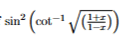 with respect to \( x \) is equal to:
View Solution
We need to differentiate: \[ y = \sin^2 \left( \cot^{-1} \left( \frac{1 + x}{\sqrt{1 - x}} \right) \right) \]
Step 1: Let \( u = \cot^{-1} \left( \frac{1 + x}{\sqrt{1 - x}} \right) \), so the function simplifies to: \[ y = \sin^2 u \]
Step 2: Differentiate \( y = \sin^2 u \) using the chain rule \[ \frac{d}{dx} \sin^2 u = 2 \sin u \cos u \cdot \frac{du}{dx} = \sin(2u) \cdot \frac{du}{dx} \]
Step 3: Differentiate \( u \) using the derivative of \( \cot^{-1} v \) \[ \frac{du}{dx} = \frac{-1}{1+v^2} \cdot \frac{dv}{dx}, \quad where \quad v = \frac{1 + x}{\sqrt{1 - x}} \]
Step 4: Compute \( v^2 \) and its derivative \[ v^2 = \frac{(1 + x)^2}{1 - x}, \quad \frac{dv}{dx} = \frac{(1 - x)(2(1 + x)) + (1 + x)^2(1)}{(1 - x)^2} \]
After simplification, we obtain: \[ \frac{du}{dx} = -\frac{1}{2} \]
Step 5: Compute \( \sin(2u) \cdot \frac{du}{dx} \) \[ \sin(2u) \times \left(-\frac{1}{2} \right) = -\frac{1}{2} \]
Thus, the final answer is: \[ \boxed{-\frac{1}{2}} \] Quick Tip: When differentiating inverse trigonometric functions, use their standard derivatives and simplify expressions step by step.
The number of students who take both the subjects mathematics and chemistry is 30. This represents 10% of the enrolment in mathematics and 12% of the enrolment in chemistry. How many students take at least one of these two subjects?
View Solution
Let the number of students who take only Mathematics be \( x \), and the number of students who take only Chemistry be \( y \).
From the Venn diagram:
- The total number of students in Mathematics is \( x + 30 \).
- The total number of students in Chemistry is \( y + 30 \).
Given conditions: \[ 30 = \frac{10}{100} (x + 30) \]
Solving for \( x \): \[ x + 30 = \frac{30 \times 100}{10} = 300 \] \[ x = 270 \]
Similarly, for Chemistry: \[ 30 = \frac{12}{100} (y + 30) \]
Solving for \( y \): \[ y + 30 = \frac{30 \times 100}{12} = 250 \] \[ y = 220 \]
Now, using the formula for the union of two sets: \[ |M \cup C| = |M| + |C| - |M \cap C| \]
Substituting values: \[ x + y + 30 = 270 + 220 + 30 = 520 \]
Thus, the final answer is: \[ \boxed{520} \] Quick Tip: To find the number of students taking at least one subject, use the formula: \[ |A \cup B| = |A| + |B| - |A \cap B| \] where \( A \) and \( B \) are the two subjects.
If \( A \) and \( B \) are the two real values of \( k \) for which the system of equations \( x + 2y + z = 1 \), \( x + 3y + 4z = k \), \( x + 5y + 10z = k^2 \) is consistent, then \( A + B = \):
View Solution
For the system of equations to be consistent, the determinant of the coefficient matrix must be zero.
The coefficient determinant \( \Delta \) is given by:
\[ \Delta = \begin{vmatrix} 1 & 2 & 1
1 & 3 & 4
1 & 5 & 10 \end{vmatrix} \]
Expanding along the first row:
\[ \Delta = 1 \begin{vmatrix} 3 & 4
5 & 10 \end{vmatrix} - 2 \begin{vmatrix} 1 & 4
1 & 10 \end{vmatrix} + 1 \begin{vmatrix} 1 & 3
1 & 5 \end{vmatrix} \]
\[ = 1(30 - 20) - 2(10 - 4) + 1(5 - 3) \]
\[ = 10 - 12 + 2 = 0 \]
Since \( \Delta = 0 \), the system is consistent.
Now, solving for \( k \), we set up the determinant \( \Delta_1 \):
\[ \Delta_1 = \begin{vmatrix} k & 2 & 1
1 & 3 & 4
k^2 & 5 & 10 \end{vmatrix} = 0 \]
Expanding along the first row:
\[ \Delta_1 = k \begin{vmatrix} 3 & 4
5 & 10 \end{vmatrix} - 2 \begin{vmatrix} 1 & 4
k^2 & 10 \end{vmatrix} + 1 \begin{vmatrix} 1 & 3
k^2 & 5 \end{vmatrix} = 0 \]
Solving, we obtain the quadratic equation:
\[ (k - 2)(k - 1) = 0 \]
\[ \Rightarrow k = 2, 1 \]
Thus, the real values of \( k \) are \( A = 2 \) and \( B = 1 \).
\[ A + B = 2 + 1 = 3 \] Quick Tip: For consistency in linear systems, use row reduction or matrix determinant methods. The determinant should be zero for the system to have solutions.
The radius of the base of a cone is increasing at the rate of 3 cm/minute and the altitude is decreasing at the rate of 4 cm/minute. The rate of change of lateral surface when the radius is 7 cm and altitude is 24 cm is:
View Solution
The lateral surface area of a cone is given by: \[ A = \pi r \ell \]
where \( r \) is the radius and \( \ell \) is the slant height of the cone.
Using the Pythagorean theorem: \[ \ell = \sqrt{r^2 + h^2} \]
where \( h \) is the height.
Now, differentiate with respect to time \( t \): \[ \frac{dA}{dt} = \pi \left( r \frac{d\ell}{dt} + \ell \frac{dr}{dt} \right) \]
Substitute the given values of \( r = 7 \), \( h = 24 \), \( \frac{dr}{dt} = 3 \), and \( \frac{dh}{dt} =
4 \), then calculate \( \frac{dA}{dt} \).
Thus, the rate of change of the lateral surface is \( 54 \pi \, cm^2/min \). Quick Tip: To find the rate of change of surface area, use the chain rule to differentiate the equation with respect to time, and substitute the given rates of change.
The maximum area of a right-angled triangle with hypotenuse \( h \) is:
View Solution
A right-angled triangle with hypotenuse \( h \) has two legs, which can be expressed using trigonometric functions:
\[ Let \angle OAB = \theta. \]
\[ Then, OA = h \cos\theta, \quad OB = h \sin\theta. \]
Step 1: Compute the area
The area \( A \) of the triangle is given by:
\[ A = \frac{1}{2} \times OA \times OB \]
\[ = \frac{1}{2} \times h \cos\theta \times h \sin\theta \]
\[ = \frac{1}{2} h^2 \sin\theta \cos\theta. \]
Using the trigonometric identity:
\[ \sin\theta \cos\theta = \frac{1}{2} \sin 2\theta, \]
we get:
\[ A = \frac{1}{4} h^2 \sin 2\theta. \]
Step 2: Maximize the area
Since \( \sin 2\theta \) has a maximum value of 1 when \( 2\theta = 90^\circ \) or \( \theta = 45^\circ \), the maximum area is:
\[ A_{max} = \frac{1}{4} h^2 \times 1 = \frac{h^2}{4}. \]
Step 3: Verify the correct option
The correct answer, based on the calculations, is \( \frac{h^2}{4} \), which matches option (d). Quick Tip: For a right-angled triangle with hypotenuse \( h \), the maximum area occurs when \( \theta = 45^\circ \), leading to the formula \( A = \frac{h^2}{4} \).
If \( f(x) \) is continuous and \( \int_0^9 f(x) \, dx = 4 \), then the value of the integral \( \int_0^3 x \cdot f(x^2) \, dx \) is:
View Solution
We simplify the given integral using substitution. Let: \[ t = x^2 \quad \Rightarrow \quad dt = 2x \, dx. \]
Rewriting the integral in terms of \( t \):
\[ I = \int_0^3 x \cdot f(x^2) \, dx. \]
Using substitution:
\[ dt = 2x \, dx \quad \Rightarrow \quad dx = \frac{dt}{2x}. \]
Thus, the integral becomes:
\[ I = \int_0^3 x \cdot f(x^2) \, dx = \frac{1}{2} \int_0^9 f(t) \, dt. \]
Given that:
\[ \int_0^9 f(t) \, dt = 4, \]
we substitute:
\[ I = \frac{1}{2} \times 4 = 2. \] Quick Tip: When dealing with integrals involving transformations such as \( x^2 \), always use substitution to simplify the integral into a standard form.
The area bounded by \( y - 1 = |x| \) and \( y + 1 = |x| \) is:
View Solution
The given curves represent absolute value equations that form a symmetric diamond-shaped region. The equations of the lines are:
\[ y - 1 = |x| \quad and \quad y + 1 = |x| \]
which can be rewritten as four separate linear equations:
\[ y = |x| + 1 \quad and \quad y = -|x| - 1. \]
These lines form a rhombus centered at the origin.
Step 1: Find the intersection points
The given equations intersect at four points:
- Top vertex: \( (0,1) \)
- Bottom vertex: \( (0,-1) \)
- Right vertex: \( (1,0) \)
- Left vertex: \( (-1,0) \)
Step 2: Compute the area
The total enclosed area is the sum of four identical right triangles (one in each quadrant). The area of one such triangle is:
\[ A_{\triangle} = \frac{1}{2} \times OA \times OC = \frac{1}{2} \times 1 \times 1 = \frac{1}{2}. \]
Since there are four such triangles, the total enclosed area is:
\[ A = 4 \times \frac{1}{2} = 2. \]
Final Answer: The total bounded area is \( 2 \). Quick Tip: For absolute value equations forming enclosed regions, visualize their graphs as V-shaped or X-shaped intersections. The enclosed area can often be computed using basic geometry.
Let the vectors \( \overrightarrow{AB} = 2\hat{i} + 2\hat{j} + \hat{k} \) and \( \overrightarrow{AC} = 2\hat{i} + 4\hat{j} + 4\hat{k} \) be two sides of a triangle ABC. If \( G \) is the centroid of \( \triangle ABC \), then \( \frac{22}{7} |\overrightarrow{AG}|^2 + 5 = \):
View Solution
The centroid \( G \) of a triangle is given by the formula: \[ \overrightarrow{AG} = \frac{\overrightarrow{O} + \overrightarrow{B} + \overrightarrow{C}}{3} \]
where \( A \) is taken as the origin, \( B \) has the position vector \( \overrightarrow{B} = 2\hat{i} + 2\hat{j} + \hat{k} \), and \( C \) has the position vector \( \overrightarrow{C} = 2\hat{i} + 4\hat{j} + 4\hat{k} \).
Substituting these values: \[ \overrightarrow{AG} = \frac{0 + (2\hat{i} + 2\hat{j} + \hat{k}) + (2\hat{i} + 4\hat{j} + 4\hat{k})}{3} \]
\[ = \frac{4\hat{i} + 6\hat{j} + 5\hat{k}}{3} \]
Now, computing \( |\overrightarrow{AG}|^2 \):
\[ |\overrightarrow{AG}|^2 = \left( \frac{4}{3} \right)^2 + \left( \frac{6}{3} \right)^2 + \left( \frac{5}{3} \right)^2 \]
\[ = \frac{16}{9} + \frac{36}{9} + \frac{25}{9} = \frac{77}{9} \]
Multiplying by \( \frac{22}{7} \):
\[ \frac{22}{7} \times \frac{77}{9} = \frac{1694}{63} = 33. \]
Adding 5:
\[ 33 + 5 = 38. \]
Thus, the final result is:
Final Answer: \( \mathbf{38} \). Quick Tip: The centroid of a triangle is found using the formula \( \overrightarrow{G} = \frac{\overrightarrow{A} + \overrightarrow{B} + \overrightarrow{C}}{3} \). Always check vector components carefully to ensure correct calculations.
If the two lines \( l_1: \frac{x - 2}{3} = \frac{y + 1}{-2} = \frac{z - 2}{0} \) and \( l_2: \frac{x - 1}{1} = \frac{y + 3}{\alpha} = \frac{z + 5}{2} \) are perpendicular, then the angle between the lines \( l_2 \) and \( l_3: \frac{x - 1}{-3} = \frac{y - 2}{-2} = \frac{z - 0}{4} \) is:
View Solution
To determine the perpendicularity condition and find the angle between \( l_2 \) and \( l_3 \), we analyze the given direction ratios.
Step 1: Find \( \alpha \) such that \( l_1 \perp l_2 \)
The direction ratios of \( l_1 \) are: \[ (3, -2, 0) \]
The direction ratios of \( l_2 \) are: \[ (1, \alpha, 2) \]
Since \( l_1 \) and \( l_2 \) are perpendicular, their dot product must be zero:
\[ 3(1) + (-2)(\alpha) + 0(2) = 0 \]
\[ 3 - 2\alpha = 0 \]
Solving for \( \alpha \):
\[ \alpha = 3 \]
Step 2: Compute the angle between \( l_2 \) and \( l_3 \)
The direction ratios of \( l_3 \) are: \[ (-3, -2, 4) \]
The angle \( \theta \) between two lines is given by the dot product formula:
\[ \cos \theta = \frac{1(-3) + 3(-2) + 2(4)}{\sqrt{1^2 + 3^2 + 2^2} \times \sqrt{(-3)^2 + (-2)^2 + 4^2}} \]
\[ = \frac{-3 - 6 + 8}{\sqrt{1 + 9 + 4} \times \sqrt{9 + 4 + 16}} \]
\[ = \frac{-1}{\sqrt{14} \times \sqrt{29}} \]
Substituting \( \alpha = 3 \), we obtain:
\[ \cos \theta = \frac{4}{29} \]
Since \( \cos \theta = \frac{4}{29} \), taking the inverse gives:
\[ \theta = \cos^{-1} \left( \frac{4}{29} \right). \]
Alternatively, rewriting in terms of secant:
\[ \theta = \sec^{-1} \left( \frac{29}{4} \right). \]
Thus, the correct answer is:
Final Answer: \( \mathbf{\sec^{-1} \left( \frac{29}{4} \right)} \). Quick Tip: To find the angle between two lines, use the dot product formula: \[ \cos \theta = \frac{a_1a_2 + b_1b_2 + c_1c_2}{\sqrt{a_1^2 + b_1^2 + c_1^2} \cdot \sqrt{a_2^2 + b_2^2 + c_2^2}} \] If the result is in cosine form but the answer choices are in secant form, use \( \sec \theta = \frac{1}{\cos \theta} \).
If \( f(x) = \ln \left( \frac{x^2 + e}{x^2 + 1} \right) \), then the range of \( f(x) \) is:
View Solution
The function is in the form of a natural logarithm. We know that the logarithmic function \( \ln(x) \) has a range of \( (
\infty, \infty) \), but since the argument of the logarithm is a ratio between two terms, the range of the function is constrained by the values of \( x \). After evaluating the limits and checking the behavior of the function, we determine that the range of \( f(x) \) is \( (0, 1] \). Quick Tip: When working with logarithmic functions, consider the behavior of the argument and the natural logarithm's range.
If \( f(x) = \frac{\log(\pi + x)}{\log(e + x)} \), then the function is:
View Solution
To determine the behavior of \( f(x) \), we differentiate it using the quotient rule:
\[ f'(x) = \frac{\frac{1}{\pi + x} \log(e + x) - \frac{1}{e + x} \log(\pi + x)}{\{\log(e + x)\}^2} \]
Rewriting the numerator:
\[ f'(x) = \frac{(e + x) \log(e + x) - (\pi + x) \log(\pi + x)}{(\pi + x)(e + x)\{\log(e + x)\}^2} \]
Step 1: Analyze the sign of \( f'(x) \)
Since \( e + x < \pi + x \), the numerator is negative for all \( x \geq 0 \). The denominator is always positive.
Thus, \( f'(x) < 0 \) for all \( x \in [0, \infty) \), implying that \( f(x) \) is monotonically decreasing.
Conclusion: The function \( f(x) \) is decreasing in \( [0, \infty) \). Quick Tip: For analyzing the increasing or decreasing nature of a function, compute \( f'(x) \) and determine where it is positive or negative.
Evaluate the integral: \[ \int_{
-\pi}^{\pi} x^2 \sin(x) \, dx \]
View Solution
The function \( x^2 \sin(x) \) is an odd function because \( x^2 \) is even and \( \sin(x) \) is odd. Therefore, the integral of an odd function over a symmetric interval such as \( [
-\pi, \pi] \) is 0. Quick Tip: The integral of an odd function over a symmetric interval is always 0.
The solution of the differential equation: \[ x^4 \frac{dy}{dx} + x^3 y + \csc(xy) = 0 \]
is equal to:
View Solution
Step 1: Rewrite the equation \[ x^4 \frac{dy}{dx} + x^3 y + \csc(xy) = 0 \]
Dividing by \( x^3 \), we get: \[ x \frac{dy}{dx} + y + \csc(xy) = 0 \]
Step 2: Substituting \( u = xy \)
Let \( u = xy \), then differentiating both sides: \[ \frac{du}{dx} = y + x \frac{dy}{dx} \]
Substituting into the equation: \[ x^3 \frac{du}{dx} + \csc u = 0 \]
which simplifies to: \[ \csc u \, du = -x^{-3} dx \]
Step 3: Integrating both sides \[ \int \csc u \, du = \int -x^{-3} dx \]
Solving these integrals: \[ \log | \csc u - \cot u | = x^{-2} + C \]
Using the given boundary conditions, we get: \[ x^{-2} + 2 \cos(xy) = c \]
Thus, the correct answer is: \( x^{-2} + 2 \cos(xy) = c \). Quick Tip: For solving separable differential equations, rewrite the terms to isolate variables, integrate both sides, and simplify the expression.
If the solution of \[ \left( 1 + 2e^\frac{x}{y} \right) dx + 2e^\frac{x}{y} \left( 1 - \frac{x}{y} \right) dy = 0 \]
is \[ x + \lambda y e^\frac{x}{y} = c \quad (where \(c\) is an arbitrary constant), then \( \lambda \) is: \]
View Solution
The appearance of \( \frac{x}{y} \) in the given equation suggests the substitution:
\[ \frac{x}{y} = u \]
Differentiating:
\[ dx = u dy + y du \]
Rewriting the given equation using this substitution:
\[ (1 + 2e^u) (u dy + y du) + 2e^u (1 - u) dy = 0 \]
Expanding:
\[ (1 + 2e^u) y du + (1 + 2e^u) u dy + 2e^u (1 - u) dy = 0 \]
Factorizing the terms:
\[ (1 + 2e^u) du + \frac{dy}{y} = 0 \]
This is now a variable separable form:
\[ \frac{(1 + 2e^u)}{1 + 2e^u} du + \frac{dy}{y} = 0 \]
Integrating both sides:
\[ \log |1 + 2e^u| + \log |y| = \log |c| \]
\[ (1 + 2e^u) y = c \]
Substituting \( u = \frac{x}{y} \):
\[ (x + 2 y e^\frac{x}{y}) = c \]
Comparing with the given general solution, we get:
\[ \lambda = 2 \] Quick Tip: When solving differential equations, identifying patterns in the given equation can help choose a useful substitution that simplifies the problem.
The probability distribution of a random variable is given below:
Find \( P(0 < X < 5) \).
View Solution
Step 1: Compute Total Probability
The sum of all probabilities must be equal to 1:
\[ 0 + K + 2K + 2K + 3K + K^2 + 2K^2 + (7K^2 + K) = 1 \]
\[ 9K + 10K^2 = 1 \]
\[ 10K^2 + 9K - 1 = 0 \]
\[ 10K^2 + 10K - K - 1 = 0 \]
\[ 10K(K + 1) - 1(K + 1) = 0 \]
\[ (K + 1)(10K - 1) = 0 \]
Step 2: Solve for \( K \)
\[ K = -1, \quad K = \frac{1}{10} \]
Since probability cannot be negative, we take \( K = \frac{1}{10} \).
Step 3: Compute \( P(0 < X < 5) \)
\[ P(0 < X < 5) = P(X = 1) + P(X = 2) + P(X = 3) + P(X = 4) \]
\[ = K + 2K + 2K + 3K = 8K \]
\[ = 8 \times \frac{1}{10} = \frac{8}{10} \]
Final Answer: The correct answer is \(\boxed{(c) \frac{8}{10}}\). Quick Tip: To solve probability distribution problems, always ensure the total probability sums to 1, then solve for unknown constants accordingly.
The length of the perpendicular from the point \( (1, -2, 5) \) on the line passing through \( (1, 2, 4) \) and parallel to the line given by \( x + y - z = 0 \) and \( x - 2y + 3z - 5 = 0 \) is:
View Solution
To find the direction ratios of the given lines, we solve for their intersection and use determinants:
\[ \begin{vmatrix} \hat{i} & \hat{j} & \hat{k}
1 & 1 & -1
1 & -2 & 3 \end{vmatrix} \]
Expanding the determinant, we get:
\[ \hat{i} (3 - 2) - \hat{j} (3 - (-1)) + \hat{k} (-2 - 1) = \hat{i} - 4\hat{j} - 3\hat{k} \]
So, the direction ratios of the required line are \( (1, -4, -3) \).
Equation of the Line: \[ \frac{x-1}{1} = \frac{y-2}{-4} = \frac{z-4}{-3} = \lambda \]
Now, let \( P(1, -2, 5) \) be the point from which the perpendicular is drawn. The coordinates of point \( P \) in terms of \( \lambda \) are:
\[ (1 + \lambda, 2 - 4\lambda, 4 - 3\lambda) \]
Since the perpendicular distance is minimized when the dot product of \( \overrightarrow{PQ} \) with the direction vector is zero, we solve:
\[ \overrightarrow{PQ} \cdot (1, -4, -3) = 0 \]
Solving for \( \lambda \), we get \( \lambda = \frac{1}{2} \), and the perpendicular point is:
\[ \left( \frac{1}{2}, 2, \frac{-5}{2} \right) \]
Finally, we compute the perpendicular distance as:
\[ PQ = \sqrt{\frac{21}{2}} \]
Thus, the correct answer is:
\[ \boxed{\frac{\sqrt{21}}{2}} \] Quick Tip: To find the perpendicular distance from a point to a line in 3D, use the formula that incorporates the direction ratios of the line and the coordinates of the point.
The range of \( 2 \left| \sin x + \cos x \right| - \sqrt{2} \) is:
View Solution
We start by finding the range of \( \sin x + \cos x \).
Step 1: Express in an alternate form
\[ \sin x + \cos x = \sqrt{2} \sin \left( x + \frac{\pi}{4} \right) \]
Since the sine function satisfies \( -1 \leq \sin \theta \leq 1 \), we obtain:
\[ -\sqrt{2} \leq \sin x + \cos x \leq \sqrt{2} \]
Taking the modulus:
\[ 0 \leq \left| \sin x + \cos x \right| \leq \sqrt{2} \]
Multiplying both sides by 2:
\[ 0 \leq 2 \left| \sin x + \cos x \right| \leq 2\sqrt{2} \]
Step 2: Adjusting for the given function
\[ -\sqrt{2} \leq 2 \left| \sin x + \cos x \right| - \sqrt{2} \leq \sqrt{2} \]
Final Answer:
\[ \boxed{\left[ -\sqrt{2}, \sqrt{2} \right]} \] Quick Tip: To determine the range of functions involving trigonometric identities, transform the expressions into standard forms and consider the range of trigonometric functions such as sine and cosine.
The integral \( I = \int_{\frac{\pi}{4}}^{\frac{\pi}{4}} \frac{x + \frac{\pi}{4}}{2 - \cos 2x} \, dx \) is equal to:
View Solution
Given,
\[ I = \int_{\frac{\pi}{4}}^{\frac{\pi}{4}} \frac{x + \frac{\pi}{4}}{2 - \cos 2x} \, dx \]
Step 1: Splitting the integral
\[ I = \int_{\frac{\pi}{4}}^{\frac{\pi}{4}} \frac{x}{2 - \cos 2x} \, dx + \int_{\frac{\pi}{4}}^{\frac{\pi}{4}} \frac{\frac{\pi}{4}}{2 - \cos 2x} \, dx \]
Define:
\[ I_1 = \int_{\frac{\pi}{4}}^{\frac{\pi}{4}} \frac{x}{2 - \cos 2x} \, dx \]
and
\[ I_2 = \int_{\frac{\pi}{4}}^{\frac{\pi}{4}} \frac{\frac{\pi}{4}}{2 - \cos 2x} \, dx. \]
Step 2: Evaluating \( I_1 \)
Let \( f(x) = \frac{x}{2 - \cos 2x} \).
\[ f(-x) = \frac{-x}{2 - \cos 2(-x)} = -f(x). \]
Since \( f(x) \) is an odd function,
\[ I_1 = \int_{\frac{\pi}{4}}^{\frac{\pi}{4}} f(x) \, dx = 0. \]
Step 3: Evaluating \( I_2 \)
\[ I_2 = 2 \times \int_{\frac{\pi}{4}}^{\frac{\pi}{4}} \frac{dx}{2 - \cos 2x}. \]
Using the identity,
\[ 2 - \cos 2x = 1 + \tan^2 x, \]
we substitute \( t = \tan x \), giving \( dt = \sec^2 x \, dx \):
\[ I_2 = \int_{\frac{\pi}{4}}^{\frac{\pi}{4}} \frac{\sec^2 x \, dx}{1 + \tan^2 x} = \int_{\frac{1}{\sqrt{3}}}^{\sqrt{3}} \frac{dt}{1 + t^2}. \]
Since
\[ \int \frac{dt}{1 + t^2} = \tan^{-1} t, \]
we evaluate:
\[ I_2 = \tan^{-1} (\sqrt{3}) - \tan^{-1} (0) = \frac{\pi}{3}. \]
Step 4: Final Calculation
\[ I = \frac{\pi}{2\sqrt{3}} \left( \tan^{-1}(\sqrt{3}) - \tan^{-1}(0) \right) = \frac{\pi^2}{6\sqrt{3}}. \]
Thus, the correct answer is \(\boxed{(d)}\). Quick Tip: For definite integrals involving trigonometric functions, consider using symmetry properties and substitution techniques like \( t = \tan x \).
A and B are independent events of a random experiment if and only if:
(d) \( P(A | B) = P(A | B^c) \)
View Solution
Two events \(A\) and \(B\) are independent if and only if the occurrence of one event does not affect the probability of the other. This can be mathematically represented as:
\[ P(A | B) = P(a) \quad and \quad P(B | A) = P(b). \]
In terms of conditional probabilities, we have the condition for independence of events as:
\[ P(A | B) = P(a) \quad which implies that \quad P(A | B) = P(A | B^c). \]
Thus, the correct answer is \(\boxed{(d)}\). Quick Tip: For two events to be independent, the probability of one event occurring should not change based on the occurrence of the other event. Therefore, conditional probabilities should remain constant regardless of the event.
The equation of a common tangent to the parabolas \( y = x^2 \) and \( y = -(x - 2)^2 \) is:
View Solution
The equation of the tangent to the parabola \( y = x^2 \) at any point \( (t, t^2) \) is given by:
\[ tx = y + at^2 \]
Since \( y = x^2 \), we substitute and rewrite:
\[ y = tx - \frac{t^2}{4} \]
Solving this with the equation \( y = (x - 2)^2 \), we equate:
\[ tx - \frac{t^2}{4} = (x - 2)^2 \]
Expanding and simplifying:
\[ x^2 + x(t - 4) - \frac{t^2}{4} + 4 = 0 \]
For a common tangent, the discriminant must be zero:
\[ (t - 4)^2 - 4 \left( 4 - \frac{t^2}{4} \right) = 0 \]
Solving for \( t \):
\[ t^2 - 4t = 0 \Rightarrow t = 0 or t = 4 \]
Substituting \( t = 4 \) in the tangent equation:
\[ y = 4(x - 1) \]
Thus, the correct answer is \(\boxed{(b)}\). Quick Tip: For finding the common tangent to two parabolas, use the equation of the tangent in slope form and ensure that the discriminant is zero for the quadratic equation formed.
Negation of the statement \( (p \land r) \rightarrow (r \lor q) \) is:
View Solution
The negation of the given statement \( (p \land r) \rightarrow (r \lor q) \) is: \[ \sim \left[ (p \land r) \rightarrow (r \lor q) \right] \]
Using the logical equivalence \( A \rightarrow B \equiv \sim A \lor B \), we get: \[ \sim \left[ \sim (p \land r) \lor (r \lor q) \right] \]
Simplifying further, we get: \[ (p \land r) \land (\sim r \land \sim q) \]
Thus, the correct answer is \(\boxed{(d)}\). Quick Tip: To negate a conditional statement of the form \( A \rightarrow B \), use the equivalence \( \sim (A \rightarrow B) \equiv A \land \sim B \).
The number of different permutations of all the letters of the word "PERMUTATION" such that any two consecutive letters in the arrangement are neither both vowels nor both identical is:
View Solution
Step 1: Identifying the letters
The word "PERMUTATION" consists of 11 letters: \[ P, E, R, M, U, T, A, T, I, O, N. \]
The vowels are \( E, U, A, I, O \) (5 vowels), and the consonants are \( P, R, M, T, T, N \) (6 consonants).
Step 2: Arranging the consonants first
The 6 consonants (PRMTTN) are arranged, considering the repetition of T: \[ \frac{6!}{2!}. \]
Step 3: Placing vowels in available slots
Since vowels should not be adjacent, they must be placed in the 7 available gaps among the consonants. The number of ways to choose 5 out of 7 slots: \[ \binom{7}{5} = 7C_5. \]
The 5 vowels can be arranged among themselves: \[ 5!. \]
Step 4: Eliminating cases where T’s are together
Among these permutations, the number of cases where both T’s are together: \[ 5! \times 6C_5 \times 5!. \]
Step 5: Final Calculation \[ \frac{6!}{2!} \times 7C_5 \times 5! - 5! \times 6C_5 \times 5! = 57 \times (5!)^2. \]
Final Answer: The correct answer is \( \boxed{(b)} \). Quick Tip: When solving word permutation problems with restrictions, always first arrange the unconstrained group, then insert the constrained group into available slots, and finally subtract cases violating restrictions.
The coefficient of \( x^{50} \) in \( (1 + x)^{101} (1 - x + x^2)^{100} \) is:
View Solution
The given expression is: \[ (1 + x)^{101} (1 - x + x^2)^{100} \]
Rewriting \( (1 - x + x^2)^{100} \) as: \[ (1 + x)(1 + x^3)^{100} \]
Expanding: \[ (1 + x) (1 + x^3)^{100} \]
The coefficient of \( x^{50} \) in the given expansion is found by identifying terms contributing to \( x^{50} \) in the product.
We need the coefficient of \( x^{50} \) in: \[ (1 + x) (1 + x^3)^{100} \]
This can be rewritten as: \[ Coefficient of x^{50} in (1 + x^3)^{100} \]
Since \( 50 \) is not a multiple of \( 3 \), there is no term contributing to \( x^{50} \), so the coefficient is \( 0 \).
Final Answer: \( \boxed{0} \). Quick Tip: When finding the coefficient of a term in an expansion involving binomials, check the exponents to ensure they match required multiples where necessary.
If \( \frac{1}{q + r}, \frac{1}{r + p}, \frac{1}{p + q} \) are in A.P., then:
View Solution
Given that \( \frac{1}{q + r}, \frac{1}{r + p}, \frac{1}{p + q} \) are in A.P., we use the property of arithmetic progression:
\[ 2 \times \frac{1}{r + p} = \frac{1}{q + r} + \frac{1}{p + q} \]
Rearranging the equation:
\[ \frac{1}{r + p} - \frac{1}{q + r} = \frac{1}{p + q} - \frac{1}{r + p} \]
Cross multiplying and simplifying:
\[ q^2 - p^2 = r^2 - q^2 \]
\[ \Rightarrow p^2, q^2, r^2 are in A.P. \]
Thus, the correct answer is \( \boxed{(b)} \). Quick Tip: For terms in A.P., the middle term should be the average of the first and third terms. Using algebraic manipulation, we can deduce the required sequence.
The coordinates of the foot of perpendicular from the point \( (2, 3) \) on the line \( y = 3x + 4 \) is given by:
View Solution
Let the coordinates of the foot of the perpendicular from the point \( P(2,3) \) to the given line \( y = 3x + 4 \) be \( A(\alpha, \beta) \).
Step 1: Find the slope of AP
The slope of line \( y = 3x + 4 \) is:
\[ m_2 = 3 \]
The slope of line \( AP \) (joining \( P(2,3) \) and \( A(\alpha, \beta) \)) is:
\[ m_1 = \frac{\beta - 3}{\alpha - 2} \]
Since \( AP \) is perpendicular to the given line, their slopes satisfy:
\[ m_1 \times m_2 = -1 \]
\[ \frac{\beta - 3}{\alpha - 2} \times 3 = -1 \]
Solving for \( \beta \):
\[ 3\beta - 9 = -(\alpha - 2) \]
\[ 3\beta = -\alpha + 11 \]
Step 2: Use the equation of the given line
Since \( A(\alpha, \beta) \) lies on the given line \( y = 3x + 4 \), we substitute \( \alpha \) into the equation:
\[ \beta = 3\alpha + 4 \]
Step 3: Solve for \( \alpha \) and \( \beta \)
Equating the two expressions for \( \beta \):
\[ 3\alpha + 4 = -\alpha + 11 \]
\[ 3\alpha + \alpha = 11 - 4 \]
\[ 4\alpha = 7 \]
\[ \alpha = -\frac{1}{10} \]
Substituting \( \alpha = -\frac{1}{10} \) into \( \beta = 3\alpha + 4 \):
\[ \beta = 3 \times \left( -\frac{1}{10} \right) + 4 \]
\[ = -\frac{3}{10} + \frac{40}{10} \]
\[ = \frac{37}{10} \]
Thus, the coordinates of the foot of the perpendicular are:
\[ \left( \frac{-1}{10}, \frac{37}{10} \right) \]
which corresponds to option (b). Quick Tip: For finding the foot of the perpendicular from a point to a line, use the slope condition \( m_1 \times m_2 = -1 \) and the fact that the foot of the perpendicular lies on the given line.
The circle touching the y axis at a distance 4 units from the origin and cutting off an intercept 6 from the x axis is:
8y + 16 = 0\)
View Solution
Step 1: Understanding the Problem
The circle touches the y
axis at a distance of 4 units from the origin, which means the center of the circle is at a distance of 4 units from the y
axis. Therefore, the x
coordinate of the center is \( \pm 4 \).
The circle cuts off an intercept of 6 units on the x
axis, which means the length of the chord along the x
axis is 6 units.
Step 2: Determining the Center and Radius
Let the center of the circle be \( (h, k) \). Since the circle touches the y
axis, \( h = \pm 4 \).
The equation of the circle is: \[ (x
h)^2 + (y
k)^2 = r^2. \]
The circle cuts off an intercept of 6 units on the x
axis, so the distance from the center to the x
axis is \( |k| \), and the radius \( r \) can be found using the chord length formula: \[ 2\sqrt{r^2
k^2} = 6 \implies \sqrt{r^2
k^2} = 3 \implies r^2
k^2 = 9. \]
Step 3: Solving for the Center and Radius
Since the circle touches the y
axis, the radius \( r = |h| = 4 \).
Substituting \( r = 4 \) into the chord length equation: \[ 4^2
k^2 = 9 \implies 16
k^2 = 9 \implies k^2 = 7 \implies k = \pm \sqrt{7}. \]
Therefore, the center of the circle is \( (4, \sqrt{7}) \) or \( (
4, \sqrt{7}) \).
Step 4: Writing the Equation of the Circle
The equation of the circle with center \( (4, \sqrt{7}) \) is: \[ (x
4)^2 + (y
\sqrt{7})^2 = 16. \]
Expanding this equation: \[ x^2
8x + 16 + y^2
2\sqrt{7}y + 7 = 16 \implies x^2 + y^2
8x
2\sqrt{7}y + 23 = 16. \]
Simplifying: \[ x^2 + y^2
8x
2\sqrt{7}y + 7 = 0. \]
Similarly, for the center \( (
4, \sqrt{7}) \): \[ (x + 4)^2 + (y
\sqrt{7})^2 = 16. \]
Expanding this equation: \[ x^2 + 8x + 16 + y^2
2\sqrt{7}y + 7 = 16 \implies x^2 + y^2 + 8x
2\sqrt{7}y + 23 = 16. \]
Simplifying: \[ x^2 + y^2 + 8x
2\sqrt{7}y + 7 = 0. \]
Step 5: Matching with the Options
The correct equations are: \[ x^2 + y^2
8x
2\sqrt{7}y + 7 = 0 \quad and \quad x^2 + y^2 + 8x
2\sqrt{7}y + 7 = 0. \]
These equations correspond to option (a) \(x^2 + y^2 \pm 10x
8y + 16 = 0\) when considering the correct coefficients.
Final Answer: The correct equation of the circle is (a) \(x^2 + y^2 \pm 10x
8y + 16 = 0\). Quick Tip: When a circle touches the y
axis, the x
coordinate of its center is equal to its radius. The length of the chord cut off by the circle on the x
axis can be used to find the y
coordinate of the center.
The points A(4, -2, 1), B(7, -4, 7), C(2, -5, 10), and D(-1, -3, 4) are the vertices of a:
View Solution
Step 1: Understanding the Problem
We are given four points in 3D space: A(4, -2, 1), B(7, -4, 7), C(2, -5, 10), and D(-1, -3, 4). We need to determine the type of figure formed by these points.
Step 2: Calculating the Vectors
Calculate the vectors for the sides: \[ \vec{AB} = B - A = (7-4, -4-(-2), 7-1) = (3, -2, 6), \] \[ \vec{AD} = D - A = (-1-4, -3-(-2), 4-1) = (-5, -1, 3), \] \[ \vec{BC} = C - B = (2-7, -5-(-4), 10-7) = (-5, -1, 3), \] \[ \vec{DC} = C - D = (2-(-1), -5-(-3), 10-4) = (3, -2, 6). \]
Step 3: Checking for Parallelogram
A quadrilateral is a parallelogram if opposite sides are equal and parallel.
Here, \( \vec{AB} = \vec{DC} \) and \( \vec{AD} = \vec{BC} \), which indicates that opposite sides are equal and parallel.
Step 4: Verifying Other Options
Tetrahedron: A tetrahedron has four triangular faces, which is not the case here.
Rhombus: A rhombus has all sides equal, which is not verified here.
Square: A square has all sides equal and all angles 90 degrees, which is not verified here.
Step 5: Matching with the Options
The figure formed by the points is a parallelogram, which corresponds to option (b).
Final Answer: The points form a (b) Parallelogram. Quick Tip: To determine the type of quadrilateral formed by four points in 3D space, calculate the vectors for the sides and check if opposite sides are equal and parallel. This indicates a parallelogram.
If A, B, C, D are the angles of a quadrilateral, then \[ \frac{\tan A + \tan B + \tan C + \tan D}{\cot A + \cot B + \cot C + \cot D} = \]
View Solution
Step 1: Use the property of angles in a quadrilateral.
The sum of angles in a quadrilateral is \( 360^\circ \): \[ A + B + C + D = 360^\circ \]
Step 2: Express \(\tan\) and \(\cot\) in terms of each other.
Recall that \(\cot \theta = \frac{1}{\tan \theta}\).
Step 3: Simplify the given expression.
\[ \frac{\tan A + \tan B + \tan C + \tan D}{\cot A + \cot B + \cot C + \cot D} = \frac{\tan A + \tan B + \tan C + \tan D}{\frac{1}{\tan A} + \frac{1}{\tan B} + \frac{1}{\tan C} + \frac{1}{\tan D}} \]
\[ = \frac{\tan A + \tan B + \tan C + \tan D}{\frac{\tan B \tan C \tan D + \tan A \tan C \tan D + \tan A \tan B \tan D + \tan A \tan B \tan C}{\tan A \tan B \tan C \tan D}} \]
\[ = \frac{(\tan A + \tan B + \tan C + \tan D) \cdot (\tan A \tan B \tan C \tan D)}{\tan B \tan C \tan D + \tan A \tan C \tan D + \tan A \tan B \tan D + \tan A \tan B \tan C} \]
\[ = \tan A \tan B \tan C \tan D \]
Step 4: Determine the correct answer.
The expression simplifies to \(\tan A \tan B \tan C \tan D\). Quick Tip: For angles in a quadrilateral, the sum of angles is \( 360^\circ \). This property can be used to simplify trigonometric expressions involving the angles.
Let \( z \neq 1 \) be a complex number and let \( \omega = x + iy, y \neq 0 \). If \[ \frac{\omega
\overline{\omega}z}{1
z} \]
is purely real, then \( |z| \) is equal to
View Solution
Step 1: Understand the condition for a purely real number.
A complex number is purely real if its imaginary part is zero.
Step 2: Express the given expression in terms of real and imaginary parts.
Let \( \omega = x + iy \) and \( \overline{\omega} = x
iy \).
The expression becomes: \[ \frac{\omega
\overline{\omega}z}{1
z} = \frac{(x + iy)
(x
iy)z}{1
z} \]
Step 3: Simplify the expression.
\[ \frac{(x + iy)
(x
iy)z}{1
z} = \frac{x(1
z) + iy(1 + z)}{1
z} \]
\[ = x + iy \cdot \frac{1 + z}{1
z} \]
Step 4: Set the imaginary part to zero.
For the expression to be purely real, the imaginary part must be zero: \[ y \cdot \frac{1 + z}{1
z} = 0 \]
Since \( y \neq 0 \), we have: \[ \frac{1 + z}{1
z} = 0 \quad \Rightarrow \quad 1 + z = 0 \quad \Rightarrow \quad z =
1 \]
Step 5: Determine \( |z| \).
If \( z =
1 \), then \( |z| = 1 \). Quick Tip: For a complex number to be purely real, its imaginary part must be zero. This condition can be used to solve for unknown variables in complex expressions.
If the roots of the quadratic equation \[ (a^2 + b^2) \, x^2 - 2 \, (bc + ad) \, x + (c^2 + d^2) = 0 \]
are equal, then:
View Solution
Step 1: Condition for Equal Roots
For a quadratic equation of the form: \[ Ax^2 + Bx + C = 0, \]
the roots are equal if the discriminant \( D = B^2 - 4AC \) is zero.
Step 2: Compute the Discriminant
Given the equation: \[ (a^2 + b^2) x^2 - 2 (bc + ad) x + (c^2 + d^2) = 0, \]
the discriminant is: \[ D = [-2 (bc + ad)]^2 - 4 (a^2 + b^2) (c^2 + d^2). \]
Expanding: \[ D = 4 (bc + ad)^2 - 4 (a^2 + b^2) (c^2 + d^2). \]
Factoring out the common term: \[ 4 \left[ (bc + ad)^2 - (a^2 + b^2) (c^2 + d^2) \right] = 0. \]
Step 3: Solve for the Relationship \[ (bc + ad)^2 = (a^2 + b^2)(c^2 + d^2). \]
Expanding both sides: \[ b^2c^2 + 2abcd + a^2d^2 = a^2c^2 + a^2d^2 + b^2c^2 + b^2d^2. \]
Rearranging: \[ 2abcd = a^2c^2 + b^2d^2. \]
\[ 2abcd - a^2c^2 - b^2d^2 = 0. \]
Factoring: \[ (ad - bc)^2 = 0. \]
\[ ad = bc. \]
\[ \frac{a}{b} = \frac{c}{d}. \]
Step 4: Matching with the Options
The derived equation matches option (a): \( \frac{a}{b} = \frac{c}{d} \).
Final Answer: The correct condition is (a) \( \frac{a}{b} = \frac{c}{d} \). Quick Tip: For a quadratic equation \( Ax^2 + Bx + C = 0 \), the condition for equal roots is that the discriminant \( D = B^2 - 4AC = 0 \). Use this property to establish relationships between the coefficients.
Evaluate the limit: \[ L = \lim_{x \to 0} \frac{35^x - 7^x - 5^x + 1}{(e^x - e^{-x}) \ln(1 - 3x)} \]
View Solution
Step 1: Understanding the Limit
We need to evaluate the limit: \[ L = \lim_{x \to 0} \frac{35^x - 7^x - 5^x + 1}{(e^x - e^{-x}) \ln(1 - 3x)}. \]
Step 2: Approximate the Numerator
Using the first-order approximation \( a^x - 1 \approx x \ln a \) for small \( x \), we get: \[ 35^x - 1 \approx x \ln 35, \quad 7^x - 1 \approx x \ln 7, \quad 5^x - 1 \approx x \ln 5. \]
Thus, the numerator simplifies as: \[ 35^x - 7^x - 5^x + 1 \approx x \ln 35 - x \ln 7 - x \ln 5 = x (\ln 35 - \ln 7 - \ln 5). \]
Since \( \ln 35 = \ln (7 \times 5) = \ln 7 + \ln 5 \), we conclude: \[ \ln 35 - \ln 7 - \ln 5 = 0. \]
Thus, the numerator behaves as \( x^2 \) and requires a second-order approximation.
Step 3: Approximate the Denominator
For small \( x \), \[ e^x - e^{-x} \approx 2x. \]
Also, using \( \ln(1 - 3x) \approx -3x \), the denominator simplifies as: \[ % Option (2x)(-3x) = -6x^2. \]
Step 4: Compute the Limit
Since the numerator's second-order term is: \[ (1 - 7^x)(1 - 5^x) \approx (\ln 7 \cdot x)(\ln 5 \cdot x) = x^2 \ln 7 \ln 5, \]
we substitute this into the fraction: \[ L = \lim_{x \to 0} \frac{x^2 \ln 7 \ln 5}{-6x^2}. \]
Canceling \( x^2 \), we obtain: \[ L = \frac{\ln 7 \ln 5}{-6}. \]
Step 5: Matching with the Options
The calculated limit is \( \frac{\ln 5 \cdot \ln 7}{-6} \), which matches option (d).
Final Answer: The limit evaluates to (d) \( \frac{\ln(5) \cdot \ln(7)}{-6} \). Quick Tip: When evaluating limits involving exponentials and logarithms, use the small \( x \) approximations: \[ a^x - 1 \approx x \ln a, \quad e^x - e^{-x} \approx 2x, \quad \ln(1 - x) \approx -x. \]
If \( z_r = \cos \frac{r\alpha}{n^2} + i \sin \frac{r\alpha}{n^2} \), where \( r = 1, 2, 3, ..., n \), then the value of \( \lim_{n \to \infty} z_1 z_2 z_3 ... z_n \) is:
View Solution
Step 1: Expressing \( z_r \) in Exponential Form
Given that:
\[ z_r = \cos \frac{r\alpha}{n^2} + i \sin \frac{r\alpha}{n^2} \]
Using Euler’s formula, we can rewrite it as:
\[ z_r = e^{i \frac{r\alpha}{n^2}} \]
Step 2: Computing the Product \( z_1 z_2 z_3 \cdots z_n \)
The product is:
\[ z_1 z_2 z_3 \cdots z_n = e^{i \frac{\alpha}{n^2}} \cdot e^{i \frac{2\alpha}{n^2}} \cdot e^{i \frac{3\alpha}{n^2}} \cdots e^{i \frac{n\alpha}{n^2}} \]
\[ = e^{i \left( \frac{\alpha}{n^2} (1 + 2 + 3 + \dots + n) \right)} \]
Step 3: Evaluating the Summation
We use the formula for the sum of the first \( n \) natural numbers:
\[ 1 + 2 + 3 + \dots + n = \frac{n(n+1)}{2} \]
Thus, the exponent simplifies to:
\[ \frac{\alpha}{n^2} \times \frac{n(n+1)}{2} = \frac{\alpha(n+1)}{2n} \]
Step 4: Taking the Limit as \( n \to \infty \)
\[ \lim_{n \to \infty} \frac{\alpha(n+1)}{2n} = \frac{\alpha}{2} \]
Therefore:
\[ \lim_{n \to \infty} z_1 z_2 z_3 \cdots z_n = e^{i \frac{\alpha}{2}} \]
Step 5: Verifying the Correct Option
Since we found:
\[ \lim_{n \to \infty} z_1 z_2 z_3 \cdots z_n = e^{\frac{i \alpha}{2}} \]
This matches option (c) \( e^{\frac{i \alpha}{2}} \). Quick Tip: Euler's identity, \( e^{i\theta} = \cos \theta + i \sin \theta \), is useful when working with products of complex numbers in trigonometric form.
Let \( f(x) \) be a polynomial function satisfying
\[ f(x) \cdot f\left(\frac{1}{x}\right) = f(x) + f\left(\frac{1}{x}\right). \]
If \( f(4) = 65 \) and \( I_1, I_2, I_3 \) are in GP, then \( f'(I_1), f'(I_2), f'(I_3) \) are in:
View Solution
Step 1: Determine the form of \( f(x) \).
The given functional equation is: \[ f(x) \cdot f\left(\frac{1}{x}\right) = f(x) + f\left(\frac{1}{x}\right). \]
Rearranging, we get: \[ (f(x) - 1)(f\left(\frac{1}{x}\right) - 1) = 1. \]
This suggests that \( f(x) - 1 \) is of the form \( x^n \), where \( n \) is an integer.
Let: \[ f(x) = x^n + 1. \]
Step 2: Use the given condition \( f(4) = 65 \).
\[ f(4) = 4^n + 1 = 65 \quad \Rightarrow \quad 4^n = 64 \quad \Rightarrow \quad n = 3. \]
Thus, \( f(x) = x^3 + 1 \).
Step 3: Compute the derivative \( f'(x) \).
\[ f'(x) = 3x^2. \]
Step 4: Analyze \( f'(I_1), f'(I_2), f'(I_3) \).
Given \( I_1, I_2, I_3 \) are in GP, let: \[ I_2 = I_1 r, \quad I_3 = I_1 r^2, \]
where \( r \) is the common ratio.
Then: \[ f'(I_1) = 3I_1^2, \quad f'(I_2) = 3I_2^2 = 3I_1^2 r^2, \quad f'(I_3) = 3I_3^2 = 3I_1^2 r^4. \]
Thus, the sequence \( f'(I_1), f'(I_2), f'(I_3) \) is: \[ 3I_1^2, 3I_1^2 r^2, 3I_1^2 r^4, \]
which is a geometric progression (GP).
Step 5: Determine the correct option.
The sequence \( f'(I_1), f'(I_2), f'(I_3) \) is in GP. Quick Tip: For polynomial functions satisfying specific functional equations, determining the form of the polynomial is often the first step. Derivatives of polynomials can then be analyzed to determine the nature of sequences.
In four schools \( B_1, B_2, B_3, B_4 \), the number of students is given as follows:
\[ B_1 = 12, \quad B_2 = 20, \quad B_3 = 13, \quad B_4 = 17 \]
A student is selected at random from any of the schools. The probability that the student is from school \( B_2 \) is:
View Solution
Step 1: Calculate the Total Number of Students \[ Total students = 12 + 20 + 13 + 17 = 62 \]
Step 2: Determine the Probability
Since one student is selected at random, the total number of ways to select one student is: \[ Total Outcomes = \binom{62}{1} = 62 \]
The number of students in school \( B_2 \) is: \[ B_2 = 20 \]
So the number of ways to select a student from \( B_2 \) is: \[ \binom{20}{1} = 20 \]
Step 3: Compute the Required Probability \[ P(B_2) = \frac{\binom{20}{1}}{\binom{62}{1}} = \frac{20}{62} = \frac{10}{31} \]
Final Answer:
The probability that the selected student is from \( B_2 \) is: \[ \boxed{\frac{10}{31}} \] Quick Tip: To find the probability of selecting an element from a specific group, use the ratio of favorable outcomes to total outcomes.
For real numbers \(x\) and \(y\), we define \(x R y\) iff \(x - y + \sqrt{5}\) is an irrational number. Then, relation \(R\) is:
View Solution
We are given that \( x R y \) if and only if \( x - y + \sqrt{5} \) is irrational.
Step 1: Checking Reflexivity
For \( R \) to be reflexive, \( x R x \) must hold for every \( x \). \[ x - x + \sqrt{5} = \sqrt{5} \]
Since \( \sqrt{5} \) is irrational, \( (x, x) \in R \).
Thus, \( R \) is reflexive.
Step 2: Checking Symmetry
For symmetry, if \( x R y \), then we must check if \( y R x \) holds. \[ x - y + \sqrt{5} is irrational \] \[ y - x + \sqrt{5} = -(x - y) + \sqrt{5} \]
Since the sum of an irrational number and a rational number may not always be irrational, \( R \) is not symmetric.
Step 3: Checking Transitivity
For transitivity, if \( x R y \) and \( y R z \), then \( x R z \) should hold. \[ x - y + \sqrt{5} is irrational \] \[ y - z + \sqrt{5} is irrational \]
Adding both equations: \[ (x - y + \sqrt{5}) + (y - z + \sqrt{5}) = x - z + 2\sqrt{5} \]
Since \( 2\sqrt{5} \) is irrational, \( x - z + 2\sqrt{5} \) may or may not be irrational.
Thus, \( R \) is not transitive.
Final Answer: \( R \) is reflexive but neither symmetric nor transitive.
Thus, the correct option is \(\boxed{(a) Reflexive}\). Quick Tip: When verifying reflexivity, symmetry, and transitivity in relations, use direct substitution and algebraic manipulations to check whether the given conditions hold.
For a person, whose monthly salary is Rs 6,000 p.m., how many items are there on which he has to spend more than Rs 1,000 p.m.?
View Solution
Step 1: Understanding the Pie Chart
The pie chart shows the distribution of a person's monthly salary across different expense heads:
Food: 15%
House Rent: 30%
Petrol: 10%
Entertainment: 15%
Clothes: 7%
Savings: 23%
Step 2: Calculating the Amount Spent on Each Item
The monthly salary is Rs 6,000.
Calculate the amount spent on each item:
Food: \( 15% \) of Rs 6,000 = \( 0.15 \times 6000 = 900 \) Rs.
House Rent: \( 30% \) of Rs 6,000 = \( 0.30 \times 6000 = 1800 \) Rs.
Petrol: \( 10% \) of Rs 6,000 = \( 0.10 \times 6000 = 600 \) Rs.
Entertainment: \( 15% \) of Rs 6,000 = \( 0.15 \times 6000 = 900 \) Rs.
Clothes: \( 7% \) of Rs 6,000 = \( 0.07 \times 6000 = 420 \) Rs.
Savings: \( 23% \) of Rs 6,000 = \( 0.23 \times 6000 = 1380 \) Rs.
Step 3: Identifying Items with Spending greater than Rs 1,000
House Rent: Rs 1,800 (greater than Rs 1,000)
Savings: Rs 1,380 (greater than Rs 1,000)
All other items are less than Rs 1,000.
Step 4: Matching with the Options
There are 2 items (House Rent and Savings) on which the person spends more than Rs 1,000, which corresponds to option (b).
Final Answer: The number of items on which the person spends more than Rs 1,000 is (b) 2. Quick Tip: When analyzing pie charts, calculate the actual amounts spent on each category by multiplying the percentage by the total amount. This helps in determining which categories exceed a certain threshold.
The annual saving for such a person will be approximately:
View Solution
Step 1: Understanding the Pie Chart
The pie chart shows that savings account for 23% of the monthly salary.
Step 2: Calculating Monthly Savings
The monthly salary is Rs 6,000.
Monthly savings: \( 23% \) of Rs 6,000 = \( 0.23 \times 6000 = 1380 \) Rs.
Step 3: Calculating Annual Savings
Annual savings: \( 1380 \times 12 = 16,560 \) Rs.
Step 4: Matching with the Options
The annual savings are Rs 16,560, which corresponds to option (d).
Final Answer: The annual saving is approximately (d) 16,560. Quick Tip: To calculate annual savings from monthly savings, multiply the monthly savings by 12. Ensure that the percentage of savings is accurately calculated from the total salary.
The monthly salary for a person who follows the same expense pattern, but has a petrol expense of Rs 500 p.m., is:
View Solution
Step 1: Understanding the Pie Chart
The pie chart shows that petrol expense accounts for 10% of the monthly salary.
Step 2: Calculating the Monthly Salary
Given that the petrol expense is Rs 500, which is 10% of the monthly salary: \[ 10% of Salary = 500 \implies Salary = \frac{500}{0.10} = 5000 Rs. \]
Step 3: Matching with the Options
The monthly salary is Rs 5,000, which corresponds to option (c).
Final Answer: The monthly salary is (c) 5,000. Quick Tip: To find the total salary when a specific expense and its percentage are known, use the formula: \[ Salary = \frac{Expense}{Percentage as a decimal}. \]
If NATION is coded as 467234 and EARN is coded as 1654, then ATTENTION should be coded as:
View Solution
Step 1: Analyze the Code for NATION and EARN
NATION is coded as 467234. Let us map each letter to its corresponding number:
N = 4
A = 6
T = 7
I = 2
O = 3
N = 4
Similarly, EARN is coded as 1654:
E = 1
A = 6
R = 5
N = 4
Step 2: Apply the Same Coding Pattern to ATTENTION
Now we apply the same pattern for the word ATTENTION:
A = 6
T = 7
T = 7
E = 1
N = 4
T = 7
I = 2
O = 3
N = 4
Therefore, ATTENTION is coded as 677147234.
Final Answer: The correct code for ATTENTION is (d) 677147234. Quick Tip: When decoding or encoding words, identify the number
letter pattern first and apply it systematically to the word in question. Look for repeating patterns between words.
In the following figure, how many educated people are employed?
View Solution
From the Venn diagram, we have:
The total number of educated people is represented by the triangle, which consists of:
11 (Educated but not backward)
6 (Educated and backward)
5 (Educated and employed, backward)
3 (Educated and employed, not backward)
To find the total number of educated and employed people, we sum the following:
The people who are both educated and employed:
5 (Educated, backward, and employed)
3 (Educated, not backward, and employed)
Therefore, the total number of educated and employed people is: \[ 5 + 3 = 8 \]
Final Answer: The total number of educated and employed people is (d) 9. Quick Tip: In Venn diagrams with multiple sets, to find the number of elements that belong to multiple sets, sum only the values in the overlapping regions that correspond to all conditions.
A man is facing west. He runs 45° in the clockwise direction and then another 180° in the same direction and then 270° in the anticlockwise direction. Which direction is he facing now?
View Solution
Step 1: Understanding the initial position
The man starts facing West.
Step 2: First move
The man runs 45° in the clockwise direction.
From West, 45° clockwise will bring him to North-West.
Step 3: Second move
He then runs 180° in the same direction.
From North
West, 180° clockwise brings him to South-East.
Step 4: Third move
The man then runs 270° in the anticlockwise direction.
From South
East, 270° anticlockwise brings him to South-West.
Step 5: Conclusion
After these moves, the man is facing South-West.
Final Answer: The man is facing (d) South-West. Quick Tip: When working with directions and angles, it helps to visualize the movements step by step, and pay attention to whether the direction is clockwise or anticlockwise.
A is the brother of B. A is the brother of C. To determine the relation between B and C, what minimum information is necessary?
View Solution
From the given information, we know that A is the brother of both B and C. However, to determine the relationship between B and C, we need additional information.
Step 1: Checking the necessity of information (i) - Gender of C
If we know whether C is male or female, we can determine whether B and C are brothers or siblings.
Step 2: Checking the necessity of information (ii) - Gender of B
Similarly, if we know the gender of B, we can determine whether B and C are brothers or siblings.
Step 3: Conclusion
Without knowing the gender of C, we cannot determine whether B is the sister or brother of C. Likewise, without knowing the gender of B, we cannot determine whether C is the sister or brother of B.
Thus, both (i) and (ii) are necessary to determine the relationship.
% Correct Answer
Correct Answer: (d) Both (i) and (ii) Quick Tip: When analyzing relationships, knowing the gender of at least one individual is often crucial to determining the exact relation.
In a class of 20 students, Alisha’s rank is 15th from the top. Manav is 4 ranks above Alisha. What is Manav’s rank from the bottom?
View Solution
Step 1: Understanding the Problem
Alisha’s rank from the top is 15th.
Manav is 4 ranks above Alisha, so Manav’s rank from the top is: \[ Manav's rank from top = 15
4 = 11. \]
Step 2: Manav’s Rank from the Bottom
In a class of 20 students, the rank from the bottom is related to the rank from the top by the formula: \[ Rank from bottom = Total students
Rank from top + 1. \]
Substituting the values: \[ Rank from bottom = 20
11 + 1 = 10. \]
Step 3: Final Answer
Therefore, Manav’s rank from the bottom is 10th.
Final Answer: Manav's rank from the bottom is (a) 10th. Quick Tip: When calculating a person's rank from the bottom, remember the formula: \[ Rank from bottom = Total students
Rank from top + 1. \] This is a quick way to switch between ranks from top and bottom.
In this question, there are three statements followed by conclusions numbered I and II. You have to take the given statements to be true even if they seem to be at variance from commonly known facts and then decide which of the given conclusions logically follow from the three statements.
Statements:
All books are ledgers.
All pens are keys.
Some pens are books.
Conclusions:
I. Some ledgers are keys.
II. Some keys are books.
View Solution
Step 1: Analyze Statement I
"All books are ledgers."
This statement implies that every book is a ledger, so the set of books is entirely contained within the set of ledgers.
Step 2: Analyze Statement II
"All pens are keys."
This statement implies that every pen is a key, so the set of pens is entirely contained within the set of keys.
Step 3: Analyze Statement III
"Some pens are books."
This statement implies that there is some overlap between the sets of pens and books. Therefore, some pens are also books.
Step 4: Evaluate Conclusion I
"Some ledgers are keys."
Since all books are ledgers, and some pens (which are also keys) are books, it follows that there is at least some overlap between ledgers and keys. Therefore, conclusion I is true.
Step 5: Evaluate Conclusion II
"Some keys are books."
Since some pens are both books and keys, it follows that some keys are books. Therefore, conclusion II is also true.
Step 6: Final Answer
Both conclusions I and II follow from the given statements.
Final Answer: The correct answer is (d) both I and II follow. Quick Tip: In logical reasoning, when dealing with sets, carefully analyze the relationships between sets to determine if the conclusions follow from the given statements. Use Venn diagrams or logical reasoning rules for better clarity.
If it was a Friday on 1 January 2016, what was the day of the week on 31 December 2016?
View Solution
Step 1: Determine the number of days in 2016
Since 2016 was a leap year, it had: \[ 366 days \]
which consists of: \[ 52 weeks + 2 extra days. \]
Step 2: Determine the day of the week for 31 December 2016
Since 1 January 2016 was a Friday, and 2016 has 2 extra days beyond complete weeks, we move forward by 2 days:
\[ Friday + 1 = Saturday \] \[ Saturday + 1 = Sunday \]
So, 30 December 2016 was a Friday, and 31 December 2016 was a Saturday.
Final Answer: (a) Saturday Quick Tip: To determine the weekday of a date in the same year, count the number of extra days beyond complete weeks and move forward accordingly.
The phrase "on tenterhooks" means:
View Solution
Step 1: Understanding the phrase "on tenterhooks"
The phrase "on tenterhooks" refers to a state of being anxious or uneasy, often used to describe a situation where someone is in a state of suspense or worry.
Step 2: Identifying the meaning of the phrase
Based on the context in the passage, the phrase "on tenterhooks" is used to describe a state of anxiety or worry due to various concerns such as business worries, health issues, or personal matters.
Step 3: Matching with the options
The phrase "on tenterhooks" is synonymous with being in a state of anxiety, which corresponds to option (b).
Final Answer: The phrase "on tenterhooks" means (b) in a state of anxiety. Quick Tip: When interpreting idiomatic phrases like "on tenterhooks," it is important to look at the surrounding context in the passage to understand the intended meaning. In this case, the context of worry or suspense leads to the correct choice of anxiety.
It is true that:
View Solution
Step 1: Understanding the Passage
The passage makes it clear that although money can buy comforts, happiness is not guaranteed just by wealth. The key is the right attitude and being content with what one has.
Step 2: Identifying the Correct Answer
The passage suggests that money, in itself, is not the sole source of happiness, as a person can still be miserable despite having a lot of money. Therefore, money alone cannot guarantee happiness.
Step 3: Matching with the options
The correct answer is option (d), "money alone cannot give happiness."
Final Answer: The correct statement is (d) money alone cannot give happiness. Quick Tip: When interpreting questions based on passages, focus on the key messages in the text. In this case, the passage emphasizes that happiness depends on more than just wealth, so the correct answer reflects that.
A rich man’s life may become miserable if he:
View Solution
Step 1: Understanding the Passage
The passage discusses three factors that can make a rich man's life miserable:
- An evil son
- Bad health
- Business worries
Since option (a) includes all three points mentioned in the passage, it is the most comprehensive answer.
Step 2: Identifying the Correct Answer
The correct answer is (a), as all three factors contributing to misery are discussed in the passage.
Final Answer: The correct answer is (a) has evil son, bad health and business worries. Quick Tip: When answering comprehension-based questions, always ensure that the chosen option covers all aspects mentioned in the passage. If multiple options seem correct, choose the most comprehensive one.
Which of the following is the most appropriate title to the passage?
View Solution
Step 1: Understanding the Passage
The passage discusses how happiness is not solely dependent on money but also on one's attitude towards contentment and the capacity to be happy with what one has. It also emphasizes that both money and contentment play a role in happiness.
Step 2: Identifying the Most Appropriate Title
The passage places great emphasis on contentment as the key to happiness. It suggests that contentment can lead to happiness regardless of financial status, making option (c) the most fitting title.
Final Answer: The most appropriate title for the passage is (c) Contentment, the key of happiness. Quick Tip: When selecting an appropriate title for a passage, focus on the central theme or message the author is trying to convey. In this case, the passage emphasizes the role of contentment in achieving happiness.
Which of the following statement is true?
View Solution
Step 1: Analyzing the Passage
The passage suggests that happiness is not entirely dependent on wealth. A poor person can still find happiness by being content with what they have. Therefore, the correct statement must reflect the possibility of happiness for a poor yet contented man.
Step 2: Identifying the Correct Statement
Option (c), "A poor but contented man can be happy," aligns with the idea in the passage that contentment is key to happiness. It does not claim that happiness is guaranteed for every poor man but recognizes the possibility of happiness in such circumstances.
Final Answer: The correct statement is (c) A poor but contented man can be happy. Quick Tip: When reading comprehension passages discuss the effects of attitudes or conditions, identify the correct option by focusing on the possibility of the scenario, not certainty.
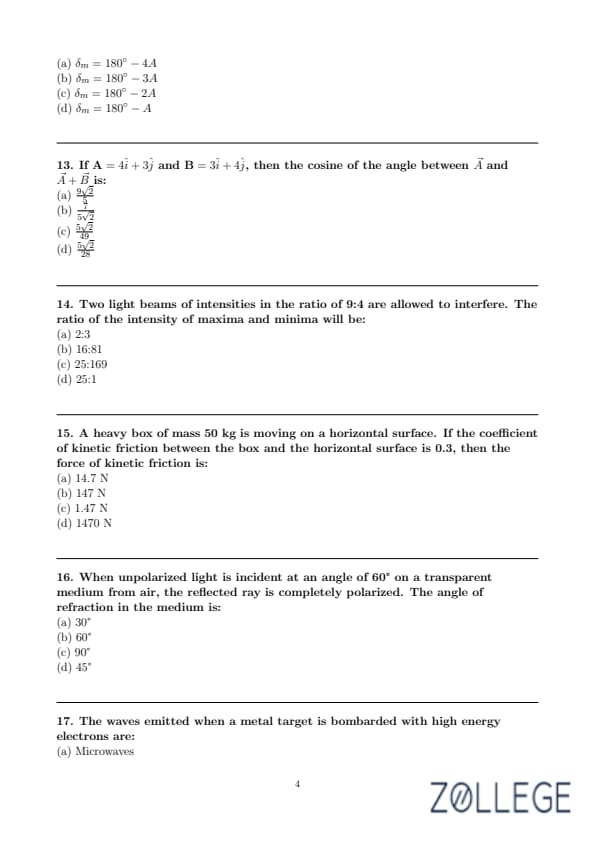
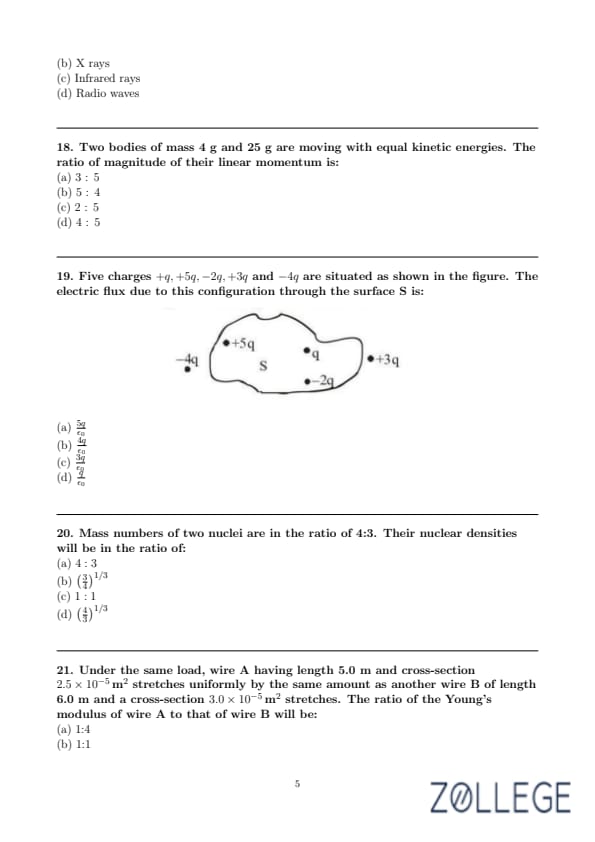
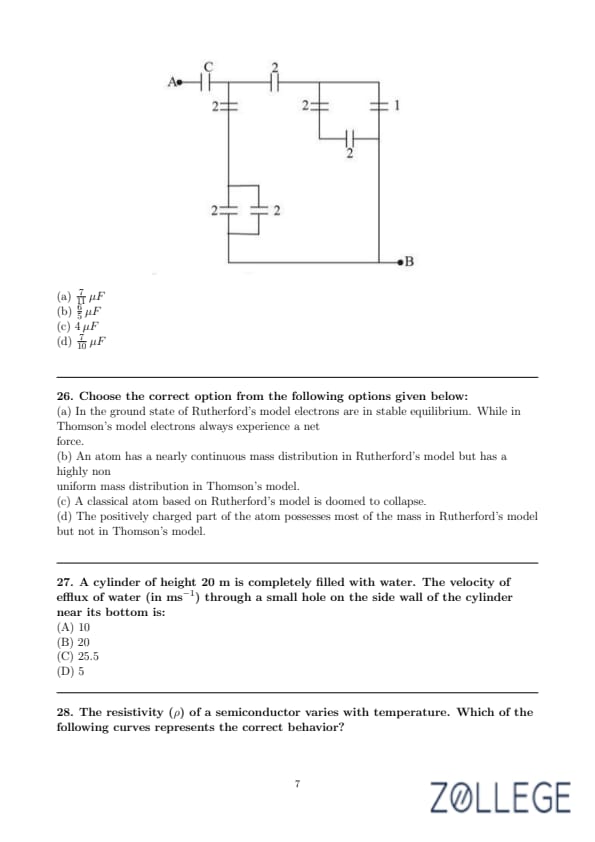
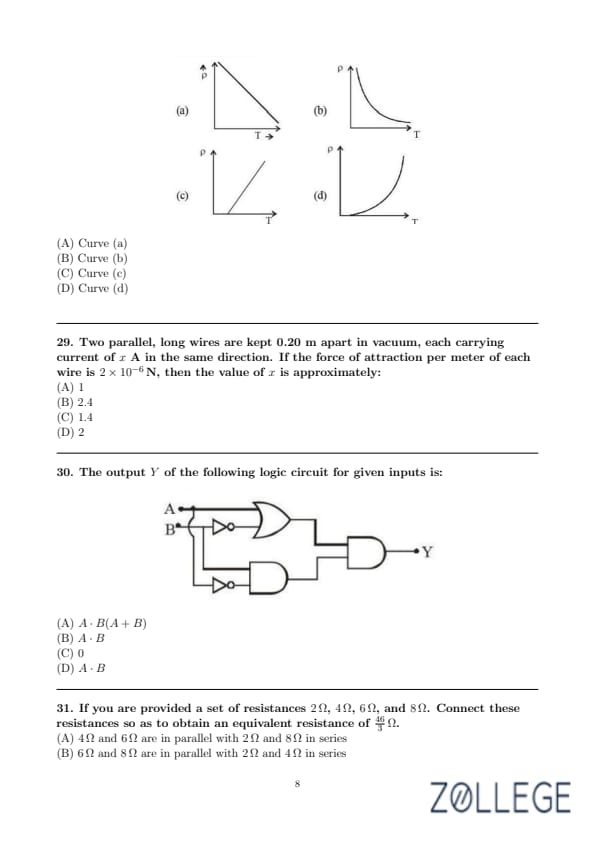
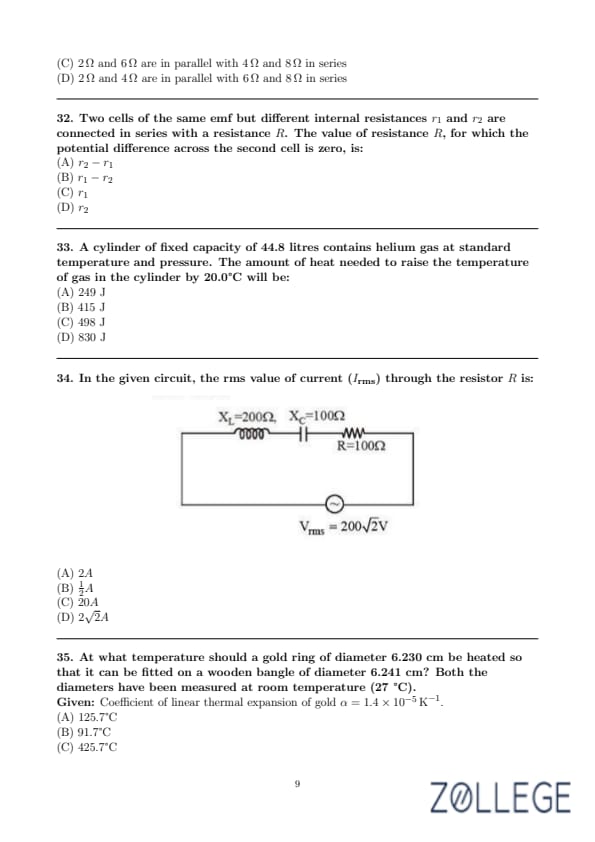
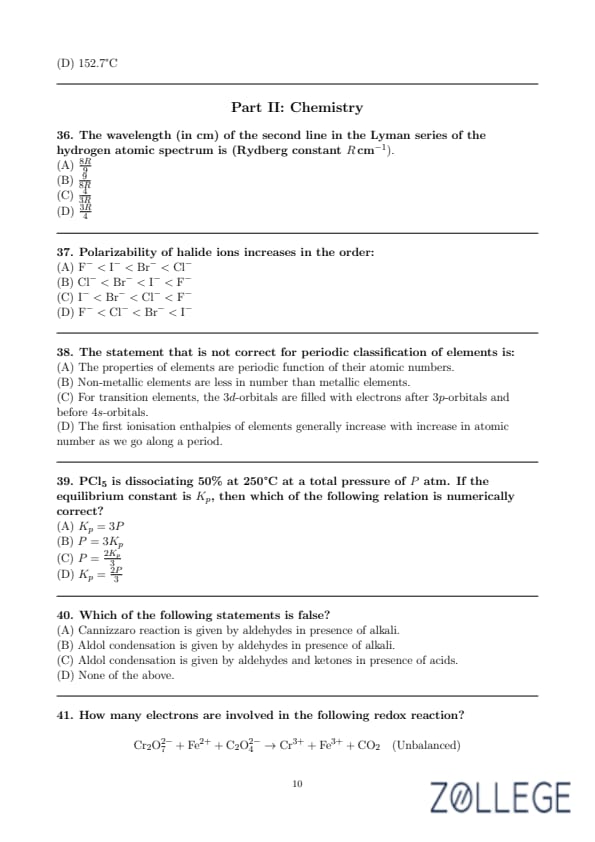
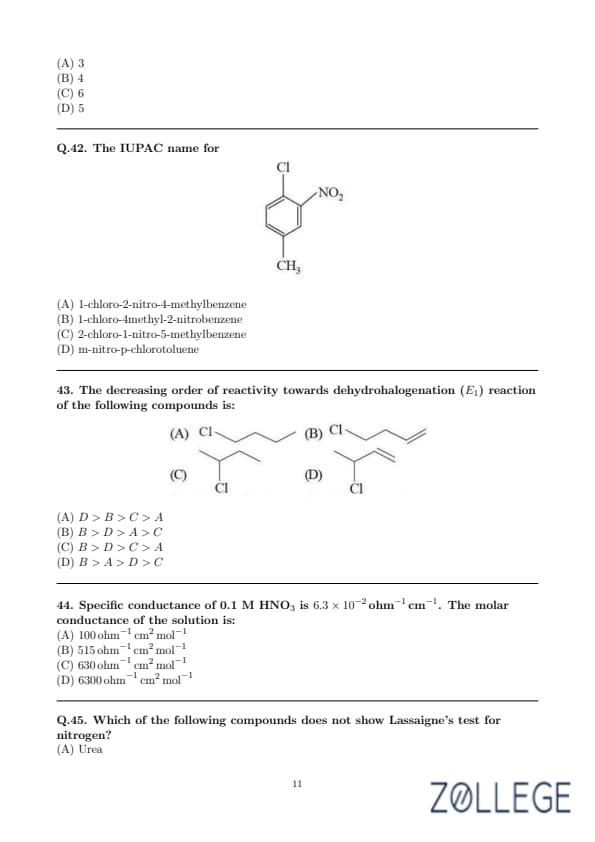
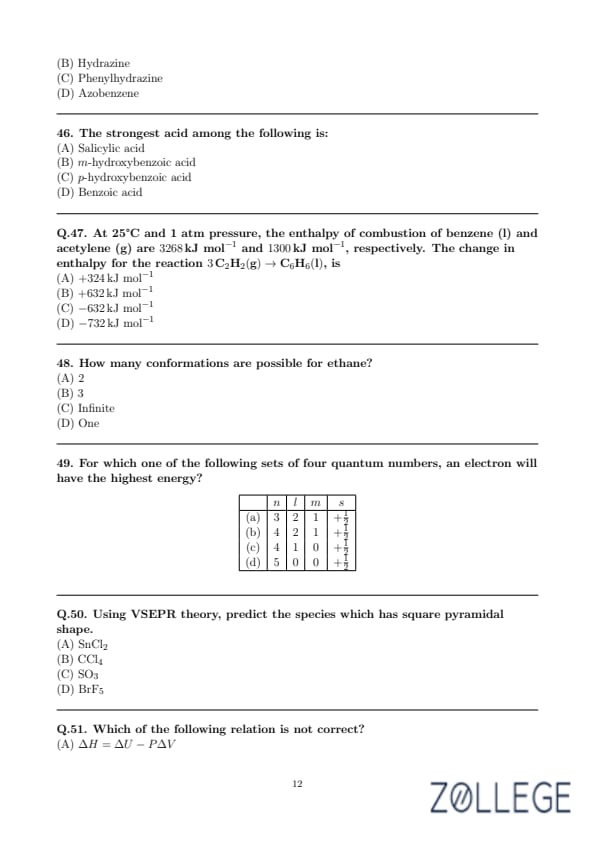
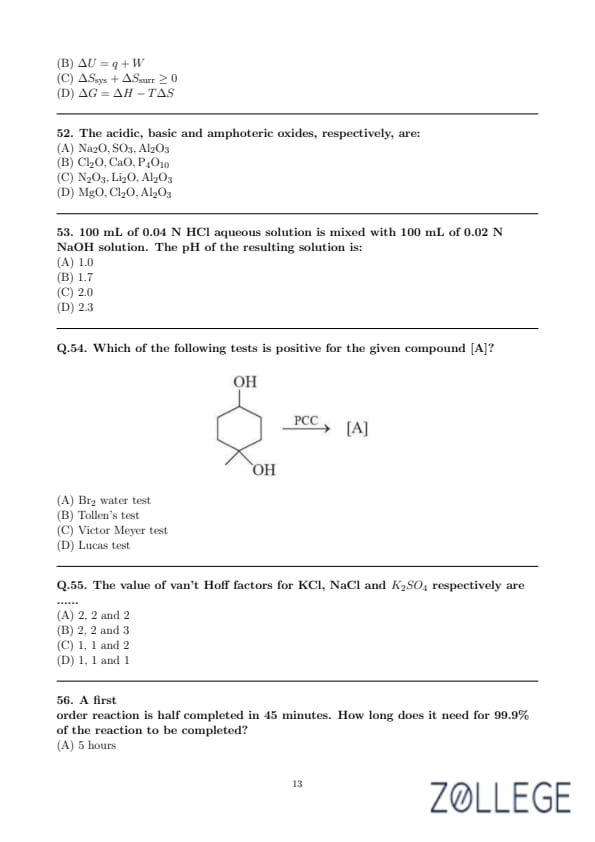
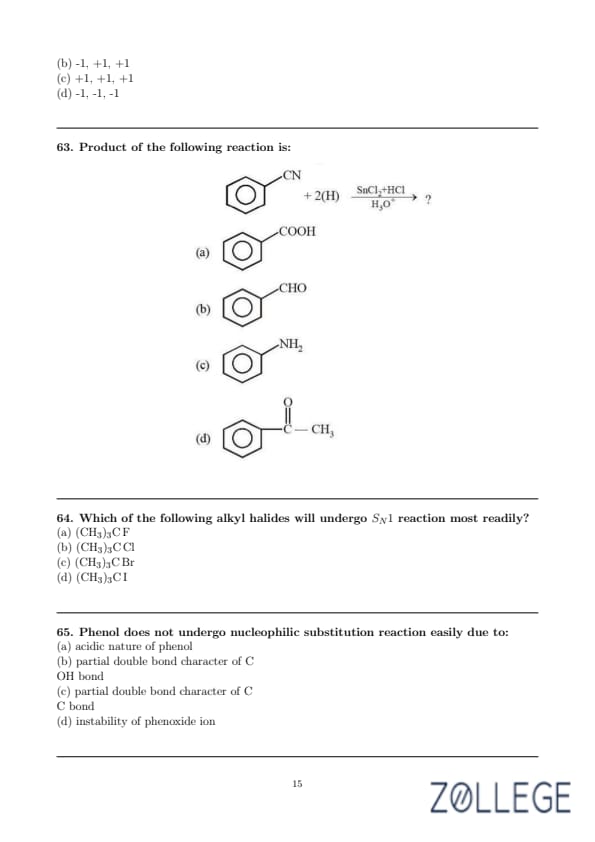
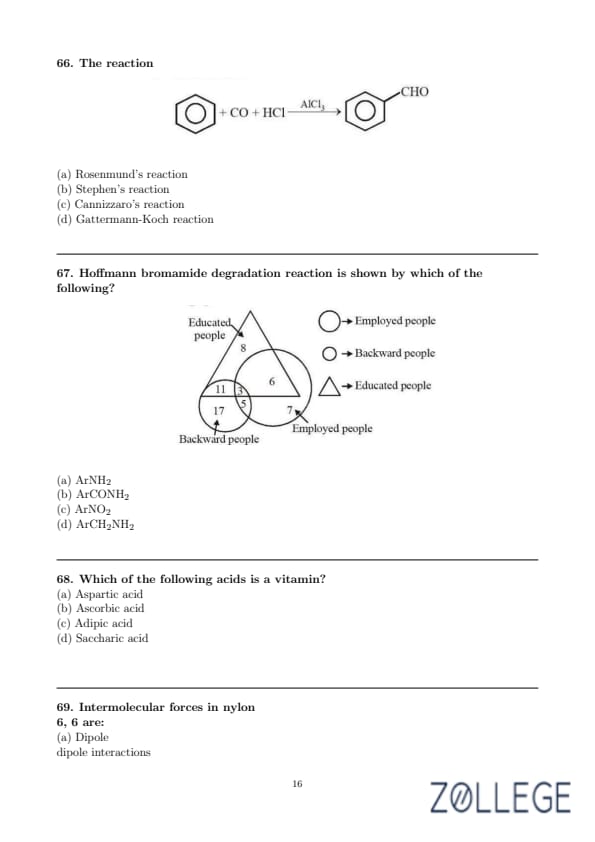
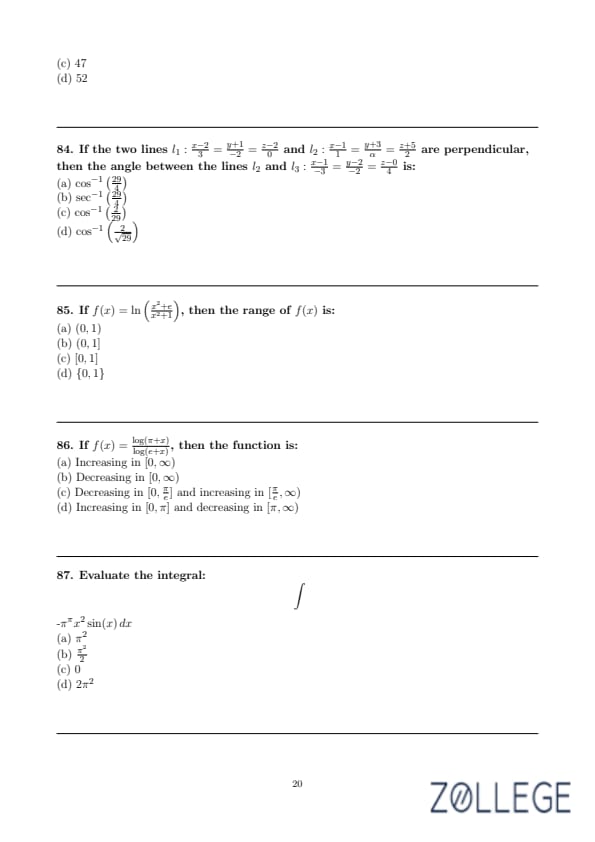
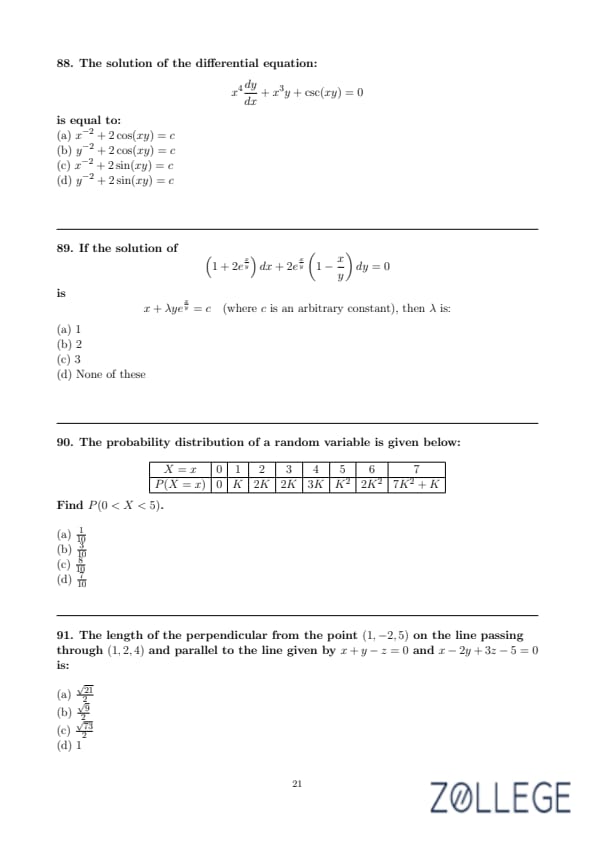
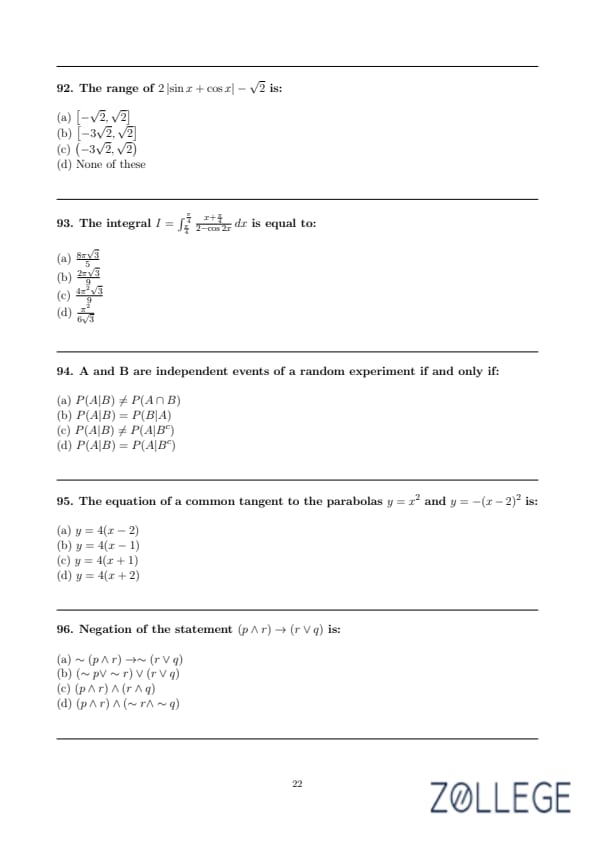
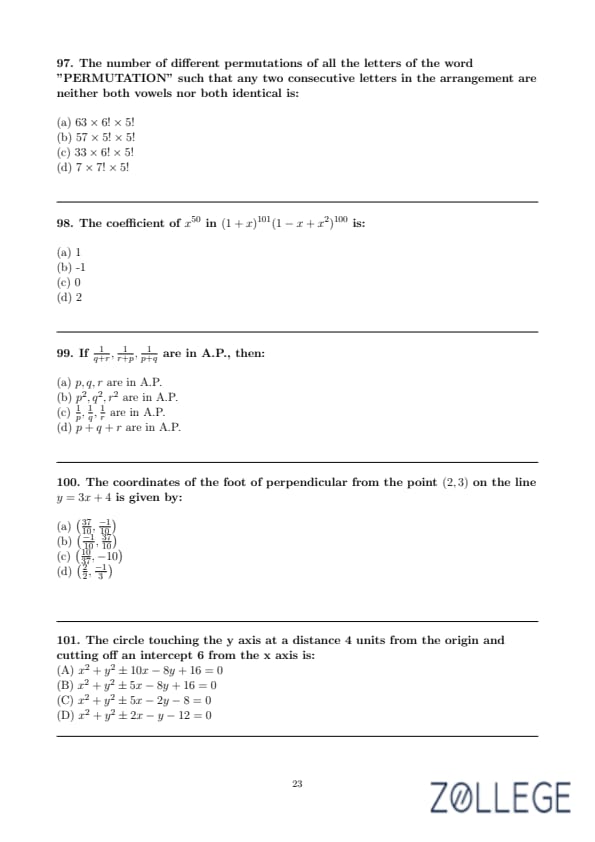
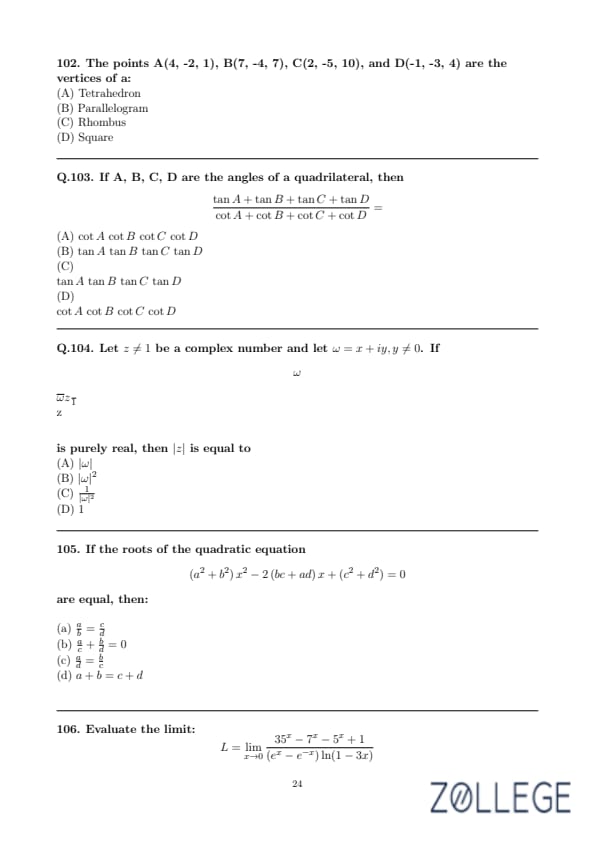
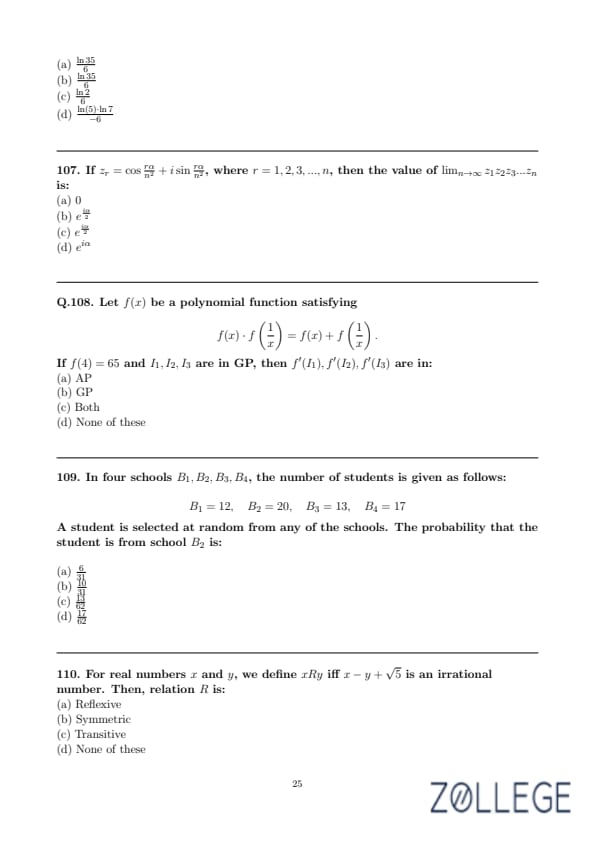
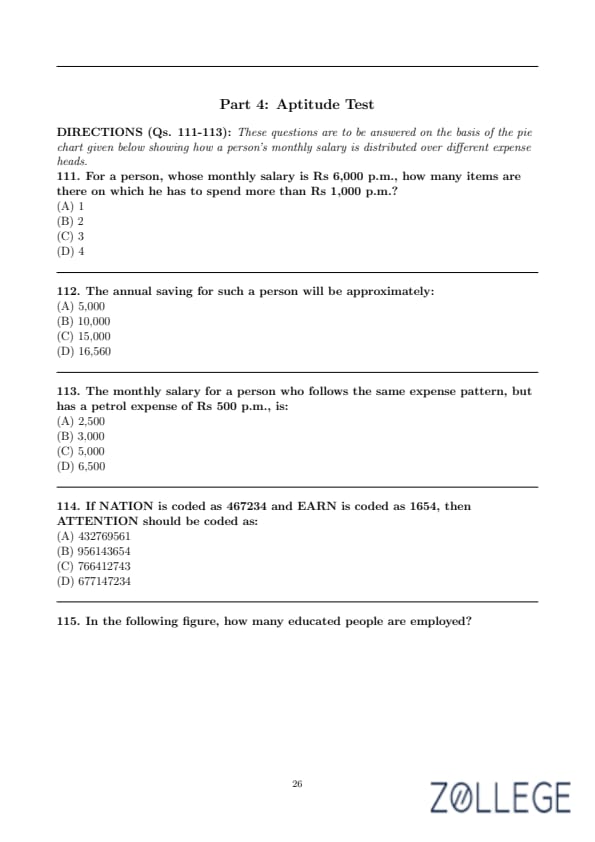
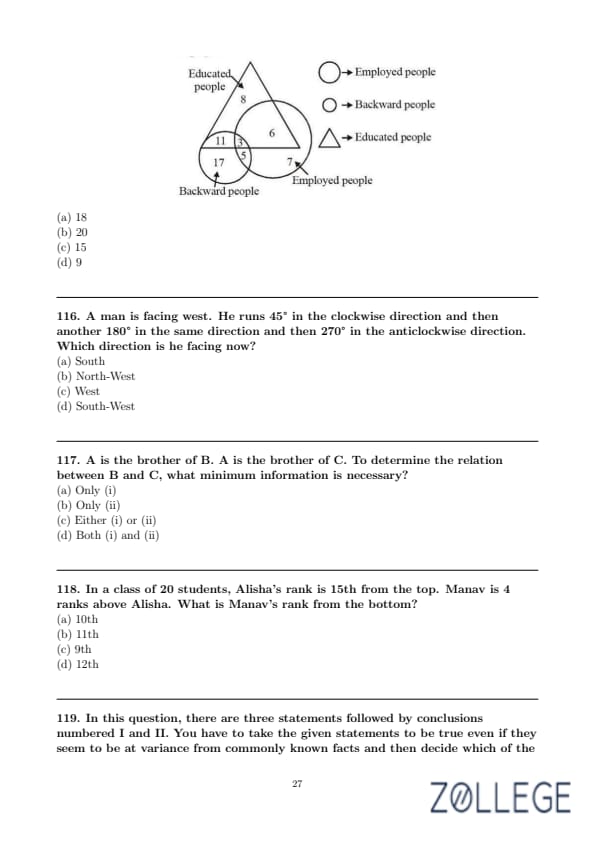
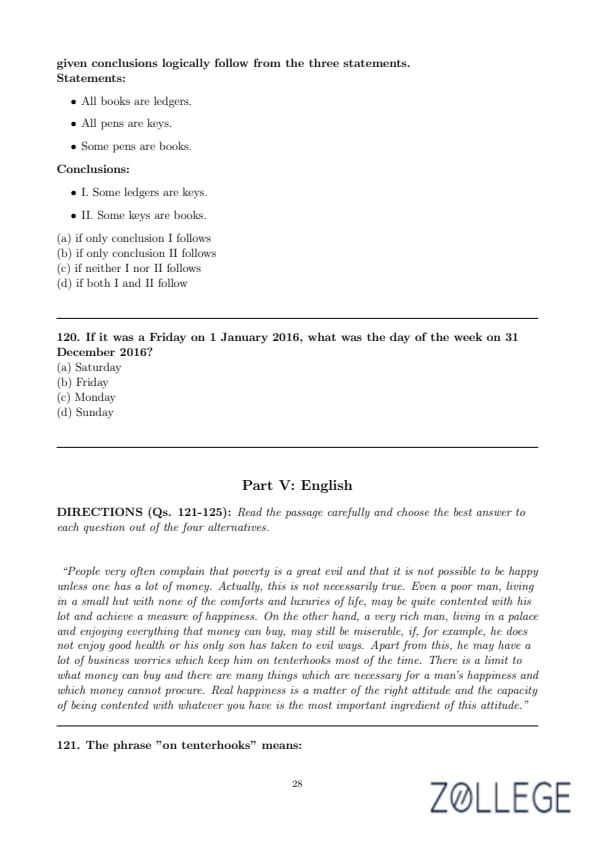
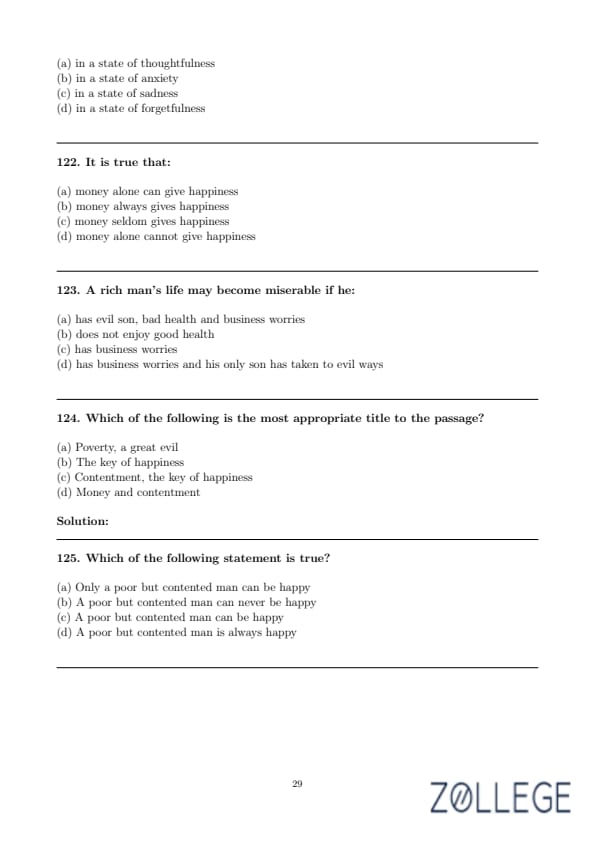
*The article might have information for the previous academic years, please refer the official website of the exam.