
VITEEE 2025 21 April Shift 1 Question Paper (Available): Download Solutions with Answer Key


| Updated On - Nov 17, 2025
VITEEE 2025 Question Paper for April 21 Shift 1 is available for download here with solutions PDF. Vellore Institute of Technology conducted VITEEE 2025 from April 20 to April 27. VITEEE 2025 Question Paper includes 40 questions from Mathematics/Biology, 35 questions from Physics, 35 questions from Chemistry, 5 questions from English, and 10 questions from Aptitude to be attempted in 150 minutes.
VITEEE 2025 21 April Shift 1 Question Paper PDF Download
| VITEEE 2025 Question Paper With Answer Key | Download | Check Solution |
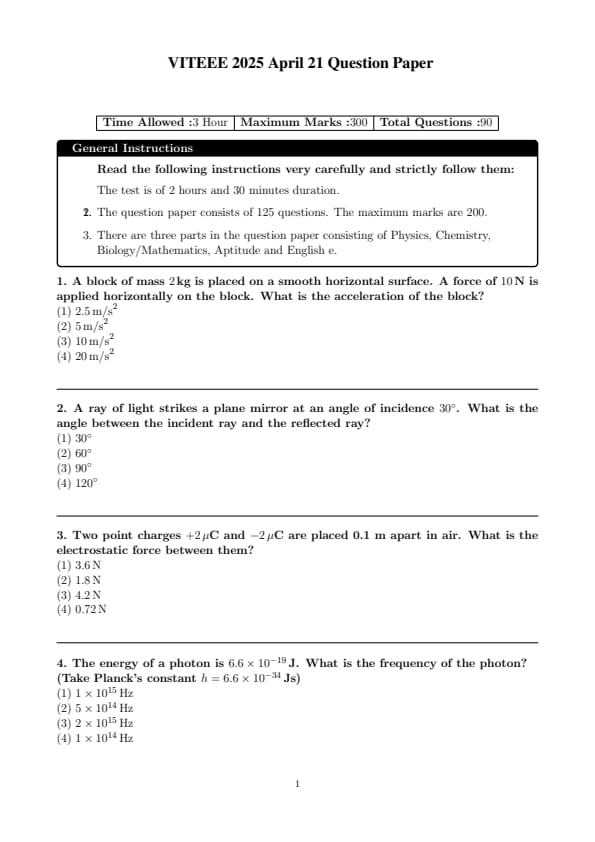
A block of mass \(2\, kg\) is placed on a smooth horizontal surface. A force of \(10\, N\) is applied horizontally on the block. What is the acceleration of the block?
View Solution
We are given:
- Mass of the block \(m = 2\, kg\)
- Force applied \(F = 10\, N\)
- The surface is smooth, i.e., there is no friction.
Step 1: Use Newton’s Second Law of Motion
According to Newton’s Second Law,
\[ F = m \cdot a \]
Solving for acceleration \(a\):
\[ a = \frac{F}{m} \]
\[ a = \frac{10}{2} = 5 \, m/s^2 \]
Step 2: Final Answer
Thus, the acceleration of the block is \(5 \, m/s^2\).
Answer: The correct answer is option (2) \(5 \, m/s^2\). Quick Tip: When the surface is smooth (frictionless), you can directly apply \( F = ma \) without accounting for frictional forces.
A ray of light strikes a plane mirror at an angle of incidence \(30^\circ\). What is the angle between the incident ray and the reflected ray?
View Solution
Step 1: Understand the law of reflection
The law of reflection states that: \[ Angle of incidence i = Angle of reflection r \]
Given: \( i = 30^\circ \Rightarrow r = 30^\circ \)
Step 2: Find the angle between the incident and reflected ray
The incident ray and the reflected ray are on opposite sides of the normal, and each makes a \(30^\circ\) angle with the normal. So the angle between them is:
\[ Angle between incident and reflected ray = i + r = 30^\circ + 30^\circ = 60^\circ \]
Answer: The correct answer is option (2) \(60^\circ\). Quick Tip: For a plane mirror, the angle between the incident and reflected ray is always \(2i\), where \(i\) is the angle of incidence.
Two point charges \(+2 \, \muC\) and \(-2 \, \muC\) are placed 0.1 m apart in air. What is the electrostatic force between them?
View Solution
We are given:
- \(q_1 = +2 \, \muC = 2 \times 10^{-6} \, C\)
- \(q_2 = -2 \, \muC = -2 \times 10^{-6} \, C\)
- Distance \(r = 0.1 \, m\)
- Coulomb’s constant \(k = 9 \times 10^9 \, Nm^2/C^2\)
Step 1: Use Coulomb’s Law
\[ F = \frac{k |q_1 q_2|}{r^2} \]
\[ F = \frac{9 \times 10^9 \cdot (2 \times 10^{-6})^2}{(0.1)^2} \]
\[ F = \frac{9 \times 10^9 \cdot 4 \times 10^{-12}}{0.01} = \frac{36 \times 10^{-3}}{0.01} = 3.6 \, N \]
Step 2: Direction of force
Since the charges are opposite in sign, the force is attractive.
Answer: The electrostatic force between the charges is \(3.6 \, N\). So, the correct answer is option (1). Quick Tip: Always convert microcoulombs (\( \muC \)) to coulombs (\( C \)) before using Coulomb’s Law.
The energy of a photon is \(6.6 \times 10^{-19} \, J\). What is the frequency of the photon?
(Take Planck’s constant \(h = 6.6 \times 10^{-34} \, Js\))
View Solution
Step 1: Use the relation between energy and frequency
The energy of a photon is given by:
\[ E = h \nu \]
Where:
- \(E = 6.6 \times 10^{-19} \, J\)
- \(h = 6.6 \times 10^{-34} \, Js\)
Step 2: Rearrange to find frequency \(\nu\)
\[ \nu = \frac{E}{h} = \frac{6.6 \times 10^{-19}}{6.6 \times 10^{-34}} = 1 \times 10^{15} \, Hz \]
Answer: The frequency of the photon is \(1 \times 10^{15} \, Hz\). Hence, the correct answer is option (1). Quick Tip: Remember: \(E = h\nu\) is a fundamental relation in quantum physics used to calculate photon frequency from its energy.
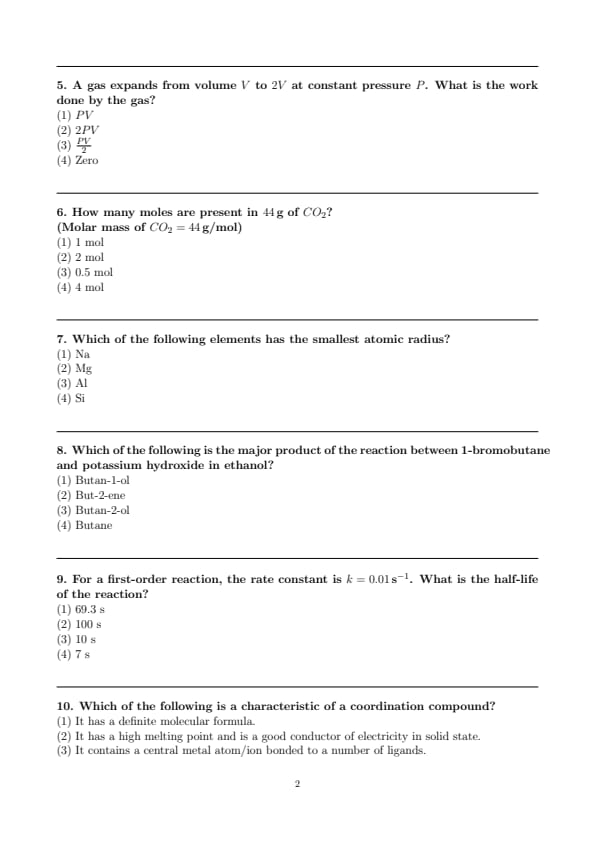
A gas expands from volume \(V\) to \(2V\) at constant pressure \(P\). What is the work done by the gas?
View Solution
Step 1: Use the formula for work done at constant pressure (isobaric process)
Work done by a gas during isobaric expansion:
\[ W = P(V_2 - V_1) \]
Given:
- \(V_1 = V\)
- \(V_2 = 2V\)
- \(P = P\) (constant)
\[ W = P(2V - V) = P \cdot V \]
Step 2: Final Answer
The work done by the gas is \(PV\).
Answer: Hence, the correct answer is option (1) \(PV\). Quick Tip: In an isobaric process, the area under the \(P\)-\(V\) graph (a rectangle) gives the work: \(W = P \Delta V\).
How many moles are present in \(44\, g\) of \(CO_2\)?
(Molar mass of \(CO_2 = 44\, g/mol\))
View Solution
Step 1: Use the formula for number of moles
\[ Number of moles = \frac{Given mass}{Molar mass} \]
Given:
- Mass of \(CO_2 = 44\, g\)
- Molar mass of \(CO_2 = 44\, g/mol\)
\[ Moles = \frac{44}{44} = 1 \, mol \]
Answer: Therefore, the number of moles in \(44\, g\) of \(CO_2\) is 1 mol. So, the correct answer is option (1). Quick Tip: Always remember: \( Moles = \frac{Mass}{Molar Mass} \). Keep units consistent when using this formula.
Which of the following elements has the smallest atomic radius?
View Solution
The elements Na, Mg, Al, and Si all belong to Period 3 of the periodic table.
As we move left to right across a period:
- Atomic number increases
- Effective nuclear charge increases
- Electrons are added to the same shell, so the attraction between the nucleus and outer electrons increases.
Hence, atomic radius decreases across a period.
Order of atomic radius: \[ Na > Mg > Al > Si \]
Answer: Therefore, Si has the smallest atomic radius among the options. Correct answer is option (4). Quick Tip: Across a period in the periodic table, atomic radius decreases due to increasing nuclear charge.
Which of the following is the major product of the reaction between 1-bromobutane and potassium hydroxide in ethanol?
View Solution
The reaction involves 1-bromobutane (an alkyl halide) with potassium hydroxide (KOH) in ethanol. This is a typical example of an elimination reaction (E2 mechanism), where the hydroxide ion (OH⁻) removes a proton from the carbon adjacent to the carbon that is bonded to the leaving group (Br⁻), leading to the formation of a double bond.
Step 1: Identify the type of reaction
Since the reaction is occurring in ethanol, which is a polar protic solvent, the elimination occurs via the E2 mechanism.
Step 2: Identify the product
- The E2 mechanism will lead to the formation of an alkene.
- The hydrogen is removed from the carbon next to the carbon bearing the bromine (the β-carbon), leading to the formation of But-2-ene.
Answer: The major product of the reaction is But-2-ene, and thus the correct answer is option (2). Quick Tip: In a reaction with KOH in ethanol, the elimination (E2) mechanism typically leads to the formation of an alkene.
For a first-order reaction, the rate constant is \(k = 0.01 \, s^{-1}\). What is the half-life of the reaction?
View Solution
For a first-order reaction, the half-life (\(t_{1/2}\)) is given by the formula:
\[ t_{1/2} = \frac{0.693}{k} \]
Given:
- Rate constant \(k = 0.01 \, s^{-1}\)
Step 1: Calculate the half-life
\[ t_{1/2} = \frac{0.693}{0.01} = 69.3 \, s \]
Answer: Therefore, the half-life of the reaction is \(69.3 \, s\), and the correct answer is option (1). Quick Tip: For a first-order reaction, the half-life is independent of the initial concentration and only depends on the rate constant.
Which of the following is a characteristic of a coordination compound?
View Solution
A coordination compound is formed when a central metal ion or atom is surrounded by a number of ligands, which are molecules or ions that can donate electron pairs to the metal ion.
Step 1: Review the options
- Option 1: While coordination compounds can have a definite molecular formula, this is not their most distinguishing feature.
- Option 2: Coordination compounds do not necessarily have high melting points or conduct electricity in the solid state. This is more typical of ionic compounds.
- Option 3: The hallmark of a coordination compound is the bonding of a central metal atom/ion with ligands. This option is correct.
- Option 4: Coordination compounds can be soluble in water, especially if they form ions in solution.
Answer: The correct characteristic of a coordination compound is option (3) — it contains a central metal atom/ion bonded to a number of ligands. Quick Tip: Coordination compounds typically involve metal-ligand coordination bonds, and the ligands donate electron pairs to the central metal.
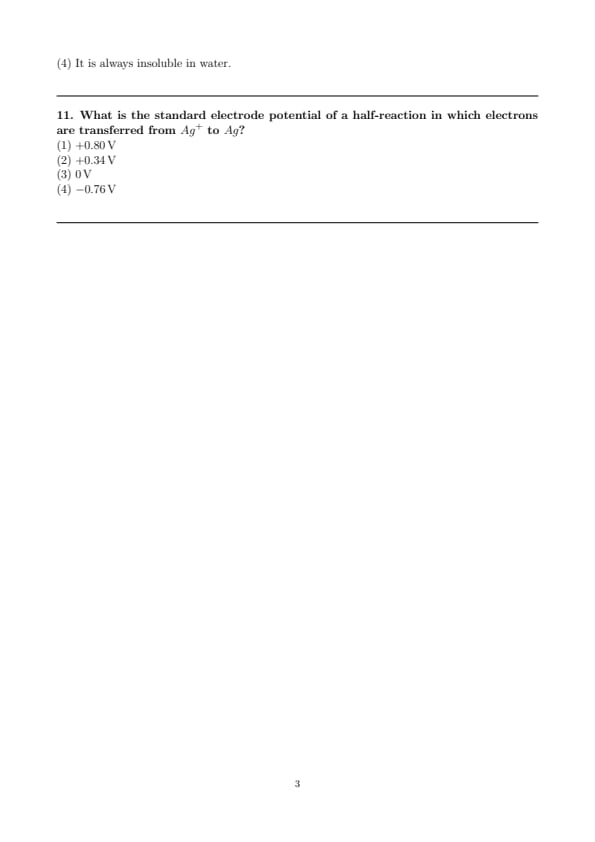
What is the standard electrode potential of a half-reaction in which electrons are transferred from \(Ag^+\) to \(Ag\)?
View Solution
The standard electrode potential of a half-reaction is defined as the potential difference when the half-reaction occurs under standard conditions (1 M concentration, 1 atm pressure, and 25°C).
Step 1: Review the given half-reaction
The given half-reaction is: \[ Ag^+ + e^- \rightarrow Ag(s) \]
The standard electrode potential for this half-reaction is a well-known value in electrochemistry and is given as:
\[ E^\circ = +0.80 \, V \]
Answer: Therefore, the standard electrode potential for the reduction of \(Ag^+\) to \(Ag\) is \(+0.80 \, V\). The correct answer is option (1). Quick Tip: The standard electrode potential for the reduction of \(Ag^+\) to \(Ag\) is \(+0.80 \, V\), which indicates that silver ions are easily reduced to silver metal.
VITEEE 2025 Expected Difficulty Level
According to the exam pattern, candidates must attempt 125 questions in 150 minutes across 5 major sections: Mathematics/Biology, Physics, Chemistry, English, and Aptitude.
As per the past year's trends, this is the expected difficulty level of VITEEE 2025:
| Section | No. of Questions | Expected Difficulty Level | Remarks |
|---|---|---|---|
| Mathematics / Biology | 40 | Moderate to Difficult | Maths will have more application-based questions, and biology will have more NCERT-based questions. |
| Physics | 35 | Moderate | It will be conceptual and related to formulas with few calculations. |
| Chemistry | 35 | Easy to Moderate | Questions will be direct theory-based, with a focus on NCERT and a few tricky numerical problems |
| English | 5 | Easy | This section will focus on Grammar and comprehension-based questions. |
| Aptitude | 10 | Moderate | Basic logical reasoning and pattern questions |
VITEEE 2025: Section-Wise Weightage
Below is the section-wise topic weightage for VITEEE 2025:
Mathematics (40 Questions) – For PCM Candidates
| Important Topics | Expected No. of Questions |
|---|---|
| Calculus | 8–10 |
| Coordinate Geometry | 5–6 |
| Algebra (Quadratic, Complex No.) | 6–7 |
| Trigonometry | 4–5 |
| Probability & Statistics | 4–5 |
| Matrices and Determinants | 3–4 |
| Vectors and 3D Geometry | 4–5 |
Physics (35 Questions)
| Important Topics | Expected No. of Questions |
|---|---|
| Mechanics | 6–8 |
| Electrostatics & Current Electricity | 5–6 |
| Optics | 4–5 |
| Thermodynamics & Heat Transfer | 4–5 |
| Modern Physics | 4–5 |
| Waves & Oscillations | 3–4 |
| Magnetism & EMI | 4–5 |
Chemistry (35 Questions)
| Important Topics | Expected No. of Questions |
|---|---|
| Organic Chemistry (Reactions, Mechanisms) | 10–12 |
| Physical Chemistry (Thermo, Equilibrium) | 10–12 |
| Inorganic Chemistry (p/d/f block, Coordination) | 8–10 |
| Environmental Chemistry, Biomolecules | 2–3 |
English (5 Questions)
| Type of Questions | Expected questions |
|---|---|
| Reading Comprehension | 1–2 |
| Grammar (Tense, Voice, Error Spotting) | 2–3 |
| Vocabulary (Synonyms/Antonyms) | 1 |
Aptitude (10 Questions)
| Important Topics | Expected No. of Questions |
| Number Series & Coding-Decoding | 2–3 |
| Data Interpretation | 2–3 |
| Syllogism & Logical Reasoning | 2–3 |
| Basic Arithmetic | 2 |
*The article might have information for the previous academic years, please refer the official website of the exam.