
VITEEE 2026 Total Marks: Check Detailed Paper Pattern, Marking Scheme, and Attempt Strategy


| Updated On - Apr 28, 2026
VITEEE 2026 carries a total of 500 marks across 125 MCQs, a major structural shift from the old 1-mark-per-question format. With a +4 for every correct answer and -1 for every wrong one, the VITEEE exam now requires accuracy for the final rank.
-
VITEEE 2026 is a 2.5-hour computer-based test with 125 MCQs across Physics, Chemistry, Mathematics/Biology, English, and Aptitude
- Mathematics/Biology is the highest-weightage section at 40 questions (160 marks).
- Physics and chemistry contribute 35 questions each.
- English (5 questions) and Aptitude (10 questions) together offer 60 marks in under 10 minutes.

Related Articles:
- VITEEE 2026 Syllabus: Subject-Wise Topics and Weightage
- VITEEE 2026 Exam Pattern: Section-Wise Breakdown
- VITEEE 2026 Preparation Tips: Strategy for 400+ Score
Key Summary:
|
|---|
VITEEE 2026 Total Marks and Exam Pattern
- The VITEEE 2026 has a revised marking structure.
- VIT increased the per-question mark from 1 to 4, which means the maximum score increased from 125 to 500.
| Section | Questions | Marks | Marking Scheme |
|---|---|---|---|
| Physics | 35 | 140 | +4 / -1 |
| Chemistry | 35 | 140 | +4 / -1 |
| Mathematics / Biology | 40 | 160 | +4 / -1 |
| Aptitude | 10 | 40 | +4 / -1 |
| English | 5 | 20 | +4 / -1 |
| Total | 125 | 500 | +4 correct, -1 wrong, 0 unattempted |
Source: Official VITEEE 2026 Brochure, viteee.vit.ac.in
VITEEE 2026 Marking Scheme
This is the single most important change in 2026.Before reading the table, note these key points:
- +4 marks are awarded for every correct answer.
- -1 mark is deducted for every wrong answer.
- A single wrong answer creates a net swing of -5
- Unanswered questions and questions marked for review both score zero.
| Scenario | Marks Awarded | Impact on Net Score |
|---|---|---|
| Correct answer | +4 | Gain of 4 marks |
| Wrong answer | -1 | Net swing of -5 from a correct answer lost |
| Unanswered | 0 | No penalty |
| Marked for review (unanswered) | 0 | Treated as unattempted |

Source: Official VITEEE 2026 Brochure, viteee.vit.ac.in
Read More:
VITEEE 2026 Score Targets
- Scores are normalised across shifts
- VIT Vellore CSE is the most competitive program; it needs a rank under 500, which means a score above 450
- VIT Chennai and VIT AP campuses have comparatively lower cutoffs for the same branch.
- A 5-10 mark difference can shift a candidate's rank by hundreds, especially in the 400-460 score range where competition is densest
| Target Rank | Approximate Score Required | Minimum Correct Answers Needed |
|---|---|---|
| Top 250 (Rank 1-250) | 470-490 | 120+ correct |
| Rank 251-1000 | 440-469 | 113-118 correct |
| Rank 1001-5000 | 400-440 | 105-113 correct |
| Rank 5001-10000 | 350-399 | 92-102 correct |
| Rank 10001-20000 | 300-349 | 78-90 correct |
Note: Score-rank mapping is trend-based. VIT uses a normalisation process across shifts. Actual cutoffs vary by campus and branch.
VITEEE 2026 Section-Wise Marks and Time Strategy
- Aptitude has the highest marks-per-minute ratio at 4.4, which has 10 questions at 4 marks each.
- English is the fastest section at only 5 questions.
- Mathematics and physics have the same marks-per-minute ratio (3.7).
- Chemistry is more time-efficient than physics for most candidates.
| Section | Marks | Suggested Time | Marks Per Minute | Attempt Strategy |
|---|---|---|---|---|
| English | 20 | 5-7 min | 3.3 | Attempt all 5 |
| Aptitude | 40 | 8-10 min | 4.4 | Attempt all 10 |
| Chemistry | 140 | 30-35 min | 4.2 | NCERT-based |
| Physics | 140 | 35-40 min | 3.7 | Formula-heavy |
| Mathematics | 160 | 40-45 min | 3.7 | Highest marks |
VITEEE 2026 In-Exam Section Sequence
- Start with English and aptitude.
- Chemistry before Physics because Chemistry leans on NCERT memory recall, which is faster than physics derivations.
- Mathematics last because it has the highest marks but also the highest variance in difficulty.
- Never spend more than 90 seconds on any single question in the first pass.
- The final 10 minutes should be reserved only for reviewing flagged questions where you are at least 70% confident
| Order | Section | Target Time | Key Tip |
|---|---|---|---|
| 1 | English | 5-7 min | Attempt all 5; vocabulary questions are rarely traps |
| 2 | Aptitude | 8-10 min | Attempt all 10; skip only if a question needs multi-step calculation |
| 3 | Chemistry | 30-35 min | Memory-based: NCERT recall works for most questions |
| 4 | Physics | 35-40 min | Skip complex derivation questions; flag and return |
| 5 | Mathematics | 40-45 min | Attempt strongest topics first; do not linger over any single question |
| 6 | Review flagged questions | Remaining time | Only attempt if 70%+ confident—the -1 penalty applies |
Total target: 140 minutes of answering + 10 minutes of review.
VITEEE 2026 Paper Pattern
- The question count (125) and duration (2.5 hours) have not changed
- Total marks jumped from 125 to 500 because VIT changed from +1 per correct answer to +4 per correct answer
- Negative marking is new in VITEEE 2026.
- The VITEEE 2026 syllabus is unchanged all Physics, Chemistry, Mathematics, English, and Aptitude topics remain the same as prior years
- The exam mode remains Computer-Based Test (CBT) with no change to the interface or navigation
| Parameter | Pre-2026 (Old Pattern) | VITEEE 2026 (New Pattern) |
| Marks per correct answer | +1 | +4 |
| Negative marking | None | -1 per wrong answer |
| Total marks | 125 | 500 |
| Number of questions | 125 | 125 (unchanged) |
| Duration | 2.5 hours | 2.5 hours (unchanged) |
| Exam mode | CBT | CBT (unchanged) |
| Unattempted questions | 0 marks | 0 marks (unchanged) |
The number of questions has not changed; only the weight of each question has changed.
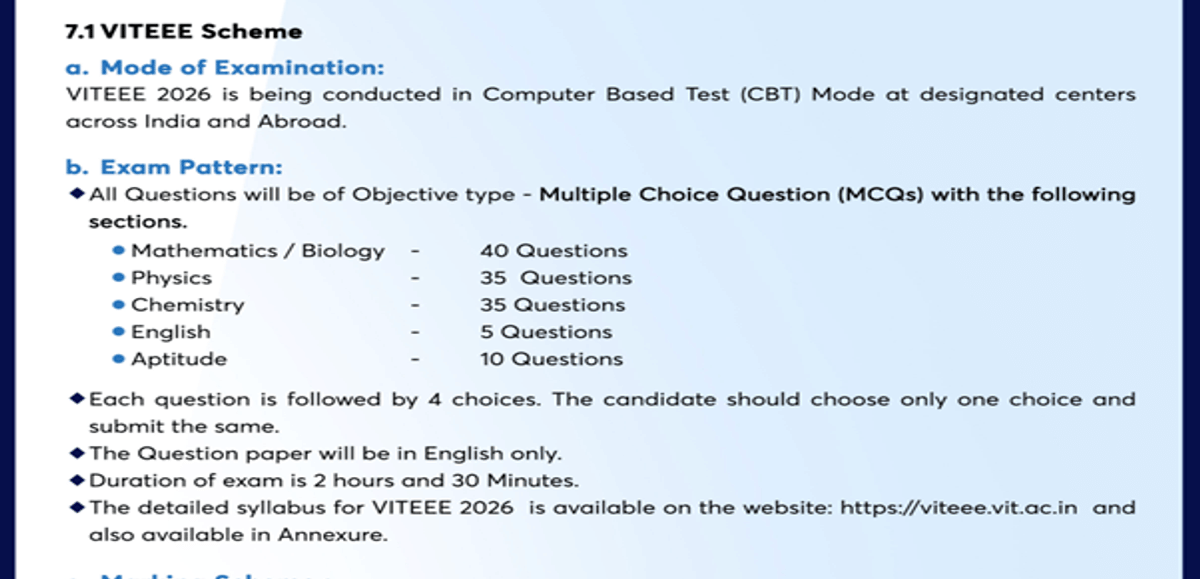
Source: Official VITEEE 2026 Brochure, viteee.vit.ac.in
Also Check:
- VITEEE 2026 Cutoff: Expected Rank and Score Ranges
- VITEEE 2026 Counselling: Process, Dates, and Branch Allotment
For official syllabus, exam dates, registration, and brochure: viteee.vit.ac.in
VITEEE 2026 Total Marks and Marking Scheme FAQs
Ques. Is there any negative marking scheme in VITEEE 2026?
Ans. Yes. For the very first time, VITEEE 2026 has introduced negative marking. There will be a deduction of one mark for each wrong answer. No negative marking scheme applies to questions not attempted by the candidate.
Ques. Which portion holds the maximum weightage in the upcoming VITEEE 2026 examination?
Ans. Mathematics or Biology (depending upon whether it is Paper I or II respectively) hold the maximum weightage of 160 out of 500 marks – that makes 40 questions carrying 4 marks each. While Physics and Chemistry each hold a weightage of 140 consisting of 35 questions each. English and Aptitude collectively score 60 marks.
Ques. Is it advisable to solve all 125 questions in the forthcoming VITEEE 2026 examination?
Ans. It is not advised because answering all 125 questions without reasonable certainty would be dangerous due to the negative marking policy. The candidate who answers 108 questions right with 7 incorrect earns a total of 425 marks whereas a candidate answering all 125 questions but having 40 questions incorrect earns a total of 300 marks.
Ques. Does VITEEE 2026 have different papers for PCM and PCB students?
Ans. Yes. MPCEA (Mathematics, Physics, Chemistry, English, Aptitude) is for engineering stream candidates and makes them eligible for all B.Tech programmes. BPCEA (Biology, Physics, Chemistry, English, Aptitude) is for biology stream candidates and limits eligibility to bio-stream B.Tech programmes. The marking scheme is identical in both.
*The article might have information for the previous academic years, please refer the official website of the exam.