
CBSE Board Class 12 Physical Education Question Paper 2025- Download Solution PDF with Answer Key

.jpg?tr=h-55,w-55,c-force)
Content Strategist|Tech-innovator|National Hackathon Winner | Updated On - Sep 20, 2025
The CBSE 2025 Class 12th Boards Physical Education exam was conducted on February 17, 2025. The question paper along with the solution PDF is available here to download.
The CBSE 12th Boards Physical Education exam was easy to moderate and based on previous year trends. The Physical Education exam includes sports management, children/women in sports, yoga, special needs, nutrition, tests, physiology, biomechanics, psychology, and training.
CBSE Class 12 Physical Education Question Paper 2025 with Solutions
| CBSE Class 12 Physical Education Question Paper |  Download PDF Download PDF |
Check Solution |
Which one of the following is a post-competition responsibility of the technical committee?
View Solution
Following the conclusion of the competition, the technical committee's responsibilities encompass various post-event organizational tasks. The option that correctly depicts the committee's duty is to manage equipment and stationery after the event.
The committee is tasked with overseeing the equipment and stationery, making sure these items are securely stored and that all necessary materials are properly organized for future events. These duties exclude purchasing new equipment or the upkeep of the event venue. Quick Tip: Post-event responsibilities usually focus on logistical matters like equipment handling, secure storage, and the preparation for upcoming events.
Which of the following is an objective of Intramural tournaments?
View Solution
The main purpose of intramural tournaments is to foster health, wellness, and recreational pursuits among students within the educational setting. These events motivate students to participate in physical activities in a relaxed and enjoyable setting.
The emphasis of intramural tournaments is on promoting participants' well-being and creating a fun environment, contrasting with intercollegiate competitions, which are geared towards high-performance athletics. Quick Tip: Intramural tournaments aim to enhance health and wellness, and build community and enjoyment through sports activities.
Which of the following deformity is NOT related to lower extremities?
View Solution
Scoliosis is a spinal condition and does not pertain to lower extremity issues. In contrast, conditions such as Knock-Knee, Bow-legs, and Flat-foot are deformities impacting the lower limbs.
Scoliosis results in an unusual spinal curvature and is unrelated to leg or foot problems, unlike the other mentioned conditions that impact the structure and function of the lower extremities. Quick Tip: In the study of deformities, understanding the specific body parts they impact is crucial. Scoliosis primarily affects the spine, distinguishing it from other conditions that involve the legs or feet.
Brisk walking, running, bicycling, and jumping are related to which activities?
View Solution
Brisk walking, running, bicycling, and jumping predominantly emphasize endurance due to their requirement for prolonged physical effort.
These activities enhance both cardiovascular and muscular endurance and are therefore categorized as endurance activities, rather than those focusing on speed or strength. Quick Tip: Activities that involve extended physical effort, like running and cycling, are considered endurance activities. These are effective in boosting stamina and aerobic fitness.
As per prescribed syllabus, Suryabhedan Pranayam is recommended for:
View Solution
Suryabhedan Pranayam, a yoga breathing technique, is particularly beneficial for managing high blood pressure, making it suitable for individuals with hypertension.
This pranayama aids in soothing the nervous system, diminishing stress, and enhancing circulation, thereby effectively controlling hypertension. Quick Tip: Breathing techniques such as Suryabhedan Pranayam are effective in reducing blood pressure, promoting relaxation, and improving the flow of oxygen.
Identify the asana:

View Solution
The asana shown in the image is Dhanurasana, commonly referred to as the Bow Pose, characterized by the body's resemblance to a bow.
To perform Dhanurasana, the individual starts by lying face down, bending the knees, and grasping the ankles with the hands, then lifting the chest and thighs from the ground to create a curve. Quick Tip: Dhanurasana enhances back flexibility, strengthens the core muscles, and activates the abdominal organs.
Given below are two statements, one of which is labelled as Assertion (A) and other is labelled as Reason (R). Read both the statements carefully:
Assertion (A): The International Paralympic Committee (IPC) has developed a classification process which can contribute "to sporting excellence for all athletes and sports in the Paralympic Movement, and provide equitable competition."
Reason (R): The classification process serves two roles. The first is to determine who is eligible and the second is to grouping the sports people for the purpose of competitions.
In the context of the above two statements, which one of the following is correct?
View Solution
Both the assertion and the reason are accurate. The classification system utilized by the IPC promotes fair competition by assessing eligibility and grouping athletes appropriately for events, consistent with the reason stated.
Step 1: The IPC's classification method enhances fairness by systematically categorizing athletes to ensure that competitions are balanced.
Step 2: The provided reason (R) justifies the necessity of the classification process and corroborates the assertion that it fosters sporting excellence.
Quick Tip: In questions where assertion and reason are evaluated, it is crucial to determine whether the reason effectively supports or justifies the assertion.
______ are the colours, that represent the four regional confederation in the Deaflympic logo.
View Solution
The Deaflympic logo incorporates four colors—red, blue, yellow, and green—to represent the four regional confederations.
These colors in the Deaflympic Games symbolize the global diversity and unity of the participants.
Quick Tip: When analyzing logos, pay attention to the prominent colors and shapes used, as they often symbolize important values or geographic regions associated with the organization.
What type of lever has the load resistance between the fulcrum and the force?
View Solution
In a second-class lever, the load is situated between the fulcrum and the force applied. Common examples include wheelbarrows and nutcrackers.
This arrangement, where the load is always between the fulcrum and the force, characterizes second-class levers and provides a mechanical advantage. Quick Tip: The classification of levers and their mechanical advantages are determined by the positioning of the fulcrum, load, and applied force.
The scientific name of Vitamin 'C' is:
View Solution
Vitamin C, also known as Ascorbic acid, is a vital nutrient required by humans. It is prevalent in citrus fruits, strawberries, and vegetables like bell peppers. Ascorbic acid is crucial for maintaining the health of skin, blood vessels, bones, cartilage, and for aiding in wound healing. Quick Tip: Known scientifically as Ascorbic acid, Vitamin C is crucial for supporting immune function and overall health.
Given below are two statements, one of which is labelled as Assertion (A) and the other is labelled as Reason (R). Read both the statements carefully:
Assertion (A): The risk of cancer can be reduced by eating more colorful vegetables, fruits, and other plant-foods that have certain phytochemicals in them.
Reason (R): Non-nutritive components of the diet are part of a balanced diet.
In the context of the above two statements, which one of the following is correct?
View Solution
Step 1: Assertion (A) is correct as it reflects the widely recognized view that consuming a diet rich in diverse vegetables, fruits, and plant-based foods can lower cancer risk due to beneficial phytochemicals.
Step 2: Reason (R) is also accurate, acknowledging that non-nutritive components like fiber and phytochemicals are part of a healthy diet. However, Reason (R) does not directly explain how these components reduce cancer risk, thus it does not provide a sufficient explanation for Assertion (A). Quick Tip: In analyzing assertions with reasons, verify the accuracy of both statements and determine whether the reason adequately supports or explains the assertion.
In which test, score is recorded to the nearest centimetre between the initial and final score?
View Solution
The sit and reach test assesses flexibility and records results to the nearest centimeter. It gauges the distance a participant can reach forward from a sitting position, measuring the change from start to end points.
During the test, participants extend their reach forward while seated, testing the flexibility of their lower back and hamstrings, with measurements noted to the nearest centimeter. Quick Tip: The sit and reach test is a commonly employed measure of flexibility, targeting the hamstrings and lower back, and is a routine part of physical fitness evaluations.
Given below are types of fractures in List - I with their features in List - II:
| List - I | List - II |
|---|---|
| (a) Transverse | (iii) Straight break right across a bone |
| (b) Oblique | (i) Bone breaks diagonally |
| (c) Green stick | (iv) Soft bone, in which bone bends |
| (d) Comminuted | (ii) Bone is crushed into a number of pieces |
Match the items of List - I with List - II and choose the correct option from the following:
View Solution
Transverse fractures (a) are defined by a straight break across the bone (iii).
Oblique fractures (b) occur when a bone breaks diagonally (i).
Greenstick fractures (c) happen in softer bone, where the bone bends and does not completely break (iv).
Comminuted fractures (d) are fractures where the bone is shattered into several pieces (ii).
This matches each type of fracture with its corresponding description accurately. Quick Tip: Understanding different types of fractures is crucial for identifying their specific break patterns, which helps in determining appropriate treatment and recovery processes.
"The golf ball remains at rest until it is struck by a golf club." This statement indicates:
View Solution
The statement illustrates the principle of inertia, which posits that an object will stay at rest until an external force is applied. Accordingly, the golf ball does not move until it is hit by the golf club.
This principle, known as the law of inertia, is encapsulated in Newton's first law of motion and is exemplified by the situation with the golf ball. Quick Tip: Inertia is a key concept in physics, describing the tendency of objects to maintain their state of motion unless influenced by an external force.
Given below are traits of the big five theories of personality in List - I with their characteristics in List - II:
| List - I | List - II |
|---|---|
| (a) Openness | (iii) Creative, focused on tackling new challenges and curious |
| (b) Extroversion | (i) Active, optimistic and social |
| (c) Neuroticism | (ii) Insecure, nervous and anxious |
| (d) Agreeableness | (iv) Friendly, helpful and trustworthy |
Match the items of List - I with List - II and choose the correct option from the following:
View Solution
Openness (a) involves being inventive, eager to face new challenges, and inquisitive (iii).
Extroversion (b) is marked by being energetic, optimistic, and sociable (i).
Neuroticism (c) is associated with feelings of insecurity, nervousness, and anxiety (ii).
Agreeableness (d) is characterized by being friendly, cooperative, and reliable (iv).
These personality traits are accurately linked with the descriptors that outline the individual differences in emotional and behavioral responses. Quick Tip: The Big Five personality framework offers a valuable tool for assessing and understanding the various dimensions of human personality, including openness, conscientiousness, extroversion, agreeableness, and neuroticism.
The concept of ______ generally refers to a person’s evaluation of, or attitude towards, him or herself.
View Solution
Self-esteem is the assessment of one's own value and the feelings one has about oneself, encompassing self-confidence and self-acceptance.
Step 1: Individuals with high self-esteem typically hold a positive perception of themselves, whereas those with low self-esteem might perceive themselves as unworthy or insufficient. Quick Tip: Self-esteem plays a vital role in psychological health, impacting how people motivate themselves and pursue their objectives.
The Swedish word speed play is also known as:
View Solution
Fartlek training, a term derived from Swedish meaning "speed play," alternates between different intensities and speeds within a single training session. It blends interval training with aerobic and anaerobic exercises, effectively enhancing both cardiovascular and muscular endurance. Quick Tip: Fartlek training merges elements of continuous and interval training, offering a versatile and effective approach to enhancing both speed and endurance.
In which type of exercises can movement NOT be seen directly?
View Solution
Iso-metric exercises involve muscle contractions where the muscle length does not change, resulting in no apparent movement at the joints. This contrasts with Iso-tonic and Iso-kinetic exercises, which involve visible movements. Iso-metric exercises require maintaining a static position without movement. Quick Tip: Iso-metric exercises are effective for building strength through sustained muscle contractions without joint movement, enhancing both stability and muscular endurance.
Suggest any two corrective measures for each, bow legs and round shoulders.
View Solution
Corrective measures for bow legs:
Engage in regular stretching routines targeting the thigh and calf muscles.
Incorporate strengthening exercises for the muscles of the inner thighs and hips.
Corrective measures for round shoulders:
Execute exercises that bolster the muscles of the upper back and shoulders.
Maintain proper posture and perform stretches that expand the chest area. Quick Tip: Consistent exercise and targeted stretching are effective in addressing structural deformities such as bow legs and round shoulders.
Enlist four benefits of participation in physical activities for children with special needs.
View Solution
1. Enhanced physical fitness and overall health improvement.
2. Improved social skills and increased interaction with peers.
3. Boosted self-confidence and greater independence.
4. Advanced cognitive development and better motor skills.
Quick Tip: Engaging in physical activities provides numerous benefits for children with special needs, affecting not only their physical well-being but also their emotional and social development.
Enumerate any two myths related to food items with their respective facts.
View Solution
Myth 1: Eating late at night leads to weight gain.
Fact: Weight gain results from consuming more calories than you burn, not from eating at specific times.
Myth 2: Carbohydrates contribute to obesity.
Fact: Carbohydrates are a vital source of energy and only cause weight gain when taken in excessive amounts.
Quick Tip: Understanding the difference between dietary myths and facts is crucial for making healthy eating decisions.
Mention the fitness index score formula and its norms for the Harvard Step Test.
View Solution
The Fitness Index Score (FIS) for the Harvard Step Test is determined by the following equation: \[ FIS = \frac{100 \times Total duration in seconds}{Total of heart rates at 1, 2, and 3 minutes after the test} \]
Performance Criteria for Harvard Step Test:
Excellent: 90 or higher
Good: 80-89
Average: 60-79
Poor: Below 60
Quick Tip: The Harvard Step Test is an effective measure to assess cardiovascular fitness and the efficiency of the heart's recovery following exertion.
Mention any two strategies for enhancing adherence to exercise.
View Solution
1. Establish realistic and attainable fitness objectives to maintain motivation.
2. Incorporate diverse activities to avoid monotony and enhance enjoyment during workouts.
Quick Tip: Selecting enjoyable activities that meet achievable goals is crucial for maintaining consistent exercise habits over time.
When wrestlers fall on the mat, why do they spread their arms, knees, and legs? Justify your answer.
View Solution
When wrestlers fall, they extend their arms, knees, and legs to spread the impact over a larger surface area, minimizing the risk of injury. This method effectively absorbs and disperses the force, avoiding concentrated injuries. Quick Tip: Distributing the impact by spreading the body helps significantly lower the chance of injury by evenly spreading the force throughout the body.
“The organization of community sports reflects the progress of any country.” In the context of this statement, outline ‘Run for a specific cause’ and ‘Run for unity’.
View Solution
Run for a Specific Cause:
This initiative focuses on mobilizing community members to run in support of particular social issues, such as health, education, or environmental protection. It not only raises awareness and funds but also engages people in physical activity, combining fitness with philanthropy.
Run for Unity:
The "Run for unity" event is designed to strengthen social bonds and promote unity among community members of diverse backgrounds. It serves as a platform for collective participation, symbolizing unity and promoting social harmony. Quick Tip: Organizing community sports events like "Run for a specific cause" or "Run for unity" enhances fitness while also advancing social causes and promoting unity, reflecting positively on a country’s developmental progress.
Describe the physical and psychological benefits of women’s participation in sports.
View Solution
Physical Benefits:
Enhanced cardiovascular fitness and increased stamina.
Boosted muscle strength, flexibility, and endurance.
Improved bone density and decreased risk of developing osteoporosis.
Psychological Benefits:
Elevated self-esteem and enhanced confidence.
Decreased stress, anxiety, and depression, facilitated by endorphin release.
Better mental focus and sharper concentration.
Quick Tip: Participating in sports offers extensive physical benefits and equally important psychological gains, fostering a sense of empowerment and improved self-confidence.
Define flexibility. Explain the methods to improve flexibility for a gymnast.
View Solution
Flexibility:
Flexibility refers to the capacity to move joints and extend muscles throughout their complete range of motion.
Methods to Enhance Flexibility for a Gymnast:
1. Static Stretching: Engaging in prolonged stretches to elongate muscle fibers and increase muscle flexibility.
2. Dynamic Stretching: Executing controlled swings of the legs and arms to warm up and loosen muscles before exercise.
3. PNF (Proprioceptive Neuromuscular Facilitation): A method that involves stretching and contracting muscles alternately to boost flexibility.
Quick Tip: Consistent stretching and specific exercises are essential for gymnasts to maintain optimal flexibility, crucial for executing complex gymnastic maneuvers.
Mention any three importance of diet during competition.
View Solution
1. Energy Supply: Adequate nutrition provides athletes with the necessary energy to excel during competitions.
2. Muscle Repair and Recovery: Consuming proteins aids in the repair and recovery of muscles post-exertion.
3. Hydration: Sufficient hydration helps maintain fluid levels, prevents cramps, and enhances performance.
Quick Tip: Maintaining a balanced diet is crucial for optimizing performance and ensuring rapid recovery during competitive events.
Describe the following:
(a) Residual Volume
(b) Stroke Volume
View Solution
(a) Residual Volume:
Residual volume refers to the volume of air left in the lungs after a forceful exhalation. This prevents the lungs from collapsing and facilitates ongoing gas exchange.
(b) Stroke Volume:
Stroke volume measures the quantity of blood the left ventricle pumps out with each beat, serving as a crucial measure of cardiovascular health. Quick Tip: Understanding residual volume and stroke volume is essential, as they are critical measures of respiratory and cardiovascular efficiency, respectively, influencing overall athletic performance.
Compare and contrast the hostile and instrumental aggression.
View Solution
Hostile Aggression:
Hostile aggression involves actions intended to harm or injure another individual, often motivated by anger or a strong emotional reaction.
Instrumental Aggression:
Instrumental aggression is a strategic form of aggression aimed at achieving a specific goal, such as winning a game, where causing harm is incidental rather than the primary intent. Quick Tip: Recognizing the differences between hostile and instrumental aggression can aid in better managing behaviors and emotions within sports contexts.
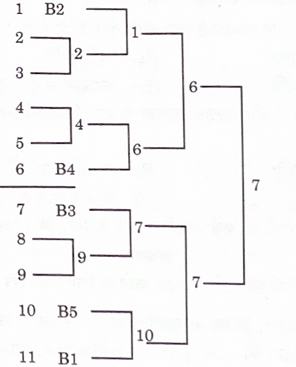
(i) What is the number of Non-bye teams in this tournament?
View Solution
In a tournament with 11 teams, 5 teams (B2, B3, B4, B5, B1) receive byes, meaning they skip the first round and automatically progress to the subsequent round. The other 6 teams compete in the initial round. Quick Tip: Receiving a "bye" in a tournament allows a team to automatically advance to the next round without competing in the first round.
(ii) If the above fixture had been of 48 teams, then the number of byes would have been _______.
View Solution
In a single-elimination tournament with 48 teams, the number of byes needed is determined by subtracting the number of teams from the nearest power of 2 that is equal to or greater than the team count. The nearest power of 2 to 48 is 64. Thus, the number of byes required is 64 minus 48, equaling 16 byes. Quick Tip: To calculate the number of byes in a knockout tournament, identify the smallest power of 2 that is equal to or greater than the number of participating teams, and then subtract the number of actual teams from this figure.
(iii) 7th match will be played between team number _____ and _____.
View Solution
In the outlined fixture, the 7th match features team number 7 (B3) against team number 6 (B4). These teams are set to compete in the 7th round of the knockout tournament. Quick Tip: In knockout tournament formats, advancing teams face off in subsequent rounds according to the predetermined bracket structure.
(iv) The provision in which good teams are placed in different half or pool, based on their ranking or previous performance, not by allotment of draw, so that they do not play with other teams in the first round is known as __________.
View Solution
The strategy described is referred to as Seeding. Seeding strategically positions top-ranked or high-performing teams in different sections of the tournament bracket. This arrangement prevents them from meeting in the early rounds, promoting a more balanced competition. Quick Tip: Seeding is a strategic approach used in tournament setups to ensure that the strongest teams do not eliminate each other in the initial stages, thereby maintaining competitive balance throughout the event.
(i) How many matches will be played in this tournament?
View Solution
In a knockout tournament format, each match results in the elimination of one team. Therefore, to determine a winner from 17 teams, the total number of matches required will be 16, as each match reduces the pool of competitors by one team. Quick Tip: In knockout tournaments, remember that the total number of games needed to declare a champion is always one less than the number of participating teams, due to the single-elimination nature of the matches.
(ii) ______ saves cost and time and makes each match intensive because of fear of elimination.
View Solution
The appropriate format is a knockout tournament. In such tournaments, teams are immediately eliminated following a loss, heightening the stakes of each contest and shortening the overall duration of the event.
Knockout tournaments are recognized for their efficiency and cost-effectiveness because they decrease the total number of games by eliminating teams progressively after each round. Quick Tip: Knockout tournaments are ideal when time or resources are limited, as they ensure a swift progression to a winner with fewer matches compared to round-robin or other formats.
(iii) Two team players got injured during the match, which committee will manage it?
View Solution
In this scenario, the Technical committee is responsible for overseeing the tournament operations, which includes addressing any injuries that occur. They would coordinate medical assistance for the injured players.
The Technical committee is tasked with managing the logistics of the matches and ensuring player safety throughout the event. Quick Tip: It's important for event organizers to have a dedicated team, such as the Technical committee, to handle logistics and safety to ensure smooth operations and immediate response to any incidents during competitions.
(iv)(a) Which formula was used to allot byes to the above teams in the lower half?
View Solution
In assigning byes in a knockout tournament, the goal is to give each team an equitable opportunity to advance. Byes are typically awarded to the highest-ranked teams or determined by the draw to facilitate an even number of teams in subsequent rounds.
In situations with an odd number of teams, such as 17, byes help to balance the bracket and ensure that each round has an even number of matches. Quick Tip: When planning a knockout tournament with an odd number of teams, consider using byes to streamline the competition structure and prevent logistical challenges in the scheduling of matches.
(iv)(b). Which formula was used to allot byes to the above teams in the upper half?
View Solution
In the upper half of the tournament bracket, byes are allocated using a similar method, favoring higher-seeded or ranked teams to maintain balance within the brackets. This strategy ensures an equal distribution of teams, accommodating instances where the total number is odd.
Byes are distributed in the upper half either based on team rankings or through a drawing process to ensure equitable match arrangements and tournament progression. Quick Tip: In tournaments, strategically assigning byes to higher-ranked teams can help maintain competitive balance and streamline the progression of rounds, especially in brackets with an odd number of participants.
(i) To participate in Special Olympics, the minimum age should be ____ years old.
View Solution
Typically, individuals must be at least 8 years old to compete in the Special Olympics. Quick Tip: When planning to participate in or register someone for the Special Olympics, it's important to verify the age requirements to ensure eligibility.
(ii) The first Deaflympics was held in the year ____.
View Solution
The inaugural Deaflympics took place in the year 1924. Quick Tip: When exploring the history of international sports events, noting their origin years can provide insights into their development and significance over time.
(iii) Who was the founder of the Paralympics?
View Solution
Sir Ludwig Guttmann is credited with founding the Paralympics. Quick Tip: Learning about the founders of major sports movements like the Paralympics can provide valuable context for their origins and the evolution of sports for athletes with disabilities.
(iv) Write any two strategies to make physical activities accessible for special children.
View Solution
Two methods to enhance accessibility in physical activities for children with special needs are:
Utilizing adaptive equipment designed to accommodate different disabilities.
Developing personalized training programs that cater to the unique requirements and capabilities of each child. Quick Tip: When organizing physical activities for children with special needs, prioritize creating a secure, inclusive, and encouraging environment. Tailor activities to individual needs and consult with experts in adaptive physical education to ensure optimal engagement and safety.
(i) Which is not a long-term effect of exercises on the muscular system?
View Solution
One long-term effect of exercise that does not occur in the muscular system is the accumulation of lactate, since lactate accumulation is generally associated with short-term anaerobic exertion. Quick Tip: Understanding the difference between short-term and long-term effects of exercise on the body can help in designing more effective fitness programs and managing expectations regarding physical training outcomes.
(ii) What is cardiac output?
View Solution
Cardiac output is the volume of blood pumped by the heart into the circulation each minute. Quick Tip: Knowing the concept of cardiac output is crucial for understanding how efficiently the heart can supply oxygen and nutrients to the body during various levels of physical activity.
(iii) Choose the correct statement related to tidal volume:
View Solution
The accurate description of tidal volume is that it represents the volume of air taken in or expelled during a normal breath. Quick Tip: Understanding tidal volume is important for gauging respiratory health, especially in assessing how effectively the lungs are working during various levels of activity and rest.
(iv) Lactic acid tolerance relates to:
View Solution
Lactic acid tolerance is closely associated with endurance, as it indicates the body's capacity to withstand and metabolize lactic acid during extended periods of exercise. Quick Tip: Grasping concepts such as lactic acid tolerance is essential for athletes and trainers to enhance endurance and optimize performance during prolonged physical activities.
Describe the procedure and benefits of Mandukasana and Makrasana to control hypertension.
View Solution
Mandukasana (Frog Pose): This yoga pose is performed by sitting back on the heels with knees spread wide, placing the hands on the floor, and bending forward to bring the chest towards the thighs. Benefits include stimulating abdominal organs, lowering blood sugar levels, and reducing stress and anxiety, which contributes to hypertension management.
Makrasana (Crocodile Pose): To execute this pose, lie face down, rest the hands folded under the head, keep the legs slightly apart, and relax the neck and shoulders. It's beneficial for easing stress and tension, enhancing relaxation, and promoting better sleep, all of which help manage hypertension. Quick Tip: Regular yoga practice can greatly enhance cardiovascular health and decrease stress, both crucial for controlling hypertension.
What do you mean by Equilibrium? Explain how Equilibrium increases with the influence of various factors by giving suitable examples from sports.
View Solution
Equilibrium in sports is the ability to maintain or restore balance during physical activity. Enhancements in equilibrium come from improved strength, flexibility, and proprioception. For instance, gymnasts achieve equilibrium on a balance beam by training specifically to improve muscle coordination and balance. Quick Tip: To enhance equilibrium, athletes should engage in regular balance and proprioceptive exercises, which are essential for optimizing performance and reducing the risk of injuries across all sports disciplines.
What do you understand by circuit training? How a coach will plan circuit training sessions with 6 stations to develop fitness of his new trainees?
View Solution
Circuit Training is a type of body conditioning or endurance training that combines high-intensity aerobics with resistance training. It focuses on enhancing strength and muscular endurance. During a circuit training session, a coach may arrange various stations involving cardiovascular, strength, and agility exercises. Participants rotate between stations, spending a few minutes at each and transitioning quickly with little to no rest. Quick Tip: Circuit training efficiently boosts overall fitness by integrating different physical training elements into a concise, time-efficient workout regimen.
Write in detail the procedure and scoring of 'Flamingo Balance Test' and 'Plate Taping Test' recommended for the age group 5 – 8 years by SAI (Sports Authority of India).
View Solution
Flamingo Balance Test: This test evaluates an individual's balance by requiring them to stand on one leg for a specified period. The score is determined by counting how often the foot touches the ground as they strive to maintain balance for one minute.
Plate Taping Test: This test measures hand-eye coordination and agility by recording the speed at which participants can place and retrieve discs from specific circles. The performance is scored based on how quickly the task is completed. Quick Tip: These tests are valuable for assessing physical abilities in children, helping to identify motor skills and balance proficiency at an early stage.
*The article might have information for the previous academic years, please refer the official website of the exam.