
CBSE Class 12 Accountancy set 1 Question Paper Pdf - Check Solutions with Answer Key Pdf

.jpg?tr=h-55,w-55,c-force)
Content Strategist|Tech-innovator|National Hackathon Winner | Updated On - Jan 22, 2025
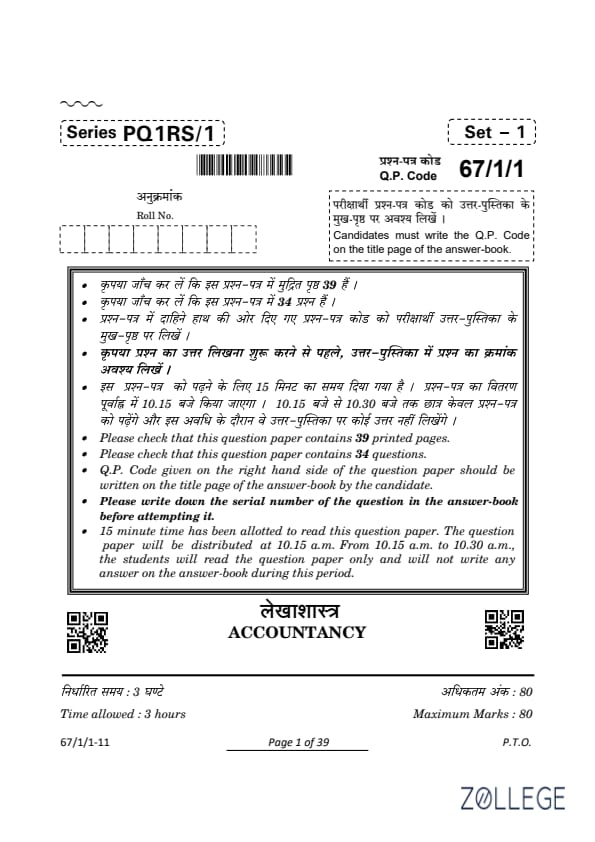
CBSE Class 12 2024 Accountancy Set-1 67/1/1 Question Paper is available for download. The exam was successfully conducted by CBSE on March 23 in the morning session from 10:30 AM to 1:30 PM. As per the student’s initial reactions, the CBSE Class 12 2024 Accountancy Set-1 67/1/1 Question Paper was reported as Moderate. The Partnership Accounts section in the CBSE Class 12 2024 Accountancy Set-1 67/1/1 Question Paper was reported as Challenging, Company Accounts as Moderate, and Analysis of Financial Statements as Easy to Moderate.
CBSE Class 12 2024 Accountancy Question Paper with Answer Key PDF
| CBSE Class 12 2024 Accountancy Question Paper with Answer Key |  Download Download |
Check Solution |
CBSE Class 12 2024 Accountancy Questions with Solutions
PART A (Accounting for Partnership Firms and Companies)
Question 1(a):
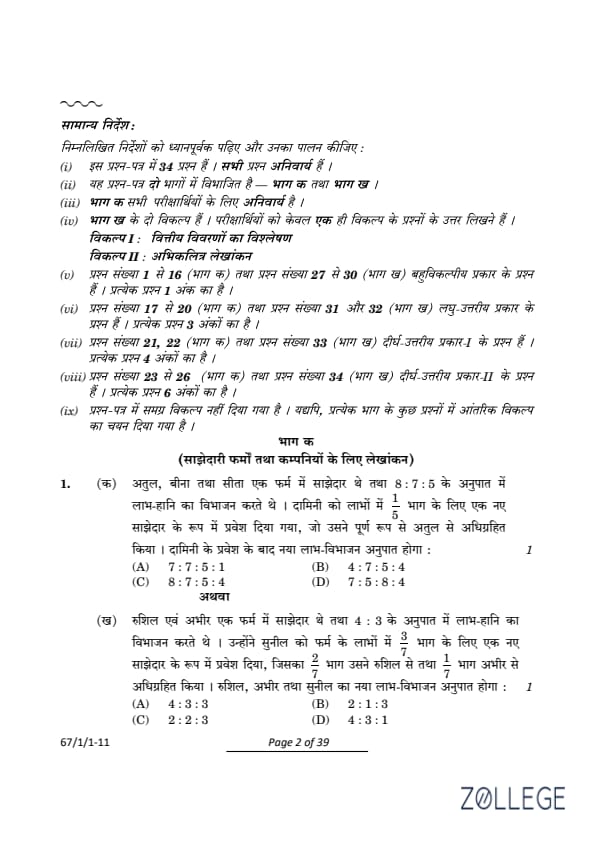
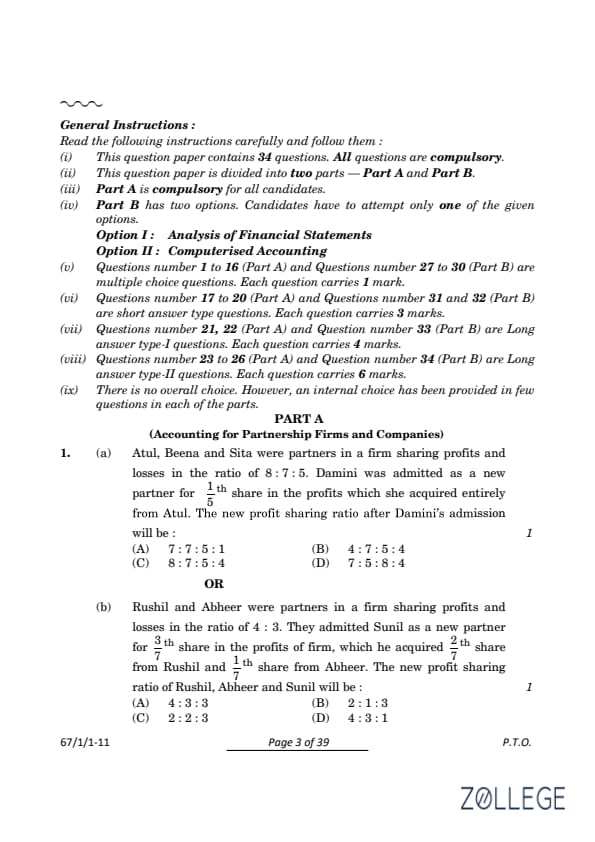
Atul, Beena, and Sita were partners in a firm sharing profits and losses in the ratio of 8 : 7 : 5. Damini was admitted as a new partner for 1/5 share in the profits, which she acquired entirely from Atul. Find the new profit-sharing ratio.
View Solution
Solution:
- Total share of Atul before Damini’s admission: 8 + 7 + 5 = 20 parts.
- Damini acquires 1/5 share from Atul. Atul’s new share: 8 − (1/5 × 20) = 8 − 4 = 7 parts.
- Beena’s and Sita’s shares remain unchanged at 7 and 5 parts, respectively.
- Damini’s share is 4 parts (from Atul).
New profit-sharing ratio: 7 : 7 : 5 : 1.
Quick Tip: When a new partner is admitted, their share is deducted from the contributing partner(s), and the new ratio is calculated accordingly.
Question 1(b):
Rushil and Abheer were partners in a firm sharing profits and losses in the ratio of 4 : 3. They admitted Sunil as a new partner for 3/7 share in the profits, which he acquired 2/7 share from Rushil and 1/7 share from Abheer. Find the new profit-sharing ratio.
View Solution
Solution:
- Rushil’s new share: 4 − 2/7 = 28/7 − 2/7 = 26/7.
- Abheer’s new share: 3 − 1/7 = 21/7 − 1/7 = 20/7.
- Sunil’s share: 3/7.
Combine to find the new ratio:
Rushil : Abheer : Sunil = 26 : 20 : 3 = 2 : 2 : 3 (on simplifying).
Quick Tip: While calculating the new ratio, ensure the proportional deduction of shares from existing partners matches the contribution to the new partner.
Question 2:
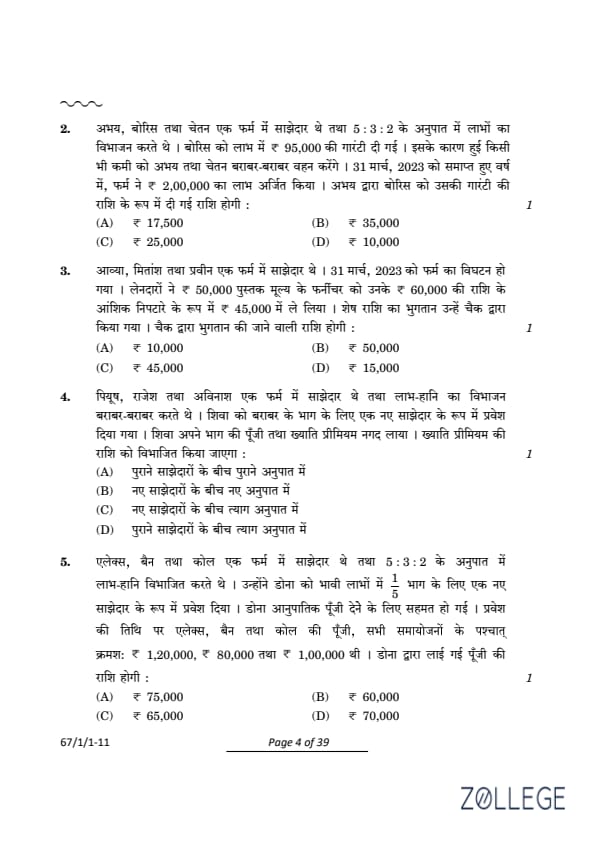
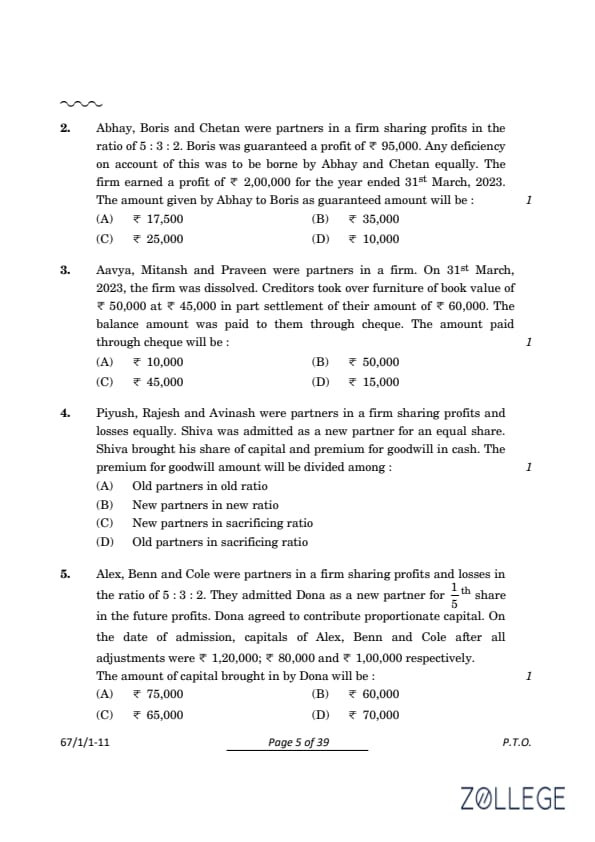
Abhay, Boris, and Chetan were partners in a firm sharing profits in the ratio of 5 : 3 : 2. Boris was guaranteed a profit of ₹95,000. Any deficiency on account of this was to be borne by Abhay and Chetan equally. The firm earned a profit of ₹2,00,000 for the year ended 31st March, 2023. Find the amount given by Abhay to Boris as guaranteed amount.
View Solution
Solution:
- Total profit = ₹2,00,000.
- Profit sharing of Boris as per ratio = (3/10) × 2,00,000 = ₹60,000.
- Shortfall for Boris = ₹95,000 − ₹60,000 = ₹35,000.
- This shortfall is borne equally by Abhay and Chetan.
- Amount given by Abhay to Boris = ₹35,000 ÷ 2 = ₹17,500.
Final Amount: ₹35,000.
Question 3:
Aavya, Mitansh, and Praveen were partners in a firm. On 31st March 2023, the firm was dissolved. Creditors took over furniture of book value ₹50,000 at ₹45,000 in part settlement of their amount of ₹60,000. The balance amount was paid to them through cheque. Find the amount paid through cheque.
View Solution
Solution:
- Total creditor amount = ₹60,000.
- Amount adjusted against furniture = ₹45,000.
- Balance payable to creditors = ₹60,000 − ₹45,000 = ₹15,000.
Final Amount: ₹15,000 (paid through cheque).
Question 4:
Piyush, Rajesh, and Avinash were partners in a firm sharing profits and losses equally. Shiva was admitted as a new partner for an equal share. Shiva brought his share of capital and premium for goodwill in cash. The premium for goodwill will be divided among:
View Solution
Solution:
- Goodwill is shared among old partners in their sacrificing ratio.
- Sacrificing ratio: Old ratio − New ratio.
- Since profits were shared equally, the sacrificing ratio = 1 : 1 : 1.
Quick Tip: Goodwill is compensated to the sacrificing partners based on the proportion of their sacrificed shares.
Question 5:
Alex, Benn, and Cole were partners in a firm sharing profits and losses in the ratio of 5 : 3 : 2. They admitted Dona as a new partner for 1/5 share in the future profits. Dona agreed to contribute proportionate capital. On the date of admission, capitals of Alex, Benn, and Cole after all adjustments were ₹1,20,000, ₹80,000, and ₹1,00,000, respectively. The amount of capital brought in by Dona will be:
View Solution
Solution:
- Total adjusted capitals of Alex, Benn, and Cole = ₹1,20,000 + ₹80,000 + ₹1,00,000 = ₹3,00,000.
- Dona’s capital based on her share = 1/5 × ₹3,00,000 = ₹75,000.
Quick Tip: When a new partner is admitted, their capital contribution is calculated in proportion to the existing partners’ capital.
Question 6:
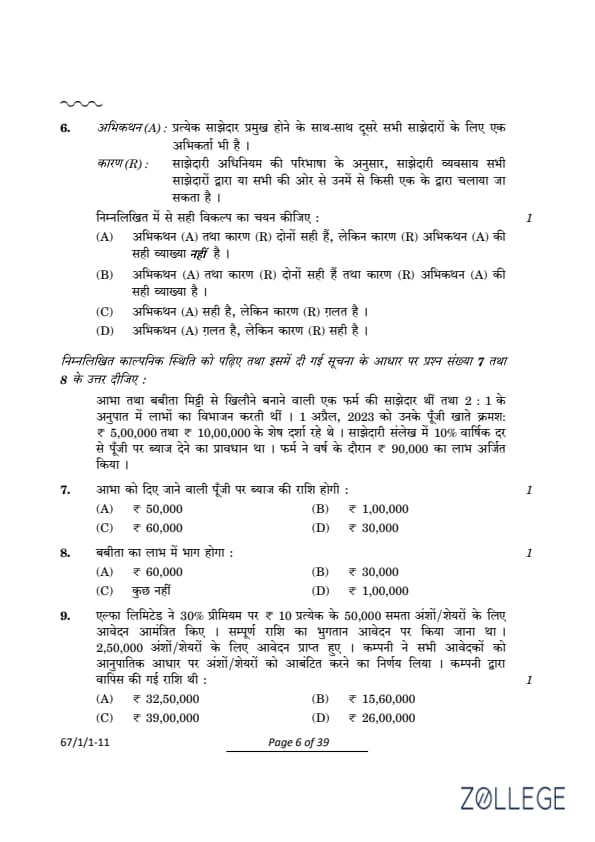
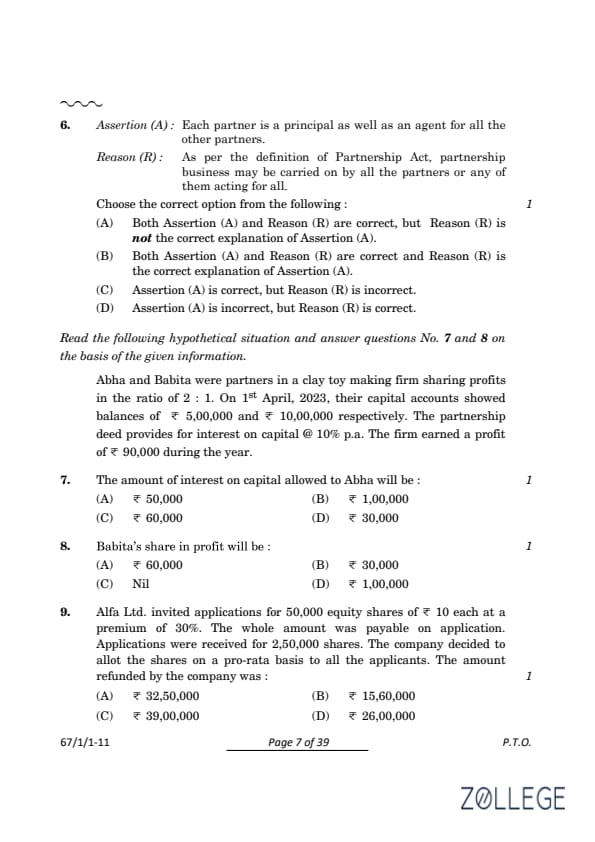
Assertion (A): Each partner is a principal as well as an agent for all the other partners.
Reason (R): As per the definition of the Partnership Act, partnership business may be carried on by all the partners or any of them acting for all.
View Solution
Solution:
- According to the Partnership Act, each partner acts as a principal when representing their own interests and as an agent when representing the interests of other partners.
- The definition in the Partnership Act clarifies that the business can be conducted by all partners collectively or by any one partner acting on behalf of all.
Conclusion: Both Assertion (A) and Reason (R) are correct, and Reason (R) appropriately explains Assertion (A).
Quick Tip: In partnerships, every partner has a dual role as both principal and agent, as defined under the Partnership Act.
Question 7:
Abha and Babita were partners in a clay toy-making firm sharing profits in the ratio of 2 : 1. On 1st April 2023, their capital accounts showed balances of ₹5,00,000 and ₹10,00,000 respectively. The partnership deed provides for interest on capital @ 10% p.a. The firm earned a profit of ₹90,000 during the year. The amount of interest on capital allowed to Abha will be:
View Solution
Solution:
- Interest on capital is calculated as per the partnership deed at the rate of 10% on Abha’s capital contribution.
- Abha’s capital = ₹5,00,000.
- Interest = 10% of ₹5,00,000 = ₹50,000.
Question 8:
Babita’s share in profit will be:
View Solution
- Babita’s share in profit is calculated based on the profit-sharing ratio of 2:1 between Abha and Babita.
- Total profit = ₹90,000.
- Babita's share = (1/3) × ₹90,000 = ₹30,000.
Quick Tip: Profit is distributed among partners based on the agreed profit-sharing ratio or as specified in the partnership deed.
Question 9:
Alfa Ltd. invited applications for 50,000 equity shares of ₹10 each at a premium of 30%. The whole amount was payable on application. Applications were received for 2,50,000 shares. The company decided to allot the shares on a pro-rata basis to all the applicants. The amount refunded by the company was:
View Solution
- Total number of shares applied for = 2,50,000.
- Total shares allotted = 50,000.
- Excess applications = 2,50,000 - 50,000 = 2,00,000.
- Amount received per share = ₹10 (face value) + ₹3 (premium) = ₹13.
- Amount refunded = Excess shares × Amount per share = 2,00,000 × ₹13 = ₹32,50,000.
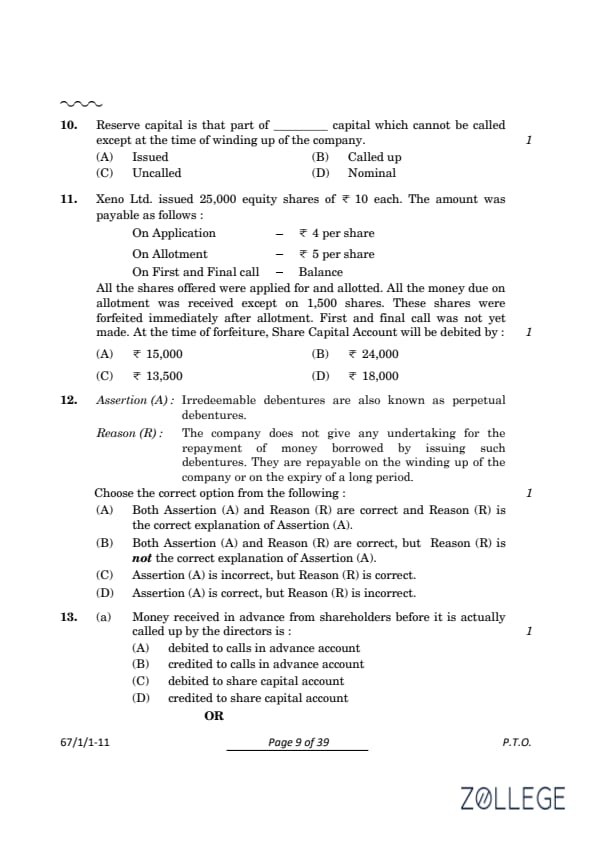
Question 10:
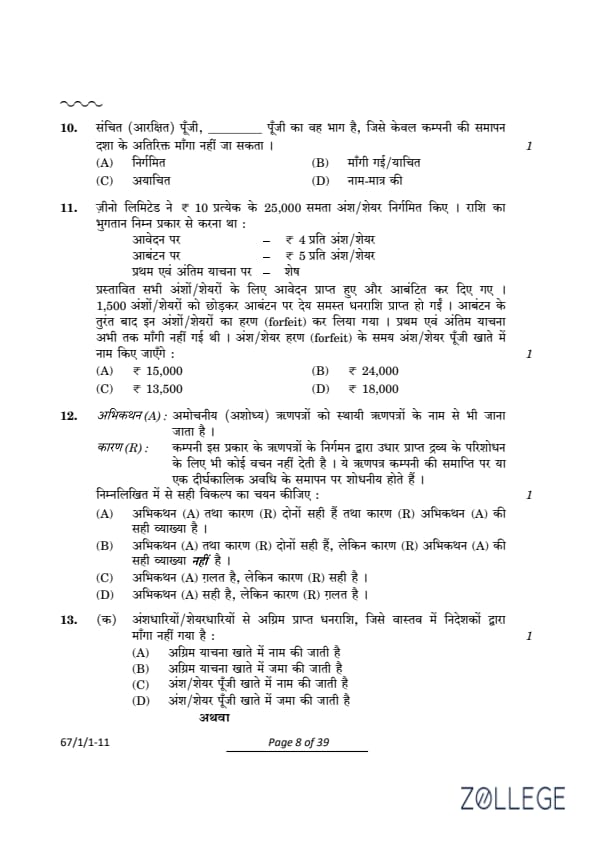
Reserve capital is that part of capital which cannot be called except at the time of winding up of the company.
View Solution
- Reserve capital refers to that portion of the uncalled capital that a company decides will only be called in the event of liquidation or winding up.
- It is a safety measure to ensure funds are available for creditors during winding up.
Quick Tip: Reserve capital is part of the uncalled capital and cannot be utilized unless the company is in liquidation.
Question 11:
Xeno Ltd. issued 25,000 equity shares of ₹10 each. The amount was payable as follows:
- On Application – ₹4 per share
- On Allotment – ₹5 per share
- On First and Final Call – Balance
All the shares offered were applied for and allotted. All the money due on allotment was received except on 1,500 shares. These shares were forfeited immediately after allotment. First and final call was not yet made. At the time of forfeiture, Share Capital Account will be debited by:
View Solution
- The face value of the shares is ₹10 each.
- The forfeiture of shares happens when the holder fails to pay the allotment money.
- Amount credited to Share Capital Account = Total application + Allotment money received.
- For 1,500 shares: ₹10 (face value) × 1,500 = ₹15,000.
Question 12:
Assertion (A): Irredeemable debentures are also known as perpetual debentures.
Reason (R): The company does not give any undertaking for the repayment of money borrowed by issuing such debentures. They are repayable on the winding up of the company or on the expiry of a long period.
View Solution
- Irredeemable debentures are also referred to as perpetual debentures because they do not have a fixed repayment date and are repayable only upon winding up or the expiration of a long period.
- These debentures serve as long-term funding instruments for the company and do not bind the company to repay the principal within a specific timeframe.
- The explanation provided in the Reason (R) supports the Assertion (A), as it clearly defines the nature and repayment conditions of irredeemable debentures.
Question 13(a):
Money received in advance from shareholders before it is actually called up by the directors is:
View Solution
- Calls in advance refers to the amount received from shareholders before it is due as per the schedule of calls decided by the company.
- This amount cannot be considered as part of share capital until the corresponding call is made.
- Instead, it is treated as a liability since the company is obligated to refund or adjust this amount if required.
- As per accounting practices, calls in advance are credited to the "Calls in Advance Account," which appears under the "Liabilities" section of the company's balance sheet.
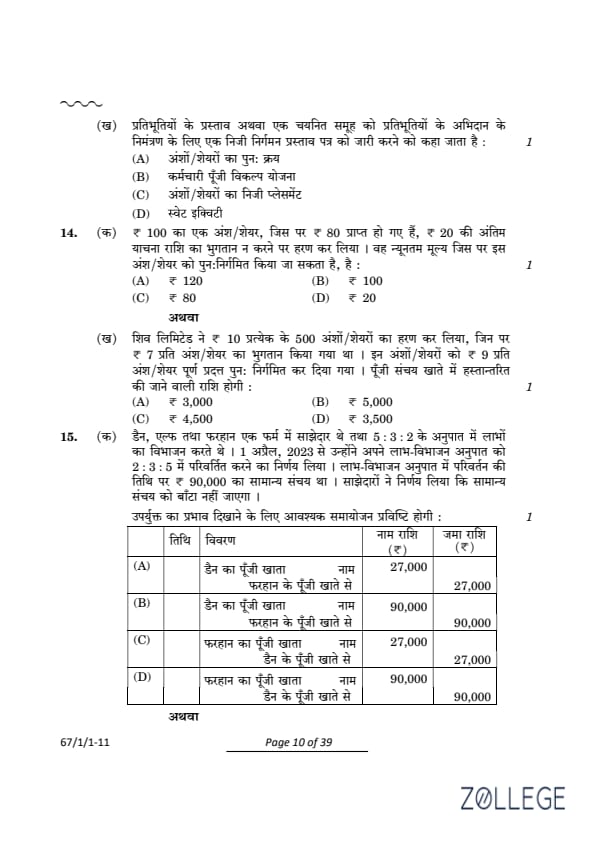
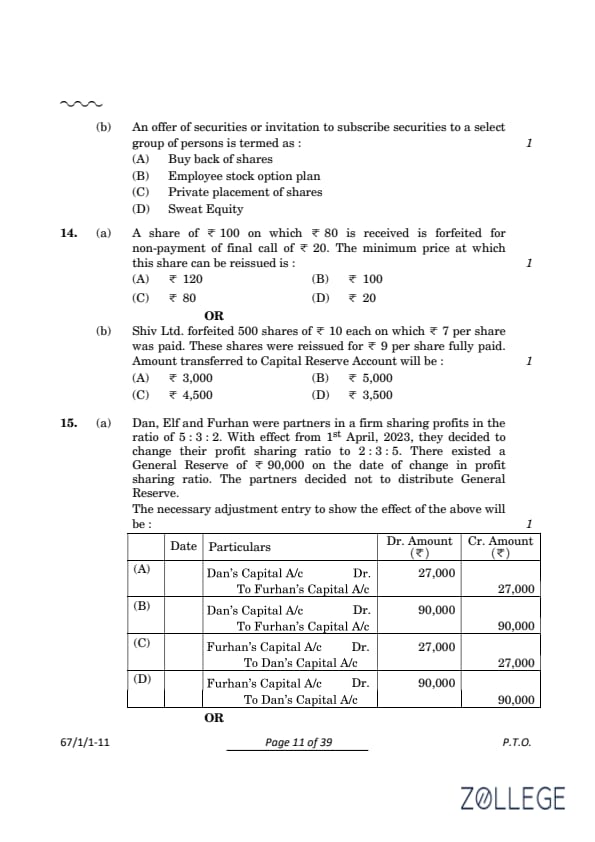
Question 13(b):
An offer of securities or invitation to subscribe securities to a select group of persons is termed as:
View Solution
- Private placement refers to the process of offering securities, such as shares or debentures, to a specific group of investors, typically institutional investors or a select few individuals.
- This method is often chosen to raise capital quickly without the formalities and costs associated with public offerings.
- Unlike a public offering, where securities are available to the general public, private placement is restricted to a limited number of investors and is governed by specific regulations under the Companies Act.
- The procedure ensures confidentiality and allows the company to target specific investors who can provide significant capital or strategic value.
Question 14(a):
A share of ₹100 on which ₹80 is received is forfeited for non-payment of final call of ₹20. The minimum price at which this share can be reissued is:
View Solution
- When a share is forfeited, it means the shareholder has failed to pay the entire amount due on the share.
- In this case, ₹80 has already been paid, and the unpaid amount is ₹20 (the final call).
- As per the Companies Act, forfeited shares can be reissued, but the minimum price at which they can be reissued must not be less than the unpaid amount.
- Therefore, the minimum price at which this share can be reissued is ₹20.
Question 14(b):
Shiv Ltd. forfeited 500 shares of ₹10 each on which ₹7 per share was paid. These shares were reissued for ₹9 per share fully paid. Amount transferred to Capital Reserve Account will be:
View Solution
Step 1: Total Paid-Up Value of Shares Before Forfeiture
- Paid-up value before forfeiture: ₹7 × 500 = ₹3,500
Step 2: Amount Received on Reissue
- Reissued price: ₹9 × 500 = ₹4,500
Step 3: Total Value of Shares
- Nominal value of shares: ₹10 × 500 = ₹5,000
Step 4: Capital Reserve Calculation
- Excess amount received on reissue (profit) transferred to Capital Reserve:
- Capital Reserve = Nominal value - Amount paid-up - Reissue price = ₹5,000 - ₹4,500 = ₹3,500
Conclusion: Amount transferred to Capital Reserve = ₹3,500
Question 15(a):
Dan, Elf, and Furhan were partners in a firm sharing profits in the ratio of 5 : 3 : 2. With effect from 1st April, 2023, they decided to change their profit-sharing ratio to 2 : 3 : 5. There existed a General Reserve of ₹90,000 on the date of the change in profit-sharing ratio. The partners decided not to distribute the General Reserve.
The necessary adjustment entry for the above is as follows:
View Solution
Step 1: Profit-Sharing Ratios
- Old Ratio: 5 : 3 : 2
- New Ratio: 2 : 3 : 5
Step 2: Calculation of Gaining/Sacrificing Ratio
- Dan’s Share:
Old Share - New Share = 5/10 - 2/10 = 3/10(Sacrificing). - Elf’s Share:
Old Share - New Share = 3/10 - 3/10 = 0. - Furhan’s Share:
Old Share - New Share = 2/10 - 5/10 = -3/10(Gaining).
Step 3: Adjustment of General Reserve
- Total General Reserve: ₹90,000
- Sacrificing/Gaining Ratio: Dan (3/10), Elf (0), Furhan (-3/10).
- Amount Adjustment:
Dan = ₹90,000 × 3/10 = ₹27,000,Furhan = ₹90,000 × (-3/10) = -₹27,000.
Journal Entry:
| Date | Particulars | Dr. (₹) | Cr. (₹) |
|---|---|---|---|
| 2023-04-01 | Dan's Capital A/c Dr. | 27,000 | |
| To Furhan's Capital A/c | 27,000 |
(Being the adjustment of General Reserve made due to the change in profit-sharing ratio)
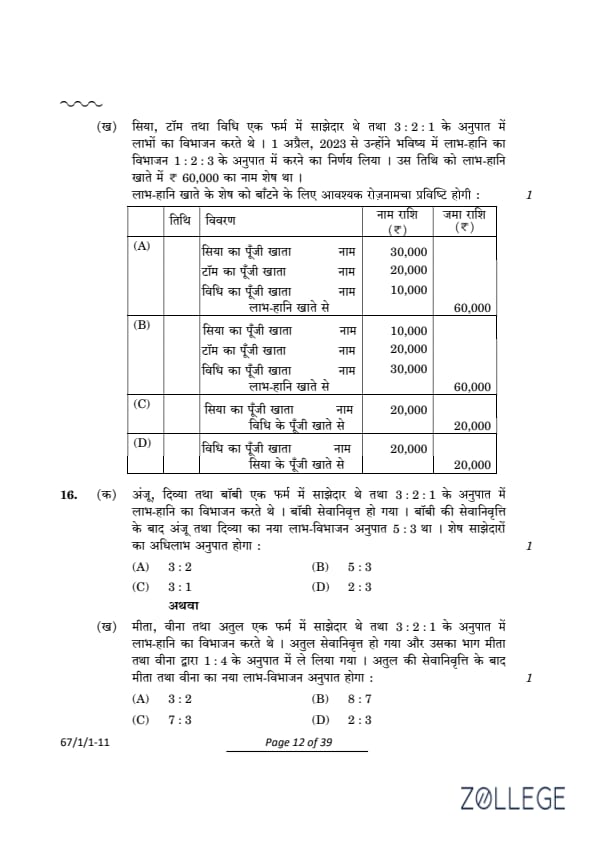
Question 15(b):
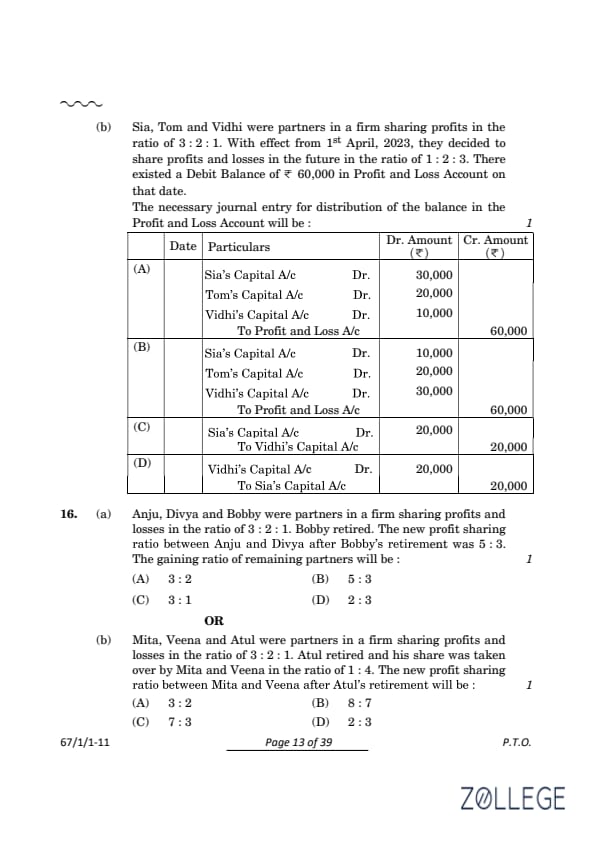
Sia, Tom, and Vidhi were partners in a firm sharing profits in the ratio of 3 : 2 : 1. With effect from 1st April, 2023, they decided to share profits and losses in the future in the ratio of 1 : 2 : 3. There existed a Debit Balance of ₹60,000 in the Profit and Loss Account on that date.
The necessary journal entry for the distribution of the balance in the Profit and Loss Account is as follows:
View Solution
Step 1: Old Profit-Sharing Ratio
- Old Ratio: 3 : 2 : 1
Step 2: Distribution of Loss
- Total Loss: ₹60,000
- Sia’s Share:
₹60,000 × 3/6 = ₹30,000 - Tom’s Share:
₹60,000 × 2/6 = ₹20,000 - Vidhi’s Share:
₹60,000 × 1/6 = ₹10,000
Journal Entry:
| Date | Particulars | Dr. (₹) | Cr. (₹) |
|---|---|---|---|
| 2023-04-01 | Sia's Capital A/c Dr. | 30,000 | |
| Tom's Capital A/c Dr. | 20,000 | ||
| Vidhi's Capital A/c Dr. | 10,000 | ||
| To Profit and Loss A/c | 60,000 |
(Being the adjustment of debit balance in Profit and Loss Account shared in the old ratio)
Question 16(a):
Anju, Divya, and Bobby were partners in a firm sharing profits and losses in the ratio of 3 : 2 : 1. Bobby retired. The new profit-sharing ratio between Anju and Divya after Bobby’s retirement was 5 : 3. The gaining ratio of the remaining partners will be:
View Solution
Step 1: Calculate Bobby's Share
- Total ratio: 3 + 2 + 1 = 6
- Bobby's share: 1/6
Step 2: Old Shares of Anju and Divya
- Anju's old share: 3/6 = 1/2
- Divya's old share: 2/6 = 1/3
Step 3: New Shares of Anju and Divya
- Total share after Bobby's retirement: 1 - 1/6 = 5/6
- New share of Anju: 5/6 × 5/8 = 25/48
- New share of Divya: 5/6 × 3/8 = 15/48
Step 4: Gaining Ratio
- Gaining Ratio = New Share - Old Share
- Anju's gain: 25/48 - 1/2 = 25/48 - 24/48 = 1/48
- Divya's gain: 15/48 - 1/3 = 15/48 - 16/48 = -1/48
- Their Gaining Ratio = 3 : 1
Question 16(b):
Mita, Veena, and Atul were partners in a firm sharing profits and losses in the ratio 3 : 2 : 1. Atul retired, and his share was taken over by Mita and Veena in the ratio 1 : 4. The new profit-sharing ratio between Mita and Veena after Atul’s retirement will be:
View Solution
- **Step 1: Determine Atul’s share:**
Atul’s share in the firm = \( \frac{1}{6} \) (since the total ratio is \( 3 + 2 + 1 = 6 \)). - **Step 2: Calculate Mita’s original share and Veena’s original share:**
Mita’s share = \( \frac{3}{6} = \frac{1}{2} \), Veena’s share = \( \frac{2}{6} = \frac{1}{3} \). - **Step 3: Distribution of Atul’s share:**
Atul’s share of \( \frac{1}{6} \) is taken over by Mita and Veena in the ratio 1 : 4.
- Mita’s additional share = \( \frac{1}{6} \times \frac{1}{5} = \frac{1}{30} \).
- Veena’s additional share = \( \frac{1}{6} \times \frac{4}{5} = \frac{4}{30} = \frac{2}{15} \). - **Step 4: New shares of Mita and Veena:**
- Mita’s new share = \( \frac{1}{2} + \frac{1}{30} = \frac{15}{30} + \frac{1}{30} = \frac{16}{30} = \frac{8}{15} \).
- Veena’s new share = \( \frac{1}{3} + \frac{2}{15} = \frac{5}{15} + \frac{2}{15} = \frac{7}{15} \). - **Step 5: New profit-sharing ratio:**
New ratio = \( 8 : 7 \).
Question 17:
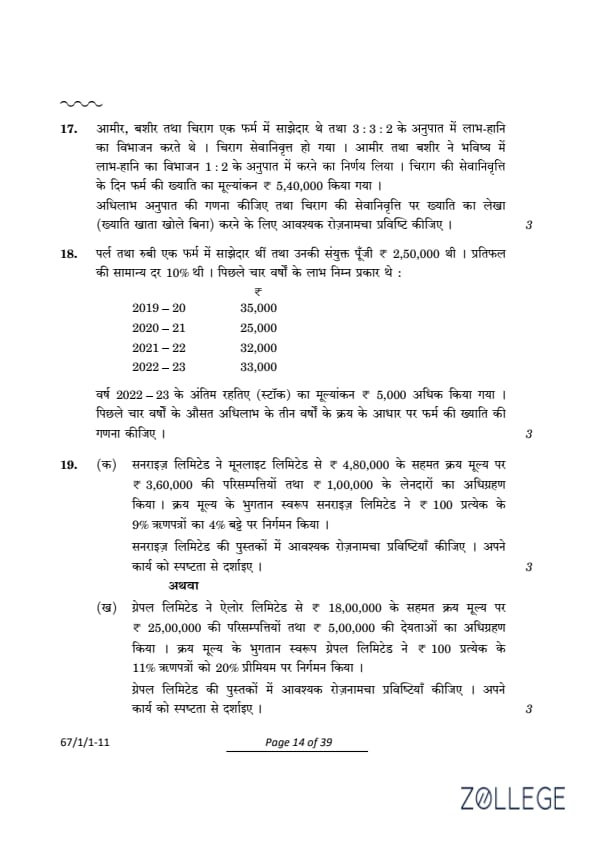
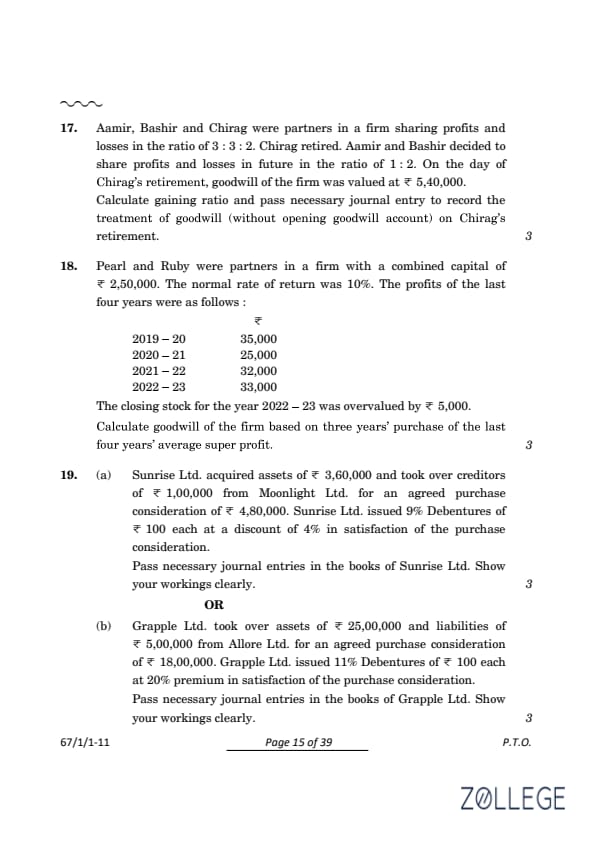
Aamir, Bashir, and Chirag were partners in a firm sharing profits and losses in the ratio 3 : 3 : 2. Chirag retired. Aamir and Bashir decided to share profits and losses in the future in the ratio 1 : 2. On the day of Chirag’s retirement, goodwill of the firm was valued at ₹5,40,000. Calculate gaining ratio and pass necessary journal entry to record the treatment of goodwill (without opening goodwill account) on Chirag’s retirement.
View Solution
- **Step 1: Determine the old ratio and Chirag’s share of goodwill:**
- Old profit-sharing ratio = 3 : 3 : 2.
- Chirag’s share = \( \frac{2}{8} \) (since \( 3 + 3 + 2 = 8 \)).
- Chirag’s share of goodwill = \( \frac{2}{8} \times ₹5,40,000 = ₹1,35,000 \). - **Step 2: Calculate the new ratio:**
- Aamir’s new share = \( \frac{1}{3} \), Bashir’s new share = \( \frac{2}{3} \). - **Step 3: Calculate gaining ratio:**
Gaining ratio = New Share − Old Share.
- Aamir’s gain = \( \frac{1}{3} − \frac{3}{8} = \frac{8}{24} − \frac{9}{24} = −\frac{1}{24} \) (no gain).
- Bashir’s gain = \( \frac{2}{3} − \frac{3}{8} = \frac{16}{24} − \frac{9}{24} = \frac{7}{24} \).
- Gaining ratio = \( 0 : \frac{7}{24} \) (Bashir solely gains). - **Step 4: Treatment of goodwill:**
Since Aamir has no gain, the entire adjustment of goodwill is borne by Bashir.
- Bashir’s Capital A/c Dr. ₹1,35,000
- To Chirag’s Capital A/c ₹1,35,000.
Question 18:
Pearl and Ruby were partners in a firm with a combined capital of ₹2,50,000. The normal rate of return was 10%. The profits of the last four years were as follows:
- 2019–2020: ₹35,000
- 2020–2021: ₹25,000
- 2021–2022: ₹32,000
- 2022–2023: ₹33,000
The closing stock for the year 2022–2023 was overvalued by ₹5,000. Calculate the goodwill of the firm based on three years’ purchase of the last four years’ average super profit.
View Solution
Step 1: Calculation of Adjusted Profits
Profit for 2022–2023 needs adjustment for the overvalued stock:
Adjusted profit for 2022–2023 = ₹33,000 - ₹5,000 = ₹28,000.
Adjusted profits for the last four years:
2019–2020: ₹35,000, 2020–2021: ₹25,000, 2021–2022: ₹32,000, 2022–2023: ₹28,000.
Step 2: Calculation of Average Profit
Average Profit = (Sum of Profits) / (Number of Years)
Average Profit = (₹35,000 + ₹25,000 + ₹32,000 + ₹28,000) / 4 = ₹1,20,000 / 4 = ₹30,000.
Step 3: Calculation of Normal Profit
Normal Profit = Capital Employed × Normal Rate of Return
Normal Profit = ₹2,50,000 × 10% = ₹25,000.
Step 4: Calculation of Super Profit
Super Profit = Average Profit − Normal Profit
Super Profit = ₹30,000 − ₹25,000 = ₹5,000.
Step 5: Calculation of Goodwill
Goodwill = Super Profit × Number of Years’ Purchase
Goodwill = ₹5,000 × 3 = ₹15,000.
Conclusion:
Goodwill of the firm = ₹15,000.
Question 19(a):
Sunrise Ltd. acquired assets of ₹3,60,000 and took over creditors of ₹1,00,000 from Moonlight Ltd. for an agreed purchase consideration of ₹4,80,000. Sunrise Ltd. issued 9% Debentures of ₹100 each at a discount of 4% in satisfaction of the purchase consideration. Pass necessary journal entries in the books of Sunrise Ltd.
View Solution
Step 1: Calculation of Issue Price of Debentures
- Face value of debentures = ₹100 each
- Discount = 4% of ₹100 = ₹4
- Issue price = ₹100 - ₹4 = ₹96 per debenture
Number of Debentures to be Issued = Purchase Consideration ÷ Issue Price
= ₹4,80,000 ÷ ₹96 = 5,000 Debentures.
Journal Entries:
| Date | Particulars | L.F. | Amount (₹) |
|---|---|---|---|
| 2025-01-14 | Sundry Assets A/c Dr. | 3,60,000 | |
| Creditors A/c Dr. | 1,00,000 | ||
| To Moonlight Ltd. | 4,80,000 | ||
| (Being assets and liabilities taken over from Moonlight Ltd.) | |||
| 2025-01-14 | Moonlight Ltd. Dr. | 4,80,000 | |
| To 9% Debentures A/c | 5,00,000 | ||
| To Discount on Issue of Debentures A/c | 20,000 | ||
| (Being issue of 5,000 debentures of ₹100 each at a discount of 4%) |
Question 19(b):
Grapple Ltd. took over assets of ₹25,00,000 and liabilities of ₹5,00,000 from Allore Ltd. for an agreed purchase consideration of ₹18,00,000. Grapple Ltd. issued 11% Debentures of ₹100 each at 20% premium in satisfaction of the purchase consideration. Pass necessary journal entries in the books of Grapple Ltd.
View Solution
Step 1: Calculation of Issue Price of Debentures
- Face value of debentures = ₹100 each
- Premium = 20% of ₹100 = ₹20
- Issue price = ₹100 + ₹20 = ₹120 per debenture
Number of Debentures to be Issued = Purchase Consideration ÷ Issue Price
= ₹18,00,000 ÷ ₹120 = 15,000 Debentures.
Journal Entries:
| Date | Particulars | L.F. | Amount (₹) |
|---|---|---|---|
| 2025-01-14 | Sundry Assets A/c Dr. | 25,00,000 | |
| To Sundry Liabilities A/c | 5,00,000 | ||
| To Allore Ltd. | 18,00,000 | ||
| (Being assets and liabilities taken over from Allore Ltd.) | |||
| 2025-01-14 | Allore Ltd. Dr. | 18,00,000 | |
| To 11% Debentures A/c | 15,00,000 | ||
| To Securities Premium A/c | 3,00,000 | ||
| (Being issue of 15,000 debentures of ₹100 each at a premium of ₹20) |
Question 20(a):
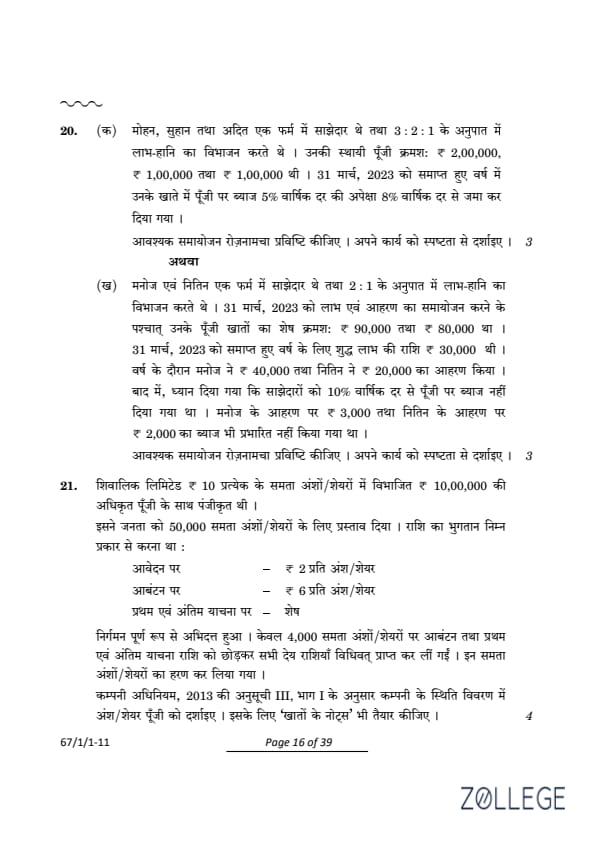
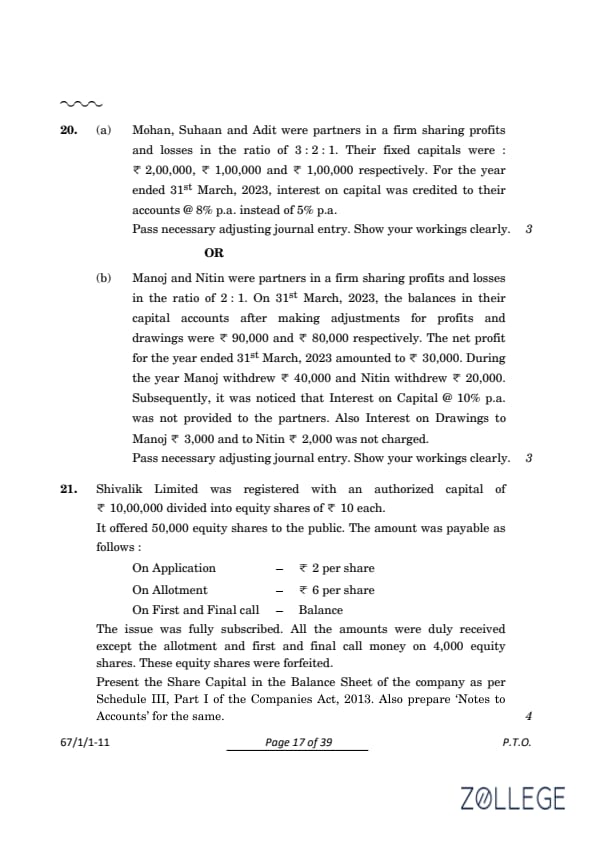
Mohan, Suhaan, and Adit were partners in a firm sharing profits and losses in the ratio 3:2:1. Their fixed capitals were ₹2,00,000, ₹1,00,000, and ₹1,00,000 respectively. For the year ended 31st March 2023, interest on capital was credited to their accounts @8% p.a. instead of 5% p.a. Pass the necessary adjusting journal entry.
View Solution
Step 1: Calculate Correct and Excess Interest on Capital
- Correct interest rate = 5%
- Excess interest rate = 8% - 5% = 3%
Correct Interest on Capital:
- Mohan: ₹2,00,000 × 5% = ₹10,000
- Suhaan: ₹1,00,000 × 5% = ₹5,000
- Adit: ₹1,00,000 × 5% = ₹5,000
Total Correct Interest = ₹10,000 + ₹5,000 + ₹5,000 = ₹20,000
Interest Credited at 8%:
- Mohan: ₹2,00,000 × 8% = ₹16,000
- Suhaan: ₹1,00,000 × 8% = ₹8,000
- Adit: ₹1,00,000 × 8% = ₹8,000
Total Credited Interest = ₹16,000 + ₹8,000 + ₹8,000 = ₹32,000
Excess Interest Credited: ₹32,000 - ₹20,000 = ₹12,000
Partner-wise Excess:
- Mohan: ₹6,000
- Suhaan: ₹3,000
- Adit: ₹3,000
Step 2: Adjust Excess Interest through Profit Sharing Ratio (3:2:1)
- Mohan’s Share of Adjustment = ₹6,000 × (3/6) = ₹3,000
- Suhaan’s Share = ₹6,000 × (2/6) = ₹2,000
- Adit’s Share = ₹6,000 × (1/6) = ₹1,000
Journal Entry:
| Date | Particulars | L.F. | Amount (₹) |
|---|---|---|---|
| 2025-01-14 | Mohan’s Capital A/c Dr. | 3,000 | |
| Suhaan’s Capital A/c Dr. | 2,000 | ||
| Adit’s Capital A/c Dr. | 1,000 | ||
| To Profit and Loss Adjustment A/c | 6,000 | ||
| (Being adjustment of excess interest on capital credited to partners) |
Question 20(b):
Manoj and Nitin were partners in a firm sharing profits and losses in the ratio 2:1. On 31st March 2023, the balances in their capital accounts after making adjustments for profits and drawings were ₹90,000 and ₹80,000 respectively. During the year, Manoj withdrew ₹40,000 and Nitin withdrew ₹20,000. Subsequently, it was noticed that interest on capital @10% p.a. was not provided to the partners. Also, interest on drawings to Manoj ₹3,000 and to Nitin ₹2,000 was not charged. Pass the necessary adjusting journal entry.
View Solution
Step 1: Calculate Interest on Capital
- Manoj: ₹90,000 × 10% = ₹9,000
- Nitin: ₹80,000 × 10% = ₹8,000
Total Interest on Capital = ₹9,000 + ₹8,000 = ₹17,000
Step 2: Interest on Drawings
- Manoj: ₹3,000
- Nitin: ₹2,000
Step 3: Net Adjustment
- Manoj: ₹9,000 - ₹3,000 = ₹6,000 (to be credited)
- Nitin: ₹8,000 - ₹2,000 = ₹6,000 (to be credited)
Journal Entry:
| Date | Particulars | L.F. | Amount (₹) |
|---|---|---|---|
| 2025-01-14 | Interest on Drawings A/c Dr. | 5,000 | |
| To Manoj’s Capital A/c | 3,000 | ||
| To Nitin’s Capital A/c | 2,000 | ||
| (Being interest on drawings charged to partners) | |||
| 2025-01-14 | Interest on Capital A/c Dr. | 17,000 | |
| To Manoj’s Capital A/c | 9,000 | ||
| To Nitin’s Capital A/c | 8,000 | ||
| (Being interest on capital credited to partners) |
Question 21:
Shivalik Limited was registered with an authorized capital of ₹10,00,000 divided into equity shares of ₹10 each. It offered 50,000 equity shares to the public. The amount was payable as follows:
- On Application: ₹2 per share
- On Allotment: ₹6 per share
- On First and Final Call: Balance (₹2 per share)
Additional Information: The issue was fully subscribed. All amounts were duly received except the allotment and first and final call money on 4,000 equity shares. These equity shares were forfeited.
Required: Present the Share Capital in the Balance Sheet as per Schedule III, Part I of the Companies Act, 2013, and prepare “Notes to Accounts” for the same.
View Solution
Step 1: Calculation of Share Capital
- Total Issued Capital = 50,000 × ₹10 = ₹5,00,000
- Subscribed Capital (Fully Paid) = (50,000 − 4,000) × ₹10 = ₹4,60,000
- Subscribed Capital (Not Fully Paid) = 4,000 × ₹2 = ₹8,000
- Forfeited Amount on 4,000 Shares = 4,000 × ₹2 (Application Money Received) = ₹8,000
Step 2: Presentation in the Balance Sheet
| Balance Sheet of Shivalik Limited as on 31st March, 2023 | |
|---|---|
| Particulars | Amount (₹) |
| Equity and Liabilities | |
| Shareholders’ Funds | 4,68,000 |
| Total | 4,68,000 |
Notes to Accounts:
| Note No. | Particulars | Amount (₹) |
|---|---|---|
| 1 | Authorized Capital: 1,00,000 Equity Shares of ₹10 each | 10,00,000 |
| Issued Capital: 50,000 Equity Shares of ₹10 each | 5,00,000 | |
| Subscribed Capital: | ||
| Subscribed and Fully Paid: 46,000 Equity Shares of ₹10 each | 4,60,000 | |
| Subscribed but Not Fully Paid: 4,000 Equity Shares of ₹2 each | 8,000 | |
| Forfeited Shares (Amount Received): 4,000 Equity Shares forfeited | 8,000 | |
| Total | 4,68,000 |
Question 22:
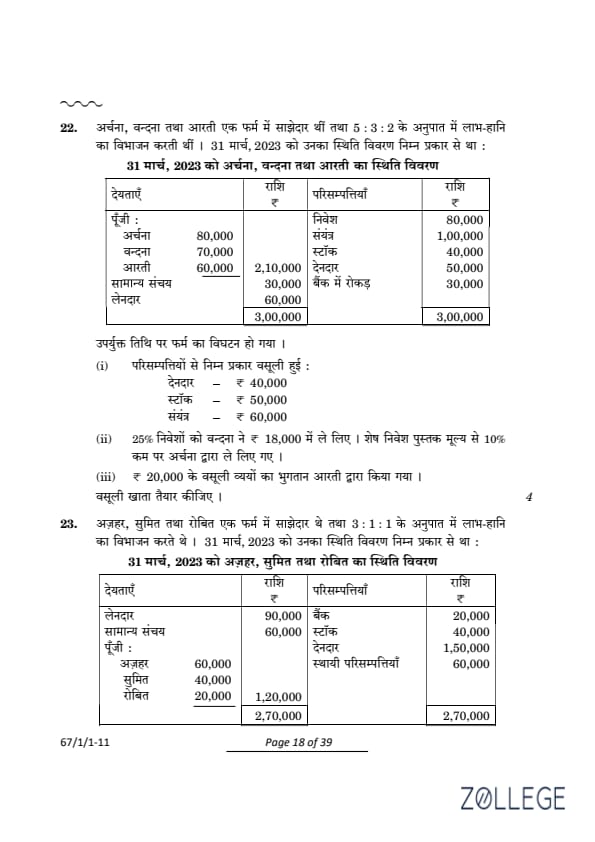
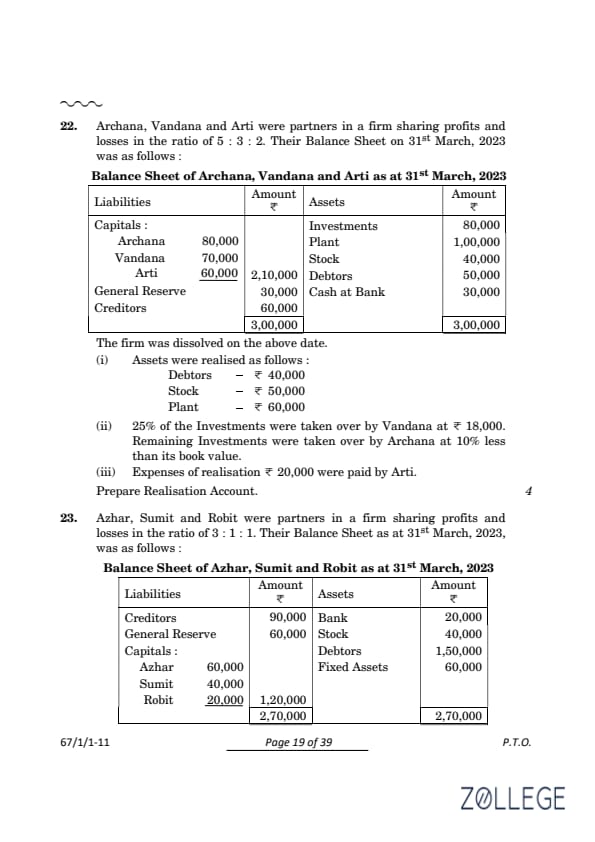
Archana, Vandana, and Arti were partners in a firm sharing profits and losses in the ratio 5 : 3 : 2. Their Balance Sheet as at 31st March, 2023 was as follows:
| Liabilities | Amount (₹) | Assets | Amount (₹) |
|---|---|---|---|
| Capitals: | |||
| Archana | 80,000 | Investments | 80,000 |
| Vandana | 70,000 | Plant | 1,00,000 |
| Arti | 60,000 | Stock | 40,000 |
| General Reserve | 30,000 | Debtors | 50,000 |
| Creditors | 60,000 | Cash at Bank | 30,000 |
| Total | 3,00,000 | Total | 3,00,000 |
Adjustments:
- Debtors realized ₹40,000; Stock ₹50,000; Plant ₹60,000.
- 25% of investments taken over by Vandana at ₹18,000. Remaining investments taken over by Archana at 10% less than book value.
- Realization expenses ₹20,000 paid by Arti.
Prepare Realization Account.
View Solution
Realization Account
| Particulars | Amount (₹) | Particulars | Amount (₹) |
|---|---|---|---|
| To Sundry Assets: | By Creditors | 60,000 | |
| Investments | 80,000 | By Cash (Debtors) | 40,000 |
| Plant | 1,00,000 | By Cash (Stock) | 50,000 |
| Stock | 40,000 | By Cash (Plant) | 60,000 |
| Debtors | 50,000 | By Vandana (Investments) | 18,000 |
| To Cash (Expenses) | 20,000 | By Archana (Investments) | 54,000 |
| To Profit Transferred: | By Profit Transferred: | ||
| Archana (5/10) | 12,000 | Vandana (3/10) | 7,200 |
| Arti (2/10) | 4,800 | ||
| Total | 3,54,000 | Total | 3,54,000 |
Working Notes:
- 25% of investments = ₹20,000; Vandana paid ₹18,000 for her portion.
- Remaining investments = ₹60,000; Archana took them at 10% less (₹54,000).
- Total profit on realization = ₹42,000, shared in the ratio 5:3:2.
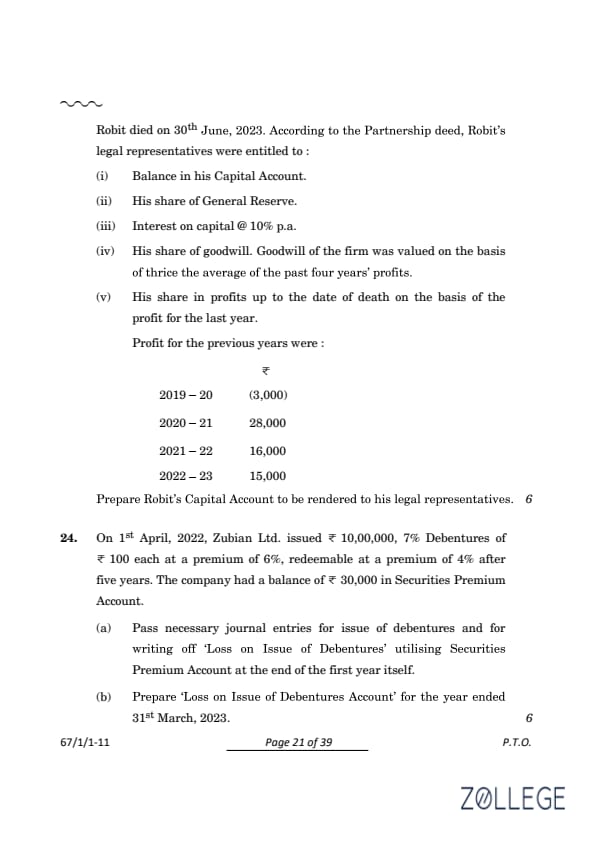
Question 23:
Azhar, Sumit, and Robit were partners in a firm sharing profits and losses in the ratio 3 : 1 : 1. Their Balance Sheet as at 31st March, 2023 was as follows:
| Liabilities | Amount (₹) | Assets | Amount (₹) |
|---|---|---|---|
| Creditors | 90,000 | Bank | 20,000 |
| General Reserve | 60,000 | Stock | 40,000 |
| Capitals: | Debtors | 1,50,000 | |
| Azhar | 60,000 | Fixed Assets | 60,000 |
| Sumit | 40,000 | ||
| Robit | 20,000 | ||
| Total | 2,70,000 | Total | 2,70,000 |
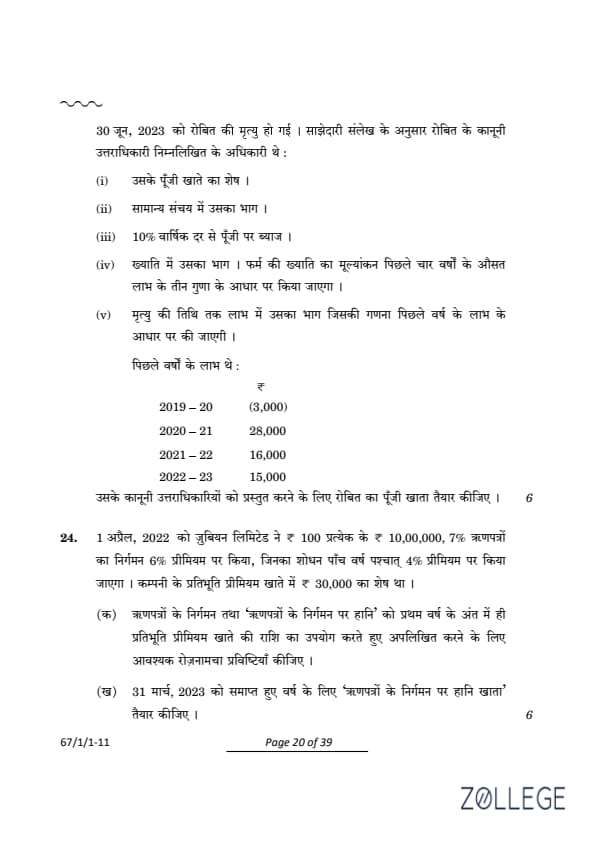
Adjustments:
- Robit died on 30th June, 2023.
- His legal representatives were entitled to:
- Balance in his Capital Account.
- His share of General Reserve.
- Interest on capital @10% p.a.
- His share of goodwill (thrice the average of past four years’ profits).
- His share in profits up to the date of death.
Profits for the previous four years: -3,000; 28,000; 16,000; 15,000
View Solution
Robit's Entitlements:
- Balance in Capital Account = ₹20,000
- General Reserve = 1/5 × ₹60,000 = ₹12,000
- Interest on Capital = ₹20,000 × 10% × 3/12 = ₹500
- Average Profit = (-3,000 + 28,000 + 16,000 + 15,000) ÷ 4 = ₹14,000
- Goodwill = ₹14,000 × 3 = ₹42,000; Robit's Share = 1/5 × ₹42,000 = ₹8,400
- Profit up to Death = ₹15,000 × 3/12 = ₹3,750; Robit's Share = 1/5 × ₹3,750 = ₹750
Robit's Capital Account:
| Date | Particulars | Amount (₹) |
|---|---|---|
| 2023-06-30 | To Bank (Legal Representatives) | 41,650 |
| By Balance b/d | 20,000 | |
| By General Reserve | 12,000 | |
| By Interest on Capital | 500 | |
| By Goodwill | 8,400 | |
| By Profit up to Death | 750 | |
| Total | 41,650 |
Question 24:
On 1st April 2022, Zubian Ltd. issued ₹10,00,000, 7% Debentures of ₹100 each at a premium of 6%, redeemable at a premium of 4% after five years. The company had a balance of ₹30,000 in the Securities Premium Account.
(a) Pass necessary journal entries for the issue of debentures and for writing off "Loss on Issue of Debentures" utilizing the Securities Premium Account at the end of the first year itself.
(b) Prepare "Loss on Issue of Debentures Account" for the year ended 31st March 2023.
View Solution
Step 1: Calculation of Premiums and Loss on Issue
- Issue Price per Debenture:
Nominal Value = ₹100
Premium on Issue = ₹6
Total Issue Price per Debenture = ₹100 + ₹6 = ₹106 - Redemption Price per Debenture:
Nominal Value = ₹100
Premium on Redemption = ₹4
Total Redemption Price per Debenture = ₹100 + ₹4 = ₹104 - Loss on Issue of Debentures:
Loss on Redemption per Debenture = ₹104 − ₹106 = ₹2
Total Loss on Issue of Debentures = ₹2 × 10,000 = ₹20,000
(a) Journal Entries:
| Date | Particulars | Debit (₹) | Credit (₹) |
|---|---|---|---|
| 2022-04-01 | Bank A/c Dr. | 10,60,000 | |
| To 7% Debentures A/c | 10,00,000 | ||
| To Securities Premium A/c | 60,000 | ||
| (Being issue of 10,000 debentures at ₹6 premium) | |||
| 2022-04-01 | Loss on Issue of Debentures A/c Dr. | 20,000 | |
| To Premium on Redemption of Debentures A/c | 20,000 | ||
| (Being loss on issue due to redemption premium of ₹4 per debenture) | |||
| 2023-03-31 | Securities Premium A/c Dr. | 20,000 | |
| To Loss on Issue of Debentures A/c | 20,000 | ||
| (Being loss on issue written off using securities premium) |
(b) Loss on Issue of Debentures Account:
| Date | Particulars | Debit (₹) | Credit (₹) |
|---|---|---|---|
| 2022-04-01 | To Premium on Redemption of Debentures A/c | 20,000 | |
| 2023-03-31 | By Securities Premium A/c | 20,000 | |
| Total | 20,000 | 20,000 |
Explanation:
- The loss on issue of debentures arises due to the redemption premium and is treated as a deferred expense.
- The Securities Premium Account is utilized to write off the loss, reducing the burden on future profits.
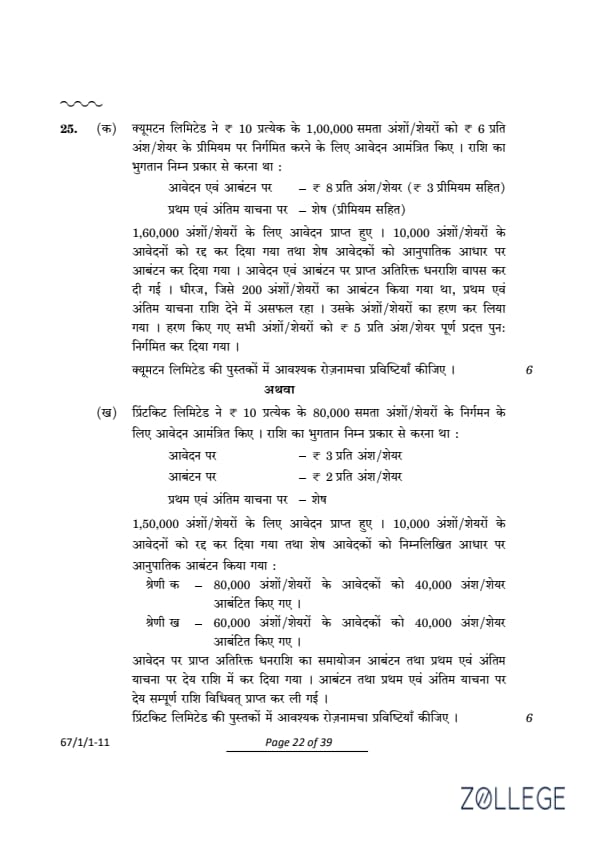
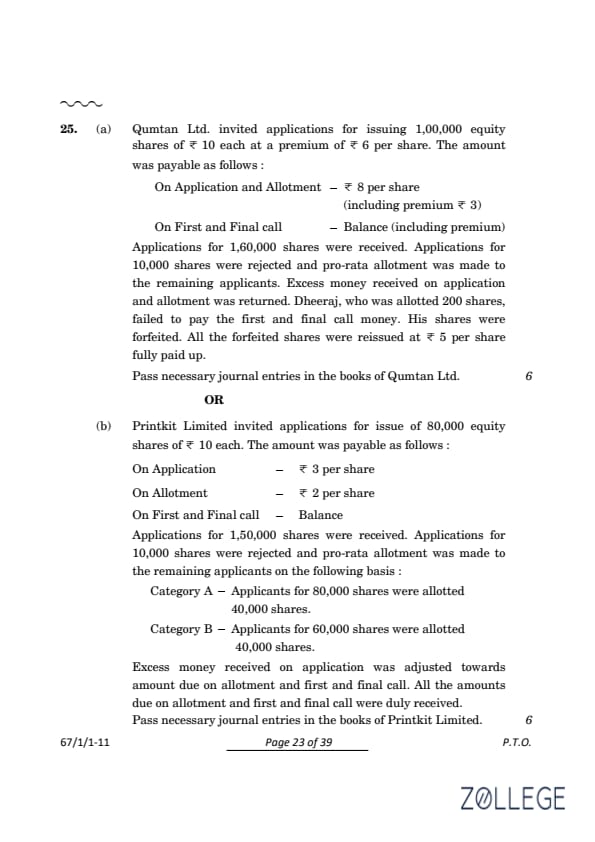
Question 25(a):
Qumtan Ltd. invited applications for issuing 1,00,000 equity shares of ₹10 each at a premium of ₹6 per share. The amount was payable as follows:
- On Application and Allotment: ₹8 per share (including premium of ₹3).
- On First and Final Call: Balance (including premium).
Additional Information:
- Applications for 1,60,000 shares were received.
- Applications for 10,000 shares were rejected, and pro-rata allotment was made to the remaining applicants.
- Excess money received on application was returned.
- Dheeraj, who was allotted 200 shares, failed to pay the first and final call money. His shares were forfeited. All the forfeited shares were reissued at ₹5 per share fully paid up.
Pass necessary journal entries.
View Solution
Journal Entries in the Books of Qumtan Ltd.
| Date | Particulars | Amount (₹) |
|---|---|---|
| 2023 | Bank A/c Dr. To Equity Share Application and Allotment A/c |
12,80,000 |
| (Being application money received on 1,60,000 shares at ₹8 each) | ||
| 2023 | Equity Share Application and Allotment A/c Dr. To Equity Share Capital A/c To Securities Premium A/c To Bank A/c (Excess Refund) |
12,80,000 5,00,000 3,00,000 4,80,000 |
| (Being application money transferred and excess refunded) | ||
| 2023 | Equity Share First and Final Call A/c Dr. To Equity Share Capital A/c To Securities Premium A/c |
4,00,000 2,00,000 2,00,000 |
| (Being first and final call money due on 1,00,000 shares) | ||
| 2023 | Bank A/c Dr. To Equity Share First and Final Call A/c |
3,96,800 |
| (Being first and final call money received except on 200 shares) | ||
| 2023 | Equity Share Capital A/c Dr. Securities Premium A/c Dr. To Forfeited Shares A/c To Equity Share First and Final Call A/c |
2,000 1,200 800 2,400 |
| (Being 200 shares forfeited due to non-payment of first and final call) | ||
| 2023 | Bank A/c Dr. Forfeited Shares A/c Dr. To Equity Share Capital A/c |
1,000 1,000 2,000 |
| (Being forfeited shares reissued at ₹5 per share fully paid up) | ||
| 2023 | Forfeited Shares A/c Dr. To Capital Reserve A/c |
800 800 |
| (Being profit on reissue transferred to Capital Reserve) |
Explanation:
- Total application money received = 1,60,000 shares × ₹8 = ₹12,80,000.
- Excess refund for 10,000 shares = 10,000 × ₹8 = ₹80,000.
- First and final call money unpaid by Dheeraj (200 shares): ₹4 × 200 = ₹800.
- Reissue price of forfeited shares = ₹5 × 200 = ₹1,000.
- Profit on reissue = ₹1,600 (received) - ₹800 (forfeited) = ₹800 transferred to Capital Reserve.
Question 25(b):
Printkit Limited invited applications for the issue of 80,000 equity shares of ₹10 each. The amount was payable as follows:
- On Application: ₹3 per share
- On Allotment: ₹2 per share
- On First and Final Call: Balance
Applications for 1,50,000 shares were received. Applications for 10,000 shares were rejected, and pro-rata allotment was made to the remaining applicants as follows:
- Category A: Applicants for 80,000 shares were allotted 40,000 shares.
- Category B: Applicants for 60,000 shares were allotted 40,000 shares.
Excess money received on application was adjusted toward the amount due on allotment and first and final call. All the amounts due on allotment and first and final call were duly received.
View Solution
| Date | Particulars | Debit (₹) | Credit (₹) |
|---|---|---|---|
| 2023 | Bank A/c Dr. | 4,50,000 | |
| To Equity Share Application A/c | 4,50,000 | ||
| (Being application money received on 1,50,000 shares at ₹3 each) | |||
| 2023 | Equity Share Application A/c Dr. | 4,50,000 | |
| To Equity Share Capital A/c | 2,40,000 | ||
| To Bank A/c (Refund) | 30,000 | ||
| To Equity Share Allotment A/c | 1,80,000 | ||
| (Being application money adjusted to capital, refund for 10,000 shares) | |||
| 2023 | Equity Share Allotment A/c Dr. | 1,60,000 | |
| To Equity Share Capital A/c | 1,60,000 | ||
| (Being allotment money due on 80,000 shares at ₹2 each) | |||
| 2023 | Bank A/c Dr. | 1,60,000 | |
| To Equity Share Allotment A/c | 1,60,000 | ||
| (Being allotment money received) | |||
| 2023 | Equity Share First and Final Call A/c Dr. | 2,40,000 | |
| To Equity Share Capital A/c | 2,40,000 | ||
| (Being first and final call money due on 80,000 shares at ₹3 each) | |||
| 2023 | Bank A/c Dr. | 2,10,000 | |
| To Equity Share First and Final Call A/c | 2,10,000 | ||
| (Being first and final call money received, adjusted from excess application money) |
Explanation:
- Application Money Received: Total money received is for 1,50,000 shares at ₹3 each.
- Refund for Rejected Applications: Application money for 10,000 shares is refunded.
- Adjustment of Excess: Excess application money received for pro-rata allotment is adjusted toward the allotment and first and final call dues.
- Allotment and First and Final Call: All amounts due are fully adjusted and received, either through direct payments or adjustments from excess application money.
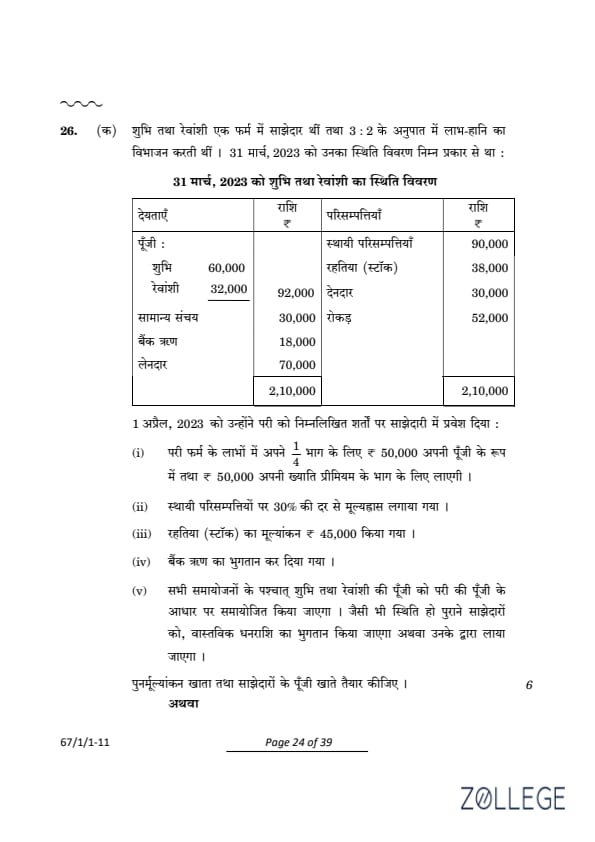
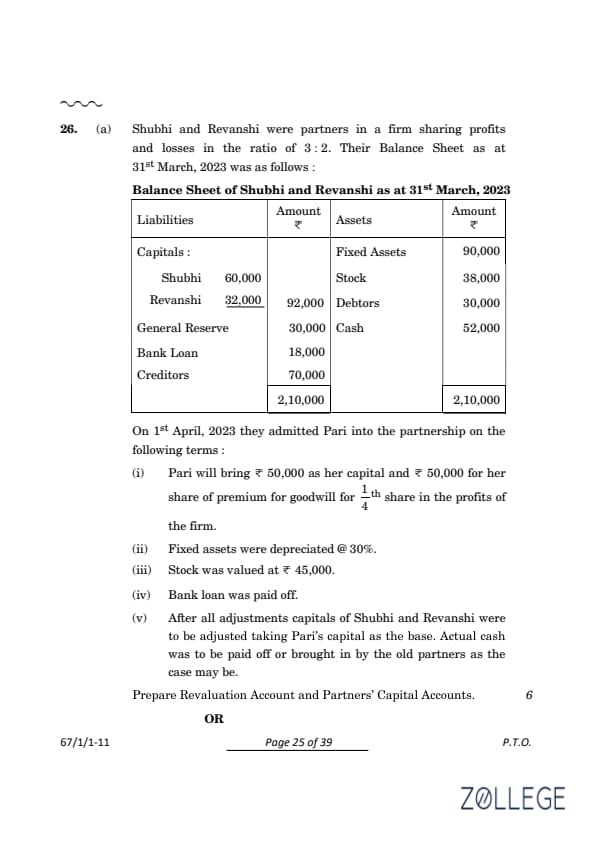
Question 26(a):
Shubhi and Revanshi were partners in a firm sharing profits and losses in the ratio of 3 : 2. Their Balance Sheet as at 31st March 2023 was as follows:
| Liabilities | Amount (₹) | Assets | Amount (₹) |
|---|---|---|---|
| Capitals: | |||
| Shubhi | 60,000 | Fixed Assets | 90,000 |
| Revanshi | 32,000 | Stock | 38,000 |
| General Reserve | 30,000 | Debtors | 30,000 |
| Bank Loan | 18,000 | Cash | 52,000 |
| Creditors | 70,000 | ||
| Total | 2,10,000 | Total | 2,10,000 |
Adjustments:
- Pari brings ₹50,000 as her capital and ₹50,000 as her share of premium for goodwill for 1/4 share in the profits of the firm.
- Fixed assets were depreciated by 30%.
- Stock was revalued at ₹45,000.
- Bank loan was paid off.
- Capitals of Shubhi and Revanshi were adjusted based on Pari’s capital, with actual cash being paid or brought in.
View Solution
Revaluation Account:
| Particulars | Amount (₹) | Particulars | Amount (₹) |
|---|---|---|---|
| To Fixed Assets (Depreciation @ 30%) | 27,000 | By Stock (Increase in Value) | 7,000 |
| To Profit transferred to: | |||
| Shubhi (3/5) | 12,000 | ||
| Revanshi (2/5) | 8,000 | ||
| Total | 47,000 | Total | 47,000 |
Partners’ Capital Accounts:
| Particulars | Shubhi (₹) | Revanshi (₹) | Pari (₹) |
|---|---|---|---|
| To Bank (Adjustment) | 20,000 | 10,000 | - |
| To Balance c/d | 80,000 | 40,000 | 50,000 |
| By Balance b/d | 60,000 | 32,000 | - |
| By General Reserve | 18,000 | 12,000 | - |
| By Revaluation Profit | 12,000 | 8,000 | - |
| By Premium for Goodwill | 30,000 | 20,000 | - |
| By Bank (Capital Brought In) | - | - | 50,000 |
| Total | 1,20,000 | 72,000 | 50,000 |
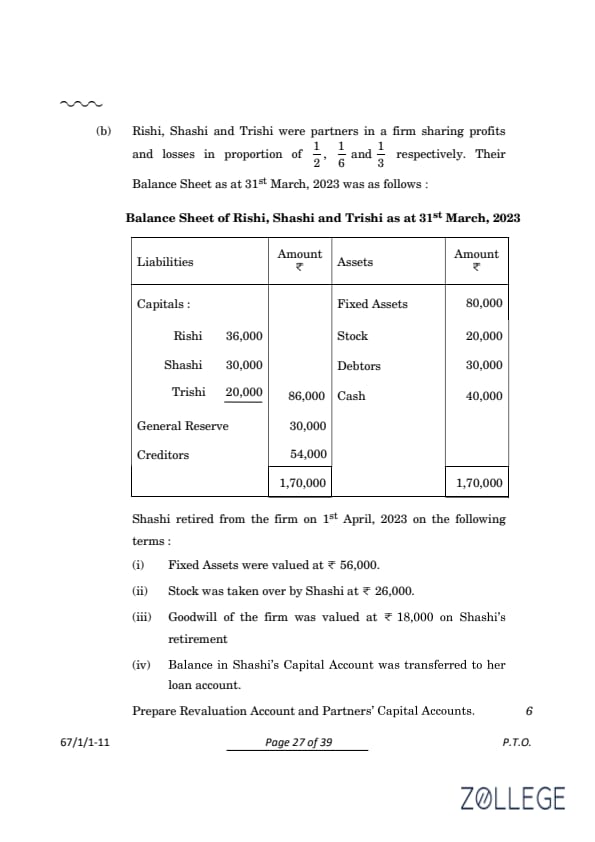
Question 26(b):
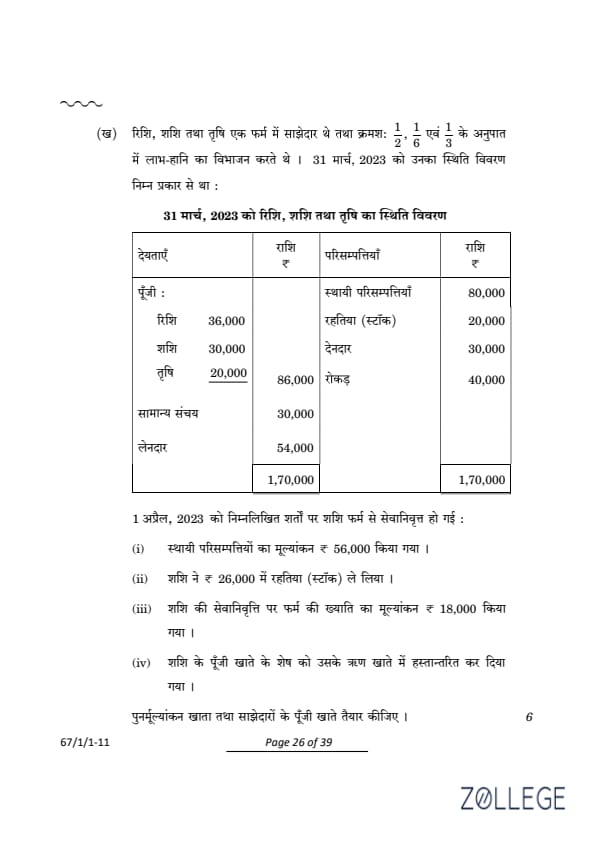
Rishi, Shashi, and Trishi were partners in a firm sharing profits and losses in proportion of 1/2, 1/6, and 1/3, respectively. Their Balance Sheet as at 31st March, 2023 was as follows:
| Liabilities | Amount (₹) | Assets | Amount (₹) |
|---|---|---|---|
| Capitals: | |||
| Rishi | 36,000 | Fixed Assets | 80,000 |
| Shashi | 30,000 | Stock | 20,000 |
| Trishi | 20,000 | Debtors | 30,000 |
| General Reserve | 30,000 | Cash | 40,000 |
| Creditors | 54,000 | ||
| Total | 1,70,000 | Total | 1,70,000 |
Adjustments:
- Fixed assets were valued at ₹56,000.
- Stock was taken over by Shashi at ₹26,000.
- Goodwill of the firm was valued at ₹18,000 on Shashi’s retirement.
- The balance in Shashi’s Capital Account was transferred to her loan account.
View Solution
Revaluation Account:
| Particulars | Amount (₹) | Particulars | Amount (₹) |
|---|---|---|---|
| To Fixed Assets (Reduction) | 24,000 | By Stock (Increase) | 6,000 |
| To Profit transferred to: | |||
| Rishi (1/2) | 10,000 | ||
| Shashi (1/6) | 3,000 | ||
| Trishi (1/3) | 6,000 | ||
| Total | 40,000 | Total | 40,000 |
Partners’ Capital Accounts:
| Particulars | Rishi (₹) | Shashi (₹) | Trishi (₹) |
|---|---|---|---|
| To Shashi’s Loan A/c | - | 47,000 | - |
| To Balance c/d | 53,000 | - | 33,000 |
| By Balance b/d | 36,000 | 30,000 | 20,000 |
| By General Reserve | 15,000 | 5,000 | 10,000 |
| By Revaluation Profit | 10,000 |
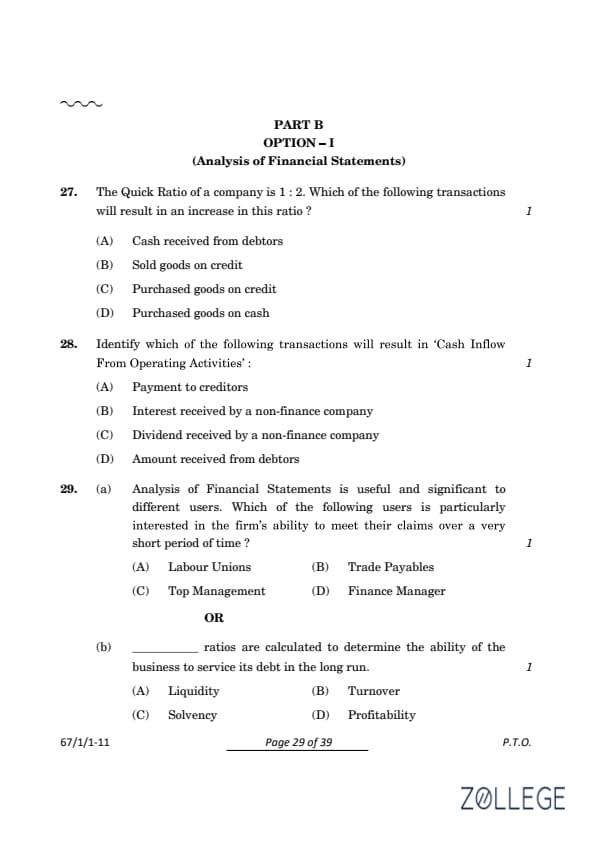
PART B (Analysis of Financial Statements) OPTION I
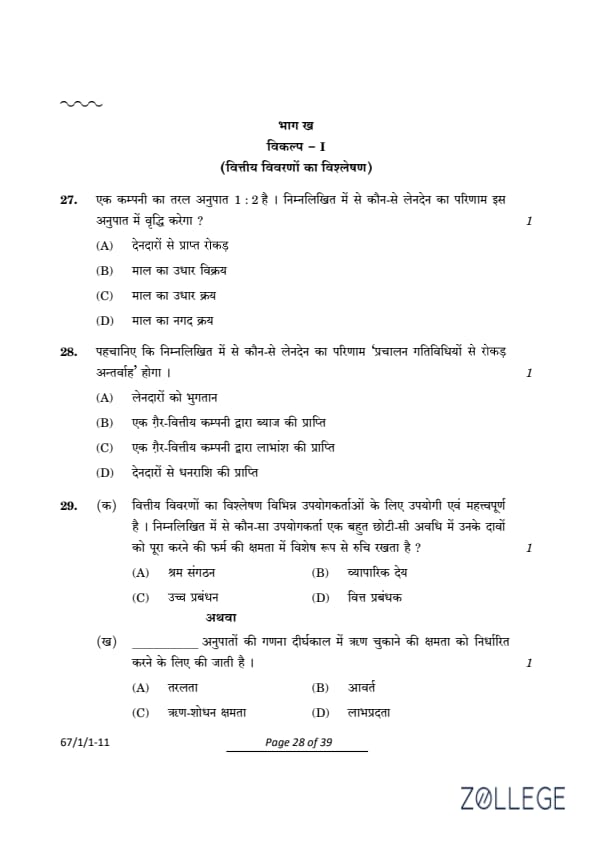
Question 27:
The Quick Ratio of a company is 1:2. Which of the following transactions will result in an increase in this ratio?
View Solution
Solution:
The quick ratio is calculated as:
Quick Ratio = Quick Assets / Current Liabilities
- Purchasing goods on cash reduces inventory (a non-quick asset) without affecting current liabilities. This increases the quick ratio.
Question 28:
Identify which of the following transactions will result in ‘Cash Inflow from Operating Activities’:
View Solution
Solution:
- Cash inflow from operating activities includes cash received from primary business operations such as sales or collections from debtors.
- Amount received from debtors represents cash collected from customers, directly related to operating activities.
Question 29(a):
Analysis of Financial Statements is useful and significant to different users. Which of the following users is particularly interested in the firm’s ability to meet their claims over a very short period of time?
View Solution
Solution:
- Trade payables are short-term creditors who are primarily interested in the company’s ability to meet its short-term liabilities.
- Ratios like the current ratio and quick ratio provide this information.
Question 29(b):
Ratios are calculated to determine the ability of the business to service its debt in the long run.
View Solution
Solution:
- Solvency ratios assess a company’s ability to meet its long-term financial obligations. Examples include the debt-to-equity ratio and interest coverage ratio.
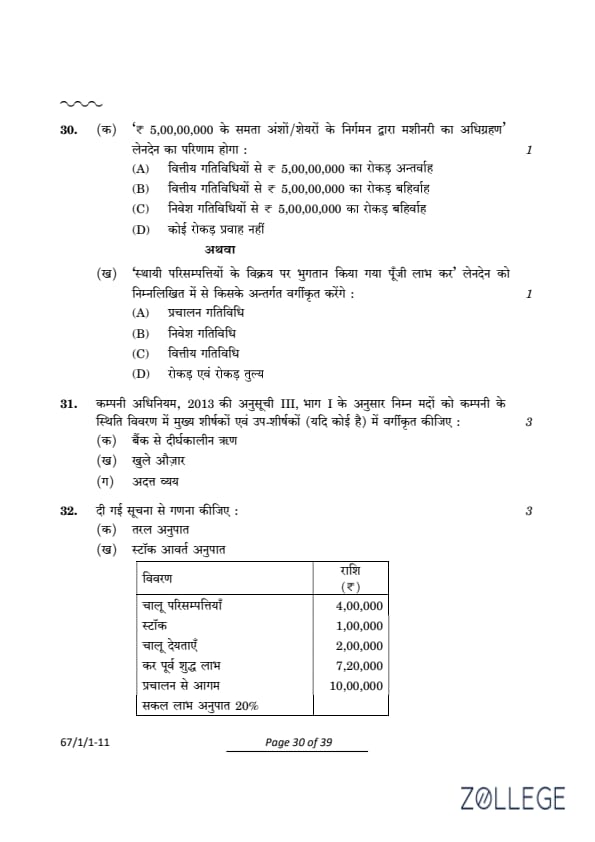
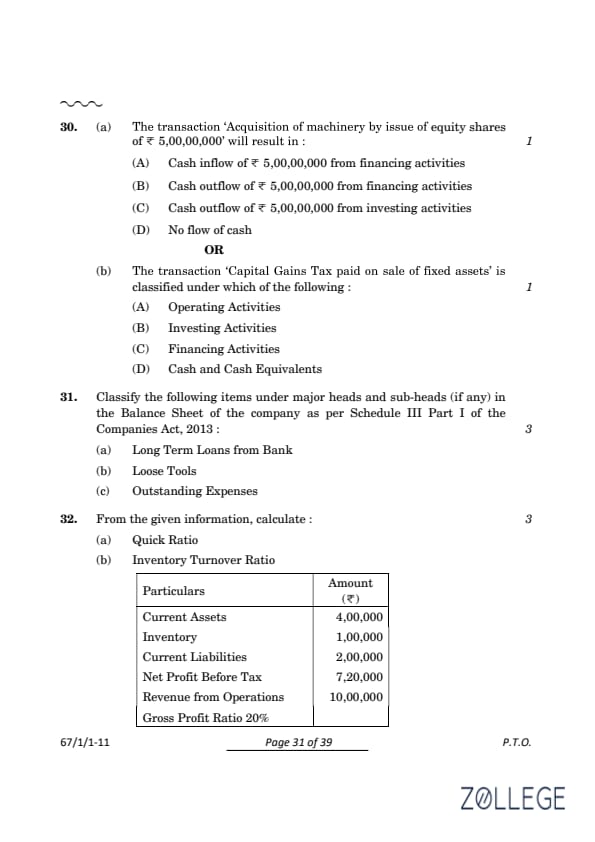
Question 30(a):
The transaction ‘Acquisition of machinery by issue of equity shares of ₹5,00,00,000’ will result in:
View Solution
Solution:
- This transaction involves the acquisition of machinery through equity shares, which is a non-cash transaction.
- Such transactions do not affect cash inflows or outflows and are disclosed as supplementary notes in the cash flow statement.
Question 30(b):
The transaction ‘Capital Gains Tax paid on sale of fixed assets’ is classified under which of the following?
View Solution
Solution:
- Capital gains tax is related to the sale of fixed assets, which is an investing activity.
Question 31:
Classify the following items under major heads and sub-heads (if any) in the Balance Sheet of the company as per Schedule III Part I of the Companies Act, 2013:
- Long-Term Loans from Bank
- Loose Tools
- Outstanding Expenses
View Classification
Classification in the Balance Sheet:
| Item | Classification |
|---|---|
| Long-Term Loans from Bank | Non-Current Liabilities → Long-Term Borrowings |
| Loose Tools | Non-Current Assets → Fixed Assets → Tangible Assets |
| Outstanding Expenses | Current Liabilities → Other Current Liabilities |
Question 32:
From the given information, calculate:
- (a) Quick Ratio
- (b) Inventory Turnover Ratio
Particulars:
| Particulars | Amount (₹) |
|---|---|
| Current Assets | 4,00,000 |
| Inventory | 1,00,000 |
| Current Liabilities | 2,00,000 |
| Net Profit Before Tax | 72,000 |
| Revenue from Operations | 10,00,000 |
| Gross Profit Ratio | 20% |
View Calculations
(a) Quick Ratio:
Quick Ratio = Quick Assets / Current Liabilities
- Quick Assets = Current Assets − Inventory = ₹4,00,000 − ₹1,00,000 = ₹3,00,000
- Quick Ratio = ₹3,00,000 / ₹2,00,000 = 1.5:1
(b) Inventory Turnover Ratio:
Inventory Turnover Ratio = Cost of Goods Sold (COGS) / Average Inventory
- COGS = Revenue from Operations × (1 − Gross Profit Ratio)
- COGS = ₹10,00,000 × (1 − 0.2) = ₹8,00,000
- Average Inventory = ₹1,00,000
- Inventory Turnover Ratio = ₹8,00,000 / ₹1,00,000 = 8 times
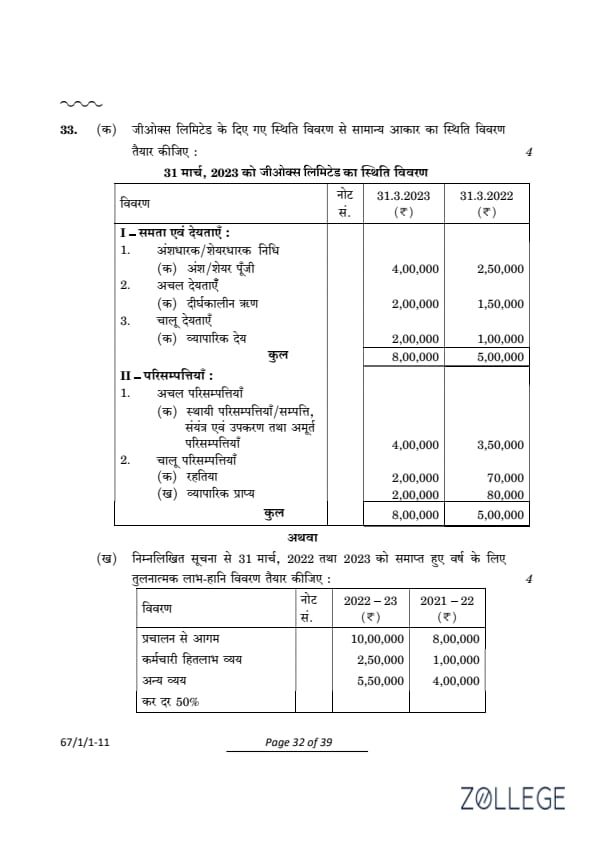
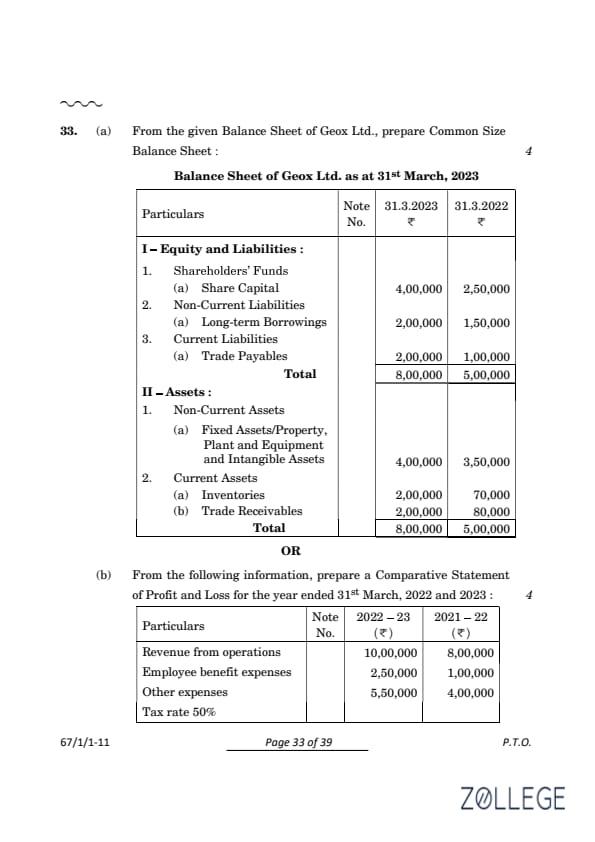
Question 33(a):
From the given Balance Sheet of Geox Ltd., prepare a Common Size Balance Sheet:
Common Size Balance Sheet of Geox Ltd. as at 31st March, 2023:
| Particulars | 31.03.2023 (₹) | % of Total | 31.03.2022 (₹) | % of Total |
|---|---|---|---|---|
| I – Equity and Liabilities | ||||
| Shareholders' Funds | 4,00,000 | 50% | 2,50,000 | 50% |
| Non-Current Liabilities | 2,00,000 | 25% | 1,50,000 | 30% |
| Current Liabilities | 2,00,000 | 25% | 1,00,000 | 20% |
| Total Equity and Liabilities | 8,00,000 | 100% | 5,00,000 | 100% |
| II – Assets | ||||
| Non-Current Assets | 4,00,000 | 50% | 3,50,000 | 70% |
| Current Assets | 4,00,000 | 50% | 1,50,000 | 30% |
| Total Assets | 8,00,000 | 100% | 5,00,000 | 100% |
View Explanation
Purpose of Common Size Statement:
- Each item in the balance sheet is expressed as a percentage of the total assets/liabilities.
- Helps in year-over-year comparison to identify trends, such as shifts in current vs. non-current components.
Question 33(b):
From the following information, prepare a Comparative Statement of Profit and Loss:
Comparative Statement of Profit and Loss for the years ended 31st March, 2022 and 2023:
| Particulars | 2022–23 (₹) | 2021–22 (₹) | % Change |
|---|---|---|---|
| Revenue from Operations | 10,00,000 | 8,00,000 | 25% |
| Employee Benefit Expenses | 2,50,000 | 2,00,000 | 25% |
| Other Expenses | 5,50,000 | 4,00,000 | 37.5% |
| Profit Before Tax (PBT) | 2,00,000 | 2,00,000 | 0% |
| Tax Expense (50%) | 1,00,000 | 1,00,000 | 0% |
| Profit After Tax (PAT) | 1,00,000 | 1,00,000 | 0% |
View Explanation
Purpose of Comparative Statement:
- Shows the absolute and percentage changes over two years.
- Helps analyze trends in revenues, expenses, and profitability.
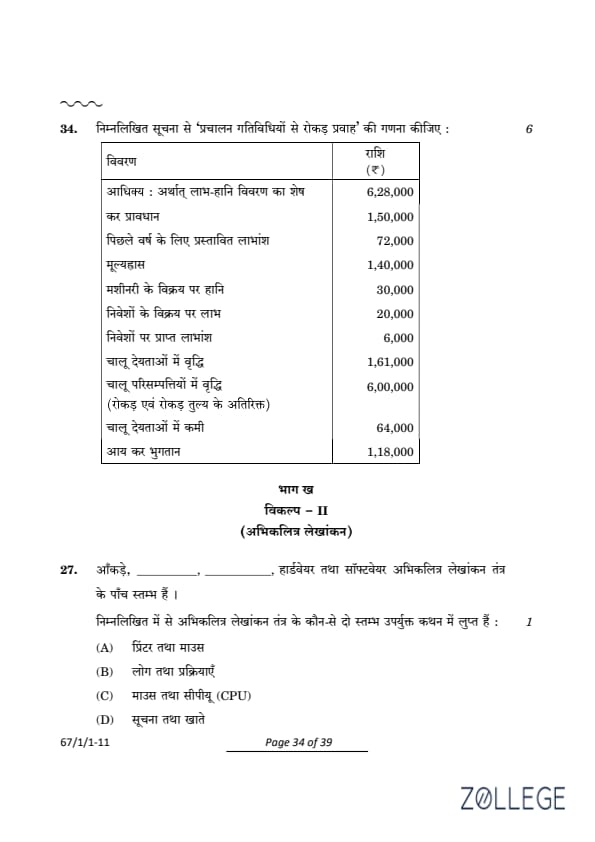
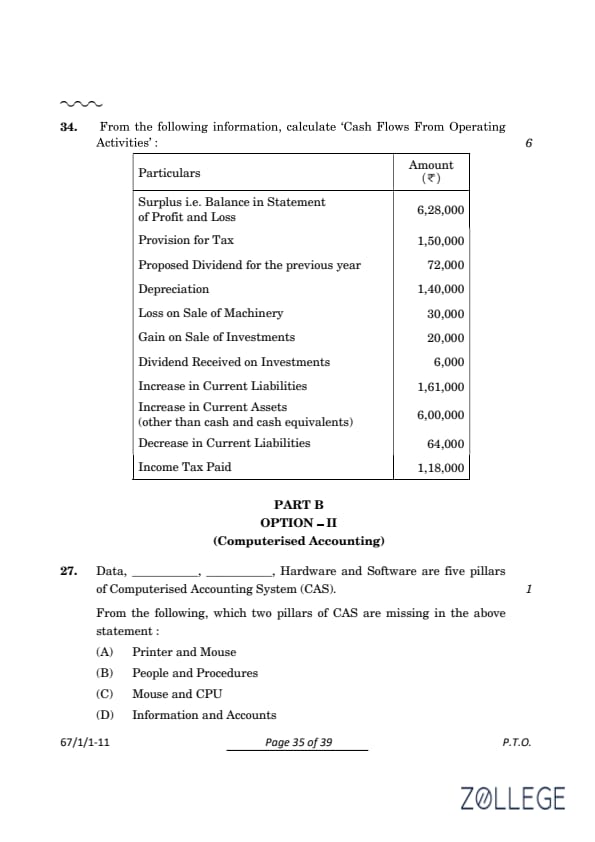
Question 34:
From the following information, calculate ‘Cash Flows From Operating Activities’:
Given Information:
| Particulars | Amount (₹) |
|---|---|
| Surplus i.e., Balance in Statement of Profit and Loss | 6,28,000 |
| Provision for Tax | 1,50,000 |
| Proposed Dividend for the Previous Year | 72,000 |
| Depreciation | 1,40,000 |
| Loss on Sale of Machinery | 30,000 |
| Gain on Sale of Investments | 20,000 |
| Dividend Received on Investments | 60,000 |
| Increase in Current Liabilities | 1,61,000 |
| Increase in Current Assets (Other than Cash) | 6,00,000 |
| Decrease in Current Liabilities | 64,000 |
| Income Tax Paid | 1,18,000 |
View Calculation
Step 1: Calculate Net Profit Before Tax and Extraordinary Items:
Net Profit = ₹6,28,000 + ₹1,50,000 = ₹7,78,000
Step 2: Adjust for Non-Cash and Non-Operating Items:
- Add: Depreciation = ₹1,40,000
- Add: Loss on Sale of Machinery = ₹30,000
- Less: Gain on Sale of Investments = ₹20,000
Operating Profit Before Working Capital Changes = ₹7,78,000 + ₹1,40,000 + ₹30,000 − ₹20,000 = ₹9,28,000
Step 3: Adjust for Working Capital Changes:
- Add: Increase in Current Liabilities = ₹1,61,000
- Less: Increase in Current Assets = ₹6,00,000
- Less: Decrease in Current Liabilities = ₹64,000
Cash Generated from Operations = ₹9,28,000 + ₹1,61,000 − ₹6,00,000 − ₹64,000 = ₹4,25,000
Step 4: Adjust for Taxes Paid:
Net Cash Flow = ₹4,25,000 − ₹1,18,000 = ₹3,07,000
PART B (Computerised Accounting) OPTION II
Question 27:
The Quick Ratio of a company is 1:2. Which of the following transactions will result in an increase in this ratio?
- Cash received from debtors
- Sold goods on credit
- Purchased goods on credit
- Purchased goods on cash
View Solution
Explanation:
- The quick ratio is calculated as Quick Assets / Current Liabilities.
- Purchasing goods on cash reduces inventory (a non-quick asset) without impacting current liabilities, thus increasing the quick ratio.
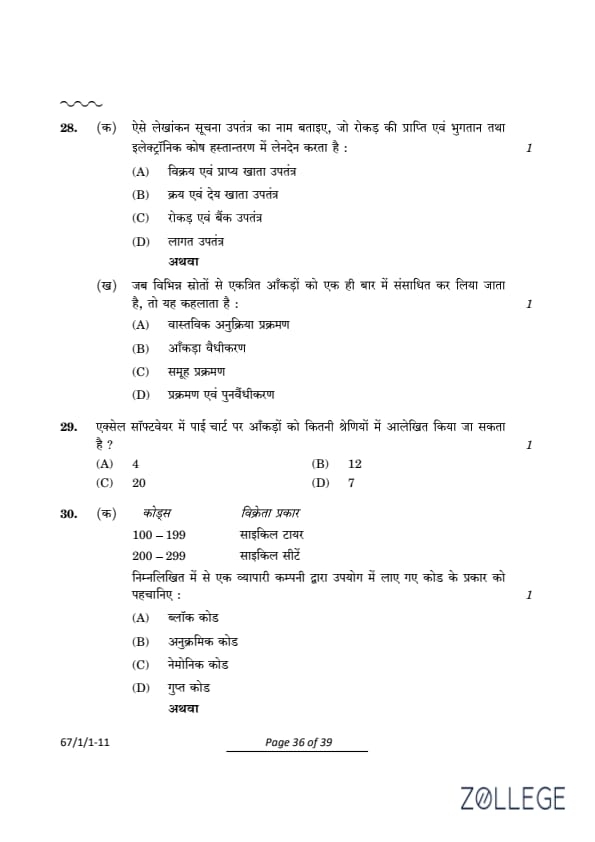
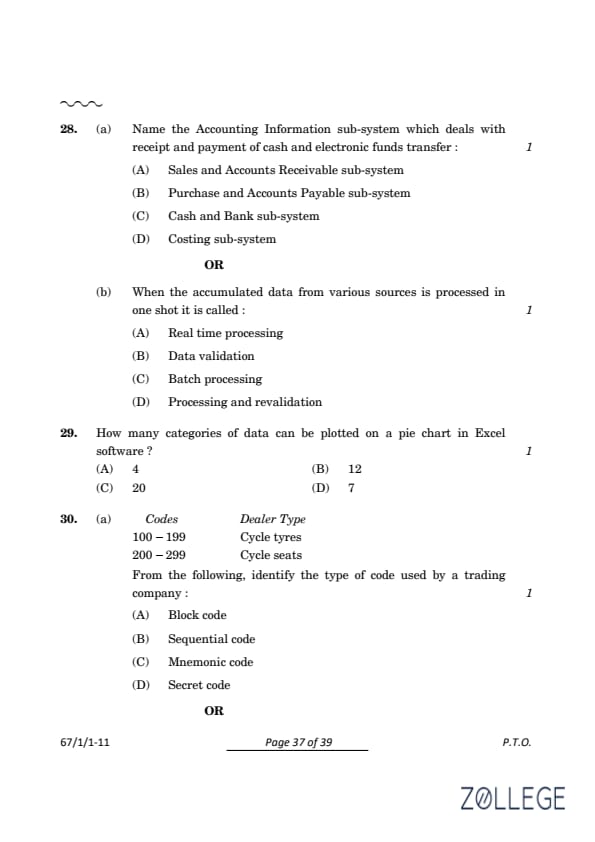
Question 28(a):
Name the Accounting Information sub-system which deals with receipt and payment of cash and electronic funds transfer:
- Sales and Accounts Receivable sub-system
- Purchase and Accounts Payable sub-system
- Cash and Bank sub-system
- Costing sub-system
View Solution
Explanation:
- The Cash and Bank sub-system manages transactions related to cash receipts, cash payments, and electronic fund transfers (EFTs).
- This ensures accurate recording and monitoring of liquid funds critical for business operations.
Question 28(b):
When the accumulated data from various sources is processed in one shot, it is called:
- Real-time processing
- Data validation
- Batch processing
- Processing and revalidation
View Solution
Explanation:
- Batch processing involves grouping large volumes of data and processing them together in a single operation.
- It is used in systems like payroll, where periodic processing is sufficient.
Question 29:
How many categories of data can be plotted on a pie chart in Excel software?
- 4
- 12
- 20
- 7
View Solution
Explanation:
- Excel supports up to 20 categories in a pie chart for effective visualization.
- For datasets with more than 20 categories, other charts like bar charts are recommended for better clarity.
Question 30(a):
Identify the type of code used by a trading company:
| Codes | Dealer Type |
|---|---|
| 100–199 | Cycle tyres |
| 200–299 | Cycle seats |
- Block code
- Sequential code
- Mnemonic code
- Secret code
View Solution
Explanation:
- Block codes assign a specific range of numbers to categories for better organization and retrieval.
Question 30(b):
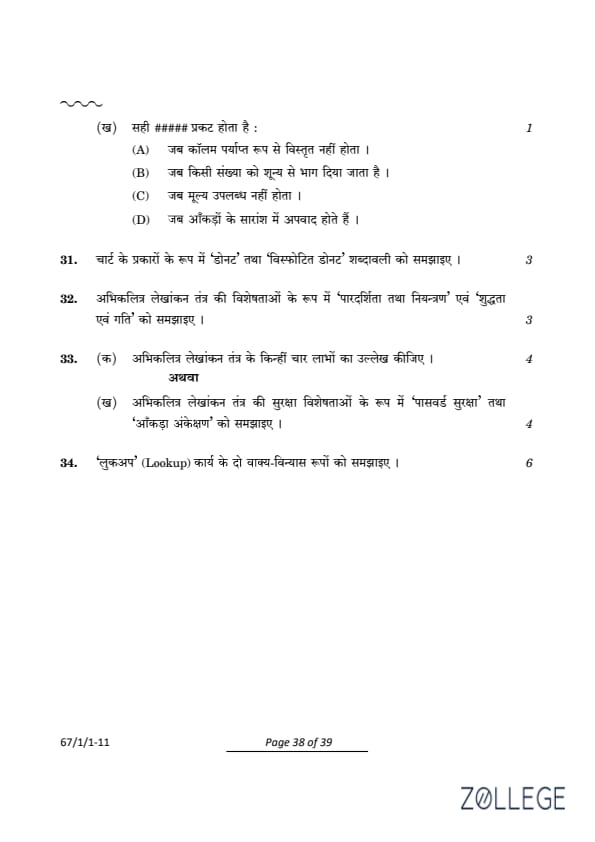
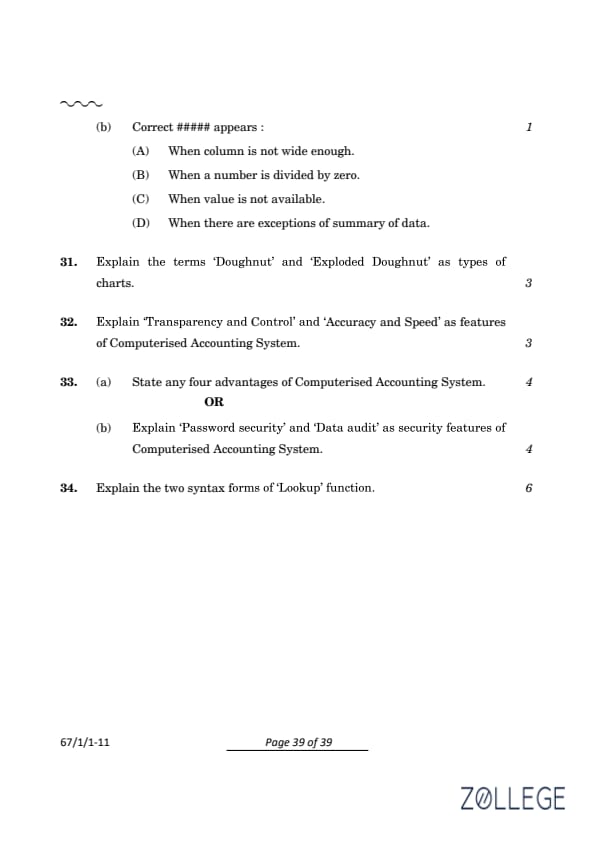
The error ##### appears in Excel:
- When column is not wide enough
- When a number is divided by zero
- When value is not available
- When there are exceptions of summary of data
View Solution
Explanation:
- The error ##### occurs when the column width is too narrow to display the content.
- To fix this, adjust the column width by dragging its edge or using the AutoFit Column Width option.
Question 31:
Explain the terms ‘Doughnut’ and ‘Exploded Doughnut’ as types of charts:
View Solution
1. Doughnut Chart:
- A doughnut chart is a variation of a pie chart with a hollow center.
- It shows parts-to-whole relationships and supports multiple data series in concentric rings.
2. Exploded Doughnut Chart:
- An exploded doughnut chart separates or "explodes" slices to emphasize specific data points.
- It is used to highlight critical comparisons within a dataset.
Question 32:
Explain ‘Transparency and Control’ and ‘Accuracy and Speed’ as features of a Computerised Accounting System:
View Solution
1. Transparency and Control:
- Ensures accurate and up-to-date accounting records.
- Tracks all entries, modifications, and deletions, enhancing accountability.
2. Accuracy and Speed:
- Automates calculations, reducing errors.
- Processes data quickly, aiding timely decision-making and reporting.
Question 33(a):
State any four advantages of Computerised Accounting System:
View Solution
- Efficiency:
- Automates routine accounting tasks like payroll, invoicing, and inventory management.
- Saves time and resources compared to manual accounting.
- Accuracy:
- Reduces human errors in calculations and ensures accurate financial records.
- Built-in checks and validations minimize discrepancies.
- Real-Time Reporting:
- Provides updated financial data instantly for better decision-making.
- Example: Real-time generation of profit and loss statements or balance sheets.
- Cost-Effectiveness:
- Reduces reliance on manual labor and paperwork.
- Long-term savings due to automation and improved efficiency.
Question 33(b):
Explain ‘Password Security’ and ‘Data Audit’ as security features of Computerised Accounting System:
View Solution
1. Password Security:
- Prevents unauthorized access to sensitive financial data.
- Ensures only authorized personnel can view, edit, or delete records.
- Enhances the overall security of the accounting system by restricting access based on user roles.
2. Data Audit:
- Tracks all changes made to financial records, including the user, time, and nature of changes.
- Facilitates compliance with regulatory requirements.
- Helps identify errors, fraud, or unauthorized modifications.
Question 34:
Explain the two syntax forms of the ‘Lookup’ function:
View Solution
1. Vector Form:
- Syntax:
=LOOKUP(lookup_value, lookup_vector, result_vector) - Explanation:
- Searches for a value (lookup_value) in a single row or column (lookup_vector) and returns the corresponding value from another row or column (result_vector).
- Example:
- Product Codes: A101, B202, C303
- Prices: 500, 700, 900
- To find the price of B202:
=LOOKUP("B202", A2:A4, B2:B4) - Result: 700
2. Array Form:
- Syntax:
=LOOKUP(lookup_value, array) - Explanation:
- Searches for a value (lookup_value) in a two-dimensional array and returns the corresponding value.
- Example:
- Names: John, Sarah, Mike
- Grades: A, B, A+
- To find the grade of Sarah:
=LOOKUP("Sarah", A2:A4, B2:B4) - Result: B
*The article might have information for the previous academic years, please refer the official website of the exam.