
CBSE Class 12 Accountancy set 1 Question Paper Pdf - Check Solutions with Answer Key Pdf

.jpg?tr=h-55,w-55,c-force)
Content Strategist|Tech-innovator|National Hackathon Winner | Updated On - Jan 23, 2025
CBSE Class 12 Accountancy Set 1 Question Paper (Code: 67/3/1) for March 23, 2024, is available for download. CBSE conducted the exam successfully from 10:30 AM to 1:30 PM. As per the students’ initial reaction, the CBSE Class 12 Accountancy Set 1 Question Paper for March 23, 2024, was reported as moderately challenging. Section A was considered easy to moderate, Section B was of moderate difficulty, while Section C was reported as difficult by most students.
CBSE Class 12 2024 Accountancy (Set 1- 67/3/1) 2024 Answer Key With Solution
Candidates can download the CBSE Class 12 Accountancy Question Paper with Solution and Answer Key PDFs for Set 1 Question Paper (Code: 67/3/1) using the link below.
| CBSE Class 12 2024 Accountancy Question Paper with Answer Key |  Download Download |
Check Solution |
CBSE Class 12 Accountancy 2024 Questions with Solutions
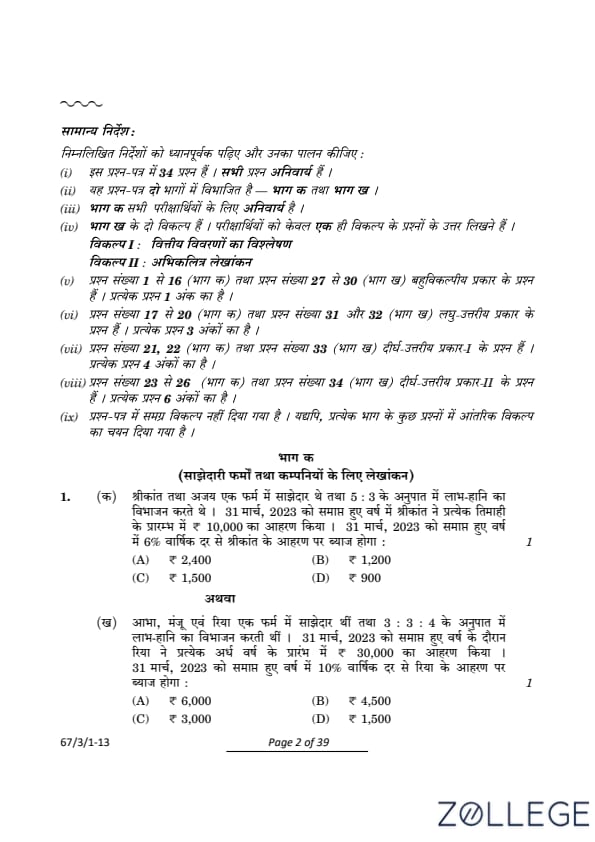
PART A (Accounting for Partnership Firms and Companies)
Question 1(a):
Shrikant and Ajay were partners in a firm sharing profits and losses in the ratio of 5:3. Shrikant withdrew 10,000 at the beginning of each quarter during the year ended 31st March, 2023. Interest on Shrikant's drawings @ 6% p.a. for the year ended 31st March, 2023 will be:
View Solution
Solution: Interest on drawings is calculated as:
Interest on Drawings = Total Drawings × Rate of Interest × Average Period.
1. Total Drawings = 10,000 ×4 = 40,000.
2. Average Period = 15⁄12 years (as withdrawals are made at the beginning of each quarter).
3. Interest on Drawings:
Interest = 40,000 × 6⁄100 × 15⁄12 = 1,500.
Question 1(b):
Interest on Rhea's drawings @ 10% p.a. for the year ended 31st March, 2023 will be:
View Solution
Solution: 1. Total Drawings = 30,000 × 2 = 60,000.
2. Average Period = 6+3⁄12 = 9⁄12 = 3⁄4 years (as withdrawals are made at the beginning of each half-year).
3. Interest on Drawings:
Interest = 60,000 × 10⁄100 × 9⁄12 = 4,500.
Question 2:
Seema and Laksh were partners in a firm sharing profits and losses in the ratio of 2:1. Their capitals were 2,00,000 and 1,80,000 respectively. They admitted Aadi as a new partner on 1st April, 2023 for 1⁄5 share in future profits. Aadi brought 1,50,000 as his share of capital. The goodwill of the firm on Aadi's admission will be:
View Solution
Solution: 1. Total Capital of the Firm (based on Aadi's capital contribution):
Total Capital = 1,50,000 ÷ 1⁄5 = 7,50,000.
2. Existing Partners' Capital = 2,00,000 + 1,80,000 = 3,80,000.
3. Goodwill of the Firm:
Goodwill = Total Capital – Existing Partners' Capital – Aadi's Capital = 7,50,000 – 3,80,000 – 1,50,000 = 2,20,000.
Question 3(a):
Lata, Mehu, and Namita were partners in a firm sharing profits and losses in the ratio of 3:2:1. They decided to dissolve the firm on 31st March, 2023. Creditors took over stock of book value of 80,000 at 80%, in part settlement of their amount of 90,000. The balance amount was paid to the creditors by cheque. The amount paid by cheque to the creditors will be:
View Solution
Solution: 1. Value of Stock Taken Over by Creditors:
Value of Stock = 80,000 × 80% = 64,000.
2. Balance Amount Payable to Creditors:
Balance Payable = 90,000 – 64,000 = 26,000.
Question 3(b):
Amount realised from debtors will be:
View Solution
Solution: 1. Total Debtors = 3,00,000.
2. Bad Debts = 20,000.
3. Provision for Discount on Debtors = 28,000.
4. Remaining Debtors Realised:
Realised Amount = 3,00,000 – 20,000 - 28,000 = 2,52,000.
Question 4:
Geeta and Hari were partners in a firm sharing profits and losses in the ratio of 3 : 2. Krish was admitted as a new partner for 1⁄4 share in profits of the firm which he acquired from Geeta and Hari in the ratio of 2 : 3. Krish brought 1,00,000 as his share of capital and 50,000 as premium for goodwill in cash. The sacrificing ratio of Geeta and Hari will be:
View Solution
Solution: To calculate the sacrificing ratio, we first need to determine the amount of profit each partner sacrificed for Krish. The total share acquired by Krish is 1⁄4, which is taken from the existing partners Geeta and Hari. Hence, the sacrificing ratio of Geeta and Hari will be in the ratio of their original shares, i.e., 2 : 3.
Question 5:
Manu, Sonu, and Rahul were partners in a firm sharing profits and losses in the ratio of 4 : 3 : 2. With effect from 1st April, 2023, they decided to share profits and losses in the future in the ratio of 3 : 2 : 1. Their Balance Sheet showed Workmen Compensation Reserve of 84,000. The claim on account of Workmen Compensation is estimated at 75,000. The journal entry to give effect to the above transaction will be:
View Solution
Solution:
| Date | Particulars | Dr Amount (₹) | Cr Amount (₹) |
|---|---|---|---|
| (A) | Workmen Compensation Reserve A/c | 84,000 | - |
| To Workmen Compensation Claim A/c | - | 75,000 | |
| To Manu's Capital A/c | - | 4,000 | |
| To Sonu's Capital A/c | - | 3,000 | |
| To Rahul's Capital A/c | - | 2,000 | |
| (B) | Workmen Compensation Reserve A/c | 84,000 | - |
| To Workmen Compensation Claim A/c | - | 75,000 | |
| To Manu's Capital A/c | - | 45,000 | |
| To Sonu's Capital A/c | - | 30,000 | |
| To Rahul's Capital A/c | - | 9,000 | |
| (C) | Manu's Capital A/c | 500 | - |
| To Rahul's Capital A/c | - | 500 | |
| (D) | Workmen Compensation Reserve A/c | 75,000 | - |
| To Manu's Capital A/c | - | 45,000 | |
| To Sonu's Capital A/c | - | 30,000 | |
| To Rahul's Capital A/c | - | 9,000 |
The journal entries are as follows:
1. Journal Entry (A): Transfer Workmen Compensation Reserve to Workmen Compensation Claim.
Workmen Compensation Reserve A/c 84, 000 is transferred to the Workmen Compensation Claim
2. Journal Entry (B): Allocate the Workmen Compensation Claim among the partners in the new profit-sharing ratio (3:2:1).
| Partner | Share of Workmen Compensation Claim (₹) | Ratio |
|---|---|---|
| Manu | 45,000 | 3:6 |
| Sonu | 30,000 | 2:6 |
| Rahul | 9,000 | 1:6 |
3. Journal Entry (C): Adjust the difference in Manu's and Rahul's capital accounts based on the claim adjustment.
| Partner | Adjustment Amount (₹) |
|---|---|
| Manu's Capital A/c | 500 |
| Rahul's Capital A/c | 500 |
4. Journal Entry (D): Further adjustments are made to balance the Workmen Compensation Reserve, reflecting the final allocation among the partners.
| Partner | Adjustment Amount (₹) |
|---|---|
| Manu | 45,000 |
| Sonu | 30,000 |
| Rahul | 9,000 |
Question 6:
Assertion (A): Partners' current accounts maintained under ‘Fixed Capital Method' may show a debit or a credit balance.
Reason (R): In the ‘Fixed Capital Method', all items like share of profit or loss, interest on capital, drawings, interest on drawings etc. are recorded in the partners' capital accounts.
Choose the correct option from the following:
View Solution
Solution: Under the Fixed Capital Method, the partners' capital accounts only reflect the fixed contributions of partners. Items like share of profits or losses, interest on capital, drawings, and interest on drawings are recorded in the partners' current accounts, not the capital accounts. Hence, Assertion (A) is correct because the current account can have either a debit or credit balance based on transactions. However, Reason (R) is incorrect as it wrongly attributes all these adjustments to the capital accounts.
Question 7:
Sheena's interest on drawings will be:
View Solution
Solution: Interest on drawings is charged at 10
Interest on drawings = 20,000 × 10% = 2,000
Question 8:
Tapti's share of profit will be:
View Solution
Solution: Tapti's share of profit is based on the profit-sharing ratio and the net profit of the firm. Given that the net profit is 57,000, Tapti's share is:
Tapti's share of profit = 1⁄6 × 57,000 = 10,500
Question 9:
Alfa Ltd. offered for public subscription 50,000 equity shares of 10 each at 12 per share. The entire amount was payable on application. Applications were received for 48,000 shares and allotment was made for all the applications. The amount received against the applications is:
View Solution
Solution: The amount received from the applications is calculated as:
Amount received = 48,000 × 11 = 52,80,000
Question 10:
Assertion (A): When the shares are forfeited, share capital account is debited with the amount called up and credited to (i) respective unpaid calls account i.e., calls in arrears and (ii) share forfeiture account with the amount already received on shares.
Reason (R): When the shares are forfeited, all entries relating to the shares forfeited, except those relating to securities premium, already recorded in accounting records must be reversed.
Choose the correct option from the following:
View Solution
Solution: When shares are forfeited, the share capital account is debited by the amount called up on the shares. The credited entries include: - Calls in Arrears account for unpaid amounts, and - Share Forfeiture account for amounts already received. The securities premium account, if any, is not reversed during forfeiture because it represents a legitimate premium received on the shares and is not affected by forfeiture. Thus, both the Assertion (A) and Reason (R) are correct, and Reason (R) correctly explains the Assertion (A).
Question 11:
On forfeiture of shares, Calls in Arrears Account will be:
View Solution
Solution: The amount called but unpaid on 1,000 shares is 5 per share: Calls in Arrears = 1,000 × 5 = 5,000. This amount is credited to the Calls in Arrears Account upon forfeiture.
Question 12:
Minimum subscription for allotment of shares as per SEBI guidelines cannot be less than 90% of which of the following capital?
View Solution
Solution: As per SEBI guidelines, at least 90% of the issued capital must be subscribed before shares can be allotted.
Question 13(a):
KLB Ltd. forfeited 3,000 shares of 10 each, 8 per share called up for non-payment of the first call of 2 per share. All these shares were reissued at 7 per share, 8 paid up. The amount transferred to the Capital Reserve Account will be:
View Solution
Solution:
1. Forfeiture Amount for 3,000 Shares: - Amount called up per share = 8 - Amount unpaid per share = 2 (First call) - Amount received per share before forfeiture = 6 (8-2) - Total amount forfeited:
Forfeiture Amount = 3,000 × 6 = 18,000
2. Reissue of 3,000 Shares: - Reissue price per share = 7 - Paid-up value per share = 8 - Amount received on reissue:
Reissue Amount = 3,000 × 7 = 21,000
3. Nominal Value of Reissued Shares: - Nominal value per share = 8 - Total nominal value:
Nominal Value = 3,000 × 8 = 24,000
4. Utilization of Forfeited Amount: - Amount required to make shares fully paid:
Required Amount = Nominal Value – Reissue Amount
Required Amount = 24,000 – 21,000 = 3,000
5. Excess Forfeiture Amount Transferred to Capital Reserve: - Total forfeited amount = 18,000 - Forfeited amount used = 3,000 - Remaining amount transferred to Capital Reserve:
Capital Reserve = 18,000 – 3,000 = 15,000
Final Answer: The amount credited to the Capital Reserve Account is 15,000.
Question 13(b):
NUK Ltd. forfeited 1,000 shares of 10 each, fully called up for non-payment of final call of 2 per share. 800 of these shares were reissued at 11 per share fully paid. The amount credited to the Capital Reserve Account will be:
View Solution
Solution:
1. Forfeiture Amount for 1,000 Shares: - Amount called up per share = 10 - Amount unpaid per share = 2 (Final call) - Amount received per share before forfeiture = 8 - Total amount forfeited:
Forfeiture Amount = 1,000 × 8 = 8,000
2. Reissue of 800 Shares: - Reissue price per share = 11 - Amount received on reissue:
Reissue Amount = 800 × 11 = 8,800
3. Nominal Value of Reissued Shares: - Nominal value per share = 10 - Total nominal value:
Nominal Value = 800 × 10 = 8,000
4. Utilization of Forfeited Amount: - Forfeited amount utilized per share = 2 (to make shares fully paid) - Total forfeited amount used for reissued shares:
Utilized Forfeiture Amount = 800 × 2 = 1,600
5. Excess Forfeiture Amount Transferred to Capital Reserve: - Total forfeited amount = 8,000 - Forfeited amount used = 1,600 - Remaining amount transferred to Capital Reserve:
Capital Reserve = 8,000 – 1,600 = 6,400
Final Answer: The amount credited to the Capital Reserve Account is 6,400.
Question 14:
The debentures which do not carry a specific rate of interest are called:
View Solution
Solution: Zero Coupon Rate Debentures do not pay periodic interest but are issued at a discount and redeemed at face value.
Question 15(a):
Nicku's share of profit will be:
View Solution
Solution: 1. Nicku's share of profit = Previous Year's Profit × Nicku's Share × Proportion of Year:
80,000 × 5⁄10 × 6⁄12 = 20,000.
Question 15(b):
Nikhil, Arun and Mansi were partners in a firm sharing profits and losses in the ratio of 4:3 :3. With effect from 1st April, 2023, they decided to share profits and losses in the ratio of 5 : 3 : 2. Due to change in the profit sharing ratio, Mansi's gain or sacrifice will be:
View Solution
Solution: To calculate Mansi's sacrifice or gain, we need to first find her old share and new share of profits. - Old share of Mansi = 3⁄10 - New share of Mansi = 2⁄10 - Mansi's sacrifice = 3⁄10 - 2⁄10 = 1⁄10
Question 16(a):
Hema and Tara were partners in a firm sharing profits and losses in the ratio of 2 : 3. They admitted Ojas as a new partner. Hema surrendered 1⁄5 of her share and Tara surrendered 1⁄4 of her share in favour of Ojas. The new profit sharing ratio of Hema, Tara and Ojas will be:
View Solution
Solution: - Hema's new share = 2⁄5 - 1⁄5 × 2⁄5 = 8⁄25, - Tara's new share = 3⁄5 - 1⁄4 × 3⁄5 = 9⁄20, - Ojas's share = 1⁄5 × 2⁄5 + 1⁄4 × 3⁄5 = 13⁄100.
The new ratio is 8 : 9 : 13.
Question 16(b):
Aaroh, Bhuvan and Charu were partners in a firm sharing profits and losses in the ratio of 1:2 : 6. Charu died. Aaroh and Bhuvan acquired Charu's share in the ratio of 2 : 1. The new profit-sharing ratio between Aaroh and Bhuvan after Charu's death will be:
View Solution
Solution: Charu's share = 6⁄9 of the total profit. Aaroh and Bhuvan acquire this share in the ratio of 2:1, so: - Aaroh's share = 1⁄9 + 2⁄3 × 6⁄9 = 1⁄9 + 12⁄27= 1⁄9 + 4⁄9= 5⁄9, - Bhuvan's share = 2⁄9 + 1⁄3 × 6⁄9= 2⁄9 + 6⁄27= 2⁄9+ 2⁄9= 4⁄9
Thus, the new profit sharing ratio between Aaroh and Bhuvan is 5:4.
Question 17:
Aaria, Beenu and Clara were partners in a firm sharing profits and losses in the ratio of 4 : 3 : 3. On 30th June, 2023, Clara died. Clara's share in the profits of the firm till the date of death was to be calculated on the basis of sales. Sales during the year 2022–23 were 20,00,000, and sales from 1st April, 2023 to 30th June, 2023 were 4,00,000. The profit for the year ended 31st March, 2023 was 5,00,000. Calculate Clara's share of profit up to the date of death and pass the necessary journal entry for the same in the books of the firm. Show your workings clearly.
View Solution
Solution: First, we calculate the profit for the period from 1st April, 2023 to 30th June, 2023.
Total sales from 1st April to 30th June, 2023 = 4,00,000 Total sales for the year = 20,00,000
Clara's share of the profit is calculated by the sales ratio:
Clara's share = (4,00,000⁄20,00,000) × 5,00,000 = 1,00,000
Clara's share of profit up to the date of death = 1,00,000.
Now, the journal entry:
| Date | Particulars | Dr Amount (₹) | Cr Amount (₹) |
|---|---|---|---|
| 30th June 2023 | Clara's Capital A/c | 1,00,000 | - |
| To Aaria's Capital A/c | - | 33,333 | |
| To Beenu's Capital A/c | - | 33,333 | |
| To Clara's Capital A/c (Clara's share of profit) | - | 33,334 |
Question 18:
Rishi and Suman were partners in a firm. Their capitals were 1,20,000 and 80,000, respectively. The normal rate of return in similar business is 12%. The profits of the last four years were:
| Year | Profits (₹) |
|---|---|
| 2019-20 | 33,000 |
| 2020-21 | 22,000 |
| 2021-22 | 31,000 |
| 2022-23 | 34,000 |
Calculate goodwill of the firm based on: (i) Three years' purchase of the last four years' average profits. (ii) Capitalisation of super profit.
View Solution
Solution:
1. Average Profit:
Average Profit = 33,000 + 22,000 + 31,000 + 34,000⁄4 = 30,000.
2. Goodwill (Three Years' Purchase):
Goodwill = Average Profit × 3 = 30,000 × 3 = 90,000.
3. Normal Profit:
Normal Profit = Capital Employed × Normal Rate of Return⁄100
Capital Employed = 1,20,000 + 80,000 = 2,00,000.
Normal Profit = 2,00,000 × 12⁄100 = 24,000.
4. Super Profit:
Super Profit = Average Profit - Normal Profit = 30,000 – 24,000 = 6,000.
5. Goodwill (Capitalisation of Super Profit):
Goodwill = Super Profit × 100⁄Normal Rate of Return = 6,000 × 100⁄12 = 50,000.
Final Answers: (i) Goodwill (Three Years' Purchase) = 90,000. (ii) Goodwill (Capitalisation of Super Profit) = 50,000.
Question 19(a):
Sumi Ltd. acquired assets of 8,00,000 and took over sundry creditors of 2,00,000 from Pandora Ltd. for a purchase consideration of 9,00,000. The payment was made by issuing a cheque of 4,60,000 and the remaining by issue of 9% Debentures of 100 each at a premium of 10%.
Pass necessary journal entries for the above transactions in the books of Sumi Ltd.
View Solution
Solution:
| Date | Particulars | Dr (₹) | Cr (₹) |
|---|---|---|---|
| 2023 April 1 | Assets A/c | 8,00,000 | - |
| Sundry Creditors A/c | 2,00,000 | - | |
| To Pandora Ltd. A/c | - | 9,00,000 | |
| (Being purchase of assets and assumption of liabilities from Pandora Ltd.) | |||
| 2023 April 1 | Pandora Ltd. A/c | 9,00,000 | - |
| To Bank A/c | - | 4,60,000 | |
| To 9% Debentures A/c | - | 4,00,000 | |
| To Securities Premium A/c | - | 40,000 | |
| (Being payment made partly in cash and balance through issuance of 9% Debentures at 10% premium) | |||
Question 19(b):
Gundola Ltd. took over assets of 9,00,000 and liabilities of 3,00,000 from AK Ltd. for an agreed purchase consideration of 14,00,000. The payment was made through a bank draft of 5,00,000 and the remaining by issue of 8% Debentures at a discount of 10%.
Record necessary journal entries in the books of Gundola Ltd. for the above transactions.
View Solution
Solution:
| Date | Particulars | Dr (₹) | Cr (₹) |
|---|---|---|---|
| 2023 April 1 | Assets A/c | 9,00,000 | - |
| Liabilities A/c | 3,00,000 | - | |
| To AK Ltd. A/c | - | 14,00,000 | |
| (Being purchase of assets and assumption of liabilities from AK Ltd.) | |||
| 2023 April 1 | AK Ltd. A/c | 14,00,000 | - |
| To Bank A/c | - | 5,00,000 | |
| To 8% Debentures A/c | - | 8,40,000 | |
| To Discount on Issue of Debentures A/c | - | 60,000 | |
| (Being payment made partly in cash and balance through issuance of 8% Debentures at a 10% discount) | |||
Question 20(a):
Misha and Prisha were partners in a firm sharing profits and losses in the ratio of 3:2. On 1st April, 2022, their capital accounts showed balances of 50,000 and 30,000, respectively. During the year, Misha withdrew 12,900 while Prisha withdrew 9,600. They were allowed interest on capital @ 10% p.a. Interest on drawings of 660 was charged on Misha's drawings and 540 on Prisha's drawings. Prisha had advanced a loan of 20,000 to the firm on 1st August, 2022. The net profit for the year ended 31st March, 2023, amounted to 22,600. Prepare Profit and Loss Appropriation Account for the year ended 31st March, 2023.
View Solution
Solution:
Interest on Capital:
Misha: 50,000 × 10% = 5,000 Prisha: 30,000 × 10% = 3,000
Interest on Prisha's Loan:
Prisha: 20,000 × 6% × 8⁄12= 800
Profit Sharing:
Remaining profit after appropriations is shared in the ratio 3:2.
Profit and Loss Appropriation Account for the year ended 31st March, 2023
| Particulars | Amount (₹) | Amount (₹) |
|---|---|---|
| To Interest on Capital: | ||
| Misha | 5,000 | |
| Prisha | 3,000 | 8,000 |
| To Interest on Prisha's Loan | 800 | |
| To Profit Transferred: | ||
| Misha (3/5) | 7,980 | |
| Prisha (2/5) | 5,320 | 13,300 |
| By Net Profit | 22,600 | |
| By Interest on Drawings: | ||
| Misha | 660 | |
| Prisha | 540 | 1,200 |
Question 20(b):
On 31st March, 2023, the capitals of Raghav and Diya stood at 4,00,000 and 3,00,000 respectively, after the necessary adjustment in respect of drawings and net profit. Subsequently, it was discovered that interest on capital @ 10% p.a. had been omitted. The net profit for the year ended 31st March, 2023 amounted to 1,00,000. During the year ended 31st March, 2023, Raghav's drawings were 2,000 drawn at the beginning of each month, while Diya's drawings were 3,000 drawn at the beginning of each quarter. Pass the necessary adjustment entry.
View Solution
Solution:
1. Interest on Capital: - Raghav's Interest on Capital:
Interest = 4,00,000 × 10⁄100 = 40,000.
- Diya's Interest on Capital:
Interest = 3,00,000 × 10⁄100 = 30,000.
2. Interest on Drawings: - Raghav's Drawings:
Total Drawings = 2,000 × 12 = 24,000.
- Average Period = 13⁄24 years:
Interest on Drawings = 24,000 × 10⁄100 × 13⁄24 = 1,300.
- Diya's Drawings:
Total Drawings = 3,000 × 4 = 12,000.
- Average Period = 7.5⁄12 years:
Interest on Drawings = 12,000 × 10⁄100 × 7.5⁄12 = 750.
3. Net Profit Distribution: - Adjusted Net Profit:
Net Profit = 1,00,000 – (40,000 + 30,000) + (1,300 + 750) = 32,050.
- Profit Sharing Ratio (Assumed Equal):
Raghav's Share = 16,025, Diya's Share = 16,025.
Journal Entry:
| Date | Particulars | Dr (₹) | Cr (₹) |
|---|---|---|---|
| 2023 March 31 | Interest on Capital A/c | 70,000 | - |
| To Raghav's Capital A/c | - | 40,000 | |
| To Diya's Capital A/c | - | 30,000 | |
| (Interest on capital credited to partners' accounts) | |||
| March 31 | Profit and Loss A/c | 32,050 | - |
| To Raghav's Capital A/c | - | 16,025 | |
| To Diya's Capital A/c | - | 16,025 | |
| (Distribution of adjusted net profit among partners) | |||
| March 31 | Raghav's Capital A/c | 1,300 | - |
| Diya's Capital A/c | 750 | - | |
| To Interest on Drawings A/c | - | 2,050 | |
| (Interest on drawings charged to partners) | |||
Question 21:
Shri Ganga Ltd. was registered with an authorised capital of 7,00,000 divided into equity shares of 10 each. Show Share Capital in the Balance Sheet as per Schedule III, Part I of the Companies Act, 2013.
Balance Sheet of Shri Ganga Ltd. as at 31st March, 2023:
| Particulars | Amount (₹) |
|---|---|
| Equity and Liabilities: | |
| Share Capital (Note 1) | 5,60,000 |
| Calls in Arrears | 40,000 |
| Total | 6,00,000 |
Notes to Accounts:
| Particulars | Amount (₹) |
|---|---|
| Authorised Capital | 7,00,000 |
| Issued Capital (50,000 shares) | 5,00,000 |
| Subscribed and Paid-Up Capital (46,000 shares) | 4,60,000 |
View Solution
Solution:
Present Share Capital under Schedule III requirements, showing detailed disclosures of issued, subscribed, and called-up amounts.
Question 22:
Frank, George, and Hemant were partners in a firm sharing profits in the ratio of 5:3:2. They decided to change their profit-sharing ratio to 2:5:3 with effect from 1st April, 2023. Their Balance Sheet as at 31st March, 2023, was as follows:
Balance Sheet of Frank, George, and Hemant as at 31st March, 2023
| Liabilities | Amount (₹) | Assets | Amount (₹) |
|---|---|---|---|
| Capitals: | Land | 5,00,000 | |
| Frank | 4,00,000 | Building | 3,00,000 |
| George | 3,00,000 | Machinery | 3,00,000 |
| Hemant | 2,00,000 | Stock | 1,50,000 |
| Creditors | 2,50,000 | Debtors | 9,00,000 |
| Employees' Provident Fund | 1,00,000 | Cash | 2,00,000 |
| General Reserve | 2,00,000 | ||
| Total | 17,50,000 | Total | 17,50,000 |
Adjustments: 1. The value of land having appreciated is to be brought up to 6,50,000. 2. Goodwill of the firm is valued at 2,00,000. Goodwill is not to appear in the books of the firm.
Solution: Journal Entries:
View Solution
Solution:
| Date | Particulars | Dr (₹) | Cr (₹) |
|---|---|---|---|
| 2023 Mar 31 | Revaluation of Land: | ||
| Land A/c (Appreciation in value) | 1,50,000 | - | |
| To Revaluation A/c | - | 1,50,000 | |
| (Increase in the value of land recorded) | |||
| Mar 31 | Distribution of Revaluation Profit: | ||
| Revaluation A/c | 1,50,000 | - | |
| To Frank's Capital A/c (5/10) | - | 75,000 | |
| To George's Capital A/c (3/10) | - | 45,000 | |
| To Hemant's Capital A/c (2/10) | - | 30,000 | |
| (Revaluation profit transferred to partners' capital accounts) | |||
| Mar 31 | Goodwill Adjustment: | ||
| Frank's Capital A/c (Sacrificing Share) | 40,000 | - | |
| George's Capital A/c (Sacrificing Share) | 40,000 | - | |
| To Hemant's Capital A/c (Gaining Share) | - | 80,000 | |
| (Goodwill adjusted among partners in sacrificing/gaining ratio) | |||
Question 23:
Abhay, Bikram, and Chris were partners in a firm sharing profits and losses equally. They decided to dissolve their partnership firm on 31st March, 2023. The firm's Balance Sheet on the date of dissolution was as follows:
Balance Sheet of Abhay, Bikram, and Chris as at 31st March, 2023
| Liabilities | Amount (₹) | Assets | Amount (₹) |
|---|---|---|---|
| Capital: | Plant and Machinery | 80,000 | |
| Abhay | 68,000 | Furniture | 45,000 |
| Bikram | 1,00,000 | Motor Car | 1,25,000 |
| Chris | 77,000 | Stock | 30,000 |
| Creditors | 1,20,000 | Debtors | 70,000 |
| Cash at Bank | 15,000 | ||
| Total | 3,65,000 | Total | 3,65,000 |
Adjustments:
1. Plant and Machinery was taken over by Abhay at an agreed valuation of 75,000.
2. Furniture realised 40,000.
3. Motor Car was taken over by Bikram for 1,30,000.
4. Debtors realised 10% less than their book value.
5. 10% of the stock was taken over by Chris for 4,500. The remaining stock was sold for 30,000.
6. Realisation expenses amounted to 5,000.
View Solution
Solution:
Realisation Account:
| Particulars | Amount (₹) | Amount (₹) |
|---|---|---|
| To Assets Transferred: | ||
| Plant and Machinery | 80,000 | |
| Furniture | 45,000 | |
| Motor Car | 1,25,000 | |
| Stock | 30,000 | |
| Debtors | 70,000 | |
| To Cash (Realisation Expenses) | 5,000 | |
| To Partner's Capital A/c: | ||
| Chris (10% Stock Taken Over) | 4,500 | |
| Abhay (Plant and Machinery Taken Over) | 75,000 | |
| Bikram (Motor Car Taken Over) | 1,30,000 | |
| By Liabilities Transferred: | ||
| Creditors | 1,20,000 | |
| By Cash (Assets Realised): | ||
| Furniture | 40,000 | |
| Debtors (90% of 70,000) | 63,000 | |
| Remaining Stock Sold | 30,000 | |
| Total | 4,59,500 | 4,59,500 |
Question 24:
On 1st April, 2022, Helloix Ltd. issued 10,000, 7% Debentures of 500 each at a premium of 10%, redeemable at a premium of 5% after five years. The company had a balance of 1,50,000 in the 'Securities Premium Account' before the issue. (a) Pass necessary journal entries for issue of debentures and for writing off Loss on I utilising Securities Premium Account at the end of the first year itself. (b) Prepare Loss on Issue of Debentures Account for the year ended 31st March, 2023.
View Solution
Solution:
(a) Journal Entries:
| Date | Particulars | Dr (₹) | Cr (₹) |
|---|---|---|---|
| 2022 Apr 1 | Bank A/c | 55,00,000 | - |
| To Debentures A/c | - | 50,00,000 | |
| To Securities Premium A/c | - | 5,00,000 | |
| (Amount received on issue of 10,000 debentures at 10% premium) | |||
| 2022 Apr 1 | Loss on Issue of Debentures A/c | 7,50,000 | - |
| To Premium on Redemption of Debentures A/c | - | 2,50,000 | |
| To Securities Premium A/c | - | 5,00,000 | |
| (Loss on issue of debentures due to premium on re-demption adjusted) | |||
| 2023 Mar 31 | Securities Premium A/c | 7,50,000 | - |
| To Loss on Issue of Debentures A/c | - | 7,50,000 | |
| (Loss on issue of debentures written off from Securities Premium) | |||
(b) Loss on Issue of Debentures Account:
| Particulars | Amount (₹) |
|---|---|
| To Premium on Redemption of Debentures A/c | 2,50,000 |
| To Securities Premium A/c (adjusted on issue) | 5,00,000 |
| By Securities Premium A/c (written off) | 7,50,000 |
| Total | 7,50,000 |
Question 25(a):
Pass necessary journal entries for forfeiture and reissue of shares in the following cases:
1. Neon Ltd. forfeited 2,000 shares of 10 each issued at a premium of 2 per share for non-payment of allotment money of 5 per share (including premium). The first and final call of 2 per share was not yet made. Out of these, 1,500 shares were reissued at 7 per share, 8 paid up.
2. Mamta Ltd. forfeited 3,000 shares of 10 each on which the first call of 3 per share was not received. The second and final call of 1 per share was not yet called. Out of these, 2,000 shares were reissued at 9 per share, 9 paid up.
Solution: Journal Entries:
View Solution
Solution:
| Date | Particulars | Dr (₹) | Cr (₹) |
|---|---|---|---|
| 2023 Mar 31 | Case (i): For Neon Ltd. | ||
| Share Capital A/c (2,000 × 8) | 16,000 | - | |
| Securities Premium A/c (2,000 × 2) | 4,000 | - | |
| To Share Forfeiture A/c | - | 15,000 | |
| To Share Allotment A/c (2,000 × 5) | - | 5,000 | |
| (Forfeiture of 2,000 shares for non-payment of allotment money) | |||
| 2023 Mar 31 | Bank A/c (1,500 ×7) | 10,500 | - |
| Share Forfeiture A/c (1,500 ×1) | 1,500 | - | |
| To Share Capital A/c (1,500 × 8) | - | 12,000 | |
| (Reissue of 1,500 shares at 7, 8 paid up) | |||
| 2023 Mar 31 | Share Forfeiture A/c | 7,500 | - |
| To Capital Reserve A/c | - | 7,500 | |
| (Transfer of profit on forfeited shares reissued to Capital Reserve) | |||
| Case (ii): For Mamta Ltd. | |||
| 2023 Mar 31 | Share Capital A/c (3,000 ×7) | 21,000 | - |
| To Share Forfeiture A/c | - | 9,000 | |
| To Share First Call A/c (3,000 ×3) | - | 12,000 | |
| (Forfeiture of 3,000 shares for non-payment of first call money) | |||
| 2023 Mar 31 | Bank A/c (2,000 ×9) | 18,000 | - |
| To Share Capital A/c (2,000 ×9) | - | 18,000 | |
| (Reissue of 2,000 shares at 9 fully paid up) | |||
| 2023 Mar 31 | Share Forfeiture A/c | 6,000 | - |
| To Capital Reserve A/c | - | 6,000 | |
| (Transfer of profit on forfeited shares reissued to Capital Reserve) | |||
Question 25(b):
Sai Ltd. invited applications for issuing 60,000 shares of ₹ 10 each. The amount was payable as follows:
• On application ₹ 5 per share
• On allotment ₹ 1 per share
• On first and final call - balance
Applications were received for 58,000 shares. Rajat, the holder of 300 shares, did not pay allotment money, and Usha, the holder of 500 shares, paid her entire share money along with allotment money. Rajat’s shares were forfeited immediately after allotment. First and final call was made afterward and duly received. Pass necessary journal entries for the above transactions. Open ‘Calls-in-arrears’ and ‘Calls-in-advance’ Account, wherever required.
View Solution
Solution:
Journal Entries:
| Date | Particulars | Dr (₹) | Cr (₹) |
|---|---|---|---|
| 2023 Mar 31 | Bank A/c | 2,90,000 | - |
| To Share Application A/c | - | 2,90,000 | |
| (Amount received on 58,000 shares @ ₹ 5 per share) | |||
| 2023 Mar 31 | Share Application A/c | 2,90,000 | - |
| To Share Capital A/c | - | 2,90,000 | |
| (Application money transferred to Share Capital Account) | |||
| 2023 Apr 1 | Bank A/c | 58,200 | - |
| Calls-in-advance A/c | 500 | - | |
| To Share Allotment A/c | - | 58,700 | |
| (Allotment money received, including calls in ad-vance for 500 shares) | |||
| 2023 Apr 2 | Calls-in-arrears A/c | 300 | - |
| To Share Allotment A/c | - | 300 | |
| (Allotment money not received from Rajat on 300 shares) | |||
| 2023 Apr 3 | Share Capital A/c (300 × 6) | 1,800 | - |
| To Calls-in-arrears A/c (300 × 1) | - | 300 | |
| To Share Forfeiture A/c | - | 1,500 | |
| (Forfeiture of 300 shares for non-payment of allot-ment money) | |||
| 2023 Apr 30 | Bank A/c | 2,88,000 | - |
| To Share First and Final Call A/c | - | 2,88,000 | |
| (First and final call money received on 57,200 shares) | |||
Calls-in-Arrears Account:
| Particulars | Amount (₹) |
|---|---|
| To Share Allotment A/c (Rajat) | 300 |
| By Share Capital A/c (Forfeiture) | 300 |
| Total | 300 |
Calls-in-Advance Account:
| Particulars | Amount (₹) |
|---|---|
| By Share Allotment A/c (Usha) | 500 |
| Total | 500 |
Question 26(a):
Sarah and Varsha were partners in a firm sharing profits and losses in the ratio of 3:2. Their Balance Sheet as at 31st March, 2023, was as follows:
Balance Sheet of Sarah and Varsha as at 31st March, 2023
| Liabilities | Amount (₹) | Assets | Amount (₹) |
|---|---|---|---|
| Capital: | Plant and Machinery | 2,00,000 | |
| Sarah | 50,000 | Stock | 60,000 |
| Varsha | 50,000 | Debtors | 1,20,000 |
| Workmen's Compensation Fund | 20,000 | Less: Provision for doubtful debts | 5,000 |
| Provident Fund | 45,000 | Cash | 25,000 |
| Creditors | 3,00,000 | Total | 3,00,000 |
Adjustments:
1. Tasha brought 40,000 as her capital and 20,000 as her share of premium for goodwill.
2. Plant and Machinery was valued at 1,90,000.
3. An item of 20,000 included in creditors is not likely to be claimed and should be written off.
4. Capitals of the partners in the new firm are to be in the new profit-sharing ratio based on Tasha's capital, by bringing or paying off cash, as the case may be.
Revaluation Account:
View Solution
Solution:
| Particulars | Amount (₹) | Particulars | Amount (₹) |
|---|---|---|---|
| To Plant and Machinery (Decrease in value) | 10,000 | By Creditors (Written off) | 20,000 |
| To Profit transferred to: | |||
| Sarah (3/5) | 6,000 | ||
| Varsha (2/5) | 4,000 | ||
| Total | 20,000 | Total | 20,000 |
Partners' Capital Accounts:
View Solution
Solution:
Partners' Capital Accounts:
| Particulars | Sarah (₹) | Varsha (₹) | Tasha (₹) | Total (₹) |
|---|---|---|---|---|
| Opening Balance (Capital) | 60,000 | 50,000 | - | 1,10,000 |
| Revaluation Profit | 6,000 | 4,000 | - | 10,000 |
| Goodwill Premium | 12,000 | 8,000 | - | 20,000 |
| Tasha's Capital Brought In | - | - | 40,000 | 40,000 |
| Total before Adjustment | 78,000 | 62,000 | 40,000 | 1,80,000 |
| Adjustment for New Capitals (Cash) | (6,000) | (18,000) | - | (24,000) |
| Final Capital Balances | 72,000 | 44,000 | 40,000 | 1,56,000 |
Question 26(b):
Inder, Jonny, and Kapil were partners in a firm sharing profits and losses in the ratio of 9:3:4. Their Balance Sheet as at 31st March, 2023, was as follows:
Balance Sheet of Inder, Jonny, and Kapil as at 31st March, 2023
| Liabilities | Amount (₹) | Assets | Amount (₹) |
|---|---|---|---|
| Capital: | Fixed Assets | 1,20,000 | |
| Inder | 90,000 | Stock | 60,000 |
| Jonny | 75,000 | Debtors | 1,00,000 |
| Kapil | 60,000 | Cash | 35,000 |
| General Reserve | 80,000 | ||
| Creditors | 10,000 | ||
| Total | 3,15,000 | Total | 3,15,000 |
Adjustments:
1. Bad debts amounting to 5,000 were to be written off.
2. Fixed assets were revalued at 96,000.
3. Stock was undervalued by 29,000.
4. Creditors were paid off.
5. Goodwill of the firm was valued at 80,000, and Kapil's share of goodwill was to be adjusted in the accounts of Inder and Jonny.
6. New profit-sharing ratio between Inder and Jonny was 3:2.
Journal Entries:
View Solution
Solution:
| Date | Particulars | Dr (₹) | Cr (₹) |
|---|---|---|---|
| 2023Mar31 | Revaluation A/c | 5,000 | - |
| To Debtors A/c | - | 5,000 | |
| (Bad debts written off) | |||
| 2023Mar31 | Revaluation A/c | 24,000 | - |
| To Fixed Assets A/c | - | 24,000 | |
| (Decrease in value of fixed assets) | |||
| 2023Mar31 | Stock A/c | 29,000 | - |
| To Revaluation A/c | - | 29,000 | |
| (Increase in value of stock) | |||
| 2023Mar31 | Creditors A/c | 10,000 | - |
| To Cash A/c | - | 10,000 | |
| (Creditors paid off) | |||
| 2023Mar31 | Inder's Capital A/c (9/16 × 80,000) | 45,000 | - |
| Jonny's Capital A/c (3/16 × 80,000) | 15,000 | - | |
| To Kapil's Capital A/c (4/16 × 80,000) | - | 60,000 | |
| (Adjustment of goodwill in capital accounts) | |||
| 2023Mar31 | General Reserve A/c | 80,000 | - |
| To Inder's Capital A/c (9/16 × 80,000) | - | 45,000 | |
| To Jonny's Capital A/c (3/16 × 80,000) | - | 15,000 | |
| To Kapil's Capital A/c (4/16 × 80,000) | - | 20,000 | |
| (Distribution of general reserve among partners) | |||
| 2023Mar31 | Kapil's Capital A/c | 80,000 | - |
| To Cash A/c | - | 80,000 | |
| (Payment of Kapil's capital balance on retirement) | |||
PART B (Analysis of Financial Statements) OPTION I
Question 27:
The Debt-Equity Ratio of a company is 3 : 2. Which of the following transactions will result in an increase in this ratio?
View Solution
Solution: - The debt-equity ratio is calculated as:
Debt-Equity Ratio = Total Debt⁄Total Equity
- Issuing debentures increases debt without affecting equity, resulting in an increase in the debt-equity ratio. - Other transactions like issuing equity shares or receiving cash from debtors affect equity or current assets, not the debt-equity ratio.
Question 28(a):
Statement I: 'Issue of fully paid bonus shares out of Securities Premium Account' will result in inflow of cash.
Statement II: 'Cash withdrawn from bank' will result in inflow of cash.
Choose the correct option from the following:
View Solution
Solution: - Statement I: Issue of fully paid bonus shares does not result in cash inflow, as it involves a transfer within equity accounts, not cash transactions. - Statement II: Cash withdrawn from the bank does not lead to cash inflow, as it only involves a movement of funds within cash and bank accounts.
Question 28(b):
Which of the following tools of ‘Analysis of Financial Statements' indicate the trend and direction of financial position and operating results?
View Solution
Solution: Comparative Statements compare financial data for multiple periods to analyze trends and directions in financial performance. Common size statements and ratio analysis focus on proportions and relationships, while cash flow analysis examines liquidity and cash movements.
Question 29(a):
__________ indicate the speed at which activities of the business are being performed.
View Solution
Solution: - Turnover Ratios (e.g., inventory turnover, receivables turnover) measure the efficiency and speed at which business activities (like sales or collections) are performed. - Liquidity ratios assess short-term financial health, solvency ratios measure long-term stability, and profitability ratios focus on returns.
Question 30(a):
Which of the following transactions will result in cash flows from operating activities?
View Solution
Solution: - Operating activities involve cash flows related to the principal revenue-generating activities of a company. Sale of goods is an operating activity as it is part of the company's core operations. Sale of investments and dividend receipts are classified under investing activities, and payment for fixed assets is also an investing activity.
Question 30(b):
'Dividend paid by a finance company' is classified under which of the following?
View Solution
Solution: - Dividend payments, whether made by a finance company or a non-finance company, are classified under financing activities. This is because they involve cash outflows to owners and are related to equity financing. - For a finance company, only dividend received (if applicable) is considered part of operating activities.
Question 31:
Classify the following items under major heads and sub-heads (if any) in the Balance Sheet of the company as per Schedule III, Part I of the Companies Act, 2013: (a) Mining Rights (b) Loose Tools (c) Income Received in Advance
View Solution
Solution:
| Item | Classification in Balance Sheet |
|---|---|
| Mining Rights | Non-Current Assets: Intangible Assets |
| Loose Tools | Current Assets: Inventories |
| Income Received in Advance | Current Liabilities: Other Current Liabilities |
Question 32:
From the following information, calculate 'Return on Investment (ROI)':
| Particulars | |
|---|---|
| Total Assets | 22,00,000 |
| 10% Debentures | 5,00,000 |
| Current Liabilities | 2,00,000 |
| Net Profit After Tax | 7,20,000 |
| Tax | 1,80,000 |
View Solution
Solution:
1. Capital Employed:
Capital Employed = Total Assets - Current Liabilities = 22,00,000 - 2,00,000 = 20,00,000.
2. Net Profit Before Tax:
Net Profit Before Tax = Net Profit After Tax + Tax = 7,20,000 + 1,80,000 = 9,00,000.
3. Return on Investment (ROI):
ROI = Net Profit Before Tax⁄Capital Employed × 100 = 9,00,000⁄20,00,000 × 100 = 45%.
Final Answer: ROI = 45%.
Question 33(a):
From the following Balance Sheet of Hira Ltd. as at 31st March, 2023, prepare Comparative Balance Sheet:
Balance Sheet of Hira Ltd. as at 31st March, 2023
| Particulars | Note No. | 31.3.2023 (₹) | 31.3.2022 (₹) |
|---|---|---|---|
| I - Equity and Liabilities: | |||
| 1.Shareholders' Funds: | |||
| (a) Share Capital | 1 | 15,00,000 | 12,00,000 |
| 2.Non-Current Liabilities: | |||
| (a)Long-term Borrowings | 2 | 10,00,000 | 5,00,000 |
| 3. Current Liabilities: | |||
| (a) Trade Payables | 3 | 1,00,000 | 3,00,000 |
| Total | 26,00,000 | 20,00,000 | |
| II - Assets: | |||
| 1.Non-Current Assets: | |||
| (a)Fixed Assets/Property, Plant, and Equipment | 4 | 20,00,000 | 15,00,000 |
| 2. Current Assets: | |||
| (a) Inventories | 5 | 1,50,000 | 1,00,000 |
| (b) Trade Receivables | 6 | 4,50,000 | 4,00,000 |
| Total | 26,00,000 | 20,00,000 |
View Solution
Solution:
Comparative Balance Sheet of Hira Ltd. as at 31st March, 2023 and 31st March, 2022
| Particulars | 31.3.2023 (₹) | 31.3.2022 (₹) | % Change |
|---|---|---|---|
| I - Equity and Liabilities: | |||
| 1.Share Capital | 15,00,000 | 12,00,000 | 25% |
| 2.Long-term Borrowings | 10,00,000 | 5,00,000 | 100% |
| 3.Trade Payables | 1,00,000 | 3,00,000 | -66.67% |
| Total | 26,00,000 | 20,00,000 | 30% |
| II- Assets: | |||
| 1. Fixed Assets | 20,00,000 | 15,00,000 | 33.33% |
| 2.Inventories | 1,50,000 | 1,00,000 | 50% |
| 3. Trade Receivables | 4,50,000 | 4,00,000 | 12.5% |
| Total | 26,00,000 | 20,00,000 | 30% |
Notes to Accounts:
1. Share Capital increased by 3,00,000 due to the issuance of additional shares.
2. Long-term Borrowings doubled due to additional loans.
3. Trade Payables decreased due to payments made to creditors.
4. Fixed Assets increased by 5,00,000 due to capital expenditure.
5. Inventories increased by 50,000 due to stock buildup.
6. Trade Receivables increased by 50,000 due to higher credit sales.
View Solution
| Quick Tip | ||
|---|---|---|
| To prepare a Comparative Balance Sheet, calculate the percentage change as: % Change = Current Year - Previous Year⁄Previous Year × 100 |
Question 33(b):
From the following information of NK Ltd., prepare a Common Size Statement of Profit and Loss for the years ended 31st March, 2022 and 31st March, 2023:
| Particulars | 31.3.2023 (₹) | 31.3.2022 (₹) |
|---|---|---|
| Revenue from Operations | 25,00,000 | 20,00,000 |
| Cost of Materials Consumed | 8,00,000 | 6,00,000 |
| Employee Benefit Expenses | 4,00,000 | 4,00,000 |
| Income Tax Rate (%) | 20 | 30 |
Common Size Statement of Profit and Loss for the years ended 31st March, 2023 and 31st March, 2022
View Solution
Solution:
| Particulars | 31.3.2023 (%) | 31.3.2022 (%) |
|---|---|---|
| Revenue from Operations (Base) | 100.00 | 100.00 |
| Cost of Materials Consumed | 32.00 | 30.00 |
| Employee Benefit Expenses | 16.00 | 20.00 |
| Profit Before Tax (PBT) | 52.00 | 50.00 |
| Less: Income Tax (20% for 2023, 30% for 2022) | 10.40 | 15.00 |
| Profit After Tax (PAT) | 41.60 | 35.00 |
Steps to Prepare Common Size Statement:
1. Base Percentage: Revenue from Operations is taken as 100%.
2. Calculations: • Cost of Materials Consumed% = Cost of Materials Consumed⁄Revenue from Operations × 100
• Similarly, calculate other items as a percentage of Revenue from Operations.
3. Income Tax and PAT:
Question 34(a):
Calculate ‘Cash Flows from Investing Activities' from the following information:
| Particulars | 31.3.2023 (₹) | 31.3.2022 (₹) |
|---|---|---|
| Plant and Machinery | 4,10,000 | 3,00,000 |
| Goodwill | 1,80,000 | 80,000 |
Additional Information:
• A machine costing 85,000 (depreciation provided thereon 15,000) was sold for 62,000.
• Depreciation charged during the year amounted to 48,000.
View Solution
Solution:
1. Proceeds from Sale of Machinery:
Proceeds from Sale = 62,000
2. Purchase of New Machinery:
Increase in Plant and Machinery = 4,10,000 – 3,00,000 = 1,10,000
3. Investment in Goodwill:
Increase in Goodwill = 1,80,000 – 80,000 = 1,00,000
4. Net Cash Flows from Investing Activities:
Cash Flows from Investing Activities = Proceeds from Sale of Machinery – Purchase of Machinery – Investment in Goodwill
= 62,000 – 1,10,000 – 1,00,000 = -1,48,000
Final Answer: Net Cash Flows from Investing Activities = -1,48,000.
Question 34(b):
Calculate 'Cash Flows from Financing Activities' from the following information:
| Particulars | 31.3.2023 (₹) | 31.3.2022 (₹) |
|---|---|---|
| Equity Share Capital | 15,00,000 | 10,00,000 |
| Bank Overdraft | 90,000 | 1,20,000 |
| Loan from Bank | 7,00,000 | 6,00,000 |
Additional Information:
• Interest paid on bank loan amounted to 60,000.
• Dividend paid 1,10,000.
View Solution
Solution:
1. Proceeds from Issue of Equity Share Capital:
Increase in Equity Share Capital = 15,00,000 – 10,00,000 = 5,00,000
2. Proceeds from Additional Loan:
Increase in Loan from Bank = 7,00,000 – 6,00,000 = 1,00,000
3. Repayment of Bank Overdraft:
Decrease in Bank Overdraft = 1,20,000 – 90,000 = 30,000
4. Payment of Dividend:
Dividend Paid = -1,10,000
5. Payment of Interest:
Interest Paid on Loan = -60,000
6. Net Cash Flows from Financing Activities:
Net Cash Flows from Financing Activities = Proceeds from Equity Shares+Proceeds from Loan - Repayment of Overdraft - Dividend Paid - Interest Paid
= 5,00,000 + 1,00,000 - 30,000 - 1,10,000 - 60,000 = 4,00,000
Final Answer: Net Cash Flows from Financing Activities = 4,00,000.
PART B (Computerised Accounting) OPTION II
Question 27:
Identify the type of software which is suited for large and medium organisations and can be linked to other information systems.
View Solution
Solution: - Specific Software is designed for particular purposes and is highly suited for large and medium organizations that require unique functionalities and integrations with other systems. - Generic and tailored software may also provide certain features, but specific software is built to meet targeted needs directly.
Question 28(a):
In a graph, the area bounded by different axes is known as:
View Solution
Solution: - The plot area is the rectangular region in a graph where the data points are plotted. - It is bounded by the axes and displays the relationship between variables.
Question 28(b):
Which of the following is not contained on the formula tab on Excel ribbon?
View Solution
Solution: - The formula tab in Excel contains tools like function library, defined names, and calculation options for managing and analyzing data. - Page layout is part of a different tab for designing the worksheet's appearance.
Question 29:
How is navigation conducted from the first to the last filled cells of clusters when moving one cell at a time in a row?
View Solution
Solution: - The correct shortcut is CTRL + Right arrow (→) successively
Question 30(a):
Which Date and Time function returns the value of today's date with time?
View Solution
Solution: - The Now() function in Excel returns the current date and time. - The Today() function returns only the current date without the time.
Question 30(b):
What is the outcome of an arithmetic expression or function called?
View Solution
Solution: - The derived value is the result obtained after performing a calculation or evaluation of an arithmetic function.
Question 31:
Explain 'Transparency and Control' and 'Accuracy and Speed' as features of a Computerised Accounting System.
View Solution
Solution: - Transparency and Control: Computerized accounting systems provide clear and accurate reports, enabling better control and informed decision-making. - Accuracy and Speed: Automation ensures minimal errors and speeds up data processing, saving time and enhancing reliability.
Question 32:
State the parameters of Excel's PMT function. What is the use of this function?
View Solution
Solution: - PMT Function Parameters: 1. Rate: Interest rate per period. 2. Nper: Total number of payment periods. 3. PV: Present value or loan amount.
- Use: The PMT function calculates the payment amount for a loan based on constant interest rates and payments.
Question 33(a):
Explain ‘Password Security' and 'Data Audit' as security features of a Computerised Accounting System.
View Solution
Solution: - Password Security: Protects data by restricting unauthorized access. Each user can have a unique password. - Data Audit: Tracks changes made to data, providing accountability and ensuring accuracy.
Question 33(b):
What is Data Formatting? What tools are used to format a given data?
View Solution
Solution: - Data Formatting: Data formatting refers to the process of organizing, structuring, and styling data to enhance its readability and presentation. It includes modifying the appearance of text, numbers, dates, or any other content within a dataset to make it more meaningful and easy to understand.
Tools Used for Data Formatting: 1. Font and Text Tools: Bold, Italics, Font Size, Font Color. 2. Number Formatting: Currency, Percentage, Decimal Points, Scientific Notation. 3. Alignment Tools: Left, Right, Center Alignment, Indentation. 4. Conditional Formatting: Highlighting data based on specific conditions. 5. Date and Time Formatting: Changing date and time formats (e.g., MM/DD/YYYY). 6. Borders and Shading: Adding borders and background colors to cells or tables.
Question 34:
Using the worksheet, find out the error and its reason for the given syntax:
(i) = VLOOKUP (B1, B4 : D6, 2, 0)
(ii) = SQRT (VLOOKUP (C2, C2 : D8, 2, 0) - 100)
(iii) = VLOOKUP (B5, B6: D8, 1, 0)
(iv) = VLOOKUP (B3, B2 : D8, 5, 0)
(v) = VLOOKUP (B5, B3: D8, 0, 0)
(vi) = VLOOKUP (B2, B2 : D7, 2, 0)/0
| S. No. | Consumables | Price in FY 21-22 (₹) | Price in FY 23-24 (₹) |
|---|---|---|---|
| 1 | Apple | 50 | 60 |
| 2 | Orange | 20 | 40 |
| 3 | Banana | 60 | 80 |
| 4 | Lemon | 40 | 80 |
| 5 | Milk | 53 | 60 |
| 6 | Bread | 40 | 45 |
| 7 | Egg | 58 | 60 |
Given Syntax and Solution:
View Solution
Solution:
| S. No. | Formula | Error | Reason |
|---|---|---|---|
| (i) | =VLOOKUP(B1, B4:D6, 2, 0) | Returns #N/A error | The lookup value (B1) refers to the header "S. No." instead of an actual data value, which is not present in the range B4:D6. |
| (ii) | =SQRT(VLOOKUP(C2, C2:D8, 2, 0) - 100) | Incorrect range for VLOOKUP | The lookup value (C2) searches within C2:D8, which includes the lookup value itself, causing invalid results. |
| (iii) | =VLOOKUP(B5, B6:D8, 1, 0) | Column index is invalid | Column index "1" refers to the lookup column, not the return column, which causes incorrect output. |
| (iv) | =VLOOKUP(B3, B2:D8, 5, 0) | Column index exceeds range | The column index "5" is outside the range of B2:D8, which has only 3 columns, resulting in an #REF! error. |
| (v) | =VLOOKUP(B5, B3:D8, 0, 0) | Invalid range for VLOOKUP | The lookup column (B5) is outside the range B3:D8, leading to incorrect results. |
| (vi) | =VLOOKUP(B2, B2:D7, 2, 0)/0 | Division by zero | The formula divides the result of the VLOOKUP by zero, which is an invalid mathematical operation. |



*The article might have information for the previous academic years, please refer the official website of the exam.